Boundary Perception Guidance: A Scribble-Supervised
Semantic Segmentation Approach
Bin Wang
1,3,
Guojun Qi
2,
Sheng Tang
1∗,
Tianzhu Zhang
4,
Yunchao Wei
5,
Linghui Li
1,3and
Yongdong Zhang
11
Key Lab of Intelligent Information Processing, Institute of Computing Technology,
Chinese Academy of Sciences, China
2
Huawei Cloud, China
3
University of the Chinese Academy of Sciences, China
4University of Science and Technology of China, China
5
University of Technology Sydney, Australia
{
wangbin1, ts, lilinghui, zhyd
}
@ict.ac.cn, [email protected],
[email protected], [email protected]
Abstract
Semantic segmentation suffers from the fact that densely annotated masks are expensive to obtain. To tackle this problem, we aim at learning to seg-ment by only leveraging scribbles that are much easier to collect for supervision. To fully explore the limited pixel-level annotations from scribbles, we present a novel Boundary Perception Guid-ance (BPG) approach, which consists of two basic components, i.e. prediction refinement and bound-ary regression. Specifically, the prediction refine-ment progressively makes a better segrefine-mentation by adopting an iterative upsampling and a semantic feature enhancement strategy. In the boundary re-gression, we employ class-agnostic edge maps for supervision to effectively guide the segmentation network in localizing the boundaries between dif-ferent semantic regions, leading to producing fine-grained representation of feature maps for seman-tic segmentation. Experimental results on the PAS-CAL VOC 2012 demonstrate the proposed BPG achieves mIoU of 73.2%without fully connected Conditional Random Field (CRF) and76.0%with CRF, setting up the new state-of-the-art in litera-ture.
1
Introduction
Deep learning, especially the deep Convolutional Neural Net-works (CNN), greatly advances the state-of-the-art in arti-ficial intelligence and computer vision researches in many fields such as image classification [Krizhevskyet al., 2012; Simonyan and Zisserman, 2015; Szegedyet al., 2015; Heet al., 2016; Chen et al., 2018b], object detection [Renet al., 2015; Liuet al., 2016; Redmonet al., 2016], and semantic segmentation [Longet al., 2015; Chenet al., 2018a; Zhang
∗
Corresponding author: Sheng Tang ([email protected]).
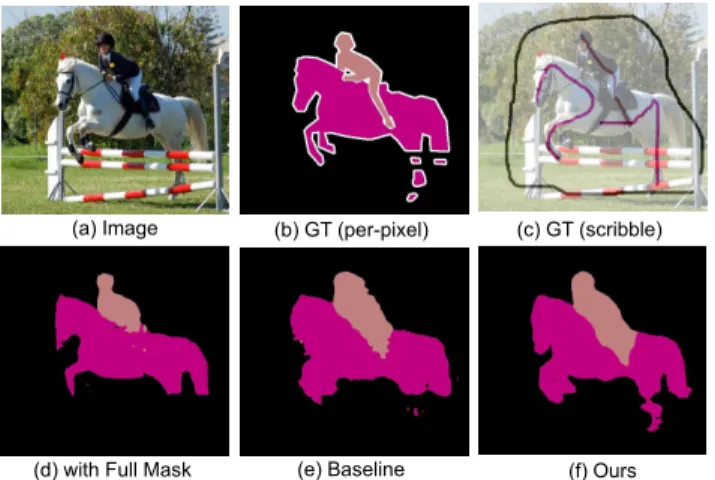
(a) Image (b) GT (per-pixel) (c) GT (scribble)
(d) with Full Mask (e) Baseline (f) Ours
Figure 1: Illustration of a segmentation example: (a) the input im-age; (b) the corresponding per-pixel annotation; (c) the correspond-ing scribble annotation; (d) the segmentation result with per-pixel annotation and deeplab-v2 architecture; (e) the segmentation result with scribble annotation and deeplab-v2 architecture; (f) the seg-mentation result with scribble annotation and the proposed BPG ap-proach.
et al., 2017; Zhanget al., 2019]. For the semantic segmenta-tion task, Fully Convolusegmenta-tional Networks based (FCN-based) architectures [Longet al., 2015; Ronnebergeret al., 2015; Chenet al., 2015; Chenet al., 2018a] have achieved com-petitive segmentation performance with the per-pixel mask labels. However, compared with image classification and object detection, obtaining these pixel-level mask annota-tions is time-consuming and expensive. In order to allevi-ate the dependence on expensive high-cost pixel-level labels, weakly-supervised semantic segmentation is much preferred and studied in the literature.
Weak annotations for semantic segmentation can be roughly divided into the following four categories: image-level tags [Pinheiro and Collobert, 2015], clicks [Bearmanet
al., 2016], bounding boxes [Dai et al., 2015] and scribbles [Lin et al., 2016]. For the image-level and click tags, the extremely limited pixel-level information makes it challeng-ing to train a high-accurate segmentation network. In con-trast, scribbles and bounding boxes contain more valuable information that can train the segmentation networks more effectively. For bounding-box annotations, iterative training strategy is often adopted by combining proposal masks (e.g. MCG [Daiet al., 2015; Pont-Tusetet al., 2017]) to update the corresponding segmentation masks. These methods im-prove the precision of the semantic segmentation by using graph algorithms and region proposal methods. However, in-accurate intermediate proposal masks could mislead training by applying the cross entropy loss to uncertain segmentation in bounding boxes. In this paper, we instead choose scrib-ble labels as the weak annotations to train the segmentation network.
For scribble-based weakly-supervised methods, Scribble-Sup [Linet al., 2016] uses an iterative method to update the segmentation mask via graph cuts. Tanget al. [Tanget al., 2018a; Tanget al., 2018b] improve the segmentation perfor-mance by designing several useful regularized losses. Never-theless, these methods do not fully explore the characteristics of the scribble annotations and do not take into account of the network structure design to improve the segmentation per-formance. We find that the scribble annotations can be used as a kind of supervised information to train a model which can segment different objects roughly. In the meanwhile, the edges, which indicate the information of boundaries among semantics, lead the network to grow/shrink the semantic re-gions, so as to revise the segmentation boundaries. Motivated by this observation, we design a novel network architecture to take advantage of both the scribble annotations and the edges. As illustrated in Figure 1, scribble annotations are simply drawn in few strokes to tag a small part of the object or the background. The model naively trained by scribbles only produces coarse segmentation results (Figure 1-e). This is mainly because scribbles only contain partial semantic infor-mation and no fine-grained boundary is provided to guide the model to accurately segment each object. To this end, we de-sign a novel segmentation model, namely Boundary Percep-tion Guidance (BPG), to effectively leverage weakly super-vised segmentation in scribbles by incorporating edge struc-tures from images. The experiments demonstrate that the re-sulting architecture can produce more accurate segmentation results with clearer boundaries in an unprecedented resolution (Figure 1-f).
Our main contributions are summarized below.
• We propose a novel BPG model to address the scribble-based weakly-supervised semantic segmentation task. The BPG model includes two components: 1) The Pre-diction Refinement Network (PRN), which combines both the high semantic information and low edge/texture information to produce the fine-grained feature maps by an iterative upsampling strategy instead of a brute-force
8×upsampling operation directly; 2) The Boundary Re-gression Network (BRN), which guides the network to obtain clear boundaries between regions of different se-mantics.
• We evaluate the proposed model on the PASCAL VOC 2012 segmentation benchmark. The experiments demonstrate that the refinement sub-network and the boundary regression sub-network can improve 1.5% and 2.5% mIoU (in terms of mean Intersection-Over-Union, i.e. mIoU) respectively. The proposed compo-nents combined successfully make 3.3% mIoU improve-ment and set up the new state-of-the-art for scribble-based weakly-supervised semantic segmentation.
2
Related Work
Supervised semantic segmentation takes the cross-entropy term of each spatial position on the CNN output feature maps as the loss function and expensive mask-level anno-tations should be provided. Under this circumstance, some Weakly-Supervised Semantic Segmentation (WSSS) meth-ods are proposed which only take some weak annotations as inputs. Training with image-level tags [Pinheiro and Col-lobert, 2015], clicks [Bearmanet al., 2016], bounding boxes [Daiet al., 2015] and scribbles [Linet al., 2016], has attracted many researchers.
2.1
Image-level and Click based WSSS
Pinheiro et al. [Pinheiro and Collobert, 2015] propose a CNN-based model which pays more attention to pixels that are important for classifying during training. Salehet al.
[Salehet al., 2016] present a novel algorithm which can ex-tract markedly more accurate masks from its own pre-trained model instead of external objectness modules. Weiet al.[Wei
et al., 2017] propose a simple to complex learning method to gradually enhance the segmentation network. In summary, image-level annotations are an order of magnitude cheaper but result in less accurate models. Bearmanet al. [Bearman
et al., 2016] collect click annotation by asking the annotators to click anywhere on a target and the click annotation gives rough location information of each object which can improve the segmentation accuracy to a certain extent.
2.2
Bounding-box based WSSS
Bounding-box annotations are often used as the labels of ob-ject detection, compared to pixel-wise annotation task, the workload of labeling object locations can be 15 times less [Linet al., 2014]. Daiet al. [Daiet al., 2015] train the seg-mentation network combined with region proposals and the prediction masks iteratively, this method can produce com-petitive segmentation results. Khorevaet al. [Khorevaet al., 2017] propose a modified version of GrabCut (GrabCut+) to produce some mask regions to train the segmentation model iteratively with the bounding-box mask.
2.3
Scribble based WSSS
Scribble annotations can be easily drawn and a certain cate-gory is given for each scribble. Linet al. [Linet al., 2016] build the scribble dataset for PASCAL VOC 2012. Combined with these scribble annotations and region proposals that are generated via graph cuts, they train the segmentation network iteratively. Tanget al. [Tanget al., 2018a] propose a novel loss for segmentation which combines with partial cross en-tropy term and the normalized cut.
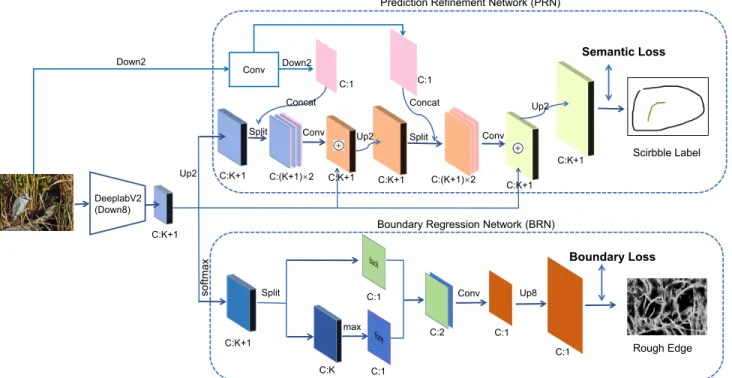
Conv DeeplabV2 (Down8) Down2 Up2 C:K+1 C:1 C:1 C:K+1 Split Conv Concat C:K+1 C:(K+1)×2 Split Concat C:K+1 C:(K+1)×2 Conv Semantic Loss Boundary Loss C:1 C:K C:1 C:1 C:2 max Conv C:1 Up8 C:K+1 Split Scirbble Label Rough Edge Down2 Up2
Prediction Refinement Network (PRN)
Boundary Regression Network (BRN)
Up2
C:K+1 C:K+1
Figure 2: The segmentation architecture (BPG) proposed in this paper. The network backbone is based on deeplab-v2(ResNet-101); Two sub-networks are added into the segmentation architecture: (1) PRN which can refine the segmentation result by fusing the high-level semantic features and low-level features; (2) BRN which can guide the network to extract edge features. The “⊕” symbol means element-wise addition operation between current feature maps and the corresponding feature maps of deeplab. “C:k” means current feature maps contain k channels.
3
Approach
As illustrated in Figure 2, the segmentation architecture pro-posed in this paper is mainly divided into three parts. The first is a feature encoding network using the deeplab-v2 structure as its backbone. After that, instead of upsampling the feature maps with a simple direct scaling-up operation, we design two sub-network branches to improve the performance of weakly-supervised semantic segmentation: they are the Pre-diction Refinement Network (PRN) and Boundary Regres-sion Network (BRN), which can greatly refine the segmen-tation features by combining weakly-supervised semantics in coarser scribbles with rough image edges yet in fine-grained resolution.
3.1
Prediction Refinement Network
Because of the effectiveness of the deeplab architecture [Chen
et al., 2015; Chen et al., 2018a], many researchers take it as their backbone network for the weakly-supervised seman-tic segmentation task [Khorevaet al., 2017; Linet al., 2016; Tanget al., 2018a]. For a fair comparison with these meth-ods, we use it as our backbone too. However, we find that this network structure has two shortcomings: 1) The last con-volutional feature only contains high-level information about semantic segmentation, which is insufficient for segmenting small hard regions with fine details; 2) It directly upsamples the convolutional features by a factor of eight to predict the fi-nal pixel labels, yielding quite coarse semantic region
bound-aries. To address these problems, we design the PRN to pro-duce clear boundaries for those hard regions.
As shown in the top of Figure 2, the PRN branch im-plements three key ideas. First, we use a shallow network to extract high-resolution convolutional features from an in-put image and concatenate them with each individual seman-tic channel to enhance features with more low-level details. Since the low-level features contain high-resolution details, the resulting representation combined with high-level tics can enable fine-grained segmentation of different seman-tic regions in a high resolution. In addition, after upsam-pling the level semantic features with low-level high-resolution details, we refine the enhanced features by a series of convolution operations to produce more boundary details. Finally, we leverage the idea of residual networks in this sub-network to accelerate the sub-network convergence (See the “⊕” symbol in Figure 2).
Compared to some existing segmentation networks with refinement structure such as U-Net [Ronneberger et al., 2015], the proposed PRN has the following merits: Firstly, we just need low-level features which pass through the given image with 5 convolutional operations; Secondly, only single-channel feature map is added to each confidence map (K+ 1
in total). Thus, our PRN only imports small amount compu-tations and GPU memories, which may benefit some future semantic works.
3.2
Boundary Regression Network
Per-pixel cross-entropy loss can train a satisfactory segmenta-tion network with per-pixel annotasegmenta-tions. However, for scrib-ble annotation, only a few internal markers are drawn for each object and no boundary information is provided explicitly. In this setting, training a segmentation model with a stan-dard segmentation network cannot yield sharp accurate ob-ject boundaries. To the end, we design a branch of BRN which can implicitly extract the important boundary infor-mation from readily available rough edges (We choose the HED method [Xie and Tu, 2015] as it has been used in other weakly-supervised semantic segmentation methods [Khoreva
et al., 2017; Caiet al., 2018]).
Although the above idea is intuitive, designing an effective boundary regression model is still challenging in a weakly supervised fashion, since the edge labels produced by HED are not the true boundaries of objects that often introduces many noise edges actually belonging to the background (See Figure 2-Rough Edge).
In fact, directly using conventional(K+ 1)-channel struc-ture (K is the category number of objects, “1” refers to the background) to predict edges not only cannot enable the net-work to obtain the boundary differentiation ability, but also damage the segmentation results. The reasons are as follows (experimental validations are also given in the section of ex-periments). The(K+ 1)-channel confidence map only con-tains segmentation results with rough object boundaries under the supervision of scribble-based weak annotations. In this case, if precise boundaries of each object are given to guide the boundary regression, the segmentation precision can be easily improved. However, only rough edge labels are avail-able, and they may break up the feature maps into several false pieces to regress the noisy edges. Thus, to keep the se-mantic structures intact, we design the BRN structure below to eliminate the negative effect of noisy edges by dividing the
(K+ 1)-channel feature maps into foreground/background channels. Only the resultant foreground channel is regressed to the noisy edges, thereby minimizing the chance of individ-ual semantic channels being compromised with noisy edge labels.
The general structure of the network is illustrated at the bottom of Figure 2. Instead of directly using deeplab-v2
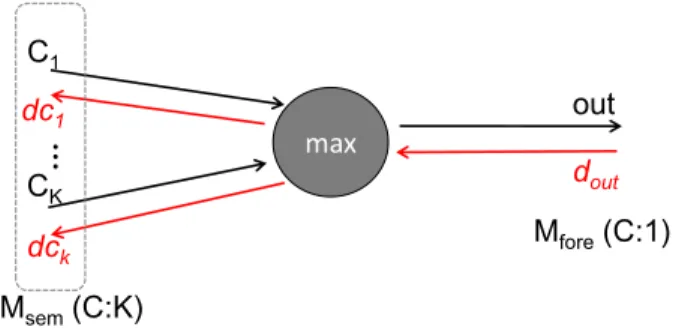
(K+ 1)-channel features to predict the boundary, we divide the features with predicted labels into foreground/background channels first and then regress them to the edge predic-tion map. As shown in Figure 3, when edge loss is back-propagated from the class-agnostic object confidence maps (DenoteMf ore, C : 1) to the semantic feature maps (C:K),
at each location, only the element with the highest probability needs to calculate the gradient (see Eq. 1) and update related parameters. In other words, it means the other(K−1) se-mantic feature maps will not be affected by the noisy edge loss.
dCi = d
out, Ci=max(C1, C2, ..., CK)
0, others, (1)
wheredCi denotes the gradient of thei-th semantic feature
map, dout refers to the gradient of foreground feature map.
max C1 CK out dout … dc1 dck Msem(C:K) Mfore(C:1)
Figure 3: Forward propagation and backward propagation illustra-tion of max pooling operaillustra-tion between semantic feature maps and foreground feature map:out=max{C1, C2, ..., Ck}.
By updating a limited number of parameters, only the bound-aries around the foreground objects are learned to fit those true object boundaries in the given edge map and those noisy ones rarely have the chance to damage theK-channel seman-tic maps.
3.3
Loss Function
The feature decoding part of the proposed network consists of the PRN and the BRN.
The loss function to train the PRN is Lsemantic=
X
p
P CE(Xref θ1(p), lscri(p)), (2)
wherepindexes pixels,Xref θ1(p)is the predicted
probabil-ity of the PRN with parametersθ1, lscri(p) is the scribble mask label at pixelp, and PCE is the Partial Cross-Entropy loss [Tanget al., 2018a] which only computes the loss on the labeled region.
The loss function of the BRN is Lboundary =
X
p
M SE(XboundReg θ2(p), ledge(p)), (3)
where XboundReg θ2(p) is the predicted probability by the
BRN with parametersθ2,ledge(p)is the edge label at pixel p, and MSE is the per-pixel MSE.
We train the two sub-networks end-to-end, and the total loss is
Ltotal=Lsemantic+λLboundary, (4)
where the hyper-parameter λ balances between the two losses.
4
Experiments
We evaluate the proposed architecture on the PASCAL VOC 2012 segmentation benchmark [Everingham et al., 2010], which involves20foreground object categories and one back-ground class. The original dataset contains1,461training im-ages, as well as1,449validation and1,456testing examples, respectively. Following the evaluation protocol in the litera-ture [Chenet al., 2018a; Daiet al., 2015; Linet al., 2016; Tanget al., 2018a], we use the augmented dataset by the ex-tra annotations provided by [Hariharanet al., 2011], totaling
10,582training images. The training data are scribbles from [Linet al., 2016] for the weak supervision task.
bkg plane bike bird boat bottle bus car cat chair cow deeplab-v2 [F] 93.8 87.1 39.6 89.1 60.0 80.1 94.3 86.0 90.8 37.0 86.4 deeplab-v2+crf[F] 94.0 88.0 38.6 90.1 60.0 80.5 94.4 86.1 91.9 37.2 87.2 deeplab-v2 [scri]∗ 91.1 70.9 34.2 71.7 59.3 74.4 88.4 82.5 84.4 36.2 80.7 +PRN∗ 92.7 72.4 34.8 74.9 60.6 74.3 90.8 83.8 86.4 36.9 80.7 +BRN∗ 91.9 78.0 36.6 78.0 63.1 76.5 89.5 82.4 87.5 35.8 84.5 BPG∗ 92.3 80.3 37.6 79.9 62.1 75.7 89.6 84.0 87.2 37.5 84.0 BPG+CRF 93.4 84.8 38.4 84.6 65.5 78.8 91.4 85.9 89.5 41.0 87.3
table dog horse mbike person plant sheep sofa train monitor mean deeplab-v2 [F] 47.8 87.1 87.7 84.0 85.8 65.8 83.3 46.2 87.6 73.3 75.8 deeplab-v2+crf[F] 48.0 88.4 88.8 84.7 86.4 67.9 84.0 47.2 87.4 73.7 76.4 deeplab-v2 [scri]∗ 53.2 78.0 77.1 78.7 78.3 58.7 77.5 40.7 82.7 68.7 69.9 +PRN∗ 58.8 81.2 79.0 79.3 79.8 59.8 77.5 43.6 83.7 70.1 71.4 +BRN∗ 50.9 82.2 80.2 80.5 81.0 58.0 81.6 43.1 84.3 74.2 72.4 BPG∗ 56.7 81.4 81.4 81.1 80.4 61.5 84.2 43.5 85.0 71.8 73.2 BPG+CRF 58.3 84.1 85.2 83.7 83.6 64.9 88.3 46.0 86.3 73.9 76.0
Table 1: Comparison results of different network architectures on the PASCAL VOC 2012 validation set (IoU in%).∗refers to scribble-based method without CRF post-processing, the best mAP for each categories among them is marked in bold.
(a) Image (b) GT (c) Deeplab-v2 (d) +PRN (e) +BRN (f) BPG
Figure 4: Weakly-Supervised semantic segmentation example: (a) the input image; (b) full mask annotation; (c) segmentation result with deeplab-v2; (d) segmentation result with [deeplab-v2 + PRN] (d) segmentation result with [deeplab-v2 + BRN]; (e) segmentation result with BPG framework [deeplab-v2 + PRN + BRN].
Methods mAP edge loss
wo/ BRN 71.4 n/a
w/ BRN (C=K+ 1) 70.8 0.026
w/ BRN (C= 2) 73.2 0.051
Table 2: Comparison with different settings on the PASCAL VOC 2012valset (mIoU in%).
4.1
Implementation Details
We re-train the ResNet101-based deeplab-v2 [Heet al., 2016; Chenet al., 2018a] by PyTorch and take it as our baseline. The proposed weakly-supervised semantic segmentation net-work is simply trained on a single scale of input images. Like the setting in deeplab-v2, we employ the “poly” learning rate policy for with a mini-batch of10images with an initial learn-ing rate of0.00025. We use a momentum of0.9and a weight decay of0.0005. The hyper-parameter λin Eq. 4 is set to
1.0. We run25training epochs on a single NVIDIA TitanX 1080ti GPU, which takes about 10 hours on the PASCAL VOC dataset. In the testing stage, instead of using multi-scale inputs with max voting, we use the average voting over multi-scale left-right flipped inputs (i.e.[0.5,0.75,1.0,1.25]).
Methods wo/ CRF w/ CRF
Supervision: Scribbles
ScribbleSup [Linet al., 2016] n/a 63.1 NormalCut [Tanget al., 2018a] 72.8 74.5 KernelCut [Tanget al., 2018b] 73.0 75.0
BPG (Ours) 73.2 76.0
Supervision: Per-pixel Labels
deeplab-v2 75.8 76.4
Table 3: Comparison with state-of-the-art methods on the PASCAL VOC 2012valset (mIoU in%).
4.2
Ablation Study and Results
Ablation Study
We perform experiments on the PASCAL VOC 2012 se-mantic segmentation dataset with different architectures. As shown in Table 1, with deeplab-v2 architecture (ResNet101-based) alone, the model can yield69.9%in mIoU. Adding the PRN can gain1.5%improvement in mIoU. Combining the BRN into deeplab-v2 alone can bring 2.5% improve-ment. The proposed BPG framework based on the deeplab-v2 backbone and both PRN and BRN can improve the weakly-supervised segmentation performance to as high as73.2%, which sets up the new start-of-the-art mIoU performance. From the Table 1, we also find that the segmentation per-formance has been improved (1.2%∼ 9.4%) on all seman-tic categories, which demonstrates the effectiveness of the proposed framework. Furthermore, by applying the CRF post-processing, we can achieve76.0%in mIoU, as good as the fully supervised semantic segmentation model using per-pixel labels (76.4%) with the same CRF post-processing.
Figure 4 shows weakly-supervised segmentation examples produced by different network structures. We can see that the baseline result (deeplab-v2 only) has much coarse seg-mentation results, where the boundaries are not well aligned with the ground-truth counterparts. In comparison, the
net-Edge Label
Edge Pred (C=21) Edge Pred (C=2) Image1
Image2
Seg Pred (C=21) Seg Pred (C=2)
Edge Label
Edge Pred (C=21) Expected Result
Expected Result Input Expected Result Edge Label
Edge Pred (C=K+1) Seg Pred (C=K+1) Seg Pred (C=2)
Input Expected Result Edge Label
Edge Pred (C=K+1) Edge Pred (C=2) Seg Pred (C=K+1) Seg Pred (C=2)
Sample1 Sample2
BPG BPG
Edge Pred (C=2)
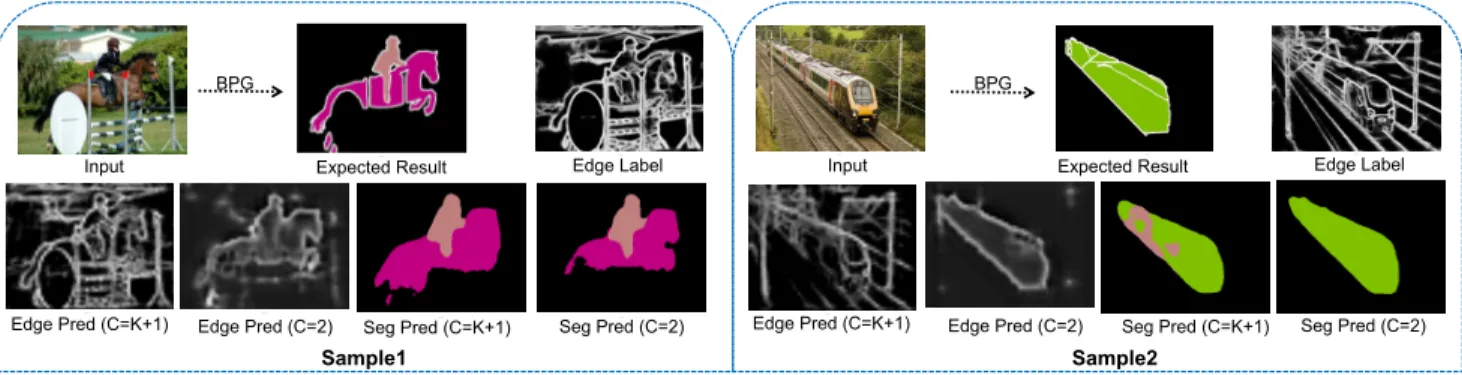
Figure 5: Segmentation predictions and edge predictions with different BRN settings: (1) Directly using K+1 feature maps following with some convolutional operations; (2) Converting K+1 feature maps to class-agnostic fg/bg maps firstly and then with the same operations.
Image Ground Truth Full Mask Baseline BPG(Ours)
Figure 6: Visualization results on the PASCAL VOC 2012 val set: input images, ground-truths, segmentation results with deeplab-v2 (supervised/scribble-based) and segmentation results with our BPG framework before/after CRF.
work with the PRN branch gains an improved segmentation, and the segmentation result by the BRN achieves an even bet-ter result. By combining both structures, the BPG can obtain a considerable high-quality segmentation result as shown in Figure 4(f).
Boundary Regression Network Design
To evaluate the effectiveness of the proposed BRN, we con-duct additional experiments to compare different settings. As shown in Table 2, when directly using(K+ 1)−channel feature maps to regress the object boundary, the edge loss of the last iteration is only 0.026. However, the segmentation mAP drops by0.6%, which is clearly overfitting.
In contrast, when using the proposed BRN structure (con-verting (K+1) semantic feature maps to fg/bg feature maps firstly), the edge loss is more than twice of the previous settings, but the segmentation precision is improved signifi-cantly (73.2%vs 71.4%). The segmentation and edge pre-diction results in Figure 5 give a more intuitive explanation for that. We can see from this figure, when directly using C = K+ 1structure, the edge predictions are close to the edge labels, but in this setting, the segmentation does not per-form very well: the segmentation result ofsample1still has rough boundary; the segmentation result ofsample2contains some mistakes on semantic predictions. On the contrary, our
boundary regression network can produce clear object bound-aries by eliminating the negative impact of those noise edges, yielding good segmentation results with precise boundaries.
Comparisons with State-of-the-art Methods
To further analyze the segmentation performance of the pro-posed method, we also compare with the current state-of-the-art methods [Linet al., 2016; Tanget al., 2018a]. From Ta-ble 3, we can see that the proposed BPG model is far bet-ter than the ScribbleSup baseline. NormalCut [Tang et al., 2018a] and KernelCut [Tanget al., 2018b] are the other two best methods at present, which also take deeplab-v2 as their network backbone. Compared with them, our model still achieves competitive segmentation result with scribble labels. ScribbleSup uses the graphical model for propagating infor-mation from scribbles. NormalCut loss and KernelCut loss are two regularized losses to train the segmentation network with scribble labels. As shown in Figure 6, the proposed BPG architecture can achieve good segmentation results with pre-cise boundaries.
5
Conclusion
We propose the BPG model including two sub-networks to improve the segmentation network training with weakly an-notations. Specifically, we first propose the branch of the PRN to refine the segmentation prediction by combining the level high-resolution feature map with high-level low-resolution feature maps through iterative upsampling layers. Then we introduce the branch of BRN to train the network to localize the sharp boundaries more effectively. The pro-posed architecture can achieve considerable better segmenta-tion performance without per-pixel annotasegmenta-tions. These two proposed sub-networks can be readily incorporated into any segmentation networks in the weakly-supervised task when incomplete per-pixel labels are provided.
Acknowledgements
This work was supported by the National Key Research and Development Program of China (2017YFB1002202), and the National Natural Science Foundation of China (61572472,61871004,61525206), and 242 progject (2019A010).
References
[Bearmanet al., 2016] Amy Bearman, Olga Russakovsky, Vittorio Ferrari, and Li Fei-Fei. What’s the point: Seman-tic segmentation with point supervision. InECCV, 2016. [Caiet al., 2018] Jinzheng Cai, Youbao Tang, Le Lu,
Adam P Harrison, Ke Yan, Jing Xiao, Lin Yang, and Ronald M Summers. Accurate weakly-supervised deep lesion segmentation using large-scale clinical annotations: Slice-propagated 3d mask generation from 2d recist. In
MICCAI, 2018.
[Chenet al., 2015] Liang-Chieh Chen, George Papandreou, Iasonas Kokkinos, Kevin Murphy, and Alan L. Yuille. Se-mantic image segmentation with deep convolutional nets and fully connected crfs. InICLR, 2015.
[Chenet al., 2018a] Liang-Chieh Chen, George Papandreou, Iasonas Kokkinos, Kevin Murphy, and Alan L Yuille. Deeplab: Semantic image segmentation with deep convo-lutional nets, atrous convolution, and fully connected crfs.
TPAMI, 40(4):834–848, 2018.
[Chenet al., 2018b] Long Chen, Hanwang Zhang, Jun Xiao, Wei Liu, and Shih-Fu Chang. Zero-shot visual recog-nition using semantics-preserving adversarial embedding networks. InCVPR, 2018.
[Daiet al., 2015] Jifeng Dai, Kaiming He, and Jian Sun. Boxsup: Exploiting bounding boxes to supervise convolu-tional networks for semantic segmentation. InICCV, 2015. [Everinghamet al., 2010] Mark Everingham, Luc Van Gool, Christopher KI Williams, John Winn, and Andrew Zis-serman. The pascal visual object classes (voc) challenge.
IJCV, 88(2):303–338, 2010.
[Hariharanet al., 2011] Bharath Hariharan, Pablo Arbel´aez, Lubomir Bourdev, Subhransu Maji, and Jitendra Malik. Semantic contours from inverse detectors. 2011.
[Heet al., 2016] Kaiming He, Xiangyu Zhang, Shaoqing Ren, and Jian Sun. Deep residual learning for image recog-nition. InCVPR, 2016.
[Khorevaet al., 2017] Anna Khoreva, Rodrigo Benenson, Jan Hosang, Matthias Hein, and Bernt Schiele. Simple does it: Weakly supervised instance and semantic segmen-tation. InCVPR, 2017.
[Krizhevskyet al., 2012] Alex Krizhevsky, Ilya Sutskever, and Geoffrey E Hinton. Imagenet classification with deep convolutional neural networks. InNIPS, 2012.
[Linet al., 2014] Tsung-Yi Lin, Michael Maire, Serge Be-longie, James Hays, Pietro Perona, Deva Ramanan, Piotr Doll´ar, and C Lawrence Zitnick. Microsoft coco: Com-mon objects in context. InECCV, 2014.
[Linet al., 2016] Di Lin, Jifeng Dai, Jiaya Jia, Kaiming He, and Jian Sun. Scribblesup: Scribble-supervised convo-lutional networks for semantic segmentation. In CVPR, 2016.
[Liuet al., 2016] Wei Liu, Dragomir Anguelov, Dumitru Er-han, Christian Szegedy, Scott Reed, Cheng-Yang Fu, and Alexander C Berg. Ssd: Single shot multibox detector. In
ECCV, 2016.
[Longet al., 2015] Jonathan Long, Evan Shelhamer, and Trevor Darrell. Fully convolutional networks for seman-tic segmentation. InCVPR, 2015.
[Pinheiro and Collobert, 2015] Pedro O Pinheiro and Ronan Collobert. From image-level to pixel-level labeling with convolutional networks. InCVPR, 2015.
[Pont-Tusetet al., 2017] Jordi Pont-Tuset, Pablo Arbelaez, Jonathan T Barron, Ferran Marques, and Jitendra Malik. Multiscale combinatorial grouping for image segmenta-tion and object proposal generasegmenta-tion. TPAMI, 39(1):128– 140, 2017.
[Redmonet al., 2016] Joseph Redmon, Santosh Divvala, Ross Girshick, and Ali Farhadi. You only look once: Uni-fied, real-time object detection. InCVPR, 2016.
[Renet al., 2015] Shaoqing Ren, Kaiming He, Ross Gir-shick, and Jian Sun. Faster r-cnn: Towards real-time object detection with region proposal networks. InNIPS, 2015. [Ronnebergeret al., 2015] Olaf Ronneberger, Philipp
Fis-cher, and Thomas Brox. U-net: Convolutional networks for biomedical image segmentation. InMICCAI, 2015. [Salehet al., 2016] Fatemehsadat Saleh,
Moham-mad Sadegh Aliakbarian, Mathieu Salzmann, Lars Petersson, Stephen Gould, and Jose M Alvarez. Built-in foreground/background prior for weakly-supervised semantic segmentation. InECCV, 2016.
[Simonyan and Zisserman, 2015] Karen Simonyan and An-drew Zisserman. Very deep convolutional networks for large-scale image recognition. InICLR, 2015.
[Szegedyet al., 2015] Christian Szegedy, Wei Liu, Yangqing Jia, Pierre Sermanet, Scott Reed, Dragomir Anguelov, Dumitru Erhan, Vincent Vanhoucke, and Andrew Rabi-novich. Going deeper with convolutions. InCVPR, 2015. [Tanget al., 2018a] Meng Tang, Abdelaziz Djelouah,
Fed-erico Perazzi, Yuri Boykov, and Christopher Schroers. Normalized cut loss for weakly-supervised cnn segmen-tation. InCVPR, 2018.
[Tanget al., 2018b] Meng Tang, Federico Perazzi, Abde-laziz Djelouah, Ismail Ben Ayed, Christopher Schroers, and Yuri Boykov. On regularized losses for weakly-supervised cnn segmentation. InECCV, 2018.
[Weiet al., 2017] Yunchao Wei, Xiaodan Liang, Yunpeng Chen, Xiaohui Shen, Ming-Ming Cheng, Jiashi Feng, Yao Zhao, and Shuicheng Yan. Stc: A simple to complex framework for weakly-supervised semantic segmentation.
TPAMI, 39(11):2314–2320, 2017.
[Xie and Tu, 2015] Saining Xie and Zhuowen Tu. Holistically-nested edge detection. InICCV, 2015. [Zhanget al., 2017] Rui Zhang, Sheng Tang, Yongdong
Zhang, Jintao Li, and Shuicheng Yan. Scale-adaptive con-volutions for scene parsing. InICCV, 2017.
[Zhanget al., 2019] Rui Zhang, Sheng Tang, Yongdong Zhang, Jintao Li, and Shuicheng Yan. Perspective-adaptive convolutions for scene parsing.TPAMI, 2019.