Copyright ã UNU/WIDER 2001 * World Bank
This study is linked to the theme of Growth and Poverty discussed at the WIDER Development Conference, 25-26 May 2001, Helsinki. UNU/WIDER gratefully acknowledges the financial support from the governments of Denmark, Finland and Norway to the 2000-2001 research programme.
Discussion Paper No. 2001/102
The Effect of IMF and World Bank
Programmes on Poverty
William Easterly*
October 2001Abstract
Structural adjustment, as measured by the number of adjustment loans from the IMF and World Bank, reduces the growth elasticity of poverty reduction. Growth does reduce poverty, but I find no evidence for a direct effect of structural adjustment on growth. Instead, the poor benefit less from output expansion in countries with many adjustment loans than in countries with few adjustment loans. By the same token, the poor suffer less from an output contraction in countries with many adjustment loans than in countries with few adjustment loans. Higher adjustment lending seems to act in a way similar to higher inequality in lowering the stake of the poor in aggregate growth. Why would this be? One hypothesis that adjustment lending is counter-cyclical in ways that smooth consumption for the poor. There is evidence that some policy variables under adjustment lending are counter-cyclical, but there is no evidence that the cyclical component of those policy variables affects poverty. I speculate that the poor may be ill-placed to take advantage of new opportunities created by structural adjustment reforms, just as they may suffer less from the loss of old opportunities in sectors that were artificially protected prior to reforms.
Keywords: poverty, structural adjustment, economic growth, income distribution JEL classification: I3, O1, F4
UNU World Institute for Development Economics Research (UNU/WIDER) was established by the United Nations University as its first research and training centre and started work in Helsinki, Finland in 1985. The purpose of the Institute is to undertake applied research and policy analysis on structural changes affecting the developing and transitional economies, to provide a forum for the advocacy of policies leading to robust, equitable and environmentally sustainable growth, and to promote capacity strengthening and training in the field of economic and social policy making. Its work is carried out by staff researchers and visiting scholars in Helsinki and through networks of collaborating scholars and institutions around the world.
UNU World Institute for Development Economics Research (UNU/WIDER) Katajanokanlaituri 6 B, 00160 Helsinki, Finland
Camera-ready typescript prepared by Lorraine Telfer-Taivainen at UNU/WIDER Printed at UNU/WIDER, Helsinki
The views expressed in this publication are those of the author(s). Publication does not imply endorsement by the Institute or the United Nations University, nor by the programme/project sponsors, of any of the views expressed.
ISSN 1609-5774
ISBN 92-9190-026-5 (printed publication) ISBN 92-9190-027-3 (internet publication)
Acknowledgements
Views expressed here are not necessarily those of the World Bank. I am grateful to Martin Ravallion and Shaohua Chen for making their poverty spells database available. I am also grateful for discussions with David Dollar, Peter Lanjouw, and Martin Ravallion, and for comments by Anders Aslund, Ricardo Hausmann, Nora Lustig, Aart Kraay, Michael Kremer, Sergio Schmukler, and John Williamson and by participants in the NBER Pre-Conference on Management of Currency Crises in Cambridge MA July 2000 and the First Annual IMF Research Conference November 2000. Any remaining errors are the responsibility of the author alone.
Introduction
Poverty reduction is in the news for both the IMF and the World Bank. The IMF website says
In September 1999, the objectives of the IMF's concessional lending were broadened to include an explicit focus on poverty reduction in the context of a growth oriented strategy. The IMF will support, along with the World Bank, strategies elaborated by the borrowing country in a Poverty Reduction Strategy Paper (PRSP).1
For its part, the World Bank headquarters has built into its lobby wall the slogan ‘our dream is a world free of poverty.’ The recent East Asian currency crisis and its aftershocks in other countries generated intense concern about how the poor were faring under structural adjustment programmes supported by the Bank and the Fund. The poverty issue is so red-hot that IMF and World Bank staff began to feel that every action inside these organizations, from reviewing public expenditure to vacuuming the office carpet, should be justified by its effect on poverty reduction. At the same time, there has been a long standing criticism from the left of Bank and Fund structural adjustment programmes as disproportionately hurting the poor:
When the International Monetary Fund (IMF) and World Bank arrive in southern countries, corporate profits go up, but so do poverty and suffering. Decades of promises that just a little more ‘short-term’ pain will bring long-term gain have exposed the IMF and World Bank as false prophets whose mission is to protect those who already control too much wealth and power.2
A report published today by the World Development Movement (WDM) shows that the International Monetary Fund’s (IMF) new Poverty Reduction Strategies are acting as barriers to policies benefiting the world’s poorest people.3
Many developing countries suffered ... sustained increases in prosperity, accompanied by dramatic increases in inequality and child poverty ... under the auspices of IMF and World Bank adjustment programmes.4
In country after country, structural adjustment programmes (SAPs) have reversed the development successes of the 1960s and 1970s, with ... millions sliding into poverty every year. Even the World Bank has had to accept that SAPs have failed the poor, with a special burden falling on women and children. Yet together with the IMF it still demands that developing countries persist with SAPs.5
1 http://www.imf.org/external/np/exr/facts/prgf.htm.
2 http://www.oneworld.net/campaigns/imf&wb/index.html under ‘50 years is enough’.
3 http://www.oneworld.net/anydoc2.cgi?url=http://www.wdm.org.uk/presrel/current/PRSPcritique.htm. 4 http://www.oneworld.net/anydoc2.cgi?url=http://www.oxfam.org.uk.
This paper examines the effect of IMF and World Bank adjustment lending on poverty reduction. I briefly examine the effect of IMF and World Bank adjustment lending on growth and find no effect (suitably instrumenting for adjustment lending), which is in line with the previous long and inconclusive literature. My main result is that IMF and World Bank adjustment lending lowers the growth elasticity of poverty, that is the amount of change in poverty rates for a given amount of growth. This means that economic expansions benefit the poor less under structural adjustment, but at the same time economic contractions hurt the poor less. What could be the mechanisms for such a result? There could be several possible explanations. I first speculate that IMF and World Bank conditionality may be less austere when lending occurs during an economic contraction, while conditionality may require more macro adjustment during an expansion. If macro adjustment disproportionately hurts the poor—say because fiscal adjustment, for example, is implemented through increasing regressive taxes like sales taxes or decreasing progressive spending like transfers—then we get the result that IMF and World Bank adjustment lending lowers the growth elasticity of poverty. Adjustment lending could even include an explicit fiscal insurance mechanism such as an increase in subsidies that cushions the effect of contractions on the poor, but accompanied by a reduction in subsidies in times of expansion. We can test this hypothesis explicitly by evaluating the behavior of fiscal policy and macro policy variables during expansions and contractions, with or without adjustment lending.
A nearly opposite hypothesis is that IMF and World Bank conditionality may itself cause an expansion or contraction in aggregate output—depending on the composition of the structural adjustment package—but not affect the poor very much. This view would see the poor as mainly deriving their income from informal sector and subsistence activities, which are not affected much by fiscal policy changes or adjustments in macro policies. Structural adjustment packages usually imply some previously favored formal sector activities must contract while other formal sector activities newly favored can expand. The net effect may be overall contraction or expansion, depending on the initial sizes of the declining and expanding sectors and the specific policy measures in the structural adjustment package. However, if the poor are not tightly linked to either the expanding or the contracting formal sector, then the amount of poverty change for a given amount of output change may not be very high under structural adjustment. An expansion or contraction in the absence of adjustment lending, on the other hand, may reflect economy-wide factors that lift or sink all boats. I will not be able to test this hypothesis directly because of lack of comparable data on the size of the informal sector and its incidence among the poor, but I offer it as a backup hypothesis in case the first hypothesis fails.
1. Data and concepts for the paper
I have data for 1980-98 on all types of IMF lending and on World Bank adjustment lending. IMF lending includes stand-bys, extended arrangements, structural adjustment facilities, and enhanced structural adjustment facilities (recently renamed Poverty Reduction and Growth Facilities). The latter two kinds of operations are concessional for low-income countries. World Bank adjustment lending includes structural adjustment loans, sectoral structural adjustment loans, and structural adjustment credits (the latter is concessional for low-income countries). The data are reported in the year that the loans are
approved. Hence, my data take the form of number of new Bank and Fund adjustment loans approved each year. It would be preferable to have data that record also how long these loans are in effect, but the data are unfortunately not available in this format. For any time period I consider in this paper, I consider the average number of new Bank and Fund adjustment loans per year.
Conditionality associated with these loans is well-known: macroeconomic conditions like reducing budget deficits, devaluation, and reducing domestic credit expansion, and structural conditions like freeing controlled prices and interest rates, reducing trade barriers, and privatizing state enterprises. Although the Fund is associated more with the former and the Bank with the latter, in practice neither will proceed with an adjustment loan unless the other is satisfied with progress on ‘its’ area of responsibility.
For data on poverty, I use an updated version of Ravallion and Chen's (1997) database on poverty spells. These authors were careful to choose spells and countries where the definition of poverty was constant and comparable over time and across countries. The source of the data is household surveys. They report the proportion of the population that is poor at the poverty line of $2 per day at the beginning of the spell and the end of the spell (they also report the poverty rates for a poverty line of $1 per day, but I choose to use the former because many countries have a 0 initial value at $1 per day). They also report the Gini coefficients at the beginning and the end, and the mean income in the household survey at the beginning and the end. They report data on 155 spells for 65 developing countries (the Appendix table gives the countries and numbers of spells each). The spells are quite short (median length 3 years), and so I interpret them more as cyclical fluctuations in mean consumption and poverty rather than as long-run tendencies in growth and poverty reduction. Table 1 gives the descriptive statistics for all the data:
Table 1
Descriptive statistics on variables used Change in
poverty
Mean consumption
growth
Initial Gini Initial poverty rate
Adjustment loans per year
Mean 6.0% -1.1% 39.5 41.2 0.62
Median -0.1% 0.0% 39.5 36.3 0.50
Std. Dev. 31.5% 11.1% 11.1 29.6 0.60
Observations 149 155 155 154 150
Source: author’s calculations based on World Bank and IMF data.
2. Results on adjustment lending and poverty reduction
Following Ravallion (1997), I regress the change in poverty rate on growth of mean income and the interaction of growth of mean income with the Gini coefficient. The idea of this specification is that if the poor have a low share in existing income (high Gini), they will likely have a low share in newly created income (low growth elasticity of poverty reduction). I also include the level of the initial Gini for completeness. To test the effect of
IMF and World Bank adjustment lending, I include the variable measuring number of adjustment loans per year during the poverty spell and also interact this variable with growth.
There is the well known selection bias problem with World Bank and IMF lending. This lending goes to countries that are in trouble, and this trouble could include initial high poverty rates. We could even imagine that World Bank and IMF programmes go to countries who are more likely to reduce poverty rapidly. With these concerns in mind, I instrument for World Bank and IMF lending. I follow the practice of the foreign aid literature in using dummies that measure friends of influential donors, including a dummy for Central America, one for Egypt, and one for Franc Zone countries. I also include continent dummies as instruments for lending, because both the World Bank and IMF have a different department for each continent, and these different departments may have different propensities to make loans. I also include initial income as an instrument of adjustment loan frequency.
With the same set of instruments, I also tested the direct effect of adjustment lending on growth, not controlling for any other factors. In line with a long and inconclusive literature, I found no systematic effect of adjustment lending on growth. (A recent paper by Przeworski and Vreeland 2000 reviews the long inconclusive literature on the IMF, while they themselves find a negative effect controlling for selection bias. Some internal Bank and Fund studies have found positive effects of their programmes on growth. I do not intend to make the effect of structural adjustment on growth a major focus of the paper, since structural adjustment would of course alleviate poverty if it raised growth and worsen it if it lowered growth.) Of course, behind this zero average result is concealed a set of expansions and contractions that depended in part on the particulars of the adjustment programme in each country and time period.
In general, we would expect that an adjustment programme would disfavour some sectors that were previously artificially protected or subsidized, and favor other sectors that benefit from a change in relative prices in their favour. Whether expansion or decline dominates depends in part on the relative sizes of the expanding and declining sectors (as pointed out by Rauch, 1997). The result on expansions strongly reducing the rate of poverty—or output crises raising the rate of poverty—is familiar from other studies (Ravallion and Chen, 1997; Dollar and Kraay, 2000; Bruno et al., 2000; Lustig, 2000; Ravallion, 2000). Without controlling for other variables, the mean growth elasticity of poverty is about 1.9 (Table 2). The significant coefficient on the interaction term between the Gini coefficient and the growth rate also confirms the Ravallion (1997) and Bruno et al. (2000) result (Table 2). Ten percentage points higher Gini will lower the growth elasticity of poverty by 0.6 percentage points. A not-often-noticed implication of this result is that the poor will be hurt less by output contraction in a highly unequal economy than in a relatively equal one, simply because the poor have a low share of output to begin with. The initial Gini also has a direct negative effect on the change in poverty, suggesting a reversion to greater equality if a country begins highly unequal.
The new result in this paper is that, while adjustment lending has no direct effect on poverty reduction, it has a strong interaction effect with economic growth (Table 2).6 The absolute value of the growth elasticity of poverty declines by about 2 points for every additional IMF or World Bank adjustment loan per year. The results are strong either in OLS or instrumenting for World Bank and IMF programmes with the instruments shown. This means that the poor benefit less from expansions during a structural adjustment programme than in expansions without an adjustment program, while they are at the same time hurt less by contractions.
Table 2
Regression results on change in poverty, growth, and adjustment programmes Dependent Variable: Log rate of change per annum in percent of population below $2/day
Method: Ordinary Least
Squares Ordinary Least Squares Two-stage Least Squares Regression 1 Regression 2 Regression 3
Variable Coefficient t-Statistic Coefficient t-Statistic Coefficient t-Statistic
C 0.039 1.82 0.319 4.68 0.382 4.21 GROWTH -1.892 -8.24 -5.481 -8.27 -5.465 -4.61 GINI1 -0.006 -3.83 -0.006 -3.65 PROGRAM -0.019 -0.62 -0.116 -1.30 GROWTH*GINI1 0.058 3.27 0.057 2.68 GROWTH*PROGRAM 1.790 7.37 2.034 3.44 Included observations: 149 144 126
Instruments for PROGRAM: CENTAM EASIA EGYPT FRZ SSA LAC ECA GROWTH*CENTAM GROWTH*EASIA GROWTH*FRZ GROWTH*EGYPT GROWTH*SSA GROWTH*GINI1
GROWTH*LAC GROWTH*ECA LGDPPC Variable definitions
GROWTH Log rate of growth per annum in mean of household survey GINI1 Initial Gini coefficient
PROGRAM Number of IMF/World Bank adjustment loans initiated per annum CENTAM Dummy for Central America
FRZ Dummy for Franc Zone
EGYPT Dummy for Egypt and Israel SSA Dummy for sub-Saharan Africa
LAC Dummy for Latin America
ECA Dummy for Eastern Europe and Central Asia
EASIA Dummy for East Asia
LGDPPC Log of initial per capita income (Summers-Heston)
Source: author’s calculations based on World Bank and IMF data.
6 IMF (1999) found that ‘In seven SAF/ESAF countries for which data are available, poverty rates declined by an average of 20 percent under IMF-supported adjustment programs, implying an average annual reduction of 5.3 percent’ This study did not control for mean growth.
Expansion under adjustment lending is less pro-poor, while contraction under adjustment lending is less anti-poor. The welfare of the poor may have increased from the income smoothing effect of adjustment lending. On the other hand, it is disappointing that the poor do not share fully in growth in those cases where there are recoveries that accompany adjustment lending. Since the Bank and the Fund ultimately wish to restore growth in the economies to which they make adjustment loans, it is worrisome that positive growth has less of a poverty-reducing impact with high Bank-Fund involvement.
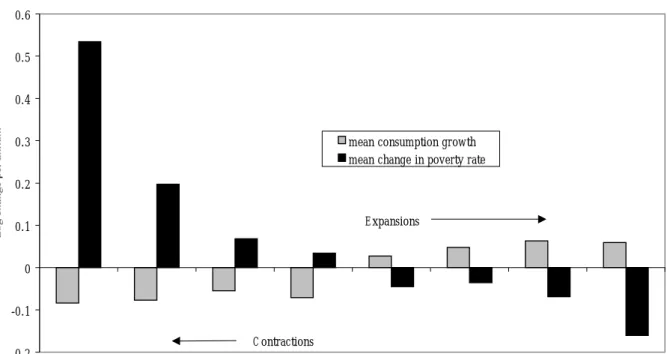
Figure 1 illustrates the results. Countries with a low level of adjustment lending (AL) as measured by PROGRAMME and low inequality have both greater increases in poverty during contraction and greater falls in poverty during expansions than do countries with a high level of IMF and World Bank lending and high inequality. (High and low AL here just mean the upper and lower 50% of the sample as measured by program; expansion is the average of all increases in mean income while contraction is the average of all decreases in mean income).
Figure 1
Contractions and expansions, with varying levels of inequality and adjustment lending
Another way of illustrating the weakened link between growth and poverty reduction with high inequality and high adjustment lending is to calculate the number of perverse outcomes in quartiles of the sample defined by high and low inequality and high and low adjustment lending. A perverse outcome is defined as either a mean expansion with an increase in poverty, or a mean contraction with a decrease in poverty. Such perverse outcomes are rare except in the case when both inequality and adjustment lending are high, when they account for 27 percent of the sample (Figure 2).
-0.2 -0.1 0 0.1 0.2 0.3 0.4 0.5 0.6 low inequality, low adjustment lending low inequality, high adjustment lending high inequality, low adjustment lending high inequality, high adjustment lending high inequality, high adjustment lending low inequality, high adjustment lending high inequality, low adjustment lending low inequality, low adjustment lending mean consumption growth
mean change in poverty rate
C ontractions
Figure 2
Probability of perverse poverty-growth outcomes depending on level of inequality and adjustment lending
What is the marginal impact on poverty of IMF and World Bank adjustment loans? If we specify a counterfactual of zero adjustment lending to all countries in the sample, we find that the effect of the actual adjustment loans on the number of poor was a net increase of 14 million. This represents an increase of 0.4 percentage points in the population-weighted average poverty rate in the sample. The outcome reflects the net effect of an increase in the number of poor compared to the counterfactual of no adjustment loans in growing countries like India and China, while there was a decrease in poverty compared to the counterfactual in contracting countries like Russia and Ukraine. The unweighted median change in the poverty rate associated with adjustment loans is 0.0.
Table 3
Poverty elasticities with respect to growth for different Gini coefficients and adjustment loan intensity
Average number of adjustment loans per year during survey spell
GINI coefficient 0 0.5 1
30 -3.8 -2.7 -1.7
45 -2.9 -1.9 -0.9
60 -2.1 -1.0 0.0
Source: author’s calculations based on World Bank and IMF data.
Table 3 uses the coefficients from regression (2) to calculate the poverty elasticity with respect to growth at different levels of the Gini coefficient and adjustment loans per year (AL). The middle cell is close to using the average value for Gini and AL, and we
high low low high 0 0.05 0.1 0.15 0.2 0.25 0.3 Probability of change in poverty rate being the same sign as change in
mean consumption
Inequality
reproduce the familiar elasticity of 2. However, there is great fluctuation around this average for different measures of the Gini and AL. If there are no adjustment loans and inequality is very low, then poverty is extremely elastic with respect to growth (3.8). China in 1990-2 is an example of an observation that would approximately fall in this cell. At the other extreme a highly unequal country receiving adjustment loans sees no effect of growth or contraction on poverty. Colombia in 1995-6 is an example of a country that would roughly fit in this cell.
I performed several robustness checks on these results. First, I looked for asymmetries between expansion and contraction in both growth effects and the interaction term with adjustment lending. I found no evidence for any asymmetries—the interaction term between adjustment lending and growth remains statistically significant in the separate samples of expansions and contractions.
Second, I added the initial poverty rate both in levels and as an interaction term. The initial poverty rate enters with a negative sign in levels—indicating some tendency of poverty to revert to the mean—but it leaves the significance of the interaction term between adjustment lending and growth unchanged.
Third, I entered the mean household consumption from the household survey, both in levels and as an interaction term with growth. It left the coefficient on the growth and adjustment programme interaction unchanged in magnitude and significance, while the mean household consumption was not significant either in levels or as an interaction term with growth.
Table 4
Growth, poverty, and adjustment lending in currency crises Country Spell Mean
growth Rate of change of poverty Poverty wrt growth elasticity Percent of population below $2/day, beginning Percent of population below $2/day, end Gini coefficient, beginning Average number of adjustment loans p.a. Indonesia 96-99 -4.3% 7.5% -1.73 50.51 63.21 36.45 1.0 Mexico 89-95 -1.9% 1.5% -0.81 38.80 42.47 55.14 1.0 Russia 96-98 -0.6% 1.3% -2.16 24.43 25.08 48.03 2.5 Thailand 96-98 -1.8% -0.2% 0.10 28.25 28.15 43.39 1.5
Source: author’s calculations based on World Bank and IMF data.
Given all the interest in currency crises, I examine the 4 currency crisis cases that are in the present sample: Mexico (1989-95), Indonesia (1996-9), Russia (1996-8), and Thailand (1996-8). All of them had at least one adjustment loan per year during the period before and during the crisis (Table 4). Growth was negative in all cases, but the increases in poverty were fairly modest except for Indonesia. We should not make much out of 4 datapoints in a sample of 126 observations, but it's still interesting to see if we can explain the differential poverty response to currency-output crises with the regression. We can understand Mexico's low poverty-growth elasticity as reflecting its high inequality and its receipt of adjustment loans. Thailand's near zero poverty-growth elasticity could be rationalized as a consequence of its high adjustment intensity and its relatively average rate
of inequality. Indonesia fits the story with a slightly below average elasticity associated with low inequality but relatively intense adjustment lending. Russia is an outlier, with a high elasticity despite an extraordinarily high number of adjustment loans per year.
3. Testing the counter-cyclicality of adjustment lending
One possible explanation for the poverty-smoothing effect of adjustment lending may be that conditionality on macro adjustment is tougher during expansions than contractions, since the Fund and Bank may fear deepening a contraction with excessive austerity. If the poor disproportionately suffer from austerity, then in contractions they will suffer less for a given rate of mean income decline while conversely they will do less well for a given rate of growth in expansions. Second, the principal means of fiscal adjustment under adjustment programmes during expansions may be through regressive taxation like sales taxes, which lower the benefits to the poor of mean income growth. Third, Bank and Fund lending programmes may explicitly include ‘social safety nets’ that cushion the effect of a contraction on the poor, while these transfers may be reduced during expansions. I will first test for counter-cyclicality of these variables, and then test their effect on the poverty rate.
Table 5
Deviations of policy variables from long-run averages under expansions and contractions with different levels of adjustment lending(t-statistics in italics)
Variable Expansion and
high adjustment lending Expansion and low adjustment lending Contraction and high adjustment lending Contraction and low adjustment lending
Macro policies (log deviations)
Black market premium -6.7% -7.3% -6.2% 5.4%
-1.61 -2.45 -1.09 0.94
Inflation -0.7% 0.4% 6.9% 6.3%
-0.72 0.21 2.63 0.61
Real exchange rate (negative is depreciation)
-13.7% -4.1% -14.5% -0.3%
-4.90 -1.36 -3.68 -0.06
Real interest rate 0.0% 2.9% 2.5% -3.1%
0.02 0.94 0.64 -0.46 Fiscal policies (% of GDP) Budget surplus 0.28 0.67 0.63 0.18 0.39 2.10 1.40 0.26 Transfers -0.57 0.00 0.86 -0.18 -1.94 0.01 2.44 -0.45
Taxes on domestic goods and services
-0.12 0.32 -0.48 0.31
-0.63 1.84 -1.53 1.21
Table 5 test the counter-cyclicality of adjustment lending by presenting means of macro and fiscal policy variables for quartiles of the sample divided between expansions and contractions and between high and low adjustment lending. We find some evidence for counter-cyclicality of adjustment lending. Inflation is above average during contractions under high adjustment lending, suggesting conditions on monetary growth and domestic credit expansion may be less tough if the economy is otherwise experiencing a contraction. (There could also be reverse causation from above average inflation to economic contraction, but then why does this not show up under low adjustment lending?) Most interesting of all, transfers are significantly above average during contractions under adjustment lending, while they are significantly below average during high-AL expansions; there is no such counter-cyclical behavior of transfers under low adjustment lending. Other macro and fiscal policy variables do not show significant deviations from the means in the quartile subsamples.
Table 6
Testing for countercyclical effects of IMF/World Bank adjustment lending (AL) (T-statistics in italics
below coefficient)
High AL different than low AL during expansions
High AL different than low AL during contractions Expansions different than contractions during high AL Expansions different than contractions during low AL Variable Coeff. on high
AL dummy
Obs. Coeff. on high AL dummy Obs. Coeff. on expansion dummy Obs. Coeff. on expansion dummy Obs.
Macro policies (log differences) Black market premium 0.01 58 -0.12 49 0.00 60 -0.13 47 0.11 -1.36 -0.06 -2.13 Inflation -0.01 67 0.01 54 -0.08 62 -0.06 59 -0.49 0.06 -2.79 -0.67
Real exchange rate (negative means depreciation)
-0.10 57 -0.14 47 0.01 56 -0.04 48
-2.31 -2.31 0.17 -0.70
Real interest rate -0.03 69 0.06 59 -0.02 64 0.06 64
-0.75 0.75 -0.56 0.89
Fiscal policies (percent of GDP)
Budget surplus -0.40 43 0.44 43 -0.35 41 0.49 45 -0.55 0.53 -0.43 0.64 transfers -0.57 42 1.05 42 -1.43 39 0.19 45 -1.46 1.94 -3.05 0.39 Taxes on domestic goods or services -0.44 43 -0.79 42 0.36 40 0.01 45 -1.69 -1.95 0.95 0.04
Table 6 does various tests of the equality of means across the quartiles displayed in Table 5. Under high adjustment lending, I confirm that inflation and transfers are significantly higher under contractions than under expansions, again reinforcing the possibility of countercylicality of monetary and fiscal policy under adjustment lending.
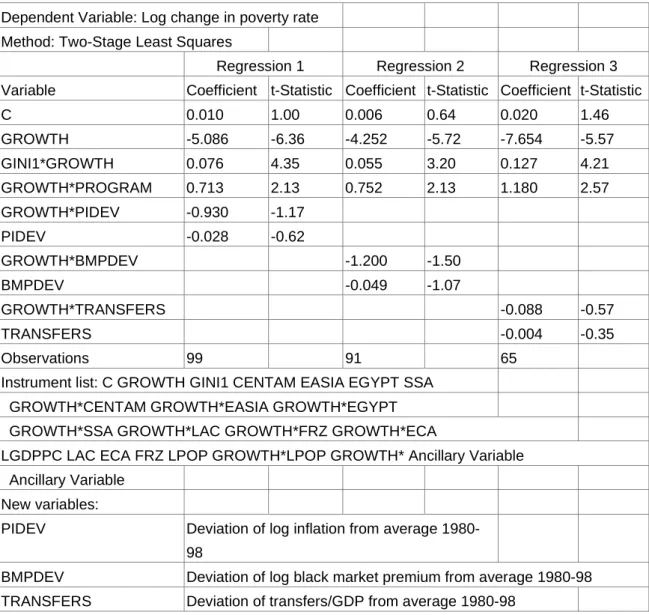
Table 7
Regression of poverty rate on possible mechanisms for poverty smoothing through adjustment lending
Dependent Variable: Log change in poverty rate Method: Two-Stage Least Squares
Regression 1 Regression 2 Regression 3 Variable Coefficient t-Statistic Coefficient t-Statistic Coefficient t-Statistic
C 0.010 1.00 0.006 0.64 0.020 1.46 GROWTH -5.086 -6.36 -4.252 -5.72 -7.654 -5.57 GINI1*GROWTH 0.076 4.35 0.055 3.20 0.127 4.21 GROWTH*PROGRAM 0.713 2.13 0.752 2.13 1.180 2.57 GROWTH*PIDEV -0.930 -1.17 PIDEV -0.028 -0.62 GROWTH*BMPDEV -1.200 -1.50 BMPDEV -0.049 -1.07 GROWTH*TRANSFERS -0.088 -0.57 TRANSFERS -0.004 -0.35 Observations 99 91 65
Instrument list: C GROWTH GINI1 CENTAM EASIA EGYPT SSA GROWTH*CENTAM GROWTH*EASIA GROWTH*EGYPT GROWTH*SSA GROWTH*LAC GROWTH*FRZ GROWTH*ECA
LGDPPC LAC ECA FRZ LPOP GROWTH*LPOP GROWTH* Ancillary Variable Ancillary Variable
New variables:
PIDEV Deviation of log inflation from average 1980-98
BMPDEV Deviation of log black market premium from average 1980-98 TRANSFERS Deviation of transfers/GDP from average 1980-98
Source: author’s calculations based on World Bank and IMF data.
There are something other interesting differences in means. The black market premium moves counter-cyclically under low adjustment lending—low during expansions and high during contractions. Causation here could run in both directions, but what is important for the poor is the pattern of cyclical covariation. Adjustment lending eliminates this countercylicality, which would tend to smooth consumption of the poor if they suffer disproportionately from high black market premiums.
The other strong pattern that emerges is that adjustment lending is associated with a more depreciated real exchange rate, regardless of whether mean consumption is expanding or contracting. This is no doubt because devaluation is often a condition of IMF programs.
There may also be reverse causation from currency collapses to the initiation of World Bank and IMF adjustment loans. Devaluation itself may be expansionary or contractionary (Gupta, Mishra, and Sahay, 2000), perhaps depending on the size of the initial current account imbalance and the currency denomination of public and private debt relative to the tradeables intensity of those who owe the debts.
So there is some evidence that adjustment lending has counter-cyclical effects in ways that may smooth the consumption of the poor. But is there direct evidence that these effects account for the lower growth elasticity of poverty under adjustment lending? Unfortunately, it is difficult to find evidence that these policy variables are responsible for smoothing poverty under adjustment lending. The three examples of variables for which adjustment lending altered the cycle—inflation, the black market premium, and fiscal transfers—do not show any direct effect on poverty, either directly or interacted with growth (Table 7). Entering these variables leaves the interaction effect of growth and adjustment lending on poverty unchanged.
Easterly and Fischer (2000) find some evidence that inflation increases poverty, when inflation is measured in absolute terms rather than relative to country averages. They also find that the poor are more likely than the rich to mention inflation as a top national problem in opinion surveys. Because of the difference in methodology, I don't think the results of Table 7 contradict the Easterly-Fischer results on the effects of inflation on poverty. I interpret the inflation deviation as a measure of the cyclical component of inflation which may be altered by IMF and World Bank adjustment lending. This cyclical component of inflation doesn't seem to have an effect on the log change in the poverty rate, in contrast to the negative effect of very high absolute inflation on the poor.
The message of Table 7 is consistent with the alternative hypothesis mentioned at the beginning of the paper. The kind of macroeconomic and fiscal policy measures that the Bank and Fund usually support may themselves cause an expansion or contraction in the aggregate economy, depending on the composition of adjustment packages. But these policies may not affect the poor very much because the poor derive much of their income from the informal sector or subsistence production. The beneficiaries of government transfers also may simply be the middle class rather than the poor. I do not test this hypothesis directly, but I adduce a few illustrative bits of information. Table 8 shows the share of the informal sector in urban employment in a variety of developing countries. While there are many problems with the comparability and accuracy of such statistics, the message of Table 8 seems to consistently be that the urban informal sector is large. It seems likely that the rural informal sector would be even larger.
The last piece in the puzzle is showing that the poor derive much of their income from informal and subsistence income. I offer a suggestive example from Zambia and Burkina Faso in Table 9. Self-employment income is extremely important for the poorest deciles in Zambia. The bias is less extreme in Burkina Faso, but the poorest still have their earnings skewed towards self-employment income. These surveys are suggestive of the importance of the informal sector for the poorest households, lending credence to the relative insulation of the poor from structural adjustment measures.
Table 8
Estimates of size of urban informal sector as percent of urban employment in developing countries
Country Year Percent
Argentina 1995 46 Benin 1992 48 Bolivia 1995 58 Botswana 1996 19 Brazil 1995 48 Cameroon 1993 57 Chile 1995 45 Colombia 1995 52 Costa Rica 1995 40 Côte d'Ivoire 1996 53 Croatia 1997 6 Ecuador 1995 48 Ethiopia 1996 33 Fiji 1990 43 Gambia 1993 83 Ghana 1997 79 Guatemala 1989 54 Honduras 1995 49 Jamaica 1996 24 Kenya 1995 58 Kyrgyzstan 1994 12 Latvia 1996 9 Madagascar 1995 58 Mali 1996 71 Mauritius 1992 24 Mexico 1995 54 Morocco 1988 28 Myanmar 1996 54 Pakistan 1992 67 Panama 1995 34 Paraguay 1995 55 Peru 1995 49 Philippines 1988 26 Poland 1995 13 Slovakia 1996 19 South Africa 1995 17
Tanzania 1990 62 Thailand 1994 77 Tunisia 1981 39 Turkey 1993 15 Uganda 1993 84 Ukraine 1997 5 Uruguay 1995 32 Venezuela 1997 42 Zambia 1993 81 median 48
Source: ILO Key Indicators of the Labor Market.
Lipton and Ravallion (1995: 2601) stress that there is considerable heterogeneity within the urban informal sector, with an individual's poverty depending more on individual attributes like human capital than on any economy-wide labor market distortion leading to the creation of an informal sector. Other distortions may exclude the poor from taking advantage of reforms under structural adjustment, like lack of access to credit. Van de Walle 2000 shows evidence of lower return to formal sector investments (irrigation in her specific example) for the less educated. The poor may be geographically isolated from the formal sector economy, which may be exacerbated by poor infrastructure. Whatever the distortion or initial endowment at work, the individuals who are poor may be ill-placed to take advantage of new opportunities created by structural adjustment programs, just as they may suffer less from the destruction of old opportunities enjoyed by protected sectors prior to structural adjustment.
Table 9
Sources of income—percent share by income decile, from poorest to richest Zambia Household Survey Burkina Faso HH Survey Income Deciles Profits and
self-employment income
Wages Profits and self-employment income Wages 1 100% 0% 42% 58% 2 99% 1% 32% 68% 3 94% 6% 21% 79% 4 67% 33% 19% 81% 5 45% 55% 17% 83% 6 17% 83% 15% 85% 7 12% 88% 18% 82% 8 11% 89% 21% 79% 9 10% 90% 27% 74% 10 36% 64% 46% 54%
4. Conclusions
The results in this paper are suggestive that IMF and World Bank adjustment lending provides a smoothing of consumption for the poor, lowering the rise in poverty for a given contraction, but also lowering the fall in poverty for a given expansion. Adjustment lending seems to play a similar role to inequality, in lowering the sensitivity of poverty to the aggregate growth rate of the economy.
The lower sensitivity of poverty to growth under adjustment lending is bad news during expansions and good news during contractions. If we think of the normal steady state of the economy as being one of positive growth, then adjustment lending is bad news for the growing economy; it means the poor share less in the expansion of the economy. One might think that adjustment lending happens only during non-steady-state output crises, but adjustment lending has been so continuous for some economies, it is hard to speak of it as purely a transitional phenomenon. From a political economy point of view, lowering the sensitivity of poverty to the aggregate growth rate could be dangerous because it gives the poor less of a stake in overall good economic performance. This might increase the support of the poor for populist experiments at redistributing income. These results could be interpreted to give support to either the critics or the supporters of structural adjustment programs. To support the critics, growth under structural programmes is less pro-poor than in economies not under structural adjustment programs. To back the supporters, contractions under structural adjustment hurt the poor less than contractions not under structural adjustment programs.
The question not fully resolved by this paper is: why does structural adjustment reduce the sensitivity of poverty to growth? Although there is evidence that adjustment lending alters the cycle for some policy variables, there is no evidence that these alterations affect poverty. I speculate that the poor may be ill-placed to take advantage of new opportunities created by structural adjustment reforms, just as they may suffer less from the loss of old opportunities in sectors that were artificially protected prior to reforms.
Appendix Table:
Countries with poverty spells 1980-99 from Ravallion and Chen 1997 (updated by the authors)
Country # spells Algeria 1 Bangladesh 4 Belarus 3 Brazil 5 Bulgaria 3 Chile 3 China 8 Colombia 3 Costa Rica 3 Cote D'Ivoire 5 Czech Republic 1 Dominican Republic 1
Ecuador 2 Egypt 1 El Salvador 2 Estonia 2 Ethiopia 1 Ghana 2 Guatemala 1 Honduras 4 Hungary 1 India 10 Indonesia 5 Jamaica 4 Jordan 2 Kazakhstan 2 Kenya 1 Korea 1 Kyrgyz Republic 2 Latvia 3 Lesotho 1 Lithuania 3 Madagascar 1 Malaysia 4 Mali 1 Mauritania 2 Mexico 2 Moldova 1 Morocco 1 Nepal 1 Niger 1 Nigeria 2 Pakistan 3 Panama 4 Paraguay 1 Country # spells Peru 2 Philippines 4 Poland 4 Romania 2 Russia 3 Senegal 1 Slovakia 1 Slovenia 1 Sri Lanka 2
Thailand 4
Trinidad and Tobago 1
Tunisia 1 Turkey 1 Turkmenistan 1 Uganda 1 Ukraine 3 Uzbekistan 1 Venezuela 5 Yemen 1 Zambia 2 Grand Total 155
Source: Ravallion and Chen (1997).
References
Bruno, Michael, Martin Ravallion, and Lyn Squire (2000) ‘Equity and growth in developing countries: old and new perspectives on the policy issues’, in A. Solimano, E. Aninat, and N. Birdsall, Distributive Justice and Economic Development: the Case of Chile and Developing Countries, University of Michigan: Ann Arbor.
Devarajan, Shanta et al. (2000) ‘A Macroeconomic Framework for Poverty Reduction Strategies’ (mimeo) World Bank: Washington DC.
Dollar, David, and Aart Kraay (2000) ‘Growth is good for the poor’ (mimeo) World Bank: Washington DC.
Easterly, William and Stanley Fischer (2000) ‘Inflation and the Poor’, Journal of Money, Credit, and Banking.
Gupta, Poonam, Deepak Mishra, and Ratna Sahay (2000) ‘Output response during currency crises’ (mimeo) IMF and World Bank: Washington DC.
International Monetary Fund (1999) The IMF and the Poor, Fiscal Affairs Department Pamphlet Series No. 52,. IMF: Washington DC.
Lipton, Michael and Martin Ravallion (1995) ‘Poverty and Policy’, in Jere Behrman and T.N. Srinivasan (eds) Handbook of Development Economics, Volume 3B: 2551-658. Lustig, Nora (2000) ‘Crises and the Poor: Socially Responsible Macroeconomics’
Economia, Vol. I, No. 1, Brookings Institution: Washington DC.
Przeworski, Adam, and James Vreeland (2000) ‘The Effect of IMF Programmes on Economic Growth,’ Journal of Development Economics, 62: 385-421.
Rauch, James (1997) ‘Balanced and Unbalanced Growth’, Journal of Development Economics 53:41-66.
Ravallion, Martin (1997) ‘Can High-Inequality Developing Countries Escape Absolute Poverty?’ Economics Letters; Vol. 56 September: 51-7.
Ravallion, Martin (2000) ‘Growth, Inequality, and Poverty: Looking Beyond Averages’ (mimeo), World Bank: Washington DC.
Ravallion, Martin and Shaohua Chen (1997) ‘What Can New Survey Data Tell Us about Recent Changes in Distribution and Poverty?’ The World Bank Economic Review Vol. 11, No. 2.
Van de Walle, Dominique (2000) ‘Are Returns to Investment Lower for the Poor? Human and Physical Capital Interactions in Rural Vietnam’ World Bank Policy Research Working Paper No. 2425, World Bank: Washington DC.