Osgoode Hall Law School of York University
Osgoode Digital Commons
Articles & Book Chapters
Faculty Scholarship
2019
Regulating Strikes in Essential Services - Canada
Eric Tucker
Osgoode Hall Law School of York University, [email protected]
Follow this and additional works at:
https://digitalcommons.osgoode.yorku.ca/scholarly_works
Part of the
Labor and Employment Law Commons
This Book Chapter is brought to you for free and open access by the Faculty Scholarship at Osgoode Digital Commons. It has been accepted for inclusion in Articles & Book Chapters by an authorized administrator of Osgoode Digital Commons.
Repository Citation
Tucker, Eric, "Regulating Strikes in Essential Services - Canada" (2019).Articles & Book Chapters. 2706.
Regulating Strikes in Essential Services
A Comparative ‘Law in Action’ Perspective
Edited by
Moti (Mordehai) Mironi
Monika Schlachter
Published by:
Kluwer Law International B.V. PO Box 316
2400 AH Alphen aan den Rijn The Netherlands
E-mail: [email protected] Website: lrus.wolterskluwer.com
Sold and distributed in North, Central and South America by:
Wolters Kluwer Legal & Regulatory U.S. 7201 McKinney Circle
Frederick, MD 21704 United States of America
Email: [email protected]
Sold and distributed in all other countries by:
Air Business Subscriptions Rockwood House Haywards Heath West Sussex RH16 3DH United Kingdom Email: [email protected]
Printed on acid-free paper.
ISBN 978-90-411-8997-4
e-Book: ISBN 978-90-411-9018-5 web-PDF: ISBN 978-90-411-9019-2
© 2019 Kluwer Law International BV, The Netherlands
All rights reserved. No part of this publication may be reproduced, stored in a retrieval system, or transmitted in any form or by any means, electronic, mechanical, photocopying, recording, or otherwise, without written permission from the publisher.
Permission to use this content must be obtained from the copyright owner. More information can be found at: lrus.wolterskluwer.com/policies/permissions-reprints-and-licensing
Editors
Moti (Mordehai) Mironi, Professor of Law (Emeritus), Haifa University Faculty of Law, specializes in labour and employment law, ADR, negotiation, mediation and arbitration. His research interests include ADR and labour employment law, in general, and strikes and labour dispute resolution, in particular. Professor Mironi practices as a mediator in labour, commercial, sport and political disputes. In this capacity he has mediated and arbitrated several nationwide mega disputes in essential services. Monika Schlachter, Professor, Trier University; Director, Institute for Labour Law and Industrial Relations in the EU, Trier; since 2010 vice president of the Council of Europe’s European Committee of Social Rights; specializes in German, European and International labour and employment law, human rights and anti-discrimination.
Contributors
Darcy Du Toit, Emeritus Professor, Faculty of Law, University of the Western Cape. Apart from collective bargaining and strike law, areas of special interest are the regulation of non-standard forms of work in general and platform work in particular, responsive regulation (including self-governance) as means of promoting social justice in work relationships, and discrimination law.
Roberto Fragale Filho, Labour Judge in Rio de Janeiro (Brazil) and Socio-Legal Professor at Universidade Federal Fluminense. He holds a PhD in Political Science from the Université de Montpellier I, and has been a fellow at the Institut d’Études Avancées de Nantes in a long and fruitful collaboration with French academia. As a visiting professor, he has taught in Angola, Macao and Portugal as well as in France and the United States. His main research interests are related to labour law, legal professions and education, and judicial training.
Christina Hießl, Senior Research Associate, Trier University Institute for Labour Law and Industrial Relations in the European Union; Invited Professor, Seoul Yonsei Graduate School of Social Welfare; Lecturer, Seoul Ehwa University. Focuses on international-comparative aspects of labour and social security law and policy. Mario Jacobs, Researcher, Labour and Enterprise Policy Research Group, Faculty of Law, University of Cape Town. Current research interest includes Global Value Chains (GVC), Trade Union organization and Collective Bargaining.
Yumiko Kuwamura, Associate Professor at School of Law, Tohoku University, Sendai. She was a visiting scholar at Goethe University of Frankfurt am Main from 2010 to 2012. Her main research interest is legal framework of collective autonomy.
Sylvaine Laulom, Professor of Labour Law at University Lumière Lyon 2. Her research interests include labour law, comparative labour law and International and European labour law.
Olivier Leclerc, CNRS Research Professor at the Center for Critical Legal Research (CERCRID), University of Lyon and University Jean Monnet (Saint-Etienne, France). His research interests include comparative labour law, scientific work and ‘science and society’ issues.
Nikita L. Lyutov, Professor; heads the Department of Labour and Social Law at the Kutafin Moscow State Law University (MSAL). His main academic activity includes the international labour law and the interaction of globalization and trans-national corpo-rations’ activity with the international labour standards. The full list of publications is available at: https://www.hse.ru/org/persons/66956091#sci.
Richard Naughton, Senior Fellow, Faculty of Law, Monash University. Richard’s research interests include the background to Australia’s conciliation and arbitration system and the operation of Australia’s present bargaining laws.
Tonia Novitz, Professor of Labour Law at the University of Bristol. Her research interests focus predominantly on labour law, international and EU trade and the protection of human rights. A graduate of the University of Canterbury (Christchurch, New Zealand) and Balliol College, Oxford, Tonia Novitz has held fellowships at the International Institute for Labour Studies (Geneva), the European University Institute (Florence), as well as the universities of Auckland and Melbourne. She has been a professor of Labour Law at Bristol since 2008.
Birgitta Nyström, Professor of Private Law, Faculty of Law, University of Lund, Sweden. Her main research field is labour law, especially European labour law and its influences on the Swedish and Nordic labour law systems. She is a member of the European Committee of Social Rights.
Marilyn Pittard, Professor of Law and Associate Dean Academic Resourcing, Faculty of Law, Monash University and President of the Australian Labour Law Association. Her recent books includeAustralian Labour and Employment Law, LexisNexis, 2015, co-edited books on labour perspectives on business innovation (Edward Elgar) and Asia-Pacific Judiciaries (Cambridge University Press, 2018). Her labour law interests include collective and individual labour relationships, electronic workplace law, and employment aspects of criminal records.
Roger Ronnie, Researcher, Social Law Project, Faculty of Law, University of the Western Cape. Areas of interest are regulation of non-standard work and forms of worker organizations.
Joseph Slater, Eugene N. Balk Professor of Law and Values and a Distinguished University Professor at the University of Toledo College of Law, where he has taught since 1999. He specializes in labour and employment law, with many of his writings focusing on the public sector. Prior to teaching, he practiced labour and employment law in Washington, DC, for twelve years. He has a BA from Oberlin College (1983), a Contributors
JD from the University of Michigan Law School (1986), and a PhD in History from Georgetown University (1998).
Andrzej Marian S´wiatkowski, Jean Monnet Professor of European Labour Law and Social Policy. Ordinary Professor at Jesuit University Ignatianum in Krakow, Poland. Adriana Topo, Full Professor of Labour Law, Law School, Università degli Studi di Padova, and PhD School in International Law, Private Law, and Labour Law of the University of Padova. On 2017 she was Visiting Fellow at IALS London, and Founder (with prof. Gian Guido Balandi) of the Summer School on International Labour and Business Law. She has written extensively on strike, dismissal and redundancies, public sector employment, protection of privacy in the workplace, apprenticeship. Eric Tucker, Professor, Osgoode Hall Law School, York University, Toronto and Distinguished Scholar in Residence, Cleveland Marshall College of Law, Cleveland State University, has written extensively on labour and employment issues, including books on the history of health and safety regulation and collective bargaining law in Canada.
Ryuichi Yamakawa, Chairman of the Central Labour Relations Commission of Japan, currently on leave from the University of Tokyo. His main research interests are resolution of labour disputes and implementation of labour law.
Summary of Contents
Editors v Contributors vii Preface xv Acknowledgement xix PARTI Theoretical Infrastructure 1 CHAPTER1Introduction: Theory, Conceptualization and Methodology
Moti (Mordehai) Mironi 3
PARTII
International Law on Strikes in Essential Services 27 CHAPTER2
Regulating Strikes in Essential Services from an International Law Perspective Monika Schlachter 29 PARTIII Country Report 51 CHAPTER3 Australia
CHAPTER4 Brazil
Roberto Fragale Filho 89
CHAPTER5 Canada
Eric Tucker 107
CHAPTER6 France
Sylvaine Laulom & Olivier Leclerc 145
CHAPTER7 Germany
Monika Schlachter & Christina Hießl 181
CHAPTER8 Japan
Ryuichi Yamakawa & Yumiko Kuwamura 221
CHAPTER9 Israel
Moti (Mordehai) Mironi 247
CHAPTER10 Italy
Adriana Topo 279
CHAPTER11 Poland
Andrzej Marian S´wiatkowski 319
CHAPTER12 Russia
Nikita Lyutov 337
CHAPTER13 South Africa
Darcy du Toit, Mario Jacobs & Roger Ronnie 373
CHAPTER14 Sweden
Birgitta Nyström 409
Summary of Contents
CHAPTER15 United Kingdom Tonia Novitz 441 CHAPTER16 United States Joseph Slater 477 PARTIV Conclusion 515 CHAPTER17 Comparative Analysis
Christina Hießl & Monika Schlachter 517
Index 555
C
HAPTER
5
Canada
Eric Tucker*
1 General Background: Country Profile
2 Collective Labour Relations
3 The Right to Strike
4 The Experience with Strikes in Essential Services
5 Restrictions on the Right to Strike in Essential Services
5.1 The Constitutional Framework
5.2 Securing Essential Services by Exclusion from Collective
Labour Relations Rights (No Right to Bargain Collectively and/or No Right to Strike)
5.3 Securing Essential Services by Imposing Limitations on the
Right to Strike (Controlled Strike Model)
5.3.1 Federal Public Service Labour Relations Act 5.3.2 Canada Labour Code
5.4 General Observations on the Controlled or Designated Strike
Model
6 Compensatory Measures for Restrictions
7 Securing Essential Services by Further Means
8 Evaluation and Conclusion
8.1 The Unfettered Strike Model (Including BTW Measures)
8.2 The No-Strike Model
* I would like to thank Tyler Fram and Andrew Link for their outstanding research assistance and Christopher Rootham for his insightful comments on an earlier draft. Of course, I am responsible for any remaining errors.
8.3 The Controlled Strike Model
8.4 Final Observations
Bibliography
1 GENERAL BACKGROUND: COUNTRY PROFILE
Canada is a federal state in which, as a general matter, labour relations come under provincial or territorial jurisdiction with a residual federal jurisdiction covering labour relations in federally regulated areas, including the federal public service, inter-provincial transportation and communications, and the postal service. Although it is estimated federal labour law covers about 10% of the Canadian workforce, because its jurisdiction extends to matters of national importance the federal government plays a disproportionately large role in regulating essential service strikes. Because there are ten provinces and three territories in Canada, each with their own labour relations laws, it is impossible to provide a comprehensive account of Canadian essential service strikes regulation. Therefore, the focus of this report is on federal and Ontario laws, with occasional forays into other jurisdictions where warranted.
Canada is best described as a liberal market economy with some social democratic tendencies. Historically, it has generally preferred to give capitalist enterprises a large measure of market freedom, but it has, to different degrees at different times and places, established public enterprises and created regulatory structures that limit market freedom in the name of securing the public welfare. In part, this can be explained by the fact that it is a large territory with a relatively small population, but more importantly since the turn of the twentieth century there have been various populist and labourist political formations that pressed for such arrangements. The New Democratic Party, founded in 1961, is the current heir to this tradition and it has formed the government at one time or another in seven provinces and one territory, although it has never formed the federal government. Its influence has fluctuated; at the end of 2017 it formed two provincial governments and was the official opposition in two others. Two other parties have dominated Canadian politics: the Liberals (centre-left) and Conser-vatives (centre-right).
In broad political terms, it is important to recognize that, like most advanced capitalist countries, since the 1970s its policy orientation shifted away from the Keynesian welfare state model that dominated in the decades after World War II toward neoliberalism.1
The neoliberal turn has had a significant impact on the legal regulation of essential services, which this chapter explores in detail.
Canada is a parliamentary democracy based on the English model it inherited. Its legal system is rooted in the common law, with the exception of Quebec, which is a civil law jurisdiction. Prior to 1982, the principle of
1. Harvey, 2005;Cahill/Konings, 2017. Eric Tucker
parliamentary sovereignty within jurisdictional boundaries was near absolute. This changed dramatically in 1982 with the adoption of theCharter of Rights and Freedoms.2
Charter rights now limit executive and legislative powers and, in the last fifteen years, the Charter has become an important source of labour rights with significant consequences for the regulation of essential service strikes.
The legal status of trade unions was ambiguous in Canada prior to 1872 when the government enacted the Trade Union Act.3 As a result, workers
became formally free to join a union, bargain collectively and, under certain conditions, collectively withdraw their labour, without fear of prosecution. But none of these freedoms was legally protected by rights. Employers could fire workers for joining unions or acting collectively.
It was not until the Second World War and its immediate aftermath that Canadian jurisdictions adopted the Wagner Act model (WAM) of labour rela-tions, which provided a legally protected right to organize and engage in lawful trade union activities, including striking, in exchange for severe limitations on legal freedoms, most importantly the freedom to strike.4
Statutory collective bargaining schemes, however, did not extend to most public sector workers until the late 1960s. The public sector collective bargaining laws of the 1960s often departed from the private sector model in significant ways, including the freedom to strike which was more tightly controlled, in part because of concerns about the disruption of essential services. Again, these limits will be explored in more detail.
Under the WAM, private sector union density increased, peaking at around 30% in the late-1950s to early 1960s. So too did collective bargaining coverage.5
Since that time density has steadily declined and is now estimated to be about 16%. Public sector union density grew rapidly in the late 1960s, reaching around 70%, where it has hovered ever since.
Since enterprise bargaining is built into the DNA of the WAM, there is little incentive for employers’ associations to form for the purposes of collective bargaining. While there are exceptions, such as large-scale construction where sectoral bargaining is the norm, employer associations do not play a direct role in Canadian collective bargaining, although they actively seek to advance employer interests, including by intervening in legal cases where permitted.
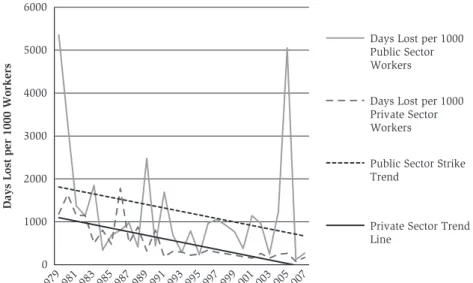
Strike activity in Canada, like in most of the advanced capitalist countries, has declined precipitously in recent decades.6
Figure 17
illustrates the downward trend for both private and public sector strikes in Canada from 1979 to 2007. In the past decade the number of person days lost to strikes in the private and 2. Canadian Charter of Rights and Freedoms, Part I of the Constitution Act, 1982, being
Schedule B to the Canada Act 1982 (UK), 1982, c 11. 3. Tucker, 1991.
4. Fudge/Tucker, 2001 and 2010, 15.
5. The discrepancy arises because bargaining unit members are not always required to be union members.
6. Tucker, 2014. 7. Ibid.
public sectors has fluctuated widely but the overall downward trend has not changed.8
Figure 5.1 Public and Private Sector Strike Rates per 1000 Workers, 1979 to 2007
2 COLLECTIVE LABOUR RELATIONS
As mentioned above, the Canadian collective bargaining regime is based on the WAM, but before clarifying its principal features regarding organizing, bargain-ing, and strikbargain-ing, it is important to highlight the distinction between freedoms and rights already averted to. Using the Hohfeldian conceptual framework, we think of freedoms and rights as jural relations between people.9You are free to
do something when no one else can call upon the state to stop you. This is different from a legal right, which entails a legal duty on others not to interfere with your action. The distinction is crucial in labour law.
Beginning with organizing, as noted above, Canadians were legally free to organize unions from at least the late-nineteenth century, but it was only in the late-1930s that organizing became a legally protected right. Labour statutes prohibited employers from interfering with or threatening union organizing activity, although the law preserved their freedom to express their opposition to
8. Government of Canada, 2018. 9. Hohfeld, 1919. 0 1000 2000 3000 4000 5000 6000
Days Lost per 1000 Workers
Days Lost per 1000 Public Sector Workers
Days Lost per 1000 Private Sector Workers
Public Sector Strike Trend
Private Sector Trend Line
197919811983198519871989199119931995199719992001200320052007 Eric Tucker
unions. This produced a grey zone about the boundary between fair and unfair employer labour practices.10
The law also formally decriminalized collective bargaining in the late-nineteenth century but collective agreements were not legally enforceable since the common law viewed them as contracts in restraint of trade. Moreover, employees had no protected right to bargain collectively until post-war labour legislation imposed a duty on employers to bargain in good faith with certified trade unions that demonstrated majority support within a bargaining unit. As well, those laws made agreements enforceable through grievance arbitration.
The issue of strikes is a bit more complex. Workers also were generally free to strike but, under common law, the withdrawal of labour was a breach of contract that allowed the employer to summarily dismiss the striking workers. Statutory collective bargaining laws gave workers a legal right to strike in that it protected their employment status while on strike and provided a legal right to return to their jobs after the strike ended. However, these laws also placed severe restrictions on the freedom to strike, discussed below.
As already mentioned, public sector workers were frequently subject to a different legal regime regarding strikes. Some statutes denied public sector workers any freedom to strike, while others permitted limited strikes but required the maintenance of essential services. Often interest arbitration was a substitute to resolve bargaining disputes. We will return to these issues,infra.
Prior to theCharter, labour rights and freedoms were rooted in common law and statute. This has now changed. TheCharterexplicitly protects freedom of association, but the scope of that protection is undefined and requires judicial interpretation. From the outset courts accepted that freedom of association protected the freedom to organize, but that freedom was not under threat in Canada since it was rarely restricted by government. The more important issue for workers excluded from statutory collective bargaining schemes was whether theCharterrequired the government to protect the right to organize. The general answer was no, except in limited cases where it could be demonstrated that workers are incapable of exercising their freedom without rights protection.11
The question of whether the Charter protects the freedom or right to bargain and strike is much more important in the context of essential services where governments frequently restrict these freedoms. The Supreme Court of Canada (SCC) initially rejected the proposition that freedom of association protected either, but in 2007 the court unexpectedly reversed itself. It held that freedom of association protected the freedom to bargain collectively and that it entailed a duty to bargain in good faith. This made collective bargaining both a
10. Slinn, 2008, 53.
11. Dunmore v Ontario (Attorney General), 2001 SCC 94 (2001).
constitutionally protected freedom and right.12
Eight years later, the SCC also held that freedom of association protects the freedom to strike.13
There are, however, two important caveats. The first is that theCharter
only applies to government action. This is less of an issue in the essential services context where government is normally the actor, either as legislator or as employer. The second caveat is that the Charter permits violations of protected rights where the restriction can be demonstrably justified in a free and democratic society. This is very significant since the SCC stated that interference with associational rights may be permitted in situations involving essential services.14
This issue will be examined in more detail,infra.
Until recently, international labour rights played an insignificant role in Canadian labour law. There were several reasons for this. One is that since Canada is a dualist country, international treaty obligations entered into by the federal government does not become domestic law unless implemented by domestic legislation, and provincial legislatures are under no constitutional obligation to pass implementing legislation.15
A second reason is Canadian governments’ limited embrace of Interna-tional Labour Organization (ILO) norms. This was evidenced by the fact that prior to 14 June 2017, Canada had only ratified one of the two foundational conventions supporting freedom of association (Convention 87, but not Conven-tion 98). Of course, the lack of ratificaConven-tions did not immunize Canada from complaints that it violated freedom of association, since the ILO considers that all members are bound to respect freedom of association regardless of whether they have ratified its underlying conventions. In fact, Canadian unions fre-quently complained to the ILO and its supervisory bodies often upheld those complaints and made recommendations to the offending government. However, those recommendations had no legal force and no political impact either. As a result, governments felt free to ignore the ILO and the violations continued.16
In recent years, however, international law has come to play a much more significant role through its influence on the development of constitutional law. The turning point came when the SCC determined that the meaning of freedom of association under theChartershould be as generous as it is in international law and thought. The SCC translated the soft law of the ILO and various UN declarations into hard constitutional law in Canada and, as we shall see, that has had a significant influence on the development of constitutional labour rights in Canada.17
12. Health Services and Support – Facilities Subsector Bargaining Assn v British Columbia, 2007 SCC 27 (2007).
13. Saskatchewan Federation of Labour v Saskatchewan, 2015 SCC 4 (2015). 14. Health Services, para. 108.
15. Macklem, 2012. 16. Adams, 2006
17. Health Services;Bogg/Ewing, 2012, 379;Langille, 2007, 363. Eric Tucker
3 THE RIGHT TO STRIKE
As mentioned, the WAM imposes significant restrictions on the freedom to strike. In particular, recognition strikes and strikes during the life of a collective agreement are prohibited. There are also procedural requirements that must be satisfied for a strike or lockout to be legal. These vary from jurisdiction to jurisdiction, but typically include the following. First, the union must have won a strike vote among the members of the bargaining unit. Second, the union and the employer must have bargained to impasse and undergone mediation or conciliation without success. Third, they must wait a prescribed number of days after mediation/conciliation has failed before taking industrial action. Fourth, some jurisdictions, including the federal jurisdiction but not Ontario, require the union provide the employer with advance notice of the strike.18
In general, the law only permits economic strikes to support collective bargaining demands. Sympathy or political strikes are almost always unlawful since unions can only legally strike during the narrow window of opportunity that opens when no collective agreement is in force and the procedural hurdles have been cleared. Political and sympathy strikes are not exempt from these general rules and so are illegal if they are untimely. Canadian unions have so deeply absorbed these norms that no case has ever posed the question of whether a union in a legal strike position could engage in a sympathy or a political strike.
The definition of a strike is quite broad and in addition to a complete work stoppage includes any concerted action undertaken with a common understand-ing designed to restrict or limit output. Thus, a partial work stoppage, a slowdown, or a work-to-rule campaign are all considered strikes.19
It is important to emphasize that while the general restrictions described here apply to both private and public sector workers, public sectors workers and particularly essential service workers are subject to additional restrictions, describedinfra.
4 THE EXPERIENCE WITH STRIKES IN ESSENTIAL SERVICES
There are no recent studies of the prevalence of strikes in essential services, if only because in Canada essential services strikes are heavily regulated and,
18. Fudge/Tucker, 2001 and 2010;Slinn/Tucker, 2016, 171;Adams, 1993, 11.7 et seq. 19. Labour Relations Act, 1995, SO 1995, c 1, s 1(1) ‘strike’ includes a cessation of work, a
refusal to work or to continue to work by employees in combination or in concert or in accordance with a common understanding, or a slow-down or other concerted activity on the part of employees designed to restrict or limit output; Canada Labour Code, RSC, 1985, c L-2, s 3(1) ‘strike’ includes a cessation of work or a refusal to work or to continue to work by employees, in combination, in concert or in accordance with a common understanding, and a slowdown of work or other concerted activity on the part of employees in relation to their work that is designed to restrict or limit output;Adams, 1993, 11.1(i).
because of that fact, likely infrequent. This was not always the case. As statutory collective bargaining laws were extended to public sector workers in the 1960s, much attention was paid to the issue of essential service strikes. For example, in 1968 Professor Harry Arthurs conducted a major study of strikes in essential services and reported that from 1946 to 1966 strikes in essential industries had become more frequent and that person days lost in total and per strike were increasing.20
If we consider the Canadian experience with essential service strike regulation from a qualitative perspective, it has revolved around two fundamen-tal questions: what are essential services and how should essential service disputes be resolved? We address the former question here and the latter in Section 5 of this chapter.
Historically, the concept of essentiality in Canada has been a political one. What activities are so important to the public welfare such that stoppages pose unacceptable risk and hardship to the broader public? The answer to that question has changed over time and place. For example, one of Canada’s earliest collective bargaining laws, the Industrial Disputes Investigation Act of 1907 (IDIA) required the parties to undergo a process of conciliation prior to a labour stoppage in mining, transportation, communications and public utilities. These services were understood at the time to be so essential as to warrant restrictions on actions that the parties were otherwise free to undertake.21
During war time the IDIA was extended to war production industries, expanding the scope of essential services. The post-World War II collective bargaining statutes retained compulsory conciliation as a general requirement, not because governments considered the economy as a whole an essential service, but rather because compulsory conciliation had come to be seen as a good industrial relations strategy for avoiding unnecessary conflict. However, these laws only applied to the private sector and so there was not a great need to be concerned over the definition essential services.
The exception was with respect to municipal police and fire-fighters. Although these workers were generally excluded from the normative private sector schemes, they were soon given access to collective bargaining through sector specific statutes.22
While some statutes permitted police strikes, in practice ad hoc legislation usually prevented police from exercising this free-dom.23
However, most statutory schemes applicable to police and fire-fighters expressly prohibited strikes and substituted binding interest arbitration by 20. Arthurs, 1971, 1 et seqq.
21. Industrial Disputes Investigation Act, 6-7 Edward VII, ch. 20 (1907);Fudge/Tucker, 2001 and 2010, 52 et seqq.
22. For example, see the Fire Departments Act, SO 1947, c 37; the Police Amendment Act, SO 1947, c 77.
23. In October 1969 Montreal police and fire-fighters went on a legal strike. During the sixteen hours that the strikes were permitted bank robberies increased and a riot occurred during which one police officer was fatally wounded. The army was called out and back to work legislation was quickly passed. Online at http://archives.cbc.ca/on_this_day/10/07/. Eric Tucker
neutral third parties. This interference with free collective bargaining was justified because of the overriding public safety interest in maintaining these services and that judgment has never been seriously challenged.24
Outside of police and fire-fighters, the issue of determining which services were essential only became pressing when government extended collective bargaining to the public and para-public sectors more broadly, beginning in the mid to late 1960s. One contemporary commentator, Paul Phillips, described the scope of essential services to be ‘whatever the responsible public authority believes it to be at any point in time.’ Reflecting the ambiguities of the time, Harry Arthurs described essentiality as lying ‘mid-way along the progression from very limited cases where a labour dispute actually does create (or threatens to create) a danger, to that very broad class of cases where the dispute touches the public interest in a very incidental way.’25
We will look more closelyinfraat the ways in which Canadian govern-ments have defined essential services in the context of the strike regulation laws of Ontario and the federal jurisdiction. However, the freedom of governments to define essential services (and to regulate essential service strikes) is now limited by the SCC’s interpretation of theCharter’s protection of freedom of association. Here we deal only with constitutional limits on the government’s freedom to define essential services.
The basic question asked by the court in theSaskatchewan Federation of Labour(SFL) case is ‘whether the legislative interference with the right to strike in a particular case amounts to a substantial interference with collective bargaining.’26
If a law substantially interferes, then the burden shifts to the government to demonstrate that the restriction is demonstrably justified in a free and democratic society. Here is where the scope of essentiality comes into play. The first step in a section 1 defence under theCharteris to establish that the law aims to achieve a pressing and substantial objective. In theSFLcase, the court accepted that maintaining essential services is such an objective, but before the argument can succeed, the court has to be convinced that the services the government is protecting are sufficiently essential so that their protection is a pressing and substantial objective. This raises the need to demarcate what services are essential or when the consequences of a labour disruption are sufficiently serious to justify interference with the constitutional freedom to strike.27
The court begins its discussion with the definition of essential services in international law. For this purpose, they accept a summary of that law presented in an affidavit filed by Professor Patrick Macklem, who identifies three situations
24. Jackson, 1995, 313 et seqq.;Haney, 1974;Downie/Jackson, 1980. 25. Phillips, 1975, 39 (italics in original);Arthurs, 1971.
26. Saskatchewan, at para. 78. 27. Ibid.,para. 86.
in which the ILO’s supervisory bodies have justified strike restrictions on essential service grounds:
(1) in the public service only for public servants exercising authority in the name of the state;
(2) in essential services in the strict sense of the term (that is, services the interruption of which would endanger the life, personal safety or health of the whole or part of the population); or
(3) in the event of an acute national emergency and for a limited period of time.28
Without getting into the details of the contested Saskatchewan legislation, the SCC found that it was overly broad because ‘the categories of workers whose right to strike may be abrogated because they provide essential services is subject to the employer’s unilateral discretion.’29
While the court does not provide a bright-line definition of essential services, its reference to international law is significant because in the past the court has expressed the opinion that freedom of association in Canada should be interpreted as generously as it is in international law. The court was also disturbed by the absence of a collaborative process for categorizing services as essential and determining the number of employees necessary to maintain them.30
Since theSFLdecision, there has been one lower court judgment that dealt directly with the question of whether the government had a pressing and substantial interest that justified an infringement of the right to strike. The case arose out of continuing conflicts between the teachers’ unions and the Ontario provincial government, which the government resolved by passing legislation that imposed terms and conditions on unions that did not reach an agreement by a set date. One effect of measure was that it deprived workers of the freedom to strike that they otherwise would have enjoyed. The unions successfully chal-lenged the legislation as a violation of theirCharterrights. The court accepted that the legislation substantially interfered with their freedom to strike and held that the interference was not justified. Central to the court’s holding was its conclusion that the government’s purpose was fiscal restraint rather than maintaining or restoring essential services. It then stated: ‘It is only in excep-tional circumstances that a breach of rights under theCharterwill be justified based on economic concerns.’31
It will take further litigation to clarify where and how courts will draw the line demarcating services as essential, but it is clear that governments no longer have the absolute right unilaterally to make that determination.
28. Ibid.
29. Ibid.,para. 87. 30. Ibid.,at para. 89.
31. OPSEU v Ontario, 2016 ONSC 2197, at para. 238 (2016). Eric Tucker
5 RESTRICTIONS ON THE RIGHT TO STRIKE IN ESSENTIAL SERVICES
5.1 The Constitutional Framework
It is clear that any discussion of statutory restrictions on the right to strike of employees in essential services must begin with a consideration of Canada’s newly constitutionalized labour rights, including the right to unionize, the right to bargain collectively, and the right to strike. We have previously discussed how this body of law affects the definition of essentiality. Here we discuss the impact of constitutional labour rights on the government’s power to regulate essential service strikes by excluding workers from the right to organize, bargain, or strike, or imposing substantial limits on their exercise.
Canada historically rarely deprived workers of their freedom to form associations, even for police and other public security workers. As well, it rarely denied workers the freedom to bargain collectively. Instead, Canada has gener-ally secured essential services related to public security by denying workers the freedom to strike – the no-strike model – or limiting the strike to maintain essential services – the designation model. There are exceptions,32
however, including members of the armed forces, who are not covered by any collective bargaining legislation.33
Another exception was the he Royal Canadian Mounted Police (RCMP) whose situation merits closer examination because of their recent successful constitutional challenge to their exclusion from collective labour rights. The RCMP provides police service at the federal level and for many of Canada’s provinces and territories. As such, it is the closest thing Canada has to a national police force. In part because of its long history of involvement in internal security and strikebreaking, the government was concerned about RCMP officers having connections to the labour movement. Indeed, from 1918 to 1974 they were prohibited by an order-in-council from engaging in union-related activity on pain of instant dismissal.34
When the order-in-council was lifted in 1974, the head of the RCMP recognized there was a high level of discontent among officers and instituted the Division Staff Relations Representation Program (DSRRP) to 32. An interesting recent exception was 2003 legislation passed in Quebec, which declared certain home care and child-care workers not to be employees. The effect of the law was to remove them from any statutory collective bargaining scheme so that any attempt to bargain collectively was potentially a violation of competition law. The legislation was declared unconstitutional in 2008, a year after the SCC recognized that freedom of association protected collective bargaining. SeeConfédération des syndicats nationaux c Québec (Procureur General), 2008 QCCS 5076 (2008).
33. The Public Service Alliance of Canada (PSAC) unsuccessfully petitioned the Canadian government in 1971 to create statutory collective bargaining schemes for the military. See PSAC, Collective Bargaining Rights for Members of the Armed Forces(Presented to the Committee on Legislation Review April 1971).
34. Fudge/Tucker, 2001 and 2010, 100 et seqq. For a history of the restrictions on freedom of association of RCMP members, see Mounted Police Association of Ontario v. Canada (Attorney General), 2009 CanLII 15149 (ON SC), <http://canlii.ca/t/2315w>, retrieved Chapter 5: Canada
provide for a weak form of consultation. The program was formalized in regulation in 1989 and renamed the Staff Relations Representation Program (SSRP). Then, in 1996, a Pay Council was created to provide officers with a mechanism for being consulted on compensation issues. RCMP officers chose representatives to participate in both these bodies, which were the only bodies the RCMP recognized for the purposes of discussing workplace and wage issues. Neither body was independent of government nor was there a role for collective bargaining. Both bodies were limited to consultation.
RCMP officers first challenged their exclusion from any statutory collective bargaining law in early years of Charterlitigation but were unsuccessful. The SCC embraced a thin interpretation of freedom of association as only protecting the freedom to form associations. Since the law did not prohibit RCMP officers from forming associations theirCharterrights were not violated.35
In 2006, an independent association of RCMP officers, the Mounted Police Association of Ontario (MPAO), launched a fresh challenge to the constitution-ality of the RCMP’s representation scheme. Their case was bolstered in 2007 when the SCC adopted a broader view that freedom of association that protected collective bargaining and this time the challenge succeeded. The SCC held that the SRRP substantially failed to provide RCMP officers with a meaningful process of collective bargaining by denying them representation by an associa-tion independent of government and by depriving officers of a sufficient degree of choice in the selection of their representatives. The SCC also rejected the government’s defence that the infringement was justified because unionization would compromise the force’s neutrality.36
The effect of the judgment is to limit severely the power of government to protect essential services by depriving workers of the right to form independent unions or bargain collectively.
This leaves governments with the option of regulating strikes, but their power is constitutionally limited. In order to determine whether restrictions on strikes are constitutional, the court must answer two key questions. The first is whether the restrictions on the freedom to strike substantially interfere with a process of collective bargaining. A complete ban on strikes, or even broadly drawn restrictions, will constitute substantial interference, so this is unlikely to be the difficult point in litigation. Rather, the key question will be whether the government can satisfy the court that the interference is demonstrably justified. The starting point for the justification will be that the freedom to strike is limited to maintain essential services, which, as discussed in section 4, involves the court in patrolling the boundaries of what constitute essential services. Assum-ing the government satisfies the court that it has a pressAssum-ing and substantial objective, it must then demonstrate minimum impairment. That inquiry will
on 2018-03-08. Even today, statutes prohibit police from being members of unions that are affiliated with the labour movement. For example, see Police Services Act, RSO 1990, c P-15, s 117.
35. Delisle v Canada (Deputy Attorney General), [1999] 2 SCR 989 (1999).
36. Mounted Police Association of Ontario v Canada (Attorney General), 2015 SCC 1 (2015). Eric Tucker
lead the court to examine the scope of the restrictions, the process by which they were developed, and the alternative provided to the strike.
Where the government adopts the no-strike model, the court will want to be satisfied that a less restrictive approach that preserved a limited right to strike could not have met its legitimate interest in preserving essential services. As well, it will require that the strike alternative provides the affected workers with an acceptable substitute, such as binding interest arbitration by a neutral third party. Where the government has selected a designation model, as in the SFL
case, the court will examine whether the processes for determining which services are essential and how those essential services will be provided are minimally impairing.
In theSFLcase, the trial judge found that the restrictions went far beyond what was necessary to maintain essential services. The SCC agreed:
Theunilateralauthority of public employers to determine whether and how essential services are to be maintained during a work stoppage with no adequate review mechanism, and the absence of a meaningful dispute resolution mechanism to resolve bargaining impasses, justify the trial judge’s conclusion that thePSESAimpairs the s. 2 (d) rights more than is necessary.37
5.2 Securing Essential Services by Exclusion from Collective Labour
Relations Rights (No Right to Bargain Collectively and/or No Right to Strike)
In general, few Canadian workers areex antedeprived of the right to bargain collectively. One such group is employees of the Canadian Security and Intelli-gence Service. Except for clerical and secretarial employees, they have no right to bargain or strike. As discussed earlier, RCMP officers were in a similar situation until the SCC found their exclusion was unconstitutional in 2015. In response, the government enacted legislation in 2017 that provides RCMP officers with a process to unionize and bargain collectively.38
It is far more common for governments to deprive essential service workers
ex anteof the right to strike. As mentioned earlier, this is the common approach to public security workers, such as police, fire-fighters and prison guards. Not surprisingly, when the federal government provided RCMP officers with a statutory collective bargaining scheme, they adopted the no-strike model, providing them with arbitration instead.
Ontario, hospital workers are the other major group subject to the no-strike model. In 1965 following a strike at a public hospital, the Ontario government enacted theHospital Labour Disputes Arbitration Act(HLDAA), which provides that in the event of an impasse the parties are obliged to submit their dispute to
37. Saskatchewan, 81.
38. Federal Public Sector Labour Relations Act, SC 2017, c 9.
arbitration.39
Another group of workers recently deprived of the right to strike are employees of the Toronto Transit Commission (TTC).40
The government enacted the exclusion in 2011 at the request of the City of Toronto. Prior to the enactment, the government had ended a number of TTC strikes through back-to-work legislation.
Workers and unions who strike unlawfully potentially face very serious penalties regardless of the circumstances. Some no-strike laws specify the consequences of violations of the law, but many incorporate the laws that govern unlawful strikes generally. For example, the recent TTC strike law expressly incorporates by reference the provisions of theLabour Relations Act
(LRA) regarding unlawful strikes.41
All contraventions of the LRA, including untimely strikes, are regulatory offences for which individuals are liable to fines of up to $2,000 and unions up to $25,000 for each day they are in violation. However, prosecutions can only be instituted with the written consent of the Labour Board. Labour boards also have the power to issue unlawful strike declarations, which have the same legal effect as a court order. Striking workers and union leaders who defy court orders could face civil or criminal contempt proceedings that could result in fines or jail.42
Apart from statute, employers can discipline individual workers who strike illegally, including termination. Employees can challenge disciplinary action through the grievance procedure, but arbitrators accept that unlawful striking is a disciplinary matter, the only issue being whether the severity of the penalty is justified in the circumstances of the case. As well, employers can bring griev-ances against the union, which is under a strict obligation not to participate in or facilitate unlawful strikes and to use its influence to end them when they occur. Arbitrators have the power to award damages against the union should they breach the peace obligation.
Unlawful strikes may give rise to tort liability. While there is no nominal tort of breach of statute (unless it was the intent of the legislature to create such liability), unlawful strikes by essential service workers will likely be tortious on other grounds. For example, an action for civil conspiracy using unlawful means could succeed on the basis that the strike violated a statutory prohibition on strikes.
In addition to the sanctions discussed above, in some circumstances essential service workers could be prosecuted for criminal breach of contract. Under the law, which dates back to 1878, it is a crime to wilfully breach a contract if you have reasonable cause to believe that the probable consequences 39. For the background and early experience, seeWhite, 1995, 82 et seqq;Arthurs, 1971, 82
et seqq. The current statute is RSO 1990, c H-14.
40. Toronto Transit Commission Labour Disputes Resolution Act, 2011, SO 2011, c 2. 41. Ibid.,s 17.
42. Fudge/Glasbeek, 1992. In another famous incident, the leader of the postal workers’ union, Jean-Claude Parrot was convicted of criminal contempt for refusing to order his members back to work after Parliament enacted back-to-work legislation. SeeR v Parrot, 106 DLR (3d) 296 (ONCA) (1979) andMandel/Glasbeek, 1979, 10.
Eric Tucker
of doing so will be to endanger human life, cause serious bodily injury, expose valuable property to serious injury or destruction, deprive the residents of a municipality of their supply of light, power or gas, or delay or prevent the running of trains.43
However, the likelihood of prosecution is remote. Indeed, we have not located a single reported case.44
Strikes in defiance of the no-strike model are uncommon. The authors of a study of public sector bargaining between 1978 and 2008 found that of the 791 contracts negotiated under this regime, unions struck just 4 times.45
The most significant strike undertaken by Ontario workers under the no-strike regime was in 1981 when approximately 10,000 health care workers covered by the HLDAA walked off the job. The Ontario government obtained a court injunction ordering the nurses back to work. The leader of the union, Grace Hartman, refused to order her members back to work and the Attorney General threatened mass prosecution of union leaders and even possibly of members. The strike collapsed soon thereafter. Seventeen union leaders were subsequently charged with contempt. Pursuant to a plea deal, Hartman was sentenced to 45 days of imprisonment, two other leaders received 15 day sentences, and the remainder received suspended sentences and were fined $300 each. Striking workers faced disciplinary action by their employers. Thirty-four local leaders were dismissed but arbitrators reinstated most, subject to lengthy disciplinary suspensions without pay. Striking workers were meted out 5,500 letters of reprimand and 3,442 disciplinary suspensions.46
Later that year acute care nurses implemented a work-to-rule campaign and an overtime ban to show their displeasure over the lack of progress in negotiations. While these actions are strikes under Ontario law, no disciplinary action followed.47
To date, unions have not challenged the constitutionality of the no-strike model, but it only became possible to do so in 2015 after theSFLdecision.48
Prior to that time, unions would have brought their complaints to the ILO. There were two early complaints by unions in Ontario and Alberta objecting to older legislation that barred government employees from striking, thePublic Service Employee Relations Act(Alberta) and theCrown Employees Collective Bargaining Act(Ontario).49In its reports, the Committee on Freedom of Association (CFA)
found that both statutes were overly broad because they covered employees of
43. Criminal Code of Canada, RSC 1985, c C-46, s 422. Craven, 1999, 142 et seqq.
44. But, seeJohnston et al v Mackey et al.,(1937) 67 CCC 196 (NSSC), where the court held that a strike involving wilful breaches of contract, where the probable consequence of the strike would have resulted in serious property damage in violation of the Code, was tortious.
45. Campolieti/Hebdon/Dachis, 2016, 201. 46. Deverell, 1982, 179;White, 1990, 73 et seqq. 47. Haiven/Haiven, 2002, 5 et seqq.
48. At the time of writing, the Amalgamated Transit Workers Union, Local 113 filed an application challenging the no-strike legislation, but as of the time of writing there is no report of the case’s progress. SeeKalinowski/Ferguson, 2015.
49. SA 1977, c 40; SO 1972, c 67, s 25.
crown agencies such as liquor control boards whose work was not essential. Apart from over-breadth, the Committee found the restrictions were otherwise justified and that the statutes provided adequate safeguards to protect the interests of those workers deprived of the right to strike, including adequate, impartial and binding conciliation, and arbitration procedures.50
The most recent ILO complaint arose out of the 2011 legislation prohibiting strikes by TTC workers. The Committee did not consider metropolitan transpor-tation to be an essential service in the strict sense of the term, but it recognized urban transit as a public service of primary importance where the requirement of a minimum service might be justified.51
Both Ontario and Alberta subsequently replaced the no-strike model for public sector workers with a controlled strike model, but in neither case was the action taken as a response to the CFA’s findings. Rather, in both provinces, their first elected New Democratic Party government made the change.52
5.3 Securing Essential Services by Imposing Limitations on the Right to
Strike (Controlled Strike Model)
The controlled strike model is the predominant approach to regulating essential service strikes in Canada that do not involve public security service workers. The approach was first adopted by the Federal government when it created a statutory collective bargaining scheme for the federal public service in thePublic Service Staff Relations Act in 1967 (PSSRA)(now the Federal Public Service Labour Relations Act (FPSLRA).53
The PSSRA was unusual in that it offered unions the choice between the no-strike model, leading to binding arbitration, and the controlled strike model. Many governments subsequently adopted the controlled-strike model when they created public sector statutory collective bargaining schemes, although most did not offer unions the choice of opting for the no-strike/binding interest arbitration model, except under limited circum-stances.
Three Canadian jurisdictions also integrated the controlled strike model into their private sector collective bargaining statutes where the unfettered strike model is the norm. One justification for imposingex anterestrictions on private sector strikes is that private sector workers are increasingly performing work 50. Interim Report – Report No 187, Nov. 1978, Case No 893 (Canada) – Complaint date: 04-NOV-77 – Closed; Definitive Report – Report No 214, March 1982, Case No 1071 (Canada) – Complaint date: 06-JUL-81 – Closed.
51. Report in which the committee requests to be kept informed of development – Report No 377, March, 2016, Case No 3107 (Canada) – Complaint date: 05-DEC-14 – Follow-up. 52. For Ontario, SO 1993, c 38, for Alberta, SA 2016, c 10.
53. SC 1967, c 72. In 2003, the statute was renamed thePublic Service Labour Relations Act, SC 2003, c 22 and in 2017 it was renamed again as theFederal Public Sector Labour Relations Act, S.C. 2017, c. 9. Unless I am making specific reference to an earlier version of the legislation, I will use FPSLRA acronym. On the origins and background of the act, see
Arthurs, 1971, ch. 3, andRootham, 2007, 27 et seqq. Eric Tucker
that is vital to public health and safety. For example, a 1995 Task Force Report recommended there be a designation process in theCanada Labour Code(CLC), in part because privatization of certain crucial functions, like air traffic control, shifted their labour relations from the FPSLRA to the CLC.54
As well, in British Columbia and Quebec, the use of replacement workers during strikes is highly restricted. As a result, the risk increases that a work stoppage could significantly disrupt the production of goods and services necessary for the public’s health and safety or result in substantial property damage or deterioration, thus providing a justification forex antestrike restric-tions.55
It is not possible to provide an account of the many variations on the controlled strike model in Canada and so we will focus on two, the FPSLRA and the CLC.
5.3.1 Federal Public Service Labour Relations Act
The designation process under the FPSLRA has been quite controversial and has undergone at least three major changes. At the time of writing, it is likely to revert to the model that was in place prior to the most recent changes in 2013. In its first iteration, the act defined essential services narrowly as ‘a service, facility or activity of the Government of Canada that is or will be, at any time, necessary for the safety or security of the public or a segment of the public.’ This definition closely tracked the ILO’s definition. The government initiated the designation process by proposing a list of designated positions and then the parties bargained in an attempt to reach an agreement. If the parties could not agree, the Public Service Staff Relations Board had jurisdiction to resolve the matter. A 1982 SCC judgment,CATCA, narrowly interpreted the scope of the board’s powers, so that it could only determine which services were essential, but could not interfere with the government’s determination of the level of service required.56
The effect of the SCC’s judgment was to expand the govern-ment’s power to designate and, in the following years, the percentage of public service positions designated as essential jumped sharply.57However, because
unions had the option of electing arbitration, they could opt out of the controlled strike model if designation levels made the strike option ineffective.
54. For a discussion of the background to the adoption of the designation model and its rationale, seeAdell, 2001, 28 et seqq.
55. For a discussion and strong expression of judicial support for limiting the freedom to strike to protect essential services, see Canadian Union of Public Employees, Local 301 v Montreal (City), [1997] 1 SCR 793 (1997).
56. Canadian Air Traffic Control Association v Canada (Treasury Board), [1982] 1 SCR 696 (1982).
57. Adell, 2001, 30 et seqq.;Swimmer, 1995, 377 et seqq.;Panitch/Swartz, 2003, 93 et seqq.;
Finkelman, 1986, 691 (limited use of designations prior to CATCA; effect of SCC judgment severely limits capability of union to mount an effective strike).
The government tweaked the model in 2003 after a lengthy review process by an Advisory Committee and a Task Force. The government repealed and replaced the PSSRA with thePublic Service Labour Relations Act(PSLRA). With regard to essential services, the new law aimed to strengthen the role of negotiation in creating essential service agreements. It required the government to notify the union within 20 days after the union gave notice to bargain that it considered employees in the bargaining unit occupied essential service posi-tions. The parties were then required to begin good faith bargaining to enter into an essential services agreement. This involved a three step process. First, it was necessary to determine which services are necessary to insure public safety or security in the vent of a strike. If the parties cannot agree, the PSLRB (now the Federal Public Service Labour and Employment Relations Board (FPSLREB) will decide the issue. The next step is to determine the level of service to be performed during a strike. This question is determined exclusively by the employer, subject to very limited review. Once these two matters are settled, the third step is to determine the types, number and specific positions necessary to provide the essential services at the designated level of service. If the parties cannot agree, the FPSLREB will decide the issue.58
The third iteration was enacted in 2013 by a Conservative government that was quite hostile toward organized labour. Bill C-4,Economic Action Plan Act 2013 No. 2, greatly expanded the power of the government to act unilaterally in almost every phase of the designation process. The amended act provides:
Section 119(1): The employer has the exclusive right to determine whether any service, facility or activity of the Government of Canada is essential because it is or will be necessary for the safety or security of the public or a segment of the public.
While the statute preserved a narrow definition of essential service, it granted the government near total discretion to determine what activities fit within it. The statute also gave the government the exclusive right to designate which positions perform essential services. While the law requires the govern-ment to consult with the union after it has made its decision, the union has no power to challenge the decision and submit the disagreement to the FPSLREB for a determination. Furthermore, the option of selecting arbitration rather than the controlled strike model is sharply limited so that unions can only demand arbitration if 80% or more of the bargaining unit is designated as essential. Given the power of the government, this creates an incentive to designate just under 80% of the bargaining unit leaving the union with an ineffective strike weapon and little or no bargaining power. Moreover, even in those circumstances when a union can opt for arbitration, the government changed the rules to tilt
58. See PSLRA, S.C. 2003, c. 22; Rootham, 2007, 195 et seqq. for a lengthy description. Subsequent cases further clarified the process. For a summary, seeProfessional Institute of the Public Service of Canada v. Canada (Attorney General), 2011 FCA 143 (CanLII). The change in the name of the labour board was made in 2017. See S.C. 2017, c. 9.
Eric Tucker
arbitration outcomes in its direction. It lists two factors to which the arbitrator must give preponderant weight. While one of these factors existed in the previous model, the necessity of attracting and retaining public servants, the second is new. It requires the arbitrator to give preponderant weight to ‘Cana-da’s fiscal circumstances relative to its stated budgetary policies.’ This sharply steers arbitrations toward outcomes favourable to the government, compared to prior language requiring consideration of ability to pay, which arbitrators treated cautiously because of the power of government to increase taxes.59
The 2013 version of the law remains on the books but the current Liberal government introduced legislation in 2016 to repeal the 2013 amendments.60
The more labour friendly orientation of the Liberals is one motivation for the change, but the more important story is the constitutional one. In order to determine whether theCharterright to strike has been violated, the court asks ‘whether the legislative interference with the right to strike in a particular case amounts to substantial interference with collective bargaining.’61
In the SFL
case, the court was considering Saskatchewan’sPublic Service Essential Services Act(PSESA), passed in 2008, which introduced a designation model for regulat-ing essential service strikes.62
The SCC found that the PSESA violated the right to strike ‘because it prevents designated employees from engaging inany work stoppage as part of the bargaining process.’63
Of course, this is true for all designation models, so the constitutionality of the law will depend on whether the violation can be justified under s. 1.
The SCC accepted that the ‘maintenance of essential public services is self-evidently a pressing and substantial objective’ and that the prohibition on strikes including the sanctions imposed on violators of the essential service restrictions are rationally connected to the goal of maintaining essential public services. ‘The determinative issue here, in my view, is whether the means chosen by the government are minimally impairing…’64
The SCC found the government went well beyond what was reasonably required to protect its legitimate interest in the maintenance of public services. First, the legislation provided the government with unilateral discretion to identify by regulation which services are essential without any opportunity for discussion or access to an impartial and effective process to dispute the government’s determination. Second, the law also provided that in the event an essential services agreement is not reached, the employer had the unilateral power to determine how essential services would be maintained, including the classifications of employees who must continue to work and the number and
59. S.C. 2013, c. 40;Rootham et al.,2013;Goldman/Scott,2013.
60. Bill C-34, An Act to amend the Public Service Labour Relations Act and other Acts, 42nd Parliament, 1st Session (2016).
61. Saskatchewan, para. 78.
62. Public Service Essential Services Act, SS 2008, c P-42.2. 63. Saskatchewan, at para. 78.
64. Ibid.,paras. 79 et seq.
names of employees within each classification. Finally, the SCC also found the act failed to provide access to a meaningful alternative mechanism for resolving bargaining disputes, such as arbitration. The court summed up its findings:
Given the breadth of essential services that the employer is entitled to designate unilaterally without an independent review process, and the ab-sence of an adequate, impartial and effective alternative mechanism for resolving collective bargaining impasses, there can be little doubt that the trial judge was right to conclude that the scheme was not minimally impairing.65
The FPSLRA clearly violates the right to strike. The only question is whether the violation is minimally impairing. Based on theSFLjudgment, it is almost certain the current law could not be justified under s. 1. It allows the government unilaterally designate which services are essential without access to an effective and impartial process to dispute the government’s determination, and it severely limits access to arbitration when extensive designations deprive bargaining units of the effective ability to strike.
Interestingly, the Canadian Labour Congress filed a complaint with the ILO regarding the 2013 legislation after the SFLjudgment, perhaps in the belief it would provide it with additional leverage in lobbying the federal government to amend the FPSLRA.66
Although at the time of writing the amending legislation has not moved beyond first reading, which occurred on 28 November 2016, in the most recent round of bargaining the government offered all affected unions the option of selecting interest arbitration as a dispute resolution mechanism, essentially putting them back in the pre-2013 regime.
5.3.2 Canada Labour Code
As noted earlier, the CLC is one of the few private sector collective bargaining statutes that deals with essential service strikesex anteand does so through the designation model. The CLC provides:
87.4 (1) During a strike or lockout not prohibited by this Part, the employer, the trade union and the employees in the bargaining unit must continue the supply of services, operation of facilities or production of goods to the extent necessary to prevent an immediate and serious danger to the safety or health of the public.
The law provides that within fifteen days after notice to bargain has been given either the employer or the union may give notice of the services that must be provided in the event of a strike or lockout and the number of employees in the bargaining unit that would be required for that purpose. If the parties are 65. Ibid.,at para. 96.
66. By the time the Committee issued its definitive report in March, 2017, the Canadian government had introduced a measure to repeal Bill C-4. See ILO Case No. 3143 – Complaint Date 13-May-2015; Report of the Committee on Freedom of Association, 381st Report of the Committee on Freedom of Association, GB.329/INS/17, at paras. 173–219. Eric Tucker
unable to reach an essential services agreement, either may refer outstanding differences to the labour board. The Minister of Labour may intervene in the labour board’s hearing to provide her views on what is required to maintain essential services. The law gives the board broad powers to determine what services are essential and to specify the manner and extent to which those services are to be provided. The board also has the power to review and modify its orders during a strike or lockout. Finally, if the board is satisfied the provision of essential services will render the strike or lockout ineffective, it may direct that binding arbitration be available to resolve the dispute (s. 87.4 (2) – (8)).67
In addition to the formal designation process, the law grants the Minister extraordinarily wide discretionary power:
107. The Minister, where the Minister deems it expedient, may do such things as to the Minister seem likely to maintain or secure industrial peace and to promote conditions favourable to the settlement of industrial disputes or differences and to those ends the Minister may refer any question to the Board or direct the Board to do such things as the Minister deems necessary.
As we shall see in Section 7 of this chapter, the Minister has used this section to bypass the designation process.
5.4 General Observations on the Controlled or Designated Strike Model
Strikes in violation of the designation provision are rare in Canada. Indeed, strikes under the designation model are uncommon. A study of public sector strikes between 1978 and 2008 found that among the 422 contracts negotiated under this regime, unions struck 34 times or in about 8.0% of all negotiations.68
This study did not identify which strikes, if any, were illegal. However, it seems illegal strikes under the designation model are exceedingly rare. For example, Haiven & Haiven’s examination of strikes in the Canadian health care sector between 1999 and 2002, identified only one unlawful strike among those governed by the designation model, and that dispute was resolved within a few days with no record of disciplinary action being taken.69The penalties against a
union or a designated essential service worker who strikes unlawfully are much the same as those available against workers and unions who strike unlawfully under the no-strike model.
As mentioned earlier, the designation model violates the right to strike, so to pass constitutional muster it must be justified on the basis that it was enacted to achieve a pressing and substantial objective and that the means used minimally impaired the right to strike. Depending on how the courts interpret
67. For a brief overview, seeAdell, 2001, 32 et seqq.
68. Campolieti/Hebdon/Dachis,2016, 201. It is interesting to note that the frequency of strikes under this model is nearly double the frequency under the right-to-strike model (4.6%). 69. Haiven/Haiven, 2002, 8 et seq.