RISK OR RESILIENCE? EXPLORING THE FACTORS THAT INFLUENCE THE PSYCHOSOCIAL FUNCTIONING OF BLACK IMMIGRANT-DESCENDED YOUTH
BY
NANCY JOSEPH
DISSERTATION
Submitted in partial fulfillment of the requirements for the degree of Doctor of Philosophy in Psychology
in the Graduate College of the
University of Illinois at Urbana-Champaign, 2014
Urbana, Illinois
Doctoral Committee:
Assistant Professor Carla D. Hunter, Chair Associate Professor Mark Aber
Associate Professor Nicole Allen Associate Professor Michael Kral Professor Helen Neville
Abstract
Current studies have found that racial socialization has important implications for African American adolescents’ psychological and social functioning. However, Black
immigrant-descended youth displayed greater psychological vulnerability to perceived discrimination than their African American peers (Seaton, Caldwell, Sellers, & Jackson, 2008). This recent data suggests that socialization messages regarding ethnic and racial groups may have divergent implications for subsequent mental health outcomes. Thus, systematic research is needed examining Black immigrant-descended youth’s
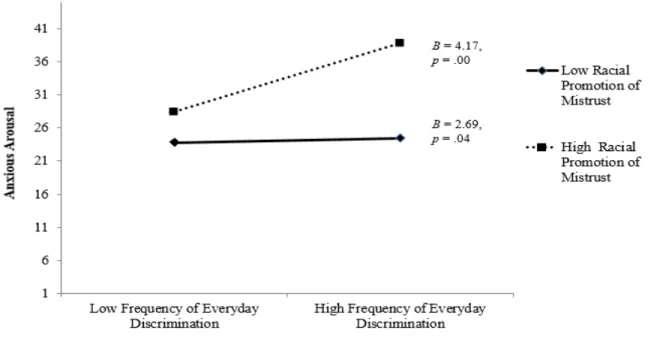
socialization with respect to both ethnicity and race. Such studies may also elucidate the role of ethnic and racial socialization as potential risk and/or protective factors in the functioning of Black immigrant descended youth who encounter discrimination. The first aim of the current study was to separately explore the factor structure of an ethnic and racial socialization measure to assess whether they replicated the 3-factor structure of Hughes & Chen’s (1997) original measure. Employing a sample of 186 participants of Black immigrant descent, the exploratory factor analysis revealed that the 3-factor structure replicated across both the ethnic and racial socialization measures. The intercorrelations between the two measures demonstrated that they were not redundant; rather, the two measures were able to capture distinct aspects of racial and ethnic socialization, respectively. Employing the same sample of Black immigrant-descended youth, the second aim of this study sought to explore the potentially moderating role of ethnic and racial socialization in the relationship between perceived discrimination and psychological functioning. The findings revealed that receiving few ethnic cultural socialization messages was associated with symptoms of anxious arousal when faced
with discrimination. This exacerbating effect was not as strong when participants reported receiving more frequent ethnic cultural socialization messages. Additionally, participants who received few racial preparation for bias messages also reported symptoms of anxiety when faced with discrimination. However, this moderating role was less influential under conditions of frequent racial preparation for bias. Lastly, participants who reported receiving a high frequency of ethnic promotion of mistrust messages directed at non-ethnic group endorsed symptoms of anxiety when faced with discrimination. The same was true for participants who reported receiving a high frequency of racial promotion of mistrust messages directed at non-racial group members. However, the moderating effect was not as strong under conditions of infrequent ethnic or racial promotion of mistrust messages. These findings provide preliminary evidence that ethnic and racial socialization may have differing implications for outcomes among individuals of Black immigrant descent. This suggests that future studies should separately examine ethnic and racial socialization, as well as their associated correlates, rather than confounding these two concepts. Additional findings and suggestions for future research are also discussed.
To my mother, Marie Dina Joseph, and late father, Edmond Joseph, as well as my Maker, All Mighty God: “I can do all things through Christ who strengthens me” (Philippians
Acknowledgements
I would like to extend a very special thanks to my advisor, Dr. Carla D. Hunter, for her unparalleled guidance and mentorship over the years. I would like to also acknowledge the members of the Cultural Heritage and Racial Identity Lab for lending their expertise and support throughout the years: Andrew D. Case, Yara Mekawi, Zhenni Wang, and Natalie N. Watson. I also extend many thanks to Dr. Nathan Todd, Emily Dworkin, and Ida Salusky for their assistance on this project. Additionally, I would like to thank my dissertation committee for their support: Dr. Mark Aber, Dr. Nicole Allen, Dr. Michael Kral, and Dr. Helen Neville. Also, I offer many thanks to my family, friends and spiritual leaders (Apostle & Prophetess Nesbitt) for their constant source of
encouragement. Lastly, I am indebted to the research participants of this study who made this work possible.
Table of Contents
Background and Overview……….…..……..1
Chapter 1: Literature Review .…...……….………..….…4
Chapter 2: Methods ……….………..……22 Chapter 3: Results ………..………...………28 Chapter 4: Discussion ………..……….42 References……….………...…..54 Appendix.………..……….61 Measures………..…76
Background and Overview
Within the socialization literature, there are considerable interests in Black children’s socialization to race and ethnicity and the implications of this socialization for subsequent outcomes (Boykin & Toms, 1985; Hughes, Witherspoon, Rivas-Drake, West-Bey, 2009; Rivas-Drake, Hughes, & Way, 2009). Ethnic-racial socialization—which includes cultural socialization messages, preparation for bias messages, and promotion of mistrust messages—was a term coined by Hughes and colleagues in their 2006 review that described messages that socialize individuals about their racial and ethnic group’s heritage and traditions, as well as messages that alert individuals to prejudice and provide strategies for how to cope. Cultural socializationmessages provide information regarding the cultural customs and traditions specific to one’s ethnic or racial heritage. These messages promote pride in one’s ethnic or racial background and may be deliberate, as in explicit conversations, or implicit, such as the display of artwork around the home that is characteristic of that particular culture. Preparation for bias messages inform individuals about racism and discrimination and provides coping strategies when confronted with such encounters. Promotion of mistrust messages encourage distrust or wariness of out-group members, but do not provide messages on how to cope with discrimination. Among ethnic minorities, promotion of mistrust messages may be directed at majority group members (i.e., Whites), or they may be directed at other oppressed minority groups.
Current studies have found that ethnic-racial socialization has important implications for African American adolescents’ psychological and social functioning, including identity development and academic functioning (Hughes, Witherspoon,
Rivas-Drake, West-Bey, 2009; Rivas-Rivas-Drake, Hughes, & Way, 2009). However, growing awareness of the ethnic diversity within the racial group in psychological functioning demonstrates that, when compared with African American adolescents, Black immigrant-descended youth display greater psychological vulnerability to perceived discrimination (Seaton, Caldwell, Sellers, & Jackson, 2008). This suggests that ethnic-racial
socialization may also play a role in Black immigrant descendants psychological functioning. However, few studies to date have investigated the type of socialization messages transmitted by members of various Black ethnic groups—particularly in households with recent immigrant ancestry (e.g., Jamaica, Nigeria, Haiti, and Ethiopia). Instead, studies often gloss over the within-group diversity of the racial group. This communicates an implicit assumption that the socialization experiences of racially Black individuals will not significantly differ across the various ethnic groups, nor will these distinct socialization experiences have divergent implications for subsequent outcomes.
Thus, systematic research is needed examining Black immigrant-descended youth’s socialization with respect to both ethnic and racial socialization in order to capture the totality of their socialization experience. In so doing, this will allow for a thorough examination of the role of socialization in the psychological functioning of Black immigrant-descended youth. One aim of this study is to extend the socialization literature by exploring whether the socialization practices within Black immigrant households are accurately captured by current conceptualizations of ethnic-racial
socialization. Chapter 1 provides an overview of the socialization literature and describes the adaptation of a current socialization measure that may potentially capture the
In assessing the socialization experiences of Black-immigrant descended youth, important information can be garnered regarding the role of socialization in their
psychological functioning, particularly the role that socialization plays in the presence of racial discrimination. As previously mentioned, Black immigrant-descended youth display greater psychological vulnerability to perceived discrimination when compared to their African American peers (Seaton et al., 2008). Investigations focused on the roles of ethnic and racial socialization as protective and risk factors associated with Black
immigrant-descended youth’s psychological functioning in the face of discrimination is timely. Thus, the second aim of this study will be to utilize the adapted socialization measure to explore associations between socialization and perceived discrimination on Black immigrant-descended youths’ psychological functioning.
Chapter 1: Literature Review
Disentangling Race from Ethnicity in Theory and Measurement
Socialization has been defined as a process whereby children learn the necessary social, emotional and cognitive skills for successfully functioning in society (Grusec & Davidov, 2010). Grusec and Davidov (2010) propose that the domains of socialization in relation to parent-child interactions are universal and can be seen across cultures. These domains of socialization include control, participation, protection, reciprocity, and guided learning. The guided learning domain characterize interactions where parents provide instruction and promote the mastery of a particular skill or knowledge base. This type of socialization consists of messages regarding the values, beliefs, and practices of a
particular cultural group—namely, ethnic and racial socialization. These socialization messages may have implications for children’s development in terms of behaviors and outcomes. Furthermore, while parenting practices may be universal and applicable to the broader human experience, the culture of the parent or caregiver may influence the frequency of use, meaning, goals, and consequences of a particular domain of
socialization (Grusec & Davidov, 2010). Thus, in understanding the role of socialization practices within Black families, studies are needed identifying the within-group variance that may exist with respect to ethnic and racial socialization practice. This will then allow researchers to examine the correlates of ethnic-racial socialization and outcomes of interest.
The socialization literature exploring the practices of African Americans have found that parents’ views regarding race and racial group membership predict the types of socialization messages they transmit to their children (Barr & Neville, 2008; Scottham
& Smalls, 2009). Thus, it is important to consider Black immigrants’ views regarding race and racial group membership to better understand how these views may influence their socialization practices. However, Black immigrants’ experiences in their countries of origin also play an important role in their conceptualization of group membership and the implications of racism; yet, their experiences may go overlooked in studies that view Blacks as a homogenous group (Hunter, 2008). Despite similarities in phenotype (i.e., skin color) and shared African ancestry, Black immigrants’ experiences in their countries of origins may influence the content and nature of the ethnic socialization they transmit to their children. Foreign born Blacks typically migrate from countries where Blacks
compose the racial majority. Given their experiences in societies where they were the numerical majority they may 1) define the in-group in terms of ethnicity rather than race (or their ethnic group membership may be more central to their self-concept/more salient than their racial group membership), 2) possess inaccurate views regarding African American culture, 3) experience tensions within the Black community in the US as the rate of their population increases, and 4) minimize the hindering effects of racism on social advancement. The influence of these aforementioned characteristics on Black immigrant parents’ socialization practices, as well as the need for socialization measures that accurately reflect these nuances, will be explored in-depth in the following sections. This section concludes by proposing a revised socialization measure that assesses both ethnic and racial socialization.
Black Immigrants’ In-group/Out-group Distinction
Black immigrants typically migrate from countries that are predominantly Black in terms of population. In these societies, group membership is defined in terms of
affiliation with a particular nation (i.e., Jamaican, Haitian, Bahamian). As Black immigrants settle in the U.S. in search of educational and occupational attainment for their families, their nationality is often referred to as their “ethnicity.” Additionally, in the U.S. context, their racial group membership becomes the dominant classification of group membership, irrespective of whether Black immigrants define themselves in this manner (Waters, 1999). Indeed, in previous studies, Black immigrant participants have reported feeling a greater affinity to their ethnic group and may try to dissociate
themselves from the negative stereotypes they perceive to be associated with African Americans (Rogers, 2001; Waters, 1999). Thus, Black immigrants view members of their in-group as those who share their ethnicity or an immigrant background. Individuals, such as African Americans, who do not share these characteristics, are viewed as out-group members, irrespective of whether they share the same racial background (Rogers, 2001). To the extent that Black immigrants view
African-Americans as a distinct and separate group, the socialization messages they provide will include messages about out-group members (i.e., African Americans).
This in-group/out-group distinction made along ethnic (i.e., Haitian, Jamaican, Nigerian), rather than racial, lines plays a role in terms of the nature of socialization messages Black immigrants provide to their children. In particular, Black immigrants will be more likely to encourage their children to adopt the culture of their ethnic group, rather than the racial group. Indeed, prior research querying Black immigrant-descended youth about their ethnic and racial socialization has found that they received different frequencies of ethnic socialization versus racial socialization in their households—with a preference given to ethnic socialization (Joseph & Hunter, 2011). Thus, the children of
Black immigrants are likely to receive cultural socialization messages (i.e., messages that promote pride and knowledge of the cultural group) primarily pertaining to their
ethnicity.
Black Immigrants’ Mis-education regarding African American culture
Black immigrants may be more likely to provide cultural socialization regarding their ethnic group, rather than their racial group, because they more closely identify with other members of their ethnic group. However, another reason why Black immigrants do not provide much cultural socialization about the racial group is that they are less familiar with African American culture. In particular, Black immigrants may be unfamiliar with the experiences, beliefs, values, and preferences of African Americans. Consequently, they may refrain from providing cultural socialization messages about the racial group or provide misinformation regarding the group. This is consistent with the findings of an earlier study by Joseph & Hunter (2011), where participants of Caribbean descent
reported receiving little to no cultural socialization messages about their racial group, but, instead, received messages that promoted a mistrust of other racial group members— specifically, African Americans.
Black Immigrants and the Experience of Tension within the Black Community Given their lack of information about African American culture, it is not surprising then that Black immigrants may be misinformed about African American culture. They may transmit these biased messages to their children in the form of promotion of mistrust messages. Typically in the African American socialization
literature, promotion of mistrust messages are directed at individuals outside of the racial group; however, Black immigrants may encourage their children to be wary of
individuals outside of their ethnic group, such as African Americans (Hine-St. Hilaire, 2006; Rong & Brown, 2005). Many of these negative messages regarding African Americans may be gleaned from American media outlets where negative images of African Americans are over-represented. However, some of these biased views may come from their interactions with other African Americans. In her ethnographic study exploring the experiences of Black immigrants, Waters (1999) discusses how Caribbean immigrants and African Americans would at times experience tension due to the
preferential treatment of White employers towards foreign-born Blacks. In contexts where Black immigrants and African Americans are pitted against one another in competition for resources, attitudes of distrust and animosity may arise. Black immigrants who encounter negative stereotypes or negative experiences with their African American peers may transmit messages to their children that encourage distancing from individuals outside of their ethnic group, such as African Americans. Black Immigrants and the Minimization of the Implications of Racism
Black immigrants’ experience of discrimination in their countries of origin and in the U.S. may not parallel the experiences of their U.S. born children. Thus, Black immigrant parents’ socialization messages may not effectively prepare Black immigrant-descended youth for the bias they may encounter in the racially hierarchal context of the U.S. In countries where Blacks make up the numerical majority, it is a common occurrence to see members of the racial group occupying a variety of powerful positions in society (i.e., education, law enforcement, and government). In these societies, cultural, institutional, or individual discrimination based on one’s racial group membership are not perceived as impediments to one’s upward advancement. Even so, these societies are not immune to
issues of class bias. Yet, the prevailing notion in these meritocratic societies is that if one works hard enough, she or he will invariably experience success. These Black
immigrants hold tight to this belief as they migrate to the U.S. in hopes of attaining success for themselves and their families.
The notion that hard work will invariably lead to success may not generalize to U.S. society where Blacks are not the numerical majority and hold 9% of the seats in state legislator, despite the election of a president with African ancestry (National Black Caucus of State Legislators, 2009). Despite their minority status, Blacks in the United States made up 37.8% of the prison inmate population (Minton, 2010), had an
unemployment rate of 16.2% compared to the national average of 9.1% (Bureau of Labor Statistics, 2011), and, in the 2009-2010 school year, graduated from high school at a rate of 66.1% (U.S. Department of Education, 2012). Thus, in the U.S. context, it is possible that institutional, cultural, or individual racism may hinder forward progression and contribute the gaps in academic and other social domains, despite one’s best efforts.
Given some Black immigrants’ beliefs of meritocracy, which may not be congruent with the U.S. context, they may be less prepared to socialize their children on how to cope with racism they may encounter in the U.S. In a study by Anglin and colleagues (2006) comparing the socialization experiences of participants who self-labeled as African American, West Indian, and African they found that participants who identified as African American were more likely to report being educated on how to use their cultural knowledge to “survive” the hostile experiences of racial bias. Conversely, participants who identified as West Indian reported receiving messages that made them aware of the struggles associated with racism, but received few messages on how to use
their cultural knowledge to “survive” these experiences. Similar results were found among a sample of adolescents of Haitian descent (Joseph & Hunter, 2011). While some participants reported receiving preparation for racial bias messages that educated them about discrimination directed at their racial group, their parents also encouraged them to be wary of African Americans. Additionally, their parents did not provide them with racial cultural socialization messages that would instill a sense of pride in their racial group in contrast to society’s negative stereotypes about the racial group. So, while Black immigrant descended youth may receive some messages that alert them to racism, they may not receive racial cultural socialization messages that encouraged them to maintain a positive self-concept of their racial group in the face of discriminatory experiences.
Description of the First Study Aim: Preliminary Analysis of the Revised Socialization Measure
This review of the literature highlights the need for a socialization measure that captures the socialization experiences of Black immigrant-descended children. In particular, it underscores the need for socialization measures to capture the degree to which Black immigrant parents transmit cultural socialization regarding ethnic group membership, as well as racial group membership. In addition, socialization measures must be able to capture promotion of mistrust messages directed at individuals outside of Black immigrants’ ethnic group, rather than solely racial group, since in-group/out-group status may be defined by ethnic-group membership. Measures that do not account for the aforementioned characteristics of Black immigrant socialization (i.e., addressing both racial and ethnic socialization messages) will not capture the totality of Black
immigrant-descended youth’s socialization and will be a less effective measure for understanding the role of socialization messages in discrimination and psychological functioning.
Thus, I propose the adaptation of Hughes and Chen’s (1997) widely used measure of socialization. The adapted version of Hughes and Chen’s measure (Hughes, Witherspoon, Rivas-Drake, West-Bey, 2009) will be re-worded to be applicable for individuals across various ethnic and racial groups. In particular, the items in the original measure ask respondents to report socialization messages about their “ethnic/racial background.” Thus, the measure uses the terms “ethnic’ and “racial” interchangeably. However, as noted in the literature review, Black-immigrant descended youth have reported receiving distinct messages regarding members of their ethnic or immigrant group (i.e., Haitians, Jamaicans, or Nigerians) and members of their racial group (i.e., African Americans). Thus, items from the original measure will be modified to capture messages directed around the ethnic group separately from messages directed at the racial group. The first aim of this study will explore three types of socialization messages that have been previously identified: cultural socialization messages, preparation for bias messages, and promotion of mistrust messages. These socialization messages have often been the focus of prior studies exploring socialization (Hughes & Johnson, 2001; Hughes, Witherspoon, Rivas-Drake, West-Bey, 2009; Rivas-Drake, Hughes, & Way, 2009). These socialization messages also emerged in Joseph and Hunter’s (2011) qualitative investigation of
Haitian-descended adolescents’ socialization experiences. This suggests that these categories are present across cultural groups, but that the content and frequency of these messages may reflect idiosyncrasies reflective of Black immigrant socialization practices.
Given these distinct variations in Black immigrant socialization, the cultural socialization subscale will be modified to represent cultural socialization messages regarding the ethnic group, as well as the racial group. The preparation for bias subscale will also be modified to assess for messages on how to cope for ethnic and racial bias in particular, since the review of the literature suggests that Black-immigrant descended adolescents may receive a paucity of these messages. Lastly, in addition to assessing for messages that promote a mistrust of individuals outside of the racial group, the promotion of mistrust subscale will be modified to also assess for messages that encouraged
wariness of individuals who do not share Black immigrants’ ethnic group membership (i.e., African Americans). This adapted measure will be tested to assess its psychometric properties, factor structure, and validity.
Thus, the first aim of this study is to investigate whether the three-factor solution put forth in the literature (Hughes & Chen, 1997; Hughes & Johnson, 2001; Hughes, Witherspoon, Rivas-Drake, West-Bey, 2009) will replicate in the presently adapted measures, which assessed the ethnic and racial socialization experiences separately.
The second aim of this study is to utilize these adapted measures to explore the moderating role of ethnic and racial socialization in the associations between perceived discrimination and psychological functioning among Black immigrant-descended youth.
Utilizing the Revised Socialization Measure to Assess for Moderating Effects on the Relationship between Perceived Discrimination and Psychological Functioning
In view of the psychological vulnerability demonstrated by Black-immigrant descended youth who encounter discrimination (Seaton et al, 2008 and 2010), additional
research is needed to further explore the nuances of the associations between their ethnic and racial socialization, discriminatory experiences, and psychological outcomes. Utilizing the adapted socialization measure from the preliminary analyses, this study will explore the interactions between ethnic and racial socialization and perceived
discrimination on the outcomes of Black-immigrant descended youth.
The Interplay between Ethnic and Racial Socialization and Perceived Discrimination on Psychological Functioning
Studies with African American adolescents have found that a lack of racial socialization messages coupled with frequent experiences of discrimination may leave youth vulnerable to the negative impact of racial discrimination. In particular, youth may be less prepared to deal with the realities of racism, and therefore more vulnerable to the psychological impact of racial stigmatization. For example, Fisher and Shaw (1999) found that African Americans who reported frequent discriminatory experiences, but few preparation for bias messages that prepared them for the realities of racism, experienced poor psychosocial functioning. Conversely, Neblett and colleagues (2008) found that African Americans who reported high levels of racial discrimination, as well as frequent racial socialization messages, exhibited significantly less perceived stress and less problem behaviors than adolescents who had different socialization profiles.
Similarly, Black immigrant-descended youth, who reported high levels of perceived discrimination and few messages on how to cope with racism, were less
prepared to cope with experiences of racism and therefore more vulnerable to its negative sequelae (Joseph &Hunter, 2011). For instance, a study conducted by Seaton and
of perceived discrimination as their African American peers, reported significantly higher levels of depressive symptomatology than African Americans. This may especially be true for girls of Black immigrant descent. According to a review of the socialization literature by Hughes and colleagues (2006), prior studies have produced mixed results with some studies suggesting no gender differences in the socialization transmitted by parents, while other studies conducted with African American samples reporting that girls typically receive fewer messages that prepare them for racial bias than boys. In light of prior studies that have found gender differences in the frequency of preparation for bias messages among African Americans, it is possible that Black immigrant-descended girls may receive even fewer messages that prepare them for racial bias than their African American peers given that Black immigrant parents are found to minimize the frequency and impact of racism. Indeed, in a different study conducted by Seaton and colleagues (2010), they found that the intersection of Caribbean girls’ ethnicity and gender made them significantly more vulnerable to the psychological effects of perceived
discrimination (i.e., higher depressive symptoms and lower life satisfaction) than their African American and male Caribbean peers. Thus, high levels of perceived
discrimination paired with low frequency of preparation for bias messages may hinder the ability of Black immigrant youth, particularly girls, to face discrimination, which may subsequently affect their functioning.
While the aforementioned studies (Fisher & Shaw, 1999; Neblett et al., 2008) display a pattern of socialization serving as a buffer in the relationship between perceived discrimination and psychological outcomes, other studies exploring the moderating role of socialization have not always produced significant findings. In particular, some
studies found that socialization did not buffer the relationship between perceived discrimination and psychological functioning (Dotterer et al., 2009, Huynh & Fuligni, 2010; Neblett, 2006). The mixed findings in the socialization literature may be an artifact of how socialization is measured—that is, the potentially distinctive effects of ethnic socialization and racial socialization are confounded, rather than examined separately.
Thus, this study seeks to build on the current body of literature by exploring the nuanced effects of ethnic versus racial socialization in the relationship between perceived discrimination and psychological functioning.
Perceived Discrimination and Psychological Functioning
Studies have often examined anxiety and depressive symptoms as possible correlates of discrimination with a number of studies providing supporting evidence (Banks, Kohn-Wood, & Spencer, 2006; Burrow & Ong, 2010; Gaylord-Harden & Cunningham, 2009; Tynes et al., 2012). In terms of depressive symptoms, Coker and colleagues (2009) queried fifth-grade students of varying backgrounds about their experiences of discrimination. They found that children who reported perceived ethnic and racial discrimination had a higher likelihood of endorsing symptoms of depression when compared to children who did not report experiences of discrimination. Simons and colleagues (2002) reported similar findings in that racial discrimination emerged as one of the individual-level variables associated with childhood depressive symptoms among African American children ranging in age from 10-12. In a longitudinal study conducted by Greene and colleagues (2006), peer and adult discrimination was
significantly associated with increased depression over time among adolescents of color.
Studies have also examined the relationship between anxiety symptoms and perceived discrimination. In their study exploring the relationship between perceived discrimination and generalized anxiety disorder (GAD) among African Americans, Caribbean Americans, and European Americans, Soto and colleagues (2011) found that the more discrimination participants reported experiencing, the greater their odds of developing GAD at some point in their lifetime, irrespective of background. McLaughlin and colleagues (2010) reported similar findings in that individuals who experienced discrimination in the prior year exhibited elevated odds of 12-month anxiety disorders, as assessed by the DSM-IV, irrespective of one’s racial background, ethnicity, gender, or sexual orientation. While not formerly assessing for psychopathology utilizing a diagnostic interview, Carter and colleagues (2010) found similar results in that participants of color who endorsed experiences of racial discrimination reported significantly higher mean scores of anxiety than those who did not experience discrimination.
Taken together, these findings suggest that anxiety and depressive
symptomatology are important outcomes in assessing the psychological impact of discrimination. The present study seeks to extend upon this work, as well as the studies conducted by Seaton and colleagues (2008, 2010), by exploring the role of ethnic and racial socialization messages in the relationship between perceived discrimination and psychological functioning. While Seaton and colleagues measured psychological functioning in terms of depressive symptoms, this study will assess psychological functioning in terms of levels of anxious arousal and anhedonic depression.
Description of the Second Study Aim: Exploring the Moderating Role of Socialization Messages
For the second aim of this study, I will explore how experiences of racial discrimination and associated psychological functioning are buffered or exacerbated by ethnic and racial socialization messages. In investigating the factors that influence the effect of perceived discrimination on outcomes, it is important to examine the role of both individual-level factors, such as one’s perceptions of discrimination, as well as the influence of one’s social context—for example, the messages one receives from parents regarding ethnic and racial socialization. This approach is informed by Bronfenbrenner’s ecological model (1979) which acknowledges the mutual influence between the
individual and the immediate setting in which the person resides—or the “person-in-context.” Utilizing this framework, this study will examine the interaction of perceived discrimination at the individual-level with participants’ socialization context—
specifically, the socialization they received from their parents and/or caregivers regarding the Black immigrant group (ethnic socialization) and the African American group (racial socialization). It is proposed that the interactive effect of perceived discrimination and socialization may serve as either a stress-buffer or stress-magnifier on one’s
psychological functioning.
Overall, the extent to which perceived discrimination is positively or inversely related to one’s psychological functioning will depend on the nature and frequency of the socialization message received. Hypotheses regarding this interactive effect between perceived discrimination and racial socialization on psychological functioning will be presented below. Additionally, although there is a dearth of studies disentangling the role
of ethnic socialization regarding the Black immigrant group on psychological
functioning, tentative hypotheses will be presented regarding ethnic socialization. This study will use hierarchical multiple regression analyses assessing the 2-way interaction effects between perceived discrimination and ethnic and racial socialization, respectively (i.e., racial cultural socialization, ethnic cultural socialization, preparation for racial bias, preparation for ethnic bias, promotion of mistrust of non-Blacks, promotion of mistrust of non-Black immigrants) on psychological functioning (depressive symptomatology and anxious arousal).
Hypotheses regarding the effects of perceived discrimination and psychological distress in the presence of ethnic socialization
It is likely that adolescents who frequently receive messages promoting pride in Black immigrant culture (ethnic cultural socialization messages) will report fewer
depressive and anxiety symptoms than adolescents who report lower frequencies of these messages.
1. Thus, it is hypothesized that adolescents who frequently receive ethnic cultural socialization messages will report fewer depressive and anxiety symptoms than adolescents who report lower frequencies of these messages. 2. Furthermore, it is also hypothesized that high levels of ethnic cultural
socialization messages will act as a stress-buffer between perceived discrimination and depression, as well as anxious arousal.
As previously stated, Black immigrants may have the tendency minimize the implications of discrimination. Given this, Black immigrant parents may feel less
immigrant descent. Consequently, messages that inform participants of the Black immigrants may face (preparation for ethnic bias) may not be a salient aspect of their socialization experience and, therefore, may not significantly correlate with the other study variables.
3. Thus, it is hypothesized that there will not be a main effect of preparation for ethnic bias on depression, as well as anxious arousal.
4. In view of this hypothesized null main effect, it is not likely that preparation for ethnic bias will significantly interact with perceived discrimination in predicting depression, as well as anxious arousal.
Lastly, it is possible that messages that promote a mistrust of individuals outside of the Black immigrant group will distance Black-immigrant descended youth from other Blacks who may have provided insight regarding possible coping strategies in the face of discrimination, messages which these adolescents may not receive in the home setting. Thus, these promotion of mistrust messages may act as a stress-magnifier between perceived discrimination and psychological functioning.
5. Thus, it is hypothesized that adolescents who report receiving messages that promote a distrust of Black non-immigrant group members (i.e., African Americans; promotion of mistrust of non-ethnic group members) will report more depressive and anxiety symptoms than adolescents who do not
frequently report receiving these messages.
6. It is also hypothesized that high levels of promotion of mistrust messages directed at individuals outside of the Black immigrant group will act as a
stress-magnifier between perceived discrimination and psychological functioning.
Hypotheses regarding the effects of perceived discrimination and psychological functioning in the presence of racial socialization
In terms of racial socialization, messages that promote an understanding of African American culture (racial cultural socialization) will not likely be a salient aspect of participants’ socialization experience and, thus, will not significantly predict anxious arousal and depressive symptoms.
1. Thus, it is hypothesized that racial cultural socialization messages will not significantly predict psychological functioning.
2. It follows, then, that racial cultural socialization will not interact with perceived discrimination in predicting anxious arousal and depressive symptoms.
In terms of preparation for racial bias, Black immigrant parents may be less likely to convey messages that prepare youth for racism; however, participants’ phenotypically dark skin will likely increase the likelihood that they will encounter racism. Thus, it is likely that receiving little to no messages preparing participants for the realities of racism will be associated with more anxious arousal and depressive symptoms, while higher frequency of these messages will be associated with less of these symptoms.
3. Thus, it is hypothesized that receiving little to no messages preparing
arousal and depressive symptoms, while higher frequency of these messages will be associated with less symptoms.
4. Given this, it is hypothesized that low levels of preparation for racial bias messages will act as a stress-magnifier between perceived discrimination and psychological functioning (i.e., anxious arousal and depressive symptoms). Although studies have not typically explored the role of promotion of mistrust messages, it may be the case that adolescents who report receiving messages that promote a distrust of non-racial group members (i.e., Whites) without offering strategies for coping with racial bias (promotion of mistrust of non-racial group members) may report high levels of depressive and anxiety symptoms when faced with perceived racial
discrimination than adolescents who do not frequently report receiving these messages. 5. Thus, it is hypothesized that adolescents who report receiving messages that
promote a distrust of non-racial group members will report higher levels of depressive and anxiety symptoms than adolescents who do not frequently report receiving these messages.
6. In terms of the interactive effect, it is hypothesized that high levels of promotion of mistrust messages directed at individuals outside of the racial group will act as a stress-magnifier between perceived discrimination and psychological functioning (i.e., anxious arousal and depressive symptoms).
Chapter 2:Methods Participants
The sample included 186 participants (115 women, 71 men) who ranged in age from 13 to 29 (M = 19.43, SD = 5.94). Participants in the sample included individuals who 1) racially self-identified as Black and 2) reported being an immigrant or having one or both parents who are immigrants. Of the participants who reported their ethnic
background (n = 153, 82.3%), the most highly identified backgrounds included Haitian (n = 31; 20.3%), Nigerian (n = 27; 17.6%), Jamaican (n = 27; 17.6%), Congolese (n =20; 13.1%), and Belizean (n = 28; 11.8%). The sample was composed of both first-generation immigrants who migrated to the U.S. (n = 68) and second-generation immigrants who were born in the U.S. (n = 118). For first-generation immigrants, the average age of arrival was 13 (SD = 5.91). On average, participants were in their senior year of high school (M = 12.34, SD = 2.45). Of the participants currently attending school, 58.5% (n = 79) report currently pursing college or post-baccalaureate degrees. On average, participants reported that their parents’ household income ranged from $40,000 to $49,999. A majority of participants reported that their mother (n = 105, 56.5%) and/or father (n = 100, 53.8%) worked full time. Twenty-nine participants reported that their parents worked part time
Procedures
This study utilized a number of sampling strategies. The sampling was criterion-based in that the study seeks to recruit participants of Black immigrant descent. In order to recruit additional participants, participants who have already taken part in the study were asked to refer other individuals who met criteria for the study (snowball sampling).
In addition, I explored individuals in my personal network, as well as the networks of the research team, for other individuals who meet criteria for the study. Assent was obtained from participants under age 18 and consent was obtained from their parents/caregivers. Surveys were primarily administered in-person to participants. Individuals were
provided with $10 as compensation for their participation in the study. Data were then entered into the SPSS statistical software program (version 21) for storage and analysis. Site Selection
Research with Black immigrants in geographic regions of the U.S. with smaller populations of foreign born Blacks (i.e., Champaign-Urbana) presents various challenges. In particular, it is often difficult to locate a critical mass of Black immigrants in one
particular city. Thus, it becomes necessary to travel to multiple cities in order to recruit participants and collect sufficient data for subsequent analyses. In meeting this
recruitment goal, data was collected from three neighborhoods in Chicago and its surrounding suburbs which boast growing Black immigrant populations according to 2000 U.S. Census data: Uptown, Roger’s Park, and Evanston. These neighborhoods have served as recruitment sites for my Master’s research and subsequent projects, thus I am already familiar with the gatekeepers and data collection sites in these communities. The sister towns of Champaign, Illinois and Urbana, Illinois also boast a small, but growing population of Black immigrants and I have been able to recruit from this population for prior and ongoing projects. I utilized selective purposive sampling in that I recruited individuals of Black immigrant descent at various Caribbean and African churches, festivals, and organizations. The gatekeepers of these various settings were approached and given an overview of the nature of the study. Whenever possible, I tried to make
contact with these gatekeepers through a mutual acquaintance in order to assist with rapport-building. Gatekeepers were informed that data would be collected through the use of in-person surveys. The topic of reciprocity was discussed and negotiated with each of the gatekeepers (i.e., creating a report of the findings, etc).
Measures
The questionnaire packet included a demographic questionnaire, as well scales assessing perceived discrimination, ethnic and racial socialization, depressive
symptomatology, and anxious arousal.
Ethnic and racial socialization. Ethnic and racial socialization was assessed utilizing an adaptation of Hughes and Chen’s (1997) socialization measure. The measure assesses three domains of socialization messages: cultural socialization, preparation for bias, and promotion of mistrust messages. All items utilize a 5-point Likert-type scale (1=Never, 5= Very Often) with higher subscale scores indicating greater frequency of socialization messages. For this study, the measure was adapted to assess for these three domains of socialization for both the ethnic and racial group respectively. Ethnic cultural socialization comprises of 9 items that ask participants to indicate how often their parents provided information regarding the cultural traditions, practices, and history of the ethnic group (“How often have your parents encouraged you to read books about the history or traditions of your parents’ birth culture [i.e., Haiti, Nigeria, Trinidad, Ethiopia, etc]”). The racial cultural socialization scale also contains 9 items and asks participants to indicate how often parents provide information regarding the cultural traditions,
to read books about the history or traditions of Black Americans1”). The preparation for
ethnic bias subscale contains 12 items and assesses for messages that alert participants to the prejudice they may encounter as a member of their immigrant group, as well as providing coping strategies for handling bias (“How often have your parents talked to you about poor treatment against people who are Black immigrants”). The preparation for racial bias subscale also consists of 12 similarly worded items that assess for
messages alerting participants to the prejudice they may encounter as a member of their racial group, as well as coping strategies (“How often have your parents talked to you about how to handle situations where you are treated unfairly because you are viewed as Black American”). The promotion of mistrust of non-Blacks subscale contains 5 items assessing for messages that encourage a wariness of individuals outside of the racial group (e.g., “How often have your parents mentioned it is a bad idea to date [or go out with] someone who is not Black American [for example: a White person]”). The last subscale, promotion of mistrust of non-Black immigrants subscale comprises of 5 items measuring the frequency that participants receive messages that discourage them from associating with individuals outside of their Black immigrant group (e.g., “How often have your parents done or said things to keep you from trusting other kids who are not of your same Black immigrant background [for example: Black American kids]”).
Perceived discrimination. Perceived discrimination was assessed utilizing the Everyday Discrimination Scale (Williams, Yu, Jackson, & Anderson, 1997). The original 10-item measure was modified by Seaton and colleagues (2008) to include 3 questions assessing participants’ perceptions of teacher discrimination. Participants are
1
Although “African American” is used synonymously with “Black American,” I chose to use the term “Black American” in the measures to signify participants’ racial group membership based on information from prior research with Black immigrant descended youth (Joseph & Hunter, 2011).
asked to rate the frequency with which they have encountered discrimination in daily life. Sample items include “People act as if they are afraid of you” and “Your teachers act as if they think you are not smart.” This measure utilizes a Likert-type scale (1 = never to 6 = almost every day) with higher scores indicating a higher frequency of events in the past year.
It may be possible that participants high in trait negative affect will be more likely to perceive everyday discrimination. To account for this potential confound, participants also completed the Negative Temperament subscale from the General Temperament Survey (GTS; Watson & Clark, 1993) to assess trait negative affect. The 28-item Negative Temperament subscale utilizes a “True/False” rating system with higher
subscale scores indicating greater negative mood and self-concept. Sample items include “Sometimes I feel “on edge” all day” and “Small annoyances often irritate me.”
Psychological Functioning. Psychological functioning was assessed utilizing the Mood and Anxiety Symptom Questionnaire (MASQ; Watson, 1991; Watson et al., 1995). This measure asks participants to indicate the frequency of symptoms they experienced in the past week. Participants’ responses on the 5-point Likert-type scale can range from experiencing the symptoms not at all to extremely with higher scores reflecting a greater occurrence of symptoms. The Anxious Arousal subscale contains 17 items assessing anxiety symptoms. Sample items include “Heart was racing or pounding” and “Felt faint.” The Anhedonic Depression subscale contains 22 items assessing depressive symptoms. Sample items include “Felt really slowed down” and “Felt withdrawn from other people.” Given that the anhedonic depression subscale was not correlated with the
predictor variable perceived discrimination (r = .09, p = ns), subsequent analyses will utilize anxious arousal as the dependent variable.
Power Analysis
An a priori power analysis was conducted utilizing the G* power program (Faul, Erdfelder, Lang, & Buchner, 2009) to compute the sample size needed for subsequent analyses that will include 8 predictor variables (5 main effects: negative affect, perceived discrimination, cultural socialization, preparation for bias, promotion of mistrust; 3 two-way interactions: everyday discrimination X cultural socialization, everyday
discrimination X preparation for bias, everyday discrimination X promotion of mistrust)2.
The type I error was set at .025 to account for the fact that these analyses would be conducted for both the ethnic socialization and racial socialization measures. An effect size of 0.15 was specified, which is considered a medium effect size (Cohen, 1992). A sample size of 181 was recommended; thus, the sample size of the current study is adequate.
2 I did not test the interaction terms for cultural socialization X preparation for bias, cultural socialization X promotion of mistrust, and preparation for bias X promotion of mistrust since they were not relevant to the research questions. Additionally, negative affect was not included in the subsequent interaction tests because it served as a control variable.
Chapter 3: Results Data Analytic Strategy for the Factor Analysis
Exploratory factory analyses (EFA) were performed on the ethnic socialization and racial socialization measures, respectively, utilizing the Mplus statistical software package (Muthén & Muthén, 1998-2012; Version 7). Missing values were addressed utilizing list-wise deletion, such that any case missing data on any of the variables of interested were dropped from analyses resulting in a sample of 157 for the EFA conducted on the ethnic socialization measure and a sample of 146 for the EFA conducted on racial socialization measure. A maximum likelihood estimator was specified after determining that the measured variables did not violate the assumption of multivariate normality. The correlation row standardization method was specified and the Geomin oblique factor rotation was utilized since it does not make the assumption that the latent factors are uncorrelated. The Geomin rotation is particularly advantageous when factor indicators have substantial loadings across multiple factors (Muthén & Muthén, 1998-2012; seventh edition). Commonality estimates were allowed a maximum of 1000 iterations. The reader is referred to the following articles by Fabrigar, Wegener, MacCallum, & Strahan (1999) and Reise, Waller, & Comrey (2000) for a more in-depth discussion of best practices for factor analyses. The intercorleations across both the ethnic and racial socialization measures can be found in Table 1.
Factor Structure of the Ethnic Socialization Measure
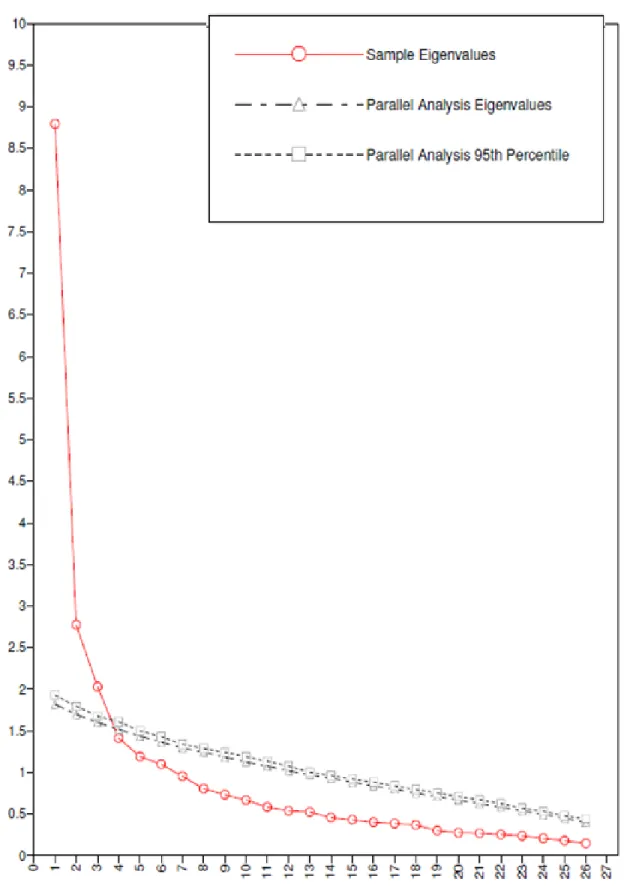
As previously stated, an EFA was performed on the 26-item ethnic socialization measure resulting in a 3-factor solution (see Table 2). Three factors constituted the most appropriate number of components as indicated by their presence on the steep slope of
the scree-plot (see Figure 1). Following the recommendation of previous scholars (Fabrigar, Wegener, MacCallum, & Straham, 1999; Reise, Waller, & Comrey, 2000), a parallel analysis was also conducted to augment the scree test in determining the appropriate factor structure. In a parallel analysis, the eigenvalues from the actual data set are compared to the eigenvalues generated from repeated random data sets with the same number of cases and variables resulting in a plot of the expected mean eigenvalues and the upper bound values of the 95% confidence interval around the mean eigenvalue. The point at which the scree plot generated from the actual data intersects with the plots from the parallel analysis provides an indication of the maximum number of factors to extract from the data. In the present study, the parallel analysis supported a 3-factor solution for the ethnic socialization measure in that the observed eigenvalues were greater than the expected mean and 95% CI upper-bound eigenvalues (see Figure 1). Amongst the three factors, items with unique factor loadings greater than or equal to.40 were retained, eliminating a total of 4 items from the initial 26-item measure resulting in a revised 22-item measure. For items that loaded at .40 and above across multiple factors, the item with the highest loading was retained for that respective factor. None of these items negatively loaded on the factors. The reliability across the three factors ranged from .83 to .88, which is acceptable by conventional standards. The intercorrelations among the factors are provided in Table 1. Overall, the three factors mirrored the three socialization subscales discussed in the literature (e.g., Hughes & Chen, 1997; Hughes & Johnson, 2001) with the factor indictors demonstrating appropriate face validity for the overarching construct of each particular factor.
The first factor consisted of 8 items (α = .84). This factor was named “Ethnic Cultural Socialization” in that it reflects messages that promote an appreciation and attachment to Black immigrant culture. The items that loaded highly onto this factor demonstrated face validity with one exception. While item nine (“talked to you about poor treatment against people of your Black immigrant background”) assesses messages that prepare one for ethnic bias, it loaded highly on the Ethnic Cultural Socialization factor. Similar loadings were found in a study by Hughes and Johnson (2001) exploring the construct validity of a slightly modified version of the Hughes and Chen (1997) racial socialization measure. This suggests that participants’ socialization to Black immigrant culture includes being given accounts of oppression faced by other group members, which is distinguished from messages that provide strategies for coping with ethnic bias (e.g., Item 6: “done or said things to prepare you to handle discrimination against your Black immigrant group”).
The second factor consisted of 6 items (eigenvalue = 3.92, α = .83). This factor was named “Promotion of Mistrust of Non-Ethnic Group Members” and captured the degree to which participants received messages discouraging them from trusting and associating with individuals who were not of Black immigrant descent. The factor items demonstrated good face validity, with the exception of item 17 (“talked to someone else about discrimination or prejudice against your Black immigrant group when you were around and could hear them”). This item has typically been conceptualized as a message preparing one to face the realities of prejudice, rather than to promote a mistrust of non-group members (Hughes & Chen, 1997; Hughes & Johnson, 2001). However, in the
present study, the factor loading did not load at .40 or above on the preparation for bias factor.
Finally, the third factor consisted of 8 items (α = .88). This factor was named “Preparation for Ethnic Bias” to reflect messages that both informed participants of the bias they may face as individuals of Black immigrant descent, while also providing them with strategies to cope with these incidents. Each of the items demonstrated good face validity and the composition of this factor resembled those found in prior studies (Hughes & Chen, 1997; Hughes & Johnson, 2001).
Factor Structure of the Racial Socialization Measure
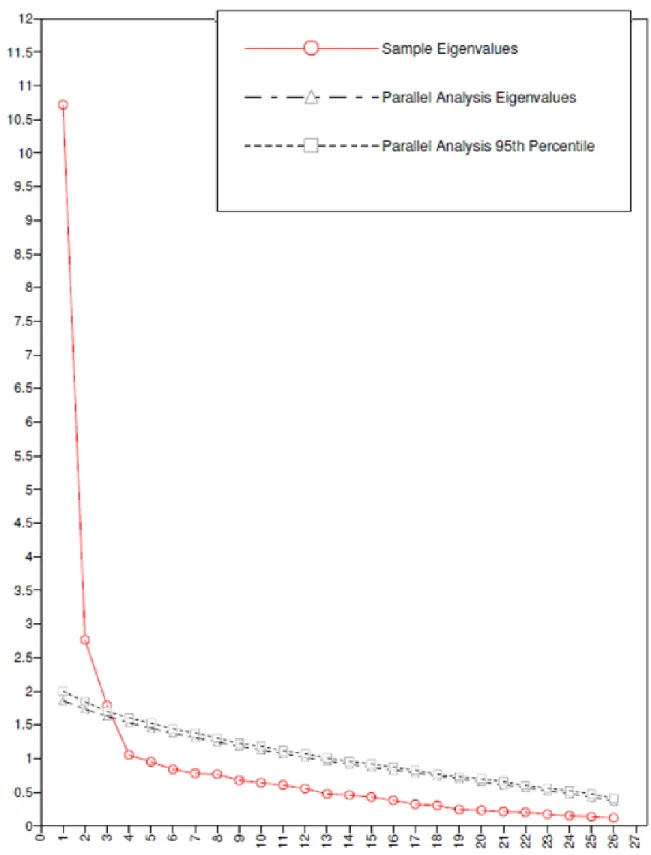
A separate EFA was performed on the 26-item racial socialization measure, which also resulted in a 3-factor solution (See Table 3). This was further supported by the scree-plot and parallel analysis (see Figure 2). Across the three factors, items with unique factor loadings greater than or equal to.40 were retained, eliminating a total of 2 items from the initial 26-item measure resulting in a revised 24-item measure. For items that loaded at .40 and above across multiple factors, the item with the highest loading was retained for that respective factor. None of these items negatively loaded on the factors. The reliability across the three factors ranged from .81 to .91, which is acceptable by conventional standards. The intercorrelations among the factors are provided in Table 1. Overall, the three factors mirrored the three socialization subscales discussed in the literature (e.g., Hughes & Chen, 1997; Hughes & Johnson, 2001) with the factor indictors demonstrating appropriate face validity for the overarching construct of each particular factor.
The first factor consisted of 7 items (α = .88). This factor was named “Racial Cultural Socialization” in that the items represented messages encouraging knowledge of and active involvement in African American culture. The items that loaded highly onto this factor demonstrated face validity with the exception of item 2 (“talked to you about how to handle situations where you are treated unfairly because you are viewed as Black American”), which assesses messages that prepare one for racial bias. Similar to the Ethnic Cultural Socialization factor, this demonstrates that participants’ socialization to African American culture includes being informed of the prejudice they may face as members of the racial group. However, it should be noted that this item loaded somewhat highly on the Preparation for Racial Bias factor at .38.
The second factor consisted of 11 items (α = .91). This factor was named “Preparation for Racial Bias” and included items warning participants about racial bias, while also providing guidance for how to deal with these incidents. With the exception of two items (items 10 and 13), each of the items demonstrated good face validity and the factor composition resembled those found in prior studies (Hughes & Chen, 1997;
Hughes & Johnson, 2001). Both item 10 (“told you that being Black American is an important part of who you are”) and item 13 (“said to you that you should be proud to be Black American”) encourage participants to ascribe prominence to the African American identity (e.g., importance and pride). The high loadings of these items on this factor suggest that participants believe messages that promote the status of one’s African American identity are an important strategy in contending with racial bias.
Lastly, the third factor consisted of 6 items (α = .81). This factor was named “Promotion of Mistrust of Non-Racial Group Members” and reflected the degree to
which participants received messages encouraging a wariness of non-racial group members and discouraging the formation of inter-racial relationships (both platonic and romantic). The factor items demonstrated good face validity, with the exception of item 17 (“talked to someone else about discrimination or prejudice against your Black
immigrant group when you were around and could hear them”) and item 24 (said some children may exclude you from activities because they view you as Black American). Both items are typically categorized as messages that prepare one for racial bias, rather than promoting wariness of non-racial group members; however, these items did not load highly on the Preparation for Racial Bias factor.
Descriptive Analyses
The means and intercorrelations for the study variables are presented Table 4. The study variables did not violate the assumption of multivariate normality and demonstrated good internal consistency with estimates ranging from .81 to .92. Participants report that discrimination is not a common-place experience in their daily lives (M = 2.20, SD = .94). Overall, participants reported occasionally receiving messages that informed them of both immigrant (M = 3.33, SD = .89) and African American cultural experiences (M = 2.98, SD = 1.02). However, paired-sample (“repeated measures”) t-test analyses reported that the mean for ethnic cultural
socialization was significantly higher than for racial cultural socialization, t (184) = 6.23, p = .00, indicating that participants received cultural socialization about immigrant culture at a greater frequency than messages about Black American culture. In terms of preparation for bias messages, participants reported occasionally receiving messages that informed them of the bias faced by Black immigrants (M = 2.75, SD = .95), as well as
African Americans (M = 3.03, SD = .98). The paired-sample t-test, however, revealed that participants receive significantly more messages preparing them for bias directed at their racial group than their immigrant group, t (184) = -4.64, p = .00. Participants reported rarely to occasionally receiving messages that promoted a mistrust of individuals outside of their racial group (e.g., White Americans; M = 2.32, SD = .93), as well as those who are not members of their immigrant group (e.g., African Americans; M = 2.40, SD = .97). The paired-sample t-test confirmed that participants received both types of
promotion of mistrust messages at comparable rates of frequency, t (184) = 1.13, p = .26. In terms of their psychological functioning, participants reported a low endorsement of anxious arousal symptoms (M = 28.93, SD = 10.99). These scores are consistent with those reported by the student sample utilized in the initial validation of the measure (Watson et al., 1995). As an additional step, we conducted an analysis of variance (ANOVA) to assess whether there were significant mean differences in anxious arousal as a function of generation status. Our results indicated that self-report of anxious arousal symptoms did not differ as a function of generational status, F (1, 184)= .44; p = .51). Therefore, generation status was not controlled in subsequent analyses. We also conducted an ANOVA to determine whether males and females differed on the
dependent variable. We found that endorsement of anxious arousal symptoms did not differ as a function of gender (F (1, 184)= 0.01; p = .94). Thus, subsequent analyses did not control for the effect of gender. In terms of trait negative affect, participants were below the mid-range for negative temperament (M = 11.53, SD = 6.36). To distinguish between the effect of everyday discrimination and trait negative affect on anxious arousal, subsequent analyses will control for negative temperament as a potential
covariate.
Data Analytic Strategy for the Main Analyses
Separate step-wise hierarchical regressions were conducted for the ethnic socialization and racial socialization measures respectively according to the procedures recommended by previous scholars (Aiken & West, 1991; Frazier, Tix, & Barron, 2004). These regressions determined whether the predictor variables (perceived discrimination, subscales of ethnic socialization measure, subscales of racial socialization measure) and their interaction terms predicted the outcome variable (anxious arousal). All predictor variables were centered and interaction terms were created prior to being entered into the regression. The first step-wise regression involved entering negative temperament into the first block to control as a possible covariate; thus, any observed effect for negative temperament would be independent from the effect of the other predictor variables. In the second block, everyday discrimination was entered as a predictor variable and assessed participants’ perceptions of discrimination in their daily lives within the past year. The ethnic socialization subscales were entered into the third block to assess the proportion of variance in the anxious arousal variable that may be attributed to ethnic cultural socialization, ethnic preparation for bias, and ethnic promotion of mistrust. The everyday discrimination variable was then multiplied by the ethnic socialization scales and entered into the fourth block: 1) everyday discrimination X ethnic cultural
socialization, 2) everyday discrimination X ethnic preparation for bias, and 3) everyday discrimination X ethnic promotion of mistrust. The second step-wise regression followed similar steps, but substituted the racial socialization subscales in place of the ethnic socialization variables. There was no evidence of multicollinearity among the variables
given that the tolerance levels were over 0.1 and the VIF (variance inflation factor) values were under 10. Furthermore, the distribution of the residuals included in the regression models did not violate the assumption of multivariate normality.
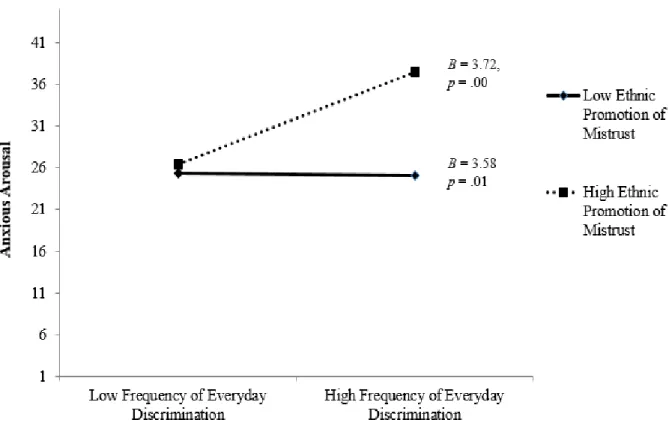
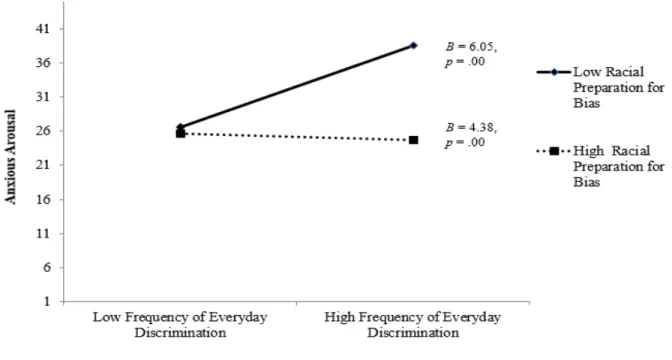
To further probe and interpret the significant interactions, I plotted the estimated values of anxious arousal at high levels (1 SD above the mean) and low levels (1 SD below the mean) of everyday discrimination and the subscales of the ethnic and racial socialization measures, respectively (Aiken & West, 1991).
Findings regarding the effects of perceived discrimination and psychological functioning in the presence of ethnic socialization messages
The overall model was statistically significant (Table 5) indicating that the predictor and interaction variables accounted for 37.5% of the statistically significant variance in the dependent variable, anxious arousal (p = .00). The tests of main effects and interaction effects are described in the following sections.
In the first step of the hierarchical regression, the standardized regression
coefficient for negative temperament was statistically significant and accounted for 9% of the variance in anxious arousal. Thus, participants reported higher levels of anxious arousal if they also endorsed higher trait negative affect (B = .30, p = .00).
The hypothesized positive relationship between everyday discrimination and anxious arousal was supported in the analysis (B = 2.86, p = .00). Everyday
discrimination was a significant predictor and accounted for an additional 12% of the variance in anxious arousal when entered at step 2. Thus, participants’ frequent occurrences of discrimination, over and above temperament, predicted high levels of anxious arousal.
At the third step, the inclusion of three subscales of the ethnic socialization measure on anxious arousal significantly accounted for 10% of additional variance – (a) participants who reported greater ethnic cultural socialization endorsed lower levels of anxious arousal (B = -3.83, p = .00), (b) there was a non-significant relationship between preparation for ethnic bias and anxious arousal (B = .75, p = .44), and (c) participants who reported high frequency of messages promoting mistrust of non-immigrants also reported high anxious arousal (B = 3.46, p = .00).
Next, the interaction terms entered at step four resulted in a significant change in R2 and accounted for an additional 7% of the variance in the criterion variable anxious arousal. The interaction between everyday discrimination and ethnic cultural
socialization was statistically significant and a unique predictor (B = -3.49, t (185) = -3.17, p =.00) of anxious arousal. The test of simple slopes (see Figure 3; Aiken & West, 1991) revealed that both slopes were statistically different from zero. Consistent with my hypothesis, the effect of perceived discrimination on anxious arousal was positive (i.e., risk; slope negative) among participants who endorsed low ethnic cultural socialization messages, (B = 7.47, p = .00). However, contrary to hypothesis, the effect of perceived discrimination on anxious arousal was also positive (i.e., risk; slope negative) for
participants who reported high ethnic cultural socialization messages (B = 7.47, p = .00). Thus, it would seem that greater perceived discrimination is associated with higher rates of anxious arousal irrespective of the frequency of ethnic cultural socializations
messages. However, it should be noted that the relationship between perceived
discrimination and anxious arousal is slightly exacerbated for participants who received few ethnic cultural socialization as indicated both by the beta weight in the graphical