Resource
Inspiring leaders to
improve children’s lives
Schools and academies
National teaching schools
Contents
Introduction ...3
Quality assurance model ...4
Professional conduct ...7
The collaborative fund ...8
Teaching schools data packs ...10
The strategic role of initial teacher training in teaching schools ...12
Continuing professional development and leadership development ...14
School-to-school support ...17
Diversifying school leadership ...19
Succession planning and talent management ...22
De-designation of teaching schools ...25
Role of College associates working with TDA regional leads ...27
Teaching school models and scenarios ...29
Possible funding streams, opportunities and risks ...43
An introduction to business planning ...47
Commercial activity ...49
The teaching schools national network,
and the research and development role of teaching schools ...50
Teaching schools council ...54
Lead schools ...56
Specialist leaders of education: the role of the teaching school ...59
Building capacity ...72
Teaching schools logo guidelines ... 74
This document is intended to provide the first draft of a concise handbook for teaching schools that sets out all the key information that schools need to know at this stage in the development of teaching school alliances. It contains sections that will be of particular use to school business managers (SBMs) and senior colleagues who will be co-ordinating work on teaching school alliances. It will also be useful to College associates and regional leads of the Training and Development Agency for Schools (TDA) in their role in supporting the teaching schools programme.
The handbook complements the teaching school prospectus available from the teaching schools pages of the College website (www.nationalcollege.org.uk/teachingschools). This will be a live, non-bureaucratic resource accessible through the teaching schools online community. It does not replace the many other resources on the College website that may be helpful for leaders of teaching schools, such as the various publications on models and partnerships.
Teaching schools are developing in a changing landscape not least in terms of the College’s move to deliver its products under licence. Therefore, the handbook will be created incrementally by the College teaching schools team working in close consultation with the teaching school community, the TDA, Department for Education and other partners. Revised editions will be produced in January 2012 and in April 2012 when the second teaching school cohort comes on stream.
One of the risks with the teaching school model is that the demands placed on the schools involved become unmanageable and staff at all levels feel overwhelmed by their responsibilities. It will be really important for all involved to recognise that the development of alliances needs to be built in a sustainable way.
We therefore encourage teaching schools to think about how they can test the temperature of staff morale within their organisations; many schools already carry out various types of staff survey that include measures of staff morale. The College hopes in the near future to make available resources that might assist schools with this.
Purpose of this handbook
This handbook aims to support teaching schools to deliver their objectives by:
— clearly setting out expectations for teaching schools and the quality assurance framework, success criteria, performance monitoring and evaluation underpinning the teaching schools programme
— clearly setting out expectations for teaching schools in relation to the key strategic themes: initial teacher training, continuing professional development, leadership development, succession planning and talent management, and school-to-school support
— providing critical information to support teaching school in developing and implementing sustainable delivery plans
— clarifying roles and responsibilities and protocols for collaborative work
— clarifying funding arrangements and funding opportunities
— clarifying the timeline for the development of the teaching schools programme
— sharing models for governance, business development and capacity-building
Introduction
What is expected of teaching schools
Teaching schools have been designated because of their strong track record in the collaborative delivery of ITT, CPD, leadership development, school-to-school support and research and development. As a minimum, we expect teaching schools to continue to offer similar levels of support now they are designated and it will be up them to decide which of these areas to improve in their plans for the future. However, we are also specifically asking every teaching school to designate and broker a minimum of one SLE and to play a role in developing the next generation of leaders. For many teaching schools this will be a new departure.
The College and TDA approach to quality assurance is founded on the following building blocks:
— Professional judgement is paramount and peer review essential. This will be externally moderated where appropriate.
— The quality assurance process is fundamental to the success of teaching school alliances and must itself generate knowledge and learning and encourage innovation and development.
— The emphasis should be on upfront quality assurance; ongoing quality monitoring should be kept to the minimum that is required for quality control and accountability, so that the approach is appropriate for a self-improving school system.
— The annual delivery focus of each teaching school alliance should be based on a thorough assessment of need.
— There needs to be effective methods for the assessment of impact.
— We should distinguish between system-level key performance indicators and alliance-level success criteria.
— There should be a robust process for managing the review of designation, which includes some form of moderation.
Figure 1 outlines the key annual activity involved in the quality assurance process and success criteria throughout the four-year lifecycle of a teaching school.
Figure 1: The quality assurance model
Quality assurance model
1. Start-up / annual meeting with NC and
TDA
Full core funding released
Mid-year collaborative fund monitoring (If total exceeds £100k) 2. Peer review of teaching school alliance Annual collaborative fund monitoring 3. Peer review moderated externally (Year 3 only)
Success criteria and national performance indicators
Definitions
Success criteria are the indicators each teaching school alliance will use to assess whether it has met the annual objectives set out in its annual action plan, based on its assessment of need for the alliance. These will reflect local priorities and the national KPIs.
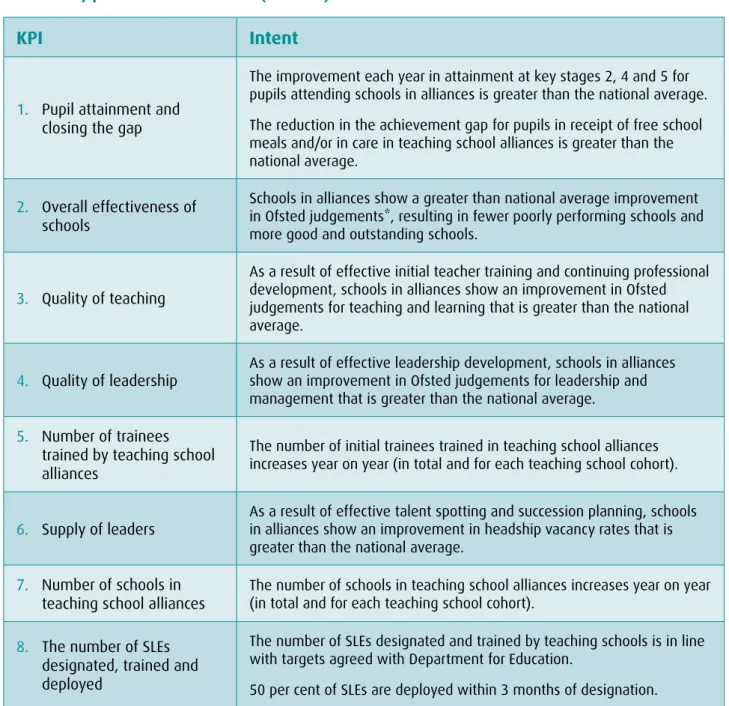
Key performance indicators (KPIs) for the teaching schools programme as a whole are designed to show the impact of the programme nationally. These are set out in Table 1.
Table 1: Key performance indicators (national)
KPI
Intent
1. Pupil attainment and closing the gap
The improvement each year in attainment at key stages 2, 4 and 5 for pupils attending schools in alliances is greater than the national average. The reduction in the achievement gap for pupils in receipt of free school meals and/or in care in teaching school alliances is greater than the national average.
2. Overall effectiveness of schools
Schools in alliances show a greater than national average improvement in Ofsted judgements*, resulting in fewer poorly performing schools and more good and outstanding schools.
3. Quality of teaching
As a result of effective initial teacher training and continuing professional development, schools in alliances show an improvement in Ofsted judgements for teaching and learning that is greater than the national average.
4. Quality of leadership
As a result of effective leadership development, schools in alliances show an improvement in Ofsted judgements for leadership and management that is greater than the national average.
5. Number of trainees trained by teaching school alliances
The number of initial trainees trained in teaching school alliances increases year on year (in total and for each teaching school cohort).
6. Supply of leaders
As a result of effective talent spotting and succession planning, schools in alliances show an improvement in headship vacancy rates that is greater than the national average.
7. Number of schools in teaching school alliances
The number of schools in teaching school alliances increases year on year (in total and for each teaching school cohort).
8. The number of SLEs designated, trained and deployed
The number of SLEs designated and trained by teaching schools is in line with targets agreed with Department for Education.
50 per cent of SLEs are deployed within 3 months of designation.
* Outstanding schools will not be subject to routine Ofsted inspections. Measures that refer to Ofsted judgements, therefore, will not include schools already judged ‘outstanding’
Summary of quality assurance cycle
1. Each teaching school alliance should set its own objectives and define its own limited number of success indicators as part of an action plan, based on its analysis of local priorities. Each action plan will need to be supported by some form of financial modelling. Alliances will be free to use their own format for
— The action plan and financial modelling will be discussed and agreed with College associates (working with the TDA regional leads) each year at the annual meeting held in April or May (October 2011 for cohort 1 only.)
— The annual meeting will need to ensure that the teaching schools have the following:
• a succinct action plan of intended delivery and covering initial teacher training (ITT), CPD, leadership development, talent management, SLE designation and brokerage, school-to-school support and research and development
• defined success indicators for the teaching school alliance which take account of the action-plan priorities and the national KPIs and areas for monitoring
• identification of a member of the senior leadership team (SLT) to oversee quality assurance
• clear governance arrangements in place including appropriate financial modelling
• data required by the College from each alliance to be submitted annually:
• names of schools currently judged to be members of the alliance for the preceding year ( see below)
• names of all designated SLEs and their specialisms and whether they are currently judged to be deployed and any SLEs de-designated in the last year
• number of trainee teachers that have been trained on school-based and school-led training programmes by (i) teaching schools and (ii) strategic partners
• names of any schools that have been supported in a school-to-school support role by (i) teaching schools and (ii) strategic partners
— It will be up to teaching schools to define which schools they consider to be members of their alliance. In deciding whether a school is a member of their alliance, teaching schools will need to make a judgement about what constitutes ‘sufficient engagement’. In reaching this judgement, teaching schools may wish to ask the question: ‘does the level engagement of a school in the work of the alliance have the potential to make a difference to pupil outcomes in that school?’ If the answer is ‘yes’, then they should probably be deemed a member of the alliance.
— TDA regional leads will take part in each annual meeting and may also join College associates in other visits throughout the year, where appropriate.
2. Core funding will be released by the College in one payment using a collaborative fund grants process. Each alliance will be required to complete a light-touch monitoring form at the end of the financial year. Where an alliance receives over £100,000 in total from the College, a completed mid-year monitoring form will be required.
3. Each year, College associates will facilitate a peer review of each teaching school alliance by another alliance.
4. In the third year, this peer review will be externally moderated by an organisation commissioned by the College. This will support the decision on redesignation as well as contributing to the external evaluation of the teaching schools programme as a whole.
5. During the design and development year, existing arrangements for the monitoring of ITT by HEIs or Ofsted will remain. It will be up to alliances to choose whether to carry out additional monitoring.
Teaching schools are designated and quality assured by the National College working in collaboration with the TDA. Local authorities, supported schools and the Department for Education may see individual teaching schools as the face of the teaching school initiative as a whole. Leaders of teaching schools will also need to be aware of the potential for increased media interest in their schools.
In essence, as we move further towards a school-led system where the role of teaching schools will be central, it is important that teaching schools take responsibility for acting appropriately within their role. All teaching schools will be required to sign a conditions of designation agreement, which will constitute the College’s agreement with them and set out the College’s responsibilities and functions, as well as the responsibilities of teaching schools. This will include responsibilities that relate to conduct and behaviour, such as the requirements to:
— act as an ambassador for teaching schools and the College, including promoting the teaching schools initiative and, where reasonable, assisting in the support and growth of other schools that may apply for teaching school status
— behave in a way that upholds the reputation of the teaching school role, the initiative as a whole and the College, and to inform the us about any change in circumstances or events that may bring the reputation of the College or the initiative into disrepute
More difficult to define and set out is the sense of integrity and moral purpose that we expect all teaching schools to demonstrate. In developing this new designation we anticipate that teaching schools will want to go out of their way to build relationships based on trust, particularly with other schools.
This would include:
— upholding commitments (contractual or otherwise) to schools, local authorities or others to provide teaching school support
— taking appropriate action to deal with any reports from client schools or local authorities in relation to inappropriate conduct of staff providing support
— ensuring they are not seen to be identifying the best staff in their alliance or area for the benefit of their own school when designating and brokering SLEs or running CPD activity
— ensuring that the behaviour of the headteacher and members of the SLT of the teaching school, including that outside their work in school, does not in any way call into question their integrity or probity
— ensuring teaching schools are not using their teaching schools status or brand to actively campaign against local authority or government policy.
Since April 2010, through the leadership strategy regions, we have implemented a successful and simple model to enable funding to be allocated to schools to support the system by means of the collaborative fund. The leadership strategy teams have worked with and funded approximately 1,000 schools since this model was implemented. These schools have as a result been enabled to lead the system through a huge amount of school-to-school support and school-led leadership development.
Before this, many school leaders felt the we were more bureaucratic than other agencies that they worked with. Their experience was that accessing funding for specialist activities through the standards fund was much simpler than the processes adopted by the National College, which employed a contract and invoicing model for funding schools. Since the implementation of the collaborative fund in the leadership strategy regions, school leaders have appreciated the College’s move to reduce bureaucracy whilst maintaining smart and appropriate assurances around the use of public funding, which they both expect and welcome.
The approach
In its simplest form, the approach used within the leadership strategy regions was to fund targeted, school-led activity in a way that follows the former standards fund process. A similar model is adopted for the collaborative fund but with enhanced, smart assurance. Figure 2 illustrates where the collaborative fund fits in the different financial operating models available.
Figure 2: Funding model for the collaborative fund
The collaborative fund
Low assurance Smart assurance High assurance
Department for Education standards fund
National College collaborative fund
Contracts
Benefits
Through the implementation of the collaborative fund, many benefits were identified, including:
— increased efficiency for both schools and project teams, lowering the administration costs as a result
— reduced bureaucratic burden on schools, thus enabling school leaders to lead the system more effectively
— evidence to show that robust financial processes are in place which ensure public funds are used properly and to best effect
— evidence of a manageable but effective evaluation and monitoring process
— a level of stability for teams in forecasting budgets
— significantly reduced level of accruals required for project teams
— removal of the need for goods receipting, complex purchase orders and the need to chase invoices from schools
How the process works
1. Where appropriate, a competition process is run.
2. Once schools are identified, the scope of work is identified by the organisation that is funding the work and a collaborative fund letter is sent to the school concerned. The approach is always cautious in estimating the level of engagement.
3. On the first occasion in the financial year, the school is required to return a signed terms and conditions (T&C) document. If there are future collaborative fund awards within the financial year this is not necessary for them.
4. Upon receipt of the T&C document, the funds are paid to the school. If the total amount of funding offered is above £100,000 then half the funds are released once an agreed plan of action is approved. This approach is adaptable depending on the length of the initiative and the point within the year at which the funds are agreed.
5. Schools complete an annual collaborative fund evaluation form in March to give evidence of the activity that was completed with the support of the funding. For schools that receive more than £100,000 there will also be a requirement to complete a mid-year evaluation in October.
6. For schools that received more than £100,000, further payments of the collaborative fund are issued in November, with these payments dependent upon appropriate assurances from the evaluation processes. Adjustments are made to the level and scope of funding, if required, at these times. Where the provision agreed with the Department for Education is based on a period outside a financial year, the funding will be provided and include an end-date for the use of funding.
7. Evaluations will be audited in line with the collaborative fund audit policy.
8. Schools that are not delivering according to their grant terms have funds clawed back appropriate to the variance.
Teaching schools are part of the government’s drive to give schools more freedom and take increasing responsibility for managing the school system. Teaching schools will play a fundamental role in the future of school improvement, ITT, CPD, leadership development and talent management in this country. They will provide the impetus, co-ordination and focus that is so critical to achieving excellence through learning from and working with others. With this in mind, we are keen to ensure that teaching schools take ownership of the national teaching schools network from the outset.
Purpose of data pack
The purpose of the data packs is to provide regionally focused information on key themes and challenges, which may assist teaching schools in assessing the needs of their area and support planning approaches and assumptions in order to have the greatest impact on outcomes for children.
The data pack includes a regional view of the local authorities that make up the following nine regions:
— East Midlands — East of England — London — North East — North West — South East — South West — West Midlands
— Yorkshire and the Humber It focuses on the following themes:
Demographics
— Type of establishment
— Phase of education
Ofsted
— Number and percentage of schools judged outstanding for overall effectiveness
— Number and percentage of schools judged outstanding for overall effectiveness
— Number and percentage of schools judged good for overall effectiveness
— Number and percentage of schools judged satisfactory for overall effectiveness
— Number and percentage of schools judged inadequate for overall effectiveness
— Number and percentage of schools judged outstanding for leadership and management
Teaching schools data packs
— Number and percentage of schools judged good for leadership and management
— Number and percentage of schools judged satisfactory for leadership and management
— Number and percentage of schools judged inadequate for leadership and management
— Number of schools with notice to improve
— Number of schools requiring special measures
System leadership capacity
Number of designated national leaders of education (NLEs) and as a percentage of schools judged good/ outstanding for leadership and management
Number of designated local leaders of education (LLEs) and as a percentage of schools judged good/ outstanding for leadership and management
Leadership capacity
— Number of retirements
— Number of job advertisements
The government set out its proposals to reform initial teacher training (ITT) in Training our next generation of outstanding teachers: an improvement strategy for discussion (Department for Education, 2011). This envisaged an important and growing role for teaching schools in leading ITT partnerships and bringing schools together with others to develop teachers. A plan for implementing these proposals, in the light of responses to the discussion paper, will be published in autumn 2011 and we will then issue further information about how teaching schools will fit into the broader landscape of ITT provision and funding. All teaching schools will already be involved in ITT, either as part of a training partnership with an HEI, or as part of or leading school-centred initial teacher training (SCITT) or employment-based initial teacher training (EBITT). Teaching schools and their alliances will have a key role in ensuring that trainee teachers see and learn from truly outstanding practice. ITT offers a particular opportunity for teaching schools to build on the teaching hospital model, training current and future generations of teachers while also providing an excellent educational experience for their pupils. Teaching schools will need to plan their role in ITT as core business in itself, as well as a way to deliver their other development responsibilities and raise standards for pupils. For some schools this might involve working towards becoming a fully accredited ITT provider on behalf of its alliance of schools (if not already accredited), thereby taking full responsibility for the governance, financial arrangements and quality assurance of ITT. For others it might involve taking responsibility for the strategic leadership of ITT across the alliance, developing creative and more pedagogically driven models of partnership with HEIs to create innovative arrangements that provide outstanding experiences for trainee teachers.
Whatever the approach, teaching school alliances will take responsibility for:
— assessing the needs of trainee teachers and ensuring appropriate provision to meet them
— ensuring that all trainee teachers observe outstanding teaching, and undertake detailed discussion and reflection with outstanding teachers on the observed teaching and their own teaching so that they work with and learn from the best teachers
— managing a range of high-quality, school-based training experiences and professional development activities (including those at Master’s level) into which trainee teachers will be fully integrated, such as peer learning sessions and demonstration lessons
— encouraging greater involvement in ITT across the alliance by showing how supporting trainee teachers can contribute to pupil learning and professional and leadership development for teachers, and
supporting their partner schools in improving the quality of their ITT provision
— ensuring all teaching staff working with trainee teachers across the alliance provide high-quality, school-based tutoring and coaching, including the provision of appropriate training and ongoing support linked to other coaching and mentoring roles such as newly qualified teacher (NQT) induction and early professional development, and are helped to use these roles to develop their own practice
— assessing trainees against the qualified teacher status standards
— demonstrating a clear commitment and capacity to respond to local, regional and national priorities in training
— making a long-term commitment within the alliance to training an agreed number of trainee teachers, including the provision of substantial school experience opportunities for people interested in becoming teachers
The strategic role of initial teacher training in
teaching schools
— working strategically with an accredited provider on the management and leadership of the ITT
partnership to ensure joint planning so that schools and universities maximise the integration of school- and centre-based training and determine which partner is best placed to provide key aspects of the training programme
Developing CPD provision in teaching school alliances
Teaching schools already have strong professional learning cultures that contribute to the high levels of achievement of their pupils. Collaborative, school-based professional development backed by access to relevant specialist expertise is well established in these schools and leads to impact on the development of teaching and learning and leadership.
The challenge that teaching schools face is to work with schools in their alliance to extend this effective culture widely, so that the whole alliance becomes a place in which the workforce is nurtured, developed and challenged. Some of the key strategies for taking this work forward are suggested below.
Collaborative identification of development needs and priorities
— Teaching schools will need approaches for working with alliance schools to identify development needs and priorities related to both pupil outcomes and staff outcomes, including development in the areas of subject knowledge, teaching and learning, and leadership.
— Teaching schools may need to help alliance schools make effective use of a range of evidence and data when deciding how to prioritise development needs.
— Teaching schools will ensure that the intended pupil and staff outcomes of any alliance CPD provision are clearly agreed at the planning stage with the alliance schools involved.
Planning, co-ordination and delivery of alliance CPD provision
— Teaching schools will have a key role in ensuring the effective co-ordination of CPD provision in their alliance that makes best use of expertise and provides value for money.
— Teaching schools will work in conjunction with alliance schools to decide when it is appropriate to use expertise within the alliance, when to access bespoke external specialist expertise, and when to use off-the-shelf programmes.
— Teaching schools will work with alliance schools to increase access and reduce costs for appropriate professional and academic awards and qualifications.
— Teaching schools will encourage increasingly sophisticated use of a range of professional learning activities in alliance CPD provision, including coaching and mentoring, practitioner enquiry and research, observation and shadowing of excellent practitioners, and collaborative learning and development groups.
Evaluating impact and sustaining improvement
— Teaching schools will ensure that thorough evaluation of alliance CPD provision is carried out and is related to the intended outcomes identified at the planning stage.
— Teaching schools will ensure that lessons learned from evaluation help to identify ongoing development needs and shape improved alliance CPD provision going forward.
— Teaching schools will work with alliance schools to judge the appropriate pace for development and how improvement can be sustained over time.
Continuing professional development and
leadership development
Identifying and building capacity for alliance CPD provision
— Teaching schools will support alliance schools in developing their strategic leadership of staff
development that leads to school improvement. This would include helping leaders establish a strong professional learning culture in which time is protected for the full range of effective professional learning work.
— Teaching schools will work with alliance schools to build capacity and develop the culture required for effective coaching and mentoring. This includes developing both the skills required by the different forms of coaching and mentoring and the understanding of when to use them.
— Teaching schools will work with alliance schools to identify the outstanding practitioners within their schools who can support the development of colleagues. Teaching schools will co-ordinate the effective deployment of this expertise and help these excellent practitioners develop their capacity to support others.
— Teaching schools will ensure that their alliance is able to draw upon specialist expertise from beyond the alliance schools, through ongoing collaboration with HEIs, local authorities, national agencies and other teaching school alliances, as well as the selective use of commercial and third-sector organisations.
Teaching and learning programmes
The national scholarship fund for teachers
Teaching schools may wish to promote to the teachers within their alliance the new opportunity that comes from the national scholarship fund for teachers. The fund was launched in June 2011 with the primary objective of supporting professional development and extending the subject knowledge of teachers through an academically rigorous programme of study.
The fund is intended to be highly prestigious and enhance the contribution teachers make to the intellectual life of the nation. The first round of the scholarship focuses on priority specialisms: mathematics, English, science and special educational needs (SEN). The application window for round one opened in June 2011 and closes on 30 September 2011. For more details about the fund see the TDA website (www.tda.gov.uk/ teacher/developing-career/national-scholarship-fund-for-teachers.aspx).
The outstanding facilitation programme
Teaching schools may be particularly interested in undertaking the five-day outstanding facilitation
programme (OFP), which trains teachers to deliver two highly effective teaching and learning programmes, the outstanding teacher programme (OTP) and the improving teaching programme (ITP). Completing OFT successfully would enable teachers to deliver OTP and ITP to teachers who would benefit from support within and/or beyond their alliance. This may also generate income for teaching schools.
Both programmes have a proven track record of improving the quality and consistency of learning and teaching in schools. Feedback showed that 80 per cent of delegates had been able to improve the quality of their teaching and learning by at least one Ofsted grade.
— OTP aims to develop teachers from ‘good’ to ‘outstanding’, meeting the growing national and local need to improve the quality of our best teachers and give them the skills to share their knowledge and expertise with colleagues. Each programme comprises 9 or 10 sessions over as many weeks. Participants focus on specific aspects of teaching and learning such as challenge, engagement, assessment,
differentiation, questioning and planning, and work through observation, coaching and linked practical tasks.
— ITP was developed to provide a targeted support programme to enable teachers to consistently deliver lessons that would be graded satisfactory to good. The programme helps teachers to understand the
We have contracted the organisations Third Wave and Olevi to deliver OFP to teachers from a small number of schools. If schools are interested in applying for these limited places, they will need to express interest by 19 September.
If schools are interested in using their core budget to cover the cost of OFP places, they will need to contact Olevi for more information at [email protected].
Leadership development
The College is moving from linear programmes to offering a range of modules and qualifications that will provide a flexible, coherent leadership development offer to leaders of schools, academies and children’s centres.
The modular curriculum will support individuals as they progress in their leadership careers and provide optional opportunities to gain leadership qualifications. It will draw from international research, evaluation evidence and leadership practice in schools.
As the College develops its modular curriculum, it is also moving from a commissioning approach to a licensing model. This will create the potential for teaching schools and other organisations to bid for the opportunity to deliver products on the College’s behalf.
We believe that this licensing approach will help us to better respond to a diverse range of needs and demands. We want to support the development of a self-improving system, where schools are given more responsibility for leadership development. By creating a series of attractive licensed products that other organisations would be interested in delivering, we also hope to support the development of the delivery market, increasing the number and type of our delivery partners, including teaching schools.
Through the licensing of a range of delivery partners we will encourage creative and innovative approaches to leadership development, including creating new modules and contextualising products to meet the needs of the schools system.
Licensing NPQH and MLDP
Our licensing approach will start in 2012, with the National Professional Qualification for Headship (NPQH) and the Middle Leadership Development Programme (MLDP). These will be linked to levels 1 and 3 of the modular curriculum.
— NPQH is required by anyone wishing to take up a headship post in the maintained sector. The gateway (entry) stage and the final assessment of NPQH will be commissioned by the College. The development stage will be licensed for delivery by a range of providers, including teaching schools.
— MLDP offers the opportunity for clusters of schools, academies and children’s centres to deliver middle leadership development in a way that best meets their needs.
We anticipate that the successful delivery of leadership development programmes will most likely be
achieved through the creation of partnership arrangements that will deliver a number of benefits to teaching schools. The programmes offer high-quality National College content with HEI accreditation (CATS points). Both programmes offer a flexible delivery approach and an opportunity for teaching schools and partners to generate income.
We would like to develop the licensing proposition with teaching schools and others early in the autumn term, leading to the award of the first licences in spring 2012. There will be more licensed products released in future years linked to other levels of the modular curriculum.
If schools are interested in finding out more about opportunities to become a licensed delivery partner for NPQH or MLDP, they should contact [email protected].
One of the most exciting developments in schools in recent years has been the growth of school-to-school support. School leaders across the country are recognising that by working with other schools, and sharing their learning, practice and ideas, they can support system-wide improvements, whilst continuing to improve their own schools.
In 2006 the College designated its first tranche of NLEs and national support schools (NSSs) to work with local authorities to support schools in Ofsted categories or other challenging circumstances.
The teaching school prospectus www.nationalcollege.org.uk/teachingschools makes it clear that designated teaching schools must demonstrate the track record and capacity to undertake support for schools in challenging circumstances, which would usually be those in special measures or identified as in need of significant improvement. Indeed, many teaching schools will already be designated as NLEs/NSSs and will have a strong track record of providing such direct support.
The model is realistic however, and recognises that this is not about one school doing it all, but an alliance of schools working together towards system-wide school improvement. Therefore teaching schools may not themselves be supporting other schools directly but will still be expected to play a major role in the support of other school by brokering the services of NLEs/NSSs, LLEs and SLEs.
National leaders of education and national support schools (NSS)
NLEs are outstanding headteachers or principals who, together with the staff in their schools (NSS), use their skills and experience to support schools in challenging circumstances. In addition to leading their own schools, NLEs work to increase the leadership capacity of other schools to help raise standards.NLEs/NSSs can be deployed in a number of ways and each deployment can be tailored to suit the needs of the school receiving support. NLEs/NSSs are expected to support schools in the most challenging
circumstances such as those in an Ofsted category, facing closure or amalgamation or falling below the floor standards. Deployments could involve one of the following levels of involvement:
— NLE as full-time acting or executive headteacher in a school that has a vacancy for the headship, with significant involvement of staff from the NSS
— NLE and NSS sponsoring a failing school to become an academy
— NLE supporting an acting or executive headteacher (who may be a deputy or a leader from another school) for three days a week, providing advice and extensive support from staff in the NSS
— NLE providing consultancy support with staff from the NSS for up to two days a week
There are currently almost 600 NLEs/NSSs nationally. Details of those designated as NLEs/NSSs can be found on ourwebsite at www.nationalcollege.org.uk/nle.
Local leaders of education
LLEs are successful headteachers who, in addition to leading their own schools, work alongside other heads to raise attainment and build capacity to ensure that improvements can be sustained.
LLEs can be deployed in a variety of ways and each deployment can be tailored to suit the needs of the school receiving support. LLEs are expected to undertake deployments involving:
— supporting a school to raise attainment where it is below the floor standards
— supporting the head of a school that is considered vulnerable
— coaching and mentoring a new head in their first headship
Generally LLEs will work half a day or a day a week with a partner school and a further 20-30 hours over 2 years in support of a new head, though the LLE will be expected to be flexible depending on the needs of the system and the capacity of the LLE.
There are currently over 2,000 LLEs. More information can be found on the our website at
www.nationalcollege.org.uk/lle.
Brokerage of system leaders
The National College currently contracts associates whose role is to support the brokerage of NLEs/NSSs and LLEs. Liaising with system leaders and local authorities, the associate facilitates the deployment process by advising on the most appropriate match and providing general support as required.
Most deployments are currently commissioned by local authorities which pay the NLE/NSS or LLE for the support provided.
Once the deployment has been set up, the associate informs the National College who in turn updates the central record.
Role of teaching schools
As we move to a self-improving system, the National College envisages that the role of brokering will move to teaching schools. Teaching schools will work closely with local networks of NLEs/NSSs and LLEs to provide support to schools in the most challenging circumstances.
The extent and pace of change and the scope for partnership between teaching schools and other agencies will need to be determined through discussions at a local level, and will depend on existing relationships.
School Workforce Census data (Department for Education, 2010) indicates that only 2.4 per cent of heads are from black or minority ethnic (BME) groups. This is despite the fact that 5.9 of teachers are from a non-white British background. The same data also shows that there are still significant gender gaps within school leadership, particularly within the secondary phase where only 37 per cent of heads are female despite women making up 61 per cent of the teaching population. Alongside this, the recent white paper (HM Government, 2010) highlighted some startling statistics on bullying among school pupils: for example, 75 per cent of gay, lesbian and bisexual pupils report bullying based on their sexuality. The government is clear in its expectation to see school leaders tackling bullying (particularly prejudice-based bullying) and has committed to supporting leaders in taking a strong stand against it.
This data is just a snapshot of a bigger picture demonstrating a clear and continued diversity challenge within school leadership today. The issue of under-representation and equality of opportunity is one that links to several important agendas within our schools and academies, not least the succession planning work since under-representation inevitably means fewer aspiring leaders making their way through the pipeline. To read more about the importance of diversifying school leadership, see the College website (www. nationalcollege.org.uk/diversity-in-schools).
The College has to date taken some solid steps towards providing positive action to address the gaps. Initiatives range from national programmes such as Equal Access to Promotion to regionally focused programmes funded through diversity grants. There has been a lot of useful learning over the course of the last four years relating to barriers experienced by particular groups and the best ways to overcome them. There is a small team dedicated to the work, including three supra-regional diversity associates and an equality and diversity manager based at the College. You can contact us by email to
[email protected] or by telephone on 0115 8722040.
The role of teaching schools in this respect will be to provide strong and visible leadership in order to close the gaps and ensure equal opportunities for all staff and pupils. In order to support this work, some questions are given below to aid thinking around leadership diversity issues.
Questions for teaching schools alliances
1. Why should we consider diversity? What are the laws and requirements underpinning equalities?
• Are we clear on the moral, business and ultimately the legal case for looking at diversity?
• How can work on diversity issues also help us to address other important agendas such as succession planning, school improvement and community cohesion?
• Are we familiar with the Equality Act 2010 and the nine specific groups referred to as ‘protected characteristics’ under this legislation?
• Are we aware of the general and specific duties (which apply to all schools in England) set out by the Equality Act 2010? Do we have an understanding of how a school would show compliance with these requirements? What does good practice look like?
• Do we have an equalities policy and strategy, and an action plan in place that is made available to all interested parties?
• Do we know the best organisations and resources to refer to should we need further advice and support?
2. What does our data show us about leadership diversity? What are the specific diversity challenges within our alliance and local area?
• Do we collect school workforce diversity data against each of the protected characteristics outlined in the Equality Act 2010?
• If not, what data collection processes are already in place and how might equality questions be added? Could we make use of School Workforce Census data (Department for Education, 2010) to provide a picture in the meantime? What other methods of intelligence might we also use where hard data is not available?
• If data is available, what does the leadership workforce look like when compared with the teaching workforce? Are individuals within leadership positions broadly representative of the population they are drawn from or are there some gaps to be addressed?
• What are the consequences of not addressing under-representation on succession planning, talent development, school culture and school improvement?
3. What actions could we take to support a diverse leadership population?
• Do we make our commitment to equal opportunities clear enough? What steps might we take to reinforce this message?
• Where data and other intelligence show an under-representation, how can we uncover the underlying reasons for this in order to then take the best course of action to address it?
• Could we form a consultation group to uncover specific needs or concerns among identified groups?
• What best practice is out there in terms of positive action? What does research suggest as the most successful courses of action?
• Do the National College and other organisations have any schemes, resources or programmes we could use or point leaders to?
• What funding, resources and time are we willing to commit to this? How can we bring others on board to help us lead it?
• What should be our role and responsibility in this and how do we ensure sustainability?
• How will success be tracked and demonstrated?
Funding to support diversity and equality work
The National College has a ringfenced budget for undertaking leadership diversity work. Specific targeted support diversity work may be happening in your local area and some teaching schools may choose to become involved with this in the future. An outline of some of this work can be found by visiting
www.nationalcollege.org.uk/networking/networking-your-region and clicking on ‘diversity’.
What you will need to do
Leadership on equality and diversity is an important part of the remit of teaching schools. Our expectation is that your business plan will set out your approach to monitoring and addressing leadership diversity issues. This may be referred to within your overall succession planning strategy or may be best served as a standalone area that cuts across a number of agendas.
What to expect from your College associate
Your College associate will support you with your diversity work. Depending on the individual needs of your teaching schools alliance, you can expect to receive from him or her:
— data on the national and regional diversity picture
— a signpost to further support and advice on staying compliant with new equality legislation
— a critical friend offering challenge and support
— advice on what’s worked and what hasn’t as part of the diversity work to date
— advice on co-ordinating and administering positive action schemes
— brokering with peers and stakeholders involved in previous diversity work
— links to best practice, materials and research
Useful contacts
The College has a small team dedicated to leadership diversity work which is available to give advice. Contact details are:
Equality and Diversity Manager
Alice Gregson: telephone 0115 8722040 or email [email protected]
Diversity associates (covering three supra-regions)
North: Rosemary Campbell-Stephens: email [email protected] Central: Ankhara Lloyd-Hunte: email [email protected]
The white paper (HM Government, 20011) highlighted the fact that one in four headteachers are eligible to retire in the next four years. In addition to this retirement challenge, there remain difficulties in recruiting heads to some school types, mainly primary, special, small rural and faith schools. Read more about the succession challenge at www.nationalcollege.org.uk/successionplanning.
Like the TDA’s role for teacher supply, the College’s number one priority has been ensuring the supply of high-quality leaders into the system. It has done this until now through its leadership development work and by engaging local authorities and schools via its succession planning strategy (30 per cent of teaching schools are already involved in this work). We expect the future will be different by 2015 as we learn from current good practice in teaching schools and, over time, enable all teaching schools to play a greater role in meeting the strategic supply needs of the system:
In particular, we will expect teaching schools to identify and develop teachers with the
potential to take on headship. We will continue to fund succession planning work (via the
teaching schools) in the areas with the biggest challenges.
HM Government, 2010:28 para 2.45 This part of the teaching school’s role is not just about securing headteacher supply: it is clear from current practice and research that systematic talent management has a positive effect on school improvement, performance and the recruitment and retention of the best teaching talent. Recent College research on how schools, chains and federations grow leaders can be found in Matthews et al (2011).
Questions for teaching school alliances
1. What does our data show about the leadership supply issues for our alliance? What does the data show for the wider local area?
• Do we know the current age profiles and likely retirement behaviours of the alliance’s headteachers and senior leaders in the next year, and in three and five years’ time?
• Which schools and areas in our alliance have most difficulty recruiting heads and senior leaders? Which have highest readvertisement rates? Which have the lowest number of applicants or the poorest quality of applicant, and why?
• Is there particular difficulty in recruiting to primary, special, rural and faith schools?
• What is unique about our alliance’s leadership supply needs?
• Do we know who in the alliance has undertaken NPQH? Who do we expect to put forward for the new NPQH?
• Do we see the alliance taking on a role for developing the supply of leaders for schools outside the initial alliance?
• Do we know how many women and BME teachers we have in senior leadership positions compared with their proportion in the staff overall?
2. Do we have an agreed approach to identifying future leadership talent in our alliance?
• What approaches across the alliance do we have that systematically identify talent?
• How do we combine these systematic approaches with drawing on the talent-spotting instinct of experienced heads and leaders?
• What leadership talent have we identified as a priority for the alliance? Is it potential heads, senior leaders or middle leaders?
• How do we ensure that talent identification approaches are accessible and equitable but also meet clear strategic needs? What is the relationship between quality and quantity?
• Do we know the views of our middle and senior leaders about the perceived leadership development opportunities currently open to them?
• What role might SLEs play in spotting leadership talent?
• Do we sometimes overlook talent? If so, where and why? Do we understand the behaviours that motivate individuals to aspire to senior posts?
3. Do we have an agreed approach across the alliance to managing, developing and retaining leadership talent?
• What best practice does our alliance have in relation to developing leadership talent?
• Who in the alliance could co-ordinate and administer talent management activity?
• What will the role of partners be in developing talent?
• How will this activity link with delivering CPD and leadership development provision, such as MLDP and other possible College-licensed programmes or our alliance’s current provision?
• How will this activity link with any current succession planning targeted support led by local
authorities and other school leaders and groups? This support will decline over the next four years in line with the success teaching schools have in adopting progress on succession planning on behalf of the system as a whole.
• What positive action might we undertake to tackle under-representation in senior leadership of particular groups? See www.nationalcollege.org.uk/diversity-in-schools for more information.
• How will we use the development of talent to reinforce school improvement?
• How will we define, track and demonstrate our success?
• Who are the wider stakeholders we might involve in developing talent?
• Could new models and structures of leadership (eg, rural federations) help our alliance? For more information visit www.nationalcollege.org.uk/modelsandpartnerships
Funding to support this work
Additional funding has been added to the core grant to help teaching schools support succession planning. In 2011-12 this will be an additional £7,000. Depending on annual remit negotiations and Department for Education agreement we anticipate that each teaching school will receive up to £10,000 2012-15. The actual funding allocation will depend on progress made and the College’s need to respond to the areas with the greatest challenges.
Other funded targeted support succession planning work may be happening in the system and some teaching schools may choose to become further involved in this as part of a joined-up approach.
What teaching schools will need to do
Succession planning and talent management are a core part of the remit of teaching schools. Our expectation is that your business plan will set out your approach to addressing supply challenges and should include:
— a section on data and evidence-based needs
— your planned approach
— your proposed success criteria and evaluation plans
What to expect from your College associate
Your College associate will talk through your plans for talent management. Depending on the needs of your alliance, you can expect from him or her:
— data on the national and regional supply picture
— a critical friend offering challenge, support and quality assurance
— advice on what’s worked and what hasn’t as part of succession planning work
— advice on co-ordinating and administering talent management approaches
— brokering with peers and stakeholders involved in previous succession work
If the teaching schools designation is to retain its credibility, the College needs to ensure that schools that fail to fulfil the role or no longer meet the criteria have their designation frozen or removed. Draft de-designation criteria and an outline of the proposed process are set out below.
Principles underpinning the review of designation process
— The process is based on robust evidence which is judged against clear de-designation criteria (see below). This is aligned to the current process for the designation of NLEs and LLEs.
— The process applies to all schools annually.
— Bureaucracy for schools is kept to the absolute minimum.
— A review of designation is integrated with the overall approach of quality assurance.
— Consideration is given to the individual circumstances of each alliance.
— There is an expectation that teaching schools will inform the College immediately if they no longer meet the eligibility criteria.
How the process works
Each year, at the annual meeting with the College associate and TDA regional lead (or at any time a teaching school itself raises an issue regarding de-designation), the work of the alliance is reviewed and checks are made to ensure the school still meets the eligibility criteria.
In reviewing a teaching school’s designation, the de-designation panel has the option to reaffirm, freeze or remove the designation. In the case of freezing or removing designation, the panel will review the funding implications of its decision. For example, in an alliance with only one teaching school, core funding may be withdrawn.
A teaching school has the right to appeal against a decision. An appeals process will be developed later this year, once the new de-designation team has been established.
Draft de-designation criteria
De-designation may arise from self-assessment, external review or peer assessment for the reasons detailed below.
1. A teaching school no longer meets the eligibility criteria For example the school:
• can no longer identify a leader who is:
• accountable for one or more schools or academies that meet the teaching school criteria • judged to be an outstanding serving headteacher
• has a minimum of three years’ experience as a headteacher • expects to remain in headship for at least a further two years
De-designation of teaching schools
• has the support of the relevant governing body
• can no longer provide evidence that it:
• has been graded by Ofsted as outstanding for overall effectiveness, teaching and learning, and leadership and management
• shows consistently high levels of pupil performance and continued improvement over the previous three years and shows that the school is above the floor standards
2. A teaching school fails to make an appropriate contribution to the work of the alliance For example, the school fails to:
• improve pupils’ learning and performance
• provide a supply of high-quality new teachers
• improve the quality of serving teachers
• develop great leaders and the next generation of headteachers
• provide support for schools that are facing challenging circumstances
• reduce the number of schools in special measures or with a notice to improve
• generate funds to sustain the future of the alliance
• designate and broker an appropriate quantity and range of SLEs that meet the designation criteria
3. A teaching school fails to provide appropriate input to the leadership of the alliance For example, the school fails to:
• ensure collaborative partnership activity across the alliance
• quality assure the work of the teaching school alliance
• undertake the expected role of working with and on behalf of other schools and the wider system
• provide outstanding senior and middle leaders who can demonstrate the capacity and skills to make an appropriate contribution to the work of the alliance as outlined in 2) above.
4. Misconduct
For example, the school:
• withholds or misrepresents any information in the teaching school application in such a way that it may have materially affected the original designation decision
• fails to meet requirements relating to past or present funding
• withdraws from a commitment (contractual or otherwise) to a school or a local authority to provide teaching school services without good cause and appropriate and reasonable notice
• fails to take appropriate action to deal with any reports or complaints from schools within the alliance or network in relation to the conduct of teaching school staff who are providing support
• has a head whose behaviour or conduct, or whose involvement in the behaviour of others, could call into question her or his integrity or probity, including any conduct or behaviour outside work
• has a headteacher who has been suspended from post pending investigation, in which case the designation of the teaching school will automatically be frozen until the investigation has been concluded
Each teaching school will have a single point of contact with the College and the TDA through a specific College associate and TDA regional lead. The College associate and regional lead will focus on two key areas of work as described below.
Support designated teaching schools
The College associate and TDA regional lead will:
— provide support and challenge to each teaching school alliance as it develops its action and business plan between 15 September and 28 October 2011.
— clarify the plan’s objectives and success criteria in the context of the College’s quality assurance model and ensure a match between the College’s KPIs for the teaching school programme and the success indicators for individual teaching school alliances
— sign off each teaching school delivery or business plan in consultation with the College’s lead associates for each region
— broker links with other alliances to form teaching school networks
— enable quality assurance by peers of each alliance’s work
— link teaching schools with other College and TDA colleagues and with other College and TDA agendas
Build capacity
The College associate and TDA regional lead will:
— help more schools to become teaching schools by supporting them in meeting the eligibility criteria
— identify the gaps in teaching school coverage and provision from a national perspective
— identify candidate schools using College and TDA regional intelligence
— support aspiring schools to carry out a trial application to discover and confirm areas for development
— broker the relationship between the school and a designated teaching school and with other sources of support
During September and October of the first year of the programme (2011) there is an opportunity to refine and develop the respective College and TDA roles based on need. During this first development year, the roles will not be fully defined until they have been co-constructed and tested.
Offer to teaching schools
From the National College associate team, teaching schools will receive:
— one day for the start-up meeting with the College associate and TDA regional lead
— one day for a mid-year visit
— up to two days to support peer review between January and March 2012
Role of College associates working with TDA
regional leads
From TDA regional lead
From the TDA regional lead, teaching schools will receive:
— one day for the start-up meeting with the TDA regional lead and College associate
— up to five days of additional support as required
Start-up meetings
Start-up meetings will take place between 15 September and 28 October 2011. They will comprise the following items:
— introductions and purpose of meeting
— role of College associate and the relationship between the TDA and the National College, including the National College/TDA offer and protocol
— quality assurance and performance, ie defining the teaching school alliance’s objectives and specific success indicators and identifying a member of the SLT to oversee quality assurance
— action plan with financial modelling, including a preparatory discussion, advice on other sources of help, and business planning options and support
— governance of teaching schools, the relationship with the strategic alliance and financial accountability
We have commissioned the ISOS partnership (Robert Hill and Simon Rea to undertake a short project for the National College to gather messages and learning about models and funding scenarios that are likely to be faced by the first teaching school alliances. Simon and Robert worked with 12 schools during June and July. At that stage, all the schools had applied to become teaching schools in cohort 1.
The work took place at two half-day workshops at the National College in Nottingham. Between the two workshops, Robert and Simon visited the schools to discuss the teaching schools programme with school leaders, staff and school business managers.
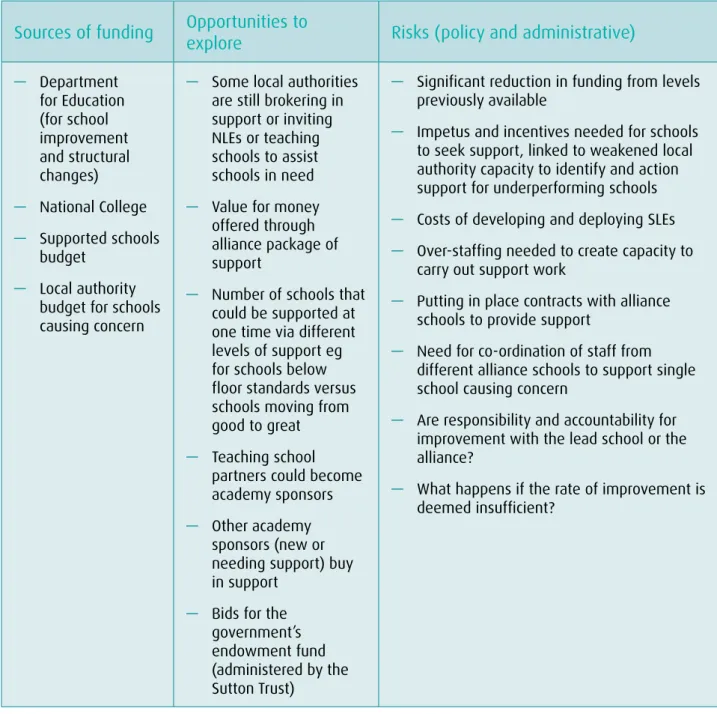
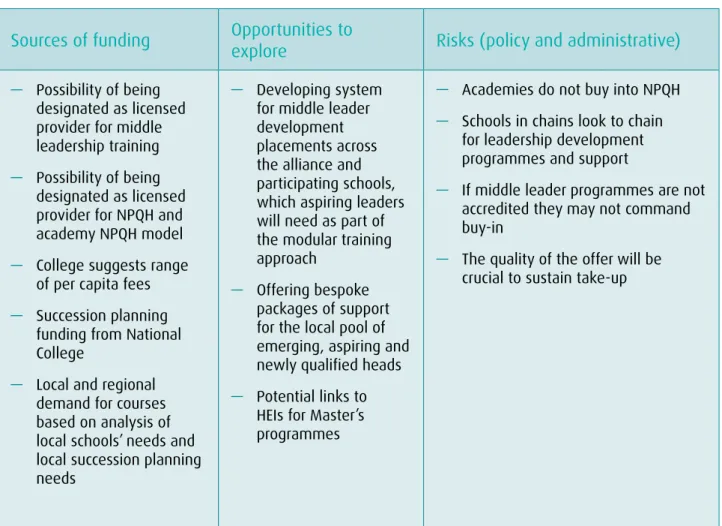
The purpose of the project was to generate discussion among the group of schools, develop thinking about a range of potential teaching school scenarios, and focus on two specific issues: governance of a teaching school alliance, and arrangements for funding. The project is not proposing or prescribing any particular approaches, rather it is intended that the material developed can be employed as a useful pointer that might help teaching school alliances to decide what is appropriate for their context.
Materials generated so far
During the work with the focus group of schools, the following materials were generated.
— a pack with materials that consider some of the relationships teaching schools are likely to have with their strategic partners, describing how these relationships might look for a number of different teaching school alliance scenarios
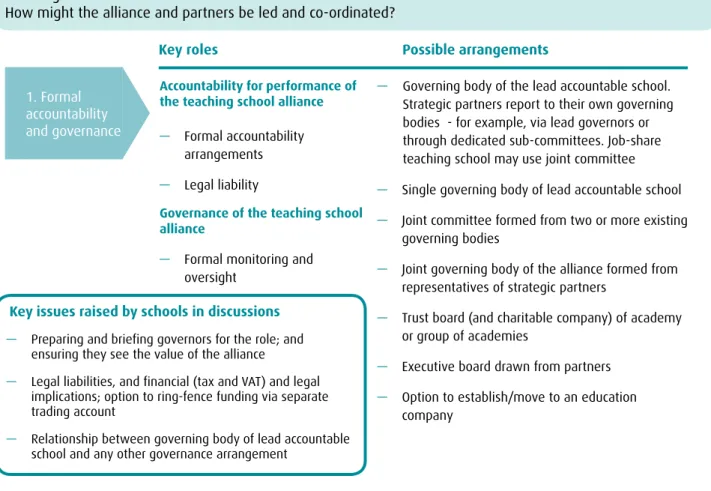
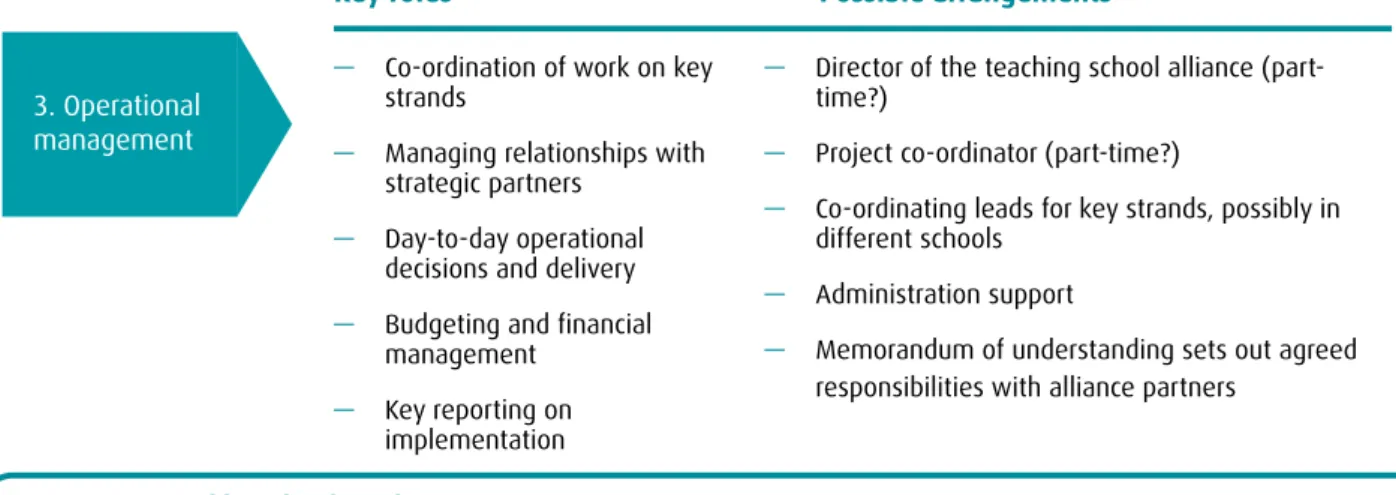
— a pack that analyses governance issues, focusing on how the alliance might be governed, led and managed, including consideration of how leadership and accountability might operate at different levels, the available options and associated issues, and how governance might change over time
— a description of the areas that a memorandum of understanding for a teaching school alliance might cover, and a checklist of practical issues to use when considering ways of working
— a pack that analyses funding issues, focusing on potential sources of funding for the four elements of the role of teaching schools, with some associated opportunities to explore and risks to manage
— a draft business planning template which summarises some of the income and costs that might be associated with the different roles
All the materials have been developed following workshops with and visits to the focus group of schools, and should be seen as pointers that might help leaders in teaching school alliances to decide what is appropriate for their context.
Mapping the relationships with strategic partners and the alliance
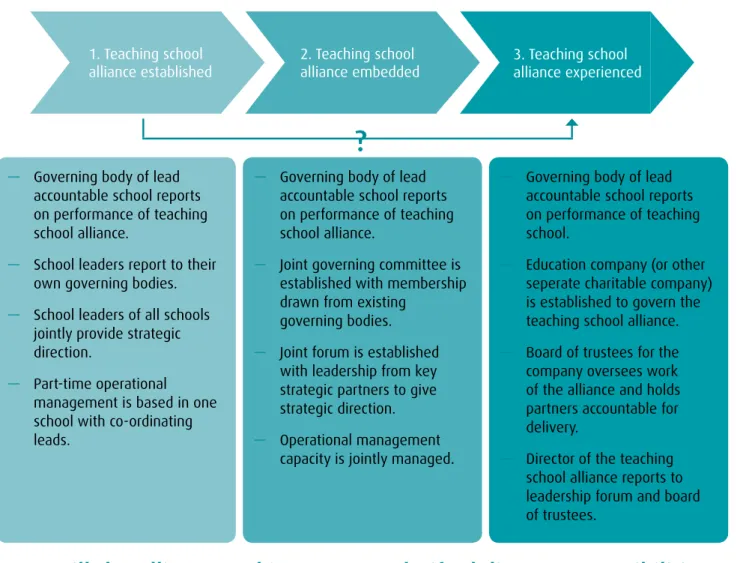
— Teaching school alliances will involve a range of strategic partners, will be established in different ways,and will change over time.
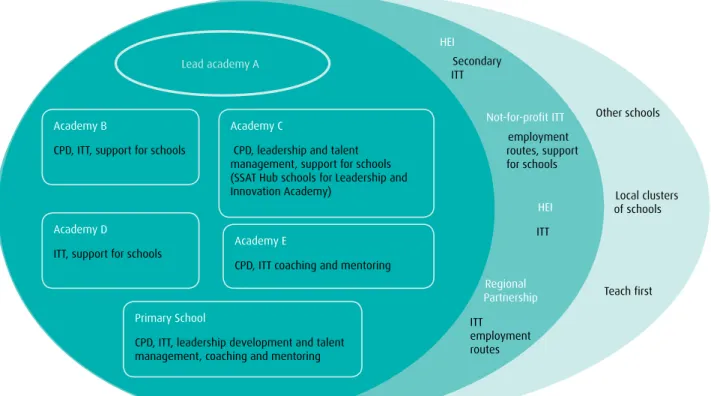
— Following discussions with the schools, diagrams were produced in a variety of formats to describe their prospective relationships with strategic partners. A set of generic diagrams (Figures 3-8) was produced to show how relationships might look for a number of different teaching school alliance scenarios.
— These are examples only to illustrate some of the possible relationships. We recognise that all teaching school alliances will be different, and that these examples illustrate emerging relationships which would
Teaching school models and scenarios
Some common themes emerged from our discussions:
— An alliance may have a single lead school, job-share schools, or groups of key strategic partner schools.
— There may be a broad range of strategic partners.
— Existing relationships with HEIs would continue and be developed.
— What are the possibilities for working with other teaching school alliances?
— Local cluster working can take place through existing networks.
— Cross-phase strategic partners with specific SEN support (often through special schools) is being built into most teaching school alliances.
— Support and/or commissioned work is from the local authority.
— Differences between alliances are reflected in part through geography and the stage of their partnership journey. The differences affected areas such as working across a specific region, relationships with private sector providers, maintaining previous cluster-based relationships, and working as part of an established chain or multi-school federation.
Single large primary school as lead accountable school, or with another primary in
job-share
Two Higher Education Institutions
—ITT
—CPD
—Research
Local Primary Schools —Leadership development —School improvement capacity —Curriculum development —ITT placements Local Secondary Schools —ITT placements —CPD —Leadership development —CPD —SEN support —Leadership development —ITT placements Special schools —Early years support
—Leadership development —School improvement —SEN/inclusion training —CPD Local Authority
—Expertise and capacity on maths
—QA, CPD, resources to support SLEs, action research
—Expertise and capacity on ICT
—CPD, e-learning, learning platforms
Other providers
Work with other prospective teaching alliances
Figure 3: A single large primary as lead school, or a job-share alliance in a rural area
Teaching school relationships with strategic partners and the alliance
Example A: single large primary/job-share primaries in rural areas
Figure 4: Two job-share primary schools as lead as part of a multi-school federation in an urban area
Teaching school relationships with strategic partners and the alliance
Example B: job-share primaries as part of a multi-school federation in urban setting
Lead accountable primary in job-share with primary school,
in federation with two other primaries
Set vision for alliance; all pilot teaching schools Two existing area
clusters of schools
National College development work e.g. on training for chairs of govs, closing gaps etc
Range of schools supported
Primary special school
SEN support and leadership professional development School leaders across 10
authorities collaborating to develop a self-improving school system
Regional alliance of schools
—ITT packages and cluster allocations
—Research and professional development
Two HEIs
Private sector providers —Host training —CPD work and development —Behaviour management training Working collaboratively with schools across the LA, and providing