EXPLOITING SIMILARITIES BETWEEN SECRET
AND COVER IMAGES FOR IMPROVED
EMBEDDING EFFICIENCY AND SECURITY IN
DIGITAL STEGANOGRAPHY
By
ALAN ANWER ABDULLA
Department of Applied Computing
The University of Buckingham
United Kingdom
A Thesis
Submitted for the degree of Doctor of Philosophy in Computer Science to
the School of Science in the University of Buckingham
October 2015
Copyright © Alan Abdulla and the University of Buckingham 2015 All Rights Reserved
Abstract
The rapid advancements in digital communication technology and huge increase in computer power have generated an exponential growth in the use of the Internet for various commercial, governmental and social interactions that involve transmission of a variety of complex data and multimedia objects. Securing the content of sensitive as well as personal transactions over open networks while ensuring the privacy of information has become essential but increasingly challenging. Therefore, information and multimedia security research area attracts more and more interest, and its scope of applications expands significantly. Communication security mechanisms have been investigated and developed to protect information privacy with Encryption and Steganography providing the two most obvious solutions. Encrypting a secret message transforms it to a noise-like data which is observable but meaningless, while Steganography conceals the very existence of secret information by hiding in mundane communication that does not attract unwelcome snooping. Digital steganography is concerned with using images, videos and audio signals as cover objects for hiding secret bit-streams. Suitability of media files for such purposes is due to the high degree of redundancy as well as being the most widely exchanged digital data. Over the last two decades, there has been a plethora of research that aim to develop new hiding schemes to overcome the variety of challenges relating to imperceptibility of the hidden secrets, payload capacity, efficiency of embedding and robustness against steganalysis attacks. Most existing techniques treat secrets as random bit-streams even when dealing with non-random signals such as images that may add to the toughness of the challenges. This thesis is devoted to investigate and develop steganography schemes for embedding secret images in image files. While many existing schemes have been developed to perform well with respect to one or more of the above objectives, we aim to achieve optimal performance in terms of all these objectives. We shall only be concerned with embedding secret images in the spatial domain of cover images.
The main difficulty in addressing the different challenges stems from the fact that the act of embedding results in changing cover image pixel values that cannot be avoided, although these changes may not be easy to detect by the human eye. These pixel changes is a consequence of dissimilarity between the cover LSB plane and the secret
image stream, and result in changes to the statistical parameters of stego-image bit-planes as well as to local image features. Steganalysis tools exploit these effects to model targeted as well as blind attacks. These challenges are usually dealt with by randomising the changes to the LSB, using different/multiple bit-planes to embed one or more secret bits using elaborate schemes, or embedding in certain regions that are noise-tolerant. Our innovative approach to deal with these challenges is first to develop some image procedures and models that result in increasing similarity between the cover image LSB plane and the secret image bit-stream. This will be achieved in two novel steps involving manipulation of both the secret image and the cover image, prior to embedding, that result a higher 0:1 ratio in both the secret bit-stream and the cover pixels‘ LSB plane.
For the secret images, we exploit the fact that image pixel values are in general neither uniformly distributed, as is the case of random secrets, nor spatially stationary. We shall develop three secret image pre-processing algorithms to transform the secret image bit-stream for increased 0:1 ratio. Two of these are similar, but one in the spatial domain and the other in the Wavelet domain. In both cases, the most frequent pixels are mapped onto bytes with more 0s. The third method, process blocks by subtracting their means from their pixel values and hence reducing the require number of bits to represent these blocks. In other words, this third algorithm also reduces the length of the secret image bit-stream without loss of information. We shall demonstrate that these algorithms yield a significant increase in the secret image bit-stream 0:1 ratio, the one that based on the Wavelet domain is the best-performing with 80% ratio.
For the cover images, we exploit the fact that pixel value decomposition schemes, based on Fibonacci or other defining sequences that differ from the usual binary scheme, expand the number of bit-planes and thereby may help increase the 0:1 ratio in cover image LSB plane. We investigate some such existing techniques and demonstrate that these schemes indeed lead to increased 0:1 ratio in the corresponding cover image LSB plane. We also develop a new extension of the binary decomposition scheme that is the best-performing one with 77% ratio.
We exploit the above two steps strategy to propose a bit-plane(s) mapping embedding technique, instead of bit-plane(s) replacement to make each cover pixel usable for secret embedding. This is motivated by the observation that non-binary pixel decomposition schemes also result in decreasing the number of possible patterns for the three first bit-planes to 4 or 5 instead of 8. We shall demonstrate that the combination of the
mapping-based embedding scheme and the two steps strategy produces stego-images that have minimal distortion, i.e. reducing the number of the cover pixels changes after message embedding and increasing embedding efficiency. We shall also demonstrate that these schemes result in reasonable stego-image quality and are robust against all the targeted steganalysis tools but not against the blind SRM tool.
We shall finally identify possible future work to achieve robustness against SRM at some payload rates and further improve stego-image quality.
Acknowledgments
ALLAH THE MOST GRACIOUS AND MERCIFUL: Who gave me the energy, health, nerves and provided me with all the people to whom I am dedicating this hard work, which took a lot of determination and time until it came to light.
My parents: I would like to dedicate the fruitful outcome of this work to my father and mother who have been waiting for so long to see the result of their son‘s work and who haven‘t stopped praying for this work to be done. I hope I made them proud of me as I am very proud of them. My gratitude, love, respect, and thanks go to my dearest mother. Without her blessings, prayers, and unconditional love, I would have achieved nothing in the life.
My brother: My thankfulness and appreciation to my brother Miran for his support, encouragement, and patience during the time of my study.
My wife: My warm thanks go to my wife Shaida for her support, patience, and understanding throughout the duration of my study time.
My daughters: I would like to dedicate this thesis and all my success in my life to my lovely twin daughters Aya and Anna, who have been my continuous source of hope and determination to go on despite the difficult times I have been through. Their smiles have often pushed me to put in my best possible efforts to be a better person.
My supervisors: I would like to express my sincerest gratitude towards my supervisor Prof. Sabah Jassim for providing me the opportunity to work in the challenging areas of multimedia security. Prof. Jassim has been unrelenting source of motivation and support throughout my PhD life. Without his guidance, motivation, and support, this thesis would never come to light. I would also like to thank my supervisor Dr. Harin Sellahewa for his valuable comments, suggestions, and discussions.
My sponsor: I would like to express my sincere appreciation and gratitude to the Kurdistan Regional Government (KRG), and Ministry of Higher Education and Scientific Research in Kurdistan for sponsoring my postgraduate programme of study. Also my special thanks go to the University of Sulaimani.
My friends and Colleagues: Last but not least, I wish to thanks all friends, fellow students, and staff in the Department of Applied Computing, in the University of
Buckingham, for their encouragement and support during the time of this programme. I would like to express my special thanks to Mr. Hongbo Du, the lecturer in the department, for his encouragement and useful discussion. Also my special thanks go to Dr. Nasser Al-Jawad, the lecturer in the department, for his assistance and encouragement. I would like to thank Dr. Stuart Hall, the lecturer in the department, for his valuable advices and recommendations that significantly improves clarity as well as the soundness of the thesis. Finally, huge thanks and appreciates are also go to Dr.
Faraidun K. Hamasalh, lecturer at the University of Sulaimani, for his help and encouragement.
Abbreviations
2D-DWT Two Dimensional Discrete Wavelet Transform
dB Decibel
DCT Discrete Cosine Transform DFT Discrete Fourier Transform DIH Difference Image Histogram DIP Digital Image Processing DWT Discrete Wavelet Transform FLDs Fisher Linear Discriminants
IWSIM Integer Wavelet Based Secret Image Manipulation IWT Integer Wavelet Transform
LSB Least Significant Bit
LSBM Least Significant Bit Matching LSBR Least Significant Bit Replacement MSB Most Significant Bit
MSE Mean Square Error
OPAP Optimal Pixel Adjustment Process PoV Pair of Values
PRNG Pseudo Random Number Generator PSNR Peak Signal-to-Noise Ratio
PVD Pixel Value Differencing RR Reduction Ratio
RS Regular and Singular RWS Revised Weighted Stego SIM Secret Image Manipulation SISR Secret Image Size Reduction SRM Spatial Rich Model
SVM Support Vector Machine VER Variable Embedding Ratio WS Weighted Stego
Contents
Abstract ... I Acknowledgments ... IV Abbreviations ... VI Contents ...……….……VII List of Figures ... X List of Tables... XV Declaration ... XVII Chapter 1 Introduction ... 11.1 From Ancient to Digital Steganography ... 3
1.2 Overview of the Research Problem ... 7
1.3 Challenges and Success Criteria for Digital Steganography ... 9
1.4 Digital Steganography– Some Emerging Applications ... 10
1.5 Motivation ... 11
1.6 Objectives ... 12
1.7 Contributions ... 12
1.8 Structure of the Thesis ... 13
Chapter 2 Steganography: Background, Objectives and Approaches ... 15
2.1 Information Security Mechanisms ... 15
2.1.1 Information Security – Objectives and Governing Principles ... 16
2.2 Digital Steganography – Categorisation and Hiding Methods ... 21
2.3 Steganalysis and Steganography Attacks ... 28
2.4 Performance Evaluations of Image Steganography Techniques ... 32
2.4.1 Data Payload or Capacity ... 32
2.4.2 Stego-image Quality ... 33
2.4.3 Un-detectability of Hidden Secrets ... 35
Chapter 3 Image-based Steganography and Steganalysis: Literature Review ... 38
3.1 Image-based Steganography Approaches ... 38
3.1.1 LSB\higher LSBs (Bit-Planes) based embedding Approaches... 42
3.1.2 Pixel value decomposition based embedding Approaches ... 47
3.1.3 Location\Region based embedding Approaches... 51
3.1.4 High Embedding Efficiency Approaches ... 57
3.2 Image-based Steganalysis Approaches ... 63
3.3 An Overview of our Approach ... 71
3.4 Summary ... 73
Chapter 4 Multi Bit-planes Image-based Steganography ... 74
4.1 Bit-plane Indexing-based Embedding Scheme ... 74
4.1.1 Embedding and Extracting Procedures ... 75
4.1.2 Experimental Setup and Results ... 77
4.2 Fibonacci-Mapping based Embedding Scheme ... 82
4.2.1 Embedding and Extracting Procedures ... 82
4.2.2 Experimental Results ... 84
4.3 Discussion ... 89
Chapter 5 Secret Image Pre-Processing ... 90
5.1 Secret Image Manipulation (SIM) ... 91
5.1.1 SIM Forward Procedure... 91
5.1.2 SIM Backward Procedure ... 94
5.1.3 Performance of SIM... 94
5.2 Integer Wavelet based Secret Image Manipulation (IWSIM) ... 96
5.2.1 IWSIM Forward Procedure ... 98
5.2.2 IWSIM Backward Procedure ... 100
5.2.3 Performance of IWSIM ... 101
5.3 Secret Image Size Reduction (SISR) algorithm ... 103
5.3.2 SISR Decoding Procedure ... 106
5.3.3 Example Application of SISR Algorithm ... 106
5.3.4 Performance of SISR ... 109
5.4 Performance of Fibonacci-Mapping based scheme post SIM, IWSIM, and SISR……….. ... 112
5.5 Discussion ... 118
Chapter 6 Cover Pixel Value Decomposition Schemes ... 120
6.1 Background ... 121
6.2 Simple Sequence based cover pixel value decomposition scheme (SS) ... 123
6.3 Extended-Binary cover pixel value decomposition scheme ... 126
6.3.1 Performance of Extended-Binary ... 130
6.4 Experimental Results ... 134
6.5 Discussion ... 140
Chapter 7 Mapping based Steganography for Hiding Secret Images in Cover Images ……….142
7.1 Single bit Mapping Tables for pixel value decomposition schemes ... 143
7.1.1 The 5-rows Mapping Tables (Fibonacci, prime, natural, and CF) ... 143
7.1.2 The 4-rows Mapping Tables (Lucas, and Extended-Binary) ... 145
7.2 Efficient Secure image-based steganography schemes ... 146
7.3 Experimental Setup and Results ... 149
7.4 Summary ... 173
Chapter 8 Conclusions and Future Research Directions ... 175
8.1 Conclusions ... 175
8.2 Future Research Directions ... 180
References ... 182
List of Publications ... 191
List of Figures
Figure 1-1: General structure of the image-based steganography process…………...6
Figure 2-1: Diagram of classification of security systems. ... 21
Figure 2-2: Bit-planes of Lenna image. ... 23
Figure 2-3: DFT and DCT Frequency domains: (a) original image, (b) spectrum of the DFT domain, and (c) DCT domain. ... 26
Figure 2-4: DWT (a) Original image, (b) Level 1, (c) Level 2, (d) Level 3. ... 27
Figure 2-5: General framework of universal steganalysis. ... 31
Figure 2-6: Classification of the steganalysis techniques. ... 31
Figure 3-1: Pseudo-Code of the LSBMR embedding technique. ... 59
Figure 3-2: Chan‘s approach (a) The decision tree of the data embedding procedure (b) An example. ... 61
Figure 3-3: Illustration of the (Iranpour & Farokhian, 2013) for the eight cases. ... 62
Figure 3-4:Example of PoV plot for cover image Lenna (without embedding). ... 65
Figure 3-5:Example of PoV plot for stego image Lenna (50% embedding). ... 65
Figure 3-6:Example of PoV plot for stego image Lenna (100% embedding). ... 65
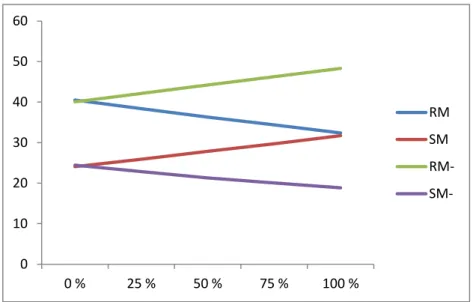
Figure 3-7: RS diagram for Lenna image. The x- axis is a ratio of flipped LSBs; the y-axis is the (RM, RM-, SM, SM-). ... 67
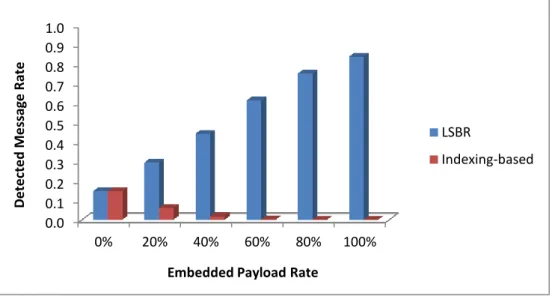
Figure 4-1: Ratio of modified pixels for the LSBR and Indexing-based embedding technique. ... 78
Figure 4-2: Embedding efficiency for the LSBR and Indexing-based embedding technique. ... 78
Figure 4-3: The PSNR for the LSBR and Indexing-based embedding technique. ... 79
Figure 4-4: RS diagram for LSBR technique. ... 80
Figure 4-5: RS diagram for the Indexing-based embedding technique. ... 80
Figure 4-6: DIH steganalysis for LSBR and Indexing-based embedding technique. ... 81
Figure 4-7: RWS steganalysis for LSBR and Indexing-based embedding technique. ... 81
Figure 4-8: The ratio of the modified pixels for the LSBR and Fibonacci-Mapping based embedding technique. ... 85
Figure 4-9: The embedding efficiency for the LSBR and Fibonacci-mapping based embedding technique. ... 85
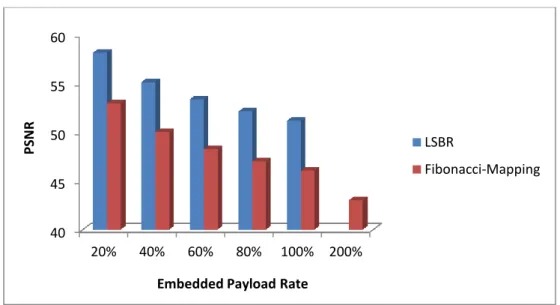
Figure 4-10: The PSNR for the LSBR and Fibonacci-Mapping based embedding
technique. ... 86
Figure 4-11: RS diagram for Fibonacci-Mapping scheme. ... 87
Figure 4-12: DIH steganalysis for LSBR and Fibonacci-Mapping based embedding technique. ... 87
Figure 4-13: RWS steganalysis for LSBR and Fibonacci-Mapping based embedding technique. ... 88
Figure 5-1: Lenna image and its modified version using SIM algorithm. ... 92
Figure 5-2: Level one IWT sub-bands of Lenna image and histograms. ... 97
Figure 5-3: Ratio of zero-bits of SIM and IWSIM. ... 103
Figure 5-4: Ratio of side information bits of SIM and IWSIM. ... 103
Figure 5-5: Ratio of modified pixels for the Fibonacci-Mapping based techniques... 113
Figure 5-6: Embedding Efficiency for the Fibonacci-Mapping based techniques. ... 114
Figure 5-7:The PSNR for the Fibonacci-Mapping based techniques. ... 115
Figure 5-8: RS diagram for Mapping-based-SIM. ... 116
Figure 5-9: RS diagram for Mapping-based-IWSIM. ... 116
Figure 5-10: RS diagram for Mapping-based-SISR... 116
Figure 5-11: DIH steganalysis for the Fibonacci-Mapping based techniques. ... 117
Figure 5-12:RWS steganalysis for the Fibonacci-Mapping based techniques. ... 117
Figure 6-1: Ratio of cover pixels‘ LSB = 0 for the different sequences of numbers. ... 132
Figure 6-2: Ratio of LSB = 0 for different decomposition techniques. ... 133
Figure 6-3: Ratio of capacity for different decomposition techniques. ... 133
Figure 6-4: The ratio of the modified pixels for the Original_EB, SISR_EB, SIM_EB, and IWSIM_EB schemes. ... 136
Figure 6-5: The embedding efficiency for the Original_EB, SISR_EB, SIM_EB, and IWSIM_EB schemes. ... 136
Figure 6-6: The PSNR for the Original_EB, SISR_EB, SIM_EB, and IWSIM_EB schemes. ... 137
Figure 6-7: RS diagram for the Original_EB, SISR_EB, SIM_EB, and IWSIM_EB schemes. ... 138
Figure 6-8: DIH steganalysis for the Original_EB, SISR_EB, SIM_EB, and IWSIM_EB schemes. ... 139
Figure 6-9: RWS steganalysis for the Original_EB, SISR_EB, SIM_EB, and
IWSIM_EB schemes. ... 139
Figure 7-1: Embedding procedure for our image-based steganography schemes. ... 147
Figure 7-2: Extracting procedure for our image-based steganography schemes. ... 148
Figure 7-3: Secret images: Lenna and Jet. ... 150
Figure 7-4: Ratio of modified pixels for the SIPI experimental images. ... 152
Figure 7-5: Ratio of modified pixels of the cover BOSSBase image when Lenna is the secret image. ... 152
Figure 7-6: Ratio of modified pixels of the cover BOSSBase image when Jet is the secret image. ... 152
Figure 7-7: Embedding efficiency for the SIPI database. ... 153
Figure 7-8: Embedding efficiency for the BOSSBase database when the secret image Lenna is embedded. ... 153
Figure 7-9: Embedding efficiency for the BOSSBase database when the secret image Jet is embedded. ... 154
Figure 7-10: PSNR for the tested steganography schemes for the SIPI database. ... 154
Figure 7-11: PSNR for the BOSSBase stego images when the secret image Lenna is embedded. ... 155
Figure 7-12: PSNR for the BOSSBase stego images when the secret image Jet is embedded. ... 155
Figure 7-13: RS diagram for all tested steganography schemes for SIPI database. ... 157
Figure 7-14: RS diagram for all tested schemes for the BOSSBase database when Lenna image is embedded. ... 158
Figure 7-15: RS diagram for all tested schemes for the BOSSBase database when Jet image is embedded. ... 159
Figure 7-16: PoV diagram for sample stego-image from SIPI database. ... 161
Figure 7-17: PoV diagram for sample stego-image from BOSSBase when the Lenna image was embedded. ... 163
Figure 7-18: PoV diagram for sample stego-image from BOSSBase when the Jet image was embedded. ... 164
Figure 7-19: DIH steganalysis for all tested steganography schemes for SIPI database. ... 165
Figure 7-20: DIH steganalysis for BOSSBase database when Lenna image was embedded. ... 165
Figure 7-21: DIH steganalysis for BOSSBase database when Jet image was embedded.
... 166
Figure 7-22: WS steganalysis for stego-images in SIPI database. ... 167
Figure 7-23: WS steganalysis for BOSSBase stego-images when Lenna image was embedded. ... 167
Figure 7-24: WS steganalysis for BOSSBase stego-images when Jet image was embedded. ... 167
Figure 7-25: RWS steganalysis for all tested steganography schemes for SIPI database. ... 168
Figure 7-26: RWS steganalysis for BOSSBase database when Lenna image was embedded. ... 169
Figure 7-27: RWS steganalysis for BOSSBase database when Jet image was embedded. ... 169
Figure 7-28: LSBMS steganalysis for SIPI database. ... 170
Figure 7-29: LSBMS steganalysis for BOSSBase database when Lenna image was embedded. ... 170
Figure 7-30: LSBMS steganalysis for BOSSBase database when Jet image was embedded. ... 171
Figure 7-31: SRM steganalysis of SIPI database. ... 172
Figure 7-32: SRM steganalysis of BOSSBase database when Lenna image was embedded. ... 172
Figure 7-33: SRM steganalysis of BOSSBase database when Jet image was embedded. ... 173
Figure A-1: PoV diagram for stego-image number 330 from SIPI database. ... 196
Figure A-2: PoV diagram for stego-image number 965 from SIPI database. ... 197
Figure A-3:PoV diagram for stego-image number 1023 from SIPI database. ... 199
Figure A-4: PoV diagram for stego-image number 1417 from SIPI database. ... 200
Figure A-5: PoV diagram for stego-image number 1832 from SIPI database. ... 202
Figure A-6: PoV diagram for stego-image number 122 from BOSSBase when the Lenna image was embedded. ... 203
Figure A-7: PoV diagram for stego-image number 489 from BOSSBase when the Lenna image was embedded. ... 205
Figure A-8: PoV diagram for stego-image number 664 from BOSSBase when the Lenna image was embedded. ... 206
Figure A-9: PoV diagram for stego-image number 855 from BOSSBase when the Lenna image was embedded. ... 208 Figure A-10: PoV diagram for stego-image number 970 from BOSSBase when the
Lenna image was embedded. ... 209 Figure A-11: PoV diagram for stego-image number 122 from BOSSBase when the Jet
image was embedded. ... 211 Figure A-12: PoV diagram for stego-image number 489 from BOSSBase when the Jet
image was embedded. ... 212 Figure A-13: PoV diagram for stego-image number 664 from BOSSBase when the Jet
image was embedded. ... 214 Figure A-14: PoV diagram for stego-image number 855 from BOSSBase when the Jet
image was embedded. ... 215 Figure A-15: PoV diagram for stego-image number 970 from BOSSBase when the Jet
List of Tables
Table 3-1: RS steganalysis for Lenna image. ... 66
Table 4-1: Fibonacci-Mapping Table... 83
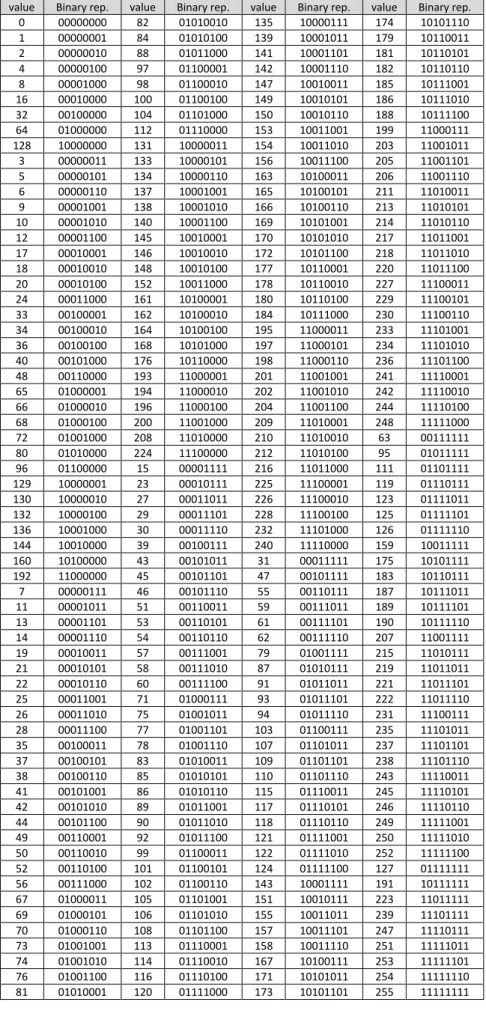
Table 5-1: Grayscale values (0-255) in descending order of number of 1s in its binary representation... 93
Table 5-2: SIPI database - Ratio of 0:1 in the secret images and SIM modified secret images . ... 95
Table 5-3: BOSSBase database - Ratio of 0:1 in the secret images and SIM modified secret images . ... 95
Table 5-4: Ratio of bits of the SIM side information. ... 96
Table 5-5: SIPI database - Ratio of 0:1 in the secret images and IWSIM modified secret images . ... 101
Table 5-6: BOSSBase database - Ratio of 0:1 in the secret images and IWSIM modified secret images . ... 101
Table 5-7: Ratio of bits of the side information using IWSIM. ... 102
Table 5-8:Ratio of increased bits to represent the modified sub-bands. ... 102
Table 5-9: Number of obtained bits from proposed SISR algorithm for block size 4x4. ... 106
Table 5-10: Block of 16 pixels ... 106
Table 5-11: Differences between pixels value and minimum pixel value. ... 107
Table 5-12: Producing original pixels value from the recovered . ... 108
Table 5-13: Average of 0:1 ratio before and after applying the SISR for 4x4 block size. ... 109
Table 5-14: Ratio 0:1 SISR algorithm for different block sizes. ... 110
Table 5-15: Average RRs for SISR algorithm for different image and block sizes. .... 111
Table 5-16: Average RRs for SISR, RLE, Huffman, and LZW for different image sizes. ... 111
Table 5-17: Average time cost for SISR, RLE, Huffman, and LZW for different image sizes. ... 112
Table 6-1: Number of bit-planes and their corresponding weights for different pixel value decomposition techniques ... 125
Table 6-2: Pixel values and their decomposition using Extended-Binary scheme. ... 129
Table 6-3: Ratio of the cover pixels‘ LSB zero value of the Extended-Binary decomposition technique for SIPI database. ... 130
Table 6-4: Ratio of the cover pixels‘ LSB zero value of the Extended-Binary decomposition technique for BOSSBase database. ... 130
Table 6-5: Ratio of 0:1 LSB for different decomposition techniques. ... 134
Table 7-1: Mapping for Fibonacci, prime, natural, and CF. ... 144
Table 7-2: Mapping for Lucas and Extended-Binary. ... 145
Table 7-3: Capacity of the tested steganography techniques. ... 150
Table 7-4: Ratio of 0:1 in the binary representation of the tested secret images. ... 151
Table A-1: Grayscale values (0-511) in descending order of number of 1s in its binary representation... 192
Declaration
I hereby declare that all the work in my thesis entitled (EXPLOITING SIMILARITIES BETWEEN SECRET AND COVER IMAGES FOR IMPROVED EMBEDDING EFFICIENCY AND SECURITY IN DIGITAL STEGANOGRAPHY) is my own work except where due reference is made within the text of the thesis.
I also declare that, to the best of my knowledge, none of the material has ever previously been submitted for a degree in the University of Buckingham or any other University.
Chapter 1
Introduction
Digital steganography is an information security mechanism that is general concerned with concealing the presence of a secret data/object during mundane communication sessions by embedding the secret data in another innocuous data/object in such a way that only the sender and intended recipient are aware of the secret‘s existence. It is an alternative to cryptography in protecting sensitive secrets where the adversary is aware of the presences of the secret but cannot extract it. Thus, digital steganography is the art and science of making the act of communication itself a secret.
In recent years, interest in steganography has shifted from traditional and ancient practices into hiding secret data and media objects, especially secret image files, in image files. This area of steganography, for example, is becoming a common technique in protecting sensitive communications by intelligence and law enforcing agencies to crime prevention by exchanging facial images of suspects to be compared with databases of known criminal faces. Moreover, forensic investigators often need to take and transmit photos of the scene of the crime, or left fingerprints, for later comparison without undermining the integrity of the evidence. Armed forces have a variety of similar needs such as exchanging military maps or surveillance video in hostile environment/situations. Modern health care systems required by law to maintain the privacy of critical information when storing or exchanging patient‘s medical images such as X-ray. Furthermore, financial as well as commercial organizations such as banks can benefit from such technology to prevent customers‘ account information/identification
from being accessed illegally by unauthorised users. Therefore, those mentioned communication systems become more and more dependent on digital steganography.
This thesis is concerned with the design, the development and the testing the performance of secure embedding and transmission of secret messages in image objects. Throughout the recent history of digital communication, many steganography techniques have been developed for embedding secrets into digital images primarily by manipulating their least significant bit-planes (LSBs). Although, the effect of these changes may not be visible to human eye, but the presences of the secret can become more detectable, by a determined and digitally skilled adversary, the longer the secret message is. Steganographers must address the problem of embedding capacity of the cover image while protecting against detectability. Embedding longer secrets, though desirable, definitely result in some form of cover image distortion or even degraded image quality. Hence, the robustness of message embedding against adversary attacks is closely linked to maintaining image quality. Embedding efficiency is the most important requirement for digital steganography that employs all the above addressed problems (i.e. payload capacity, message detectability or security, and stego-image quality). Embedding efficiency means minimising the changes made to the cover image pixels, as a result of embedding a secret message, while maintaining capacity.
We shall investigate and test techniques to improve security and efficiency of message embedding techniques in digital images. Most existing steganography techniques focus on the embedding strategy and give no consideration to pre-processing the secret image except encrypting or compressing the secret. Here encryption is aimed at protected the secret even if it was detected while compression is used to improve the quality of the resulted stego-image. One of the premises of this thesis is that applying carefully selected pre-processing techniques could help enhance the embedding efficiency and security of the steganography systems. The objective of our approach, in relation to pre-processing, is to increase the probability of similarity between the secret bits value and the cover pixels‘ least significant bit (LSB) value. Consequently, designing a new pixel value decomposition technique to decompose cover pixels value with aim of making the cover pixels‘ LSB value similar, as much as possible, to the secret bits value could support our objective.
This chapter provides a general introduction to the research area and the investigations carried out in this thesis by first starting with some background knowledge and examples of ancient and digital steganography, then an overview of the
research problem is explained. Moreover, the challenges and success criteria for digital steganography are discussed followed by listing some recent and potential applications of digital steganography. Furthermore, the main motivation of this study is discussed, and the research objectives are identified based on the established definition of the research project followed by an overview of our contributions. We close the chapter by highlighting the structure of the thesis.
1.1
From Ancient to Digital Steganography
Linguistically, steganography means secret writing since the word steganography
originally derives from two Greek words, steganos means covert or secret, and graphy
means writing (Cole & Krutz, 2003). Practically, it means the art and science of hiding secret data in an innocent looking dummy container in such a way that the existence of the embedded data is imperceptible and un-detectable (Kahn, 1996). Thus, steganography is the process of hiding secret data within the publicly accessible information.
In physical (i.e. non-digital) steganography, the cover object may be basically anything, for example a physical text document, a painting, or a piece of wood, as long as it can be used to convey a hidden message to the intended recipient without raising suspicion of untrusted parties. Interestingly, the first documented cover object used for the purposes of steganography was the human body. Greek historian Herodotus detailed that steganography‘s ancient origin can be traced back to 440 BC (Macaulay & others, 1904). It was started by the Greek fellow named Histiaeus, the ruler of the ancient Greek city of Miletus, who shaved the hair of his most trusted slave and wrote/tattooed the message on his head. Once the hair had grown, the message was hidden and he was sent to their allies to communicate with them without the enemies‘ knowledge. The purpose was to instigate a revolt against Persians (Macaulay & others, 1904). Another example of physical steganography was again ancient Greeks technique by writing secret messages on wax-covered tables. To pass a hidden message, a person would scrape the wax off a table, write a message on underlying wood and again cover the table with wax to make it appear blank and unused. The recipient would simply remove the wax from the table to see the message (Johnson & Jajodia, 1998). Also, invisible ink was used for writing secret messages by the American revolutionaries during the USA revolution on pieces of paper so that the paper appeared to the average person as just being blank pieces of paper. Liquids such as urine, milk, vinegar and fruit juices were
used as ink. When these substances are heated, they darken and become visible to the human eye (Mangarae, 2006). Also, invisible ink was used in both World Wars by the German army. In World War II, Germany also used microdots to hide large amounts of data on printed documents, masqueraded as dots of punctuation (Cole & Krutz, 2003).
The advent of electronic and computer technology as well as advances in communication technology triggered an interest in developing steganography techniques to fit the new medium of communication. Although, the focus of the early days of the new technology era was on cryptography as the main security mechanism for the protection of sensitive information. This may have been a result of the fact that access to computer technology in the early days of main frame computers and minicomputers was limited to governmental and corporate organisations besides the scientific community. The advent of space exploration in the early sixties led to the emergence of Digital Image Processing (DIP) and nuclear medicine. The convergence of communication and computer technology has triggered the digital revolution that has escalated over the last two decades and pushed mobile technology into the front to finally widen access to this technology beyond any expectation. This has led to an emergence of huge interest in digital image processing for a variety of applications with new security concerns that is very difficult to address by cryptography alone. The rise of terrorism has finally rekindled the interest in digital steganography. It is often claimed that the 11th of September bombers were using steganography for hiding their secret plans in innocuous communications of digital media objects. Whether it is true or not, this story and similar more recent cases seem to be generating more incentives to research various aspects of steganography and steganalysis.
Digital steganography exploits properties of digital media files such as images, audios, and videos to hide a variety of secrets that could remain undetected. Although some digital/computer based steganography references can be found before 1995, most of the interest and action in the field has occurred since 2000 (Cole & Krutz, 2003). In image-based steganography, a secret message is often hidden within an image in such a way that others cannot discern the presence or contents of the secret. It is important that the stego-image does not contain any easily detectable artefacts due to message embedding that could be detected by electronic surveillance. For example, a message might be embedded in an image by changing the pixels‘ LSB to be the message bits.
The Prisoner’s problem
Steganography systems have one general principle, described by (Katzenbeisser & Petitolas, 2004) based on a simple scenario formulated by Simmons known as the prisoners‘ problem (Simmons, 1984) as follows: Two criminals, Alice and Bob, have been arrested and locked in separate cells. The warden Wendy allows them to exchange messages but the communication has to be completely open to her. As Alice and Bob
need to coordinate their escape plan, they need to find a different way to communicate secretly without being caught. Since any suspicion of a secret information exchange would result in an immediate communication cut off, the prisoners cannot protect their message exchange by encryption. Alice and Bob resort to using steganography to avoid detection. The job of the warden Wendy is steganalysis, she needs to find out whether or not Alice and Bob‘s communications include secretly embedded messages. Alice, who wants to send a secret message to the recipient Bob, randomly chooses a harmless cover file and embeds the secret message in the cover file and probably uses a stego key.
Alice’s constructed stego file must be as much as possible undistinguishable from the cover file neither by a human eye nor by a computer system. Alice transmits the stego file to Bob over the open communication channel allowed by the prison authority. The purpose of the system is to prevent Wendy, from observing or noticing the presence of a hidden message. On the other side, Bob extracts the embedded message since he knows the embedding method and the stego key used in the embedding process. Only the transmitter and the intended recipient should have the stego key. Most steganography systems prompt users to provide a stego key when they try to embed information in a cover file.
Sometimes, attackers like Wendy can detect a hidden message in a stego file and determine how the message was embedded, but they are unable to extract the hidden message. This system is considered to be a secure steganography system because the secret message is unreadable unless one has the related stego key. Therefore, stego keys must be chosen as strong as possible in order to prevent attackers from breaking the steganography systems using all possible stego keys (Cox, et al., 2005).
The security of steganography systems must be based on the assumption that attackers have full knowledge of the steganography system design, the embedding and extracting algorithm. However, attackers only miss the stego key to suspect that a secret communication is taking place. Therefore, most of steganography systems available nowadays meet this principle (Rabah, 2004). Therefore, it is assumed that Wendy has a
complete knowledge of the steganography algorithm that the prisoners may use. This is a very important assumption and it is one of the most important security principles that have been accepted and practiced since the middle of the 19th century and known as Kerckhoff‘s principles (Rabah, 2004). Figure 1-1 illustrates the general structure of image steganography systems.
Figure 1-1:General structureof the image-based steganography process.
The main terminologies used in the steganography are: 1. The cover object is the carrier of the secret message.
2. The secret message is the information that is to be hidden in a suitable cover object producing stego object. Note that in this thesis the terms message, hidden message, and secret message are used interchangeably.
3. The process of hiding information is called embedding algorithm which is the way or the idea that usually used to embed the secret message in the cover object (Swanson, et al., 1996) (Petitcolas, et al., 1999) and it is also called steganography system, steganography technique, or steganography scheme. 4. The stego key is a random key agreed between the participants, and it is
usually used to control the hiding process/algorithm so as to restrict detection or recovery of the embedded data to authorised parties only.
1.2
Overview of the Research Problem
With advancements in digital communication technology, the exponential growth in the use of the Internet, and a huge increase in computer power; the difficulties in ensuring the privacy of information become increasingly challenging. Therefore, information and multimedia security research area attract more and more interest, and its scope of applications expand significantly. Communication security mechanisms have been investigated and developed to protect information privacy with Encryption and Steganography providing the most obvious solutions. Encrypting a secret message transforms it to a meaningless data which looks more like random noise and is generally observed during transmission, while steganography is not observable. Steganography aims to make the secret communication itself undistinguishable from mundane communication, i.e. hiding the presence of the secret message. It modifies the carrier/cover in an imperceptible way only so that it reveals nothing neither the embedding of a message nor the embedded message itself.
Although steganography is an old field, the recent developments in digital communication technology and the emergence of social media networks have brought new attention to steganography. With the arrival of the digital era, advances in mobile devices and technologies, and the widespread availability of efficient multimedia manipulation tools, exchanging secrets and sensitive information between different groups of users has become a much easier task. Digital steganography is a much easy to use alternative to encryption and creates new opportunities for crime and abuse through hiding secrets and illegal material in digital carriers/covers such as audio, image and videos files. The phenomenal volume of exchanged messages and media files greatly reduce the chance of being caught by legitimate authorities. The growth in the use of multimedia files for steganography is due a high degree of redundancy in the media data, which makes them suitable to embed information without degrading their visual quality. Steganography is made much easier if the cover file includes a lot of redundancies. Images and videos are examples of files that contain a high degree of spatial and temporal redundancies that are often exploited for compression. For example, it is well known that changing the least significant bits of some/all image pixels do not have a noticeable impact on image quality/content. Consequently, the LSB plane may be seen as redundant and those bits can be altered to hide any binary secret. Note that, such type of data hiding certainly result in some distortion that could be
detectable by image statistical analysis tools, but criminals bet on the difficulty experienced by authorities in processing huge volumes of daily file exchanges.
Most hiding schemes are designed, and their performances are tested with a random bit-stream secret. However, this thesis focuses on the scenario whereby both the embedded message and the cover are grayscale images. The reason for choosing images as a cover is that images usually have a high degree of redundancy and also images are widely exchanged over the Internet than other digital media and they attract little suspicion. Moreover, the reason for choosing images as secret messages is due to their frequently used in many applications as mentioned earlier.
There are different ways of categorising the different techniques of steganography due to the variety of media file types that can be used as cover files as well as the fact that there is more than one way of representing cover files. For example, audio and image files can be represented in the spatial domain as well as frequency domain and each of these can provide different ways of embedding secrets with advantages as well as limitations. In Chapter 2, we shall give an account of categorisation of embedding techniques.
While steganographers aim to design difficult to detect, and efficient steganography techniques, steganalysers attempt to defeat the goal of steganography by detecting the presence of a hidden message, even if they cannot retrieve it. Steganalysis schemes attempt to exploit the fact that any embedding scheme will result in some kind of local random distortions, albeit difficult to detect by the naked eye, or may violate in a small way, but computable, some statistical/correlation models that are known/expected to hold among the different spatial/gray-level components of cover images. There are numbers of existing image steganalysis tools that are widely used to detect the presence/absence of a hidden message and estimate the size of the embedded secret message. These tools are classified in different ways, whereby some are targeting specific embedding schemes while others are designed to detect the presences of hidden messages without knowledge of the embedding algorithm. We will discuss the classification of these tools in Chapter 2. In this thesis, we aim to investigate steganography schemes that have the ability of withstanding against most reliable and well-known steganalysis techniques, and therefore we shall give details about the theory and working of certain tools in Chapter 3.
1.3
Challenges and Success Criteria for Digital Steganography
The most important and obvious success criteria for steganographers is the ability to avoid attracting suspicion of the presence of a hidden message in otherwise innocuous looking communication. General factors that influence this overarching objective and must be addressed by image-based steganography systems are: 1) the quality of the stego-image (i.e. minimising the perceptual difference between the stego and the cover image); 2) the payload capacity of the cover image (i.e. the amount of secret data that can be embedded in the cover image); 3) detectability of the message (i.e. prevent detection/recovery by a third party); and 4) the robustness of the stego-image (i.e. protection against distortion attacks). However, the first two requirements are at odds with each other, and it is quite difficult to increase the payload capacity and simultaneously maintain the imperceptibility of a stego-image. Consequently, a compromise may have to be found that is application dependent. The third requirement is relevant to the first one; in other words, by improving the stego-image quality the steganography system becomes less detectable. Currently, most existing steganography systems deal with first three requirements without taking the robustness against distortion attacks into account. This is most likely due to the fact that robustness is application dependent (Cox, et al., 2007), and most steganography systems consider the passive warden scenario in which the warden does not interfere with the stego file in any way (Cox, et al., 2005). It is a challenge for steganographers to achieve a good balance among all these different steganography requirements.
The above first three requirements, are affected directly by the number of changing pixels of the cover image after embedding the secrets, and, therefore, in the literature minimising this change has been stated as the most important requirement. The amount of change must be considered relative to the payload capacity, and, hence, it is natural to model this requirement by the ratio of changed pixels to the size of the secret message. In recent proposed steganography techniques, less ratio of changing of cover image pixels‘ value after message embedding, while maintaining payload capacity, has been used as an indicator of higher stego-image quality and lower message detectability. The evaluation of the ratio of changing cover image pixels‘ value is called embedding efficiency in the literature, which can be defined as the number of secret bits embedded per one embedding change. When the embedding efficiency increases, the less detectable traces will be introduced in the stego-image, and the more robust against steganalysis techniques. Embedding efficiency is the main objective in this thesis.
All these requirements can be associated with quantitative measures that can be modelled and determined in terms of the stego-images that can provide objective tools to test the performance of any embedding scheme. Performance evaluations for image steganography techniques are presented in Section 2.4.
1.4
Digital Steganography– Some Emerging Applications
Digital steganography has various useful applications. However, like any other science it can be used for good as well as ill intentions. Government organisations and business communities rely heavily on exchanging, sharing and processing information to assist them in making a variety of strategic decisions and steganography is one of the security infrastructures that are established to help protect and preserve the integrity of information flowing across different channels. Digital steganography is useful in protecting sensitive communications for many applications such as intelligence and law enforcing agencies to prevent crime (Petitcolas, et al., 1999) (Mercuri, 2004); military purposes such as exchanging military maps (Jenifer, et al., 2014) (Wayner, 2002) (Wu & Tsai, 2003); in health care systems to maintain the privacy of critical information such as medical records (Liu, et al., 2013) (Cheddad, et al., 2008) (Li, et al., 2007) (Raul, et al., 2007); and in financial and business organizations (Juarez-Sandoval, et al., 2013) such as banks to prevent customers‘ account information from being accessed illegally by unauthorised users, or identity cards; where individuals‘ details are embedded in their photographs (Jain & Uludag, 2002).
On the other hand, digital steganography is also used by malicious users, organised crime, and international terrorism to hide their ill intentions. Here two examples of steganography threat are highlighted out of many examples. The most dangerous usage of steganography was when it was used by a terrorist group on the 11th of September 2001. In his article (Lau, 2003), Stephen states that “News stories began appearing in
mainstream United States media in the days following September 11th reporting that Osama bin Laden and al-Qaeda were using the internet to covertly communicate between various terrorist cells to plan and relay information. One interesting aspect of the media reports was that the al-Qaeda was supposedly using a technique known as steganography to covertly communicate.”
Terrorists are not the only criminals who may employ steganography techniques for illegal purposes. Steganography was reported to be used by South American drug dealers to communicate photographs of transit routes and cocaine shipment information
(Kodovsk, 2012). The mentioned examples of illegal usage of steganography have all relied on the use of digital images as cover files because images have a high degree of redundancy and are suitable to embed information without degrading their visual quality. Moreover, images are widely exchanged over the Internet than other digital media and they attract little suspicion.
1.5
Motivation
There has been an explosive growth in multimedia technology and applications in the past several years. Efficient representation for storage, transmission, retrieval and security of information are some of the biggest challenges faced. With growing need of information security, digital image steganography has established itself as an important discipline in signal processing and multimedia security. That is due in part to the strong interest from the research community. The motivation behind developing image steganography methods its growing use by various organizations to communicate securely, which include the military or intelligence operatives (in the field of espionage and crime prevention) as well as a variety of companies and organisations that provide public services to protect customers information. The main goal of using the image steganography is to avoid drawing attention to the transmission of hidden information.
I am particularly motivated to help in reducing the huge digital gap that exists between the developed world and my own nation Kurdistan (and may other third world countries that are in the process of building its institutions and suffer from terrorisms). For that, I try to study and design efficient and secure image-based steganography techniques in order to be used in my country which by the many organizations that need to maintain security and privacy of its information such as hospitals needing to establish and benefit a medical information records system, intelligence and law enforcing agencies for knowledge-based crime and terrorism prevention, and financial organizations and banks to protect customers account information against illegal access by unauthorised users/actions. Despite the fact that there are many existing practical image-based steganography systems, but still the trade-off between steganography requirements is a problem in this research area. This is a motivation to design image-based steganography techniques that minimises the embedding impact on the stego-image while maintaining payload capacity. Security considerations form another incentive to assess robustness against a plethora of steganalysis tools.
1.6
Objectives
Section 1.3 has highlighted the main challenges of the steganography systems as increasing the payload capacity while maintaining the stego-image quality and message detectability; or improving message detectability while maintaining payload capacity. The main objectives of the investigations conducted in this thesis are focused on the design image-based steganography schemes that have the property of improving embedding efficiency as well as message un-detectability while maintaining payload capacity. In this thesis, we confine our investigations into the steganography schemes that work in the spatial domain of the cover images and manipulate/modify image bit-planes. To meet the above objectives, our approach strategy can be summarised in this research question: Can the probability of similarity between the secret image bit-streams and the cover images LSB plane be increased without compromising the payload capacity? In achieving this, i.e. optimising similarity between the secret image bit-streams and cover image LSB plane, the following sub-objectives are identified:
To manipulate the secret image prior to embedding it in a way that its binary representation contains a higher ratio of 0 bits to the 1 bits (0:1) and possibly reduce the size of the secret image before embedding.
To study and investigate existing pixel value decomposition techniques used for image steganography, and design a new pixel value decomposition scheme that achieves the best ratio of 0:1 in the LSB plane of the cover image.
To exploit the possible increase in similarity between the pre-processed secret image bit-stream and the LSB plane of a decomposed cover image, and develop new steganography schemes that achieve high embedding efficiency, acceptable stego-image quality, high payload capacity and robustness against the most common steganalysis attacks
.
1.7
Contributions
The main contributions of this thesis are related to the above stated objectives and can be enumerated as follows:
1. We developed three pre-processing algorithms that encode the secret images, prior to embedding, into bit-streams with significantly increased 0:1 ratio. The first two algorithms are based on the similar strategy adopted in statistical coding by exploiting the structure of histograms of the secret image spatial
domain and Integer Wavelet sub-bands, respectively. One of these algorithms provides highest 0:1 ratio (80% on average). The third algorithm is directly applied on the spatial domain of the secret image, and it reduces the secret image bit-stream size by 30% of the original secret image size. This algorithm not only reduce the size of the secret image, but produces a similar property to that of the first two algorithms in that the reduced size also have approximately 57% ratio of 0:1 (on average).
2. A new pixel value decomposition scheme is proposed that has a property that on average, approximately 77% of cover pixels have 0 LSB value. This would increase the probability of similarity between the cover images LSB plane and the secret image bit-streams obtained in 1. This results in reducing the ratio of the pixels change of the cover image after embedding the secrets.
3. A bit-plane mapping technique is proposed for Fibonacci based message embedding. This mapping based embedding is solved the problem of skipping some cover pixels, due to Zeckendorf‘s theorem, to use for embedding the secrets. In other words, by using mapping based embedding instead of bit replacing based embedding, every cover pixel can be used for embedding the secret bits. This proposed mapping technique is not only applicable on Fibonacci based embedding technique, but also applicable on some other pixel value decomposition schemes including our proposed in 2.
4. As a combination of steps 1, 2, and 3, efficient and secure image-based steganography approaches are designed that increase embedding efficiency and improve message un-detectability due to minimise the ratio of cover pixels change after message embedding, while maintaining the payload capacity. Minimising the ratio of changed of the cover image pixels reflects less detectability and withstands to existing well-known steganalysis tools.
1.8
Structure of the Thesis
The rest of the thesis is organised into seven chapters:
Chapter two introduces background information about steganography that is relevant to the objectives and challenges of digital steganography. It also describes common secure communication mechanisms, namely steganography and cryptography, highlighting their objectives and relevance to information security. In addition, it
explains various categories of steganography techniques, the main performance evaluations criteria, and different kinds of attacks that undermine their effectiveness.
Chapter three gives a literature review of the most relevant image-based steganography approaches as well as different steganalysis approaches. Also, it gives a brief overview of our proposed approaches.
Chapter four presents two initial simple image-based steganography schemes that manipulate more than one bit-plane including the LSB to embed one or two secret bits. The first scheme embeds one secret bit in a way that depends on the first two LSBs of the cover image pixels, and the second scheme attempts to double capacity by embedding two secret bits in each cover pixel value; and improve un-detectability. It also discusses the related experimental results.
Chapter five presents the first step of our embedding strategy by showing three proposed algorithms as a pre-processing on the secret image prior to embedding. It also shows the related experimental results.
Chapter six presents the second step of our embedding strategy by studying and investigating different pixel value decomposition techniques, and presenting the proposed new pixel value decomposition technique. Furthermore, it discusses the related experimental results.
Chapter seven presents the last step of our embedding strategy by showing the proposed mapping based embedding schemes. Experimental results are provided to show the efficiency and security of these proposed embedding schemes.
Chapter 2
Steganography: Background, Objectives and
Approaches
This chapter aims to present a reasonable account of background information about steganography that is relevant to the objectives and challenges of digital steganography. We first describe common secure communication mechanisms, namely steganography and cryptography, highlighting their objectives and relevance to information security. Understanding similarities and differences between steganography and cryptography helps in developing appropriate security tools that meet the multi-faceted and dynamically changing requirements of highly connected society for robust and efficient tools. We shall describe various categories of steganography techniques, the main performance evaluations criteria, and different kinds of attacks that undermine their effectiveness. The main focus in these discussions will be on image-based steganography systems, i.e. hiding sensitive data in innocuous image file covers.
2.1
Information Security Mechanisms
Over the last few decades, the phenomenal advances in, and convergence of, computing and communication technologies has led to an exponential growth in their deployment in all aspects of societal, health, crime fighting and economic activities. The emergence of smart and mobile technologies, the social networking, the rise in terrorism, and cloud computing have led to an explosion in the amount, type, and sensitivity of exchanged information all the time and have raised serious concerns about
the security of information and infrastructure. Safeguarding the secrecy of sensitive and valuable information assets is not new and predates the digital age. Cryptography is the more commonly used mechanism of information security and attracted the focused research efforts and matured throughout the centuries. The advents of digital technology in the last few decades re-energised research interest in the other long practiced security mechanisms of information hiding and steganography, which has led to the development of a plethora of dual use tools that could be used to undermine or to protect sensitive digital information. In this section, we shall describe the main objectives of the two security mechanisms of cryptography and steganography, the principles that govern their development, evaluation and evolutions, and their main developed techniques.
2.1.1
Information Security – Objectives and Governing Principles
Any computer and communication system have several security related requirements that should be addressed if the system is to be accepted and work reliably. Overall, five key objectives/services have been identified for securing a variety of information systems: confidentiality, integrity, availability, authentication, and non-repudiation. Cole identifies these concepts as follows (Cole & Krutz, 2003):
1. “Confidentiality deals with protecting, detecting, and deterring the unauthorized disclosure of information‖.
2. “Integrity deals with preventing, detecting, and deterring the unauthorised modification of information‖.
3. “Availability relates to preventing, detecting, or deterring the denial of access to critical information‖.
4. “Authentication in most transaction you need to be able to authenticate or validate that the people you are dealing with are who they say they are‖.
5. “Non-repudiation deals with the ability to prove in a court of law that someone sent something or signed something digitally‖.
The above individual objectives do not have the same priority or importance in all information systems. Cryptography and steganography have emerged as the two well-suited mechanisms to protect sensitive information, but both mechanisms are fraught with serious challenges. It is widely accepted that no one security method can address all the above objectives, but together steganography and cryptography can provide the
tools that cover most of these services (Cole & Krutz, 2003). However, securing computing and communication systems is not a collection of procedures and tools that could be put together once and be assured that nothing could go wrong. The landscape of security is dynamically changing due to many factors such as rapid changes in technology and emergence of new services and scenarios.
Confidentiality is the most fundamental security service offered by cryptography since the secret message is scrambled in such a way that only the intended recipient can unscramble it. By using hash functions combined with cryptographic keys, integrity and authentication services are provided. Cryptography hash function thus used to ensure the integrity of data. Digital signature also offers data authentication as well as support non-repudiation. Digital signature schemes encrypt the message with a private key. The encrypted message acts as a signature since only a specific private key could have produced the specific result (Cole & Krutz, 2003). To summarise, of the five security services, cryptography offers confidentiality, integrity, authentication, and non-repudiation.
On the other hand, since steganography ensures the privacy of sensitive information by concealing it in other information objects, then confidentiality is also offered by steganography. Since the embedded information could have been altered intentionally or not, and the alteration will not be noticed by the receiver, therefore the integrity of the steganography cannot be checked. Authentication and non-repudiation are not offered automatically by steganography, since steganography does not have the functionality of knowing the origin of embedded information and someone can later deny having embedded the information. However, authentication can be offered if the steganographic key is used, since knowledge of the key can identify a person to be the one who sends the secret message. To summarise, steganography only offers confidentiality and authentication out of five security services. Thus, cryptography and steganography have two security services in common, namely confidentiality and authentication/identification. However, cryptography can offer two additional security services that are not offered by steganography at the moment, namely data integrity and non-repudiation. Although both cryptography and steganography are offered confidentiality service, steganography provides more confidentiality and information security than cryptography since it conceals the existence of secret message rather than only protecting the message contents.
Although both cryptography and steganography provide the two well researched secret communication techniques, they have different ways of achieving their intended objectives. Cryptography conceals only the meaning or contents of a secret message from an attacker by scrambling it, whereas steganography even conceals the existence of the secret message. In other words, use of cryptography would not stop a third party knowing that some secret communication is going on, while in steganography, the message to be sent is concealed in such a way that an intruder would not normally know whether any secret communication is going on or not. Cryptography and steganography they have a different definition in terms of system breaking (Zollner, et al., 1998). A cryptography system is considered broken if an attacker can read the secret message. On the other hand, steganography system is considered broken if an attacker can detect the existence or read the contents of the embedded secret message. Intuitively, the security of the steganography system depends on the inability of an attacker to distinguish a cover object from stego object (Katzenbeisser & Petitcolas, 2002). Moreover, steganography system will be considered to have failed or be insecure if an attacker detects the presence of secret message even without decoding it (Zollner, et al., 1998) (Katzenbeisser & Petitcolas, 2002). As a result, this consideration makes steganography systems more fragile than cryptography systems in terms of system security failure. Therefore, steganography systems must avoid detection in order to achieve security and not considered failed systems.
Since steganography adds an extra layer of protection to cryptography, it is recommended that they be used together for achieving a higher level of security. For example, one straightforward approach in securing a sensitive message may be based on first encrypting it and then hide it in a cover object.
Due to the fact that both cryptography and steganography tools are no longer a private enterprise, but are regularly used by the public to protect their information assets and their privacy, these tools must adhere to certain principles in order to be accepted and used. As early as 1883 the Dutch cryptographer Auguste Kerkhoff has laid down six principles that are now referred to as the Kerkhoff‘s Principles, for the design of secure ciphers. The most important interpretation of these principles stipulates that security of ciphers is not served in any way by using a secret cipher algorithm but rather on the secrecy of the key used for encryption. This is why research efforts in cryptography are dominated by the security of key management systems and protocols. As mentioned in the last chapter, this principle extends naturally to steganography in