1
Comparison/Summary Report
FFY 2012
Medicaid Drug Utilization Review Annual Report
Table of Contents
I.
State ……… 1
II.
Medicaid Agency Information ……….. 1
III. Prospective DUR ………. 2
IV. Retrospective DUR ………. 17
V.
Physician Administered Drugs ……… 21
VI. DUR Board Activity ……….. 26
VII. Generic Policy and Utilization ……….. 27
VIII. Program Evaluation/Cost Savings ……….31
IX. Fraud, Waste and Abuse Detection ………...38
X.
Innovative Practices ………..43
2
Comparison/Summary Report
FFY 2012
Medicaid Drug Utilization Review Annual Report
I.
STATE
Total Number of Responses States 50
II.
MEDICAID AGENCY INFORMATION
Total Number of Responses States 50
II-2. Identify pharmacy POS vendor – (Contractor, State-operated,
Other).
Vendor Count Percent
Contractor 46 92.0%
State Operated 4 8.0%
Other 0 0.0%
State Operated: IL, MN, ND, SD
Please enter the vendor name or explain:
Count (State) Vendor Name
4 (GA, NV, TN, VT) Catamaran
1 (NY) Computer Sciences Corporation
4 (IA, ME, UT, WY) Goold Health Systems (GHS) 11 (AL, AR, CT, DE, IN, KS, NC,
OK, PA, RI, WI) HP Enterprise Service
8 (AK, FL, ID, KY, MI, NE, NH, SC) Magellan Medicaid Administration 3 (LA, NJ, WV) Molina Medicaid Solutions
1 (MO) Wipro Infocrossing Healthcare Service Inc. 12 (CA, CO, DC, HI, MA, MD, MS,
3
Count (State) Vendor Name
1 (OR)
Hewlett Packard Enterprise Services operates the POS claims system and Prospective DUR services. Oregon Health Sciences University (OHSU) College of Pharmacy is subcontracted to operate the Retrospective DUR services.
1 (WA)
Pharmacy Point-of-Sale software system and automated claims processing functions are provided through a contract with MMIS vendor CNSI, who subcontracts the POS system from Catamaran. All other functions are state operated (configuration of claims processing rules, authorization, customer support, clinical support, etc...) are all state operated. Neither Catamaran nor CNSI act as a fiscal agent of PBM for Washington State Medicaid in any capacity.
II-3. If not State-operated, is the POS vendor also the MMIS
Fiscal agent?
Answer Count Percent
Yes 26 56.5%
No 20 43.5%
No: AK FL GA IA ID KY MA MD ME MI NE NH NV OH SC TN UT VT WA WY
Yes: AL AR CA CO CT DC DE HI IN KS LA MO MS MT NC NJ NM NY OK OR PA RI TX VA WI WV
III. PROSPECTIVE DUR
III-1. Identify prospective DUR criteria source.
Criteria Source Count Percent
First Data Bank 34 68.0%
Other 16 32.0%
Other: DE GA IA LA ME MT NV PA TN TX UT VA VT WA WI WY
If answer to III-1 above is "Other", please specify here.
Count (State) Other Criteria Source1 (WI) FDB and state 2 (TN,UT) MediSpan
1 (VT) MediSpan FDA Safety Alerts
1 (ME) Medispan, Clinical Literature and other State programs 1 (WY) Medispan, University of Wyoming School of Pharmacy
4
Count (State) Other Criteria Source 1 (DE) Micromedex
1 (LA) Molina Medicaid Solutions 1 (VA) Virginia DUR Board 1 (MT) Xerox
1 (PA) PA uses both First Data Bank and recommendations from the DUR Board as sources for prospective DUR criteria.
1 (WA)
Automated DUR edit parameters (NCPDP Edit 88) are defined by the Medispan drug file. Thresholds for claim editing based on those parameters, as well as all other Pro-DUR requirements (limits, step therapy, prior authorization criteria, etc...) are determined by state staff (a panel of pharmacists and physicians) with the support of the Drug Utilization Review Board. All criteria are established based on medically accepted indications, federally recognized compendia, peer reviewed literature, or the recommendations of the DUR Board. 1 (TX) Prospective criteria is developed both in-house via contract with the University of Texas Health Science Center and through First Data Bank DUR modules.
III-2. Are new prospective DUR criteria approved by the DUR
Board?
Answer Count Percent
Yes 35 70.0%
No 15 30.0%
No: See Explanation below
Yes: AK FL KY MA MI NH OH SC AL AR CA CO CT DC HI IN KS MS NC NJ NM NY WV SD ME UT VT WY DE LA MT PA TX VA WI
If answer to III-2 above is "No," please explain.
Count(State) Explanation
1 (GA) Criteria are from MediSpan.
1 (NV) Medispan provides the criteria; the DUR Board does not review criteria. 1 (ID) The DUR Board has reviewed, but not approved any vendor criteria.
1 (NE) The DUR Board recommends criteria; however, final approval is made by DHHS. 1 (RI) The prospective DUR criteria are auto-loaded from First Data Bank.
1 (ND) Too many criteria - that is why FDB is in that business.
1 (OR) DUR criteria are updated by FDB. There is ability to modify how the alerts are responded to (override required, informational), but not to change the criteria itself. 1 (OK) Guidelines have been approved, and new criteria are updated as it comes from FDB as long as it
5
Count
(State) Explanation
meets the set parameters.
1 (MN) High dose and/or quantity limits are bout to the DUR Board. Informational criteria are not reviewed by the DUR Board. 1 (MO) Automatic updates are made from First Data Bank which is incorporated in our prospective DUR criteria.
1 (IL)
The newly reformulated DUR Board met in September 2012. The HFS Pharmacy Services staff, in conjunction with consulting pharmacists from Prior Authorization and the University of Illinois at Chicago College of Pharmacy, reviews and implement new DUR criteria.
1 (MD)
Although DUR Board does not review and approve all new prospective DUR criteria, a summary of prospective DUR alerts are reviewed and discussed at all DUR Board meetings. Individual criteria may be recommended by the Board for implementation. All new severity level 1 drug interaction criteria are automatically implemented by the POS vendor as they become available from First Data Bank.
1 (WA)
Some criteria are reviewed by the DUR Board. When developing and implementing criteria based explicitly on FDA labeling and/or compendia references with adequate evidence basis, the State does not submit criteria to the Board for review. The Board's expertise and recommendations are reserved for consideration of criteria not explicitly based on FDA labeling or compendia support. 1 (IA) This is a collaborative effort between the State, POS Contractor and DUR. Most new proposed criteria are reviewed by the DUR. 1 (TN) Difficult to review all new ProDUR edits. Custom or non-industry standard criteria are approved by the DUR Board when the Board has seen issues that arise.
III-3. When the pharmacist receives prospective DUR messages
that deny the claim, does your system?
Answer Count Percent
a) Require preauthorization 5 10.0%
b) Allow the pharmacist to override with the correct "conflict", "intervention" and "outcome" codes? 7 14.0%
c) a) and/or b) above - depending on the situation 38 76.0%
a): IL CO HI MN NJ
b): RI AK AR CA NC NM SD
If answer to III-3 above is "c)," please explain.
State ExplanationAL Some edits require manual overrides, while others allow override at the POS level. CT The system requires a preauthorization for early refill; all others can be overridden with
correct intervention and outcome codes.
6 DE In Delaware, the Pro-DUR system has both edits than can be overridden and edits that
requires prior authorization. Soft edits are used to alert retail pharmacists to drug interactions or pregnancy concerns, and can be handled by the retail pharmacist in the appropriate manner. Once the pharmacist handles the soft alert with the prescriber or patient, they can override the alert at the point of service by entering the appropriate intervention codes. Soft edits are in place for pro-DUR alerts regarding, late refill, pregnancy alerts, and early refill after 83% utilization. Hard edits are not overridable by the pharmacist and therefore require a too soon according to the day supply.
FL If the claim rejects for therapeutic duplication - different prescriber, high dose, early refill, a prior authorization has to be entered manually via the call center.
GA Pharmacists may override certain claim denials at the point of sale but other claim denials may require prior authorization.
IA A helpdesk override may be used or a PA is required.
ID Depending on the medication, edits have been set up that create a hard stop so the pharmacist is not allowed to override the message and other times where it has been determined that a Prior Authorization is not required the pharmacist may enter in the system appropriate override codes that will allow the claim to pay.
IN Pharmacies have the ability to contact the Clinical Call center for assistance with PRO-DUR edits/criteria approval adopted by the PRO-DUR Board.
KS Some are able to be overridden using codes; however others require a 'super PA' to override the limitation.
KY In most cases, the pharmacy can override the denial using correct conflict, intervention and outcome codes; however, a prior authorization is required in the following cases:
• Early Refill
• Therapeutic duplication between two long-acting or two short-acting stimulant medications. • Therapeutic duplication involving more than 2 antipsychotic medications.
LA Some denied claims may be overridden with pharmacist's discretion. Others require prescriber approval.
MA Pharmacist may not override medications requiring prior authorization. Pharmacists may override therapeutic duplications and interactions.
MD Therapeutic duplication alerts require a pharmacist override with appropriate intervention and outcome codes. Early refill alerts and alerts for the use of Suboxone with another opioid or benzodiazepine require prior authorization.
ME Some Pro-Dur edits require prior authorization for other information requiring clinical review by pharmacist prior to approval.
MI Early refill edits for controlled substances require an override from the PBM call center. All other ProDUR edits that deny allow for pharmacist to override with intervention and outcome codes.
7 (therapy exceeded).
MS For example, pharmacists may override pregnancy conflicts, but cannot override other edits such as, but not limited to, gender edits and/or early refills edits.
MT Benzodiazepines Rxs allow the pharmacist to override with conflict codes. Other drugs require prior authorization to override.
ND Some are soft edits (just messages), some are denials which can be over-ridden, and some are denials which require a phone call or prior authorization.
NE Most DUR messages can be overridden at POS by a pharmacist. Some situations require prior authorization, such as TD on 2 NSAIDs, ER on controlled substances or ID on Pristiq and Intuniv.
NH Early refills require an additional reason for override request.
NV There are both "Soft" and "Hard" rejects in the system. A pharmacist is able to override the "Soft" rejects, but needs to call for an override for the "Hard" rejects.
NY Certain situations, such as a quantity limit or step therapy modified drug item, may require a prior authorization. Otherwise, the claim may be overridden by the pharmacist.
OH When denials for ProDUR edits are received, providers may override these denials using the appropriate NCPDP intervention and outcome codes. The following are the ProDUR edits that will deny for any Therapeutic Duplication DUR that are dispensed in any 3 week period for Ohio Medicaid:
• Antihistamines
• Non-steroidal anti-inflammatory drugs (NSAIDs)
• Proton Pump Inhibitors (PPIs)
• Sedative/Hypnotics, Selective Serotonin Reuptake Inhibitors (SSRIs) All other therapeutic categories of medications will only message.
OK High dose and ingredient duplication require prior authorization; drug-drug interaction and pregnancy allow pharmacist override at POS.
OR A pharmacist can override an early refill and/or pregnancy/drug interaction with correct conflict intervention and outcome codes. A high dose alert requires a prior authorization. PA Prospective DUR alerts from First Data Bank can be resolved by the pharmacy using the
appropriate NCPDP conflict codes. Prospective DUR edits approved by the DUR Board require prior authorization, initiated by the prescriber and approved by the Department, when the medical necessity guidelines are met.
SC ProDUR denials for problems other than Early Refill (ER) and Therapeutic Duplication (TD) may be overridden by the pharmacy provider. Therapeutic duplication can be overridden by the pharmacy for the following classes of medications: Bronchial dilators, ophthalmic preparations, antivirals medications, anticonvulsants, diabetic therapy, and cardiovascular medications.
8 appropriate Professional Pharmacy Service (PPS) codes.
TX For criteria such as Early refill, Acetaminophen Maximum daily dose, or inappropriate quantity (high qty.), the system denies the claim and Medicaid staff need to put an override in order for the system to pay for that claim. In other situations, where there are criteria associated with a prospective clinical edit, the claim goes to the contracted PA vendor, and a PA is assigned or denied.
UT No claim is currently denied based upon prospective DUR messages. Claims are denied for early refill, duplication edits, lock-in (the patient is restricted to one
pharmacy/physician), preferred drug list (PDL) and/or clinical prior authorizations (PAs). VA Some edits require a PA by one of our vendors and others require only an override by the
pharmacist.
VT The ProDUR Services listed provide responses to the dispensing pharmacy concerning potential drug therapy problems. The responses may be:
· Hard Reject: Reject the claim, and do not allow the pharmacy to override a DUR conflict. Only the Clinical or Technical Call Center may override these rejections (may require
clinical PA submission).
· Soft Reject: Reject the claim, but allow a pharmacy to override a DUR conflict by submitting conflict, intervention and outcome codes. The Call Centers may also override these
types of rejections in certain situations.
· Message: Pay the claim, but send a conflict message back to the pharmacy.
WA With the exception of refill too soon that exceeds specified thresholds, the pharmacy can override NCPDP edit 88 DUR rejections with 'reason for service', 'professional service', and 'result of service' codes. All other forms of Pro-DUR (step therapies, contingent therapies, period to date limits, dose limits, specific therapeutic duplications, prior authorization requirements, etc...) require full prior authorization.
WI For most prospective DUR messages that deny the claim, our system allows the pharmacist to override with the correct "conflict", "intervention", and "outcome" codes. For certain drugs, pharmacy claims are denied if a member attempts a refill before 80 percent of a previous claim's days’ supply has transpired. For certain controlled drugs, pharmacists are not able to override the denial at the point of service, but are required to contact the pharmacy call center to obtain an override (preauthorization). Examples of when the pharmacy call center may authorize an override include: -If the member has an appropriate medical need (e.g., the member's medications were lost or stolen, the member has
requested a vacation supply). -A member has been taking too much of a medication because he or she misunderstood the directions for administration from the prescriber. -A prescriber changed the directions for administration of the drug and did not inform the pharmacy provider.
WV Early refill edits always require a call to the help desk for an edit override, but others, in some therapeutic classes, can be overridden by the pharmacist if they deem it appropriate. All therapeutic duplicate (TD), ingredient duplicate (ID) and drug duplicate (DD) edits for opioids written by different prescribers require a call to the Help Desk for an edit override. WY Pharmacists may override the vast majority of prospective DUR edits; however, some
9 medication-related problems have been identified by the P&T Committee as significant enough to require prior authorization.
III-4. Early Refill:
III-4. a) At what percent threshold do you set your system
to edit?
Number of Total Responses States
Non-controlled drugs: 50
Controlled drugs: 50
III-4. b) When an early refill message occurs, does the State
require prior authorization for non-controlled drugs?
Answer Count Percent
Yes 35 70.0%
No 15 30.0%
No: NJ RI AR CA NC SD OR NE IA ND NH KS LA TX WI
If answer to III-4 (b) above is 'Yes', who obtains
authorization?
Obtains Authorization Count Percent
Pharmacist 5 14.3% Prescriber 3 8.6% Either 27 77.1% Pharmacist: MN MD OK WA VA Prescriber: NV ID NY Either: IL CO HI AK NM MO GA TN FL KY MA MI OH SC AL CT DC IN MS WV ME UT VT WY DE MT PA
If answer to III-4 (b) above is 'No', can the pharmacist
override at the point of service?
Answer Count Percent
10
No 4 26.7%
No: NJ IA NH TX
Yes: RI AR CA NC SD OR NE ND KS LA WI
III-4. c) When an early refill message occurs, does the State
require prior authorization for controlled drugs?
Answer Count Percent
Yes 39 78.0%
No 11 22.0%
No: NJ IA NH TX RI CA NC SD OR KS LA
If answer to III-4 (c) above is 'Yes', who obtains
authorization?
Obtains Authorization Count Percent
Pharmacist 6 15.4% Prescriber 9 23.1% Either 24 61.5% Pharmacist: WI MN MD OK WA VA Prescriber: FL CT IN MS WV DE NV ID NY Either: AR NE ND IL CO HI AK NM MO GA TN KY MA MI OH SC AL DC ME UT VT WY MT PA
If answer to III-4 (c) above is 'No', can the pharmacist
override at the point of service?
Answer Count Percent
Yes 7 63.6%
No 4 36.4%
No: NJ IA NH TX
Yes: RI CA NC SD OR KS LA
III-5. Therapeutic Duplication:
III-5. a) When there is therapeutic duplication, does
the State require prior authorization for
11
Answer Count Percent
Yes 7 14.0%
No 23 46.0%
Sometimes 20 40.0%
If answer to III-5 (a) above is 'Yes', who obtains
authorization?
Obtains Authorization Count Percent
Pharmacist 0 0.0%
Prescriber 3 42.9%
Either 4 57.1%
Prescriber: HI PA ID
Either: NJ IL AL DC
If answer to III-5 (a) above is 'No', can the pharmacist
override at the point of service?
Answer Count Percent
Yes 22 95.7%
No 1 4.4%
No: MS
Yes: NH TX RI CA NC SD KS LA CO AK NM GA MI VT WY WI MN MD OK VA CT NY
If answer to III-5 (a) above is "Sometimes," please
explain.
State Explanation
FL A manual prior authorization is required if the prescribers are different (incoming vs. historical).
NV Depending on the severity of the therapeutic duplication, the reject can sometimes be overridden.
ME Depends on the medication and the variety of dosages within the classification of the drug.
12
State Explanation
UT Multiple medications within a class are frequently used for a synergistic approach to disease management. For example, it is not uncommon to use more than one type of insulin. Therapeutic duplications are individually clinically evaluated.
OH Only one drug from each of the following categories may be dispensed in any three-week period: Antihistamines, Non-steroidal anti-inflammatory drugs (NSAIDs), Proton Pump Inhibitors (PPIs), Sedative/Hypnotics, Selective Serotonin Reuptake Inhibitors (SSRIs). Pharmacy overrides using standard NCPDP intervention and outcome codes will be permitted for these therapeutic duplication edits and should be used only when the pharmacist believes it is clinically appropriate. The pharmacy provider must contact the Xerox (ACS) Technical Call Center (1-877-518-1545) for any other override
reasons.
NE Prior authorization is required for patients taking 2 or more NSAIDs.
IN Prior authorization is required when 2 or more agents are requested for antidepressants, antipsychotics, and stimulants.
IA Prior authorization is required where there is duplication between oral and injectable antipsychotic. Prescribers are to submit request on the Concurrent IM/PO Antipsychotic PA form. NSAIDs also require PA when used concurrently.
MO ProDUR alerts are informational only, however some edits require PA: SNRI, SSRI, PolyPharm and Atypical Antipsychotics.
MT Some classes are hard coded to stop, an example is gabapentin and doesn't allow TD edits at POS.
ND Some will simply be soft edits with just messaging, but others are complete denials which require prior authorization to over-ride (and some will simply never be allowed). TN TD edits are overridden by pharmacy using PPS codes for all non-controlled drugs
except Skeletal Muscle Relaxants.
AR The therapeutic duplication (TD) ProDUR alert message that is sent to a pharmacist is separate and apart from any state approved prior authorization (PA) criteria on the incoming claim. AR Medicaid has built point-of-sale (POS) PA criteria algorithms on many drugs in the system. These POS PA criteria can include therapeutic duplication criteria. If the POS PA criteria included therapeutic duplication criteria and the TD is found in the patient's Medicaid profile, the incoming claim will reject at POS. This sequence of events will happen before the TD ProDUR alert message can occur. The TD ProDUR alert message is not a prior approval criterion in the AR Medicaid system. The TD ProDUR alert message is an informational message only, and if the incoming claim has passed through all POS PA criteria and the ProDUR system triggers an
informational alert message, the pharmacist may enter the appropriate code and continue with the process or cancel or void the claim.
SC Therapeutic duplication can be overridden by the pharmacy for the following classes of medications: bronchial dilators, ophthalmic preparations, antivirals, anticonvulsants,
13
State Explanation
diabetic therapy and cardiovascular medications.
WV Therapeutic duplication edits for classes that have long and short-acting formulations in them require a call to the Help Desk for an edit override if they are written by different prescribers. If they are written by the same prescriber, the pharmacist can override the edit.
OR Therapeutic duplication involving CNS sedatives such as benzodiazepines, zolpidem, or zaleplon require a prior authorization.
MA Therapeutic Duplication override for controlled drugs is dependent on the Drug/Class. DE Therapeutic duplication typically does require prior authorization except in categories
where the standard of care is to employ duplicate therapy. Some examples of categories where therapeutic duplication would be considered outside the normal prescribing patterns and also cost prohibitive are atypical antipsychotics, angiotensin modulators, and proton pump inhibitors.
WA Therapeutic duplication under NCPDP Reject 88 does not require prior authorization, and may be overridden with ‘reason for service', 'professional service', and 'result of service' codes. The State has initiated specific therapeutic duplication initiatives that require prior authorization (Duplication of Second Generation Antidepressants, Duplication of ADHD medications, Duplication of Atypical Antipsychotics, Mental Health Polypharmacy - 5 or more drugs).
III-5. b) When there is therapeutic duplication, does
the State require prior authorization for controlled
drugs?
Answer Count Percent
Yes 11 22.0%
No 20 40.0%
Sometimes 19 38.0%
If answer to III-5 (b) above is 'Yes', who obtains
authorization?
Obtains Authorization Count Percent
14
Prescriber 3 27.3%
Either 8 72.7%
Prescriber: HI PA ID
Either: MO SC AK MI NJ IL AL DC
If answer to III-5 (b) above is 'No', can the pharmacist
override at the point of service?
Answer Count Percent
Yes 19 95.0%
No 1 5.0%
No: MS
Yes: NE NH TX RI CA NC SD KS LA CO NM VT WI MN MD OK VA CT NY
If answer to III-5 (b) above is "Sometimes," please
explain.
State Explanation
UT A cumulative edit is set to deny for therapeutic duplication that occurs over a set amount. For example, the system accumulates and tracks all hydrocodone + acetaminophen dosages and limits the total quantity that can be obtained without prior authorization.
FL A manual prior authorization is required if the prescribers are different (incoming vs. historical).
MT Benzodiazepines allow the pharmacist to use override codes at point of sale for therapeutic duplication.
IA CNS Stimulants require PA if used concurrently.
NV Depending on the severity of the therapeutic duplication, the reject can sometimes be overridden.
ME Depends on the medication and the variety of dosages within the classification of the drug. Long acting and short acting narcotics are allowed while multiple strength stimulants may not be.
GA For certain therapeutic classes of controlled drugs, prior authorization is required. WV If the member has prescriptions for long and short acting opioids written by the
15 written by different prescribers, a call for an edit override is required. The same logic applies to long and short acting stimulants.
OH Only one drug from each of the following categories may be dispensed in any three-week period: Antihistamines, Non-steroidal anti-inflammatory drugs
(NSAIDs), Proton Pump Inhibitors (PPIs), Sedative/Hypnotics, Selective Serotonin Reuptake Inhibitors (SSRIs). Pharmacy overrides using standard NCPDP
intervention and outcome codes will be permitted for these therapeutic duplication edits and should be used only when the pharmacist believes it is clinically
appropriate. The pharmacy provider must contact the Xerox (ACS) Technical Call Center (1-877-518-1545) for any other override reasons.
IN Prior authorization is required when 2 or more agents are requested for
sedative/hypnotic/benzodiazepines, stimulants, and for more than 3 opiate requests. OR Prior authorization is required when a patient is taking more than one long acting
opioid.
ND Some will simply be soft edits with just messaging, but others are complete denials which require prior authorization to over-ride (and some will simply never be allowed).
TN The following classes require PA, and request can be made by pharmacy, provider or enrollee: narcotic analgesics, benzo/barb, non-benzo hypnotics and controlled anticonvulsants.
AR The therapeutic duplication (TD) ProDUR alert message that is sent to a
pharmacist is separate and apart from any state approved prior authorization (PA) criteria on the incoming claim. AR Medicaid has built point-of-sale (POS) PA criteria algorithms on many drugs in the system. These POS PA criteria can include therapeutic duplication criteria. If the POS PA criteria included therapeutic duplication criteria and the TD is found in the patient's Medicaid profile, the incoming claim will reject at POS. This sequence of events will happen before the TD ProDUR alert message can occur. The TD ProDUR alert message is not a prior approval criterion in the AR Medicaid system. The TD ProDUR alert message is an informational message only, and if the incoming claim has passed through all POS PA criteria and the ProDUR system triggers an
informational alert message, the pharmacist may enter the appropriate code and continue with the process or cancel or void the claim.
DE Therapeutic duplication does require a prior authorization for narcotics analgesics but for benzodiazepines we instead control overuse of these medications by having a rolling 30 day limit on units of controlled substances for each of these therapeutic categories. Stimulants would require a prior authorization for duplicate long-acting or duplicate short-long-acting, but in children they are able to get one of each without any prior authorization since this is often a standard of care with longer acting medications used in the morning and short acting medications used to control any breakthrough symptoms in the evenings. All stimulants require prior
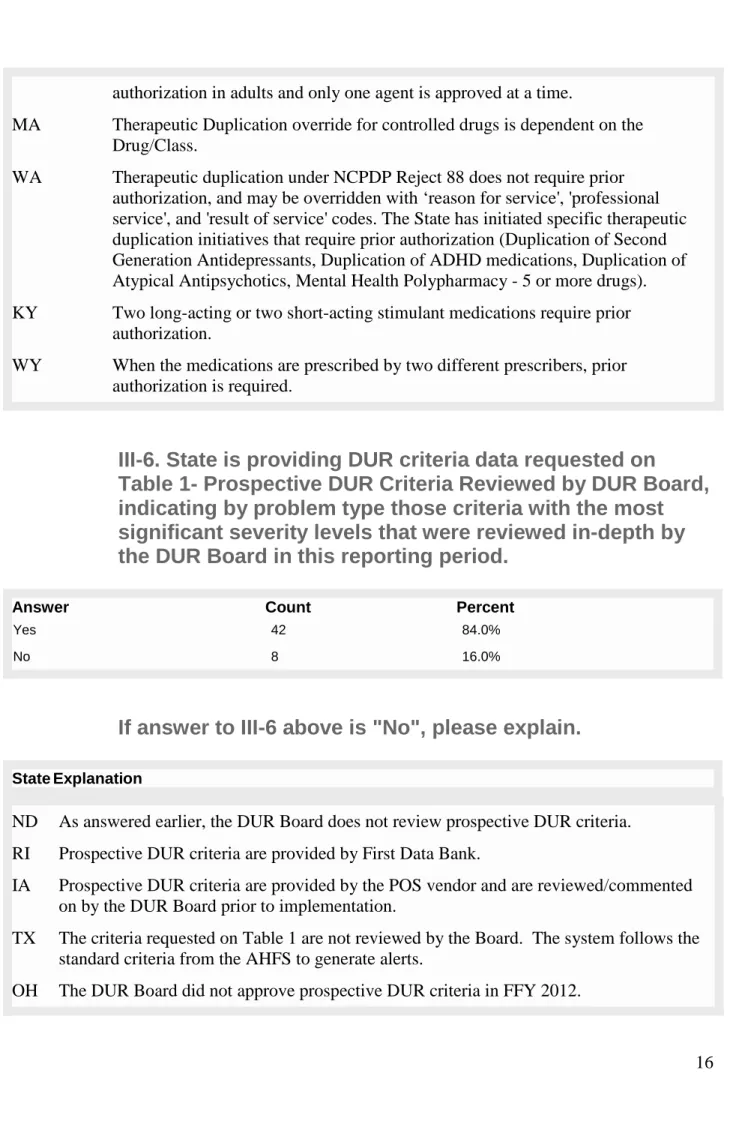
16 authorization in adults and only one agent is approved at a time.
MA Therapeutic Duplication override for controlled drugs is dependent on the Drug/Class.
WA Therapeutic duplication under NCPDP Reject 88 does not require prior authorization, and may be overridden with ‘reason for service', 'professional service', and 'result of service' codes. The State has initiated specific therapeutic duplication initiatives that require prior authorization (Duplication of Second Generation Antidepressants, Duplication of ADHD medications, Duplication of Atypical Antipsychotics, Mental Health Polypharmacy - 5 or more drugs). KY Two long-acting or two short-acting stimulant medications require prior
authorization.
WY When the medications are prescribed by two different prescribers, prior authorization is required.
III-6. State is providing DUR criteria data requested on
Table 1- Prospective DUR Criteria Reviewed by DUR Board,
indicating by problem type those criteria with the most
significant severity levels that were reviewed in-depth by
the DUR Board in this reporting period.
Answer Count Percent
Yes 42 84.0%
No 8 16.0%
If answer to III-6 above is "No", please explain.
State ExplanationND As answered earlier, the DUR Board does not review prospective DUR criteria. RI Prospective DUR criteria are provided by First Data Bank.
IA Prospective DUR criteria are provided by the POS vendor and are reviewed/commented on by the DUR Board prior to implementation.
TX The criteria requested on Table 1 are not reviewed by the Board. The system follows the standard criteria from the AHFS to generate alerts.
17 CO The DUR Board does not currently review any prospective DUR criteria.
CT There were no new Prospective DUR Criteria reviewed by the DUR Board during FFY 2012.
SD We are unable to provide in this format. The criteria come from First Data Bank.
III-7. State has included Attachment 1 – Prospective DUR
Review Summary.
Answer Count Percent
Yes 47 94.0%
No 3 6.0%
If answer to III-7 above is "No", please explain.
State Explanation
CO CMS has converted this document and uploaded it to Attachment 1.
ND System unable to produce.
HI Xerox (formerly known as Consultec and ACS) has never been able to provide the data to analyze for this report.
III-8. State has included Attachment 2- Prospective DUR
Pharmacy Compliance Report, a report on State efforts to
monitor pharmacy compliance with the oral counseling
requirement.
Answer Count Percent
Yes 40 80.0%
No 10 20.0%
If answer to III-8 above is "No", please explain.
State ExplanationMA Compliance with the oral counseling requirement is examined by the Board of Registration in Pharmacy.
18 RI Currently no monitoring program in place for oral counseling.
DE Delaware does not have a compliance report for oral counseling, but this requirement is checked during yearly physical pharmacy audits.
MO MO Board of Pharmacy requires that for every prescription oral counseling is offered. HI Monitoring pharmacy compliance with oral counseling requirement was not done by
contract this year.
NJ Responsibility for ensuring compliance with the offer to consult continues to reside with the New Jersey State Board of Pharmacy.
AR The AR State Board of Pharmacy is responsible for monitoring pharmacies with the oral counseling requirement per "Regulation 9 Pharmaceutical Care/Patient Counseling" in the AR State Board of Pharmacy Law Book. The Executive Director did not respond to the request for information regarding the State Board of Pharmacy monitoring
pharmacies for compliance of patient counseling.
WI The Department of Safety and Professional Services oversees pharmacy practice, policy and compliance. This is outside the scope of the work for the Department of Health Services.
NH The NH Board of Pharmacy monitors compliance of the oral counseling requirement. The Board's compliance inspectors monitor for this during their annual inspection of each pharmacy.
PA The PA Medicaid Program does not monitor pharmacy compliance with the oral
counseling requirement. The Department of State, Board of Pharmacy is responsible for this oversight.
IV. RETROSPECTIVE DUR
IV-1. Identify the vendor that performed your Retrospective
DUR activities during the time period covered by this report
(Company, Academic Institution or Other organization)
Answer Count Percent
Company 34 68.0% Academic institution 10 20.0% Other organization 6 12.0% Company: RI DE MO HI NJ AR WI NH PA ND IA TX CT SD FL NV ME GA WV IN TN KY NC KS NM VT MN MD VA AK MI AL DC ID Academic institution: MA CO OH UT OR WY MS CA OK IL
19
Other organization: MT WA NE LA NY SC
Organization Name
Count (State) Organization
3 (NV,TN,VT) Catamaran (formerly SXC Health Solutions, LLC)
2 (IA,ME) Goold Health Systems (GHS)
10
(AL,AR,CT,DE,KS,MD,ND,PA,RI,WI) Health Information Design
1 (SD) Health Information Designs and South Dakota State University College of Pharmacy 1 (WY) Health Information Designs/University of Wyoming School of Pharmacy 7 (AK,FL,ID,KY,NH,SC,MI) Magellan Medicaid Administration
1 (NC) Magellan Medicaid Services through a subcontract with Computer Sciences Corporation
1 (NJ) Molina Medicaid Solutions
1 (LA) Molina Medicaid Solutions (Company) & Louisiana-Monroe College of Pharmacy (Academic Institution)
1 (MT) Mountain Pacific Quality Health
1 (NE) Nebraska Pharmacists Association
1 (GA) NorthStar HealthCare Consulting
1 (OR) OSU College of Pharmacy
1 (NY) State University of New York at Buffalo and Health Information Designs, Inc.
1 (MS) The University of Mississippi
1 (UT) University of Utah Pharmacy School Drug Regimen Review Center 1 (CA) University of California, San Francisco (UCSF)
1 (OH) University of Cincinnati
1 (CO) University of Colorado School of Pharmacy 1 (IL) University of Illinois College of Pharmacy 1 (MA) University of Massachusetts Medical School
1 (OK) University of Oklahoma College of Pharmacy, Pharmacy Management Consultants 1 (WA) Washington State Medicaid (Health Care Authority)
20
IV-1. a) Is the retrospective DUR vendor also the Medicaid fiscal
agent?
Answer Count Percent
Yes 9 18.0%
No 41 82.0%
Yes: DC FL HI LA NJ NM UT VA WA
No: AK AL AR CA CO CT DE GA IA ID IL IN KS KY MA MD ME MI MN MO MS MT NC ND NE NH NV NY OH OK OR PA RI SC SD TN TX VT WI WV WY
IV-1. b) Is this retrospective DUR vendor also the
developer/supplier of your retrospective DUR Criteria?
Answer Count Percent
Yes 42 84.0%
No 8 16.0%
Yes: AK AL AR CA CO CT DE GA ID IL IN KS KY MA MD ME MI MN MO MS MT ND NH NV NY OR PA RI SC SD TN TX VT WI WV WY DC FL LA NM VA WA
If answer to IV-1 (b) above is "No," please explain.
State ExplanationHI The DUR Board and the DUR Coordinator develop and supply the retrospective DUR criteria.
IA GHS uses the MediSpan Retrospective DUR Criteria.
NC The developer/supplier of our retrospective DUR criteria is the NC Division of Medical Assistance and the DUR Board Members.
NE Retrospective reports are generated by the POS vendor. Criteria may be developed by POS vendor and/or DUR Board.
NJ Criteria identified by the NJ Drug Utilization Review Board.
OH Retrospective DUR criteria are formulated internally with assistance from the University of Cincinnati.
OK The University utilizes Medi-Span drug information applications.
UT RetroDUR criteria are recommended by the DURB after careful review. Information is supplied by leading experts, studies, and other validated sources. Both the Utah
21 Medicaid staff and the University of Utah College of Pharmacy recommend RetroDUR criteria to the DURB.
IV-2. Does the DUR Board approve the retrospective DUR criteria
supplied by the criteria source?
Answer Count Percent
Yes 46 92.0%
No 4 8.0%
If answer to IV-2 above is "No," please explain.
State ExplanationIA Provided by MediSpan.
KS The DUR Board approves general therapeutic topics, but HID is responsible for developing the criteria used for patient profile identification and review.
NV The Board suggests some topics, and will approve some of the more controversial topics. WA The DUR Board consults on and approves retrospective DUR criteria which are not
explicitly based on FDA labeling. Criteria taken directly from FDA labeling is not taken to the Board for validation.
IV-3. State has provided the DUR Board approved criteria data
requested on Table 2 – Retrospective DUR Approved Criteria.
Answer Count Percent
Yes 47 94.0%
No 3 6.0%
If answer to IV-3 above is "No," please explain.
State ExplanationIA Not reviewed by DUR Board.
WI The DUR Board approves high-level parameters for retrospective DUR interventions administered by HID. The DUR Board does not review and approve each distinct criterion. Retrospective DUR interventions are monitored by the DUR Board
22 through a quarterly DUR activity report.
WY No new retrospective criteria were added in FFY 2012 as we were researching and moving to a new retrospective review vendor and system.
IV-4. State has included Attachment 3 - Retrospective DUR
Screening and Intervention Summary Report.
Answer Count Percent
Yes 49 98.0%
No 1 2.0%
If answer to IV-4 above is "No," please explain.
State Explanation
HI Small sample size. Please see Attachment 4 Summary of DUR Board Activities for a description.
V. PHYSICIAN ADMINISTERED DRUGS
The Deficit Reduction Act requires collection of NDC numbers
for covered outpatient physician administered drugs. These
drugs are paid through the physician and hospital programs.
Has your MMIS been designed to incorporate this data into
your DUR criteria for both Prospective DUR and
Retrospective DUR?
Answer Count Percent
Yes 15 30.0%
No 35 70.0%
If 'No' to V, when do you plan to include this information in
your DUR criteria?
State Date
23 AL 09/09/2099 AR 01/01/2020 CA 07/01/2015 CO 07/01/2014 CT 12/31/2299 DC 10/01/2014 FL 01/01/2016 GA 07/01/2016 IA 07/01/2016 IL 01/01/2015 IN 12/01/2099 LA 12/31/2020 MN 09/01/2025 MS 01/01/2015 MT 02/26/2015 NC 10/01/2013 ND 06/03/2030 NE 05/08/2020 NH 09/30/2021 NJ 01/01/2016 NM 12/31/2014 NV 01/01/2014 NY 12/31/2015 OH 07/01/2023 OK 12/31/2299 RI 10/01/2014 SD TN TX 09/30/2017 01/01/2015 10/03/2016
24 VA VT WI WV WY 06/30/2020 01/01/2015 12/31/2030 10/01/2014 12/31/2100
Comment for V
State CommentWI A target date has not yet been established.
AK Alaska is in the process of transitioning from the current Legacy MMIS to a new MMIS. Once the conversion to the new MMIS is completed, the Department will need to evaluate the functionality of the system to process physician administered drug claims with both ProDUR and RetroDUR edits applied to the claims. Depending on existing functionality at or around go-live and the need for additional system
enhancements, the Department will then evaluate how to apply ProDUR and RetroDUR edits to these claims, whether it be through the MMIS or pharmacy point-of-sale. GA Although NDC numbers for physician administered drugs are captured, the current
MMIS system does not systematically incorporate this data.
MS At this time, the MS Medicaid's MMIS has not incorporated DUR criteria for ProDur and medical claims. MS Medicaid will include ProDur for medical claims as a requirement for the new MMIS procurement. Some drugs/drug classes are closed to POS or MMIS in order to assure no duplicate billing or administration is occurring. In addition, select drugs/NDCs require specific diagnoses (ICD-9 codes), age edits, refill edits, and duration of therapy edits, if applicable, associated with the prescriptions to assure appropriate use.
WA Because medical billings for drugs administered by licensed healthcare practitioners is not performed in real time in the same manner as retail pharmacy billing, it is not possible to apply prospective DUR to professionally administered drugs. However, Washington State's MMIS has been designed to pass records of office based drug administration to the Pharmacy Point of Sale system, so that this claim history can be used for Pro-DUR in real time in relation to retail and specialty pharmacy billing. The same information is available when performing retrospective DUR activities.
ND Company designing new MMIS says they can't do it.
RI Currently no project in place to make this change to our MMIS.
25 Fiscal Year 2011. Utah's MMIS system is midway into an approximately 9-year
development and implementation phase. Interfaces between the GHS and MMIS continue to be evaluated and established.
IN Indeterminate at present.
MN It is included in the RetroDUR process. Since Medical claims are not processed at POS, the cost-benefit is not favorable for ProDUR activities.
NM MMIS is designed to incorporate data only for Retrospective DUR.
MT Montana is building the Xerox Health Enterprise System that will use DUR criteria for physician administered medications.
NH NH Medicaid does collect NDC numbers on all covered outpatient physician administered drugs for rebate collection purposes. DUR criteria are only for drug claims submitted by pharmacies.
FL No current plan for implementation due to the scheduled transition from FFS to Statewide Medicaid Managed Care in January, 2014.
NC Not included in the ProDUR criteria. Data available retrospectively upon request. NE Not planned at this time.
VT Our MMIS is separate from our POS claims processing system, which cannot accommodate medical claims. Therefore, we do not believe we can accomplish ProDUR edits until we implement our new MMIS system in 2015. However, we are evaluating whether we can incorporate HCPCS medication claims into our RetroDUR. MI Physician Administered Drug utilization history from MMIS professional claims is
available for both Prospective and Retrospective DUR activities.
DC Present MMIS design does not support ProDUR data collection. Plans to address this issue are included in the upcoming PBM RFP.
LA RetroDUR- YES- Physician claims ARE incorporated in the retrospective DUR program. ProDUR- NO- Physician claims ARE NOT processed through the Point-of-Sale.
CA Retrospective DUR is currently performed for physician administered drugs. However, our current system does not allow for incorporation of prospective DUR criteria edits. It is unknown at this time as to when the system will allow such capability; a target date is planned for 07/01/2015.
TN TennCare is 100% managed care. Physician-administered claims are available in the State's MMIS system, but not in the PBM's claims adjudication system. At this time there is no plan to incorporate these medical claims into our DUR criteria.
TX Texas Vendor Drug Program is working closely with the TMMIS team to create and maintain a list of NDCs for covered outpatient physician administered drugs, as well as to develop and implement appropriate Prospective and Retrospective DUR criteria for
26 those drugs.
AR The current Medicaid computer system does not have the capability to incorporate physician and hospital administered drug data into the DUR criteria for the ProDUR and RDUR programs. In addition, the physician's program does not use point-of-sale entry systems so the data received from the physician's program is not received in a timely manner. It is unknown if the capability to incorporate physician administered drugs into the pharmacy ProDUR and RDUR data will exist in future Medicaid computer systems.
SD The information will potentially be addressed when we receive a new MMIS. The exact date is unsure.
NY The Medicaid program is compliant in collecting the NDC numbers for covered outpatient physician administered drugs.
SC The POS system used by SC Medicaid compiles both medical and pharmacy claims data into comprehensive beneficiary health profiles. Pharmacy claims are evaluated according to established criteria against each beneficiary profile. Claims history includes current, historical, paid and denied claims data regardless of the media source of claims submission.
CT There are no plans at this time for a full ProDUR and RetroDUR integration with the Medical claim side as our pharmacy POS system consists of different claim types than drugs reimbursed from our hospital Out Patient Departments. However NDCs are required on OPD drugs and collected/processed for rebate purposes.
WY This is not yet in process. IA To be determined.
OK Unknown
CO We are currently analyzing our physician administered drug program. Our hope is to have this process started by the beginning of the fiscal year 2014/2015. This process will require changes to our MMIS system as well as our pharmacy claims system. WV We are currently in the design and development of a new MMIS system which will
incorporate physician-administered and hospital-administered outpatient drugs into the DUR system. Implementation of the new system is scheduled for October 1, 2014. ID We do not have the MMIS which is a separate claim system from the pharmacy system
set up for prospective DUR in the classical sense, but do have edits and hard stops set up for dosage, quantity and indication for many of these drugs. Hard stops require prior authorization through the pharmacy program. Several physician administered drugs have been included in Retro-DUR.
OH YES (Retrospective DUR) NO (Prospective DUR).
27
VI-1. State is including a summary report of DUR Board activities
and meeting minutes during the time period covered by this
report as Attachment 4 - Summary of DUR Board Activities.
Answer Count Percent
Yes 50 100.0%
No 0 0.0%
VI-2. Does your State have a Disease Management Program?
Answer Count Percent
Yes 20 40.0%
No 30 60.0%
If answer to VI-2 above is 'Yes', is your DUR Board involved
with this -Program?
Answer Count Percent
Yes 7 35.0%
No 13 65.0%
Yes: DC LA ME MO OR VT WY
No: CA FL IA IN MA MS ND NY OK PA SC UT WA
VI-3. Does your State have a Medication Therapy Management
Program?
Answer Count Percent
Yes 9 18.0%
No 41 82.0%
If answer to VI-3 above is 'Yes', is your DUR Board involved
with this Program.
Answer Count Percent
Yes 5 55.6%
28
Yes: FL ME MO OK OR
No: CO IA MN WI
VII. GENERIC POLICY AND UTILIZATION DATA
VII-1. State is including a description of new policies used
to encourage the use of therapeutically equivalent generic
drugs as Attachment 5 - Generic Drug Substitution
Policies.
Answer Count Percent
Yes 45 90.0%
No 5 10.0%
No: AR LA RI WA WI
VII-2. Indicate the generic utilization percentage for all covered
outpatient drugs paid during this reporting period, using the
computation instructions in Table 3 - Generic Drug Utilization
Data.
Generic Utilization Percentage
State Generic Utilization PercentageAK 73.30% AL 77.99% AR 75.70% CA 71.10% CO 77.41% CT 67.95% DC 64.56% DE 76.50% FL 69.18% GA 82.50% HI 88%
29 IA 75.50% ID 76.80% IL 79% IN 76.90% KS 82.68% KY 80.90% LA 70% MA 82.10% MD 75% ME 74.50% MI 73.18% MN 78% MO 75.06% MS 76% MT 75.80% NC 73.58% ND 79.60% NE 80% NH 74.30% NJ 71% NM 80.60% NV 77.17% NY 77% OH 76.85% OK 79.26% OR 79.38% PA 80% RI 83% SC 73.50%
30 SD 75% TN 77.18% TX 68.30% UT 78.21% VA 80% VT 71.55% WA Average 79.36% 76.3%
VII-3. Indicate the percentage dollars paid for generic covered
outpatient drugs in relation to all covered outpatient drug claims
paid during this reporting period using the computation
instructions in Table 3 – Generic Drug Utilization Data.
Generic Expenditure Percentage
State Generic Expenditure Percentage
AK 20.20% AL 25.38% AR 25.60% CA 14.30% CO 25.78% CT 17.80% DC 14.20% DE 18.10% FL 11.88% GA 22.10% HI 31.70% IA 16.70% ID 21% IL 24%
31
State Generic Expenditure Percentage
IN 16.40% KS 34.31% KY 23.60% LA 24% MA 21.70% MD 21% ME 14.10% MI 12.87% MN 21% MO 23.84% MS 30% MT 20.20% NC 18.90% ND 68.90% NE 22.90% NH 13.20% NJ 10% NM 28.70% NV 19.89% NY 9% OH 16.33% OK 24.40% OR 20.61% PA 17% RI 26% SC 16% SD 23.30% TN 19.19% TX 19.63%
32
State Generic Expenditure Percentage
UT 29.30%
VA Average
23% 21.48%
VIII. PROGRAM EVALUATION/COST SAVINGS
VIII-1. Did your State conduct a DUR program evaluation/cost
savings estimate?
Value Count Percent
Yes 48 96.0%
No 2 4.0%
If answer to VIII-1 above is "No," please explain.
State ExplanationOH Our savings methodologies are currently under review.
TN PBM vendor is supposed to provide this information, and the person who was supposed to provide this information did not.
VIII-2. Who conducted your program evaluation/cost savings
estimate? (Company, academic institution, other institution)
Value Count Percent
Company 38 79.2% Academic institution 3 6.3% Other institution 7 14.6% Company: AK AL CT DC DE FL GA HI IA ID IN KS KY LA MD ME MI MN MO MS ND NE NH NJ NM NV NY OR PA RI SD TX UT VA VT WI WV WY Academic institution: CA MA OK Other institution: AR CO IL MT NC SC WA
33
State Organization
AK Magellan Medicaid Administration
AL Pro DUR cost savings estimate was conducted by HP; Retro DUR cost savings estimate was conducted by HID.
AR HID provided the estimated RDUR cost savings info; HP provided the estimated ProDUR cost savings info; Xerox provided the estimated cost savings info for the drugs associated with the PDL and PA criteria.
CA University of California, San Francisco (UCSF) CO Internal analysis
CT Health Information Design and Hewlett Packard DC Xerox State Healthcare
DE Pro-DUR cost savings estimate conducted by HP and Retro-DUR cost savings estimate conducted by HID
FL Magellan Medicaid Administration
GA Catamaran
HI DUR Coordinator, pharmacy consultant
IA GHS
ID Magellan Medicaid Administration IL HFS Bureau of Pharmacy Services IN Xerox State Healthcare, LLC KS HID, Xerox, HP Enterprises KY Magellan Medicaid Administration LA Molina Medicaid Solutions
MA University of Massachusetts Medical School MD Xerox Government Solutions
ME Goold Health Systems
MI Magellan Medicaid Administration, Inc.
MN MN Sate did except for the RetroDUR done by Xerox MO
MS MT
Xerox Heritage LLC Xerox, Inc.
34 State Organization NC ND NE NH NJ NM NV NY OK OR PA RI SC SD TX UT VA VT WA WI WV WY
ProDUR- HP Enterprises; PDL- Mercer Health Information Designs, LLC Magellan Medicaid Administration, Inc. Magellan Medicaid Administration Molina Medicaid Solutions
Xerox State Healthcare Catamaran
Health Information Designs, Inc.
University of Oklahoma College of Pharmacy, Pharmacy Management Consultants HP Enterprise Services
Health Information Designs, Inc. (HID) Health Information Design, Inc. (HID) Magellan Medicaid Administration
Health Information Designs -- along with South Dakota State University College of Pharmacy
Xerox and HID GHS
Xerox Catamaran
Washington State Medicaid Health Information Designs
Molina Medicaid Solutions and Xerox State Healthcare Health Information Designs
VIII-3. State is providing the Medicaid program evaluations/cost
savings estimates as Attachment 6 – Cost Savings Estimate.
Value Count Percent
Yes 48 96.0%
35
If answer to VIII-3 above is "No," please explain
State ExplainOH Our savings methodologies are currently under review. TN This information was not provided to the State by Catamaran.
VIII-4. Please state the Estimatednet savings amount. $
State Estimated net savings amount. $AK 1,557,872 AL 697,462 AR 47,387,426 CA 97,973,779 CO 2,239,924 CT 25,924,841 DC 47,500 DE 3,900,000 FL 120,219,044 GA 38,097,151 HI 66,121 IA 747,655 ID 10,225,876 IL 548 IN 76 KS 2,556,322 KY 1,202,441 LA 97,653,042 MA 196,505,497 MD 18,463,470 ME 83,349,370 MI 275,494,561
36
State Estimated net savings amount. $
MN 27,575,584 MO 886,707 MS 12,466,883 MT 12,116,418 NC 397,200,000 ND 902,857 NE 9,741,427 NH 1,852,825 NJ 17,060,560 NM 1,465,503 NV 35,776,868 NY 7,870,229 OH 0 OK 129,291,699 OR 113,338 PA 2,335,744 RI 670,000 SC 14,275,314 SD 268,429 TN 0 TX 103,833,209 UT 13,053,275 VA 81,667,664 VT 44,190,270 WA 142,393,939 WI 1,727,172 WV Average 22,085,297 43,662,616
37
VIII-5. Please provide the estimated percent impact of your
state's cost savings program compared to total drug
expenditures for covered outpatient drugs. Divide the estimated
net savings amount provided in Section VIII, Question 4 above
by the total dollar amount provided in Section VII, Question 3.
Then multiply this number by 100. Estimated Net Savings
Amount / Total Dollar Amount * 100 = ________.
State Estimated percent impact
AK 2% AL 14% AR 15% CA 4% CO 1% CT 4% DC 0% DE 2% FL 9% GA 9% HI 5% IA 0% ID 8% IL 46% IN 10% KS 2% KY 1% LA 10% MA 41% MD 5% ME 37% MI 40% MN 10%
38
State Estimated percent impact
MO 1% MS MT NC ND NE NH NJ NM NV NY OH OK OR PA RI SC SD TN TX UT VA VT WA WI WV WY 3% 18% 32% 3% 26% 0% 5% 8% 29% 1% 0% 31% 1% 0% 4% 36% 1% 0% 6% 7% 40% 34% 40% 0% 7% 35%
39
IX. FRAUD, WASTE AND ABUSE DETECTION
IX-1. Do you have a process in place that identifies potential
fraud or abuse of controlled drugs by recipients?
Answer Count Percent
Yes 50 100.0%
No 0 0.0%
If 'Yes' to IX-1 above, what action(s) do you initiate? Check
all that apply.
Action Count Percent
a. Deny claim, and require pre-authorization 30 60.0%
b. Refer recipient to lock-in program 43 86.0%
c. Refer to Medicaid Fraud Control Unit (MFCU) or Program Integrity 42 84.0%
d. Other 12 24.0%
a. Deny claim, and require pre-authorization: AK AL AR CT DC DE FL GA IL IN KY MA MD ME MI MO MS MT NE NJ NV OR PA SC TN UT VT WA WI WV
b. Refer recipient to lock-in program: AK AL AR CT DC DE FL GA IL IN KY MA MD ME MI MO MT NE NJ NV OR PA SC TN UT VT WA WI WV IA ID KS LA MN NC ND NH OH OK RI TX VA WY
c. Refer to Medicaid Fraud Control Unit (MFCU) or Program Integrity: AK AL AR CT DC FL GA IL IN KY MA MD ME MI MO NE NJ NV OR PA SC UT VT WA WI WV IA KS LA MN ND NH OK RI TX VA WY MS CA CO NY SD
d. Other: NV PA VT IA LA MS DE MT TN NC HI NM
If response to above is "d. Other", please explain.
State ExplanationNV Refer the recipient to Welfare for eligibility verification and refer the recipient to the controlled substance task force, enforced by the Board of Pharmacy.
PA RetroDUR interventions also identify potential fraud and abuse of controlled substances. Prescribers are made aware of recipients receiving prescriptions for controlled substances by multiple prescribers. The response we receive from
40 the only mechanism that they have to learn of recipients that shop prescribers for controlled substances in Pennsylvania.
VT Referrals are also made to law enforcement.
IA The DUR contacts prescribers and pharmacies based on profile reviews. The DUR also sends out the Quarterly Narcotic Utilization Report to prescribers identifying members that are using three or more prescribers and/or pharmacies to obtain narcotic medications.
LA Refer to the audit program, Louisiana Board of Pharmacy, Office of Medical Examiners
MS MS Medicaid works with the MS Board of Pharmacy's Prescription Monitoring Program (PMP) regarding concurrent use of controlled substances. If appropriate, the prescriber is contacted regarding potential abuse and duplicated therapies. Regulatory Boards such as Medical Licensure, the MS Bureau of Narcotics and /or MS Board of Pharmacy are notified. MS Medicaid has an electronic health records program (EHR) with e-prescribing. This program works independently and/or overlays with a
prescriber's EHR to allow the prescriber to validate medications the patient is using regardless of the payer.
DE The pharmacy services call center can refer clients to Surveillance and Utilization Review (SURS) when information or cash profiles are received
MT Place a reverse PA, so that the client must have each prescription authorized by their prescriber.
TN Refer to State of Tennessee's Office of Inspector General, which is the agency that investigates and enforces Tennessee's Doctor Shopping and Enrollee TennCare fraud laws.
NC All potential recipient fraud and abuse leads are referred to the recipient's county Dept. of Social Services for further investigation and disposition.
HI Retrospective review of paid claims and provider communications (telephone and letter) are utilized to identify. Monitoring and re-evaluation are done at least annually.
NM Preparing to implement prior authorization and begin notifying physicians.
IX-2. Do you have a process in place that identifies possible
fraud or abuse of controlled drugs by prescribers?
Answer Count Percent
Yes 44 88.0%
41
No: MT NE OR WI MN ID
If 'Yes' to IX-2 above, what action(s) do you initiate? Check
all that apply.
Action Count Percent
a. Deny claims written by this prescriber 16 36.4%
b. Refer to MFCU or Program Integrity 41 93.2%
c. Refer to the appropriate Medical Board 29 65.9%
d. Other 9 20.5%
a. Deny claims written by this prescriber: PA VT DE TN FL GA IN KY MA ME MO NJ SC WA KS CA
b. Refer to MFCU or Program Integrity: PA VT DE TN FL GA IN KY ME MO NJ SC WA KS CA NV IA LA MS NC HI AK AL AR CT DC IL MD MI UT WV ND NH OK RI VA WY CO NY SD OH
c. Refer to the appropriate Medical Board: VT TN FL GA IN KY ME MO NJ SC WA KS NV LA MS NC AK AL CT IL MD MI WV ND OK SD MA NM TX
d. Other: VT MO KS NV LA NC IL MI TX
If response to above is "d”. Other", please explain.
State ExplanationNC An audit of the particular claims would be performed. MO DUR Board review of provider/patient cases.
LA In the recipient-driven Lock-in Program, a prescriber may not be approved based on the recipient's utilization pattern.
VT Prescribers can be removed from our network so claims will be denied. A record review may be undertaken.
MI Prescribers may be suspended from the program, sanctioned, and prescriptions from the prescriber would then be denied at point-of-sale.
NV Refer the prescriber to the controlled substance task force, enforced by the board of pharmacy.
TX Refer to the Office of Inspector General.
IL Report to the Illinois Department of Professional Regulations, which issues professional licenses, for review.
KS We have a PERC (Peer Education Resource Council) that reviews problematic prescribing and may refer providers to the appropriate licensing board.
42
IX-3. Do you have a process in place that identifies potential
fraud or abuse of controlled drugs by pharmacy providers?
Answer Count Percent
Yes 42 84.0%
No 8 16.0%
No: NM OH MT NE OR WI MN ID
If 'Yes' to IX-3 above, what action(s) do you initiate?
Check all that apply.
Action Count Percent
a. Deny claim 12 28.6%
b. Refer to MFCU or Program 42 100.0%
c. Refer to Board of Pharmacy 29 69.1%
d. Other 11 26.2%
a. Deny claim: MO TN FL GA IN KY ME NJ SC WA MA DE
b. Refer to MFCU or Program: MO TN FL GA IN KY ME NJ SC WA MA DE NC LA VT MI NV TX IL KS MS AK AL CT MD WV ND OK SD PA CA IA HI AR DC UT NH RI VA WY CO NY
c. Refer to Board of Pharmacy: MO TN FL GA IN KY ME NJ SC WA MA NC LA VT MI NV TX IL KS MS AK AL CT MD WV ND OK SD DC
d. Other: MO TN IN KY NC LA VT MI NV TX IL
If response to above is "d. Other", please explain.
State Explanation
MO DUR Board review of provider/patient cases.
TN We would also terminate pharmacy's provider contract if fraud is found. We did not take this action during FFY 2012.
IN Audit recoupment, Prepayment review program.
KY Onsite pharmacy audits to ensure policies/procedures/laws established by the Kentucky Board of Pharmacy and Kentucky Medicaid are followed.
43 LA In the recipient-driven Lock-in Program, a pharmacy provider may not be approved
based on the recipient's utilization pattern. VT A record review may be undertaken.
MI Pharmacy providers may be suspended from the program, sanctioned, and prescription claims would then be denied at point-of-sale.
NV Refer the pharmacy to the controlled substance task force, enforced by the Board of Pharmacy.
TX Refer to the Office of Inspector General.
IL Report to the Illinois Department of Professional Regulations, which issues professional licenses, for review.
IX-4. Does your State have a Prescription Drug Monitoring
Program (PDMP)?
Please see Attachment 7 for a description of this Program.
Answer Count Percent
Yes 41 82.0%
No 9 18.0%
If 'No' to IX-4 above, does your State plan to establish
a PDMP?
Answer Count Percent
Yes 6 66.7%
No 3 33.3%
Yes: GA MD DC NH RI WI
No: MO VA NE
X. INNOVATIVE PRACTICES
X-1. Have you developed any innovative practices during
the past year which you have included in Attachment 8 –
Innovative Practices?
44
Yes 34 68.0%
No 16 32.0%
No: NE RI IN KY LA NJ SC WA SD IA HI WY NM OH OR MN
XI. E-PRESCRIBING
XI-1. Has your State implemented e-prescribing?
Answer Count Percent
Yes 27 54.0%
No 23 46.0%
If 'No', are you planning to develop this capability?
Answer Count Percent
Yes 13 56.5%
No 10 43.5%
Yes: IN NJ WA SD IA WY MD NC IL OK CA UT CO
No: NE RI KY LA HI VA WI TN AK ND
If 'Yes', please respond to questions XI-2 and XI-3
below.
XI-2. Does your system use the NCPDP Origin Code that
indicates the prescription source?
Answer Count Percent
Yes 32 64.0%
No 18 36.0%
Yes: NE VAWI TN AK WA NC IL UT SC NM OH OR GA DC NH VT MI NV TX FL MA KS AL CT WV DE PA AR NY MT ID