Seton Hall University Seton Hall University
eRepository @ Seton Hall
eRepository @ Seton Hall
Seton Hall University Dissertations and Theses
(ETDs) Seton Hall University Dissertations and Theses
Winter 3-9-2020
Teachers Perception of the Influence of Trauma Informed
Teachers Perception of the Influence of Trauma Informed
Classroom Practices on Elementary School Students: A Case
Classroom Practices on Elementary School Students: A Case
Study
Study
Kelly MurraySeton Hall University, [email protected]
Follow this and additional works at: https://scholarship.shu.edu/dissertations
Part of the Early Childhood Education Commons, Educational Methods Commons, and the Elementary Education Commons
Recommended Citation Recommended Citation
Murray, Kelly, "Teachers Perception of the Influence of Trauma Informed Classroom Practices on Elementary School Students: A Case Study" (2020). Seton Hall University Dissertations and Theses (ETDs). 2731.
ABSTRACT
The purpose of this study is to gain insight into the lived experiences and perceptions of elementary school teachers as they seek to bring trauma-informed classroom practices to their students. Around the world, there has been an increase in the need for trauma-informed classroom practices based on the lives and struggles of those who are walking through our public school doors. Teachers implementing trauma-informed classroom strategies do so to attempt to create environments for students to share their life experiences while simultaneously teaching them coping strategies for a better future. Educators and students become part of an environment in which care, support and community-building are prioritized over academic achievement. In trauma-informed classrooms, we commonly see teachers who have taken extensive time to get to know the lived experiences of the students they teach, paying close attention to their actions and the environment they have created, watching the impact that it has on each individual child. Such an environment creates a sense of belonging and prioritizes social and emotional learning.
Teachers have used trauma-informed classroom practices in their classrooms to address the adverse childhood experiences that students entering school have faced. As the movement spreads, more school leaders are bringing trauma-informed practices outside of the classroom to develop school-wide trauma-informed environments (Kostanski & Hassed, 2008). According to Broderick, “the prevalence of childhood affective disorders (approximately 20%) may
contribute to deteriorating class climates and increasing teacher stress” (Broderick & Metz, 2009). In both educational psychology and neuroscience, there is a demand for those who work with children to evaluate the systems that exist to meet the social and emotional challenges that children face. Trauma-informed classroom practices help students learn to cope with the difficulties that exist in their lives and, as a result, engage in more positive productive experiences within the school setting.
Traumatic experiences alter the brain and impact children in multiple ways beyond a lack of academic success. Students can struggle socially and can possess behavioral needs that schools are unable to address. As a result of anxiety and stress, many students exhibit behavioral issues perpetuated by anger or depression (Howard, 2014). Howard writes that “When you adopt a trauma-informed perspective you approach that student’s behavior with openness and curiosity because the ultimate aim of most school-based trauma-informed instruction programs is to increase awareness of the influence of trauma on students’ thoughts, emotions and behaviors and, by implementing key techniques and strategies, enhance the likelihood of treating trauma in the classroom” (Shapiro, 2009).
Many factors impact student success, including violence, domestic abuse and poverty. Nearly half of children in the United States, or almost 35 million, have experienced “at least one or more types of serious childhood trauma,” according to a survey by the National Survey of Children’s Health (National Survey of Children’s Health, 2018). Because teachers are the adults who see students for the longest periods of time throughout the day, they play a critical role in recognizing the symptoms of trauma and treating it at the classroom level.
DEDICATION
ACKNOWLEDGEMENTS
I would like to thank my family for always believing in me. Without their relentless support, none of this would be possible. I am especially thankful for my two children, Claire and Finn, who are the motivation for all that I do. I hope that as you grow up, you too find passion and purpose in your life and work. I am extremely appreciative of my dissertation committee, which consists of Dr. Daniel Gutmore, Dr. Michael Kuchar and Dr. Julie Riess, as well as the six teacher participants who openly shared their experiences with trauma-informed classroom practices.
Table of Contents
CHAPTER 1 ... 1
INTRODUCTION ... 1
Historical Background ... 4
Statement of the Problem ... 7
Purpose of the Study ... 8
Research Questions ... 9
Significance of the Study ... 10
Theoretical Framework ... 13
Limitations of the Study ... 14
Definition of Terms ... 15
Summary ... 17
CHAPTER 2 ... 20
REVIEW OF THE LITERATURE Historical Context & Terminology ... 20
Prevalence of Trauma... 23
From the Lens of the Classroom ... 26
Policy Influences ... 28
CHAPTER 3 ... 33 RESEARCH METHODOLOGY ... 33 Research Design ... 33 Participants ... 34 Recruitment of Teachers ... 34 Sample ... 34 Setting ... 35
Ethical Considerations & Human Subjects Protection ... 36
Instrumentation ... 36
Research Questions ... 37
Data Collection ... 38
Reliability and Validity ... 39
Researcher Bias ... 40 Data Analysis ... 41 Summary ... 42 CHAPTER 4 ... 43 RESEARCH FINDINGS ... 43 Research Questions ... 43
Actively Seek to Understand the Past ... 49
Avoid Re-Traumatization in the Present ... 51
A Systematic Approach for the Future ... 52
Academic Improvement ... 55
Community Building ... 58
Summary ... 61
CHAPTER 5 ... 63
IMPLICATIONS... 63
Overview of the Study ... 63
Methodology ... 64
Summary of Findings ... 65
Benefits of Trauma-informed Practice on the Lives of Teachers ... 66
Building a Skillset for Success ... 66
Classroom Observations ... 68
Outside Factors As Barriers ... 68
Implications ... 69
Limitations ... 70
Recommendations for Policy, Practice and Future Research ... 71
REFERENCES... 75
APPENDICES ... 91
Appendix A ... 92
Appendix B Letter of Recruitment ... 93
Appendix C Informed Consent Form ... 94
CHAPTER 1
INTRODUCTION
Trauma-informed instruction is in many ways, a foundation that all additional instruction is
built upon because without conditions in place to address trauma in classrooms, learning is lost.
In the absence of this learning, trauma has to potential to alter the ability of a child to
self-regulate. Social skills and a child’s sense of self can also be impacted along with the appropriate
growth and development of foundational academics, especially when language skills, memory
acquisition and executive functioning are necessary. Addressing trauma enables children to deal
with both past and future challenges (Shapiro et al., 2008; Mind and Life Education Research
Network [MLERN], 2012).
“Reports of increased clinical and stress-related problems and problems related to social pressure in children are at an all-time high, with much of this manifesting itself at the present
moment” (Currie et al., 2002; Lohaus and Ball, 2006; Card and Hodges, 2008). In addition to
very complicated social-emotional needs faced by children, it has been reported that “21% of
children aged 13 to 18 years in the United States are currently suffering, or have at some point
during their life suffered, from a severe mental disorder (Merikangas et al., 2010), with ADHD,
behavioral or conduct problems, anxiety and depression being the most prevalent current
diagnoses” (US Department of Health and Human Services, and Centers for Disease Control
and Prevention, 2013). In addition, roughly 26% of children in the United States have witnessed
or experienced trauma before the age of four (Briggs-Gowan et al. 2010). In 2012, an estimated
686,000 children were victims of child abuse and neglect (Collins, 2012). More than half of all
younger than three years old, 19.9% were between three and five years old and another 16.6%
were between six and eight. Over 80% of these identified traumatic events were reported to have
been perpetrated by the children’s family and/or caregivers and took place within the child’s
residence (HHS 2013). Daily, many elementary school teachers are likely to encounter young
children who have experienced trauma. These traumas may include separation issues related to
experienced loss of a loved one, abuse (sexual and/or physical) and many forms of violence. In
addition, early forms of trauma could be caused by illness or medical procedures and/or accidents of
any sort (Herman [1992] 1997; van der Kolk 2005; NCTSNSC 2008).
Trauma research demonstrates that all types of trauma can negatively impact children’s abilities
to learn, create healthy attachments, form supportive relationships and fulfill classroom
expectations (NCTSNSC 2008). The effect of trauma can lead to emotional, developmental and
neurobiological challenges that stretch well beyond childhood and into adulthood. “Children who
experience trauma are two-and-a-half times more likely to fail a grade in school than their
non-traumatized peers. In addition, they score lower on standardized tests, have higher rates of
suspension and expulsion and are more likely to be placed in special education classrooms”
(Delaney- Black et al. 2002; Cole et al. 2005).
Children are experiencing trauma at an alarming rate and the impact of this trauma has the
potential to change the path of their lives significantly. As a result, the school environment must
be a reflective, safe and nurturing space where students can work with dedicated caregivers to
cope with traumatic events from the past and build a better educational future. “Early on,
children decide whether they view themselves as learners, and by age 8, most children are on
to truly address the needs that our students are coming to school with, educators must build
their own skills and knowledge about trauma, its impact on the brain and stages of appropriate
growth and development in for our youth. This knowledge can help teachers and those working
in education to create environments and structures within the school setting in which all students
can thrive.
The organ that defines every individual is the brain, and as new discoveries help us to better understand our brains, we must acknowledge that learning, memories and emotions all go hand
in hand. We can all benefit from understanding the rudimentary functions of the brain, including
why some of our experiences become lasting memories while others seem to disappear quickly
(Erisman, S.M., & Roemer, L. 2010). Perhaps one of the most exciting discoveries about our
brains is that we have the potential to learn new information and re-wire our brains throughout
our lives. Understanding how the brain learns and concurrently understanding the impact of
anxiety, trauma, joy, stress and other emotions on learning can facilitate interpersonal and
instructional strategies that improve learning and increase resilience in our students and
employees (Goldin, P. R., & Gross, J. J. (2010).
Trauma-informed instruction is defined by the Social-Emotional Learning Goals set by the New
York State Education Department. Trauma-informed instruction is rooted in developing the
whole child as a multifaceted learner and building a capacity for self-awareness (Roemer, L.,
Williston, S. K., & Rollins, L. G. 2015). Trauma-informed instruction is grounded in the art of
mindfulness, which is the mind–body connection through which we are conscious of our
thoughts, feelings and actions to help us focus on being in the present (Jones, D. E., Greenberg,
becoming increasingly apparent. Healthy stress is a natural part of life and is necessary to push us
to grow and develop, but toxic stress impairs attention, emotional regulation, sleep and learning
readiness in students. In the long term, it can lead to serious mental and physical health issues.
For teachers, prolonged exposure to toxic stress leads to decreased productivity and creativity as
well as increased frustration, anxiety and burnout (Blaustein, M., & Kinniburgh, K., 2010).
One out of every four children attending school has been exposed to at least one traumatic
event that can affect learning and behavior; impair learning, attention, memory and cognition;
interfere with problem solving; and result in overwhelming feelings of frustration and anxiety
(Davis, T.S. 2012). As a result, teachers are tasked with developing their own skills and abilities
in order to support themselves and student learning in our nation’s classrooms.
Historical Background
The Diagnostic and Statistical Manual of Mental Disorders (DSM-IV-TR) defines traumatic
events as “those in which an individual experiences, witnesses or is confronted with actual or
threatened death or serious injury or threatened physical integrity of the self or others”
(Blaustein, M., & Kinniburgh, K. 2010). Contrary to what one might expect, the traumatic
experience that a child may face, does not necessarily have to be violent in nature and
does not have to be aimed solely on the child. Traumatic experiences in childhood are
defined as adverse childhood experiences (ACEs), including “physical, psychological or sexual
abuse; violence against one’s mother; or living with household members who are mentally ill,
suicidal or substance abusers or who were ever incarcerated.” According to a well-known study
where ACEs were defined, “a person who has experienced traumatic events may feel intense
S. F., et al. 2003).
Childhood trauma can be seen “the response to an event or or series of events that render a child
“temporarily helpless” and surpass the child’s “ordinary coping and defensive operations” (Beauchemin J., Hutchins T., Patterson F. 2008). Depending on the actual experience and
diverse characteristics of the child that has been impacted, the depth of suffering and
challenge can vary. “By being sensitive to students’ past and current experiences with trauma,
educators can break the cycle of trauma, prevent re-traumatization and engage a child in
learning and achieving success in school” (Scheeringa, M., Salloum, A., Arnberger, R.,
Weems, C., Amaya-Jackson, L., & Cohen, J.2007).
Children from all races and backgrounds experience and are impacted by trauma. Research
suggests that between half and two-thirds of all school-aged children experience trauma as they
are exposed to one or more adverse childhood experience that can be trauma-inducing (Garro,
A., Brandwein, D., Calafiore, T., & Rittenhouse, N. 2011).
“Traumatic experiences that occur during the time when the brain is still being developed have the potential to profoundly impact child development” (Ghosh Ippen, C., Harris, W., Van Horn,
P., & Lieberman, A. 2011). Brain imaging shows that the brain continues to develop into early
adulthood, with the peak times of development in early childhood and adolescence. More
specifically, areas such as the hippocampus, which is involved in learning and memory, develop
rapidly in early childhood, while the prefrontal cortex, which regulates thoughts and attention,
matures more rapidly during adolescence (Cohen, J., Mannarino, A., & Deblinger, E. 2006).
protective for survival (Cook, A., Spinazzola, J., Ford, J., Lanktree, C., Blaustein, M., Cloitre,
M., et al. 2005). These children are then described as existing with ongoing, pervasive anxiety,
stress and fear. These emotions and the inability to cope have negative consequences for
appropriate development, both neurologically and developmentally.
Anyone working in education can vividly describe the impacts of trauma on student learning,
social-emotional well-being and behavior at school. Specifically, children who have experienced
trauma struggle with focus, access to instruction, short term memory and the need for sensory
input. All of these areas then have the potential to delay the acquiring of new skills such as
reading, writing and math. “In a sample of high-risk children at a pediatric clinic in Florida,
children who were exposed to four or more adverse experiences were 32 times more likely to
have learning or behavioral problems than their peers with no adverse experiences” (Badenoch,
B., 2008).
Throughout the last few years, various trauma-informed instruction programs for schools have
been developed and applied (Meiklejohn et al., 2012). The increasing number of meetings,
books and newspaper articles on the subject indicate that the integration of trauma-informed
instruction into education speaks to the demand of educators and caregivers for assistance in
helping children succeed despite the trauma in their lives.
The number of studies evaluating trauma-informed instructional practices in school settings is
growing; however, to date, enthusiasm about the integration of trauma-informed instructional
practices in schools surpasses evidence (Greenberg and Harris, 2011). The diversity of programs
and outcome measures combined with the pilot-character nature of most studies make it difficult
easily derived. “Presenting a narrative review on the literature summarizing the research
published to date is a good start, but a quantitative synthesis exclusively of studies on
trauma-informed practices in the school context is still lacking” (Meiklejohn et al., 2012). Some studies
have shown that children benefit from trauma-informed instruction practices, but few
incorporate teacher observations on the use of trauma-informed instruction with elementary
school students (Zelazo P. D., Lyons K. E., 2012). The few studies that exist regarding the
influence of trauma-informed instruction on the elementary school student suggest a generally
positive effect on decreasing anxiety and increasing cognitive performance; however, with such
little research available, those in education remain uncertain as to how much of that effect
comes specifically from trauma-informed instruction (Coffey, K.A., Hartman, M., &
Fredrickson, B.L. 2010). The amount of trauma-informed instruction that children need is also
unknown, as is whether the positive effects on relationship building and academic success are
sustainable. As a result, focus must be placed on gaining knowledge and skills regarding
trauma-informed classroom practices used in elementary classrooms (Eberth J., Sedlmeier P.
2012).
Statement of the Problem
Every public education system must critically reflect on the social-emotional needs of the
children it serves. Howard Gardin stated that “academic achievement, social and emotional
competence and physical and mental health are fundamentally and multiply interrelated and
therefore, the best and most efficient way to foster any of those is to foster all of them”
(Diamond, 2010, p. 789). We have no choice to but to ensure that our schools foster not just
trauma-prevention and education can be provided simultaneously, thus addressing a wide range of
student needs and unfulfilled potential.
Trauma impacts the ability for children to have positive interactions and relationships with peers
and adults both inside and outside of the classroom. The impact of trauma could manifest itself
by creating children who are seemingly anxious, afraid and unable to trust those around them.
“Research indicates that children who have been exposed to violence often have difficulty responding to social cues and may withdraw from social situations or bully others” (Wright, T.
2014). Children impacted by trauma often have challenges with those in positions of authority,
rules, expectations and associated punishments. “The consequences of traumatic experiences
have the potential to destroy the lives of children by increasing their risk for mental and
physical health problems, substance abuse and criminal justice involvement in adolescence and
adulthood” (van der Kolk, B.A. 2005).
Those in positions of authority within the education system must seek to end the impact that
the cycle of trauma creates within our institutions. Although much research has been conducted
about trauma and the impact on learning and achievement in school, little research has presented
educators with knowledge regarding the structures, skills and techniques they can employ in
their classrooms to minimize the impact of trauma and change the lives of children. A gap in the
literature thus exists, resulting in a need to explore trauma-informed instruction and specifically
the perceptions of teachers who have had experiences that can guide our thinking about what
best practices look like.
Purpose of the Study
significant space for growth and development. My goal is to understand how trauma-informed
instruction is being integrated into elementary school classrooms and to gain a teacher’s
perspective on its impact on student achievement, social emotional learning and overall success.
According to the National Institute of Health, one in eight children suffers from anxiety, one in
five suffers from a mental health or learning disorder and 80% of chronic mental disorders begin
in childhood (Hoge, E. A., Bui, E., Marques, L., Metcalf, C. A., Morris, L. K., Robinaugh, D. J.,
Simon, N. M., 2013). “Children are exposed to traumatic experiences that have the potential to
impact brain development, social functioning and their ability to learn and engage in school and
recognizing and addressing this issue must become a focus of our educational system” says
Flook. “Trauma-informed approaches, which have been supported by research evidence in fields such as mental health and child welfare, recognize and address the implications of
traumatic experiences for students” (Flook L., Smalley S. L., Kitil M. J., Galla B. M.,
Kaiser-Greenland S., Locke J., et al. 2010). Understanding the harsh reality of the potential impact that
trauma can have on our most vulnerable children, schools must seek to create and implement a
trauma-informed approach within our public schools.
Research Questions
The main inquiry of this study is the following: What are the perceptions of teachers who
practice trauma-informed classroom practices of its influence on students’ academic, social and
emotional engagement in the elementary school setting? This overarching question is divided
into five sub-questions:
1. How do teachers who employ trauma-informed classroom practices describe the impact of
2. How do teachers who employ trauma-informed classroom practices describe their objectives
in using these practices?
3. What are the trauma-informed classroom practices that teachers implement in an effort to
achieve their objectives?
4. How do teachers who employ trauma-informed practices in their classrooms describe the
impact of these practices in meeting their objectives?
5. What are the influences outside the classroom that teachers describe as impacting the
success of trauma-informed classroom practices within their classrooms?
Significance of the Study
This study will contribute to current research on how to ensure that all students achieve success
in school. The goal of this study is to explore and understand the implications of
trauma-informed instruction for student success in the elementary-school classroom, specifically from
the perspective of the classroom teacher. Currently, students are experiencing toxic stress, which
impacts their ability to pay attention, regulate their moods and emotions, sleep and be ready to
learn daily. In addition, prolonged exposure to childhood toxic stress has lifelong impacts on
mental and physical health that begin as decreased productivity and creativity and then escalate
to frequent anxiety, dissociation, frustration and burnout (Black, D.S., Milam, J., & Sussman, S.
2008). The findings of the Lokniti CSDS youth survey indicate that around 4 out of 10
youngsters who are currently studying felt regular or occasional bouts of stress and depression,
and at least 6% had felt like committing suicide at least once in the last several years (Black, D.,
blind eye on the impact of trauma on our children, and we can do this by creating classrooms
that support the needs of all students. Most importantly, we need to shift our areas of research
from impact to understanding trauma in order to stop it from plaguing our children throughout their
lives.
Understanding and implementing trauma-informed instruction aim to improve student attention,
self-control, emotional resilience, recovery from addiction, memory and immune responses
(Williams, R., & Fields, M. 2013). Improved skills in these areas will allow students to learn
and produce at higher levels in the classroom setting and face fewer obstacles that they are not
equipped to handle or cope with. Over the past 10 years, the educational system in the United
States has demanded progressively higher academic expectations in elementary schools, which
require increasingly sustained attention from students in kindergarten through to fifth grade
(Hooper & Chang, 1998). Applying trauma-informed instruction techniques in schools can assist
students in coping with the experiences that they are faced with. Being taught to cope,
understand, empathize and regulate is associated with long-term benefits in terms of overall
health, well-being and success (Sanders, R., & Broderick, P. C. 2013). This suggests that the
long-term effects of trauma-informed instruction are beneficial for students, having the potential
to be a powerful tool to help our children change a cycle into which they were often born.
In a study conducted by Yale, more than 2,000 people were studied from birth until the age of
40 to determine what made them more successful than their peers. The study found that it was
not race, culture, language, neighborhood or parental income, nor how well they performed in
standardized tests or even IQ: It was self-control (Davis, T.S. 2012). If our students cannot focus
However, how often do educators actually take the time to explore the factors that hinder
students’ ability to focus and pay attention? How comfortable are educators in deviating from
the lesson plans that they have created to sit on the floor with a child going through crisis? How
adept are educators at recognizing the underlying meaning behind the behavior a child is
showing in the classroom?
Understanding the experiences of classroom teachers and learning from their observations
related to the implementation of trauma-informed instruction techniques promote a clearer
picture of how trauma-informed instruction interventions are impacting our students and the
potential of such approaches to improve the lives of our youth (Blair, C. 2010). In summary,
trauma-informed instruction techniques used in classrooms have the potential to change the
trajectory of a child's life, and teachers who implement these practices are our greatest
resources. This study is significant in that it adds to the current research on the influence of
trauma-informed instruction in children and thus can serve as a resource for teachers and
administrators who seek to create effective trauma-informed instruction programs within their
classrooms and schools. With attention, care and commitment dedicated to educational
professionals learning and researching the impact of trauma, we can create the learning
environments that our students deserve.
This study seeks to gain insight into strategies that could be implemented to not only benefit
students who have overcome trauma but also to decrease burnout among the educational
Theoretical Framework
It is the responsibility of school systems working with children to confront the epidemic of
trauma that plagues our communities and negatively impacts our youth. “From medical centers
to courts to child welfare systems, evidence-based approaches to addressing trauma have been
developed and have proven to be effective” (Howard, K., Spinazzola, J., Strothers, H., Evans,
M., et al. 2011). According to Howard, “our work can be divided into two categories:
trauma-informed systems approaches, which aim to shape organizations to be more trauma-sensitive in
their work with children and families, and trauma-specific treatment interventions, which can be
implemented at the individual level to address trauma and its symptoms” (Anand U., Sharma M.
P. 2018).
A paradigm shift within our schools must take place. When confronted with challenging
behaviors from students, educators must critically reflect on the answer to the question “what
happened to create this behavior.” It is within the answer to that question that the potential for
learning and ability to cope exists. Of the many systematic approaches to addressing the impact
of trauma on children, one well-known approach is the sanctuary model, developed by Dr.
Sandra Bloom, an associate professor at Drexel University in Philadelphia. In this model,
students build skills in key areas such as safety, emotional management, self-control and
conflict resolution while also learning open communication, healthy boundaries, healthy social
relationships and a growth mindset. The model also utilizes the S.E.L.F. curriculum – “safety,
emotions, loss, and the future” – to guide individual treatment and organizational change
(Bloom, S.L., 2014).
juvenile justice facilities, mental health programs and schools, and it has received positive
outcomes including a “67% reduction in the number of times children were placed in seclusion
or restraints” (Bloom, S.L, 2014).
Both in theory and practice, it is difficult to find research that does not support that
trauma-informed approaches at the system level are not simply beneficial but are in fact, essential.
Having said that, a significant amount of learning and knowledge remains untouched and
requires further research (Birnie, K., Speca, M., & Carlson, L.E. 2010). There has been much controversy over trauma-informed practices and what results constitute success.
Limitations of the Study
All studies are subject to some limitations, and this one is no exception. The purpose of this
research is to determine how teachers’ perceptions of how trauma-informed practices and
teaching influence a student’s experience in an elementary classroom environment, and this
could be influenced by internal bias. In this particular study, the sample of teachers is small and
representative of only a single school district. The two schools that the participants are from both
already had extensive experience with trauma-informed classroom practices, again limiting the
generalizability of this study.
The participants in this study teach elementary grades, and thus the findings may not be
generalizable to teachers of middle or high school. In addition, the information was gained using
interviews, as this was the only way in which teachers’ experiences could be determined. The
limited scope of the research does not allow for additional methods such as classroom
observations or parent feedback, and, as a result, the researcher cannot guarantee that the use of
Another limitation of this study is that it does not address factors outside of the classroom. As
students spend only 900 hours in school and 7,800 hours at home, outside factors have a major
impact. Finally, it is essential to report that, within this study, the researcher has no way of fully
understanding the demographics of the classroom on which the teacher is reporting. This
means that “needy students” from one population might be considered “severely needy” in another classroom environment.
Definition of Terms
Child traumatic stress occurs when children and adolescents are exposed to traumatic events or situations and when this exposure overwhelms their ability to cope. Children who suffer from
child traumatic stress have been exposed to one or more traumas over the course of their lives
and develop reactions that persist and affect their daily lives after the events have ended (Bögels
S., Hoogstad B., Van Dun L., De Schutter S., Restifo K. 2008).
Childhood traumatic grief is a condition that some children develop after the death of a close friend or family member. Children who develop childhood traumatic grief reactions experience
the cause of that death as horrifying or terrifying, regardless of whether the death was
unexpected or due to natural causes. Even if the manner of death is not objectively sudden,
shocking or frightening to others, children who perceive the death this way may develop
childhood traumatic grief (Bögels S., Hoogstad B., Van Dun L., De Schutter S., Restifo K.
2008).
Trauma isdefined as an experience that threatens life or physical integrity and that overwhelms an individual’s capacity to cope. In a trauma-informed school, the adults in the school
traumatic stress. Those adults include administrators, teachers, staff, parents and law
enforcement. In addition, students are provided with clear expectations and communication
strategies to guide them through stressful situations. The goal is to not only provide tools with
which to cope with extreme situations but also to create an underlying culture of respect and
support (Coffey, K.A., Hartman, M., & Fredrickson, B.L. 2010).
Threat assessment is a set of strategies and procedures intended to help identify potential threats and the likelihood that they will occur. This is a key component of a trauma-informed school
because it helps a community recognize and respond to threats to prevent traumatic events from
occurring (Spinazzola, J., Ford, J., van der Zucker, M., Kolk, B., Silva, S., Smith, S., et al.
2005).
A trauma-informed school system (K-12) is one in which all teachers, school administrators, staff, students, families and community members recognize and respond to the behavioral,
emotional, relational and academic impact of traumatic stress on those within the school system
(Semple, R. J., Lee, J., Rosa, D., & Miller, L. F. 2010).
Trauma-informed, in any context, means understanding the ways in which violence,
victimization and other traumatic experiences may have impacted the lives of the individuals
involved and to apply that understanding to the design of systems and the provision of services
so that they accommodate trauma survivors’ needs and are consonant with healing and recovery
(Butler, Critelli, & Rinfrette, Butler, L. D., Critelli, F. M., & Rinfrette, E. S. 2011).
Post-traumatic stress disorder (PTSD) is a mental health condition that is triggered by a terrifying event — either experiencing it or witnessing it. Symptoms may include flashbacks,
2017).
Adverse Childhood Experiences (ACEs) include all types of abuse, neglect and other potentially traumatic experiences that occur to people under the age of 18 (National Center for Injury
Prevention and Control, Division of Violence Prevention, 2010).
Resilience is the set of attributes that provides people with the strength and fortitude required to confront the overwhelming obstacles they are bound to face in life (Sagore, 1996).
Re-traumatization is a conscious or unconscious reminder of past trauma that results in a re-experiencing of the initial trauma event. It can be triggered by a situation, an attitude or an
expression or by certain environments that replicate the dynamics (loss of power/control/safety)
of the original trauma (Patricia Shelly, MSW, Shelley Hitzel, MSW, and Karen Zgoda, MSW, LCSW, 2014).
Executive function is the regulation of cognitive processes, including attention, memory and motor skills (Blair, 2010 Blair & Razza, 2007).
Summary and Outline
The objective of this qualitative study is to determine whether teachers perceive
trauma-informed classroom practices as a tool for academic and social-emotional success in the
classroom, so that educators and schools can learn from their experiences and implementation in
order to create a more conducive learning environment for all students. In this study, the
researcher assumes that age-appropriate trauma-based instruction practices are being utilized
and that they are fully developmentally appropriate. Schools are finally beginning to realize that
fact, teachers often report that social-emotional learning is far more important than they had
previously imagined. Researchers and educators are responsible for identifying best practices
that will assist in creating educational communities that welcome all and align our systems with
the needs of those who walk through our doors. In schools today, educators are faced with
students from all walks of life, many of whom have experienced trauma in their homes and
communities. This requires sensitivity to students' past and current adverse experiences and a
deeper understanding of who they are and the challenges they are seeking to overcome (Flook,
L., Goldberg, S. B., Pinger, L., Bonus, K., & Davidson, R. J. 2013). There is a high need for
students to be able to self-regulate, cope and proactively advocate for their needs. Implementing
trauma-informed instructional approaches means being informed about and sensitive to trauma
and providing a safe, stable and understanding environment for students and staff with the goal
of acknowledging trauma to prevent re-injury or re-traumatization of youth at the hands of the
very people who are here to help them.
All educators have a responsibility to shape the lives of their students by looking beneath the
surface for the root causes of student behaviors. “Specific strategies can be used to support the
learning needs of students who have experienced trauma, including discovering and building on
students’ individual interests and competencies, maintaining predictable routines and
expectations for students that are consistent with those of their peers and providing positive
behavioral support” (Diamond A., 2010). Seligman, Ernst, Gillham, Reivich and Linkins (2009)
argue that schools and teachers play a major role in cultivating the kinds of mental habits and
social-emotional dispositions that children in general will need to attain to lead productive,
Chapter 1 presented the introduction and background of the problem, purpose, significance of
the study, research questions and proposal. Chapter 2 presents the current literature related to the
topic. Chapter 3 outlines the demographics, interview process and the analysis used to conduct
the research, as well as the methodological approaches and data analysis tools. Chapter 4
presents the findings of the study, and Chapter 5 summarizes and discusses the findings and
CHAPTER 2
REVIEW OF THE LITERATURE: Historical Context & Terminology
The word “trauma” originates from the Greek, and its literal meaning is defined as wound
(Boyd, 2007). Cerney (1995) states that the word “trauma” comes from the Greek word meaning
injury. In the Diagnostic and Statistical Manual of Mental Disorders (DSM-IV-TR), the
American Psychiatric Association (2000) defines exposure to trauma as experiencing,
witnessing or being confronted with “an event or events that involves actual or threatened death
or serious injury, or a threat to the physical integrity of self or others” (p. 467). Harris,
Lieberman and Marans (2007) identify trauma as “the frequent cause of physical and mental
illness, school underachievement and failure, substance abuse, maltreatment, and criminal
behavior” (p. 393). Exposure to trauma may lead to traumatization when fear, anger or stress
overwhelms a child’s internal attributes and protective mechanisms (Dulmus & Hilarski, 2006).
Traumatized students can be students who are exposed to physical abuse, sexual abuse,
emotional abuse, neglect, community violence, domestic violence, homelessness or disruptive
loss of loved ones.
Trauma is an exceptional experience in which powerful and dangerous events overwhelm a
person’s capacity to cope (Rice & Groves, 2005). Every child has a different capacity to cope,
so this definition honors each child’s individual reactions and interpretations. Trauma need not
necessarily involve violence but could include events such as divorce, major/frequent/sudden
changes in living situations or bullying. The fear that children feel when experiencing trauma
creates an imprint on their development that becomes a lifetime experience, rather than a
body, causing a constant “red flag” for the body that produces an impulsive fight-or-flight state. In other words, the mind is telling the body that it is constantly in an unsafe situation, and the body
is hyper-sensitive to the triggers that seem to confirm this (J.D., Berkowitz, S.J., & Wong, M.
2012).
Trauma is an epidemic, affecting children across racial and socio-economic lines. It is probably
safe to say that every teacher is working with children who have experienced trauma (Hertel,
R., & Kincaid, S.O. 2014). Most of these children will not receive any kind of special services
or counseling and instead will be present in the classroom, expected to learn and thrive
according to a set of predetermined standards for success. According to a study conducted by
the Centers for Disease Control and Prevention, childhood trauma is far more pervasive than
was previously believed and is often invisible. As a result, trauma-informed practices benefit all
children by building critical skills like self-awareness, self-regulation, empathy and an openness
to teamwork and cooperation (Courtois, C. A., 2002). Consequentially, those in education must
adopt a universal approach and assume that all children are trauma-affected and need social and
emotional learning instruction and support. As Harrison (Harrison, E. G. 2006) noted,
“Disability in and of itself is not a problem, but the environment in which we ask people with disabilities to function often is.” In education it is important that we draw a parallel and
understand it is not the trauma itself, nor the impact of that trauma on our children that is the
problem. Instead, it is the inability of our educational professionals and institutions to
successfully create an atmosphere conducive to supporting the needs of our survivors.
With the use of trauma-informed classroom practices, systematic approaches and proven
“Trauma-informed” approaches target the traumatic events that have impacted students
through the structure of the educational system and the therapeutic manner in which children
are cared for and taught. Trauma-informed instruction coined by Harris and Fallot (Harris, M.,
& Fallot, R. D. [Eds.], 2001) aims to “specifically target the educational setting as a venue for
meeting the needs of students who have experienced trauma so that they can be successful.”
The U.S. Attorney General’s National Task Force on Children Exposed to Violence
recommends that “every school in our country should have trauma-informed staff and
consultants providing school-based trauma-specific treatment.” According to a recent survey by
the NCTSN, “few schools have protocols in place to obtain either trauma histories or further
information from students in order to identify exposure to trauma, nor have they created
environments that allow all to feel safe” (Blair, C., 2018).
There is nothing new about the presence of traumatized children in our schools. Often without
realizing it, educators have been dealing with the impact of trauma for generations, and it is
only now, finally, that trauma researchers can explain the hidden background behind many of
the classroom challenges that haunt our educational system. Recent psychological research has
shown that childhood trauma from exposure to violence can diminish the concentration,
memory and organizational and language abilities that children need to function well in school.
For some children, this can lead to inappropriate behavior and learning problems in the
classroom, the home and the community. For other children, the manifestations of trauma
include perfectionism, depression, anxiety and self-destructive or even suicidal behavior.
Studies show that abused children have more severe academic problems than their non-abused
level achievement scores and have poor work habits. They are also 2.5 times more likely to fail
a grade (Broderick, P.C., & Metz, S. 2014).
Many experts, including members of the NCTSN, are calling for a community-wide effort to
create environments in which children who have experienced trauma can succeed. The NCTSN
believes that schools play a key role in this effort because school is a place in which it is
possible for traumatized children to forge strong relationships with caring adults and learn in a
supportive, predictable and safe environment.
Prevalence of Trauma
In 2006, approximately 905,000 children were found by child protective agencies to have been
victims of child abuse and neglect (U.S. Department of Health and Human Services, [USHHS],
2006a). In Massachusetts, there were 36,151 substantiated cases of abuse and neglect claims,
which translates to a 25% child victim rate (USHHS, 2006b). In 2006, 64.1% of victims
experienced neglect, 16.0% were physically abused, 8.8% were sexually abused, 6.6% were
psychologically maltreated and 2.2% were medically neglected (USHHS, 2006b).
Childhood trauma is an urgent health problem (Dulmus & Hilarski, 2006; Harris et al., 2007;
Kiser, 2007). Garbarino et al. (1992) drew similarities between 26 traumatized children living in
America’s urban areas and children living in war zones. They examined multiple risk factors
that negatively impact children. These risk factors include witnessing or being exposed to family
drug and substance abuse, gangs, violence, crime, abuse, assault and grief due to the loss of
family members. Children in urban areas are being exposed to an increasingly hostile and toxic
social environment. Garbarino et al. (1992) found that these risk factors jeopardize the mental
family chaos, conflict, violence and dissolution, victimization, the incarceration or death of a
family member and neglect or maltreatment (Kiser, 2007). Some of the problems that children
experience include grief and loss issues, family changes such as divorce and parent separation
(including parent deployment to Iraq or Afghanistan), child abuse and neglect, parents who are
arrested or jailed, sibling or parent addictions, family crisis, emergency dental care, eviction,
poor hygiene, parent illness and lack of resources for food, clothing, health care, transportation
and utilities (Garrett, 2006). Condly (2006) identifies increases in “child poverty, drug use,
violence, and abuse; declines in academic performance; and fundamental changes (for the
worse) in discipline and social behavior” (p. 214). O’Donnell et al. (2002) found that, in
addition to the above risk factors, exposure to community violence “threatens children’s
formation of healthy attachment, their capacity to experience trust, and their development of
self-confidence and autonomy” (p. 1265). Students may also witness or be victimized by
community violence and be exposed to adults engaging in illicit activities, such as drug dealing,
stealing, gang-related criminal activity and gambling (Kiser, 2007).
Exposure to trauma interferes with child development and can impact the parent–child
relationship by undermining feelings of trust, safety and security and can also lead to regression
in some developmental tasks, such as language development and toileting (Cole et al., 2005;
Dulmus & Hilarski, 2006; Harris et al., 2007; Osofsky, 1995). Children exposed to trauma may
also experience increases in anxiety and sleep disturbances, such as nightmares, increased or
decreased ability to sleep and re-enactment of trauma in their dreams (Dulmus & Hilarski,
2006). Osofsky (1995) contends that traumatized children may have difficulty paying attention
hyperarousal, emotional withdrawal, attentional problems, and psychiatric disturbances” (p.
392). Younger children exposed to traumatic events are more likely to engage in bedwetting,
thumb sucking, somatic complaints, social withdrawal and high anxiety during caregiver
separation (Dulmus & Hilarski, 2006).
Osofsky (1995) contends that there are three areas to explore while examining traumatized
children, including the development of aggressive behavior and negative emotions, PTSD as a
response to violence and early relationship problems. Dulmus and Hilarski (2006) note that
traumatized children can have difficulty regulating their emotions, showing empathy and
establishing appropriate peer relationships. School children exposed to violence display both
externalizing and internalizing behaviors (Dulmus & Hilarski, 2006; Osofsky, 1995). Boys tend
to exhibit externalizing behaviors, such as becoming hypervigilant and aggressive, and the
trauma that they are exposed to is seen as normative and modeling these behaviors (Dulmus &
Hilarski, 2006). Girls, in contrast, tend to exhibit internalizing responses such as depression and
anxiety (Dulmus & Hilarski, 2006).
Teachers are profoundly affected by students that have been at or near the epicenter of traumatic
events (Stebnicki, 2008). Ko et al. (2008) examine numerous professionals who work with
children, including those in health, mental health, education, child welfare, first responder and
criminal justice professions, and discuss ways to incorporate a trauma-informed perspective in
their practices to enhance the quality of care for traumatized children. The consequences of
exposure to violence can interfere with a child’s ability to process academic instruction and
maintain appropriate control over behavior and emotions (Cole et al., 2005). Traumatized
school settings, in which their prior exposure to trauma is routinely unrecognized (Harris et al.,
2007). To address this, Cole et al. (2005) advocate decreasing punitive disciplinary responses to
traumatized children and urge schools to seek out therapeutic and positive behavioral supports.
Cole et al. summarize and maintain that “We can either invest in necessary supports for
educators and services for children now, or can allow the cycle of violence and failure to
continue, dealing with children later through more costly institutions, including the criminal
justice system” (p. 9).
From the Lens of the Classroom
Trauma can undermine a child’s ability to learn, form healthy relationships, function
appropriately in the classroom (Cole et al., 2005), concentrate, regulate emotion, show empathy
and successfully adapt to the school environment (Dulmus & Hilarski, 2006). Cole et al. state
that symptoms of trauma can vary and can lead to poor concentration, memory and
organizational and language abilities. Cohen et al. (2008) state that childhood trauma has
negative outcomes of increased risk of poor school performance, high health-care use, substance
abuse, suicide attempts, PTSD and depression. Other manifestations of trauma in children can
lead to learning problems, inappropriate behavior, perfectionism, anxiety, self-destructive
behaviors and multiple suspensions from school (Cole et al., 2005). Repeated exposure to
traumatic events can increase the risk of low academic performance, engagement in high-risk
behaviors and difficulties in peer and family relationships (Ko et al., 2008). Students who
experience trauma struggle academically due to multiple disciplinary suspensions are usually
retained, are denied a diploma and drop out of school, which all negatively impact their life
and funerals and reported being scared of the violence and of something happening to them” (p.
783). O’Donnell et al. (2002) state that children who are traumatized have low future
expectations, use alcohol and other drugs, engage in delinquent behavior and school misconduct
and exhibit symptoms of depression, anxiety and somatization. Traumatized students may also
have problems relating and learning and have behavioral manifestations in the form of
aggression, hyper-arousal, emotional withdrawal, attentional problems and psychiatric
disturbances (Harris et al., 2007). In addition, children exposed to trauma may exhibit
social-emotional issues, such as angry outbursts, aggressive behavior, poor social skills, inability to
identify and express emotions, perfectionist tendencies, stress, low self-esteem, anxiety and
depression (Garrett, 2006). Similarly, negative after-effects of trauma are the frequent cause of
physical and mental illness, school underachievement and failure, maltreatment and criminal
behavior (Harris et al. 2007).
Statistics indicate that 30% of new teachers leave the profession within three years (Johnson,
2004) and 50% within five years (Intrator, 2006; Johnson, 2004). This teacher shortage has a
detrimental impact on schools serving students from urban communities, who may be more
susceptible to trauma. Managing teacher stress is very important to realize academic success in
students and to retain teachers. Five studies were found that explored the importance of
managing teacher stress and the detrimental impact of students’ home situations on K-12
educators (Houghton, 2001; Kees & Lashwood, 1996; Koller & Bertel, 2006; Naylor, Lambert,
&Scott 2009; Rieg, Paquette, & Chen, 2007). Houghton (2007) examines the tremendous
amount of physical and psychic energy required to teach effectively. She asks educators an
on educators in urban, high-poverty areas and call these educators first responders or frontline
trauma workers. They found that educators are among the first professionals to interact with
children during times of crisis and have the potential to experience negative reactions as a result
of educating children who experience trauma. Koller and Bertel (2006) state that “more children
with a variety of emotional needs are included in the general classroom setting, placing
increased demands on both the special education and general education teacher” (p. 198).
Therefore, school-based personnel must be provided with sufficient knowledge and skills to
proactively meet the needs of today’s youth (Koller & Bertel, 2006). Naylor et al. (2008)
examine schools in Canada and discuss the impact of teachers working with traumatized
students. Their findings show that an increase in workload results in many teachers feeling
burned out and disillusioned with a role where more is demanded from teachers and less support
offered to them. It is important that those in education are cognizant of the stressors experienced
by educators who are exposed to students who are experiencing trauma.
Policy Influences
“Given the growing research on trauma and increased knowledge about the prevalence, consequences and costs associated with trauma, there have been increased efforts at the local,
state and federal levels to make systems trauma-informed” (Lang, Campbell, & Vanerploeg,
2015).
As a result, The United States Congress created the NCTSN in 2000 in conjunction with
Substance Abuse and Mental Health Services Administration (SAMHSA). This is a group of
passionate professionals and families of those impacted by trauma, working tirelessly to ensure
trauma informed care for children. “The NCTSN offers training, support and resources aimed at
treatment, intervention development, program evaluation, systems change and the integration of
trauma-informed and evidence-based practices in all child-serving systems.” As a result, the
Department of Education has validated this work by instituting programs and policies created to
increase and expand on the establishment of trauma-informed systems in our neediest
communities. The growth of trauma-informed approaches in schools has been sparked by manyt
different federal, state and local initiatives and increasing support by education-related
organizations. For example, there are explicit provisions for trauma-informed practices in the
Every Student Succeeds Act (ESSA, 2015), the legislation that replaced No Child Left Behind,
including training school personnel in understanding when and how to refer students affected by
trauma and grant programs that provide funding to support services that are based on
evidence-based trauma-informed practices (section 4108). The promotion of trauma-informed schools is
also supported by the National Education Association and at the state level across school
systems. States and school districts around the country have begun to advance an agenda
intended to restore school climate, improve student safety, facilitate positive teaching
experiences and provide youth with adequate services and practices that enrich their learning.
State and school officials recognize, with the support of extensive research, that many children
in the U.S. school system, particularly in inner-city and rural areas, experience adversities that
hinder their ability to learn. No Child Left Behind was an attempt to close the learning gap
among inner-city and rural schools in comparison with more affluent schools. Instead, this bill
created barriers to student success by reducing school funding in low-performing inner cities
and rural schools. The bill pushed an agenda that dramatically focused on the importance of
around the country are now taking the problems into their own hands to begin restoring their
respective school climates. San Francisco, for example, is often recognized as one of the most
progressive counties in California and across the U.S. It is no surprise then, that its policymakers
and Board of Education leaders have started the movement towards restoring the school climate.
In 2014, Resolution No. 1312-10A4, Establishment of a Safe and Supportive School Policy, was
adopted by the San Francisco Unified School District (SFUSD; Haney, 2014). This policy is a
motion to create a district-wide positive and relationship-based culture that is supportive of all
members of the SFUSD community (Haney, 2014). Through this policy, SFUSD hopes to
initiate restorative practice (RP) support, positive behavior interventions and supports and
trauma-sensitive practices (Haney, 2014). As of 2017, most schools in San Francisco now
operate within an RP model. Many of these schools have also adopted the use of Wellness
Centers, which often take the lead in facilitating RP throughout the school community. Other
states in the U.S. are also active in creating change in school communities. Massachusetts, a
state often identified as the leader in the trauma-sensitive school movement, proposed H3528,
which focused on attempting to improve the identified needs of schools in the state (Balser and
Clark, 2013). This initiative focused on the importance of the proposed outcome that students
would have the tools to reach their full potential and in turn help reduce the achievement gap
amongst students (Balser and Clark, 2013). H3528 requires that, by 2016, all schools develop
action plans for creating safe and supportive schools, establishes a commission on statewide
implementations and provides technical assistance to help schools and districts achieve their
goals (Balser and Clark, 2013). Due to the recent implementation of this bill, there is no current
moving towards a more progressive agenda that focuses on addressing the needs of students in
schools. The Mental Health in Schools bill (2013) H.R. 628 & Senate, S. 195 focuses on
amending the Public Health Service Act by revising and extending projects relating to children
and violence (Civic Impulse, 2016). This bill is intended to provide students with access to
school-based comprehensive mental-health programs (Civic Impulse, 2016). The bill includes
increased funding and revised allocation of existing funds in order to provide access to
comprehensive mental-health programs, initiate staff development within the school community
and provide psychoeducation for children with mental-health disorders to family members,
siblings, caregivers and other interested parties (Civic Impulse, 2016). The original Mental
Health in Schools bill was introduced in the 113th Congress, which sat from January 3, 2013 to
January 2, 2015, during which time the legislation was not enacted into law (Civic Impulse,
2016). In June 2015, the bill was reintroduced as Mental Health in Schools S. 1588 and is
currently being considered by Congress before being sent to vote by the House of
Representatives and Senate (Civic Impulse, 2016). The hope is that the passing of this bill will
facilitate movement within the U.S. public school system and create a universally safe and
supportive approach that utilizes trauma-informed practice models.
Summary
In summary, the reviewed literature substantiates the need to further explore trauma-informed
practices and instruction to improve the educational experience of all students. The studies
conducted by researchers thus far provide readers insight into the effects of traumatic and
adverse experiences on students and learning; however, this research is limited regarding the
CHAPTER 3
RESEARCH METHODOLOGY
This chapter presents the procedures and methodologies used to collect data, as well as the
importance of the qualitative methodology used in this study and the decisions made throughout
the research process. Included in this chapter are the instruments used for data collection and a
description of the participants of my study, including the sampling criteria and recruitment
process. Finally, I outline the data analysis and review of procedures and, in conclusion, discuss
the limitations of my methodological framework and the strengths of my research process.
Research Design
In a narrative inquiry, participants’ stories are collected and retold by combining the
participants’ views with the researcher’s experience to produce a collaborative narrative
(Creswell, 2003). For this qualitative study, I used a narrative inquiry research method to gain a
deeper understanding of six elementary school teachers’ experiences and perceptions regarding
the use of trauma-informed practices in their classrooms. Furthermore, this qualitative study
investigated teachers’ perceptions of student engagement when trauma-informed practices are
used. I based my research on the participating teachers’ interview responses. I questioned rather
than measured data to identify meaningful patterns descriptive of a phenomenon in order to
Participants
Recruitment of Teachers
I identified schools that have engaged in comprehensive development for teachers and staff on
the impact of trauma, the creation of a trauma sensitive environment and the development of
academic and social-emotional techniques for teaching traumatized students. I then recruited
elementary school teachers from those schools. I contacted the school district director to ask
permission, and once permission was given, I sent an email with a letter of solicitation to
elementary teachers within the specific trauma-sensitive schools explaining the purpose of the
research and requesting their voluntary participation in the interviews (Appendix A).
Sample
Participants were selected based on criteria sampling, with each meeting four criteria: (a)
teacher in a trauma-sensitive elementary school, grades K–5; (b) had two or more years of
teaching experience; (c) had training in a program based in trauma-informed instruction; and (d)
had used trauma-informed instruction in their classroom for at least one year. The study began
with a pool of 14 participants, each with a vast range of training, experience and years of service
in trauma-informed practices. Ultimately, only six candidates expressed interest in participating
in the study, and all six ultimately provided informed consent. Those six participants signed the
informed consent after understanding the details related to the study and the confidentiality
practices it uses.
Of the final participants, three teachers represented grade levels kindergarten through second
grade, and three teachers represented grade levels third through fifth grade.
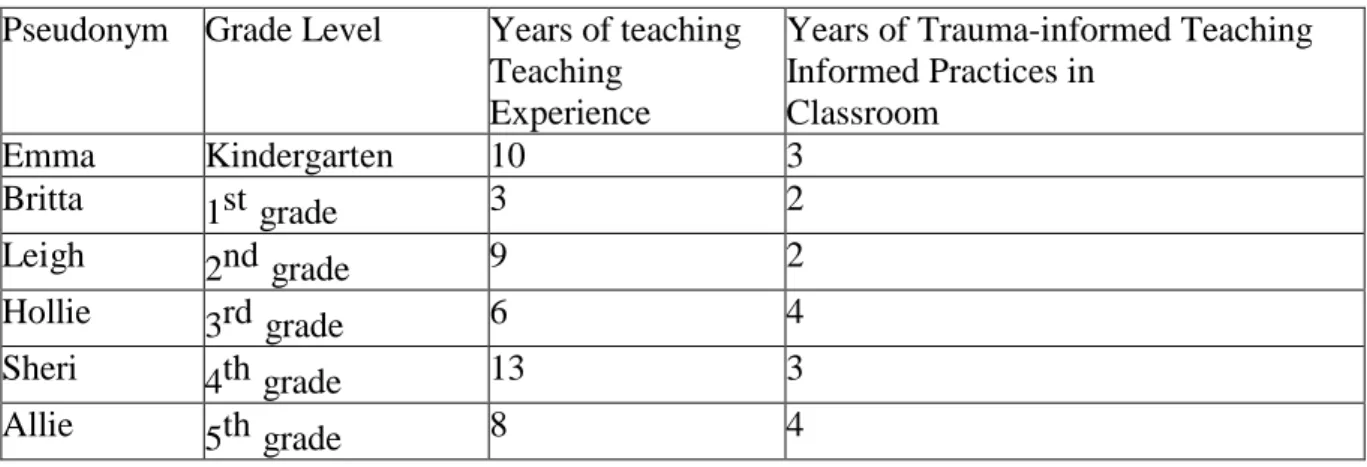
protect the anonymity and confidentiality of the participants in the study.
Table 1 provides an overview of the participant discipline, teaching experience and years of
mindfulness training used in the classroom.
Table 1: Participant Profile
Pseudonym Grade Level Years of teaching Teaching
Experience
Years of Trauma-informed Teaching Informed Practices in Classroom Emma Kindergarten 10 3 Britta 1st grade 3 2 Leigh 2nd grade 9 2 Hollie 3rd grade 6 4 Sheri 4th grade 13 3 Allie 5th grade 8 4 Setting
The study was conducted in a school district in the Hudson Valley. The school district is in a
large suburban town consisting of approximately 8,300 students, ranging from kindergarten to
12th grade. Participants were selected from two programs within the district. Both programs
were set up as a direct result of the increased need for more therapeutic environments for
children struggling with trauma. According to the New York State Department of Education, a
recent school performance report indicated that enrollment in this district is divided into 70%
White students, 7% African American students, 15% Hispanic students, 4% Asian students and
3% Multiracial students. An average of 98% of the district population speaks English, 15% are
students with disabilities, and 27% are economically disadvantaged; 50% of students are female
The two programs explored are two of the few that have provided professional development to
teaching staff in trauma-informed classroom practices.
Ethical Considerations and Human Subjects Protection
As a qualitative researcher, ethical considerations were taken into account throughout the
research and data collection process. Each participant was given an informed consent form,
including information about the purpose of the study, information about participating in the
study and a request for permission to record the audio of the interview. All subjects’ personal
information was protected, as well as the names of the schools and districts in which they work.
In addition, pseudonyms were used as identification when reporting data and results to preserve
confidentiality. Before any interviewing began, I created an environment of trust and established
credibility as a researcher by providing the participants with a full explanation of the study, its
purpose and their role as participants. In accordance with the requirements of the Institutional
Review Board, all participants and the school districts involved in the study completed
permission forms to protect personal information and district information.
Instrumentation
An interview guide was used to ask participants to respond to questions that focus on the
teacher’s background, use of trauma-informed practices, objectives and assessment of progress
towards identified objectives. Semi-structured interviews were conducted to explore teacher
experiences, beliefs and attitudes about trauma-informed classroom practices, as well as the
strategies used within the elementary school classrooms. Interview questions were open-ended,
with follow-up questions to gain depth.