The Relationship between
Compulsive Behaviour and Internet Addiction
Maria Rosita Cecilia, PhD Student Monica Mazza, Researcher Silvia Cenciarelli, MA Student Marta Grassi, MA Student Vincenza Cofini, Researcher
University of L’Aquila, Italy [email protected]
[email protected] [email protected]
Abstract: A variety of behavioural and emotional problems among university students is due to Internet Addiction (Alavi et al. 2012, Rusconiet al. 2012). In 2013 a survey is conducted on a sample
of 532 students of University of L‘Aquila. The purpose is to investigate Internet use patterns and the correlation between Internet Addiction disorder and compulsive behaviour. Two self-administered questionnaires are used: the Internet Addiction Test and the Cognitive Behavioural Assessment 2.0. 517 students show signs of Internet Addiction, which is moderate for 31% of respondents and severe for 1% of them. 5% shows intrusive thoughts and compulsive behaviours. The symptoms of obsessive-compulsive disorder are statistically associated with Internet Addiction (chi² test=23.53, p=0.000). Among young people there is a relationship between compulsive behaviour and Internet Addiction. This relationship has significant effects on treatment of Internet Addiction.
Keywords: problematic internet use; mental health; behavioral assessment
1. Introduction
The scientific study of behaviour and mental processes follows human socio-cultural evolution. The Internet is considered the most important breakthrough in interpersonal communication of the 20th century. It has been providing many benefits to its users. Its basic features, such as widespread usability and access, have created a circulation of data of any kind, at any distance, with limited costs and maximum speed (Di Maria, Cannizzaro 2001). Over the past decade, Internet usage has grown on a global scale enabling new forms of social interaction, activities, and organizing. However, people actually spend too much time online. This situation has raised many concerns in areas such as personal privacy and identity (Milne et al. 2004), distribution of copyrighted materials (Goldsmith, Wu 2006) and mental health (Yau et al. 2013). The increasing popularity and frequency
of Internet use have led to an increasing number of reports highlighting potential negative consequences of overuse (Kuss et al. 2013), in fact people can become addicted to the Internet which could be used in an uncontrolled way, thus producing many negative effects on user‘s psychological well-being (Kraut et al. 1998), the formation and maintenance of personal relationships, group memberships and social identity (Lemmens, Valkenburg, Peter 2011), the workplace (Young 1999), and community involvement (John et al. 2004). The concept of ―Internet Addiction‖ has been proposed as an explanation for uncontrollable, damaging use of this technology (Keithet al. 2001). Symptoms of Internet overuse are compared to the criteria used to diagnose other addictions. Moreover, neuroscientific evidence has indicated parallels between Internet Addiction and substance-related addiction disorders and pathological gambling (Ko et al. 2009; Kuss, Griffiths 2012). In particular, pathological gambling is compared to problematic Internet use because of overlapping criteria.
2. The Study
2.1. ObjectivesThe present study aims to investigate Internet use patterns, gender differences in Internet use and the specific relationship between Internet Addiction Disorder and compulsive behaviour in a sample of university students.
2.2. Materials and Methods
The study is conducted in the period June 2012-January 2013. The participants are students enrolled in various faculties at the University of L'Aquila, Italy. Participants are assessed with the Internet Addiction Test and the Cognitive Behavioural Assessment 2.0, which are self-administered by the students after giving them brief instructions. Young‘s Internet Addiction Test (IAT) is a reliable and valid measure of addictive Internet use. It consists of 20 items that measure the severity of self-reported compulsive Internet use: mild (20-39 points), moderate (40-69 points) and severe (70-100 points) (Young 1998a; Young 1998b). The IAT is one of the most widely used scales for assessing Internet Addiction (Kim et al. 2012) and it received a psychometric evaluation for its Italian version (Ferraroet al. 2007). The CBA 2.0 battery includes a series of questionnaires that investigate broad issues of potential clinical interest and identify areas of current dysfunctions (Bertolottiet al. 1995). It has been validated in 2304 healthy subjects and 6175 chronic patients subdivided by sex and age (Zottiet al. 1991; Bertolottiet al. 1995). Only the Maudsley Obsessive-Compulsive Questionnaire Revised (MOCQ-R), Italian version, of the Cognitive Behavioural Assessment Primary Scales (CBA 2.0), is administered. The MOCQ-R is one of the most used tests in clinical
psychology for assessing the obsessive and compulsive symptoms in psychiatric patients and it is used as a screening tool in nonclinical population. The Italian version, which includes 21 dichotomous items, provides an overall score, for the subjective evaluation of obsessive-compulsive symptoms. The MOCQ-R consists of 3 indices that study thought patterns and compulsive behaviours: the MOCQ-R1 (Checking Subscale), the MOCQ-R2 (Cleaning Subscale) and the MOCQ-R3 (Doubting-Ruminating Subscale). Scales scores at or above the 95th percentile are in the severe problem range (Bertolotti, Sanavio et al. 1997). The statistical analysis is processed with the software Stata 12\ME. The chi-square test or Fisher's exact test are used to examine differences with categorical variables. One way-Anova model is used to assess the differences between means.
3. Results
Table 1. 532 University Students Participated in This Study and Their Ages Ranged from 18 to 51 (22 Years ± 4). 331 (62%) Are Female Socio-demographic characteristics Total sample (N=532)
Gender n %
Male 201 38
Female 331 62
Age Mean SD
22 4
The analysis of the scores obtained from the IAT shows that 517 students have signs of Internet Addiction, which is mild for 68%, moderate for 31%, and severe for 1% of the respondents. According to several studies (Egger,Rauterberg 1996; Hall, Parsons 2001) the one-way Anova shows that there is no statistically significant gender difference in the IAT (F(1;530)=1.96, p=0.1621). Every item of the
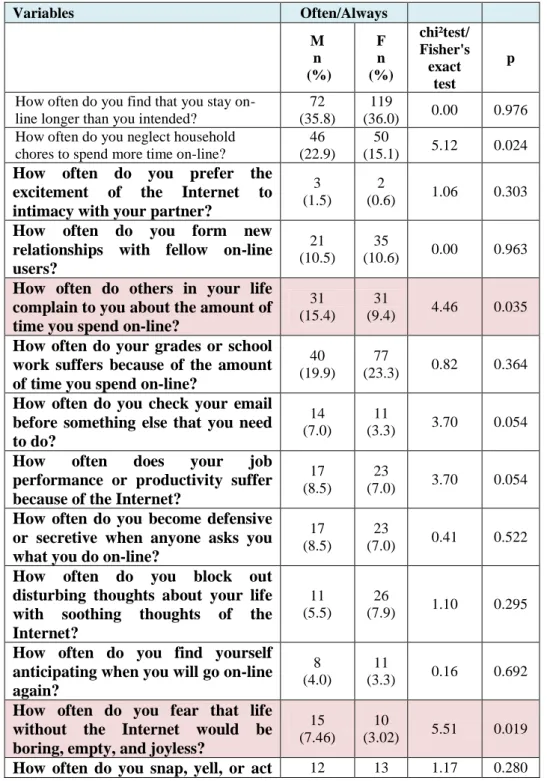
IAT is categorized in dichotomous variables: yes (Often/Always) and no (Rarely/Occasionally/Frequently). Table 2 shows gender differences in IAT scores for dichotomous variables (Often/ Always).
Table 2. Gender Differences in IAT Scores Variables Often/Always M n (%) F n (%) chi²test/ Fisher's exact test p
How often do you find that you stay on-line longer than you intended?
72 (35.8)
119
(36.0) 0.00 0.976 How often do you neglect household
chores to spend more time on-line?
46 (22.9)
50
(15.1) 5.12 0.024
How often do you prefer the excitement of the Internet to intimacy with your partner?
3 (1.5)
2
(0.6) 1.06 0.303
How often do you form new relationships with fellow on-line users?
21 (10.5)
35
(10.6) 0.00 0.963
How often do others in your life complain to you about the amount of time you spend on-line?
31 (15.4)
31
(9.4) 4.46 0.035
How often do your grades or school work suffers because of the amount of time you spend on-line?
40 (19.9)
77
(23.3) 0.82 0.364
How often do you check your email before something else that you need to do?
14 (7.0)
11
(3.3) 3.70 0.054
How often does your job
performance or productivity suffer because of the Internet?
17 (8.5)
23
(7.0) 3.70 0.054
How often do you become defensive or secretive when anyone asks you what you do on-line?
17 (8.5)
23
(7.0) 0.41 0.522
How often do you block out disturbing thoughts about your life with soothing thoughts of the Internet?
11 (5.5)
26
(7.9) 1.10 0.295
How often do you find yourself anticipating when you will go on-line again?
8 (4.0)
11
(3.3) 0.16 0.692
How often do you fear that life without the Internet would be boring, empty, and joyless?
15 (7.46)
10
(3.02) 5.51 0.019
annoyed if someone bothers you while you are on-line?
(6.0) (3.9)
How often do you lose sleep due to late-night log-ins?
37 (18.4)
33
(10.0) 7.79 0.005
How often do you feel preoccupied with the Internet when off-line, or fantasize about being on-line?
4 (2.0)
2
(0.6) 2.15 0.142
How often do you find yourself saying ―just a few more minutes‖ when on-line?
42 (20.9)
74
(22.4) 0.16 0.692
How often do you try to cut down the amount of time you spend on-line?
11 (5.5)
15
(4.5) 0.24 0.626
How often do you try to hide how long you’ve been on-line?
7 (3.5)
8
(2.4) 0.52 0.472
How often do you choose to spend more time on-line over going out with others?
7 (3.5)
5
(1.5) 2.21 0.137
How often do you feel depressed, moody or nervous when you are off-line, which goes away once you are back on-line?
3 (1.5)
5
(1.5) 0.00 0.987
Men neglect household chores to spend additional time online (M=23% vs F=15%; chi² test=5.12, p=0.024), they fear that life without the Internet would be boring, empty, and joyless (M=7% vs F=3%; chi² test=5.51, p=0.019) and they lose sleep due to prolonged use of the Internet (M=18% vs F=10%, chi² test=7.79, p=0.005) more often than women. Moreover, men usually receive more complaints from other people such as friends or relatives, than women (M=15% vs F=9%, chi² test=4.46, p=0.035).
Women block out disturbing thoughts about their life with soothing thoughts of the Internet more often than men, but there is no statistically significant gender difference (M=6% vs F=8%, chi² test=1.10, p=0.295). Based on the MOCQ-R, 5% of the respondents (95%CI: 3.20%-6.95%) is in the severe problem range, 5% has checking compulsions (95%CI: 3.20%-6.95%), 7% (95%CI: 4.95%-9.34%) has obsessions and compulsions associated with symmetry or exactness and about 6% (95%CI: 3.83%-7.82%) has contamination and cleaning symptoms. A significance association between gender and Checking Subscale (Fisher‘s exact test=8.61, p=0.002) is reported, but there are no gender differences in Cleaning Subscale (Fisher‘s exact test=1.36, p=0.161), Ruminating Subscale (Fisher‘s exact test=0.76, p=0.245) and MOCQ-R Total score (Fisher‘s exact test=0.80, p=0.247). The chi
and Internet Addiction levels. There is a significant association between Internet Addiction levels and Ruminating Subscale (chi² test=30.95, p=0.000). MOCQ-R Total score analysis displays that the symptoms of obsessive-compulsive disorder are statistically associated with Internet Addiction (chi² test=23.53, p=0.000).
4. Conclusion
According to the international epidemiological studies, about 1% of general population and about 3–13% of adolescents has shown signs of Internet Addiction (Lin, Ko, Wu 2011). The present study shows that 517/532 students have signs of Internet Addiction, and despite of the findings in different studies (Seyyed Salman Alaviet al. 2011; Young 1998), Internet Addiction is not more common in males than in females. The gender gap in Internet use is rapidly diminishing, in fact, in this study there is no relationship between gender and Internet Addiction. Many evidences show a variety of behavioural and emotional problems in young subjects with Internet problematic use (Bozkurt et al. 2013; Dong, Hu, Lin 2013). This is a newly emergent disorder and it is associated with a variety of psychiatric problems (Koet al. 2012), including several similar to those found in addictions (Brenne 1997). Several studies found that obsessive-compulsive symptoms are the most related symptoms in both genders in Internet addicts (Chou, Condron, Belland 2005; Kim et al. 2006). This study displays that the symptoms of obsessive-compulsive disorder are statistically associated with Internet Addiction. This relationship has significant effects on treatment of Internet Addiction among young people.
References
Alavi, Seyyed S.; Alaghemandan, Hamed; Maracy, Mohammad R., Jannatifard, Fereshte; Eslami, Mehdi & Ferdosi, Masoud (2012). Impact of Addiction to Internet on a Number of Psychiatric Symptoms in Students of Isfahan Universities, Iran. International Journal of Preventive Medicine.
Feb;3(2):122-7. PubMed PMID: 22347609; PubMed Central PMCID: PMC3278877.
Alavi, Seyyed S.; Maracy, Mohammad R.; Jannatifard, Fereshte & Eslami, Mehdi (2011). The Effect of Psychiatric Symptoms on the Internet Addiction Disorder in Isfahan's University Students. Journal of Research in Medical Sciences16(6): 793–800. PMCID: PMC3214398.
Bargh, John A. & McKenna, Katelyn Y.A. (2004). The Internet and Social Life. Annual Review of Psychology.
Beard, Keith W. & Wolf, Eve M. (2001). Modification in the Proposed Diagnostic Criteria for Internet Addiction. Cyberpsychology & Behavior4.3: 377-383.
Bertolotti, Giorgio; Michielin, Paolo; Sanavio, Ezio; Vidotto, Giulio &Zotti, Anna M. (1997). Batteria CBA-2.0. [In:] Del Corno, Franco and Lang, Margherita. La diagnosi testologica. Test neuropsicologici, test d‟intelligenza, test di personalità, testing computerizzato. Milano: Franco Angeli.
Bertolotti, Giorgio; Sanavio, Ezio; Angelino, Elisabetta; Seghizzi, Paolo; Vidotto, Giulio; Bettinardi, Ornella & Zotti, Anna M. (1995). Psychophysiological Reactivity, Depression, Neuroticism and Type a Behavior: An Interactive effect?. Stress Medicine11:123 – 9.
Bozkurt, Hasan H.; Coskun, Murat; Ayaydin, Hamza; Adak, Ibrahim; Zoroglu, Salih S. (2013) ―Prevalence and patterns of psychiatric disorders in referred adolescents with Internet addiction.‖ [In:]
Psychiatry and Clinical Neurosciences 67(5):352-9.
Brenner, Viktor (1997). Psychology of Computer Use: XLVII. Parameters of Internet Use, Abuse and Addiction: The First 90 Days of the Internet Usage Survey. Psychological Reports80 (3 Pt 1):879-82. PubMed PMID: 9198388.
Chou, Chien; Condron, Linda & Belland, John C. (2005). A Review of the Research on Internet Addiction. Educational Psychology Review17(4):363–88.
Di Maria, Franco & Cannizzaro, Stefania (2001). Reti telematiche e trame psicologiche. Nodi, attraversamenti e frontiere di Internet/ Computer Networks and Psychological Plots. Nodes, and Border Crossings of the Internet. Franco Angeli.
Dong, Guangheng; Hu, Yanbo & Lin, Xiao (2013). Reward/Punishment Sensitivities among Internet Addicts: Implications for their Addictive Behaviors. Progress in Neuro-Psychopharmacology & Biological Psychiatry. Jul 19;46C:139-145. doi: 10.1016/j.pnpbp.2013.07.007. PubMed PMID: 23876789.
Egger, Oliver & Rauterberg, Matthia (1996). Internet Behavior and Addiction. Work & Organizational Psychology Unit (IFAP), Swiss Federal Institute of Technology (ETH); Zurich. Ferraro, Giovanni; Caci, Barbara; D‘Amico, Antonella & Di Blasi, Marie (2007). Internet Addiction Disorder: An Italian Study. Cyberpsychology & Behavior10:170–5.
Goldsmith, Jack & Wu, Tim (2006). Who Controls The Internet? Illusions Of A Borderless World.
Oxford University Press.
Hall, Alex S. & Parsons Jeffrey (2001). Internet Addiction: College Student Case Study Using Best Practices in Cognitive Behavior Therapy. Journal of Mental Health Counseling23(4):312–27. Kim, Kyunghee; Ryu, Eunjung; Chon, Mi-Young; Yeun Eun-Ja; Choi, So-Young; Seo, Jeong-Seok & Nam, Bum-Woo (2006). Internet Addiction in Korean Adolescents and its Relation to Depression and Suicidal Ideation: A Questionnaire Survey. International Journal of Nursing Studies43(2):185–92. Kim, Seog J.; Park, Doo-Heum; Ryu, Seung-Ho; Yu, Jaehak & Ha, Jee H. (2012). Usefulness of Young's Internet Addiction Test for Clinical Populations. Nordic Journal of Psychiatry, Dec 18. [Epub ahead of print] PubMed PMID: 23249304.
Ko, Chih-Hung; Liu, Gin-Chung; Hsiao, Sigmund; Yen, Juyu; Yang, Ming J.; Lin, Wei-Chen; Yen, Chengfang & Chen, Chengsheng (2009). Brain Activities Associated with Gaming Urge of Online Gaming Addiction. Journal of Psychiatric Research43(7):739–747.
Ko, Chih-Hung; Yen, Ju-Yu; Yen, Cheng-Fang; Chen, Chia S. & Chen, CC. (2012). The Association between Internet Addiction and Psychiatric Disorder: A Review of the Literature. European Psychiatry27(1):1-8, Epub 2011 Dec 6. Review. PubMed PMID: 22153731.
Kraut, Robert; Patterson, Michael; Lundmark, Vicki; Kiesler, Sara; Mukophadhyay, Tridas & Scherlis, William (1998). Internet Paradox: A Social Technology that Reduces Social Involvement and Psychological Well-Being?. The American Psychologist53(9):1017–1031.
Kuss, Daria J. & Griffiths, Mark D. (2012). Internet and Gaming Addiction: A Systematic Literature Review of Neuroimaging Studies. Brain Sciences2(3):347–374.
Kuss, Daria J.; Griffiths, Mark D.; Karila, Laurent & Billieux, Joël (2013). Internet Addiction: A Systematic Review of Epidemiological Research for the Last Decade. Current Pharmaceutical Design,Aug 29. [Epub ahead of print] PubMed PMID: 24001297.
Lemmens, Jeroen S.; Valkenburg, Patti M. & Peter, Jochen (2011). Psychosocial Causes and Consequences of Pathological Gaming. Computers in Human Behavior27(1):144–152.
Lin, Min-Pei; Ko, Huei-Chen & Wu, Joanna Y-W. (2011). Prevalence and Psychosocial Risk Factors Associated with Internet Addiction in a Nationally Representative Sample of College Students in Taiwan. Cyberpsychology, Behavior, and Social Networking14(12):741–746.
Milne, George R.; Rohm, Andrew J. & Bahl, Shalini (2004). Consumers‘ Protection of Online Privacy and Identity. Journal of Consumer Affairs38 (2): 217–232.
Rusconi, Anna C.; Valeriani, Giuseppe; Carlone, Cristiano; Raimondo, Pasquale; Quartini, Adele; Coccanari De' Fornari, Maria A. & Biondi, Massimo (2012). Internet Addiction Disorder and Social Networks: Statistical Analysis of Correlation and Study of the Association with Social Interaction Anxiousness. Rivista di Psichiatria/ Journal of Psichiatrics47(6):498-507, Italian. PubMed PMID: 23160110.
Yau, Yvonne H. C.; Potenza, Marc N.; White, Marney A. (2013). Problematic Internet Use, Mental Health and Impulse Control in an Online Survey of Adults. Journal of Behavioral Addictions 2(2):72.PubMed PMID: 24294501.
Young, Kimberly S. (1998a). Caught in the Net: How to Recognize the Signs of Internet Addiction and a Winning Strategy for Recovery. New York: John Wiley & Sons.
Young, Kimberly S. (1998b). Internet Addiction: The Emergence of a New Clinical Disorder.
CyberPsychology & Behavior 3:237–44.
Young, Kimberly S. (1999). Internet Addiction: Symptoms, Evaluation and Treatment. [In:] Vande-Creek, Leon. Jackson T. (eds.) Innovations in Clinical Practice: A Source Book. Vol. 17. Sarasota, Fla, USA: Professional Resource Press: S. 19–S. 31.
Zotti, Anna M.; Bettinardi, Ornella; Soffiantino, Francesco; Tavazzi, Luigi & Steptoe, Andrew (1991). Psychophysiological Stress Testing in Postinfarction Patients. Circulation83:25 – 35.