T H E I N F O R M AT I O N T E C H N O L O G Y & I N N O V AT I O N F O U N D AT I O N
I T I F
The Information Technology & Innovation FoundationT
here is perhaps no issue more central to the debate about
broadband policy than the state of and role of competition.
Indeed, the issue of competition drives many of the debates
over broadband, including net neutrality, wireless spectrum auctions,
municipal broadband, and unbundling proposals. Although some
ad-vocates claim that the current state of broadband competition is more
than adequate, others decry market conditions and seek proactive
pub-lic popub-licies to spur more competition. Yet almost everyone involved
in broadband policy in the United States agrees that regardless of the
current state of competition, more competition is better. The stated
reason is that more competition leads to lower prices, higher speeds,
broader deployment, more innovation, and better customer service.
Yet, the Washington consensus in favorof more broadband competition ignores the fact that broadband displays natural monopoly or duopoly characteristics. Because of the nature of the broadband industry, there are signifi cant tradeoffs between more competition and goals of effi ciency, innovation, low prices, and higher speeds and broader deployment. Thus, it’s a mistake for policymakers to assume that if they simply “push the competition lever,” all the problems with broadband policy will be solved. Some problems will recede, but others are likely to emerge. The bottom line is that if policymakers want to maximize not
only societal welfare but also consumer welfare, they must balance the push for more competition with the need to main-tain and create an effi cient broadband in-dustry structure.
This paper starts by reviewing the afford-ability of broadband in the United States. It then postulates two starkly different views toward broadband competition: the “engineers’ view” and the “econo-mists’ view.” Finally, it reviews the four main policy options toward broadband competition: 1) keep the same number of “pipes”; 2) spur the deployment of more pipes; 3) force incumbents to open up ex-BY ROBERT D. ATKINSON1 | O CTOBER, 2 0 07
There are signifi cant tradeoffs between more competition and goals of effi ciency, innovation, low prices, and higher speeds and broader deployment.
The Role
of Competition in a
PAGE 2 THE INFORMATION TECHNOLO GY & INNOVATION FOUNDATION | O CTOBER 20 07
isting pipes to competitors, and 4) regulate “duopoly” pipes. Although each policy track will achieve some benefi ts, each also brings with it costs and risks. Poli-cymakers need to balance the desire for more competi-tion to enhance consumer welfare in the broadband realm with the need for the most effi cient broadband industry structure.
IS BROADBAND AFFORDABLE IN THE UNITED STATES? Before discussing the role of competition in keeping broadband prices low, it’s worth fi rst assessing broad-band pricing in the United States. Achieving the goal of nearly universal high-speed broadband adoption in the United States will require, among other things, that most families can afford broadband. Competition is said to be a key aspect of broadband affordability. In terms of price per megabit per second (mbps), broadband prices have fallen in the United States over the last decade. Thus, for example, Verizon customers can purchase 768 kilobits per second (kbps) DSL ser-vice for just $14.99 a month, less than half the price of what 56 kbps dial-up service was 10 years ago.2
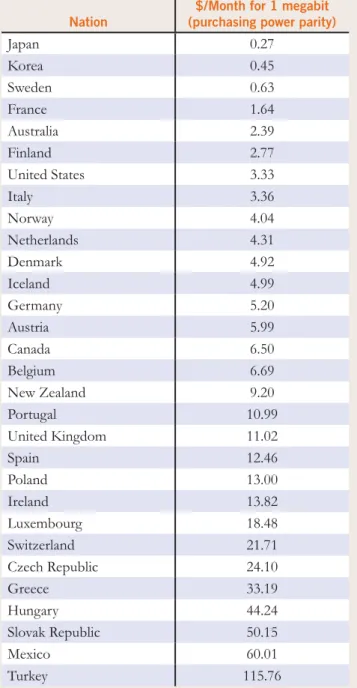
The United States performs better in terms of broad-band pricing (ranking 7th) in comparison with 29 other Organisation for Economic Co-operation and Development (OECD) nations than it does in terms of broadband adoption (ranking 12th).3 As shown in
Table 1, Japan, Korea, and Sweden offer broadband at the lowest prices, measured as the monthly rate per ad-vertised megabit per second (mbps) of the fastest ser-vice generally available, in large part because of exten-sive very fast fi ber optic deployments. Some Japanese residents, for example, subscribe to 100 mbps service for less than $40 per month.
COMPETITION ÜBER ALLES?
So what is the role of competition in driving broadband price performance? In the last decade, the Washing-ton telecom consensus has focused fi rst and foremost on competition as the driver of all things good in the telecom space. Almost everyone involved in broad-band policy agrees that regardless of the current state of competition, more competition is better.
TABLE 1: RANKING OF OECD COUNTRIES BY PRICE OF THE FASTEST GENERALLY AVAILABLE BROADBAND SERVICES4
Nation
$/Month for 1 megabit (purchasing power parity)
Japan 0.27 Korea 0.45 Sweden 0.63 France 1.64 Australia 2.39 Finland 2.77 United States 3.33 Italy 3.36 Norway 4.04 Netherlands 4.31 Denmark 4.92 Iceland 4.99 Germany 5.20 Austria 5.99 Canada 6.50 Belgium 6.69 New Zealand 9.20 Portugal 10.99 United Kingdom 11.02 Spain 12.46 Poland 13.00 Ireland 13.82 Luxembourg 18.48 Switzerland 21.71 Czech Republic 24.10 Greece 33.19 Hungary 44.24 Slovak Republic 50.15 Mexico 60.01 Turkey 115.76
To be sure, competition has much to commend it. It provides consumers with choice. It spurs companies to improve service quality, including customer service. It helps keep prices down. The experience of other industries—including banking, airlines, and truck-ing—where regulation was reduced or eliminated and competition enabled makes it clear that the benefi ts of competition can indeed be profound.
PAGE 3 THE INFORMATION TECHNOLO GY & INNOVATION FOUNDATION | SEP TEMBER 20 07
When applied to the goal of achieving a universal and affordable broadband network, the focus of the Wash-ington telecom consensus is clear: Spur more competi-tion by encouraging alternative “pipes” (e.g., opening up more spectrum for broadband data transmission; establishing rules to enable broadband over power lines; fostering municipally owned networks); and/or requiring incumbent providers (e.g., telecom and cable companies) to open up their networks for competitors to ride on.
But is telecommunications—and, in particular, broad-band—like banking, airlines, and trucking? Or is it more like municipal water, electricity, and gas service, where there is no competition in the “last mile?” In other words, is broadband more like a natural monopo-ly or a service provided in highmonopo-ly competitive markets? This question has in fact been at the center of debates over telecommunications for many years—and should also be at the center of the broadband debate.
DIFFERING PERSPECTIVES ON BROADBAND SERVICE: ENGINEERS VS. ECONOMISTS
Whether one thinks broadband is more like a natural monopoly or a service provided in highly competitive
markets depends in part on whether one brings an en-gineer’s or an economist’s perspective to the question.
The Engineers’ Perspective
Here’s what many engineers will say: It is expensive to build a standard broadband network to homes, and even more expensive to build a high performance one with large data capacity (e.g., fi ber optic). Given these economics and since Internet protocol networks are just transmitting bits from applications that reside outside the network, why not just build one network? Most homes have just one electricity wire, one water pipe, one gas pipe, and one sewage line, because build-ing a duplicative “pipe” for any of these services would cost an enormous amount of money.5 Like these
ser-vices, broadband networks are a natural monopoly; hence, encouraging the deployment of more than one will lead to a waste of societal resources.6
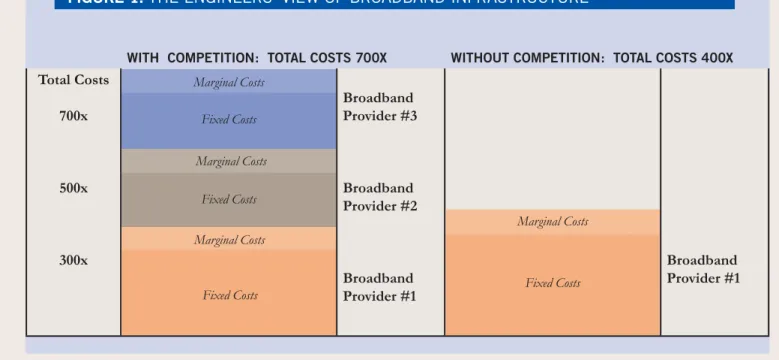
Figure 1 illustrates the engineers’ view of the broad-band world. Fixed network costs involve fi xed costs that must be paid to serve a neighborhood regardless of the number of subscribers. Marginal costs vary depending on the number of customers. Advertising is usually a fi xed cost; customer service is a marginal
WITH COMPETITION: TOTAL COSTS 700X WITHOUT COMPETITION: TOTAL COSTS 400X
Total Costs 700x 500x 300x Broadband Provider #3 Broadband Provider #2 Broadband Provider #1 Broadband Provider #1
FIGURE 1: THE ENGINEERS’ VIEW OF BROADBAND INFRASTRUCTURE
Fixed Costs Fixed Costs
Fixed Costs Fixed Costs Marginal Costs Marginal Costs Marginal Costs Marginal Costs
PAGE 4 THE INFORMATION TECHNOLO GY & INNOVATION FOUNDATION | SEP TEMBER 20 07
one. Most central offi ce expenses and wiring to the neighborhood constitute a fi xed cost, whereas wiring a customer’s home from the street constitute a marginal cost. Most of the total broadband network costs are fi xed, so building multiple networks to serve the same neighborhood increases overall costs—and hence pric-es. In the engineers’ ideal world, therefore, it would be best to have just one very high-speed “pipe” to the home.
Engineers have one other belief: More computer pro-cessing capacity, more storage, and more data trans-mission capacity is always a good investment. You can never get enough. Engineers cite the history of com-puting and telecom, which always quickly took advan-tage of increased processing, storage, and speed. As a result, engineers argue: Why not future-proof net-works by building very fast pipes (often fi ber)? Indeed, the Institute of Electrical and Electronics Engineers states “only too much [bandwidth] is enough.”7
The Economists’ Perspective
If engineers favor about one pipe and abundance, economists favor multiple pipes and scarcity. Most economists argue that competition brings important
consumer benefi ts by forcing companies to cut costs, improve service, and reduce “excessive” profi ts. With-out competition, companies get lazy, limit their inno-vation, provide poor service, and reap monopoly prof-its. As shown in Figure 2, economists see competition as reducing not just marginal costs but fi xed costs as well. Robust broadband competition reduces excessive profi ts and forces companies to cut marginal and fi xed costs through innovation and the drive to gain greater effi ciencies. According to their logic, more competi-tors are better because they will make the competitive environment more intense, driving more effi ciency, ex-perimentation, and innovation.8
Yet even the most ardent advocate of competition will probably admit that competition can be excessive if it leads to a market structure in which average establish-ment and fi rm size are below optimal levels. If the most effi cient automobile factory has to produce at least 100,000 cars a year (below this level, the plant gains fewer economies of scale), for example, then a fragmented and competitive market composed of fi rms producing 50,000 cars each would be ineffi cient and lead to higher costs and higher prices.9 Excessive
com-petition can also reduce profi ts to a level that makes it diffi cult for fi rms in an industry to make adequate
in-WITH COMPETITION: TOTAL COSTS 400X WITHOUT COMPETITION: TOTAL COSTS 400X
Total Costs 400x Broadband Provider #3 Broadband Provider #2 Broadband Provider #1 Broadband Provider #1 Costs Costs Costs Costs Profi ts Profi ts Profi ts Profi ts
PAGE 5 THE INFORMATION TECHNOLO GY & INNOVATION FOUNDATION | O CTOBER 20 07
vestments in effi ciency and new products or services. Whereas engineers can’t get enough speed and see a fi ber-enriched world as the ideal, economists are skep-tical of getting too far out in front of the market. They often argue that consumers may not actually need all the speed that a fi ber network provides (either because technologies like compression will obviate the need or that consumers won’t be interested in the applications needing high speeds). Moreover, many economists are loathe to have government pick the best technology (e.g., fi ber) and worry that doing so will preclude the developments of other potentially superior (in perfor-mance and/or price) technologies.10
Who’s Right?
So who’s right: the engineers or the economists? In fact, both are. Both engineers and economists bring important perspectives to the issue, and ignoring ei-ther set will lead us to the wrong policy conclusions. Engineers are right in noting that there are elements of broadband infrastructure that have natural monopoly aspects, as do water, gas, and sewer pipes, and electric lines to the home. What is striking is that even during the height of the electricity deregulation movement in the 1990s, almost no advocates, even the most free-market oriented, proposed deregulating the local elec-tricity distribution network. Most saw this network rightly as a natural monopoly where the most effi cient structure was one set of wires to each home.
To be sure, competition might bring benefi ts in elec-tricity production and even long haul distribution, but this was because these segments do not exhibit natural monopoly characteristics. If public policies somehow spurred the construction of a second set of electric wires to every home in America, society as a whole— largely through ratepayers, or if funded by government incentives then by taxpayers—would bear the added costs. There is no “free lunch.”
The same holds true for broadband networks. If in the face of more competitors, broadband providers are forced to amortize the fi xed costs of their networks over signifi cantly fewer customers, total broadband costs will rise—and prices will almost certainly have to rise as well, even if profi ts are squeezed and effi
cien-cies maximized. The only way this situation could be averted would be if a new entrant was not successful in gaining any broadband customers. In this case, over-all broadband costs would still increase but the costs would be borne by the new entrant’s bondholders and stockholders. If all new entrants gained customers, however, then the incumbents by defi nition would have fewer customers and hence less revenue to amor-tize the costs of their networks.
The issue, then, becomes one of how to attain the right balance between the cost-effi ciency of fewer networks and the competitive benefi ts of more networks.
Yet economists are right in pointing to the potentially signifi cant problems with monopolies or duopolies and reminding us that competition can spur innovation, as well as increased effi ciency and consumer welfare. Af-ter all, we just have to remember the bad old days of the “Ma Bell” monopoly, where customer service and choice was often problematic and innovation limited. In the broadband world, too little competition can lead to slower rollout of more advanced networks.
The issue, then, becomes one of how to attain the right balance between the cost-effi ciency of fewer networks and the competitive benefi ts of more networks. Be-fore considering this issue, it’s important to realize that the current state of competition in the United States is due largely to historical telephony and cable televi-sion (CATV) monopolies that enabled providers to build their networks to a large share of households: CATV passes upwards of 90 percent of homes, and DSL broadband is available to approximately 79 per-cent of households where incumbent local-exchange carriers (ILECs) offer local telephone service.11 The
evolution of technology just happened to allow both networks to relatively easily transmit IP-switched data on their networks. The situation in the United States is in marked contrast to that in many other parts of the world, including Japan and much of Europe, where the cable plant is less built out and where intermodal competition is more limited.
PAGE 6 THE INFORMATION TECHNOLO GY & INNOVATION FOUNDATION | O CTOBER 20 07
United States could ultimately result in lower total net-work costs (e.g., especially if that one provider—cable or telephone company—laid fi ber to most households) than what we have today, it’s not clear how that solution would come about. Clearly, the Federal Communica-tions Commission (FCC) or state public utility com-missions would not and should not be in a position to anoint one winner while shutting other technologies/ companies out of the market.
So is existing broadband competition in the United States adequate? In most local markets, there are only two principal competitors: telephone and cable broad-band. Indeed, for the foreseeable future, the “last mile” of broadband services is for most consumers at best a duopoly, and sometimes a monopoly. To be sure, the FCC reports that 87.5 percent of zip codes have three or more broadband providers.12 But the FCC’s
inclu-sion of satellite broadband services in this measure misrepresents the actual competitiveness of the mar-ket. Satellite is generally not a full substitute for DSL or cable modem service, because it has higher prices, slower speeds, and high latency. Consequently, the re-ality is that most Americans with a choice of cable mo-dem, DSL, and satellite really have a choice between “two and a half” providers of broadband service.13
In assessing the state of broadband competition today, it’s important to realize that not every home has to be served by every provider in an area for that household to realize the benefi ts of competition. Thus, for ex-ample, there are homes located in the Washington, D.C., metropolitan area that cannot get DSL service but can get cable modem service; yet, because the in-cumbent cable companies have to price their offerings based on competition in the entire metropolitan area, households without access to DSL still benefi t from competition.
This consideration is important when considering proposals to require cable or telephone companies to build-out in their service areas. These proposals are often justifi ed on the basis of providing competition and lower prices to those households that would not get service (or get it as soon) without a mandate. But if there is competition in the overall local market— indeed this seems to be the case as pricing plans are often statewide or multistate—then individual
house-holds with access to fewer providers will still benefi t from competition. It is important to note, however, that this statement is less true if incumbents are able to offer discounts to those households with choice; if this is the case, households with fewer or no choices will gain fewer benefi ts of competition.
POLICY OPTIONS
Given these factors and conditions, what is the appro-priate role for U.S. telecommunications policy towards broadband competition? There are essentially four different policy approaches.
1) Keep the Same Number of Pipes
Given that most U.S. households are served by “two and a half” broadband providers, is this the right number? In the short term, it appears to be. The fact that cable and telco broadband providers are competing quite in-tensely to gain new customers and hold onto existing ones appears to compensate for the fact that the mar-ket is largely a duopoly. And indeed, with around half of all households currently subscribing to broadband, it is likely that cable and telephone companies will con-tinue their vigorous competition to sign up new cus-tomers. To get new customers, these companies are rolling out new technologies and introducing low-price offers, including bundled package offers.14
But what happens in the future when most households have adopted broadband? And what if some customers are reluctant in the face of diffi culties associated with switching broadband providers to switch providers?15
In this case, it’s possible that broadband providers may be able to exercise more market power.
2) Spur Deployment of More Pipes
In the face of a market with “two and a half” pipes, many policymakers see promoting more pipes into the home as the silver bullet. In some cases, proposed policies would simply remove barriers to competition. In other cases, policies would proactively support ad-ditional networks.
One of the leading rationales used by supporters of municipal broadband networks (either wireless or wired) is that a publicly subsidized (whether publicly or privately owned) additional network will boost
com-PAGE 7 THE INFORMATION TECHNOLO GY & INNOVATION FOUNDATION | O CTOBER 20 07
petition, driving down prices and making it easier for residents to afford broadband.16 It’s not clear, though,
that this will be the case. Leaving aside the question of whether publicly owned broadband can operate as effi ciently, it’s clear, as described above, that an addi-tional network will mean fewer subscribers for incum-bent providers.17 And even if some of the lost revenue
leads directly to lower profi ts, it’s unlikely that all of it will, with the result that the provider will either have to raise prices or invest less capital to upgrade to next generation networks.
The right policy regarding more broadband pipes is: “Enable, but don’t promote.”
This impact of more competition on investment is par-ticularly important. Noted economist Joseph Schum-peter talked about the advantage of innovation in cre-ating temporary higher profi ts, which in turn let com-panies invest the sizeable amounts of capital needed in more technological innovation.18 If competition
becomes as fi erce in broadband as it is in the long-dis-tance voice business, the effect will surely be to reduce the amount of capital needed to deploy next generation high-speed networks.19
Although public policy should not proactively sub-sidize the deployment of additional networks, con-versely it should not erect or maintain barriers to the emergence in the market of additional networks. With respect to spectrum, this means freeing up ineffi ciently used or underutilized spectrum, including spectrum in so-called “white spaces,” while letting the marketplace (with the exception of fi rst responder uses) decide on its highest and best use.20
In the FCC’s forthcoming auction of 700 MHz trum, for example, it’s likely that much of that spec-trum will be used for IP data transmission. Given that there are areas that cannot get either DSL or cable modem service, developing a “fi rst” pipe there is im-portant. In this situation, it appears that fi xed wire-less may be the most cost-effective technology, so it’s important to have public policies, particularly with re-spect to re-spectrum, to help enable this. But it would be
just as wrong to limit such spectrum from being used for broadband services as it would be to mandate its use for broadband. With respect to broadband over power lines, the policy should be to remove unneces-sary regulatory obstacles to deployment. But policy should not tilt the playing fi eld to promote a particular technology.
This principle should also be applied to the universal service fund (USF). Currently, in the name of promot-ing competition, almost $1 billion in USF funds are in-vested yearly on competitive, duplicative voice provid-ers, including cellular, in high-cost areas.21 Instead of
using these limited funds to subsidize the building of a parallel network, it would be better to use the funds to subsidize the buildout of incumbent broadband net-works to more places with higher speeds. If broad-band becomes explicitly eligible for USF payments, then policymakers will have to address the issue of how many providers to fund in an area. If policymak-ers decide that mobility is a distinctly valuable service that deserves public subsidies in high-cost areas, then subsidies to both wireless and wireline phone service in the same area could make sense. But investing lim-ited USF funds in the goal of competition means that funds to expand broadband to the places that need it will be more limited.
In sum, the right policy regarding more broadband pipes is: “Enable, but don’t promote.” For example, if policymakers provide tax incentives for broadband (either to spur deployment to high-cost areas or de-ployment of next generation high-speed networks), the incentives should be available to all providers—and not, as some have argued, available only to the provid-ers of additional new pipes.
3) Regulate Open Pipes
Many people who advocate more broadband competi-tion but are pessimistic about more pipes being built (either through market forces alone or with public promotion) see unbundling of incumbent pipes as the answer.22
Indeed, the European Union has pushed this approach as the core of its broadband strategy, requiring mem-ber nations to craft regulations unbundling the
incum-PAGE 8 THE INFORMATION TECHNOLO GY & INNOVATION FOUNDATION | O CTOBER 20 07
bent copper telephone loops. It appears that the Eu-ropean Union will soon mandate that all nations adopt “virtual separation” arrangements, as described below. This strategy has met with some success. For example, OECD reports that the company with the best “triple play” in the world—France’s Free Telecom—rides on the DSL pipes of the incumbent France Telecom.23
Likewise, Japan’s fast and cheap DSL broadband ser-vice Yahoo! rides on the wires, and increasingly fi ber, of the incumbent NTT.
There are various models of open pipes. In most na-tions, competitors get access to the incumbent’s copper loop at regulated prices and terms. In these and other cases, competitors lease some parts of the incumbent’s network, usually the pipe itself, and install their own switches and other equipment. But at least one nation, the United Kingdom, has moved to a virtual separa-tion model, in which the incumbent British Telecom was required to create “separate” retail and wholesale division. The wholesale division manages the “pipes,” and the retail division that sells broadband and other services competes with many other broadband service providers.
Many advocates of the unbundling model, particularly in the United States in the 1990s, saw mandatory un-bundling as a transitional state until competitive pro-viders built their own networks. But the anticipated building of networks did not occur, and it appears that even if the regulatory framework of the 1990s had been extended, the building would not have occurred. The reason goes to the engineer’s insight: It makes little economic sense for homes to have multiple DSL lines.24 The costs of such a model would be
prohibi-tive. Thus, unbundling or open pipes is not a transi-tional model to get to facilities-based competition. Unbundling has both benefi ts and costs. First, on the plus side, unbundling is a relatively quick way to get competition. This is one reason why many nations, particularly those where intermodal competition was limited, have chosen an open pipes model. Some con-tinental European nations have much less intermodal competition than the United States and Canada, as il-lustrated by the fact that the United States and Canada score much lower on a two-fi rm Herfi ndahl-Hirschman Index (HHI) of cable and DSL (0.50) than France (0.90)
and Germany (0.94).25 Second, intramodal
competi-tion can lead to lower prices, particularly compared to higher costs of promoting facilities-based competition. This is especially true if incumbents must resell lines at or below cost. Third, it can enable other benefi ts of competition, including greater consumer choice. On the negative side, though, unbundling reduces in-centives of incumbents to invest in larger pipes. If the incumbent has to resell the pipe, particularly at very low prices, where is the incentive to invest a large amount of capital in a better pipe (e.g., fi ber)? Indeed, there is a risk that Europe could be in a “DSL-cul-de-sac” with robust competition on copper lines, but little investment in next generation lines. (Because of shorter copper loops in many European nations, this is a strategy that can at least for the foreseeable future generate more than adequate speeds. For example, Free Telecom offers speeds of around 20 mbps.) In addition, the unbundling model (at the least the con-tinental European model) requires regulators to be much more interventionist, including setting prices. But if they price access to the network too low, they limit investment. If they set the price too high, they limit competition.
In some ways, Japan has appeared to square the circle of getting the benefi ts of competition with the incen-tives to deploy big fast pipes. More than 70 percent of the Japanese households served by NTT East now can subscribe to 100 mbps (advertised speed) fi ber optic service. Yet NTT must resell these lines to competi-tors.26 Why then did NTT deploy, given this regime?
In part, NTT responded to generous fi nancial incen-tives from the government to deploy fi ber and direc-tion from the government to do so. The fact that NTT is approximately 40 percent government owned makes them more likely to respond to such government direc-tion and to be able to pay less attendirec-tion than U.S. fi rms do to the capital markets.
Another nation that has been able to combine the en-gineers’ view with the economists’ is Sweden. There some municipalities control the right to lay the under-ground cable. In Stockholm, a publicly chartered cor-poration is the only entity with the right to lay wires and has deployed a fi ber network to most buildings in the city. This corporation leases dark fi ber to
what-PAGE 9 THE INFORMATION TECHNOLO GY & INNOVATION FOUNDATION | O CTOBER 20 07
ever company—ILEC or competitive local-exchange carrier (CLEC)—wants it. Thus, for example, one large CLEC, B2, uses this fi ber, installing routers and modems on either end, to provide up to 100 mbps broadband to Stockholm residents and businesses. The advantage of the Stockholm model is that it limits infrastructure costs—private sector fi ber and cable de-ployment was previously largely nonexistent—while at the same time spurring competition. It should be not-ed that this model is different than many of the muni fi ber projects in the United States (such as Lafayette, La.), which are over-builder projects, spending money to build a third pipe and provide their own applica-tions. In contrast, the Stockholm model involves just one pipe over an open network.
4) Regulate Duopoly Pipes
The fi nal policy option would be simply to assume that there will be limited broadband competition in the United States—a duopoly at best—and that some form of regulation is needed. Regulation has the ad-vantage of limiting any current or potential abuse of market power. As noted above, however, regulation can also reduce incentives for investment. Moreover,
at least for the foreseeable future, there appears to be considerable competition between cable and DSL pro-viders. In addition, there can be the signifi cant in-stitutional challenge of managing rate regulation or allowing new entry once a monopoly is embraced. A “softer” alternative to regulation, but one that would still be premised on a mature duopoly market, would be to use existing antitrust and consumer protection rules more aggressively to limit abuses.
CONCLUSION
As Congress, the FCC, and states consider broadband policies over the next few years, the issue of competi-tion is sure to play a central role in their deliberacompeti-tions. This paper argues that competition is not an end in itself but rather a means by which the economic sys-tem produces the benefi ts citizens desire. Moreover, increased broadband competition is by no means a panacea for solving perceived or real limitations in the nation’s broadband infrastructure. As a result, policy-makers need to balance the desire for more competi-tion to enhance consumer welfare in the broadband realm with the need for the most effi cient broadband industry structure.
PAGE 10 THE INFORMATION TECHNOLO GY & INNOVATION FOUNDATION | O CTOBER 20 07
ENDNOTES
1. The author wishes to thank the following individuals for comments on earlier drafts: Dan Correa, Julie Hedlund, Jon Peha, and Phil Weiser. A version of this paper was originally prepared as a discussion paper for the Aspen Institute 2007 Telecommunications Roundtable.
2. In constant dollars.
3. We measure take up on a per-household basis, which leads the United States to rank 12th, instead of 15th on a per-capita basis. See Daniel K. Correa, “Assessing Broadband in America: OECD and ITIF Broadband Rankings,” (The Information Technology and Innovation Foundation, Washington, D.C., April 2007) <www.itif.org/fi les/BroadbandRankings.pdf>. 4. Correa, op. cit., 4.
5. A related issue is whether incumbent telephone companies must keep their legacy copper network after a customer switches to fi ber. An engineer’s view of the issue is that they should not, because the maintenance costs can be signifi cant and are passed along to all customers. (See Deborah Yao, “Verizon Copper Cutoff Worries Some Users, Small Rivals,” USA Today
(2007) <www.usatoday.com/ tech/products/ services/2007-07-08-verizon_N.htm>.)
6. IEEE, USA, “Report from the Workshop: This Decade’s Revolutionary Telecommunications Paradigm” (2003) <forum. johnson.cornell.edu/afn/publish/WSR/WSR.pdf>.
7. Ibid.
8. See Howard A. Shelanski, “Competition and Regulation in Broadband Communications,” Broadband: Should We Regulate High Speed Access? Robert W. Crandall and James H. Alleman, eds. (Washington, DC: AEI-Brookings Joint Center, 2002).
9. Most economists would argue that the market would prevent this from happening by enabling more effi cient fi rms to gain market share, putting out of business ineffi cient producers, but the real world does not always approximate the textbook world. 10. Odlyzko notes, “technological predictions have always been hard, of course, and much of what broadband proponents say has to be treated cautiously.” See Andrew Odlyzko, “The Many Paradoxes of Broadband,” First Monday 8(9) (September 1, 2003) <fi rstmonday.org/issues/issue8_9/ odlyzko/index.html>.
11. Federal Communications Commission, Wireline Competition Bureau, High Speed Services for Internet Access (Washington, DC: FCC, January 2007) <fjallfoss.fcc.gov/edocs_public/attachmatch/DOC-270128A1.pdf>.
12. Federal Communications Commission, Table 16.
13. A 2006 Government Accountability Offi ce (GAO) analysis of broadband in eight states confi rmed that the number of broadband providers available to consumers is far below what the FCC’s broadband statistics suggest. GAO found that the median number of providers available to households surveyed was only two, even though the FCC reported a median of eight providers for the relevant zip codes. See U.S. Government Accountability Offi ce, Broadband Deployment Is Extensive Throughout the United States, but It Is Diffi cult to Assess the Extent of Deployment Gaps in Rural Areas (Washington, DC: GAO, May 2006) 17-18. 14. For example, Verizon is rolling out its FiOS fi ber optic network. Comcast recently announced plans to deploy in the future high-speed DOCSIS 3.0 channel bonding technology.
15. Some broadband subscribers, for example, use their providers’ e-mail services for their e-mail address (e.g., johnsmith@ verizon.com). This makes switching broadband providers more diffi cult for these subscribers than for broadband subscribers who use platform-independent e-mail services (e.g. [email protected]).
PAGE 11 THE INFORMATION TECHNOLO GY & INNOVATION FOUNDATION | O CTOBER 20 07
Federal Communications Law Journal 59(3) (2007), 67-103.
17. Ford models how reduced market size reduces the number of profi table providers. George Ford, “Competition After Unbundling,” Federal Communications Law Journal, 59(2 (Mar. 2007), 332-367.
18. See Joseph Schumpeter, Capitalism, Socialism, and Democracy (New York: Harper & Row, 1942).
19. Verizon’s FIOS strategy requires considerable capital. Comcast’s recently announced DOCSIS 3.0 investment is estimated to cost less, but will still be in the billions of dollars. Whether such high-speed networks will be rolled out in most places, though, remains to be seen.
20. For more information on “white spaces,” see <www.itif.org/index.php?id=81>.
21. Universal Service Administrative Company, 2006 Annual Report: Reaching Out (Washington, DC: USAC, 2007) <www.usac. org/_res/documents/about/pdf/usac-annual-report-2006.pdf>.
22. For example, see and Donna N. Lampert, “No Sight Like Hindsight: The 1996 Act and the View Ten Years Later,” Federal Communications Law Journal 58(3) (2006), 519-523.
23. OECD Directorate for Science, Technology, and Industry, Committee for Information, Computer, and Communications Policy, Working Party on Telecommunication and Information Services Policies, Multiple Play: Pricing and Policy Trends (Paris: OECD, April 2006) <www.oecd.org/dataoecd/47/32/ 36546318.pdf>.
24. Providing broadband service to businesses in crowded downtowns is another matter. There densities and demand are high enough to support multiple providers.
25. The Herfi ndahl-Hirschman Index (HHI) is a measure of fi rm concentration in an industry, calculated as the sum of the squares of each fi rm’s market share. HHI scores range from 0 to 1, with higher scores indicating an industry dominated by a small number of fi rms. The HHI for an industry monopolized by a single fi rm is 1. To gain a better understanding of the importance of platform competition for broadband in OECD countries, we calculated the HHI for each country’s mix of broadband technologies. For this measure, we used the OECD’s latest data, “Broadband Statistics to December 2006,” found at <www.oecd.org/sti/ict/broadband>. The OECD data include four broadband technologies (DSL, cable, fi ber, and other), only two of which—DSL and cable—have signifi cant market share in most countries. For this reason we have calculated the HHI for DSL and cable alone, and scores fall between 0.5 and 1 (0.5 represents a case in which both platforms have equal market share).
26. According to Mr. Takeshi Eberhara, Senior Director, Corporate Strategy Department, NTT, who participated in an April 2007 ITIF Policy Forum, “Understanding the Japanese Broadband Miracle,” they must resell their fi ber lines to CLECs <www. itif.org/index.php?id=38>.
PAGE 12 THE INFORMATION TECHNOLO GY & INNOVATION FOUNDATION | O CTOBER 20 07
ABOUT THE AUTHOR
Dr. Robert D. Atkinson is President of the Information Technology and Innovation Foundation, a Washington, DC-based
technology policy think tank. He is also author of the The Past and Future of America’s Economy: Long Waves of Innovation
that Power Cycles of Growth (Edward Elgar, 2005).
ABOUT THE INFORMATION TECHNOLOGY AND INNOVATION FOUNDATION
The Information Technology and Innovation Foundation (ITIF) is a nonprofi t, non-partisan public policy think tank com-mitted to articulating and advancing a pro-productivity, pro-innovation and pro-technology public policy agenda inter-nationally, in Washington and in the states. Through its research, policy proposals, and commentary, ITIF is working to advance and support public policies that boost innovation, e-transformation and productivity.
For more information contact ITIF at 202-449-1351 or at [email protected], or go online to www.innovationpolicy.org.