NBB WORKING PAPER No. 54 - MAY 2004
NATIONAL BANK OF BELGIUM
WORKING PAPERS - RESEARCH SERIES
Regulating Financial Conglomerates
___________________
Xavier Freixas (*) Gyöngyi Lóránth (**) Alan D. Morrison (***) Hyun Song Shin (****)
The views expressed in this paper are those of the authors and do not necessarily reflect the views of the National Bank of Belgium.
Preliminary / please do not quote
__________________________________
(*) Xavier Freixas, Universitat Pompeu Fabra and CEPR, Department of Economics and Business, Jaume I building, Ramon Trias Fargas 25-17, 08005-Barcelona, Spain. e-mail: [email protected] (**) London Business School.
(***) Alan Morrison, Saïd Business School, University of Oxford, Merton College, Oxford OX1 4JD, UK. e-mail: [email protected]
(****) Hyun Shin, Room A350, London School of Economics and CEPR, Houghton Street, London WC2A, UK. e-mail: [email protected]
NBB WORKING PAPER No. 54 - MAY 2004 Editorial Director
Jan Smets, Member of the Board of Directors of the National Bank of Belgium
Statement of purpose:
The purpose of these working papers is to promote the circulation of research results (Research Series) and analytical studies (Documents Series) made within the National Bank of Belgium or presented by external economists in seminars, conferences and conventions organised by the Bank. The aim is therefore to provide a platform for discussion. The opinions expressed are strictly those of the authors and do not necessarily reflect the views of the National Bank of Belgium.
The Working Papers are available on the website of the Bank: http://www.nbb.be
Individual copies are also available on request to: NATIONAL BANK OF BELGIUM
Documentation Service boulevard de Berlaimont 14 BE - 1000 Brussels
Imprint: Responsibility according to the Belgian law: Jean Hilgers, Member of the Board of Directors, National Bank of Belgium. Copyright © fotostockdirect - goodshoot
gettyimages - digitalvision gettyimages - photodisc National Bank of Belgium
Reproduction for educational and non-commercial purposes is permitted provided that the source is acknowledged. ISSN: 1375-680X
NBB WORKING PAPER No. 54 - MAY 2004
Editorial
On May 17-18, 2004 the National Bank of Belgium hosted a Conference on "Efficiency and stability in an evolving financial system". Papers presented at this conference are made available to a broader audience in the NBB Working Paper Series (www.nbb.be).
Abstract
We analyse a model of financial intermediation in which intermediaries are subject to moral hazard and they do not invest socially optimally, because they ignore the systemic costs of failure and, in the case of banks, because they fail to account for risks which are assumed by the deposit insurance fund. Capital adequacy requirements are designed to minimise the social costs of these effects. We show that banks should always have higher regulatory capital requirements than insurance companies. Contrary to received wisdom, when banks and insurance companies combine to form financial conglomerates we show that it is socially optimal to separate their balance sheets. Moreover, the practice of "regulatory arbitrage", or of transfering assets from one balance sheet to another, is welfare increasing.
NBB WORKING PAPER No. 54 - MAY 2004
TABLE OF CONTENTS
1. Stand-alone Capital Requirements ...2
1.1. The Model ...2
1.2. Banker Investment Decisions...3
1.3. Insurer Investment Decisions ...6
2. Capital Regulation of Financial Conglomerates...8
2.1. Decentralised Conglomerates ...9
2.2. Optimal Capital Regulation for Centralised Conglomerates ...12
3. Conclusion...15 4. Appendix...15 4.1. Proof of Proposition 1 ...15 4.2. Proof of Proposition 2 ...16 4.3. Proof of Proposition 3 ...17 References ...18
This paper examines the optimal capital regulation of financial conglomerates: institutions which provide under a single corporate umbrella the provision of banking, insurance and other financial products.
The emergence of financial conglomerates is one of the major financial developments of recent years. This has raised concerns amongst regulators about the appropriate measurement of capital within afinancial group. In contrast, the existing theoretical academic literature about conglomer-ates focuses on internal and industrial organisational issues, although an empirical study by Berger
et. al shows that conglomeratedfirms tend to take more risks. Our objective in this paper is tofill a gap in the literature by analysing optimal capital adequacy regulations forfinancial conglomerates. Several issues arise in the context of conglomerate regulation. Firstly, should the conglomerate be structured as a unique entity, or should its various divisions be allowed to fail independently? In the former case, capital requirements will be determined on a centralised basis for the entire conglomerate, while in the latter, the regulator can set decentralised capital requirements for each of the conglomerate’s divisions. Secondly, when capital is computed on a decentralised basis, how should the regulator respond to the existence of regulatory arbitrage, under which conglomerate assets are held in the division where they will attract the lowest regulatory capital charge? At this point it should be emphasized that our contribution does not deal with loss transferts from one division to another, a practice that allows the solvent division of a holding to dump its bad assets on a division that is close to failure. This is a practice that is usually forbidden by regulators (as for instance in regulation W implementing the Federal Reserve Act Sections 23A/23B). The difference with regulatory arbitrage is that in this case the allocation of assets to the division is made ex ante, while in the case of loss transferts it is done ex post.
Capital regulations are currently computed on a decentralised basis. This encourages regulatory arbitrage, which has been identified by both practitioners and regulators as evidence of undesirable inconsistencies in the treatment of financial assets. It has been argued that a centralised system with a unique capital requirement would resolve these inconsistencies and that, by enforcing cross-division warranties against failure, it would reap additional diversification benefits and reduce bankruptcy risk.
We analyse these questions using a model in which the role of capital requirements is to force shareholders (and hence managers) to internalise effects which are not adequately priced. The specific effects which concern us in this paper are a social cost of bankruptcy and the existence of a deposit insurance safety net for banks, both of which result in overinvestment relative to the social optimum. We assume that capital is exogenously costly as a result of informational frictions of the type considered by blah, and hence that capital requirements will cause some underinvestment in marginal projects. The optimal capital regulation trades off these under- and over-investment effects.
We examine two division conglomerates consisting of a bank and an insurance company. Two features distinguish the bank from the insurance company. Firstly, only the bank has access to the deposit insurance net; and secondly, the bank has monopoly access to positive net present value projects, while the insurance company must compete in an efficient marketplace for the right to invest in its projects. Since the insurance company does not have access to the deposit insurance
net it follows immediately that its standalone capital requirements will be lower than the bank’s. We consider in turn decentralised and centralised structures. In a decentralised conglomerate capital arbitrage will occur to transfer assets to the division which has the lowest capital charges. By increasing the capital charge of the bank sufficiently, the regulator can induce it to transfer all of its assets to the insurance company. This has three consequences. Firstly, the investment distortions induced by the deposit insurance fund will no longer occur. Secondly, marginal projects in which the standalone bank would not invest will now attract funds, because of the lower capital. Thirdly, the bank will as a result of the arbitrage have only safe cash assets. Regulatory arbitrage therefore reduces the extent of the safety net and, by allowing for a more efficient use of capital, results in a greater degree of bank credit extension.
Under a centralised structure, the various operating units of the conglomerate are compelled to bail one another out. Losses in one division may therefore be covered by profits in another. However, it is also true that the failure of one division may result in the insolvency of the entire conglomerate. Thus, centralisation may open new channels for financial contagion. In particular, the costs of insurance company failure may be borne by the deposit insurance fund. We show that, for a given regulatory capital requirement, the lending decisions of the bank will depend upon the fragililty of the insurance company. When the insurance company is relatively low risk the diversification effect dominates and the value of the bank’s deposit insurance safety net is decreased. As a result the bank is less willing to lend to riskier projects. In contrast, when the insurance company is riskier the contagion effect dominates and the bank therefore extracts a higher expected payment from the deposit insurance safety net. This renders it more willing to lend. We therefore show that centralised conglomerates have an amplifying effect: that is, the bank invests in more risky projects precisely when the insurance company is facing more risk.
We conclude from the above discussion that, contrary to the majority view, decentralised con-glomerates allow for a more efficient allocation of resources than centralised ones. Moreover, the amplification effect which we have identified in centralised conglomerates gives rise to systemic concerns which do not arise in decentralised conglomerates.
1. Stand-alone Capital Requirements
1.1. The Model
In this section we introduce our basic modelling approach and use it to consider the optimal capital requirements for standalone bank and insurance companies. In later sections we consider the capital regulation of conglomerates which contain both banks and insurance companies. Our modelling approach is similar to Lóránth and Morrison (2003), extended to include a systemic cost of institutional insolvency.
The financial institutions in our model are risk neutral profit maximisers which collect funds from depositors and policy-holders and invest them on their behalf. We assume that bank depos-itors are protected by deposit insurance and that policy-holders are not. In this model we ignore payments which the banker makes into a deposit insurance scheme; in such schemes the banker is charged for the average rather than the marginal cost of his moral hazard and these schemes cannot
entirely resolve the allocative problems which we identify. In the interests of brevity, we will refer to depositors and policy-holders collectively as “investors”.
The model for both banks and insurance companies is identical. At time t0, nature presents the financial institution with an investment project (B, R) which is drawn from the region A ≡ ©
(B, R)∈<2 :R
l ≤R≤Rh,0≤B≤R
ª
with measure A, according to the uniform distribution. The project requires a time 1 investment of 1 and at timet2 returns R+B or R−B, each with probability 0.5.
At time t1 the bank decides whether or not to invest in the project; if it does so then it raises 1−C from investors and C as equity capital. The capital requirement C is stipulated by the regulator. We assume that there is an exogenous costκper unit of capital which the bank deploys. This is intended to reflect a lemons problem in the capital markets (see Myers and Majluf, 1984; Froot, Scharfstein and Stein, 1993; Froot and Stein, 1998; and Bolton and Freixas, 2000) and κ is therefore a wealth transfer whose only effect upon the welfare calculations in our paper will be through the investment distortions which is causes.
Capital in our model is a real cushion of external equity which will bear losses. We therefore assume that cross holdings, multiple gearing and downstreaming are excluded from the capital computation according to the standard consolidation rules. In the context of our model, the structure of the capital as tier 1 or tier 2 is irrelevant insofar as it has an informational cost.
Returns from the project are realised at timet2 and are distributed to the various providers of funds.
As it is well known, financial institution insolvency has a social cost. We assume that this is equal to 2φ for both banks and insurance companies and that it is a pure externality so that financial institutions will fail to account for it in their calculations.
1.2. Banker Investment Decisions
In this section we analyse the incentives to which the banker is subject and we discuss the optimal capital adequacy response to them.
In the social optimum the banker invests in any project which has positive NPV, after accounting for the social costs of failure. To analyse these projects, we defineS≡{(B, R)∈A:R−B <1−C} to be the set of speculative projects and P ≡A\S to be the set of prudent projects and we refer to a bank as speculative or prudent according to its project type. Speculative projects will with probability0.5become insolvent and incur a social cost of 2φ; prudent projects will not. Thefirst best investment rule is therefore to invest whenever R≥σ(B), where
σ(B)≡ (
1, (B, R)∈P;
1 +φ, (B, R)∈S. (1)
The banker will not adopt this investment rule for two reasons: firstly, because he does not bear the systemic cost 2φ; and secondly, because depositors are protected by deposit insurance. The deposit insurance cost will cover losses sustained by depositors if the bank becomes insolvent: this is relevant precisely when the bank is speculative, and in this case the deposit insurance fund will make a payment of 1−C−(R−B) if the project fails. The effects of deposit insurance are
well understood (see for example Merton, 1977): because depositors do not fully internalise the riskiness of speculative projects, they do not demand compensation for it. The bank’s shareholders therefore experience a gain equal to the value of the unpriced risks:
D≡ 12[(1−C)−(R−B)].
To derive the banker’s investment rule, note that with a capital requirement of C the cost of investing in project (B, R) is 1 +Cκ. When (B, R) is prudent the bank’s shareholders will experience all of the profits and losses associated with the project and they will therefore price them correctly. This yields the following hurdle rate for prudent projects:
HBP (B)≡1 +Cκ. (2) When(B, R)is speculative the bank’s shareholders will in addition receive a wealth transferDfrom the deposit insurance fund. They will therefore invest in any project for which R≥ 1 +Cκ−D, which yields the following hurdle rate for speculative projects:1
HBS(B)≡1−B+C(1 + 2κ). (3) We define the hurdle rate function HB(B) to be HBP (B) for prudent projects and to be HBS(B)
for speculative projects.
The discussion so far is illustrated infigure 1. Nature selects the project from the regionA, with border A1A2A3A4A1. Prudent projects are separated from speculative projects by the lineP1P2. The bank’s hurdle rate is given by the lineU1U2O1: U1U2 is the locus of HP(B) inP andU2O1 is the locus of HS(B) in S. The socially first best policy is to accept projects for which R≥σ(B). The discrepancy between the banker’s objective function and that of society is represented by the shaded areas U and O. These represent respectively the banker’s under- and over- investment relative to the social optimum.
The banker’s deviation from the social optimum can be explained as follows. He will overinvest in speculative projects for two reasons: because the deposit insurance fund renders him insufficiently sensitive to the risks assumed by his depositors, and because he will ignore the expected social cost φassociated with speculative projects. Prudent projects do not result in insolvency and hence are not subject to these distortions. The banker will however include in his calculations the transfer cost Cκof capital which does not appear in the social welfare function. He will therefore underinvest in prudent projects. Distortions of the type which we identify here have been observed in the wake of the first Basle Accord on bank capital (Furfine et. al, 1999).
To understand better the relative contributions of the systemic cost φ of insolvency and the incentive effects of the deposit insurance safety net to the inefficiencies identified here, consider figure 2, which defines new regions O0, ΣU and ΣO. Define in addition the region U0 ≡U ∪ΣU.
Then U0 and O0 represent the respective under- and over- investment regions when there is no 1
The hurdle rates can be derived directly. The expected shareholder payofffrom prudent investments isR−1−Cκ and from speculative projects is 1
2(R+B−1−C)−C(1 +κ). Requiring each of these to be positive yieldsH
P and
B R Rh 1 1-C Rl 0 κ +C 1 (1+κ) C [C(1+2κ)+1]2 A1 A4 A3 P1 P2 A2 U1 U2 O1 O2
U
O
P
S
σ
(B) U3 U4 U5 O3 U6 φ + 1Figure 1: Investment decisions of a stand alone bank in response to a capital requirement C. The banker will invest in projects in the regionA1A2O1U2U1A1. The sociallyfirst best policy is to invest in the region A1A2O3U4U5U6A1. The regions U and O represent over- and under-investment, respectively.
systemic cost of bank failure (so that φ= 0and σ(B)≡1). The total expected welfare generated by bank investment when there is no systemic cost of failure is therefore
W0B≡ 1 A ZZ R≥1 R∈A R−1.dRdB− 1 A ZZ U0 R−1.dRdB− 1 A ZZ O0 1−R.dRdB,
whereAis the area of the regionAfrom which nature selects the project. Whenφis non-zero, the total expected welfare generated by a stand alone bank’s investments is
WB≡A1 ZZ R≥σ(B) R∈A R−σ(B).dRdB− 1 A ZZ U R−σ(B).dRdB− 1 A ZZ O σ(B)−R.dRdB. (4)
The following proposition, which is proved in the appendix, identifies the effect upon welfare of the systemic costφ:
R 1 κ +C 1 φ + 1 D=0 R=B R=H(B) R=
σ
(B) UΣ
UΣ
O O0Figure 2: Definitions of sub-regions inA.
Proposition 1 Let WB
0 and W Bbe the welfare generated by a standalone bank in the respective
cases where insolvency has no systemic cost, and where it has. Then WB=WB0 − 1 A ZZ R≥H(B) R∈A σ(B)−1.dRdB. (5) Let SB(C)≡ 1 A ZZ R≥H(B) R∈A σ(B)−1.dRdB. (6)
Proposition 1 states that SB(C) is a measure of the systemic risk associated with a standalone
bank which has capital requirement C. It is obvious from inspection of figure 1 thatSB0 (C)<0; moreover, since whenC= 1,σ(B)≡1 withinA,SB(1) = 0. Systemic risk in our model therefore
arises when banks have fractional capital requirements and is diminishing in their capital level. The regulator sets the capital requirementCBs∗ for a standalone bank to minimise the combined effect of the distortion caused by systemic costs of failure and deposit insurance incentive effects. Proposition 2, which is proved in the appendix, guarantees that0< CBs∗ <1:
Proposition 2 The optimal capital requirement for a standalone bank lies between0 and1 and is increasing in the magnitude of the systemic cost 2φof insolvency and decreasing in κ.
1.3. Insurer Investment Decisions
The only difference in our model between an insurance company and a bank is that the former has no deposit insurance, and the latter does. Speculative insurance companies still incur an expected systemic cost ofφand theirfirst best investment rule is to accept investments wheneverR≥σ(B), whereσ(B)is defined by equation 1.
Since the policy holders are not insured they will internalise the risks which the insurer takes for both speculative and prudent projects. Since the systemic cost2φis an externality the insurer and
the insured will ignore it and the hurlde rate for the standalone insurance company will therefore be
HI(B)≡1 +Cκ.
The insurance company’s investment decision is illustrated infigure 3. As in the bank case, the insurance company should invest in all projects for which R ≥ σ(B). However, the insurer will invest in projects for whichR≥1 +Cκ. When Cκ<φas shown (this will trivially always be the case for an optimal capital requirement), both under and over investment occur: projects in region
U will be sub-optimally rejected, and those in region Owill sub-optimally be accepted.
B R Rh 1 1-C Rl 0 κ +C 1 A1 A4 A3 A2
U
P
S
σ
(B) φ + 1O
Σ
Figure 3: Insurance company investment decisions in response to a capital requirement C.
As in section 1.2, we examine the difference between welfare levels with and without systemic costs of bank failure. Define W0I and WI as follows to be the expected welfare generated by the insurance company without and with a systemic cost2φof insolvency:
W0I ≡ 1 A ZZ R≥1 R∈A R−1.dRdB− 1 A ZZ U R−1.dRdB− 1 A ZZ ΣU R−1.dRdB; (7) WI ≡ A1 ZZ R≥σ(B) R∈A R−σ(B).dBdB− 1 A ZZ U R−σ(B).dRdB− 1 A ZZ O σ(B)−R.dRdB.(8)
Proposition 3 provides an expression for the difference between W0I and WI:
Proposition 3 Let W0I be the expected welfare generated by a standalone insurance company’s investments in the absence of systemic costs of insolvency, and WI be the corresponding figure when there are costs of insolvency. Then
WI =W0I− 1 A ZZ R≥HI(B) R∈A σ(B)−1.dRdB. (9)
Proposition 3 is entirely analogous to proposition 1 and we make the following definition by analogy to equation 6: SI(C)≡ 1 A ZZ R≥HI(B) R∈A σ(B)−1.dRdB. (10)
SI(C) is a measure of the systemic risk associated with the standalone insurance company. SI
is decreasing in C withSI(1) = 0.
Since policy-holders in standalone insurance companies do not have access to a deposit insurance safety net, the optimal capital requirement for a standalone insurance company in the absence of systemic risk is 0. This provides the intuition for the following result, which we prove in the appendix.
Proposition 4 The optimal capital requirement for a standalone insurance company lies strictly between 0 and 1 and is strictly less than the optimal capital requirement for a standalone bank.
Proposition 4 is contrary to the frequently advanced practitioner belief that banks and insurance companies should be subject to the same prudential capital requirements. As banks and insurance companies increasingly invest in the same assets internally calculated capital requirements, com-monly referred to as “economic capital”, are similar for both institutions. Practitioners argue that there is therefore no justification for differing regulatory capital requirements.
This argument does not hold water in the context of our model, even though we assume that banks and insurance companies have access to an identical universe of investments. In our model the only role of capital requirements is the correction of externalities, which are by definition ignored in economic capital calculations. Since banks, whose debt-holders are protected by deposit insurance, inflict greater externalities upon society than insurance companies, whose policy-holders are not, they should inevitably be subject to more stringent capital regulation.
The simplicity of our approach allow us to extend the analysis to cope with alternative assump-tions. Thus, the extension to different social costs for banks and insurance is straightforward. Also, conflicts of interest between managers and shareholders where managers care about their reputation can also be dealt with and yield intuitive results.
2. Capital Regulation of Financial Conglomerates
In this section we consider the regulation of financial conglomerates. We define a financial con-glomerate to be a corporation which consists of a bank and an insurance company and we will refer
to the individual business units (banks and insurance companies) of the conglomerate as divisions. We examine two liability structures for financial conglomerates as follows:
Decentralised conglomerates consist of two divisions operating as standalone businesses under a single holding company umbrella. The divisions in a decentralised conglomerate can fail inde-pendently of one another, so that cross-division bail outs are not necessary and, in our simple one-period model, will not occur.2
Centralised conglomerates have consolidated balance sheets so that their divisions operate us-ing the same capital base. An inevitable consequence of this is that the various divisions of the corporation are compelled to bail one another out.
The choice between decentralised and centralised conglomerates is driven by three factors. Firstly, by compelling cross-division bail outs, centralisation introduces risk diversification which serves to reduce the potential systemic costs of failure. This effect will not obtain in decentralised conglomerates in which cross-division bail outs will not occur.
Secondly, centralisation may also result in financial contagion: this occurs when one division experiences losses so severe that the other division also fails, even though it is on a standalone basis profitable. For non zero costsφoffinancial institution insolvency this latter effect will reduce social welfare. Decentralised conglomerates have “firewalls” between their divisions which prevent financial contagion from occuring.
Finally, because each of the divisions of a decentralised conglomerate has its own balance sheet it is possible for assets to be transferred from one division to another. In practice this is typically done to avoid regulatory capital charges and it is often referred to as “regulatory arbitrage.” Regulators sometimes argue that regulatory arbitrage enables bankers to bend capital adequacy rules and hence that it is welfare reductive. We demonstrate below that, on the contrary, it allows assets to be held where they will minimise social externalities and hence that it is welfare enhancing.
In the following sections we consider the optimal capital regulation of decentralised and cen-tralised conglomerates.
2.1. Decentralised Conglomerates
To examine the optimal capital regulation of decentralised financial conglomerates, we extend the model of section 1 as follows. At timet0 nature presents the bank and the insurance company with an investment opportunity, each of which is drawn independently from the distribution described in section 1. At timet1the bank and the insurance companies decide whether to invest in the projects. At timet2 they have an opportunity costlessly to trade their projects, using the mechanism outlined below. At time t3 (after trade has occurred) the conglomerate’s divisions raise capital and other funds for investment as above. Capital requirements for the bank are set atCBand for the insurance
company atCI. At time t4 returns are realised from the project.
The timet2 trading allows the bank and insurance divisions to exchange projects. Since capital charges are determined at time t3 trading allows the divisions to decide for themselves the regime 2In a multi period model divisions may sometimes elect to bail one another out to maintain charter value or
reputation (see Boot and Thakor, 1993, for a discussion of related issues). These factors are not externalities and so including them in our model would merely complicate it without affecting the essential intuition.
under which the projects will be assessed for capital adequacy regulation. The key point is that trade will enable projects to be accepted when they would have been rejected by a standalone financial institution. As we are concerned only with the aggregate social return on investment the precise rules under which trade occurs are not important for our results. For convenience we will assume that at timet2 one division can make a take-it-or-leave-it offer to the other for its project. This trading rule ensures that a project will be accepted provided its expected returns exceeds
either of the divisions’ hurdle rate. After time t3 trade the project will be retained by the division which has the lowest hurdle rate.
B R Rh 1 1-CB Rl 0 κ +CI 1 A1 A4 A3 A2
σ
(B) φ + 1 κ +CB 1 I1 I2 I3 OI OB 1-CIU
I W1 W 2 W3 V3 W4 V2 OFigure 4: Over- and under- investment regions for decentralisedfinancial conglomerates. The situation described here is illustrated in figure 4. With trade as described in the previous paragraph, both divisions will accept any project whose expected return exceeds the hurdle rate min (HB, HI): this implies that all investments in the regionA1A2I1I2I3A1 will be accepted. HI<
HB for precisely those investments which lie to the left of I2 and these will therefore be held in the insurance company’s portfolio; investments to the right ofI2 will be held in the bank portfolio. The consequence of time t2 trade is therefore that the bank retains the riskiest investments and that the others are passed to the insurance company.
which lie above the line W1W2W3W4. The region UI therefore represents insurance company
underinvestment, while the regionOI represents insurance company overinvestment. Likewise, the
social optimum is for the bank to accept investments which lie above the line W1V2V3W4 so the regionOB∪Orepresents bank overinvestment. The regulator must select the capital requirements
CI andCB for the bank and the insurance company respectively so as to minimise the social cost
associated with these regions.
To understand how optimal capital requirements should be set, consider the effect of increasing the bank’s capital requirementCB. This would would raise the bank’s hurdle rate thus moving the
intersection point I1 up the line R=B. Although some investments in region O would then fall below the bank’s hurdle rate, they would continue to lie above the insurance company’s hurdle and hence would continue to be accepted by both divisions. In other words, the effect on the left side is nil, while the effect on the right side is positive. The only effect upon investment behaviour of an increase inCB would therefore be to diminish the size of the regionOB and with it the associated
investment distortions. It follows that the optimal regulatory policy would be to set the bank’s capital requirement so high that the area OB was empty. This is trivially higher than the stand
alone bank capital requirement.
With CB set so as to empty OB, the only remaining investment distortions are the under
investment regionUI and the overinvestment region OI∪O. This is the identical situation to that
illustrated infigure 3: in other words, whenCB is set so as to renderOB empty, the social effect of
both divisions’ investment decisions is the same as that of a standalone insurance company’s. The optimal capital requirement CI for the insurance division is therefore the same as that of a stand
alone insurance company.
We summarise the discussion so far in proposition 5.
Proposition 5 The optimal capital requirement CI∗d for the insurance division of a decentralised conglomerate is equal to the optimal capital requirement for a standalone insurance company. Any capital level in excess of 1+2CI∗d
1+2κ is optimal for the bank division.
Proof. The above discussion demonstrates that C∗d
I is optimal for the insurance division and
that any capital requirement which renders OB empty when the insurance division has capital
requirementC∗d
I is optimal for the bank division. The pointI1 lies whereR= 1−B+CB(1 + 2κ)
intersects R=B, or whereR= 12{1 +CB(1 + 2κ)}. OB is empty provided this exceeds1 +CI∗d,
or when CB≥
1+2C∗d I
1+2κ as required. 2
To appreciate why proposition 5 must be true, recall that capital requirements are set to correct as well as possible for the externalities which the financial institution will not account for when selecting its investments. These comprise a systemic cost for the insurance company, and a deposit insurance cost and a systemic cost for the bank. Since only the bank imposes a risk shifting externality upon society it is sensible to set capital requirements at such a level that the deposit insurance fund is not called upon. In this case both divisions will accept precisely those investments which the insurance company would accept on a stand alone basis. Capital requirements for the insurance company must therefore be set at the optimal stand alone level.
Corollary 6
1. Optimal capital requirements for the bank division of a decentralised conglomerate are higher than those for a standalone bank;
2. Optimal capital requirements for the bank division of a decentralised conglomerate are to be set at a higher level than those for the insurance division.
3. The expected social welfare generated by a decentralised conglomerate with optimal capi-tal requirements exceeds the expected sum of welfares of a standalone bank and insurance company;
4. Regulatory arbitrage is welfare increasing. Restrictions upon regulatory arbitrage cause an inefficient drop in the supply of credit.
Proof. The first statement is a trivial consequence of the above discussion and the second follows immediately from the first. The third statement follows from the observations that the expected social welfare generated by a standalone insurance company exceeds that of a standalone bank and that conglomeration with optimal capital requirements guarantees that the bank accepts the same investments as a standalone insurance company. The welfare increase identified in part 3 of the proposition occurs precisely because of the timet2 trading, from which part 4 follows immediately.
2
The statements in the above corollary contradict received regulatory wisdom. The standard argument is that regulatory arbitrage allows insurance companies to dump low quality assets on the bank’s balance sheet and that this is welfare reductive. While this is true for suboptimal capital requirements (in which case O is non-empty and the insurance company accepts investments in this region and then dumps them on the bank), it is incorrect when capital requirements are set optimally. With optimal capital requirements the bank’s deposit insurance net is valueless. In this case the insurance company will never dump poor quality assets on the bank. The bank’s capital requirements then serve precisely as a disincentive to asset retention; after originating assets it simply passes them onto the insurance company. In other words, capital requirements are set so as toencourage regulatory arbitrage.
Note that, unless CB = 1,I2 will lie strictly within A and after regulatory arbitrage the bank
will retain all investments which lie to the right of this point. In other words, the bank’s portfolio in the presence of regulatory arbitrage will be significantly riskier than the insurance company’s. With optimal capital requirements this is evidence of the efficient use of capital, and not of excessive risk-taking incentives.
2.2. Optimal Capital Regulation for Centralised Conglomerates
Our set up provides the tools to analyse the behaviour of a centralised conglomerate and its impli-cations for capital regulation. This follows closely Gyongyi and Morrison (2004).
To simplify the analysis we assume that the insurance company is first to select a project. The bank will then select a project knowing the risks it inherits from the insurance company project. This means that at times one division’s profit will allow the whole conglomerate to break even,
which is the diversification argument, and at other times one division’s losses will cause the whole conglomerate to go under.
A second simplification will be brought in concerning the independence of the two divisions. We will assume, not only that the insurance company investment does not alter the set of possible investments A of the bank, but also that the two projects returns are independent. This means that the case we focus on is the one where there are neither economies of scope nor economies of scale.
We denote the projects selected by the insurance company and the bank by (BI,RI) and
(BB,RB) respectively. This allow us to define four different cases depending on the realisations
of the two projects.
Denoting outcomes by ordered pairs in which the bank’s result (Sfor solvency andF for failure) appearfirst, the payofffrom each outcome is as follows.
VSS ≡RI+BI−1 +RB+BB−1 +CB; (11)
VSF ≡RI+BI−1 +RB−BB−1 +CB (12)
VF S ≡RI−BI−1−RB+BB−1 +CB (13)
VF F ≡RI−BI−1−RB−BB−1 +CB (14)
Shareholders’ payoffs will be given byVSF+ = max(VSF,0), VF S+ = max(VF S,0), VF F+ = max(VF F,0)
and their expected profit is given by
Π≡ 1 4 £
VSS+ +VSF+ +VF S+ +VF F+ ¤−CIk+CB(1 +κ). (15)
Depending on the two selected investment projects, the conglomerate may fail or may not fail. This will depend on whether VF F is strictly positive.
In the same way we define prudent projects for the standalone bank, we will now characterize a safe (centralised) conglomerate by the following condition: VF F ≥0
Regarding the cases where the conglomerate might fail, we are able to distinguish four cases, which are illustrated in Figure 4.
First when VF S > 0 and VSF > 0, one financial entity rescues the other. The diversification
of the assets allows the conglomerate to survive provided one of the two financial institutions is succesful. We will refer to this case as the diversified case.
Second, when VF S >0 and VSF <0 the conglomerate result is driven by what happens at the
bank level. Third, symetrically whenVF S<0andVSF >0, the insurance company results are the
only ones that matter for the conglomerate solvency.
Finallly, the fourth case is the one where VF S<0 and VSF <0, where one failure is enough to
trigger the conglomerate failure. This we interpret as the contagious case. The analysis here follows closely Loranth and Morrison(2004).
First it is shown that the insurance company project choice affects the investment behaviour of the bank, while this would not happen in the decentralised case. This is the case because
BB RB Rh Rl 0 VFF=0 VSF=0 VFS=0 SAFE DIVERSIFIED BANK DOMINATED INSURANCE DOMINATED CONTAGIOUS
Figure 2: Branch bank projects, speculative home bank
VSF<0
VFS<0
depending on the choice of (BI, RI)the different areas infigure 4 will change. In particular, if the
insurance company choice is prudent, this decreases the value of the deposit insurance put option and therefore the bank tends to underinvest. Conversely, if the insurance company is speculative, this increase in riskinessBI increases the value of the deposit insurance put option3.
Second, diversification reduces the value of the deposit insurance net. As a consequence the capital requirement for a bank within a centralised financial conglomerate will be lower than the one for a standalone bank. Yet, since the insurance will now benefit from the deposit insurance of the bank division, its capital requirements will have to be set at a higher level than for the standalone insurance company.
Finally, decentralised financial conglomerates constitute a more efficient form of conglomerate for the optimal capital requirements. This is the case as the distortive effect of deposit insurance is fully eliminated in the decentralised conglomerates while they are not in the centralised ones.
3. Conclusion
The main contribution of this paper is to consider simultaneously a rationale for the existence of capital requirements and the issue of capital regulation. This perspective allow us to characterize the optimal levels of capital for a conglomerate. We think this is worthwhile because the fact that a financial conglomerate is able to decrease its capital burden through regulatory arbitrage is not, per se, inefficient.
We show that, on the contrary, once we take into account the different distortions, regulatory arbitrage leads to allocating the asset to the division that bears the lowest cost of funds and, if capital coefficients are set correctly, this is efficient.
The result is in stark contrast with the argument often made that capital requirements should be set at the same level. The fact that banks are funded through deposits at a flat risk premium will adds an additional distorition to the ones existing because of the cost of raising capital that is borne by any financial institution.
Our model allow us also to compare the centralised, i.e.with consolidated limited liability, and decentralised financial conglomerates where each division has limited liability and to show that decentralised financial conglomerates may represent a better choice from the efficiency point of view.
4. Appendix
4.1. Proof of Proposition 1
Observe that
3An interesting implication of our analysis is that the response of investment behaviour to the business cycle is
W0B = 1 A ZZ R≥1 R∈A R−1.dRdB− 1 A ZZ U R−1.dRdB− ZZ ΣU R−1.dRdB −A1 ZZ O 1−R.dRdB+ ZZ Σ0 1−R.dRdB. (16) Equation 4 can be re-written as follows:
WB = 1 A ZZ R≥1 R∈A R−1.dRdB− 1 A ZZ R∈ΣU R−1.dRdB− 1 A ZZ R∈ΣO R−1.dRdB −A1 ZZ R≥σ(B) R∈A σ(B)−1.dRdB− 1 A ZZ U R−1.dRdB− 1 A ZZ U 1−σ.dRdB −1 A ZZ O σ−1.dRdB− 1 A ZZ O 1−R.dRdB = W0B− ZZ R≥σ(B) R∈A σ(B)−1.dRdB− ZZ U 1−σdRdB− 1 A ZZ O σ(B)−1.dRdB = W0B− 1 A ZZ R≥H(B) σ(B)−1.dRdB, where the second line follows from equation 16.
4.2. Proof of Proposition 2
Define ∆(C) to be the total investment distortion caused by deposit insurance in the absence of systemic effects, as a function of the capital requirement C. Then
∆(C) = 1 A ½ZZ OO (1−R)dBdR+ ZZ UO (R−1)dBdR ¾ . Lemma 7 ∆(C) =C 3κ2 6A (4κ+ 3) + 1 24A[1−C(1 + 2κ)] 3. (17)
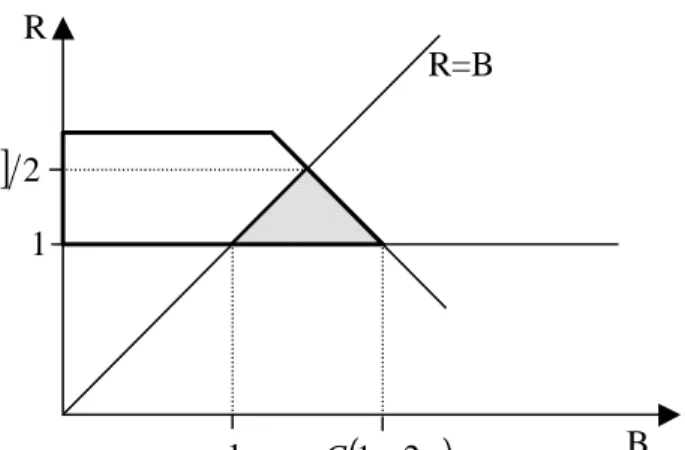
Proof. There are two cases to consider, according to whetherC(1 + 2κ)is less than or greater than 1. The former is illustrated in figure 1; in the latter, which is illustrated in figure 6, region OO
vanishes.
Case 1: C(1 + 2κ)≤1. This is the case which is illustrated in figure 1. UO is comprised
of a rectangular area and a right angled triangle bounded below by R = 1 and above by R = C(1 + 2κ) + 1−B: 1 A ZZ UO (R−1)dBdR= 1 A Z C(1+κ) 0 Z Cκ 0 RdRdB+ 1 A Z C(1+2κ) C(1+κ) Z C(1+2κ)−B 0 RdRdB = C 3κ2 2A (1 +κ) + 1 6A h {C(1 + 2κ)−B}3iC(1+κ) C(1+2κ) = C3κ2 6A (4κ+ 3). (18) It is convenient to think ofOO as comprising two identical right angled triangles:
1 A ZZ OO (1−R)dBdR= 2 A Z 1 C(1+2κ)+1 2 Z 1 B (1−R)dRdB = 1 A Z 1 C(1+2κ)+1 2 (1−B)2dB = 1 3A h (1−B)3i C(1+2κ)+1 2 1 = 1 24A(1−C(1 + 2κ)) 3.
Adding these expressions yields equation 17. B R 1 1 C
(
1+2κ)
R=B(
)
[
C1+2κ +1]
2Figure 6: RegionUO whenC(1 + 2κ)>1.
Case 2: C(1 + 2κ)>1. This case is illustrated infigure 6. In this case regionOO vanishes and
region UO is the region with the bold outline, with the shaded area removed. α(C) can therefore
be obtained by subtracting the welfare which could be attained by investing in shaded area projects from that attained by investing in all projects in the bold outline. The welfare from projects in the bold outline is given by equation 18 above; that from projects in the shaded area is
2 A Z C(1+2κ)+1 2 1 Z B−1 0 RdRdB= 1 24A(1−C(1 + 2κ)) 3,
from which the required result follows immediately. 2
To prove the proposition, note that
∆0(0) = −(1 + 2κ) 24A <0; ∆0(1) = κ
2
A (1 +κ),
andSB0 (1)≤0withSB0 (1) = 0, so that the aggregate distortion is decreasing inCwhenC = 0and increasing whenC = 1. It follows that the optimal capital requirement is strictly between 0and1. That the optimal capital requirement is increasing inφ follows immediately from the observation that ∂SB
∂φ >0.
4.3. Proof of Proposition 3
Equation 8 can be re-written as follows:
W = ZZ R≥1 R∈A R−1.dRdB− ZZ Σ R−1.dRdB− ZZ O R−1.dRdB − ZZ R≥σ(B) R∈A σ(B)−1.dRdB− ZZ U R−1.dRdB− ZZ U 1−σ(B).dRdB − ZZ O σ(B)−R.dRdB
Using equation 7 this reduces to W = W0− ZZ O σ(B)−1.dRdB− ZZ R≥σ(B) R∈A σ(B)−1.dRdB− ZZ U 1−σ(B).dRdB = W0− ZZ R≥1+Ck R∈A σ(B)−1.dRdB. References
Bolton, P. and D. S. Scharfstein (1996), ‘Optimal Debt Structure and the Number of Creditors’,
Journal of Political Economy, Vol. 104, No. 1, pp. 1—25.
Boot, A. W. A., S. I. Greenbaum and A. V. Thakor (1993), ‘Reputation and Discretion in Financial Contracting’,American Economic Review, Vol. 83, No. 5 (December), pp. 1165 — 1183. Froot, K. A., D. S. Scharfstein and J. C. Stein (1993), ‘Risk Management: Coordinating Corporate
Investment and Financing Decisions’,Journal of Finance, Vol. 48, No. 5 (December), pp. 1629— 1658.
and J. C. Stein (1998), ‘Risk Management, Capital Budgeting, and Capital Struc-ture Policy for Financial Institutions: An Integrated Approach’, Journal of Financial Eco-nomics, Vol. 47, pp. 55 — 82.
Furfine, C., H. Groeneveld, D. Hancock, P. Jackson, D. Jones, W. Perraudin, L. Radecki and M. Yoneyama (1999), Capital Requirements and Bank Behaviour: The Impact of the Basle Accord, Working Paper 1, Bank for International Settlements, Basle, Switzerland.
Lóránth, G. and A. D. Morrison (2003), Multinational Bank Capital Regulation with Deposit Insurance and Diversification Effects, Working Paper 2003-FE-11, Oxford Financial Research Centre, University of Oxford.
Merton, R. C. (1977), ‘An Analytic Derivation of the Cost of Deposit Insurance and Loan Guar-antees: An Application of Modern Option Pricing Theory’, Journal of Banking and Fi-nance, Vol. 1, No. 1 (June), pp. 3 — 11.
Myers, S. and N. Majluf (1984), ‘Corporate Financing and Investment Decisions When Firms Have Information Investors Do Not Have’,Journal of Financial Economics, Vol. 13, pp. 187—222.
19
NATIONAL BANK OF BELGIUM - WORKING PAPERS SERIES
1. "Model-based inflation forecasts and monetary policy rules" by M. Dombrecht and R. Wouters,
Research Series, February 2000.
2. "The use of robust estimators as measures of core inflation" by L. Aucremanne, Research Series, February 2000.
3. "Performances économiques des Etats-Unis dans les années nonante" by A. Nyssens, P. Butzen, P. Bisciari, Document Series, March 2000.
4. "A model with explicit expectations for Belgium" by P. Jeanfils, Research Series, March 2000. 5. "Growth in an open economy: some recent developments" by S. Turnovsky, Research Series,
May 2000.
6. "Knowledge, technology and economic growth: an OECD perspective" by I. Visco, A. Bassanini, S. Scarpetta, Research Series, May 2000.
7. "Fiscal policy and growth in the context of European integration" by P. Masson, Research Series, May 2000.
8. "Economic growth and the labour market: Europe's challenge" by C. Wyplosz, Research Series, May 2000.
9. "The role of the exchange rate in economic growth: a euro-zone perspective" by R. MacDonald, Research Series, May 2000.
10. "Monetary union and economic growth" by J. Vickers, Research Series, May 2000.
11. "Politique monétaire et prix des actifs: le cas des Etats-Unis" by Q. Wibaut, Document Series, August 2000.
12. "The Belgian industrial confidence indicator: leading indicator of economic activity in the euro area?" by J.J. Vanhaelen, L. Dresse, J. De Mulder, Document Series, November 2000.
13. "Le financement des entreprises par capital-risque" by C. Rigo, Document Series, February 2001.
14. "La nouvelle économie" by P. Bisciari, Document Series, March 2001.
15. "De kostprijs van bankkredieten" by A. Bruggeman and R. Wouters, Document Series, April 2001.
16. "A guided tour of the world of rational expectations models and optimal policies" by Ph. Jeanfils, Research Series, May 2001.
17. "Attractive Prices and Euro - Rounding effects on inflation" by L. Aucremanne and D. Cornille,
Documents Series, November 2001.
18. "The interest rate and credit channels in Belgium: an investigation with micro-level firm data" by P. Butzen, C. Fuss and Ph. Vermeulen, Research series, December 2001.
19 "Openness, imperfect exchange rate pass-through and monetary policy" by F. Smets and R. Wouters, Research series, March 2002.
20. "Inflation, relative prices and nominal rigidities" by L. Aucremanne, G. Brys, M. Hubert, P. J. Rousseeuw and A. Struyf, Research series, April 2002.
20
21. "Lifting the burden: fundamental tax reform and economic growth" by D. Jorgenson, Research series, May 2002.
22. "What do we know about investment under uncertainty?" by L. Trigeorgis, Research series, May 2002.
23. "Investment, uncertainty and irreversibility: evidence from Belgian accounting data" by D. Cassimon, P.-J. Engelen, H. Meersman, M. Van Wouwe, Research series, May 2002. 24. "The impact of uncertainty on investment plans" by P. Butzen, C. Fuss, Ph. Vermeulen,
Research series, May 2002.
25. "Investment, protection, ownership, and the cost of capital" by Ch. P. Himmelberg, R. G. Hubbard, I. Love, Research series, May 2002.
26. "Finance, uncertainty and investment: assessing the gains and losses of a generalised non-linear structural approach using Belgian panel data", by M. Gérard, F. Verschueren, Research series, May 2002.
27. "Capital structure, firm liquidity and growth" by R. Anderson, Research series, May 2002. 28. "Structural modelling of investment and financial constraints: where do we stand?" by
J.- B. Chatelain, Research series, May 2002.
29. "Financing and investment interdependencies in unquoted Belgian companies: the role of venture capital" by S. Manigart, K. Baeyens, I. Verschueren, Research series, May 2002. 30. "Development path and capital structure of Belgian biotechnology firms" by V. Bastin,
A. Corhay, G. Hübner, P.-A. Michel, Research series, May 2002.
31. "Governance as a source of managerial discipline" by J. Franks, Research series, May 2002. 32. "Financing constraints, fixed capital and R&D investment decisions of Belgian firms" by
M. Cincera, Research series, May 2002.
33. "Investment, R&D and liquidity constraints: a corporate governance approach to the Belgian evidence" by P. Van Cayseele, Research series, May 2002.
34. "On the Origins of the Franco-German EMU Controversies" by I. Maes, Research series, July 2002.
35. "An estimated dynamic stochastic general equilibrium model of the Euro Area", by F. Smets and R. Wouters, Research series, October 2002.
36. "The labour market and fiscal impact of labour tax reductions: The case of reduction of employers' social security contributions under a wage norm regime with automatic price indexing of wages", by K. Burggraeve and Ph. Du Caju, Research series, March 2003.
37. "Scope of asymmetries in the Euro Area", by S. Ide and Ph. Moës, Document series, March 2003.
38. "De autonijverheid in België: Het belang van het toeleveringsnetwerk rond de assemblage van personenauto's", by F. Coppens and G. van Gastel, Documentseries, June 2003.
39. "La consommation privée en Belgique", by B. Eugène, Ph. Jeanfils and B. Robert, Document series, June 2003.
40. "The process of European monetary integration: a comparison of the Belgian and Italian approaches", by I. Maes and L. Quaglia, Research series, August 2003.
21
41. "Stock market valuation in the United States", by P. Bisciari, A. Durré and A. Nyssens,
Document series, November 2003.
42. "Modeling the Term Structure of Interest Rates: Where Do We Stand?", by K. Maes, Research series, February 2004.
43. "Interbank Exposures: An Empirical Examination of Systemic Risk in the Belgian Banking System", by H. Degryse and G. Nguyen, Research series, March 2004.
44. "How Frequently do Prices change? Evidence Based on the Micro Data Underlying the Belgian CPI", by L. Aucremanne and E. Dhyne, Research series, April 2004.
45. "Firm's investment decisions in reponse to demand and price uncertainty", by C. Fuss and Ph. Vermeulen, Research series, April 2004.
46. "SMEs and Bank Lending Relationships: the Impact of Mergers", by H. Degryse, N. Masschelein and J. Mitchell, Research series, May 2004.
47. "The Determinants of Pass-Through of Market Conditions to Bank Retail Interest Rates in Belgium", by F. De Graeve, O. De Jonghe and R. Vander Vennet, Research series, May 2004. 48. "Sectoral vs. country diversification benefits and downside risk", by M. Emiris, Research
series, May 2004.
49. "How does liquidity react to stress periods in a limit order market?", by H. Beltran, A. Durré and P. Giot, Research series, May 2004.
50. "Financial consolidation and liquidity: prudential regulation and/or competition policy?", by P. Van Cayseele, Research series, May 2004.
51. "Basel II and Operational Risk: Implications for risk measurement and management in the financial sector", by A. Chapelle, Y. Crama, G. Hübner and J.-P. Peters, Research series,
May 2004.
52. "The Efficiency and Stability of Banks and Markets", by F. Allen, Research series, May 2004. 53. "Does Financial Liberalization Spur Growth?" by G. Bekaert, C.R. Harvey and C. Lundblad,
Research series, May 2004.
54. "Regulating Financial Conglomerates", X. Freixas, G. Lóránth, A.D. Morrison and H.S. Shin,