Northumbria Research Link
Citation: Ragnedda, Massimo (2019) Conceptualising the digital divide. In: Mapping Digital Divide in Africa: A Mediated Analysis. Amsterdam University Press, pp. 27-44. ISBN 9789462986855
Published by: Amsterdam University Press
URL: https://doi.org/10.2307/j.ctvh4zj72.6 <https://doi.org/10.2307/j.ctvh4zj72.6>
This version was downloaded from Northumbria Research Link: http://nrl.northumbria.ac.uk/43052/
Northumbria University has developed Northumbria Research Link (NRL) to enable users to access the University’s research output. Copyright © and moral rights for items on NRL are retained by the individual author(s) and/or other copyright owners. Single copies of full items can be reproduced, displayed or performed, and given to third parties in any format or medium for personal research or study, educational, or not-for-profit purposes without prior permission or charge, provided the authors, title and full bibliographic details are given, as well as a hyperlink and/or URL to the original metadata page. The content must not be changed in any way. Full items must not be sold commercially in any format or medium without formal permission of the copyright holder. The full policy is available online:
http://nrl.northumbria.ac.uk/pol i cies.html
This document may differ from the final, published version of the research and has been made available online in accordance with publisher policies. To read and/or cite from the published version of the research, please visit the publisher’s website (a subscription may be required.)
Accepted Manuscript
This chapter has been accepted for publication and undergone full peer review but has not been through the copyediting, typesetting, pagination and proofreading process which may
lead to differences between this version and the Version of Record.
To cite this chapter: Ragnedda, M. (2019). Reconceptualising the digital divide. In Mutsvairo, B., and Ragnedda, M., (2019) (eds)., Mapping the Digital Divide in Africa. A
mediated Analysis. Amsterdam: Amsterdam University Press, pp. 27-43.
Introduction
The term “digital divide” emerged in the 1990s to define inequalities in access to the Information Communication Technologies (ICTs), framing it as a matter of having or not having access to ICTs (Compaine 2001). The firsts empirical researches have shown how some specific socio-demographic variables, such as employment status, income, education level, geographic location, ethnicity, age, gender and family structure, influenced the access to the ICTs, creating a digital gap or divide among citizens (domestic digital divide) or countries (global digital divide). Such inequalities have widened during the years, despite the fact that the World Summit on the Information Society, held in Geneva (2003) and then in Tunis (2005) has stressed the idea that no one should be left out from the benefits offered by the information society. The importance of the Internet as a pre-requisite for economic and social development, has been further stressed by the United Nations in 2015 when the Internet has been included among its goals for resolving the most persistent social and economic challenges of our time (UN, 2015: 15). Indeed, in a digital enabled society, part of the human activities depends on how we access, generate and process information. It is then worth asking how the phenomenon of digital divide and digital inequalities has been approached and analysed by both scholars and policy makers and how such approach has changed over the years. Hence, the aim of this chapter is to discuss the change of perspectives in analysing and attempting to bridge the digital divide, and reconceptualise this concept by offering a nuanced theoretical approach to analyses the rise and persistence of digital inequalities.
In order to shed light on this issue, I shall draw on some of the most important researches that have been carried out on this topic in the last two decades, exploring the rise of the digital
divide as a matter of public concern. The chapter will start by attempting to define the digital divide, taking into account its multidimensionality and stressing how the apparently simple matter of “accessibility” is a sophisticated phenomenon. The chapter will underline the development of the digital divide by focusing on the shift from the first to the second level of digital divide, discussing how researchers have moved their focus from inequalities in access to inequalities in use, going beyond the black and white approach of “have” and “have not”. The chapter will then introduce and discuss the third level of digital divide, seen as the social and cultural benefits deriving from accessing and using the Internet, stressing how social and digital inequalities are intertwined. Finally, some conclusion will be drawn and some recommendations and further direction of future work will be also made.
The origin and the evolution of the digital divide
Although the digital divide is a relatively new phenomenon, research on the digital divide has “created its own literature and [has] gained the reputation as a legitimate academic field” (Wang, McLee and Kuo, 2011: 323). However, not only there is not a clear and commonly accepted definition (Epstein et al., 2011; Stevenson, 2009), but it is impossible to identify with any certainty the person (scholar or policy maker) who coined or used for the first time the term “digital divide”. The term has been used in different way with different meanings. In 1995 Moore used this term to distinguish attitudes of pessimism or euphoria in the use of technology, while in 1996, Gore used it to indicate the different chances for students to access and use personal computers at school. This concept started to be used in relation to the gap in accessing the ICTs by the US Department of Commerce’s National Telecommunications and Information Administration (NTIA), in a series of “Current Population Surveys” in 1995, 1998, 1999, 2000, 2002 and 2004. The issue of digital divide has, therefore, gained importance as a policy issue. These reports mainly referred to the socio-economic gap between communities with access to computers and the Internet and those without, tracing the most important intergroup differences related to the spread of access. These studies showed that low-income people, adults, women and racial minorities had the lowest rate of computer ownership and Internet access, thus creating a digital gap or divide across population. In order to bridge the gap in accessing the ICTs earlier researchers and policy makers have adopted what we can define as the “telephone approach”, which mainly focuses on the cost and diffusion of technologies, thus reflecting the influence of traditional public policies on the universal spread of the telephone. In such perspective, however, gaps and inequalities essentially referred to the difficulties encountered
by certain social categories or entire countries to access and use technologies. The phenomenon of digital divide was reduced to a simple technological and economic issue, underestimating the social consequences associated with the rise of the digital divide (Compaine, 1988). In this vein, several researches and policy makers thought that the initial differences in access to ICTs gradually disappear as a result of socio-economic processes: the levelling of access will be possible thanks to the reduction of costs and simplification of interfaces. This approach, known also as standardization, stresses the idea that citizens have different time of technology’s adoption and the current gap will be gradually overcome as the technology will adapt itself to the market (Thierer, 2000). Lower price and a much simpler interfaces, will eradicate the problems surrounding the digital divide (Compaine, 1988, 2001).
However, framing the digital divide as a technological problem and as a matter of adoption, means to ignore other variables such the overall socio-cultural, educational and political background. Describing the digital divide as the simple difference between those who have a personal computer and a connection to the Internet, and those who, not having this technology, remain cut off from its possibilities, is what we can define as the first level of digital divide. Such approach has characterized the early stage of its development (Hoffman and Novak, 1998; Katz and Aspden, 1997). Presenting the digital divide as a form of inequality in access to ICTs (Besser, 2004) and as a matter of absolute inequality in black and white terms, sounds problematic (DiMaggio et al., 2001; Selwyn, 2004), and fails to understand its multidimensionality (Warschauer, 2002) and the necessity to include others factors and variables (Brandtzæg et al., 2011). Access to the Internet alone cannot determine neither how much value users gain from the Internet, nor what users do online (Devaraj and Kohli, 2003; Zhu and Kraemer, 2005). This dichotomous approach, obsolete in an era characterized by extensive use of the Internet (Tondeur et al., 2011), may be useful to describe the adoption and diffusion of ICTs, but it is useless to analyse the social, cultural, political and economic inequalities at the base of the differences in accessing and using the Internet. Above all, such binary approach fails in understanding how the unequal access and usage of ICTs not only is based on already existing social inequalities, but it may also exacerbate them. Thus, what is missing in the earlier researches is not only a nuanced theoretical approach (Ragnedda and Muschert 2017), but also any attempt to analyse digital inequalities and their social implications.
With the spread of the Internet, the theoretical panorama has expanded and the phenomenon of digital divide has been reformulated in different ways (Sparks, 2013; Van Dijk, 2006). Scholars and researches went beyond the black and white divide between two dichotomous groups that can be clearly determined, by including other variables and aspects (Hargittai, 2000; Norris, 2001; DiMaggio et al., 2001; Castells, 2004; Rogers, 2003). The digital divide, as a complex and sophisticated phenomenon (Hsieh at al. 2008; Okazaki, 2006), cannot be analysed only from one point of view (access), reducing it merely to technological and economic factors. In this vein, researchers have moved from the first level of digital divide, to a more sophisticated and multidimensional second level, mainly based on the disparities in computer and Internet usage (Attewell 2001; Dewan and Riggins 2005). This new level focuses not only on the material access to the Internet, but also on the different uses of it. In fact, while the gap in access to the Internet has progressively declined (reducing the first level of digital divide) the technological usage results in an increasing divide between users (Hilbert et al., 2010), since the benefits derived are not commonly experienced by everybody (Howard, Busch, and Sheets, 2010; Ono and Zavodny, 2008). This new path in analysing the digital divide focuses on the instrumental and creative skills and communication abilities (Correa, 2010; Hargittai and Walejko, 2008; Van Dijk, 2006) that gives a different Internet’s experiences. The digital divide has thus started to be analysed in relation to the capacities and digital skills of citizens with different socio-economic backgrounds (Hargittai, 2002; Van Deursen and Van Dijk, 2009), the quality of usage (Benkler, 2006), and the different ways in which ICTs are used (Hargittai and Hsieh, 2010). Researches have disaggregated several aspects of online access and uses (DiMaggio et al., 2004; Selwyn, 2004; Van Dijk, 2005; Witte and Mannon, 2010), underlining that the digital divide is a multidimensional and multifaceted problem, and that a polarized vision cannot encompass the different gradation of e-inclusion and use of ICTs (Van Dijk 2005).
Going beyond the dichotomous division means, above all, to tie digital inequalities to social inequalities (DiMaggio et al., 2004; Sparks, 2013) and to analyse digital inequalities in terms of political participation, healthcare, education, and in relation with already-existing social inequalities (Bimber, 2000; Cavanaugh, 2000; Fox, 2001; Guillén, and Suárez, 2001; Warschauer, 2004). Over the years, the digital divide, therefore, has become a social problem rather than a merely technological one (Ragnedda and Muschert 2013). To fully appreciate the complexity of digital divide, scholars and policy makers must understand its social consequences by looking at society’s inequalities. Although scholars are now taking into
consideration the multidimensionality of the digital divide (Van Dijk, 2005; DiMaggio et al., 2001; Lenhart and Horrigan, 2003; De Haan, 2003), policy makers have often continued to look at it in terms of lack of access or infrastructure (even though something has changed over the years, specifically in the most advanced societies). In other words, policy makers have in the past focused mainly on the first level of digital divide, not acknowledging the different skills, abilities and purpose of use of ICTs in an effective way. As already noted, the concept of the digital divide does not relate to a single type of “divide”, but instead is intertwined with a series of economic, cultural, political, personal and social issues, and is linked to the growth of computer technology and the Internet. Capacities, motivations, skills and support in accessing, using and managing such information and knowledge disseminated by such technology may generate significant cultural, economic, social, personal and political advantages.
The digital divide is, therefore, a multifaceted phenomenon, interwoven with existing processes of social differentiation. The diffusion and penetration of ICTs occurs according to the traditional models of technology spread. ICTs reaches more and more citizens that tend to embed them into their daily routine. However, this spread not only do not “necessarily” reduce digital inequalities, but rather it suggests a reconfiguration of social stratification, that in some way may accentuate existing inequalities. Indeed, users who find themselves in a position of relative social advantage tend to consolidate these privileges to the detriment of social categories slower to adopt and properly use new technology (Ragnedda and Muschert, 2016). This is in line with what Hsieh and Rai (2008) have shown in their research, when they underlined how socio economic strata have not only different access to ICTs, but also they experience a completely different use of such technologies. Thus, while the divide in access to the digital realm might be at some point bridged, in the meantime other divides in terms of motivation, skills, support and capacity to gain advantages from the Internet will continue. It is, then, erroneous to expect that a relatively widespread and well distributed use of ICTs among social strata will automatically convert into the progress of equal opportunities among citizens. In order to exploit the full potential of ICTs it is necessary to have a solid purpose of use, to reach a good level of digital skills, and to have a strong cultural, social and political capital (Ragnedda and Ruiu 2017). Users are constantly asked to update and improve their skills in order to feel comfortable in the network society (Van Dijk and Hacker, 2003) and to become full citizens. Indeed, users, once passed the first level of digital divide, may experience different level of digital inclusion.
Evidently, as stated by Castells (2001: 232) access to the Internet is a prerequisite to overcome inequality in a network society, without which other factors will be irrelevant. Such gap in accessing the ICTs is a clear obstacle to enjoying the benefits of Internet (Hassani, 2006). This is why, as we have seen, at the early stage of its development, access and ownership of ICTs was seen both by policy makers and scholars as the most crucial factor (Correa, 2010; DiMaggio et al., 2004). However, also the concept of “access” needs to be reconceptualised and cannot be analysed in dichotomous terms. It is then necessary to adopt a nuanced approach that acknowledge how access is a complicated and multifaceted issue. For instance, Kling (1998) outlined differences in social and technical access, while Van Dijk (1999: 179) stressed four different kinds of access: material access, mental access, usage access and skills access. Always Van Dijk, few years later (2005), analysed access skills in relation both to the availability of material, cultural, social and mental resources and to personal factors such as gender, intelligence, ability, ethnicity, age, health and ability. Finally, Wilson (2006) has further stressed the complexity of the variable “access”, underlining eight factors related to access to the Internet: physical, financial, cognitive access, production, design, content, institutional and political access. All these forms of access can create or reinforce divides in the online experiences and, eventually, effecting the tangible outcomes users can get from the Internet. Hence, access, in all its facets, must then be seen as a complicated set of issues that produce and reinforce differences between social classes (Goldfarb and Prince, 2008; Hilbert, 2011). Different accesses and different abilities and skills in exploiting the benefits offered by the ICTs are strongly connected with social inequalities and, thus, are connected with the third level of digital divide.
The third level of digital divide
Several researchers have underlined how digital skills and different uses of ICTs are the key in generating digital inequalities in terms of different social, economic, cultural or political advantages among users (Van Deursen and Van Dijk, 2009; DiMaggio and Bonikowski, 2008). The digital skills should not be reduced to a simple skill to surf the web, but should also include the capacity to search for valuable information, manage social and professional contexts online, select mission-critical content, be aware of potentialities offered by ICTs, engage in self-promotion and increase social and cultural capital. In a digital-enabled society, capacity, motivation, education and the “quality” of information and knowledge acquired online have consequences for life opportunities in the social realm. The different accesses and uses of the
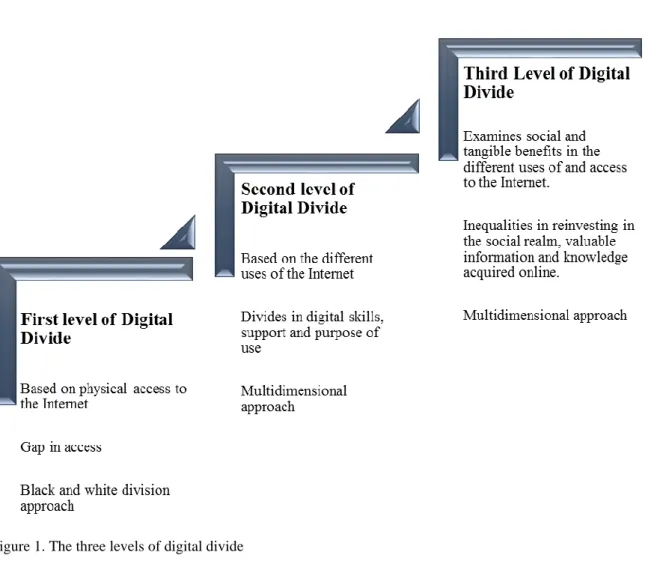
ICTs lead to entirely different roles of the Internet in individuals’ lives, strongly influencing inequality in the digital age. The pervasiveness of ICTs into every aspect of our lives made the issues related to inequalities in accessing (first level of Digital Divide) and the use of ICTs (second level) increasingly vital. Furthermore, the penetration of ICTs and its relation with the already existing social inequalities have given the rise to the so-called third level of digital divide (Ragnedda 2017), seen as the capacity to reinvest into the social realm the valuable information, knowledge and resources found online. The third level of digital divide is, therefore, the capacities to transform the digital benefits, resulting from a satisfactory use of ICTs, into social benefits that might improve the life chance of individuals.
Figure 1. The three levels of digital divide
Individuals’ access to and digital skills in using the Internet do not automatically transform online experiences into other social and tangible outcomes. Indeed, without the “right” social,
political, cultural and economic environment in which to grow and rely to amplify the benefits offered by the digital environment, most of the opportunities opened up by the Internet are not completely exploited. In this way, it is possible to argue that socio-economic and cultural backgrounds affect the access to and the use of the Internet (first and second level), and this different online experience influences people’s life chances and the opportunities they have in the offline world (third level). To put it differently, information, resources and knowledge acquired in the digital realm are influenced by social, economic, personal and cultural factors at the base of social inequalities. In turn, the different use of Internet (second level of digital divide) generates knowledge and resources (cultural, social, personal, economic and political) that might be reinvested and used in the social world creating different rewards and tangible outcomes (third level of digital divide). These different personal, economic, social, political and cultural rewards tend to reinforce and solidify inequalities already existing in the society. Thus, like in a vicious circle, pre-existing forms of social inequalities influence the digital divide at all three levels, which in turn influence social inequalities upon which it relies. In this way, social inequalities are further exacerbated and reinforced by the advent of ICTs.
For the sake of clarity, this does not mean we are living in a closed society where any forms of social mobility - namely the ability for people to improve their life conditions - are prevented. ICTs, and the Internet in particular, may offer concrete help in stimulating such mobility. By offering, for instance, to individuals of low socio-economic status, but with great motivation and high-level digital skills, to promote themselves up the social ladder by using the ICTs. However, as several researches have shown, it is more likely that individuals with higher income, better education and a better prestigious position in society tend to use the Internet to maintain or enhance their privileged position. van Deursen, van Dijk and ten Klooster (2015), for instance, have demonstrated how the opportunities offered by the Internet are entirely exploited by individuals who belong to a higher socio-economic class. This shows how, despite the Internet is an open and democratic platform, not everyone is in the same position to exploit the opportunities offered by the digital arena. Indeed, the capacity to improve life chances using the Internet is shaped by previous position in the social strata. To put it differently, what determines individuals’ chances to improve their position in society is not the simple possession of better skills and qualifications, but above all their capacity to offer and use these in the social realm. Appropriate access to and use of ICTs can give citizens a wide-ranging array of opportunities to improve their social position. An effective and productive way of using ICTs offers information-enhancing options to permit previously unknown actions.
However, without the support of solid social network and the skills and capacities to exploit and reinvest in the offline reality, citizens lose part of the potentialities offered by the Internet. Services, information, applications and opportunities offered by the Internet are more likely to be fully exploited by well-educated individuals, especially those belonging to socially advantaged classes, who will use these chances to improve and reinforce their position in society.
Concluding thoughts
One of the assumptions that has led this chapter is that digital divide and digital inequalities tend to strengthen social inequalities already existing in the offline society, both at the micro and macro levels, and enlarge the gap between the less advantaged and the most advantaged individuals. As we have seen, in its broadest terms, the digital divide describes the incapacity of specific social categories (national digital divide), or some countries (global digital divide), to use technological tools to expand and enhance their life chances. The advantages/disadvantages of accessing and using the Internet act in a vicious circle based on the already existing social structure. This is why an analysis of digital inequalities has to take into consideration the political, cultural and social system within which technologies are embedded and work. More specifically, social and digital inequalities reciprocally influence each other and must be seen as complementary phenomena.
The trend (that cannot be seen in absolutist terms) is that social strata that tend to obtain more valuable resources in the social world are, in some way, the same that tend to exploit ICTs most advantageously. However, while the Internet cannot be seen as a cause of inequalities, its different access and use - influenced by economic, cultural, personal, socio and political factors - influence social inequalities. As we have seen, the Internet opens up wide array of opportunities in economic, political, social and educational arenas, but different users do not exploit them in the same way, since previous backgrounds determine both its usage and the tangible outcomes of Internet usage. This is in line with the third level of digital divide, seen in relation to the capacities and possibilities to transform digital valuable resources and knowledge, into social and tangible benefits.
In conclusion, I reiterate the idea that the third level of digital divide is the result of the different uses of the Internet tangled with previous social inequalities. As we have seen, the first level of digital divide, traditionally used at the beginning, is mainly based on access to the Internet, while the second level refers to the different usage of the Internet; as for the third level, it is the consequence of these two previous forms, tied with the already existing social inequalities. To put it differently, the third level of digital divide, based on the capacity and possibility to access the Internet, and the motivation and skills to use it in the “right” way, focuses on the social consequences of Internet usage. This reconceptualization of digital divide moves away the focus from the digital arena, by addressing it as a social issue. It is not the simple access to the Internet itself (first level of digital divide) that expands life chances, but rather are the motivations, skills and purpose of use (second level of digital divide) and the opportunities and capacities to convert the possibilities offered by the ICTs into concrete and tangible resources (third level of digital divide) that increase the possibilities to move on the social ladder. It is then vital, for policy makers, act to bridge the digital divide and engender the digital development; however, it would be wrong to focus only on the access, as suggested by some local and international actors. While it is vital to close the first level of digital divide, an approach that take into account “especially in Internet access” risks to replace the (first level) digital divide with digital inequalities (second and third level) that are much more difficult to eradicate and it may reinforce social inequalities.
References
Attewell, P. (2001). The First and Second Digital Divides. Sociology of Education. 74(3): 252-259.
Benkler, Y. (2006). The Wealth of Networks. New Haven, CT: Yale University Press.
Besser, H. (2004). The next digital divides. Retrieved September 2016, from
https://tcla.gseis.ucla.edu/divide/politics/besser.html.
Bimber, B. (2000). The Gender Gap on the Internet. Social Science Quarterly, 81(3): 868-876.
Brandtzæg P, Heim J and Karahasanovic A. (2011) Understanding the new digital divide-A typology of Internet users in Europe. International Journal of Human-Computer Studies 69(3): 123-138.
Castells, M. (2001) The Internet Galaxy: Reflections on the Internet, Business, and Society. Oxford: Oxford University Press.
Castells, M. (2004). The power of identity. Malden, Mass: Blackwell Pub.
Cavanaugh, J.W. (2000). E-democracy: Thinking About the Impact of Technology on Civic Life. National Civic Review, 89: 229–34.
Compaine, B. (1988). “Information gaps: Myth or reality?”. In Issues in new information technology, Edited by: Compaine, B. and Norwood, NJ: Ablex Publishing Company, pp. 179– 191.
Compaine, B.M. (2001). The digital: facing a crisis or creating a myth? Boston: MIT Press. Correa, T., (2010). The participation divide among ‘‘online experts’’: experience, skills and psychological factors as predictors of college students’ web content creation. Journal of Computer-Mediated Communication, 16(1): 71–92.
De Haan, J. (2003). IT and social inequality in the Netherlands. IT & Society, 1(4): 27-45.
Devaraj, S. and Kohli, R. (2003). Performance Impacts of Information Technology: Is Actual Usage the Missing Link? Management Science, 49(3): 273-289.
Dewan, S., Ganley, D. and Kraemer, K. L. (2005). Across the Digital Divide. A cross-country multi-technology analysis of the determinants of IT penetration. Journal of the Association for Information Systems, 6(12): 409-432.
DiMaggio, P. and Bonikowski, B. (2008). Make Money Surfing the Web? The Impact of Internet Use on the Earnings of U.S. Workers. American Sociological Review. 73(2): 227–250.
DiMaggio, P., Hargittai, E., Russell Neuman, W., and Robinson J.P. (2001). Social Implications of the Internet. Annual Review of Sociology. 27(1). 307–336.
DiMaggio, P., Hargittai, E.,Celeste, C., and Shafer, S. (2004) 'Digital Inequality, From Unequal Access to Differentiated Use', in K. Neckerman (ed.) Social Inequality, pp. 355 – 400. New York: Russell Sage Foundation.
Epstein, D., Nisbet, E.C. and Gillespie, T. (2011). Who’s responsible for the digital divide? Public perceptions and policy implications. The Information Society, 27(2): 92-104.
Fox, S. (2001) Wired seniors: a fervent few, inspired by family ties. Pew Internet & American Life Project, Retrieved June 2016, from http://www.pewinternet.org/2001/09/09/wired-seniors/.
Goldfarb, A. and Prince, J. (2008). Internet Adoption and Usage Patterns are Different: Implications for the Digital Divide. Information Economics and Policy, 20(1): 2-15.
Guillén, M.F. and Suárez, S.L. (2001). Developing the Internet: Entrepreneurship and Public Policy in Ireland, Singapore, Argentina, and Spain. Telecommunications Policy, 25(5): 349- 371.
Hargittai, E. (2000). Open Portals or Closed Gates? Channeling Content on the World Wide Web. Poetics (Journal of Empirical Research on Culture, the Media and the Arts). 27(4): 233-254.
Hargittai, E. (2002). Second Level Digital Divide: Differences in People’s Online Skills. First Monday, 7(4).
Hargittai, E. and Hinnant, A. (2008). Digital inequality: differences in young adults’ use of the internet. Communication Research, 35(5): 602–621.
Hargittai, E. and Hsieh, Y.P. (2010). From Dabblers to Omnivores: A Typology of Social Network Site Usage. In Z. Papacharissi (Ed.). A Networked Self (p. 146–168). London: Routledge.
Hargittai, E. and Walejko, G., (2008). The participation divide: content creation and sharing in the digital age 1. Information, Communication & Society, 11(2); 239–256.
Hassani, S.N. (2006). Locating digital divides at home, work, and everywhere else. Poetics
34(4–5): 250–272, Retrieved September 2016, from
http://www.sciencedirect.com/science/article/pii/S0304422X06000209.
Hilbert, M. (2011). Digital Gender Divide or Technologically Empowered Women in Developing Countries? A Typical Case of Lies, Damned Lies, and Statistics. Women’s Studies International Forum, 34: 479-489.
Hilbert, M., López, P. and Vasquez, C. (2010). Information societies or “ICT equipment societies”? Measuring the digital information processing capacity of a society in bits and bytes. The Information Society, 26(3): 157-178.
Hoffman, D.L. and Novak, T. P. (1998). Bridging the racial divide on the internet. Science. 280: 390-391.
Howard, P., Busch, L. and Sheets, P. (2010). Comparing digital divides: Internet access and social inequality in Canada and the United States. Canadian Journal of Communication, 35(1): 109-128.
Hsieh JJP-A, Rai A and Keil M. (2008) Understanding Digital Inequality: Comparing Continued Use Behavioral Models of the Social-Economically Advantaged and Disavantaged. MIS Quarterly, 32: 97-126.
Katz, J.E. and Aspden, P. (1997). Motives, hurdles and dropouts. Who is on and off the Internet and why. Communications of the ACM, 40(4): 97–102.
Kling, R. (1998). Technological and Social Access on Computing, Information and Communication Technologies, White Paper for Presidential Advisory Committee on High-Performance Computing and Communications, Information Technology, and the Next Generation Internet.
Lenhart, A. and Horrigan, J. B. (2003). Revisualizing the digital divide as a digital spectrum. IT and Society, 1(5): 23–39.
Moore, D.W. (1995). The Emperor’s Virtual Clothes: The Naked Truth About Internet Culture. New York: Algonquin Books.
National Telecommunications and Information Administration, (1995). Falling Through the Net: A Survey of the “Have Nots” in Rural and Urban America. Retrieved October 2016 from
http://www.ntia.doc.gov/ntiahome/fallingthru.html.
National Telecommunications and Information Administration, (1998). Falling Through the Net II: New Data on the Digital Divide. Retrieved October 2016 from
http://www.ntia.doc.gov/ntiahome/net2/falling.html.
National Telecommunications and Information Administration, (1999). Falling through the
net: Defining the digital divide, Retrieved October 2016 from
http://www.ntia.doc.gov/ntiahome/fttn99/contents.html.
National Telecommunications and Information Administration, (2000). Falling Through the Net: Toward Digital Inclusion, Washington: US Department of Commerce Retrieved October 2016 from http://www.ntia.doc.gov/ntiahome/fttn00/contents00.html.
National Telecommunications and Information Administration, (2002). A Nation Online: How Americans Are Expanding Their Use of the Internet, Retrieved October 2016 from:
http://www.ntia.doc.gov/ntiahome/dn/html/anationonline2.htm.
National Telecommunications and Information Administration, (2004). A Nation Online: Entering the Broadband Age. Washington, DC. Retrieved October 2016 from
https://www.ntia.doc.gov/report/2004/nation-online-entering-broadband-age.
Norris, P. (2001). Digital Divide: Civic Engagement, Information Poverty and the Internet in Democratic Societies. New York: Cambridge University Press.
Ono, H. and Zavodny, M. (2008). Immigrants, English Ability, and the Digital Divide. Social Science Quarterly, 36(3): 1135-1155.
Ragnedda, M. and Muschert, G.W. (2016). Theorizing Digital Divides and Digital Inequalities, in Jan Servaes and Toks Oyedemi (editors) Social Inequalities, Media and Communication: A Global Perspective, London: Lexington Books, pp. 23-35.
Ragnedda, M. and Muschert, G.W. (2017). Theorizing the Digital Divides. Oxford: Routledge.
Ragnedda, M. and Ruiu, M.L. (2017). Social capital and the three levels of digital divide. In Ragnedda M., Muschert G. eds. (2017), Theorizing Digital Divides. Oxford: Routledge, pp. 21-34.
Ragnedda, M. and Muschert, G.W. (Eds.) (2013). The Digital Divide: The Internet and Social Inequality in International Perspective. Oxford: Routledge.
Ragnedda, M. (2017). The third Digital Divide: a weberian approach to digital inequalities. Oxford: Routledge.
Rogers, E.M. (2003). Diffusion of innovations (5th ed.). New York: Free Press.
Selwyn, N. (2004). Reconsidering political and popular understandings of the digital divide. New Media & Society, 6(3): 341–362.
Servon, L.J. (2002). Bridging the Digital Divide: Technology, Community and Public Policy. Oxford: Blackwell.
Sparks, C. (2013). What is the “digital divide” and why is it important? Javnost, The Public: Journal of the European Institute for Communication and Culture. 20 (2), 27–46.
Stevenson, S. (2009). Digital divide: A discursive move away from the real inequities. The Information Society, 25(1), 1-22.
Thierer, A. (2000). Is the digital divide a virtual reality? Consumers' Research Magazine, 83(7): 16-21.
Tondeur, J., Sinnaeve, I., van Houtte, M. and van Braak, J. (2011). ICT as cultural capital: the relationship between socioeconomic status and the computer-use profile of young people. New Media & Society, 13(1), 151-168.
UN (2015). Open Working Group proposal for Sustainable Development Goals, Retrieved
October 2016, from
https://sustainabledevelopment.un.org/content/documents/1579SDGs%20Proposal.pdf.
van Deursen, A.J.A.M. and van Dijk, J.A.G.M. (2014). The digital divide shifts to differences in usage. New Media and Society, 16(3): 507–526.
van Deursen, A.J.A.M. and van Dijk, Jan A.G.M. (2009). Improving digital skills for the use of online public information and services. Government Information Quarterly, 26(2): 333–340. .
van Deursen, A.J.A.M.., van Dijk, J. A. G. M. and Klooster P.M. (2015). Increasing inequalities in what we do online: A longitudinal cross sectional analysis of Internet activities among the Dutch population (2010 to 2013) over gender, age, education, and income. Telematics and Informatics, 32(2): 259–272.
van Dijk J. A. G. M. and Hacker, K. (2003). The ‘Digital Divide’ as a Complex and Dynamic Phenomenon. The Information Society, 19(4): 315–326.
van Dijk, J.A.G.M. (1999). The Network Society, Social aspects of the new media. London, Thousand Oaks, New Delhi: Sage Publications.
van Dijk, J.A.G.M. (2005). The deepening divide. Inequality in the information society. London: Sage.
van Dijk, J.A.G.M. (2006). Digital divide research, achievements and shortcomings. Poetics, 34(4–5): 221–235.
Wang, C.H, McLee, Y. and Kuo, J.H. (2001). Mapping the Intellectual Structure of Digital Divide. International Journal of Social Science and Humanity, 1(1): 49-54.
Warschauer M. (2002). Reconceptualising the Digital Divide, First Monday. 7(7). Retrieved October 2016, from http://www.firstmonday.org/issues/issue7_7/warschauer/.
Warshauer, M. (2004). Technology and Social Inclusion: Rethinking the Digital Divide. London: The MIT press.
Wilson, E. J. (2006). The information revolution and developing countries. Cambridge, MA: MIT Press.
Witte, J.C. and Mannon, S.E. (2010). The Internet and Social Inequalities. New York, NY: Routledge.
World Bank (2016). From Digital Divides to Digital Dividends, Retrieved October 2016, from
http://www.worldbank.org/en/news/infographic/2016/01/13/from-digital-divides-to-digital-dividends.
Zhu, K. and Kraemer, K.L. (2005). Post-adoption variations in usage and value of e-business by organizations: Cross-country evidence from the retail industry. Information Systems Research, 16(1): 61-84.