2018 IEEE International
Conference on Automation,
Quality and Testing, Robotics
(AQTR 2018)
Cluj-Napoca, Romania
24-26 May 2018
IEEE Catalog Number:
CFP18AQT-POD
Copyright О 2018 by the Institute of Electrical and Electronics Engineers, Inc.
All Rights Reserved
Copyright and Reprint Permissions:
Abstracting is permitted with credit to the source.
Libraries are permitted to photocopy beyond the limit of U.S. copyright law for private
use of patrons those articles in this volume that carry a code at the bottom of the first
page, provided the per-copy fee indicated in the code is paid through Copyright
Clearance Center, 222 Rosewood Drive, Danvers, MA 01923.
For other copying, reprint or republication permission, write to IEEE Copyrights
Manager, IEEE Service Center, 445 Hoes Lane, Piscataway, NJ 08854. All rights
reserved.
* * *
This is a print representation o f what appears in the IEEE Digital
Library. Some format issues inherent in the e-media version may also
appear in this print version.
IEEE Catalog Number:
ISBN (Print-On-Demand):
ISBN (Online):
CFP18AQT-POD
978-1-5386-2206-3
978-1-5386-2205-6
Additional Copies of This Publication Are Available From:
Curran Associates, Inc
57 Morehouse Lane
Red Hook, NY 12571 USA
Phone:
(845)758-0400
Fax:
(845) 758-2633
E-mail:
[email protected]
Web:
www.proceedings.com
C U RR A N ASSOCIATES INC.proce
Trojan Circuits Masking and Debugging of
Combinational Circuits with LUT Insertion
A. Matrosova, S. Ostanin
Tomsk State University (TSU) Tomsk, Russia
maul [email protected], [email protected]
Abstract—It is extremely difficult to provide 100%
correctness of fabricated high performance circuits. Manufactured circuits may have logical and electrical bugs, Trojan Circuits (TCs) inclusions and so on. Sometimes it is necessary to execute slight correction of the circuit specification. If there is in-field programmability in the circuits, they may be rectified. Here partially programmable circuits are considered. They are derived from gate circuits by covering some sub-circuits by look up tables (LUTs). Some LUTs have one free input and use reserved line. The way of selection of sub-circuits oriented to masking TCs or masking arbitrary logic faults on gate circuit lines is suggested. The selection is based on using observability estimations of internal circuit lines. Note that the internal line observability estimation represents at the same time determined area (its portion in Boolean space) of the incompletely specified Boolean function corresponding to the line. We get the estimations applying operations on ROBDDs. ROBDDs are derived from gate circuit fragments. A combinational circuit (the combinational part of a sequential circuit) from gates is given. We cover its sub-circuits by LUTs either to mask TCs actions or to recover the circuit specification if faults are detected on the last stages of the circuit fabrication. Arbitrary logical faults on lines are possible, several lines may be fault, several TCs may be injected. Algorithm of reprogramming LUTs is developed, some experimental results are given.
Keywords—partially programmable circuits; malicious circuits (Trojan Circuits); observability; Reduced Ordered Binary Decision Diagrams (ROBDDs)
I. In t r o d u c t i o n
It is extremely diffieult to provide 100% eorreetness of fabrieated high performanee eireuits. Manufaetured eireuits may have logieal and eleetrieal bugs, Trojan Cireuits (TCs) inelusions and so on. Sometimes it is neeessary to exeeute slight eorreetion of the eireuit speeifieation. If there is in-field programmability in the eireuits they may be reetified. It is known [I] that small programmability eould be enough for that. In [2] the authors suggest eovering some gate sub-eireuits by Look-Up Tables (LUTs). Certain LUTs may have a free input. This input is eonneeted with the reserved line. These eireuits are ealled as partially programmable ones (PPCs) [3, 4,
5]. PPC may be applied for reetifieation under bugs [6] and for
small ehanges of speeifieation (Engineering Change Order (ECO)) [7]. PPC is one of possible ways of eireuit reetifieation.
In papers [2, 8] the authors either use some heuristies [2] for seleetion of LUT inelusions or eonsider that PPC is already
given and eonsists of gates and LUTs [8]. Our approaeh is
different: we determine points of probable inserting LUTs being oriented to reetifieation under bugs and TCs insertions. For that we use random estimations of internal eireuit lines observabilities that are ealeulated with applying operations on Redueed Ordered Binary Deeision Diagrams (ROBDDS). ROBDDs are derived from eireuit fragments. Note that the internal line observability estimation represents at the same time determined area (its portion in Boolean spaee) of the ineompletely speeified Boolean funetion eorresponding to the line.
In papers [7, 8] reprogramming LUTs is redueed to solving
Quantified Boolean Formula (QBF) SAT problems. Our approaeh is based on reprogramming LUTs with a permutation of LUT input variables. We eonsider that both a bug deteeted on a eireuit line and a TC inserted into a line ehange the ineompletely speeified Boolean funetion eorresponding to the line of a eorreet eireuit. We suggest masking either bug or TC in the same way.
When outsoureing serviees are used for VLSI fragments, TCs insertion is possible. TC may destroy VLSI or provide leakage of eonfidential information. TCs are usually not deteetable neither during VLSI verifieation nor VLSI testing as they aet in very rare situations.
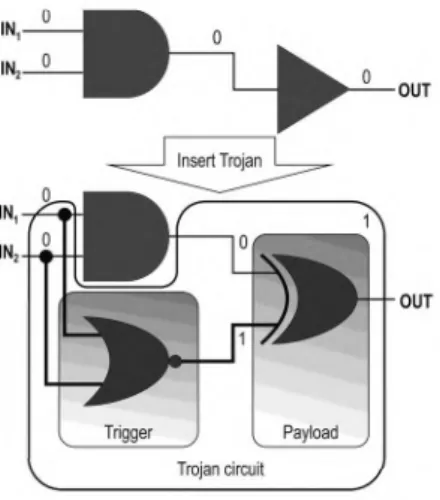
A Trojan Cireuit (TC) eonsists of two parts (Fig. 1). One of them is a Trojan trigger that is switehed on when the speeial eombination of signals appears on TC inputs. Another part is a Trojan payload that is switehed on by the trigger sub-eireuit. Internal nodes INi, IN2 (Fig. 1) are applied to switeh on the trigger of the TC and the payload output is inserted into the line between two gates of the eorreet eireuit fragment. When the TC aets, the value on the fragment output (Fig. 1) is ehanged from 0 to 1. It is desirable to mask TCs. We suggest masking TCs applying partially programmable eireuits.
In high performanee VLSIs it is possible deteeting faults on the last stages of their fabrieation. It deereases the manufaeturing yield and inereases the design eyele. Using PPCs we may reetify VLSIs reprogramming some LUTs. In [2] the method of inereasing yield based on using PPC was suggested. They apply eonventional logie eireuit and eover some its sub-eireuits by LUTs that may be reprogrammed to 978-1-5386-2203-2/18/$31.00 ©2018 IEEE
OUT
OUT
Trojan circuit
Fig. 1. TC insertion.
recover the circuit specification. It is supposed that single stuck-at faults may be detected and only one fault is possible.
In this paper a combinational circuit (the combinational part of a sequential circuit) from gates is given. It is necessary to cover some sub-circuits by LUTs either to mask TCs actions into the given circuit or to recover the circuit specification if faults are detected on the last stages of circuit fabrication. Arbitrary logical faults on lines are possible, several lines may be fault, several TCs may be masked.
Here a selection of sub-circuits to cover LUTs is based on finding lines that probably may be used for inserting TCs or be fault. These lines have low observability estimations and, consequently, their incompletely specified Boolean functions are poor determined. The selection is executed with applying operations on ROBDDs. ROBDDs are derived from fragments of the given combinational circuit (the combinational part of a sequential circuit).
Denote the given combinational circuit from gates as C.
Circuit C turns into partially programmable circuit Cp by
covering the chosen sub-circuits by LUTs. Some of the LUTs have free inputs (usually one input for one LUT). Reserved line connects free input with output of the appropriate circuit gate. These LUTs are reprogrammed either to mask TCs actions or
mask logical faults of the lines. The procedure of
reprogramming is developed. Specifications of circuit C and
fault free circuit Cp in which of that TCs do not act are the same. We consider that TC output is inserted into line between
circuit elements. Several TCs may be inserted into circuit Cp.
The behavior of an activated TC which output is inserted into line / is similar to manifestation of logical fault of this line on some test patterns (on full states of a sequential circuit).
These test patterns are Boolean vectors depending on circuit Cp
input variables. Some of circuit output values are changed for opposite ones on these test patterns. Thus, a TC changes the Boolean function corresponding to line / and, consequently, incompletely specified Boolean function of this line. That is why we may apply the same rectifying method both for masking a TC! inserted into line / and masking a logical fault of
line /. Reprogramming the proper LUTs we keep circuit Cp
specification in spite of insertion of TCs or faults appearance on some lines.
In Section II a statement of the problem is discussed. In Section III we consider the way of calculation of random observability estimation. In Section IV an algorithm of reprogramming LUT is suggested. In Section V some experimental results on benchmarks are given.
II. A St a t e m e n to et h e Pr o b l e m
Combinational circuit C (the combinational part of a
sequential circuit) from gates is given. It is necessary to cover some sub-circuits by LUTs either to mask TCs or to debug faults detected on the last stages of circuit fabrication. We consider that TC output may be connected with only one circuit line (Fig. 1). In general case several TCs may be inserted into circuit C and several lines may be fault. We consider the way of inserting LUT with free input as it is suggested in [2] (Fig. 2).
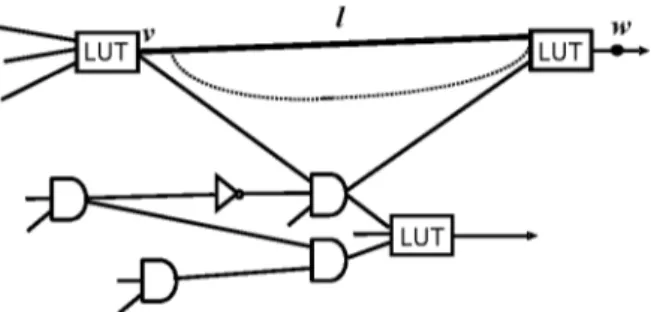
Node V is linked with LUT input m, by thick line /. The dashed line is reserved one. It links free input with the gate output CO.
More general, LUT with output w has m inputs and covers
sub-circuit Clut from gates. Glut has (m-l) inputs. It is
necessary to mask line / applying free input. Mark this input by
m. Further we will call this LUT as rectifying one. Systems of
Boolean functions (specifications) of circuits C and Cp without
TCs and faults are the same. C„ is sub-circuit with output w, its
input variables are input ones of circuit Cp. Let line / be linked with TC output. If TC is inserted into line /, sub-circuit C„
changes its functioning when TC acts. The function of circuit
Cp is also changed. It is necessary to recover the specification of circuit Cp. Our preliminary studies show that possibilities of providing LUT rectification by way suggested in [2] (Fig. 2) are very rare. That is why we suggest connecting dashed (reserved) line with node v and free input m (Fig. 3). Here line / is thick one.
Take into account the following. For each internal line and internal node we may derive incompletely specified Boolean function.
We find lines that of which observability estimations are less than the given threshold. The determined areas are also less than the given threshold for the corresponding incompletely specified Boolean functions.
As a result, we get a set of suspicious lines in circuit C. A set of suspicious lines is divided into two sets. We include into the first set lines running from branch-points of circuit C and into the second one - the rest suspicious lines. Lines of the first set have to be masked with using rectifying LUT s.
The certain lines of the second set may be covered by LUT s so that input and output of the line are inside of the proper LUT (Fig. 4). Such LUT is not reprogrammed. We would like to cover in such way as much as possible suspicious lines from the second set. Lines that cannot be covered we include in the first set and mask them with rectifying LUT (Fig. 3).
Fig. 4. Covering suspicious line by LUT.
After covering some gate sub-circuits in the above mentioned way we may program rectifying LUTs in different ways so that suspicious lines and reserved lines may be transposed. After that we get circuit Cp. As a result, violator
having circuit Cp does not know beforehand which of input
lines of rectifying LUT is inessential. Even if he determines essential lines and includes TCs in them, we may reprogram
rectifying LUTs of circuit Cp and mask TCs activity. Thus Cp is
tolerant to TC insertion. If we use Cp for masking logical faults
on lines, suspicious lines and reserved lines cannot be transposed before faults detection.
111. Ca l c u l a t i o no f Ob s e r v a b i l i t y Es t i m a t i o n sa n d Fi n d i n g In c o m p l e t e l y Sp e c i f i e d Bo o l e a n Fu n c t i o n s
Observability is a possibility of monitoring of changing
l(0)-value of the internal line on the corresponding circuit
output. We suggest calculating random estimations of internal line observability based on applying ROBDDs operations [9].
To get observability estimation for internal line / of circuit
C and the corresponding circuit output we construct ROBDD R
(Ci) for sub-circuit Ci. The sub-circuit correlates with the
proper corresponding circuit C output. The sub-circuit is
derived from circuit C under the condition that internal line / is
an input of sub-circuit Ci [9]. During construction of ROBDD
R(Ci) variable / is the first variable of the decomposition. It
means that ROBDD R(Ci) root is marked by variable /.
ROBDD R(Ci) implements function/ (
Then we get (from R(Ci)) ROBDDs R { f ‘‘°), R ( f ‘"^) which
roots are daughter nodes of R(Ci) root. These ROBDDs
implement functions and accordingly.
Multiplications R ( / = ') & R ( / = ° ) are
implemented and results are merged being presented by
ROBDD . Note that ROBDD operations have a
polynomial complexity.
Take into account that deriving R { f^ ° ) , R (/^ ') from
R ( f ‘"°), R(f^"^) is reduced to permutation of terminal nodes of the corresponding ROBDDs.
We suggest that probabilities of 1 value of all input
variables are equal to 'A. Using ROBDD we calculate
observability estimation for line / and the corresponding circuit C output.
Let 1 value probability p(cp) of Boolean function cp be correlated with ROBDD internal node |J, (node |J, is noted by
variable Xt). The value is calculated with applying probabilities
Р(ф^'"') 5 Р(ф^'"°) of 1 values of functions and corresponding to daughter nodes of node |J, in the following way: р(ф) = р(х,.)р(ф^‘=') + р(^.)р(ф^‘= ° ).
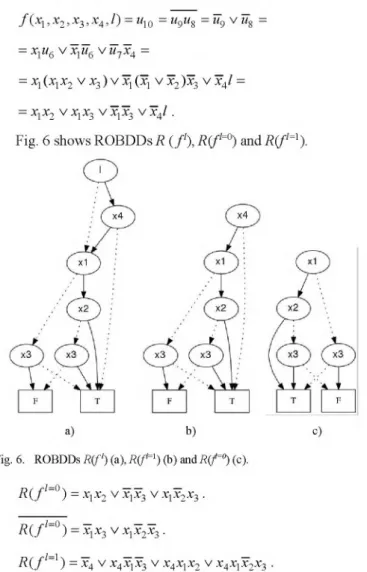
Illustrate observability calculation by example (Fig. 5).
Here V is one of branch-points and line / is input of number
7 gate. Let u? be output of gate with number 7. Then
/ ( X j , X2 , X3 , X4 , / ) = MjQ = MgMg = Mg V Mg =
= Xj (X jX 2 V X3 ) V Xj (X j V X2 )Х з V Х 4 / =
= XjX2 V XjX3 V XjX3 V Х 4 / .
Fig. 6 shows ROBDDs R ( / ) , and «(/'=').
a) b)
Fig. 6. ROBDDs R {f‘) (a), (b) and R {f‘^') (c).
c)
**) = ^Нз V X J X 2 X 3 .
' ) = ^^4 V X4XJX3 V X4XJX2 V X4XJX2X3 .
' ) = X 4X JX 3 V X 4 X J X 2 X 3 .
Here we multiply Disjoint Sum of Products for calculation of the observability value.
= (X 4 V X4X1X3 V X4X1X2 V Х 4 Х |Х 2 Х з)(Х |Х з V X1X2X3) =
= X1X3X4 V X4X1X2 V X1X2X3X4 .
R{f=^^)R{f=^) =
=(X jX 2 V X j ^ V X jX 2X 3)(X 4X jX 3 V X 4 X j X 2 ^ ) = 0 .
Thus, observability estimation of line / is equal to 1/8 + 1/8
+ 1/16 = 5/16. This line has rather high observability
estimation, it is not attractive for TC injection.
If we have additional information about TCs, we may decrease the number of lines applying partial observability estimations of the lines for concrete circuit output and concrete changing signal value on the proper internal circuit node v [10].
If circuit C has several outputs, and line / is connected with some of outputs of this circuit, we calculate the observability estimation in the above mentioned way for each output of sub circuits containing line /. The minimal value is chosen as observability estimation of line /. We consider the most rare situations connected with propagation of changing signals from internal line to the circuit output.
Calculate incompletely specified function for line / using
ROBDD [9]. For that it is necessary to derive ROBDD
R v for sub-circuit Cv .The sub-circuit has output node v and its inputs are inputs of circuit C. R v represents the behavior of this
sub-circuit. R^ represents inversion function of sub-circuit Cv.
Let M ] and be on-set and off-set of incompletely
specified Boolean function corresponding to line /. R ] and Rj
are ROBDDs compactly representing M ] and of this
function:
R] = R^ , R ? = К ■
Note that ROBDD R ] presents all test patterns for stuck-at
0 fault on line / and ROBDD R j presents all test patterns for stuck-at 1 fault [9]:
R j v R i = R ° '^ C
It means that ROBDD R°^" applying for random
observability estimation of line / represents at the same time determined area (its portion in Boolean space) of the incompletely specified Boolean function corresponding to line /.
IV. Masking Trojan Circuitand Arbitrary Faulton
Line / by LUT
First of all we have to pick out sub-circuit Gl u t for line /.
The circuit has one output and the number of its inputs is not more than ( m - l ) . The certain input m, of sub-circuit Gl u t is
connected with line /. We include into the sub-circuit as much gates as possible. In worse case the sub-circuit may contain one gate with two inputs. We consider that the number of LUT inputs is not less than three. Function /l u t is derived from the
sub-circuit. It depends on input variables of sub-circuit Clu t -The function on-set is represented by Boolean vectors
depending on ( m - l ) variables. Each Boolean vector from the
on-set is changed for two vectors depending on m variables
with 1 and 0 values of variable (here corresponds to the
certain LUT input that is free one). These Boolean vectors comprise on-set of rectifying LUT. The on-set corresponds to the situation when TC is not inserted into circuit Cp. If we reprogram LUT, It is necessary to form the following function
depending on m variables:
f h V T ( “ г = 1 ) ^ ^ f h V T ( “ г ■
This function essentially depends on ( m - \ ) variables: щ , ...,
M , _ 1, M , + 1, ..., Um ■The function of ( m - \ ) variables is derived
for variable Um- As a result variable Um becomes essential one. Each on-set vector of this function is changed for two Boolean
vectors depending on m variables: one with 1 value of variable
Ui another with 0 value of variable m,. Variable щ becomes inessential. If TC is injected into line / it can’t change the
correct behavior of circuit Cp.
Take into account that after covering sub-circuits in circuit
C we may program LUT s choosing as essential variable either
Ui or Um- It keeps circuit Cp specification, but complicates TC injection.
If nevertheless violator finds the essential line and injects
T C into it, this fact may be detected by simulation of circuit Cp
on Boolean vectors from on-set and off-set (vectors of determined area) of incompletely specified Boolean function corresponding to line /. It is possible because suspicious lines have poorly determined incompletely specified Boolean functions. When TC acts it changes the function of the line in which it is injected. Under going on Boolean vectors from determined area TC manifests itself obligatory. After detection TC we may mask it by reprogramming LUT in above mentioned way.
Fig. 7 illustrates the reprogramming procedure. Fig. 7a)
shows the function in which variable U2 is essential and
variable M4 is inessential. After variable permutation variable M4
becomes essential and variable м2 - inessential.
minimum observability. MinObs is the minimum observability
value among all internal lines.
0 1 1 1 1 1 0 0 1 1 0 0 0 1 1 1 0 1 1 0 1 1 1 1 0 0 0 0 1 1 1 1 a)
Fig. 7. Permutation o f variables.
b)
Thus, after reprogramming the LUT implements function of Fig. 7b) instead of function of Fig. 7a).
If logical fault is detected on line / we reprogram the rectifying LUT in above mentioned way to mask this fault. It is
possible to mask logical faults on several lines of circuit Cp.
V . Ex p e r i m e n t a l Re s u l t s
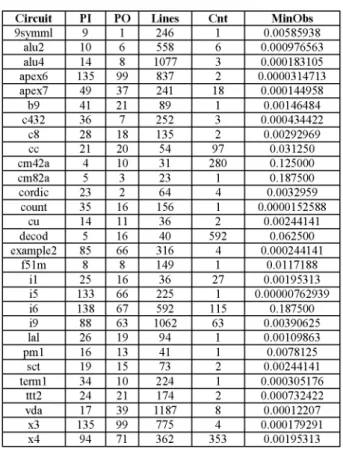
The experimental results on calculation of observability estimations on combinational MCNC benchmark circuits were performed. Firstly, the initial circuits were transformed into ones only with two-input AND gates which may have inverters in its inputs and outputs if necessary. These circuits were obtained by the tool ABC [11] as some kind of And-Inverter Graphs (AIGs). The experimental results are presented in Table I. Circuit is the name of an MCNC benchmark circuit,
PI/PO/Lines are the number of primary inputs, outputs, and
internal lines. Cut is the number of internal lines with
TABLE I. Theexperimentalresults
Circuit PI PO Lines Cut MinObs
9symml 9 1 246 1 0.00585938 alu2 10 6 558 6 0.000976563 alu4 14 8 1077 3 0.000183105 а р е х б 135 99 837 2 0.0000314713 apex? 49 37 241 18 0.000144958 b9 41 21 89 1 0.00146484 c432 36 7 252 3 0.000434422 c8 28 18 135 2 0.00292969 CC 21 20 54 97 0.031250 cm42a 4 10 31 280 0.125000 cm82a 5 3 23 1 0.187500 cordic 23 2 64 4 0.0032959 count 35 16 156 1 0.0000152588 cu 14 11 36 2 0.00244141 decod 5 16 40 592 0.062500 examplc2 85 6 6 316 4 0.000244141 fS lm 8 8 149 1 0.0117188 il 25 16 36 27 0.00195313 15 133 6 6 225 1 0.00000762939 16 138 67 592 115 0.187500 19 88 63 1062 63 0.00390625 lal 26 19 94 1 0.00109863 pm l 16 13 41 1 0.0078125 set 19 15 73 2 0.00244141 terml 34 10 224 1 0.000305176 ttt2 24 21 174 2 0.000732422 vda 17 39 1187 8 0.00012207 x3 135 99 775 4 0.000179291 x4 94 71 362 353 0.00195313
These calculations show that minimal values of
observability estimations are very different. For circuits (cm42a, cm82a, cc, i6 and some others) risks of inserting TCs or finding faults on last stages of circuit fabrication are rather low. For each of the rest circuits we have to choose the threshold taking into consideration the possible number of LUTs and values of observability estimations for all internal lines of the circuit considered. Note that we calculated observability estimations for each line of circuits during the experiment.
V I . Co n c l u s i o n
The approach to Trojan Circuits masking and debugging
based on LUT insertion in combinational circuits
(combinational parts of sequential circuits) is suggested. We turns the given circuit into partially programmable one (PPC) consisting of gates and LUTs in order to mask TCs and debug circuits when faults are detected on the last stages of the circuit fabrication. Some LUTs have one free input and reserved line connected with this input. The algorithm of reprogramming these LUTs is developed. The way of choosing lines being suspicious for inserting TC or being fault is suggested. This way is connected with calculations of observability estimations for internal circuit lines. The calculations are based on
ROBDDs operations. ROBDDs are derived from
combinational circuit (combinational part of a sequential circuit) fragments. Several arbitrary logical faults on circuit
lines are possible. Their debugging is executed by reprogramming the proper LUTs. if TCs are inserted into several lines they may be detected by simulation in determined area of the corresponding circuit lines and then masked. Scalability of the approach is connected with complexity of ROBDDs involved from combinational circuits.
Ac k n o w l e d g m e n t
The reported study was supported by Russian Science Foundation, research project № 14-19-00218.
Re e e r e n c e s
[1] S. Sarangi, S. Narayanasamy, B. Cameal, A. Tiwari, B. Calder, and J. Torrellas, “Patching Processor Design Errors with Programmable Hardware,” IEEE Micro, vol. 27, no. 1, pp. 12-25, Jan. 2007.
[2] S. Yamashita, H. Yoshida, and M. Eujita, “Increasing yield using partially-programmable circuits,” in Workshop on Synthesis And System Integration o f Mixed Information technologies (SASIMI), 2010, pp. 2 3 7 - 242.
[3] A. Matrosova, S. Ostanin, I. Kirienko, and V. Singh, “Partially programmable circuit design,” in Proc. o f 2014 East-West Design Test Symposium (EWDTS), 2014, pp. 1-4.
[4] A. Y. Matrosova, S. A. Ostanin, and I. E. Kirienko, “Providing Reliability o f Physical Systems: Partially Programmable Circuit D esign,” Russian Physics Journal, vol. 57, no. 6, pp. 847-852, Oct. 2014.
[5] A. Matrosova, S. Ostanin, and I. Kirienko, “Increasing Manufacturing Yield Using Partially Programmable Circuits with CEB Implementation o f Incompletely Specified Boolean function o f the Corresponding Sub-Circuit,” in 2015 IEEE 18th International Symposium on Design and Diagnostics o f Electronic Circuits Systems, 2015, pp. 267-270. [6] A. Matrosova, S. Ostanin, and V. Andreeva, “Patching circuit design
based on reserved CLBs,” in 2016 IEEE International Conference on Automation, Quality and Testing, Robotics (AQTR), 2016, pp. 1-5. [7] H. Mangassarian, H. Yoshida, A. Veneris, S. Yamashita, and M. Eujita,
“On error tolerance and Engineering Change with Partially Programmable Circuits,” 2012, pp. 695-700.
[8] S. Jo, T. Matsumoto, M. Eujita, “SAT-based automatic rectification and debugging o f combinational circuits with LUT insertions”, Proc. O f IEEE Asian Test Symposium, 2012, pp. 19-24.
[9] A Y u . Matrosova, S .A Ostanin, I.E. Kirienko, “Generating all test patterns for stuck-at faults at a gate pole and their connection with the incompletely specified Boolean function o f the corresponding subcircuit,” Proceedings o f the 14th Biennial Baltic Electronics Conference. Tallinn, Estonia, 2014, pp. 85-88.
[10] A. Y. Matrosova, I. E. Kirienko, V. V. Tomkov, and A. A. Miryutov, “Reliability o f Physical Systems: Detection o f M alicious Subcircuits (Trojan Circuits) in Sequential Circuits,” Russ. Phys. J., vol. 59, no. 8, pp. 1281-1288, Dec. 2016.
[11] R. Brayton and A. Mishchenko, “ABC: An Academic Industrial-Strength Verification Tool,” in Computer Aided Verification, vol. 6174, T. Touili, B. Cook, and P. Jackson, Eds. Berlin, Heidelberg: Springer Berlin Heidelberg, 2010, pp. 2 4 ^ 0 .