DIPLOMARBEIT
„A Distributed Data Aggregation Platform for
Plant Metabolomics and Biochemistry“
Deutsch: “Eine distributierte Daten Aggregations Platform für Pflanzen Metabolomik und Biochemie”
Author
Lorenz Sauer, B.Sc.
angestrebter akademischer Grad
Magister der Naturwissenschaften (Magister rerum naturalium)
Wien, 14.05.2012
Studienkennzahl lt. Studienblatt: A 490
Studienrichtung lt. Studienblatt: Diplomstudium Molekulare Biologie
ii
Contents
Contents ... 2 List of Abbreviations ... 5 Abstract ... 6 Kurzfassung ... 7Preface and Acknowledgements ... 1
Acknowledgements ... 1 1. Introduction ... 2 1.1 Motivation ... 2 1.2 Goals ... 4 1.3 Approach ... 4 1.4 Recapitulation ... 8 1.5 Thesis Organization ... 8
2. Basics and Methods ... 9
2.1 Server... 9
2.1.1 Distributed Computing ... 9
2.1.2 Service Oriented Architecture (SOA) and APIs ... 10
2.2 Client... 12
2.2.1 RPC – Remote Procedure Call ... 12
2.3 Presentation: User Interface Concepts ... 13
2.3.1 MVC - Model View Controller ... 13
MVC process flow ... 14
2.3.2 The Web-Browser Document Object Model (DOM)... 15
2.4 Data: Important File formats, Data structures and Databases ... 16
2.4.1 InChi & InChiKey and MDL mol-files ... 16
2.4.2 SDF files ... 17
2.4.3 JSON ... 17
2.4.4 MSL, MSP – Spectra list files ... 18
2.4.5 Databases and Data Extraction-Transform-Loading (ETL) ... 19
Databases ... 19
2.4.5.1 CRUD - Database Transactions ... 20
2.4.5.2 ETL Processes ... 21
2.5 Data-Sources: Biological Databases ... 23
2.5.1 KEGG - Kyoto Encyclopedia of Genes and Genomes ... 23
2.5.2 BioMeta Database / KEGG Ligand ... 23
2.5.3 ExplorEnz – A MySQL database of the IUBMB enzyme nomenclature ... 24
2.5.4 TAIR ... 24
2.5.5 PROMEX - the mass spectral reference database ... 25
iii
2.5.7 Massbank ... 25
2.5.8 AraCyc / PlantCyc ... 26
2.5.9 RIKEN PRIMe and Omicspace ... 26
2.5.10 Other Databases... 26
2.5.11 Ontologies ... 28
3. Aggregator Implementation ... 29
3.1 Data Aggregation... 29
3.1.1 Manual Data Provision ... 29
3.1.2 Automated Data Provision ... 30
3.2 Web Services ... 31
3.2.1 SOAP - Simple Object Access Protocol ... 31
3.2.2 REST and RESTful web-services ... 31
3.3 Data Integration Challenges ... 32
3.4 Users and usage scenarios ... 32
3.5 Implementation ... 34
3.5.0 Recapitulation ... 34
3.5.1 Objective ... 35
3.5.2 Architecture ... 35
3.5.2.1 State of the art: Distributed SOA web-applications ... 35
3.5.2.2 Distributed aspects... 36
3.5.2.3 The service broker ... 37
3.5.2.3 The physical server unit ... 38
3.5.2.4 The logical server unit ... 39
3.5.2.5 The Toolkit : Rapid prototyping of scientific SOA web-applications ... 40
3.5.2.6 The Aggregator as a web-service provider ... 42
3.5.2.7 Concluding Comparison: Metabolomics vs. Proteomics Aggregator ... 43
4. Presentation and User Interface ... 44
4.1 Introduction ... 44
4.1 Objectives ... 44
4.2 Summarization of the UI Concept ... 44
4.3 The User Interface (UI) and web-application aspects ... 46
4.4 The user area ... 46
4.5 Searching metabolism-centric information ... 47
4.5.1 Search Types ... 47
4.5.2 EC-Number Search ... 48
4.5.3 Reaction Search ... 48
4.5.4 Pathway Search ... 49
4.5.5 Keyword, Gene, Protein Search ... 49
4.5.6 Spectrum Search ... 49
4.5.6 Compound Search... 51
4.5.6 Search Providers as RESTful web-services ... 55
5. Results, Discussion and Outlook ... 56
iv 5.2 Results ... 57 5.2.1 Accomplished ... 57 5.2.2. Missing ... 58 5.2.3. Presentation ... 59 5.3 Discussion ... 61 5.3.1 Challenges ... 61
5.3.2 The Aggregator web-application ... 62
5.3.4 Integrative Metabolomics ... 64
5.3.5 Community Metabolomics ... 64
5.3.1 Cloud computing in Metabolomis and other Omics sciences ... 65
5.4 Outlook and future work ... 66
6. Appendix ... 69
6.1 ETL Example for extracting web-resources via the DOM: ... 71
6.2 Using the Project Toolkit and Web-services for web-application development ... 72
Complete Result of the Web-application Example ... 75
6.3 Using the Gator Webservices ... 76
Examples ... 77
6.4 Service Map/Mapping Description -SMD ... 81
Example SMD-file loaded upon a GET request to handler.php ... 82
6.5 Database related ... 85
Mysql SELECT Syntax ... 85
Selected Database Tables ... 86
6.6 Selected Scripts, Files and other Resources... 87
6.6.1 Chemical Compound API Interface Definition for Third party providers in IDL ... 87
6.6.2 Spectrum used in the Gator Spectrum Search Example ... 88
6.6.3 KEGG Color Codes (Kanehisa Laboratories, 2012) ... 89
6.6.4 Designs and misc resources ... 90
7. Bibliography ... 91
v
List of Abbreviations
Acronym Definition
AI Artificial Intelligence
API Application Programming Interface
CML Chemistry Markup Language
CPU central processing unit
EBI European Bioinformatics Institute
EMBL European Molecular Biology Laboratory
EMBL-Bank European Molecular Biology Laboratory Nucleotide
Env Environment
GUI graphical user interface
JSON JavaScript Object Notation
KEGG Kyoto Encyclopedia of Genes and Genomes
LC-MS Liquid-Chromatography Mass-Spectrometry
MS mass spectrometry
MS Mass Spectrometry
MS/MS tandem mass spectrometry
MSn n-tandem Mass Spectrometry
NCIB National Cancer Institute Center for Bioinformatics
NIH National Institutes of Health
PubMed Free National Library of Medicine online database of
R precursor to the letter S in the alphabet: Statistics package, inspired by S
RDF Resource Description Framework
RNA Ribonucleic Acid
RSS Really Simple Syndication
SOA service-oriented architecture
TCP/IP Transmission Control Protocol/Internet Protocol
UML Unified Modeling Language
UniProt Universal Protein Resource
URI Uniform Resource Identifier
VPN Virtual Private Network
vi
Abstract
Metabolomics is a scientific discipline concerned with the unbiased measurement and characterization of all small molecular compounds within an organism. By dealing with metabolites, physical granularity is finer than in other Omics disciplines and, inextrica-bly, the amount of data generation. The situation is aggravated by the exhaustive number of metabolites in plants, owing to a complex secondary plant metabolism. Metabolomics is tightly interwoven with Systems Biology, thereby gaining functional insight into plant processes. This knowledge is applied for instance in the quest of find-ing new remedies against diabetes, obesity and cancer. The Systems Biology and Me-tabolomics communities offer vast amounts of data, tools and supplementary informa-tion of specialist research areas, which are incrementally expanded and updated at many different locations and in many different data formats. Desirable to the field of Metabolomics and Biochemistry would be a quick up-to-date research-overview with unimpeded data accessibility, and without the need for deeper initial investigation into the nature of the underlying data and its formats.
Described herein are the motivation, implementation, challenges and future outlook of a Metabolomics summarization portal, and its underlying open-ended service-oriented architecture (SOA), amenable to aspects of distributed or cloud computing. Metabo-lomics, as a computationally demanding and data-intensive discipline, subject to a broad range of data types and distributed data-sets, is aided by the prototypal imple-mentation of an aggregation web portal.
The underlying toolkit provides rapid application development (RAD) of scientific web-applications and Metabolomics related web-services.
Keywords: Arabidopsis / Plant Metabolomics / Aggregation / Web Portal / SOA / Database / Metabolomics / Visualization / Web Application
vii
Kurzfassung
Metabolomics ist eine wissenschaftliche Disziplin die sich mit der unverfälschten Messung und Charakterisierungs aller kleinen molekularen Verbindungen innerhalb eines Organismus beschäftigt. Durch den Umgang mit Metaboliten, ist die physische Granularität feiner als in anderen Omics-Disziplinen und damit die Menge der Daten-Generierung. Die Daten-Situation wird durch die erschöpfende Zahl von Metaboliten in Pflanzen aufgrund eines komplexen sekundären pflanzlichen Stoffwechsel verschärft. Metabolomics ist eng mit der Systembiologie verknüpft und ermöglicht Einblick in Pflanzen-Prozesse. Diese Erkenntnisse werden beispielsweise bei der Suche neuer Heilmittel gegen Diabetes, Fettleibigkeit und Krebs angewendet. Die Systembiologie und Metabolomics-Community bietet eine große Fülle von Daten, Werkzeugen und ergänzende Informationen von spezialisierten Forschungsgebieten, die schrittweise erweitert und aktualisiert werden, - an unterschiedlichen Standorten und in
unterschiedlichen Datenformaten. Wünschenswert, im Bereich der Metabolomik und Biochemie wäre eine schnelle, aktuelle Forschungs-Übersicht mit ungehinderten Zugriff auf Daten, und ohne die Notwendigkeit zur Untersuchung der Art der zugrunde liegenden Daten und deren Formate.
Beschrieben wird hierin, die Motivation, Implementierung, Herausforderung und Perspektiven eines Metabolomics Aggregation - Portals, und dessen zugrunde liegende, offene, service-orientierte Architektur (SOA),die gefügig für Aspekte des verteilten Rechnens ist. Metabolomics, als rechnerisch anspruchsvolle und
datenintensive Disziplin mit einem vielen Datentypen und verstreuten Datensätzen, wird geholfen durch die prototypische Umsetzung eines Aggregations web-Portals.
Das zugrundeliegendes Toolkit ermöglicht die schnelle Entwicklung von
wissenschaftlichen Applikationen (RAD) und Metabolomics bezogenen Web-Services.
Keywords: Arabidopsis / Plant Metabolomics / Aggregation / Web Portal / SOA / Database / Metabolomics / Visualization / Web Application
1
Preface and Acknowledgements
The thesis was created from May 2011 to April 2012, in part, at the Molecular Systems Biology (MoSys) group, located at the University of Vienna.
Dr. Wolfram Weckwerth (MoSys head of department and co-chair of the Multinational Arabidopsis Committee - MASC1) and members from the Metabolomics community are initiating the MASC Metabolomics forum, MASCM. This thesis could eventually serve the Metabolomics community, through the implementation of an aggregator platform, which pools concurrent metabolic data resources from the Web for uniform presenta-tion within a common web-applicapresenta-tion interface.
Acknowledgements
I am thankful for my thesis supervisor Univ. Prof. Dr. Wolfram Weckwerth and particu-larly my thesis instructor Dr. Volker Egelhofer and all people at MoSys for the nice at-mosphere and useful hints. I want to acknowledge the help from M.sc. David Lyon, M.sc. Lena Fragner, Dr. Till Ischebbeck, Xiaoliang Sun Ph.D.,Dr. Alexander Seidel from MoSys2 and fruitful discussions with Univ. Pro.f Dr. Christoph Flamm (TBI3) as well as Peifen Zhang, Ph.D. (PMN4), João Ferreira, Ph.D. (XLDB5), Joshua Heazlewood, Ph.D. (JBEI6), James Treworgy and others not explicitly mentioned.
The thesis is dedicated to my family, Viktor and Christine who supported me through-out my studies in ways only a parent is likely to understand, as well as my two brothers Sebastian and Benedikt.
1http://www.arabidopsis.org/portals/index.jsp 2www.univie.ac.at/mosys
3 TBI Theoretical Biochemistry Group http://www.tbi.univie.ac.at/ 4http://www.plantcyc.org/about/pmn_staff.faces
5http://xldb.fc.ul.pt/ 6http://pbd.lbl.gov/
2
1.
Introduction
1.1 Motivation
"Genomics and proteomics tell you what might happen, but metabolom-ics tells you what actually did happen".
- Bill Lasley, University of California, Davis
Metabolomics is the unbiased identification and quantification of all metabolites in a biological system and is generally performed via Mass Spectrometry (MS) or NMR Spectroscopy. Metabolites are small molecular compounds of a molecular weight of usually less than 600 Dalton, spanning a wide range of chemical classes as well as con-centration ranges of several orders of magnitude (Weckwerth W. , 2003).
Omics is a generic term, characterizing a wide range of science and engineering fields which generate vast amounts of data, in the quest of delineating the totality of func-tions and interacfunc-tions that govern biological systems at various hierarchical levels. In-creases in data acquisition are commonly driven by advancements in automation and measurement-technology, amenable to high-throughput methodologies. In other cas-es, Omics is driven by advances in computing and algorithms alone (Rihn, 2003). The obtained raw Metabolomics data-sets can be seen as timeseries-snapshots of equili-brated states of organisms, constituting a corpus of discrete Omes (Sakata, 2009). The number of metabolites in plants is much higher than in animals, owing to a complex secondary metabolism, estimated to exceed 200 000 metabolites (Weckwerth W. , 2003).
Ultimately, careful protocol consideration, data processing, statistical treatment and literature research puts focus on one or a set of metabolites as a potential candidate for biomarkers, as a participant in a biochemical process, for verification of a hypothe-sis through systematic reviews and meta-analyhypothe-sis as well as other research aspects. This thesis is concerned with the aggregation of literature, tools and data for- or around a particular metabolite found in the plant model organism Arabidopsis thalia-na. Aggregation refers to the process of creating a compound object from several smaller ones (J Heaton, 2002). Data and literature research is generally a time consum-ing task, hindered by numerous publisher license/access schemas and a wide range of specialist research areas. This situation is improved by text mining methods which add
3
considerably to the extraction of systematic knowledge from the literature (Chikashi Nobata, 2011), and are often a key aspect of many biological and chemical databases hosted on the Web.
Due to the disorganized and semantically un-annotated nature of the Web, the search for suitable data-resources generally turns into a daunting and time-consuming task (HJ Joshi, 2011). Moreover, annual data growth follows an exponential law (Gavish, 2010)
A key feature of the Arabidopsis and other model plant communities is the abundance of online resources offering functional information. Often, studies employing mass-spectrometry lead to the creation of online resources for detailed investigation and interaction with the data (Weckwerth W, 2008). Locating and navigating these data resources can be difficult without intimate knowledge of the details that underlie the project which created and provisioned the data.
Usually researchers in plant Metabolomics seek out data resources on the Web through MS or NRM spectra data, compounds, gene identifiers (ATG’s in case of Arabi-dopsis thaliana (TAIR, 2000)), Protein Accession numbers, Reactions, Pathways or Key-words – thus constituting seven search-types.
Serving the researcher with unimpeded data-accessibility is a key goal of any summari-zation portal. Pubmed is a well known web-portal, initially conceived for searching the vast medical literature corpus, through primarily natural-language keyword searches. The query is underpinned by Pubmed-controlled synonymous vocabularies, or MESH terms, for the purpose of maximizing the reach of a particular keyword and thus the reach of the search and hence the number of qualitative results. For a proteomics por-tal, such as MASCP, access through a Protein name, Protein identifier or the Identifier of the underlying gene coding for a protein, is likely to cover most demands of the Pro-teomics community. In the field of Metabolomics however, the non-applicability of sequence data and direct application of the central dogma of molecular biology (F Crick, 1970), posit unique challenges in regard to presentation and cross-referencing of data. At the moment the field of Metabolomics is lacking a comprehensive, open and modular Data aggregation portal. Aggregators that currently may come closest to the project’s objectives would be the proprietary Chemspider-Portal by RSC-Publishing and the open Pubchem-project by NCBI.
4
1.2 Goals
A Metabolomics web portal should present a logical workflow and uni-form, unobtrusive user-interface, facili-tate portal entry through the most fre-quent search-types which include Key-words, Spectra, Chemical Compounds and Gene Identifiers, and adapt to the information demands of the research-er. For instance, the initial search for new predictive biomarker candidates, with the premise of discovering
indica-tors of a process, event, or condition (Schmidt, 2006), is less likely to require detailed physical, chemical and spectra information of a compound in contrast to literature, pathway, reaction and genetic information.
The main aspect of an aggregation portal is, firstly, the summarization of a particular set of web-resources which are queried on a subject in question, such as a Metabolite, and secondly, the presentation of the data, based on coherent user interface design aspects. The prerequisite for querying data is an implementation of inter-type and in-ter-accession conversion functions, which can translate between any of the given search types such as from a gene identifier to a set of metabolites, which occur in a reaction or, in another example, from an enzyme classification number to a pathway. Additionally, the source to be queried has to be well defined in terms of the
in-put/output data formats and the web service-endpoint, which may be a simple url.
Further significant aims, whose approach is briefly discussed in the next paragraph, are the selection of an appropriate web-toolkit for a Browser plugin-free, uniform user interface, identification of usage-scenarios for the Aggregator, determination of data standards, selection of data-sources, creation of a federated schema and database, selection of data integration options, and concepts for data visualization.
1.3 Approach
To approach the implementation of a Plant Metabolomics Aggregator serving the Ara-bidopsis community, related Chemistry and MASC (Multinational AraAra-bidopsis Steering Committee) projects were selected for investigation. To this end, the concept of the
5
two related aggregators, Chemspider and MASCP7 (HJ Joshi, 2011), an aggregator serv-ing the Arabidopsis Proteomics community, were studied.
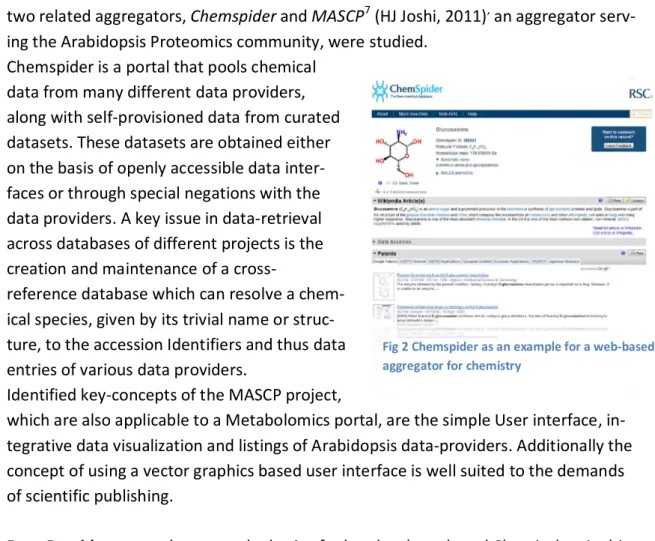
Chemspider is a portal that pools chemical data from many different data providers, along with self-provisioned data from curated datasets. These datasets are obtained either on the basis of openly accessible data inter-faces or through special negations with the data providers. A key issue in data-retrieval across databases of different projects is the creation and maintenance of a
cross-reference database which can resolve a chem-ical species, given by its trivial name or struc-ture, to the accession Identifiers and thus data entries of various data providers.
Identified key-concepts of the MASCP project,
which are also applicable to a Metabolomics portal, are the simple User interface, in-tegrative data visualization and listings of Arabidopsis data-providers. Additionally the concept of using a vector graphics based user interface is well suited to the demands of scientific publishing.
Data Providers were chosen on the basis of related web-tools and Chemical or Arabi-dopsis related information (Akiyama K, 2008) (Garcia-Hernandez M, 2002) (HJ Joshi, 2011) (Weckwerth W, 2008). Included data providers encompass KEGG (Kanehisa M, 2000), Chebi (K Degtyarenko, 2007), ProMex (Hummel J, 2007), TAIR (Swarbreck D, 2008), SUBA (JL Heazlewood, 2007), RIKEN PRIMe (Akiyama K, 2008), PlantMetabolom-ics.org (Bais, 2010) , Massbank (H. Horai, 2010) and Aracyc/PMN (Mueller, 2003) (Zhang, 2005). The reasoning for inclusion, along a short project description and the provided data accessibility is stated in Chapter 2.
The Approach to data integration leaves several options, with Data Warehousing as one of the most intensive choices, yet offering unparalleled performance for Data Analysis. Alternatives are Navigational Integration and Mediator-based Integration (Hernandez T., 2004). Whereas in Navigational Integration the source/target combin-ing occurs via a-hyperlinkcombin-ing model such as the Web, the latter option, Mediator-based Integration, couples data sources more closely, to be combined by a data wrapper, - the Mediator. Complex websites are often summarization portals themselves, and bet-ter amenable to be included via navigational integration in the form of link-outs or new
7http://www.masc-proteomics.org/mascp/index.php/Main_Page
Fig 2 Chemspider as an example for a web-based aggregator for chemistry
6
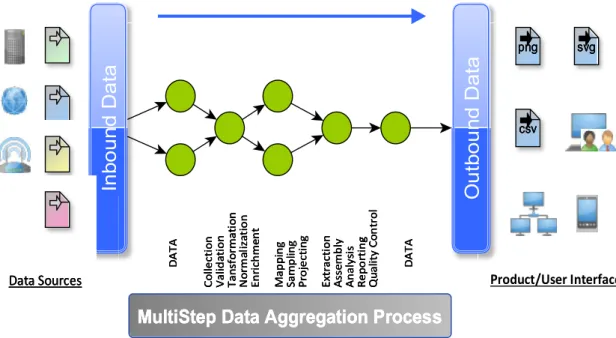
document-views or ‘tabs’ within the Aggregator’s User Interface. Whenever data inter-faces (‘APIs’) are directly available, Mediator-based methods are used, giving flexibility towards extensibility, data mixing, and presentation through the Mediator. Local data federation is realized for static data resources such as Enzyme Classification tables. The data integration process, and its various intermittent steps are shown schematically in Fig 3.
Fig 3 Showing the Data Aggregation Process and the numerous steps in aggregation that can occur intermittently. Data originates on the left, in different formats (represented by different colors), is collated, transformed and ultimately mapped to a visualization-interface or user interface element at the Client (right)
Querying the data not from a central source but from distributed projects with individ-ual funding and individindivid-ual data curators, offers several advantages. One is up-to-date data and distribution of responsibilities such as data management. Additionally the distributed data model shows less uncertainty overall, in terms of research funding and project support (HJ Joshi, 2011; D Reynolds, 2004).
The approach towards the User Interface aspects should gain initial attention during project planning, as it requires narrowing down a specific web-toolkit/library, often resulting in significant upfront learning-time investment. Professional large scale Bioin-formatics Centers like EMBL and NCBI frequently employ the comprehensive ExtJS li-brary (Sencha, 2011). Toolkit aspects to be taken into consideration are the licensing model, learning curve, documentation, performance and upfront time-investment, generally increasing with the capabilities of the library/toolkit. Comprehensive toolkits offer storage, communication, user-interface and visualization functions. For perfor-mance reasons and to meet demands of bioinformatic tools such as command
para-In b o u n d D a ta O u tb o u n d D a ta Product/User Interface png png png svgsvgsvg csv csv csv Data Sources Data Sources Data Sources D A TA Colle ct io n Va lid at io n Ta ns fo rm at io n N or m al iz at io n En ric hm en t Map pi ng Sa m pl in g Pr oj ec tin g Extr ac tio n As se m bl y An al ys is Re po rt in g Q ua lit y Co nt ro l D A TA
MultiStep Data Aggregation Process
D A TA Colle ct io n Va lid at io n Ta ns fo rm at io n N or m al iz at io n En ric hm en t Map pi ng Sa m pl in g Pr oj ec tin g Extr ac tio n As se m bl y An al ys is Re po rt in g Q ua lit y Co nt ro l D A TA
MultiStep Data Aggregation Process
D A TA Colle ct io n Va lid at io n Ta ns fo rm at io n N or m al iz at io n En ric hm en t Map pi ng Sa m pl in g Pr oj ec tin g Extr ac tio n As se m bl y An al ys is Re po rt in g Q ua lit y Co nt ro l D A TA
7
meter listings and manual-pages or ‘manpages’, a purpose-written toolkit was incorpo-rated, and connected to the lightweight user-interface library jQueryUI, which is intro-duced in Chapter 3.
The approach to workflow concepts incrementally improves during the development cycle with the addition of new functionality, revision of the existing functionality and abandoning or hiding user-interface features which are infrequently accessed. For in-stance, in an initial workflow scenario the search for a Reaction yielded reaction infor-mation via KEGG, Aracyc and TAIR as data providers. At a later stage the reactants were included in the compound visualization-matrix, and finally the workflow was ex-tended to allow interactive browsing of reactions by clicking on each of the respective reactant to yield a list of related reactions. The reasoning behind these workflow deci-sions was tightly linked to the visualization and possible usage-scenarios, discussed next.
The approach towards appropriate visualization tools helps communication and inter-pretation of scientific data (W Cleveland, 1985).
In proteomics, dogma holds that the structure of a protein determines function and vice versa (J Skolnick, 2000). The structure is reflected in the protein’s composition, which at its most basic level consists out of a linear chain of amino-acids, the primary structure. Mapping supplementary Omics data on top of a presentation of the pro-tein’s primary structure is thus a frequently used strategy (F Azuaje, 2005), and one that is employed in the MASCP Gator. Contrarily, Metabolomics data can be more fa-ceted, and often requires pioneering consideration towards visualizations. Additional-ly, unlike complete sequence information, complete pathway information is hard to obtain and often incomplete (W Weckwerth, 2002). Whereas the correlation of gene and protein expression is low, it is even lower between gene expression and metabo-lites (U Roessner, 2009). Thus it is favorable to delineate enzymes and their corres-ponding genetic information against metabolic information in an integrative visualiza-tion context. A key visualizavisualiza-tion method in metabolomics involves overlaying metabo-lite concentrations with metabolic pathways (N. Gehlenborg, 2010).
One newly devised strategy for data visualization is through a linear assembly of clus-tered pathways or ‘superpathways’, arranged into a dendrogram to reveal the Path-way Semantic Similarity (Tiago Grego, 2010) between pathPath-ways. The vertical axis of the graphical 2D plot is constituted by a linear arrangement of metabolites, which too are amenable to hierarchical clustering through a dendrogram, based on similarity meas-ures such as the Tanimoto Index (TT Tanimoto, 1957) which may be visually aug-mented by color-coding. Other distance measures for the horizontal
8
EC reaction-types/species between pathways (Tohsato Y, 2000) or heuristic pathway similarity based on preceding studies (Jiang K, 2011).
Chemical species may be assigned to categories or hierarchies which could be re-trieved from ontological databases rather than a linear arrangement of pathways. This is partially realized by coloring the pathway-clusters in the KEGG-metabolism color schema (Kanehisa Laboratories, 2012), wherein for instance orange represents path-ways related to amino-acid metabolism. The same color coding concept could be ex-tended and applied to metabolite-ontologies, or controlled vocabularies, provided by the ChEBI Database (K Degtyarenko, 2007). This would allow a functional presentation for many metabolites, but completeness of such information is lacking at the moment (McShan, 2005). Currently there is no 'metabolite ontology' database to systematically annotate individual compounds into different groups (J G Bundy, 2008).
1.4 Recapitulation
Plant Metabolomics deals with a large number of metabolites which are described in a large scientific literature and data corpus. The Metabolomics community is served by numerous scientific tools, which can be hard to find and data is spread over a large number of disparate databases, facing exponential growth. Arabidopsis thaliana as a popular plant model organism has an active community providing functional characte-rizations. To quickly get a comprehensive overview of metabolism-related research data and literature a unified aggregator portal is desirable. The aim of creating an ag-gregator lies in a uniform user-interface design, deciding which data sources to hyper-link, which to locally federate in a database, and which to query from the Web, as well as deciding upon the data standards to use, the workflow for the enduser, and creating visualizations of the integrated or ‘compounded’ data.
1.5 Thesis Organization
The structure of this work is as follows:
Chapter 2 provides a review of technical concepts and databases used for the imple-mentation of the aggregator and its toolkit.
Chapter 3 briefly elaborates the issue of data collection, and describes the target au-dience of the Aggregator, and the implementation for the system design prototype Chapter 4 introduces and analyzes important User Interface aspects.
Finally, Chapter 5 concludes this work with a project-recapitulation, results and discus-sions, and a future outlook.
9
2.
Basics and Methods
This chapter provides a review of technical concepts and databases used for the im-plementation of the aggregator and its toolkit.
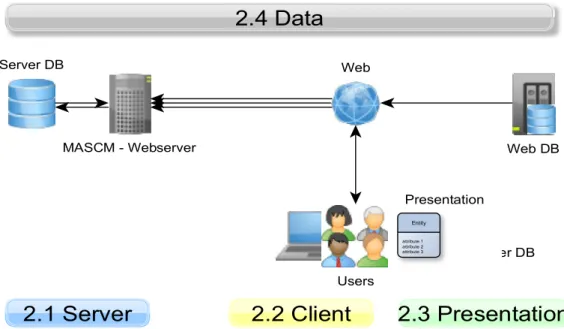
The following sub-chapters can be divided into the topics Server, Client, Presentation and Data – in that order. Data is generally retrieved, distributed and stored at the Server, the Web and the Client, depending on the nature of the data. The Client con-nects to the Server, upon which the requested data is loaded from Web-accessible Da-tabases, and conjoined with Server-side data for subsequent data collection, collation and enrichment, and finally data-aggregates are sent to the Client for the purpose of presentation (Fig 4).
Fig 4 Showing an outline of the Server-Client relationship, and the distribution of the data. Numbers indicate the corresponding sub-chapter. Web-DB represents any generic data resource which is queried by the Server from the Web. Browser-DB is an HTML5-specified, small (>5MB) persistent database used for caching most frequently accessed data.
In this picture, the Web (blue globe) is assigned the role as a central network-hub.
2.1 Server
2.1.1 Distributed Computing
MASCM - Webserver Web DB
Server DB Web Users Browser DB Entity attribute 1 attribute 2 attribute 3 Presentation
2.1 Server
2.2 Client
2.3 Presentation
10
A computational grid is a hardware and software infrastructure that provides depend-able, consistent, pervasive, and inexpensive access to high-end computational capabili-ties (Foster, 1999). Distributed Computing refers to the federation of computer re-sources from disparate locations or domains for use under a common objective (B Fran, 2003). Distribution affords robustness and scalability, which is the property to handle growing demand on processing, storage or networking traffic in an enlarging manner, to accommodate that growth. By making all server aspects of the Aggregator portal distributable, flexibility is afforded at later stages of the portal’s evolution, wherein computationally demanding services such as Spectra Deconvolution, automat-ic Spectra Annotation or quality control of large mass-spectral Metabolomautomat-ics datasets could be offered. Secondly the distributed-model enforces a modular and extensible codebase, to interoperate seamlessly with functions or programs written by other de-velopers around the world. In practice this means that disparate command-line pro-grams, application-scripts, background-processes and external web-services can be federated and mapped to the Client-application.
This project facilitates the modular distribution of services through assembly of func-tions into service-domains assigned at specific service-endpoints, which can be hosted on a traditional web-server but also in the Cloud at a service Provider such as Google, Amazon, Microsoft or Cloudera. Since the same service-endpoints are hosted multiple times, in a redundant manner, an increase in availability and robustness is afforded. The concepts works by a) furnishing the Client with a list of multiple endpoints for each service domain, b) initially randomly assigning service-endpoints to the connecting clients, and lastly, by c) letting the Client program switch an
end-point after a short timeout-period. The aim is to provide a good tradeoff between availability of the portal/web-services and access speed.
Distribution of the Server database can be performed via the Data-base Management System or DBMS, in this case MySQL, which can be set up to perform replication tasks within the server environ-ment and between servers.
The distributed aspects are delineated in detail as part of Chapter 3.
2.1.2 Service Oriented Architecture (SOA) and APIs
Modularity of software components is the result of adherence to SOA-principles.
Service-Oriented Architecture (SOA) refers to a set of software de-sign principles following the idea of developing discrete,
Fig 5 SOA layers in the Domain Model. The Do-main service layer con-tains interoperable func-tions within separate domains.
11
able software components (Fig 6), which can be repurposed at will. Many scientific applications serving the scientific communities are not web-service-oriented, despite a growing need to base applications on a service-oriented architecture (Fang L., 2006).
In SOA projects, disparate applications are connected on the basis of a common set of Interfaces, which are defined in terms of underlying languages and protocols, usually with the aim of cooperation within a web-based environment. Generally, all applica-tions or modules share a loose dependency with their native operating system and OS dependent platforms. However, SOA separates service functionality into discrete units, accessible over the network through a defined data-interface (Fig 5)
An Application Programmable Interface (API) provides a data in- terface for software, which is ideally well-accessible in terms of
hie-rarchy, data throughput and the learning curve for a potential API-user.
Following is a list of web technologies which undergird the provision of the Aggregator web-application and it’s APIs (Fig 5):
· RDF, RSS and similar standards which are part of the semantic web can be used to
provide dynamic content updates on a subscrip-tion-basis across various interoperable applications
· JSON or Javascript Object Notation, provides a lightweight data-container for passing data between the server and client, when the capabilities of XML are not required (see 2.4.3)
· SOAP short for Simple Object Access Protocol provides Remote Procedure Calls (RPC, see 2.2.1) enveloped in XML over HTTP (see 3.2.1)
· REST or Representational State Transfer, builds upon the traditional HTTP pro-tocol as a simple service-architecture based on paths instead of
url-parameters. RESTful services are lightweight and broadly accessible (see 3.2.2)
· AJAX or Asynchronous JavaScript And XML, allows loading of data such as XML documents from a remote web resource and is typically used to enable site-updates without page-refreshes. AJAX is used to shuttle JSON messages be-tween the server and client (See 2.4.3, 3.5.2.5).
12
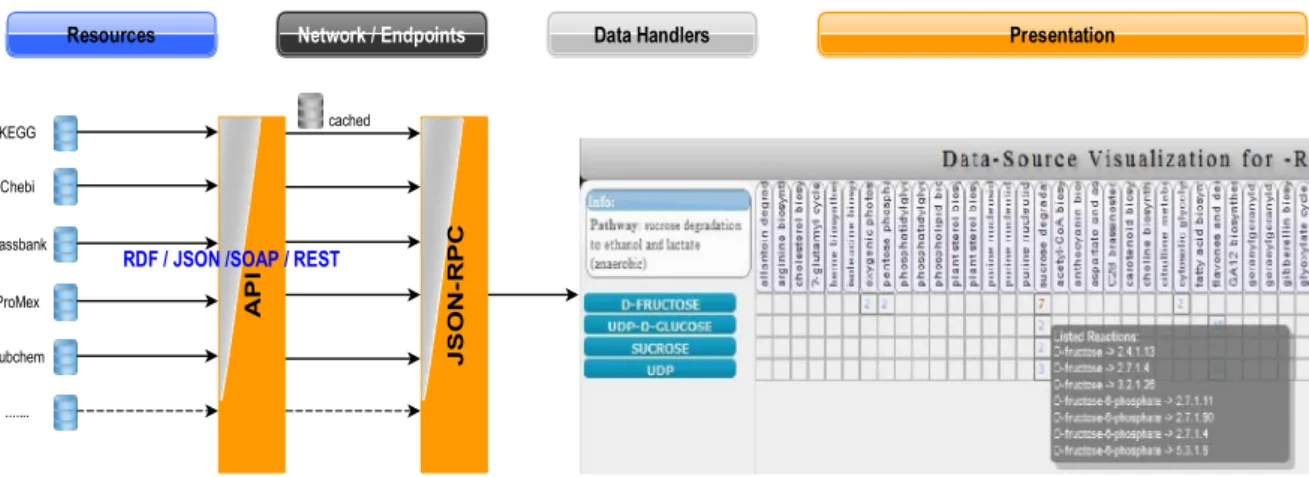
Fig 7 Schematic diagram of the data retrieval process for the Aggregator portal. Data is requested from online resources and cached, or from a locally federated Database (e.g. enzyme-classification information) through different API’s. Different caching strategies are employed for different data, which is subsequently and dissemi-nated via a JSON-RPC API. Event-based data handlers and data adaptors on the Client, incorporate the data in-crementally into the presentation layer. Event-based strategies are generally used for asynchronous operations wherein the operation-sequence and schedule or even successful completion cannot be predicted. XHR2 refers to an AJAX specification.
Note: Distributed aspects are omitted for clarity.
2.2 Client
The Client or User accesses the Aggregator application via a HTML5 compatible web-browser. HTML5 is a W3C (World Wide Web Consortium) provisional standard, which aims to unify the programmability and demands of modern web-applications across browsers, without the need of third-party plugins. To facilitate communication be-tween the Server and Client a JSON-RPC gateway is used (Fig 7).
2.2.1 RPC – Remote Procedure Call
Remote Procedure Calls or RPCs, allow programs to invoke each other's functions or procedures over a network, so long as these functions are public. RPCs are an old standing topic of networked software architecture. A procedure, in programmatic terms, refers to a function typically consisting of inputs, a processing-declaration or function-routine and outputs, all of which are optional, except for a function declara-tion. An exemplary function or procedure in the JavaScript browser-environment may be: alert(‘hello world’) . Herein, the native procedure alert is passed as in-put a character-sequence or string, whereupon a popup dialog opens which displays the passed text (Fig 8) as part of the function’s routine, without returning any output value. Technically alert is a wrapper-function for a native UI call of the underlying op-erating system which is mediated by the web-browser. On windows machines this will
Resources A P I J S O N -R P C KEGG Chebi Massbank ProMex Pubchem ...
RDF / JSON /SOAP / REST
Network / Endpoints Data Handlers Presentation
13
result in Win32API function invocations.
Fig 8 Showing the resulting popup dialog of the native user-interface (more precisely modal-dialog), invoked by calling the JS-function alert, requiring the user to click on OK in order to continue using the Browser application user-interface
2.3 Presentation: User Interface Concepts 2.3.1 MVC - Model View Controller
User 5. The View is updated and the UI returns to Idle 1. User Input
2. Model selection upon input
MVC describes the separation of the main aspects of an application comprised of In-put-, Business- and User Interface- logic, with only loose coupling remaining between those elements. An easy way to understand MVC, is by assuming the model as the da-ta, the view as the window on the user-screen, and the controller as the adhesive be-tween the view and the model (Fig 9).
MVC as a programming paradigm which, when properly adhered to during the soft-ware-development-cycle of an application, allows for a flexible program layout of inte-roperating components. A practical example for an inter-operation is the search of a
Controller
V
iew
M
odel
Fig 9 Model View Controller schematics. ___Solid line: direct association; …..Dashed line: indi-rect association e.g. stateless queries (‘observers’);
MVC allows different presentation layers without changing the underlying controller code
3. Model-Response is sent to the Controller
4. Template selection for the Model-Response
14
spectrum, yielding three top compound candidates, and the subsequent retrieval of chemical information for these compounds from PubChem, to be finally displayed sparsely, in an interactive table with the option of table-data export to an open data-format.
A program adhering to the MVC concept can easily switch its graphical interface im-plementation, for instance from a Windows Forms application of the Dot Net Platform to a HTML-based user-interface rendered in a web-browser, incurring few to no changes in the underlying Controller logic.
MVC distinguishes between three aspects, comprising the Data model (Model), the Presentation layer (View) and the
Pro-gram logic (Controller). One particularly important facet of MVC, is the reusability of flexible components to enable rapid implementation of various program-drafts, during the development-cycle of a particular application.
MVC process flow
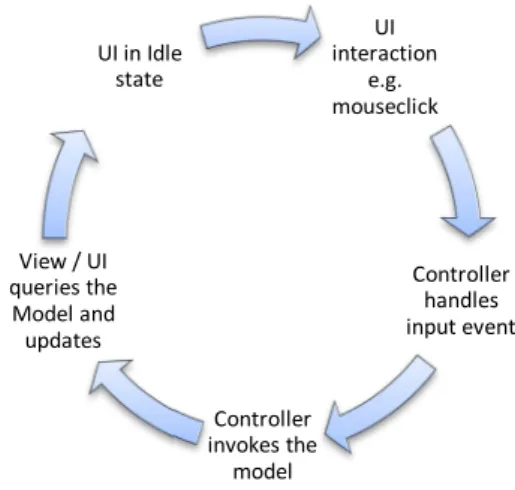
As shown in Fig 10, the user interacts with the user interface in restricted ways, for instance by clicking on a button, as part of an element of the View.
The Controller handles the input event
which is fired by the user interface, -usually via a registered handler or callback func-tion. The callback function is invoked by the fired event, thereby converting the event into an appropriate user action which is understandable by the Model.
The Controller notifies the model of the user action, possibly resulting in a change of the model’s state. For example, the controller might update a user's shopping cart. Following, the View queries the Model in order to generate an appropriate re-rendering of the user interface. For example the View might list the user’s shopping cart contents. The View can either retrieve its data from the Model or in other imple-mentations, be instructed by the Controller to re-render itself appropriately, thus avoiding latencies incurred through Model – View communication. Lastly, the user in-terface waits idly for further user interactions, therewith restarting the control-flow cycle. UI interaction e.g. mouseclick Controller handles input event Controller invokes the model View / UI queries the Model and updates UI in Idle state
Fig 10 Showing the repeating process flow within an MVC appli-cation, and how MVC’s three components (Model, View and Controller) are coupled to each other. Practically Model – View communication occurs asynchronously due to inherent network-ing latencies in the Web.
15
à An MVC example is provided in 3.5.2.5.
2.3.2 The Web-Browser Document Object Model (DOM)
Fig 11 Showing the DOM structure as a height-map model of the cnn.com news website; The height corresponds to the number of nesting for a given DOM-element; The picture
is rendered in WebGL8
The DOM is a W3C standardized programming model in which markup elements with various rendering intents, are assigned in a hierarchical tree-like order (Fig 11). Nested sub-elements inherit properties from elements of higher order such as visibil-ity. Through the use of the same standardized API i.e.
the same methods, DOM elements, which are part of a document, can be read or writ-ten via the syntax of a wide range of programming languages.
à A DOM application example is provided in the Appendix. DOM usage
The DOM is a ubiquitous and wide-spread object-model used throughout the project to treat web-documents in an object-oriented manner. On the server side the DOM is used for rule-based content-extraction of markup documents such as HTML docu-ments. On the client-side, the DOM provides element selection abilities to enable up-dating of the user-interface and visual display of data.
8http://hacks.mozilla.org/2011/12/new-developer-tools-in-firefox-11-aurora/ Kevin Dangoor, December 23, 2011
Fig 5 Example of a simple html-document. In-dentation reflects the level of nesting
16
Chapter 3 shows using the DOM in the context of this project’s toolkit (See 3.5.2). 2.4 Data: Important File formats, Data structures and Databases
Similarly to the popular MIAME standard in the microarray field, for data exchange with metadata describing the experiment, the MIAMET (Minimum Information About a METabolomics experiment) standard is set to archive the same goal for Metabolomics data (O. Fiehn, 2007). Unfortunately adoption is still lacking, thus at the moment me-tadata is primarily shown by linking out to the original web- data source.Each metabo-lomics experiment should contain information about its design, samples, sample prep-aration, metabolite extraction and derivation, metabolic profiling design, metabolite measurement and measurement specifications. These aspects are heeded in a poten-tial data-schema used for storing original experimental data, and is provided in the Appendix (See also Fig 15).
2.4.1 InChi9 & InChiKey and MDL mol-files
As a chemistry-centric aggregation project the project has to cope with the issue of converging on one and the same chemical species from a wide range of possible data access identifiers and compound formats. Some of these formats enrich or lose data during conversion. The IUPAC-adopted International Chemical Identifier (InChI) can uniquely describe chemical compounds, and should thus be constant preset in a chem-ical data-schema. The adoption of InChi-strings in databases is recommended to ena-ble easy and unambiguous access across databases and web-services, - currently a daunting problem, given that many web-services require a unique accession Id for the retrieval of entries of a given database (InChi-Trust, 2011). (See 3.3) To resolve be-tween entries of different databases, cross-reference databases and cross-reference web-services are required, which are difficult to maintain, usually not comprehensive and entail additional database queries, thus incurring additional latencies.
IUPAC provides a cross-platform conversion utility that reads several chemical input formats such as MDL’s mol files and converts these to InChi representations (InChi, 2011). A Python script was devised to convert all KEGG compounds from mol-files into InChi entries via an IUPAC provided converter. InChiKeys must not be unique and are generated by applying a hashfunction on the InChi-string, yielding a much shorter re-presentation. InChi strings can be converted into the popular SMILES string represen-tation, which is used for on-the-fly generation of molecular representations
9 http:// http://www.iupac.org/inchi/
17
out the web-portal (see 3.5.2.6). SMILES is plagued by different canonical string-output of different vendors.
Following, the KEGG Compound C0007410 Phosphoenolpyruvate (PEP) is converted into an InChi representation via the IUPAC/InChi provided converter tool:
inchi-1 C00074.mol C00074.inchi
The resulting InChi file containing the InChi representation (3rd line) for PEP is then:
* Input_File: "~/Chemlib/keggcmpd_00074.mol" Structure: 1
InChI=1S/C3H5O6P/c1-2(3(4)5)9-10(6,7)8/h1H2,(H,4,5)(H2,6,7,8)
Both SMILES and InChi data is stored in a chemical compound dataset on the server database, based on the list of KEGG compounds (see 2.5.1).
2.4.2 SDF files
The Structure Data Format or SDF is a wrapper of molfile-data, which specifies addi-tional metadata or associated-molecular data to be placed at the end of the file. SDF files have a typical footer, consisting out of one line with four dollar signs: $$$$ or in Regular Expression (RegExp) notation: /\${4}$/
Preceding the footer, are several line-wise entries, for instance:
> <Unique_ID> C00074
> <ClogP> 6.12
Both, sdf and mol files, can be used in the compound search input, by generating cor-responding SMILES or InChi strings enabling lookup of compounds in the server-database and subsequent invocation of aggregation-services.
2.4.3 JSON
JSON, short for JavaScript Object Notation, is a subset of the JavaScript language nota-tion to serialize or store nested data-types in a lean, minimalistic ASCII-text based cha-racter sequence. JSON has found widespread application due to the ubiquitous use of JavaScript in web-browsers and as a lightweight data-container-alternative to XML.
18
Objects are encapsulated by curly brackets, and can be used as a key-value store sepa-rated by a colon, as follows ‘key:value’. Values can be any valid JavaScript data-type such as numbers, booleans (true|false), arrays, strings and other objects, thus allowing nesting. Cyclic references are not possible, effectively disallowing the passing of func-tions and function containing objects (both of which are marked by a cyclic prototype-chain in JavaScript, which is beyond the scope of this paragraph).
Following is a concise JSON data container example.
{"header":{"name":"Uridine 5'-diphospho-N-acetylglucosamine" ,"mass":73} ,"peaks":{"40":0,"41":13,"42":4,"43":39,"44":25,"45":207},"summary":["library ","10"],"author":null}
2.4.4 MSL, MSP – Spectra list files
MSP files are simple semicolon separated mass spectra text-files containing m/z peaks and corresponding intensities, such as for instance 40 0; 41 13;.... Prior to the listing, a header provides optional meta-information about the name, peak-purity, and the number of peaks in form of a field-key separated by a colon, followed by the field-value e.g. Mass: 73. Each data field starts at a new line.
MSL or MS-Library files are obtained through concatenation of multiple msp files into a single file, usually separated by a new line. MSL and MSP spectra are widely used for Electron Impact spectra.
A client-function implemented in JavaScript (gator.spec.js), allows dragging and drop-ping of msl-, or similar text-based spectra in the
spectra search tab, by parsing the msp or msl-file. Thereupon peaklists are extracted into a data-structure, whilst omitting peaks with zero intensi-ty and peaks below a user-defined threshold upon user-confirmation. A threshold value is suggested based on the peak just following the
peak-window of the 33% most intense peaks, should more than ten peaks be present in the spectrum. The value is additionally rounded (‘ceiled’) to the next full decade, with intend of introducing less variance in the search parameters between spec-tra. (Fig 12). If the initial baseline cutoff prior to spectra import is set too high, the aforemen-tioned routine does not apply.
Spectra are stored on the server, and a database log entry is submitted. If the user is
Fig 12 Showing the baseline cutoff estimated and ceiled at an intensity of 10 for an experimentally obtained sample spectrum, provided in the Appendix.
19
logged in, this entry encompasses the User-ID, and the option to share spectra with other users becomes possible. Thus the web-portal may be used as a cloud-like storage platform.
Following is a short excerpt of an msp spectrum to demonstrate the format’s outline.
NAME: Uridine 5'-diphospho-N-acetylglucosamine; GC-EI-TOF; MS; n TMS; BP_73 Mass: 73
Num Peaks: 561
40 0; 41 13; 42 4; 43 39; 44 25; 45 207; 46 10; 47 36; 48 0; 49 0; 50 0; 51 3; 52 2; 53 3; 54 1; 55 19; 56 4; 57 8; 58 12; 59 75;
à The full msp-Electron-Impact (EI) spectrum, acquired on a GC/MS-TOF metabolom-ics experiment of Arabidopsis inflorescence measurements and exported via Leco ChromaTOF, is provided in the Appendix.
2.4.5 Databases and Data Extraction-Transform-Loading (ETL) Databases
Database refers to the structured collection of data to furnish data-reliability and eased data access, of generally digital data assets (Ullman, 1983). Special demands or ‘purposes’ of the data organization determine the choice of database management system (DBMS).
Data is often modeled to ad-dress aspects of reality and is organized accordingly through data schemas (M Johnson, 2002).
Initially databases were simple applications, with the
pur-pose of storing data in digital form and granting quick access. This simple concept still applies in the field of biology through the widespread availability of structured text-files or flattext-files. Access speed necessitates a layered organization and hierarchy of the data which the database application has to understand. A Logical Database is an ab-straction wherein the Database System manages the physical distribution and location of Data (MSDN, 2011)in accordance with the minimum requirements of Databases – the ACID rules of Atomicity, Consistency, Isolation and Durability (H Theo, 1983). Con-trary to the former, a Physical Database is aware of the data-location of the logical
20
database and the operational paths between them (Fig 13). In common parlance, the term Database always refers to the Logical Database unless indicated otherwise. MySQL11 is employed as the primary DBMS for the aggregator, owing to its widespread
adoption, open source status, documentation, speed and extensibility. The Aggregator caches most data requests for a predefined time-period, which depends on the data-type, upon user request. Caching facilitates gains in access speed and availability of the provided web-services as well as for usage analysis to aid in carving out usage scena-rios on which to focus future development (See
1.3, 5.2).
2.4.5.1 CRUD - Database Transactions
Transaction-Oriented Databases are supposed to implement a set of rules that allow for a maxi-mum of data consistency in situations of system
failures, such as a computer-crash. Fault-tolerance is established by encapsulating da-tabase CRUD operations within transactions, which are said to be atomic if the rules of Atomicity, Consistency, Isolation and Durability (ACID) are obeyed. The primary objec-tive for a Database during a system crash is not the prevention of any data-loss, but to ensure consistency (correct functioning). Database operations generally entail Data-base-transactions, yet operations do not necessarily result in a transaction. Both terms are often not sufficiently delineated and used interchangeably.
The four most basic operations of persistent-storage solutions are Create, Read, Up-date and Delete, collectively known as CRUD-operations (Fig 14) (Heller, 2007). Nota-bly, CRUD operations are defined for the Hypertext Transfer Protocol (HTTP) and used in a stateless manner for REST-API interfaces also called RESTful when all CRUD opera-tions are supported. Data Operaopera-tions on Databases are performed via a Data Manipu-lation Language (DML), with the salient aspect of the functional intend being placed first (Fig 8). A particularly important DML is the Simple or Structured Query Language or SQL (EF Codd, 1970).
An important aspect for storing datasets in relational databases is initial delineating of data relations to yield reliable data-schemas and relations between them. Subsequent-ly naïve data is imported from an arbitrary data source into the created database-tables which satisfy the relational schema.
Biological flatfile databases often contain redundant columns, rather than a data-relation to a separate table, as would be the case in a data-relational database. The step of
11www.mysql.com , MySQL © 2012, Oracle Corporation
§ SELECT ... FROM ... WHERE ... § INSERT INTO ... VALUES ... § UPDATE ... SET ... WHERE ... § DELETE FROM ... WHERE ...
Fig 14 Typical CRUD (Create Read Update Delete) -Command Set of SQL (Note: text is web-linked)
21
extracting data, transforming and finally loading of the data into a DBMS is referred to as ETL (See 2.4.5.2).
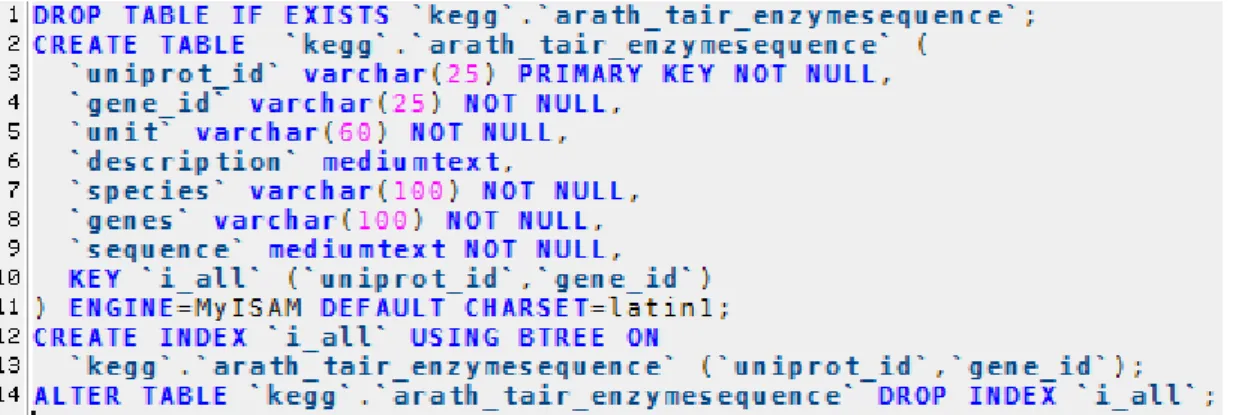
Relational tables should show little redundancy in the assignment of keys and values and the relations between them, referred to as normalized, which is exemplified in Fig 9 for the TAIR flatfile database AraCyc_Enzymes_Without_Tags_BLASTset.fasta12. The flatfile was created from a FASTA Protein sequence file via regular expressions and a custom-written Python script.
Fig15 - Exemplary Database Table; Four separate SQL statements are shown, terminated by a semicolon. The first statement deletes the table without warning should it already exist. The CREATE TABLE operation is followed by a table.name and the declaration of the table data-schema. An INDEX ‘i_all’ is defined for uniprot_id and gene_id, and the storage engine is set to MyISAM (MySQL specific implementation of the Indexed Sequential Access Me-thod).For automated-relations the Engine should be set to the newer InnoDB format. The characterset is set to be Unicode compatible.
The third SQL statement demonstrates how to independently create Indices in an existing table; likewise ‘DROP’
can be used to delete Indices (fourth SQL statement).
The relations of the table are uniprot_id, gene_id – which link to other tables. ‘species’ could be indexed and made into a further relation, but at the moment the species is limited to Arabidopsis thaliana.
2.4.5.2 ETL Processes
Extract, Transform, Load (ETL) refers to the chronology of the process by which data from usually different, heterogene-ous sources is integrated into a target database. ETL-tasks (Fig 16) are ascribed a paramount role for the establishment of a federated Database. As entire bases are integrated the term
12ftp://ftp.arabidopsis.org/
Load
Data#3 Data#2 Data#1 Extract data TransformFig 16 Illustrative concept of the ETL process cascade. The funnel represents the transforma-tion step
22
warehousing (BA Devlin, 1988) is commonly used.
“Premature optimization is the root of all evil", by Donald Knuth
Extraction often implies conversion of the relevant data from different sources into one common format, and can be the most challenging step in the ETL-process cascade. Transformation comprises tasks such as missing data imputation, deriving values, join-ing or splittjoin-ing values, and brjoin-ingjoin-ing the data into a format for the data loadjoin-ing into the devised data schema which depends upon the designated purpose of the data. Follow-ing the creation of a schema definition, the data is then imported.
Empirically speaking, ETL may resembles an E(TL)n process, wherein the transform and load process repeats several times through an iterative refinement and testing-period, until the database-schema is such that it optimally captures the imported data. In practice, the resulting SQL statements translate to an initial CREATE TABLE and a re-peated sequence of (LOAD DATA, TRUNCATE TABLE, ALTER TABLE)n statements. ETL tools can significantly speed up this process.
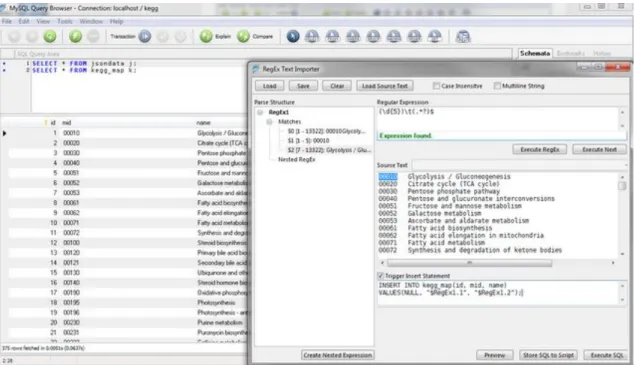
For instance, to load the KEGG Arabidopsis th. pathway-map accession-list containing map-ID numbers and the pathway names, a regular Expression is written and executed on the cross-platform MySQL Query Browser13tool (Fig 17).
Fig 17 Using the undocumented RegEx Text Import Feature of the MySQL Query Browser v1.2.17 to perform sim-ple ETL tasks. The Regular Expression - (\d{5})\t(.*?)$ , matches five digits, separated by a tabulator and a
second match of any characters until a new line or line-feed character occurs. Each line matches is transformed into ‘INSERT INTO...’ SQL statements- to insert the matched values into a pre-created table-schema.
13http://dev.mysql.com/doc/query-browser/en/index.html ; no longer supported http://dev.mysql.com/support/eol-notice.html
23
àAn example of an ETL Script for extracting web resources is provided in the Appendix 2.5 Data-Sources: Biological Databases
Following is a concise list and description of biological databases, used as primary data sources for the status quo of the Aggregator portal.
2.5.1 KEGG - Kyoto Encyclopedia of Genes and Genomes
KEGG is an online database providing genomic, enzymatic, pathway and biochemical data (Kanehisa, 1997). KEGG initially consisted out of five databases, KEGG Atlas, KEGG Pathway, KEGG Genes, KEGG Ligand, KEGG BRITE. BRITE14 lists functional hierar-chies and binary relationships of biological entities. The different KEGG databases are highly integrated to provide a digital representation of the biological system. Addition-ally KEGG provides an increasing range of text-mined information, which is initiAddition-ally set to be outside the scope of the Aggregator.
Within the project’s scope, KEGG provides information on molecular interaction net-works, such as pathways, compounds and enzymes.
Beginning with July 2011, KEGG switched to a subscription model for direct FTP access to the databases. Full database access to up-to-date database entries is still provided via the dbget interface. To get a web-rendition of the content, for instance for the Pri-mary bile acid biosynthesis (map00120) the following url can be called:
http://www.genome.jp/dbget-bin/www_bget?map00120.
àKEGG provides a SOAP API. The KEGG API is fully mapped to the web-portal (See 2.2.1, 3.5.2.5, 3.5.2.6).
2.5.2 BioMeta Database / KEGG Ligand
BioMeta is a database of metabolites and metabolic reactions. Its contents are largely based on the KEGG Ligand database. Compared to the KEGG database, a large number of chemical structures have been corrected with respect to constitution and stereo-chemistry. The database aims to provide correct representations of molecules and reactions. Roughly 1,500 molecular structures have been corrected and about 55% of the unbalanced reactions have been "balanced". (MA Ott, 2006)
Four flatfiles are provided rxnflat.txt, molflat.txt, srcflat.txt and enzflat.txt which are dated to June 2007, with entries separated by <entry> - tags, and line-content is de-noted by a two character code, which was converted into a SQL file via a previously created Python script (Sauer, 2011) and custom written Regular Expressions.
14http://www.genome.jp/kegg/brite.html
24
Biometa is used for cross-referencing of reactions for the data-aggregates.
àBioMeta is federated into a local database.
2.5.3 ExplorEnz – A MySQL database of the IUBMB enzyme nomenclature
The database ExplorEnz, is the primary repository for EC numbers and enzyme data, curated on behalf of the IUBMB. The enzyme nomenclature is incorporated into many other resources, including the ExPASy-ENZYME, BRENDA and KEGG bioinformatics da-tabases.As a MySQL database, the formatting of chemical and enzyme names is pre-served and allows simple as well as complex query constructs. The database is availa-ble for free download as SQL and XML file at http://www.enzyme-database.org (AG McDonald, 2007).
ExplorEnz was directly federated into a local Aggregator database. It is used for en-zyme information, links to other databases, enen-zyme classes and primary literature ref-erences.
àExplorEnz is federated into a local database.
2.5.4 TAIR15
The Arabidopsis Information Resource is a web-portal for genomic and, to some ex-tends, proteomic data for Arabidopsis thaliana. TAIR provides information about genes, markers, polymorphisms, maps, sequences, clones, DNA and seed stocks, gene families and proteins and links to other databases (Garcia-Hernandez M, 2002).
AraCyc, for visualizing biochemical pathways was developed as part of TAIR and is now incorporated in PMN (Zhang, 2005).
TAIR flatfile databases have been acquired from the TAIR website and federated into a local database via several ETL processes. The datasets provide the aggregator with Arabdiopsis specific pathway, reaction and metabolite information.
àTAIR provides a REST interface. Additional information is provided via link-outs.
15http://arabidopsis.org
25
2.5.5 PROMEX - the mass spectral reference database
ProMex provides spectral information linked to experimental metadata such as spe-cies, tissue, organ, treatment and the Mass-spectrometry instrument type (e.g. Orbi-trap, LTQ, TSQ). The library initially contained 4557 manually validated experimental mass spectra (Hummel J, 2007). Recently ProMex was revised and implemented as an AJAX web-application (V. Egelhofer, publication pending).
Users can query and retrieve proteomics data via protein accession numbers, protein names, organism name, peptide sequences and spectra.
The current ProMex version is built around a process-flow of three successive JSON queries to retrieve a spectrum, which were compounded into one query to allow spec-tra data preview. Detailed information will be provided via a link-out.
àProMex provides a JSON interface. Within the scope of the Aggregator, Data is re-trieved by a Protein Accession numbers (‘mgate_getPromex’).
2.5.6 SUBA II - the Arabidopsis Subcellular Database
SUBA provides experimental information of protein localization to facilitate under-standing of protein function and of biological interrelationships. At least 1100 related experiments completed in Arabidopsis are referenced. Proteomic surveys of subcellu-lar components in Arabidopsis are available for roughly 2600 proteins. (JL Heazlewood, 2007)
à SUBA provides a JSON-RPC interface. Within the scope of the Aggregator, Data is retrieved by passing one or multiple Arabidopsis Gene Accession numbers and data is used for graphical representation of the localization of enzymes. Details are provided via a link-out to the SUBA flatfile-entry.
2.5.7 Massbank
MassBank is the first public repository of mass spectral data for sharing them among scientific research community. MassBank data are useful for the chemical identifica-tion and structure elucidaidentifica-tion of chemical comounds detected by mass spectrometry (H. Horai, 2010).
àMassbank provides a SOAP interface. At the moment, the task of cross-referencing local entries with Massbank Accession Id’s is facilitated by extracting Massbank acces-sion Ids from the website through a DOM-parser.
26
2.5.8 AraCyc / PlantCyc16
The Plant Metabolic Network (PMN) provides a broad network of plant metabolic pathway databases that contain curated information from the literature and computa-tional analyses about the genes, enzymes, compounds, reactions, and pathways in-volved in primary and secondary metabolism in plants. (Rhee SY, 2005)
The Aracyc datasets are reflected in the TAIR datasets. See 2.5.4. Additionally Reaction information is linked-out to the Aracyc databse. The TAIR datasets provide Reaction-Accession Ids.
2.5.9 RIKEN PRIMe and Omicspace
The RIKEN Institute of Physical and Chemical Research in Japan provide many databas-es which are accdatabas-essible via a Hub-Site, named RIKEN Omicspace17, which is integrated in the aggregator portal for biomarker information and to furnish a research overview on a particular compound.
RIKEN PRIMe, the Platform for RIKEN Metabolomics, is a Web-based service for meta-bolomics and transcriptomics providing multi-dimensional NMR spectroscopy, GC/MS, LC/MS, and CE/MS spectra as well as related tools (Akiyama K, 2008). PRIMe is only integrated within the Aggregator at a preliminary web-service level. Most spectra are available through Massbank, which is fully integrated in the aggregator.
à No web-interface API for PRIMe is available. 13C-HSQC Spectrum peaks, of less than 100 compounds, have been web-scraped and parsed into a flatfile database.
2.5.10 Other Databases
ChEBI or Chemical Entities of Biological Interest18 is a freely available dictionary of mo-lecular entities focused on ‘small’ chemical compounds. ChEBI provides group informa-tion, classifications and ontologies with relationships information between molecular entities or classes of entities and their parents and/or children (K Degtyarenko, 2007). ChEBI provides a SOAP interface use to augment chemical information such as chemi-cal relatedness and similarity within the Aggregator.
Pubchem19 is only used for similarity and chemical structures, despite providing the most feature rich information in terms of biological activity of compounds. The
16http://www.plantcyc.org/
17http://omicspace.riken.jp/
18http://www.ebi.ac.uk/chebi/ - ChEBI 19http://pubchem.ncbi.nlm.nih.gov - PubChem
27
Chem Compound Database contains validated chemical depiction information pro-vided to describe substances in PubChem Substance. Structures stored within Pub-Chem Compounds are pre-clustered and cross-referenced by identity and similarity groups (Bolton E, 2008) SOAP, RESTful APIs are provided (‘PUG-API’), in addition to full database downloads. Only the PubChem SOAP-API is used via the provided WSDL ser-vice-map20 and fully mapped to the Aggregator Client via a JSON-RPC (See 3.5.2.5). The KNApSAcK Database contains a Comprehensive Species-Metabolite Relationship Database (FM Afendi, 2011), and as part of the cross-link annotation of the TAIR data-sets is provided in the form of link-outs, within the scope of the Aggregator. The last update was 2008. No web-API or download is provided.
The National Cancer Institute Databases (NCI-DB) provides various cheminformatic services and information for many compounds.
CAS, by the Chemical Abstracts Service, provides the largest and most comprehensive da-tabase of chemical substance information, and is an official chemical registry.
The PathLocDB21 –Database provides pathway localization information, subcellular and multiple localizations of pathways summarized from UniProt and KEGG pathway data-bases (Min Zhao, 2011). The provided flatfiles were transformed and loaded into a local federated database. Publichouse is a large federated Biological Datawarehouse and provides supportive information such as superpathway-clusterings.
Aracyc is used for Pathway and reaction information for Arabidopsis thaliana and Plantmetabolomics.org provides Metabolomics datasets delineating Environmental from Genetic influence based on experimentally set genotypes and environments. An overview of the databases, APIs, and steps performed is provided in Tab 2.5.
Tab 2.5 - Metabolomics related data sources served by the Aggregator web-portal
(highlighted: functionally mapped but not integrated in the GUI), underlined: primary use
Name Link Description API Reference
SRI Public-House
biowareh-ouse.ai.sri.com
DataMart, PH v15.0 (T J Lee, 2006)
TAIR arabidopsis.org Genome annotation (Swarbreck D,
2008) SUBA su-ba.plantenergy.uw a.edu.au Subcellular localization (MS, FP) (JL Heazlewood, 2007)
Aracyc/PMN plantcyc.org Pathway, Ontologies, Reactions
~ (Akiyama K, 2008) (Zhang, 2005)
KEGG www.kegg.jp Pathway, Enzyme
infor-mation, Ontologies (Kanehisa M, 2000)
20http://pubchem.ncbi.nlm.nih.gov/pug_soap/pug_soap.cgi?wsdl 21 pathloc.cbi.pku.edu.cn/