Comparing methods for automatic acquisition of Topic Signatures
Montse Cuadros, Lluis Padro
TALP Research Center
Universitat Politecnica de Catalunya C/Jordi Girona, Omega S107
08034 Barcelona
{cuadros, padro}@lsi.upc.es
German Rigau
IXA Group
Euskal Herriko Unibertsitatea P.Manuel Irdiazabal, 1
20018 Donostia [email protected]
Abstract
The main goal of this work is to compare two methods for building Topic Signatures, which are vectors of weighted words acquired from large corpora. We used two different software tools, ExRetriever and Infomap, for acquiring Topic Signatures from corpus. Using these tools, we retrieve sense examples from large text collections. Both systems construct a query for each word sense using WordNet. The quality of the acquired Topic Signatures is indirectly evaluated on the Word Sense Disambiguation English Lexical Task of Senseval-2.
keywords: Topic Signatures, acquisition, La-tent Semantic Indexing, Word Sense Dis-ambiguation, Multilingual Central Repository, WordNet.
1 Introduction
Topic Signatures (TS) are word vectors related to a particular topic. Topic Signatures are built by retrieving context words of a target word from large text collections. They have been used in a variety of ways, such as in Summarization Tasks (Lin & Hovy 00), ontology population (Alfonseca et al. 04) or word sense disambiguation (Agirre et al. 00), (Agirre et al. 01). In fact, there is now available Topic Signatures for all WordNet (Fellbaum 98) nominal senses (Agirre & de laCalle 04).
This work presents a comparison of two differ-ent techniques for building Topic Signatures.
The first technique retrieve contexts using queries which consist of a set of literal words. Al-though these systems have been improved with several enhancements such as term weighting, au-thority linking, and ad-hoc heuristics to improve their performance, these lexical matching meth-ods can be inaccurate because the queries are based on words instead of concepts. However, there are many ways to characterize a given con-cept.
The second technique uses Latent Semantic In-dexing (LSI). LSI tries to overcome the problems
of lexical matching by using statistically derived conceptual indexes instead of literal words for re-trieval. This technique assumes that there is some underlying latent semantic structure in the data. A Topic Signature, for our purposes, is a weighted vector of words related to a particu-lar word sense. We tried two different systems for build Topic Signatures. The first one, ExRe-triever (Cuadros et al. 04), is based on the first technique described above, and the second one, Infomap (Dorow & Widdows 03), is based on the second technique.
Our main goal with this study, as mentioned before, is to compare the performances of both methods for automatic TS acquisition. In order to perform this comparison, we evaluated the TS acquired by both systems in a specific task, the English-Lexical Sample task of Senseval-2.
For building the Topic Signatures for all the word senses of the Lexical Sample task of Senseval-2 we used BNC (British National Cor-pus).
This paper is organised as follows: In section 2, we explain in detail the software tools we use for the task, providing a brief explanation of Latent Semantic Indexing (LSI). In section 3, we explain the steps followed to construct the Topic Signa-tures and in section 4, the results of the indirect evaluation we carried out. Finally, in section 5 and 6, some concluding remarks and future work are provided.
2 Tools
2.1 ExRetriever
ExRetriever is a flexible tool to perform sense queries on large corpora (Cuadros et al. 04). ExRetriever characterises automatically each synset of a word as a query (mainly using: syn-onyms, hyponyms and the words of the defini-tions); and then, uses these queries to obtain sense examples (sentences) automatically from a large text collection. The current implementation of
ExRetriever accesses directly the content of the Multilingual Central Repository (MCR) (Atserias et al. 04) of theMeaningproject which includes
several WordNet versions. The system uses also SWISH-E1 to index large collections of text such as SemCor (Miller et al. 93) or BNC. SWISH-E is a fast, powerful, flexible, free, and easy to use system for indexing collections of Web pages or other files. ExRetriever has been designed to be easily ported to other lexical knowledge bases and corpora, including the possibility to query search engines such as Google.
2.2 Infomap
The Infomap NLP Software package2 uses a vari-ant of Latent Semvari-antic Indexing (LSI) on free-text corpora to learn vectors representing the meanings of words in a reduced vector-space known as Word-Space (Dorow & Widdows 03).
The Infomap software performs two basic func-tions: building models by learning them from a free-text corpus using certain learning parameters specified by the user, and searching an existing model to find the words or documents that best match a query according to that model.
2.2.1 Latent Semantic Indexing
Latent Semantic Indexing (LSI) allows to ex-tract and represent the contextual meaning of words by statistical computations applied to a large corpus of text (Schtze 98). The underly-ing idea is that when reducunderly-ing the dimensionality of the original word-space, similar words are pro-jected closer to each other in the reduced space while dissimilar words are projected to distant lo-cations. The reduced space is obtained using lin-ear algebra methods, in particular, the Singular Value Decomposition (SVD). Part of the motiva-tion for using SVD for word vectors is the success of LSI in information retrieval.
Latent Semantic Indexing maps the contextual relationships between words in terms of common usage across a collection of documents. LSI en-ables to understand how words relate to each other through the creation of a similarity mea-sure, which reveals whether a given word or doc-ument is similarly used compared with another word or document.
1
http://swish-e.org
2
http://infomap-nlp.sourceforge.net/
3 Strategies for acquiring Topic
Signatures
In order to evaluate the performance of both ap-proaches, we designed a preliminary set of strate-gies for acquiring the Topic Signatures from BNC.
3.1 Acquisition Process
The acquisition process consist of the following steps:
1. Devise a particular strategy for query con-struction and apply the query concon-struction schema to all the senses of a word.
2. Perform the sense queries on the BNC. 3. Collect the sense corpus.
4. Obtain a Topic Signature for each sense.
3.2 Query construction strategies
We have designed a few preliminary set of query construction strategies based on synonymy, hy-ponymy and hypernymy relationship of WordNet inspired by the work of (Leacock et al. 98).
• A) Monosemous strategy : (OR monosemous-words) the union set of all the synonym, hyponym and hyperonym monosemous words of a WordNet sense. • B) Polysemous strategy : (OR
polysemous-words) the union set of all the synonym, hy-ponym and hyperonym polisemous words of a WordNet sense.
• C) Monosemous and Polysemous strategy : (word AND (OR polysemous-words)) OR* (OR monosemous-words) the union set of all synonym, hyponym and hyperonym monose-mous and polisemonose-mous words of a WordNet sense in such a way. OR* stands for a par-ticular OR boolean function to express that there is at least one monosemous word or the word and one polysemous word.
We remove those words (monosemous or poly-semous) appearing in more than one sense query, trying to construct the sense queries in such a way, that there is no overlapping words in differ-ent sense queries of the same word.
3.3 Construction of the Topic Signatures using ExRetriever
These queries have been applied to locate partic-ular sentences of the BNC using ExRetriever. In that way, we are able to retrieve a set of exam-ples for each word sense. In all cases, we remove all stop words from the corpus. Afterwards, we calculate the Mutual Information for each word in the sense corpus with respect to their synset using the formula (1).
M I(w, s) =log P(w∧s)
P(w)P(s) (1) Given a wordwand their word senses,P(w∧s) represents the probability of appearingwin thes sense. P(w) is the probability of occurring w in the BNC corpus, andP(s) is the probability of a document (sentence) to belong to the ssense.
As an example, we will show the full process of obtaining a Topic Signature.
For example, a query of type C for the word church#nis constructed using ExRetriever as fol-lows:
As WordNet 1.7 church#n has three senses, ExRetriever builds three different queries:
• sense 1: ((church and (christianity or protes-tant or religion)) or christian church or catholic church or coptic church)
• sense 2: ((church and (abbey or basilica or cathedral)) or church building or kirk or place of worship or house of prayer or house of god)
• sense 3: ((church and (service)) or church service or religious service or di-vine service)
Once we construct each sense query, we use ExRetriever to gather all matching sentence ex-amples from the BNC corpus. Afterwards, we calculate the Mutual Information of all the words appearing in the corpora obtained.
We have calculated the Topic Signatures for query A and C, in an improved method based on not taking account the case of the words and look-ing for the appearance of the exact compound-words in the gathered examples.
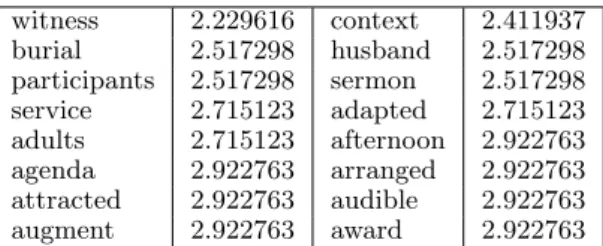
After this process, we obtain per each word sense, a word vector with weights (Topic Signa-tures). Table 1 presents some resulting words for sense 3 ofchurch#n using the strategy A).
witness 2.229616 context 2.411937 burial 2.517298 husband 2.517298 participants 2.517298 sermon 2.517298 service 2.715123 adapted 2.715123 adults 2.715123 afternoon 2.922763 agenda 2.922763 arranged 2.922763 attracted 2.922763 audible 2.922763 augment 2.922763 award 2.922763
Table 1: Example of a Topic Signature obtained with ExRetriever
3.4 Construction of the Topic Signatures using Infomap
Infomap only allows AND and ANDNOT op-erator and does not consider the OR opop-erator. For this reason, the queries have been modified slightly. We use the same words that we used when querying with ExRetriever but we remove all the operators (by default Infomap uses the AND operator).
After building a model with the corpus, the as-sociate command of Infomap can return both a list of the words or the documents best matching the query, in descending order of relevance. Using this option provided by Infomap, once we have the queries, we obtain the list of weighted words that in this experiment we consider the Topic Signa-ture of the query. Table 2 presents the resulting words for sense 3 of church#n using the strategy C) with higher relevance.
service 0.776187 anglican 0.651298 church 0.776186 services 0.651127 clergy 0.718070 tower 0.651071 hymns 0.695500 st 0.650787 peter´s 0.695215 congregational 0.648595 episcopal 0.689341 congregation 0.647037 presbyterian 0.685548 priest 0.644656 cathedral 0.685220 memorial 0.644652 churches 0.683878 charters 0.642540 royal 0.673297 worship 0.637472 parish 0.671534 bishop 0.634107 pastoral 0.670789 volunteer 0.629541 mary´s 0.666601 ...
Table 2: Example of a Topic Signature obtained with Infomap
4 Indirect evaluation on Word Sense
Disambiguation
In order to measure the quality of the acquired TS by these two different approaches, we performed an indirect evaluation by using the acquired Topic Signatures (TS) for a Word Sense Disambigua-tion (WSD) task. In particular, the Senseval-2
English Lexical Sample task. We used this evalu-ation framework instead of the the one provided by Senseval-3 because in this case, the verbal part was not directly annotated using WordNet senses. The TS are applied to all the examples of the test set of the Senseval-2 using a simple word overlapping (or weighting) counting. That is, the program calculates the total number of overlap-ping words between the Topic Signature and the test example. The sense having higher count-ing (or weightcount-ing) is selected for that particular test example. In table 3, we can see an exam-ple of the evaluation test corresponding to sense 3 of church#n. As we can see, in bold there are some words that appear in the Topic Signatures for sense 3 obtained using Infomap.
In table 4 appears a summary of the results of this indirect evaluation. This table presents the results for each type of query construction strat-egy (either A, B or C), each system (either In-fomap or ExRetriever), and with several levels of sense granularity (either fine or coarse). In this table, P stands for Precision, R for Recall and F1 for F1 measure.
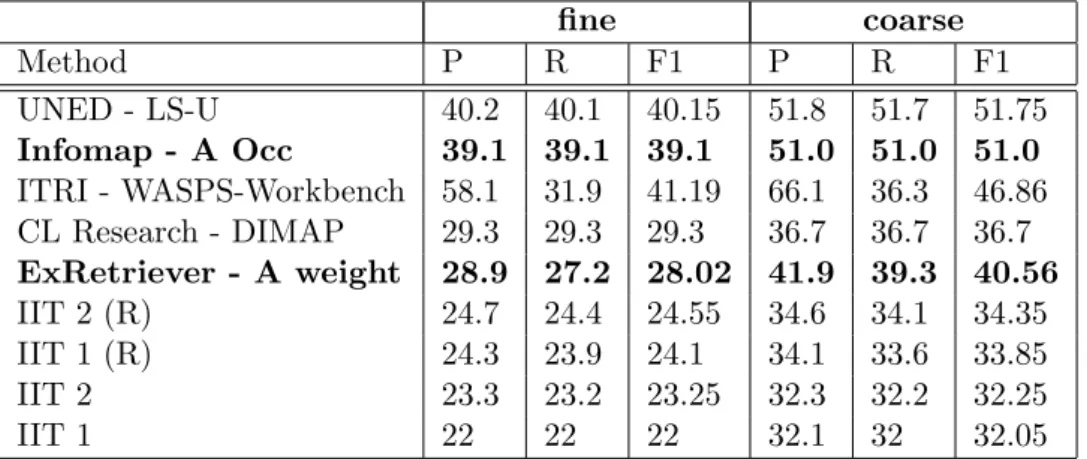
The best figures are obtained by using the In-fomap method with occurrences, which is not sur-prising due to the LSI effect (39.1 precision and recall for fine grained granularity). In table 4, we present the official results of the Senseval-2 of those systems declared to be unsupervised. When comparing with those systems, Infomap would score second while ExRetriever fourth getting as a reference the recall in fine-grained. Looking at lit-erature, (Agirre & Martinez 04), UNED-LS-U un-supervised method is considered semi-un-supervised. This approach, uses some heuristics rely on the bias information available in Semcor. The distri-bution of senses is used to discard low-frequency senses.
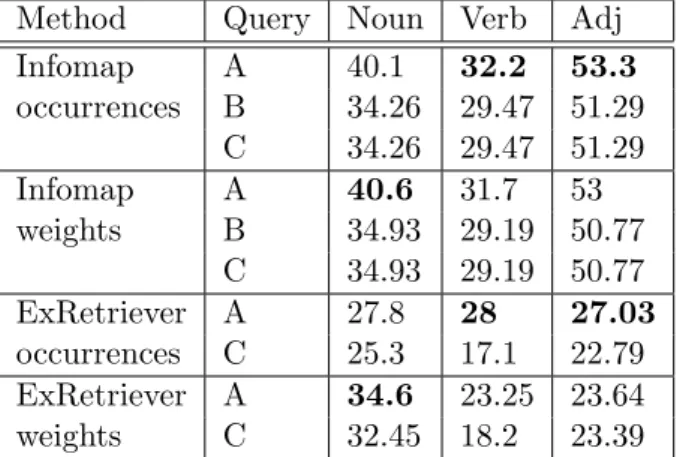
In table 4, we present the results of the queries for each system based on POS, and we can see that the best query for each POS always rely on A, the only difference is that sometimes the best result uses the occurrence or the weight measure method. We have put the results of the improved methods for ExRetriever. If we had used the best method for each part of speech, we had improved our results achieving a precision of 31.5, a recall of 29.7 and a f1 of 30.57 which would imply to be one position over in the 4 results for ExRetriever. Otherwise, Infomap would improve not very
sig-nificantly, we would get a precision and recall of 39.3, that would mean that we would be in the same position.
As expected, regarding the query construc-tion strategy, in general it seems that strat-egy A (Monosemous stratstrat-egy), is better than C (Monosemous and Polysemous strategy) and B (Polysemous strategy), which is the one with the lowest results. We also obtain similar figures with respect occurrences vs. weights methods: using Infomap we obtain slightly better figures for oc-currences while when using ExRetriever the best results appear for weights.
5 Conclusions
We presented some experiments using two soft-ware tools to compare the automatic acquisition of Topic Signatures for word senses. Our Eval-uation Framework has been the English Lexical Sample task of Senseval-2. We have focus on the Senseval-2 task because it uses the synsets of WordNet 1.7 for each part of speech, and then is more reliable to our experiments because our queries are build with WordNet 1.7.
We can observe that using Infomap, the tool developed to work with vector models acquired from Corpus, we obtain promising results.
In order to improve the ExRetriever results we plan to filter out those words that seem to be very common in all senses, for example, Named Enti-ties, Multi Words Expressions, etc. or keeping those words that have a common domain or any other semantic relation in common.
Infomap vectors seem to be more accurate for obtaining good context words of an specific word sense. Furthermore, it seems that the results could improve largely varying different system pa-rameters such as dimensionalty of the model, size of the Topic Signatures, etc.
We also plan to tune separately each part-of-speech.
6 Acknowledgements
This work is supported by the European Commis-sion (MEANING IST-2001-34460). Our research group, TALP Research Center, is recognized as a Quality Research Group (2001 SGR 00254) by DURSI, the Research Department of the Catalan Government.
In developing measuring tools for the localchurchwe are concerned with quality control as much as quantity performance, to use commercial language. Responsible leaders want to know how people are growing in their understanding of the Christian faith, whether relationships are deepening and extending throughout thechurch-fellowship, and to what extent the Christian presence is evident in the community outside. Such information cannot be gathered with such precision as numerical data, but it is essential that each area be investigated to ensure that there is a balance between
worship, fellowship, learning, evangelism and service. Healthy organic growth is proportionate, with each area and function developing in relation to the other. Quality of<head>church<head> life can be measured in the following three ways
Table 3: Test example for noun church
fine coarse Method Query P R F1 P R F1 Infomap A 39.1 39.1 39.1 51.0 51.0 51.0 occurrences B 37.8 33.2 35.3 50.0 43.8 46.7 C 37.8 33.2 33.2 50.0 43.8 46.7 Infomap A 39.1 39.1 39.1 50.7 50.7 50.7 weights B 38.4 32.8 35.4 49.9 42.7 46.02 C 38.4 32.8 35.38 49.9 42.7 46.02 ExRetriever A 28.5 27.1 27.8 42.3 40.3 41.3 occurrences B 24.1 17.2 20.0 35.4 25.3 29.5 C 21.7 21.3 21.5 36.6 36.0 36.3 ExRetriever A 28.9 27.2 28.02 41.9 39.3 40.6 weight B 22.6 15.9 18.67 33.0 23.2 27.3 C 25.1 24.6 24.85 36.9 36.1 36.5
Table 4: Overall results of the systems using Senseval-2 with respect fine-grained and coarse-grained senses
Method Query Noun Verb Adj Infomap A 40.1 32.2 53.3 occurrences B 34.26 29.47 51.29 C 34.26 29.47 51.29 Infomap A 40.6 31.7 53 weights B 34.93 29.19 50.77 C 34.93 29.19 50.77 ExRetriever A 27.8 28 27.03 occurrences C 25.3 17.1 22.79 ExRetriever A 34.6 23.25 23.64 weights C 32.45 18.2 23.39
Table 5: F1 related to each POS
References
(Agirre & de laCalle 04) E. Agirre and O. Lopez de la Calle. Pub-licity available topic signatures for all wordnet nominal senses. InLREC’04, pages 97–104, 2004.
(Agirre & Martinez 04) E. Agirre and D. Martinez. Unsupervised wsd based on automatically retrieved examples: The importance of bias. InProceedings of the EMNLP, Barcelona, 2004. (Agirre et al.00) E. Agirre, O. Ansa, D. Martinez, and E. Hovy.
Enriching very large ontologies with topic signatures. In Pro-ceedings of ECAI’00 workshop on Ontology Learning, Berlin, Germany, 2000.
(Agirreet al.01) E. Agirre, O. Ansa, D. Martez, and E. Hovy. En-riching wordnet concepts with topic signatures. InProceedings of the NAACL workshop on WordNet and Other lexical Re-sources: Applications, Extensions and Customizations, Pitts-burg, 2001.
(Alfonsecaet al.04) E. Alfonseca, E. Agirre, and O. Lopez de La-calle. Approximating hierachy-based similarity for wordnet nom-inal synsets using topic signatures. InProceedings of the Second International Global WordNet Conference (GWC’04). Panel on figurative language, Brno, Czech Republic, January 2004. ISBN 80-210-3302-9.
fine coarse Method P R F1 P R F1 UNED - LS-U 40.2 40.1 40.15 51.8 51.7 51.75 Infomap - A Occ 39.1 39.1 39.1 51.0 51.0 51.0 ITRI - WASPS-Workbench 58.1 31.9 41.19 66.1 36.3 46.86 CL Research - DIMAP 29.3 29.3 29.3 36.7 36.7 36.7 ExRetriever - A weight 28.9 27.2 28.02 41.9 39.3 40.56 IIT 2 (R) 24.7 24.4 24.55 34.6 34.1 34.35 IIT 1 (R) 24.3 23.9 24.1 34.1 33.6 33.85 IIT 2 23.3 23.2 23.25 32.3 32.2 32.25 IIT 1 22 22 22 32.1 32 32.05
Table 6: Senseval-2 systems results for fine-grained and coarse-grained senses, in wining order
(Atseriaset al.04) Jordi Atserias, Lu´ıs Villarejo, German Rigau, Eneko Agirre, John Carroll, Bernardo Magnini, and Piek Vossen. The meaning multilingual central repository. In Proceed-ings of the Second International Global WordNet Conference (GWC’04), Brno, Czech Republic, January 2004. ISBN 80-210-3302-9.
(Cuadroset al.04) M. Cuadros, M. Castillo, G. Rigau, and J. At-serias. Automatic Acquisition of Sense Examples using ExRe-triever. InIberamia’04, pages 97–104, 2004.
(Dorow & Widdows 03) B. Dorow and D. Widdows. Discovering corpus-specific word senses. InEACL, Budapest, 2003. (Fellbaum 98) C. Fellbaum, editor.WordNet. An Electronic Lexical
Database. The MIT Press, 1998.
(Leacocket al.98) C. Leacock, M. Chodorow, and G. Miller. Using Corpus Statistics and WordNet Relations for Sense Identifica-tion. Computational Linguistics, 24(1):147–166, 1998. (Lin & Hovy 00) C. Lin and E. Hovy. The automated acquisition
of topic signatures for text summarization. InProceedings of 18th International Conference of Computational Linguistics, COLING’00, 2000. Strasbourg, France.
(Milleret al.93) G. Miller, C. Leacock, R. Tengi, and R. Bunker. A Semantic Concordance. InProceedings of the ARPA Workshop on Human Language Technology, 1993.
(Schtze 98) H. Schtze. Automatic word sense discrimination. In