Senior Theses Honors College
Spring 5-5-2016
Design Proposal: Peer Mentoring Program in
SCHC
Kylie Anna Stevens
University of South Carolina - Columbia
Follow this and additional works at:https://scholarcommons.sc.edu/senior_theses
Part of theBiology Commons
This Thesis is brought to you by the Honors College at Scholar Commons. It has been accepted for inclusion in Senior Theses by an authorized administrator of Scholar Commons. For more information, please [email protected].
Recommended Citation
Stevens, Kylie Anna, "Design Proposal: Peer Mentoring Program in SCHC" (2016).Senior Theses. 76.
DESIGN PROPOSAL: PEER MENTORING PROGRAM IN SCHC By
Kylie Stevens
Submitted in Partial Fulfillment Of the Requirements for Graduation with Honors from the
South Carolina Honors College
May 2016 Approved: Tricia Kennedy Director of Thesis Dr. Claire Robinson Second Reader
Steve Lynn, Dean
Contents Title Page ... 1 Thesis Summary... 3 Abstract ... 5 Introduction ... 6 Program Design ... 9 Conclusion ... 31 Works Cited ... 33
Thesis Summary:
The South Carolina Honors College (SCHC) Peer Mentoring Program is a program designed to bring peer leadership into the Honors College by allowing Honors students to become mentors for the incoming Honors College freshmen. Peer mentoring programs exist at Universities around the country and have been praised for the social and academic benefits they provide, especially for first-year students. There are already many peer leadership and peer mentor type programs across campus at the University of South Carolina, but this program is unique because it is has been designed for some of the best and brightest students on campus.
Honors College students are all highly intelligent and usually have lengthy resumes outlining their leadership and involvement in high school, but the transition from high school to college is unlike any other and is difficult on many students. This proposed peer mentoring program aims to make that transition easier by providing incoming Honors College freshmen with a mentor who has already completed at least one year in the Honors College.
The Honors Peer Mentoring Program would be a selective program that requires an application and interview from Honors College faculty and staff to ensure that all mentors are enthusiastic and up for the challenged of mentoring freshmen students. Mentors must have completed their first semester before applying so that they would have completed their full freshman year before beginning to mentor. Mentors would go through extensive training to prepare them for the challenges that come with being a peer leader and the responsibilities involved in participating in this program. This training would last for one half-semester, to be completed in the second-half term of the spring semester after mentors have been accepted into the program. The training course would count for one Honors College elective, and would be
taught by the Program Director, who should be a member of the Honors College staff, ideally an advisor.
Mentors would be trained by many of the different offices across campus, including the Office of Diversity and Inclusion and the Counseling and Psychiatry department. These trainings would ensure that mentors can be aware of the mental health of their mentees as they make the transition to college life and try to find new friends and new involvement opportunities. Mentors would serve as guides to introduce their mentees to campus resources, organizations, and events that can enhance the first-year experience. Mentors would be responsible for supporting,
encouraging, introducing, and many other responsibilities with their mentees.
The Honors Peer Mentoring Program would be presented at freshmen orientation and participation encouraged to all incoming students, however, joining the program would not be required. Mentors and mentees would be matched randomly to eliminate selection bias from either party. Each mentor would receive between three and five mentees depending on the size of the incoming class and number of participants. Mentors would create a schedule each month that includes a bi-weekly meeting with their mentees, either individually or in a group, to answer any questions and continuously build a trusting and respectful relationship with their mentees. Both parties would evaluate the program after each semester of the first year. Evaluations would be critical to this program because it would allow continuous development and improvement for the program.
This program is being proposed to ease the transition from high school to college and enhance the first year experience for freshmen in the South Carolina Honors College at the University of South Carolina.
Abstract:
Peer mentoring programs have been shown to be successful at universities across the country. This present paper proposes the creation of a peer mentoring program within the South Carolina Honors College. This program has been designed to enhance the first-year experience for incoming Honors College freshmen by pairing them with an upperclassmen student mentor that can help guide them through their first year and beyond. The role of these mentors would be to provide valuable guidance for students on how to be successful as a student of the Honors College and the University of South Carolina. This mentoring program aims to foster both emotional and academic growth for SCHC students by providing a resource to find answers to any questions they may have or to point them in the right direction if they are not able to answer questions themselves. Mentors would spend a semester in training for Peer Leadership, where they would complete training with many offices across campus, such as Diversity and Mental Health training, as well as learn about all of the resources the University of South Carolina has to offer its students and where to find them. Mentors would be matched with incoming freshmen Honors College students in early fall in order to allow time to get to know their mentees and foster trust and confidence. Students wishing to become mentors would apply fall of their sophomore year and go through an interview process with Honors College staff to be selected and enrolled in the spring training class. This program aims to solve the dilemma that many freshmen have when looking for advice, having a person to turn to who is welcoming, unintimidating, and on the same level as a college student.
Introduction:
A mentoring relationship is one between a more experienced individual and a less experienced individual with the purpose of sharing knowledge or wisdom on a variety of topics (D’Abate 66). Typically the more experienced individual is also older than the less experienced individual, which can foster a certain amount of respect within the relationship. A peer
mentorship at a university involves a younger student and an older student, and in this case, a freshman and an upperclassman. The South Carolina Honors College would fit this type of program well because it is home to the best and brightest students on campus with some of the most rigorous course loads as well as high social involvement for most students. “The mid-range of scores—between 25% and 75% of all scores—for the 2013 freshman class was between 1390 and 1470 (SAT Critical Reading and Math). The average weighted GPA was 4.65 (South
Carolina Honors College).” Students in the Honors College could greatly benefit from a peer mentoring program that would allow freshmen an outlet for questions that inevitably arise throughout freshman year and beyond.
The University of South Carolina puts a great emphasis on peer leadership, with many opportunities available to students of all levels, and this program would be another that can foster interpersonal relationships as well as personal and academic growth among its best students. “Peer leaders represent formalized, informed, and experienced agents to help the socialization process of fellow college students (Shook 7).” A distinction must be made between a peer mentor and a peer advisor, as they serve students in a similar manner but have a different
purpose. Peer advising is the use of upper classmen college students who work with an academic advisor to assist in academic advisement for younger students, often used in advising freshmen (Esplin 1). This project is going to focus on a peer mentoring program and not a peer advising
program. The reasoning behind this distinction is that SCHC advisors are very accessible to their students and peer advisement only hits the academic aspect of freshman year, whereas a mentor can provide support in all areas of student life.
Many studies have shown that First-Year programs can enhance the overall first experience. These studies have shown results such as lower dropout rates, enhanced learning capabilities, and higher GPAs for students in peer and faculty mentoring programs (D’Abate 66). The South Carolina Honors College is the perfect place to implement a peer mentoring program because all of the advisors act as faculty mentors, so the addition of peer mentors would only enhance student success. Peer mentors can provide support in areas where faculty mentors typically cannot, such as advice on joining organizations or making personal connections on campus, or answering questions that students may feel too intimidated to ask a faculty member.
Peer leaders can be the site of resource and referral for their peers. “The referral process is frequently more intuitive and proactive among peers (Shook 9)”. This knowledge comes from experience and training. Peer mentors in this project would not only be using previous
knowledge of campus life and organizations but would be trained with further information about all of the great resources available at The University of South Carolina, to best be able to direct their mentees to an office or organization that would best fit their needs. The peer mentors and mentees would both benefit greatly from the training because the mentors are likely to learn more during training than they previously knew, giving them greater access to campus, and a greater ability to educate their peers about these resources as well. Peer leaders could also be the resource for mentees who gives them the fastest access to a resource as opposed to attempting to set up a meeting with a faculty member, and this timeliness can be crucial when dealing with time sensitive issues such as mental health. Peer leaders can be a much less intimidating source
of information because they are peers instead of superiors, allowing for a highly trusting relationship and one that can promote healthy behaviors, both physical and mental.
The role and training of peer leaders allows them to be “poised to reap true educational and personal benefits, including greater awareness of the campus community, an enhanced sense of belonging, and meaningful interpersonal relationships within that institutional environment (Shook 10).” These benefits can continue on into the rest of the mentors’ lives, as they transition from college to a career or continuing education, they are prepared with many of the skills that typically create a smooth transitional period and ability to integrate into a new and more professional environment. Peer leaders are able to hone many skills that are highly desirable to employers. A few of these important skills include oral communication, intercultural
competence, civic engagement, teamwork, and critical thinking. Students in SCHC are some of the most dedicated students on campus, fulfilling both a major curriculum and an honors curriculum, and would be well suited to build these skills and use them to contribute greatly in many global environments after graduation, as well as foster alumni involvement and
contributions to the university (Shook 13).
The act of being a mentor can also enhance personal skills and leadership, which
encourage students to become leaders in their future careers and positively impact others in many aspects of life. A concept called ‘generativity,’ defined as the concern in establishing and guiding the next generation, comes into play with peer mentoring. Although these relationships tend to be close in age, the skills gained from these relationships can lead to increased generativity
throughout the lifetime, contributing to the betterment of future generations (Hastings 651). Both being mentored and being a mentor can contribute to the development of personal generativity, making a mentorship extremely worthwhile not just in college, but throughout the lifetime.
Through this program, peer mentors would be trained in peer leadership before becoming a mentor, learning invaluable skills to make the mentoring relationship effective. If the program is implemented, the hope is that the mentees would want to become mentors in order give back to incoming students year after year.
Program Design:
The design for this program is adapted from the elements outlined in the article published in 2012, “The Architecture of a High-Impact and Sustainable Peer Leader Program: A Blueprint for Success” by Pat Esplin, Jenna Seabold, and Fred Pinnegar. These elements include
institutional context, institutional buy-in, organizational structure, leadership, budget and funding, theoretical grounding, expectations and standards for peer leaders, role and
responsibility of peer leaders, motivation of peer leaders, and recruitment and selection of peer leaders.
To define the institutional context of this program, this question must be asked: where is the need? The South Carolina Honors College is home to hundreds of academically advanced students from around the country. “Admission [to the South Carolina Honors College] requires excellent high-school grades, strong scores on the SAT or ACT, and completion of an
application to the Honors College including an essay, in addition to the USC undergraduate application (South Carolina Honors College).” Although these students are extremely intelligent, often many of these students didn’t study as much in high school because they are naturally smart, or enter college with so many AP credits that they jump right into upper level courses in their major. A study outlined in a NACADA article about advising honors students observed that “some highly capable students experience academic drift because they rely on habits that served
them well in high school but are no longer useful or appropriate in college (Huggett 78).” These issues are where the need arrives. SCHC students could greatly benefit from an older student who has gone through the same process of jumping into difficult college courses and adjusting study habits to guide them through the transition from high school to college, enhancing first-year success both socially and academically. Many SCHC students also want to be involved in many organizations across campus and a peer mentor could provide valuable knowledge and serve as a guide for these students to find their fit as well as help students find a balance between academic and social life on campus. Honors students are extremely susceptible to
over-involvement because of their high potential, and this can lead to a drop in academic success, but a trained peer mentor could recognize the signs of over-involvement and advise mentees on prioritizing their lives and creating a balance.
The institutional buy-in for this project would come from the support of the Honors College staff, specifically academic advisors. The SCHC advisors would oversee this project, working closely in the selection of peer mentors and the instruction of the training class. Peer mentors should also have close relationships with SCHC advisors, as the advisors are an important resource for their students in many different aspects. Advising honors students is somewhat different than advising non-honors students because honors students are operating within their own curriculum and functioning at an extremely high level and “advising for the honors student ‘is more of an inquiry into academic opportunity broadly defined’ (Huggett 77).” This program is designed to enhance the SCHC experience and should encourage students to form relationships with and utilize all of the professional resources provided by their honors advisor as well as their honors mentor. Many SCHC students are peer leaders in other capacities and this program would provide an opportunity to serve as a leader specifically in SCHC and
pass on specialized knowledge that they have learned through their individual Honors College process and relationships with the SCHC faculty and staff.
This program would be located specifically within the South Carolina Honors College. It would be a part of the First-Year Experience for Honors College students by providing incoming freshmen with upperclassmen mentors. The mission of the Honors College is to foster academic success, leadership, talent, and social development, and this program aligns with that mission by creating leaders who serve to further the mission (South Carolina Honors College). This program would span all levels within the Honors College, from students to staff to faculty, to continue growing the program and developing leaders who would continue to lead in the future.
Leadership is the key for this peer mentoring program. The leaders of the program would be SCHC staff and advisors, all of whom are already leaders in many different aspects of SCHC and beyond. These leaders would new leaders in the peer mentors. Peer mentors would become leaders through a training process where they would learn about campus resources and
participate in activities led by the leaders of offices and organizations from all areas of the university. Peer mentors could also use the skills gained through participation in this program in their future, whether that be in graduate school, professional schools, or within careers. SCHC graduates are already leaders around the world and this program would only continue to develop and enhance the impact of that leadership. Peer mentors would also create leaders out of their mentees, passing on the skills for success that they have learned. Peer mentors could also recommend their mentees to apply to become mentors. They should look for students that “earn good grades, work well with people, and value general education. These students are prime recruits to replace senior peer leaders who are leaving or moving into supervisory positions in the program (Esplin et al. 87).” Peer leaders could not only find the best students to fill their jobs
but could participate in the next selection process, working together with advisors to find a new class of peer mentors perfect for the position.
The funding for this program would come from the South Carolina Honors College. The program should cost very little to run, as peer mentors would be volunteers. The main cost for the program would come from the cost of the training class, which would ideally be taught by an SCHC advisor with guest speakers/trainers each week throughout the spring semester. Any other costs incurred would come from room reservations for the mentor selection process.
The theoretical grounding for this program comes from a combination of many different approaches adapted to the conditions within the South Carolina Honors College. This program would take a network mentoring approach adapted from a study at Purdue University (Walker et al. 50), where one student mentor has multiple mentees. In this program, a network can consist of one mentor with three to five mentees. This approach has been chosen because the study tested a traditional one-on-one mentoring relationship and a networking style relationship and found no difference in the satisfaction of the mentoring relationships between the two styles. This
networking style would allow all incoming students the opportunity to have a mentor. The networking style also allows the mentees of each mentor to develop quick relationships and create connections that otherwise may not have occurred. Mentees would be able to rely on their mentor as well as their fellow mentees, who they would likely live with and be in similar classes throughout their first years. Mentors in the program at Purdue were expected to meet with their mentors or networks on at least a monthly basis. For this program, mentors would be expected to meet with the mentees in their network at least on a bi-monthly basis because the program is primarily aimed to improve the first-year experience and the frequency of meeting would be extremely important in developing trust and understanding quickly at the start of the school year.
This study found that the level of satisfaction of the mentoring relationship also increased as the number of meetings increased, another reason why mentors in the Honors College program would be expected to meet with greater frequency, at least once every two weeks.
The expectations and standards for the peer leaders involved in this program would be very high. The students involved in the Honors College are exceptional and that is to be expected of their participation in this program as well. Expectations and standards are defined by the roles and responsibilities given to the peer mentors. A study done on a peer mentoring program in a small liberal arts college surveyed both faculty and mentors in an attempt to define the role of a mentor. Results from the faculty suggested that the role of the mentor should include modeling, introducing, socializing, affirming, helping on assignments, befriending, and supporting. The results from the mentors were largely the same, except results were mixed on befriending and supporting as well as personal goal setting and tracking. The results for these three topics ranged from moderately disagree to strongly agree when asked if the function was better suited for faculty mentors or peer mentors. Both faculty and student results showed that neither felt that they should be responsible for sheltering their mentees but both did feel responsible for aiding, advising, and encouraging (D’Abate 76).
In the proposed program, mentors would be responsible for the following functions of mentoring: modeling, introducing, socializing, affirming, helping on assignments, befriending, supporting, aiding, advising, and encouraging. This list, adapted from Defining Mentoring in the Year Experience: One Institution’s Approach to Clarifying the Meaning of Mentoring First-Year Students by Caroline D’Abate is comprehensive of the main roles of a mentor; however, it would not be possible to define every function a mentor would be able to fulfill throughout this program. To clarify each of these roles:
1. Modeling includes displaying responsible social and academic behaviors and exemplifying the program and university positively.
2. Introducing includes introducing mentees to other students, faculty, staff, organizations, and campus resources that could be of benefit to them.
3. Socializing includes accompanying or informing mentees of campus events that would
allow them to meet other students and enhance their relationship with campus. 4. Affirming includes supporting responsible decisions and actions of the mentee and
ensuring that the mentees feel self-affirmed.
5. Helping on assignments includes pointing mentees in the right direction when asking for help on an assignment such as on-campus academic support, a professor, or another student that can be of assistance if the mentor cannot.
6. Befriending includes creating a relationship with the mentee that is appropriate, trusting, and supportive to ensure a successful mentorship.
7. Supporting includes providing assistance to the mentee in many aspects such as academic, social, and mental health.
8. Aiding includes being able to answer any questions the mentee might have or finding someone who can answer the question if the mentor is unable to.
9. Advising includes giving advice to the mentee socially and academically when asked.
*This does not include advising the mentee on their academic schedule beyond recommendations. Mentors cannot sign off on any schedules or approve schedule changes; mentees must go to their honors and academic advisors to schedule classes.
10.Encouraging includes giving emotional support to the mentees and making them feel
Mentors should not be responsible for academic goal setting, but can provide support in achieving goals. Mentors should also not be responsible for any teaching, only providing assistance to find an available resource for their mentee to get the help needed. Sheltering is defined by D’Abate as “protecting the student in ways that will help him/her succeed in college,” and should not be a responsibility of the mentor. If the mentor feels that the mentee needs
sheltering, the student should be referred to the appropriate campus office.
Mentors would be responsible for creating a monthly calendar with set meetings with each of their mentees. They should meet with each mentee at least twice a month, which can include group meetings. A copy of this calendar should be turned in to the Honors College advisor in charge by a set date each month for accountability.
The motivation for peer mentors to apply for this position should be intrinsic. This program is designed for students who want to give back to the Honors community and develop leadership skills through the training program. “Although money can be an important factor, individuals are also motivated by positions that offer autonomy, mastery, and purpose (Esplin et al. 89).” Honors students tend to be extremely motivated students, which should translate to the level of
enthusiasm and number of applications for this program. After the first year, mentors would be able to pick out mentees who are extremely motivated and strongly encourage them to apply to become mentors.
The application process for mentors would consist of an application and an interview. To encourage applications, an email should be sent through the SCHC listserv summarizing the benefits of the program, how to apply, and when application deadlines are approaching. An example of the text in the email is shown in Figure 1. The application should provide space for
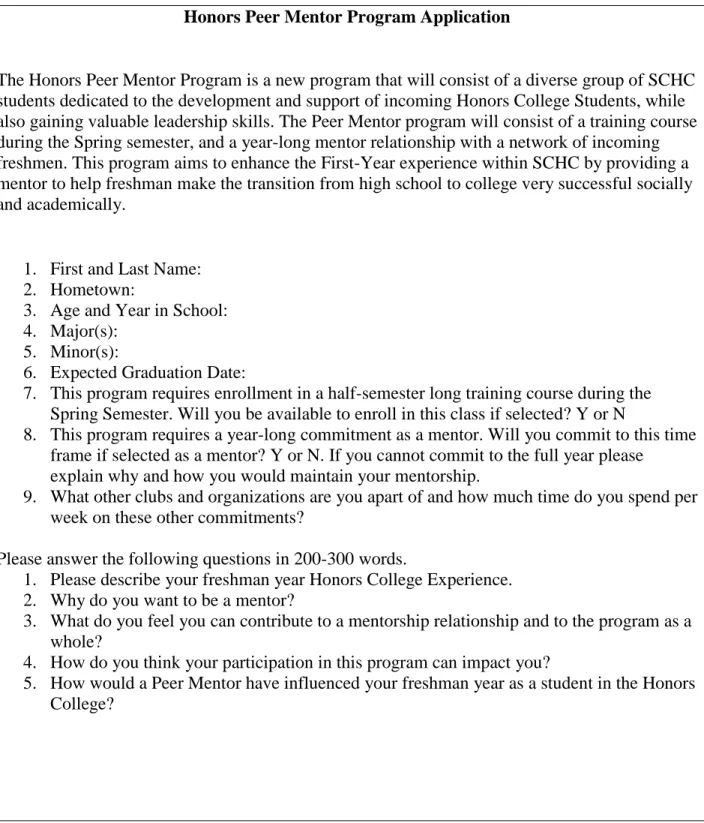
demographic information such as applicant age, year, and address, as well as questions that allow the applicant to express why they are interested in being involved in the program, other campus interests and involvements, availability, and qualifications for this position (Esplin et al. 97). A sample application is provided in Figure 2.
Honors Peer Mentor Program Application
The Honors Peer Mentor Program is a new program that will consist of a diverse group of SCHC students dedicated to the development and support of incoming Honors College Students, while also gaining valuable leadership skills. The Peer Mentor program will consist of a training course during the Spring semester, and a year-long mentor relationship with a network of incoming freshmen. This program aims to enhance the First-Year experience within SCHC by providing a mentor to help freshman make the transition from high school to college very successful socially and academically.
1. First and Last Name:
2. Hometown:
3. Age and Year in School:
4. Major(s): 5. Minor(s):
6. Expected Graduation Date:
7. This program requires enrollment in a half-semester long training course during the Spring Semester. Will you be available to enroll in this class if selected? Y or N
8. This program requires a year-long commitment as a mentor. Will you commit to this time
frame if selected as a mentor? Y or N. If you cannot commit to the full year please explain why and how you would maintain your mentorship.
9. What other clubs and organizations are you apart of and how much time do you spend per
week on these other commitments?
Please answer the following questions in 200-300 words.
1. Please describe your freshman year Honors College Experience.
2. Why do you want to be a mentor?
3. What do you feel you can contribute to a mentorship relationship and to the program as a whole?
4. How do you think your participation in this program can impact you?
5. How would a Peer Mentor have influenced your freshman year as a student in the Honors
College?
As shown in the sample email and application, applicants for this program would need to have completed at least one semester of coursework in the Honors College and be in good academic standing. This qualification means that all freshmen, sophomore, and junior Honors College students are eligible to apply. The selection process would take place in late January and early February so that selected participants would be able to enroll in the second half of the semester training course. The training course would be worth one Honors College elective credit and would meet once a week for two hours during the second half of the spring semester.
The training course would be comprehensive and use a model similar to other peer leadership training schedules that have been used at the University of South Carolina. Training would include presentations from a variety of offices on campus, team-building activities, addressing needs of first-year students, and a thorough presentation of an example Carolina Core and Honors College curriculum. All of these components are necessary to ensure that Peer Mentors are prepared to create meaningful relationships with incoming first-year Honors College students in a way that would benefit both mentor and mentee.
Campus offices to present and what they would present during training include:
1. University 101 Programs would present important information on first-year students and how they adapt to the college classroom and how Peer Leaders can facilitate the ease of the transition. This presentation is important because it would give the mentors an introduction to the needs of first-year students and what role U101 plays in the first-year experience.
2. The Office of Fellowships and Scholar Programs would present opportunities available
students. The goal of this presentation is to demonstrate the accessibility of this office to all students on campus and make students aware of their resources and location on campus. This presentation is important because it would allow mentors to educate mentees on where to go and what is available when seeking scholarships, grants, and fellowship programs.
3. The USC Police Department would present safety tips and resources available to USC
students as well as how to encourage a fellow student to report to the police when an unsafe or unlawful situation has occurred. They would also present on alcohol
responsibility and how to use the blue light system if a student feels unsafe on campus. This presentation is extremely important because student safety is critical and especially important for first-year students learning their way around a new campus, and this presentation would allow mentors to best advise mentees on how to stay safe and report any issues.
4. University Ambassadors would give mentors a tour of campus to refresh the locations
and histories of campus buildings and monuments in order to be able to properly direct mentees to buildings they don’t know how to get to on their own. This can also serve mentors in reconnecting them to their campus. This presentation is important because it would give mentors the ability to guide mentees around campus as well as be informed about the importance of history on campus.
5. The Office of Diversity and Inclusion would present to mentors on how to be supportive and inclusive not only to their future mentees but also to all students on campus. They would also present on how to report an incident seen on campus that seems to be in bias or hate. The Office of Diversity and Inclusion would also complete Safe Zone Training
with mentors so that mentors could join the network of allies across campus to create respect and dignity for LGBTQ individuals and be easily identified as students that are involved in creating a campus of equality and inclusion. This training is critical as college is the first time students are away from home and are unsure where to turn for support on campus as LGBTQ individuals or allies and trained mentors would be a resource for this support.
6. The Office of Student Disability Services would present on how students can register with them once they arrive on campus and the resources that are available to students. They would also present on how to encourage students that are struggling to register with them instead of trying to conform to traditional classroom methods that do not work with their disability. This office serves students with all types of disabilities including
learning, physical, health, or psychiatric disabilities to help them best manage their environment and succeed at the University of South Carolina. This office is extremely important for first-year students as it allows students to feel comfortable and succeed in their learning environment from the start and not after they have already run into issues with classes and grades. Mentors would be able to advise mentees on how and where to register a disability after this training.
7. University Technology Services would present on the resources available to students and how they can help in the event of a technology emergency such as a laptop crash. This presentation is important because mentors would know where to send mentees should a technology problem or emergency arise during their college career.
8. The Office of Undergraduate Research would present on how students can become
how the office is there to help in the search for the right research project and research mentor. They would also present on the money and awards available and how to apply to receive them for students that are involved in undergraduate research. This presentation is important because undergraduate research can greatly benefit students in applying for future programs and jobs.
9. The Office of Academic Integrity would present on the Honor Code and how to ensure it
is upheld and what to do if it is violated. This presentation is important because it would allow mentors to best explain the Honor Code to their mentees and ensure it is well understood.
10.A representative from Counseling and Psychiatry would present on how to maintain good
mental health and how to identify signs of poor mental health. They would present on their location on campus and how to make an appointment as well as what to do in the event of an emergency. This presentation is extremely important and sensitive and would allow mentors to become more aware of mental health issues and how to get help.
11.The Leadership and Service Center would present on the resources they provide and events that they hold to foster leadership and service across campus. This presentation is important because it would allow mentors to explain the benefits and uses of this resource to their mentees, and how it could help them become more involved across campus. 12.The Office of Pre-Professional Advising would present about the resources they provide
for all pre-professional students and how those resources can be utilized to help students enhance their professional school applications. This presentation is important because mentors would be able to send mentees to this office who are interested in professional
school after completion of their undergraduate career, giving them access to all of the information and resources available that would give them the best chance at acceptance. 13.The Student Success Center would present on the resources they provide to students for
academic support. They would present on how to access these resources and the other programs that they provide. This presentation is important because mentors would know where to send mentees who need access to tutors and better study habits.
14.Campus Recreation would present on all of the resource that they provide, where both of their main locations are, how to access them, and the other programs they hold outside of the university. This presentation is important because it would allow mentors to better understand the resources provided by Campus Rec and the importance of exercise, knowledge they can pass on to their mentees.
15.The University Advising Center would present on the services that they provide specifically for first-year students as well as give an overview of the most updated
Carolina Core requirements. This presentation is important as it would inform mentors of how the UAC advises first-year students and how they can also help first-year students who are undecided on what discipline to pursue a major in.
Each of these presentations fulfills a need applicable to first-year students. All of these presentations would allow mentors to be best prepared to advise first-year students on how to best take advantage of all of the resources available to them on campus. Mentors should also gain a better understanding of how they can use these resources and have any questions they may have answered as well. There would also be a presentation from the Honors College advisors on the extra resources available specifically to SCHC students as well as the typical Honors
Curriculum. An Honors College faculty or staff member would lead these trainings but the trainings would not be in a lecture style but rather in a conversational or discussion style to best facilitate retention of this information for the mentors.
Mentors would also participate in team-building activities. This is important because it would create relationships between mentors, which would create a greater network of access for their mentees. Mentors would all have been taking classes in their respective majors and
therefore may be able to provide valuable advice to other mentors mentees if needed. These team-building activities can include get-to-know-you games, service projects, and campus activities. Due to the length of the training class, each training session should contain two to three presentations from the offices across campus and one team-building activity. This training should also expect feedback each week from the mentors on how they felt about the
effectiveness of the training and usefulness of the information provided to them during the presentations. This feedback could be used to further improve the training program throughout the semester and in future semesters.
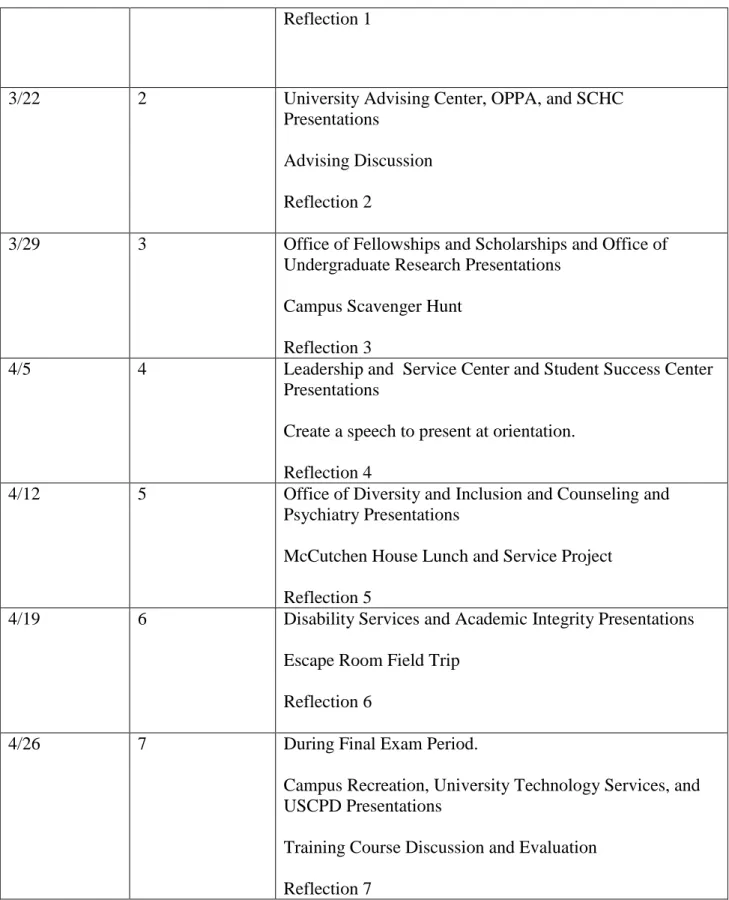
A sample curriculum for the training class is provided in Table 1.
Date Week Class Presentations and Activities
3/15 1 U101 Presentation and Ambassadors Tour
Introductions and Tour Team Trivia SCHC 444: Peer Mentor Program Training Wednesdays 3:00-5:00pm, 3/13-4/25, 2017
Reflection 1
3/22 2 University Advising Center, OPPA, and SCHC
Presentations
Advising Discussion Reflection 2
3/29 3 Office of Fellowships and Scholarships and Office of
Undergraduate Research Presentations Campus Scavenger Hunt
Reflection 3
4/5 4 Leadership and Service Center and Student Success Center
Presentations
Create a speech to present at orientation. Reflection 4
4/12 5 Office of Diversity and Inclusion and Counseling and
Psychiatry Presentations
McCutchen House Lunch and Service Project Reflection 5
4/19 6 Disability Services and Academic Integrity Presentations
Escape Room Field Trip Reflection 6
4/26 7 During Final Exam Period.
Campus Recreation, University Technology Services, and USCPD Presentations
Training Course Discussion and Evaluation Reflection 7
The Honors Peer Mentor Program Training Course would provide valuable information about all of the resources available to students at the University of South Carolina. Peer Mentors would have an in-depth knowledge about where and how to best access these resources as well as in what situations they can be utilized. In essence, Peer Mentors would become the ultimate resource for their freshmen mentees. Each of these presentations would provide the most current and accurate information about each office and their programs. After each day of presentations, mentors should write a one-to-two page reflection on why they think that presentation was valuable to their training and how they think they would be able to use what they learned with their mentees. The team building activities would allow Peer Mentors to get to know each other while also using time constructively to make sure Mentors have learned from their training and provide feedback on the program as well.
One of the most important aspects of the training is the feedback to the Program Director on how to improve the curriculum and to ensure the mentors feel fully prepared for the
assignments of their mentees. Mentors should be able to answer any questions about campus resources and where to send students with questions they cannot answer. They should be prepared to address warning signs for mental health, sexual assault, and be a safe space for all students.
Mentors would be matched with mentees during the first week of school. The matching process would be at random during the first trial of this program. The 2001 study by Walker and Taub found that there was no significant relationship between similarity of demographic
variables and mentees’ reports of satisfaction (57-58). These findings are the reason for a random matching process. Random matching would decrease bias by not allowing mentors to select their
mentees. Each mentor would receive a network of three to five mentees depending on the size of the incoming class.
Mentees would watch a presentation given by an Honors College faculty, staff, or a trained mentee during orientation to inform them about this program and the benefits it can provide to them. Mentees should then have the option to opt out of the program if they feel strongly about not participating, but the program should be highly encouraged by the Honors College. Mentors would work together to create this presentation during their training to ensure that the program is presented as something extremely beneficial and enjoyable for incoming students. During the first week of school, mentors should receive a list of their assigned mentees and mentees should receive an email with the name of their assigned mentor. Mentors would be responsible for the first contact with their mentees. During the first week of school, a
mentor/mentee event should be held by the program on campus for mentees to meet their mentors and the rest of their mentee network for the first time. This would allow mentors to introduce themselves and tell the mentees a little bit more about what they could be doing throughout the year.
The mentoring relationship in this program has been designed to begin as a formal relationship, but all meetings should be informal to establish trust and equality between mentor and mentee. Equality is important because first-year students need to know that they are valuable members of our community and that they are the next generation of Carolina students.
Mentors should have monthly meetings throughout the mentoring year to discuss how their mentor relationships are progressing, voice any concerns, and offer advice to other mentors on things that they have found works really well and things that have not worked quite as well.
This evaluation and discussion is crucial to the success of the program and should be taken very seriously. Mentors would also turn in their monthly meeting calendars to the Program Director at each monthly meeting.
One crucial component to this program is evaluation from both mentors and mentees. A formal evaluation should be given to mentors and mentees at the end of the first semester and at the end of the second semester. These evaluations should help the program improve and become more beneficial for both students and mentors. The evaluation after the first semester should be analyzed over Winter Break in order to make immediate changes for spring semester if
necessary. Evaluations would use a Lickert scale as well as open ended questions. Sample evaluations for mentors and mentees are presented below in Figure 4 and Figure 3, respectively. The sample mentee evaluation would be designed to be given after the first semester and the sample mentor evaluations would be designed to be given after the second semester.
Fall Semester Program Evaluation- Mentees
This survey is anonymous and is designed to help us understand how this program is working so far and how it can be improved upon in the future. Your responses are appreciated.
The scale of this survey is as follows:
1-Strongly Disagree 2-Moderately Disagree 3-Neutral 4-Moderately Agree 5-Stongly Agree Please circle the response you feel is most accurate to your feelings about each statement or question.
1. How frequently did you meet with your mentor throughout the semester?
Never Once Once per month Twice per month Once per week More than once per week 2. I am satisfied with the number of meetings I had with my mentor.
1-Strongly Disagree 2-Moderately Disagree 3-Neutral 4-Moderately Agree 5-Stongly Agree
3. My mentor has been able to answer all of my questions or guided me to someone who
could.
1-Strongly Disagree 2-Moderately Disagree 3-Neutral 4-Moderately Agree 5-Stongly Agree 4. I am a better student as a result of this program.
1-Strongly Disagree 2-Moderately Disagree 3-Neutral 4-Moderately Agree 5-Stongly Agree 5. I know more about the University and the Honors College as a result of this program. 1-Strongly Disagree 2-Moderately Disagree 3-Neutral 4-Moderately Agree 5-Stongly Agree
6. I get along well with my mentor.
1-Strongly Disagree 2-Moderately Disagree 3-Neutral 4-Moderately Agree 5-Stongly Agree 7. I wish to continue this program in the spring.
1-Strongly Disagree 2-Moderately Disagree 3-Neutral 4-Moderately Agree 5-Stongly Agree
Spring Semester Program Evaluation- Mentors
This survey is anonymous and is designed to help us understand how this program is working so far and how it can be improved upon in the future. Your responses are appreciated.
The scale of this survey is as follows:
1-Strongly Disagree 2-Moderately Disagree 3-Neutral 4-Moderately Agree 5-Stongly Agree Please circle the response you feel is most accurate to your feelings about each statement or question.
1. How often did you meet with your mentee during the semester?
1-Never 2- Once 3-Once per month 4-Twice per month 5-Once per week 6-More than once per week
2. My training allowed me to answer any questions my mentee asked.
1-Strongly Disagree 2-Moderately Disagree 3-Neutral 4-Moderately Agree 5-Stongly Agree 3. I have gained leadership and interpersonal skills as a result of this program.
1-Strongly Disagree 2-Moderately Disagree 3-Neutral 4-Moderately Agree 5-Stongly Agree 4. I feel closer to my university and the Honors College as a result of my participation in
this program.
1-Strongly Disagree 2-Moderately Disagree 3-Neutral 4-Moderately Agree 5-Stongly Agree 5. I was able to create meaningful relationships with all of my mentees.
1-Strongly Disagree 2-Moderately Disagree 3-Neutral 4-Moderately Agree 5-Stongly Agree 6. I am satisfied with my participation in this program.
1-Strongly Disagree 2-Moderately Disagree 3-Neutral 4-Moderately Agree 5-Stongly Agree 7. I would be a mentor again.
1-Strongly Disagree 2-Moderately Disagree 3-Neutral 4-Moderately Agree 5-Stongly Agree 8. I will continue to have a relationship with my mentees past the first year of the program. 1-Strongly Disagree 2-Moderately Disagree 3-Neutral 4-Moderately Agree 5-Stongly Agree
9. Please leave any other comments about the program below.
Figures 3 and 4. Figure 3 is a sample survey for mentees. Figure 4 is a sample survey for mentors.
This program should be implemented first with a small group of mentors and a randomly selected group of voluntary mentees to test the dynamics of the program and how it can be put into a larger scale use. The test program should follow the same structure as the program design but put a larger emphasis on feedback to make sure the program is working effectively and how to ensure it would be effective and meaningful when used on a large scale.
The Honors College is the ideal location for this program because Honors College students are dedicated to involvement, leadership, and academics; all qualities required to make this program work. The hope for this program is that it would be able to provide incoming Honors College students with a personal resource for any questions, emotional support, and academic support they may need as they make the transition to college life.
Conclusion:
The Honors Peer Mentoring Program is a program proposal designed to support first-year Honors College students. These first-year students are some of the most vulnerable and
dependent students on campus. Most freshmen are experiencing independence for the first time, which can be very intimidating. They are also likely experiencing true academic rigor for the first time, as many Honors College students begin their freshmen year in junior and senior level classes, after coming into college with thirty or more hours of AP or IB credit and placing out of the entry-level classes most first-year students take. This program aims to make this transition easier by providing first-year students with older mentors who have been in the same position with similar experiences and able to pass on their knowledge. Mentors would be trained to deal with any situation that can be foreseen and be an introducer for their mentees. College can be an intimidating place as a freshmen and having a mentor that is able to act as a guide through difficult and unknown situations can make it seem much less intimidating and enhance the first-year experience at the University of South Carolina.
This program would match trained upperclassmen mentors with a network of incoming Honors College freshmen to act as a guide through their first year. Mentors would go through training to prepare for this position and should also gain many benefits from participation in this program, such as leadership experience and personal growth. Peer mentoring programs are used in colleges and universities across the country and have been found to be extremely beneficial and provide a new level of student support, creating better students and future leaders. If this program is implemented it should create a new sense of belonging within the South Carolina Honors College and give students access to many new opportunities and resources that may not have seemed important on their own. Honors College students are leaders, and this program
would only enhance their leadership and success on campus. If this program is successful, it can leave a lasting positive impact in the Honors College and beyond as program participants use skills learned throughout this program to lead and create positive change in the workforce and beyond.
Works Cited:
Campus Recreation. University of South Carolina. Web. 06 Apr. 2016.
Counseling and Psychiatry. University of South Carolina. Web. 06 Apr. 2016.
D'Abate, Caroline P. "Defining Mentoring in the First-Year Experience: One Institution's
Approach to Clarifying the Meaning of Mentoring of First-Year Students." Journal of the
First-Year Experience & Students in Transition 21.1 (2009): 65-91. Web. Spring 2016.
Division of Law Enforcement and Safety. University of South Carolina. Web. 06 Apr. 2016.
Elliott, Earl S. "Academic Advising with Peer Advisors and College Freshmen." NACADA
Journal 5.1 (1985): 1-7. Web. Spring 2016.
Esplin, Pat, Jenna Seabold, and Fred Pinnegar. "The Architecture of a High-Impact and
Sustainable Peer Leader Program: A Blueprint for Success." New Directions for Higher
Education 2012.157 (2012): 85-100. Web. Spring 2016.
Hastings, Lindsay J., James V. Griesen, Richard E. Hoover, John W. Creswell, and Larry L. Dlugosh. "Generativity in College Students: Comparing and Explaining the Impact of Mentoring." Journal of College Student Development 56.7 (2015): 651-69. Web. 15 Spring 2016.
Huggett, Kathryn Dey. "Advising in Undergraduate Honors Programs: A Learner-Centered Approach." NACADA Journal 24.1-2 (2004): 75-87. Web. Spring 2016.
Leadership and Service Center. University of South Carolina. Web. 06 Apr. 2016.
Office of Academic Integrity. University of South Carolina. Web. 06 Apr. 2016.
Office of Diversity and Inclusion. University of South Carolina. Web. 06 Apr. 2016.
Office of Fellowships and Scholar Programs. University of South Carolina. Web. 06 Apr. 2016.
Office of Student Disability Services. University of South Carolina. Web. 06 Apr. 2016.
Office of Undergraduate Research. University of South Carolina. Web. 06 Apr. 2016.
Shook, Jaime L., and Jennifer R. Keup. "The Benefits of Peer Leader Programs: An Overview from the Literature." New Directions for Higher Education 2012.157 (2012): 5-16. Web. Spring 2016.
South Carolina Honors College. University of South Carolina. Web. 24 Apr. 2016.
Student Success Center. University of South Carolina. Web. 06 Apr. 2016.
University Advising Center. University of South Carolina. Web. 06 Apr. 2016.
University Ambassadors. University of South Carolina. Web. 06 Apr. 2016.
University Technology Services. University of South Carolina. Web. 06 Apr. 2016.
University 101 Programs. University of South Carolina. Web. 06 Apr. 2016.
Walker, Suzanne Coolbaugh, and Deborah J. Taub. "Variables Correlated with Satisfaction with a Mentoring Relationship In First-Year College Students and Their Mentors." Journal of