Perceptions of professional nurses regarding clinical competence
of community service practitioners from degree and diploma
programmes offered in the Western Cape
L.A. SNELL1 AND F.M. DANIELS2
1School of Nursing and Public Health, University of KwaZulu-Natal, Howard Campus, Durban, South Africa. E-mail: [email protected]
2
School of Nursing, University of the Western Cape, Private Bag X17, Bellville, Cape Town, South Africa.
Abstract
In compliance to the national requirements of producing competent learners, the South African Nursing Council requires community service practitioners to have the necessary knowledge, skills, attitudes and values which will enable them to render efficient professional service. The purpose of the study was to compare the perceptions of professional nurses about the clinical competence of community service practitioners (CSPs) who graduated from a nursing degree programme and those who completed a nursing diploma programme in the Western Cape. A quantitative, descriptive, cross-sectional design was adopted to make comparisons of how professional nurses’ rated the clinical competence of the CSPs. Five regional hospitals were purposively selected based on them being designated health establishments for community service. Non-probability convenient sampling was employed to select a total of 52 professional nurses who were directly involved in the supervision of CSPs who graduated from degree and diploma programmes. A self-administered questionnaire was used to collect the data, which were analyzed using SPSS version 21. Bivariate analysis was done using contingency tables to compare the associations of clinical competence between the two groups of CSPs as rated by the professional nurses who supervised them. A confidence level of 95% with a 5% level of significance was set, and a p-value of less than 0.05 was interpreted as significant. The results show that professional nurses perceived the CSPs who had completed a diploma nursing programme to be more competent than the nurses with degrees. It is recommended that a longitudinal study be conducted tp see if the rating for clinincal competence between the two groups and the professional nurses’ ratings of the two groups change at all. In conclusion this study suggests that there is no significant difference in clnical competence related to knowledge and skills between the two gropuips of CSPs.
Keywords: Clinical competence, community service practitioner, degree programme, diploma programme.
How to cite this article:
Snell, L.A. & Daniels, F.M. (2014). Perceptions of professional nurses regarding clinical competence of community service practitioners from degree and diploma programmes offered in the Western Cape. African Journal for Physical, Health Education, Recreation and Dance,
Introduction
Clinical competence of community service practitioners who graduated from a nursing degree programme is still being compared to those who completed a nursing diploma programme. An undergraduate programme in nursing can be completed at a college or a university. There has been and still are increasing debates about the undergraduate nursing programmes offered at the two different institutions (Bartlett, Simonite, Westcott & Taylor, 2000). The debates focus on whether degree or diploma nurses are better prepared for the realities of practice in the clinical area.
Based on the differences within the structure of the two nursing programmes (degree versus diploma), it is commonly assumed that nurses who have a degree are better at theory, but have poor clinical skills, whereas those who have a diploma are better in their clinical performance, but lack the necessary theoretical basis (Clinton, Murell & Robinson, 2005). The ultimate aim of nursing education programmes in South Africa is to produce professional nurses who are competent critical thinkers and who possess the necessary knowledge, attitude and ability to solve problems independently.
Competence, however, is a much broader concept, which includes the application of knowledge, psychomotor skills and ability to adequately manage the demands that clinical nursing require (Winterton, Le Deist, & Stringfellow, 2006). As proposed by Lizzio and Wilson (2004), competence is generally defined as consisting of integrated pieces of knowledge, skills and attitude, and is therefore assumed to be a prerequisite to perform adequately when carrying out a task. According to Uys (2003) an individual is competent if he/she can optimally combine knowledge, understanding, skills and attitude in his/her performance. However, for community service practitioners (CSPs) who are doing community service (according to Act No. 33 of 2005) South African Nursing Council (SANC), 2005) as legislated by working in hospitals are expected to have the necessary knowledge, skills, attitudes and values which enable them to render professional and quality care when exposed to the clinical area.
Community service for newly qualified nurses, leading to registration as a Professional Nurse (R425), was commenced in 2008. Community service enables newly qualified nurses to gain confidence, develop their clinical skills and deal with the challenges of working in under-resourced areas. The education and training of nurses aim to prepare nurses who will be competent to provide quality patient care (Morolong & Chabeli, 2010).
In order to improve the standard of nursing care rendered and reduce the number of medico-legal hazards in the clinical area, it is important that newly qualified professional nurses are found competent in carrying out their duties as registered nurses within the scope of practice. Medico-legal risks resulting from lack of clinical competence and knowledge can be detrimental to the patient and costly to the healthcare system. In order to reduce and avoid the number of medico-legal risks in the clinical area it is of the utmost importance that clinically competent nurses are produced.
According to the SANC the purpose of nursing education is to develop a student who has the ability to think critically, evaluate a situation and exercise independent judgement (SANC, 2005). It is therefore of the utmost importance that each institution which offers a programme in nursing strives towards producing professional nurses of high calibre, as stipulated by the SANC. The aim of this study was to assess the perceptions of clinical competence of CSPs in the Western Cape.
Methodology
A quantitative approach using a descriptive design was adopted to assess the perceptions of the clinical competence of CSPs. The data were collected during November 2012 at five regional hospitals located in the Western Cape. Regional hospitals were chosen because these hospitals follow the same rotation policy for CSPs.
The target population included professional nurses who supervised CSPs working at selected regional hospitals in the Western Cape. Non-probability, convenience sampling was used to select the sample population for this study due to limited time and because it is an inexpensive method. A total of 68 professional nurses volunteered to participate in the study.
A questionnaire with closed-ended questions was used to determine the self-reported perceptions of the professional nurses regarding the clinical competence of the CSPs. The questionnaire was developed with the assistance of research experts, academics, and the supervisor. The structure of the questionnaire was guided by the aims of the research to maintain control over extraneous variables, and to ensure that the responses were specific to the research aim. A variety of Likert scales were used in the questionnaire for the professional nurses. The questionnaire was prepared using a three-point Likert scale (1 = incompetent, 2 = competent, and 3 = proficient) because the primary purpose was to rate the CSPs clinical performance.
The reliability of this study was tested using Cronbach’s alpha coefficient that was set at 0.7. The instrument was pre-tested on 5% of the sample who were located at one of the regional hospitals in order to ensure content validity. Participants indicated that they had no difficulty in understanding the questionnaire and thus no additional changes were made to the questionnaire. Face validity was assessed by consulting nurse educators from a college and a university.
Ethical clearance was obtained from the Research Grants Committee at the University of the Western Cape (Registration 12/4/20). Informed consent was obtained from all of the participants. They were assured that all data collected will be treated with confidentiality and anonymity. Participation was voluntary and participants were free to decline or to participate without fear that they would be affected adversely. No risks from this study were foreseen.
A total of 52 participants completed the questionnaire yielding a response rate of 76.5%. The quantitative data collected from the questionnaires were edited, coded, categorized and analyzed using the SPSS version 21 computer programme.
Results
The results present the professional nurses’ perceptions of the CSPs related to clinical competence in the clinical area.
Skills
Table 1 shows the Professional nurses’ ratings of the CSPs’ skills and show that their perceptions of clinical competence of the CSPs by degree/diploma status were largely similar. A marginal statistical difference was noted in ‘displaying effective time management skills’ (p = 0.051). In relation to the assessment of psychological symptoms, 90.5% (n=19) of degree CSPs were rated as competent compared to 91.6% (n=22) of diploma CSPs. The professional nurses rated the majority of CSPs in both groups as competent, yet they rated more diploma CSPs (92%, n = 23) as competent compared to degree CSPs (73.1%, n= 19).
Table 1: Professional nurses’ ratings of CSPs’ skills: Degree versus diploma (n=52) (%)
Item CSP I C P p-value
Practices within the scope of practice while implementing nursing care
Degree 0 (0) 25(92.6) 2(7.4) 0.936
Diploma 0 (0) 23(92.0) 2(8.0)
Application of appropriate skills to clinical practice
Degree 0 (0) 25(92.6) 2(7.4) 0.936
Diploma 0 (0) 23(92.0) 2(8.0)
Applies current clinical intervention in patient care
Degree 2(7.4) 23(85.2) 2(7.4) 0.744
Diploma 1(4.0) 23(92.0) 1(4.0)
Assesses physical symptoms Degree 2(8.3) 22(91.7) 0 (0) 0.360
Diploma 0(0) 24(96.0) 1(4.0)
Assesses psychological symptoms Degree 2(9.5) 19(90.5) 0 (0) 0.786
Diploma 1(4.2) 22(91.6) 1(4.2)
Social circumstances Degree 2(8.3) 21(87.5) 1(4.2) 0.837
Diploma 1(4.2) 22(91.6) 1(4.2)
Assesses spiritual needs Degree 1(4.5) 20(91.0) 1(4.5) 0.513
Diploma 0 (0) 21(91.3) 2(8.7)
Assesses practical needs Degree 2(8.7) 21(91.3) 0 (0) 0.315
Diploma 1(4.2) 21(87.5) 2(8.3)
Assesses of pain Degree 3(11.5) 19(73.1) 4(15.4) 0.137
Diploma 0 (0) 23(92.0) 2(8.0)
Administers injections in correct manner with confidence
Degree 1(4.0) 22(88.0) 2(8.0) 0.667
Diploma 0 (0) 21(84.0) 4(16.0)
Assists with a resuscitation Degree 0 (0) 18(90.0) 2(10.0) 0.638
Diploma 1(4.3) 20(87.0) 2(8.7)
Administers oral medication Degree 0 (0) 23(92.0) 2(8.0) 0.355
Diploma 0 (0) 20(83.3) 4(16.7)
Inserts a nasogastric tube Degree 2(9.5) 18(85.7) 1(4.8) 0.844
Diploma 2(9.5) 16(76.2) 3(14.3)
Is able to assess the presence and extent of the patient’s suffering
Degree 0 (0) 23(85.2) 4(14.8) 0.545
Diploma 0 (0) 22(88.0) 3(12.0)
Creates a safe environment for the patients
Degree 2(7.4) 23(85.2) 2(7.4) 0.670
Diploma 0 (0) 22(88.0) 3(12.0)
Follows the correct procedures in disposals of sharps
Degree 3(11.1) 22(81.5) 2(7.4) 0.321
Diploma 0 (0) 23(92.0) 2(8.0)
Is competent and co-ordinated with patient care
Degree 4(15.4) 21(80.8) 1(3.8) 0.110
Diploma 0 (0) 24(96.0) 1(4.0)
Is able to identify abnormal or changes in the patient’s condition implements appropriate nursing care
Degree 3(11.1) 22(81.5) 2(7.4) 0.703
Diploma 1(4.0) 23(92.0) 1(4.0)
Displays effective time management skills
Degree 5(19.2) 21(80.8) 0 (0) 0.051*
Diploma 0 (0) 24(96.0) 1(4.0)
Works with health care team members to identify the patient’s health care needs
Degree 3(11.1) 23(85.2) 1(3.7) 0.230
Diploma 0 (0) 22(88.0) 3(12.0)
Effectively communicates facts and ideas regarding the patient to the health care members
Degree 3(11.1) 23(85.2) 1(3.7) 0.703
Diploma 1(4.0) 22(88.0) 2(8.0)
NA= Not applicable; I = Incompetent; SP= Satisfactory performance; C = competent = Proficient; Asymptomatic significance is displayed. *The significance level is less than 0.05.
In Table 2 a comparison is shown of Professinal nurses’ rating of CSPs according to the three categories are shown. There is a significant difference (p = 0.017) in the attitude of the two groups of CSPs as perceived by the professional nurses. Bivariate analysis was done using contingency tables to compare the associations between the two groups of CSPs as rated by the professional nurses that supervised them. Standard t-tests were used to identify significant mean differences in continuous explanatory variables by dichotomous outcomes. A non-parametric equivalent (Bivariate Poisson regression test) was used to calculate the overall sum scores of the three different categories. Categorically explanatory variables were used if the data were not normally distributed. Categorical explanatory variables were cross-tabulated against categorical outcomes and significant association (dependence) was identified using the Pearson’s chi-square (x2) if an expected cell count was less than 5. The Wilcoxon rank-sum test was used to compare the median difference in overall category scores (knowledge, skills and attitudes) given by the professional nurses by degree/diploma status of the CSPs. Significance was assessed at the 5% level for all tests.
Table 2: Comparison of professional nurses’ ratings of aggregated CSPs’ scores by category (knowledge, skills, attitudes): Degree versus diploma (n=52)
Variable Degree median (IQR) Diploma median (IQR) p-value Knowledge 45.4 (39.5 – 51.9) 49.8 (43.5 – 56.7) 0.332 Skills 46.9 (42.8 – 51.2) 50.8 (46.5 – 55.3) 0.201 Attitude 49.9 (45.1 – 55.1) 58.8 (53.5 – 64.6) 0.017 IQR = Interquartile Range
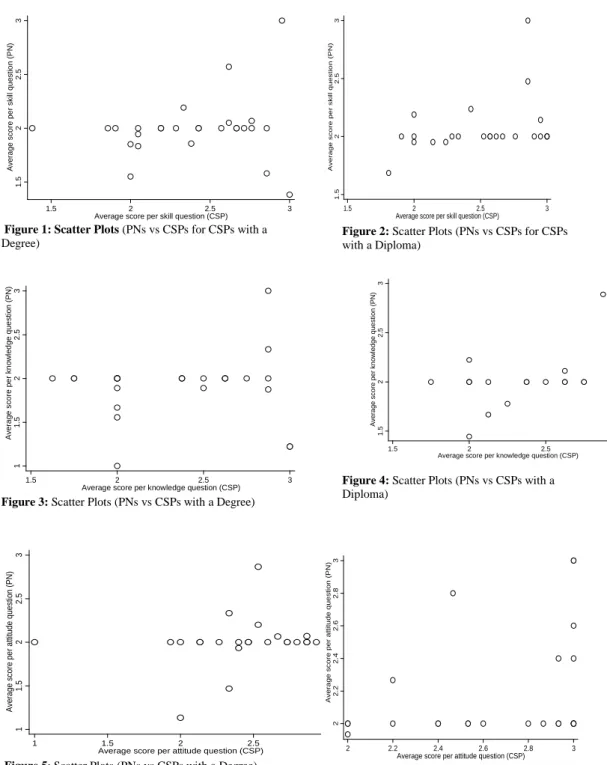
Figures 1 to 6 are scatterplots that show the relationship between how the CSP rated them compared to how the professional nurses rated them as shown in figures 1 to 6. Throughout one can see similar ratings between degree CSPs and the professional nurses compared to the diploma CSPs and professional nurses who viewed themselves as more competent than what the professional nurses perceived them to be.
1. 5 2 2. 5 3 Ave ra g e sco re p e r ski ll q u e st io n (PN ) 1.5 2 2.5 3
Average score per skill question (CSP)
Figure 1: Scatter Plots (PNs vs CSPs for CSPs with a Degree) 1 1. 5 2 2. 5 3 A v er a ge s c o re pe r k n owl ed ge q ue s ti on ( P N) 1.5 2 2.5 3
Average score per knowledge question (CSP)
Figure 3: Scatter Plots (PNs vs CSPs with a Degree)
1 1. 5 2 2. 5 3 Ave ra g e sco re p e r a tti tu d e q u e st io n (PN ) 1 1.5 2 2.5 3
Average score per attitude question (CSP)
Figure 5: Scatter Plots (PNs vs CSPs with a Degree)
1. 5 2 2. 5 3 Ave ra g e sco re p e r ski ll q u e st io n (PN ) 1.5 2 2.5 3
Average score per skill question (CSP)
Figure 2: Scatter Plots (PNs vs CSPs for CSPs with a Diploma)
Figure 4: Scatter Plots (PNs vs CSPs with a Diploma) 2 2. 2 2. 4 2. 6 2. 8 3 Ave ra g e sco re p e r a tt it u d e q u e st io n (PN ) 2 2.2 2.4 2.6 2.8 3
Average score per attitude question (CSP)
Figure 6: Scatter plots (PNs vs CSPs with a Diploma) 1. 5 2 2. 5 3 A v er a ge s c o re pe r k n owl ed ge q ue s ti on ( P N) 1.5 2 2.5 3
In Table 3 the Professional’ nurses’ rating of CSPs’ knowledge is displayed. The professional nurses rated the CSPs based on the nursing care they witnessed them providing while in the clinical area. This was rated according to a Likert rating scale of 1–3.Ratings of competence given by the professional nurses for ‘ability to assess the presence and extent of patient’s suffering’ and ‘creation of a safe environment for the patients’ were the same for both groups of CSPs. A significant difference was noted related to ‘displays effective time management skills’ (p = 0.051). Overall there was no statistical difference in knowledge between the two groups of CSPs as rated the professional nurses.
Table 3: Professional nurses’ rating of CSPs’ knowledge: Degree versus diploma (n=52)
Item CSP I C P p-value
Is able to apply knowledge of nursing care appropriately in a variety of situations when rendering patient care
Degree 4(14.8) 21(71.8) 2(7.4) 0.106 Diploma 0 (0) 24(96.0) 1(4.0)
Able to prevent patient problems by providing appropriate nursing care that will avoid complications for the patient
Degree 3(11.5) 21(80.8) 2(7.7) 0.914 Diploma 2(8.0) 21(84.0) 2(8.0)
Is open and transparent by explaining nursing procedures as an opportunity to interact with a patient
Degree 3(11.5) 22(84.6) 1(3.9) 0.764 Diploma 2(8) 21(84) 2(8)
Uses independent clinical judgement in a clinical crisis situation
Degree 5 (18.5) 21 (77.8) 1 (3.7) 0.329 Diploma 2 (8.0) 23 (92.0) 0 (0)
Monitoring individualization of the nursing care plan
Degree 2(7.7) 24(92.3) 0 (0) 0.135 Diploma 1(4.0) 23(92.0) 1(4.0)
Treats the patient within the context of their social religious practices
Degree 1(3.85) 24(92.3) 1(3.82) 0.513 Diploma 0 (0) 23(92.0) 2(8.0)
Able to think critically about why specific nursing procedures are being performed on a patient
Degree 4(22.2) 20(74.1) 1(3.7) 0.128 Diploma 1(4.0) 23(92.0) 1(4.0)
Displays appropriate problem-solving and decision-making skills
Degree 4(22.2) 20(74.1) 1(3.7) 0.128 Diploma 1(4.0) 23(92.0) 1(4.0)
Evaluates patient care after implementing the nursing process
Degree 3(11.5) 21(80.8) 12(7.7) 0.855 Degree 3(12.0) 21(84.0) 1(4.0)
NA= Not Applicable; I= Incompetent; SP= Satisfactory performance; C = competent; P = proficient. Asymptomatic significance is displayed. The significance level is less than 0.05.
Discussion
The results show that there is a difference perceived in the attitudes of the two groups of CSPs, but not in the knowledge and skills categories.
Biographical data of the professional nurses who supervised the CSPs
The study sample consisted of 52 professional nurses, of whom 13.5% (7) had obtained a degree and 86.5% (45) a diploma qualification. The majority of professional nurses (51.9%, n=27) had worked in the clinical area for more than 20 years, while 28.8% (n=15) had worked in the clinical area for 0–5 years. The significance of this information is that based on their years and scope of experience, these Professional Nurses can be viewed as qualified to supervise the CSPs and capable of providing valuable input on the level of clinical competence of the CSPs with regard to rendering patient care.
Perceptions of clinical competence of the CSPs
There was no statistically significant difference in the professional nurses’ rating of the skills of CSPs (degree versus diploma) related to psychomotor skills. Ramritu and Barnard (2001) found that new nurses who qualified with a degree were able to practice independently when performing basic-level nursing care, such as hygiene needs, but were less confident in using more advanced skills, such as managing bigger workloads. This can support why the professional nurses see degree CSPs as incapable of managing bigger workloads, such as being responsible for a ward when the professional nurses are not present.
There was very little difference in the overall clinical competence of the two groups of CSPs as rated by the professional nurses. There was no significant difference in the knowledge and skills categories; however, there was a significant difference in the attitude category, with a p-value of 0.017. Where differences were found and the statistical difference was less than 0.05, the professional nurses scored the diploma CSPs higher than the degree CSPs. The results also show that the degree CSPs are not as clinically incompetent as people perceive them to be, and that the undergraduate degree programme does provide them with adequate practical skills to provide quality care. This also confirms the assumption that the block system, used for most diploma programmes, does not necessarily afford these students more clinical development than the system used for the degree programme is unfounded.
More focus should be placed on establishing how the clinical placement is used for clinical learning and how much clinical learning actually happens for each student while in the placement, irrespective of the programme for which they are registered.
This is supported by Clinton et al. (2005), who did a comparative study of nurses prepared through three-year degree and three-year diploma programmes, which showed that there is not much difference in the clinical competence of these two groups. Watson and Thompson (2000) stated that there is ample evidence to the contrary indicating, for example, that graduate nurses remain in nursing longer, remain in clinical practice longer and have better decision-making skills than diplomate nurses. Results showing diploma CSPs to be a bit more competent could partially be attributed to either increased exposure to the clinical area as an undergraduate student and complex real-life situations. The professional nurse is also seen as the expert provider of ongoing support and guidance in the clinical area that can help the CSP to provide safe nursing care. The diploma CSPs rated themselves more competent than the professional nurses perceived them to be with regard to knowledge, skills and attitude, as seen in Table 3.
Limitations
The findings of the study cannot be generalised because the sample size was too small and the study was limited to regional hospitals in the Western Cape. The data collection instrument was limited to close-ended questions. Different views might have been obtained from the CSPs and the professional nurses supervising them if the questionnaire included open-ended questions. Most of the professional nurses who supervised the CSPs have a diploma in nursing, and might have been biased in how they answered the questionnaire, specifically in relation to the CSPs with degrees.
Recommendations
The cycle of stigmatising of nurses with degrees as ‘theory nurses’ must be interrupted by reviewing and improving the clinical learning opportunities of undergraduate nursing students in an attempt to close the gap between how they are viewed against the nurses with diplomas. It is suggested that a longitudinal study should be carried out to see if the rating for competence between these two groups and the professional nurses’ ratings of the two groups changed at all over time. Bartlett et al. (2000) suggested that over the first 6 to 9 months of employment graduate nurses become more competent than diplomats, and Gerrish (2000) suggested that a nurse’s competence increases under the tutelage of preceptors.
The findings give nurse educators at both colleges and universities cause to revisit and review the curricula to ensure that the graduate and diplomate are clinically competent in the basic clinical skills required of a professional nurse, to enable him/her to competently and confidently perform the tasks according to the scope of practice.
Conclusion
The results of this study suggest that there is no significant difference in clinical competence related to knowledge and skills between the two groups of CSPs. This is probably the first study of its kind to be conducted in South Africa, a developing country with limited resources in most hospitals in the public sector. However, the results concur with the findings of similar studies conducted in the United Kingdom, where the nurse who had completed a diploma programme rated themselves as proficient in the provision of nursing care in the clinical area. The results of the current study indicate that CSPs with diplomas are exposed to a clinical area for a longer period of time during their training, which might have positively influenced their level of competence and confidence in clinical practice.
References
Bartlett, H.P., Simonite, V., Westcott, E. & Taylor, H.R. (2000). A comparison of the nursing competence of graduates and diplomates from UK nursing programmes. Journal of Clinical Nursing, 9, 369-381.
Clinton, M., Murrell, T. & Robinson, S. (2005). Assessing competency in nursing: A comparison of nurses prepared through degree and diploma programmes. Journal of Clinical Nursing, 14, 82-94.
Gerrish, K. (2000). Still fumbling along? A comparative study of the newly qualified nurses’ perception of the transition from student to qualified nurse. Journal of Advance Nursing, 32(2), 473-480.
Lizzio, A. & Wilson, K. (2004). Action learning in higher education: An investigation of its potential to develop professional capability. Studies in Higher Education, 29, 469-488.
Morolong, B.G. & Chabeli, M.M. 2005. Competence of newly qualified registered nurses from a nursing college. Curationis, 28(2), 38-50.
Ramritu, P.L. & Barnard, A. (2001). New nurse graduates’ understanding of competence.
International Nursing Review, 48, 47-57.
South African Nursing Council (2005). The Nursing Act, 33 of 2005. Pretoria: Government Printer.
South African Nursing Council (1984). Regulations relasting to the scope of practice of persons registered or enrolled under the Nursing Act. 1978. Regulation R2598 of November 1984.
Uys, L. (2003). Fundamental Nursing. Cape Town: Maskew Miller Longman.
Watson, R. & Thompson, D. (2000). Recent development in UK nursing: Horses for courses or courses for horses? Journal of Advanced Nursing, 32, 1041 – 1042.
Winterton, J., Delamare Le Deist, F. & Stringfellow, E. (2006). Typology of Knowledge, Skills and Competences: Clarification of the Concept and Prototype, CEDEFOP Reference Series 64, Luxembourg: Office for Official Publications of the European Communities.