Persistent cough in children
Philip K PattemoreCorrespondence to: [email protected]
Philip Pattemore is Associate Professor of Paediatrics at
Christchurch School of Medical and Health Sciences, Uni-versity of Otago. He is a general and respiratory paediatri-cian with research, teaching and clinical interests in the epidemiology and management of childhood asthma, and in cystic fibrosis airway disease.
The mammalian cough reflex is de-signed to protect the lower airways and air-exchanging regions of the lung from infection and inhalation of foreign substances. Reptiles, who have no glottis to cough with, are prone to dying from pneumonic in-fection of their simple lungs. Cough is due to irritation of sensory nerve endings, particularly in the larynx, trachea and major bronchi. Cough receptors are sparse in the pharynx and epiglottis above the vocal cords and in the respiratory bronchioles and alveoli (Figure 1). Cough is not in itself a sign of airway obstruction. Normal children wearing cough meters have been recorded as cough-ing 10–11 times per day, but rarely at night.1,2 During respiratory infec-tions, or in children presenting with recurrent cough, coughing may oc-cur 60–100 times by day, and less often at night. Coughing at night is
often the main concern of parents. This is possibly because of the low ambient noise at night, a long spell in close proximity to the child, and the fact that the coughing disturbs the parent’s sleep. Cough undergoes developmental changes and is weak in premature infants.3
Asthma clinically consists of in-termittent episodes of intrathoracic airway obstruction manifest by ex-piratory wheezing (due to vibration
of partially collapsed airway walls), and shortness of breath. In an acute episode there will also be tachypnea, increased inspiratory effort, hyper-expansion, auscultatory wheeze, pro-longed expiration, and decreased air entry. Cough may or may not be prominent. Very few children with asthma have cough as their predomi-nant symptom but they will have wheeze and chest tightness as well. This is best categorised as ‘cough- predominant asthma’.4
The important thing to note here is that recurrent or nocturnal cough in the absence of wheezing is (a) very common, particularly in pre-school children (b) very non-specific with a broad differential, and (c) unlikely to be due to asthma.5 The term ‘cough- variant asthma’ should not be used in children.6 Whether or not there is an entity of cough-variant asthma in adults is beyond the scope of this article.
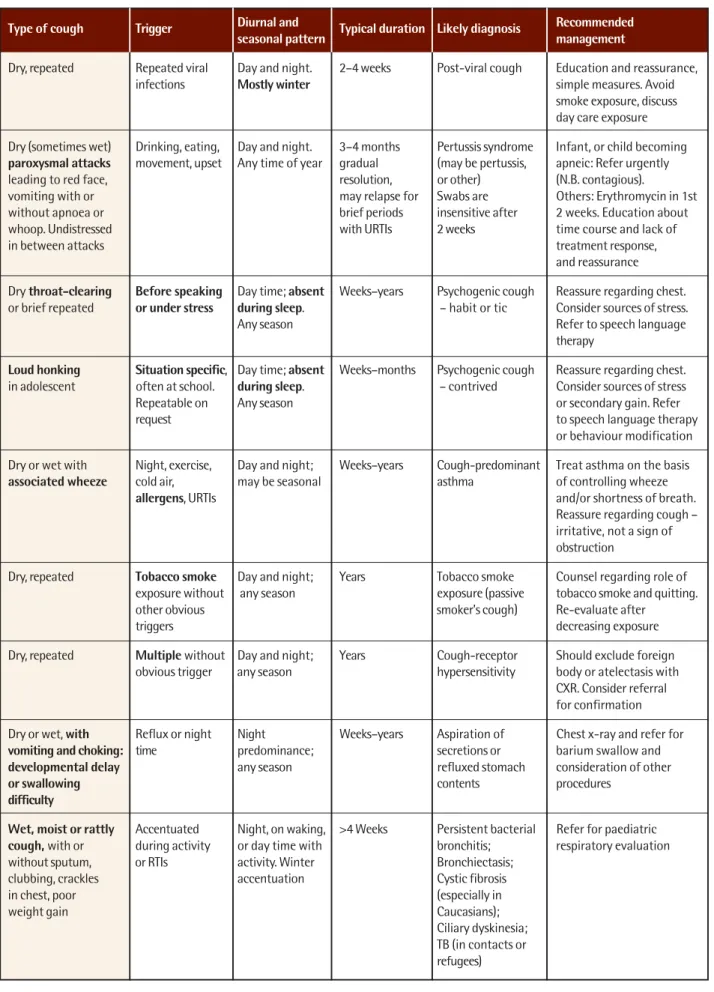
In a child with recurrent or per-sistent cough the first important dis-tinction to make clinically is between an irritating, dry cough (this refers to the absence of moist, rattly, or phlegmy sounds, rather than to be-ing non-productive) and a moist or rattly cough. A moist cough may or may not be productive in school chil-dren. A guide to assessment and when to refer is shown in Table 1. nose pharynx Sneezing Dysphagia Cough Pleural Chest Pain Expiratory Grunting (alveolar consolidation) Snoring Inspiratory Stridor Expiratory Wheeze Hyperexpansion Irritation Obstruction
Figure 1. The anatomical localisation of signs and symptoms of airway irritation and obstruction.
Table 1. Types of cough in children and diagnostic features
Type of cough Trigger Diurnal and Typical duration Likely diagnosis Recommended seasonal pattern management
Dry, repeated Repeated viral Day and night. 2–4 weeks Post-viral cough Education and reassurance,
infections Mostly winter simple measures. Avoid
smoke exposure, discuss day care exposure Dry (sometimes wet) Drinking, eating, Day and night. 3–4 months Pertussis syndrome Infant, or child becoming paroxysmal attacks movement, upset Any time of year gradual (may be pertussis, apneic: Refer urgently
leading to red face, resolution, or other) (N.B. contagious).
vomiting with or may relapse for Swabs are Others: Erythromycin in 1st
without apnoea or brief periods insensitive after 2 weeks. Education about
whoop. Undistressed with URTIs 2 weeks time course and lack of
in between attacks treatment response,
and reassurance Dry throat-clearing Before speaking Day time; absent Weeks–years Psychogenic cough Reassure regarding chest. or brief repeated or under stress during sleep. – habit or tic Consider sources of stress.
Any season Refer to speech language
therapy
Loud honking Situation specific, Day time; absent Weeks–months Psychogenic cough Reassure regarding chest. in adolescent often at school. during sleep. – contrived Consider sources of stress
Repeatable on Any season or secondary gain. Refer
request to speech language therapy
or behaviour modification Dry or wet with Night, exercise, Day and night; Weeks–years Cough-predominant Treat asthma on the basis associated wheeze cold air, may be seasonal asthma of controlling wheeze
allergens, URTIs and/or shortness of breath.
Reassure regarding cough – irritative, not a sign of obstruction
Dry, repeated Tobacco smoke Day and night; Years Tobacco smoke Counsel regarding role of exposure without any season exposure (passive tobacco smoke and quitting.
other obvious smoker’s cough) Re-evaluate after
triggers decreasing exposure
Dry, repeated Multiple without Day and night; Years Cough-receptor Should exclude foreign obvious trigger any season hypersensitivity body or atelectasis with
CXR. Consider referral for confirmation Dry or wet, with Reflux or night Night Weeks–years Aspiration of Chest x-ray and refer for vomiting and choking: time predominance; secretions or barium swallow and
developmental delay any season refluxed stomach consideration of other
or swallowing contents procedures
difficulty
Wet, moist or rattly Accentuated Night, on waking, >4 Weeks Persistent bacterial Refer for paediatric cough, with or during activity or day time with bronchitis; respiratory evaluation
without sputum, or RTIs activity. Winter Bronchiectasis;
clubbing, crackles accentuation Cystic fibrosis
in chest, poor (especially in
weight gain Caucasians);
Ciliary dyskinesia; TB (in contacts or refugees)
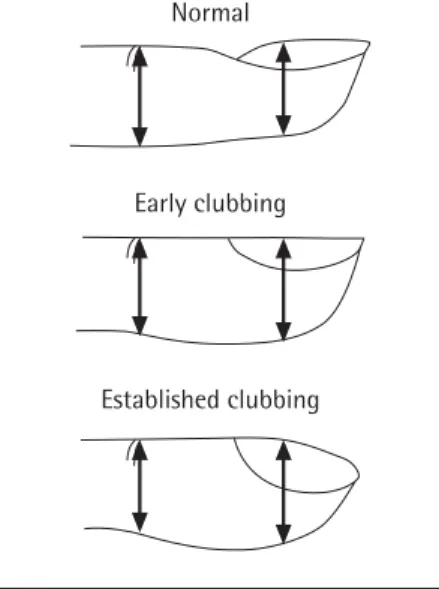
Figure 2. The distinction of normal and clubbed fingers. Note that the earliest signs are increased AP diameter compared to the distal IP joint and flattening of the nail an-gle. Fluctuance is too subjective to be used as a marker. Curvature without the other fea-tures is called beaking and may be familial.
Early clubbing
Established clubbing Normal Repeated or persistent dry
cough-ing may be due to increased cough receptor sensitivity, exposure to ir-ritants, or psychogenic.
Increased cough receptor sensitivity
Coughing is very common for two to three weeks following a viral respira-tory infection in many pre-schoolers and is often the last symptom to disap-pear. Prospective studies of coughing due to viral infections show that 50% last less than one week, 70–80% less than two weeks, and only 5% last more than four weeks.4 From aged two to five children may have four to 10 epi-sodes of respiratory infection per year, mostly during winter. Persistent cough-ing after each bout may thus blend seamlessly into the next infection and, although this may be reported as chronic coughing over three months, careful enquiry will reveal the repeated viral infection pattern. This is a pro-tective reflex and can be regarded as helping to prevent atelectasis, stagnant secretions and bacterial pneumonia.
Increased cough receptor sensi-tivity is also characteristic of pertus-sis syndrome, in which the hyper-sen-sitivity is so extreme that attacks of coughing (often triggered by drink-ing or disturbance) occur without in-tervening breaths until red face, vom-iting, and sometimes apnoea and cya-nosis occur. A whoop on the follow-ing massive inspiration may or may not be present. Pertussis apnoea may be life-threatening in young infants who should be referred for urgent ad-mission. In between these bouts the child usually looks and sounds en-tirely normal with no chest signs. The coughing bouts in whooping cough usually last for three to four months,7 gradually decreasing unless re- stimulated by intercurrent viral in-fections. Pertussis syndrome is clini-cally diagnosed – it may be caused by Bordetella pertussis, adenovirus, Mycoplasma pneumoniae or other agents. Swabs for culture or PCR of Bordetella pertussis are insensitive after the first few weeks of illness. Erythromycin given in the first two
weeks of illness may shorten the pe-riod of infectivity but does not af-fect the course of the coughing.7
In some cases persistent atelecta-sis, or congenital narrowing of the airway (bronchomalacia) may result in persistent coughing. In cases of persistent dry cough, without an ob-viously recognisable cause, it is im-portant to obtain a chest x-ray and consider paediatric specialist referral. In some children increased cough receptor sensitivity appears to be con-stitutional and is repeatedly demon-strated on capsaicin challenge testing.8 Some children with this condition are atopic, but the coughing does not re-liably respond to anti-asthma medi-cation such as inhaled steroids.4 Management
Specific treatment of dry protracted coughing is not available at this point.9 Symptomatic treatment of the cough itself with asthma medications, cough suppressants and antibiotics is unhelpful,10 associated with adverse effects, and not necessary.11 Support-ive management is important, how-ever, to stop a frustrating search for a cure on the part of the parents. This primarily involves reassurance about the aetiology, natural history, and the absence of signs of serious underly-ing disease. In my experience reas-surance is more effective after doing a thorough examination of the child and in some cases a chest x-ray (to check for unexpected findings such as a foreign body, or atelectasis). On occasions specialist referral is appro-priate for reassurance. Reassurance is often all that is necessary to take the pressure and focus off a child’s coughing. Other simple measures such as a glass of water beside the bed or school desk, or lemon and honey sips, may be helpful as temporary reliev-ers. Offering to re-check the child af-ter some weeks is also helpful. Extrapulmonary irritants
The most common irritant in the child-hood environment is tobacco smoke – children exposed at home cough more, but also get two to four times as
many respiratory infections (ears, nose, throat, bronchial and pneumonic).
In children with swallowing prob-lems, for instance due to cerebral palsy, or oesophageal disease, reflux or secretions with aspiration at night may cause a dry or moist cough de-pending on the amount of aspiration and the development of chronic in-fection. However aspiration is ex-tremely uncommon in neuro-developmentally normal children with simple gastro-oesophageal reflux.
A foreign body in the chest may cause cough or wheeze or both. A his-tory of a choking episode should be sought but its absence does not exclude a foreign body. A chest x-ray may iden-tify persisting pulmonary problems. Paediatric respiratory referral should be made if foreign body or aspiration lung disease is suspected or likely.
Cough may be associated with na-sal disease but the cough is not due to post-nasal drip.12 Nasal secretions track to the pharynx and oesophagus rather than the airway. Throat clearing (rather than true cough) occurs when there are a lot of secretions in the pharynx. How-ever airway disease often affects both the nasal and tracheo-bronchial epi-thelium (viral infections, allergic
rhini-tis, CF, bronchiectasis, ciliary dyski-nesia) and the irritation of bronchial epithelium does cause coughing. Psychogenic cough
Psychogenic cough13 can be of two main types. In the first, a dry cough or throat clearing is a habit or tic, oc-curring before speaking or under stress. The cough may have first started with a respiratory infection. The cough is usually brief and fre-quent, easily noticed during a con-sultation. In the second, an adolescent produces a loud ‘honking’ cough that is disruptive and occurs in particular situations, such as the classroom, but can be readily demonstrated to the doctor on demand. In both types of psychogenic cough, coughing is ab-sent when the child is truly asleep (but may occur when lying awake in bed). Identification of stresses and triggers at school or at home is the principal investigation (‘Let’s see what situa-tions make your coughing worse…we may be able to help you deal with the situations that make your coughing worse’). and often vocal re-training by speech language therapists or behav-iour modification is necessary.14 Moist cough
A persistent or recurrent moist, rattly, or productive cough that lasts beyond the time course of a usual viral respi-ratory infection (four weeks) is of sig-nificant concern. Whereas sometimes this is just the tail end of the infection, it may alternatively reflect low-grade secondary bacterial infection with or-ganisms such as non-typable Haemo-philus influenzae and Streptococcus pneumoniae – referred to sometimes as persistent bacterial bronchitis15 or protracted bronchitis. Many paediatri-cians believe this may be a reflection of airway damage presaging the de-velopment of bronchiectasis. Hence antibiotic treatment of a moist cough lasting more than four weeks is rec-ommended (14 days of amoxicillin- clavulanic acid, macrolide or cotrimoxazole). Signs of clubbing and poor growth should be sought and, in older children who can produce
spu-Table 2. The desktop guide to evaluating cough in children
Background to consider
The child
• Always chesty or unwell
• Hypotonia, difficulties with secretions, swallowing or airway protection (e.g. Down’s syndrome, muscular dystrophy, oesophageal surgery) The environment and contacts
• Passive smoke exposure
• Exposure to other children at home or in day care / pre-school • Refugee / immigrant from high risk country, contact with TB • Contact with whooping cough
Symptoms to enquire for
• Character of cough and associated symptoms (vomiting, choking, wheeze, apnoea) • Onset, time course and time of day / season of cough
• Has there been a significant choking episode?
• Triggers of coughing (drinking, lying down, exercise, allergens, school class)
Signs to look for
• Respiratory distress • Noisy breathing (see Figure 1) • Growth and development • Clubbing (see Figure 2) • Chest deformity
• Wheeze or crackles – generalised or localised
Reassure when cough is benign or due to pertussis syndrome after 1 year old
• Otherwise well child
• Coughing is always dry, triggered by repeated viral infections, or clearly paroxysmal with red face, vomiting (N.B. refer acutely if the paroxysms cause significant apnoea) • Cough did not start with choking on food or other item
• Chest x-ray is clear
Investigations to consider if any cough is persistent >4 weeks
• Chest x-ray
• Spirometry in older child
• Sputum microbiology in older child if productive • Sources of stress in situational cough
• Mantoux test in refugee / immigrant from high risk country / TB contact
Referral to paediatrician recommended
1. Any cough started with an episode of choking on food or other item 2. Cough lasts >4 weeks AND any of the following:
(a) Moist or productive cough does not respond to antibiotics within two weeks, relapses immediately on stopping antibiotics, or undergoes repeated prolonged cycles for more than three months
(b) Nocturnal only cough is associated with vomiting and choking, or occurs in a child with neurodevelopmental or oesophageal problems (other than simple reflux)
(c) Child is chronically unwell or has poor weight gain (d) Fingernails are clubbed
(e) There are persistent asymmetrical added sounds in the chest: wheeze (in spite of bronchodilators) or crackles (in spite of antibiotics)
(f) There are significant x-ray findings (g) Mantoux is greater than 5mm
tum, sputum culture is helpful. A chest x-ray should be considered. Paediat-ric specialist evaluation for suppurative lung disease is recommend for chil-dren with moist cough who:
• have only partial response to an antibiotic regime as above • have moist cough for longer than
three months
• have repeated protracted spells of moist cough
• have clubbing or poor growth. Sometimes children with established bronchiectasis or cystic fibrosis present with repeated episodes such as this (although they may have been treated for asthma for a long time before this is recognised).
Rarely, asthma in children may present with coughing, however signs of airway obstruction, such as wheezing are also present, if not as prominent.
How did the idea of ‘cough-vari-ant asthma’ become so widespread? In the early 1980s there was growing concern about asthma – asthma preva-lence and hospitalisations seemed to be rising in children and epidemics of asthma deaths had been documented in adults. It was widely believed that asthma was being under-diagnosed and under-treated in children. At the same time, a handful of small studies References
1. Chang AB, Phelan PD, Robertson CF, Newman RG, Sawyer SM. Frequency and perception of cough severity. Journal of paedi-atrics and child health 2001 Apr; 37(2):142-5.
2. Munyard P, Bush A. How much coughing is normal? Archives of disease in childhood 1996 Jun; 74(6):531-4.
3. Chang AB, Widdicombe JG. Cough throughout life: children, adults and the senile. Pulmonary pharmacology & therapeutics 2007; 20(4):371-82.
4. Landau LI. Acute and chronic cough. Paediatric Respiratory Reviews 2006; 7 Suppl 1:S64-7.
5. van Asperen PP. Cough and asthma. Paediatric Respiratory Re-views 2006 Mar; 7(1):26-30.
6. Chang AB, Landau LI, Van Asperen PP, Glasgow NJ, Robertson CF, Marchant JM, et al. Cough in children: definitions and clini-cal evaluation. The Mediclini-cal Journal of Australia 2006 Apr 17; 184(8):398–403.
7. Harnden A, Grant C, Harrison T, Perera R, Brueggemann AB, Mayon-White R, et al. Whooping cough in school age children with persistent cough: prospective cohort study in primary care. BMJ (Clinical research ed.) 2006 Jul 22; 333(7560):174-7. 8. Chang AB, Masters IB. Treatment of chronic cough in children.
New Ethicals Journal 2002(July):60-6.
9. Belvisi MG, Geppetti P. Cough. 7: Current and future drugs for the treatment of chronic cough. Thorax. 2004 May; 59(5):438–40.
Key Points
• Persistent cough without wheeze is not a sign of asthma in children.
• Persistent cough is usefully categorised as dry or moist. • Chest x-ray (and spirometry in
older children) is recommended in children with protracted dry or moist cough lasting greater than four weeks.
• Well children with typical viral initiation of dry cough or pertussis syndrome, and normal chest x-ray, do not benefit from medications, but lots of reassurance is necessary for parents.
• Children with moist cough lasting greater than four weeks should have a trial of two weeks of appropriate antibiotics. • Children with persistent cough
should be referred for paediatric evaluation if there is suspicion of foreign material in the airway, suppurative lung disease or TB, or the diagnosis is otherwise not clear.
seemed to indicate that some children and adults with persistent night cough had developed wheeze months to years later and one study showed that such coughing responded to theophylline. Very quickly the idea grew that this was the ‘dark matter’ of asthma, the hidden, under-diagnosed cases, and this partly explained the rise in preva-lence of doctor-diagnosed asthma.16 Studies of cough and cough receptors in the 1990s,17,18 cast serious doubt on the entity of ‘cough-variant asthma’ and we now know that theophylline has some cough-suppressing effects. How-ever the notion that these children have asthma has been extremely persistent and difficult to unseat.
Coughing is an important reflex in protecting the airways, but it may become over-active. Alternatively it may be a sign of noxious environ-mental exposure, psychological stress, or serious chest disease. The initial evaluation is largely clinical, but may take significant interview and observation time.
Competing interest
The author has, in the past five years, received funding to attend symposia from companies that have an inter-est in medications for asthma, which is dealt with in this paper.
10. Paul IM, Yoder KE, Crowell KR, Shaffer ML, McMillan HS, Carlson LC, et al. Effect of dextromethorphan, diphenhydramine, and placebo on nocturnal cough and sleep quality for coughing children and their parents. Pediatrics 2004 Jul; 114(1):e85-90. 11. Thomson F, Masters IB, Chang AB. Persistent cough in children
and the overuse of medications. Journal of Paediatrics and Child Health 2002 Dec; 38(6):578-81.
12. Kemp A. Does post-nasal drip cause cough in childhood? Paedi-atric Respiratory Reviews 2006 Mar; 7(1):31-5.
13. Fitzgerald DA, Kozlowska K. Habit cough: assessment and man-agement. Paediatric Respiratory Reviews 2006 Mar; 7(1):21-5. 14. Faught J, Fitzgerald DA. Habit cough and effective therapy.
Jour-nal of Paediatrics and Child Health 2004 Jul; 40(7):399-400. 15. Donnelly D, Critchlow A, Everard ML. Outcomes in children treated
for persistent bacterial bronchitis. Thorax 2007 Jan; 62(1):80-4. 16. Kelly YJ, Brabin BJ, Milligan PJ, Reid JA, Heaf D, Pearson MG.
Clinical significance of cough and wheeze in the diagnosis of asthma. Archives of Disease in Childhood 1996 Dec; 75(6):489-93. 17. Ninan TK, Macdonald L, Russell G. Persistent nocturnal cough in
childhood: a population based study. Archives of Disease in Childhood 1995 Nov; 73(5):403-7.
18. Chang AB, Phelan PD, Sawyer SM, Robertson CF. Airway hyperresponsiveness and cough-receptor sensitivity in children with recurrent cough. American Journal of Respiratory and Critical Care Medicine 1997 Jun; 155(6):1935-9.