Fire Eurocodes - The Future?
COST- the acronym for European COoperation in the field of
widest European intergovernmental network for cooperation in research. Established by the Ministerial Conference in November 1971, COST is presently used by the scientific communities of 35 European countries to cooperate in common research projects supported by national funds.
The funds provided by COST - less than 1% of the total value of the projects COST Actions, through which, with only around
involved in research having a total value which exceeds added value which COST achieves.
A bottom up approach (the initiative of launching a COST Action comes from the European scientists themselves carte participation (only countries interested in the Action
the scientific communities of countries not belonging to the European Union) and flexible structure (easy implementation and light management of the research initiatives ) are the main characteristics of COST.
As precursor of advanced multidisciplinary research COST has a very important role for the realisation of the European Research Area (ERA) anticipating and complementi
ridge towards the scientific communities of emerging countries,
and fostering the establishment of Networks of Excellence in many key
Molecular Biosciences; Food and Agriculture; Forests, their Products and Services; Materials, Physics and Nanosciences; Chemistry and Molecular Sciences and Technologies; Earth System Science and Environmental Management; Information and Communication Technologies; Transport and Urban Development; Individuals, Society, Culture and Health. It covers basic and more applied research and also addresses issues of pre
societal importance.
Web: http://www.cost.eu
COST Action TU0904
Integrated Fire Engineering and Response fire.fsv.cvut.cz/ifer
Fire Eurocodes - The Future?
Wald F., Burgess I., Outinen J., Vila Real P., Horov
The production of this publication is supported by COST.
ISBN – 978-80-01-05476-5
CTU Publishing House, Czech Technical University in Prague March 2014
© COST Office, 2014
No permission to reproduce or utilise the contents of this book by any means is necessary, images, diagrammes or other material from other copyright holders.
holders is required. This book may be cited as:
operation in the field of Scientific and Technical Research
intergovernmental network for cooperation in research. Established by the Ministerial Conference in November 1971, COST is presently used by the scientific communities of 35 European countries to cooperate in
national funds.
less than 1% of the total value of the projects - support the COST
COST Actions, through which, with only around € 20 million per year, more than 30.000 European scientists are research having a total value which exceeds € 2 billion per year. This is the financial worth of the European
approach (the initiative of launching a COST Action comes from the European scientists themselves carte participation (only countries interested in the Action participate), equality of access (participation is open also to the scientific communities of countries not belonging to the European Union) and flexible structure (easy
d light management of the research initiatives ) are the main characteristics of COST.
As precursor of advanced multidisciplinary research COST has a very important role for the realisation of the European Research Area (ERA) anticipating and complementing the activities of the Framework Programmes, constituting a ridge towards the scientific communities of emerging countries, increasing the mobility of researchers across Europe and fostering the establishment of Networks of Excellence in many key scientific domains such as: Biomedicine and Molecular Biosciences; Food and Agriculture; Forests, their Products and Services; Materials, Physics and Nanosciences; Chemistry and Molecular Sciences and Technologies; Earth System Science and Environmental nt; Information and Communication Technologies; Transport and Urban Development; Individuals, Society, Culture and Health. It covers basic and more applied research and also addresses issues of
pre-Integrated Fire Engineering and Response
s I., Outinen J., Vila Real P., Horová K.
lication is supported by COST.
, Czech Technical University in Prague
No permission to reproduce or utilise the contents of this book by any means is necessary, other than in the case of images, diagrammes or other material from other copyright holders. In such cases, permission of the copyright holders is required. This book may be cited as: COST Action TU0904 – Fire Eurocodes - The Future?
echnical Research- is the oldest and intergovernmental network for cooperation in research. Established by the Ministerial Conference in November 1971, COST is presently used by the scientific communities of 35 European countries to cooperate in
cooperation networks, 20 million per year, more than 30.000 European scientists are 2 billion per year. This is the financial worth of the European
approach (the initiative of launching a COST Action comes from the European scientists themselves), à la participate), equality of access (participation is open also to the scientific communities of countries not belonging to the European Union) and flexible structure (easy
d light management of the research initiatives ) are the main characteristics of COST.
As precursor of advanced multidisciplinary research COST has a very important role for the realisation of the European ng the activities of the Framework Programmes, constituting a increasing the mobility of researchers across Europe ific domains such as: Biomedicine and Molecular Biosciences; Food and Agriculture; Forests, their Products and Services; Materials, Physics and Nanosciences; Chemistry and Molecular Sciences and Technologies; Earth System Science and Environmental nt; Information and Communication Technologies; Transport and Urban Development; Individuals, Society, -normative nature or of
other than in the case of es, permission of the copyright
CONTENTS
INTRODUCTION ... 5
1 Current application of structural fire Eurocodes... 6
1.1 Building regulations ... 9
1.1.1 Prescriptive / performance based rules ... 9
1.1.2 Relevant Building Regulations ... 11
1.1.3 Additional guidance ... 14
1.1.4 Different regulations for certain types of buildings ... 16
1.2 Design codes ... 20
1.2.1 Relevant national or international/European standards - Means of escape ... 20
1.2.2 Relevant national or international/European standards - Smoke management ... 22
1.2.3 Relevant national or international/European standards - Fire resistance of the construction .... 24
1.2.4 Relevant national or international/European standards - Fire fighting ... 25
1.2.5 Relevant national or international/European standards - Fire safety systems (alarm, suppression, …) ... 28
1.2.6 Use of Eurocodes or other international fire standards ... 31
1.2.7 Translations of the fire parts of Eurocodes and it National annexes ... 32
1.2.8 National annexes to Structural fire Eurocodes ... 36
1.3 Approvals process ... 37
1.3.1 Route to get a project approved ... 37
1.3.2 Fire brigade in the process ... 38
1.3.3 Review by third party ... 39
1.3.4 Alternative route of approvals for performance based design ... 40
1.3.5 Time frame for the approvals process ... 42
1.3.6 Level of information needs ... 44
1.3.7 Specific facilitators ... 45
1.3.8 Product approvals ... 46
1.4 Insurance companies ... 47
1.4.1 Involvement of insurance companies ... 47
1.4.2 Discussion with insurance companies... 49
1.5 Qualification requirements for designers ... 50
1.5.1 Certificates/licenses requirements ... 50
1.5.2 Specific design licenses ... 51
1.5.3 Licenses holder ... 53
1.5.4 Specific insurance ... 54
1.6 Sequence of performance based fire engineering projects ... 55
1.6.1 Project details ... 55
1.6.2 Performance based fire design ... 56
1.6.3 Used techniques ... 58
1.6.4 Approvals route ... 59
1.6.5 Asked documentation ... 60
1.6.6 Location in nationally required documents ... 61
2 Tasks and deliverables of structural fire safety design ... 63
2.1 Background ... 63
2.2 List of the requirements set ... 63
3.1 EN 1991-1-2 ... 70 3.2 EN 1992-1-2 ... 85 3.3 EN 1993-1-2 ... 90 3.4 EN 1994-1-2 ... 110 3.5 EN1995-1-2 ... 115 New Eurocode ... 117 References ... 119
INTRODUCTION
It is current practice in the European Union that safety, including Fire safety, is nationally managed, and the demands made are determined by the specific experiences of each country. While the political motivation for this approach is obvious, and local circumstances vary between countries, it can easily lead to similar processes having to be re-researched and re-invented country by country. In the context of the European Union, safety requirements in the event of fire are based on Directive 305/2011 (9 March 2011) of the European Parliament and Council, setting harmonised conditions for the marketing of construction products and repealing the previous Council Directive 89/106/EEC. The regulation is applied to construction products, as an essential element in construction works. In Annex I of this Directive, the essential requirements for mechanical resistance and stability, and for fire safety, are summarised. The construction works must be designed and built in such a way that, in the event of the outbreak of fire:
• The load-bearing capacity of the construction can be assumed for a specific period of time; • The generation and spread of fire and smoke within the works are limited;
• The spread of the fire to neighbouring construction works is limited; • Occupants can leave the works or be rescued by other means; • The safety of rescue teams is taken into consideration.
The load-bearing capacity of the construction may be modelled on the principles summarised in the parts of the structural Eurocodes which deal with fire. The materials relevant for the proper application of Eurocode fire design are described with worked examples in (Wang et al., 2012) and for steel structures in (Moore et al., 2007) and (Franssen and Vila Real, 2011).
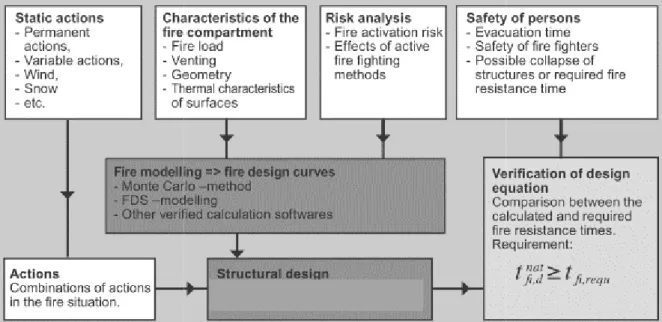
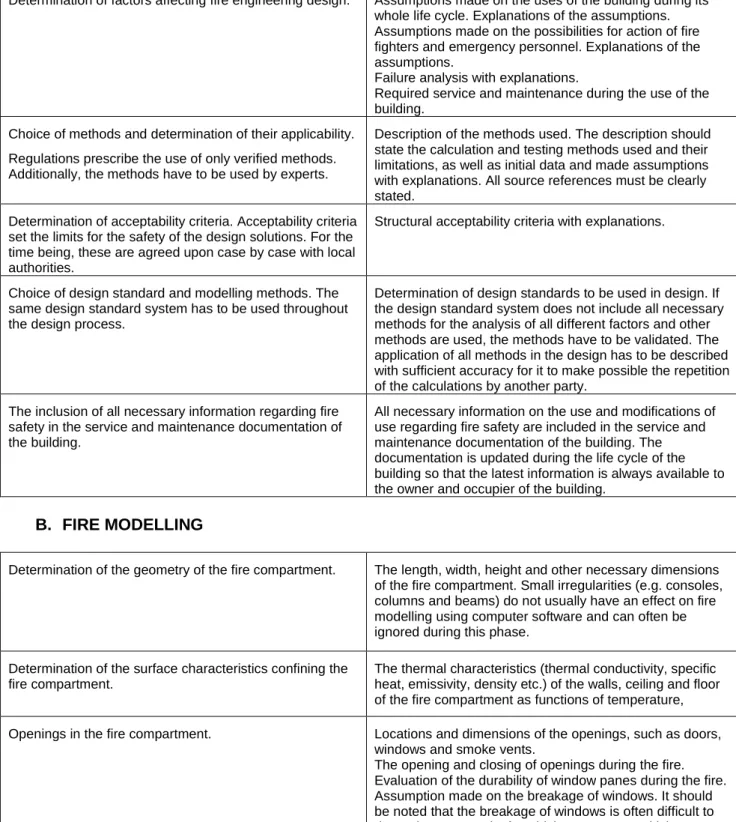
The first part of the material produced in this Work Package was prepared on the basis of the work of WG3 (Integrated Design) and edited by Professor Paulo Vila Real (Portugal) and Dr Jyri Outinen (Finland). The questionnaire was intended to establish current design practice in the member countries with respect to fire safety in buildings (Wald et al., Integrated fire engineering and response - state of the art report, Czech Technical University, Prague, 2011, 239, ISBN 978-80-01-04598-5). Seventeen countries provided responses (Belgium, Croatia, Czech Republic, Finland, France, Germany, Greece, Hungary, Italy, Poland, Portugal, Romania, Slovakia, Slovenia, Spain, Turkey and United Kingdom). Questions concern building regulations, design codes the approvals process, the role of insurance companies, qualification requirements for designers, the conditions for the use of performance based fire engineering design and passive fire protection. The answers have been collated and summarised in this document, so that comparisons can be made. The ways in which designers, regulators and authorities currently deal with application of the ‘fire’ parts of the structural Eurocodes (EN199x-1-2) in different countries, are then listed. The questions in this section, mainly suggested by Dr Florian Block, co-Chair of WG1, were finalised in 2014. Requirements for the contents of documentation on fire safety design were prepared by Dr Jyri Outinen, on the basis of Table 2 in Performance-based structural fire safety design (Rautaruukki Oyj). This part covers the use of Eurocodes in fulfilling the requirements for fire safety in national regulations.
The third part of this volume summarises a collection of knowledge developed in recent European and national research projects, which suggests that amendments should be made to the ‘fire’ parts of the Eurocodes. It is hoped that these suggestions will help to increase the fire safety of future European buildings. The work is categorised in terms of existing and expected standards, and is intended both to inform the direct development of the Eurocodes, but also to aid the production of Technical Documents which will accompany the next generation of Eurocodes.
The text was kindly reviewed by Prof. Gintaris Kaklauskas, Vilnius Gediminas Technical University, Lithuania. Luleå, March 2014
1 Current application of structural fire Eurocodes
In 2011 several questions were prepared to find out which were the current design practice in some European countries regarding fire safety in buildings. Thirteen countries have responded to that questionnaire. In 2014 this questionnaire has been updated by the country members that have answered to the first edition and four new countries have also contributed to the questionnaire. Seventeen countries have responded to the call: Belgium, Croatia, Czech Republic, Finland, France, Germany, Greece, Hungary, Italy, Poland, Portugal, Romania, Slovakia, Slovenia, Spain, Turkey and United Kingdom.
Questions about building regulations, design codes approvals process, insurance companies, qualification requirements for designers, precedence of performance based fire engineering projects and passive fire protection have been made.
The aim was to provide information about the practice in the European countries. Building and design to other countries meet often a variety of problems due to different procedure and acceptance. To help in this matter and also in co-operation between researchers from different countries this questionnaire has been gathered. Although EU should make this kind of interaction easier, the national regulations vary a lot and therefore this kind of information is valuable.
All the answers have been collected and put together in this document so that a comparison could be made between them. The way in which designers, regulators and authorities currently deal with the issues of fire safety in buildings in some European countries, can be checked hereafter.
The following questions, mostly suggested by Dr Florian Block Co-chairman of WP1, have been sent to the members. A comment from Professor Paulo Vila Real and Dr Jyri Outinen has been included.
1. Building Regulations
1.1 Are the Building Regulation Prescriptive / performance based (i.e. is it possible to design from first principles using finite element analysis, CFD, etc to show that the intents of the Building Regulations are met?)
Comment: Most of the countries allow for performance based design and the use of advanced calculation methods. Only in Greece, Hungary, Romania and Slovakia the regulations are purely prescriptive and do not allow for the use of advanced calculation methods.
1.2 What are the Building Regulations relevant for fire called and who is the issuing body? Comment:Each country provided a list of their Building Regulation for Fire Safety.
1.3 Is there additional guidance available to interpret the Building Regulations for fire?
Comment:Some Countries have guides and FAQ’s. Croatia, France, Greece and Italy do not have this type of information from the authorities.
1.4 Are there different regulations for certain types of buildings (I.e. schools, hospitals, airports, railway stations)?
2. Design Codes
2.1 What are the relevant national or international/European standards required to undertake the design of:
Means of escape Smoke management
Fire resistance of the construction Fire fighting
Fire safety systems (alarm, suppression, …)
Comment:Most of the Countries do not have relevant regulation for Means of escape, Smoke
management, Fire fighting and Fire safety systems (alarm, suppression, …), but some guidance are given in the National Regulation for fire safety or some rules are used from NFPA. Only Poland has referred the EN 12101 - Smoke and heat control systems, which also should be used in the other European Countries. All the countries have adopted the structural Eurocodes for checking fire resistance of constructions.
2. 2 Is it possible to use Eurocodes or other international fire standards in lieu of the local code? Comment:All the countries have adopted the structural Eurocodes.
2.3 Are there available the translations of the fire parts of Eurocodes? Which ones?
Comment:For the time being only Greece, Hungary and Italy do not have any translation available.
2.4 Are the national annexes available in internet?
Comment:Only Finland, Greece, Turkey and UK provide the National Annexes in the internet.
3. Approvals process
3.1 What is the normal route to get a project approved? Via a public body
Via a private body Self-certified
Comment: The projects are approved in most of the Countries via a public body.
3.2 What is the position of the fire brigade in the process?
Comment:In all the Countries the fire brigade plays an important role in the approval process. In Croatia Fire brigade doesn’t participate in the process of design approval.Exception is the case of approval of fire approach paths for the historical buildings.
3.3 Is there a third party review process common?
3.4 Is it necessary to follow an alternative route of approvals for performance based design and what would that route be?
Comment:For the Countries where it is possible to use performance based design the project follows the same route as for prescriptive approach, i.e. the authorities must approve the project.
3.5 What is the normal time frame for the approvals process?
Comment:Not easy to define. The time depends on the complexity of the project.
3.6 What level of information must be provided to the approving body?
Comment:In all the Countries the normal details of a project of fire safety of buildings.
3.7 Are any specific facilitators required to help the engineer in the approvals process?
Comment:In most of the countries there are no specific facilitators required to help the engineer in the approvals process, but in Czech Republic, Greece, Hungary, Portugal and Spain the support can be asked to the authorities.
4. Insurance companies
4.1 Are insurance companies involved in the design process?
Comment:In most of the countries no, but in Spain requirements of insurance companies are more restrictive that authorities for important projects, for instance; skyscrapers or industrial installations.
4.2 Are insurance companies open to a discussion on fire safety?
Comment:In most of the countries insurance companies are not particularly concerned with this matter when establishing insurance premium, they are normally conservatives. Only in Belgium and Finland the insurance companies open to a discussion on fire safety.
5. Qualification requirements for designers and Insurance Companies
5.1 Is it required to hold specific certificates/licenses in the member state to undertake fire safety design and fire engineering?
Comment:In some Countries no (Belgium, France, Germany in some federal sates, Greece, Spain, Turkey and UK) and in other yes (Croatia, Czech Republic, Finland, Germany in some federal sates, Hungary, Italy, Poland, Portugal, Romania, Slovakia and Slovenia).
5.2 Are there certain types of buildings for which specific design licenses are required?
Comment:In most of the countries no, but in Finland, Poland, Portugal and Spain there are certain types of buildings for which specific design licenses are required.
Comment:In most of the countries the license is individual. In France and Hungary the license holder is an organization.
5.4 Is a specific insurance required?
Comment:In all the Countries a specific insurance is not required.
6. Precedence of performance based fire engineering projects 6.1 Project details.
Comment:It depends on the Country the amount of the details. Normally are the temperature of the compartment according to the adopted fire scenario, and calculation in agreement with the standards.
6.2 What was performance based?
Comment:In most cases the fire scenario and structural fire behaviour, but also the evacuation time of the building.
6.3 What techniques where used to justify the non-compliance? Comment:Normally Fire Safety Engineering.
6.4 What approvals route was used?
Comment:Usual route through the authorities.
6.5 Is in your country standardised/recommended format of text of calculation of Performance based fire design?
Comment:In most countries no.
1.1 Building regulations
1.1.1 Prescriptive / performance based rules
Are the Building Regulation Prescriptive / performance based (i.e. is it possible to design from first principles using finite element analysis, CFD, etc to show that the intents of the Building Regulations are met?)
BELGIUM
The regulations are Prescriptive. For industrial buildings: mixture of prescriptive & performance based design and use some calculation methods.
CROATIA
CZECH REPUBLIC
The regulation allows performance based design and use of advanced calculation methods (technical expertise). Law No. 133/1985 Coll. on fire protection (Section 99): Certified engineer in fire protection can use during the design of fire safety of building approach which is determined by technical standart or another technical document of fire protection.
FINLAND
The regulation allows both: design based on prescriptive rules, performance based design and use of advanced calculation methods.
FRANCE
The building regulation is mostly prescriptive, but allows performance based design and use of advanced calculation methods.
GERMANY
The regulations in exceptionally allow performance based design and use of advanced calculation methods. These methods have to be discussed with the public authorities for every project.
GREECE
The regulation doesn’t allow the use of advanced calculation methods (finite element analysis, CFD, etc.). HUNGARY
The regulations are really prescriptive. ITALY
The regulations are basically prescriptive and concern several types of building use. However, the performance based design and advanced calculation methods may be applied either in the lack of prescriptive rules or in the case of “derogation” with respect to prescriptive rules.
POLAND
Generally building regulations are still prescriptive, but they allow performance based design and use of advanced calculation methods.
PORTUGAL
The regulation allows performance based design and use of advanced calculation methods. ROMANIA
The regulations are prescriptive. SLOVAKIA
It is not possible to use the engineering access. SLOVENIA
The regulations are mostly Prescriptive. The regulation allows performance based design and use of advanced calculation methods but in this case additional revision of the project is required.
SPAIN
There are excellent codes in Spain based in modern concepts of Fire Engineering in harmony with European regulations. Spanish designers can use advanced models with supervision of local officers.
TURKEY
The regulations are prescriptive. The main regulation is on the fire safety of buildings. It is obliged by law to design and construct buildings according this document. The official title (in Turkish) “Türkiye Binaların Yangından Korunması Hakkında Yönetmelik 2009” is available online.
UNITED KINGDOM
The regulation allows performance based design and use of advanced calculation methods.
1.1.2 Relevant Building Regulations
What are the Building Regulations relevant for fire called and who is the issuing body?
BELGIUM
Les Normes de Base:
- 7 Juillet 1994. - Arrêté royal fixant les normes de base en matière de prévention contre l'incendie et l'explosion, auxquelles les bâtiments nouveaux doivent satisfaire plus modifications
- Plus a lot of regulations for all sort of building types such as hotels, hospitals, homes for elderly people. CROATIA
Law on Fire Protection (NN 92/10), Ministry of Internal Affairs
Regulation of resistance to fire and other requirements that buildings must meet in fire (NN 29/13), Ministry of Internal Affairs
- Plus a lot of accompanying regulations which can be found on:
http://www.arhitekti-hka.hr/hr/zakoni-propisi/popis/zastita/od-pozara/
CZECH REPUBLIC
Law No. 133/1985 Coll., on Fire Protection
This Law includes obligations of state authorities, legal and natural persons on fire protection field (e.g. classification of performed business by fire risk, content evaluation of fire risk).
Decree No. 246/2001 Coll., on stipulation of fire safety conditions and on State fire supervision performance (Decree on fire prevention)
- basic requirements of fire safety
- types of dedicated fire technique, fire protection material means and fire safety equipment - requirements to Design and istallation of fire safety equipment
- type of fire protection documentation
- method of managing the fire protection documentation - contents and scope of fire safety design etc.
Decree No. 23/2008 Coll., on the technical requirements for the fire protection of buildings
This Decree lays down the technical requirements for fire protection in the design, construction and use of buildings.
FINLAND
The National Building Code of Finland, Series E, especially parts E1 and E2, issued by the Finnish Ministry of the Environment. Link to page with unofficial English translations of said documents:
http://www.ym.fi/fiFI/Maankaytto_ja_rakentaminen/Lainsaadanto_ja_ohjeet/Rakentamismaarayskokoelm a/The_National_Building_Code_of_Finland(10420)
Also the Finnish NA’s to the Eurocodes are available on this page. FRANCE
The principal document is "Le code de la construction et de l'habitation: The Code of the Construction and the buildings".
There are some decret:
- Décret n° 69-596 of 14-06-1969 which fix the general rules of construction of dwelling buildings - Décret n°67-1063 of 15-11-1967 which deals with the construction of high rise buildings and their fire protection
- Décret n°54-856 of 13-08-1954 retating to protection against the panic and fire hazards in the establishments receiving of the public.
The issuing body is the Direction of the civil safety of the Ministry for the interior:
http://www.interieur.gouv.fr/sections/a_l_interieur/defense_et_securite_civiles/presentation/ddsc/view GERMANY
For the reason that Germany is a federal state, every state (bavaria, lower saxony, north-rhine-westphalia, etc.) has its own building regulations. All are based on the Musterbauordnung “MBO” which is a template and could be translated by “Master building regulation”. The general requirements are written down there. Fire resistance time for different structural members of buildings can be determined by the Eurocodes (parts 1-2).
For industrial buildings according to Musterindustriebaurichtlinie (see below) there are calculation methods listed in DIN 18230.
GREECE
The main regulations are:
- Greek Presidential Edict (71/88) ‘Building Fire Protection’.
- Greek Goverment Decision (no 5905/1995) ‘Industrial Fire Protection’ HUNGARY
From the Ministry of Local Government:
9/2008. (II. 22.) ÖTM rendelet az Országos Tűzvédelmi Szabályzat kiadásáról ITALY
- Decree of the Ministry of the Interior, 16/02/2007 “Classificazione di resistenza al fuoco di prodotti ed elementi costruttivi di opere da costruzione”.
- Decree of the Ministry of the Interior, 09/03/2007, “Prestazioni di resistenza al fuoco delle costruzioni nelle attività soggette al corpo nazionale dei vigili del fuoco”.
- Decree of the Ministry of the Interior, 09/05/2007 “Direttive per l’attuazione all’approccio ingegneristico alla sicurezza antincendio”.
- Decree of the Infrastructure Ministry 14/01/2008, “NUOVE NORME TECNICHE PER LE COSTRUZIONI”. - Infrastructure Ministry n.617 of 02/02/2009, “Istruzioni per l’applicazione delle Nuove Norme Tecniche di cui al DM 14 Gennaio 2008”
- Decree of Republic President n° 151 01/08/2011, “Regolamento recante semplificazioni della disciplina dei procedimenti ralativi alla prevenzione degli incendi, a norma dell’art. 49 c0mma 4-quater, del decreto – legge 31 maggio 2010, n. 78, convertito, con modificazioni, dalla legge 30 luglio 2010, n. 122”.
- Decree of the Ministry of the Interior, 07/08/2012, “Disposizioni relative alle modalità di presentazione delle istanze concernenti I procedimenti di prevenzione incendi e alla documenazione da allegare, ai sensi dell’articolo 2, comma 7, del decreto del Presidente della Repubblica 1° Agosto 2011, n.151”.
POLAND
- Ustawa z dnia 7 lipca 1994 r. Prawo budowlane (Dz.U. z 2006 r. Nr 156, poz. 1118 z późn. zm.) – Sejm RP (Sejm of the Republic of Poland – Polish Parliment)
- Ustawa z dnia 24 sierpnia 1991 r. o ochronie przeciwpożarowej (t.j. Dz. U. Nr 178 z 2009 r. poz. 1380 z późn. zm.) – Sejm RP (Sejm of the Republic of Poland – Polish Parliment)
- Rozporządzenie Ministra Infrastruktury z dnia 12 kwietnia 2002 w sprawie warunków technicznych jakim powinny odpowiadać budynki i ich usytuowanie (Dz. U. Nr 75 z 2002 r, poz. 690 z póżn. zm.) – Ministerstwo Infrastruktury (Ministry of Infrastructure)
- Rozporządzenie Ministra Spraw Wewnętrznych i Administracji z dnia 7 czerwca 2010 roku w sprawie ochrony przeciwpożarowej budynków, innych obiektów budowlanych i terenów (Dz. U. Nr 109, poz. 719) – Ministerswo Spraw Wewnętrznych i Administracji (Ministry of the Interior and Administration).
PORTUGAL
- The law Decreto-Lei n.º 220/2008, de 12 de Novembro, which establishs the juridical rules for buildings fire safety Regime Jurídico da Segurança Contra Incêndio em edifícios (RJ-SCIE);
- Technical regulation for buildings fire safety Regulamento Técnico de Segurança contra Incêndio em Edifícios e Recintos (RT-SCIE), que constitui a Portaria n.º 1532/2008, de 29 de Dezembro de 2008; - Despacho n.º 2074/2009, de 15 de Janeiro, do Presidente da Autoridade Nacional de Protecção Civil on the technical criteria for determining the modified fire load density.
ROMANIA
“Normative for fire security of buildings“ Indicative: P118-99, issued by the Ministry of Public Works, 1999 SLOVAKIA
- The law n.º 314/2001; The protection for the fires;
- Announcement of Ministry of Interior of the Slovak Republic n. 121/2002; The fire prevention
- Part of government, which prepare juridical decree is ministry of Interior of the Slovak Republic. In the law 314/2001 are the basic duty on the part of protection for the fire and the details solve the Announcements of Ministry of interior of the Slovak Republic with technical contents;
- Fire security of buildings solve the Announcement of MI SR, n. 94/2004, which describe the technical requests on fire protection by the construction of building, so by the using of buildings.
SLOVENIA
- Zakon o varstvu pred požarom (Uradni list RS, št. 3/07 - uradno prečiščeno besedilo, 9/11 in 83/12) (eng: Fire Protection Act)
- Pravilnik o požarni varnosti v stavbah (Uradni list RS, št. 31/04, 10/05, 83/05, 14/07 in 12/13) (eng: Rules on fire safety in buildings)
- Pravilnik o zasnovi in študiji požarne varnosti (Uradni list RS, št. 12/13 in 49/13) (eng: Rules on the concept and study of fire safety)
- Pravilnik o požarnem redu (Uradni list RS, št. 52/07, 34/11 in 101/11) (eng: Rules on Fire Rules)
Issuing body is Ministry of Defense. SPAIN
We have two relevant codes in Spain;
- The Spanish Technical Building Code (CTE) for residential, commercial and administrative buildings, from Ministry for Housing. It’s a true performance-based code but it has the prescriptive rules too.
http://www.codigotecnico.org/web/cte/
- A second code for industrial buildings is the Spanish Security Code against to Fire in Industrial Activities (RSIEI) from Ministry of Industry, Tourism and Trade. It’s a specific legislation for industrial safety.
RSIEI- Reglamento de Seguridad contra Incendios en los Establecimientos Industriales
http://www.ffii.nova.es/puntoinfomcyt /Archivos/Dis_4539.pdf TURKEY
There is one regulation on the fire safety of buildings In Turkey. It is obliged by law to design and construct buildings according this document. The issuing body is “Ministry of Environment and Urban Planning of Turkey”.
The official title (in Turkish) “Türkiye Binaların Yangından Korunması Hakkında Yönetmelik 2009” is available online:
http://www.resmigazete.gov.tr/eskiler/2009/09/20090909-10.htm UNITED KINGDOM
- 2010 No. 2214 - Building And Buildings, England And Wales - The Building Regulations 2010
- 2010 No. 2215 - Building And Buildings, England And Wales - The Building (Approved Inspectors etc.) Regulations 2010.
1.1.3 Additional guidance
Is there additional guidance available to interpret the Building Regulations for fire?
BELGIUM Not answered. CROATIA
There is no additional guidance. CZECH REPUBLIC
Fire rescue service of Czech Republic provides some technical notes on fire safety of building. For example interpretation of laws about fire protection:
http://www.hzscr.cz/clanek/odpovedi-na-nejcastejsi-dotazy.aspx FINLAND
Guidance is available in Finnish and Swedish, e.g.
- Ympäristöopas 39 (YO39 Rakennusten paloturvallisuus & Paloturvallisuus korjausrakentamisessa) – a guidebook related to E1 / In Finnish and Swedish.
- RIL 221-2003 Paloturvallisuussuunnittelu (guidebook on fire safety engineering design) / In Finnish FRANCE
No
GERMANY
GREECE No. HUNGARY
We have some national pre standards
- 1. MSZE 595-1:2009 Építmények tűzvédelme. 1. rész: Fogalommeghatározások
- 2. MSZE 595-3:2009 Építmények tűzvédelme. 3. rész: Épületszerkezetek tűzállósági követelményei - 3. MSZE 595-5:2009 Építmények tűzvédelme. 5. rész: Tűzszakaszolás, tűzterjedés elleni védelem - 4. MSZE 595-6:2009 Építmények tűzvédelme. 6. rész: Kiürítés
- 5. MSZE 595-7:2009 Építmények tűzvédelme. 7. rész: A számított tűzterhelés és a mértékadó tűzidőtartam meghatározása
- 6. MSZE 595-8:2009 Építmények tűzvédelme. 8. rész: Hő és füst elleni védelem - 7. MSZE 595-9:2009 Építmények tűzvédelme. 9. rész: Robbanási túlnyomás lefúvatása ITALY
No, in Italy there isn’t a guide available to interpret the Building Regulations for fire. However, the National Body of Fire provides some technical notes (named “Lettere Circolari”) related to several decrees.
POLAND
Some instructions are published by Instytut Techniki Budowlanej (Building Research Institute). PORTUGAL
ANPC – National Authority of Civil Protection, provides some technical notes on fire safety of buildings: http://www.prociv.pt/Pages/Detalhe4.aspx?IDitem=41
ROMANIA
A guide is available in order to interpret the normative for fire security of buildings. SLOVAKIA
The basic requests are described in juristically decree – announcements. Concrete requests specify the Slovak technical standards.
SLOVENIA Yes, for example:
- Tehnične smernica TSG-1-001:2010, Požarna varnost v stavbah (eng: : Technical guideline: TSG-1-001:2010: Fire safety in buildings) general guidance on how to reach sufficient fire safety for the building. SPAIN
Yes, there are some guides and FAQ’s to interpret the practical application of these rules. In several cases this additional information is very relevant.
- CTE
http://www.codigotecnico.org/web/cte/faqs/ - RSIEI - Technical Guide
http://www.ffii.nova.es/puntoinfomcyt/Archivos /InstProtInc/GUIA_TECNICA_RSCI.pdf TURKEY
Additional guidance is provided by two main organizations TUYAK – Turkish Fire Protection and Education Foundation TUCSA – Turkish Institute of Steel Construction
By TUCSA:
European Recommendations for the Fire Safety of Steel Structures, ECCS Technical Committee (1983) Design Manual on the European Recommendations for the Fire Safety of Steel Structures, ECCS Technical Committee (1985)
By TUYAK:
Turkey’s Regulation on Fire Protection, July 2012 (Technical Books Series Number 05) UNITED KINGDOM
Practical guidance on ways to comply with the functional requirements in the Building Regulations is outlined in a series of 'Approved Documents' published by the Department for Communities and Local Government.
Each document contains:
- general guidance on the performance expected of materials and building work in order to comply with each of the requirements of the Building Regulations; and
- practical examples and solutions on how to achieve compliance for some of the more common building situations.
All of the latest 'Approved Documents' can be downloaded free on the Planning Portal at: www.planningportal.gov.uk/approveddocuments
1.1.4 Different regulations for certain types of buildings
Are there different regulations for certain types of buildings (I.e. schools, hospitals, airports, railway stations)?
BELGIUM
Yes for every type of buildings there is a different regulation: - Industrial buildings (part of “les norms de base”)
- Hospitals,
- All sort of different hotels
- All sort of different homes for elderly people, - Schools,
- Homes for youngsters - Homes for disabled people - Homes for childcare - ...
CROATIA
There are different regulations for certain type of buildings like: - Regulation on fire protection in warehouses (NN 93/08) - Regulation on fire protection in hotels (NN 100/99)
- Regulation on the essential requirements for fire protection of power plants and equipment (NN 146/05)
- Regulation on stations supplying vehicles with fuel (NN 93/93, 116/07, 141/08)
- Rules on technical standards for the design, construction, operation and maintenance of gas boilers (ex Yu regulation Sl. SFRJ 10/90, 52/90, accepted as good technical practice)
There is also an important regulation which divides buildings in different groups regarding complexity of fire protection measures:
Regulation on the classification of buildings into groups by the demanding of fire protection measures (NN 56/12)
CZECH REPUBLIC
Decree No. 23/2008 Coll., on the technical requirements for the fire protection of buildings This Decree specifies basic technical requirements for following types of buildings:
- 1 Family homes and buildings for family recreation - 2 Apartment buildings
- 3 Hostel buildings
- 4 Health care and social welfare buildings - 5 Buildings with assembly areas
- 6 Lookout tower buildings - 7 Garage buildings
- 8 Filling station, servicing and repair buildings
- 9 Buildings used for school and educational establishment activities - 10 Agricultural buildings
- 11 Production and storage buildings - 12 Listed buildings
- 13 Building site buildings FINLAND
Buildings are categorised into three fire classes, P1, P2 and P3, based on the use, size and occupancy of the building. P1 is the highest class and these buildings are usually not allowed to suffer structural collapse due to a fire.
Schools, hospitals, airports etc. are usually Class P1 buildings due to their size and the amount of people using them.
FRANCE
There are some other regulations:
- Arrêté du 31-01-1986, relating to the protection of the apartment buildings against the fire
- Arrêté du 25-06-1980, retating to protection against the panic and fire hazards in the establishments receiving of the public.
- Arrêté du 18-10-1977, retating to protection against the panic and fire hazards in the high rise buildings. There are different regulations (arêtes) for
- Car parks
- Industrial installation, - Warehouse,
- Nuclear installations GERMANY
As mentioned above, every state has its own code in Germany. This is the same for every building type code. The list includes the “template-versions”:
- Musterindustriebaurichtlinie (industrial buildings) - Mustergaragenverordnung (car parks)
- Musterversammlungsstättenverordnung (meeting halls) - Musterverkaufsstättenverordnung (shopping centres) - Musterschulbauorndnung (schools)
- Musterbeherbergungsstaättenverordnung (hotels) - Musterkrankenhausbauverordnung (hospitals)
GREECE
Greek Presidential Edict (71/88), Section 1, covers the following utilization-types of buildings: - Type I «Dwelling»
- Type II « Hotels - Type III «Schools» - Type IV «Offices» - Type V «Shops»
- Type VI «Places of public meetings»
- Type VII «Industrial, workshops and storage» - Type VIII «Hospitals and nursing homes» - Type IX «Parking places and fuel stations» HUNGARY
We use different groups according the fire resistance of the building materials.
- In the first group there are high rise buildings and the middle high rise buildings if there is in a crowd staying room above 13m.
- In the second group there are kindergartens, social homes, closed garages, handicap people staying room if the building is taller than 2 floors, middle high rise buildings, buildings which are not in the first group with the two and three underground floors.
- In the third group there are schools, living buildings which taller than 2 level, community buildings if the top floor is not over 13,65m, more than one floors open garages, handicap people staying room.
- In the fourth group the one floor living and holiday buildings, the one floor community buildings minimum 25 maximum 50 person.
- In the fifth group, maximum ground floor living and holiday buildings maximum 25 person. ITALY
The Decree of Republic President 01/08/2011 n.151 (Regolamento recante semplificazioni della disciplina dei procedimenti ralativi alla prevenzione degli incendi, a norma dell’art. 49 comma 4-quater, del decreto – legge 31 maggio 2010, n. 78, convertito, con modificazioni, dalla legge 30 luglio 2010, n. 122) defines 80 types of building use, which are subjected to the control of the Fire Brigades.
For many building uses the Ministry provides specific Technical Rules of Fire Fighting, generally based on a prescriptive approach.
POLAND
Regulations are general for all kinds of buildings, nevertheless they divide building into three main groups: - Housing and public utility buildings; involving endangering people (ZL)
- Production plants and warehouses (PM) - Agricultural (IN)
PORTUGAL
The RJ-SCIE covers the following twelve utilization-types: - Type I «Dwelling»
- Type II «Car parks» - Type III «Administrative» - Type IV «Schools»
- Type V «Hospitals and nursing homes»
- Type VI «Theatres/cinemas and public meetings» - Type VII «Hotels and restaurants»
- Type VIII «Shopping and transport centres» - Type IX «Sports and leisure»
- Type X «Museums and art galleries» - Type XI «Libraries and archives»
- Type XII «Industrial, workshops and storage»
Due to the big dimension in plan and height the building can be classified as “atypical danger”. ROMANIA
Regulations are general for all kinds of buildings, divided in industrial and civil buildings. A special separate normative is available for underground parkings.
SLOVAKIA
Yes they are specifying in technical decrees:
- Announcements of MI SR n.94/2004 – there are described technical requests on Fire safety by construction and using of the buildings.
- Announcements of MI SR n.96/2004, there are described principles fire protection by manipulation and the storage of flammable liquids, hard fuel oils and flowers and animal fat and oils.
- Announcements of MI SR n.121/2002 – about fire prevention
- Announcements of MI SR n.124/2000- here by the work with the flammable gasses
- Announcements of MI SR n.142/2004 about the fire safety by the construction and using the spaces, where are used pain materials.
- Announcements of MI SR n.258/2007 about demands of fire security by the storage and manipulation with solid flammable materials.
SLOVENIA
Yes, for some type of buildings with high number of possible occupant (I.e. hospitals, sport domes,..) or with higher risk of fire, like chemical companies..., regulations rules from other countries are allowed, Switzerland (VKF rules), German (MBO rules).
SPAIN
The Spanish Technical Building Code (CTE) covers the most types of buildings.
The industrial building or big storage building are covered by the Spanish Security Code against to Fire in Industrial Activities (RSIEI).
Specific activities are out of both codes, for instance; nuclear or mineral extraction. TURKEY
No. The regulations are for all buildings. But there are the following building categories listed within the Turkish Fire Safety Regulation of Buildings “Türkiye Binaların Yangından Korunması Hakkında Yönetmelik 2009”
- Residents
- Hotels, Restaurants - Cooperate buildings - Offices
- Business type buildings - Industrial buildings - Shopping centers - Storage / Warehouses
- Storages of flammables / Gas stations / Refineries - Mixed occupation buildings
UNITED KINGDOM - 2 (a) Institutional
- 2 (a) Other residential: a. in bedrooms; b. in bedrooms corridors; c. elsewhere - 3 office
- 4 Shop and commercial
- 5 Assembly and recreation: a. building primarily for disabled people; b. areas with seating in rows; c. elsewhere
- 6. Industrial: normal hazard; higher hazard
- 7. Storage and other non-residential: normal hazard; higher hazard - 2-7 Place of special fire hazard
- 2-7 Plant room or rooftop plant: a. distancewithin the room; b. escape route not in open air (overall travel distance); c. escape route in open air (overall travel distance)
1.2 Design codes
1.2.1 Relevant national or international/European standards - Means of escape What are the relevant national or international/European standards required to undertake the design of: means of escape?
BELGIUM
There are no relevant standards on this matter. CROATIA
There are no relevant Croatian standards issued specifically on this matter. Evacuation is covered by
Regulation of resistance to fire and other requirements that buildings must meet in fire (NN 29/13) and by Law of Safety on Works(NN 59/96, 94/96-correct., 114/03, 86/08, 75/09, 143/12)
We also use international standards for this purpose like NFPA (USA), TRVB (Austria). CZECH REPUBLIC
- CSN 73 0802 - Fire protection of buildings - Non-industrial buildings - CSN 73 0804 - Fire protection of buildings - Industrial buildings FINLAND
No information on design standards, but the relevant regulations include:
- National decree No. 805/2005 concerning lighting and signalling of escape routes, in Finnish. - Regulations given also in Finnish National Building Code Part E1 Chapter 10 (see link above). FRANCE
There are no relevant standards on this matter. GERMANY
GREECE
There are no relevant standards on this matter. HUNGARY
There are no relevant standards on this matter. ITALY
There are national standards depending on the use of building (within the quoted prescriptive technical rules of fire fighting concerning the specific building use).
POLAND
- Rozporządzenie Ministra Infrastruktury z dnia 12 kwietnia 2002 w sprawie warunków technicznych jakim powinny odpowiadać budynki i ich usytuowanie (Dz. U. Nr 75 z 2002 r, poz. 690 z póżn. zm.) – Ministerstwo Infrastruktury (Ministry of Infrastructure)
- Rozporządzenie Ministra Spraw Wewnętrznych i Administracji z dnia 7 czerwca 2010 roku w sprawie ochrony przeciwpożarowej budynków, innych obiektów budowlanych i terenów (Dz. U. Nr 109, poz. 719) – Ministerswo Spraw Wewnętrznych i Administracji. (Ministry of the Interior and Administration).
- PN-ISO 8421-6 Ochrona przeciwpożarowa. Terminologia. Ewakuacja i środki ewakuacji. - PN-92/N-01256/02 Znaki bezpieczeństwa. Ewakuacja.
PORTUGAL
Technical Regulation for Fire Safety in Buildings (Portaria n.º 1532/2008). ROMANIA
The regulations for the means of escape are included in the mentioned normative for fire security. SLOVAKIA
The escape ways, which are saved for the fire and secured with air ventilation. SLOVENIA
No information on design standards, but relevant regulations for buildings on this issue are given in: Tehnične smernica TSG-1-001:2010, Požarna varnost v stavbah (eng: : Technical guideline: TSG-1-001:2010: Fire safety in buildings)
- i.e. rules on escape routes (distance width), issues concerning emergency lighting and signalling of escape routes are given.
SPAIN
Section SI-3 of CTE is devoted to provision of a safe route(s) for emergency evacuation by horizontal and vertical escape.
Moreover, RSIEI has additional requirements for industrial buildings. TURKEY
There are no relevant standards on this matter. UNITED KINGDOM
1.2.2 Relevant national or international/European standards - Smoke management What are the relevant national or international/European standards required to undertake the design of: smoke management?
BELGIUM
There is not a general legislation only a these standards:
- NBN S 21-208-1 : 1995 - Protection incendie dans les bâtiments - Conception et calcul des installations d'évacuation de fumées et de chaleur (EFC) - Partie 1 : Grands espaces intérieurs non cloisonnés s'étendant sur un niveau
- NBN S 21-208-2 : 2006 - Protection incendie dans les bâtiments - Conception des systèmes d'évacuation des fumées et de la chaleur (EFC) des bâtiments de parking intérieurs
- NBN S 21-208-2/prA1 : 2010 - Protection incendie dans les bâtiments - Conception des systèmes d'évacuation des fumées et de la chaleur (EFC) des parkings fermé
CROATIA
In Croatia EU norms and standards for smoke management are used (HRN EN 12101-1 to HRN EN 12101-6) CZECH REPUBLIC
- CSN 73 0802 - Fire protection of buildings - Non-industrial buildings (Annex H – natural smoke and heat exhaust)
- CSN P CEN/TR 12101-5 - Smoke and heat control systems - Part 5: Guidelines on functional recommendations and calculation methods for smoke and heat exhaust ventilation systems FINLAND
No information on design standards, but the relevant regulations include:
- Regulations given in Finnish National Building Code Part E1 Chapter 11 (see link above). FRANCE
There are:
- Technical instruction n° 246, relating to receiving smoke clearing in the establishments of the public. - Technical instruction n° 263 relating to the construction and the receiving smoke clearing of interior free volumes (atriums) in the establishments of the public.
GERMANY
vfdb-guideline, Muster-Versammluingsstättenverordnung, Muster-Industriebaurichtlinie. GREECE
There are no specific regulations on this matter. HUNGARY
We use MSZ EN 12101 Smoke and heat control system standard. ITALY
There are national standards depending on the use of building (within the quoted prescriptive technical rules of fire fighting concerning the specific building use).
POLAND
- Rozporządzenie Ministra Infrastruktury z dnia 12 kwietnia 2002 w sprawie warunków technicznych jakim powinny odpowiadać budynki i ich usytuowanie (Dz. U. Nr 75 z 2002 r, poz. 690 z póżn. zm.) – Ministerstwo Infrastruktury (Ministry of Infrastructure)
ciepła -- Zasady projektowania. (Fire protection of buildings - Installation of gravitational devices for smoke and heat drainage - Design rules
- PN-EN-12101-1 System kontroli rozprzestrzeniania dymu i ciepła – Część 1: Wymagania techniczne dotyczące kurtyn dymowych. (Smoke and heat control systems -- Part 1: Specification for smoke barriers.) - PN-EN-12101-2 System kontroli rozprzestrzeniania dymu i ciepła – Część 2: Wymagania techniczne dotyczące klap dymowych. (Smoke and heat control systems -- Part 2: Specification for natural smoke and heat exhaust ventilators.)
- PN-EN-12101-3 System kontroli rozprzestrzeniania dymu i ciepła – Część 3: Wymagania techniczne dotyczące wentylatorów oddymiających. (Smoke and heat control systems -- Part 3: Specification for powered smoke and heat exhaust ventilators.)
- PN-EN-12101-6 System kontroli rozprzestrzeniania dymu i ciepła – Część 6: Wymagania techniczne dotyczące systemów różnicowania ciśnień -- Zestawy urządzeń (Smoke and heat control systems -- Part 6: Specification for pressure differential systems – Kits.)
- PN-EN-12101-10 System kontroli rozprzestrzeniania dymu i ciepła – Część 10: Zasilacze (Smoke and heat control systems -- Part 10: Power supplies.)
PORTUGAL
There are no specific regulations on this matter but documents / different rules, for example, the NFPA and APSARD.
ROMANIA
The regulations for the smoke management are included in the mentioned normative for fire security. SLOVAKIA
Systems for offtake of warm and combustion gasses. The rules are from the producers or from Slovak technical standards 12101. Accepted are technical standards DIN, NFS and the directions VdS.
SLOVENIA
General requirements on smoke management are given in:
Tehnične smernica TSG-1-001:2010, Požarna varnost v stavbah, (eng: Technical guideline: TSG-1-001:2010: Fire safety in buildings)
More design options are given:
Smernica 405-1/10 Naprave za naravni odvod dima in toplote (NODT), (Technical guidiline for natural smoke and heat exhaustion)
Smernica 405-2/10 Naravni odvod dima iz stopnišč (NODS), Technical guideline for natural smoke exhaustion from stairways)
Mainly still regulations from other EU contries are use, especially for mechanical (forced) smoke and heat : Technical guideline, mainly German (DIN) or English (BS).
SPAIN
The article 8th of Section SI-3 of CTE to remit to national standard UNE 23585:2004 and to Euronorme EN 12101-6:2005 for smoke and heat control systems.
Nowadays, this Euronorme is Spanish standard UNE-EN 1991-1-2:2004 since 2006.
The Annex IIof RSIEI has additional requirements and allows using others international standards. TURKEY
Within the Turkish Fire Safety Regulation of Buildings “Türkiye Binaların Yangından Korunması Hakkında Yönetmelik 2009”, the Clause 86, 87, 88 give guidelines on smoke management (Chapter 6).
UNITED KINGDOM
1.2.3 Relevant national or international/European standards - Fire resistance of the construction
What are the relevant national or international/European standards required to undertake the design of: Fire resistance of the construction?
BELGIUM
There is a standard for the fire resistance of
- NBN 713-020 Protection contre l'incendie - Comportement au feu des matériaux et éléments de construction - Résistance au feu des éléments de construction
- Part 1.2 (Structural fire design) from Eurocodes. CROATIA
Requirements on fire resistance:
- Regulation of resistance to fire and other requirements that buildings must meet in fire (NN 29/13
- Part 1.2 (Structural fire design) from Eurocodes, HRN DIN 4102 (till 2019) CZECH REPUBLIC
Requirements on fire resistance:
- CSN 73 0802 - Fire protection of buildings - Non-industrial buildings - CSN 73 0804 - Fire protection of buildings - Industrial buildings - CSN 73 0810 - Fire protection of buildings - General requirements - Eurocodes.- Part 1.2 (Structural fire design)
- CSN 73 0821 - Fire protection of buildings - Fire resistance of engineering structures FINLAND
Structural Eurocodes. Parts 1.2 (Structural fire design), National building code of Finland. FRANCE
Part 1.2 (Structural fire design) from Eurocodes. GERMANY
Part 1.2 (Structural fire design) from Eurocodes GREECE
National prescriptive rules require a certain standard fire resistance of walls and floors, depending on their use and geometry.
HUNGARY
(Structural fire design) from Eurocodes. ITALY
The Decree of the Ministry of the Interior, 16/02/2007 (“Classificazione di resistenza al fuoco di prodotti ed elementi costruttivi di opere da costruzione”) is applicable to assess the fire resistance of the building. In addition, the Decree allows the use of the Parts 1.2 of the relevant Eurocodes.
POLAND
- Rozporządzenie Ministra Infrastruktury z dnia 12 kwietnia 2002 w sprawie warunków technicznych jakim powinny odpowiadać budynki i ich usytuowanie (Dz. U. Nr 75 z 2002 r, poz. 690 z póżn. zm.) – Ministerstwo Infrastruktury (Ministry of Infrastructure)
- Eurocodes: Part 1.2 (Structural fire design). Other codes (based on European codes)
- PN-EN 1363-1:2001 Badania odporności ogniowej -- Część 1: Wymagania ogólne (Fire resistance test – Part 1: General requirements)
- PN-EN 1364-1:2001 Badania odporności ogniowej elementów nienośnych -- Część 1: Ściany (Fire resistance tests for non-loadbearing elements: Part 1: Walls)
- PN-EN 1365-1:2001 Badania odporności ogniowej elementów nośnych -- Część 1: Ściany (Fire resistance tests for loadbearing elements: Part 1: Walls)
- Other parts of PN-EN 1363, 1964, 1965 PORTUGAL
Part 1.2 (Structural fire design) from Eurocodes. ROMANIA
Part 1.2 (Structural fire design) from Eurocodes, translated in Romanian Standards (SR) together with the corresponding National Annexes.
SLOVAKIA
(Structural fire design) is fromestimation of proof or calculation with help of Eurocodes. SLOVENIA
Part 1.2 (Structural fire design) from Eurocodes, or if desired performance based rules. SPAIN
Nowadays, three codes are in coexistence in Spain Regulations for fire resistance verifications of buildings: 1) Section SI-6 of Código Técnico de Edificacion is devoted to requirements for structural fire resistance and his verification for several structural materials:
- Annex C Concrete Structures - Annex D Steel Structures - Annex E Timber Structures - Annex F Masonry
2) National codes; EHE (Concrete Structures) and EAE (Steel Structures)
3) Finally, the official translations of Eurocodes. They are adapted as Spanish standard UNE-EN 199x-1-2 However, national Spanish rules for structural verification under fire are very similar at the general rules of Eurocodes.
TURKEY
No. There are no standards required for fire resistance of the construction. UNITED KINGDOM
BS EN’s or Eurocodes primarily but functional regulations so any guidance permissible.
1.2.4 Relevant national or international/European standards - Fire fighting
What are the relevant national or international/European standards required to undertake the design of: Firefighting?
BELGIUM
The NBN S21-011 to NBN S21-018 range should have been replaced by the NBN EN3 -1 to EN3-6. Because the Dutch version of EN3 doesn’t exist, the NBN preserved this range (against all CEN-rules). These standards have become obsolete. In practice, most fire extinguishers are in accordance with the EN3 ranges, of which the last valid standard is the EN3-7: 2004.
CROATIA
All EU norms which covered fire fighting equipment are used in Croatia. There are stipulated in Technical regulation on construction products, group H (NN 33/10, 87/10, 146/10, 81/11, 100/11-correct. 130/12, 81/13). Beside this there are a lot specific regulations related to fire fighting. Main regulation is Law of Fire fighting.
CZECH REPUBLIC
CSN 73 0873 - Fire protection of buildings - Equipment for fire-water supply (Annex B – Fundamentals for analyses fire fighting).
FINLAND
No information on design standards, but the relevant regulations include:
- Regulations given in Finnish National Building Code Part E1 Chapter 11 (see link above). FRANCE
There are no relevant standards on this matter. GERMANY
Feuerwehrdienstvorschrift 3 (FwDV 3), Feuerwehrdienstvorschrift 4 (FwDV 4) (fire brigade codes), Fire Protection Law.
GREECE
There are no relevant standards on this matter. HUNGARY
ITALY
There are national standards depending on the use of building (within the quoted prescriptive technical rules of fire fighting concerning the specific building use).
POLAND
- Rozporządzenie Ministra Spraw Wewnętrznych i Administracji z dnia 7 czerwca 2010 roku w sprawie ochrony przeciwpożarowej budynków, innych obiektów budowlanych i terenów (Dz. U. Nr 109, poz. 719) – Ministerswo Spraw Wewnętrznych i Administracji (Ministry of the Interior and Administration).
- Rozporządzenie Ministra Spraw Wewnętrznych i Administracji z dnia 24 lipca 2009 r. w sprawie przeciwpożarowego zaopatrzenia w wodę oraz dróg pożarowych (Dz.U. Nr 124, poz. 1030).
- Rozporządzenie Ministra Spraw Wewnętrznych i Administracji z dnia 29 grudnia w sprawie szczegółowych zasad organizacji krajowego systemu ratowniczo-gaśniczego(Dz. U. 111, poz.1311)
- PN-B-02864 Ochrona przeciwpożarowa budynków. Przeciwpożarowe zaopatrzenie wodne. Zasady obliczania zapotrzebowania na wodę do zewnętrznego gaszenia pożaru.
- PN-B-02865 Ochrona przeciwpożarowa budynków. Przeciwpożarowe zaopatrzenie wodne. Instalacja wodociągowa przeciwpożarowa.
- PN-82/B-02857 Ochrona przeciwpożarowa w budownictwie. Przeciwpożarowe zbiorniki wodne. Wymagania ogólne.
PORTUGAL
There are no relevant standards on this matter. ROMANIA
There are national regulations depending on the use of building (within the quoted prescriptive technical rules of fire fighting concerning the specific building use).
SLOVAKIA
It is solved the adequate conditions for efficient of fire fighting units. SLOVENIA
In technical guideline:
Tehnične smernica TSG-1-001:2010, Požarna varnost v stavbah (eng: : Technical guideline: TSG-1-001:2010: Fire safety in buildings)
There are some points considering firefighting issues, mainly accessibility for fire fighting. And rules:
-Pravilnik o izbiri in namestitvi gasilnih aparatov (Ur.l. RS, št. 67/2005) (Rules on the selection and installation of fire extinguishers)
-Pravilnik o preizkušanju hidrantnih omrežij Ur.l. RS, št. 22/1995) (Rules on the testing of the hydrant network) SPAIN
Section SI-5 of CTE is devoted to accessibility for fire fighting. TURKEY
Within the Turkish Fire Safety Regulation of Buildings “Türkiye Binaların Yangından Korunması Hakkında Yönetmelik 2009”, Chapter 7 gives fire extinguishing systems and management. However, no clearly defined fire fighting guidelines.
UNITED KINGDOM
1.2.5 Relevant national or international/European standards - Fire safety systems (alarm, suppression, …)
What are the relevant national or international/European standards required to undertake the design of: Fire safety systems (alarm, suppression, …)?
BELGIUM
There are specific standards only some demands in the regulations
- NBN EN 54 part 1,2,3,4,5,7,10,11,12,13,16,17,18, 20, 21, 23, 24, 25; specifies requirements for all component parts of a fire alarm system
CROATIA
All EU norms which covered fire safety systems are used in Croatia. There are stipulated in Technical regulation on construction products, group H (NN 33/10, 87/10, 146/10, 81/11, 100/11-correct. 130/12, 81/13)
CZECH REPUBLIC
- CSN EN 54 – x (Fire detection and fire alarm systems)
- CSN 73 0875 - Fire protection of buildings – Design of fire detection systems FINLAND
- SFS-EN 12845 + A2 Kiinteät palonsammutusjärjestelmät. Automaattiset sprinklerilaitteistot. Suunnittelu, asennus ja huolto. (Fixed firefighting systems. Automatic sprinkler systems. Design, installation and maintenance)
- prNS-INSTA 900-1: Residential sprinkler systems – Part 1: Design, installation and maintenance - CEA 4001 Sprinkler Systems: Planning and Installation
- A national decree on extuingishing methods is under preparation. - CEN / TC 72 published standards, list available at
http://www.cen.eu/CEN/Sectors/TechnicalCommitteesWorkshops/CENTechnicalCommittees/Pages/Standa rds.aspx?param=6055&title=CEN%2FTC+72
- CEA 4040 Fire Protection Systems - Specifications for automatic fire detection and fire alarm systems - Planning and Installation.
- ST-ohjeisto 1 Paloilmoittimen suunnittelu, asennus, huolto ja kunnossapito 2009 (guidance in Finnish) FRANCE
European standards and the NFPA documents. GERMANY
DIN EN 54: Brandmeldeanlagen (EN 54: Fire detection and fire alarm systems), DIN 14675:
Brandmeldeanlagen - Aufbau und Betrieb (DIN 14675: Fire alarm systems – setup and operation), DIN VDE 0833: Gefahrenmeldeanlagen für Brand, Einbruch und Überfall (DIN VDE 0833: Alarm systems for fire, intrusion and hold-up ).
GREECE
National standards and NFPA documents. HUNGARY
European standards and the NFPA documents. ITALY
There are national standards depending on the use of building (within the quoted prescriptive technical rules of fire fighting concerning the specific building use).
POLAND
- Rozporządzenie Ministra Spraw Wewnętrznych i Administracji z dnia 7 czerwca 2010 roku w sprawie ochrony przeciwpożarowej budynków, innych obiektów budowlanych i terenów (Dz. U. Nr 109, poz. 719) – Ministerswo Spraw Wewnętrznych i Administracji (Ministry of the Interior and Administration).
- PN-EN 54-1 Systemy sygnalizacji pożarowej – Wprowadzenie. Fire detection and fire alarm systems – Part 1: Introduction.
- PN-EN 54-2 Systemy sygnalizacji pożarowej – Część 2: Centrale sygnalizacji pożarowej. Fire detection and fire alarm systems – Part 2: Introduction.
- PN-EN 54-3 Systemy sygnalizacji pożarowej -- Część 3: Pożarowe urządzenia alarmowe -- Sygnalizatory akustyczne.
- PN-EN 54-4 Systemy sygnalizacji pożarowej -- Część 4: Zasilacze.
- PN-EN 54-5 Systemy sygnalizacji pożarowej -- Część 5: Czujki ciepła -- Czujki punktowe.
- PN-EN 54-7 Systemy sygnalizacji pożarowej -- Część 7: Czujki dymu -- Czujki punktowe działające z wykorzystaniem światła rozproszonego, światła przechodzącego lub jonizacji.
- PN-EN 54-10 Systemy sygnalizacji pożarowej -- Część10: Czujki płomienia -- Czujki punktowe. - PN-EN 54-11 Systemy sygnalizacji pożarowej -- Część 11: Ręczne ostrzegacze pożarowe.
- PN-EN 54-12 Systemy sygnalizacji pożarowej -- Część 12: Czujki dymu -- Czujki liniowe działające z wykorzystaniem wiązki światła przechodzącego.
- PN-EN 54-13 Systemy sygnalizacji pożarowej -- Część 13: Ocena kompatybilności podzespołów systemu. - PN-EN 54-16 Systemy sygnalizacji pożarowej -- Część 16: Dźwiękowe systemy ostrzegawcze – Centrale. - PN-EN 54-17 Systemy sygnalizacji pożarowej -- Część 17: Izolatory zwarć.
- PN-EN 54-18 Systemy sygnalizacji pożarowej -- Część 18: Urządzenia wejścia/wyjścia. - PN-EN 54-20 Systemy sygnalizacji pożarowej -- Część 20: Czujki dymu zasysające.
- PN-EN 54-21 Systemy sygnalizacji pożarowej -- Część 21: Urządzenia transmisji alarmów pożarowych i sygnałów uszkodzeniowych.
- PN-EN 54-23 Systemy sygnalizacji pożarowej -- Część 23: Pożarowe urządzenia alarmowe -- Sygnalizatory optyczne.
- PN-EN 54-24 Systemy sygnalizacji pożarowej -- Część 24: Dźwiękowe systemy ostrzegawcze – Głośniki. - PN-EN 54-25 Systemy sygnalizacji pożarowej -- Część 25: Urządzenia wykorzystujące łączność radiową. - PKN-CEN/TS 54-14 Systemy sygnalizacji pożarowej -- Część 14: Wytyczne planowania, projektowania, instalowania, odbioru, eksploatacji i konserwacji.
- PN-EN 1838 Zastosowania oświetlenia -- Oświetlenie awaryjne. Lighting applications – Emergency lighting. - PN-EN 50172 Systemy awaryjnego oświetlenia ewakuacyjnego.
- PN-EN 12845 Stałe urządzenia gaśnicze -- Automatyczne urządzenia tryskaczowe -- Projektowanie, instalowanie i konserwacja. Fixed firefighting systems – Automatic sprinkler systems – Design, installation and maintenance.
- PN-EN 15004-1 Stałe urządzenia gaśnicze -- Urządzenia gaśnicze gazowe -- Część 1: Ogólne wymagania dotyczące projektowania i instalowania.
- PN-EN 60849 Dźwiękowe systemy ostrzegawcze. PORTUGAL
ROMANIA
There are national regulations depending on the use of building (within the quoted prescriptive technical rules of firefighting concerning the specific building use).
SLOVAKIA
European standards. SLOVENIA
European standards and the DIN and NFPA documents. SPAIN
Section SI-4 of CTE is devoted to fire safety systems. More requirements are described in Annex II of Spanish Security Code against to Fire in Industrial Activities (RSIEI) with reference to Euronormes TURKEY
Within the Turkish Fire Safety Regulation of Buildings “Türkiye Binaların Yangından Korunması Hakkında Yönetmelik 2009”, Chapter 5 (Section 4) includes fire alarm systems and Chapter 7 includes fire
extinguishing systems. UNITED KINGDOM
BS EN’s or Eurocodes primarily but functional regulations so any guidance permissible
1.2.6 Use of Eurocodes or other international fire standards
Is it possible to use Eurocodes or other international fire standards in lieu of the local code?
BELGIUM
Yes, but you must request a deviation. When documenting your file, you can apply these standards. CROATIA Yes CZECH REPUBLIC Yes FINLAND Yes FRANCE Yes GERMANY Yes GREECE Yes HUNGARY