Working Paper Series
Real Balances in the Utility Function: Evidence for Brazil
Leonardo Soriano de Alencar and Márcio I. Nakane
ISSN 1518-3548ISSN 1518-3548 CGC 00.038.166/0001-05
Working Paper Series
Edited by:
Research Department (Depep) (E-mail: [email protected])
Reproduction permitted only if source is stated as follows: Working Paper Series n. 68. Authorized by Afonso Sant’Anna Bevilaqua (Deputy Governor for Economic Policy).
General Control of Publications Banco Central do Brasil
Secre/Surel/Dimep
SBS – Quadra 3 – Bloco B – Ed.-Sede – M1 Caixa Postal 8.670
70074-900 Brasília – DF – Brazil Phones: (5561) 414-3710 and 414-3711 Fax: (5561) 414-3626
E-mail: [email protected]
The views expressed in this work are those of the authors and do not reflect those of the Banco Central or its members. Although these Working Papers often represent preliminary work, citation of source is required when used or reproduced.
As opiniões expressas neste trabalho são exclusivamente do(s) autor(es) e não refletem a visão do Banco Central do Brasil.
Ainda que este artigo represente trabalho preliminar, citação da fonte é requerida mesmo quando reproduzido parcialmente.
Banco Central do Brasil Information Bureau Address: Secre/Surel/Diate SBS – Quadra 3 – Bloco B Edifício-Sede – 2º subsolo 70074-900 Brasília – DF – Brazil Phones: (5561) 414 (....) 2401, 2402, 2403, 2404, 2405, 2406 DDG: 0800 992345 Fax: (5561) 321-9453 Internet: http://www.bcb.gov.br E-mails: [email protected] [email protected]
Real Balances in the Utility Function: Evidence for Brazil
*Leonardo Soriano de Alencar
**Márcio I. Nakane
***Abstract
The aim of this paper is to examine the relevance of a money-in-the-utility-function model for the Brazilian economy. In addition to consumption, the household is supposed to derive utility from leisure and from the holdings of real balances. The system, formed by the first-order conditions of the household intertemporal problem (Euler equations), is estimated by generalized method of moments (GMM). The results show strong support for the presence of money in the utility function for Brazil.
Keywords: money in the utility function, GMM estimation JEL Classification: D91, E21, E49
*
This article is part of the first author’s Doctorate thesis submitted to the Department of Economics, University of São Paulo. The views expressed here are those of the authors and do not reflect those of the Central Bank of Brasil or its members.
** Research Department, Central Bank of Brazil. E-mail: [email protected]
1. Introduction
This paper presents an empirical study about the relevance of a model with money in the utility function (MIU) estimated for Brazil. The first order conditions for an intertemporal optimization problem for a representative agent are estimated through GMM (Generalized Method of Moments). The framework of a representative agent is employed due to its analytical simplicity. The representative agent derives utility not only from consumption but also from the holdings of real balances, and from leisure activities. The estimated utility function parameters may be useful for researchers working in the field of monetary dynamic general equilibrium models applied to Brazil.
To the best of our knowledge, this is the first study aiming at an empirical evaluation of a model in the class of Brock (1974, 1975)–Sidrauski (1967) using Brazilian data. It is also the first paper to simultaneously estimate the utility function parameters incorporating consumption, real balances, and leisure as arguments. Reis et al. (1998) make use of the same methodology as ours to examine the existence of precautional savings. Issler and Piqueira (2000) investigate whether there is an equity premium puzzle in the country. These two articles, however, incorporate only consumption in the utility function. Another related article is by Costa Val and Ferreira (2002), who estimate a model with consumption and leisure in the utility function to test the performance of some standard real business cycle models calibrated for Brazil.
Another novelty of the present paper is the use of the official series for quarterly consumption, as calculated by IBGE. Both Issler and Piqueira (2000) as well as Reis et
al. (1998) have made use of a quarterly consumption series calculated by the last ones.
The calculated series is, presumably, subject to more measurement errors than the official estimates.1
With regard to the international literature, there are some papers examining the relevance of MIU models estimated for the US economy. Holman (1998) investigated different utility function specifications and found results favoring the Brock-Sidrauski model. Dutkowsky and Dunsky (1998) obtained similar results when examined the
1
liquidity of the M2 components. There are also some less favorable results in the literature. For example, Finn et al. (1990) rejected several different MIU specifications whereas equivalent models with cash-in-advance constraints could not be rejected.
The present paper has the following structure. The next section summarizes the theoretical developments in the field. Section 3 describes the optimization problem for the representative household and derives the respective first order conditions. Section 4 briefly comments the estimation technique. Section 5 describes the data. Section 6 presents the results, and Section 7 summarizes the main findings.
2. Theoretical background
The presence of money in the utility function captures the importance of the liquidity services associated to its holdings. Money has the role of reducing frictions in economic transactions, which benefits the agents. Obstfeld and Rogoff (1996) cite the reduction of time spent in economic transactions as one example of such benefits. Money reduces such frictions due to its purchasing power and it is therefore the real balances that should be an argument in the utility function.
The money-in-the-utility specification can be interpreted as a shortcut to models involving transactions costs. Transactions costs can be introduced either as a diversion of time from leisure and work activities or else as a pecuniary cost in the household budget constraint [Saving (1971), McCallum and Goodfriend (1987)].
Feenstra (1986) formally demonstrated the functional equivalence between a model with consumption and real balances as arguments of the utility function and entering money into liquidity costs, which appear in the budget constraint. Liquidity costs are supposed to have both consumption and real balances as arguments. Feenstra also shows that liquidity costs appearing in budget constraints can arise in conventional Baumol-Tobin money demand models.
The functional equivalence establishes an exact duality between two models by a redefinition of the choice variables, such that both the objective function and the
constraints exhibit identical forms. This is achieved by Feenstra (1986) by a redefinition of consumption into a new variable (“gross consumption”), taken as the sum of consumption and liquidity costs. However, when the labor-leisure choice is endogenous, it is not possible to obtain such an isomorphism by redefining the consumption variable. Correia and Teles (1999) proved the functional equivalence between models with money in the utility function and models with shopping-time transactions costs by redefining the leisure variable.
When functional equivalence cannot be established, a weaker form of equivalence may be useful, that of qualitative equivalence. Two models are said to be qualitative equivalent when their comparative static results are identical in sign.
Wang and Yip (1992) study the qualitative equivalence between a model with consumption, money, and leisure in the utility function and a model with a shopping-time technology. The comparative static results are those associated to a once-and-for-all change in the (constant) money growth rate. The authors show that both models
generate identical comparative static predictions (except for leisure2) when the utility
function is such that there is Pareto complementarity between consumption and leisure, between consumption and money, and Pareto substitutability between leisure and money. Under such conditions, both models predict that an increase in the money growth rate leads to a fall in the capital stock, in labor, in money holdings, in consumption, and in welfare. Moreover, the capital-labor ratio is not affected by the increase in the money growth rate.
The liquidity cost specification adopted by Feenstra (1986) assumes that money is a consumption good. Zhang (2000) generalizes the pecuniary transactions cost to consider money alternatively as (1) a consumption good, (2) a production good, (3) an investment good, and (4) a consumption as well as an investment good. Like Wang and Yip (1992), Zhang also introduces leisure as an argument in the
2 An increase in the money growth rate increases leisure in the money-in-the-utility-function specification
while the result is ambiguous for the shopping-time model. For the latter, there are two opposite forces at work. First, there is a negative real balance effect: the reduction in real balances arising from a higher money growth rate increases shopping time, which decreases leisure. Second, there is a positive consumption effect: when the money growth rate increases, consumption reduces, reducing shopping time and, therefore, increasing leisure. When the latter effect is the dominant, both models generate the same prediction for leisure as well.
function specification and also investigates the qualitative equivalence of changes in the money growth rate. Zhang shows that when the consumption effect dominates the real balance effect (see footnote 2), an increase in the money growth rate is accompanied by increased leisure, and by reductions in the capital stock, in labor, in real balances, in consumption, and in welfare for all the four specifications for transactions costs. In addition, when money is specified as a consumption good, the capital-labor ratio is unaffected by the money growth rate, whereas this ratio is negatively affected by the money growth rate for the other three specifications.
The equivalence results are important because many theoretical implications of the money-in-the-utility-function models depend on the signs of the cross derivatives of the utility function, for which there are no strong priors. On the other hand, the required restrictions on the transactions technology are more familiar and more palatable.
3. The model
In the present paper, the representative agent is supposed to maximize the expected value of his discounted utility flow by choosing the amount of consumption, the time dedicated to leisure – i.e. the available time not dedicated to work –, and the levels of real balances and financial assets subject to a sequence of budget constraints:
∑
∞ = + + + + + − β 0 j j t j t 1 j t j t j t ,T h P m , c U E (1)(
)
t 1 t t t t t 1 t 1 t 1 Dt t t t P m P m d P P d R 1 h w c = + + − − − − + − + (2)where Et is the conditional expectations operator, conditioned on the information set
available at time t, β∈(0,1) is the intertemporal discount rate, ct is real consumption at
time t, dt is the real volume of one-period fixed income financial assets at time t, RDt is
the interest rate accruing in return for the holdings of the financial asset payable at
(t+1), ht is the number of hours devoted to working, wt is the wage rate per hour
Following standard notational convention in the literature, mt+1 represents the nominal
balances held by the household at the end of period t, and Pt is the general price level at
period t. We assume that U
(
ct+j,mt+j+1 Pt+j,T−ht+j)
is a quasiconcave, time separable function.The optimization problem faced by the representative agent consists in maximizing (1) subject to the budget constraint (2). The first order conditions for this problem are the following:3
( )
t w U( )
t U3 = t 1 (3)( )
( )(
)
β + + = +1 t Dt 1 t t 1 P R 1 1 t U E P t U (4)( )
( ) (
Dt)
Dt 1 2 R 1 R t U t U + = (5)Equation (3) informs that the household equates the marginal utility of leisure to the cost of foregone consumption. The consumption Euler equation (4) indicates that the marginal cost of reducing consumption in one unit at period t is equal to the expected discounted value of purchasing one real unit of the financial asset at t and consume the proceeds in period t+1. Equation (5) reflects the trade-offs involved in the optimal choice of real balances.4
Holman (1998) estimated different functional forms for utility functions with money as one of the arguments. The results found by this author indicate that more elaborated specifications do not significantly improve the empirical performance of the models for the US economy. Based on such findings, we assume that the period utility function is well represented by a constant relative risk aversion (CRRA) functional form:
3 Equations (4) and (5) are obtained through the maximization with respect to the financial asset and to
the real balances. Ui(t), i = 1, 2, 3 refers to the partial derivative of the utility function with respect to the
ith argument evaluated at period t.
4 For issues related to the existence of equilibrium in money-in-the-utility function models see Brock
(1974, 1975). For the possibility of multiple stable paths for these models, see Calvo (1979) and Obstfeld (1984). For discussions on the arising of divergent speculative paths for such models, see Obstfeld and Rogoff (1983) and Gray (1984).
(
)
( )
(
)
= φ − γ + α + ≠ > φ φ − − − = − + φ − γ α + + 1 , h T ln P m ln c ln 1 and 0 , 1 1 h T P m c h T , P m , c U t t 1 t t 1 t t 1 t t t t 1 t t ,∀t∈Ν (6)A special case of (6) that will play a role in the empirical section below is the
Cobb-Douglas functional form, which arises when φ=0.
With the CRRA specification for the utility function, the first order conditions can be rewritten as:
(
)
0 c h T w t t t − −γ = (7)(
)
0 P P R 1 h T h T P m P m c c E 1 t t Dt ) 1 ( t 1 t ) 1 ( t 1 t 1 t 2 t t 1 t t = + β − − − + − φ γ + − φ α + + + φ + (8)(
1 R)
c 0 R P m t Dt Dt t 1 t −α = + + (9)4. The estimation technique
The model presented in the previous section will be estimated by the Generalized Method of Moments (GMM) procedure. There are some excellent textbook expositions of this technique. See, among others, Davidson and Mackinnon (1993), Hamilton (1994), and Greene (2000). See also the surveys in Hall (1993), Ogaki (1993), and the volume edited by Mátyás (1999). Thus, this section will only briefly touch on some of the issues involved in GMM estimation.
The basic idea of the estimation of the first order conditions of an intertemporal optimization model through GMM is fairly simple and it was first introduced by Hansen
and Singleton (1982). According to these authors, the solution of a dynamic optimization problem leads to a set of stochastic Euler equations, which has to be satisfied in equilibrium. Such equations imply a set of population orthogonality conditions, which depends on observable variables and on unknown preference parameters. The estimation procedure consists in taking the sample versions of the orthogonality conditions as close to zero as possible according to some defined metric.
The GMM estimator is a non-linear instrumental variable estimator. Hansen (1982) obtains the sufficient conditions for this estimator to be strongly consistent, asymptotically normal, and efficient in the class of instrumental variable estimators defined by orthogonality conditions. When there are more instruments (or sample orthogonality conditions) than parameters to be estimated, the model is said to be overidentified. The overidentifying restrictions can be tested through the J test developed by Hansen (1982).
Hansen and Singleton (1982) mention the following two advantages of estimating Euler equations through GMM:
1) Unlike the maximum likelihood (ML) estimator, the GMM estimator does not require the specification of the joint distribution of the observed variables. ML estimation may not be consistent when the distribution is not correctly specified [Hansen and Singleton (1982)].5
2) The instrument vector does not need to be econometrically exogenous; the only requirement is that this vector be predetermined in the period when the agent forms his expectations. Thus, both past and present values of the variables in the model can be used as instruments. Moreover, the GMM estimator is consistent even when the instruments are not exogenous or when the disturbances are serially correlated.
However, these features are related to the asymptotic properties of the GMM technique. As for the performance of GMM in small samples, Tauchen (1986) reports favorable
5 This topic is subject to controversy in the literature on small samples. For example, Fuhrer et al. (1995)
found evidence favoring ML estimation, while Cogley (2001) found support for the GMM estimator. According to Cogley (2001), the reason for the discrepancy is related to the choice of the instruments.
results both for the GMM estimator as well as for the T×J overidentification test. The choice of the instruments must be made carefully though since, as investigated by Nelson and Startz (1990a, b), the use of poor instruments – i.e. instruments that are weakly correlated with the regressors – can lead to biased estimates.
There are many possibilities for the choice of instruments in the GMM estimation since any variable in the agent’s set of information in period t can, in principle, be used. Fuhrer et al. (1995) suggest a common sense solution of using lags of the regressors as instruments. Such variables are usually highly correlated with the regressors, alleviating the poor instrument problem.
Kocherlakota (1990) and Mao (1990) recommend the use of few instruments in small samples. According to these authors, the performance of the GMM estimator and of the
T×J test improve significantly in this case.6 According to Mao (1990), this improvement
is due to the reduction in the number of restrictions being tested in one hand, and to the reduction in sampling errors in the other.
5. Data
The system formed by equations (7)-(9) was estimated using data for the Brazilian economy. The data for consumption was taken from quarterly national accounts available at the SIDRA system from IBGE (www.sidra.ibge.gov.br). We took the “Final Consumption for Families” series. There are two main series available, namely, a nominal one in current monetary units, and an index for a real one. By comparing the two of them, we are able to obtain a series for real consumption quoted in monetary units, which was then normalized to constant prices for the first quarter of 2001.
Per capita consumption is the ratio of real consumption to total population. Total population is available only at annual frequency. The quarterly series was obtained through linear interpolation using the annual census data for 1991 and 2000.
6
Both Kocherlakota (1990) and Mao (1990) have found that the T×J test tends to over reject a true model when the number of instruments rises.
Money is measured as M1.7 The source for the M1 series is the Brazilian Central Bank. The nominal values at the end of each quarter were first taken and then deflated by the General Price Index IGP-DI calculated by FGV. The price-adjusted series was then divided by total population to obtain the per capita M1 series.
Two alternative interest rates were used as proxies for the rate of return on the financial asset, namely: the overnight selic rate, obtained from the Central Bank; and the return on fixed-rate certificates of deposits, calculated by ANDIMA, and obtained from IPEADATA (www.ipeadata.gov.br). Both series were originally available on a monthly basis and they were both converted into quarterly frequencies by capitalizing the corresponding monthly observations.
There is no available information for the number of hours worked nor for wages paid per worker for the country as a whole. We proxied them by taking the series called “number of hours paid in production per worker – total industry” and “real payroll per worker – total industry”, both available at the “Pesquisa Industrial Mensal – Dados Gerais” survey. However, the data collection for this survey was stopped in March 2001 and was replaced by “Pesquisa Industrial Mensal do Emprego e Salário”, which started in January 2001. Both data sets are from IBGE, and the quarterly arithmetic means were interpolated to generate series from the first quarter of 1991 to the first quarter of 2002. These series, however, are only available as index numbers. In order to obtain a measure of the actual number of hours worked we followed Burnside et al. (1993) and Eichenbaum et al. (1988) and fixed the time endowment of each representative agent as the total number of non-slept hours. The time endowment for each agent was set to 1428 hours per quarter – the same assumption as in Eichenbaum et al. (1988) – and the original series was then normalized in such a way that, along the sample period, the representative agent had a forty-hour working week, close to the statutory one.
With regard to the real wage per hour worked, we equated the average index for the real payroll per worker series for 2000 to one-fourth of the sum of the accounts “remuneration of employees” and “remuneration of self-employed” found at the
7 One limitation of the M1 series is that it is not possible to split the shares held by the households from
Brazilian National Accounts for 2000. The index series was then used to find the remaining observations.
6. Empirical Results
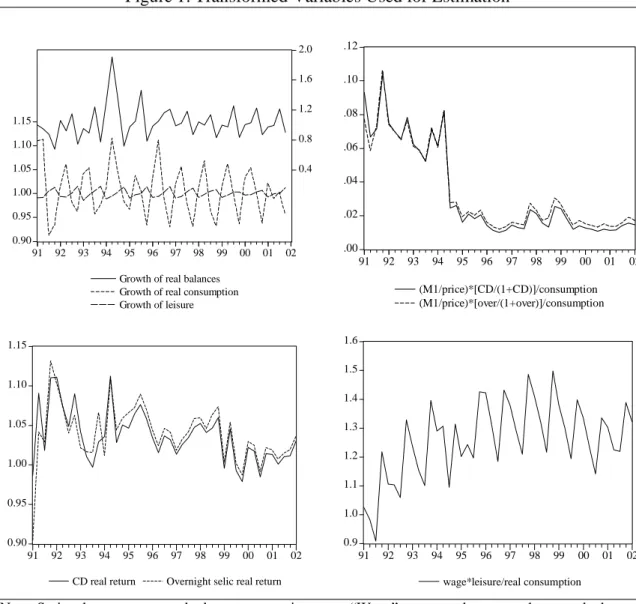
Figure 1 shows the evolution of the transformed variables that will be used in the empirical estimation of the model. The data spans the first quarter of 1991 – the first available observation for quarterly consumption series – until the first quarter of 2002, and the series were converted into per capita terms as explained in the previous section.
Figure 1: Transformed Variables Used for Estimation
0.90 0.95 1.00 1.05 1.10 1.15 0.4 0.8 1.2 1.6 2.0 91 92 93 94 95 96 97 98 99 00 01 02 Growth of real balances
Growth of real consumption Growth of leisure .00 .02 .04 .06 .08 .10 .12 91 92 93 94 95 96 97 98 99 00 01 02 (M1/price)*[CD/(1+CD)]/consumption (M1/price)*[over/(1+over)]/consumption 0.90 0.95 1.00 1.05 1.10 1.15 91 92 93 94 95 96 97 98 99 00 01 02 CD real return Overnight selic real return
0.9 1.0 1.1 1.2 1.3 1.4 1.5 1.6 91 92 93 94 95 96 97 98 99 00 01 02 wage*leisure/real consumption
Note: Series shown are quarterly data on per capita terms. “Wage” means real wage per hour worked.
As can be seen in Figure 1, there is a structural break in the
(
mt+1 Pt)
[
RDt(
1+RDt)
]
ct series starting in the third quarter of 1994, the launching of the “Real Plan”. The GMMestimator is strongly consistent, asymptotically normal, and efficient as long as both the instrument set and the transformed variables are stationary. On this account, estimations of the model will be only performed for the sub-sample starting in the third quarter of 1994.
Due to the same reason, both the
(
mt+1 Pt)
[
RDt(
1+RDt)
]
ct series as well as the real interest rates were adjusted for possible deterministic trends in the sub-sample starting in the third quarter of 1994. The procedure was to, first, take the residuals of a regression of each series on an intercept and a trend. The trend-adjusted variable is thenthe sum of the residual with the sample mean for the respective variable.8
GMM estimation requires that there are at least as many moment restrictions as parameters to be estimated. The model is called “over-identified” when there are more moment restrictions than parameters. In such a case, a weighting matrix determines the relative importance of each moment restriction. Hansen (1982) showed that it is possible to choose this matrix “optimally” in the sense that it yields an estimator with the smallest asymptotic covariance matrix among the class of estimators that uses weighting matrices. A necessary condition to obtain efficient estimates is to equate the weighting matrix to the inverse of the sample moments’ covariance matrix. The estimator used here will be robust to heteroskedasticity and serial correlation of
unknown form (HAC). The literature presents different weighting matrix estimators.9
We follow Ogaki (1993) who states that Monte Carlo evidence recommends the use of prewhitened sample moments and quadratic spectral kernel together with Andrews’
(1991) automatic bandwidth parameter.10
In order to avoid biased estimation and poor performance of the GMM estimator, the chosen instrument set for each first order condition include a constant and the
8 Robustness tests checking the influence of this detrending method in the results are reported below. 9
See Ogaki (1993, Section 6), and Cushing and McGarvey (1999).
10 On the other hand, the Monte Carlo results presented by Cushing and McGarvey (1999) do not lead to a
clear conclusion about which HAC estimator has the best small sample performance. This performance would depend on the distribution of the error process. Their results also show that the use of HAC estimators lead to quasi t-statistics that reject a true null more often than their nominal size, impairing inference.
transformed variables appearing in that first order condition. Only one two-period lag of the instruments is used.11
The data set consists of quarterly observations; so it is expected that seasonality may be present in some series. To deal with this issue, seasonal dummies will be included both in the estimated equations and in the instrument set, when they are significantly different from zero at the 5 percent level.12
Table 1 presents the benchmark results for the CRRA specification. The T×J test
indicates non-rejection of the money-in-the-utility-function model at the usual
significance levels. In addition, the estimated parameter for real balances, α, is positive
and significantly greater than zero at the 1 percent level. This result provides some support for the view that real money balances provide liquidity services that contribute directly to utility in Brazil, which means that the use of models in the class of Brock-Sidrauski seems to be valid. Moreover, the results do not seem to be influenced by the use of alternative measures for the interest rate.
TABLE 1
Parameters Estimates from a CRRA Utility Function
Interest Rate β φ α γ T×J
CD 0.9772 -0.0973 0.0143 1.3640 4.1604
(0.0032) (0.1130) (0.0010) (0.0272) (0.5266)
Over selic 0.9695 -0.1064 0.0165 1.3585 4.1481
(0.0033) (0.1263) (0.0014) (0.0276) (0.5283) Note: Estimated standard deviations appear in parentheses under the parameters estimates. P-values are in parentheses below the T×J Statistics. The weighting matrix follows Andrews’ (1991) methodology with quadratic spectral kernel and prewhitening. The instrument set for each Euler equation includes a constant and the transformed variables entering in the respective Euler equation, with only one lag of two periods. The sample period is 1994(3)-2002(1).
The estimate for the intertemporal discount rate, β, is close to one and significantly
greater than zero at the 1 percent level. The point estimates are greater than the ones found by Reis et al. (1998) [between 0.81 and 0.89] and in line with the estimated median (0.97) obtained by Issler and Piqueira (2000, Table 1c) both studies using
11
The two-period lag is justified by Ogaki (1993) on the grounds that nominal variables in monetary models are not aligned over time in the same way as they are in the corresponding real model. In addition, agents’ information sets are also considered differently in monetary and real models.
12 Ogaki (1993) states that deterministic seasonal dummies can be viewed as artificial stationary
stochastic processes, and can therefore be included in systems estimated by GMM. The robustness of the results to seasonally adjusted data is checked below.
quarterly data with seasonal dummies. The estimated discount rate is smaller than that found in studies with U.S. data – Holman (1998), for example, estimates a discount rate close to 0.96 using annual data, which is equivalent to a quarterly discount rate of 0.989 –, which denotes a greater impatience of the Brazilian consumers. One possible reason for such behavior, as suggested by Reis et al. (1998), is the low per capita income in Brazil.
The point estimates for the relative risk aversion coefficient φ are negative but they are
not significantly different from zero. Thus, a reduction to Cobb-Douglas preferences
cannot be rejected.13 The estimated values for φ are smaller than the ones reported by
Reis et al. (1998) [between 3.6 and 6.43], and by Issler and Piqueira (2000) [median value of 1.7 for quarterly data with seasonal dummies]. The comparison, however, is not appropriate due to the inclusion of different arguments in the utility function for each study.
The estimated coefficient related to leisure, γ, is also positive and significantly greater
than zero. For comparison, the estimates are close to the 1.4301 value obtained by
Araújo and Ferreira (1999).14 However, comparisons across different studies can be
misleading because γ depends on the choice of total time endowment and on the
assumption about the average hours worked per week. Estimates for γ can therefore
change with different sets of assumptions about these values. Moreover, the value of γ
can also change with different adjustments for income taxation.
Two sets of robustness checks were performed. Table 2 presents the results with different treatments for seasonality and for detrending. Table 3 presents estimation results when alternative weighting matrices are used.
13 We present below the estimates for the Cobb-Douglas utility function.
14 Araújo and Ferreira (1999) obtained the value for this parameter calibrating a real business cycle model
TABLE 2
Parameters Estimates from a CRRA Utility Function
[ Different approaches to seasonality and trend – Interest Rate: CD ]
Approach β φ α γ T×J SAd 0.9808 2.3658 0.0162 1.3210 3.1646 (0.0080) (1.6368) (0.0010) (0.0135) (0.6746) SAdTr 0.9844 4.3209 0.0153 1.3250 2.5364 (0.0163) (2.8049) (0.0014) (0.0132) (0.7710) Tr 0.9799 -0.1377 0.0151 1.4055 2.9254 (0.0041) (0.2180) (0.0008) (0.0360) (0.7115) Note: Estimated standard deviations appear in parentheses under the parameters estimates. P-values are in parentheses below the T×J Statistics. SAd means that seasonally adjusted data were used. SAdTr means that seasonally adjusted data and non-detrended data were used. Tr means that non-detrended data were used and that seasonality was treated using seasonal dummies.
TABLE 3
Parameters Estimates from a CRRA Utility Function [ Different weighting matrices – Interest rate: CD ]
Covariance Matrix β φ α γ T×J ABP 0.9771 -0.1015 0.0144 1.3652 4.1700 (0.0032) (0.1120) (0.0010) (0.0271) (0.5252) AQ 0.9733 0.7078 0.0154 1.3278 5.7621 (0.0036) (0.1717) (0.0006) (0.0154) (0.3301) AB 0.9709 -0.0057 0.0160 1.3988 6.6658 (0.0032) (0.1097) (0.0005) (0.0145) (0.2467) NWFBP 0.9756 0.1129 0.0159 1.3696 4.9986 (0.0024) (0.1292) (0.0005) (0.0210) (0.4161) NWFB 0.9762 0.2758 0.0157 1.3607 6.0996 (0.0028) (0.1351) (0.0005) (0.0157) (0.2966) NWBP 0.9771 0.1403 0.0152 1.3360 3.6432 (0.0021) (0.1243) (0.0006) (0.0272) (0.6018) NWB 0.9753 0.4792 0.0152 1.3302 4.7655 (0.0036) (0.1384) (0.0006) (0.0166) (0.4452) Note: Estimated standard deviations appear in parentheses under the parameters estimates. P-values are in parentheses below the T×J Statistics. ABP is the method due to Andrews (1991) with Bartlett kernel and prewhitening. AQ is the method due to Andrews (1991) with quadratic spectral kernel and with no prewhitening. AB is the method due to Andrews (1991) with Bartlett kernel and with no prewhitening. NWFBP is the method due to Newey and West (1987) with fixed bandwidth, Bartlett kernel and prewhitening. NWFB is the method due to Newey and West (1987) with fixed bandwidth, Bartlett kernel and with no prewithening. NWB is the method due to Newey and West (1994) with Bartlett kernel and prewithening. NWB is the method due to Newey and West (1994) with Bartlett kernel and no prewithening. The instrument set as well as the sample period is the same as in Table 1.
With regard to seasonality, one can either include seasonal dummies in each equation to be estimated or else seasonally adjust the data. Seasonal adjustment was made through the multiplicative X-11 method. Table 2 shows that, apart from the relative risk aversion
inclusion of non-detrended data. The point estimates for φ change substantially but neither of them are statistically significant.
The comparison of the results presented in Table 3, which uses alternative weighting matrices, to the results of Table 1 shows that little differences emerge with the exception, again, of the estimates for φ. The range of variation for the estimated β is in the interval 0.9709 to 0.9771, which is much narrower than the range reported by Reis
et al. (1998) and by Issler and Piqueira (2000). The point estimates for γ showed
variations ranging from 1.3278 to 1.3988. The variation found for the estimates of α
ranged from 0.0144 to 0.0160. The largest interval of values was obtained for φ, for
which the estimates ranged from –0.1015 to 0.7078. Moreover, three of the reported estimates for this coefficient are significantly different from zero.
In view of the discrepant results obtained for the coefficient of relative risk aversion, two other sets of estimation were performed. In the first of them, the restriction leading
to Cobb-Douglas preferences (φ = 0) was imposed and in the other one, the restriction
leading to logarithmic preferences (φ = 1) was imposed.
Tables 4 to 6 report the estimates for the Cobb-Douglas utility function as well as the
results of the same robustness checks. None of the estimations are rejected by the T×J
test. The overall conclusion is that the estimated values for the other parameters change very little across the different specifications. The range of variation found for β, α, and
γ are, respectively [0.9690, 0.9808], [0.0146, 0.0165], and [1.3106, 1.4045].
TABLE 4
Parameters Estimates from a Cobb-Douglas Utility Function
Interest Rate β α γ T×J
CD 0.9784 0.0146 1.3556 4.0006
(0.0032) (0.0009) (0.0262) (0.6766)
Over selic 0.9705 0.0162 1.3480 4.0247
(0.0033) (0.0014) (0.0269) (0.6733)
TABLE 5
Parameters Estimates from a Cobb-Douglas Utility Function
[ Different approaches to seasonality and trend – Interest Rate: CD ]
Approach β α γ T×J SAd 0.9709 0.0165 1.3267 3.6908 (0.0035) (0.0010) (0.0136) (0.7184) SAdTr 0.9795 0.0148 1.3106 3.3974 (0.0053) (0.0014) (0.0121) (0.7576) Tr 0.9808 0.0152 1.4045 3.3309 (0.0040) (0.0007) (0.0337) (0.7663) Note: Same as for Table 2.
TABLE 6
Parameters Estimates from a Cobb Douglas Utility Function [ Different weighting matrices – Interest rate: CD ]
Approach β α γ T×J ABP 0.9786 0.0146 1.3561 3.9831 (0.0032) (0.0009) (0.0261) (0.6790) AQ 0.9690 0.0165 1.3964 6.4197 (0.0021) (0.0004) (0.0106) (0.3779) AB 0.9711 0.0160 1.3980 6.6901 (0.0031) (0.0005) (0.0124) (0.3505) NWFBP 0.9735 0.0161 1.3852 5.3297 (0.0025) (0.0004) (0.0178) (0.5023) NWFB 0.9700 0.0163 1.3924 5.9280 (0.0025) (0.0004) (0.0114) (0.4313) NWBP 0.9760 0.0154 1.3545 4.1807 (0.0023) (0.0005) (0.0230) (0.6522) NWB 0.9705 0.0163 1.3872 5.4577 (0.0024) (0.0004) (0.0122) (0.4866)
Note: Same as for Table 3.
Tables 7 to 9 report the estimations for the logarithmic utility function. The T×J
overidentifying restriction test does not reject any of the estimated equations. One can see that, for this functional form, the estimated values lie in a wider interval. The range
of variation for β, α, and γ are, respectively, given by [0.9008, 0.9828], [0.0143,
0.0188], and [1.3069, 1.4358].15
TABLE 7
Parameters Estimates from a Logarithmic Utility Function
Interest Rate β α γ T×J
CD 0.9101 0.0160 1.4317 1.4146
(0.0100) (0.0008) (0.0335) (0.8417)
Over selic 0.9008 0.0188 1.4341 1.5780
(0.0101) (0.0012) (0.0345) (0.8127)
Note: Same as for Table 1.
TABLE 8
Parameters Estimates from a Logarithmic Utility Function
[ Different approaches to seasonality and trend – Interest Rate: CD ]
Approach β α γ T×J Sad 0.9765 0.0162 1.3107 3.1202 (0.0050) (0.0010) (0.0119) (0.5379) SAdTr 0.9828 0.0143 1.3069 2.9463 (0.0064) (0.0017) (0.0112) (0.5669) Tr 0.9186 0.0155 1.4323 2.7392 (0.0172) (0.0009) (0.0344) (0.6024) Note: Same as for Table 2.
TABLE 9
Parameters Estimates from a Logarithmic Utility Function [ Different weighting matrices – Interest rate: CD ]
Approach β α γ T×J ABP 0.9098 0.0158 1.4296 1.0145 (0.0099) (0.0009) (0.0330) (0.9076) AB 0.9134 0.0159 1.4357 4.5094 (0.0067) (0.0005) (0.0161) (0.3414) NWFBP 0.9146 0.0160 1.4252 1.9873 (0.0074) (0.0005) (0.0291) (0.7381) NWFB 0.9132 0.0158 1.4358 4.5052 (0.0069) (0.0005) (0.0155) (0.3419) NWBP 0.9146 0.0160 1.4251 1.9873 (0.0074) (0.0005) (0.0291) (0.7381) NWB 0.9140 0.0159 1.4348 4.5514 (0.0065) (0.0004) (0.0166) (0.3365) Note: Same as for Table 3.
Summing up, the estimates for the relative risk coefficient show a great range of variation across different specifications. In most of the estimations, this coefficient is not significant implying that the reduction to Cobb-Douglas preferences is not rejected. The estimates for the intertemporal discount rate are reasonable and, apart from the logarithmic preferences, there are no substantial differences across the different specifications. Most importantly, the money-in-the-utility function model was not
rejected in any of the different estimates. In all of the estimates, the parameter linked with real balances was found to be always positive, significant, and robust to different specifications. Such results are favorable evidence to the view that real balances provide services that are valued by the agents.
7. Conclusions
In this paper we estimated and tested a representative agent model relating consumption, interest rates, real balances, hours worked, and wage. The model was estimated by Generalized Method of Moments (GMM) techniques. Robustness checks were performed for different definitions of interest rates, different treatments to seasonal and detrending adjustments, different weighting matrices, and different utility functions. In none of the cases, the model was rejected for the usual significance levels. Moreover, the estimated coefficient for real balances was found to be robust to such variations.
The main contribution of the paper was to find favorable evidence for the Brazilian economy to the view that real balances play a positive role for the welfare of agents. Therefore, there is an empirical justification for the development of money-in-the-utility function models applied to Brazil. Another contribution of this paper is the estimation of some behavioral parameters, which may be useful for those researchers working with models calibrated for Brazil.
References
ANDREWS, Donald W.K. (1991). “Heteroskedasticity and autocorrelation consistent covariance matrix estimation.” Econometrica, 59, 817–858.
ARAÚJO, Carlos H. and FERREIRA, Pedro C. (1999). “Reforma tributária, efeitos alocativos, e impactos de bem-estar.” Revista Brasileira de Economia, 53, 133-166.
BROCK, William (1974). “Money and growth: the case of long run perfect foresight.”
International Economic Review, 15, 750-777.
--- (1975). “A simple foresight monetary model.” Journal of Monetary
Economics, 1, 133-150.
BURNSIDE, Craig, EICHENBAUM, Martin and REBELO, Sérgio (1993). “Labor hoarding and the business cycle.” Journal of Political Economy, 101, 245-273. CALVO, Guillermo A. (1979). “On models of money and perfect foresight.”
International Economic Review, 20, 83-103.
COGLEY, Timothy (2001). “Estimating and testing rational expectations models when the trend specification is uncertain.” Journal of Economic Dynamics and
Control, 25, 1485-1525.
CORREIA, Isabel and TELES, Pedro (1999). “The optimal inflation tax.” Review of
Economic Dynamics, 2, 325-346.
COSTA VAL, Paulo Rogério and FERREIRA, Pedro Cavalcanti (2002). “Modelos de ciclos reais de negócios aplicados à economia brasileira.” Ensaios Econômicos
da EPGE – n.438, Fundação Getúlio Vargas, Rio de Janeiro.
CUSHING, Matthew J. and MCGARVEY, Mary G. (1999). “Covariance matrix estimation.” In MÁTYÁS, László (ed.) Generalized Method of Moments
Estimation. Cambridge University Press, Cambridge, UK.
DAVIDSON, Russel and MACKINNON, James (1993). Estimation and Inference in
Econometrics. Oxford University Press. New York.
DUTKOWSKY, Donald H. and DUNSKY, Robert M. (1998). “Estimating the liquidity of M2 components in the post-DIDMCA era.” Economic Inquiry, 36, 244-257. EICHENBAUM, Martin S., HANSEN, Lars Peter and SINGLETON, Kenneth J.
(1988). “A time series analysis of representative agent models of consumption and leisure choice under uncertainty.” Quarterly Journal of Economics, 103, 51-78.
FEENSTRA, Robert C. (1986). “Functional equivalence between liquidity costs and the utility of money.” Journal of Monetary Economics, 17, 271-291.
FINN, Mary G., HOFFMAN, Dennis L. and SCHLAGENHAUF, Don E. (1990). “Intertemporal asset-pricing relationships in barter and monetary economies: an empirical analysis.” Journal of Monetary Economics, 25, 431-451.
FUHRER, Jeffrey C., MOORE, George R. and SCHUH, Scott D. (1995). “Estimating the linear-quadratic inventory model: maximum likelihood vs. generalized method of moments.” Journal of Monetary Economics, 35, 115-157.
GRAY, Jo Anna (1984). “Dynamic instability in rational expectations models: an attempt to clarify.” International Economic Review, 25, 93-122.
GREENE, William H. (2000). Econometric Analysis, 4th ed., Prentice Hall, Upper
Saddle River, New Jersey.
HALL, Alastair (1993). “Some aspects of generalized method of moments estimation.” In MADDALA, G. S., RAO, C. R. and VINOD, H. D. (eds.) Handbook of
Statistics, Vol. 11. Elsevier Science Publishers, Amsterdam.
HAMILTON, James D. (1994). Time Series Analysis. Princeton University Press, Princeton, New Jersey.
HANSEN, Lars Peter (1982). “Large sample properties of generalized method of moments estimators.” Econometrica, 50, 1029-1054.
HANSEN, Lars Peter and SINGLETON, Kenneth J. (1982). “Generalized instrumental variables estimation of nonlinear rational expectations models.” Econometrica,
50, 1269-1286.
HOLMAN, Jill A. (1998). “GMM estimation of a money-in-the-utility-function model: the implications of functional forms.” Journal of Money, Credit, and Banking,
30, 679-698.
ISSLER, João Victor and PIQUEIRA, Natália Scotto (2000). “Estimating relative risk aversion, the discount rate, and the intertemporal elasticity of substitution in consumption for Brazil using three types of utility function.” Brazilian Review of
Econometrics, 20, 200-238.
KOCHERLAKOTA , Narayana R. (1990). “On tests of representative consumer asset pricing models.” Journal of Monetary Economics, 26, 285-304.
MAO, Ching-Sheng (1990). “Hypothesis testing and finite sample properties of generalized method of moments estimators: a Monte Carlo study.” Working
Paper 90-12, Federal Reserve Bank of Richmond.
MÁTYÁS, László (editor) (1999). Generalized Method of Moments Estimation. Cambridge University Press, Cambridge, UK.
McCALLUM, Bennett T. and GOODFRIEND, Marvin S. (1987). “Demand for money: theoretical studies.” In EATWELL, John, MILGATE, Murray and NEWMAN, Peter (eds.) The New Palgrave: A Dictionary of Economics. Macmillan, London.
NELSON, Charles R. and STARTZ, Richard (1990a). “Some further results on the exact small sample properties of the instrumental variable estimator.”
Econometrica, 58, 967-976.
--- (1990b). “The distribution of the instrumental variables estimator and its t-ratio when the instrument is a poor one.” Journal of Business, 63, S125-S140.
NEWEY, Whitney K. and WEST, Kenneth J. (1987). “A simple, positive semi-definite, heteroskedasticity and autocorrelation consistent covariance matrix.”
Econometrica, 55, 703-708.
--- (1994). “Automatic lag selection in covariance matrix estimation.” Review of
Economic Studies, 61, 631-653.
OBSTFELD, Maurice (1984). “Multiple stable equilibria in an optimizing perfect-foresight model.” Econometrica, 52, 223-228.
OBSTFELD, Maurice and ROGOFF, Kenneth (1983). “Speculative hyperinflations in maximizing models: can we rule them out?” Journal of Political Economy, 91, 675-687.
--- (1996). Foundations of International Macroeconomics. The MIT Press, Cambridge, Massachusetts.
OGAKI, Masao (1993). “Generalized method of moments: econometric applications.” In MADDALA, G. S., RAO, C. R. and VINOD, H. D. (eds.) Handbook of
Statistics, Vol. 11. Elsevier Science Publishers, Amsterdam.
REIS, Eustáquio, ISSLER, João Victor, BLANCO, Fernando and CARVALHO, Leonardo Mello (1998). “Renda permanente e poupança precaucional: evidências empíricas para o Brasil no passado recente.” Pesquisa e
Planejamento Econômico, 28, 233-271.
SAVING, Thomas R. (1971). “Transactions costs and the demand for money.”
American Economic Review, 61, 407-420.
SIDRAUSKI, Miguel (1967). “Rational choice and patterns of growth in a monetary economy.” American Economic Review - Papers and Proceedings, 57, 534-544. TAUCHEN, George (1986). “Statistical properties of generalized method-of-moments
estimators of structural parameters obtained from financial market data.”
Journal of Business and Economic Statistics, 4, 397-416.
WANG, Ping and YIP, Chong K. (1992). “Alternative approaches to money and growth.” Journal of Money, Credit, and Banking, 24, 553-562.
ZHANG, Junxi (2000). “Inflation and growth: pecuniary transactions costs and qualitative equivalence.” Journal of Money, Credit, and Banking, 32, 1-12.
Banco Central do Brasil
Trabalhos para Discussão
Os Trabalhos para Discussão podem ser acessados na internet, no formato PDF, no endereço: http://www.bc.gov.br
Working Paper Series
Working Papers in PDF format can be downloaded from: http://www.bc.gov.br
1 Implementing Inflation Targeting in Brazil
Joel Bogdanski, Alexandre Antonio Tombini and Sérgio Ribeiro da Costa Werlang
Jul/2000
2 Política Monetária e Supervisão do Sistema Financeiro Nacional no Banco Central do Brasil
Eduardo Lundberg
Monetary Policy and Banking Supervision Functions on the Central Bank
Eduardo Lundberg
Jul/2000
Jul/2000
3 Private Sector Participation: a Theoretical Justification of the Brazilian Position
Sérgio Ribeiro da Costa Werlang
Jul/2000
4 An Information Theory Approach to the Aggregation of Log-Linear Models
Pedro H. Albuquerque
Jul/2000
5 The Pass-Through from Depreciation to Inflation: a Panel Study
Ilan Goldfajn and Sérgio Ribeiro da Costa Werlang
Jul/2000
6 Optimal Interest Rate Rules in Inflation Targeting Frameworks
José Alvaro Rodrigues Neto, Fabio Araújo and Marta Baltar J. Moreira
Jul/2000
7 Leading Indicators of Inflation for Brazil
Marcelle Chauvet
Sep/2000
8 The Correlation Matrix of the Brazilian Central Bank’s Standard Model for Interest Rate Market Risk
José Alvaro Rodrigues Neto
Sep/2000
9 Estimating Exchange Market Pressure and Intervention Activity
Emanuel-Werner Kohlscheen
Nov/2000
10 Análise do Financiamento Externo a uma Pequena Economia
Aplicação da Teoria do Prêmio Monetário ao Caso Brasileiro: 1991–1998
Carlos Hamilton Vasconcelos Araújo e Renato Galvão Flôres Júnior
Mar/2001
11 A Note on the Efficient Estimation of Inflation in Brazil
Michael F. Bryan and Stephen G. Cecchetti
Mar/2001
12 A Test of Competition in Brazilian Banking
Márcio I. Nakane
13 Modelos de Previsão de Insolvência Bancária no Brasil
Marcio Magalhães Janot
Mar/2001
14 Evaluating Core Inflation Measures for Brazil
Francisco Marcos Rodrigues Figueiredo
Mar/2001
15 Is It Worth Tracking Dollar/Real Implied Volatility?
Sandro Canesso de Andrade and Benjamin Miranda Tabak
Mar/2001
16 Avaliação das Projeções do Modelo Estrutural do Banco Central do Brasil para a Taxa de Variação do IPCA
Sergio Afonso Lago Alves
Evaluation of the Central Bank of Brazil Structural Model’s Inflation Forecasts in an Inflation Targeting Framework
Sergio Afonso Lago Alves
Mar/2001
Jul/2001
17 Estimando o Produto Potencial Brasileiro: uma Abordagem de Função de Produção
Tito Nícias Teixeira da Silva Filho
Estimating Brazilian Potential Output: a Production Function Approach
Tito Nícias Teixeira da Silva Filho
Abr/2001
Aug/2002
18 A Simple Model for Inflation Targeting in Brazil
Paulo Springer de Freitas and Marcelo Kfoury Muinhos
Apr/2001
19 Uncovered Interest Parity with Fundamentals: a Brazilian Exchange Rate Forecast Model
Marcelo Kfoury Muinhos, Paulo Springer de Freitas and Fabio Araújo
May/2001
20 Credit Channel without the LM Curve
Victorio Y. T. Chu and Márcio I. Nakane
May/2001
21 Os Impactos Econômicos da CPMF: Teoria e Evidência
Pedro H. Albuquerque
Jun/2001
22 Decentralized Portfolio Management
Paulo Coutinho and Benjamin Miranda Tabak
Jun/2001
23 Os Efeitos da CPMF sobre a Intermediação Financeira
Sérgio Mikio Koyama e Márcio I. Nakane
Jul/2001
24 Inflation Targeting in Brazil: Shocks, Backward-Looking Prices, and IMF Conditionality
Joel Bogdanski, Paulo Springer de Freitas, Ilan Goldfajn and Alexandre Antonio Tombini
Aug/2001
25 Inflation Targeting in Brazil: Reviewing Two Years of Monetary Policy 1999/00
Pedro Fachada
Aug/2001
26 Inflation Targeting in an Open Financially Integrated Emerging Economy: the Case of Brazil
Marcelo Kfoury Muinhos
27 Complementaridade e Fungibilidade dos Fluxos de Capitais Internacionais
Carlos Hamilton Vasconcelos Araújo e Renato Galvão Flôres Júnior
Set/2001
28 Regras Monetárias e Dinâmica Macroeconômica no Brasil: uma Abordagem de Expectativas Racionais
Marco Antonio Bonomo e Ricardo D. Brito
Nov/2001
29 Using a Money Demand Model to Evaluate Monetary Policies in Brazil
Pedro H. Albuquerque and Solange Gouvêa
Nov/2001
30 Testing the Expectations Hypothesis in the Brazilian Term Structure of Interest Rates
Benjamin Miranda Tabak and Sandro Canesso de Andrade
Nov/2001
31 Algumas Considerações sobre a Sazonalidade no IPCA
Francisco Marcos R. Figueiredo e Roberta Blass Staub
Nov/2001
32 Crises Cambiais e Ataques Especulativos no Brasil
Mauro Costa Miranda
Nov/2001
33 Monetary Policy and Inflation in Brazil (1975-2000): a VAR Estimation
André Minella
Nov/2001
34 Constrained Discretion and Collective Action Problems: Reflections on the Resolution of International Financial Crises
Arminio Fraga and Daniel Luiz Gleizer
Nov/2001
35 Uma Definição Operacional de Estabilidade de Preços
Tito Nícias Teixeira da Silva Filho
Dez/2001
36 Can Emerging Markets Float? Should They Inflation Target?
Barry Eichengreen
Feb/2002
37 Monetary Policy in Brazil: Remarks on the Inflation Targeting Regime, Public Debt Management and Open Market Operations
Luiz Fernando Figueiredo, Pedro Fachada and Sérgio Goldenstein
Mar/2002
38 Volatilidade Implícita e Antecipação de Eventos de Stress: um Teste para o Mercado Brasileiro
Frederico Pechir Gomes
Mar/2002
39 Opções sobre Dólar Comercial e Expectativas a Respeito do Comportamento da Taxa de Câmbio
Paulo Castor de Castro
Mar/2002
40 Speculative Attacks on Debts, Dollarization and Optimum Currency Areas
Aloisio Araujo and Márcia Leon
Apr/2002
41 Mudanças de Regime no Câmbio Brasileiro
Carlos Hamilton V. Araújo e Getúlio B. da Silveira Filho
Jun/2002
42 Modelo Estrutural com Setor Externo: Endogenização do Prêmio de Risco e do Câmbio
Marcelo Kfoury Muinhos, Sérgio Afonso Lago Alves e Gil Riella
43 The Effects of the Brazilian ADRs Program on Domestic Market Efficiency
Benjamin Miranda Tabak and Eduardo José Araújo Lima
Jun/2002
44 Estrutura Competitiva, Produtividade Industrial e Liberação Comercial no Brasil
Pedro Cavalcanti Ferreira e Osmani Teixeira de Carvalho Guillén
Jun/2002
45 Optimal Monetary Policy, Gains from Commitment, and Inflation Persistence
André Minella
Aug/2002
46 The Determinants of Bank Interest Spread in Brazil
Tarsila Segalla Afanasieff, Priscilla Maria Villa Lhacer and Márcio I. Nakane
Aug/2002
47 Indicadores Derivados de Agregados Monetários
Fernando de Aquino Fonseca Neto e José Albuquerque Júnior
Set/2002
48 Should Government Smooth Exchange Rate Risk?
Ilan Goldfajn and Marcos Antonio Silveira
Sep/2002
49 Desenvolvimento do Sistema Financeiro e Crescimento Econômico no Brasil: Evidências de Causalidade
Orlando Carneiro de Matos
Set/2002
50 Macroeconomic Coordination and Inflation Targeting in a Two-Country Model
Eui Jung Chang, Marcelo Kfoury Muinhos and Joanílio Rodolpho Teixeira
Sep/2002
51 Credit Channel with Sovereign Credit Risk: an Empirical Test
Victorio Yi Tson Chu
Sep/2002
52 Generalized Hyperbolic Distributions and Brazilian Data
José Fajardo and Aquiles Farias
Sep/2002
53 Inflation Targeting in Brazil: Lessons and Challenges
André Minella, Paulo Springer de Freitas, Ilan Goldfajn and Marcelo Kfoury Muinhos
Nov/2002
54 Stock Returns and Volatility
Benjamin Miranda Tabak and Solange Maria Guerra
Nov/2002
55 Componentes de Curto e Longo Prazo das Taxas de Juros no Brasil
Carlos Hamilton Vasconcelos Araújo e Osmani Teixeira de Carvalho de Guillén
Nov/2002
56 Causality and Cointegration in Stock Markets: the Case of Latin America
Benjamin Miranda Tabak and Eduardo José Araújo Lima
Dec/2002
57 As Leis de Falência: uma Abordagem Econômica
Aloisio Araujo
Dez/2002
58 The Random Walk Hypothesis and the Behavior of Foreign Capital Portfolio Flows: the Brazilian Stock Market Case
Benjamin Miranda Tabak
Dec/2002
59 Os Preços Administrados e a Inflação no Brasil
Francisco Marcos R. Figueiredo e Thaís Porto Ferreira
60 Delegated Portfolio Management
Paulo Coutinho and Benjamin Miranda Tabak
Dec/2002
61 O Uso de Dados de Alta Freqüência na Estimação da Volatilidade e do Valor em Risco para o Ibovespa
João Maurício de Souza Moreira e Eduardo Facó Lemgruber
Dez/2002
62 Taxa de Juros e Concentração Bancária no Brasil
Eduardo Kiyoshi Tonooka e Sérgio Mikio Koyama
Fev/2003
63 Optimal Monetary Rules: the Case of Brazil
Charles Lima de Almeida, Marco Aurélio Peres, Geraldo da Silva e Souza and Benjamin Miranda Tabak
Feb/2003
64 Medium-Size Macroeconomic Model for the Brazilian Economy
Marcelo Kfoury Muinhos and Sergio Afonso Lago Alves
Feb/2003
65 On the Information Content of Oil Future Prices
Benjamin Miranda Tabak
Feb/2003
66 A Taxa de Juros de Equilíbrio: uma Abordagem Múltipla
Pedro Calhman de Miranda e Marcelo Kfoury Muinhos
Fev/2003
67 Avaliação de Métodos de Cálculo de Exigência de Capital para Risco de Mercado de Carteiras de Ações no Brasil
Gustavo S. Araújo, João Maurício S. Moreira e Ricardo S. Maia Clemente