Essays on Financial Stability
Inaugural-Dissertation
zur Erlangung des Grades eines Doktors der Wirtschafts- und Gesellschaftswissenschaften
durch die
Rechts- und Staatswissenschaftliche Fakultät der Rheinischen Friedrich-Wilhelms-Universität Bonn
vorgelegt von
Paul Schempp
aus Bonn
Zweitreferent: Prof. Dr. Hendrik Hakenes
Tag der mündlichen Prüfung: 27. Februar 2015
Diese Dissertation ist elektronisch publiziert auf dem Hochschulschriftenserver der ULB Bonn: http://hss.ulb.uni-bonn.de/diss_online
Acknowledgments
Writing this thesis was a great challenge for me as well as a great op-portunity. Many individuals and institutions have enabled and supported the process of this work, and I would like to thank them at this point.
I am particularly grateful to my supervisor, Martin Hellwig, for his invalu-able advice and support. While giving me freedom to pursue my own research agenda, he always pointed out interesting aspects and research topics, and he generously shared his impressive knowledge of facts and his economic intu-ition. I have been inspired by his scientific approach to both highly theoretical topics as well as applied matters which are of high practical relevance.
I am also very grateful to Hendrik Hakenes for several inspiring discussions about this work, which were especially helpful for improving its formal rigidity. Moreover, I would like to thank him for acting as the second assessor of my thesis.
My dear friend and coauthor Stephan Luck deserves my deepest gratitude for our collaboration. Stephan, it was a great pleasure to do research with you over the last three years! I am very thankful for your persistence, for your enthusiasm and your eye for economic and political relevance, for the count-less inspiring discussions and long hours of tedious technical work, for your indulgence and relentless encouragement. I am looking back on a productive and pleasant collaboration that I am looking forward to continue!
All chapters of this thesis have benefited from various discussions and com-ments. I would like to thank Tobias Adrian, Patrick Bolton, Florian Buck, Jean-Edouard Colliard, Christoph Engel, Falko Fecht, Christian Hellwig, Kon-stantin Milbradt, Sebastian Pfeil, Jean-Charles Rochet, Eva Schliephake, Isabel Schnabel, Julian Schumacher, and Ansgar Walther. Furthermore, I would like to thank my fellow graduate students as well as my colleagues at the MPI, particularly Dominik Grafenhofer, Wolfgang Kuhle, and Alexander Morell.
I conducted the research for my thesis at the Bonn Graduate School of Economics, with funding from Deutsche Forschungsgemeinschaft, and at the Max Planck Institute for Research on Collective Goods, with funding through the Max Planck Research Award of the Alexander von Humboldt Foundation and the Max Planck Society.
I would like to thank the BGSE and the MPI for offering such a great learning and research environment, and I would like to thank my fellow PhD students as well as my colleagues for the pleasant time! I am also thankful for the support by the administration of the BGSE and the MPI. Monika Stimpson deserves special thanks for helping me with various technical and non-technical matters!
Contents
List of Figures vii
List of Abbreviations ix
Introduction 1
1 Outside Liquidity, Rollover Risk, and Government Bonds 5
1.1 Introduction . . . 5
1.2 Intermediation with Inside Liquidity . . . 10
1.2.1 First-Best Allocation . . . 12
1.2.2 Diamond & Dybvig (1983) . . . 13
1.3 Intermediation with Outside Liquidity . . . 15
1.3.1 First-best with Outside Liquidity . . . 15
1.3.2 Efficient Banking . . . 17
1.4 Private Outside Liquidity and Rollover Risk . . . 19
1.4.1 Rollover Freeze . . . 19
1.4.2 Inefficient Liquidity Provision . . . 21
1.4.3 Fragility . . . 22
1.5 Public Outside Liquidity . . . 24
1.5.1 Liquidity Management and Government Bonds . . . . 24
1.5.2 Government Solvency . . . 26
1.6 Liquidity Regulation in Basel III . . . 27
1.6.1 Liquidity Coverage Ratio (LCR) . . . 29
1.6.2 Net Stable Funding Ratio (NSFR) . . . 30
1.6.3 Comparison . . . 31
1.7 Conclusion . . . 33
Appendix 1.A Sub-Optimality of Financial Markets under Outside Liquidity . . . 36
Appendix 1.B Sunspots: Optimal Contracts under Private Outside Liquidity . . . 37
2 Sovereign Defaults, Bank Runs, and Contagion 41
2.1 Introduction . . . 41
2.2 Single-Country Model . . . 46
2.2.1 Setup . . . 46
2.2.2 Outcomes . . . 50
2.2.3 Deposit Insurance Scheme (DIS) . . . 54
2.3 Two-Country Model . . . 56
2.3.1 Setup . . . 57
2.3.2 International Contagion . . . 58
2.3.3 Optimal Policies: Supranational Institutions . . . 59
2.4 The European Banking Union . . . 63
2.5 Conclusion . . . 65
Appendix 2.A Proofs . . . 67
3 Banks, Shadow Banking, and Fragility 69 3.1 Introduction . . . 69
3.2 A Model of Intergenerational Banking . . . 75
3.3 Banks and Shadow Banks . . . 81
3.3.1 Fragility of Shadow Banks . . . 87
3.3.2 Liquidity Guarantees . . . 92
3.4 MMFs, ABCP Conduits, and SPV . . . 95
3.4.1 Runs on ABCP Conduits . . . 98
3.4.2 Runs on MMFs . . . 99
3.5 Conclusion . . . 101
Appendix 3.A Moral Hazard and Regulatory Costs . . . 104
Appendix 3.B Heterogeneous Investors . . . 106
List of Figures
1.1 Diamond and Dybvig (1983) . . . 14
1.2 Private Outside Liquidity . . . 18
1.3 Public Outside Liquidity . . . 25
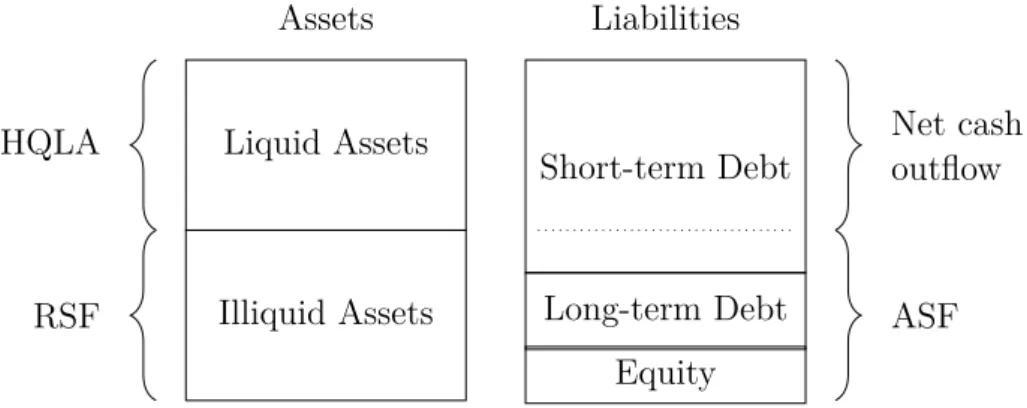
1.4 Bank Balance Sheet . . . 32
1.5 Financial Market . . . 37
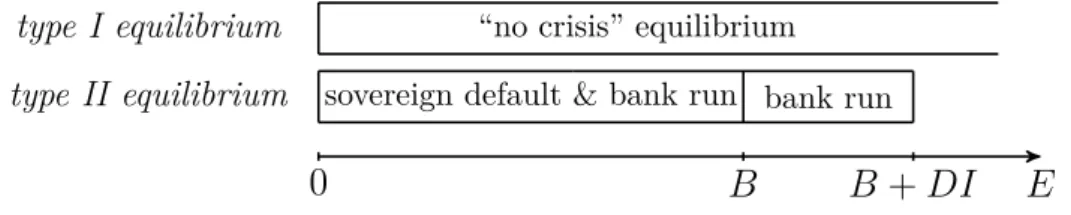
2.1 Interdependence of Sovereign Debt and Banking . . . 52
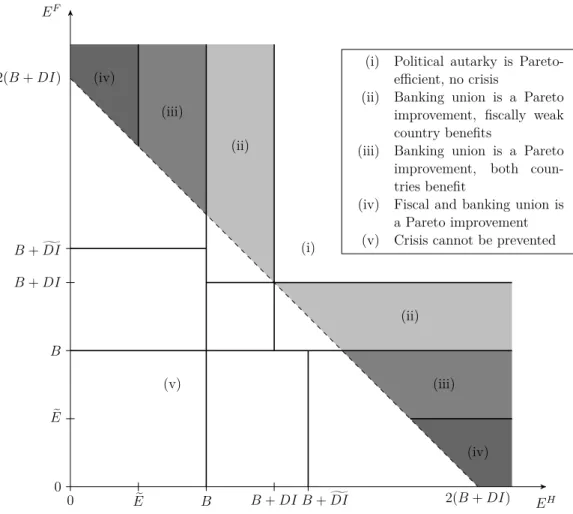
2.2 Existence of Equilibria under the Deposit Insurance Scheme . 55 2.3 Equilibria under Political Autarky . . . 60
2.4 Efficient Policy Measures . . . 62
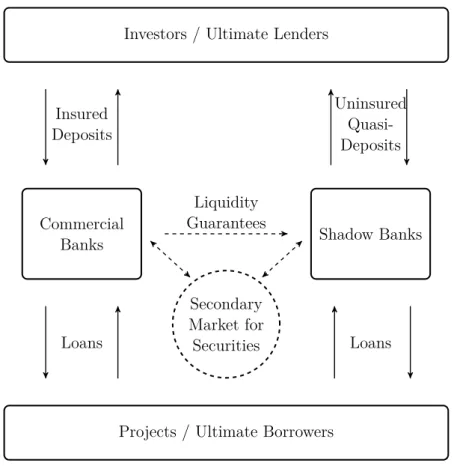
3.1 Structure of the Financial System . . . 83
3.2 Fire-sale Prices . . . 90
3.3 Existence of Equilibria . . . 91
3.4 Fire-sale Prices under Liquidity Guarantees . . . 94
List of Abbreviations
ABCP Asset-Backed Commercial Papers
ABS Asset-Backed Securities
ASF Available Stable Funding
D&D Diamond and Dybvig (1983)
DGS Deposit Guarantee Scheme
DI Deposit Insurance
FCIC Financial Crisis Inquiry Commission
FSB Financial Stability Board
HQLA High Quality Liquid Assets
LCR Liquidity Coverage Ratio
MMF Money Market (Mutual) Fund
NAV Net Asset Value
NSFR Net Stable Funding Ratio
RMBS Residential Mortgage Backed Securities
RSF Required Stable Funding
SIV Structured Investment Vehicle
SoC Suspension of Convertibility
SPV Special Purpose Vehicle
SRM Single Resolution Mechanism
Introduction
This thesis consists of three chapters that analyze the stability of financial institutions, particularly that of banks. All chapters are based on joint work with my friend and colleague Stephan Luck. The focus lies on self-fulfilling liquidity crises that are associated with maturity transformation conducted by financial intermediaries such as banks. The need for such maturity trans-formation arises because, on the one hand, investors have a demand for liquid assets and, on the other hand, investment projects require stable long-term funding. As pointed out by Diamond and Dybvig (1983), banks are insti-tutions that can efficiently intermediate in this environment. The maturity mismatch induced by such intermediation makes banks prone to self-fulfilling liquidity crises, i.e., bank runs or roll-over freezes. We show that the govern-ment has a distinct role in ensuring the functioning of efficient maturity trans-formation (Chapter 1). We also show that if a single government’s power is limited, supranational agreements can help to mitigate this limitation (Chap-ter 2). Finally, we address the problem of regulatory arbitrage and show that safeguarding measures become ineffective if there is an opportunity to shift intermediation into a shadow banking sector (Chapter 3).
Chapter 1 is based on Luck and Schempp (2014b) and discusses the optimal provision of liquidity. It asks whether financial intermediaries can optimally provide liquidity, or whether the government has a role in creating liquidity by supplying government securities. We discuss a model in which intermediaries optimally manage liquidity with outside rather than inside liquidity: instead of holding liquid real assets that can be used at will, banks sell claims on long-term projects to investors. While increasing efficiency, liquidity management with private outside liquidity is associated with a rollover risk. This rollover risk either keeps intermediaries from providing liquidity optimally, or it makes the economy inherently fragile. In contrast to privately produced claims, government bonds are not associated with coordination problems unless there is a prospect of the government defaulting. Therefore, efficiency and stability can be enhanced if liquidity management relies on public outside liquidity.
that a government cannot default because it can commit future liquidity via taxation. It is thus the only institution that can credibly promise to provide liquidity in the future. However, this ability depends on the assumption that the government has access to a sufficiently large and stable tax base. In the next chapter, we assume that the tax base is endogenous and depends on the performance of the financial sector and of the whole economy.
Chapter 2 is based on Luck and Schempp (2014c) and provides a model that unifies the notion of self-fulfilling banking crises and sovereign debt crises. In this model, a bank run can be contagious by triggering a sovereign default, and vice versa. A deposit insurance scheme can eliminate the adverse equilib-rium only if the government can repay its debt and credibly insure deposits, irrespective of the performance of the financial sector. Moreover, we analyze how banking crises and sovereign defaults can be contagious across countries. We give conditions under which the implementation of a banking union, in-cluding a supranational deposit insurance, prevents crises effectively and at no cost. Finally, we discuss the current proposals for a banking union in the euro area and argue that it should be extended by a supranational Deposit Guarantee Scheme.
Chapter 3 is based on Luck and Schempp (2014a) and addresses the reg-ulation of financial intermediation. While deposit insurance is effective at excluding panic-based runs, it may also introduce moral hazard on the part of banks and make regulation necessary. We study a banking model of matu-rity transformation in which regulatory arbitrage induces the coexistence of regulated commercial banks and unregulated shadow banks. We derive three main results: First, the relative size of the shadow banking sector determines the stability of the financial system. If the shadow banking sector is small rel-ative to the capacity of secondary markets for shadow banks’ assets, shadow banking is stable. In turn, if the sector grows too large, it becomes fragile: an additional equilibrium emerges that is characterized by a panic-based run in the shadow banking sector. Second, if regulated commercial banks them-selves operate shadow banks, the parameter space in which a run on shadow banks may occur is reduced. However, once the threat of a crisis reappears, a crisis in the shadow banking sector spreads to the commercial banking sector. Third, in the presence of regulatory arbitrage, a safety net for banks may fail to prevent a banking crisis. Moreover, the safety net may be tested and may eventually become costly for the regulator.
All three chapters are concerned with the self-fulfilling elements of finan-cial crises. We find that the government has a distinct role in dealing with such fragilities. During the 2007-09 financial crisis, fiscal authorities and
cen-Introduction
tral banks tried to stabilize the financial system by engaging in bail-outs and by providing guarantees for distressed institutions. While such ex-post mea-sures can be useful once a financial system is in a state of crisis, this thesis contributes to the understanding of how ex-ante measures can prevent such crises in the first place. Our models show that a fiscally strong government can ensure efficient liquidity provision by issuing government bonds. If a single country is fiscally weak, we show how a banking union that includes a supranational Deposit Guarantee Scheme may be mutually beneficial for its participants. Finally, we show how regulatory arbitrage can reintroduced panic-based runs even in the presence of deposit insurance for regulated banks, and how this poses severe restrictions on the government’s ability to stabilize the financial system.
1
Outside Liquidity, Rollover Risk, and
Government Bonds
1.1 Introduction
Empirical evidence suggests that investors value the liquidity of government bonds (see, e.g., Longstaff, 2004; Krishnamurthy and Vissing-Jorgensen, 2012). There are various explanations for why incomplete financial markets and fi-nancial frictions give rise to a demand for liquidity, and for government secu-rities as means to provide such liquidity. Government bonds may be valuable to investors as a simple medium of transfer across time, e.g., to enhance risk-sharing (see, e.g., Gale, 1990) or to improve investment by alleviating frictions (see, e.g., Woodford, 1990; Saint-Paul, 2005). Demand for government secu-rities may especially arise when private liquidity provision is limited, e.g., if moral hazard and commitment problems restrict the pledgeable income of private agents. Publicly issued claims may guarantee the provision of liq-uidity and reduce the need to set liquid real assets aside (Holmström and Tirole, 1998, 2011). Moreover, it lies in the nature of government bonds that they mitigate the adverse selection problems typically associated with liq-uidity provision because they are free from private information (Gorton and Pennacchi, 1990; Gorton and Ordoñez, 2013).
This chapter provides a simple but novel explanation for why government securities are especially suited to manage liquidity needs: government
securi-ties are less prone to coordination failures than privately issued claims, i.e., less exposed to rollover risk.
In the run-up to the recent financial crisis, financial intermediaries satisfied liquidity needs by transforming long-term real investments into liquid claims instead of setting liquid real assets aside. However, when the crisis unfolded as a consequence of various shocks in the housing market, privately produced assets stopped being liquid – leaving financial markets and intermediaries in turmoil.1 The crisis ultimately appears as an inability of the private sector to provide liquidity efficiently to the economy.
In our model, financial intermediaries2 optimally provide liquidity not
through holding liquid real assets that can be used at will (inside liquidity). Instead, they optimally rely on liquidity that investors provide in exchange for claims on future returns of long-term real investments (referred to as private outside liquidity). The key friction of our model is that at the time of initial investment, it impossible to contract with the potential providers of private outside liquidity such as wholesale funding. While the reliance on outside liquidity increases profitable long-term investment, it may be also associated with a rollover risk. We argue that this rollover risk is inherent in liquidity management with privately produced claims. We show that the rollover risk may either make intermediaries refrain from providing liquidity optimally in the first place, or it may make the economy inherently fragile. In turn, under the assumption that the government never defaults, public claims are free from such risk. Satisfying liquidity needs by selling government securities in exchange for outside liquidity (referred to as public outside liquidity) may thus enhance efficiency and stability.
We derive our results from a banking model in the tradition of Diamond and Dybvig (1983, henceforth D&D). Demand for liquid assets arises from an idiosyncratic liquidity risk on the part of consumers. Financial interme-diaries provide optimal risk-sharing to consumers by offering demand-deposit contracts. However, we alter the D&D setup by assuming that banks can sell claims on their future returns to investors in the interim period in exchange for outside liquidity. Banks use the proceeds to serve early withdrawing con-sumers. This model feature is reminiscent of Holmström and Tirole (1998, 2011) and Bolton et al. (2011).
The model’s implications are the following: First, the presence of investors
1See, e.g., Hellwig (2008), Brunnermeier (2009), Krishnamurthy (2010), and Caballero
(2010).
2We use the terms “bank” and “financial intermediary” interchangeably throughout the
1.1 Introduction
who may buy claims on future returns generally allows a reduction of the holdings of liquid real assets in order to manage liquidity. Banks can conduct more productive, but illiquid long-term investments. Second, we find that intermediaries might not be able to manage liquidity optimally with privately produced claims. Relying on outside liquidity by investors in exchange for privately produced claims exposes an intermediary to the risk of a rollover freeze. There is strategic complementarity between investors in their decisions to purchase claims on intermediaries’ future returns. If no investor purchases claims, the intermediary will be forced to conduct costly liquidation. This in turn may make it optimal to refuse a rollover. Importantly, the rollover risk – unlike the classical bank run problem – cannot be eliminated by a classic deposit insurance or by a suspension of convertibility. This caused by the friction that outside liquidity is not contractible in the initial period. The potential rollover freeze in turn may make intermediaries either reluctant to implement the first-best, or it may make the economy inherently fragile.
As a third result, we show that in the presence of potential coordination failures between investors, the existence of public claims increases welfare. These claims allow intermediaries to implement the optimal allocation with-out exposing the economy to the risk of a rollover freeze. The reason is simple: under the assumption that the government never defaults, government secu-rities are never subject to a coordination problem, i.e., there is no strategic complementarity between the investors in their decisions to purchase govern-ment bonds. In contrast to privately produced assets, the value of governgovern-ment securities is independent of the decision of investors to purchase the security or not. By using government bonds to manage liquidity, banks can reduce in-efficient reliance on inside liquidity while avoiding rollover risk. Consequently, government borrowing may have non-Ricardian effects (see, e.g., Barro, 1974). Finally, we discuss the assumption that the government can always repay its debt. We show that once the government’s ability to repay depends on the banking sector, a run on the banking sector may be complemented by a run on government debt if there is public supply of liquidity. In this case, the positive effects of public liquidity provision may vanish. We analyze the interplay of sovereign defaults and banking crises in more depth in Chapter 2. We use the term “outside liquidity” in the sense of Holmström and Tirole (2011), Bolton et al. (2011), and Gourinchas and Jeanne (2012). The concept of inside and outside liquidity is to some degree reminiscent to the definition of inside and outside money (see, e.g., Lagos, 2006), but there are subtle differences. Outside money is money that is not anyone’s liability, and that is thus a net asset for the private sector. In contrast, inside money is created
within the private sector, and is thus some private agent’s liability. Similarly, inside liquidity is the liquidity that is created within a specified sector, while outside liquidity is supplied by agents or institutions outside this sector. In contrast to the definition of outside money, outside liquidity is mostly defined “from the point of view of the financial sector”.3 In Bolton et al. (2011), inside liquidity denotes the intermediary’s cash reserves, whereas the intermediary can raise outside liquidity by selling assets to long-term investors (hedge funds and pension funds). Thus, outside liquidity is the label for liquidity that investors supply to banks (and thus to consumers).
This chapter is closely related to the literature on the government’s role in providing safe assets for the purpose of liquidity management. As in the sem-inal paper by Holmström and Tirole (1998), we allow the economy to reduce the holdings of real assets and to issue claims on future returns in order to manage liquidity needs. In contrast to Holmström and Tirole, the limitation of private liquidity supply originates not from agency problems, but from co-ordination problems. In terms of our results, this chapter is close to a series of recent papers (Greenwood et al., 2012; Gourinchas and Jeanne, 2012; Gorton and Ordoñez, 2013). With Gorton and Ordoñez (2013), we share the notion that government bonds are more liquid than privately produced assets and make the economy more stable. However, their reasoning is based on the infor-mation sensitivity of assets.4 They show that liquidity provision by privately produced assets may make an economy fragile, as seemingly safe assets may become illiquid when they become information-sensitive. Government bonds in turn are less information-sensitive and thus more liquid. With the paper by Greenwood et al. (2012) we have in common that the government has a com-parative advantage in bearing refinancing risk relative to the private sector, and thus public provision of liquidity is welfare-enhancing. However, their fo-cus is on the maturity of different securities. Finally, Gourinchas and Jeanne (2012) provide a macroeconomic model with inside and outside liquidity. As in our setup, a crisis occurs when private liquidity provision is insufficient and the role of public securities for financial stability is emphasized.
The results of this chapter can also be interpreted in the light of the theory of liquidity mismatch. Brunnermeier et al. (2013) argue that maturity trans-formation and the associated maturity mismatch are not problematic per se. Fragility arises only if maturity transformation also induces a liquidity mis-match. While financing a 20 year government bond with demand deposits
3Definition in Gourinchas and Jeanne (2012); other definitions are similar.
4See Dang et al. (2013a) and Dang et al. (2013b) on information (in)sensitivity of assets
1.1 Introduction
is an extreme form of maturity mismatch, it does not constitute a liquidity mismatch as long as there is a liquid market for government bonds. In our model, the government bonds on the banks’ balance sheets neither change the mechanism of maturity transformation nor the liquidity mismatch, but it substantially reduces the liquidity mismatch.
We also relate our results to recent empirical findings. In our model, liq-uidity benefits from government bonds have real effects, consistent with the evidence that investors value these attributes (Krishnamurthy and Vissing-Jorgensen, 2012). Moreover, public provision of liquidity reduces the fragility in our setup, which is in line with the finding that financial crises are more likely when little public debt is available (Krishnamurthy and Vissing-Jorgensen, 2013) and financial crises seem to be related to excessive private debt rather than public debt (Jordà et al., 2013; Schularick, 2014).
This chapter is also very closely related to theories of banking, in which intermediaries optimally rely less on inside liquidity and more on sales of claims on long-term investments, such as the model by Bolton et al. (2011). This model is concerned with the timing of trade in the presence of uncertainty and asymmetric information, while we focus on the coordination failures that may be associated with outside liquidity.
Finally, this chapter contributes to the literature on liquidity provision by financial intermediaries. D&D have argued that financial intermediaries can provide optimal risk-sharing to consumers and allow them to benefit from profitable long-term investments by offering demand-deposit contracts.5 In contrast, we argue that the ability of financial intermediaries to provide liq-uidity is limited. We are far from being the first to address the problems of liquidity provision by intermediaries. The banking literature has already produced various arguments. It has been argued that the ability of banks to provide risk-sharing in the presence of financial markets is very limited (Jacklin, 1987; Farhi et al., 2009).6 Especially when consumers are able to adjust their portfolio, liquidity provision may be harmed (von Thadden, 1998). Moreover, banks may be unable to implement the first-best through demand-deposit contracts in the presence of macroeconomic interest rate risk (Hellwig, 1994).7 Under aggregate risk and in the presences of moral hazard, financial
intermediaries may not be able to insure firms against liquidity shocks either (Holmström and Tirole, 1998). The creation of liquidity through interbank
5On the optimality of intermediaries of liquidity provider, see also, e.g., Gorton and
Pen-nacchi (1990), Calomiris and Kahn (1991), Diamond and Rajan (2001), and Kashyap et al. (2002).
6See also Diamond (1997) and Fecht (2004). 7See also Allen and Gale (1998) on this point.
trade may also be limited if banks are unable to diversify the liquidity risk of their consumers (Bhattacharya and Gale, 1987).
Our argument, however, is neither based on agency problems nor on aggre-gate uncertainty. We argue that liquidity management with privately issued claims creates a coordination problem between those investors who could pro-vide liquidity. A memorable insight from the seminal contributions by Bryant (1980) and D&D is that liquidity provision may be associated with the exis-tence of run equilibria and make an economy inherently fragile.8 Importantly, the rollover problem in our setup differs from the classical bank run problem. We show that the coordination problem cannot be eliminated by a deposit insurance nor by a suspension of convertibility. Ultimately, the rollover risk associated with optimal private liquidity provision may prevent the imple-mentation of the optimal allocation in the first place. This chapter stands in contrast to models arguing that banks are especially suited to provide liq-uidity because of their fragile capital structure. Amongst others, Calomiris and Kahn (1991) and Diamond and Rajan (2001, 2005) argue that the frag-ile nature of bank balance sheets disciplines bank managers and thus allows overcoming commitment problems associated with liquidity provision. In con-trast, we argue that the potential rollover risk may cause banks to refrain from supplying liquidity in an optimal fashion in the first place.
We proceed as follows: In Section 1.2, we introduce the general setup and derive the first-best allocation and show how it can be implemented by banks. In Section 1.3, we investigate how the first-best and its implementation change if we introduce outside liquidity. Section 1.4 shows how the rollover risk associated with privately liquidity supply influences the stability and efficiency of banks. In Section 1.5, we demonstrate why the provision of public liquidity by the government is superior to the private case. Finally, we use our model to evaluate the liquidity regulation proposed in Basel III in Section 1.6.
1.2 Intermediation with Inside Liquidity
Consider an economy that goes through a sequence of three dates,t ∈ {0,1,2}. There is a single good that can be used for consumption as well as for
invest-8Following the seminal contributions by Bryant and Diamond and Dybvig, a vast literature
on bank runs evolved. See, e.g., the literature regarding information-based runs (Jacklin and Bhattacharya, 1988), models with positive probability of bank runs (Postlewaite and Vives, 1987; Chari and Jagannathan, 1988; Allen and Gale, 1998; Rochet and Vives, 2004; Goldstein and Pauzner, 2005), models with interbank contagion (Allen and Gale, 2000; Dasgupta, 2004; Uhlig, 2010), runs in repurchase agreements (Martin et al., 2014), and dynamic runs (He and Xiong, 2012).
1.2 Intermediation with Inside Liquidity
ment. Moreover, there are two investment technologies that we refer to as assets. The economy is populated by risk-averse consumers who face an id-iosyncratic liquidity risk.
Consumers
There is a continuum of ex ante identical consumers with mass one. Each consumer is endowed with e0 units of the good in t= 0. There are two types
of consumers, denoted by θi ∈ {0,1}. The type determines the consumer’s
intertemporal preference for consumption in periods one and two. With prob-ability π, consumer i is an “impatient consumer” who needs to consume in
t = 1, denoted by θi = 1. With probability (1−π), she is a “patient
con-sumer” who is indifferent between consumption at both dates, denoted by
θi = 0. Initially, consumers do not know their type; their probability of being
type 1 is identical and independent. In period one, each consumer privately learns his type. This private revelation can be considered as a liquidity shock.
A consumption profile (c1, c2) gives a consumer i a utility of
U(c1, c2, θi) =θiu(c1) + (1−θi)u(c1+c2), (1.1)
where the “baseline” utility u: R+ → R is an increasing and strictly concave function that is twice continuously differentiable and satisfies Inada condi-tions,u0(0) = +∞andu0(+∞) = 0. For each consumer, the ex-ante expected utility is given by EU(c1, c2) =πu(c1) + (1−π)u(c1+c2).
Notice that the attributes “patient” and “impatient” characterize the con-sumer’s exogenous type which determines his preference, denoted by θi. In
contrast, the attributes “late” and “early” will characterize the timing of con-sumption which is endogenous: An “early consumer” consumes int= 1, while a “late consumer” consumes in t= 2.
Assets
There are two different assets (investment technologies) available in t = 0: a short asset (storage technology), and a long asset (production technology). The short asset transforms one unit of the good at time t into one unit of the good at t+ 1, effectively storing the good. The long asset promises a higher expected return in the long run. However, this asset is considered to be illiquid as it can only be liquidated with a substantial discount in t= 1.
The long asset is represented by a continuum of investment projects. An investment project is a metaphor for an entrepreneur who is endowed with a production technology but has no endowment of goods for investment. Each consumer has access to exactly one project (or equivalently is matched with
exactly one entrepreneur). Each investment project yields a stochastic return of Ri units in t = 2 for each unit invested in t = 0. The return Ri is the
realization of an independently and identically distributed random variable ˜
R, characterized by a probability distributionF. F is continuous and strictly increasing on a compact interval with minimumR > 0 and maximumR, with E[Ri] = R > 1. We assume that the realization of an investment project’s
long-term returnRi is privately revealed to the project’s financier int = 1. As
we will shortly see, the idiosynchratic risk implies that financial intermediaries dominate a financial markets solution in terms of welfare.
Finally, an investment project may be physically liquidated prematurely at a rate ` ∈ (0,1/R) in t = 1, yielding a liquidation return of `Ri units. The
liquidation return of a project thus depends on the project’s stochastic long-term return. However, the ratio of liquidation return to long-long-term return is constant and equal to `.
1.2.1 First-Best Allocation
The allocation of consumption across different consumer types and different periods is denoted by{c1(θ), c2(θ)}θ∈{0,1}. The unconstrained optimum results
from the social planner’s first-best problem, which is given by max {c1(θ),c2(θ)}θ∈{0,1} πu(c1(1)) + (1−π)u(c1(0) +c2(0)) (1.2) subject to π c1(1) + c2(1) R ! + (1−π) c1(0) + c2(0) R ! ≤e0. (1.3)
Equation (1.3) is the feasibility condition, resulting from the initial investment constraint in t= 0 and the two budget constraints in period one and two.
In the first-best, it holds that
c2(1) =c1(0) = 0. (1.4)
The late consumption levels of patient and the early consumption level of impatient consumers are then given by the following first-order condition and budget constraint:
u0(c1(1)) =Ru0(c2(0)), (1.5)
πc1(1) + (1−π)
c2(0)
1.2 Intermediation with Inside Liquidity
The optimal allocation is thus characterized by the trade-off between insur-ance against liquidity risk (investment in storage) and productive investment (investment in the long assets).
1.2.2 Diamond & Dybvig (1983)
The model described above resembles the essential features of the framework of the D&D model. Therefore, we briefly review the key results of the seminal D&D model. The first important result is that a competitive financial market generally fails to implement the first-best allocation. In contrast, a competi-tive banking sector or a representacompeti-tive bank can implement the first-best. It is assumed that the law of large numbers applies on the bank level. That is, there is neither uncertainty on the fraction of consumers being impatient, π, nor on the return of the portfolio of long assets, R.
A bank that aims at maximizing consumers’ expected utility thus needs to maximize (1.2) subject to the feasibility constraint, and because the type of consumers is private information, the constrained efficient program contains two additional restrictions. The allocation of consumption must be such that no consumer has an incentive to misreport his type in the interim period:
u(c1(1))≥ u(c1(0)), (1.7)
u(c1(0) +c2(0))≥ u(c1(1) +c2(1)). (1.8)
Constraint (1.7) ensures that a impatient consumer has no incentive to misre-port, while (1.8) ensures that a patient consumer does not want to misreport. Adding constraints (1.7) and (1.8) to the first-best problem, however, does not change the solution because the constraints are not binding in the first-best. This implies that the first-best is in fact implementable given the friction of unobservable types. The second-best thus coincides with the first-best.
The proposed mechanism, a bank representing a contestable banking sector, proceeds as follows (see also Figure 1.1): In t = 0, the endowment of all consumers is collected. In exchange the bank offers a demand-deposit contract that allows a consumer to withdraw c∗1 units in t = 1 and c∗2 units in t = 2. The bank chooses cDD1 and cDD2 such that u0(cDD1 ) = Ru0(cDD2 ) which is the FOC for the first-best allocation, see Equation (1.5). R >1 and concavity of
uimply that cDD1 ≤ cDD2 , and thus Equations (1.7) and (1.8) are satisfied and it is incentive-compatible for patient consumers to withdraw only in t = 2. The bank invests e0−I =πcDD1 in the storage technology and the remaining
t= 0 t= 1 t= 2 Bank Bank πcDD 1 Bank I=e0−πcDD1 = (1−π)c DD 2 /R Consumers e0 Consumers πcDD 1 Consumers (1−π)cDD 2
Figure 1.1: Diamond and Dybvig (1983). The graph illustrates investment and the flow of goods (solid arrows). Initially, consumers deposit their endowment at the bank. Banks invest the endowment in the long and in the short asset. In periods one and two, early and late consumers are served with the returns of the short and the long asset, respectively.
The representative bank is thus able to implement the first-best allocation.9 The second important result is that there is also a second type of equilibrium in t = 1. If all patient consumers desire withdrawing at once, the bank will be left with assets of πcDD1 +`(1−πcDD1 ) < 1 which is typically strictly less than its total liabilities in t = 1, which amount to cDD1 .10 The bank will therefore be insolvent int= 1 and no funds for patient consumers will be left over in t= 2. It is thus optimal for all patient consumers to withdraw and a bank run may constitute an equilibrium in the interim period. In fact, there are two subgame-perfect Nash-Equilibria in t = 0, one in which the bank is established, and a second one in which consumers refuse to deposit funds in the banks as they expect a bank run in t= 1.
Finally, the third result of the D&D model is that the adverse run equi-librium can be eliminated by two policy measures: either the banks should commit to suspending convertibility after paying out an overall amount of
πcDD1 , or the government should provide a deposit insurance which guaran-tees cDD1 units for each consumer in t = 1, irrespective of the banks being solvent or not. In both cases, the adverse equilibrium can be eliminated at
9Note that the optimality of the banking solution relies on a no-trading restriction of
consumers int= 1; see Jacklin (1987) and more recently Farhi et al. (2009).
10The run equilibrium exists whenever cDD
1 ≥ 1. This condition is typically satisfied
through the assumption that the coefficient of relative risk-aversion is larger than one, i.e.,−cu00(c)/u0(c)>1 for everyc.
1.3 Intermediation with Outside Liquidity
no cost.11
1.3 Intermediation with Outside Liquidity
We now introduce a new type of agents whom we refer to as “investors”. Investors can provide banks or consumers with liquidity in the interim period which we refer to as “outside liquidity”. In the following, we analyze how the optimal allocation is altered by allowing for interim outside liquidity, and how the new first-best allocation may be implemented by a banking sector.
Assume that there is a continuum of investors with mass α > 1. Investors have no endowment initially, but with a probability 1/α an investor j has an endowment of e1,j = e1 in period one. Otherwise, her endowment is zero.
Therefore, the mass of investors that has a positive endowment is equal to one, and the overall endowment of all investors is e1 = R e1,jdj. We assume
that e1 > πRe0. As we will see, this condition assures that the supply of
outside liquidity is never limited by a binding resource constraint.
The key friction of private outside liquidity is the following: We assume that it is the investor’s private information whether she has a positive endowment in period one. Thus, investors cannot write enforceable contracts in t = 0, which are contingent on whether they have a positive endowment in t = 1. Because investors cannot contract in t = 0, we will only consider their behavior form period t= 1 onwards. Furthermore, we have to consider only those investors who have a positive endowment.
We assume that investors have no market power, and that they are indif-ferent between consuming in periods one and two. Their utility is given by
v(ˆc1+ ˆc2), where ˆct is her consumption in periodtandv : R+ → Ris a strictly
increasing function. Consequently, they are willing to invest their complete endowment e1 as long as the gross return in t= 2 is at least e1.
1.3.1 First-best with Outside Liquidity
We now derive the new first-best allocation, given that outside liquidity is available in the interim period. The social planner’s objective function, speci-fied by the maximization problem (1.2), remains unchanged. The objective is
11Observe that for suspension of convertibility to be an effective measure there must not
be aggregate uncertainty about the actual fraction of consumers who withdraw early. Moreover, suspension of convertibility is also ineffective if withdrawing depositors are paid out by new depositors, see the extension of the D&D setup to an overlapping generation setting by Qi (1994).
maximizing the consumers’ welfare, whereas investors’ utility does not enter our welfare measure. However, we assume that even the social planner cannot transfer funds from investors to consumers without restrictions. Because in-vestors’ welfare does not directly enter into the objective function, we require that investors must be willing to participate.12 The aggregate transfer from investors to consumers in period one is denoted by d1 ≤ e1, and d2 denotes
the reverse transfer in period two. Investors’ participation constraint is given by d2 ≥ d1. It is straightforward that this constraint will be binding in the
optimum, i.e., d1 =d2 will hold in the following.
The first-best program with outside liquidity is slightly different from the one in the previous section. We now explicitly consider the budget constraints in each period. The variable I ∈ [0, e0] again denotes the investment in the
long asset, and an amount e0 −I is invested in storage. Let d denote the
amount of interim liquidity (i.e., the amount of liquidity that is transferred between investors and consumers), where d=d1 =d2 ≤ e1.
The budget constraints for the two periods are given by
e0−I +d≥πc1(1) + (1−π)c1(0), (1.9)
RI ≥πc2(1) + (1−π)c2(0) +d. (1.10)
Constraint (1.9) ensures that, in t = 1, the payments to consumers do not exceed the sum of inside liquidity (storage) and interim outside liquidity. Constraint (1.10) ensures that, in t = 2, the sum of payments to consumers and the repayment of interim outside liquidity does not exceed the return from investment in the long asset.
Proposition 1.1 (First-best). In the presence of outside liquidity, the con-sumers’ first-best consumption allocation is given by c1(1) =c2(0) =Re0, and
c1(0) =c2(1) = 0. It is attained by choosing I =e0 and d =πRe0.
The fundamental insight of Proposition 1.1 is that the D&D allocation, in which consumption levels in both periods are strictly less than Re0, can
strictly be improved upon.13 The social planner can make full use of the productive long asset because the supply of liquidity in the interim period
12In our setup, a comparison of consumers’ and investors’ utility does not appear
meaning-ful. We are neither interested in the allocation of risk, nor in redistribution of wealth between the two groups of agents. We interpret the investor’s participation constraint rather as a resource constraint that as a friction. It thus appears adequate to refer to the optimum as the “first-best”.
13This result is reminiscent of the finding by Qi (1994), who shows that storage may be
1.3 Intermediation with Outside Liquidity
removes the need to invest in storage. In the model with outside liquidity, the trade-off between liquidity insurance (provided through the short-asset, i.e., inside liquidity) and return (long-asset) can be solved such that consumption is perfectly smoothed by making full use of the productive technology.
Observe that the first-best allocation is not unique if the endowment of investors strictly exceeds the amount that is given to impatient consumers in the interim period, e1 > πRe0. Because early and late consumption are
perfect substitutes for patient consumers, impatient consumers could receive some positive payment int = 1, as long as their total amount of consumption remains unchanged. Without loss of generality, we focus on the solution presented in Proposition 1.1 in the following, i.e., impatient consumers only consume late.14
1.3.2 Efficient Banking
We now show that the first-best allocation in the model with outside liquidity can be implemented by an institution that is reminiscent of a financial inter-mediary that signs demand-deposit contracts with consumers in period zero. In contrast to the situation without outside liquidity, a bank now only invests in the long asset and raises liquid funds in the interim period. It raises funds by issuing claims and selling them to investors. We will refer to those claims as debt.15
As in the D&D setup, one may think of the banking sector as a contestable market. The assumption of free entry and the resulting perfect competition imply that financial intermediaries implies contracts that maximize the ex-pected utility of consumers.16 Again, the law of large numbers is assumed to apply on the bank level, resulting in a gross return of R on the long asset with certainty, and a fraction of early impatient consumers of exactly π.
Therefore, banks can implement the first-best in the following way (see also Figure 1.2): banks collect the total endowmente0 of all consumers as deposits
in period zero against the promise that consumers can withdrawRe0 units at
any time. In order to serve their obligations, banks invest all of the economy’s
t= 0 endowment in the long assets, transforming them in Re0 units in t= 2.
In the interim period, banks sell claims d on their portfolio of long assets to
14Notice that this allocation can be attained by choosing anyd∈[πRe 0, e1].
15Notice that the bank could likewise issue equity claims. As we frame the problem as
one of rollover, however, we refer to the claims as debt claims without giving a specific microeconomic reasoning why debt is preferred over equity.
16Alternatively, one may assume that the banking sector is a mechanism or a coalition of
investors. Because banks are assumed to be able to diversify the liquidity and the return risk, there is no adverse selection in the market for claims in the interim period. Therefore, the investors’ participation constraint implies that banks can sell their claims at par. Banks will sell claims with a total value of πRe0, and only impatient consumers withdraw early. The issuance
of claims is equivalent to a rollover of debt, as the liability towards depositors is replaced by liabilities towards investors.
t= 0 t = 1 t= 2
Bank Bank Bank
e0 Consumers e0 Consumers πRe0 Consumers (1−π)Re0 Investors πRe0 d Investors d πRe0
Figure 1.2: Private Outside Liquidity. The graph illustrates investment and the flow of goods (solid arrows) and claims (dashed arrows). Claims associated with demand-deposit contracts are not depicted. In t= 0, consumers deposit their endowment e0
at the banks. Banks invest the endowment in the long asset, transforming e0 units
of the good into Re0 units. In the interim period, early consumers are served by
selling claims d to investors. In t = 2, banks redeem the claims of investors and repay investors and late consumers using the returns of the long asset.
Proposition 1.2 (Implementation of the first-best). The first-best allocation c1(1) =c2(0) =Re0 can be implemented in a demand deposit economy. Banks
invest only in the long asset. Banks serve withdrawing consumers in the in-terim period by issuing claims on future returns and selling these to investors in exchange for outside liquidity.
The implementation of the first-best allocation thus involves privately pro-duced assets. Instead of investing in storage in t= 0, financial intermediaries issue claims on their future returns in the interim period. The proceeds from selling these to investors are used to serve withdrawing consumers. This
al-1.4 Private Outside Liquidity and Rollover Risk
lows intermediaries to increase the investment in the long asset and thus to promise higher payments to consumers.
As in the D&D setup, the first-best allocation cannot be implemented by trade in a financial market in the interim period. The reason is somewhat different, however. In our model, the main reason why financial markets cannot implement the first-best is that consumers cannot insure themselves against idiosyncratic return risk. For such an insurance, contingent contracts between consumers or between consumers and investors are required, which are not feasible because of the unobservability of consumers’ returns, liquidity needs and investors’ endowments. For a detailed analysis, see the Appendix 1.A. Because the idiosyncratic return risk restricts the benefits of side-trading, it can be interpreted as trading restriction in the sense of (Jacklin, 1987; von Thadden, 1998).
The fragility associated with this implementation will be discussed in the next section.
1.4 Private Outside Liquidity and Rollover
Risk
In this section, we show that a bank may face a rollover freeze if it relies on raising liquidity by issuing claims in the interim period. It turns out that the efficient private provision of liquidity is inherently fragile. Therefore, banks might refrain from relying on outside liquidity. Instead, they might rely on the inefficient storage technology and offer the D&D contract.
1.4.1 Rollover Freeze
Consider the subgame starting in the interim period, given that banks have invested the complete endowment in the long asset. In this subgame, con-sumers are endowed with a demand-deposit contract promising Re0 units in
either period, and banks issue claims on their future returns in order to serve withdrawing consumers. Consumers have the choice to withdraw early or to wait, and investors have the choice whether to buy claims on bank assets. In the previous section, we saw that there exists an efficient equilibrium of this subgame in which consumers do not run on banks and investors roll over the banks’ debt. However, there are strategic complementarities between agents, giving rise to multiple equilibria. As in the D&D model, there is a strategic complementarity between consumers whether or not to withdraw early. In the model with outside liquidity, an additional strategic complementarity arises
between investors concerning their decision whether to buy claims on bank as-sets and thus to roll over the banks’ debt. Furthermore, there is also strategic complementarity across these two groups of agents. In the following, however, we will only focus on the strategic complementarity between investors.
In order to understand the rollover freeze, consider a situation in which no investor is willing to purchase bank claims. Let us first assume that only impatient consumers withdraw early. In this case, banks will need to liquidate a positive fraction z = min[π/`,1] of their long assets at the inefficient rate
`Rin order to serve impatient consumers with an amount of πRe0 units. This
liquidation implies that the bank will only be left with (1−z)Re0 in t = 2.
Therefore, the bank will not have sufficient funds at hand in order to serve its patient customers or any investors int= 2. Therefore, an individual investor will not provide any liquidity in t = 1, as banks will be insolvent in t = 2. This implies that even if consumers behave diligently and do not run on the bank, a rollover freeze always constitutes an equilibrium.
This consideration also leads to the insight that the standard measures to prevent inefficient liquidation and thus financial crises, such as deposit in-surance (DI) or suspension of convertibility (SoC), become ineffective. The reason is that these policies are only targeted at breaking the strategic com-plementarity between depositors – they are concerned with the demand for liquidity, but not with its supply. The DI may keep patient consumers from running on banks, but a bank run is not the only way a bank can become illiquid and insolvent once a bank relies on outside liquidity. Banks may in fact experience a rollover freeze as the deposit insurance does not alter the strategic complementarity between investors. Moreover, SoC is also ineffec-tive. By suspending convertibility, banks can limit the amount they pay out to early consumers, which induces stability in the D&D model because it elim-inates the need for liquidation. However, if banks rely on outside liquidity, this measure does not prevent liquidation in case of a rollover freeze, inducing consumers to run.
Lemma 1.1. In the t = 1 subgame, a rollover freeze by investors constitutes a Nash equilibrium. Moreover, a rollover freeze may occur independently of whether there is a bank run or not, and irrespectively of the existence of a credible deposit insurance or of banks committing to suspend convertibility.
In the following, we show that the fact that there may be a rollover freeze in
t= 1 makes banks either refrain from providing the efficient level of liquidity or it will expose the economy to the rollover risk. In the latter case, the economy will be fragile despite DI or SoC.
1.4 Private Outside Liquidity and Rollover Risk
1.4.2 Inefficient Liquidity Provision
Because the subgame of the interim period has an efficient as well as an ad-verse equilibrium, the whole game (starting in period zero) has at least one additional, inefficient subgame-perfect Nash equilibrium. While there might be a continuum of equilibria, we are interested in the generic case where investors coordinate on a rollover freeze. In a subgame-perfect Nash equi-librium, consumers and banks anticipate not being able to raise any outside liquidity in the interim period. Given that outside liquidity is not available in the interim period, banks have to rely on storage again. The constraint efficient allocation is given by the Diamond-Dybvig allocation described in Section 1.2.2.
Proposition 1.3.The model has a subgame-perfect Nash equilibrium in which investors do not roll over bank debt, consumers do not run on banks, and banks implement the Diamond-Dybvig consumption allocation, given by c1(1) =cDD1
and c2(0) =cDD2 , and c1(0) =c2(1) = 0.
We have seen that if banks rely on raising outside liquidity by issuing claims on their future return, they are exposed to the risk of investors coordinating on a rollover freeze. The most efficient allocation entails full exposure to the rollover risk resulting from the coordination problem. If banks fear a rollover freeze, they might completely shy away from relying on outside liquidity, rather implementing the less efficient D&D allocation.
The reasoning in Proposition 1.3 is in fact very similar to the argument in the D&D model that if a bank run was expected in t = 1, consumers would not be willing to deposit their endowment in the bank in t = 0. However, it is important to notice that the adverse equilibrium cannot be eliminated by the standard measures (DI or SoC) in our model. This is due to the key friction of non-contractible private outside liquidity. One may assume that the government offers a credible DI or banks may commit to SoC. In our setup, this will not eliminate the fragility associated with the efficient provision of liquidity. In fact, if there is no credible DI, a third equilibrium may exist in which investors would not roll over bank debt and investors would run on the bank, which is why no bank is founded in the first place. In turn, if there is a credible DI, this equilibrium does not exist. However, the DI is tested in the equilibrium of Proposition 1.3 and may be costly for the institution providing it.
Finally, Proposition 1.3 can be seen as an argument for why liquidity pro-vision by banks may be limited in general. We argue hat efficient liquidity provision rests on reliance on outside liquidity. However, privately produced
assets may not be able to ensure the provision of outside liquidity. Due to the rollover risk associated with privately produced assets, financial interme-diaries may thus not be able to implement the optimal allocation. This line of argument stands in contrast to models arguing that banks are especially suited to provide banking services because of their fragile capital structure (Calomiris and Kahn, 1991; Diamond and Rajan, 2001). In our setup, the fragility in the interim period can cause banks to refrain from supplying liq-uidity in an optimal fashion.
1.4.3 Fragility
Until this point, we have tied our hands by assuming that investors cannot coordinate their behavior on something that is not observed or not initially contractible. Formally, this means that investors cannot play a strategy by which they condition their action on a public signal that is only revealed in the interim period. This implies that a rollover freeze will never occur in a subgame-perfect Nash equilibrium in pure strategies. Either banks suc-cessfully rely on outside liquidity because they know that a rollover will be successful, or they anticipate a rollover freeze and rely on the storage tech-nology. In equilibrium, the rollover “risk” is degenerate, as it either occurs with a probability of zero, or it occurs with a probability of one, but has no effect.17
We now want to consider a setup where investors can coordinate on a rollover freeze. The notion of coordination problems in the tradition of the D&D model is that depositors decide in the interim period whether to with-draw, thus coordinating on whether to run on the bank onlyafter the invest-ment decision has been made. Formally, the concept of subgame perfection requires agents to choose a strategy in period zero. Therefore, uncertainty about the action int = 1 can only prevail if there exists a public signal upon which agents can condition their action. A popular illustration of such a coordination device is the concept of sunspots.18
We adopt this notion and assume that with some exogenous probability
p∈(0,1) a sunspot occurs, and investors play a strategy that prescribes not
17There exists no equilibrium in which investors play mixed strategies and banks rely on
rollover. While this might seem strange, it is worth mentioning that investors play a weakly dominated strategy in the “rollover equilibrium”. As soon as we introduce marginal net profits for investors, rollover stops being weakly dominated and an equi-librium in mixed strategies arises.
1.4 Private Outside Liquidity and Rollover Risk
to roll over the banks’ liabilities in case of this sunspot.19 We restrict our attention to the two extremes where the probability of a rollover freeze is either close to one or close to zero.
Proposition 1.4. As the probability of a rollover freeze converges to one, i.e., p → 1, the optimal investment converges towards the Diamond-Dybvig case, I(p) → IDD. Furthermore, there exists a threshold p` ∈ (0,1) such
that for p≤p`, it is optimal fully to rely on private outside liquidity storage,
I∗(p) =e0.
For the proof of Proposition 1.4, see the Appendix. The result, however, is very intuitive as it rests on the insight of the following trade-off: On the one hand, efficiency can be attained by choosing high investment in the illiquid but profitable long-term technology. Because banks thereby rely on outside liquidity, this is associated with a high rollover risk. On the other hand, stability can be attained if banks are not exposed to rollover risk. To this end, banks make use of the storage technology and thus rely on inside liquidity. In other words, the trade-off is between strong maturity mismatch and narrow banking.
If the sunspot probability p is sufficiently high, banks will implement the D&D allocation. Banks and consumers know that each unit of early con-sumption that is not covered by investment in the storage technology has to be raised by liquidating long assets in case of a rollover freeze. Therefore, banks will finance every unit of early consumption by using inside liquid-ity and the optimal allocation under this constraint is the D&D allocation. In contrast, if the probability of a rollover freeze is sufficiently small, banks choose full exposure to rollover risk by only investing in the long asset, and implement a consumption level of Re0 for both consumer types. This
im-plies that banks have to engage in substantial liquidation in case of a rollover freeze, but given that this risk is very low, they are willing to accept this risk. It is worth noticing that even if a rollover freeze occurs with a positive probability, it may still be optimal that banks fully rely on outside liquidity. In this case, the economy is inherently fragile and a financial crisis may unfold in equilibrium if investors coordinate on a rollover freeze.
19We do not model the underlying reason for the occurrence of these sunspots, and if we
1.5 Public Outside Liquidity
In Section 1.3, we showed that optimal liquidity management does not rely on inside liquidity, but rather on outside liquidity. Building on this, Section 1.4 revealed that the efficient allocation can be implemented by banks issuing private claims and relying on the rollover of debt. However, outside liquidity in exchange for privately produced assets is associated with a rollover risk. The anticipation of a rollover freeze can lead to inefficient investment choices ex-ante. We now analyze how this friction could be overcome. In particular, we ask whether the government can mitigate the problem by providing liquidity. In general, a government has the ability – unlike private agents – to commit future income via taxation or money creation. This makes claims against a public authority inherently safer than claims produced by the private sector. In the first part of this section, we therefore assume that the government never defaults. In this case, we show that the government can increase welfare by issuing a public claim that can be used by banks to manage liquidity. In the second part of this section, we relax the assumption that the government cannot default and show that the benefits from public provision of liquidity may vanish.
1.5.1 Liquidity Management and Government Bonds
Let us assume that the government never defaults. Consider the following mechanism in which the government provides liquidity by issuing a govern-ment bond (Figure 1.3): In t = 0, consumers deposit their endowment e0 ata bank in exchange for a demand-deposit contract allowing the consumer to withdrawRe0 in either period. Banks receive government bonds that promise
a payment of b units by the government in t= 2. In exchange for the b gov-ernment bonds, banks write a debt contract with the govgov-ernment, promising to pay d units to the government in t = 2. Banks and government will lend and borrow such that d = b ≥ πRe0. Effectively, banks are expanding their
balance sheets by an amount of b.
Int = 1, banks sellπRe0 units of government bonds to the investors and use
the resulting liquidity to serve withdrawing consumers. In t= 2, the govern-ment has due gross liabilities of b units, necessary to redeem the government bonds. An amount of πRe0 is paid to investors. The difference of b−πRe0
units is a gross liability towards banks, resulting from the government bonds they did not sell to investors in t = 1. However, the banks also owe d = b
units to the government. Therefore, they have a net liability of πRe0 units
1.5 Public Outside Liquidity
long assets which is used to pay out (1−π)Re0 units to the patient consumers
and πRe0 to the government.
t= 0 t = 1 t= 2 Government Government Bank d b Bank Bank e0 πRe0 d Consumers e0 Consumers πRe0 Consumers (1–π)Re0 Investors πRe0 b Investors πRe0 b
Figure 1.3: Public Outside Liquidity. The graph illustrates investment and the flow of goods and claims. In this graph, we assume thatb=d=πe0R. The dotted arrow
denotes the investment in assets and thus the “transfer” of goods between periods. The solid arrows denote the flow of goods. The dashed arrows denote the flow of net claims. For simplicity, the claims of consumers towards banks (resulting from the demand-deposit contracts) are left out.
Proposition 1.5. If the government provides government bonds in t = 0, the banks are able to implement the first-best consumption allocation, given by c1(1) = c2(0) =Re0 and c1(0) = c2(1) = 0. Furthermore, the rollover risk
is eliminated and the economy has a unique equilibrium.
By expanding their balance sheet, the banks implement the first-best al-location while the rollover risk is completely eliminated. Even if all other investors refused to buy government bonds, this would not influence the in-centives of an individual investor. Public outside liquidity eliminates the coordination problem concerning the supply of liquidity by investors. Note though that public liquidity provision as described does not address the coor-dination problem between consumers concerning their withdrawal decisions. However, given that there is public outside liquidity, a bank run equilibrium can be eliminated by the standard measures, i.e., by introducing a deposit insurance or allowing banks to suspend convertibility. This is important as we saw in the previous section that these measures are ineffective as long as
the rollover problem is not addressed, but in this context they are effective at eliminating the coordination problem.
The central reason for the stability is that by assumption the government’s solvency, unlike that of a bank, does not depend on the behavior of investors. This eliminates any strategic considerations of investors when deciding to purchase government bonds in the interim period. Therefore, multiplicity of equilibria vanishes once government securities are used for liquidity manage-ment.20
Observe that there are alternative implementations of the first-best alloca-tion to the one shown in Figure 1.3. There are two obvious alternatives. First, the government could insure all current and future bank liabilities ex-ante. Second, the government could provide liquidity itself in the interim period. Both mechanisms are equivalent in terms of the results in our setup, as they also eliminate the fragility and thereby enhance efficiency. However, we ar-gue that both alternatives may not be equally desirable as they may be more problematic in a richer setup in which other issues such as agency problems may arise. Insuring bank liabilities may give rise to certain risks on behalf of the bank (e.g., risk-shifting) and creditors (e.g., weak disciplining effects). Moreover, if the government actively manages liquidity by lending directly to banks when they need funds, i.e., in a crisis, this may lead to excessive maturity mismatch as in, e.g., Farhi and Tirole (2012). We discuss these two issues in more depth in Section 6.
1.5.2 Government Solvency
So far, we have made the extreme assumption that the government is always able to repay its debt, irrespectively of what investors do and of whether there is a banking crisis. This assumption gives government bonds the important characteristic of being immune against rollover risk. We now relax this as-sumption in two different ways. First, we allow the government to default with some exogenous probability. We show that, in this case, public liquidity pro-vision may still be optimal. Second, we assume that the government’s ability to repay debt is endogenous and depends on the performance of the banking sector. In this case, the benefits from public liquidity provision vanish.
Assume first the government defaults with some positive probability which is given exogenously. This is not necessarily detrimental to efficiency and
20This is reminiscent of how multiplicity of equilibria is eliminated in the Kiyotaki and
Moore (1997) model when government bonds are introduced (see p. 515 in Tirole, 2010).
1.6 Liquidity Regulation in Basel III
stability. Under the condition that investors are risk-neutral, and that the government’s solvency is only revealed after t = 1, the optimal allocation could still be implemented. Under these conditions, the value of government bonds is still independent of the behavior of the investors. Thus, even if there is an exogenous default probability, there is no risk of a coordination failure between investors. Government bonds would be traded at the fair price (under par), and the government debt must be chosen such that its expected repayment equals the banks’ liabilities towards the government. If we require the debt contracts between the banks and the government to be budget-balanced in expectation, the implementation could be as follows: Assume that the government defaults with probability ρ and repays nothing in this case. The government still holds a claim of d = πRe0 against the banks, whereas
the banks hold claims with a face value of b =d/ρ =πRe0/ρ against banks.
When selling these claims to investors, the fair value is given by d= πRe0.
Let us now relax the exogeneity assumption and go to the other extreme. Assume that the government can only repay its debt if banks are solvent and thus fully serve their liabilities towards the government d. We thus relax the assumption that the government has access to exogenous funds, e.g., via taxation. In this setup, all features of the setup without government bonds reappear. The equilibrium of thet= 1 subgame still exists in which investors roll over debt, and one equilibrium where they do not. The whole game thus still has a subgame-perfect equilibrium that implements the first-best. How-ever, this equilibrium is not unique – there also exists an equilibrium of the
t = 1 subgame where a rollover freeze is accompanied by a government de-fault. This induces banks to refrain from implementing the optimal allocation and the D&D allocation is implemented instead. In this case, the public pro-vision of liquidity cannot help to overcome the coordination problem. The fragility of an economy in which both the solvency of banks and that of the government are endogenous and interdependent is discussed in more detail in Chapter 2.
1.6 Liquidity Regulation in Basel III
Our model shows that the government should use its unique ability to en-sure efficient liquidity management by issuing government securities that are held by financial intermediaries. This becomes necessary because the efficient liquidity management relies on the provision of non-contractable liquidity by private agents. By issuing government bonds, the government can prevent