Issued October 6, 2015
The Most Innovative Operational Design Since 1790
U.S. Department of Commerce
Table of Contents
1.
Introduction ... 1
1.1 Purpose ... 1
1.2 Design Approach ... 1
1.3 Document Scope ... 2
1.4 Document Development Process ... 3
1.5 Document Organization ... 4
2.
The 2020 Census Overview ... 5
2.1 Purpose, Goal, and Challenge ... 5
2.2 Uses of Decennial Data ... 5
2.3 The Changing Environment and Escalating Costs ... 6
2.4 Four Key Innovation Areas ... 8
2.5 A New Design for the 21st Century ... 9
2.6 The 2020 Census Operations... 11
3.
The Four Key Innovation Areas ... 16
3.1 Reengineering Address Canvassing ... 16
3.2 Optimizing Self-Response... 19
3.3 Utilizing Administrative Records and Third-Party Data... 23
3.4 Reengineering Field Operations ... 27
3.5 Summary of Innovations ... 31
4.
Key Tests, Milestones, and Production Dates ... 34
4.1 Tests to Inform the Operational Design and Prepare for Conducting the Census ... 34
4.1.1 Tests in 2012-2014 ... 36 4.1.2 Tests in 2015 ... 42 4.1.3 Tests in 2016 ... 47 4.1.4 Tests in 2017 ... 49 4.1.5 Tests in 2018 ... 50 4.1.6 Tests in 2019 ... 51
4.3 2020 Census Production Operational Schedule ... 54
5.
The 2020 Census Operations ... 56
5.1 Operations Overview... 57 5.1.1 Frame ... 59 5.1.2 Response Data ... 59 5.1.3 Publish Data ... 60 5.2 Program Management ... 61 5.2.1 Program Management ... 61 5.3 Census/Survey Engineering ... 68
5.3.1 Systems Engineering and Integration ... 68
5.3.2 Security, Privacy, and Confidentiality ... 74
5.3.3 Content and Forms Design... 78
5.3.4 Language Services ... 83
5.4 Frame ... 87
5.4.1 Geographic Programs... 87
5.4.2 Local Update of Census Addresses... 97
5.4.3 Address Canvassing ... 103
5.5 Response Data ... 109
5.5.1 Forms Printing and Distribution ... 110
5.5.2 Paper Data Capture ... 113
5.5.3 Integrated Partnership and Communications ... 118
5.5.4 Internet Self-Response ... 122
5.5.5 Non-ID Processing ... 130
5.5.6 Update Enumerate ... 135
5.5.7 Group Quarters... 139
5.5.8 Enumeration at Transitory Locations ... 145
5.5.9 Census Questionnaire Assistance ... 148
5.5.10 Nonresponse Followup ... 154
5.5.11 Response Processing ... 164
5.6 Publish Data ... 172
5.6.1 Data Products and Dissemination ... 173
5.6.2 Redistricting Data Program... 176
5.6.3 Count Review... 180
5.6.4 Count Question Resolution ... 183
5.6.5 Archiving ... 186
5.7 Other Censuses ... 188
5.7.1 Island Areas Censuses... 188
5.8 Test and Evaluation ... 192
5.8.1 Coverage Measurement Design and Estimation ... 193
5.8.2 Coverage Measurement Matching ... 196
5.8.3 Coverage Measurement Field Operations ... 199
5.8.4 Evaluations and Experiments ... 203
5.9 Infrastructure ... 207
5.9.1 Decennial Service Center ... 207
5.9.2 Field Infrastructure... 212
5.9.3 Decennial Logistics Management ... 217
5.9.4 IT Infrastructure ... 220
6.
Key Program Level Risks ... 227
6.1 Funding Requests Not Realized ... 228
6.2 Reengineering Address Canvassing Operation ... 228
6.3 Administrative Records and Third-Party Data - External Factors ... 229
6.4 Public Perception of Ability to Safeguard Response Data ... 230
6.5 Cyber Security Incidents ... 230
6.6 Enterprise IT Solutions... 231
6.7 Technological Innovations Surfacing After Design Is Finalized ... 232
6.8 Data Quality ... 232
6.9 Late Operational Design Changes ... 232
6.10 Administrative Records and Third-Party Data – Access and Constraints ... 233
7.
Quality Analysis ... 235
7.1 Reengineered Address Canvassing ... 235
7.2 Optimizing Self-Response... 240
7.3 Utilizing Administrative Records and Third-Party Data for Nonresponse Followup .. 242
7.4 Future Plans ... 251
8.
Life-Cycle Cost Estimate ... 253
9.
Approval Signature ... 254
10.
Document Logs ... 255
10.1 Sensitivity Assessment ... 255
10.2 Review and Approvals... 255
10.3 Version History... 256
Appendix: List of Acronyms ... 257
List of Figures
Figure 1: Approach to the Operational Design ... 1Figure 2: 2020 Census Program Documentation Structure ... 3
Figure 3: Organizations and Governance Boards for the 2020 Census Operational Plan ... 4
Figure 4: 2020 Census Environment... 6
Figure 5: Costs - Traditional vs Innovative 2020 Census ... 8
Figure 6: The 2020 Census - A New Design for the 21st Century ... 9
Figure 7: Operations by Work Breakdown Structure ... 15
Figure 8: Summary of Reengineering Address Canvassing ... 17
Figure 9: Operations that Contribute to Reengineering Address Canvassing ... 18
Figure 10: Summary of Optimizing Self-Response ... 20
Figure 11: Operations that Contribute to Optimizing Self-Response ... 21
Figure 12: Summary of Utilizing Administrative Records and Third-Party Data ... 23
Figure 13: Operations that Contribute to Utilizing Administrative Records and Third-Party Data ... 25
Figure 15: Operations that Contribute to Reengineering Field Operations ... 29
Figure 16: Operations with Significant Innovations since the 2010 Census ... 31
Figure 17: High Level View of Tests ... 34
Figure 18: Tests in 2012-2014 ... 36
Figure 19: Tests and Key Decisions in 2015 ... 42
Figure 20: Tests Planned in 2016... 47
Figure 21: Schedule for the 2017 Census Test ... 49
Figure 22: Schedule for the 2018 Census End-to-End Test ... 50
Figure 23: Defect Resolution and Performance Tests in 2019 ... 52
Figure 24: Key Decision Points and Milestones ... 53
Figure 25: 2020 Census Operations - Production Timeline... 54
Figure 26: High-Level Integrated Schedule ... 55
Figure 27: Operational Overview by WBS ... 57
Figure 28: High-Level Integration of Operations ... 58
Figure 29: Program Management Framework ... 63
Figure 30: Summary of Geographic Programs Components ... 89
Figure 31: Geographic Programs Timeline ... 97
Figure 32: Paper Data Capture Flow ... 114
Figure 33: Response Processing Operation ... 167
Figure 34: 2020 Census Program Level Risk Matrix ... 227
Figure 35: The Hybrid Administrative Records Use ... 244
Figure 36: Simulated Household Population Distribution ... 246
Figure 37: Projected Number of Occupied and Vacant Housing Units in NRFU Workload. .... 247
Figure 38: Distribution of 2010 NRFU Fieldwork Cases Under New Design Scenario ... 247
Figure 39: Projected Number of Household Visits in the 2010 NRFU under New Design Scenario... 248
List of Tables
Table 1: Operations and Purpose ... 11
Table 2: Description of Operations that Contribute to Reengineering Address Canvassing ... 19
Table 3: Description of Operations that Contribute to Optimizing Self-Response ... 22
Table 4: Description of Operations that Contribute to Utilizing Administrative Records and Third-Party Data ... 26
Table 5: Description of Operations that Contribute to Reengineering Field Operations ... 30
Table 6: Summary of Key Innovations by Operation ... 32
Table 7: Operational Tests ... 35
Table 8: Estimated Missed Adds and Missed Deletes by Percent of In-Field Address Canvassing ... 237
Table 9: Estimated Missed Adds and Missed Deletes by In-Office Address Canvassing Success Rate ... 237
Table 10: Estimated Missed Adds and Missed Deletes by Percentage of Added and Deleted Addresses in the Initial Frame ... 239
Table 11: 2010 Census Correct Enumerations by Operation... 241
Table 12: Estimated Correct Person Enumerations ... 242
1.
Introduction
1.1
Purpose
The U.S. Census Bureau’s 2020 Census Operational Plan documents the current design for conducting the 2020 Census. As the initial version of an emerging concept of operations, it reflects and supports evidence-based decision making by describing design concepts and their rationale, identifying decisions still to be made, and describing significant issues and risks related to the implementation of the Operational Plan.
1.2
Design Approach
As shown in Figure 1, the operational design comprises a set of design decisions that drive how the 2020 Census will be conducted. These design decisions are informed through research, testing, and analysis of the cost and quality impacts of different design options. The operational design also drives the requirements for Information Technology (IT) capabilities and
acquisitions.
The 2020 Census is being designed and developed on a rolling schedule. Accordingly, this process is iterative. Preliminary design decisions have been made based on early research, testing, and analysis, and these have been used to determine initial requirements for capabilities and acquisitions. As the design matures and more decisions are finalized, the requirements will be updated to reflect the revised design.
An important aspect of the design approach for the 2020 Census is an increased reliance on enterprise standards and solutions. Specifically, the design of all information technology
capabilities adheres to the Enterprise Systems Development Life-Cycle (eSDLC) and IT Guiding Principles. Furthermore, the 2020 Census Program’s budget, schedule and work activities align with the ESLDC/Mission Enabling and Support Work Breakdown Structure (WBS). The 2020 Census design also leverages enterprise-shared services, including the Census Enterprise Data Collection and Processing (CEDCaP) solution and the Center for Enterprise Dissemination
Services and Consumer Innovation (CEDSCI) solution.1 These two initiatives provide the
technology solutions required to support significant portions of the innovations for the 2020 Census.
1.3
Document Scope
This document is the initial baseline version of the 2020 Census Operational design and covers all operations required to execute the 2020 Census, starting with pre-census address and
geographic feature updates, and ending once census data products are disseminated and coverage and quality are measured. It describes what will be done during the 2020 Census and, at a high-level, how the work will be conducted. Additional specifics of how each operation will be performed are documented in individual detailed operational plans, which are being created on a rolling schedule. These detailed plans will include the business process models and requirements that have been developed for each operation.
While this document is a comprehensive plan, the initial research and testing phase focused on those areas that provided the greatest opportunity for cost savings. The maturity level of the plan varies by operation. For each operation, the plan presents the decisions made to date and the decisions that still need to be made. Research and testing to refine and improve all operations will continue through the end-to-end test in 2018.
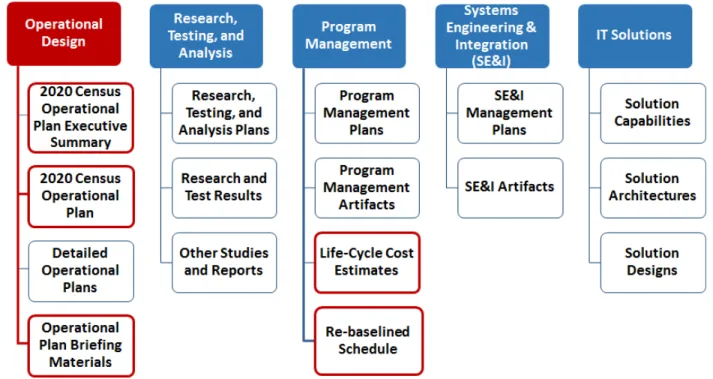
As shown in Figure 2, this Operational Plan, shaded in pink, is part of a broader set of documentation for the 2020 Census Program that will be developed as the Program matures. Those items outlined in red (i.e., the 2020 Census Operational Plan Executive Summary, the Operational Plan Briefing Materials, the Life-cycle Cost Estimates, and the Re-baselined Schedule) are being completed in conjunction with this Plan.
1 Throughout this document references are made to specific systems that are part of CEDCaP. These are the systems being used to support the early 2020 Census tests; however, final decisions on production systems have not been made.
Figure 2: 2020 Census Program Documentation Structure
1.4
Document Development Process
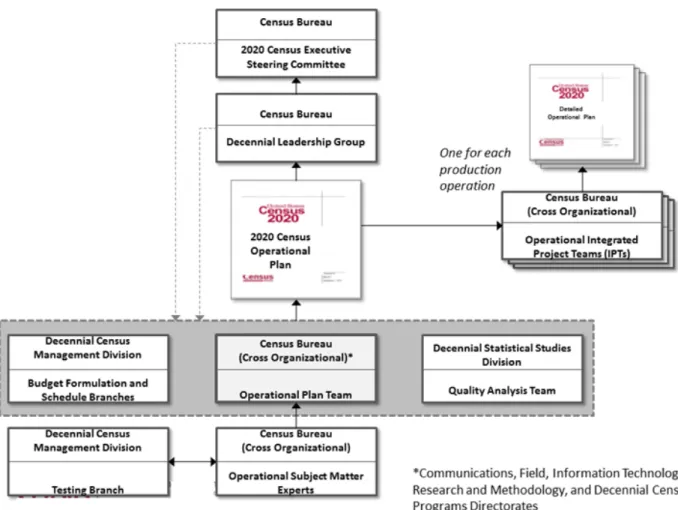
Many organizations across the Decennial Census Directorate and the Census Bureau have been involved in developing the 2020 Census operational design. Figure 3 illustrates these
organizations. The Operational Plan Team consists of subject matter experts from the key Census Bureau organizations with significant roles in supporting the 2020 Census. This team,
supplemented with additional subject matter experts from across the Census Bureau, plays a key role in identifying research needs, preparing for and analyzing the results of tests, and
recommending design decisions. The Decennial Census Management Division is leading the development of the schedule, life-cycle cost analysis and the testing. The Decennial Statistical Studies Division is leading the quality analysis. The 2020 Census Operational Plan has been reviewed and approved by both the Decennial Leadership Group and the 2020 Census Executive Steering Committee. Over the next two years, Operational Integrated Project Teams are
Figure 3: Organizations and Governance Boards for the 2020 Census Operational Plan
1.5
Document Organization
This document is organized into eight sections:
1. Introduction
2. The 2020 Census Overview
3. The Four Key Innovation Areas
4. Key Tests, Milestones, and Production Dates
5. The 2020 Census Operations
6. Key Program Level Risks
7. Quality Analysis
8. Life-Cycle Cost Estimate
Section 5 describes each of the 34 census operations and constitutes the bulk of this Operational Plan.
2.
The 2020 Census Overview
2.1
Purpose, Goal, and Challenge
The purpose of the 2020 Census is to conduct a census of population and housing and disseminate the results to the President, the states, and the American people. The goal of the 2020 Census is to count everyone once, only once, and in the right place, and the challenge is to conduct a 2020 Census at a lower cost per household (adjusted for inflation) than the 2010 Census, while maintaining high quality results.
2.2
Uses of Decennial Data
As the operational design of the 2020 Census is finalized, it is important to keep in mind the purpose of the 2020 Census and how the data will be used.
The primary requirement of the decennial census is the apportionment of seats allocated to the states for the House of Representatives. This requirement is mandated in the U.S. Constitution:
Article I, Section 2, “The actual enumeration shall be made within three years after the first meeting of the Congress of the United States, and within every subsequent Term of ten Years”
Fourteenth Amendment, Section 2, “Representatives shall be apportioned among the several States according to their respective numbers, counting the whole number of persons in each State”
Decennial data at the census block level are used by governmental entities for redistricting, i.e., defining the representative boundaries for congressional districts, state legislative districts, school districts, and voting precincts. Additionally, decennial data are used to enforce voting rights and civil rights legislation.
The Census Bureau also uses the decennial census results to determine the statistical sampling frames for the American Community Survey (ACS), which replaced the long form in the decennial census and is part of the Decennial Program, and the dozens of current surveys conducted by the Census Bureau. The results of these surveys are used to support important government functions such as appropriating federal funds to local communities (an estimated $400 billion annually); producing monthly unemployment, crime, and poverty rates; and publishing health and education data.
Finally, decennial data play an increasingly important role in United States commerce and the economy. As people expand their use of data to make decisions at the local and national levels, they increasingly depend on data from the Census Bureau to make these decisions. Today, local businesses look at data provided by the Census Bureau on topics like population growth and
income levels to make decisions about whether or where to locate their restaurants or stores. Similarly, a real estate investor, who is considering investing significant funds to develop a piece of land in the community, relies on Census Bureau data to measure the demand for housing, predict future need, and review aggregate trends. Big businesses also rely heavily on Census Bureau data to make critical decisions that impact their success and shape the economy at the national level. As noted above, the decennial census is the foundation for the Census Bureau’s demographic survey data.
The decennial data must meet high quality standards to ensure good decision-making and to continue building confidence in the government, society, and the economy. Studying the balance between cost and quality is an increasing focus of the census design in the 2016-2018 years.
2.3
The Changing Environment and Escalating Costs
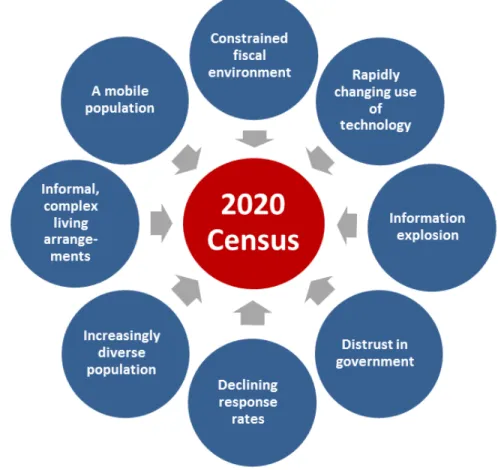
The 2020 Census challenge is exacerbated by multiple environmental factors that have the potential to impact its success. The Census Bureau is committed to proactively addressing the challenges that follow (see Figure 4):
• Constrained fiscal environment: Budget deficits place significant pressure on funding available for the research, testing, design and development work required for successful innovation.
• Rapidly changing use of technology: Stakeholders expect the decennial census to use
technology innovation, yet the rapid pace of change makes it challenging to plan for and adequately test the use of these technologies before they become obsolete.
• Information explosion: Rapid changes in information technology create stakeholder
expectations for how the Census Bureau interacts with the public to obtain and disseminate data products.
• Declining response rates: Response rates for Census Bureau surveys and for surveys
and censuses in general have declined as citizens are overloaded with requests for information and become increasingly concerned about sharing information.
• Distrust in government: Concerns continue to grow about information security and
privacy, the confidentiality of information given to the government, and how government programs will use the information it collects. This makes it more difficult to collect important demographic survey information.
• Increasingly diverse population: The demographic and cultural make-up of the United
States continues to increase in complexity, resulting in a growing number of households and individuals who do not speak English as their native language, who have a wide variety of cultural traditions and mores, and who may have varying levels of comfort with government involvement.
• Informal, complex living arrangements: Households are becoming more diverse and
dynamic, making it a challenge to associate an identified person to a single location. For example, blended families may include children who have two primary residences. Additionally, some households include multiple relationships and generations.
• A mobile population: The United States continues to be a highly mobile nation as about
12 percent of the population moves in a given year, based on results from the ACS conducted in 2012-2013 and 2013-2014. Continued growth in the use of cellular
telephone technology and an associated reduction in landline telephones tied to physical locations may also complicate enumeration.
Several of the societal, demographic, and technological trends listed above can result in a population that is harder and more expensive to enumerate. As it becomes more challenging to locate individuals and solicit their participation through traditional methods, the Census Bureau must decade after decade spend more money simply to maintain the same level of accuracy as in
conducting the decennial census have nearly doubled each decade. Initial estimates for expected total costs for the 2020 Census are $17.8 billion in 2020 constant dollars if the Census Bureau repeats the 2010 Census design and methods. With the innovations described in this Operational Plan, the Census Bureau estimates that it can conduct the 2020 Census for $12.5 billion in 2020 constant dollars.
Figure 5: Costs - Traditional vs Innovative 2020 Census
2.4
Four Key Innovation Areas
With cost reductions in mind, the 2020 Census team focused on four Key Innovation Areas:
Field costs associated with Address Canvassing and Nonresponse Followup operations comprise the most expensive parts of the 2020 Census. All four innovation areas are aimed at reducing the costs of fieldwork. A reengineered Address Canvassing operation is expected to reduce the field
$17.8 B $1.1 B $3.0 B $4.7 B $9.4 B $12.3 B $12.5 B 1970 1980 1990 2000 2010 2020
Costs - Traditional vs Innovative 2020 Census
Total Costs
(In 2020 Constant Dollars through 2020)
Traditional 2020 Census
Innovative 2020 Census
*Source: Bureau of the Census estimate on 2020 Census Life-cycle cost if the 2010 approach is used. Note: Figures through 2020 shown in 2020 constant dollars.
workload for address updating by 75 percent. Self-response innovations, which are aimed at generating the largest possible self-response rate, coupled with the use of administrative records and third-party data, are intended to reduce the field workload associated with Nonresponse Followup. Finally, the reengineered field operations are intended to increase the efficiency of those operations, allowing managers and fieldworkers to be more productive and effective. Each innovation area is described further in Section 3.
2.5
A New Design for the 21st Century
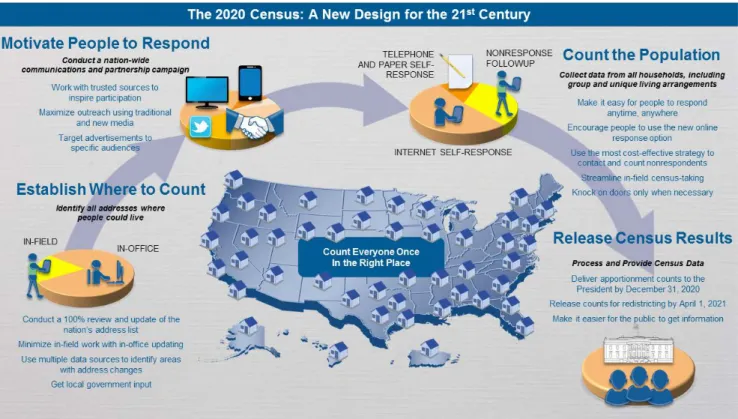
Figure 6 describes at a high-level how the 2020 Census will be conducted. This design reflects a flexible approach that takes advantage of new technologies and data sources while minimizing risk.
Figure 6: The 2020 Census - A New Design for the 21st Century
The first step in conducting the 2020 Census is to identify all of the addresses where people
could live, or Establish Where to Count. An accurate address list helps ensure that everyone is
counted. For the 2020 Census, the Census Bureau will begin an in-office review of one hundred percent of the nation’s addresses in September 2015 and continually update the address list based on data from multiple sources, including the U.S. Postal Service, tribal, state, and local
governments, satellite imagery, and third-party data providers. This office work will also determine which parts of the country require fieldwork to verify address information. While fieldwork will begin in 2016 on a small scale for address coverage measurement, the bulk of the
In-Field Address Canvassing will begin in 2019 and is anticipated to cover approximately 25 percent of all addresses, a significant reduction from the 100 percent that were reviewed in the field during the 2010 Census.
As noted above, response rates to surveys and censuses have been declining. To Motivate
People to Respond, the 2020 Census will include a nation-wide communications and
partnership campaign. This campaign is focused on getting people to respond on their own (self-respond) as it costs significantly less to process a response provided via the Internet or through a paper form than it does to send a fieldworker to someone’s home to collect their response. Advertising will make heavy use of digital media, tailoring the message to the audience.
The Census Bureau Counts the Population by collecting information from all households,
including those residing in group or unique living arrangements. The Census Bureau wants to make it easy for people to respond anytime and anywhere. To this end, the 2020 Census will offer and encourage people to respond via the Internet and will not require people to enter a unique Census identification with their response. Online responses will be accurate, secure, and convenient. If people are at the bus stop, waiting at the doctor’s office, or watching TV and do not have their Census ID handy, they can provide their address instead.
For those who do not respond, the Census Bureau will use the most cost-effective strategy for contacting and counting people. The goal for the 2020 Census is to reduce the average number of visits by using available data from government administrative records and third-party sources. These data may be used to identify vacant households, determine the best time of day to visit a particular household, or to count the people and fill in the responses with existing high-quality data from trusted sources. A reduced number of visits will lead to significant cost savings. It can also allow the Census Bureau to focus its field resources to achieve consistent response rates across geographic areas and demographic groups.
Additional cost savings are expected to result from the use of automation to streamline in-field census taking. Fieldworkers will use handheld devices for collecting the data. Operations such as recruiting, training, and payroll will be automated, reducing the time required for these activities. New operational control centers will rely on automation to manage the work, enabling more efficient case assignment, automatic determination of optimal travel routes, and reduction of the number of physical offices. In general, a streamlined operation and management structure is expected to increase productivity and save costs.
The last step in the 2020 Census is to Release the 2020 Census Results. 2020 Census data will
be processed and sent to the President (for apportionment) by December 31, 2020, to the states (for redistricting) by March 31, 2021, and to the public beginning in December 2021.
2.6
The 2020 Census Operations
The 2020 Census includes 34 operations that are organized into eight major areas that correspond with the Census Bureau standard WBS. The term operation refers to both support and business functions. For example, Program Management is considered a support function, and Address Canvassing is considered a business function. Table 1 provides a high-level purpose statement for each operation.
Table 1: Operations and Purpose
Operations Purpose
Program Management
Program Management Define and implement program management policies, processes, and the control functions for planning and implementing the 2020 Census.
Census/Survey Engineering Systems Engineering and
Integration (SE&I)
Manage the delivery of a system of systems that meets the 2020 Census Program business and capability requirements. Implement and manage the full Enterprise Systems Development Life-cycle for systems supporting the 2020 Census.
Security, Privacy, and Confidentiality
Ensure that all operations and systems used in the 2020 Census adhere to the appropriate systems and data security, respondent, and employee privacy and confidentiality policies, and regulations.
Content and Forms Design Identify, research, and finalize content and design of questionnaires and other non-questionnaire materials, ensure consistency across data collection modes and operations, and promote high response rates and accurate and consistent responses across modes.
Language Services Assess and support language needs of non-English speaking populations for all modes and other mailing and field materials, determine the number of languages and level of support required, optimize non-English content, and ensure cultural relevancy and meaningful translation of non-English materials.
Frame
Geographic Programs Provide the geographic foundation in support of the 2020 Census data collection and tabulation activities, including delineation of boundaries in the Master Address File (MAF)/Topologically Integrated Geographic Encoding and Referencing (TIGER) System, delivery of address and spatial extracts from the MAF/TIGER System, and updates to the MAF/TIGER System.
Operations Purpose
Local Update of Census Addresses (LUCA)
Provide an opportunity for tribal, federal, state, and local governments to review and improve the address lists and maps used to conduct the 2020 Census as required by Public Law (P.L.) 103-430.
Address Canvassing Deliver a complete and accurate address list and spatial database for enumeration and determine the type and address characteristics for each living quarter.
Response Data
Forms Printing and Distribution Print and distribute Internet invitations, reminder postcards, and
questionnaire mailing packages to support the 2020 Census mailing strategy and enumeration of the population.
Paper Data Capture Capture and convert data from the 2020 Census paper questionnaires, including document preparation, scanning, Optical Character Recognition, Optical Mark Recognition, Key from Image, editing, and checkout.
Integrated Partnership and Communications (IPC)
Communicate the importance of participating in the 2020 Census to the entire population of the 50 states, the District of Columbia, and Puerto Rico.
Motivate people to self-respond, preferably via the Internet, and raise and keep awareness high throughout the entire 2020 Census.
Internet Self-Response Collect response data via the Internet to reduce paper and Nonresponse Followup and maximize online response to the 2020 Census via contact strategies and improved access for respondents.
Non-ID Processing Make it easy for people to respond anytime, anywhere to increase self-response rates by providing self-response options that do not require a unique Census ID.
Update Enumerate (UE) Update the address and feature data and enumerate housing units in certain designated geographic areas with special enumeration needs (e.g., areas that do not have city-style addresses and areas with unique challenges associated with accessibility).
Group Quarters (GQ) Enumerate people living or staying in group quarters, people experiencing homelessness, and people receiving service at service based locations. Enumeration at Transitory
Locations (ETL)
Enumerate individuals in occupied units at transitory locations such as recreational vehicle parks, camp grounds, tent cities, racetracks, circuses, carnivals, marinas, hotels, and motels, who do not have a usual home elsewhere.
Operations Purpose
Census Questionnaire Assistance (CQA)
Provide questionnaire assistance for respondents by answering questions about specific items on the census form or other frequently asked questions about the 2020 Census and provide an option for callers to complete a census interview over the telephone.
Nonresponse Followup (NRFU) Determine housing unit status for nonresponding addresses and enumerate housing units for which a census response was not received.
Response Processing Establish the initial 2020 Census universe, assign the specific enumeration strategy for each census case based on case status and associated paradata, create and distribute workload files required for enumeration operations, track case enumeration status, and run post-data collection processing actions in preparation for producing the final 2020 Census results. Federally Affiliated Americans
Count Overseas
Obtain counts by home state of U.S. military and federal civilian employees stationed or deployed overseas and their dependents living with them.
Publish Data
Data Products and Dissemination Prepare and deliver the 2020 Census population counts to the President of the United States for Congressional apportionment, tabulate and disseminate 2020 Census data products for use by the states for redistricting, and tabulate and disseminate 2020 Census data for use by the public.
Redistricting Data Provide to each state the legally required P.L. 94-171 redistricting data tabulations by the mandated deadline of one year from Census Day: April 1, 2021.
Count Review Enhance the accuracy of the 2020 Census by implementing an efficient and equitable process for Federal-State Cooperative Population Estimates members to identify missing housing units and missing or geographically misallocated large group quarters.
Count Question Resolution (CQR) Provide a mechanism for governmental units to challenge their official 2020 Census results.
Archiving Provide 2020 Census records deemed permanent, including files containing individual responses, to the National Archives and Records Administration for archiving and to the National Processing Center (NPC) to use as source materials to conduct the Age Search Service.
Operations Purpose
Other Censuses
Island Areas Censuses (IA) Update and enumerate all living quarters in the Pacific Island Area of
American Samoa, the Commonwealth of the Northern Mariana Islands, Guam, and the U.S. Virgin Islands, collectively known as the Island Areas.
Test and Evaluation Coverage Measurement Design
and Estimation
Develop the survey design and sample for the post-enumeration survey for the 2020 Census. It also produces coverage error estimates and independent assessment of coverage via demographic analysis.
Coverage Measurement Matching
Identify matches and non-matches between the 2020 Census and the Census Coverage Measurement Survey for the enumerated housing units and people. Coverage Measurement Field
Operations
Collect person and housing unit information (independent from the 2020 Census operations) for the sample of housing units in the Census Coverage Measurement Survey.
Evaluations and Experiments Measure the success of critical 2020 Census operations. Formulate and execute an experimentation program to support early planning and inform the transition and design of the 2030 Census.
Infrastructure
Decennial Service Center (DSC) Support 2020 Census Field Operations and handle all service requests initiated by field staff.
Field Infrastructure Coordinate space acquisition for and lease management of the Regional Census Centers and field offices and provide the administrative infrastructure for data collection operations covering the 50 states, Washington, D.C., and Puerto Rico.
Decennial Logistics Management Provide logistics management services to include procuring warehouse space, warehousing, inventory management, kit assembly, deployment of materials, and receiving and accessing materials.
IT Infrastructure Provide the IT Infrastructure to support the 2020 Census, including enterprise systems and applications, 2020 Census-specific applications, field IT
infrastructure, and mobile computing.
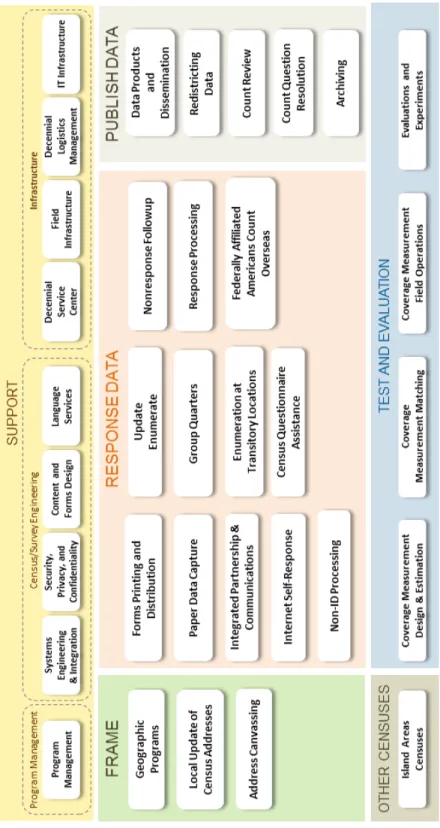
Figure 7 presents a graphic representation of the 34 operations organized into the eight areas described above. Program Management, Census/Survey Engineering, and Infrastructure are combined into one general group called Support, which is shown at the top of the diagram.
In addition, a separate area, Other Censuses, was added to account for the Island Areas Censuses operation, which is unique to the Decennial Census Programs. See Section 5 for details about the design and decisions for each of these operations.
3.
The Four Key Innovation Areas
The 2020 Census is designed to cost less per housing unit than the 2010 Census (when adjusted for inflation), while continuing to maintain high quality. The Census Bureau plans to achieve this by conducting the most automated, modern, and dynamic decennial census in history. The 2020 Census includes sweeping design changes in four key areas, including new methodologies to conduct Address Canvassing, innovative ways of optimizing self-response, the use of
administrative records and third-party data to reduce the Nonresponse Followup (NRFU) workload, and the use of technology to reduce the manual effort and improve productivity of field operations. The primary goal is to achieve dramatic cost savings by:
• Adding new addresses to the Census Bureau’s address frame using geographic
information systems and aerial imagery instead of sending Census employees to walk and physically check 11 million census blocks;
• Encouraging the population to respond to the 2020 Census using the Internet, reducing
the need for more expensive paper data capture;
• Using data the public has already provided to the government and data available from
commercial sources, allowing realized savings to focus additional visits in areas that have been traditionally hard-to-enumerate; and
• Using sophisticated operational control systems to send Census employees to follow up
with non-responding housing units and to track daily progress.
The Census Bureau estimates that conducting a 2020 Census that includes these major cost-saving innovations has the potential to save approximately $5.2 billion compared with repeating the 2010 design in the 2020 Census.
3.1
Reengineering Address Canvassing
The goal of Reengineering Address Canvassing is to eliminate the need to canvass every block. Instead, the Census Bureau is developing innovative methodologies for updating the Master Address File (MAF)/Topologically Integrated Geographic Encoding and Referencing (TIGER) System throughout the decade. Figure 8 highlights the key concepts in the Reengineering Address Canvassing approach.
Figure 8: Summary of Reengineering Address Canvassing
Continual research and updating will be conducted through an In-Office Address Canvassing operation that will begin in September 2015 and continue through the 2020 Census. Clerks will start with the 2010 Census address list and update it based on new information from the United States Postal Service (USPS), and data from tribal, state, and local governments and third parties (i.e., commercial vendors). Clerks will review satellite imagery to determine where changes in addresses are occurring, and based on these changes, the Census Bureau will develop a plan for capturing those changes. This plan will include an In-Field Address Canvassing operation where address updates cannot be obtained or verified or in areas undergoing rapid change. The number of addresses requiring In-Field Canvassing is expected to be approximately 25 percent of the total number of addresses. These design changes have the potential to save the Census Bureau an estimated $900 million.
The operations shaded in Figure 9 include innovations related to Reengineering Address Canvassing.
Documented below are brief descriptions of how each operation contributes to the Reengineering Address Canvassing innovation area:
Table 2: Description of Operations that Contribute to Reengineering Address Canvassing
Operation Contributions
Geographic Programs
• Simplified collection geography
• Simplified Type of Enumeration Area Delineation • More data sources to validate and augment the frame
• More frequent engagement with partners to improve quality of the MAF/TIGER System
Local Update of Census Addresses
• LUCA submissions validated as part of In-Office or In-Field Address Canvassing
Address Canvassing • 100 percent address canvassing conducted In-Office
• Target 25 percent of living quarters for In-Field Address Canvassing • Ongoing in-office and in-field improvement process
• Classification of living quarter types during In-Office review
• Increased productivity of field staff due to automated case assignment and route optimization
Update Enumerate • Geography in UE areas not included in the in-field workloads
Field Infrastructure • Reduced office infrastructure needed for In-Field Address Canvassing
• Automated administrative functions
IT Infrastructure • Listing applications for In-Field Address Canvassing with flexibility to support
Government Furnished Equipment, personally-owned devices, and Device as a Service
• Enterprise solutions with flexible architecture
• Additional IT infrastructure to support In-Office Address Canvassing
Additional operations that contribute to Reengineering Address Canvassing include: Decennial Service Center; Security, Privacy, and Confidentiality; Integrated Partnership and
Communications (IPC), and the Systems Engineering and Integration (SE&I).
3.2
Optimizing Self-Response
The goal of this innovation area is to communicate the importance of the 2020 Census to the United States population and generate the largest possible self-response, reducing the need to conduct expensive in-person followup with those households.
As shown in Figure 10, the Census Bureau plans to motivate people to respond by using technology and administrative records and third-party data to target advertisements and tailor contact strategies to different demographic groups and geographic areas. The Census Bureau also plans to utilize its partnership program, providing information to government agencies and hosting events at community, recreation, and faith-based organizations. Communication and contact strategies will encourage the use of the Internet as the primary response mode through a sequence of invitations and postcard mailings. In addition, when census fieldworkers visit a house and no one is home, the notice of visit will encourage self-response.
Figure 10: Summary of Optimizing Self-Response
A second key aspect of Optimizing Self-Response is to make it easy for people to respond from any location at any time. This is done in several ways:
• By enabling people to respond via multiple modes (Internet, paper, or telephone if they
call the Census Questionnaire Assistance (CQA) Center);
• By allowing respondents to submit a questionnaire without a unique identification code;
and,
• By providing on-line forms in multiple languages.
For these innovations to be successful, respondents must know that their personal information is protected. Thus, a key element of this innovation area is to assure respondents that their data are secure and treated as confidential.
The operations shaded in Figure 11 include innovations related to Optimizing Self-Response.
Documented below are brief descriptions of how each operation contributes to the Optimizing Self-Response innovation area:
Table 3: Description of Operations that Contribute to Optimizing Self-Response
Operation Contributions
Content and Forms Design
• Questionnaire designed for multiple modes and devices
Language Services • Non-English questionnaires available across modes
• Non-English content development of contact materials (e.g., invitation letters and postcards)
Forms Printing and Distribution
• Census mailing that encourage people to respond via the Internet
Paper Data Capture • Paper available as a response mode
Integrated Partnership and Communications
• Micro-targeted advertising • Multi-channel outreach
• Integrated Partnership and Communications program adjusted based on customer response, behavior, and feedback
• National and local partnerships promoting self-response
• Educational awareness campaign via traditional and new media sources (e.g., social media)
Internet Self-Response
• Multi-mode contact approach (e.g., postcard, email, phone, and text) • Optimized for mobile devices
• Multiple languages available
• Contact approach tailored to demographic and geographic areas based on administrative records, third-party data, and paradata analysis
• Real-time edits for Internet Self-Response to improve quality
Non-ID Processing • Public can respond anytime, anywhere without a unique Census ID
• Real-time geocoding of responses
• Real-time validation of responses without a unique Census ID • Real-time soft edits and checks for addresses
• Administrative records and third-party data used to validate identity and validate and augment address data
Census Questionnaire Assistance
• Flexible and adaptive language support • Web chat
• Respondent-initiated telephone response collection
Response Processing
Operation Contributions
IT Infrastructure • Infrastructure built and sized to meet demand and ensure adequate performance for
Internet Self-Response
• Secure Internet response capability
In addition, the Security, Privacy and Confidentiality operation and the Systems Engineering and Integration operation contribute to the Optimizing Self-Response innovation area.
3.3
Utilizing Administrative Records and Third-Party Data
The goal of this innovation area is to use information people have already provided to improve the efficiency and effectiveness of the 2020 Census, and in particular reduce expensive in-person followup activities. Administrative record data refers to information from federal and state governments. Third-party data refers to information from commercial sources. As shown in Figure 12, data from both sources can help improve the quality of the address list (frame), increase the effectiveness of advertising and contact strategies, validate respondent submissions, and reduce field workload for followup activities.
Figure 12: Summary of Utilizing Administrative Records and Third-Party Data
As has been done in prior decades, administrative data from the U.S. Postal Service and other government records are used to update the address frame and reflect changes that occur over time. Additional administrative records sources as well as third-party data from commercial
companies will also be used for this purpose. In addition, these data sources will be used to validate incoming data from tribal, federal, state and local governments.
To increase the effectiveness of advertising and contact strategies, the Census Bureau will use demographic and geographic information from various administrative record and third-party data sources to help target the advertising to specific populations. These data will also be used to create a contact frame that includes email addresses and telephone numbers. A contact frame with this additional information enables the Census Bureau to expand its contact methods beyond traditional postal mail.
Administrative records and third-party data will also be used to validate respondent addresses for those who respond without providing a unique Census ID. This will help prevent fraudulent and erroneous submissions.
Finally, a primary use of administrative records is to reduce field workload for followup
activities. To this end, the Census Bureau will use data from internal and external sources, such as the 2010 Census, the USPS, the Internal Revenue Service and the Centers for Medicare and Medicaid Services to identify vacant and nonresponding occupied housing units and remove them from the Nonresponse Followup workload. The Census Bureau plans to continue acquiring and testing data from other sources, including the National Directory of New Hires, the
Supplemental Nutrition and Assistance Program and state-administered programs such as Temporary Assistance for Needy Families to better understand how these data sources can help reduce followup field workload.
These design changes have the potential to save the Census Bureau an estimated $1.4 billion. The operations shaded in Figure 13 include innovations related to Utilizing Administrative Records and Third-Party Data.
Documented below are brief descriptions of how each operation contributes to the Utilizing Administrative Records and Third-Party Data innovation area:
Table 4: Description of Operations that Contribute to Utilizing Administrative Records and Third-Party Data
Operation Contributions
Security, Privacy, and Confidentiality
• Ongoing monitoring of public perception on decennial application of administrative records and third-party data
IT Infrastructure • Use of administrative records require that systems be Title 13 and Title 26
compliant
Geographic Programs • Administrative records and third-party data used to determine types of
enumeration areas, basic collection units, and geographic boundaries
Local Update of Census Addresses
• Administrative records and third-party data used to validate incoming data from tribal, federal, state, and local governments
Address Canvassing • Additional sources of administrative records and third-party data used to
update the frame
Integrated Partnership and Communications
• Expanded use of administrative records and third-party data to support micro-targeted Integrated Partnership and Communications program
Internet Self-Response • Administrative records and third-party data used to create the contact frame
• Administrative records and third-party data used to tailor the contact strategy
Non-ID Processing • Administrative records and third-party data used to validate and augment
address data and validate identity for submissions missing a unique Census ID
Group Quarters • Electronic transfer and expanded use of administrative records and
third-party data to enumerate group quarters where possible
Enumeration at Transitory Locations
• Administrative records and third-party data used to update addresses of transitory locations
Nonresponse Followup • Expanded use of administrative records and third-party data to remove
vacant and occupied housing units from the NRFU workload
• Administrative records and third-party data used to reduce the number of contact attempts made
• Administrative records and third-party data used to tailor work assignments based on language and “best time of day” for contact
Response Processing • Increased use of administrative records and third-party data to impute
response data (in whole or in part)
• Increased use of libraries from past surveys and censuses to support editing and coding
Operation Contributions
libraries for primary selection algorithm and Invalid Return Detection
Count Question Resolution • Administrative records and third-party data used to resolve CQR challenges
Coverage Measurement Design and Estimation
• Administrative records and third-party data used for demographic analysis • Administrative records and third-party data used for estimation
• Administrative records and third-party data used for sample design
Coverage Measurement Field Operations
• Administrative records used and third-party data to reduce the number of contact attempts made
• Administrative records and third-party data used to tailor work assignments based on language and “best time of day” for contact
Island Areas Censuses • Administrative records and third-party data used where appropriate to
support both listing and enumeration
Additional operations that contribute to utilizing Administrative Records and Third-Party Data include: Field Infrastructure, Federally Affiliated American Count Overseas and the Systems Engineering and Integration.
3.4
Reengineering Field Operations
The goal of this innovation area is to use technology to efficiently and effectively manage the 2020 Census fieldwork, and as a result, reduce the staffing, infrastructure, and brick and mortar footprint required for the 2020 Census. Figure 14 shows the three main components of the reengineered field operations: streamlined office and staffing structure, increased use of technology, and increased management and staff productivity.
Figure 14: Summary of Reengineering Field Operations
The 2020 Census field operations will rely heavily on automation. For example, the Census Bureau plans to provide fieldworkers with the capability to work completely remotely and perform all administrative and data collection tasks directly from a handheld device. Supervisors will also be able to work remotely and communicate with their staff via these devices. These enhanced capabilities significantly reduce the number of offices required to support 2020 Census fieldwork. In the 2010 Census, the Census Bureau established 12 regional census centers and nearly 500 area census offices. The agency hired over 516,000 enumerators to conduct
Nonresponse Followup activities. The new design for the 2020 Census field operations includes six regional census centers with up to 250 Administrative Support Operation Centers.
In addition, automation enables significant changes to how cases are assigned and the supervision of field staff. By making it easier for supervisors to monitor and manage their workers, the ratio of workers to supervisor can be increased, reducing the number of supervisors required. This streamlines the staffing structure. Other design changes include optimized case assignment and routing.
All administrative functions associated with field staff will be automated, including recruiting, hiring, training, time and attendance, and payroll. Finally, the new capabilities allow for quality to be infused into the process through alerts to supervisors when there is an anomaly in an enumerator’s performance (e.g., the Global Positioning Satellite indicator on fieldworker’s handheld device indicates that she or he is not at the assigned address) and real-time edits on data collection. Accordingly, the quality assurance process used in the 2010 Census is being
In total, these design changes have the potential to save the Census Bureau an estimated $2.5 billion.
The operations shaded in Figure 15 include innovations related to Reengineering Field Operations.
Documented below are brief descriptions of how each operation contributes to the Reengineering Field Operations innovation area. The field data collection operations are grouped together as they all contribute similarly.
Table 5: Description of Operations that Contribute to Reengineering Field Operations
Operation Contributions
Field Infrastructure • Streamlined staffing structure
• Automated use of real-time data by the field operations control system to enable better management of the field workforce
• Automated training for field staff
• Automated administrative functions, including recruiting, and payroll • Supervisory support for fieldworkers available during all hours worked
IT Infrastructure • Enterprise solutions with flexible architecture
• Listing and enumeration applications with flexibility to run on Government Furnished Equipment, personally-owned devices, and Device as a Service
Integrated Partnership and Communications
• Enhanced communications to support field recruitment
Field Data Collection Operations: Address Canvassing Update Enumerate Group Quarters Enumeration at Transitory Locations Nonresponse Followup Coverage Measurement Field Operations
• Rapid reclassification of living quarter type (under review)
• Reduced paper; Number of attempts tailored based on the availability of administrative records, third-party data, and paradata
• Reduced field workload as measured by cases and attempts • Near real-time case status updates
• Automated and optimized assignment of work • Declaration of work availability and case assignments
• Flexibility built into work assignment process based on in-field feedback or observations
• Data on household language and best time of day to contact standardized and available at central location for work assignments • Redesigned quality assurance process
• Ability to update address list and enumerate on a single device with a suite of integrated applications
• Ability for addresses not identified during Address Canvassing to be enumerated when identified
Additional operations that contribute to utilizing Reengineering Field Operations include
3.5
Summary of Innovations
This section summarizes the key innovations planned for the 2020 Census. Innovations are considered significant changes to the operational design as compared with the 2010 Census. Figure 16 highlights the operations that have the most significant innovations.
The specific innovations planned for each of these operations are listed in Table 6 below. Note that these innovations are dependent upon funding and decisions on the final design.
Table 6: Summary of Key Innovations by Operation
Operation Contributions
Local Update of Census Addresses
• Reduced complexity
• Elimination of the full address list submission options to improve quality and reduce burden and cost
Address Canvassing • Use of a combination of in-office and in-field methods to achieve a 100 percent
Address Canvassing (target of 25 percent of addresses going to the field)
• Use of automation and data (imagery, administrative records, and third-party data) for In-Office Address Canvassing
• Ongoing fieldwork (Master Address File (MAF) Coverage Study) to validate in-office procedures, measure coverage, and improve in-field data collection methodologies • Use of reengineered field management structure and approach to managing
fieldwork, including new field office structure and new staff positions
Integrated Partnership and Communications
• Micro-targeted messages and placement for digital advertising, especially for hard-to-count populations
• Advertising and partnership campaign adjusted based on respondent actions • Expanded predictive modeling to determine propensity to respond by geographic
areas
• Expanded use of social media
Internet Self-Response
• Internet data capture, providing real-time edits, ability to capture unlimited household size entries, and multi-access methods across different technologies (e.g., computers, phones, tablets, kiosks)
• On-line questionnaires available in multiple languages and non-Roman alphabets • Multi-mode contact approach tailored to demographic or geographic area
• A contact frame, including email and phone numbers, developed from administrative records and third-party data to allow for followup if required (e.g., missing or illegible information and reinterview for quality assurance)
Non-ID Processing • Ability for public to respond anytime, anywhere
• Real-time matching and geocoding of responses • Validation of Non-ID response data
• Use of administrative records and third-party data to validate identity and validate and augment address data for Non-ID submissions
Update Enumerate (planned innovations dependent on funding of this operation)
• The 2010 Census Update Leave and UE Operations combined into a single operation • Single visit with enumeration or push to Internet Self-Response
• Use of single device for both listing and enumeration
• Use of reengineered field management structure and approach to managing fieldwork, including new field office structure and new staff positions
Operation Contributions Nonresponse
Followup
• Use of administrative records and third-party data to remove vacant housing units from the NRFU workload
• Use of administrative records and third-party data to remove nonresponding occupied housing units from the NRFU workload
• Use of reengineered field management structure and approach to managing fieldwork • Use of a variable contact strategy and stopping rules to control the number of
attempts made for each address (based on paradata) • Assignment and route optimization
• Automated training for field staff • Automation of the field data collection
• Automation of administrative functions such as recruiting, onboarding, and payroll • Reengineered quality assurance approach
Field Infrastructure • Reduced number of Regional Census Centers (RCC) managing a reduced number of
Area Census Offices tasked with managing field operations and support activities • Automated job application and recruiting processes, payroll submission and approval
process, and other administrative processes resulting in reduced staffing requirements • Automated training
• Reduced number of enumerators and supervisors due to reengineered design for field operations
Decennial Logistics Management
• Implementation of an on-line, real-time Enterprise Resource Planning system with extended access for the RCC and field offices
• Implementation of a wireless network and bar code technology that will automate inventory transactions
IT Infrastructure • Early development of solutions architecture
• Use of enterprise solutions as appropriate
• Iterative deployment of infrastructure aligned with and based on testing
• Implementation of alternatives to providing Government Furnished Equipment, such as Bring Your Own Device or Device as a Service
• Use of demand models to help predict Internet response volume, Census Questionnaire Assistance center staffing, etc.
• Scalable design
4.
Key Tests, Milestones, and Production Dates
The 2020 Census has multiple decision points, milestones, and production dates that must be met to deliver the final apportionment and redistricting data. Informing the decisions points are a series of tests. These tests are documented in the 2020 Census Research and Testing
Management Plan, which provides the overarching management and analysis framework for executing research and testing projects and integrating the results across projects. More detailed information about each test is captured in formal research and test plan documents and in an integrated master schedule, facilitating the integration and coordination of activities across tests and operations. Refer to Figure 2 in Section 1 for how this documentation fits into the broader set of documentation for the 2020 Census program. Detailed test plans and results are available for review upon request.
The first part of this section describes the tests used to inform the operational design and prepare for conducting the Census. The second section highlights key decision points and milestones beginning with the research and testing phase in Fiscal Year (FY) 2012 through the completion of the Census in 2023. The third section provides the planned production timeline for the primary 2020 Census operations, and the final section shows an integrated schedule of the tests, milestones, and production operations.
4.1
Tests to Inform the Operational Design and Prepare for Conducting the
Census
As shown in Figure 17, the tests conducted early in the decade (2012-2015) are aimed at answering specific research questions (objectives) needed to make decisions on important aspects of the operational design for the four key innovation areas. Starting in 2016, the focus shifts to validating and refining the design by testing the interactions across operations and determining the proposed methodology for the operations. In addition, testing of production systems begins during this time-frame and continues through 2018, with final performance testing to ensure scalability occurring in 2019. An end-to-end test in 2018 will test the integration of all major operations and systems.
Table 7 lists the operational tests executed or planned for the 2020 Census.
Table 7: Operational Tests
Calendar Year Test
2012 • Public Opinion Polling (ongoing as needed throughout the decade)
• 2012 National Census Test
2013 • 2013 National Census Contact Test
• 2013 Census Test
2014 • 2014 Census Test
• Continuous Small-Scale testing (ongoing as needed throughout the decade) • LUCA Focus Groups
• 2014 Human-in-the-Loop Test
2015 • Address Validation Test (starts in late 2014)
• 2015 Optimizing Self-Response Test • 2015 Census Test
• 2015 National Content Test
2016 • 2016 Census Test
• 2016 Address Canvassing Test
2017 • 2017 Census Test
2018 • 2018 Census End-to-End Test
2019 • Post End-to-End Testing
The following sections describe the tests listed above. Tests for Calendar Years 2012 through 2014 are combined into one section. For the past and current tests, a short description of the purpose, scope, and timing is presented, followed by a table with objectives of the tests, findings, and, where applicable, design implications based on these findings. For future tests, only the purpose, scope, timing, and objective are provided. These may change since future test plans are based on availability of funding as well as the analysis of prior tests.
4.1.1 Tests in 2012-2014
As shown in Figure 18, eight tests were conducted between 2012 and 2014.
Figure 18: Tests in 2012-2014
4.1.1.1 Public Opinion Polling
The Public Opinion Polling Test is a public opinion survey of attitudes toward statistics produced by the federal government that focuses on trust in the federal statistical system, the credibility of federal statistics, and attitudes toward and knowledge of the statistical uses of administrative records and third-party data. The Census Bureau is using the Nightly Gallup Polling for this survey, and collects data by telephone from 850 nationally representative housing units per week. Data collection started in February 2012 and will continue on an ongoing basis as needed.
Public Opinion Polling Test
Objectives • Determine if the public’s perception of the Census Bureau’s commitment and
ability to protect privacy and confidentiality are impacted if administrative records are used in the 2020 Census design
• Determine what the public is most concerned about with regard to privacy and confidentiality, in general and as related to government data collection
Findings • Reported belief in the credibility of statistics predicts reported trust in federal
statistics
• Questions regarding administrative record and third-party data use has shown when framed to indicate that the use of records can save the government money or provide a social good then respondents are more likely to favor using
administrative records and third-party data
Design Implications
• Continue to pursue research and testing related to the use of administrative records and third-party data
4.1.1.2 2012 National Census Test
The 2012 National Census Test studied overall self-response rates and Internet self-response rates. The test was conducted from August 2012 to October 2012 and included 80,000 nationally representative housing units.
2012 National Census Test
Objectives • Assess relative self-response rates and Internet self-response rates
• Evaluate the performance of combined race and origin questions on the Internet • Assess the Telephone Questionnaire Assistance operation
Findings • Total self-response rate was 56.9 percent, and the Internet self-response rate was 36.5
percent.
• An advance letter resulted in no significant difference in overall response rate as compared with no advance letter
• Providing a telephone number in the initial mailing resulted in no significant difference in overall response, but an increase in telephone interviews
• A second reminder to answer the 2012 National Census Test performed well
• Tailoring the content of the reminder materials resulted in no significant difference in overall response
• Response distributions of the combined race and origin questions were similar across the two question versions
• Results did not indicate expected benefit of enhanced reporting of detailed race and origin groups
• Sixty-nine percent of calls to the Telephone Questionnaire Assistance operation were because the respondent did not have a computer or Internet access
Design Implications
• Continue tests to determine response rates and optimal contact strategies
• Further study of the collection of detailed race and origin groups in a national mailout test
• The 2020 Census Questionnaire Assistance operation must account for increased call volumes
4.1.1.3 2013 National Census Contact Test
The 2013 National Census Contact Test studied two key areas related to strategies for contacting respondents: the quality of the Contact Frame (a list of supplemental contact information such as email addresses and phone numbers, built from third-party data sources) and automated
processing of census responses lacking a preassigned census identification number (Non-ID Processing). The study included 39,999 nationally representative addresses.