Multidisciplinary Studies Full Paper Proceeding ETAR-2014, Vol. 1, 300-304
IS BN: 978-969-9948-23-7
*All correspondence related to this article should be directed to , Arie Wibowo Yanuar Firdaus, Telkom University, Indonesia.. Email: [email protected]
ETA R 2014
Component Based Model For General Reporting System Engine
Arie Wibowo Yanuar Firdaus1*, Laksitowening Kusuma Ayu2 1,2
Telkom University, Indonesia
Abstract
Information systems imple mentation impacts organization behavior of running business and in the same time arise new cha llenges. Nowadays, organizat ion faces the challenges related to data management. One of co mmon forms of utilizing technology in data management is reporting. Reporting plays a key role as the basic reference of decision making. Reporting systems are expected to assure interoperability with other systems, accommodate mu lti data sources, provide varied format option, and can be used easily. To meet these needs, it is necessary to be constructed a model that can be a reference in developing reporting systems engine. The objectives of this research is to propose a new model that assure the reporting system being developed meet the functional require ment while also give independency to components inside the engine. The model is formu lated through the following steps: comparing some approaches in system development, identifying co mponents and modules needed in reporting system engine, and analyzing technologies used in reporting systems.
© 2014 The Authors. Published by Global Illuminators. This is an open access article under the CC BY-NC-ND license (http://creativecommons.org/licenses/by-nc-nd/4.0/)
Peer-review under responsibility of the Scientific & Review committee of ETAR-2014.
Keywords : Reporting Systems, Data Source, Interoperability, Engine, Co mponents.
Introduction
Reporting became a crucial component of data management and a fundamental process for organization. The main purpose of reporting is presenting current state of organization‟s performance. Nowadays, many organizations implement web-based systems as reporting tools to help them in generating up-to-date information based existing data sources.
In selecting reporting system, the organization needs to consider many aspects. Some of the basic features that must be owned by a reporting system, besides the basic functionalities, are: ability to connect to multiple data sources, user friendliness, capability to customize report format, integration with main system, and interoperability (“Reporting Tool Selection,” 2014).
To meet these needs, reporting systems development should refer to appropriate architecture. Software architecture is intended to decompose systems into components. The component decomposition helps developers to deal with complexity and manage coordination among individuals or small teams (Unphon & Dittrich, 2010).
This research proposed a component based modelling as reference for engineers in developing reporting systems. This research were conducted by literature study in software modelling and architecture, identifying components and modules needed in reporting engine, and finally formulating the proposed modelling.
Literature Study
a. Reporting in Information Systems
Information system, as we know it, is system that collects, processes, stores, a nalyzes, and distributes information for a specific purpose or objective (Turban & Volonino, 2012). The objective of its implementation is to help organization improve their performance.
Information system is expected to enable organization in sharing data among departments and with external business partners. Information system implementation allows managers and executives to access and analyze real time information and transaction processes across the entire institution (Pearlson & Saunders, 2013).
Organizations need reporting system to provide reports that suit to user need and handle customizable format. Organizations expect accessibility, transparency, reliability and customization in generating reports. Above all, reporting system accommodate the need of organization in extracting information for prediction, planning and decision-making (Corporateregister.com, 2001).
b. Software Architecture and Modeling
Software architecture is the fundamental organization of a system embodied in its components, their relationships to each other and to the environment and the principles guiding its design and evolution. In software development, it is one of the most important documentation (Unphon & Dittrich, 2010).
Architecture determines conceptual model, structure and relationship between objects, and must be environment and language- independent (Schwabe, Rossi, Esmeraldo, & Lyardet, n.d.) (Unphon & Dittrich, 2010).
Architecture consists of layers, modules and dependenc ies. It is then translated into folders, files, and classes in implementation step. In order to bridging architecture to implementation perspective, we need to decompose the architecture into components. The component based modeling will be more „implementation-friendly‟ and clearly describe the codes to be built by developers.
Proposed Model
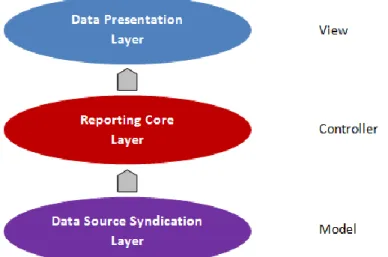
General reporting system is formed from reusable components. The component composition in the architectural framework consists of three layers: data source syndication layer, core layer reporting and data presentation layer. This architecture adopts the Model-View-Controller concept as show in the Figure 1. The concept separates component that access data and component related to user interface.
Figure 1. General reporting system model adopts the MVC concept
Figure 2. The object of general reporting system is composed of several components
Each layer in the general reporting system is represented by an object. One object represents a subsystem that is composed of several components. There are three objects, namely: the data access object, pivot table object and chart object. The structure of subsystems is shown in the Figure 3.
Data Access Subsystem has four components, as follows:
a. System configuration. The first component of the independent reporting system. This component can be under administrator‟s authority. Administrators can configure the system and defines who is allowed to use the general reporting system.
b. Report creation. The component makes new report at once defines anyone who is allowed to access the report.
c. Query management. The component to manage query on a report. Query adapted to the scheme and structure of the data source table that has been determined.
d. The data source connection. The component that will connect to data sources. Each data source has a preference of different connections. All of the data source that is used to form the report needs to be defined and tested the connection through this component.
Figure 3. The structure of general reporting subsystem
Pivot table subsystem has three parts, as follows:
a. Query execution. The component that will generate content in a report by executing query. Data extraction will be done by connecting directly to the data source.
b. Report format definition. The component to set the format of the report, define rows and columns as well as the position of the sequence of rows and columns.
c. Data customization. The component to customize the information displayed in the table cells that have been specified format. Customizing display detailed information may include data record, calculate the number of records of data, and other defined formula.
Subsystem chart has two components, as follows:
a. Data delivery. The component that will present the report in tabular form based on any customizations that have been previously made.
b. Data visualization. The component that will present the report in graphical form based on any customizations that have been previously made.
Discussion And Conclusion
General reporting system established by applying the concept of MVC, consists of three layers: data source layer syndication, reporting core layer and the data presentation layer. Each layer is represented by an object that is composed of several components. Each component is reusable, allowing to set the corresponding workflow components and certain privileges. The structure of the general reporting subsystem shows that the reporting application that was built to accommodate the needs of or ganizations to provide flexible and
References
Corporateregister.com. (2001). Environmental , Social and Sustainability Reporting on the
World Wide Web : A Guide to Best Practice. The Certified Accountants Educational
Trust (CAET).
Pearlson, K. E., & Saunders, C. S. (2013). Strategic Management of Information Systems (5th Editio.). WILEY.
Reporting Tool Selection. (2014). 1keydata.com. Retrieved from
http://www.1keydata.com/datawarehousing/toolreporting.html
Schwabe, D., Rossi, G., Esmeraldo, L., & Lyardet, F. (n.d.). Web Design Frameworks : An approach to improve reuse in Web applications Towards Web design frameworks. Turban, E., & Volonino, L. (2012). Information Technology for Management (8th Edition).
WILEY.
Unphon, H., & Dittrich, Y. (2010). Software architecture awareness in long-term software
product evolution. Journal of Systems and Software, 83(11), 2211–2226.