1
Development of a Forensic Engineering Course in Civil Engineering
James J. Lynch, PhD, P.E.
University of Detroit Mercy, Detroit, MI Email: [email protected] Abstract
A forensic engineering course has been developed to be taught in the Department of Civil and Environmental Engineering. The objective of the course relates to the performance of existing construction and the implications of that performance. The outcomes of the course were developed to meet the current program outcomes but also such that the students can develop skills necessary for the practice of forensic engineering. The course is cross-listed at the undergraduate and graduate levels, and is open to students studying civil engineering and environmental engineering, but also to students studying architecture.
The course objective was to address the technical, economic, societal, legal, and ethical implications related to the performance of existing construction. The technical aspects included evaluating existing construction, identifying specific defects and their causes, and recommending corrective action. The economic aspects included determining the cost of implementing the recommendations from the technical aspects. The societal, legal, and ethical aspects developed from the technical and economic considerations, e.g., determining who will pay for remedial action, how the remedial action will affect the users, determining if one or more of the parties designed or constructed the subject of the investigation improperly. The course outcomes were designed to fulfill the course objective and included specific techniques for collecting and analyzing data on the performance of existing construction, designing repairs to existing construction, and communicating the results.
The course format was primarily traditional, i.e., lectures, homework assignments, presentations, projects, and a final exam, but also included a site tour. The topics covered included various materials and their application to different civil engineering works. The materials included steel, concrete, masonry, timber, and hot mix asphalt. The materials were used in buildings superstructures and foundations, bridge superstructures and foundations, building envelopes, retaining walls, and pavements.
The students were evaluated based on the results of the homework assignments,
presentations, projects, and exam. Student learning was assessed using the evaluation material as well as participation in class.
The course was generally successful in that all students completed the homework
assignments, presentations, and projects, and nearly all students successfully completed the final exam. Independent research is an area in which student learning could be improved. Forensic engineering is, by its nature, vague and open-ended. Student performance was better on the more defined activities, e.g., design a plate to increase the capacity of steel beam, than on more open-ended activities, e.g., describe the inspection process of a steel bridge. Future offerings of the course will include changes to the course content that address these deficiencies as well as
2 topics that were not fully explored in this offering. One specific topic that needs exploration is the legal aspects of forensic engineering. The professor has obtained the outline of a court case from civil engineering and will implement that in the next offering of the course.
Key Words
Forensic Engineering, Condition Surveys, Curriculum Development
Introduction
The condition of the nation’s infrastructure is generally poor and the cost of upgrading it to an acceptable level is over $2 trillion1. In some areas of the country, the need for the upgrade and repair of existing construction may exceed the need for new construction. The typical undergraduate education in civil engineering, as well as architecture, focuses heavily on the design and construction of new buildings, bridges, pavements, etc. In fact, it may not even address the performance of existing construction or the design of upgrades and repairs. The heavy focus on the design of new construction contrasted with the industry needs to address the condition of existing construction provides the opportunity for the development of courses that address this need.
The development of such a course certainly requires an understanding of the technical issues related to the performance of existing construction but also of non-technical issues. The technical issues include methods of evaluating existing construction, methods of addressing deficiencies found during an investigation, e.g., designing repairs, and methods of estimating the costs and times associated with implementing the recommended remedial action. The non-technical issues could include the effects that the poor performance on existing construction has on the users and community at large, and the identification of responsible parties if the subject of the investigation had been improperly designed or constructed.
One approach of addressing the technical and non-technical aspects of the performance of existing construction is to develop a course in forensic engineering, which is defined as
“Forensic Engineering is the application of the art and science of engineering in the jurisprudence system, requiring the services of legally qualified professional engineers. Forensic engineering may include investigation of the physical causes of accidents and other sources of claims and litigation, preparation of engineering reports, testimony at hearings and trials in administrative or judicial proceedings, and the rendition of advisory opinions to assist the resolution of disputes affecting life or property.”2
Based on this definition, civil engineers involved in forensic engineering projects need an understanding of the methods, codes, procedures, etc. required for the original design and construction of the subjects of those investigations, but they also need other skills such as specific techniques for the evaluation of existing construction, knowledge of specific design and
3 construction procedures for the repair of damaged structures, and knowledge of legal aspects of design and construction.
Although courses that address the performance of existing construction are not typically part of a civil engineering curriculum, the number has been growing. In 1997, ASCE held its first conferences on forensic engineering and the proceedings from that conference included a paper on the development of one course in forensic engineering3. A 2003 survey of colleges and universities identified 21 institutions that offered courses in failure analysis, condition
assessment, forensic engineering, structural repair, etc. through departments of civil engineering, architecture, or architectural engineering4.
This paper describes the development of an undergraduate / graduate-level course in Forensic Engineering. This course is designed primarily for students in civil engineering, although students studying architecture can also take the course. The course includes lectures, laboratory activities, and field activities, homework assignments, presentations, projects, and exams in which students study various materials or systems. The course outcomes were
developed to partially fulfill the current ABET program outcomes for civil engineering as well as to help the students develop specific skills related to forensic engineering. Student learning was assessed through participation in the various activities, and through grades on the submissions and the presentations.
Forensic Engineering Background
The behavior of buildings, bridges, pavement, and other existing construction over their life cycles is affected by the interaction of factors such as design, construction, material
selection, quality control, loads, and environmental exposure. The poor performance of existing construction generally occurs by failing to properly account for one or more of the factors that would affect its performance. The actual cause of the failure or poor performance covers a wide range, including natural disasters or accidents, acts of terrorism, fraud, design errors, and
construction errors. Eventually, all existing construction will deteriorate from loads and environmental exposure that is within the range considered in the original design.
A forensic engineering investigation could be performed on existing construction that is performing poorly or has failed. In the case of existing construction that is performing poorly, an owner or user may observe signs of that poor performance, resulting in a contract with an
engineer or engineering firm to conduct the investigation.
Skills Required for Forensic Engineering Investigations
A forensic engineering investigation starts with gathering information, and then leads into engineering analysis, conclusions, and recommendations. The results of a forensic engineering investigation would be summarized in a report. If the results are used in a court case or if the subject of the investigation is a public project, the investigators may need to provide testimony to attorneys, government officials, or the public. Based on possible tasks involved in a forensic
4 engineering investigation, Carper (2000) identified four skills necessary for the successfully practice of forensic engineering, which are:
1. Technical competency
2. Knowledge of legal procedures 3. Detective skills
4. Oral and written communication skills2
The technical skills would include expertise in areas such as structural analysis, structural design, geotechnical engineering, pavement design, construction management, etc. – all of these are standard subjects taught in civil engineering curricula. Knowledge of legal procedures is not typically taught in civil engineering curricula. Detective skills require an eye for detail but would also require some development through formal training. Oral and written communication skills are developed through formal training and continued practice, and these are skills that are developed in a university education.
Examples of Forensic Engineering Investigation Subjects
Forensic engineering investigations in civil engineering can be performed on a variety of existing construction that has failed or is performing poorly. The scope of the investigation and conclusions drawn from the investigation can vary widely based on the type of construction, materials used in the construction, and outward signs that led to the request for a forensic engineering investigation.
Investigators involved in a forensic engineering investigation, i.e., engineers and other professionals, need to gather enough data to confidently identify condition issues in the subject of the investigation, identify causes of those conditions, recommend corrective action, and attribute responsibility. Gathering the information required to complete the forensic engineering investigation would include inspecting the subject, but could also include tasks such as collecting samples for laboratory testing, reviewing design drawings and construction records, and
interviewing witnesses or occupants.
Unusual conditions such as earthquakes and hurricanes could certainly cause the poor performance or failure of existing construction. Damaged buildings bridges, etc. would need to be evaluated after such an event, and the results of this investigation would surely identify technical, economic, and societal issues or concerns; however, it may or may not identify legal and ethical issues or concerns. Consider the 1995 bombing of the Alfred P. Murrah Federal Building in 1995. In an act of domestic terrorism, several individuals constructed an explosive device, placed that explosive device in a truck, parked the truck next to the building, and
detonated the device. The result of the explosion was general damage to the building and failure of parts of the building5. A forensic engineering investigation was performed by a team that included engineers from private practice, government, and technical societies. The general conclusion was that the building was properly designed and constructed using the relevant codes at the time of the design and construction5. Because the code did not include blast loading, the
5 architects, engineers, and contractors involved in the original construction were not legally liable or ethically responsible for the damage to the building and loss of life.
Another unusual condition that can result in the poor performance or failure of existing construction is fraud on the part of engineers, architects, and contractors. For instance, a testing company in New York has been investigated for falsifying data and reports on projects for which it provided inspection and testing services, and the results of the investigation indicated that the extent of the projects for which the company falsified records was so wide-spread that criminal charges were filed against the president of that firm6. We do not yet know the extent to which the service life of the structures will be affected because the projects on which the records were falsified were only a few years old when the investigation was completed.
Design errors, construction errors, or a combination of the two can also cause the poor performance or failure of existing construction. The Hyatt Regency walkway collapse in 1981 is a structural failure used frequently as a case study7. The walkway is a multi-level system
spanning an atrium. The system was designed such that all levels of the walkway were to be supported on hanger rods. The original design was so difficult to implement in the field that the contractor changed this detail; however, this change doubled the loads acting on the walkway beams8. The outcome of this change was a catastrophic failure of the structure that resulted in numerous deaths and injuries. This failure is used as a case study in forensic engineering
because the designer did not adequately consider constructability; the contractor changed a detail so that it was easier to construct but did not consider how that change altered the distribution of loads. In this investigation the primary technical consideration was to determine the cause of the failure. In the process of determining the cause, the investigators identified problems with the design and construction, as well as problems with the communication between parties. The problems were so severe that there were legal and ethical implications, and economic considerations that included law suits.
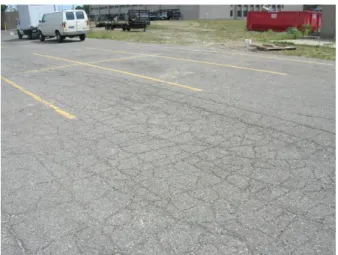
Possible design and construction errors combined with the normal deterioration expected with age can cause the poor performance of existing construction. Consider, for example the pavement shown in Figure 1.
6 If this parking lot were the subject of a forensic engineering investigation, the technical,
economic, societal, legal, and ethical issues would need to be addressed. The technical aspects of the investigation include the identification of the condition and its cause, and the
recommendation of corrective action. The economic issues would be the cost of addressing the poor performance, which could include maintenance, repair, or replacement. The societal issues would be inconvenience to the users of the parking lot. The legal and ethical issues would need to be considered if the results of the investigation indicate incorrect design or construction.
The primary technical issue is to determine the reason that the pavement has cracked, and to recommend corrective action. The distress most closely matches Alligator Cracking9.
According to the Pavement Surface Evaluation and Rating (PASER) method, the method used in the State of Michigan, the PASER rating of hot mix asphalt pavement with alligator cracking over at least 25% of the surface is 2 (Poor) and the recommended corrective action is to replace the pavement10. Possible causes of Alligator Cracking include weak subgrade soils, insufficient cross-section, and poor drainage9. Determining which of these possible causes is present can be determined by performing a visual inspection and a geotechnical investigation. If more than one of the items could have contributed to the poor performance of the pavement, the investigators need to determine the extent to which each item contributed to the condition of the pavement. Addressing that issue is not straight forward and is somewhat subjective. Furthermore
recommending what should have been done differently is a non-unique solution. For example, if the subgrade soils are naturally weak, the original design could have included subgrade
improvements, additional aggregate base, or thicker pavement. From a technical standpoint, all three options for paving over a weak subgrade are equally viable.
Assigning responsibility requires the investigators to determine if the pavement was improperly designed or improperly constructed, which would require review of the design drawings and construction documents. If these are not available, the investigators would not be able to attribute responsibility.
Finally, even a properly designed and constructed pavement will deteriorate over time, but the pavement life can be extended through maintenance. If the owner did not perform the necessary routine maintenance, the failure on the owner’s part may mitigate the responsibility of the design engineer or contractors.
The examples presented in this section illustrate that the poor performance or failure of existing construction can be caused by a single unusual condition or by prolonged exposure to typical conditions. Identifying the cause or causes of that poor performance or failure requires an investigation that includes visiting the site, collecting and testing samples, and reviewing the design drawings and construction records. The conclusions and recommendations from the investigation will have technical implications, i.e., something needs to be done, as well as economic and societal implications, i.e., addressing the technical implications will cost money and affect the users. The conclusions and recommendations from the investigation may also have legal and ethical implications if the parties involved in the design and construction did not follow proper codes and standards or practice. Non-conformance with codes or standards of practice could occur accidentally through errors and omissions or deliberately through fraud. Some complicating factors in the completion of a forensic engineering investigation include
7 obtaining enough information to confidently reach conclusions, and weighting factors identified as contributing to the cause.
Course Development
CIVE 4300: Forensic Engineering is a technical elective available for undergraduate students in civil engineering and architecture, and is also cross-listed at the graduate level. The pre-requisites for the course are structural design and Construction Materials. Some students may have taken classes that relate to specific topics to be covered in the course, e.g., foundation engineering or earth retaining systems; however, prior knowledge of those subjects is not necessary for the completion of CIVE 4300. The course objectives, outcomes, structure, and content were developed to meet program outcomes as well as specific requirements associated with forensic engineering.
Two conclusions from the examples presented in the Forensic Engineering Background Section are that forensic engineering principles can be applied to a variety of materials and types of construction, and that even a thoroughly-conducted forensic engineering investigation may not lead to a unique conclusion. These two conclusions were strongly considered in the
development of the course.
The course objective was to explain the technical, economic, societal, ethical, and legal implications of the performance of existing construction.
Course Outcomes
The course outcomes were developed to help prepare students for the practice of civil engineering (or architecture) in a job that includes forensic engineering. The outcomes of the course were designed to partially fulfill program outcomes as well as to develop the four skills necessary for the practice of forensic engineering presented in the
Skills Required for Forensic Engineering Investigations Section. Because the course is offered through the Department of Civil and Environmental Engineering and will be taken by students in civil engineering, the course outcomes in this course were developed to meet the program
8 Table 1: Civil & Environmental Engineering program outcomes
Outcome Description
a An ability to apply a knowledge of math, science, and Civil & Environmental Engineering
b An ability to design and conduct experiments, and to critically analyze and interpret data
c An ability to design a Civil/Environmental Engineering system, component, or process to meet desired needs
d An ability to function in multidisciplinary teams e An ability to identify, formulate, and solve Civil &
Environmental Engineering problems
f An understanding of professional and ethical responsibility g An ability for effective oral, graphic, and written communication h The broad education necessary to understand the impact of
engineering solutions in a global and societal context
i A recognition of the need for, and an ability to engage in lifelong learning
j A knowledge of contemporary issues
k An ability to use the techniques, skills, and modern engineering tools (AutoCAD, GIS, relevant analysis and design software) necessary for the practice of Civil & Environmental Engineering l Define key aspects of advanced technical specialization
appropriate to civil engineering
m An ability to explain key concepts and problem-solving processes used in management
n An ability to explain key concepts and problem-solving processes used in business, public policy, and public administration
o An ability to explain the role of the leader, leadership principles, and attitudes conducive to effective professional practice of Civil & Environmental Engineering
The course outcomes were developed such that they provided a specific skill that is performed to a particular level on Bloom’s taxonomy. Bloom’s taxonomy identifies six level of achievement on the cognitive domain, which are:
1. Knowledge 2. Comprehension 3. Application 4. Analysis 5. Synthesis 6. Evaluation11
The verbs selected for each outcome were selected such that they correspond to particular level on Bloom’s taxonomy using the terminology in Civil Engineering Body of Knowledge for th 21st
9
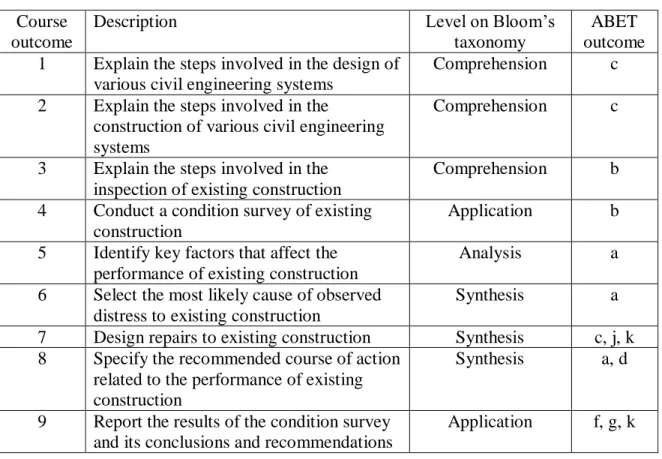
Century: Preparing the Civil Engineer for the Future12. The course outcomes, along with their level on Bloom’s taxonomy and their correspondence to the course outcomes, are shown in Table 2.
Table 2: Course outcomes for CIVE 4300: Forensic Engineering, levels of outcomes on Bloom’s taxonomy and linkages to program outcomes
Course outcome
Description Level on Bloom’s
taxonomy
ABET outcome 1 Explain the steps involved in the design of
various civil engineering systems
Comprehension c 2 Explain the steps involved in the
construction of various civil engineering systems
Comprehension c
3 Explain the steps involved in the inspection of existing construction
Comprehension b 4 Conduct a condition survey of existing
construction
Application b
5 Identify key factors that affect the performance of existing construction
Analysis a
6 Select the most likely cause of observed distress to existing construction
Synthesis a
7 Design repairs to existing construction Synthesis c, j, k 8 Specify the recommended course of action
related to the performance of existing construction
Synthesis a, d
9 Report the results of the condition survey and its conclusions and recommendations
Application f, g, k
Outcomes 1, 2, and 3 are at the comprehension level on Bloom’s taxonomy because the students need to sort through and summarize a few easily available resources to fulfill these outcomes. Outcome 4 is at the application level because it is essentially an experimental process. Outcome 5 is at the application level because the students need to sort through available resources, which can be extensive, and then select the items that they believe to be important. Outcomes 6, 7, and 8 are at the synthesis level because the students need to work with their assumptions and
conclusions from the earlier outcomes, which, by definition, will be non-unique and open-ended. Outcome 9 is at the application level because the students summarize their previous work in a cohesive document.
10
Course Topics and Structure
The course outcomes were applied to a variety of civil engineering systems and combinations of materials used to construct these systems. The materials covered were:
Steel Concrete
Masonry
Timber
Hot mix asphalt
The systems to which the materials were applied included: Buildings
Bridges Pavement Foundations Retaining walls
Foundations are, of course, supporting elements for buildings and bridges and can be constructed of steel, concrete, and timber; however, they are covered separately from buildings and bridges because the design and construction considerations for foundations are different from the design and construction considerations associated with beams, columns, and other building or bridge components.
Each topic had a homework assignment. Question 1 typically asked the students to find an example of existing construction that fit the subject of the assignment, and then take a picture of that existing construction and present the findings to the class. The remaining questions in each homework assignment asked the students to examine the original design and construction of the system, identify things that could go wrong, and conclude how to determine what went wrong and what to do about the problems.
The project was an individual research report in which the students were asked to select a topic from the course and explore it more deeply.
The final exam consisted of seven questions, with one question each on steel structures, concrete structures, masonry structures, timber structures, pavement, foundations, and retaining walls. Each question presented a scenario in which existing construction was not performing properly. The question included a problem statement and all but one of the questions included either a photograph of an actual structure or a schematic drawing of a hypothetical structure. The question related to timber structure was entirely verbal. Each question had a technical issue to address that included identifying the condition, determining its cause, and recommending corrective action. The economic, societal, legal, and ethical issues would develop from the answer to the technical issue.
11
Course Assessment and Results
The assessment included informal assessment, such as participation in discussion during class and laboratory sessions, and formal assessment, i.e., grading of submitted material. The assessment was expressed in terms of how well students met the course outcomes. The greatest weight on the formal assessment was given to the presentations, project and final exam.
The subject of the presentations, which were part of the homework assignments, involved the analysis of a structure or other existing construction corresponding to the material or system covered in that homework assignment. Each student was asked to find a structure or existing construction that interested them and prepare a five-minute presentation that included an introduction, analysis, and conclusions. The introduction was to identify the subject and to contextualize the subject, such as its location and history, and to identify the reasons that the student picked that subject. The analysis should include discussion of the original design and construction, identification of condition issues, identification of possible causes of the condition issues, and recommendations of further investigation or corrective action. The pedagogical purposes of the presentations were to develop technical competency and oral communication skills, which correspond to Course Outcome g. The presentations were also intended to develop the skills necessary for the practice of forensic engineering2. From a broader perspective, the students were asked to find the subject to encourage them to explore their world. All students fulfilled the technical requirements of the presentation. The presentation requirements also met the broader perspective idea in that the students chose a wide range of subjects in terms of age, condition, location, etc. Furthermore, so many of the presentations resulted in extended discussion that some of the sessions did not end at the scheduled time.
The final exam consisted of seven questions in which students were asked to address the technical, economic, societal, ethical, and legal aspects of the condition presented. In general, all students did a reasonably good job of addressing the technical aspects of the exam question but less well in addressing the remaining issues. In many of the questions, a small percent of students had low levels of achievement. Nearly all of the low levels of achievement are attributed to one student who simply did not address all parts of the problem statement.
The extent to which the students met course outcomes for each material or system covered in the course was assessed using the following rubric:
A score of 0 indicates that the student did not do the work.
A score of 1 indicates that the student missed major aspects of the item, presented unreasonable arguments, or drew unreasonable conclusions.
A score of 2 indicate that the student missed several aspects of the item, presented an incomplete argument, or drew incomplete conclusions.
A score of 3 indicates that the student captured all major aspects of the item, presented a well-reasoned argument, and drew reasonable conclusions.
A score of 4 indicates that the student captured all aspects of the item, presented a well-reasoned and comprehensive argument.
12 The course covered seven major topics in terms of materials and application of these materials to civil engineering works. The extent to which each student met the overall outcome was
determined as the mean of the student performance on each of the seven major topics. The number of students reaching each level of achievement is shown in Table 3.
13 Table 3: Levels of achievement for each outcome and number of students reaching that level
Course outcome
Description Percent of students reaching levels of achievement
0 1 2 3 4
1 Explain the steps involved in the design of structures and pavements
3 4
2 Explain the steps involved in the construction of structures and pavements
3 4
3 Explain the steps involved in the inspection of existing construction
1 6
4 Conduct a condition survey of existing construction
7 5 Identify key factors that affect the
performance of existing construction
1 1 5
6 Select the most likely cause of observed distress to existing construction
2 5
7 Design repairs to existing construction 5 2
8 Recommend the course of action to address the poor performance of existing construction
2 5
9 Report the results of the condition survey and its conclusions and recommendations
14 The students did best addressing the technical aspects of the various materials and
systems covered, which was not surprising considering that the pre-requisite courses focus primarily on the technical aspects of design and construction and even CIVE 4300 places more emphasis on the technical aspects than on the other aspects.
Future Work
The extent to which the students fulfilled the outcomes depended in part on the lecture material and subject sites selected for analysis. Due to the constraints of the sites selected, most of the effort was spent on the technical aspects of forensic engineering and the least amount of time was spent on the legal and ethical issues. One change for the next offering would be to include an in-class activity consisting of a mock trial. The professor has obtained a script for a case that went to trial and has approached faculty and administrators with law degrees to help out as attorneys and judges. The professor will also seek out sites for future assignments such that they would include more legal and ethical issues.
Future offerings of the course will include additional course content and assignments to explicitly address the items not thoroughly covered in this offering. The course content will include lecture material and handouts. The additional assignment material will include homework questions as well as research requirements. The course will also include a comprehensive group project in which the students assess a structure, identify defects and determine their causes, design repairs, estimate the costs, and prepare a report.
Summary and Conclusions
A course in forensic engineering has been developed for undergraduate and graduate students in civil engineering or architecture. The course objectives were developed to address the performance of existing construction and the course outcomes were developed to fulfill the course objectives while fulfilling the program outcomes for the Department of Civil &
Environmental Engineering. The topics covered were technical issues including general discussion of the performance of existing construction, evaluation of existing construction, the design of repairs; economic issues related to the performance of existing construction; and the societal, ethical, and legal implications of the technical and economic aspects.
The course was generally successful, although future offerings will include adjustments to the content, assignments, and activities. The adjustment to the content and assignments will be to generally provide greater depth and breadth on forensic engineering. The adjustment to the activities will include the development of a comprehensive group project and the implementation of a mock trial.
15
Acknowledgements
The author would like to thank the students who took the course and the colleagues who provided editorial and content input. The colleagues include Ms. Amanda Hiber from the English Department at the University of Detroit Mercy and Mr. Carey J. Suhan, P.E. of Testing Engineers and Consultants, Inc.
References
[1] ASCE, Report Card for America’s Infrastructure, http://www.infrastructurereportcard.org, accessed Feb 3, 2012.
[2] Carper, K. L., Forensic Engineering 2nd edition, Boca Raton, FL: CRC Press, 2000.
[3] Rens, K. L., Knott, A. W., “Teaching Experiences, a Graduate Course in Condition Assessment and Forensic Engineering,” Proceedings, First Congress on Forensic Engineering, ASCE, Minneapolis, MN, 1997.
[4] Reynolds, C. “Rewriting the Curriculum: a Review and Proposal of Forensic Engineering Coursework in U. S. Universities,” Proceedings, Third Congress on Forensic Engineering, ASCE, San Diego, CA, 2003. [5] Corley, W. G., Sturm, R., Sozen, M. A., Thornton, C. A., Mlakar, P.. F., “Using Forensic Engineering
Techniques to Obtain Data from the Oklahoma City Bombing,” Proceedings, First Congress on Forensic Engineering, ASCE, Minneapolis, MN, 1997.
[6] Moynihan, C., “Concrete Testing Executive Sentenced to Up to 21 Years,” The New York Times, May 26, 2010.
[7] Delatte, N. J., “Failure Case Studies and Engineering Ethics in Engineering Mechanics Courses,” Journal of Professional Issues in Engineering Education and Practice, ASCE 124(4), 1998.
[8] Delatte, N. J., Rens, K. L., “Forensics and Case Studies in Civil Engineering Education: State-of-the-Art,”
Journal of Performance of Constructed Facilities, ASCE 16(3), 2002.
[9] Huang, Y. H., Pavement Analysis and Design, 2nd edition, Upper Saddle River, NJ: Pearson/Prentice Hall, 2004.
[10] Walker, D., Entine, L., Kumer, S., PASER Manual Asphalt Roads, Madison, WI: Wisconsin Transportation Information Center, 2002.
[11] Bloom, B. S., Taxonomy of Educational Objectives Book 1: Cognitive Domain, 2nd edition, Boston, MA: Addison Wesley Publishing Company, 1984.
[12] ASCE, Civil Engineering Body of Knowledge for the 21st Century: Preparing Civil Engineers for the Future, Reston, VA: ASCE, 2008.