Network Coding-Based Broadcast in Mobile Ad
hoc Networks
Li (Erran) Li
Ramachandran Ramjee
Milind Buddhikot
Scott Miller
Bell Labs, Alcatel-Lucent
erranlli,ramjee,mbuddhikot,[email protected]
Abstract— Broadcast operation, which disseminates
informa-tion network-wide, is very important in multi-hop wireless networks. Due to the broadcast nature of wireless media, not all nodes need to transmit in order for the message to reach every node. Previous work on broadcast support can be classified as probabilistic (each node rebroadcasts a packet with a given probability) or deterministic approaches (nodes pre-select a few neighbors for rebroadcasting). In this paper, we show how network-coding can be applied to a deterministic broadcast approaches, resulting in significant reductions in the number of transmissions in the network. We propose two algorithms, that rely only on local two-hop topology information and makes extensive use of opportunistic listening to reduce the number of transmissions: 1) a simple XOR-based coding algorithm that provides up to 45% gains compared to a non-coding approach and 2) a Reed-Solomon based coding algorithm that determines the optimal coding gain achievable for a coding algorithm that relies only on local information, with gains up to 61% in our simulations. We also show that our coding-based deterministic approach outperforms the coding-based probabilistic approach presented in [1].
I. INTRODUCTION
Mobile ad hoc networks (MANETs) are an important tech-nology for mission critical military communications. They enable communication between a group of nodes to form a network in absence of infrastructure components such as base stations and power sources. The nodes themselves are often portable radios in soldier’s backpacks, in combat vehicles, etc where size, weight, energy efficiency, and the ability to maintain reliable communication are key constraints. The applications that use these networks often require continuous ”group communication”. For example, soldiers in a team continuously exchanging voice messages, or a set of battlefield tanks exchanging shared situation awareness information such as their locations or their targets. Furthermore, even in the case of unicast routing in mobile ad hoc networks, flooding or broadcast is frequently used to discover unicast routes between a source and a destination. Thus, efficient support for group broadcast semantics, where data is sent to all or most of the nodes, is critical for these networks.
To date, research on efficient broadcast support in mobile ad hoc networks has proceeded along two main approaches: prob-abilistic and deterministic. Probprob-abilistic or gossiping-based approaches [2] require each node to rebroadcast the packet to its neighbors with a given forwarding probability. The key challenge with these approaches is to tune the forwarding probability: keeping it as low as possible for maximum
efficiency while maintaining it high enough, so that all the nodes are able to receive the broadcast packets. Deterministic approaches on the other hand predetermine and select the neighboring nodes that forward the broadcast packet. If the complete topology is used (feasible for static ad hoc networks), a good approximation algorithm [3] for constructing a small connected dominating set-based approach will yield very few transmissions to reach all nodes; otherwise, pruning-based solutions based on one or two hop topology information have to be adopted [4], [5].
Separately, network coding [6], i.e. allowing intermediate nodes to combine packets before forwarding, has been shown to significantly improve transmission efficiency in wired net-works. Recently, network coding has been adapted to support unicast and multicast applications in wireless networks [7], [8], [1], [9]. The closest related work to ours is [1], where network coding is adapted to a probabilistic approach for supporting broadcast in mobile ad hoc networks. However, this approach has several drawbacks. As mentioned earlier, fine-tuning the forwarding probability in probabilistic approaches is a hard problem - in order to ensure that most nodes receive the broadcast, one typically chooses a higher forwarding proba-bility, that results in inefficiencies compared to a deterministic approach. Also, the approach in [1] has to group packets transmitted from various sources into globally unique sets called generations - solving this in a distributed manner is a hard problem and limits coding gains. Furthermore, the use of a globally unique set of coded packets implies that decoding delay can be large1.
In this paper, we show how network coding can provide significant gains when applied to a deterministic broadcasting approach. We apply coding to the partial dominant pruning (PDP)-based deterministic approach presented in [5] for illus-trating our algorithms but since our algorithm executes locally at each node, it can be directly applied to other localized deter-ministic approaches for broadcasting such as those proposed in [4], [5] etc. The algorithm relies only on local two-hop topology information and makes extensive use of opportunistic listening to reduce the number of transmissions. We propose two algorithms: 1) a simple XOR-based coding algorithm that provides up to 45% gains compared to a non-coding approach and 2) a Reed-Solomon based coding algorithm that
1Enough information must be received from the various sources before a
determines the optimal coding gain achievable for a coding algorithm that relies only on local information, with coding gains up to 60% in our simulations. In both these algorithms, the set of packets that are grouped together to achieve coding gains is local to each node and thus we avoid the generation management and decoding delay issues of [1]. We also show using simulations that the coding-based deterministic approach outperforms the coding-based probabilistic approach presented in [1].
The rest of the paper is structured as follows. In Section II, we present related work. In Section III, we present some background on PDP and our motivation for a coding-based deterministic broadcasting approach. In Section IV, we present an overview of our approach and in Section V, we present the details of our localized coding algorithms. In Section VI, we present a detailed evaluation of our algorithm using simulation. In Section VII, we discuss other issues. Finally, we present our conclusions with a discussion of future work.
II. RELATEDWORK
The problem of broadcast support in mobile ad hoc net-works has been extensively studied [10], [4], [5], [2]. The high overhead of using naive flooding to support broadcast was highlighted in [10]. Since then, researchers have adopted either deterministic [4], [5] or probabilistic [2] approaches to support broadcast efficiently.
Under deterministic approaches, if complete topology in-formation is known, a connected dominating set-based ap-proach [3] will yield optimal results. However, for mobile ad hoc networks, the availability of complete topology in-formation, that remains current for reasonable durations, is unrealistic. Thus, algorithms that rely only on local topology information were developed [4], [5]. In [4], authors propose two algorithms called self pruning and dominant pruning, that rely on 1-hop and 2-hop neighborhood information resp., to reduce redundant broadcasts as compared to a flooding-based approach. In [5], the authors propose total dominant pruning and partial dominant pruning (PDP), that rely on 3-hop and 2-3-hop neighborhood information resp., to improve on the proposals by [4]. We describe the PDP algorithm in Section III, which we use to highlight our coding algorithms in this paper.
Recently, there has been a lot of interest in the use of network coding to improve transmission efficiency in net-works [6], [8], [7], [1], [9]. The seminal work in [6] showed networks that allow intermediate nodes to combine informa-tion before forwarding results in significant throughput gains over networks with intermediate nodes that only forward information. Support for multicast and broadcast in wireless networks with network coding can also be tackled either using deterministic or probabilistic approaches. Under probabilistic approaches, authors in [1] show that practical coding-based probabilistic schemes significantly outperform non-coding-based probabilistic schemes. Under deterministic approaches, authors in [7], [8] study theoretical solutions based on solving linear programs that assume knowledge of the entire network
v u t s r p1 p5 p2 p4 p3 p5 p4 p3 p2 p1 v 1 0 0 0 1 u 0 0 1 0 1 t 0 1 0 1 0 s 1 0 1 0 1 r Fig: 1 (a) Fig: 1 (b)
Fig. 1. Example to illustrate coding gains
topology and show significant gains in terms of efficiency and computational overhead over approaches that do not use network coding. Practical and deterministic coding-based schemes for support of unicast traffic in wireless networks have been studied in [9]. In this paper we consider practical and deterministic coding-based schemes that use only local topology information for efficient support of broadcast and show that our approach performs better than both probabilistic coding-based schemes and practical and deterministic non-coding-based schemes.
III. BACKGROUND ANDMOTIVATION
In this section, we first describe the partial dominant pruning (PDP) algorithm presented in [5]. We then motivate, through an example, the gains that can be achieved by adding our coding algorithms, to a deterministic broadcast approach such as PDP.
We now describe the PDP algorithm. Let
represent the set of neighbors of node
, including
and let
represent the two-hop neighborhood of node
. Let
send a broadcast packet to , choosing as its forward node; then selects a forward list, which contains the minimum number of broadcast nodes that would re-broadcast packets to cover all nodes in its 2-hop neighborhood,
. Among nodes in , nodes in
have already received the packet while nodes in
will receive the packet when broadcasts it. Further, neighbors of nodes common to nodes in
and
, i.e.
will also receive it. Thus, just needs to determine its forward node set
from nodes in to cover nodes in "!# . A greedy set cover algorithm is used for the selection of these forwarding nodes - basically, at each step, the node in set that covers
the maximum number of nodes in is added to the forward
list, until either all nodes in are covered or no more nodes
Let us consider a 5 node network shown in Figure 1(a). There are four source nodes,$ with packet%& ,' with packets %)(
%+* ,, with packet%- , and
with packet%. . When each of
these nodes execute the PDP algorithm, they would determine that node is the forwarding node that would cover each of their respective two-hop neighborhood. Thus, node would be chosen as the forwarder for packets% & to% . in this example.
As each of the source nodes transmit packets% & to% . , node
builds its neighbor reception table as shown in Figure 1(b). Each row represents one neighbor node of and each column represents whether the neighbor node received the respective packet or not (denoted by 1 or 0, respectively). Note that, node is aware of its 2-hop neighborhood information and thus, when node $ transmits packet%/& , it can deduce that nodes ,
and
, which are neighbors of$ also receive the packet.
Given this neighbor reception table, in the basic PDP algorithm, node has to broadcast each of the packets %&
through %). , as at least one of its neighbors is missing this
packet. This results in a total of0 transmissions for forwarding.
Now consider a simple XOR-based coding approach. Suppose node broadcasts% % &21 % ( . Nodes $ , recover% ( by
simply doing % 1 % &; node ' recovers % & by simply doing % 1 % ( . Thus, in one transmission, both% & and% ( are delivered
to the neighbors of node . However, packets%
% *
% . need
to be transmitted individually as XOR does not help in this case. Thus, a total of 3 transmissions are sufficient when a
XOR-based coding algorithm is used. As we discuss later, the problem of computing the set of packets 4 to XOR such that
the maximum number of neighbors in &
will decode a missing packet in one transmission while the rest has gotten all packets in 4 is NP-hard. We use a greedy heuristic for our
XOR-based coding algorithm.
Lets now consider packets %& through%. again, but in a
more general context. Nodes$
'
,
each are missing at most
5
packets. We need to send an appropriately coded combina-tion of packets % & through% . such that each of these nodes
recover their respective missing packets. In order to come up with such a coded combination, consider forward error correction (FEC) codes, specifically Reed-Solomon codes used between a sender and a receiver, that guarantees the property that by sending 6798 bits, the receiver can recover from
erasures in any8 bits. Now, in our example, if node sends
5
packets using Reed-Solomon codes as a broadcast, each of the nodes$ ' ,
can independently recover up to any5
missing packets out of the 0 packets. Note that, unlike the
XOR-based approach, this requires some batching. However, batches are local to a node and its neighbors, unlike the generations in [1] that are global in scope. As we show in detail later, a Reed-Solomon code-based algorithm can be used to create the coded packets for broadcasting, resulting in the optimal (fewest) number of transmissions. Thus, in this example, we can reduce the number of transmissions for the forwarding node , from five to three broadcasts, thereby increasing the broadcast efficiency of the network.
IV. CODEB OVERVIEW
We introduce CODEB, a new coding-based broadcast pro-tocol for ad-hoc networks. Similar to COPE [9], it inserts a coding layer between the IP and MAC layer which detects coding opportunities and exploits them to reduce the number of transmissions needed.
CODEB incorporates three main techniques:
:
Opportunistic listening: Similar to COPE, nodes in
CODEB operate in promiscuous mode equipped with omni-directional antennae. Nodes snoop all communica-tions over the wireless medium and store the overheard packets for a limited period ; . Nodes also periodically
broadcasts the set of nodes it can hear (i.e., its one-hop neighbors) to all its one-hop neighbors. This allows each node to build a two-hop neighbor graph; given this and the previous hop
of a packet% , node can infer
2 that
the neighbors of
has received% . If% is a coded packet,
other inferences are possible as discussed later. Based on this, each node creates a neighbor reception table as shown in Figure 1(b). If a new packet can not find any coding opportunities, the packet can either be sent to the interface queue directly, or be buffered in the coding layer for some time. For delay tolerant applications, buffering can increase coding opportunities. Note that, we do not broadcast “reception report”— the set of packets a node has received.
:
Forwarder selection and pruning: Unlike a gossiping
based approach [1] where all nodes serve as forwarders with a given probability, we pick a subset of neighbors as forwarders. We use the PDP algorithm [5] to select forwarders and maintain forwarder selection independent of coding, thereby allowing our scheme to be used with other forwarder selection algorithms. The forwarder set is stamped in the packet header and a node only rebroadcasts a packet when it is chosen as a forwarder. Note that, due to opportunistic listening, even if a node is a forwarder of a given packet, it does not necessarily have to send it if it determines that all its neighbors have received the given packet.
:
Opportunistic coding: By opportunistic coding, we
mean that each node examines its set of to-be-forwarded packets and its current neighbor table obtained through opportunistic listening, and dynamically determines if it can exploit coding opportunities to send coded packet(s), instead of sending native (non-encoded) packet(s). As discussed before, we present two algorithms for coding packets: 1) a simple XOR-based algorithm that tries to XOR a number of packets in the buffer to enable the maximum number of nodes to decode a new packet and 2) an optimal coding scheme that makes use of Reed-Solomon code as the coefficients for linearly combining native packets. Note that, opportunistic coding for broad-cast is very different from coding for unibroad-cast, such as
2assuming broadcast is reliable; else, a NACK-based scheme can be used
COPE [9]. In unicast, only the intended next hop needs to receive a given packet. However, for broadcast, all the neighbors must receive the given packet. To appreciate the difference between COPE and CODEB, for the XOR-based algorithm, to find the optimal number of packets to XOR, both problems are NP-hard. However, in the case of COPE, it is the same as finding a maximum independent set, and the problem is hard to approximate within a constant factor factor (reduction omitted for lack of space). In the case of CODEB, it is actually the same as finding a maximum hypergraph matching which is also hard to approximate within a constant factor (see Section V). For the linear code-based solution, there exists optimal and efficient polynomial algorithms for CODEB. The same algorithm is not optimal for COPE.
V. ALGORITHMS
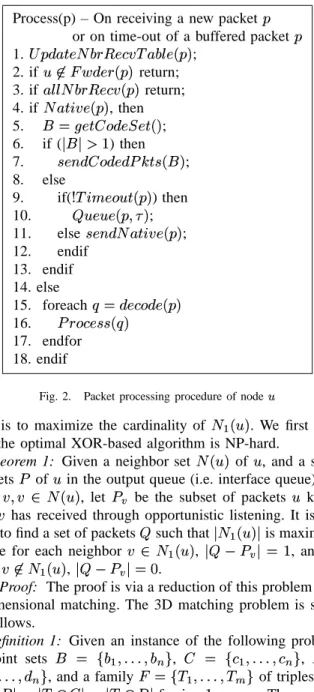
We briefly describe the algorithm used in our CODEB broadcast protocol. The pseudo-code is shown in Figure 2. We assume nodes exchange their neighbor information so that each node knows the network topology within its 2-hop neighborhood. When any packet is received, the node first updates its neighbor table (line 1, described further in Section V-C ). In PDP, for each native packet, only a subset of neighbors are delegated as forwarders; other nodes do not re-broadcast (line 2). If node
is a forwarder, but based on its neighbor table it determines that all its neighbors have already received the packet, it does not re-broadcast (line 3). Otherwise, node
tries to see if it can get any coding opportunities by encoding the packet with a set of already received packets that it needs to forward. (line 5). If yes, we will generate one or more encoded packets and schedule the transmission (line7). If not, for delay tolerant applications, the node will buffer the packet for a random amount of time (line 10) and process it later. This can create more coding opportunities. For non-delay tolerant applications, we send the packet immediately (line 11). Finally, if the received packet is a coded packet, we decode it before processing the packet (line 15,16). Packet decoding is covered in Section V-B.
A. Packet encoding algorithm
The function getCodeSet() implements the packet coding algorithm. In this section, we present two encoding algorithms: a greedy XOR-based algorithm and the optimal Reed-Solomon code-based algorithm.
1) XOR-based algorithm: For the XOR-based algorithm,
we design for simplicity. If the neighbor reception table of a node
is accurate and
sends an XOR-ed packet% , a neighbor
of
should be able to decode% using stored native packets.
That is, a XOR-ed packet can be decoded by each of
’s neighbor without waiting for further coded packets to arrive. In more detail, each node
with a set of native packets <
in its output queue seeks to find a subset of native packets
4 to XOR. Let the set of neighbors of
, each of which can decode a missing packet be &
(determined by 4 and the
neighbor reception tables). The rest is denoted as (
. Our
Process(p) – On receiving a new packet%
or on time-out of a buffered packet%
1. 2%=?>@,BA C $EDFAHGI @;J> CIK A % ; 2. ifML N FOJ=@AP$ % return; 3. if > KKC $EDFAHGI % return; 4. if >@,RQS TA % , then 5. VU AP,WFXE=@AEYZAP, ; 6. if ([[T\^] ) then 7. 'PA_6/=TWFXE=@AP=@<`8T,' ; 8. else 9. if(a;bQScdAHX , % ) then 10. 4 A A % e+ ; 11. else 'PAP6/= >?,RQS TA % ; 12. endif 13. endif 14. else 15. foreach f =@AHGgXE=@A % 16. <F$EXEGgAE'P' f 17. endfor 18. endif
Fig. 2. Packet processing procedure of nodeh
goal is to maximize the cardinality of &
. We first show that the optimal XOR-based algorithm is NP-hard.
Theorem 1: Given a neighbor set of , and a set of packets< of
in the output queue (i.e. interface queue). For each
N
, let <i be the subset of packets
knows that has received through opportunistic listening. It is NP-hard to find a set of packets4 such that [ &
[ is maximized
where for each neighbor N
& , [4 <ij[ ] , and for each L N & , [4 <ik[ ml .
Proof: The proof is via a reduction of this problem from
3-dimensional matching. The 3D matching problem is stated as follows.
Definition 1: Given an instance of the following problem:
Disjoint sets onEC & qpqp_pgrCgst , W un G & _pqpqp_ G st , v n = & _pqp_pg = st , and a family wn ; & qp_pqp_ ;x t of triples with [;y z[ [;y W{[ [;y v[ forQ ] qpqp_pg c . The question
is: does contain a matching, i.e. a subfamily #| for which [ [
6 and}~HR/; y
^}dW }v ?
For each elementA
N
} W}{v , we create a neighbor for
. For each triple
>
rCH
G
, we create a packet. We assume only neighbor>
CH
G has not received this packet. It is easy to see
that a 3D matching of size 6 exists if and only if there exists
a corresponding 4 such that &
(each neighbor will be able to decode a missing packet).
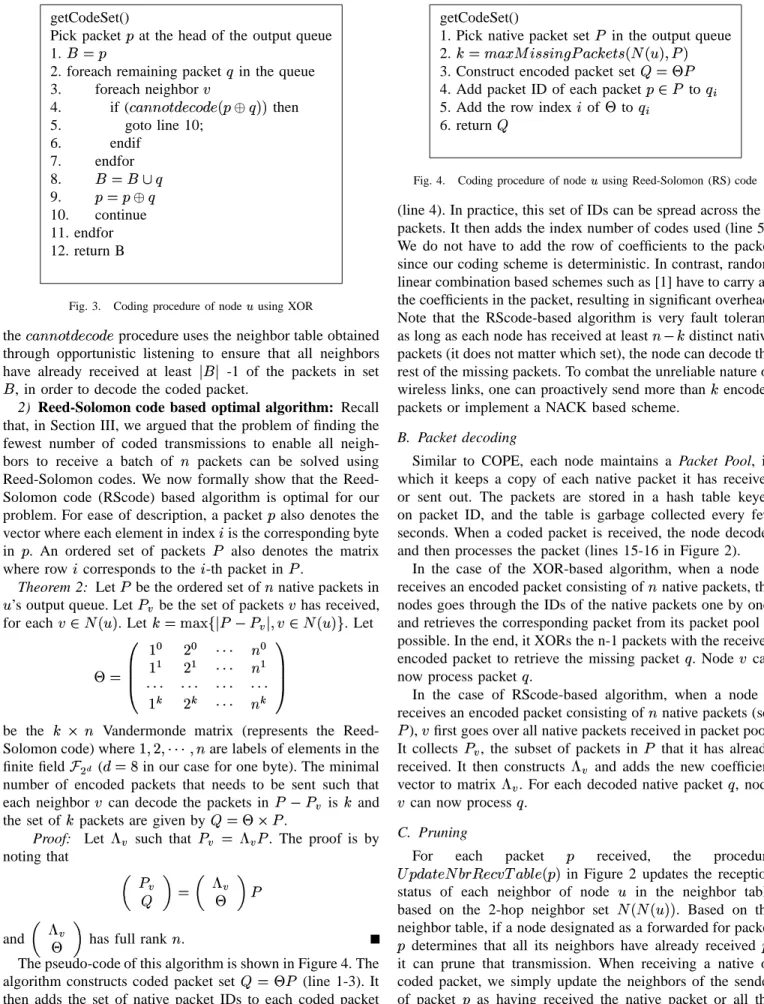
Since the problem is NP-hard and also hard to approximate within a constant factor (by noting that it is equivalent to maximum hypergraph matching), we design a practical greedy algorithm. The XOR-based greedy algorithm is illustrated in Figure 3. The algorithm takes the packet % at the head of
the queue (line 1) and sequentially looks for other packets in the queue (line 2) that when combined with % will allow
all neighbors of node
to decode the packet (line 4-6). If successful, these packets are added to set B (line 8). Note that
getCodeSet()
Pick packet% at the head of the output queue
1.
%
2. foreach remaining packetf in the queue
3. foreach neighbor 4. if (Gg>@66/XH,B=@APGqXE=?A % 1 f then 5. goto line 10; 6. endif 7. endfor 8. }f 9. % % 1 f 10. continue 11. endfor 12. return B
Fig. 3. Coding procedure of nodeh using XOR
the Gg>@66/XH,B=?AHGgXE=@A procedure uses the neighbor table obtained
through opportunistic listening to ensure that all neighbors have already received at least [z[ -1 of the packets in set , in order to decode the coded packet.
2) Reed-Solomon code based optimal algorithm: Recall
that, in Section III, we argued that the problem of finding the fewest number of coded transmissions to enable all neigh-bors to receive a batch of 6 packets can be solved using
Solomon codes. We now formally show that the Reed-Solomon code (RScode) based algorithm is optimal for our problem. For ease of description, a packet% also denotes the
vector where each element in indexQ is the corresponding byte
in % . An ordered set of packets < also denotes the matrix
where row Q corresponds to the Q-th packet in < .
Theorem 2: Let< be the ordered set of6 native packets in
’s output queue. Let <i be the set of packets has received,
for each N . Let8 V{En [< <ij[ N It . Let ]q q_6 ] & & q_6 & qq_qq_q_ ]H ? q_6 q
be the 86 Vandermonde matrix (represents the
Reed-Solomon code) where ]
qq
6 are labels of elements in the
finite field (r (
=
^
in our case for one byte). The minimal number of encoded packets that needs to be sent such that each neighbor can decode the packets in <
< i is 8 and
the set of 8 packets are given by 4
d< . Proof: Let ¡ i such that < i
¡ i < . The proof is by noting that ¢ <i 4£ ¢ ¡2i £ < and ¢ ¡2i £
has full rank6 .
The pseudo-code of this algorithm is shown in Figure 4. The algorithm constructs coded packet set 4
< (line 1-3). It
then adds the set of native packet IDs to each coded packet
getCodeSet()
1. Pick native packet set < in the output queue
2. 8 c>@¤¥QB'H'_QS6 U <¦>TGq8kAP,' I <
3. Construct encoded packet set 4
<
4. Add packet ID of each packet%
N
< tofHy
5. Add the row index Q of
to fPy
6. return 4
Fig. 4. Coding procedure of nodeh using Reed-Solomon (RS) code
(line 4). In practice, this set of IDs can be spread across the8
packets. It then adds the index number of codes used (line 5). We do not have to add the row of coefficients to the packet since our coding scheme is deterministic. In contrast, random linear combination based schemes such as [1] have to carry all the coefficients in the packet, resulting in significant overhead. Note that the RScode-based algorithm is very fault tolerant, as long as each node has received at least6
8 distinct native
packets (it does not matter which set), the node can decode the rest of the missing packets. To combat the unreliable nature of wireless links, one can proactively send more than8 encoded
packets or implement a NACK based scheme.
B. Packet decoding
Similar to COPE, each node maintains a Packet Pool, in which it keeps a copy of each native packet it has received or sent out. The packets are stored in a hash table keyed on packet ID, and the table is garbage collected every few seconds. When a coded packet is received, the node decodes and then processes the packet (lines 15-16 in Figure 2).
In the case of the XOR-based algorithm, when a node receives an encoded packet consisting of6 native packets, the
nodes goes through the IDs of the native packets one by one, and retrieves the corresponding packet from its packet pool if possible. In the end, it XORs the n-1 packets with the received encoded packet to retrieve the missing packet f . Node can
now process packetf .
In the case of RScode-based algorithm, when a node receives an encoded packet consisting of6 native packets (set < ), first goes over all native packets received in packet pool.
It collects < i , the subset of packets in < that it has already
received. It then constructs ¡ i and adds the new coefficient
vector to matrix ¡ i . For each decoded native packetf , node
can now process f . C. Pruning
For each packet % received, the procedure 2%=?>@,BA C $EDFAHGI ?;§> CgK A %
in Figure 2 updates the reception status of each neighbor of node
in the neighbor table based on the 2-hop neighbor set
. Based on the neighbor table, if a node designated as a forwarded for packet
% determines that all its neighbors have already received % ,
it can prune that transmission. When receiving a native or coded packet, we simply update the neighbors of the sender of packet % as having received the native packet or all the
packets in the coded packet. We refer this as update rule 1. Note that, for Reed-Solomon encoded packet % , this update
rule prevents a node from purging already scheduled coded packets based on newly snooped packets (may need fewer than 8 coded packet). The reason is that, for a neighbor O
of both
and , both nodes
and may assume (based on snooped packet from each other) that the other node will send the encoded packets in order for O to decode the
missing packets, resulting in O not receiving any packets.
Therefore, if one wants to prune scheduled coded packets, one has to use the following priority rule (update rule 2): node can assume O
N
Fm
has received all underlying 6 native packets (packet IDs are in the header) if
and only if ¨@v
\^¨@v
. This is not needed if all coded packets are transmitted instead of opportunistically purged (see Section VII).
D. Analysis
We show that our CODEB algorithm enables all nodes to eventually receive the set of packets injected into the network as long as the network is connected and packet transmission is reliable.
Theorem 3: Given a set of packets < injected into a
con-nected network ©
ª"!«r¬#
, CODEB enables all nodes to receive < eventually with the assumption that broadcast is
reliable.
Proof: We only give the proof for update rule 2. The
proof for update rule 1 can be proven similarly. It suffices to show that each node will eventually receive each packet
%
N
< . Suppose in the end, not all nodes receive % . Let
!
&
be the set of nodes that has received% . Let !
be the set of “boundary” nodes such that at least one neighbor of
N
!
is in
!
&. There are two cases: (1) is a forwarder of% selected
by previous hop; (2) is not a forwarder.
For the first case, will not send% in native or in coded
packets if and only if infers that
has received it. must have snooped native% or coded packetsf including% from a
nodeO which
is a neighbor ofO . If there are multiple such O , we pick O with the smallest ID. If the snooped packet is a
native packet or XOR-coded packet, then
must have received it. If the snooped packet f is a Reed-Solomon coded packet,
then ¨@v \®¨?v O
. So O will either complete sending
the batch of packets that enable
to decode% or stop half
way because another neighbor , (also a neighbor of
) with a smaller ID will take the responsibility for % or any other
packet in the same batch. However, this chain will end at the the node with the smallest ID. Otherwise, there will be a cycle where each node has a smaller ID than the previous node in the cycle, which is a contradiction.
For the second case, let , be the previous hop of which
has gotten the packet % from in either native/XOR-coded
packet or through Reed-Solomon decoding. There are two cases. Case A: , must have decided that some other node j|
is a forwarder of % and k| is a neighbor of
, i.e. , must
select a subset of nodes that “cover” all nodes within its 2-hop neighborhood. This goes back to case (1). Case B: , has
decided that another node , | will cover , according to PDP
algorithm. This goes back to Case A. According to PDP [5], there is no loop where each node assumes the previous one in the loop covers
.
VI. EVALUATION
We implemented our CODEB algorithm in the NS2 sim-ulator. For the experiments, we use IEEE 802.11 as the MAC layer protocol. The radio model assumes a nominal bit rate of 2Mb/sec and a nominal range of 250 meters. The radio propagation model is the two-ray ground model. Our application traffic is CBR (constant bit rate). The broadcast sources are chosen randomly. The application packets are all 256 bytes. We have a total of 30 broadcast sessions. We vary the sending rate of each session to simulate varying load conditions. We use two sending rates: 2 packets/sec and 4 packets/sec. The first is referred to as low load and the second as high load. In the simulations, 60 to 100 nodes are randomly placed in a square grid with a fixed density. For each area of
¯±° ?0
l
(
, on average there are either 15 or 30 nodes to simulate sparse and dense topologies respectively. Each data point is averaged over 5 random topologies.
We use the PDP algorithm [5] with the mark/unmark termination criterion. That is, based on the set of snooped packet, a node cancels a broadcast event if all of its neighbors have been marked (i.e. received the packet). If a node’s 2-hop neighbor is marked due to the reception of a snooped packet, the node does not need to choose a forwarder to cover that neighbor. For the RScode based algorithm, we choose a batch size of 8. The per-packet overhead of CODEB with respect to PDP is small. It needs to include 6 (=8) packet IDs and the
row index of the encoding matrix in 8 coded packets.
We use two metrics to compare CODEB with PDP. The first is the coding gain. The coding gain is defined to be the ratio of the number of transmission required by a specific non-coding approach (PDP in this paper), to the number of transmissions used by CODEB to deliver the same set of packets to all nodes. The second metric is the packet delivery ratio which is defined for broadcast as the ratio of the number of data packets successfully delivered to the number of data packets generated by the CBR sources multiplied by the total number of nodes.
A. Static Networks
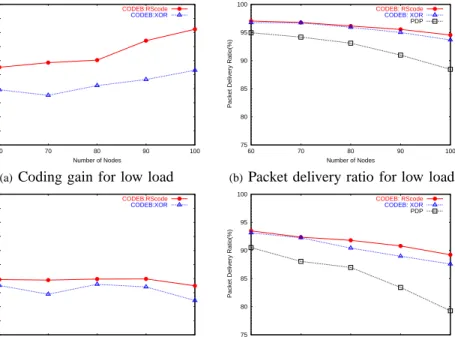
First consider the performance of the algorithms in dense networks, as shown in Figure 5. As expected, the optimal RScode algorithm outperforms the simple XOR algorithm. For example, in the 100-node topology using low load, XOR can send 15% more packets than RScode. The packet delivery ratio of RScode is also slightly higher than XOR. The coding gain for the RScode algorithm can be as high as 1.61, which means that PDP sends 61% more packets than RScode algorithm. This gain occurs even as RScode delivers 6% more packets on average to each of the nodes compared to PDP. Compared to the low load case, the coding gain for the high load case is lower but the difference in packet delivery ratio between
1.2 1.25 1.3 1.35 1.4 1.45 1.5 1.55 1.6 1.65 1.7 60 70 80 90 100 Coding Gain Number of Nodes CODEB:RScode CODEB:XOR 75 80 85 90 95 100 60 70 80 90 100
Packet Delivery Ratio(%)
Number of Nodes
CODEB: RScode
CODEB: XOR
PDP
(a) Coding gain for low load (b)Packet delivery ratio for low load
1.2 1.25 1.3 1.35 1.4 1.45 1.5 1.55 1.6 1.65 1.7 60 70 80 90 100 Coding Gain Number of Nodes CODEB:RScode CODEB:XOR 75 80 85 90 95 100 60 70 80 90 100
Packet Delivery Ratio(%)
Number of Nodes
CODEB: RScode
CODEB: XOR
PDP
(c)Coding gain for high load (d) Packet delivery ratio for high load
Fig. 5. Performance comparison of CODEB and PDP on dense topology: low load and high load
RScode and PDP widens to more than 10%. This is because losses predominate in the high load case, reducing the impact of coding opportunities. Overall, the coding gain is significant and ranges from 1.32 to 1.61.
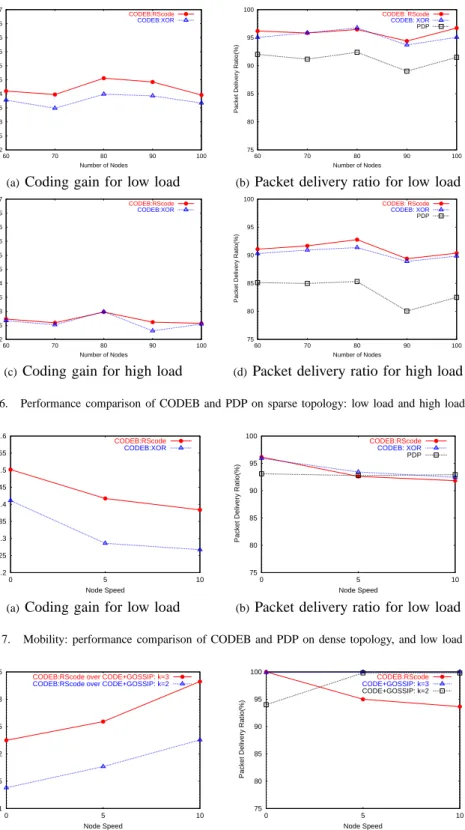
Now consider the performance of the algorithms in sparse networks, as shown in Figure 6. The coding gain for the sparse topology is generally less than that for the dense topology. This is because of limited opportunities for overhearing transmis-sions and fewer neighbors to exploit coding opportunities. The coding gain ranges from 1.22 to 1.45. The increase in packet delivery ratio is upto 8%.
B. Mobility
Let us now consider the performance of the algorithms with mobile nodes, as shown in Figure 7. In this experiment, we have 80 nodes, a dense topology and low load. We use the random waypoint mobility model with zero pause time. The max speed is varied to 5 m/sec and 10 m/sec respectively. We see that there is a drop of about 24% in coding gain (from 50% to 38% for RScode algorithm) as node mobility increases from 0 to 10m/s. This is due to the fact that the neighbor reception table gets less accurate in the presence of mobility. While a node, based on this table, might infer all its neighbors can decode its coded transmissions, due to mobility or losses, those nodes may be unable to do so. Codes that allow progressive decoding capabilities may alleviate this to some extent (see Section VII for discussion). Another reason for lowered gains is because mobility itself is beneficial to all schemes including PDP, i.e., fewer packets are needed to cover all the nodes. For example, for a speed of 10 m/sec, PDP sends only 60% of what it sends for the static case (not shown in figure). Of course,
mobility also results in lowered packet delivery ratio for all the schemes. A simple NACK-based protocol, where a node broadcasts a NACK identifying missing packets and one of its neighbors that has this packet, responds by rebroadcasting the packet, should help improve packet delivery ratio without sacrificing efficiency.
C. Comparison with probabilistic coding
Finally, we would like to compare our CODEB algorithm with a coding scheme applied to a gossiping-based protocol. In this section, we compare CODEB to the coding-based broadcast approach which uses gossiping as proposed in [1]. We will refer to their scheme as CODE+GOSSIP. Since their protocol uses an ideal MAC layer, we run CODEB with the same MAC layer for ease of comparison. We use the 80-node network with mobility to compare the two approaches. Again, each data point is averaged over 5 random topolo-gies. We set the forwarding factor of CODE+GOSSIP to (8+²HcQS6
iI³´§µ¶iI·B¸´§µ¶iI¹·¸), where
8
5
as suggested in [1] for close to 100% delivery ratio. We also show results when
8
.
As we can see from Figure 8, our CODEB approach sends significantly fewer packets. In general, CODE+GOSSIP results in far more transmissions as compared to CODEB - 40% to 120% more for no mobility to 120% to 230% for a node speed of 10m/s, using8
and
5
respectively. This also highlights some of the difficulties of using a probabilistic approach, i.e., it is hard to tune the forwarding factor accurately. Lowering
8 from 3 to 2 can reduce the number of transmissions
but also result in unpredictable lowering in packet delivery ratio (94% for static network with ideal MAC). Thus, while
1.2 1.25 1.3 1.35 1.4 1.45 1.5 1.55 1.6 1.65 1.7 60 70 80 90 100 Coding Gain Number of Nodes CODEB:RScode CODEB:XOR 75 80 85 90 95 100 60 70 80 90 100
Packet Delivery Ratio(%)
Number of Nodes
CODEB: RScode
CODEB: XOR
PDP
(a) Coding gain for low load (b)Packet delivery ratio for low load
1.2 1.25 1.3 1.35 1.4 1.45 1.5 1.55 1.6 1.65 1.7 60 70 80 90 100 Coding Gain Number of Nodes CODEB:RScode CODEB:XOR 75 80 85 90 95 100 60 70 80 90 100
Packet Delivery Ratio(%)
Number of Nodes
CODEB: RScode
CODEB: XOR
PDP
(c)Coding gain for high load (d) Packet delivery ratio for high load
Fig. 6. Performance comparison of CODEB and PDP on sparse topology: low load and high load
1.2 1.25 1.3 1.35 1.4 1.45 1.5 1.55 1.6 0 5 10 Coding Gain Node Speed CODEB:RScode CODEB:XOR 75 80 85 90 95 100 0 5 10
Packet Delivery Ratio(%)
Node Speed
CODEB:RScode
CODEB: XOR
PDP
(a) Coding gain for low load (b)Packet delivery ratio for low load
Fig. 7. Mobility: performance comparison of CODEB and PDP on dense topology, and low load
1 1.5 2 2.5 3 3.5 0 5 10 Gain Node Speed
CODEB:RScode over CODE+GOSSIP: k=3
CODEB:RScode over CODE+GOSSIP: k=2
75 80 85 90 95 100 0 5 10
Packet Delivery Ratio(%)
Node Speed
CODEB:RScode
CODE+GOSSIP: k=3
CODE+GOSSIP: k=2
(a)CODE:RScode over CODE+GOSSIP (b)Packet delivery ratio
Fig. 8. Performance comparison of CODEB and CODE+GOSSIP on dense topology
CODE+GOSSIP is more resilient to mobility compared to CODEB, it results in significantly more transmissions. The addition of a simple NACK-based protocol to CODEB, as discussed earlier, can increase the packet delivery ratio to 100% without significantly impacting broadcast efficiency.
D. Summary
In summary, the coding gain of CODEB can be as high as 1.6, which means PDP sends 61% more packets compared to CODEB. On top of the coding gain, CODEB also simultane-ously improves the packet delivery ratio by as much as 10%.
Among the two algorithms, as expected, the RScode-based optimal algorithm outperforms the XOR-based algorithm by up to 15%. The coding gain is higher when the network load is low or moderate (at high load, losses predominate) and when the networks are dense (more opportunities for coding when the number of immediate neighbors are higher). In the presence of mobility, the coding gain achieved by CODEB decreases by about 24% when node speed increases from 0 to 10m/s. Finally, CODEB results in significantly fewer transmission compared to the gossiping-based coding algorithm proposed in [1].
VII. DISCUSSION
In this section, we discuss other issues relevant to CODEB. By separating the choice of forwarders (e.g. PDP) from how to code packets (CODEB), our design favors simplicity. While this approach results in significant gains, one can envision a combined forwarding and coding algorithm that can perform better. For example, consider the network of nodes shown in Figure 9. If node
, originating packets %] and % , can
determine both forwarding and coding within its two hop neighborhood, it can ask node to send packet%] , node O
to send packet% and node¤ to send packet%] 1 % , thereby
allowing nodesº and» to receive both%] and% in the least
number of broadcasts.
Along the same lines, our design does not allow an encoded packet to travel more than one-hop and a node encodes native packets independently. There could be more coding gains if these conditions are relaxed. However, this may introduce coordination overhead and vulnerability in the presence of rapid topology changes. We have assumed that each node chooses the set of forwarders independently and explicitly. An interesting research question is whether there exists efficient schemes where nodes implicitly volunteer to be forwarders based on the local RF condition. This is especially important for adverse setting where links are very unreliable. In this context, one can also explore encoding packets using other codes that enable faster or incremental decoding as compared to Reed-Solomon code. For example, codes that allow pro-gressive decoding could enable partial error recovery in the case of high link error rates or fast moving mobile nodes (if a node is missing 8 +1 packets, it may still be able to recover
up to 8 packets using a code that transmits 8 coded packets).
There are other improvements one can do. A node can reduce the number of coded packets to send in a batch based on newly snooped packets. This requires purging pending packets from output queue. A node can add a coded packet f to an
“un-intended” batch C
| if it is innovative to
C
| and encodes
a subset of packets of the packets in C
|. This enables faster
decoding. There is an optimal batch size. It is interesting to investigate how to set it optimally. If the number of native packets exceeds the batch size, an interesting question is to find a subset of packets that fits the batch size and enable maximum number of missing packets to be received by the neighbors. v x u y w p1 p2 z p1 p2 p2 p1+
Fig. 9. Joint forwarding and coding
VIII. CONCLUSION AND FUTURE WORK
Broadcast operation is often used both to disseminate information to all nodes and for finding unicast routes in military ad-hoc networks. Therefore, broadcast efficiency is very important. Due to the potentially dynamic nature of ad-hoc networks, localized algorithms are much more robust and effective with less maintenance overhead. In this paper, we show how to incorporate network coding into a non-coding based localized algorithm called PDP for improving broadcast efficiency. While we illustrate our approach in the context of PDP, our CODEB coding algorithm can potentially be applied to other non-coding based schemes. The algorithm tries to optimize the coding gains given a set of native packets and the subset of packets each neighbor receives. We design two coding algorithms: an XOR-based simple coding algorithm that enables decoding without waiting for more coded packets to arrive and a Reed-Solomon-based coding algorithm that is optimal but requires a node to wait until it receives the appropriate number of coded packets. The first problem is NP-hard. We outline a simple greedy algorithm. The second can be solved efficiently and optimally using Reed-Solomon codes. Our extensive simulation shows that non-coding based scheme sends as much as 60% more packets with reduced packet delivery ratio. For future work, we intend to explore more on the reliability issue and implement CODEB in a real 802.11-based mobile ad hoc testbed in order to thoroughly evaluate its efficacy.
REFERENCES
[1] C. Fragouli, J. Widmer, and J.-Y. L. Boudec, “A network coding approach to energy efficient broadcasting: from theory to practice,” in Proceedings of IEEE INFOCOM, Apr 2006.
[2] Z. Haas, J. Halpern, and L. Li, “Gossip-based ad hoc routing,” in Proceedings of IEEE INFOCOM, June 2002.
[3] K. M. Alzoubi, P.-J. Wan, and O. Frieder, “New distributed algorithm for connected dominating set in wireless ad hoc networks,” in Proceedings of HICSS, 2002.
[4] H. Lim and C. Kim, “Flooding in wireless ad hoc networks,” Computer Communications Journal, 2001.
[5] W. Lou and J.Wu, “On reducing broadcast redundancy in ad hoc wireless networks,” IEEE Transactions on Mobile Computing, 2002.
[6] R. Ahlswede, N. Cai, S. Li, and R. Yeung, “Network information flow,” IEEE Transactions on Information Theory, 2000.
[7] e. a. D.S. Lun, “Achieving minimum-cost multicast: A decentralized approach based on network coding,” in Proceedings of IEEE INFOCOM, Mar 2005.
[8] Y. Wu, P. Chou, and S.-Y. Kung, “Minimum-energy multicast in mobile ad hoc networks using network coding,” IEEE Transactions on commu-nications, 2005.
[9] S. Katti, D. Katabi, W. Hu, H. Rahul, and M. Medard, “The importance of being opportunistic: Practical network coding for wireless environ-ments,” in Proceedings of ACM SIGCOMM, Sep 2006.
[10] S. Ni, Y. Tseng, Y. Chen, and J. Sheu, “The broadcast storm problem in a mobile ad hoc network,” in Proceedings of ACM MOBICOM, 1999.