Asteroid Retrieval Feasibility Study
2 April 2012
Prepared for the:
Keck Institute for Space Studies
California Institute of Technology
Jet Propulsion Laboratory
Authors and Study Participants
NAME Organization E-Mail Signature
John Brophy Co-Leader / NASA JPL / Caltech [email protected] Fred Culick Co-Leader / Caltech [email protected] Louis Friedman Co-Leader / The Planetary
Society [email protected] Carlton Allen NASA JSC [email protected] David Baughman Naval Postgraduate School [email protected] Julie Bellerose NASA ARC/Carnegie Mellon
University [email protected] Bruce Betts The Planetary Society [email protected]
Mike Brown Caltech [email protected]
Michael Busch UCLA [email protected]
John Casani NASA JPL [email protected]
Marcello Coradini ESA [email protected]
John Dankanich NASA GRC [email protected]
Paul Dimotakis Caltech [email protected] Martin Elvis Harvard-Smithsonian Center for
Astrophysics [email protected]
Ian Garrick-Bethel UCSC [email protected]
Bob Gershman NASA JPL [email protected] Tom Jones Florida Institute for Human and
Machine Cognition [email protected]
Damon Landau NASA JPL [email protected]
Chris Lewicki Arkyd Astronautics [email protected] John Lewis University of Arizona [email protected]
Pedro Llanos USC [email protected]
Mark Lupisella NASA GSFC [email protected]
Dan Mazanek NASA LaRC [email protected]
Prakhar Mehrotra Caltech [email protected]
Joe Nuth NASA GSFC [email protected]
Kevin Parkin NASA ARC/Carnegie Mellon
University [email protected] Rusty Schweickart B612 Foundation [email protected]
Guru Singh NASA JPL [email protected]
Nathan Strange NASA JPL [email protected] Marco Tantardini The Planetary Society [email protected] Brian Wilcox NASA JPL [email protected] Colin Williams NASA JPL [email protected] Willie Williams NASA JSC [email protected]
Don Yeomans NASA JPL [email protected]
Table of Contents
Page
Executive Summary……… 5
I. Introduction………. 7
Why Now?... 8
II. Rationale and Benefits………. 9
Synergy with Near-Term Human Exploration……….. 9
Expansion of International Cooperation in Space……….. 10
Synergy with Planetary Defense……… 11
Exploitation of Asteroid Resources………. 12
Public Engagement………... 13
III. Mission Overview & Safety Considerations……… 14
Final Destination……… 15
Safety……… 15
IV. Target Discovery and Characterization……… 16
Asteroid Type………... 16
Discovery and Characterization Techniques………. 16
Observation Campaign……… 19
Alternative Approach……… 21
V. Flight System Design……….. 22
Electric Propulsion (EP) Subsystem………. 22
Reaction Control Subsystem (RCS)……….. 24
Electrical Power Subsystem (EPS)……… 24
Communications Subsystem……….. 25
Master Equipment List (MEL)……….. 25
Alternative Flight System Architecture……….. 26
Capture Mechanism………. 27
VI. Mission Design……….. 28
Earth Departure, Rendezvous and Pre-Capture Operations……… 28
Pick Up a Rock Alternative Mission Approach………. 30
Get a Whole One Pre-Capture Operations……… 31
Capture and Post-Capture Operations……… 32
Getting to Lunar Orbit……… 36
Cislunar Operations………... 37
Cost Estimate……….. 39
VII. SEP Technology and Required Development……… 41
Solar Array Technology………. 42
Electric Propulsion Technology……… 43
Near-Term Application of SEP Technology for Human Missions to NEAs…. 43 VIII. Recommended Near-Term Follow-on Activities……… 46
Observation Campaign………. 46
Mission Design……….. 46
Capture Mechanism Development………. 46
SEP Subsystem PPU Development……… 46
IX. Conclusions………. 47
Acknowledgements……… 48
EXECUTIVE SUMMARY
This report describes the results of a study sponsored by the Keck Institute for Space Studies (KISS) to investigate the feasibility of identifying, robotically capturing, and returning an entire Near-Earth Asteroid (NEA) to the vicinity of the Earth by the middle of the next decade. The KISS study was performed by people from Ames Research Center, Glenn Research Center, Goddard Space Flight Center, Jet Propulsion Laboratory, Johnson Space Center, Langley Research Center, the California Institute of Technology, Carnegie Mellon, Harvard University, the Naval Postgraduate School, University of California at Los Angeles, University of California at Santa Cruz, University of Southern California, Arkyd Astronautics, Inc., The Planetary Society, the B612 Foundation, and the Florida Institute for Human and Machine Cognition. The feasibility of an asteroid retrieval mission hinges on finding an overlap between the smallest NEAs that could be reasonably discovered and characterized and the largest NEAs that could be captured and transported in a reasonable flight time. This overlap appears to be centered on NEAs roughly 7 m in diameter corresponding to masses in the range of 250,000 kg to 1,000,000 kg. To put this in perspective, the Apollo program returned 382 kg of Moon rocks in six missions and the OSIRIS-REx mission proposes to return at least 60 grams of surface material from a NEA by 2023. The present study indicates that it would be possible to return a ~500,000-kg NEA to high lunar orbit by around 2025.
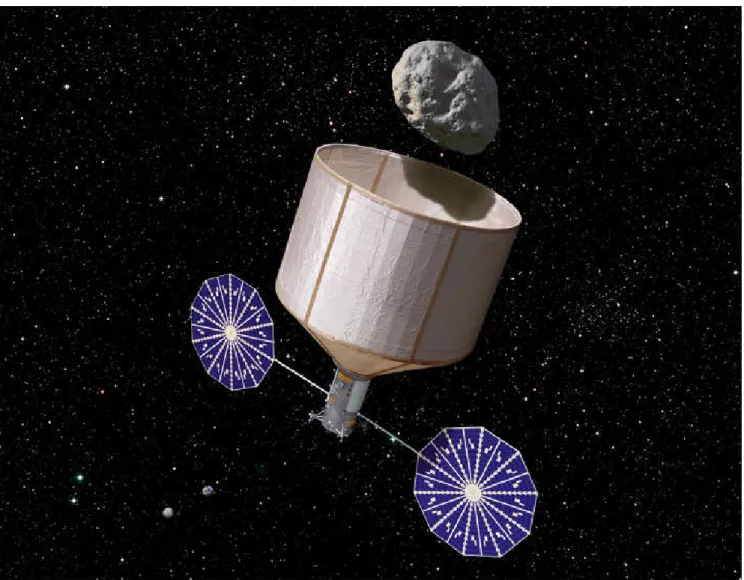
Illustration of an asteroid retrieval spacecraft in the process of capturing a 7-m, 500-ton asteroid. (Image Credit: Rick Sternbach / KISS)
The idea of exploiting the natural resources of asteroids dates back over a hundred years, but only now has the technology become available to make this idea a reality. The feasibility is enabled by three key developments: the ability to discover and characterize an adequate number of sufficiently small near-Earth asteroids for capture and return; the ability to implement sufficiently powerful solar electric propulsion systems to enable transportation of the captured NEA; and the proposed human presence in cislunar space in the 2020s enabling exploration and exploitation of the returned NEA.
Placing a 500-t asteroid in high lunar orbit would provide a unique, meaningful, and affordable destination for astronaut crews in the next decade. This disruptive capability would have a positive impact on a wide range of the nation’s human space exploration interests. It would provide a high-value target in cislunar space that would require a human presence to take full advantage of this new resource. It would offer an affordable path to providing operational experience with astronauts working around and with a NEA that could feed forward to much longer duration human missions to larger NEAs in deep space. It would provide an affordable path to meeting the nation’s goal of sending astronauts to a near-Earth object by 2025. It represents a new synergy between robotic and human missions in which robotic spacecraft retrieve significant quantities of valuable resources for exploitation by astronaut crews to enable human exploration farther out into the solar system. A key example of this is that water or other material extracted from a returned, volatile-rich NEA could be used to provide affordable shielding against galactic cosmic rays. The extracted water could also be used for propellant to transport the shielded habitat. These activities could jump-start an entire in situ resource utilization (ISRU) industry. The availability of a multi-hundred-ton asteroid in lunar orbit could also stimulate the expansion of international cooperation in space as agencies work together to determine how to sample and process this raw material. The capture, transportation, examination, and dissection of an entire NEA would provide valuable information for planetary defense activities that may someday have to deflect a much larger near-Earth object. Finally, placing a NEA in lunar orbit would provide a new capability for human exploration not seen since Apollo. Such an achievement has the potential to inspire a nation. It would be mankind’s first attempt at modifying the heavens to enable the permanent settlement of humans in space.
The report that follows outlines the observation campaign necessary to discover and characterize NEAs with the right combination of physical and orbital characteristics that make them attractive targets for return. It suggests that with the right ground-based observation campaign approximately five attractive targets per year could be discovered and adequately characterized. The report also provides a conceptual design of a flight system with the capability to rendezvous with a NEA in deep space, perform in situ characterization of the object and subsequently capture it, de-spin it, and transport it to lunar orbit in a total flight time of 6 to 10 years. The transportation capability would be enabled by a ~40-kW solar electric propulsion system with a specific impulse of 3,000 s. Significantly, the entire flight system could be launched to low-Earth orbit on a single Atlas V-class launch vehicle. With an initial mass to low-Earth orbit (IMLEO) of 18,000 kg, the subsequent delivery of a 500-t asteroid to lunar orbit represents a mass amplification factor of about 28-to-1. That is, 28 times the mass launched to LEO would be delivered to high lunar orbit, where it would be energetically in a favorable location to support human exploration beyond cislunar space. Longer flight times, higher power SEP systems, or a target asteroid in a particularly favorable orbit could increase the mass amplification factor from 28-to-1 to 70-to-1 or greater. The NASA GRC COMPASS team estimated the full life-cycle cost of an asteroid capture and return mission at ~$2.6B.
I. INTRODUCTION
The idea to exploit the natural resources of asteroids is older than the space program. Konstantin Tsiolkovskii included in The Exploration of Cosmic Space by Means of Reaction Motors, published in 1903, the “exploitation of asteroids” as one of his fourteen points for the conquest of space [1]. More recently this idea was detailed in John Lewis’ book Mining the Sky [2], and it has long been a major theme of science fiction stories [3]. The difference today is that the technology necessary to make this a reality is just now becoming available. To test the validity of this assertion, NASA sponsored a small study in 2010 to investigate the feasibility of identifying, robotically capturing, and returning to the International Space Station (ISS), an entire small near-Earth asteroid (NEA) – approximately 2-m diameter with a mass of order 10,000 kg – by 2025 [4]. This NASA study concluded that while challenging there were no fundamental show-stoppers that would make such a mission impossible. It was clear from this study that one of the most challenging aspects of the mission was the identification and characterization of target NEAs suitable for capture and return.
In 2011 the Keck Institute for Space Studies (KISS) [5] sponsored a more in-depth investigation of the feasibility of returning an entire NEA to the vicinity of the Earth. The KISS study focused on returning an asteroid to a high lunar orbit instead of a low-Earth orbit. This would have several advantages. Chief among these is that it would be easier from a propulsion standpoint to return an asteroid to a high lunar orbit rather than take it down much deeper into the Earth’s gravity well. Therefore, larger, heavier asteroids could be retrieved. Since larger asteroids are easier to discover and characterize this helps to mitigate one of the key feasibility issues, i.e., identifying target asteroids for return. The KISS study eventually settled on the evaluation of the feasibility of retrieving a 7-m diameter asteroid with a mass of order 500,000 kg. To put this in perspective, the Apollo program returned 382 kg of moon rocks in six missions. The OSIRIS-REx mission [6] proposes to return at least 60 grams of surface material from a NEA by 2023. The Asteroid Capture and Return (ACR) mission, that is the focus of this KISS study, seeks return a 500,000-kg asteroid to a high lunar orbit by the year 2025.
The KISS study enlisted the expertise of people from around the nation including representatives from most of the NASA centers (ARC, GRC, GSFC, JPL, JSC, and LaRC), several universities (Caltech, Carnegie Mellon, Harvard, Naval Postgraduate School, UCLA, UCSC, and USC), as well as several private organizations (Arkyd Astronautics, Inc., The Planetary Society, B612 Foundation, and Florida Institute for Human and Machine Cognition). The people listed below participated in the KISS study and developed the contents of this report. The study was conducted over a six-month period beginning with a four-day workshop in September 2011 followed by a two-day workshop in February 2012, and concluding with the submission of this report in April 2012.
John Brophy (Co-Leader / NASA JPL) Fred Culick (Co-Leader / Caltech)
Louis Friedman (Co-Leader / The Planetary Society) Carlton Allen (NASA JSC)
David Baughman (Naval Postgraduate School) Julie Bellerose (NASA ARC)
Bruce Betts (The Planetary Society) Mike Brown (Caltech)
Michael Busch (UCLA/NRAO) John Casani (NASA JPL) Marcello Coradini (ESA) John Dankanich (NASA GRC) Paul Dimotakis (Caltech)
Ian Garrick-Bethel (UCSC) Bob Gershman (NASA JPL)
Tom Jones (Florida Institute for Human and Machine Cognition) Damon Landau (NASA JPL)
Chris Lewicki (Arkyd Astronautics, Inc) John Lewis (University of Arizona) Pedro Llanos (USC)
Mark Lupisella (NASA GSFC) Dan Mazanek (NASA LaRC) Prakhar Mehrotra (Caltech) Joe Nuth (NASA GSFC) Kevin Parkin (NASA ARC)
Rusty Schweickart (B612 Foundation) Guru Singh (NASA JPL)
Nathan Strange (NASA JPL)
Marco Tantardini (The Planetary Society) Brian Wilcox (NASA JPL)
Colin Williams (NASA JPL) Willie Williams (NASA JSC) Don Yeomans (NASA JPL)
The KISS study consisted primarily of two workshops, the first held in September 2011 lasting for four days, and the second a two-day workshop in February 2012, with additional work performed between workshops. The three main objectives of the KISS study were to:
1. Determine the feasibility of robotically capturing and returning a small near-Earth asteroid to the vicinity of the Earth using technology available in this decade.
2. Identify the benefits to NASA, the scientific community, the aerospace community, and the general public of such an endeavor.
3. Identify how this endeavor could impact NASA’s and the international space community’s plans for human exploration beyond low-Earth orbit
A mission to retrieve an entire near-Earth asteroid must successfully address the following three key feasibility issues:
1. How to discover and characterize a sufficient number of candidate asteroids to enable robust mission planning for a launch around 2020?
2. How to capture and de-spin an asteroid with a mass of order 500,000 kg in deep space?
3. How to safely transport the captured 500,000-kg asteroid back to the Earth-Moon system and place it in a high lunar orbit?
The feasibility of capturing and returning an entire NEA to a high lunar orbit, as well as the benefits to NASA and the nation are discussed in the sections below.
Why Now?
Given that the idea to exploit the natural resources of asteroids is very old, what has changed that warrants serious investigation into the feasibility of capturing and returning entire near-Earth asteroids to the Earth-Moon system? The answer is, as mentioned in the opening paragraph above, that the technology necessary to make this possible is just now becoming available. There are three key enabling elements: 1) We now have ability to discover and characterize a sufficient number of sufficiently small near-Earth asteroids; 2) Sufficiently powerful solar electric propulsion systems necessary to transport a captured NEA are also just now becoming available; and 3) NASA is planning to have an human exploration capability in cislunar space in a time frame that is compatible with when an asteroid could be delivered to lunar orbit. Placing a 500-t asteroid there would provide a unique, meaningful, and easy-to-reach destination for exploration by astronaut crews in the next decade.
II. RATIONALE AND BENEFITS
Before discussing the feasibility of returning a 500 metric ton asteroid to lunar orbit, it is important to identify why such an endeavor is important, what benefits it would provide to NASA, the nation, and the international community, and why the public should care. Five general categories of benefits from the return of an entire NEA were identified: 1) Synergy with near-term human exploration; 2) Expansion of international cooperation in space; 3) Synergy with planetary defense; 4) Exploitation of asteroid resources to the benefit of human exploration beyond the Earth-moon system; and 5) Public engagement.
Synergy with Near-Term Human Exploration
The Asteroid Capture-and-Return mission (ACR) concept fits well within the current human spaceflight goals of NASA and its international partners. NASA is currently pursuing the goal of sending an astronaut expedition to a near-Earth asteroid sometime around 2025. A number of key milestones must be accomplished before that would be possible:
a) A search for smaller, more numerous, and dynamically accessible NEA targets. b) Development of a deep-space crewed spacecraft and heavy-lift launch system.
c) One or more robotic precursors designed to characterize the general properties of NEAs.
d) A scout mission to the likely human target to enhance safety and enable detailed mission planning.
The ACR mission concept offers an affordable, intermediate performance goal that could maintain momentum toward deep space expeditions and reduce programmatic risk. It would support human deep-space exploration in the following six ways:
First, the ACR mission could partially fulfill the role of a robotic precursor, yet provide far more information about asteroid structure, composition, and mechanical properties through the extensive field investigation it would enable. The mission would increase greatly our ability to perform complex scientific and flight operations around NEAs, well beyond levels contemplated by currently planned robotic missions. For example, the ACR mission would require mastery of autonomous proximity operations around a small body, part of a skill set that is directly applicable to a wide variety of beyond-LEO missions. A NEA retrieval mission – if conducted promptly – could feed experience and hardware forward into plans for a series of human NEA expeditions in deep space. The risk reduction and hardware validation obtained via a retrieval mission would aid subsequent human exploration planning. This gain in capability would build confidence in and reduces the risk of the first human mission to a NEA.
Second, by making available hundreds of tons of asteroidal material within the Earth-Moon system, ACR mission concept would enable astronaut visits that would take only a few weeks, not the half a year or more required for even the most accessible NEA targets. Compared to a deep-space NEA mission, a “local” visit to the captured ACR object would enable the crew to spend a much higher fraction of their mission time actually working at the object. Such a “local asteroid” mission would clearly be a bridge between LEO operations and full-fledged deep-space NEA expeditions. The shorter duration would also reduce significantly the radiation hazard facing the crew.
Third, the ACR mission concept would put bulk asteroidal material within reach of Earth-Moon L2 (EM L2) facilities and transport systems, now being evaluated by NASA as a waypoint to lunar, asteroid, and Mars system destinations. Visits from the L2 outpost to this small captured asteroid would be an attractive sortie option for astronaut crews, providing opportunities for sample return, in-depth scientific examination, and demonstration of resource processing methods. The ACR mission would enhance the scientific, operational, and economic value of establishing a human-tended outpost at EM L2.
Fourth, providing hundreds of tons of asteroidal material in cislunar space would open the door to large-scale use of extraterrestrial resources by NASA and its commercial partners. Extraction of propellants, bulk shielding, and life support fluids from this first captured asteroid could jump-start an entire space-based industry. Our space capabilities would finally have caught up with the speculative attractions of using space resources in situ. One of the simplest but highly leveraged benefits from these resources might be the provision of bulk shielding material for future deep-space expeditions—a simple but effective countermeasure to galactic cosmic ray exposure.
Fifth, the public would clearly see the results from human exploration once astronauts begin the lengthy, challenging task of examining and “dissecting” a ~ 500 metric ton asteroid. This ongoing robotic and astronaut operation would provide a steady stream of “real-time exploration” results to a public attracted to the scientific unknowns and the economic potential of this captured asteroid. Eventually, commercial consortia should be given access to the object to test resource processing methods and compete for resource production rights on this and other objects.
Sixth, the development of a high-power (40-kW class) solar electric propulsion system would provide a high-performance transportation capability that would benefit other human missions in deep space through cargo delivery and hardware pre-deployment. It would also provide a stepping stone to even higher power SEP vehicles that could be used directly for crew transportation to NEAs and beyond.
Taken together, these attributes of an ACR mission would endow NASA (and its partners) with a new demonstrated capability in deep space that hasn’t been seen since Apollo. Once astronaut visits to the captured object begin, NASA would be putting human explorers in contact with an ancient, scientifically intriguing, and economically valuable body beyond the Moon, an achievement that would compare very favorably to any attempts to repeat the Apollo lunar landings.
Expansion of International Cooperation in Space
The retrieval of a several-hundred-ton carbonaceous asteroid would present unparalleled opportunities for international cooperation. The retrieval could be carried out under the same philosophy as the Apollo program, “in peace for all mankind,” but with a significant advantage. An international panel could be formed to oversee both curation of the body and the review of proposals for its study. The demand for samples for engineering and scientific study of the carbonaceous chondrite material by academic, governmental, and industrial laboratories – usually severely hampered by lack of pristine material – could be met generously. Samples could be returned to Earth for study, whereas microgravity processing experiments of the sort envisioned above could be carried out in situ in its parking orbit. Selected spacefaring nations would have access to the body under the oversight of the international curatorial panel. Nations without the ability to fly missions to the body would be encouraged to form teaming arrangements and propose jointly with those who can access it.
As a natural step in moving human exploration capabilities from the International Space Station (ISS) into cislunar space, then beyond, the ACR mission concept would offer many opportunities for international participation.
1. Our current knowledge of the composition and surface properties of asteroids results from an international scientific exploration effort, including probes from NASA, JAXA, and ESA (e.g. NEAR-Shoemaker, Dawn, Hayabusa, and Rosetta). The U.S. and Japan have flown spacecraft to rendezvous with Near-Earth Object (NEOs), and Japan has returned samples from near-Earth asteroid 25143 Itokawa. Following up on the ESA Don Quijote study, the European Union has now funded an international consortium for a planetary defense study to organize, prepare and implement mitigation measures. Skills gained from all of these encounters might be combined to furnish the spacecraft and scientific instrument complement for the proposed ACR mission. Examples of contributed hardware to the ACR mission could include: launch systems, orbit transfer stages, solar
arrays, ion thrusters, remote sensing and imaging instruments, asteroid capture and retention systems, communications avionics and antennae, and docking hardware for future astronaut visits. 2. Once the target asteroid arrives in cislunar space, the mission partners could open the many tons of
asteroid mass to international sampling, study, and economic assay, extending the collaboration over many years. Follow-up scientific and processing visits to the returned NEA could be a collaborative effort, combining partner investigations and hardware to assess the nature of the object and then begin its industrial processing. The attraction of such an intriguing object in cislunar space would likely draw new partners and serve to expand today’s ISS coalition.
3. The proposed ACR mission concept would lend itself also to the developing international framework for planetary defense from a NEO impact. Space agencies meeting under the auspices of the United Nations Committee on the Peaceful Uses of Outer Space are discussing the planning and operations required for an international mission demonstrating the techniques that would be required to deflect a hazardous asteroid. [7,8] In addition, the NASA Advisory Council’s ad hoc Task Force on Planetary Defense recommended in 2010 that NASA pursue leadership of an international deflection mission as its long-term planetary defense objective [9]. Because the proposed ACR mission would, by definition, be a safe “deflection” of a non-hazardous asteroid, the mission concept would fit very well into this multinational effort, one that would also offer numerous scientific and human exploration benefits.
4. Russia, Europe, and Japan are all evaluating future human spaceflight systems, first to reach and service the ISS, but with application to deep-space transport. NASA’s ISS partners wish to build on their Space Station achievements by participating in future deep-space expeditions. If the proposed ACR mission made available tons of asteroidal material in cislunar space, it would spur collaborative efforts to access this new natural satellite. Experience gained via human expeditions to the small returned NEA would transfer directly to follow-on international expeditions beyond the Earth-Moon system: to other near-Earth asteroids, Phobos and Deimos, Mars and potentially someday to the main asteroid belt.
Synergy with Planetary Defense
An asteroid return mission would bring broader attention to the subject of near-Earth asteroids and therefore greater understanding and attention to the planetary defense challenge element of NEOs. From a technical standpoint an asteroid return mission would enable significant progress in the following areas relative to planetary defense:
1. Anchoring. Many options for more efficient and capable deflection of NEOs would open up if we develop reliable robotic anchoring capability. The latest time to act prior to impact could be significantly delayed if robust techniques are available. Anchoring is the key to enable many of them.
2. Structural characterization, especially of the surface layers. Kinetic impact is today one of the prime deflection technologies available. Yet its effectiveness is highly uncertain due to the (so called) momentum multiplier (beta) variability. Ejecta (at greater than escape velocity) from a kinetic impact may multiply the impactor momentum transferred to the NEO by a factor from 2-10 or more. Structural characterization of the surface layers may reduce this uncertainty to a factor of 2 or less. 3. Dust environment. The dust environment is expected to be highly variable and object dependent.
Nevertheless, understanding the forces triggering dust levitation and settling behavior are important for the gravity tractor (GT) concept in which SEP exhaust impingement on the asteroid could create
a dust hazard. As a minimum greater knowledge here would enable more efficient system designs and a better understanding of stand-off requirements.
4. Proximity operations. Techniques for proximity operations and NEO navigation gained from returning an asteroid would be directly transferable to planetary defense planning and implementation.
Exploitation of Asteroid Resources
From a long-term architectural point of view, the ability to test resource extraction processes and enable commercial resource production ideas to be applied to the captured NEA would pave the way for use of asteroidal materials in human deep-space expeditions, greatly reducing required up-mass from Earth, and thus the cost, of such missions. A 500-t, carbonaceous C-type asteroid may contain up to 200 t of volatiles (~100 t water and ~100 t carbon-rich compounds), 90 t of metals (approximately 83 t of iron, 6 t of nickel, and 1 t of cobalt), and 200 t of silicate residue (similar to the average lunar surface material). As discussed below, the ACR mission concept baselines a single Atlas V 551-class launch, with an initial mass to low-Earth orbit (IMLEO) of 18,000 kg. The delivery of a 500-t asteroid to lunar orbit, therefore, represents a mass amplification factor of about 28-to-1. That is, whatever mass is launched to LEO, 28 times that mass would be delivered to high lunar orbit. Longer flight times, higher power SEP systems, or a target object in a particularly favorable orbit could increase the mass amplification factor from 28-to-1 to 70-to-1 or greater.
Galactic Cosmic Rays: Exposure to Galactic Cosmic Rays (GCRs) may represent a show-stopper
for human exploration in deep space [10]. The only known solution is to provide sufficient radiation shielding mass. One of the potentially earliest uses of the returned asteroid material would be for radiation shielding against GCRs. Astronauts could cannibalize the asteroid for material to upgrade their deep space habitat with radiation shielding.
Materials Extraction: Aside from radiation shielding, initial processing work would concentrate on
the extraction and purification of water. Human expeditions to the NEA in lunar orbit could collect and return significant quantities of material to the ISS where this initial processing work could be conducted in a micro-gravity environment. This would take advantage of the significant infrastructure represented by the ISS. The second level of processing should be the electrolysis of water into hydrogen and oxygen and the liquefaction of both gases. The third level of processing would involve strong “baking” to the point of forcing autoreduction of the major mineral magnetite (Fe3O4) by the carbonaceous polymer,
leading to total release of more water, carbon monoxide, carbon dioxide, and nitrogen. The fourth level of processing would entail using the released CO as a reagent for the extraction, separation, purification, and fabrication of iron and nickel products via the Mond (gaseous carbonyl) process [11]. The residue from Mond extraction of iron and nickel would be a dust of cobalt, platinum-group metals, and semiconductor components such as gallium, germanium, selenium, and tellurium. These challenges could be faced one at a time, not all at once.
Prototype-scale experiments on processing the materials in the retrieved asteroid would validate our concepts and refine our techniques for production of propellants, life-support materials, structural metals, and radiation shielding in support of large-scale autonomous space activities. The extraction of water from an NEO of asteroidal or cometary origin would provide us with propellants in space, at the site of future demand. The use of solar power for electrolysis of water could supply hydrogen and oxygen for chemical propulsion and oxygen for life support on manned deep-space missions. This could also provide fuel for the use in electrochemical cells.
A rough estimate based on NASA’s NLS-II agreement for launch services suggests that it costs about $100K for each kilogram of mass delivered to a high lunar orbit using conventional chemical propulsion. Therefore, delivery of 500 t of material to a high lunar orbit would cost of order $20B. As shown in Section VI, the cost of the first ACR mission including DDT&E plus the first unit, launch
services, mission operations, government insight/oversight, and reserves is estimated at $2.6B. The first ACR mission would deliver asteroid material to high lunar orbit at a cost in $/kg that would roughly be a factor of 8 cheaper than costs for launching that mass from the ground. The recurring cost for subsequent missions is estimated at approximately $1B so subsequent missions would improve that cost savings to a factor of 20.
Public Engagement
The excitement of changing the orbit and harnessing the resources of a celestial object for space exploration is obvious. A mission like this even decoupled from human exploration would engage a whole new generation of space interested persons, and coupled to the goal of enabling sending humans further than ever before in space it would inspire even more public interest. Beyond the excitement is the wide range of educational goals that would accompany this venture: knowledge of Earth’s celestial environment, the engineering and mathematics of asteroid orbit modification, the science of solar system resources and the exploration into the solar system. Apollo was based on a cold-war rationale and ever since an over-arching geo-political rationale has been lacking from space ventures. Retrieving an asteroid for human exploration would provide a new purpose for global achievement and inspiration.
III. MISSION OVERVIEW &SAFETY CONSIDERATIONS
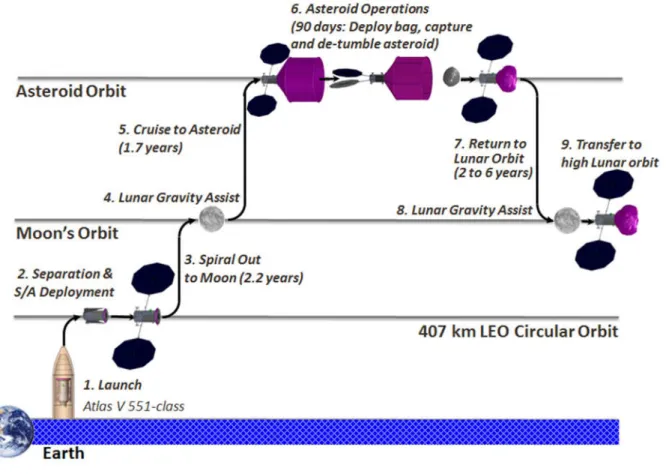
A basic Asteroid Retrieval mission concept is illustrated in Fig. 1. The spacecraft would be launched on an Atlas 551-class launch vehicle to low-Earth orbit. A 40-kW electric propulsion system would then be used to reach the NEA in about 4 years. Once at the NEA, a 90-day operations phase is divided into two phases. During the first phase, the target would be studied thoroughly to understand its size, rotation, and surface topography. In the second phase the spacecraft would capture and de-spin the asteroid. To accomplish this, the spacecraft would match the target rotation, capture it using the capture mechanism described in Section VI, secure it firmly to the spacecraft, and propulsively despin the combination. The electric propulsion system would then be used to depart the asteroid orbit, return to the vicinity of the Moon, and enter a high-lunar orbit. After reaching lunar orbit the spacecraft would stay attached to support human activity, which is anticipated to include the development of NEA proximity operational techniques for human missions, along with the development of processes and systems for the exploitation of NEA resources.
The ACR spacecraft concept would have a dry mass of 5.5 t, and could store up to 13 t of Xe propellant. The spacecraft would use a spiral trajectory to raise its apogee from LEO to the Moon where a series of Lunar Gravity Assists (LGAs) would be used in concert with SEP thrusting to depart the Earth-Moon system. This initial leg of the trajectory would take from 1.6 to 2.2 years to reach Earth escape. From escape it would take roughly 2 years to reach the target asteroid. The return time would range from 2 to 6 years depending on the actual mass of the NEA. The concept system could return asteroids with masses in the range 250,000 kg to 1,300,000 kg, to account for uncertainties in size and density.
Final Destination
Since even small asteroids have relatively large masses – a 7-m diameter asteroid has a mass roughly equal to that of the ISS – the final placement of the asteroid in the vicinity of the Earth must be considered carefully. Although the very low strength of a type C asteroid would minimize the likelihood that entry of such a body might inflict damage on Earth’s surface, it would be more prudent to place the retrieved asteroid in an orbit from which, if all else fails, it would only impact the Moon, not Earth. Lunar orbit or possibly regions near the Earth-Moon Lagrange points would, therefore, be preferred for this criterion. The second factor regarding the choice of a “parking place” is that it is important to place the asteroid in a location that is reasonably close to and accessible from Earth (within a few days journey from LEO). A third factor is the desire to park the asteroid in a place at which there is some foreseeable future demand for water and water-derived propellants, so that production of useful materials could serve the needs of future space missions. This third factor suggests LEO and the lunar vicinity as the best choices. These three factors combined suggest the immediate vicinity of the Moon as a reasonable choice. Whatever the final destination the mission must clearly define the end-of-mission conditions and asteroid maintenance and disposal effort (e.g., lunar surface). For the purposes of the trajectory design described later, we assumed a high lunar orbit as the destination for the returned asteroid.
Safety
The first question that must be answered in the consideration of feasibility is, “could the mission be conducted safely?” In fact, moving a non-hazardous asteroid toward the Earth must not just be safe, but it must be completely perceived as safe to an interested, and likely concerned, public. Safety would have to be guaranteed by the mission design. This subject was addressed in our workshops and resulted in the following “belt & suspenders” approach to safety.
First, the size and mass of the asteroid to be returned would be like many other meteorites which routinely impact the Earth and burn up harmlessly in the atmosphere. Moving an asteroid of sufficiently small size would not add to the danger from small meteorites, which are small pieces of asteroids that approach Earth.
Second, we are selecting a carbonaceous asteroid. Asteroids of this type and size are known to be too weak to survive entry through the Earth’s atmosphere, so then even if it did approach the Earth it would break up and volatilize in the atmosphere.
Thirdly the trajectory design for moving the asteroid toward the Earth would keep it on an non-impact trajectory at all times. Therefore, if the flight system fails the resulting orbit would be no more dangerous than that of thousands of natural and man-made objects in near-Earth space.
Fourth, the destination orbit would be a high lunar orbit so that even at the end of mission the natural perturbations of the trajectory would cause an eventual impact on the Moon, not on Earth. This can be insured by the laws of celestial mechanics and selection of orbit. Although multiple levels of redundancy would be employed to maintain control of the asteroid, in the event of a failure in which control is lost the asteroid would also impact the Moon.
With these levels of safety – all of which will be further analyzed and assessed during the phase II study – we can conclude the mission could be safe and that it could be explained convincingly to the public. Furthermore, this mission would help make it safe for humans to go on longer voyages beyond the Moon. Sending a human to a Near-Earth Asteroid now would require months of flight time and consequent life support and radiation protection systems not yet designed. Additionally, operations at a NEA in its natural orbit would be conducted months away from any return to Earth. By exercising the NEA mission at a chosen location in cislunar space, we would take that first step beyond the Moon safely, and build up the knowledge and capability for further steps. Metaphorically, we would be dipping our toe into the vast ocean of space before taking our first real plunge.
IV. TARGET DISCOVERY AND CHARACTERIZATION Asteroid Type
The most desirable asteroids for return are the carbonaceous C-type asteroids that are deemed by the astronomy community to have a planetary protection categorization of unrestricted Earth return. Carbonaceous asteroids are the most compositionally diverse asteroids and contain a rich mixture of volatiles, complex organic molecules, dry rock, and metals. They make up about 20% of the known population, but since their albedo is low, they may be heavily biased against detection in optical surveys. Retrieving such asteroid material would enable the development of as many extraction processes as possible. Carbonaceous asteroid material similar to the CI chondrites is easy to cut or crush because of its low mechanical strength, and can yield as much as 40% by mass of extractable volatiles, roughly equal parts water and carbon-bearing compounds. The residue after volatile extraction is about 30% native metal alloy similar to iron meteorites [12].
Our first priority, then, is to locate several, accessible ~7-m carbonaceous-chondrite objects which could be returned to Earth at some point in the 2020’s. This requires a dramatic increase in the discovery rate of small asteroids. Such an increase is possible with relatively minor adjustments to current survey programs.
Synodic Period Constraint – The feasibility of returning an entire (small, 7-m) asteroid hinges
mainly on the question of how to find sufficiently small asteroids that have orbital parameters extremely close to Earth and yet will return soon enough to be of interest. Small asteroids can only be discovered by ground-based observatories when they make a very close approach to Earth, where their intrinsic faintness is overcome by extreme closeness to the observer. In order to be able to return these objects to the vicinity of the Earth they must have orbital parameters that are very similar to Earth’s. Consequently these objects will have synodic periods that are typically one or more decades long. This places an additional constraint on small asteroids in order to be candidates for return. They must have synodic periods of approximately one decade. This would enable the object to be discovered and characterized followed by a mission targeted to return the NEA by the next close approach approximately 10 years later. There is an existence proof that such objects exist. The asteroid 2008HU4 is estimated to be roughly 8-m in diameter and will make its next close approach to Earth in 2016 with a subsequent close approach in 2026. Trajectory analysis presented in Section VI assumes this target asteroid and demonstrates how it could be returned to the vicinity of the Earth by 2026 using a 40-kW solar electric propulsion (SEP) system.
Discovery and Characterization Techniques
Discovery and characterization of a sufficient number of candidate NEAs suitable for return is critical. Multiple good targets with launch dates covering multiple years around the nominal launch date would be required to develop a robust mission implementation plan. To support mission planning it would be necessary for each candidate target asteroid that its orbit be adequately known and have the right characteristics, that it be a volatile-rich, C-type asteroid, and that it have the right size, shape, spin state and mass, and that the values of these parameters be known with uncertainties that make the flight system design practical. The current best size frequency distributions for near-Earth asteroids suggest that there are roughly a hundred million NEAs approximately 7-m diameter, but only a few dozen of these are currently known. Fewer still have secure orbits and none of them have known spectral types. It is expected that a low-cost, ground-based observation campaign could identify approximately five good candidates per year that meet these requirements out of roughly 3,500 new discoveries per year.
The key to the discovery and characterization campaign is to determine the minimum asteroid size that enables a target discovery and characterization rate sufficient to provide an adequate number of candidate asteroids before the end of this decade, and around which a mission could be planned. Larger asteroids are easier to discover and characterize but much harder to move. Since the volume and mass
scale as the cube of the diameter, but the projected area scales as the square of the diameter, smaller asteroids get less massive much faster than they get dimmer. The key feasibility issue is to determine if there is an overlap between NEAs that are bright enough (i.e, large enough) to be discovered and characterized and small enough to be moved with near-term SEP propulsion capability.
Periodic comets and asteroids that reach a perihelion distance of 1.3 Astronomical Units (AU) or less are defined as near-Earth objects (NEOs). The vast majority of these NEOs are near-Earth asteroids (NEAs) and roughly 20% of the NEA population have orbits that come within 0.05 AU of the Earth’s orbit [13]. It is the population of NEAs with Earth-similar orbits that are both the most likely to strike Earth naturally and would be the most easily accessible for spacecraft round-trip missions.
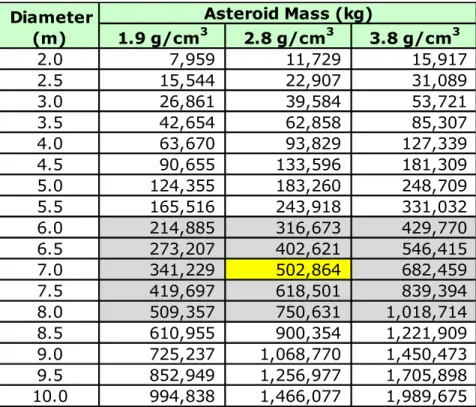
The densities of asteroids vary widely, from ~1 g/cm3 for a high-porosity carbonaceous chondrite to ~8 g/cm3 for solid nickel-iron meteorites. The majority of NEAs have densities between 1.9 g/cm3 and 3.8 g/cm3 [14]. The mass of an asteroid as a function of its diameter (assuming spherical asteroids) is given in Table 1 over the range of densities from 1.9 g/cm3 to 3.8 g/cm3. This table indicates that even very small asteroids can be quite massive from the standpoint of transporting them to the vicinity of the Earth. For example, a 7-m diameter asteroid with a density of 2.8 g/cm3 has a mass of order 500,000 kg. Small asteroids are not spherical, but Table 1 gives a general sense of the masses of these small objects.
Table 1. Asteroid Mass Scaling (for spherical asteroids)
For NEAs with diameters larger than 100 meters, the size-frequency distribution has recently been revised downwards as a result of the WISE space-based infrared observations that were made throughout 2010 and for two months into 2011 [15]. At the small end of the NEA size-frequency distribution, there are roughly 20,500 NEAs larger than 100 meters with about 25% discovered to date, but for the smallest members of the NEA population, there are millions of NEAs larger than 10 meters and billions of NEAs larger than 2 meters. However, far less than one percent of these populations have been discovered. The difficulty is that small NEAs are faint and discoverable with the current one-meter class ground-based telescopes only when they make very close Earth approaches. For example, with an assumed albedo of 25%, a 2-m-sized asteroid 0.005 AU from the Earth would have an apparent magnitude of about 31. There are only four discovered objects of this size and all are currently lost and
1.9 g/cm3 2.8 g/cm3 3.8 g/cm3 2.0 7,959 11,729 15,917 2.5 15,544 22,907 31,089 3.0 26,861 39,584 53,721 3.5 42,654 62,858 85,307 4.0 63,670 93,829 127,339 4.5 90,655 133,596 181,309 5.0 124,355 183,260 248,709 5.5 165,516 243,918 331,032 6.0 214,885 316,673 429,770 6.5 273,207 402,621 546,415 7.0 341,229 502,864 682,459 7.5 419,697 618,501 839,394 8.0 509,357 750,631 1,018,714 8.5 610,955 900,354 1,221,909 9.0 725,237 1,068,770 1,450,473 9.5 852,949 1,256,977 1,705,898 10.0 994,838 1,466,077 1,989,675 Diameter (m) Asteroid Mass (kg)
would have to be re-discovered. There are, however, 300 asteroids approximately 10-m diameter discovered to date but only a few of these currently have secure orbits, and even fewer have the physical characterization that would allow them to be identified as a particular spectral class or have information on their albedos or true diameters.
By far the most efficient NEO search program to date is the Catalina Sky Survey (CSS) near Tucson Arizona [16]. When comparing the efficiencies of NEO search telescopes, the metric of choice, called the “entendu” is the product of the telescope’s aperture and its field of view. For the CSS, its entendue is about 2. Next generation NEO search telescopes include the Panoramic Survey Telescope and Rapid Response System 1 (Pan STARRS 1) on Haleakala in Maui Hawaii, which should reach an entendue of about 13 when fully operational [17]. In addition there are plans for PanSTARRS 4, a set of four, co-located PanSTARRS 1 telescopes, which should have an entendue of about 51. The Large Synoptic Survey Telescope (LSST), which is a 8.4 meter aperture, wide field telescope in Chile, has plans for first light in 2018 [18]. The entendue for LSST is about 320 so it could be about 150 times more efficient at finding PHAs that the current CSS system.
When first discovered, all that is known about near-Earth asteroids are their orbits and their absolute magnitudes. An object's absolute magnitude can be converted to its size if its albedo is known. However, the albedos of near-Earth asteroids vary widely. Most (but not all) NEAs have albedos between 0.09 and 0.36 [19], which means that an asteroid's diameter can only be estimated to within about a factor of two from its absolute magnitude. The object's volume then can only be quantified to within a factor of 8 or 10. Assuming a factor of 2 uncertainty in the density then results in a factor of 20 uncertainty in the estimated mass of a NEA without any information beyond the discovery magnitude – and there will be significant outliers beyond even that range.
The asteroid’s mass can be estimated more accurately with additional data. If we consider ~10-m-class objects that are discovered during one Earth flyby as potential mission targets during their next Earth flyby, follow-up observations must occur as soon as possible after a potential target is discovered. Ideally follow-up should start within a day and must be started within a week.
The first follow-up observation should be additional optical astrometry to better determine the NEA’s trajectory and ensure that it will not be lost – although at this point our knowledge of its orbit would not be sufficient for a spacecraft rendezvous many years in the future. Such astrometry of newly discovered NEAs is routinely and very reliably provided by a worldwide network of professional and amateur astronomers, as demonstrated by the case of 2008 TC3 in which 26 observatories observed that object within 19 hours of its discovery [20].
The other necessary follow-up observations can occur in any order or simultaneously. Optical lightcurve measurements will likely tell us the object’s spin rate and if it is in a tumbling non-principal-axis rotation state or not [21]. More importantly for estimating the object’s mass, optical and near-infrared spectroscopy (which require the attention of professional astronomers) will constrain the asteroid’s composition – particularly to determine if it is rich in silicates (an S-class object) or in carbonaceous material (a C-class object) [22]. While asteroid’s densities can vary significantly even given the same composition, due to differences in porosity, that variation is ~50% rather than the wider range of the whole population [23].
Spectral classifications are often made solely on the basis of optical and near-IR colors. This is not sufficient for our purposes: meteorites that have C-class colors have a wide range of compositions, and only some are the water- and organic-rich carbonaceous chondrites that are normally considered to define the C-class. High-sensitivity spectroscopy covering the optical and near-IR (0.5 – 3.5 microns) is desirable to detect the absorption bands at ~0.7 and ~3.0 micron that unambiguously indicate a carbonaceous chondrite composition [24].
Thermal infrared flux measurements allow us to estimate an object’s albedo, limited by the object’s shape, thermal properties, and brightness. For large objects (>100 m), we can often obtain sizes accurate to ~10-20% from thermal radiometry [25]. However, for small objects with more irregular shapes,
estimates of their dimensions are only accurate to ~30-40% [26].
The final type of follow-up is radar ranging measurements. Currently, the Goldstone Solar System Radar can image asteroids with resolution as fine as 3.75 m [27]. This allows us to determine the target’s trajectory well enough for a later rendezvous and to measure its dimensions to ~40% for a 10-m object. For a rapidly rotating target with a known spin state, we can estimate the size somewhat more accurately by measuring the Doppler bandwidth of the radar echoes, caused by the relative motion between one side of the object and the other. Radar shape and spin state modeling works best in combination with optical lightcurve observations, with the radar imaging providing spatial resolution and the lightcurves providing a more accurate measurement of the object’s spin rate.
Radar ranging measurements also provide very accurate astrometry, sufficient for rendezvous with the object many years later [28]. With optical astrometry only, at least two epochs of observation separated by several years are required to obtain a similarly reliable orbit solution. With radar imaging, we can obtain a ~10-m NEA's dimensions to within <=40%, and its volume to within a factor of 2.75. With composition information, this gives an uncertainty in the asteroid's mass of a factor of 4 for most objects.
In a few cases, we can obtain asteroid's masses more accurately still. Approximately one-sixth of near-Earth asteroids larger than 200 m are binaries, and measurements of the mutual orbit of a binary system with radar allows us to determine the mass of the system, and in some cases the mass ratio of the components, to within a few percent [29]. However, those objects are likely too large to be moved - the smallest known asteroid satellite is ~60 m in diameter - and the fractional mass uncertainty becomes quite large for small satellites around large primary objects.
If radar ranging or high-precision optical astrometry of a ~10 m object can be obtained three or more times over a time span of months to years, we can measure the perturbations to its orbit due to radiation pressure, either direct solar radiation or the asteroid's thermal emission (the Yarkovsky effect) [30,31]. The asteroid's acceleration indicates its mass loading, so that we can estimate its mass to within 50%. Without three or more epochs of observation separated sufficiently in time, we cannot separate the effects of radiation pressure from other sources of uncertainty in the target's trajectory. For small objects that can be observed only during close Earth flybys it will not be possible to make these observations before we would want to launch this proposed mission.
Observation Campaign
Based on the rough estimates of the number of small asteroids that are available [32,33], the average sky density of asteroids with diameters between 7 and 30 m and apparent R-band magnitude <18 at any given moment is ~1/(70 deg2). Most of these objects will be >0.01 AU and <0.03 AU away, and moving at ~1º/hour. In addition to these objects, there will be a comparable number of 30 to 90 m objects at distances up to 0.1 AU, moving at ~20’/hour.
We have considered the cases of two existing surveys. For the Palomar Transient Factory (PTF) [34], which is currently observing a total of 400 to 640 deg2/night with 20 min cadence, there will be 3 to 5 such asteroids each night that are seen as ~1’ streaks in the same field in two successive images1
. 18 mag is a reasonable number for PTF’s detection limit for such streaks, but the limiting brightness and so the number of detectable objects will depend significantly on weather. For CSS, a limiting magnitude 16.5 for streaks and sky coverage 1200 deg2/night implies that 2 to 3 fast-moving asteroids will be visible each night. If Pan-STARRS can also observe a total of 400 to 640 deg2/night, then the number of detectable moving asteroids will be comparable to PTF. Consequently, the total number of fast-moving small objects that could potentially be located by these three surveys each night is between 8 and 13. We assume 10 in the estimates below.
1
There will be 2-4 asteroids that are seen in one image but have moved out of the field by the next one. Objects much smaller than 7 m will only be
detectable when they are much closer than 0.01 AU and moving so quickly that the loss fraction more than offsets their increased number. We have not considered linking streaks in images of one field to streaks in images of an adjacent one.
Locating the fast-moving objects – In order to be useful, detections of these objects must be
announced within a few hours, so that follow-up telescopes in North America and Hawaii, but also Asia and Australia, can observe them before they are lost. For PTF this could be accomplished as follows: Currently, images are processed as they are taken by subtracting the reference images from them and flagging any remaining point sources. To avoid excessive downlink data rates a copy of the subtracted images could be sent to a new PTF computer, to flag streaks with the appropriate combination of length and brightness and link them together to provide a track of the asteroid’s motion over the next several hours. The relevant images (a very small fraction of the total data) would then be transmitted from the PTF. Depending on what levels of false positives and false negatives are acceptable, the follow-up telescopes can be notified automatically with the sky track and predicted positions for the object or the detected streaks can be reviewed by a human before sending a request.
Follow-up Observations – The discoveries would need to be followed-up by additional optical
astrometry, and all astrometry provided to the Minor Planet Center, within a few hours. The existing community of asteroid observers can follow-up a certain number of objects on such timescales automatically, but ~10 per night may be too much and purchasing dedicated robotic telescope time for this purpose will likely be required.
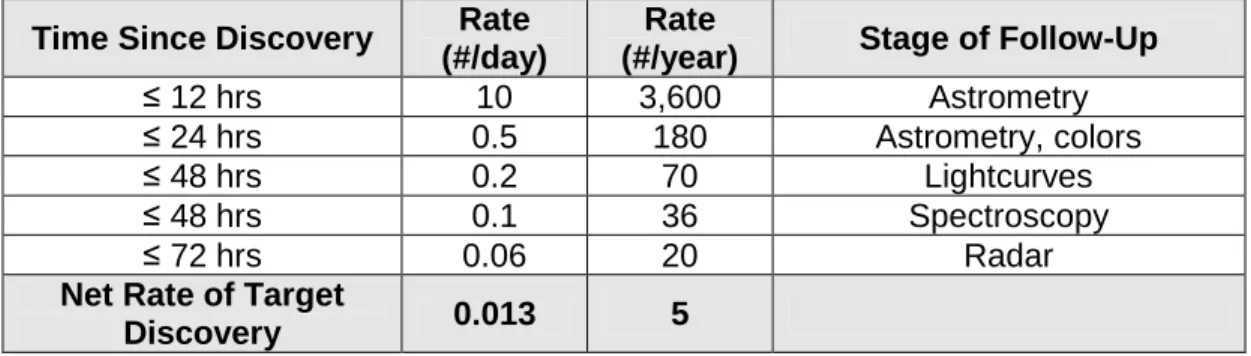
After the first round of follow-up astrometry, we would begin culling the objects to locate those that we are interested in (Table 2). The first round of culls would really take place at discovery, when we impose cuts in apparent magnitude and plane-of-sky motion to focus on only fast-moving small objects. The second cull would be to use the asteroids’ orbital elements to exclude objects with C3 > 20 km2/s2, which comprises ~95% of the discoveries. These would not be suitable for returning to Earth. Astrometry on the remaining objects should continue for at least the next two days, jointly with additional follow-up.
Table 2. Target Rates at Different Stages of Follow-Up Observations
The next stage of follow-up would be to obtain photometry. We want a water-rich carbonaceous chondrite object as the target of this mission. Such asteroids are C-class objects, with slightly reddish spectra in the visible and near-IR, and absorption bands associated with water at 3 microns and 0.7 microns. Broad-band colors do not give an estimate of the water content, but allow us to distinguish silicate and metallic objects from the C-classes. We would want colors on roughly one object every two days, which can be done by current asteroid observers, both professional and amateur, using small (<0.5 m) telescopes. Colors would exclude roughly 60% of objects as not having suitable composition.
After or simultaneously with obtaining colors, we would want lightcurve observations to determine the asteroids’ spin rates. If the mission design is limited to objects spinning no more rapidly than once every 10 minutes, roughly half of the objects would be excluded due to spinning too fast. Lightcurve observations would require 1-2 m telescopes that could be scheduled on short notice, such as the Magdalena Ridge Observatory, ideally a couple of hours of observation on each target on two successive nights to obtain good values for the spin rates and check for non-principal-axis rotation.
After culling the targets based on lightcurves and colors, we would be left with ~1% of the initial
Time Since Discovery Rate (#/day)
Rate
(#/year) Stage of Follow-Up
≤ 12 hrs 10 3,600 Astrometry
≤ 24 hrs 0.5 180 Astrometry, colors
≤ 48 hrs 0.2 70 Lightcurves
≤ 48 hrs 0.1 36 Spectroscopy
≤ 72 hrs 0.06 20 Radar
Net Rate of Target
discoveries, about one per ten nights. The next cull would be spectroscopy with ~1 m optical telescopes, separating those C-types that have abundant water from those that do not, another 40% or 50% decrease in the target rate. We can do this using an absorption band at 0.7 microns. This band is not due to water itself, but due to charge transfer in iron-bearing minerals that occur only in C-type objects when water is also present [35,36]. There is a more direct way of detecting water, by looking for a vibrational transition at 3 microns. However, these targets would be too faint to detect at 3 microns because of the very high background emission from the atmosphere in the mid-infrared. The presence of the 0.7 micron feature does not let us precisely estimate the water content of an object, but it must be greater than a few percent (and may be as high as 30%).
The final follow-up observations would be radar observations, to determine the target’s sizes and approximate densities, refine knowledge of their spin states, and improve our knowledge of their orbits to the point that a spacecraft rendezvous would be possible. Such observations would require a few hours of time with the Goldstone and/or Arecibo radars once per two or three weeks, scheduled within about 72 hours of discovery. This is within the current observing rate at both telescopes. However, as a caution, many observations on short notice at Goldstone would require changes in how transmit time is assigned there, and we may run into limits due to conflicts with scheduled deep-space telecom at Goldstone and other time-sensitive projects at Arecibo.
After the radar observations, we would have size and mass estimates and trajectory knowledge sufficient to understand which objects are in fact attractive targets, with the lowest C3s and convenient future close approaches. This would decrease the target rate by a further factor of four, assuming that the best targets would have C3 < 6, giving us a final mission target discovery rate of about 5 per year. This estimate is promising, but the entire sequence of discovery and characterization will need refining before the surveys can commence
Alternative Approach
The discovery of larger objects (≥ 100 m) is, of course, much easier than those less than 10-m in diameter. These objects can be seen at >10X greater range, so much more accurate orbits can be determined with a single pass by Earth. They are visible for enough successive nights that spectroscopic and/or radar observations can be easily arranged. Almost all NEAs whose spectral types are known fall in this category.
Only a few NEAs, all >100-m diameter, have been approached sufficiently closely to get high-resolution images of their surfaces. All such objects appear to have discrete rocks ranging from gravel to house-sized boulders (and larger) on their surfaces. Analyses of spin periods indicate that larger objects have spin periods generally longer than ~2 hours, the "rubble pile limit". Objects with periods slower than this limit have self-gravity at the equator greater than the centrifugal force that would fling loose objects off into space. Objects spinning faster than this are presumed to be competent rock or otherwise coherent and cohesive objects, since the centrifugal force is larger (often much larger) than gravity at the equator. Studies of spin periods show that small objects, with few exceptions, spin faster than the rubble pile limit, while larger objects, again with few exceptions, spin slower than the rubble pile limit. This suggests that larger objects are rubble piles, with a range of sizes of loose material on their surfaces.
So the alternative approach would be to target a larger NEA, knowing that the entire object is far too massive to return intact and assume that we could take a 7-m piece off it. We’ll refer to this alternative tactic as the Pick Up a Rock approach. The approach to capturing and returning an entire small NEA we’ll refer to as Get a Whole One, when it is necessary to distinguish it from the Pick Up a Rock approach. For the Pick Up a Rock scenario, in the unlikely event that a single right-sized piece could not be found, then at the very least the system could be designed to collect enough regolith or many small pieces to approach the design-capacity of the system in terms of return mass (i.e., a few hundred metric tons).
V. FLIGHT SYSTEM DESIGN
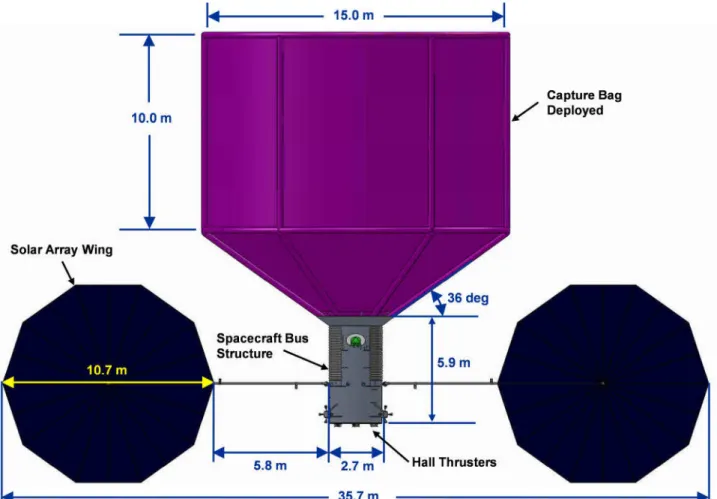
A conceptual design of the flight system was developed by the COMPASS team at NASA GRC based on guidance provided by the KISS study team. The flight system in the cruise configuration is given in Figs. 3 through 6. The spacecraft configuration is dominated by two large solar array wings that would be used to generate at least 40-kW of power for the electric propulsion system (end-of-life at 1 AU) and the large inflatable structure of the capture mechanism. The solar arrays are sized to accommodate up to 20% degradation due to spiraling through the Earth’s radiation belts. A margin of 9% is assumed to be added to the 40-kW power level and 1,200 W is allocated for the rest of the spacecraft. The solar array is assumed to be configured in two wings with each wing having a total area of approximately 90 m2. There are multiple candidate solar array technologies that would have the potential to meet the needs of this proposed mission. For example, solar array wings based on the Ultraflex [37] design are shown in Fig. 3. The spacecraft is shown in the stowed configuration in Fig. 4. Key spacecraft subsystems are described below.
Electric Propulsion (EP) Subsystem
The EP subsystem concept includes a total of five 10-kW Hall thrusters and Power Processor Units (PPUs). A maximum of 4 thruster/PPU strings are operated at a time. It also includes xenon propellant tanks, a propellant management assembly, and 2-axis gimbals for each Hall thruster. The electric propulsion subsystem concept incorporates one spare thruster/gimbal/PPU/XFC string to be single fault tolerant.
Figure 4. Conceptual ACR spacecraft in the stowed configuration.
Figure 5. Bottom view of the conceptual ACR spacecraft showing the five 10-kW Hall thrusters and
Each thruster is estimated to have a mass of 19 kg, and would operate at a specific impulse of up to 3,000 s at a PPU input power level of ~10 kW. The xenon propellant tank design is based on a cylindrical, composite overwrap pressure vessel (COPV) design with a seamless aluminum liner. Such tanks are projected to have a tankage fraction for xenon of approximately 4%. (For reference, the Dawn xenon tank had a tankage fraction of 5%.) A total of seven xenon tanks would be needed to store the 12,000 kg of xenon required for this mission. Each tank would have a diameter of 650 mm and would be approximately 3,500 mm long.
Attitude control during SEP thrusting would be provided by gimbaling the Hall thrusters. This would provide pitch, yaw, and roll control for the spacecraft. Thrusting with the electric propulsion system would be the normal operating mode for the spacecraft, i.e., this is the mode in which the spacecraft would spend the vast majority of its time during the mission. At other times attitude control and spacecraft translation would be provided by a monopropellant hydrazine reaction control system.
Reaction Control Subsystem (RCS)
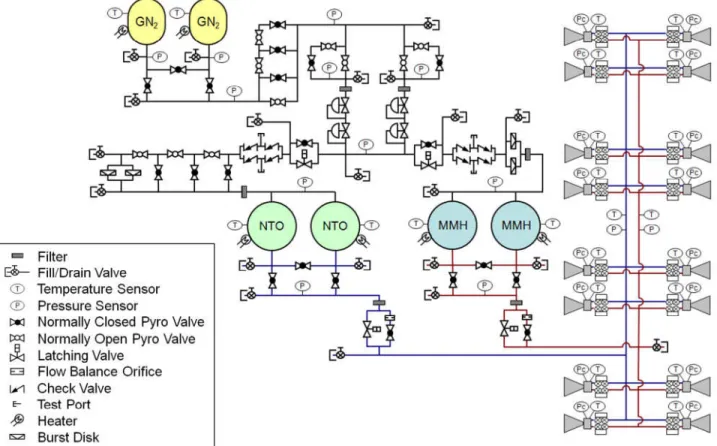
The RCS concept is a single fault tolerant, hypergolic bipropellant subsystem using monomethylhydrazine (MMH) and nitrogen tetroxide (NTO) with a gaseous nitrogen pressurization system. It includes four pods of four thrusters as indicated in Fig. 5. Each thruster has a nominal thrust of 200 N and a specific impulse of 287 s. A preliminary schematic of the RCS concept design is shown in Fig. 7. The RSC could store up to 900 kg of propellant. The propellant required to de-tumble the asteroid was estimated to be about 300 kg. A margin of 50% is added to this along with an estimated 200 kg of propellant to control the spacecraft before and after capture for a total requirement of 650 kg. Adding addition margin brings the total estimated RCS propellant load to 900 kg.
Electrical Power Subsystem (EPS)
The power system design is sized to provide 41.2 kW at 120 VDC to the user input at EOL. It would use two 10.7-m diameter Ultraflex solar arrays with 33% efficient, advanced Inverted Metamorphic
Figure 6. Top view of the conceptual ACR spacecraft showing the instrument suite and capture
(IMM) solar cells and 20-mil coverglass on front and back sides. The solar arrays could be canted toward the aft portion of the vehicle during asteroid capture and would be off-pointed at most 85° and provide at least 3.6 kW.
A secondary lithium ion battery woul