ISO/IEC/IEEE 29119:
The New International Software
Testing Standards
Stuart Reid
Testing Solutions Group
London, UK
ISO/IEC/IEEE 29119:
The New International Software
Testing Standards
Stuart Reid
Testing Solutions Group
London, UK
Abstract
In May 2007 ISO formed a working group to develop a new set of standards on software testing – a new area for ISO – the first three of these standards were published in early September 2013. This initiative is closely-‐supported by IEEE and BSI, both of which have donated existing standards as source documents to the project (these standards will be retired as the new standards are published). The new ISO/IEC/IEEE 29119 Software Testing standards currently comprise five parts. The first covers ‘concepts and terminology’, the second ‘test processes’, the third ‘test documentation’, the fourth ‘test techniques’ and the fifth ‘keyword-‐driven testing’. There is also a further complementary part in the pipeline on ‘test assessment’. This paper describes the rationale for developing these standards, progress on their development and the content of the different parts.
Parts of ISO/IEC/IEEE 29119 have already been released in draft form for review (and subsequently been updated based on many thousands of comments) and are already being used within a number of multi-‐national organizations. These organizations are already seeing the benefits of reusing the well-‐defined processes and documentation provided by standards reflecting current industry best practices.
Introduction
Background to Software Testing
Software testing has been a fundamental part of software development since well before life cycle models were defined, with references to a separate software testing activity being made as early as 1954. Today estimates for the proportion of life cycle costs spent on testing vary from below 20% up to 80% for safety-‐critical systems. Despite its long history and high costs, testing has been poorly covered in standards; this corresponds with similar poor coverage in academic courses and research. This paper introduces a new set of software testing standards, the development of which started in 2007, with the first parts being published in September 2013.
What are standards?
According to ISO, standards are “Guideline documentation that reflects agreements on products, practices, or operations by nationally or internationally recognized industrial, professional, trade associations or governmental bodies”.
They are guideline documents as they are not compulsory unless mandated by an individual or an organization – so although there is a widespread perception that standards are imposed on people and organizations, in fact that depends on how they are used. If specified in a contract then they can define requirements, but this depends on the users.
Standards are based on agreements because they reflect a certain level of consensus. ISO defines consensus as “General agreement, characterized by the absence of sustained opposition to substantial issues by any important part of the concerned interests and by a process that involves seeking to take into account the views of all parties concerned and to reconcile any conflicting arguments. Consensus need not imply unanimity.” In practice, when developing testing standards it is safe to say that unanimity is in extremely short supply, whereas reconciliation is plentiful!
Are standards useful?
Standards in general have been shown to provide increased productivity and profitability for businesses of all sizes – and, perhaps more surprisingly, enhanced innovation.
Educated consumers have increased confidence in organizations that can show compliance with standards, and these same organizations benefit from basing their practices on agreed industry standards. Standards afford benefits to both the consumer and the provider; their authors providing the expertise to a transaction that would otherwise be lacking.
Imagine an industry where qualifications are based on accepted standards, required services are specified in contracts that reference these same standards, and best industry practices are based on the foundation of an agreed body of knowledge -‐ this could easily be the testing industry of the near future.
Testing Standards
What are available?
There are many available application-‐specific standards for software development (including testing), nearly all of which are in the safety-‐related application domain. Examples of this type are DO-‐178B for avionics (RTCA 1992), MISRA for automotive (MISRA 1994), Def Stan 00-‐55 for defence (MoD 1997), and EN 50128 for railway (CENELEC 2001).
EN 50128 is derived from IEC 61508 (IEC 1998), which, according to its title, is applicable to ‘electrical/electronic/programmable safety-‐related systems’, and so could be used instead of all the previously-‐mentioned standards. IEC 61508 includes some rather strange software testing requirements (the relationship between the requirements for boundary value analysis and equivalence partitioning needs some work), and, as with all these standards, there is no rationale for
These standards require software testing to be performed, techniques to be applied, and specific test coverage levels to be achieved, but do not provide definitions of these processes, techniques and coverage measures. As different practitioners can have quite different perceptions of these, this can lead to a lack of consistency and misunderstandings. The arrival of a new set of international software testing standards should allay this type of problem.
Moving away from the safety-‐related area, a number of standards on different aspects of software testing have been published by bodies such as IEEE and BSI; these have either covered testing in individual life cycle phases (e.g. BS 7925-‐2 Software Component Testing (BSI 1998b)) or specific aspects, such as test documentation (e.g. IEEE 829 Test Documentation (IEEE 2008)).
Work on the first testing standard, IEEE 829 Software Test Documentation, began in 1979 and it was published 4 years later – the latest version was published in 2008 (IEEE 2008). Subsequently the IEEE published a unit test standard in 1987, which was revised in 2003 (IEEE 2003). BSI published two testing standards in 1998; part 1 is a testing vocabulary (BSI 1998a), while part 2 is a component testing standard that includes a test process for component (unit) testing, however the main contents are definitions (and examples) of test case design techniques (BSI 1998b).
Standardization Bodies
Standards creation is managed by a large number of standardization bodies. There are several international standards bodies (e.g. ISO, IEC, ITU, CEN) and national standards bodies (e.g. ANSI, BSI, DIN, NEN), which are typically represented in the international bodies. There are also a number of domain-‐specific standards (e.g. NASA, ESA, FAA in the aerospace field), which typically cover safety-‐ related areas.
Unsurprisingly, given their dependence on IT, defence organizations have also developed their own standards (e.g. DoD, MOD, NATO), although the US DoD, at least, now have a policy of using civilian international standards wherever appropriate. This would mean that the publication of international software testing standards will have a large impact on any defence contractors supplying the DoD, hence their interest in these standards.
A final group of standards bodies worthy of note are those IT Industry bodies that maintain standards (e.g. IEEE, INCOSE, OMG, W3C). In a similar move to the DoD, the IEEE now have a policy of donating their standards to ISO, thereby reducing their maintenance costs and increasing the cohesion within the standardization of IT. As part of this initiative the IEEE have donated both IEEE 829 and IEEE 1008 to the new ISO/IEC/IEEE 29119 set of standards.
ISO and IEC
The International Organization for Standardization (ISO) comprises a network of over 160 national standards bodies and had published well over 18,000 standards by the end of 2010. The ISO Strategic Plan (2011-‐2015) expresses a commitment to be ‘…the world’s leading provider of high quality, globally relevant international standards’.
In the field of information and communication technologies ISO often collaborates with the IEC (International Electrotechnical Commission) to produce joint standards; in the region of 1,000 in the ICT area so far. ISO and IEC have set up a committee (SC7) on software and systems engineering, with
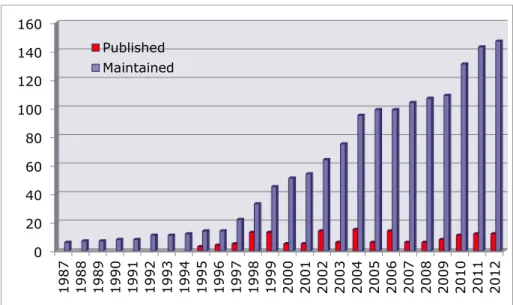
terms of reference for the ‘Standardization of processes, supporting tools and supporting technologies for the engineering of software products and systems’. In 2013 SC7 had 59 national standards body members. Figure 1 shows the number of standards published and maintained by SC7 since its inception.
Figure 1: ISO/IEC Software and Systems Engineering Standards
Motivation for ISO 29119
Unhappily, up until now there has been no definitive software testing standard. Consumers of
software testing services cannot simply look for the ‘badge of compliance’ and testers have no single source of good practice. There are many standards that touch upon software testing, but many of these standards overlap and contain what appear to be contradictory requirements with conflicts in definitions, processes and procedures. There are some useful IEEE testing standards (e.g. IEEE 829, IEEE 1028) and national standards (e.g. BS 7925-‐1/-‐2) but there are large gaps in the standardization of software testing, such as organizational-‐level testing, test management and non-‐functional testing, where no useful standards exist at all.
Given the current conflicts and gaps, it seems clear that the ideal solution would be to develop an integrated set of international software testing standards that provide far wider coverage of the testing discipline. And ideally this initiative would not re-‐invent the wheel, but build upon the best of the available standards; thus the motivation for the ISO/IEC/IEEE 29119 set of standards.
Overall structure of ISO 29119
The proposal for a new set of standards on software testing was approved by ISO in May 2007, to be based on existing IEEE and BSI standards (IEEE 829, IEEE 1008, BS 7925-‐1 and BS 7925-‐2). As no working group with software testing expertise existed within SC7 a new ‘Software Testing’ working
0 20 40 60 80 100 120 140 160 19 87 1988 19 89 19 90 19 91 19 92 19 93 19 94 19 95 19 96 19 97 19 98 19 99 2000 2001 20 02 20 03 20 04 20 05 20 06 20 07 20 08 20 09 20 10 20 11 20 12 Published Maintained
The initial proposal was for four parts; figure 2 shows how existing standards feed into parts 1 to 4 (IEEE 1008 is not shown as the working group could not find a use for it). Fairly soon after work on the first four parts started, ISO 33063 on process assessment (assessing against the test processes defined in Part 2) was created as a result of a separate proposal; this part is being jointly developed with ISO WG10 (Process Assessment) and WG26. Work on a separate standard on Keyword-‐Driven Testing has also recently started.
Figure 2: ISO/IEC 29119 Software and Systems Engineering Standards
The underlying model used as the basis for the new set of standards can be seen in Figure 2, and comprises four basic entities with the test processes forming the central core. The test documentation is produced as a result of executing the test processes, thus the test documentation describes the outputs of the test processes. The requirement to use techniques to perform the testing (e.g. designing test cases) is defined as part of the processes, while the actual techniques are defined separately. The terminology used by the other parts of this model is defined in the vocabulary.
Status of ISO 29119
Historically a typical ISO standard has taken over 7 years to publish, although the rules for completion have been tightened up in recent years to try and encourage faster publication. As an example, the framework ISO standard for software life cycle processes, ISO 12207, was conceived in 1988 and published in 1995 and represents 17,000 person hours of effort. BS 7925-‐1 & -‐2 took 8 years to develop, and the IEEE estimated in 1998 that it took 2-‐4 years to develop a standard, at a cost of between $2,000 and $10,000 per page.
Progress on the publication of the ISO/IEC 29119 set of standards has been slower than expected – but mainly from the perspective of SC7 as a whole, rather than from WG26 itself. The SC7 expectation was that as the ISO/IEC 29119 standards were based on pre-‐existing IEEE and British Standards (see figure 2), their development would largely be a re-‐badging exercise. WG26, on the other hand, knew from the start that the ‘core’ test processes standard would need to be developed from scratch as the donated standards only provided (conflicting) processes for unit testing, and no processes at any other level (so no organizational-‐level or management processes).
BS 7925-1
BS 7925-2 IEEE 829
Concepts & Vocabulary Part 1 Process Assessment Testing Techniques Part 4 Documentation Part 3 Part 2 Processes Keyword-Driven Testing Part 5 ISO/IEC 33063
As can be seen in Figure 3, the standards have been developed in several ‘tranches’. This was partly due to the lack of available editors to start working on all four initial parts at the same time. The ‘explosions’ at the start of the FIS stages represent full publication (and hopefully a party!).
Figure 3: Timelines for ISO/IEC 29119
The Approach to Testing in ISO 29119
Inclusive Standard
This new set of international standards are intended to be as inclusive as possible, thus the standards are generic, and able to support the testing in a wide variety of application domains and for varying levels of criticality. If safety-‐related regulatory standards require you to perform testing to reach a certain level of coverage then these new standards provide test processes to follow, and define the test design techniques and coverage measures you are required to use and achieve respectively. Conversely, the standards have also been written to ensure those using exploratory testing are not excluded from complying with the standards if they (or their customers) so wish. The standards are not specific to any particular life cycle, so are applicable to the testing on projects using sequential, iterative and agile approaches; for instance, Part 3 provides parallel examples for each document type for both sequential and agile projects.
Draft versions of the standards have been used by a range of businesses from the smallest to some of the largest multi-‐national organizations. This has provided excellent feedback to improve the drafts – and confidence that the approaches defined work in the real world.
May
10 May 11 May 12 May 13
…
Working Draft (WD) Committee Draft (CD)
Draft International Standard (DIS) Final Draft International Standard (FDIS) Final International Standard (FIS)
Parts 1, 2 & 3 Part 4 WD CD1 DIS FDIS WD CD1 DIS FDIS FIS!!! CD2 CD3 CD2 CD3 Part 5 CD4 DIS-2 ISO/IEC 33063 WD CD1 CD2 DIS FDIS WD CD
Risk-‐based testing & ISO 29119
When working on the development of new standards the inclusion of leading edge technology can act as a barrier to its adoption, and so care has been taken to avoid this in the new ISO/IEC/IEEE 29119 set. Some might argue that testing moves so slowly that there is little that could be described as leading edge. Probably the closest the new standards get to introducing controversial requirements for those seeking to claim compliance is in mandating the use of a risk-‐based approach to the testing. Risk-‐based testing (RBT) has been around in various forms for over 20 years, and accepted as a mainstream approach for over half that time, now being an integral part of popular certification schemes, such as ISTQB (with more than 250,000 ISTQB-‐qualified testers worldwide). Despite this, and the fact that RBT is not a complex approach in theory, it is still rare to see RBT being applied as successfully as it could be and many practitioners appear to be ‘blissfully’ ignorant of it.
When using RBT, risk analysis is used to identify and score risks, so that the perceived risks in the delivered system (and to the development of this system) can be prioritized and categorized. The prioritization is used to determine the order of testing (higher priority risks are addressed earlier), while the category of risk is used to decide the most appropriate forms of testing to perform (e.g. which test phases, test techniques, and test completion criteria to use). A valuable side-‐effect of using this approach is that at any point the risk of delivery can be simply communicated as the outstanding (untested) risks. The results of performing testing against perceived risks and also the evolving business situation will naturally change the risk landscape over time thus requiring RBT to be considered as an ongoing activity. As wide a range of stakeholders as possible should be involved in these activities to ensure that as many risks as possible are considered and their respective treatments (or not – we may decide to not address some risks) are agreed.
The application of RBT is not, however, applied in an effective manner on many of the projects that do use it. This is often due to the scope of RBT as applied being too narrow, by it not encompassing the higher levels of testing, such as in the organizational test strategy, and by it not being used as the basis for test planning that covers the whole life cycle. RBT can also fail to fulfil expectations when it is not integrated into the wider risk management practices within an organization, or when RBT is only used to address risks in the deliverable software rather than also considering the risks to the testing activities. These challenges can largely be addressed by the industry changing its perspective on RBT and widening its view. The new standard cannot, in itself, solve this problem as although it mandates RBT, it does not specify how RBT should be applied.
The new standard can, however, raise awareness of RBT within the testing community. Probably the biggest challenge to the effective use of RBT is the lack of maturity of test practitioners, and if the new standard forces recognition and the take-‐up of RBT by test practitioners it will strongly ‘encourage’ maturation in this respect.
ISO 29119 advocates a 'philosophy' of risk-‐based testing that permeates all the testing on a project -‐ the expectation is that testing decisions made at all levels (by managers and testers) are informed by knowledge of the current risk situation.
ISO/IEC/IEEE 29119 Parts
Part 1
Part 1 provides an introduction to the set of standards and includes the overall set of (consistent) definitions for all the other parts as well as describing the basic testing concepts on which the set of standards are built. This part (shown in figure 4) explains what the different parts of the standard include and how the standard can be used by those following different life cycle models.
Figure 4: ISO/IEC 29119 Part 1 – Concepts and Vocabulary
SOFTWARE TESTING CONCEPTS
Scope, Conformance, Normative References
TESTING IN DIFFERENT LIFE CYCLE MODELS
ROLES AND RESPONSIBILITIES IN TESTING
ANNEXES – Metrics, Examples, Bibliography
DEFINITIONS
Part 2
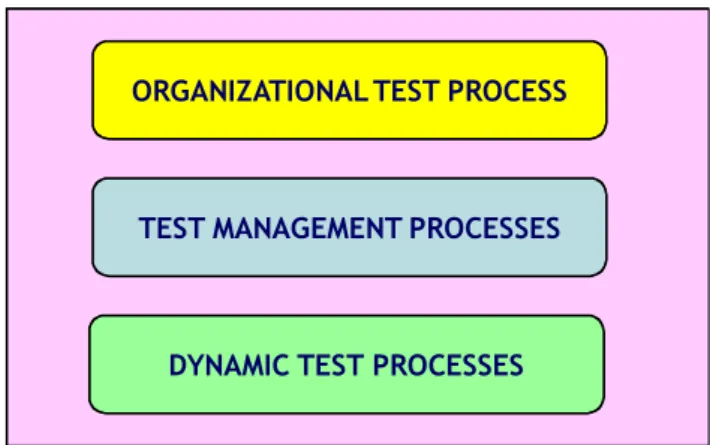
The processes in ISO/IEC/IEEE 29119 Part 2 are defined using a three layer model as shown in Figure 5.
Figure 5: ISO/IEC/IEEE 29119 Part 2 – Test Processes
Worthy of note is that the lowest layer is currently specifically defined as dynamic test processes, and so the overall model does not include any static test processes. This is because it was not possible to gain consensus within WG26 (or SC7) on the inclusion of static testing in this standard. This will be addressed in the next version.
Figure 6 provides an example of how these layers may be used in a relatively large and mature organization (mature enough to have an organizational test policy and large enough to make it worthwhile having an organizational test strategy).
Figure 6: Instantiating Test Processes
TEST MANAGEMENT PROCESSES ORGANIZATIONAL TEST PROCESS
DYNAMIC TEST PROCESSES
TEST MANAGEMENT PROCESSES ORGANIZATIONAL TEST PROCESS
Figure 6 shows the generic processes in part 2 of the standard being instantiated for use at different levels. The organizational test process is instantiated twice: once to develop and maintain the organizational test policy and once for the organizational test strategy. The test management processes are instantiated to develop and implement the project test plan, and also used for each subsequent phase or type of testing for which a separate test plan is created. Although test plans developed using ISO/IEC/IEEE 29119 are expected to include consideration of both static and dynamic testing the lowest layer of processes in ISO/IEC/IEEE 29119 is currently limited to dynamic testing. These dynamic test processes would be implemented whenever dynamic testing is required by a test plan (e.g. for unit testing, system testing, performance testing).
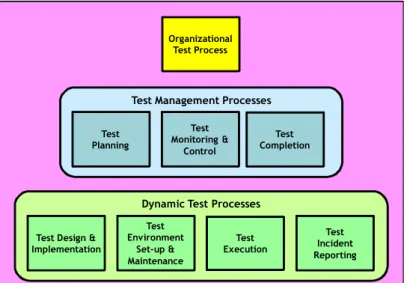
Figure 7: All eight ISO/IEC/IEEE 29119 Test Processes
Figure 7 shows the complete set of eight test processes defined in the standard. Each process is made up of a set of activities, and these activities comprise a set of specific tasks. Annex A contains descriptions of each of the processes showing all the activities, and an example of a typical textual description down to the level of the specific tasks.
Part 3
There is a strong link between Part 2 (test processes) and Part 3 (test documentation) of the set of standards. The outputs of the processes defined in Part 2 generally correspond to the test documentation defined in Part 3. As part 3 is a documentation standard, it must comply with the structure and format defined in ISO/IEC 15289 Content of life-‐cycle information products (Documentation) (ISO 2006) – hence what might appear an unusual structure to some.
The basic structure of Part 3 is shown in figure 8 – the annexes are expected to be of most use to actual practitioners – these provide examples of all defined test document types for both agile and traditional projects.
Dynamic Test Processes
Test Execution
Test Incident Reporting Test Design &
Implementation
Test Environment
Set-up & Maintenance
Test Management Processes
Test Monitoring & Control Test Completion Test Planning Organizational Test Process
Figure 8: ISO/IEC/IEEE 29119 Part 3 – Test Documentation
Part 3 provides templates with descriptions of the contents for each of the major test document types:
Organizational test documentation
• Test policy
• Test strategy
Project test documentation
• Project test plan
• Test project completion report
Test Level documentation
• Test plan
• Test specification
• Test results
• Anomaly reports
• Level test status report
• Test environment report
• Test level completion report
Appendices
• Examples of documents at each level of testing for both agile and traditional projects
The document names used in Part 3 are naturally consistent with the outputs described in Part 2, but there is no requirement for users of this standard to use the same document structure or the same naming (i.e. you can combine or break up documents described in the standard), as long as the required content is documented to the same level.
Part 4
Those users following Part 2 of the standard are required to produce test plans that include requirements for test case design techniques to be specified (and used) and test completion criteria to be achieved. Test case design techniques and corresponding coverage measures are defined in Part 4 of the standard. Each test case design technique is formally defined (in the normative part of
TEST DOCUMENTATION
ANNEXES - EXAMPLES
Scope, Conformance,
Normative References
the standard), but corresponding examples showing how the techniques could be applied are provided in the annexes.
Part 4 is shown in figure 9. It is closely based on BS 7925-‐2, so users of this standard will notice a close correspondence with Part 4. As with Part 3, the expectation is that most users will find the examples of using the techniques of more practical use than the (rather dry and technical) definitions of those techniques, and so an example of each defined technique is provided. A notable difference from BS 7925-‐2 is that an annexe on the testing of quality characteristics (i.e. non-‐functional testing) is also provided. This shows which of the defined test design techniques are appropriate for the testing of each of the quality characteristics defined in the ISO/IEC 25000 (SQuaRE) series of standards (ISO 2005).
Figure 9: ISO/IEC/IEEE 29119 Part 4 – Test Techniques
The current list of test case design techniques included in Part 4 is:
• Specification-‐based testing techniques
– boundary value analysis
– cause-‐effect graphing
– classification tree method
– combinatorial test techniques
– decision table testing
– equivalence partitioning
– error guessing
– random testing
– scenario testing
– state transition testing
– syntax testing
TEST COVERAGE MEASUREMENT
Scope, Conformance, Normative References
ANNEXE – TESTING OF QUALITY CHARACTERISTICS
ANNEXE – SELECTION OF TECHNIQUES
ANNEXE – TEST TECHNIQUE EFFECTIVENESS
TEST DESIGN TECHNIQUES
BLACK BOX WHITE BOX
• Structure-‐based testing techniques
– branch / decision testing
– branch condition testing
– branch condition combination testing
– data flow testing
– modified condition decision coverage (MCDC) testing
– statement testing
• Experience-‐based testing techniques
– error guessing
Part 5
Part 5 of ISO/IEC/IEEE 29119 covers Keyword-‐Driven Testing – it provides an introduction and a reference approach to implementing keyword-‐driven testing. It also defines requirements on frameworks for keyword-‐driven testing and minimum requirements for tools, which are necessary to fully utilize keyword-‐driven testing. Defined interfaces and a common data exchange format should ensure that tools from different vendors can exchange their data (e.g. test cases, test data and test results) and the standard will also define levels of keywords, and give advice on when to use hierarchical keywords, when to use flat structured keywords, and describe specific types of keywords (e.g. keywords for navigation or for checking something).
A working draft is currently available and development officially started on this part in early 2013, for publication in two or three year’s time.
ISO/IEC 33063
The standard on test process assessment is based on the Part 2 test processes and is progressing well. This standard is officially known as ISO/IEC 33063 as it was assigned to WG10 (Process Assessment). If you want a high level view of what this standard provides imagine an ISO standard along the lines of TMM, but based on an internationally-‐agreed set of test processes.
Conclusions
Given the high cost of testing and the maturity of the discipline it is somewhat surprising that a comprehensive set of testing standards is still unavailable. Apart from demand from the consumers of test services and test practitioners looking for a guide on good practice, there is also now a stated demand for a standard to act as a body of knowledge for test certification schemes. For many years safety-‐critical and/or application-‐specific software development standards have required forms of testing to be performed and various test completion criteria to be achieved, but there has been no definitive standards describing how this testing should be done, nor how test coverage should be measured. The new ISO/IEC/IEEE 29119 software testing standards should help to fill this gap. The new standards define good practice for testing at the organizational level (across multiple projects), at the management level (planning, monitoring and control, test completion), and for the processes for designing and performing dynamic testing. As well as the test processes (which mandate a risk-‐based approach to the testing), test documentation, test case design techniques and a testing vocabulary are all covered by these new standards. Additional standards are already under development in the form of a test process assessment standard and a keyword-‐driven testing standard.
The publication of the new ISO/IEC/IEEE 29119 set of software testing standards has now begun, providing the testing industry (and their customers) with an internationally agreed body of knowledge for the discipline. The testing standards provided as source documents from IEEE and BSI will subsequently be ‘retired’. These standards are the culmination of over 6 years’ work by a group of experts from over 20 countries.
References
1. BSI (1998a) BS 7925-‐1-‐1998, Software testing – vocabulary. BSI
2. BSI (1998b) BS 7925-‐2-‐1998 Software component testing. BSI
3. CENELEC (2001) EN 50128-‐2001 Railway applications – Software for railway control and protection
systems. CENELEC
4. IEC (1998) IEC 61508:1998 Functional safety of electrical/electronic/programmable electronic
safety-‐related systems. IEC
5. IEEE (2003) IEEE 1008-‐1987(R2003) Standard for software unit testing. IEEE
6. IEEE (2008) IEEE 829-‐2008 Standard for software test documentation. IEEE
7. ISO (2006) ISO/IEC 15289:2006 Content of life-‐cycle information products (Documentation). ISO
8. ISO (2010) ISO/IEC TR 24774 Guidelines for process description. ISO
9. ISO (2005) ISO/IEC 25000:2005, Software Engineering -‐-‐ Software product Quality Requirements
and Evaluation (SQuaRE) -‐-‐ Guide to SQuaRE
10.MISRA (1994) Development guidelines for vehicle based software. MISRA
11.MoD (1997) Def Stan 00-‐55 Requirements for safety-‐related software in defence equipment. Issue
2. Ministry of Defence
12.RTCA (1992) DO-‐178B Software considerations in airborne systems and equipment certification.
RTCA Inc.
Annex A – ISO/IEC/IEEE 29119 Part 2 -‐ Test Processes
Part 2 – Test Processes -‐ defines eight processes (as shown in figure 7): Organizational Test Process (just one process)
Test Management Processes
• Test Planning
• Test Monitoring & Control
• Test Completion
Dynamic Test Processes
• Test Design & Implementation
• Test Environment Set-‐Up & Maintenance
• Test Execution
• Test Incident reporting
Each of the eight processes is described in this annex.
Organizational Test Process
There is just one organizational test process and the activities of this process are shown in figure 10. It is used for the development and maintenance of organizational level test specifications, the most common of which are the test policy and organizational test strategy. Organizational level test specifications typically apply across a number of (if not all) projects in an organization, and so are not project-‐specific – they ensure that a consistent approach to testing is maintained across all projects. If the organization is large enough to run projects that are quite dissimilar (say in different programmes) there may be organizational test specifications that are specific to each programme.
Organizational Test Specification Develop Organizational Test Specification (OT1) Organizational Test Process
Inputs to activities in this process may include: • Views of primary
stakeholders; • Knowledge of the
current test practice s within the organization; and, where available: • Organization’s Mission Statement; • IT Policy; • IT Project Management Policy; • Quality Policy; • Organizational Test Policy; • Organizational Test Strategy; • Feedback on Test Specification; • Typical test plans from
the organization. Monitor and Control Use of Organizational Test Specification (OT2) Updated
Organizational Test Specification
Update Organizational Test Specification (OT3) Controlled Organizational Test Specification
A test policy defines the scope of testing, and describes the principles and high-‐level objectives expected of all testing within an organization. It is expected to be a high-‐level level document of only a couple of pages that is understandable by executives, and aligned with other executive level policies, such as the quality policy. The test policy provides guidance and constraints on the organizational test strategy and acts as a framework within which all the organization’s testing should be performed. An example of content from a test policy may be that ‘all testing should comply with the ISO/IEC/IEEE 29119 software testing standard’.
In contrast to the test policy, the organizational test strategy is a technical document that defines the expected practice of testing on all projects in the organization – and, as such, is expected to comprise many pages. It must be aligned to the test policy (assuming there is one) and defines a set of reusable testing guidelines that can be used as the basis for specific test plans by test managers, thus reducing the decision-‐making required at their level and ensuring consistency across projects. Example content of an organizational test strategy may be that ‘an exit criterion for unit testing should be that 100% statement coverage is achieved’.
Test Management Processes
There are three test management processes, as shown in Figure 11. These processes are used to manage lower level testing processes on a specific project, such as dynamic testing (as shown), static testing (not shown as currently not part of the standard) and lower level test management. When the test management processes are used at the project level and the project is large enough, then this project test plan may require test plans to be generated and implemented for individual test phases (e.g. system testing, acceptance testing) or specific test types (e.g. performance testing, usability testing).
Figure 11: ISO/IEC/IEEE 29119 Test Management Processes
ORGANIZATIONAL TEST PROCESS
TEST MANAGEMENT PROCESSES
TEST PLANNING TEST MONITORING & CONTROL TEST COMPLETION ORGANIZATIONAL TEST DOCUMENTATION FEEDBACK ON ORGANIZATIONAL TEST DOCUMENTATION
TEST PLAN UPDATES
TEST PLAN TEST COMPLETION REPORT DYNAMIC TEST PROCESSES TEST MANAGEMENT PROCESSES TEST PLAN, TEST COMPLETION REPORT, TEST MEASURES TEST MEASURES TEST PLAN, CONTROL DIRECTIVES TEST PLAN, CONTROL DIRECTIVES
While performing these test management processes, any constraints or guidelines provided by the test policy or the organizational test strategy should be complied with, unless there is a good reason to deviate, in which case any deviation should be agreed and documented.
One of the major outputs of these test management processes is the test plan, which is used as the basis of the actual testing performed. Figure 12 shows the activities that generate the test plan. The figure is (necessarily) a simplified view of the process and although a simple linear flow is shown, in practice a considerable amount of iteration between activities would be expected to occur. For instance, as the test strategy is designed (in ‘Design Test Strategy’), new risks are uncovered or old risks changed, and staffing and scheduling constraints discovered in ‘Determine Staffing and Scheduling’. As can be seen in the activities for identifying, analysing and mitigating risks, the standard mandates a risk-‐based approach to testing; it does not, however, specify the mechanism for performing the risk analysis. In a safety-‐related application it could be appropriate to use integrity levels derived from perceived risks, while in less critical applications it would also be possible for the test manager to make subjective judgements based on simply asserted levels of risk.
Figure 12: ISO/IEC/IEEE 29119 Test Planning Process
One of the most important test planning activities is ‘Design Test Strategy’, where decisions such as which features are to be tested and which test phases, test techniques and test completion criteria are to be used are made. The ‘test strategy’ at this level is being derived as part of the test plan, and is quite different from the organizational test strategy. The organizational test strategy provides generic guidelines to how testing should be performed across a number of projects, whereas the test strategy that forms part of the test plan defines the specific testing to be performed on this project. Note, however, that the test strategy in the test plan should normally align with the guidelines and constraints provided in the organizational test strategy, and so there should necessarily be similarities. Organise Test Plan Development Identify & Analyse Risks Design Test Strategy Determine Staffing and Scheduling Document Test Plan Schedule, Staffing Profile Test Strategy Analyzed Risks Scope Identify Risk Mitigation Approaches Gain Consensus on Test Plan Approved Test Plan Draft Test Plan Test Plan Publish Test Plan Understand Context Treatment Approaches
Dynamic Test Processes
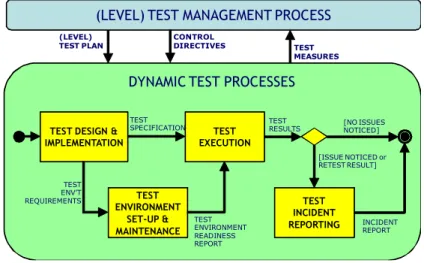
Figure 13 shows the four dynamic test processes. It should be noted that if static testing was also part of the standard, two of the processes (‘Test Environment Set-‐Up’ and ‘Test Incident Reporting’) could be shared between static and dynamic testing as both static and dynamic testing require a test environment and both also require incidents to be analysed and subsequently reported, as necessary.
Figure 13: ISO/IEC/IEEE 29119 Dynamic Test Processes
The dynamic test activities are driven by the test plan, organizational test strategy, and test policy. For instance, the test plan could specify what features are to be tested, the organizational test strategy could specify that a certain test completion criterion is to be achieved, and the test policy could specify that incident reporting is to follow a defined organization-‐wide incident management process.
Objectives specified in the test plan are used to identify test measures, which are used to determine how closely the actual testing is following the plan. The definition of these measures, the activity of comparing against the plan, and deciding on suitable responses (these appear as ‘control directives’ in figures 6, 11 and 13) are performed in the ‘Test Monitoring and Control’ process.
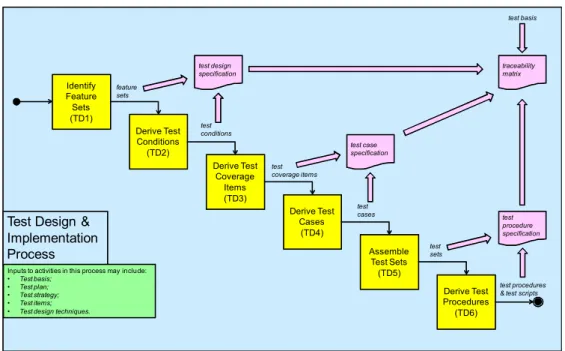
The ‘Test Design and Implementation’ Process, shown in Figure 14, requires test cases to be created to cover test coverage items, which are derived, in turn, from applying a test case design technique to the test conditions for those features that are to be tested. An example using the boundary value analysis technique would see boundaries identified as the test conditions and test coverage items could correspond to the value on the actual boundary and values an incremental ‘distance’ either side of it. For instance, in an exam grading program the boundary between pass and fail, say 65%, would be identified as one test condition (of several). Subsequently, assuming the use of integers, the values 64%, 65% and 66% would be derived as the test coverage items. Then test cases would be derived to ensure all three test coverage items were exercised by tests (and these test cases would also include expected results).
Test cases may be grouped into test sets (perhaps based on whether they are to be executed using manual or automated test execution) and then the test cases in the test sets are typically ordered into test procedures based on dependencies between the test cases.
DYNAMIC TEST PROCESSES
TEST
SPECIFICATION [NO ISSUESNOTICED]
TEST ENVIRONMENT READINESS REPORT TEST ENV’T REQUIREMENTS INCIDENT REPORT
TEST DESIGN & IMPLEMENTATION TEST ENVIRONMENT SET-UP & MAINTENANCE TEST EXECUTION TEST INCIDENT REPORTING
(LEVEL) TEST MANAGEMENT PROCESS
[ISSUE NOTICED or RETEST RESULT] TEST RESULTS CONTROL DIRECTIVES TEST MEASURES (LEVEL) TEST PLAN
A requirement of the standard, also shown in Figure 14, is that the traceability through this process should be documented, so that it is possible to link the test procedures all the way back to the original test basis (requirement).
Figure 14: ISO/IEC/IEEE 29119 Test Design & Implementation Process
Process descriptions
Each of the eight processes included in the Part 2 standard is described using the format for process descriptions defined in ISO/IEC TR 24774 Guidelines for process description (ISO 2010) – this is an ISO rule. This ISO technical report states that a process should be described in terms of:
• Title • Purpose • Outcomes • Activities • Tasks • Information items
It is noteworthy that this structure includes no description of who performs the activities and no process inputs (the ‘information items’ correspond to the process outputs). Note that the ISO guidelines on process description also provide many rules on the necessary wording and content. On the following pages is an example of a process description (for the Test Environment Set-‐Up & Maintenance Process). It is incomplete as the figure showing interactions between the activities has been removed, but it should provide an indication of the level of detail in the ISO/IEC/IEEE 29119 Test Processes standard. Note that this process was selected as it was the smallest of the process
Test Design & Implementation Process Identify Feature Sets (TD1) Derive Test Coverage Items (TD3) Assemble Test Sets (TD5) Derive Test Procedures (TD6) Derive Test Conditions (TD2) test cases test sets test conditions Derive Test Cases (TD4) test coverage items test procedures & test scripts
Inputs to activities in this process may include: • Test basis;
• Test plan;
• Test strategy;
• Test items;
• Test design techniques. feature sets test design specification test procedure specification test case specification traceability matrix test basis
Test Environment Set-‐Up & Maintenance Process
Overview
The Test Environment Set-‐Up & Maintenance Process is used to establish and maintain the
environment in which tests are executed. Maintenance of the test environment may involve changes based on the results of previous tests. Where change and configuration management processes exist, changes to the test environments may be managed using these processes.
The requirements for a test environment will initially be described in the Test Plan, but the detailed
composition of the test environment will normally only become clear once the Test Design &
Implementation Process has started.
Purpose
The purpose of the Test Environment Set-‐Up & Maintenance Process is to establish and maintain the
required test environment and to communicate its status to all relevant stakeholders.
Outcomes
As a result of the successful implementation of the Test Environment Set-‐Up & Maintenance Process:
a) The test environment is set-‐up in a state ready for testing;
b) The status of the test environment is communicated to all relevant stakeholders;
c) The test environment is maintained.
Activities and tasks
The person(s) responsible for test environment set-‐up and maintenance (such as IT support technicians) shall implement the following activities and tasks in accordance with applicable
organization policies and procedures with respect to the Test Environment Set-‐Up & Maintenance
Process.
Establish Test Environment (ES1)
This activity consists of the following tasks:
a) Based on the Test Plan, the detailed requirements generated as a result of the Test Design &
Implementation Process, the requirement for test tools, and the scale/ formality of the testing, the following shall be performed:
1) Plan the set-‐up of the test environment (e.g. requirements, interfaces, schedules and costs);
2) Design the test environment:
4) Implement the test environment (hardware and software, as appropriate);
5) Set up test data to support the testing (where appropriate);
6) Set up test tools to support the testing (where appropriate);
7) Install and configure the test item on the test environment;
8) Verify that the test environment meets the test environment requirements; and
9) Where required, certify the test environment.
b) The status of the test environment shall be communicated through the Test Environment
Readiness report to the relevant stakeholders, such as the testers and the test manager. This shall include a description of the known differences between the test environment and the operational environment.
Maintain Test Environment (ES2)
This activity consists of the following tasks:
a) The test environment shall be maintained as per the test environment requirements.
NOTE This could require making changes based on the results of previous tests.
b) Changes to the status of the test environment shall be communicated to the relevant
stakeholders.
EXAMPLE The testers and the test manager.
Information Items
As a result of carrying out this process, the following information items shall be produced:
a) Test Environment;
b) Test Data;
c) Test Environment Readiness Report;
d) Test Data Readiness Report;
e) Test Environment Updates (where applicable);
Testing Solutions Group
The Software Testing Experts
TSG, the innovative Testing Consultancy that works with you to solve specific
problems that help you achieve your corporate objectives and maximize return on
your investment.
Consultancy
• To deliver and measure the frameworks and methods for developing and testing systems
Managed Services
• Reduce the risk of systems failure and increase business satisfaction with fully managed test
teams, providing skills at the right time
Recruitment
• Specialist test resources for interim contracts or permanent roles
Training
• ISTQB and Agile Certification courses, specialist training courses including; Non Functional,
Practical Test Management, User Acceptance, Risk Based Testing & Agile Testing