Baseball and Mathematics
by
Marvin L. Bittinger
It [baseball] breaks your heart. It is designed to break your heart. The game begins in the spring when everything else begins again, and it blossoms in the summer, filling the afternoons and evenings, and then as soon as the chill rains come, it stops and leaves you to face the fall alone.
—A. BARTLETT GIAMATTI, - former commissioner of Major League Baseball
INTRODUCTION
There are number of things in life that I love dearly, but I’d say the top five are:
!1.! My wife and family
!2.! Mathematics
!3.! Baseball (Cincinnati Reds)
!4.! Hiking in Moab, Utah
!5.! Softball (Arizona State University Women’s Team)
My wife agrees with the list, but not necessarily the order, wondering if baseball is really number 1. In truth, I can walk out onto a baseball/softball field amid the red dirt, the white chalk lines, and the freshly mown grass, and just feel the goodness of life. The thought quickly comes to mind,
“Where are the guys? Let’s have a game!” I am not a great, not even a good, player but my passion for the game is great!
Dusty Baker, as Manager of the Cincinnati Reds
Photo Courtesy, Joe Robbins/Brian Spurlock Photography
Upon seeing his picture, you are probably asking how does this math textbook author connect with Dusty Baker, the former manager of the San Francisco Giants, Chicago Cubs, and present manager of the Cincinnati Reds? And what does his picture have to do with mathematics? The answer to these questions is a fantasy come true for your author. It is a bizarre story that springs from my love of both baseball and mathematics.
I grew up in a neighborhood with numerous empty lots. We spent most of our summer days on those lots playing basebball from morning to night. We used any kind of ball we could find—new, taped, hardball, or softball; and any kind of bat, mostly filled with glue and nails and covered with tape. It saddens me now when I drive by a school yard near my house and see two beautiful ballfields and backstops that are rarely used. How my baseball buddies and I would have loved to play on those fields! As most of my friends and family will tell you, I love to eat. But, when my
grandmother, a tremendous cook, would call me to come home for dinner and we were playing baseball, I never wanted to go.
I love to ask the following question, “Can you name two people who were ever cut from a Little League baseball team?” Ironically, I know two such guys. One is my dear friend and present manager of the Cincinnati Reds, Dusty Baker, cut by his father three times because he had a bad attitude. The other was yours truly at the age of 12 for lack of playing
ability. Little League was organized late in my hometown, Akron, Ohio. Compared to other cities, there were only a few teams with too many kids to fill them. So, they held tryouts. I went to a tryout with great
expectations, only to be cut—a devastating experience to a 12-year-old boy who just loved to play ball. In my mind, my baseball days were over. For the next 20 years, my baseball involvement was limited to attending Cleveland Indians games and listening to Jimmy Dudley broadcast the games on WAKR.
My early memories of TV were rooting for the Brooklyn Dodgers to beat the hated New York Yankees in the World Series. I detested the Yankees because, other than in 1954, my Indians placed second to them every year. I remember all too well watching the Indians play the Giants in the 1954 World Series. I know right where I was sitting when my heart was torn out as Willie Mays made that incredible catch in centerfield off the bat of Vic Wertz. What 13-year-old kid sitting in front of the TV set would have dreamed that someday he would write a book with the manager of those same Giants, and actually shake the hand of Willie Mays? Not me, not me, NOT ME!!
Each of us goes through the process of discerning our strengths and weaknesses. I realized very early in life that poor vision and limited athletic ability was going to prevent being a professional baseball player. I moved on to academic pursuits, where I seemed to have more God-given talents. But at the age of 32, when I had my education completed and my
profession as a math educator well under way, I started playing and coaching some slow-pitch softball teams.
Willie Mays making that catch in the 1954 World Series.
Some years later I came to know Barton (Bart) L. Kaufman. Bart was an outstanding athlete, playing outfield for Indiana University. In 1961 he finished second in the Big Ten batting title race, first place going to Bill Freehan, who later caught for the Detroit Tigers. Bart could hit, and he still can. He calls me “Right-hander” from our days playing softball together.
Bart was recommended to me as a financial advisor around 1975. I was drawn to him because of his tremendous intelligence, outstanding
character, and knowledge of life insurance and estate planning. But I must admit the crowning part of my decision to work with him was his passion for sports and especially the Cincinnati Reds. Our relationship through the years has evolved from business acquaintances to very close friends. It would take another chapter in this book to relate all the contributions Bart has made to my life; suffice it to say they approach infinity as a limit.
Bart’s father, wanting to give him every advantage, sent his teenage son to summer instructional camp at the Dodgers spring training complex in Vero Beach, Florida. At that same complex, in the mid-eighties, the Dodgers started their Adult Baseball Fantasy Camps, offered to anyone at least 30 years old who is willing to pay the admission. Campers went to the Vero Beach spring training site, Dodgertown, took instruction and played a
inning baseball game every day for a week. They slept in the same beds as the Dodger players and ate the same food. The camps were coached by former Dodger stars such as Carl Erskine, Reggie Smith, Steve Garvey, Jerry Ruess, Jeff Torborg, and Tommy Davis.
Bart attended these camps and, knowing my love of the game, urged, if not begged, me to attend with him. But I continually refused, explaining that I had only one good eye (the other is what used to be called a “lazy eye” so I have no depth perception) and that I was so lacking in talent that I got cut in Little League. However, after he told me Jane Fonda attended one year and that he needed a roommate, I finally went in 1989. I loved it so much that I have ended up going to 25 adult baseball fantasy camps with the Dodgers, Giants, and most recently the Reds.
Dodger Camp at Dodgertown in Vero Beach, FL, was truly baseball heaven. We usually had instruction in the mornings and played a nine-inning baseball game in the afternoons. In the evenings we met together for dinner and awards, and were regaled with war stories from the former players. At the end of the week, the campers played a game against the former players—they slaughtered us, but that makes for more good stories. I will always remember getting base hits off Jerry Reuss and Ron
Perranoski. I also faced the great Hall-of-Famer, Bob Gibson, who struck me out. With each pitch I was scared to death that I might get hit and die! He actually just lobbed up the pitches, but that did not relieve my fears.
It was my first time at camp in the fall of 1989 when I met Dusty Baker, a former Dodgers star, who was then batting coach for the San Francisco Giants. Dusty gave me two 45-minute hitting lessons. What a thrill for a poor-vision guy who got cut from Little League!
I had a great time and became obsessed with these camps, looking forward to them each year with a goal of improving my hitting skills. When I was looking for batting lessons one year I met Jeff Mercer, former assistant coach at Indiana University, who was running an indoor baseball
facility here in Indianapolis. Jeff was an exceptional instructor and was willing to help an old guy with one eye and poor athletic ability. When he learned that I was an author, Jeff told me he had always wanted to write a book on hitting and asked how he might go about it. Believe me, I have had many discussions with people who want to write; I usually suggest they write an outline, a proposal, and maybe a sample chapter and show them to me. Most of the time, the idea blows into the wind. But that wasn’t true in Jeff’s case; he came back to me two weeks later with an outline and a sample chapter—and it was good!
! ! ! ! ! !
You Can Teach Hitting
I was determined to get this book published but felt we needed someone with a national baseball reputation as a co-author. So I contacted Dusty Baker and met him for lunch in Cincinnati when the Giants were in town playing the Reds. He liked the idea of writing a book and producing a set of instructional videos, and later a CD-ROM. These led most recently to an enhanced ebook on the skill of hitting a baseball, by Dusty Baker, Marv Bittinger, & Jeff Mercer:
Dusty Baker’s Hitting Handbook. For more information visit the iTunes bookstore or www.hitthandbook.com.
A college baseball coach, Jeff Mercer, a professional baseball manager, Dusty Baker, and a math textbook author, Marv Bittinger, ready to play ball! No matter the job, they possess the same love of the game.
By now you are probably wondering how all the preceding leads to math and baseball. At the end of our lunch, when it was time for Dusty to go to the ballpark, he mentioned that since we were going to write a book together, I could go to the park with him and go into the locker room. Then my adrenaline started flowing like never before in my life, other than when I got married—I was going to the San Francisco Giants locker room!
entrance, and went into the locker room with Will Clark, Matt Williams, Kevin Mitchell, Robby Thompson, and all the other players. Wow! Dusty introduced me to some people at a table nearby and I sat down with Wendell Kim, third base coach, Bob Lillis, bench coach for then-manager Roger Craig, and Syd Thrift, who was employed at that time as a
consultant to the Giants.
Syd Thrift may not be a familiar name but with Barry Shapiro he wrote a book The Game According to Syd (See the REFERENCES at the end). When he was general Manager of the Pittsburgh Pirates, Syd studied scientific ways his teams could get an edge on the competition.
Dr. John Nash Ott was a team consultant to the Pirates. Ott was an expert on environmental health and light research. Ott found that light influences the pituitary gland, which controls the endocrine system, which in turn governs the production and release of body hormones, which
control body chemistry. Ott also discovered that a player’s performance will improve if the underside of the bill of the baseball cap is gray instead of green. There came a time when most Major League Baseball teams adopted the use of gray under the bills of their caps.
Another edge was Syd’s knowledge that a four-seam fastball is 4 mph faster than a two-seam fastball. This doesn’t mean that the hide of a baseball is sewn differently, or that you can go to a sporting goods store and buy ball with two seams or one with four seams. Rather, it refers to the placement of the pitcher’s fingers on the ball in relation to the ball’s
stitches.
Three of Dusty Baker’s baseball cards: with the Dodgers, Giants, & Athletics.
Not being sure how to start a conversation with these men, I said to Syd, “I read in your book that the four-seam fastball is 4 mph faster than the two-seam fastball.” Syd’s eyes lit up and he asked me, distance-wise, how much faster did one ball get to the plate over the other? I was so excited to be in that locker room that (for once) I did not want to do math. I tried to escape the issue by asserting that I needed a calculator. But right away Bob Lillis handed me the calculator-organizer in which he kept his scouting data. I finally got the answer: The two-seam fastball comes in 30 inches behind the four-seam fastball. (We do the math later.)
This was the first of my baseball and mathematics applications. Through all the subsequent time I spent with Dusty and his players, many other applications cropped up. Believe me, major-league players do math in the dugout! These ideas formed the basis of a math talk that I give at many mathematics education conventions and culminates with this article. We begin with one of those applications as follows.
A very elementary application concerns the strike zone.
The strike zone is an area of about 17 in. by 40 in., depending on the height of the hitter. What is the effect on its area of adding a 2-inch border to the zone?
The inside, or actual, area is
(17 in.)(40 in.) = 680 in.2.
When the 2 in. is added, we get a new outside zone,
21 in. by 44 in. The new area is
(21 in.)(44 in.) = 924 in.2
The new area has been increased by 924 in.2 – 680 in.2, or 244 in.2
Thus, there is an increase of
How is this relevant to a major league hitter? I once heard Ted Williams being interviewed by Bob Costas on a radio program. Williams mentioned a theory that he had developed on his own but checked with other baseball players and several umpires: “When a major league hitter swings and misses on strike three, 70% to 80% of the time the pitch is out of the strike zone.” I checked with Dusty and he agreed with Williams. In connection with the 2 inches added to the strike zone, the hitter may be allowing the pitcher 36% more area to pitch to. A pitcher and the hitter should be aware of this change. It supports a new baseball theory: “Give a pitcher 36% and he will strike you out!”
EXERCISES
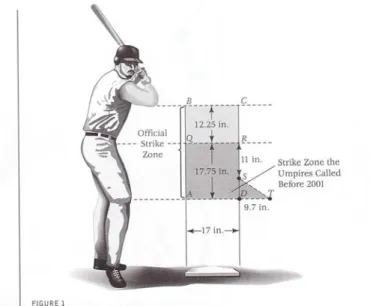
Baseball’s Strike Zones. Major league rules define the true strike zone to be the rectangle ABCD shown in Figure 1—knees to name between the sides of the plate. Somehow, prior to 2001, the strike zone had evolved to a diminished region, AQRST. In 2001 the major leagues mandated that the umpires return to enforcing the true strike zone. Figure 1 represents the zones for a normal-sized player. The height changes with the height of the player.
1." Find the area of the true strike zone, ABCD. 2.! Find the area of the altered strike zone, AQRST.
3.! How much larger is the true strike zone than the altered strike zone? 4.! By what percentage had the area of the strike zone ABCD been diminished when it evolved to AQRST?
FIGURE 1 The strike zone according to major league rules.
FOUR SEAMS VS. TWO SEAMS
Here we solve the four seams vs. two seams problem as posed to me in the Giants locker room. According to the results of Thrift’s studies, the four-seam fastball travels 4 mph faster than the two-seam fastball. But how much faster, distance-wise, does a four-seam fastball get to the plate than a two-seam fastball? We start by trying to understand the difference between
the two kinds of pitches. The answers lie with the seams and the grips.
Four-Seam Fastball
In Figure 2A, we see how the forefinger and middle finger are placed on the baseball in order to throw a four-seam fastball. The ball is thrown
toward the batter as if the hand is pointing toward the hitter. The pitch is released with backspin. With this grip imagine two horizontal seams on
this side of the ball and two on the side we can’t see. When the ball rotates with its backspin, each rotation creates “four
seams.” See Figure 2B. Thus, we call this a four-seam fastball. To further understand hold a
baseball as shown in Figure 2A, and imagine rolling it off the tips of your fingers with backspin toward the hitter.
FIGURE 2 The four-seam fastball grip: A. Position of fingers. B. Position of seams.
Two-Seam Fastball
In Figure 3A we see how a two-seam fastball is gripped. But, now only two horizontal seams go against the wind with the backspin; hence, the term for such a pitch is “two-seam” fastball. See Figure 3B. The four-seam grip is compared to the two-seam grip in Figure 4.
FIGURE 3 The two-seam fastball grip: A. The grip. B. Position of seams.
Why does one ball travel faster than the other? The simplest answer comes by proving it through repetitive testing with throwing machines. But let us try to examine the situation using some physics. Look at the
drawings in Figure 5. When the balls are thrown, a turbulent wake is created behind each ball. The wake from a four-seam pitch is greater than the wake from a two-seam pitch. One conclusion we can draw is that the wake tends to create a molecular “push,” causing the ball with more wake, or push, to go faster. In my limited knowledge of physics, I think of the seams creating a vacuum around the ball. There is more vacuum with the four-seam fastball than with the two-seam fastball. Thus, the four-seam fastball goes faster.
FIGURE 5
Airflow over a fastball: A. Four-seam fastball. B. Two-seam fastball. C. No seams.
If we had no seams on the ball, as in Figure 5C, the air would be right up against the ball, causing more friction and making it travel slower. This idea is corroborated by the Professional Golfer’s Association: A golf ball that goes 260 yd with dimples, which act like seams causing turbulence, would travel only 150 yd if it had no dimples. According to Adair, if you had a hundred highly qualified physicists in one room, you could not get
them to agree on the theoretical reason why one ball travels faster. Thus, the “proof is in the pudding,” so to speak, by doing the repetitive testing with a throwing machine.
Now let’s look at the mathematics and solve the problem. Major league fastballs travel anywhere from 85 mph to 105 mph. Suppose a ball thrown with a two-seam grip travels at a speed of 86 mph. If the same ball is
thrown with a four-seam grip, it will travel 90 mph: Two-seam: 86 mph Four-seam: 90 mph
The pitcher’s rubber is 60 ft, 6 in. from home plate. When a pitcher delivers the ball, he normally leans toward the plate, shortening the distance the ball travels to about 56 ft because it does not actually leave the pitcher’s hand until he drives his body off the mound toward the hitter. At 90 mph, how long does it take, in seconds, for the pitch to reach the plate? We use the distance formula, substituting 56 ft for distance, d, and 90 mph for the speed, or rate, r:
Next we solve for t, in seconds, by multiplying on both sides by 1 hr
90 mi, and
convert the result to seconds by making the appropriate unit conversions: 56 ft = (90 mi hr)!t 56 f/t ! 1 hr 90 mi! 1 mi 5380 ft ! 60 min 1 hr ! 60 sec 1 min = t Simplifying, we get
t
=
0.424242...
!
0.42 sec
.
Thus, the four-seam fastball travels 56 ft, or 672 in., in 0.42 seconds. The two-seam travels how far in 0.42 sec? To find out, we use the distance formula and substitute for r, and 0.4242 for t. Then we make unit changes to get the distance in inches.
Subtracting the two-seam distance, 642.07 in., from the four-seam distance, 672 in., we see that the two-seam fastball is about 30 in. behind the four-seam fastball. These computations confirm the result I determined in the
Giants locker room in Cincinnati, though I must admit that I was cautious about my calculations at the time.
Why were these coaches so interested in the answer to the question? Getting
“jammed,” meaning not getting the bat off your shoulder or barely starting a swing, is the ultimate embarrassment to a batter. Of course, a pitcher loves to “jam” a batter in this way. The 30 inches can mean all the difference in the world to a hitter and a pitcher. Evidence of this comes from the Red’s, Aroldis Chapman, the “Cuban
Missile,” who can throw pitches above 100 mph. Comparing 100 mph to 90 mph,
means 5 intervals of 30 in. each in distance, or a
Marvin L. Bittinger
Aroldis Chapman pitching the Cincinnati Reds
whopping 6 ft in swing distance between the two pitches. No wonder he is such a feared pitcher.
There are two sidelights to this rather simple application of
mathematics. One occurred when I saw Bob Lillis, then Dusty’s bench coach, at a Giants game a year or two after that initial locker-room challenge. He again asked and I confirmed the 30-inch difference.
Sometime later I also shared this information with Tom Beyers, then minor batting coach for the Los Angeles Dodgers, and Dave Wallace, who was the pitching coach for the major league Dodgers and later became the pitching coach for the Boston Red Sox. Both were fascinated with the results.
EXERCISES
!1.! Consider: Four-seam: 86 mph; two-seam: 82 mph.
! ! How much faster, distance-wise, does the four-seam fastball get to home plate than the two-seam fastball?
!2.! Consider: Four-seam: 94 mph; two-seam: 90 mph.
! ! How much faster, distance-wise, does the four-seam fastball get to home plate than the two-seam fastball?
!3.! Compare your results from item 2 with what we found in this section. Does it matter what speed we start with on the four-seam
fastball?
!4.! Once at a Reds game in Cincinnati Dusty allowed me to be on the field for batting practice. The coaches typically throw batting
practice to the players, but at slower speeds than most active major league pitchers. This is because the coaches are older and many were not pitchers in their playing days. To compensate for their slowness, teams move the pitching rubber 10 ft closer to the plate to a distance of about 50 ft, 6 in., the goal being to emulate the faster pitches they see in real games. Wendell Kim, one of Dusty’s coaches at the time,
told me he estimated that he threw 55-mph pitches to the players in batting practice.
a. From 46 ft, the release point of Kim’s pitches, estimate the time for Kim’s pitches to cross the plate.
b. What amount of time does it take for a 90-mph pitch to reach the plate from the standard 60 ft, 6 in.?
c. How should the 50 ft, 6 in. distance for the batting-practice pitching rubber be changed so the time for a 55-mph pitch to cross the plate is the same as that for a 90-mph pitch?
Note the location of the batting practice pitcher.
TALE OF THE TAPE
Recall that I seem to be a cat on the prowl for applications of
mathematics. Well, I found yet another when I was attending a baseball game in Cincinnati. After a player had hit a home run into the stands over the 375-ft sign, an announcement ran across the scoreboard saying, “IBM Tale of the Tape—the ball would have traveled 415 ft had the ball not hit the stands.” The subtle implication was that there was some kind of computerized method of making these calculations. As it turns out, the method was rather simple, involving some linear formulas.
How did I find out? Well, my co-author, Judy Beecher, asserts that it takes about ten phone calls to get to the root of an application and we are
never afraid to make phone calls. I called IBM in Armonk, New York, and was quickly put in touch with John J. McMahon, then Manager of
Corporate Promotions. He sent me a copy of a letter that had been sent to Roger Angell, noted baseball author, who was then associated with New Yorker Magazine. That letter and a subsequent conversation with its author, Robert K. Adair, gave me most of the answers to the question.
The Mathematics Behind the Tale of the Tape
In Figure 6, we see the trajectories of a well-hit baseball. Such a ball has
backspin, which tends to make the trajectory look like a parabola, which is skewed away from home plate.
FIGURE 6
Trajectories of well-hit baseballs.
It should be emphasized that the trajectory, or flight, of a well- hit baseball (or golf ball) is not modeled by a parabola such as
!
h
(
t
)
=
−
1
2
gt
2+
(
v
0sinα
)
t
+
h
0develop the equations of the flight of a baseball; we will just consider Adair’s results.
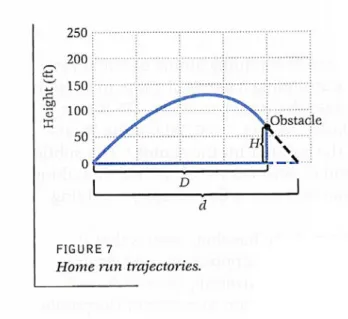
Look at Figure 7. Note the flight of the ball. It hits an obstacle at a point, where the horizontal
distance from home plate to where the ball is obstructed, and the
vertical distance from the ground to where the ball is obstructed. We want to estimate the distance, d, that the ball would have traveled had it not been obstructed. We do so with the following linear
formula, which was developed by Adair.
FIGURE 7 Home run trajectories.
IBM Estimate of Distance! ! ! ! ! ! ! !
where
D = horizontal distance, in feet, of the ball when obstructed, H = vertical height, in feet, of the ball when obstructed,
d = estimated distance, in feet, ball would have traveled had it not been obstructed. Error: ±10 ft, and
k = constant determined by the trajectory of ball.
We use three values of k, determined by the type of trajectory of the ball. See Figure 8. We make a judgment of the type of trajectory based on the
launch angle of the ball when hit. This gives an estimate for k.
FIGURE 8 Home run trajectories.
Distance Predictors! ! ! !
Suppose D = 400 ft and H = 60 ft. Then, using distance predictors, the estimated distances would be
Admittedly, deciding how to classify the trajectory of a home run ball requires an instant decision. Adair said, “If in doubt, take 70% of the height H and add it to D.” In this way, you can guess the Tale of the Tape from your seat. Once after discovering this formula, during a Reds–Dodgers playoff, I did this after a home run and estimated the answer before it was given later on the scoreboard. People around me couldn’t believe it. You can do this as well! And, yes, this certainly was a great fun.
Mantle’Griffith Stadium Blast
There is an enduring grand story of a towering home run ball off the bat of Mickey Mantle in old Griffith Stadium in Washington, D.C. The ball hit a 40-ft high beer sign 460 ft from home plate. Our estimate would be that it would have traveled 480 feet. But the press blew the home run out of proportion, announcing that it would have traveled 565 feet. According to Adair, with a 20 to 40 mph tailwind, it could have traveled no farther than 511 feet.
Standard Conditions and the Distance of a Batted Ball
Adair thinks that under standard conditions—70° temperatures, sea-level altitude, and no wind—450 ft is about the limit a normal man can hit a baseball. Of course a world-class weight lifter (say 6’8”, 300 lb; built like Arnold Schwarzenegger) with catlike speed, taking two steps at the plate, using a 42”, 56 oz bat, might be able to hit a batting-practice baseball more then 500 ft. In reality, though, if such a baseball player ever took two steps at the plate, the next pitch might be at his head because no pitcher would tolerate the insult of a hitter taking the extra step.
The Rest of the Story
The question remained in my mind: What actually happens at the
stadium when they announce the Tale of the Tape? I got the answer when I visited Dusty Baker after he became manager of the Giants. We were at Coors Field in Denver, home of the Colorado Rockies. I was given a press pass by the Giants. This allowed me to roam the ballpark at will, which I did with great joy. I ended up in the press box, where I watched players hitting homers. I decided to track down the source of announced “Tales of the Tape.” What really happens is that the announcer is given a chart of the ballpark that lists the predicted lengths of home runs. He watches where the home runs go, checks the chart, and makes an announcement. To my chagrin, no computer enters the picture at the time of the home run and I am sure the trajectory of the ball was not considered. Oh well, such is the nature of marketing.
Mickey, Billy and the Cows. I love baseball stories. One of my favorites was told by Mickey Mantle about his friend, Billy Martin. Billy was a fiery ball player, and he brought his temperament with him into his managing days, getting into fights with his players or anybody who crossed him in a bar or elsewhere. He and Mickey
Mantle were like brothers. One time they went hunting at the farm of a friend of Mickey’s. Mick left Billy in the car and went inside to ask the farmer permission to hunt on his place.
The farmer said yes, but as a favor would Mick please shoot that mule out in the barnyard—the mule was old, he was attached to it, and did not have the heart to kill it himself.
Mickey, being the fun-lover and kidder he was, decided to play a trick on Billy. Mick went to the car and told Billy that the farmer would not let them hunt and that he was so mad, he was going to shoot the farmer's mule. So, off Mick went and shot the mule. At about the same time, he heard 3 other shots and went running back to Billy in concern. Billy said, "I shot 3 of his cows as well!!"
EXERCISES
Mantle hit a home run off the facade of the upper right-field deck of Yankee Stadium. It was a towering shot off Kansas City pitcher Bill Fischer. How far would it have traveled had it not hit the facade? Let D = 367 ft, though it is shown otherwise.
THE LOST WAR YEARS
I met Bob Feller, Hall-of-Fame Pitcher for the Cleveland Indians, at a Los Angeles Dodgers Adult Fantasy Camp, being coached by all Hall-of-Fame players. That is when I had to go to the plate when Bob Gibson was
pitching.
I was a Cleveland Indians fan as a boy growing up in the early fifties when Feller was nearing the end of his career. I was thrilled to meet him at the camp. Prior to that, I had read Feller’s book, Now Pitching: Bob Feller, in which he discusses the war years when he and several prominent players such as Ted Williams, Johnny Mize, Joe DiMaggio, and Hank Greenberg left the playing field to serve in World War II. Feller explained that an analyst in Seattle, Ralph Winnie, had analyzed his records and deduced that Feller would have had five no-hitters instead of three if the war had not interrupted his career. Winnie also projected that Feller would have had
373 career wins instead of 266. Winnie also analyzed Ted Williams’s case and projected that Ted would have had 743 home runs instead of 521 (see Table 1), and 2,663 runs batted in (RBI) instead of 1,839 (see Table 3), and would have been the all-time career leader ahead of Hank Aaron, who then held the record at 2,297. Williams also would rank second to Aaron in
career home runs with 743 to Aaron’s 755.
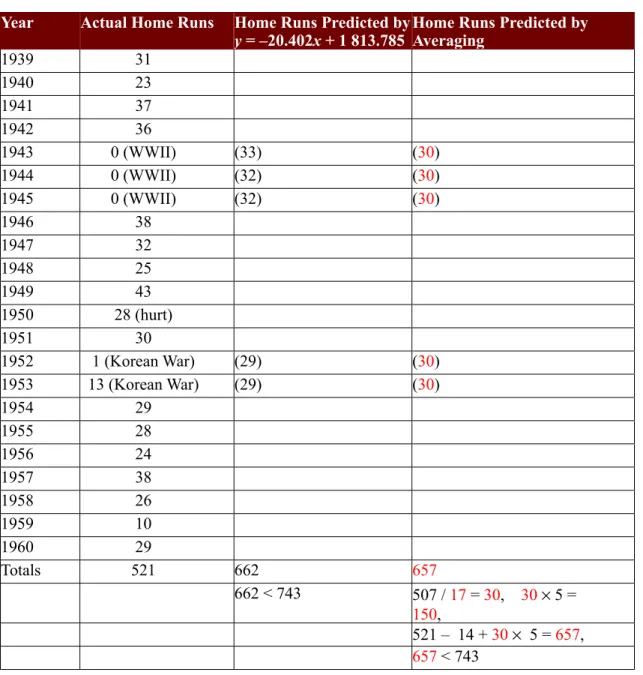
Once again I set out on my own to agree or disagree with Winnie’s results mathematically. Using a graphing calculator, I analyzed the data in Table 1 by fitting the data to a linear function by regression. The function is given by
y = –0.402x + 813.785,
where x = the year, and y = the predicted number of home runs in year x. Then I used the function to estimate the home runs in the war years of 1943, 1944, and 1945 (World War II), and 1952 and 1953 (Korean War). I deleted the HRs he got, 14, for the predicted ones. The total of these predicted HRs was 662.
Bob Feller, Cleveland Indians
Interestingly, if we just take the average for the complete years Williams played, we get 30 home runs per year.
507/17 = 30, 30× 5 = 150, 521 –14 + 30× 5 = 657
Multiplying by 5, subtracting 14, and adding to 521, we get a third
estimate, 657, which was close to the estimate found using the preceding linear function.
Table 1 Ted Williams Home Runs
Year Actual Home Runs Home Runs Predicted by
y = –20.402x + 1 813.785 Home Runs Predicted by Averaging
1939 31 1940 23 1941 37 1942 36 1943 0 (WWII) (33) (30) 1944 0 (WWII) (32) (30) 1945 0 (WWII) (32) (30) 1946 38 1947 32 1948 25 1949 43 1950 28 (hurt) 1951 30 1952 1 (Korean War) (29) (30) 1953 13 (Korean War) (29) (30) 1954 29 1955 28 1956 24 1957 38 1958 26 1959 10 1960 29 Totals 521 662 657 662 < 743 507 / 17 = 30, 30× 5 = 150, 521 – 14 + 30× 5 = 657, 657 < 743 ! Marvin L. Bittinger
Comparing all the estimates in the last line of Table 1, I could not
corroborate the results Winnie predicted for Williams, which was 743 home runs.
No other reference was given to Ralph Winnie in Feller’s book other than that he lived in Seattle, so I decided to contact Feller. I wrote one letter to his publisher and another without a street address to his home city of Gates Mills, Ohio.
A man has to have goals—for a day, for a lifetime—and that was mine, to have people say, ‘There goes the greatest hitter who ever lived.’
—TED WILLIAMS
There’s only one way to become a hitter. Go up to the plate and get mad. Get mad at yourself and mad at the pitcher.
—TED WILLIAMS
I called Feller and asked about Ralph Winnie. Feller told me Winnie was in an organization known as SABR, Society for American Baseball Research, an organization for baseball enthusiasts who analyze the game to its absolute literary-historical-statistical depths. Its publications include articles about such diverse topics as the history of the Negro leagues and the effects of the DH (designated hitter) on the game. I knew about SABR because I was a member. He gave me Winnie’s phone number.
Elaine & Bob. I must tell a related, amusing story. My beloved wife, Elaine, has never had an interest in baseball and knows very few famous players. One Saturday, after returning from running errands, I asked as usual if there had been any calls. She said in a very casual manner, “Bob Feller called.” I reacted in amazement, “Bob Feller? Bob Feller called me? Wow!” To me, it was like I had just gotten a call from the President. To Elaine, it was like a call from a friend down the street.
to refute his predictions. Winnie was irritated with me, telling me that I had not come anywhere close to the careful analysis he had carried out, but he sent me his book. Without offering details of the mathematics used, Winnie asserts that he considered many factors such as the effects of playing 162 games versus 154 games per season in the era of Feller and Williams. He also considered odd facts such as the practice of many teams keeping top-notch players hidden in the minor leagues and the effects of catastrophic problems that shortened careers of excellent players like Lou Gehrig (ALS disease) and Herb Score (hit in the eye by a shot off of the bat of Gil
McDougald). If Winnie were to repeat his study today, it might include the effect of the designated hitter.
According to Winnie’s calculations, Table 2 shows the would-be home run totals four top home run hitters at the time.
Table 2
Player Actual Career
Home Runs Projected Career Home Runs
Ted Williams 521-10th 780
Hank Aaron 755-1st 768
Babe Ruth 714-2nd 752
Lou Gehrig 493 742
Frank Robinson 586-4th 670
Source: What If?, by Ralph Winnie, p. 46.
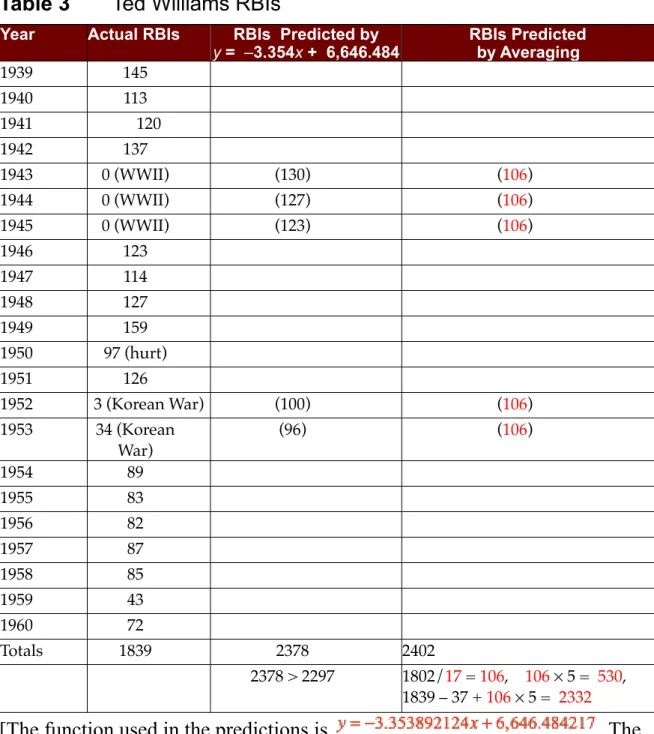
I also did my analysis of the career RBI totals of Ted Williams. Although my stats were again short of Winnie’s (Table 4), I did corroborate that
Williams would hold the all-time RBI record over Aaron. My results are in Table 3.
In his book, Bob Feller noted that he had not one regret about the
playing time or the statistics he lost serving in World War II. He was proud to have served his country in the U.S. Navy. Even the damage he suffered to his feet and legs standing on the hard decks of ships did not deter his patriotism.
The projections are, in truth, a great application to the baseball-math enthusiast, but only God knows what might have happened without interruptions for military service.
Table 3 Ted Williams RBIs
Year Actual RBIs RBIs Predicted by
y = –3.354x + 6,646.484 RBIs Predictedby Averaging
1939 145 1940 113 1941 120 1942 137 1943 0 (WWII) (130) (106) 1944 0 (WWII) (127) (106) 1945 0 (WWII) (123) (106) 1946 123 1947 114 1948 127 1949 159 1950 97 (hurt) 1951 126 1952 3 (Korean War) (100) (106) 1953 34 (Korean War) (96) (106) 1954 89 1955 83 1956 82 1957 87 1958 85 1959 43 1960 72 Totals 1839 2378 2402 2378 > 2297 1802/17 = 106,!!106! 5 = 530, 1839 – 37 + 106! 5 = 2332
[The function used in the predictions is . The
rounded version will give values different from the ones in the table.]
Player Actual Projected Career RBIs Ted Williams 1839 2795 Lou Gehrig 1990-3rd 2659 Joe DiMaggio 1537 2357 Hank Aaron 2297-1st 2336 Babe Ruth 2209-2nd 2327
! Source: What If?, by Ralph Winnie, pp. 65–66.
EXERCISES
1. Lou Gehrig. Use the following data on Lou Gehrig’s career and a graphing calculator for the years 1925–1938, excluding 1939 when he was ill. Fit a linear regression function to the data and predict
Gehrig’s home runs for years 1939–1942, and his career home run total.
Lou Gehrig, first base
Gehrig’s Hitting Stats
SEASON TEAM G AB R H 2B 3B HR RBI TB BB SO SB CS 1923 Yankees 13 26 6 11 4 1 1 9 20 2 5 0 0 1924 Yankees 10 12 2 6 1 0 0 5 7 1 3 0 0 1925 Yankees 126 437 73 129 23 10 20 68 232 46 49 6 3 1926 Yankees 155 572 135 179 47 20 16 112 314 105 73 6 5 1927 Yankees 155 584 149 218 52 18 47 175 447 109 84 10 8 1928 Yankees 154 562 139 210 47 13 27 142 364 95 69 4 11 1929 Yankees 154 553 127 166 32 10 35 126 323 122 68 4 4 1930 Yankees 154 581 143 220 42 17 41 174 419 101 63 12 14 1931 Yankees 155 619 163 211 31 15 46 184 410 117 56 17 12 1932 Yankees 156 596 138 208 42 9 34 151 370 108 38 4 11 1933 Yankees 152 593 138 198 41 12 32 139 359 92 42 9 13 1934 Yankees 154 579 128 210 40 6 49 165 409 109 31 9 5 1935 Yankees 149 535 125 176 26 10 30 119 312 132 38 8 7 1936 Yankees 155 579 167 205 37 7 49 152 403 130 46 3 4 1937 Yankees 157 569 138 200 37 9 37 159 366 127 49 4 3 1938 Yankees 157 576 115 170 32 6 29 114 301 107 75 6 1 1939 Yankees 8 28 2 4 0 0 0 1 4 5 1 0 0 Career Totals 2164 8001 1888 2721 534 163 493 1995 5060 1508 790 102 101 Source: Major League Baseball; www.mlb.com
2. J. R. Richard.An imposing 6'8" figure on the mound, J. R. Richard had a fastball clocked up to 100 mph. His career ended on July 30, 1980, when he suffered a stroke. Dusty Baker said he was the pitcher players feared most in his era. The following table shows his career stats from 1971 to 1980. Use the data for Richard’s wins in the years 1975–1979 and a graphing calculator to fit a linear regression
function to the data. Then predict his wins for the years 1980–1991 and compute his career win total.
J.R. Richard
Richards’s Pitching Stats
SEASON Team W L ERA G GS CG SHO SV IP H R ER HR 1971 Astros 2 1 3.43 4 4 1 0 0 21.0 17 9 8 1 1972 Astros 1 0 13.50 4 1 0 0 0 6.0 10 9 9 0 1973 Astros 6 2 4.00 16 10 2 1 0 72.0 54 37 32 2 1974 Astros 2 3 4.18 15 9 0 0 0 64.2 58 31 30 3 1975 Astros 12 10 4.39 33 31 7 1 0 203.0 178 107 99 8 1976 Astros 20 15 2.75 39 39 14 3 0 291.0 221 105 89 14 1977 Astros 18 12 2.97 36 36 13 3 0 267.0 212 94 88 18 1978 Astros 18 11 3.11 36 36 16 3 0 275.1 192 104 95 12 1979 Astros 18 13 2.71 38 38 19 4 0 292.1 220 96 88 13 1980 Astros 10 4 1.90 17 17 4 4 0 113.2 65 31 24 2 Totals 107 71 3.15 238 221 76 19 0 0 1606.0 1227 625 562 73
Source: Major League Baseball; www.mlb.com
BASEBALL STATISTICS
Since baseball is the sport in which statistics are most analyzed, I am going to relate them to my experiences with Dusty Baker when he was with the San Francisco Giants and we were writing our book.
A player’s batting average, BA or AVG, is defined as follows:
where walks, sacrifice-fly RBIs, sacrifice bunts, times being hit by a pitch, are not official at bats (AB). Dusty refers to the latter as non-at-bats.
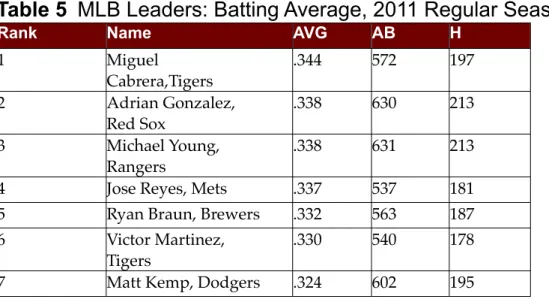
For example, a player who gets 3 hits in 10 official at bats has a 0.300 batting average. Note that he has actually failed in 7 out of 10 attempts. Where else can you fail that often and make a salary of several million dollars playing a kid’s game? Any hitter with a 0.300 batting average or better is considered an excellent hitter. An average of say 0.270 to 0.299 is a good hitter, and below 0.270, a marginal or weak hitter. Table 5 shows the batting averages of the top seven players in the major leagues in 2011.
Table 5 MLB Leaders: Batting Average, 2011 Regular Season
Rank Name AVG AB H
1 Miguel Cabrera,Tigers .344 572 197 2 Adrian Gonzalez, Red Sox .338 630 213 3 Michael Young, Rangers .338 631 213 4 Jose Reyes, Mets .337 537 181 5 Ryan Braun, Brewers .332 563 187 6 Victor Martinez,
Tigers
.330 540 178 7 Matt Kemp, Dodgers .324 602 195
AVG =batting average, AB =at bat, H =hits.
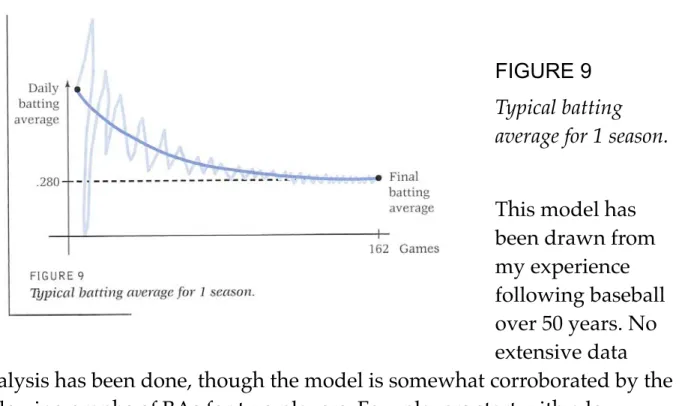
At the beginning of the season the numbers in H/AB are small allowing great variation in a player’s batting average, but at the end of the season the numbers are very large, in the hundreds, and the variations are small. For example,
Figure 9 is a graph of what I consider a typical batting average over a season. Suppose a player’s batting average for the season ends up at 0.280. The wavy blue line represents the changes in the true batting average of a player. The solid blue curve represents a continuously decreasing function which might be used to “model” the player’s batting average over the
season in relation to his final average.
FIGURE 9
Typical batting average for 1 season. This model has been drawn from my experience following baseball over 50 years. No extensive data analysis has been done, though the model is somewhat corroborated by the following graphs of BAs for two players. Few players start with a low
average and increase it over a season.
The solid blue curve in Figure 9 is not a perfect model and is conceived out of my intuition, not a careful statistical analysis. Nevertheless, you will see how Dusty Baker and his players use and corroborate this model. What happens is that a player’s BA starts out, in this case, quite high and wavers rapidly early in the season. Over the course of the season, as shown by the blue curve, the BA tends to decrease to the final BA. If you know statistics, you will recognize the Law of Large Numbers in this idea, but we will not discuss that here.
Dusty Baker was aware of this as a player, and in his capacity now as a manager, he makes his players aware of results drawn from the curve. In effect, players are taught to realize that when you get a non-at-bat, you tend to keep your batting average higher, because BA tends to be a
decreasing function for players with early high averages. So if you make
any kind of non-at-bat, draw a walk, make a sacrifice bunt, and so on, you are keeping your average higher. Quite simply, you have not received a regular at bat, which tends to decrease your average. Compare these two situations:
3 hits in 9 at bats in 3 games gives a 0.333 BA.
3 hits in 12 at bats in those three games gives a 0.250 BA.
Suppose the hitter had 3 non-at-bats out of those 12 opportunities. Then the hitter would look a lot better at 0.333 than at 0.250. To say this another way by not taking an at-bat that might reduce your average you keep it where it is and don’t reduce it. You gain by not losing.
Pete Rose is probably my favorite all-time player on the field. Off the field his character has left something to be desired. (And, yes, I do think he should be forgiven for his gambling allegations and voted into the Hall of Fame). Dusty said, and I agree from all the Reds games I followed during Rose’s career, that Pete Rose was probably the “greediest” hitter to ever play the game. If he got 1 hit in his first at bat, you could almost count on him going 2/3, 3/4, or 4/4 for the game. He always went to the plate eager, intense, and aggressive no matter how many previous hits he had made or the score of the game.
According to Dusty, immature players often fall into a trap. Say a player gets 2 hits in his first 2 at bats and ends up 2/4 for the night; he has a very
Pete Rose
respectable .500 for the game. Young players in those situations often do what I call “hit and giggle” for the rest of the game. They know after those first two at bats that they will have a good night, so they don’t bear down on the next at bats. But suppose that hitter faces a tough pitcher the next night. Then
for the two nights—not so good! If that player had played greedy the first night like Pete Rose, then maybe the situation would have changed to
for the two nights—looking good!
The moral of the story from Dusty is, no matter what your playing level, never, ever give away an at bat! For more on this discussion of non-at-bats see
p. 277 of Dusty Baker’s Hitting Handbook.
Standard Deviations and the Demise of the 0.400 Hitter_______
George Will, in his book Men at Work, referred to studies by the late Stephen Jay Gould, eminent Harvard social scientist and baseball fan, on evolutionary processes in batting.
! BA in 1870s = µ = 0.260
! BA in 1989 = µ = 0.255
According to Gould, the batting averages of players have essentially not decreased by much over the years. But the variation, or standard
deviation, of the batting averages has decreased considerably, as modeled in Figure 11.
FIGURE 11
Means and standard deviations of batting averages.
This is a fascinating result to those who know the mathematics, but unfortunately it is difficult to explain standard deviation to the average person on the street who has no training in the concept. Certainly, no
announcer comments about changes in a hitter’s standard deviation. When explaining standard deviation to someone not mathematically
sophisticated, I like to use the notion of a “spread” number and try to tell how numbers are spread out on both sides of the mean, or average.
Jay Johnstone, Jerry Reuss, Tommy LaSorda, and the Rope. Jay Johnstone and Jerry Reuss played for Tommy LaSorda when he was manager of the
Dodgers. Johnstone and Reuss were born pranksters. Once the two of them borrowed clothes from the Dodgers’ field maintenance crew and went out and raked the infield between innings. LaSorda was livid when he discovered the deed.
Johnstone was once my manager at Dodger Baseball camp, but we weren’t hitting very well. He actually took all our baseball bats, stacked them in a pile, poured gasoline on them, and lit them in order to “fire up our hitting.” He got our attention, but our hitting continued in futility.
Johnstone was a prankster extraordinaire. One prank he tells at Dodger Camp involved Tommy LaSorda and his enjoyment of food.
Tommy never missed a meal. One night during spring training, Johnstone and Reuss snuck into his room and removed the voice-transmitting device from the telephone. Thus, Tommy could hear the operator but she could not hear him.
After Tommy went to bed that night, Johnstone and Reuss got some rope, tied one end to the door knob and the other end to a tree; there was no way Tommy could get out of his room the next morning. When Tommy failed to get the door open, he tried the windows, but they were too small to crawl through. Furious, he called the front desk and yelled into the phone but the operator could not hear him. After some time, someone saw the rope and let him out. He not only missed his breakfast, but he was late to the team bus, a major no-no he impressed on his players.
Think of the probability of a hitter batting 0.400 or better as the area under each curve to the right of 0.400 on the x-axis in Figure 11. Note that in the 1870s the spread number was quite large and the shaded area to the right of 0.400 under the curve for the 1870 hitters is much higher than the blue to the right of 0.400 under the curve for the 1989 hitters. These areas are probabilities. Thus, there was a much smaller chance of a hitter batting 0.400 in 1989 than in 1870. Gould asserts that the reasons for the demise of the 0.400 hitter is that the game has refined itself, the equipment is better, the fields are better, and the instruction is better. But to me, these assertions would apply to pitching as well as hitting, which further supports Gould’s
reults.
Look back again at the solid blue curve in Figure 9. I find it amusing, if not irritating as a fan, that if a player has a 0.400 batting average or better in June or July, then the media go crazy analyzing and discussing the
possibility. Since that blue curve is a decreasing function, the media
shouldn’t involve themselves in such foolish distractions unless the player is hitting over 0.400 by the first of September. This overreaction occurred with George Brett in 1980 with the Kansas City Royals; Brett finished with a 0.390 BA. The overreaction occurred again with Tony Gwynn of the San Diego Padres in 1994; Gwynn finished with a 0.394 BA. I’m inclined to think that there will never be another .400 hitter.
Slugging Percentage
______
Slugging Percentage
A player’s slugging percentage (SLG), or slugging average, is defined as
where for the season,
HR = the total number of home runs, T = the total number of triples,
D = the total number of doubles, and S = the total number of singles.
SLG is the average number of bases attained per each at-bat. Barry Bonds, of the San Francisco Giants, had probably the most incredible season in the history of baseball in 2001, highlighted by his
record-breaking 73 home runs, eclipsing the all-time season total record of 70 then by Mark McGwire. He also broke the all-time record for slugging average in a season. Let’s compute his SLG. His hitting statistics are in Table 6.
Table 6 Career Batting Statistics of Barry Bonds
From Table 6 we see that HR = 73, T = 2, D = 32, and S = 49. Table 6 does not list the actual number of singles. We must take total hits, 156, and
subtract home runs, triples, and doubles, to get the singles. Then
A hitter is considered to have an excellent slugging percentage if it is 0.600 or better. So, Bonds set a phenomenal record, though his career has since been tainted by allegations of illegal substance abuse.
OBP and OPS Statistics
Baseball statisticians also analyze a statistic called on-base percentage, OBP. It is an adaptation of BA that takes into account other ways of getting on base such as walking and being hit by a pitch.
On-Base-Percentage, OBP, is defined as follows.
where
H = total number of hits,
W = total number of walks (often abbreviated BB, for number of bases on balls),
HBP = total number of times batter was hit by a pitch, SF = total number of sacrifice flys, and
AB = total at bats.
Most books and Internet references do not list HBP.
Bruce Froemming, Pete Rose, and the Birds. Another of my favorite baseball stories was told often by major-league umpire Bruce Froemming at the Dodger Fantasy Camp. Retired now, many players consideed Froemming to be the finest ball-strike umpire in the game.
Bruce came to the major leagues in 1970 and served his first year with Al Barlick, the noted umpire, who was completing his last year in the majors. It is typical of players and umpires to play pranks on rookies. Earlier that season, Nate Colbert of the San Diego Padres had had the misfortune to have a fly ball hit a bird in the outfield on its way to what might have been a home run. No ground rule covered this play. It caused quite a controversy.
To pull a prank on rookie Froemming, Barlick informed him that for a couple of weeks he should go out on the diamond one hour before each game and “look for birds.” Wanting to impress, Froemming did as instructed with diligence, until finally unraveling the prank. I imagine him out there staring at the sky.
Not long after this, the umpire team went to Cincinnati for a series between the Reds and the Mets. Pete Rose, the captain of the Reds at the time, brought out his lineup card to meet with the umpires and the opposing umpire, Gil Hodges. This time the prank was on Rose and was committed by Hodges and
the other umpires.
To put Froemming on the other side of the joke, the umpires told him to tell Rose something like the following, “Pete, because of the bird incident in San Diego, I have been assigned to watch for birds in the ballparks. I noticed here that there are two pigeons flying around in right field so we need a ground rule to cover the situation.” Pete agreed and asked what the rule would be.
Froemming says, “There are two birds, a male and a female. If you hit the male, it is a ground rule double. If you hit the female, it is all you can get.”
Ted Williams extolled the use of the statistic he called production.
Production, OPS, defined simply as on-base percentage plus slugging percentage. That is,
OPS = OBP + SLG
where for the season,
HR = the total number of home runs, T = the total number of triples, D = the total number of doubles, S = the total number of singles, H = total number of hits,
W = total number of walks (often abbreviated BB, for number of bases on balls),
HBP = total number of times batter was hit by a pitch, SF = total number of sacrifice flys, and
AB = total at bats.
Williams asserted adamantly, “I realize that everyone has a different idea of what constitutes a great hitter. For some it’s a high batting average. For others, it’s the guy with the most total hits, or home runs, or RBIs. I’ve always believed that slugging percentage plus on-base percentage is
absolutely the best way to rate the hitters.”
To me Ted Williams is “absolutely” the greatest hitter to ever play the game. If he says OPS is the best stat to rate a hitter, I cannot disagree. In most books and Internet sources both OBP and SLG are given, so we can simply add to find OPS.
For Barry Bonds’s outstanding 2001 season, his OBP was 0.515 and his SLG was 0.863. Thus, his OPS was 0.515 + 0.863, or 1.378. Williams asserts that any player with an OPS above 1.0 has an excellent season. In their careers, very few players had an OPS above 1; Babe Ruth had 1.163, Lou Gehrig had 1.080, Mickey Mantle had 0.979, and Willie Mays had 0.944. Table 7 shows the OPS statistics for the top five players in the major leagues in 2011.
Table 7 MLB Leaders: Sorted by Production OPS; On-Base plus Slugging Percentages, (OPS), 2011 Regular Season
Rank Name Team OPS AVG RBI AB HR OBP SLG 1 Jose Bautista Tor 1.056 .302 103 513 43 .447 .608 2 Miguel Cabrera Det 1.033 .344 105 572 30 .448 .586 3 Ryan Braun Mil 0.994 .332 111 563 33 .397 .597 4 Matt Kemp LAD 0.986 .324 126 602 39 .399 .586 5 Price Fielder Mil 0.981 .299 120 569 38 .415 .566
Pitcher’s Earned Run Average
!
!
!
!
!
!
A pitcher’s win–loss record is the first statistic used to evaluate the player. The second most used statistic is the earned run average, ERA. In 2001 the outstanding pitcher for the Arizona Diamondbacks, Randy Johnson, gave up 69 earned runs in 2492
numeral 2492
3 means that he pitched 249 full innings and plus 2 outs of 3
possible outs of another inning. The ERA is based on how many earned runs the pitcher gives up every 9 innings. To find the ERA, we set up a proportion:
Then we solve the proportion by multiplying both sides by 9, and carry out the calculations:
This leads us to the definition of a pitcher’s earned run average, ERA:
where
ER = the number of earned runs allowed, and IP = the number of innings pitched
A pitcher with an ERA below 3.00 is considered excellent, although in the present era of weaker pitching an ERA of 4.00 or less is considered good. Table 8 shows the ERA statistics for the top five pitchers in the major leagues in 2001.
Table 8 MLB Leaders ERA, 2001 Regular Season
Player TEAM W L ERA IP H R ER HR 1. R. Johnson ARI 21 6 2.49 249.2 181 74 69 19 2. C. Schilling ARI 22 6 2.98 256.2 237 86 85 37 3. J. Burkett ATL 12 12 3.04 219.1 187 83 74 17 4. F. Garcia SEA 18 6 3.05 238.2 199 88 81 16
5. G. Maddux ATL 17 11 3.05 233.0 220 86 79 20
! Note: When reading such a table for pitchers, 249.2 IP means 2492 3.
EXERCISES
1. Below are the career totals of five all-time leading players in the major leagues through June 23, 2003. In each case compute their batting average, AVG, on-base percentage, OBP,
slugging percentage, SLG, and their OPS.
Player AB H 2B 3B HR W SF HBP AVG OBP SLG OPS Hank Aaron 12,364 3771 624 98 755 1402 121 32
Babe Ruth 8399 2873 506 136 714 2062 N/A 43 Willie Mays 10,881 3283 523 140 660 1464 91 44 Barry Bonds 8725 2595 536 74 658 2070 84 84 Mark
McGwire
6187 1626 252 6 583 1317 78 75
! N/A = Not available; use 0.
!2.! What is the highest that a slugging percentage can be? the lowest?
!3.! Below are the career totals of five all-time leading pitchers in the major leagues through June 23, 2003. Compute each ERA.
PLAYER YRS G IP H ER W L ERA
1. Ed Walsh 14 430 2964.1 2346 598 195 126 2. Addie Joss 9 286 2327.0 1888 488 160 97 3. Mordecai Brown 14 481 3172.1 2708 725 239 130 4. John Ward 7 292 2461.2 2317 575 164 102 5. Christy Mathewson 17 635 4780.2 4218 1133 373 188
4. Below are five all-time single-season ERA record-holding pitchers as of June 23, 2003. Compute each ERA.
1. Dutch Leonard, Bos 1914 36 224.2 139 24 19 5 2. Mordecai Brown, Chi 1906 36 277.1 198 32 26 6 3. Bob Gibson, StL 1968 34 304.2 198 38 22 9 4. Christy Mathewson,
NY
1909 37 275.1 192 35 25 6 5. Walter Johnson, Was 1913 48 346.0 232 44 36 7
5. Limits and ERA. Suppose in the ERA formula that we fix the number of earned runs allowed at 4 and let IP = i . We get a function given by E(i)= 9!4
i
a. Complete the table that follows, rounding to two decimal places. b. Find
i!0+
lim
E(i).
c. On the basis of parts (a) and (b), conjecture a pitcher’s earned run average if 4 runs were allowed and there were 0 outs.
Innings Pitched (i) Earned Run Average (E)
9 8 7 6 5 4 3 2 1
THE PHYSICS OF THE BASEBALL BAT_________________
The physics of a baseball bat and of a batter’s swing are the basis of our next three topics.
Kinetic Energy
A swing of a bat appears as a circular motion, as shown in Figure 12. A body of mass m moving with a speed, or velocity, v possesses a kinetic energy, KE, due to its translational motion given by
!
That is,
Kinetic Energy =
1
2
⋅
(
Mass
)
⋅
(
Velocity
)
2
The equation tells us that the velocity, or speed, of the bat is much more important than its mass, or simply stated, weight. I have done enough coaching at lower levels to know that it is virtually impossible on a “dusty” playing field to explain that increasing v, because it is squared, has a
greater effect than increasing m, which is first power only.
Dusty Baker, Tommy LaSorda, and the Missed Flight. Dusty Baker told me a true story about Tommy LaSorda, his manager of the Dodgers at the time. Tommy was a rather demanding and intense manager—the subject of many stories by his former players.
During spring training in Florida the Dodgers used a rather large
commercial jet to travel to their games around the state. Tommy had the rule that if you did not get to the team plane on time after a game, you were responsible for your own
transportation back to Vero Beach, their spring training base.
After one game, Dusty and fellow player Ken Landreaux took time to stop for cocktails. Time was fleeting, and Dusty kept prodding Landreaux to leave so they would not miss the
plane and incur Tommy’s wrath. But Landreaux kept procrastinating, time got away from them, and they were late.
Meanwhile, at the airport, Tommy was fuming and finally told the pilot to leave without Baker and friend; who arrived as the plane was taking off. They began to comment about being the object of Tommy’s ire when they got back to Vero.
A pilot standing nearby responded to their grief, saying he had a Lear Jet and would be glad to fly them back to Vero as fast as possible. They hopped in the plane and got back to the Vero Beach airport before the Dodgers’ plane. (This happened because a large commercial jet consumes more flying time because of the intricate flight patterns it must follow.)
Baker and Landreaux were at the gate as Tommy and the players
disembarked. Off came Tommy, steaming about the missing players, only to look up and hear them say, “Hi guys! Where have you been?”
The Grip
In our book, Dusty Baker’s Hitting Handbook (DBHH,See Chapter 2, Section 5), Dusty and Jeff emphasize teaching the proper grip on the bat to increase speed, v. There are three types of grip: the standard, the modified, and the choke.
With the standard grip, which we prefer for the young hitter, the player aligns the middle knuckles on both hands (see Figure 13A). A simple tip for setting up this grip is to lay the bat down in the fingers, not in the palms, across the calluses in the hands (see Figure 13B). The standard grip is somewhat similar to a golf grip, but without the thumbs on the bat. If the hitter lays the bat down in his fingers as though he were gripping a golf club and then picks it up, he will normally find that the middle knuckles on both hands are aligned.
The goal of the standard grip is to achieve as much quickness and speed as possible with the hands and bat. Think of “quickness” as how the bat starts. Think of “speed” as how fast it moves through the strike zone. The energy equation says that the distance a ball travels depends on the amount
of energy applied to the ball when hit, and the energy applied to the ball is one half times the mass times the velocity squared; that is
Kinetic Energy =
1
2
!
(
Mass
)
!
(
Velocity
)
2
Thus bat speed has a greater bearing on how far the ball travels than does the weight of the bat. A player who is not a power hitter and not primarily concerned with distance can still make the ball come off the bat a lot harder if he develops quickness and speed. Although they may not understand why, most young hitters will notice a big improvement in bat quickness and speed if they move to the standard grip.
In the past, many major league players, such as Babe Ruth, Willie
Stargell, and Dick Allen, used heavy bats. Now many power hitters in the major leagues are looking for lighter bats since most of them have been brought up using metal bats. Some even go so far as to hollow out the end of the bat. Weight of the bat should not be completely ignored—it is part of the equation for hitting the ball hard. With good technique, a hitter can be successful using a heavier bat, but learning the proper techniques is far more important than moving to a heavier bat.
With the modified grip, the middle knuckles on the bottom hand align between the back knuckles and middle knuckles on the top hand (see Figure 13C). This grip tends to cause a loss in quickness and bat speed as well as a slight uppercut in the swing.
Gripping the bat: A. The standard grip. B. Positioning the standard grip.
FIGURE 13
C. The modified grip. D. The choke grip.
The third grip is the choke grip, which should not be confused with choking up on the bat. Grasping the bat in a choke grip is comparable to strangling the handle of the bat (see Figure 13D). The choke grip aligns the middle knuckles of the bottom hand with the back knuckles of the top hand. Many strong major leaguers use this type of grip, and since it does require some strength, some players aged 16 to 18 might be able to use it. The choke grip forces even more of an uppercut than does the modified grip, whether the hitter wants it or not. It also tends to cause a greater loss in quickness and bat speed, particularly with younger hitters, because it tends to force greater use of the muscles in the shoulders and back rather than those in the hands, wrists, and forearms. These muscles allow for greater speed in driving the head of the bat through the strike zone.
Finding a standard grip on a bat is similar to gripping a golf club. Be careful, however, that this does not lead you to think that swinging a golf club will enhance your baseball hitting. The swing of a baseball bat is not necessarily compatible with the swing of a golf club, even though the grips may be compatible. In fact, some major league managers have not allowed their players to play golf for this reason. Consult your hitting coach.
[A golf coach once told your author that professional baseball players are the toughest to teach.]
— DUSTY BAKER, MANAGER, CINCINNATI REDS
Why do some players use the modified or choke grip instead of the standard grip? One simple answer is that often hitters are totally unaware
of the standard grip. Another answer is that players simply have not been coached properly at the younger levels. They tend to grab a bat in a
choking manner that seems natural to them but is in fact poor fundamental technique.
There is one more positive result of using the standard grip asserted by Dusty and Jeff. The bat swung with the standard grip stays flatter longer through the swing than the bat swung with the choke grip. As a
mathematician, I explain this assertion with two graphs. The standard grip is represented by the graph of the equation y = x12, the choke grip by the
graph of the equation y = x2, and the flight of pitch as a ball traveling along
the x-axis. See Figure 14.
FIGURE 14
Paths of bat using standard vs. choke grips.
FIGURE 15
Metal vs. Wooden Bats*
All other variables remaining constant, a player can swing an aluminum bat faster than a wooden bat, and thus attain the advantage of extra speed.
Compare a wooden bat and an aluminum bat in terms of balance point (center of gravity, CG), and you will find the balance point of an
aluminum bat farther out toward the end of the bat than the CG of a wooden bat. See Figure 15. There is more weight in the handle of a metal bat. This also gives the hitter an
advantage because he will hit inside pitches with more power, and will usually not break the bat above the handle, which often happens with a
wooden bat. (Metal bats do break. I actually saw it happen once in a softball game.)
*I wish to thank Robert K. Adair, again, and Mark Reuber of Grove City College for their kind and helpful conversations regarding this topic.
Bat Vibrations and Sweet Spots
Have you ever heard a player saying “I hit the sweet spot” or “I hit that ball so well I barely felt it”? Considering the physics of a baseball bat as it hits a ball helps us understand what this means. First of all, when it is swung at a ball, a bat is a firm rotating object. It makes sense then that the speed and quickness of that rotation have an effect on the ball.
But after it hits the ball, the bat becomes a vibrating object. Although this
vibration is not visible to the naked eye, the batter definitely feels it to one degree or another. To understand how the vibration takes place, take a piece of metal sheeting about 2 inches wide and 5 feet long. Hold it in the middle and shake it. The result resembles a vibrating bat (see Figure 16). Note that vibrations can be seen in the middle, where it is being shaken
FIGURE 16
The nodes and antinodes of a vibrating strip of metal.
and on the ends, but there are two locations where there seem to be no vibrations. These locations are called nodes, and locations of greatest vibration are called antinodes.
FIGURE 17
The nodes, antinodes, and sweet spot of a vibrating bat.
(Reprinted with permission from The Physics of Baseball by Robert K. Adair, New York: HarperCollins Publishers, 1990, p. 91).
Although they are not visible, vibrations occur when the bat hits the ball. There are two nodes on a bat, one in the handle and one up in the barrel. Hopefully, the ball does not hit the handle node because that is where the bat is held. But the ball can hit the barrel node. That node is called the sweet spot (see Figure 17).
If the ball hits near a node, there is very little, if any vibration. If the ball hits an antinode, there is maximum vibration, possibly as much as one half inch. This explains why the greatest stinging effect occurs if a ball is hit on the antinode just above the handle. If it hits anywhere other than on a node, a vibration is created. Any vibration, no matter how slight, takes
energy away from the ball, shortening the distance that it travels off the bat.
You can actually “hear” where the nodes are on a wooden bat by
screwing a hook into the top end of the bat and hanging it vertically from the ceiling. Put some adhesive tape on the end of a hammer and move from one end of the bat to the other, tapping the bat with the hammer. The
changes in sound will indicate the position of the nodes and places in
between. The hitter could place a piece of tape on the sweet s