Taking home bias seriously: absolute and relative
measures explaining consumption risk-sharing
Citation for published version (APA):Holinski, N., Kool, C. J. M., & Muysken, J. (2008). Taking home bias seriously: absolute and relative measures explaining consumption risk-sharing. (METEOR Research Memoranda; No. 025). Maastricht: METEOR, Maastricht University School of Business and Economics.
Document status and date: Published: 01/01/2008
Document Version:
Publisher's PDF, also known as Version of record
Please check the document version of this publication:
• A submitted manuscript is the version of the article upon submission and before peer-review. There can be important differences between the submitted version and the official published version of record. People interested in the research are advised to contact the author for the final version of the publication, or visit the DOI to the publisher's website.
• The final author version and the galley proof are versions of the publication after peer review.
• The final published version features the final layout of the paper including the volume, issue and page numbers.
Link to publication
General rights
Copyright and moral rights for the publications made accessible in the public portal are retained by the authors and/or other copyright owners and it is a condition of accessing publications that users recognise and abide by the legal requirements associated with these rights.
• Users may download and print one copy of any publication from the public portal for the purpose of private study or research. • You may not further distribute the material or use it for any profit-making activity or commercial gain
• You may freely distribute the URL identifying the publication in the public portal.
If the publication is distributed under the terms of Article 25fa of the Dutch Copyright Act, indicated by the “Taverne” license above, please follow below link for the End User Agreement:
www.umlib.nl/taverne-license Take down policy
If you believe that this document breaches copyright please contact us at: [email protected]
providing details and we will investigate your claim.
Nils Holinski, Clemens Kool, Joan Muysken
Taking Home Bias Seriously: Absolute and
Relative Measures Explaining Consumption
Risk-Sharing
RM/08/025
JEL code: F36, F41, G15
Maastricht research school of Economics of TEchnology and ORganizations Universiteit Maastricht
Faculty of Economics and Business Administration P.O. Box 616
NL - 6200 MD Maastricht phone : ++31 43 388 3830 fax : ++31 43 388 4873
Taking Home Bias Seriously: Absolute and Relative Measures
Explaining Consumption Risk-Sharing
Nils Holinskia,∗, Clemens Koolb, Joan Muyskena
a
Department of Economics, Maastricht University, PO BOX 616, 6200 MD Maastricht, The Netherlands
b
Utrecht School of Economics, Janskerkhof 12, 3512 BL Utrecht, The Netherlands
This version: May 6, 2008
Abstract
Recent empirical work shows that ongoing international financial integration facilitates cross-country consumption risk sharing. While these studies employ absolute measures to account for a country’s integration in international capital markets, we devise a relative measure that captures the geographical composition of a country’s international portfolio investments. Using panel-data regression for a group of OECD countries during the financial globalization period 1980-2005, we show that the geography of international portfolios helps to explain the degree of consumption risk-sharing obtained.
JEL Classification: F36, F41, G15
Keywords: international financial integration, geography of international investment, con-sumption risk-sharing, international portfolio diversification
∗
Corresponding author: Department of Economics, Maastricht University, PO Box 616, MD 6200 Maastricht, The Netherlands. Tel:+31 433883653, Fax: +31 43 3884864,E-mail: [email protected]
1
Introduction
International financial integration has increased the investment opportunity set of financial in-vestors fundamentally. Inin-vestors are no longer bound to domestic markets, but have access to international capital markets that allow a better hedging of their investment portfolios. Lane and Milesi-Ferretti (2001, 2003, 2006) show in a series of seminal papers that gross foreign asset and liability positions as a fraction of GDP for a group of OECD countries have grown almost fivefold and the composition of international balance sheets in terms of geographical allocation and currency denomination is highly heterogeneous.
This paper pursues the question to what extent financial integration allows individuals to better hedge consumption risk across countries and over time. In answering this question we introduce a novel idea and view the geography of international portfolio investment as a decisive determinant.
Macroeconomic research into consumption home bias concerns the correlation of consumption growth rates across countries. Models of international financial markets (see LeRoy and Werner, 2001 or Obstfeld and Rogoff, 1996) show, under standard assumptions, how financial integration allows decoupling any idiosyncratic shock to domestic output from consumption decisions.
Financial research into asset home bias centers around the theoretical predictions of the International Capital Asset Pricing model (I-CAPM) which holds in a fully integrated world as the international version of Sharpe’s CAPM (Solnik, 1974). We refer to it as our benchmark model. The benchmark model predicts that investors maximize their risk-return trade-off by investing in identical international portfolios, which resemble the world portfolio. In our analysis, we capture the idea of the I-CAPM with two measures.
First, we define an absolute home bias measure that splits each country’s portfolio equity investments into a domestic and foreign component. Their relative size is then compared to the size as implied by the benchmark model; e.g. the relative size of the domestic security market vis-`a-vis the rest of the world (ROW). The absolute home bias measure is standard by now in empirical work. It has first been developed by French and Poterba (1991).
Our second measure is novel. Next to the broad distinction between domestic and foreign investment, we develop arelative home bias measure that explains the geographic distribution of the international component of a country’s portfolio equity investments. Research into the geography of foreign portfolio investment (inter alia Lane and Milesi-Ferretti, 2004, Portes and Rey, 2005, De Santis, 2006) has established a distance puzzle - the general tendency of countries to refrain from investing in remote destinations. Countries prefer geographical proximity for their foreign investments, where cultural ties are strongest and information asymmetries lowest. Consequently, we hypothesize that not international portfolio investmentper se unlocks a huge potential for consumption risk-sharing, but diversification in geographically relevant portfolios is equally important. We elaborate that notion in this paper.
Recent empirical research accumulates evidence on the outstanding role of foreign portfolio investment for international consumption risk-sharing (most notably Artis and Hoffmann, 2006,
Bracke and Schmitz, 2007, Fratzscher and Imbs, 2007, Sørensen et al., 2007). These studies have in common that they all employ absolute measures to account for a country’s integration in world capital markets. By emphasizing the geographical diversification, we are the first to account for absoluteand relative home bias in asset holdings.
Our panel-data regressions show that countries with international portfolios that resemble the world portfolio more closely, are better equipped to decouple consumption from output streams. These findings are robust to the inclusion of absolute home bias measures and for a variety of regression specification.
2
Data sources and measure constructions
Our dataset comprises 23 OECD countries with annual data between 1980 and 2005. Data on GDP and private and public consumption are taken from the OECD Annual National Accounts database and are expressed at constant international prices with base year 2000. To obtainper capita estimates, population data from the same source is used. We concentrate on country idiosyncratic shocks and thus define variables relative to a worldwide aggregate, which is ap-proximated as the weighted sum of our sampled countries. Data for our home bias measures are taken from various sources, including the International Monetary Fund’s Coordinated Portfolio Investment Survey(CPIS)1and International Financial Statistics, Datastream and the External Wealth of Nations Mark II dataset compiled by Lane and Milesi-Ferretti (2006).
A number of influential studies have documented the tremendous growth in international in-vestment positions and the concomitant decline in equity home bias over the past two decades. These studies define measures of equity home bias in an absolute way:
abs. EHBit = 1− T F Eit wealthit 1− M CAPit M CAPwt (1) whereT F Eitis countryi’s total foreign equity position,wealthitis defined as countryi’s equity
market capitalization plus foreign assets minus foreign liabilities in portfolio equity, andM CAPit
and M CAPwt are equity market capitalizations of country i and the world, respectively. The
absolute EHB measures, defined this way, take on values between zero and one. A value of zero implies the absence of equity home bias; the share of domestic equity in the investment portfolio is consistent with the relative size of the domestic to the world equity market. In contrast, a value of one implies that a country is exclusively invested at home.
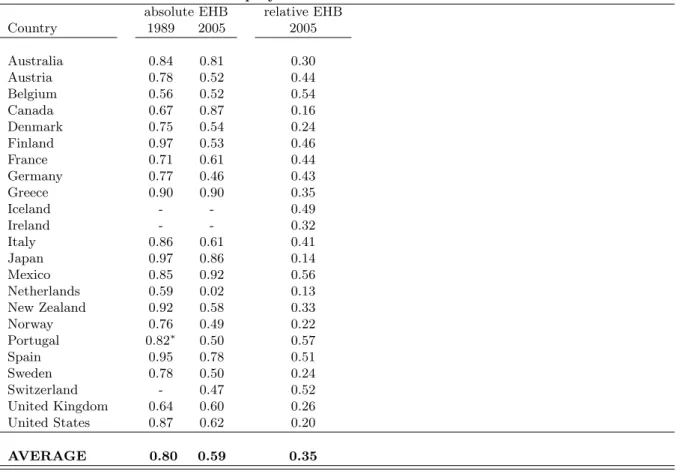
The first two columns of Table 1 show the absolute home bias measures for the years 1989 and 2005. It is apparent that financial globalization has changed the structure of international investment portfolios since its onset in the mid-1980s. All EHB coefficients, with the exception of Canada, Greece and Mexico are falling. Many small open economies like Switzerland, Norway,
1For our sample of 23 OECD countries, we are considering foreign equity holdings in 33 host countries
-covering the destinations of about 98% of total foreign equity investments. The remainder is accounted for and grouped asROW
Table 1: Absolute and Relative Equity Home Bias Measures 1989 and 2005
absolute EHB relative EHB
Country 1989 2005 2005 Australia 0.84 0.81 0.30 Austria 0.78 0.52 0.44 Belgium 0.56 0.52 0.54 Canada 0.67 0.87 0.16 Denmark 0.75 0.54 0.24 Finland 0.97 0.53 0.46 France 0.71 0.61 0.44 Germany 0.77 0.46 0.43 Greece 0.90 0.90 0.35 Iceland - - 0.49 Ireland - - 0.32 Italy 0.86 0.61 0.41 Japan 0.97 0.86 0.14 Mexico 0.85 0.92 0.56 Netherlands 0.59 0.02 0.13 New Zealand 0.92 0.58 0.33 Norway 0.76 0.49 0.22 Portugal 0.82∗ 0.50 0.57 Spain 0.95 0.78 0.51 Sweden 0.78 0.50 0.24 Switzerland - 0.47 0.52 United Kingdom 0.64 0.60 0.26 United States 0.87 0.62 0.20 AVERAGE 0.80 0.59 0.35
Notes: The relative home bias measures is the normalized version of Eq. (4). * measure relates to the years 1990. The first year data is available.
and foremost, the Netherlands lead the ranks of the most financially integrated economies. Nonetheless, an average coefficient of 0.59 for 2005 shows that investors’ portfolio choices are still tilted toward domestic equity and market integration remains far from perfect.
Next we define our relative EHB measure that assesses the geography of the international component of a country’s equity portfolio by comparing it to an empirical proxy of the world portfolio. First we compute country specific world portfolios (W Pi) as column vectors, where
each entrywpj,t denotes the relative equity market size of our 33 considered host countries, plus
the remainder grouped asROW2:
W Pi,t=
M CAP1,t
M CAPW,t−M CAPi,t
, . . . , M CAP33,t
M CAPW,t−M CAPi,t
, M CAPROW,t
M CAPW,t−M CAPi,t
0 (2)
Next we determine the actual allocation of the international portfolio investment (IPi)
ac-cording to theCPIS data and obtain a column vector, where each entry ipj,t denotes the share
2
Note that we set the vector entry for j=i equal to zero.
of total foreign equity allocated to the 33 host countries andROW: IPi,t = F E1,t T F Ei,t , . . . ,F E33,t T F Ei,t ,F EROW,t T F Ei,t 0 (3)
F Ej,t is foreign equity held in host country j and T F Ei,t is defined as above. Finally, we
determine absolute over- and underinvestments according to the international CAPM and sum them over all 33 host countries andROW:
rel. EHBi,t =
1 2 33+1 X j=1 |wpj,t−ipj,t| (4)
The relative home bias measure as defined in Eq. (4) is bounded between zero and one. A value of zero implies that a country’s international portfolio is a one-to-one replicate of the world portfolio, whereas the measure approaches one, the more idiosyncratic a country’s investment strategy becomes. The last column in Table 1 reports the relative EHB of all countries in our sample for the year 2005. At least two observations stand out: First, we observe a high dispersion of relative EHB measures,. The Netherlands and Portugal constitute our polar cases with measures of 0.13 and 0.57, respectively. Second, we notice a remarkable pattern across countries that is of interest from an institutional point of view. Scandinavian and Anglo-saxon countries do better in diversifying their foreign equity portfolios. All measures are below the average of 0.35 for these countries.
3
Consumption risk-sharing
We start with panel-data regressions of the form
∆logCit−∆logCt=α+β(∆logGDPit−∆logGDPt) +υit (5)
where the disturbance υit is specified as the one-way error component model with a
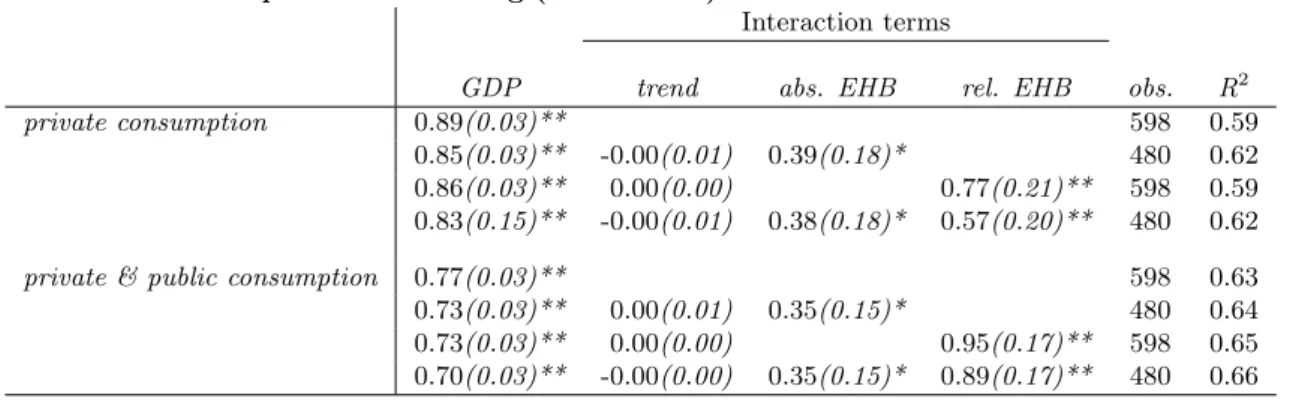
country--specific effect and a stochastic remainder disturbance3. The β-coefficient measures the co--movement between idiosyncratic GDP and idiosyncratic consumption4. In the perfect risk-sharing case the coefficient is equal to zero such that consumption decisions are decoupled from current output levels. Our results, presented in Table 2, confirm past research. We find values for theβ-coefficient that are high and significantly different from zero. Considering the narrow definition of consumption, we obtain a value of 0.89, suggesting that consumption risk-sharing is far from perfect. The value of theβ-coefficient is lower (0.77), when we consider the sum of public and private consumption in our regressions. Governments use fiscal policies to contribute
3
Moreover we understand consumption as either private consumption or the sum of private and public con-sumption as defined by the OECD Annual National Accounts database. Testing both concon-sumption definitions is our answer to the dichotomy in past research. In addition, it serves as a robustness check for our own results and allows drawing conclusion about the role that governments play in smoothing consumption.
4
Considering idiosyncratic variables is necessary in this analysis as even in the perfect risk-sharing case indi-viduals cannot insure against fluctuations in aggregate output
Table 2: Consumption Risk Sharing (1980 - 2005)
Interaction terms
GDP trend abs. EHB rel. EHB obs. R2
private consumption 0.89(0.03)** 598 0.59
0.85(0.03)** -0.00(0.01) 0.39(0.18)* 480 0.62
0.86(0.03)** 0.00(0.00) 0.77(0.21)** 598 0.59
0.83(0.15)** -0.00(0.01) 0.38(0.18)* 0.57(0.20)** 480 0.62
private & public consumption 0.77(0.03)** 598 0.63
0.73(0.03)** 0.00(0.01) 0.35(0.15)* 480 0.64
0.73(0.03)** 0.00(0.00) 0.95(0.17)** 598 0.65
0.70(0.03)** -0.00(0.00) 0.35(0.15)* 0.89(0.17)** 480 0.66
Notes:The dependent variable is idiosyncratic private consumption growth. The independent variables are idiosyncratic GDP growth (GDP) augmented with interaction terms of a time trend, absolute equity home bias (abs. EHB), relative equity home bias (rel. EHB). Estimations by ordinary least squares. The corresponding standard errors are in parantheses, where **, * denote significance at the 1 and 5 percent level, respectively.
to smoothing of overall consumption.
Next, we allow for slope heterogeneity by augmenting the β-coefficient in Eq. (5) with interaction terms.
β = β0+βttrend+βabs(abs.EHBit−abs.EHBt) (6)
β = β0+βttrend+βrel(rel.EHBi−rel.EHB) (7)
β = β0+βttrend+βabs(abs.EHBit−abs.EHBt) +βrel(rel.EHBi−rel.EHB) (8)
The interaction variables include atime trend, for control purposes, and the above defined EHB measures.
The absolute EHB measures enter as time varying deviations from cross-country averages. We expect βabs to have a positive sign, i.e. to reduce consumption risk-sharing (increase the
overall risk-sharing coefficient) if countries exhibit above-average home bias measures.
The use of our relative measures is driven by the availability of the underlying data. Since information on the geography of portfolio investment is only available for the years 2001 to 2005, we focus on the cross-country dimension and work with time invariant measures. They are obtained as averages over 2001-2005. Again we employ the relative home bias measures as deviation from cross-country averages and expect the corresponding coefficient βrel to have
a positive sign, i.e. countries that pursue a more idiosyncratic investment strategy should ex-perience less consumption risk-sharing. Table 2 presents our results. The upper panel gives the regression results for private consumption risk-sharing. All home bias measures for port-folio equity holdings enter with correct signs and are significant at the conventional 5% or 1% significance level. Individually, as defined by Eq. (6) and (7), βabs and βrel have coefficients
of 0.39 and 0.38, significant at the 5% and 1% level, respectively. In our joint specification of Eq. (8), we find βabs equal to 0.38 and βrel equal to 0.29 at an unchanged significance level.
This result is remarkable - our relative home bias measure maintains its explanatory power even
after controlling for absolute home bias - and proves our earlier suspicion that the geography of international investment conveys information in explaining consumption risk-sharing that is distinct from information about the absolute integration in international financial markets.
In the lower panel, we report results for the broad consumption definition that has been used, inter alia, by Sørensen et al. (2006). Our findings are confirmed.
4
Conclusion
The main goal of this paper is the inclusion of the geography of international portfolio holdings into the discussion of international consumption risk-sharing. Many authors have pointed at the potential role of investment geography, but, to our knowledge, we are the first to substantiate the assertion and find that asymmetries in the geography of international investment positions are reflected in the ability of economies to share in consumption-risk.
References
Artis, M. and M. Hoffmann, 2008, Financial Globalization, International Business Cycles, and Consumption Risk Sharing, forthcoming in Scandinavian Journal of Economics
Bracke, T. and M. Schmitz, 2007, Channels of International Risk-Sharing: Capital Gains versus Income Flows, ECB mimeo
De Santis, R., 2006, The Geography of International Portfolio Flows, International CAPM and the Role of Monetary Policy Frameworks, ECB Working Paper 678
Fratzscher, M. and J. Imbs, 2007, Risk Sharing, Finance and Institutions in International Portfolios, ECB mimeo
French, K. and J. Poterba, 1991, Investor Diversification and International Equity Markets, American Economic Review 81, 222-226
Lane, P. and G. Milesi-Ferretti, 2001, The external Wealth of Nations: measures of Foreign Assets and Liabilities for Industrial and Developing nations, Journal of International Economics 55, 263-294
Lane, P. and G. Milesi-Ferretti, 2003, International Financial Integration, International Mon-etary Fund Staff Paper
Lane, P. and G. Milesi-Ferretti, 2004, International Investment Patterns, IMF Working Pa-per 134
Lane, P. and G. Milesi-Ferretti, 2006, The External Wealth of Nations Mark II, IIIS Discus-sion Paper 126
LeRoy, S. and J. Werner, 2001, Principles of Financial Economics. (Cambridge University Press)
Obstfeld, M. and K. Rogoff, 1996, Foundations of International Macroeconomics. (MIT Press, Cambridge)
Portes, R. and H. Rey, 2005, The determinants of cross-border equity flows, Journal of In-ternational Economics 65, 269-296
Solnik, B.,1974, An Equilibrium Model of the International Capital markets, Journal of Eco-nomic Theory 8, 500-524
Sørensen, B., Wu, Y.-T. and Y. Zhu, 2007, Home bias and international risk sharing: twin puzzles separated at birth, Journal of International Money and Finance 26, 587-605