European Research Studies Journal Volume XXI, Special Issue 1, 2018
pp. 496-505
Principles and Methods of Efficient Organization of Vertically
Integrated Structures in the Agro-Industrial Sector
I.V. Terrenina
1D.D. Kostoglodov
2N.A. Osadchaya
3E.V. Mikhailichenko
4Abstract:
The article considers the principles and τηε organizational methods of vertically integrated structures, in particular vertical integration in the agro-industrial sector. It analyzes the peculiarities of development of the Black sea-Caspian region.
The peculiarities of functioning in agro-industrial enterprises are revealed and the problem of using logistic tools in domestic business it is formulated. The article is devoted to solve actual scientific and practical tasks to ensure the efficient production and the sale of products with the lowest cost, providing freedom in the development of strategies for competitiveness, effective economic, financial, and personnel policy.
The result of the research is to develop proposals on formation of logistic chains in the agro-industrial sector by considering the market, the economic policy of the regional authorities, the regulatory and legal acts constituting the legal basis of the organization of agro-industrial sector as given conditions.
The article provides recommendations on the organization of vertically integrated structures in the agro-industrial sector with the purpose to increase management efficiency for the agricultural enterprises.
Keywords: Vertical integration, supply chain, infrastructure, market conditions, logistic
service.
1D.Sc., Professor, Departament of Economy, Management and Logistics in Construction,
Don State Technical University, Civil Engineering and Architecture, Rostov-on-Don, e-mail: [email protected]
2D.Sc., Professor, Departament of Marketing and Advertising, Rostov State University of
Economics, Rostov-on-Don.
3Ph.D., Associate Professor, Departament of Economy, Management and Logistics in
Construction, Don State Technical University, Civil Engineering and Architecture, Rostov-on-Don.
4Senior Teacher, Departament of Foreign Languages, The Russian Customs Academy(Rostov
1. Introduction
The emerging market relations stimulate the possibility of departure from traditional management to a new scheme adjusted to domestic economic environment. It determines the necessity and the economic expediency of transition from the traditional management and marketing to the establishment of a system of efficient algorithms for management decisions to reflect changes in market conditions. The development of the agro-industrial sector depends on its structural transformation by reforming and further improving the management of agricultural enterprises on the basis of logistic methods of management according to the effectiveness and the reliability of material flows (Albekov and Laluiv, 2012; Sibirskava et al., 2016).
The theory of strategic and operational partnerships were considered in the works of Mentzer et al. (2000) and Otto and Kotzab (2003). Considering the partnership theory of vertical relations within the supply chain, the authors do not distinguish industry-specific features that are characteristics of the functioning of certain economic entities. The formation of supply chains was investigated in the work of Terenina and Ukilevich (2008), however, the regional characteristics of the Black sea-Caspian region were not considered at all.
Currently, the issue of vertical integration that improves the structure of agricultural enterprises through the formation of vertically integrated structures combining the entire production chain has acquired a special relevance not only for Russia but for the Black sea-Caspian region too. The Black sea-Caspian region attracts more and more attention from the country and from abroad. The interest is increasing in the region due to its favorable geographical position. The South region of Russia takes the 3rd place in terms of population, produces about 7.5 GRP nationwide, about 6% of Russia's total production and about 21% of the total agricultural production, while it provides one fourth of the crop production and about one fifth of the livestock. The solution to the problem of food security is an important strategic task of the state and society. The doctrine was adopted for an efficient solution which was approved and signed by the President on January 30, 2010 (N120). Russia has managed to achieve good results on most of the indicators monitored by the doctrine recently. In particular, in 2015 the volume of agricultural production increased by 3% and amounted to 5 trillion rubles in actual prices.
Russian agriculture is one of the largest in the world. The main regions which accounted 60% of Russian agricultural production are the Volga, Central and Southern Federal districts. Russia, according to expert estimates, lags behind the advanced countries for at least 40 years, despite the fact that it among the top ten of world producers. The losses of the yield reached 30% due to the backwardness, only 2% of all farmland is processed in new technologies and the unit cost of electricity is
several times higher than in Europe and the United States. There are a number of problems in the Russian agriculture according to leading world experts. At first it is the lack of financial resources and unavailability of credit due to high interest rates and high level of risk. The level of state support is significantly lower than the European average. High prices for fuels and lubricants and a high percentage of moral and physical wear and tear cause a number of problems that make it impossible for the organization of profitable agricultural production.
Secondly, it is the human factor and other social issues. Unfortunately, the level of professionalism in the industry at all levels of production and management is very low. Besides, not all agricultural enterprises want and can solve the social problems of their employees. Thirdly, it is the low competitiveness of agricultural products and the high risk in agriculture which make the domestic market vulnerable to supply agricultural products at dumping prices.
Therefore, to ensure sustainable development of the agro-industrial complex of the country and the Black sea-Caspian region it is necessary to impose additional measures aimed to solve existing problems.
2. Theoretical, Empirical and Methodological Grounds of the Research The need for specific theoretical and practical tools of logistics depends on a number of factors determining the level of development of productive forces, technology, political environment and maturity of market relations at a particular historical juncture. The possibility and pace of development of logistic approaches in domestic business cannot be considered in isolation with the existing socio-economic, political situation in Russia at the moment. Fundamental difficulties that take place in the way to development of the logistics concept in Russia can be formulated as follows:
✓ a high level of monopoly and state ownership in critical sectors of the economy, social unrest in many sectors of the society do not contribute to the promotion of domestic business principally new to the majority of Russian entrepreneurs, managers and technical officers with knowledge in logistics;
✓ for a long time in the domestic economy it was underestimated the role of the sphere of circulation (supply and sales) which in the West occupies a key position in logistics. Historically, the development of the sphere of circulation in Russia was much slower than the production sphere especially in the marketing of goods and services. The sphere of circulation was characterized by a sustained promotion of goods from producers to consumers, high levels of unmet demand, low reliability and inadequate quality of customer service;
✓ Russia is far behind from the world average level in developing the infrastructure of the economy.
Here we can specify the following negative aspects:
- irrational development of distribution structures (the lack of a comprehensive strategy for the development of systems of distribution of industry and trade, lack of organized commodity markets at large and average wholesale levels);
- weak level of development of modern systems of electronic communications, electronic networks, communication systems and telecommunications;
- poor transport infrastructure particularly in the area of roads; insufficient and low technological level of road freight and multimodal terminals;
- the absence of almost all types of transport vehicles; high degree of physical and moral depreciation of rolling stock vehicles;
- low level of development of production and technical base of storage facilities; lack of modern technological equipment for the materials handling products;
- weak development of industry, modern packaging, etc.
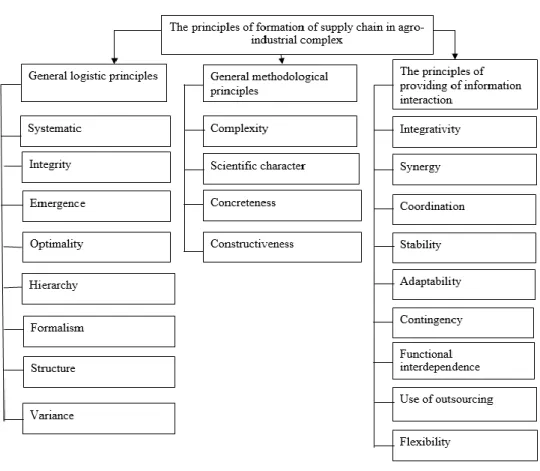
The stabilization and the development of agro-industrial sector improves its efficiency greatly, however it depends on its structural transformation by reforming and further improving the management of agricultural enterprises on the basis of logistic management techniques. In the formation of supply chains in the agricultural sector it is necessary to apply some of the principles aimed at designing the optimal structure of supply chains. They constitute a group of general logistics principles on the basis of which is the formation of supply chains in the agro-industrial sector as shown in Figure 1:
- The principle of integrity: It allows us to consider the integrated supply chain from
a position of unity, common goals and objectives for each functional area in their relationship.
- The principle of consistency: It is a set of methods and tools to explore the properties, structure and functions of business objects and processes as a whole, presenting them as systems with complex inter-relationships, mutual influence of elements on the system and on the environment, as well as the influence of the system on its structural elements.
- The principle of optimality: A characteristic feature of the formation of the supply
chain is the most suitable option of supply chain in the performance of each logistic function. It is therefore necessary to choose solutions that are the best on the complex determinants.
- The principle of emergence: The integrity of interrelated elements functioning to achieve logistics goals, or the achievement of optimum total logistics costs across the supply chain is not possible by optimizing isolated cost items.
- The principle of hierarchy: It is the presence of multiple levels in the system and
several ways of achieving the objectives of the respective levels. It is an implementation of the type of structural relations in a complex, multilevel logistic system with a large number of elements with functional differentiation, i.e., the ability to perform a certain range of logistics functions.
Figure 1. Principles of formation of supply chains in the agricultural sector
- The principle of formalization: It is aimed to obtain quantitative and the complex
characteristics of the formation of the supply chain.
- The principle of structuring: It defines the interrelated supply chain which realize
the overall objective of formation of the system of supply of agricultural products.
- The principle of variance: It involves the formation of several alternative options
when building a supply chain to choose the best of them on a set of indicators taking into account influencing factors.
- The principle of reliability: It is the property of the system to implement the specified functions during a specified period of time with specified quality parameters.
- The principle of security: It is the ability of a system not to cause unacceptable impacts to the technical facilities, the personnel and the environment during its functioning.
- The principle of resistance: It is the property of a system to perform its functions
when the parameters of the environment are beyond certain limits or tolerances. - The principle of survivability: It is the ability to change the purpose of functioning in case of refusal and (or) damage in the system components. When designing
supply chains it is necessary to use common methodological principles to all areas of scientific knowledge.
- The principle of comprehensiveness: It defines the consideration of logistics
operations, logistics functions, logistics chains in their correlation and interdependence. It ensures development of supply chains in the agro-industrial sector, given a variety of factors and certain criteria of formation.
- The scientific principle: It determines the development of methods for the
construction of integrated supply chains in accordance with the requirements of science within hardly impugnable evidence-based explanation of the legality, necessity, appropriateness (rationality, optimality) of the decision.
- The principle of specificity and robustness: It determines the adoption of logistics
solutions based on clear baseline information and reasonable methodological basis. Other features of agricultural production and as a consequence the impact of a huge number of macroeconomic and microeconomic factors affects the formation of supply chain. It is determined not only by the problem of optimization of basic elements of logistic chains but also the need for sustainable linkages between the supply chain and the ability to respond quickly to changing conditions, external and internal environment, of the organization to common goals.
The importance of the permanent modification of the supply chain in the agricultural sector is huge. In a dynamic competitive environment the product range, supply conditions and needs are changing continuously so adaptability and the possibility of restructuring the logistics chain are especially important in organizing the supply of agricultural products. A particularly important aspect of maintaining flexibility and adaptability in supply chains is information interchange between all participants in the delivery process. In this connection it is necessary to highlight the third group of principles that ensure interaction of participants of the supply chain, the application of which would maximize the consistency of implementation of logistics operations. It also parts the supply chain in a timely manner to coordinate the actions of all participants in the event of a change in environmental conditions. They include:
- The principle of integration: It is an association of supply chain participants with
the aim of organizing a balanced movement of material, information and financial flows in the line with the supply chain.
- The principle of synergy: It is a cooperation between the various elements of the logistics chain. The principle of synergies determines the effect of mutual strengthening of the links of one link in the logistics chain with the other on the level of advancement of the material and attendant flows.
- The principle of coordination: It controls the supply chain synergy based on the coordination of different operations. External coordination ensures the maintenance of mutually advantageous cooperation between participants of the supply chain using treaty and contracts on a long term basis.
- The principle of adaptability: It involves a change of objectives of the operation in
- The principle of functional interdependence: It involves ensuring consistency of execution of logistics operations of each element of the supply chain in a functional area of the supply chain and between the links executing different logistic functions which is possible in the framework of informational interaction.
- The principle of outsourcing: It involves the formation of a supply chain with the
condition of possible transfer of the execution of the logistics operations to other participants of the logistic chain in case of insufficiency of company’s potential.
- The principle of flexibility: It is a property of the system to change the purpose of
functioning depending on the conditions of operation. The basis for information exchange and the flexibility of the supply chain is the movement organization of logistics information which should meet the requirements of accuracy, availability and timeliness.
3. Results
The nature of the formation of logistic chains in the agricultural sector is largely determined by macroeconomic indicators as well as the development and status of agriculture in the region. They include:
- the gross volume of production of oil seeds and grain crops (agriculture);
- conjuncture of the market of agricultural products in the region. The volume of production of agricultural products, their nomenclature, the degree of use in agricultural production science affect the method of collection, delivery, choice of transport, conditions of storage etc.;
- economic policy of regional authorities which can stimulate or inhibit the process of pairing the economic interests of the participants of the agro-industrial sector and also defines its development priorities;
- regulatory and legal framework constituting the legal basis of the organization of agro-industrial sector and formation of economic relations between participants of the supply chain;
- the level of logistics services in the region that determines the availability of transport companies and specialized warehouses which are able to provide the whole set of related services for the delivery and storage of agricultural products; - development of transport communications which define the scheme of delivery of agricultural products.
Agriculture has a number of distinctive features that form the industry factors and affect the formation of supply chains. They include:
- the seasonal nature of agricultural production influencing the volume and nature of cargo;
- material needed for technological contingency that determines the choice of contractors providing security of supply and availability to provide additional services;
- physical characteristics of material flows which determine the method of transportation and storage conditions and thus the choice of the transport scheme and the method of storage.
Among other problems faced by the participants of the agro-industrial sector we can distinguish the change in the antagonistic relations and the formation of systems of interaction and the visibility of relationships and communications. In connection with it, the main aspects of the formation of supply chains in the agricultural sector are:
- organization of interaction of partners in the supply chain;
- coordination of logistics tasks in the work of agricultural enterprises with other goals and perspectives;
- ensuring information exchange between all participants in the procurement process. The formation of supply chain in the agro-industrial complex includes two main areas: optimizing elements of the supply chain and ensuring a coherent interaction between the links of the logistic chain. It is extremely important to create interest in the the manufacture of agricultural machinery, fertilizers, processing, storage, transport and effective marketing in agricultural products in order to decrease production costs because of the introduction of new technologies for the effective functioning of the Russian agro-industrial complex. One of the forms of ensuring this mutual interest is the formation of vertically integrated enterprises (VIE) in the form of joint-stock companies or associations, in the likeness of the existing vertically integrated oil companies (Terenina and Ukilevich, 2008).
The integration allows you to consolidate economic ties and increase incentives for the most effective final result. Also it concentrates resources on the most effective areas of technical policy, to use the most efficient system of mutual settlements, including through the use of estimated prices, an improvement in the competitiveness of the Russian producers in foreign markets, as well as the most economic solution for individual tasks of production and social infrastructure. Vertically integrated companies have significant advantages as they have the opportunity to organize activities throughout the supply chain; production of agricultural equipment, supplies of fuels and lubricants, agricultural production, infrastructure construction, processing, transportation and marketing.
In fact, competition is pushing the Russian agro-industrial complex to the creation of vertically integrated structures on a new market basis. This is the only way not only to neutralize, but at least to mitigate the effects of such negative phenomena as mutual non-payments, acute shortage of working capital, depreciation of the ruble. The vertical integration is understood as the unification of the financial and economic basis of various technologically interconnected productions. It includes businesses related to sequential stages of the process; agricultural production —
transportation — processing — distribution of finished products. Important prerequisites of such a process can be considered as the desire to master the markets of final demand and competition in the sphere of agricultural production in a fairly saturated market and a declining efficiency of investments in the financial crisis. The development of integration process in the agricultural sector might occur in various forms; direct investment with the creation of new objects in the areas of production and marketing; the acquisition of tangible and financial assets of existing enterprises (mergers, acquisitions, etc.); implementation of joint projects and formation of joint ventures.
As a result of this process the integrated enterprises are formed of two fundamentally different types. The first are enterprises which are integrated by financial sign — holding companies, not engaged in production activities, but examining many enterprises and branches. Integrated enterprises of the second type are production enterprises which are engaged in agricultural production, processing, transportation, storage and sale of finished products through its branches and specialized units.
4. Conclusions and recommendations
The most important task facing the leadership and the managerial staff of the enterprise is the mastery of the management and new management techniques in a market economy. This means to focus on demand and market needs, the needs of a specific consumer and industrial products that are in demand and can bring the planned profit; constant desire to improve the efficiency of production and sales of products with the lowest cost obtaining the best results; the economic independence providing freedom of decision to those who are responsible for results; continuous adjustment of objectives and programs, depending on market conditions; the need to use modern information technologies, including computer networks, databases, computing equipment, etc., with the purpose of carrying out multivariate and model calculations to make informed and reliable decisions.
Rational organizational structure is the most important factor in the development of vertically integrated enterprises. This type of management within the enterprise or an association of enterprises provides stability of supply, quality and low price of the final product. In addition, it is possible to increase the volume of surplus value in a vertically integrated structure. The organizational structure should be formulated in such a way to ensure the implementation of its strategy. As the strategy changes there are some needs for appropriate changes in organizational structures. Opportunities for economic growth largely depends on the choice of effective strategies of enterprises in ensuring the competitiveness of products and, consequently, high profits.
The development of effective economic, financial, and personnel policies, adequate organizational and administrative structures can bring huge benefits to any VIE and provide it with valuable competitive advantages. In contrast, the penalty of a
mistake can be very high and it has to be paid for many years. Therefore is exceptional important the development and the implemention of a long-term development strategy for the Russian VIE in the agro-industrial sector.
References:
Albekov, A., Laluiv, S. 2012. Logistics assessing forms of organization of material flow in the merchandising. Rostov, RSUE, 18-23.
Bowersox, D., Kloss, D. 2001. Logistics: integrated supply chain. M: Ltd Olympus-Business. Decree of the President of the Russian Federation. 2010. From 30th of January 2010, N
120 "About the statement of the doctrine of product safety of Russian Federation ". Available online: https://rg.ru/2010/02/03/prod-dok.html.
Mentzer, J., Min, S., Zacharia, Z. 2000. The nature of interfirm partnering in supply chain management. Journal of Retailing, Elsevier.
Otto, A., Kotzab, H. 2003. Does supply chain management really pay? Six perspectives to measure the performance of managing a supply chain. European Journal of Operational Research.
Procofieva, T., Adamov, N. 2013. Preconditions of formation and development of transport-logistic clusters «Caspian Hab». Conjuncture of trade markets, 3, 16-25.
Providing of product security of Russian Federation. 2017. Analytical messenger, 34(633). Available online: http://www.council.gov.ru
Sibirskaya, E., Yamykh, E., Eldyaeva, N., Dubrova, T. and Oveshnikova, L. 2016. Strategy of Systemic Development of Entrepreneurial Infrastructure of Regional Economy. European Research Studies Journal, 19(2), 239-262.
Terenina, I.V., Ukilevich, S. 2008. Formation of supply chain in agro- industrial sector. Rostov, RSCU.
Vovchenko, N.G., Holina, G., Orobinskiy, S. 2017. Ensuring Financial Stability of Companies on the Basis of International Experience in Construction of Risks Maps, Internal Control and Audit. European Research Studies Journal, 20(1).