pp. 753-771
Increasing Interstate Integration in the Agro-Industrial
Com-plex of the EAEU Countries
Anatoly Altukhov
1, Alexander Semin
2Abstract:
The article presents the analysis of the integration processes that are taking place in the Eurasian Economic Union (EAEU), the unified agro-food policy developed by the participat-ing countries, as well as strategic measures and mechanisms for further interstate integra-tion in the field of agro-industrial producintegra-tion.
The article pays special attention to the issues of receiving the real economic (positive) im-pact from the integration through mechanisms promoting a coordinated agrarian policy. The authors substantiate the significance of the cluster approach when creating cross-border units as one of the most effective methods of sustainable development of agricultural produc-tion in rural areas of the EAEC countries. The article proves the viability of creating joint ventures by agricultural producers and determines their basic characteristics.
Working on the paper, the authors applied traditional methods of research: dialectical (from general to particular), abstract logical, monographic ones, the method of comparative anal-ysis, and expert assessments.
The research findings can be used by the government agencies that work in the field of agro-industrial production and implement targeted complex programs for the development of ag-riculture and regulation of markets of agricultural products, raw materials and food, as well as social development of rural areas.
The material presented in the article may be of interest to managers and experts of the agro-industrial complex, scientists, post-graduate students and students exploring the development of international relations and foreign trade.
Keywords: Agricultural raw materials, competitiveness, Eurasian Economic Union, food,
integration, international trade.
JEL code: F02, F15, F53, Q17.
1 Russian Academy of Sciences, All-Russian Research Institute of Agricultural Economics.
2 Russian Academy of Sciences, Ural State Economic University, email:
1. Introduction
The modern economy is experiencing the impact of globalization which increases competition in global markets. In such context, integration has acquired significance as a special mechanism that unites companies in their struggle for survival and mar-ket leadership. Another specific feature of the world economy is a rapid transnation-alization which is interstate integration. Transnational corporations (TNCs) have become a sort of organizational embodiment of international relations that pursue the goal of private capital consolidation.
At present, the national production growth has become more dependent on the sta-bility of the world economy, the development of international trade, intensification of global economic relations resulting from economies integration and the formation of TNCs. One of the main distinctive features of the current stage of the global inte-gration development is increasing trans-border cooperation, which, for example, is rapidly expanding in the European Union and is emerging in the Eurasian Economic Union (hereinafter – the EAEU member states, the Union).
Due to historical, cultural and geographical proximity, the EAEU member states have the conditions necessary for the development of integrative cooperation in the agrarian sector of the economy and can achieve a common synergetic effect that en-sures the dynamic development of their agrarian sector of the economy through ef-fective use of the united agrarian potential. Subject matter of the study is agro-industrial production and international trade in food and agricultural raw materials by EAEU member states. Scope of the study is economic relations linked with the development of integrative cooperation between the EAEU countries in the agro-food sector of the economy. Goal of the study is to develop scientifically valid stra-tegic measures and mechanisms for further deepening and facilitating interstate inte-gration in the EAEU.
The main objectives of the study include:
- analysis of integration processes in the agrarian and agro-food spheres of the Eurasian Economic Union;
- assessment of the integration potential and competitive advantages of the EAEU member states;
- development of forms, methods and mechanisms for promoting interstate
integration, increasing the investment attractiveness of agro-industrial production and its main component – agriculture, which requires modernization and
innovative development.
The authors justified conceptual provisions related to measures and mechanisms that expand and deepen interstate integration of the Eurasian Economic Union. The paper determines the conditions that ensure the synergetic effect arising during the conver-gence of economic systems through horizontally and vertically integrated interstate
formations. The authors identified the most promising directions of agro-industrial production that increase the investment attractiveness of business entities.
2. Literature review and current state of research
Many researchers of the agrarian sector of economy focused on issues related to in-creasing competitiveness, developing integration processes, financial recovery and state support for agricultural production, improving the agricultural policy of the EAEU member states, for instance, Altukhov (2017), Ushachev et al. (2016), Maslova et al. (2018), Semin et al. (2018) and other scientists and experts working in this very specific sector.
The focus on these issues is not accidental. Issues concerning effective cooperation of the EAEU member states, alignment of the economies of the partner countries are still actively explored by many leading scientists of our time. For instance, Medvedeva, and Prokhorenko (2018), who study the problems of the development of agricultural exports by the EAEU member states, note that export of products with high added value should be diversified. Other authors identify the main factors hampering the export development and formulate some directions for promoting agricultural products and food of the EAEU member states to the food markets of third countries.
Borkhunov and Avdeev (2018) conducted a comparative analysis of the parity corre-lation of prices for agricultural and industrial products for the EAEU member states. The most favorable situation was registered in the republics of Kazakhstan and Bela-rus, which contributes to the economic development of agricultural producers. Maslova et al. (2018) focused on the factor analysis of the competitiveness of agro-food products in the EAEU member states. They estimated the competitiveness ac-cording to the price factor as the basic one. Unfortunately, they do not consider fac-tors related to modernization of agricultural production or intellectual property use. Experts studying the development of integration processes in the agrarian sector of the economy Rakhmanov and Ivoylova (2017) consider the creation and operation of agro-industrial clusters to be the most important direction in the EAEU develop-ment. The researchers identified several constraining factors, among them: poor de-velopment of organizational structures and management methods, bad transport and logistics, lack of a Eurasian strategy for entering new foreign markets for agricultur-al products and foods. Implementation of such a strategic approach will require in-troduction of large-scale innovations.
The effectiveness of formed interstate clusters is also confirmed by studies conduct-ed by Nechaev et al. (2017). They note that many countries around the world have used clusters. For instance, there are more than 2,100 clusters in the EU countries. Of this total, the agro-industrial complex makes up for 11%. Taking into account the fact that grain production is of geopolitical significance and ensures the food
securi-ty of the EAEU states, the researchers suggested creating an interstate grain cluster of Russia and Kazakhstan within the framework of integrative cooperation. This ap-proach opens up new promising areas for corporate interaction since these countries as large grain producers are largely cover their own needs in this product (Russia – 153.7%, Kazakhstan – 137.8%). The authors claim that creating a cross-border clus-ter is a necessary and viable measure. In our opinion, the creation of such a clusclus-ter is an effective way of solving problems of grain surplus in the Russian Federation and the Republic of Kazakhstan.
Also, it is worth mentioning the research papers of Semin et al. (2016) who assess the effectiveness of interaction between the economies of the EAEC states in the food trade. These researchers analyze the dynamics of foreign trade with third coun-tries and inter trade in food and agricultural raw materials, seeing trade operations as the main criteria that describe the cooperation of the EAEU partner states. The re-searchers came to the conclusion that this integrative cooperation enabled to increase inter trade and to reduce imports of food products and agricultural raw materials. These scientists pay special attention to the issues of parallel import and protection of intellectual property rights in the foreign trade of the EAEU partner states. Differ-entiating counterfeit and original agricultural products and food imports remains an urgent problem for all five countries, members of the EAEU (Armenia, Belarus, Ka-zakhstan, Kyrgyzstan, and Russia).
Studies show that the EAEU member states currently do not pay enough attention to various opinions aired by international scientists on the environmental and social responsibility of developing the agro-industrial production. This can be seen both at the level of the created union of states, and the scale of its interaction with other countries of the world (Crosson and Brubaker, 2016; Thompson, 2017).
In the modern economy, when Russian scientists propose measures aimed at ensur-ing food sovereignty, international researchers (Mathe, 2013; Sekhampu, 2013) claim that agro-industrial production should be considered not only regarding its economic efficiency, but also in terms of social responsibility. The latter implies that business entities should apply agribusiness models with low human impact on the environment (Anfinogentova et al., 2017; Aranchiy et al., 2017; Prado et al., 2014; Mathe, 2013; Sekhampu, 2013; Vertakova and Plotnikov, 2017; Burkaltseva et al., 2017; Kovalenko et al., 2016).
At the same time, most studies of the agro-industrial complex do not thoroughly consider the specific features of agricultural production (Koshkarev and Boldyrev, 2016; Marwa et al., 2017). Due to its specifics, capital is invested not only in objects created by human labor, but also in natural objects, which is obviously associated with greater risks and a longer payback period of the invested funds (Danylenko et al., 2017).
The agrarian sector implies non-standard working hours, and employees have to in-teract with living creatures, take into account the seasonal nature of work, and pay great attention to the key component of production – the land, as well as to work in the open air.
There are no studies exploring investment processes that take place in agriculture, including the subsidized territories of the EAEU countries, and their potential is not considered. Researchers have not attempted to work out a set of strategic directions and priorities for the development of the EAEU member states in the context of new challenges of the external environment. Therefore, this article focuses on the abovementioned issues.
Carrying out the research, the authors applied such general scientific methods as analysis, synthesis, logical evaluation, monographic, economic-statistical, and ab-stract-logical methods, as well as authors' original observations. They also studied the unity of qualitative and quantitative criteria that can give the most thorough as-sessment of the economic phenomenon, event and subject, and next conducted stud-ies in line with the objectives of this research.
3. Proposed methods and approaches to achieving the objectives set
The following research methods can be used to determine the factors impeding the development of forms, methods and mechanisms that enhance the effectiveness of integrative cooperation, investment attractiveness of agro-industrial production and its competitiveness in the EAEU member states: monographic (used to specify and expand the core content of processes of integrative cooperation between partner states, identify specifics of agricultural development under international economic sanctions, assess the forms, methods and mechanisms for promoting interstate inte-gration that can increase the investment attractiveness of the agro-industrial produc-tion, especially its main element – agriculture which requires modernization and in-novative development); economic-statistical (used to analyze integration processes in the agrarian and agro-food sectors of the Eurasian Economic Union, to assess the integration potential and competitive advantages of the EAEC member states); soci-ological (used to conduct a survey among heads of agricultural enterprises attracting investments and developing foreign trade cooperation); economic and mathematical (used to analyze the possibilities for developing foreign trade cooperation of the EAEU member states, to determine comparative advantages in the export of food and agricultural products).
4. Results
Having analyzed the integration processes in the agrarian sector of the economy of the Union, the authors proved that these countries receive real economic benefits from integrative cooperation by achieving the set goals, finding mutually beneficial ways of cooperation between their agrarian economies, building a mutually
benefi-cial export-oriented strategy through interaction in the sectors and sub-sectors of the agro-industrial complex that are of economic interest for these countries.
The provisions of the EAEU Agreement of May 29, 2014 imply the transition to a coordinated common, or ideally, to a unified agro-industrial policy of the EAEU member states by means of a gradual synchronization of the system of measures for state regulation aimed at the development of the agro-industrial complex. The Agreement states that reaching the objectives of the coordinated agro-industrial poli-cy means using mechanisms of interstate cooperation in the agrarian and agro-food spheres, international trade, as well as developing technical and human potential, information support and other areas of integrative cooperation (Treaty on the Eura-sian Economic Union, 2014).
The integrative potential and competitive advantages in the agrarian sector of the economy of each country and the Union as a whole can be more fully utilized only if they avoid mutual competition in specialized niches. On the one hand, this also im-plies that it is possible to facilitate interstate integration boosting innovative devel-opment of promising sectors of the agro-industrial complex, to ensure the growth of inter trade in agro-industrial products in the Union market and to substitute imports from the third countries.
On the other hand, this enables to take advantage of the efficient territorial and sec-toral division of labor in the Union's agro-industrial production, which is of crucial importance for increasing the production of food, agricultural products, and raw ma-terials, as well as attracting new resources for expanding trade between the EAEU member states and exports to third countries (Altukhov, 2017; Ivanova and Seregin, 2016).
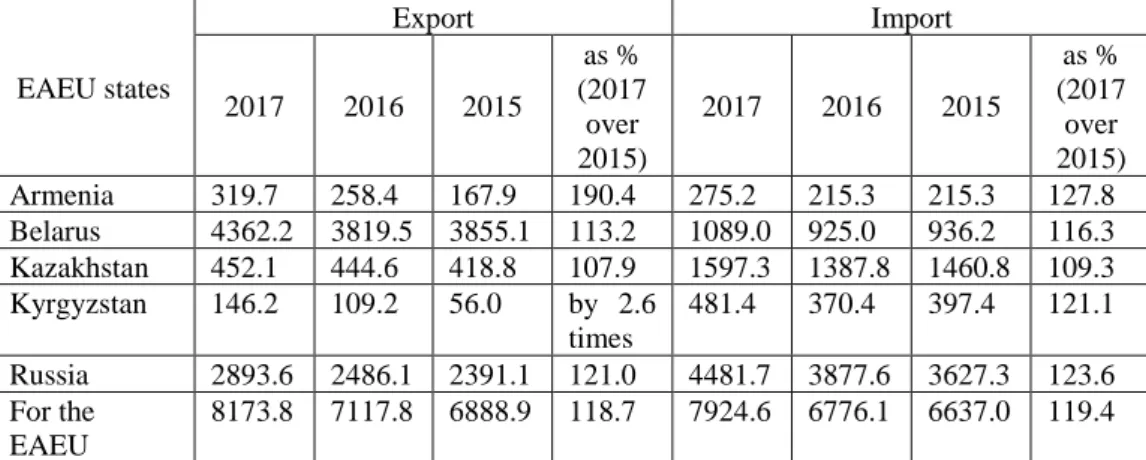
By present, the EAEU member states have already significantly increased the volume of food and agricultural raw materials exports within the framework of integrative co-operation (Table 1).
The volume of export in the inter trade of the EAEU member states in food and agri-cultural raw materials increased by 18.7% in 2017 as compared to the results of 2015 and amounted to USD 8,173.8 mln. Kyrgyzstan demonstrated the highest growth rate for this indicator – this integration partner exported through inter trade 2.6 more products (Table 1).
The analysis of exports by groups of goods depending on their destination also indi-cates an increase in exports for each group. For instance, the export of investment goods increased by 34.9% compared to January-December of 2016. The exports of intermediate goods grew by 28.9%, and consumer goods – by 22.2%.
Table 1. Export and Import of Food and Agricultural Raw Materials in the Inter
Trade of the EAEU Member States, USD mln (2015-2017)
EAEU states Export Import 2017 2016 2015 as % (2017 over 2015) 2017 2016 2015 as % (2017 over 2015) Armenia 319.7 258.4 167.9 190.4 275.2 215.3 215.3 127.8 Belarus 4362.2 3819.5 3855.1 113.2 1089.0 925.0 936.2 116.3 Kazakhstan 452.1 444.6 418.8 107.9 1597.3 1387.8 1460.8 109.3 Kyrgyzstan 146.2 109.2 56.0 by 2.6 times 481.4 370.4 397.4 121.1 Russia 2893.6 2486.1 2391.1 121.0 4481.7 3877.6 3627.3 123.6 For the EAEU 8173.8 7117.8 6888.9 118.7 7924.6 6776.1 6637.0 119.4
Source: Compiled using Eurasian Economic Commission, 2018.
Integration processes in the agro-industrial complex over the economic space of the Eurasian Economic Union should pursue the goal of implementing the relevant pro-visions of its Agreement and the Concept of Agreed (Coordinated) Agro-Industrial Policy of Member States in key sectors of the agro-industrial complex, creating a good competitive environment and ensuring the effective development of the unified agrarian market.
The activities of the Union facilitated creating additional macroeconomic conditions for the sustainable development of its agribusiness sectors through:
- devising a regulatory legal system of measures, including the Concept of Agreed (Coordinated) Agro-Industrial Policy of the EAEU Member States, as well as the Decree "On the methodology for estimating consolidated forecast balance of de mand and supply of the EAEU member states for agricultural products, foods, flax fiber, cotton fiber and wool", which allowed to apply efficient mechanisms for regulating and monitoring the development of agro-industrial complex and rural areas at the interstate level;
- improving the system of state support measures in compliance with the principles formulated in Annex No. 29 "Protocol on state support to agriculture" of the Trea ty on the Eurasian Economic Union of the Republic of Belarus, the Republic of Kazakhstan and the Russian Federation (Section 25 "Agro-industrial complex"); - ensuring equal access of domestic producers to the single agrarian market, main training fair competition between its economic entities, unifying the requirements to the products turnover (Appendix No. 19, "Protocol on general principles and rules of competition"), protecting economic interests of producers in the domestic and external markets, establishing uniform requirements and rules for veterinary and phytosanitary certification (Annex No. 9 "Protocol on technical regulation within the Eurasian Economic Union", Annex No. 12 "Protocol on the application
of sanitary, veterinary and quarantine phytosanitary measures");
- expanding the borders of the Union, and, consequently, using wider opportunities for the export potential of the agricultural sectors of its countries (Annex No. 6 "Protocol on unified customs and tariff regulation", Annex No. 7 "Protocol on measures of non-tariff regulation for third countries").
A key condition for stable economic growth of the EAEU member states is creating and developing an effective economic system and an adequate institutional environ-ment, a range of growing and competitive domestic transnational companies acting as their basis. In this regard, for example, it will be viable to use the experience of developing integration processes accumulated by the Euro-regions in the European Union (Eurasian Economic Commission, 2014; Alekneviciene et al., 2018; Gorb et al., 2017).
When creating cross-border units, it is feasible to use the cluster approach as one of the most effective methods of socio-economic development and a way to increase the competitiveness of national agribusinesses and interstate integration groups. For example, cross-border units can be used to develop joint projects in agribusiness: production and marketing of agricultural products; establishing joint ventures for production, storage and processing of agricultural products, agricultural machinery, etc.; creating logistics centers; developing innovative technologies; building export infrastructure.
To implement priority joint projects in cross-border regions, the following condi-tions should be met:
- concluding interstate agreements on the creation of cross-border regions, as well as building the necessary regulatory framework for cross-border and interstate cooperation of the EAEU member states;
- creating agencies and devising a joint strategy for the development of cross-border territories which should outline the main areas of cooperation for each cross- border region;
- developing and approving priority projects by the government agencies of the cross-border region that should be implemented on a competitive basis;
- devising a system of funding through joint funds, attracting private investment and grants;
- creating systems for monitoring and information support.
As a rule, in the EAEU member states, agricultural producers create joint ventures (JVs) on a voluntary basis and mutual agreement of the parties, except entities with partial or full state participation. The JV members do not have any economic privi-leges compared to other legal associations. There are two main legal forms in the Eurasian economic space. The first one is when contracting parties invest into joint physical capital or joint infrastructure to promote their products to the market (Semin et al., 2018).
The second form of association, unlike the first one, does not deal with physical cap-ital of companies, but only aims at consolidating funds and coordinating the activi-ties of the entiactivi-ties of participating countries in the promotion of goods in the world market. The second form of association is better applicable to such a typical com-modity as grain.
Medium and large producers of agricultural products seek for ways to expand or di-versify production as they reach full utilization of existing production capacities or saturate the market with their products. While they consider the first task as tech-nical and most often solve it applying proven technological solutions, the second one implies finding and applying fundamentally new ideas, which requires significant financial resources that exceed the volume of free own resources for launching new product lines (Benesova et al., 2017; Gorb et al., 2016).
Creating agrarian clusters should be mentioned as one of the most important aspects of improving the effectiveness of integrative cooperation. The EAEU has great po-tential for building such structures, which can be explained by long-standing produc-tion and technological links in all branches of the agro-industrial complex. At the same time, when developing cluster initiatives and creating agrarian clusters, it is advisable to use the project approach accounting for the comparative advantages of the Union countries, primarily geographical, natural-resource and transport-logistic ones. Special attention should be paid to the quality of agricultural products deter-mined by attracting investments, using advanced technological solutions, and devel-oping logistics, as well as spotting weak sides which is done through value chain analysis.
The Union cannot objectively expand or deepen integration without modern transport and logistics infrastructure that allow creating new industries, labor mobili-ty, and increase transit traffic over the Union's territory through the system of inter-national transport corridors. For example, the main advantage of transit corridors over the territory of Kazakhstan is that transport connection between Europe and China via Kazakhstan is much faster in comparison with the sea route (by 35 days), as well as is shorter by a thousand kilometers if compared with transit through the Russian territory. The development of the Eurasian commodity distribution network of agricultural products, raw materials and foods will allow a 3-5% increase in the volume of trade in the agrarian sector of the economy between the member states, and a 13-17% reduction in average wholesale purchasing prices of agricultural prod-ucts by reducing the number of intermediaries (Ushachev et al., 2016).
Flexible tariff policy for transportation of agro-food products will facilitate the de-velopment of inter trade in the Union. This aspect must be considered when prepar-ing joint interstate programs for export development.
- to assess the condition of the main facilities of the Union's trade and export infra structure, to assess its compliance with modern requirements and, taking this into account, to make a list of the most important infrastructure facilities that need to be put into operation, regarding their integration into the Silk Road Economic Belt; - to unify the common tariff policy aimed at developing unimpeded inter trade, ex port and transit of goods, as well as to ensure the agreement of standards in the transport sector, convergence of transport and transit tariffs;
- to carry out a coordinated investment policy for realizing the transit potential, to modernize the border infrastructure and modern logistics centers.
To develop inter-state integration of the EAEU, it seems viable to encourage the cre-ation of logistic schemes that enable to reduce transaction costs, transportcre-ation and storage costs for the whole distribution chain, and to enhance the interaction of eco-nomic entities. In addition, it is necessary to unify and converge ecoeco-nomic condi-tions to eliminate the excessive interference of state bodies in the activities of eco-nomic entities, to abolish or eliminate unreasonable administrative barriers, to de-velop a unified system of state support and to provide equal competition conditions for all agricultural producers (Avdonin, 2018).
Building the commodity distribution network of agricultural products, raw materials and foods within the EAEU member states will enable to implement complex measures for the delivery of agricultural products, raw materials and food, to create interstate exchange trading structures, risk insurance, bank lending and guarantees for the convergence of uniform laws and regulations, creating a single information space and unified electronic technologies to support transactions, and thereby pro-moting the overall food security of the Union.
As economic systems are becoming closer interlinked, it will become necessary to create horizontally and vertically integrated interstate unions. They should be ex-port-oriented and import-substituting and facilitate competitive specialized produc-tion, scientific and innovative potential, and promoting products to the Union's mar-ket and the marmar-ket of third countries. For example, it is possible to create intergov-ernmental entities specializing in the production of certain types of food products and agricultural raw materials: between Russia and Kazakhstan –wheat, sunflower oil, cattle meat and poultry; between Belarus and Russia – rye, buckwheat, pork and sugar made from sugar beet; between Belarus, Russia and Kyrgyzstan – dairy prod-ucts; between Kazakhstan and Armenia – vegetables and fruits. In addition, Belarus, Armenia and Russia have a scientific and technological potential to produce almost the entire range of baby food.
In recent years, there have been a number of significant changes in Russia's trade policy, firstly, the integration association of the EAEU was extended with two new partners: Armenia and Kyrgyzstan have become the Union's full members; secondly, it refers to the introduction of the embargo on the import of food from the USA and the EU; thirdly, the policy of import substitution is being implemented. To assess the
impact of these factors on the development of foreign trade cooperation of the EAEU member states, we carried out special mathematical calculations of the index of comparative advantage using the Balassa index (Balassa, 1965).
The index is calculated by the formula:
RCA = (Xij / Xit) / (Xnj / Xnt) = (Xij / Xnj ) / (Xit / Xnt), (1) where:
Х is export,
i is the country under study,
j is the commodity (or the industry),
t is a set of commodities (or industries) and n is a country.
Applying the Balassa index, it is possible to obtain indices describing the compara-tive export advantages of a commodity (industry). If the index has a value greater than 1, then the country under study has a proven comparative advantage for the ex-port of a commodity, which in turn demonstrates its competitiveness (Bludova, 2016; Bondarev, 2016; Mariev et al., 2014). In the last three years (2015-2017), the EAEU states showed an increase in the export of food products and agricultural raw materials (by 7.1% to the base year of 2015), timber and pulp-and-paper products (by 22.4%), as well as textile, textile goods and footwear (by 29.3%).
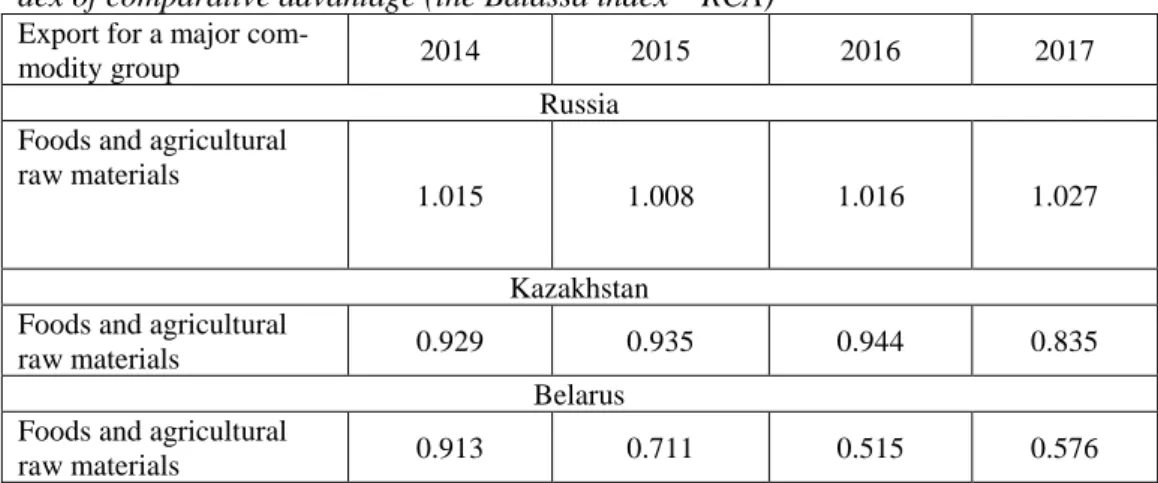
Among the EAEU member states, Russia has comparative advantage in the export of such a major commodity group as food products and agricultural raw materials. Es-timates suggest that the index of comparative advantage for this group has been steady for several years and is over 1 (in 2017 it was 1.027). It should be noted that Russia also has an index exceeding 1 in the export group "Machinery, equipment and vehicles". The Republic of Belarus demonstrated a large volume of export to third countries (according to the results of 2017). For instance, the Balassa index of comparative advantage for textile, textile goods and footwear is 7.989; chemicals – 3.625; machinery, equipment and vehicles – 2.264. Belarus lags Russia regarding foods and agricultural raw materials, with the index estimating only 0.576. Kazakh-stan also is slowly increasing the export component for this indicator, with the Balassa index decreasing by 0.019 in 2017 as compared to 2016 and estimating 0.835 (Table 2).
Table 2. Estimation of the export from Russia, the Republic of Kazakhstan and the
Republic of Belarus to "third countries" for a major commodity group using the in-dex of comparative advantage (the Balassa inin-dex – RCA)
Export for a major
com-modity group 2014 2015 2016 2017
Russia Foods and agricultural
raw materials
1.015 1.008 1.016 1.027
Kazakhstan Foods and agricultural
raw materials 0.929 0.935 0.944 0.835
Belarus Foods and agricultural
raw materials 0.913 0.711 0.515 0.576
Source: Compiled and calculated by the authors using Eurasian Economic Commission,
2018.
As for relatively new partners in the union – Armenia and Kyrgyzstan, the conduct-ed studies show that the obtainconduct-ed indices of comparative advantage for foods and agricultural raw materials (3.54 and 1.40, respectively) convincingly demonstrate the potential for further development of agro-industrial production in these EAEU member states. The share of Armenia and Kyrgyzstan's exports of foods and agricul-tural raw materials to third countries as of the end of 2017 to the total volume of this major export group of the EAEU member states estimated only 1.99% (with export-ed products worth USD 410.2 mln). Russia's export of this major commodity group for the same period amounted to USD 17,812.0 mln.
The Union has significant agrarian potential and is capable of attracting investment, creating and managing joint innovative projects aimed at the development of dairy and beef cattle breeding, vegetable and fruit farming, viticulture, modernization and construction of new food factories and feed mills, construction of fruit and vegetable stores, establishment of wholesale distribution centers, selection-genetic and breed-ing-seed centers, development of new veterinary vaccines and crop protection chem-icals (Forecast of scientific and technological development of the agro-industrial complex of the Russian Federation for the period up to 2030: main provisions, 2016).
A number of investment projects are to be implemented, which will improve the processing of dairy raw materials and increase the competitiveness of the final prod-uct. Talking about promising directions of innovative development regarding milk and dairy products over the territory of the EAEU, one should mention investment projects that would enable to increase the production of high-quality dairy raw mate-rials.
To increase the export of meat and meat products, it is necessary to develop further cooperation and specialization of the countries, using their strong points in the pro-duction of particular types of meat and meat products. For example, as for their spe-cialization, Belarus focuses on the export of beef and poultry, Kazakhstan – beef, Russia – poultry and pork, Armenia and Kyrgyzstan – mutton. It is also crucial to create a unified meat products positioning system for the Union and their promotion to the markets of third countries (Tashbaev and Abdiev, 2016; Shpak and Bashko, 2016; Gorb et al., 2017).
The Union has not developed a single mechanism for supporting the production of fruits and products produced from these, despite the similarity of certain measures aimed at reducing the cost of material and financial resources, stimulating invest-ment in the creation of new orchards. To promote the EAEU cooperation ties in the fruit production and processing, it is advisable to develop and implement a mutual program for improving this production that should be based on unified mechanisms for supporting producers. At the same time, the model of interstate unions in fruit production and products of its processing is created on the basis of certain factors: natural conditions for successful cultivation of fruits and berries; long experience and skills in growing various types of fruits and berries, the largest share of perennial plantations being occupied by fruits and berries.
Interstate cooperation in the field of fruit production and processing can be effective in the following directions:
- increasing production and improving the quality of fruits, products of its processing, expanding the range of competitive fruit products;
- increasing the load of farms specializing in the cultivation of different types and varieties of fruits, increasing the production capacity of fruit processing enterprises the infrastructure of post-harvest processing;
- building effective schemes for establishment and specialization of fruit farming, preparing and implementing the unified program for its development;
- coordinating scientific activities, joint research in the field of fruit farming and processing;
- fulfilling the export potential of fruit farming by the EAEU member states in the markets of third countries through joint marketing infrastructure.
Promising investment projects for the development of sugar beet production and sugar obtained from it in the Union include increasing the variety assortment of sug-ar beet seeds, modernization of planting, processing and hsug-arvesting of sugsug-ar beets, and development of high-quality equipment for sugar plants.
To further develop the export potential of the fat and oil industry, it is necessary to apply the model of innovative development, as well as new forms of public-private partnership on the basis of technological platforms (Altukhov, 2017; Baklakov and Alekseev, 2015; Popova et al., 2018).
Technical and technological modernization of agriculture is a key element in im-proving the competitiveness of agrarian products of the EAEU member states. To solve this incredibly challenging task, it is viable to create a structure and manage-ment system that would ensure monitoring of the technical condition of agro-production that the countries belonging to the integrative union have. Other relevant measures include forecasting, organizing and controlling processes of recovery and development of technical capacity.
The created organizational and economic mechanism should be open to innovations, allow the modernization and development of tractor and agricultural machinery, en-sure the interconnection between government agencies, science, financial institutions and organizations that produce agricultural machinery and equipment on the territory of the Union, as well as agricultural entities – the core of this mechanism (Polukhin, 2014a; 2014b).
At present, the EAEU member states see Russia as a country with a significant mar-ket capacity for agricultural machinery, spare parts and agro-technical services. Un-fortunately, Russia has not recovered its technical potential in the agrarian sector of the economy yet and has not used its competitive advantage in the development of domestic agricultural machinery. Considering the created model range and market niches covered by machinery demonstrate that Russian mechanical engineering can-not meet all the needs. This explains the importance of investments in the develop-ment of models that allow filling the import-dependent niches of the market (Polu-khin, 2018).
Belarus occupies key positions in the agricultural machinery market, being its sup-plier to foreign markets, and keeps its market fairly closed. Kazakhstan represents an undeveloped market niche in the agricultural machinery market. Armenia and Kyr-gyzstan can form market niches; however, they should carry out technical moderni-zation by renovating run-down equipment.
On the one hand, when creating and managing joint ventures for the production of agricultural machinery, it is fairly important to assess the technical facilities of agri-culture from the perspective of the state, agricultural producers, machinery produc-ers and suppliproduc-ers. On the other hand, only by assessing the availability of machinery, quantitative and price indicators of the agricultural machinery market, one can draw objective conclusions about development trends and make an informed management decision concerning technical modernization of agriculture.
However, when we assess technological infrastructure from the perspective of ma-chinery producers, we can see that in this case the emphasis is placed on the evalua-tion of the level of producevalua-tion competitiveness, resource intensity, energy intensity, and costs. Moreover, it is important to assess the synergetic effect from using pro-duction capacities of the EAEU producers and the degree of protectionism in the market.
5. Discussion
In contrast to the papers studied and the findings of other authors (Bondarev, 2016; Glotova and Osinina, 2016; Drobot et al., 2017; Zayats, 2014; Ratushnyak, 2018; Rakhmanov and Ivoylova, 2017; Sarkisov, 2009), this article aims to analyze the integration processes occurring in the Eurasian Economic Union, the developed uni-fied agro-food policy of the member states, as well as strategic measures and mech-anisms for further intergovernmental integration in the field of agro-industrial pro-duction. In this research special attention was paid to the issues related to achieving really economic (synergetic) benefit from integration through the mechanisms ensur-ing coordinated agrarian policy of the EAEU member states.
The authors identified factors that reduce the effectiveness of integrative coopera-tion. First, until now the states have not worked out a single agrarian policy and the concept of collective food security. Second, national schemes of the territorial-sectoral division of labor in agro-industrial production have not been proposed. Third, the approved draft of the export policy for foods and agricultural raw materi-als has a number of gaps and should be revised. Fourth, regulatory documents aimed at the implementation of goods turnover procedures on the EAEU territory should be simplified by means of digital technologies. Fifth, the states should consistently move to a unified methodology for providing state support to agricultural producers. The most significant research results in comparison with other studies include the identification of comparative advantages in the export of foods and agricultural raw materials of the EAEU member states that function in the context of increasing competition, embargoes, economic sanctions and import substitution policies. The authors justify the need for using the cluster approach when organizing trans-border unions and see it as one of the most effective methods for sustainable devel-opment of agricultural production in rural areas of the EAEU countries. The paper considers the viability of establishing joint ventures by agricultural producers, as well as their basic characteristics. The authors propose ways of creating and devel-oping transport and logistics infrastructure which would facilitate the implementa-tion of interstate programs for export development within the framework of a flexi-ble tariff policy.
There are some issues that require further study: for instance, challenges of forming a single market of organic products, and application of digital technologies in the agrarian sector of the economy of the EAEU member states.
6. Conclusion
Having studied the economic relations in the field of integrative cooperation devel-opment between the EAEC countries in the agro-food sector of the economy, the authors obtained the following results.
They justified the necessity and relevance of more effective and deep integrative cooperation of the EAEU member states in the agrarian and agro-industrial sectors of the economy. At the same time, it is noted that a coordinated strategy for develop-ing integration units should imply the rational use of all types of resources and intel-lectual potential, ensuring the introduction of innovations in agricultural production, sustainable development of rural areas, and increasing the states' share in the interna-tional division of labor.
It was shown that the development of interstate integration in the agrarian sector of the Union's economy should be gradual. When starting work on a unified agrarian policy, the EAEU member states should pay special attention to ensuring the harmo-nious development of the agro-food market and the market of the production means. The countries should focus on the creation of trade and logistics associations pro-moting foods and agricultural raw materials, which would accelerate and facilitate trade turnover in the agrarian sector of the economy, increase the goods competi-tiveness in the Union and external agro-food markets through efficient marketing and logistics support.
The paper proposes specific forms, methods and mechanisms that can attract and intensify the inflow of investment and financial resources into agro-industrial pro-duction. The authors determine promising directions for attracting investments aimed at the creation of new high-tech markets within the Union. These are linked with the production of high-tech types of crop and livestock goods, creation of new varieties and hybrids of crops, development of antiviral drugs for livestock and crop protection products, food biotechnology systems and synthetic biology.
The research theoretically substantiates and experimentally confirms the effective forms, methods and mechanisms that promote interstate integrative cooperation and the inflow of investment and financial resources into the agro-industrial production of the EAEU member states. The findings can be used by the management and ex-perts of the agro-industrial complex at various levels when preparing programs of agricultural development and regulation of markets of agricultural products, raw ma-terials and food, as well as social development of rural areas.
The material presented in this article can be used by managers and experts of gov-ernment agencies in the agro-industrial complex when developing, adjusting and improving agro-food policy, as well as by scientists, post-graduate students and stu-dents exploring the issues of the world economy and international relations.
Acknowledgement:
The article was prepared with the financial support of the Russian Foundation for Basic Research within the scientific project No. 17-02-00327.
References:
Alekneviciene, A., Stareviciute, B., Alekneviciute, E. 2018. Evaluation of the efficiency of European Union farms: a risk-adjusted return approach. Agricultural Economics, 64, 241-255.
Altukhov, A.I. 2017. Territorial and sectoral division of labor in agro-industrial production as the basis for inter-state integration in the agrarian sector of the economy of the Eurasian economic union. Agro-Food Policy of Russia, 10(70), 2-10.
Anfinogentova, A.A., Dudin, M.N., Lyasnikov, N.V., Protsenko, O.D. 2017. A technique for assessing the quality of the activities of enterprises of the agro-industrial complex on the basis of an ecologically responsible approach. The Economy of the Region, 13(2), 579-590.
Aranchiy, V., Makhmudov, H., Yasnolob, I., Radionova, Ya. 2017. The developing of con-ceptual foundation of the process of organizing innovation activities at agro-industrial enterprise based on outsourcing and the program business process model and notation. Economic Annals-XXI, 165(5-6), 84-89.
Avdonin, A. 2018. What should be done to accelerate the integration of the Eurasian Eco-nomic Union. Available at:
https://www.sonar2050.org/publications/ekonomicheskie-itogi-eaes-integracii-20152017-gg-i-perspektivy-20182020-gg/.
Baklakov, P.A., Alekseev, S.I. 2015. The system of bans and restrictions in the foreign goods trade of the Eurasian Economic Union member states. Moscow, Russian Customs Academy.
Balassa, B. 1965. Trade liberalisation and revealed comparative advantage. The Manchester School of Economic and Social Studies, 33, 99-123.
Benesova, I., Maitah, M., Smutka, L., Tomsik, K., Ishchukova, N. 2017. Perspectives of the Russian agricultural exports in terms of comparative advantage. Agricultural Eco-nomics, 63(7), 318-330.
Bludova, S.N. 2016. Evaluation of the dynamics of comparative advantages in the external trade of the EAEU countries. Bulletin of the North Caucasus Humanitarian Insti-tute, 1(17), 30-34.
Bondarev, I.I. 2016. EAEU: comparative advantages for Russia and the member states. Prob-lems and Prospects of Economy and Management: materials of the 5th Interna-tional Scientific Conference. St. Petersburg, 53-57. Available at:
https://moluch.ru/conf/econ/archive/219/11486/.
Borkhunov, N., Avdeev, M. 2018. Price parity in the agro-industrial complex of Russia and the EAEU member states. Agro-Industrial Complex: Economy, Management, 3, 60-68.
Burkaltseva, D.D., Sivash, O.S., Boychenko, O.V., Savchenko, L.V., T.N. Bugaeva, T.N., Zotova, S.A. 2017. Realization of Investment Processes in the Agricultural Sector of the Digital Economy. European research Studies Journal, 20(4B), 366-379. Crosson, P.R., Brubaker, S. 2016. Resource and Environmental Effects of U.S. Agriculture.
New York, Routledge.
Danylenko, A., Satyr, L., Shust, O. 2017. Price parity in the agricultural sector as a guarantee of the national food security. Economic Annals-ХХI, 164(3-4), 61-64.
Drobot, E.V., Abrosimova, A.S., Savitskaya, K.S. 2017. The influence of sanctions on the formation of the Eurasian Economic Union. Economic Relations, 7(1), 55-64.
Eurasian Economic Commission. 2014. Analysis of strategies for integrative cooperation (models for the implementation of the integration potential) of the world's best-known integration associations. Moscow.
Eurasian Economic Commission. 2018. Analytical materials. Available at:
http://www.eurasiancommission.org/ru/act/integr_i_makroec/dep_stat/tradestat/an alytics/Pages/default.aspx.
Forecast of scientific and technological development of the agro-industrial complex of the Russian Federation for the period up to 2030: Main provisions. 2016. Available at:
https://issek.hse.ru/data/2016/05/25/1131427693/Основные%20направления%20
Прогноза%20АПК.pdf.
Glotova, I.N., Osinina, A.Yu. 2016. Agro-insurance in the EAEU states as an element of the single agrarian market: common points. Economics of Agricultural and Processing Enterprises, 11, 66-70.
Gorb, O., Yasnolob, I., Dedukhno, A., Kaliuzhna, Yu. 2017. The formation of the manage-ment system of ecological, social, and economic developmanage-ment of rural territories using the experience in European Union. Journal of Environmental Management and Tourism, 8(3), 516-528.
Gorb, O.O., Yasnolob, I.O., Protsiuk, N.Y. 2016. Organizational-economic mechanism of management of food industry enterprises competitiveness. Annals of Agrarian Science, 14(3), 191-195.
Ivanova, V.N., Seregin, S.N. 2016. Intertrade of the EAEU member states with countries of free trade zones and their export potential. Economics of Agricultural and Pro-cessing Enterprises, 1, 27-31.
Koshkarev, I.A., Boldyrev, A.V. 2016. Planning and state regulation as tools for eliminating disproportionality in agriculture development. Economics of Agricultural and Pro-cessing Enterprises, 1, 32-38.
Kovalenko, E.G., Yakimova, Y.O., Avtaykina V.E. and Zaytseva, O.O. 2016. Problems and Mechanisms of Sustainable Development of Rural Areas (at the example of the Republic of Mordovia). European Research Studies Journal, 19(3) Part A, 110-122.
Mariev, O.S., Naberezhneva, E.P., Tatarkin, A.I. 2014. The main optimization directions for the sectoral structure of Russia's foreign trade through the assessment of compara-tive advantages. Humanitarian and Social Sciences, 5, 22-40.
Marwa, T., Bashir, A., Azwardi, M., Adam, M., Thamrin, H.M.K. 2017.
Market Integration of Agricultural Products. International Journal of Economics & Business Administration, 5(2), 69-82.
Maslova, V., Zaruk, N., Avdeev, M. 2018. Factor analysis of the competitiveness of agro-food products in the EAEU member states. Agro-industrial Complex: Economics, Management, 4, 75-85.
Mathe, K.M. 2013. Agricultural Growth and Food Security: Problems and Challenges Inter-national. Journal of Research in Commerce, Economic & Management, 7(3), 131-137.
Medvedeva, N., Prokhorenko, O. 2018. Increasing export of agricultural products as an im-portant direction of agrarian policy of the EAEU member states. Agro-industrial Complex: Economics, Management, 2, 74-81.
Nechaev, V.I., Mikhaylushkin, P.V., Slepneva, T.N. 2017. New approaches to advanced grain processing by forming an interstate cluster (Russia-Kazakhstan). Economics of Agricultural and Processing Enterprises, 9, 52-55.
Polukhin, A.A. 2014a. Organizational and economic mechanism of technical modernization of agriculture. Doctoral Thesis. Moscow.
Polukhin, A.A. 2014b. Problems of techniсal and engineering modernization of agriculture of Russia in conditions of the WTO membership and the Eurasian Economic Union.
Bulletin of Orel State Agrarian University, 50(5), 12-18.
Polukhin, A. 2018. Economic evaluation of the export potential of Russian agricultural ma-chine engineering. Agro-industrial Complex: Economics, Management, 2, 15-21. Popova, L., Dosova, A., Litvinova, T., Rogachev, A. 2018. Mechanism of public-private
partnership for developing infrastructure support of the Russian market of agricul-tural machinery. Agro-Industrial Complex: Economics, Management, 3, 37-44. Prado, J.R., Segers, G., Voelker, T., Carson, D., Dobert, R., Phillips, J. 2014. Genetically
Engineered Crops: From Idea to Product. Annual Review of Plant Biology, 65, 769-790.
Rakhmanov, A., Ivoylova, I. 2017. Clustering of the agro-industrial complex as the crucial element in the development of Eurasian integration in the agrarian sphere. Agro-Industrial Complex: Economics, Management, 10, 74-81.
Ratushnyak, E.S. 2018. Modern measures for protecting the internal market of the EAEU. Scientific Review: Theory and Practice, 4, 20-21.
Sarkisov, V.B. 2009. State support priorities for parties of foreign trade in the conditions of economic instability. Bulletin of the Institute of Friendship of Peoples of the Cau-casus. Economic Theory and National Economy Management, 2(10), 104-108. Sekhampu, T.J. 2013. Determinants of the Food Security Status of Households Receiving
Government Grants in Kwakwatsi, South Africa. Mediterranean Journal of Social Sciences, 4(1), 147-153.
Semin, A., Kibirov, A., Rassukhanov, U. 2018. Problems and Main Mechanisms to Increase Investment Attractiveness of Agricultural Production. European Research Studies Journal, 21(2), 378-400.
Semin, A.N., Kovalev, V.E., Falchenko, O.D. 2016. Interaction of the EAEU economies in the trade in food products: Problems of integration within the intellectual property market. Economics of Agricultural and Processing Enterprises, 8, 10-17.
Shpak, A.P., Bashko, A.Yu. 2016. Import substitution in the agro-industrial complex of the Republic of Belarus. Economics of Agricultural and Processing Enterprises, 1, 23-26.
Tashbaev, A.M., Abdiev, M.Zh. 2016. Analysis and evaluation of the development of the food and processing industry in the Kyrgyz Republic. Economics of Agricultural and Processing Enterprises, 4, 65-68.
Thompson, P.B. 2017. The Spirit of the Soil: Agriculture and Environmental Ethics. London, Routledge.
Treaty on the Eurasian Economic Union. 2014. Available at:
https://www.alta.ru/tamdoc/14bn0044/.
Ushachev, I.G., Tarasov, V.I., Ivoylova, I.V., Osinina, A.Yu., Chikanova, Yu.A. 2016. As-sessment of the role of food commodity distribution network of the EAEU for eastern and western partners. Agro-Industrial Complex: Economics, Management, 10, 4-12.
Vertakova, Yu., Plotnikov, V. 2017. Problems of sustainable development worldwide and public policies for green economy. Economic Annals-ХХI, 166(7-8), 4-10. Zayats, A. 2014. "Politics was put ahead of the economy". What are the benefits of the