Work in Progress: Security Force
Development in South Sudan
through February 2012
By John A. Snowden
Copyright
Published in Switzerland by the Small Arms Survey
© Small Arms Survey, Graduate Institute of International and Development
Studies, Geneva 2012
First published in June 2012
All rights reserved. No part of this publication may be reproduced, stored in a retrieval system, or transmitted, in any form or by any means, without prior permission in writing of the Small Arms Survey, or as expressly permitted by law, or under terms agreed with the appropriate reprographics rights organi-zation. Enquiries concerning reproduction outside the scope of the above should be sent to the Publications Manager, Small Arms Survey, at the address below. Small Arms Survey
Graduate Institute of International and Development Studies
47 Avenue Blanc, 1202 Geneva, Switzerland
Series editor: Emile LeBrun
Copy-edited by Clar Ni Chonghaile
Proofread by Donald Strachan ([email protected])
Typeset in Optima and Palatino by Richard Jones ([email protected]) Printed by nbmedia in Geneva, Switzerland
Contents
Acronyms and abbreviations ...5
Executive summary ...6
I. Assessing the conditions for security force development ...9
External security threats 9
Internal security threats 11
Implications for security sector reform 12
II. The evolving national security architecture ...14
Policy-driven developments 14
Event-driven developments 16
III. SPLA developments and the need for ‘mindset transformation’ ...18
Organizational changes 18
Salaries and force size 19
Division/sector structure 20
Prospects for DDR 22
Changing mindsets/doctrinal shift 24
IV. SSPS development: the highest priority? ...26
Origins and initial structure 26
Force size and recruitment 27
Leadership and salaries 27
Organization 29
Transformation planning 30
International assistance 32
V. The roles of other organized forces: a reserve force? ...35
The Prisons Service 35
The South Sudan Wildlife Service 37
Conclusion ...39
Endnotes ...41
Acronyms and abbreviations
COGS Chief of general staff
CPA Comprehensive Peace Agreement
DCOGS Deputy chief of general staff
DDR Disarmament, demobilization, and reintegration
DIGP Deputy inspector general of police
DRC Democratic Republic of Congo
GoS Government of Sudan
GoSS Government of South Sudan
IGP Inspector general of police
JIU Joint Integrated Unit
JOC Joint Operation Centres
LRA Lord’s Resistance Army
NISS National Intelligence and Security Service
NSS National Security Service
RSS Republic of South Sudan
SAF Sudan Armed Forces
SPLM/A Sudan People’s Liberation Movement/Army
SPLM-N Sudan People’s Liberation Movement-North
SSDF South Sudan Defence Forces
SSDM/A South Sudan Democratic Movement/Army
SSDP South Sudan Development Plan
SSLM/A South Sudan Liberation Movement/Army
SSPS South Sudan Police Service
SSR Security sector reform
SSWS South Sudan Wildlife Service
UNISFA United Nations Interim Security Force for Abyei
UNMIS United Nations Mission in Sudan
Executive summary
This paper represents research and analysis current as of 15 February 2012. It does not account for later developments, including the SPLA’s capture of Heglig in April 2012, or its implications.
The security forces of the Government of South Sudan (GoSS) are engaged in reform and development processes to improve their ability to respond to current and emerging threats, while facing a lack of resources and growing pressures to be more professional, affordable, and accountable. The objectives, strategies, and plans for reform and development are the subject of numerous policy doc-uments produced in the pre- and post-independence periods. A major challenge for the security forces will be to successfully implement reforms and develop-ment plans, while conducting real-time operations and coping with mounting day-to-day management issues.
This Working Paper reviews the recent evolution of the security forces,
espe-cially during the last two years. It considers current and evolving threats, including border conflict with the Government of Sudan (GoS), militia and proxy forces, inter- and intra-ethnic fighting, and security force cohesion. It looks at development challenges, including competition for resources and a lack of individual capacity. It also examines outdated mindsets and conflict-ing priorities.
The security forces continue to evolve. The fledgling South Sudan Police Service (SSPS) and the Prisons and Wildlife Services were born out of the
Comprehensive Peace Agreement (CPA) in 2005–06, and the formation of the
National Security Service (NSS) was a result of secession and a break from the Khartoum-controlled National Intelligence and Security Service (NISS) in
2011. Arguably, the Sudan People’s Liberation Army (SPLA) was never a truly
coherent guerrilla force. It is currently evolving, rather than transforming, into a conventionally focused professional army in an attempt to meet the defence requirements of the new country. The SPLA chain of command in the
pre-CPA years was the only security decision-making structure. While the CPA calls for a government-controlled, multi-agency architecture with civil oversight, this is still far from being achieved.
This Working Paper begins with an overview of the external and internal
threats facing the GoSS as of early 2012. It outlines challenges facing the security
forces in terms of type (conventional, insurgent, and internal security threats), location, and geography. It also addresses the problems of security force cohe-sion stemming from the prevailing integration policy, and the risks involved. The paper then analyzes the development of security decision-making struc-tures and the evolution of the security forces, in particular the SPLA and SSPS. It focuses on organizational and conceptual evolution, strength and com-position, budgets, and personnel and equipment accountability. It assesses developments in the security forces against a number of policy documents and plans produced in support of security sector reform (SSR) by the new government. It emphasizes the current challenges facing the government in an increasingly insecure and unstable environment, and addresses mindsets as well as conflicting priorities.
The Working Paper concludes by looking at future scenarios and
develop-ments, and asks whether the South’s security forces can provide services that have a positive effect in the short term—when they are arguably at their most vulnerable—while still continuing to develop.
Among the key findings are the following:
• South Sudanese security forces continue to demonstrate extraordinary robust-ness under tremendous pressure. Despite poor coordination, the forces passed
key national internal security tests, including the 2010 elections, the January
2011 referendum, and the 9 July 2011 Independence Day celebrations.
• South Sudan’s external and internal security challenges currently preclude the possibility of robust, thorough security sector reform. Piecemeal reforms and transformation efforts over the last six years have, in some ways, weak-ened the security forces’ ability to respond to threats, which will remain their primary objective for the short term, at least.
• High-level decision-making continues to take place in the absence of a for-malized architecture or process. The appointment of a minister of national
crisis management and policies on allocation of resources. More formalized
structures are expected to be put in place in the second half of 2012.
• Currently, the only agreed solution to reduce security-related spending (and particularly defence costs) is the conduct of large-scale disarmament,
demobilization, and reintegration (DDR) of up to 150,000 personnel over an
eight-year period. However, DDR alone will not achieve any significant cuts in security spending in the next two years, and it is likely security forces will continue to increase in size.
• There is an absence of operational-level planning1 and implementation in
all security forces. More importantly, the current mindset of the SPLA mostly ignores the operational level and expressions of operational art. Strategic and policy-related objectives occasionally translate to tactical action, but always with a focus on the attrition of opposing forces, which is invariably the most costly option. A doctrinal shift towards the employment of key elements of operational art is likely to lead to greater military effectiveness and accelerate the reform process.
• The success or failure of the SSPS’s reform and development efforts will have widespread implications for the entire security system. If the SSPS can assume greater responsibility for internal security, the SPLA will be able to focus solely on external defence, giving it a greater chance of successfully implementing its own reform and development programmes.
• Though substantial security reform plans are in motion, detailed, strategic security and defence reviews are needed as soon as possible to provide risk assessments of existing initiatives. Such reviews would probably prompt urgent modification of current plans.
I. Assessing the conditions for security force
development
A widely accepted assumption by security reform analysts, articulated by Wulf
(2004, p. 5), is that a country’s security situation is a central prerequisite for the
successful implementation of reforms—as important as the will of the relevant partners to institute reforms. According to Wulf, the two prerequisites are linked: there is rarely broad-based will for reform in countries experiencing war and violent conflict. Only in the absence of violent conflict can reforms, like civil control of the military and DDR, be pursued to a significant degree (ibid.). This section outlines the security challenges facing South Sudan and explores whether the basic security prerequisites needed for reform are being met.
External security threats
As of mid-February 2012, three factors formed the basis for external threat
around South Sudan’s northern border with Sudan: unresolved negotiations over oil transit fees through Sudan; a failure to demarcate the North–South border (including disputed Abyei); and an insurrection by the Sudan People’s Liberation Movement-North (SPLM-N) in Sudan’s South Kordofan and Blue Nile states, which border South Sudan.
The resulting tensions in the southern border states, particularly in oil-producing Unity and Upper Nile, are undoubtedly high. The Sudan Armed Forces (SAF) regularly conducts military over-flights, bombings, and ground incursions. The Sudanese army has also used proxy forces, such as migrating tribal groups or militias, to provoke a military response from the SPLA. The
growing tension has sparked isolated but violent conflict: December 2011 saw
the first significant ground battle between SAF and the SPLA since South Sudan’s independence, with fighting around the disputed Lake Jau. SAF and allied forces used heavy machine guns and small arms in a ‘conventional’ mil-itary sense. SAF also repeatedly attacked a refugee camp at Yida, inside Unity
state. Similar incursions have taken place on the borders with Upper Nile and
Blue Nile states.2
The southern area around Renk in Upper Nile is also under intense pressure, as it borders the conflict states of South Kordofan and Blue Nile. In addition, Upper Nile is at the centre of a North–South border dispute with the northern state of White Nile. The SPLA in this area, on high alert for several months, have not been able to respond to regular air attacks because of limited air defence capability. Each side alleges incursions by the other’s ground troops, and a build-up of forces on the ill-defined border means the chances of wider conflict are high.
A security force stand-off in the disputed border county of Abyei contin-ues, with the two sides separated only by Ethiopian peacekeepers from the UN Interim Security Force for Abyei (UNISFA). Despite the lack of a political resolution over Abyei’s status, negotiations with the migrating Missiriya in
early 2012 have largely mitigated further conflict. However, both the SPLA
and SAF maintain high readiness in case of aggression by either side.3
Another border conflict simmers around Kafia Kingi in Western Bahr al Ghazal. SAF has reportedly attacked regularly, alleging that Darfur armed opposition groups use the remote and largely unpopulated area as a haven or rear base. Air attacks have killed several SPLA personnel and civilians through
February 2012.
During the CPA period, and particularly in 2009, the Lord’s Resistance Army
(LRA) posed a significant threat to South Sudan on the border between Western Equatoria state and the Democratic Republic of Congo (DRC), and later around the border between Western Bahr al Ghazal state and the Central African Republic. Although the threat has declined since Khartoum allegedly dropped
its support for the LRA in 2010, the knowledge that LRA leader Joseph Kony
and his highly mobile and widely dispersed forces have not been completely defeated terrifies the hundreds of thousands of South Sudanese who suffered as a result of the LRA’s actions. The SPLA still dedicates forces to these
conflict-affected areas.4
To the east, illegal trading of cattle for cash and weapons is a growing prob-lem on South Sudan’s border with Ethiopia. Thought to be one of the factors
behind the inter-ethnic violence between the Lou Nuer and Murle,5 the cost
controls has led to growing insecurity. The security forces acknowledge the need to deal with this threat urgently.
Internal security threats
In the months before independence, the SPLA faced many operational chal-lenges stemming from militia groups and remnants of the former South Sudan
Defence Forces (SSDF).6 Insurgent militias emerging in the post-election period
included those commanded by George Athor and David Yauyau (both from Jonglei state) and Gatluak Gai (Unity state). While the Southern army mounted deliberate operations to defeat and/or contain these groups, they failed to
neutralize them militarily. Other militias emerged in late 2010 and the first
quar-ter of 2011, including those led by Robert Gwang and Johnson Olony (Upper
Nile state), and Peter Gadet (Unity state). In Upper Nile, Gordon Kong’s and Gabriel Tang-ginye’s former SSDF units re-emerged after years of dormancy. While many of these forces eventually took advantage of the government’s offers of amnesty, major challenges persist with efforts to integrate militia
mem-bers into the SPLA.7
Despite the deaths of a number of militia leaders (most notably Gai and Athor), and the acceptance of amnesty by Gadet, the SPLA still faces threats from the South Sudan Liberation Movement/Army (SSLM/A) in Unity, and remnants of Athor’s South Sudan Democratic Movement/Army (SSDM/A) in Jonglei.
Inter-ethnic violence has also proven a significant security challenge in
early 2012, most notably among the Murle, Lou Nuer, and Dinka in Jonglei.
In early December 2011, groups of mostly Lou Nuer cattle raiders, known as
the ‘White Army’8, massed in Akobo county, Jonglei, before advancing south
into Pibor county—home of the Murle. From 23 December to 3 January, some
6,000–8,000 men carried out attacks in Pibor county, particularly in and around
the town of Likuangole and on the outskirts of Pibor town, killing and
injur-ing at least 1,000 Murle9 and stealing up to 100,000 cattle. The attacks were in
response to several months of Murle raiding in Akobo, Uror, Duk, Nyirol, and
Twic East counties that killed up to 1,000 Lou Nuer with the loss of over
The Murle were quick to retaliate. Groups numbering fewer than 50, already located in Lou and Dinka territory, attacked the Lou in Walgak and Dengjok in Akobo, and the area of Waat in Uror and Nyirol counties in mid- and late January. The Murle also attacked Dinka in Twic East and elements of the security
forces in their own county of Pibor. More than 100 were killed in initial
retalia-tory attacks in January alone. This collective violence put tremendous pressure on the security forces and clearly takes priority over reform activities. By early
March 2012, the SPLA had committed over 12,000 members of the security
forces to civilian disarmament while facing a growing number of border
incur-sions and air attacks by SAF in Unity state.10
Extensive cattle raiding on the borders of Unity, Warrap, and Lakes states also poses a security challenge. A dry season activity (roughly October to April), large-scale cattle raiding prompted the deployment of SSPS
reinforce-ments in late 2011 and even triggered a number of self-help initiatives whereby
county commissioners decided to train local youth as community police officers
to protect property and lives.11
Conflict in Unity, Lakes, and Warrap illustrates how ethnic boundaries can be flashpoints for violence. The states of Eastern and Central Equatoria, where different ethnic groups reside side by side, also experience violent clashes over cattle and, more recently, over land. Running battles between Mundari, Bari, and Dinka ethnic groups have been commonplace on the outskirts of Juba, resulting in large numbers being killed, injured, and displaced.
Implications for security sector reform
In most post-conflict environments, the security apparatus views the provision of physical security to local communities as the immediate priority—and a more pressing concern than longer-term transformation. This is the case in South Sudan, where the major external and internal security challenges described above are, undoubtedly, a distraction from development and reform activities. While stabilization is vital, it is also important to develop a strategy to move from stabilization towards a post-conflict development phase if security force
reform is to be successful.12 If the SPLA’s ongoing stabilization activities fail to
challenges will continue to frustrate meaningful progress. This is why SSR interventions are more likely to fail in areas of tension, failed states, or
socie-ties undergoing conflict mediation.13
As a general SSR practice, countries at risk of, or affected by, violent conflict should conduct detailed assessments to identify the root causes of tensions and potential conflict triggers, and help ascertain how SSR programmes can avoid exacerbating these tensions and have a positive impact on peace-building. The following sections review the development progress made by security decision-making bodies in South Sudan, and the main security institutions (SPLA and SSPS). In addition, they analyze whether security force development is helping to address ongoing and emerging threats, or is aggravating them.
II. The evolving national security architecture
Policy-driven developments
Throughout the CPA period and through February 2012, the operations and
relations between South Sudanese government security institutions were not yet specified in formal, legislative documents. In the absence of such a foun-dation, there is a need to clarify how the central security machinery—primarily the Southern Sudan Security Committee and the Defence Council—works. The Southern Sudan Security Committee (sometimes known as the RSS Security Council) is supposed to meet weekly to review the internal national security situation, which is mainly addressed by security organs in Juba, passed on to State Security Committees, or given directly to the SPLA. Normally chaired by the vice-president, members can include the inspector or deputy inspector general of police (IGP or DIGP), the governor of Central Equatoria state, the SPLA chief of general staff (COGS), representatives from the Minis-tries of Defence and National Security, and military intelligence personnel
(UNMIS, 2011).
The Southern Sudan Defence Council is responsible for the development of strategic security plans, though there is no evidence that it has prepared such plans. Its members can include ministers of presidential affairs, foreign affairs, national security, information, defence, interior, finance, and legal affairs. Although the Defence Council is mandated to meet at least quarterly, it can meet on an ad hoc basis at any time at the request of the president. Although there is a nascent secretariat/technical committee supporting the Council, it lacks the
capability to assist decision-making or coordinate the implementation of plans.14
At the state level, governors chair security committee meetings whose
mem-bers comprise the heads of local security institutions15 and state security advisers.
Similar committees are also in place at county level. Where there is no obvious threat or ongoing security operations, county committees are often less struc-tured and less formal.
Prior to secession, government authorities acknowledged the need to estab-lish a more formal security architecture, augmented by supporting secretariats. However, there was little indication of any capacity to make this happen during
the CPA’s interim period.16
South Sudan’s independence seemed to re-energize the process. Following substantial deliberations, President Salva Kiir announced the first cabinet of
the new republic on 26 August 2011.17 It was clear from the outset that ethnic
balance, as well as competence, experience and loyalty, were key in the appoint-ment of the ministers and deputy ministers of defence and veterans’ affairs, interior, and national security. For example, the appointments of John Kong Nyuon as minister of defence (a Gawaar Nuer from Jonglei state, and an expe-rienced and well-respected former military officer), backed by Majak D’Agoot Atem (a Bor Dinka, former southern director of NISS, and a Ph.D. graduate from the School of Oriental and African Studies at the University of London) as his deputy, showed the president’s desire to have a steady, reliable hand oversee-ing the SPLA, with a progressive, yet sensible, reformist as his deputy. Although similar principles applied to the new appointments in the Ministry of Interior, the naming of General Oyay Deng Ajak as minister for national security was most significant. Oyay Deng is a former SPLA COGS, former minister of regional cooperation, and minister of investment. He has two dis-tinct roles in his new job; he is de facto national security adviser and head of the NSS. With a serious requirement to develop a national security strategy and formalize an effective decision-making architecture, as well as develop the capabilities of a fledgling security service, Oyay Deng’s biggest challenge may be balancing the two roles.
Following Oyay Deng’s appointment, a white paper on South Sudan’s National Security Architecture was submitted to the parliamentary approval process
with the aim of having higher security architecture in place by mid-2012.18 Also,
under Oyay Deng, there are signs the NSS will take a lead role in border secu-rity and attempts to address illegal trading on the eastern Jonglei/Ethiopian
border, which includes the sale of weapons and ammunition to youth groups.19
Shortly after independence, the South Sudan Development Plan (SSDP)
2011–13 was ratified. The SSDP aimed to establish a clear vision for the South’s
beyond the CPA. It was the new government’s first strategic plan, and there-fore one to be ‘taken seriously and be owned by GoSS’, according to a senior
minister.20 The plan proposes a three-year transition period pending a ‘new
constitution and improved research and analysis’.21 But while the SSDP is
acknowledged as a strategic document to guide reform, it is rarely referred to and has enjoyed no national ownership. Some security analysts regard it simply
as an international box-ticking exercise to secure future funding.22
The SSDP identifies the goals of higher-level national security development in the following terms:
To contribute to the safety and welfare of the citizens and the State through improved, coordinated security-related policy setting and decision-making at national, state and county level, based on appropriate information gathering and analysis; early warning and early response; regular review; and an agreed National Security Strategy which reflects the local, national, regional and global context.
• Establish post of National Security Advisor (Year 1) • Establish National Security Committee Secretariat (Year 1)
• Institutional support to State Security Committee and County Security Committee, including the formation of effective decision-making processes (Years 1–3, priori-tized by location as necessary)
• Equipment and communications networks required for effective and reliable county-state-national strategic communications (Years 1–3, prioritized by location as necessary) • Target (institutional): Establish National Intelligence Service in law and practice
(Year 1)
Event-driven developments
Security policy development notwithstanding, inter-agency cooperation at
national, state, and county levels improved between November 2009 and July
2011 because of the pressing need to provide enhanced security during the
national elections in 2010, and the referendum and Independence Day in 2011.
With international support, event-driven, multi-agency security planning, infor-mation sharing, reporting, and coordination improved markedly, with the
The role of the police in event security has been double-edged: it is accepted that police are supposed to act as the primary security providers, but equally accepted
that they lack the capacity to fulfil this role without significant assistance.24
The JOC network was beset with implementation challenges, including a lack of facilities and resources, illiteracy among security force personnel nominated to staff the JOCs, a lack of formal training and experience, and multiple, confusing, and often conflicting command chains. Decision-making was often slow because of the need to adhere to ‘protocol’. For example, min-isterial and/or heads of service demanded formal requests in writing for SPLA support, which could take one or two days to be delivered. Responses took even longer.
Attempts to keep the JOC network in operation between major events were even more challenging. The system’s usefulness for day-to-day security coor-dination and information sharing was not recognized until the post-secession period during the response to real-time operations, and only by JOCs in states where the security threat was high.
Since independence, funding for the JOC network has been sporadic and mainly sourced from the SSPS budget. The absence of major events has meant that the security forces in some states fail to recognize the utility of the JOCs. There has also been a reluctance to share information between the army and police and even between members of the same service. The most significant security incidents continue to be reported by mobile telephone through single-service command chains to the highest levels, with little supporting paperwork. Without a greater level of trust between security institutions, improvements in report writing and communications, and effective multi-agency secretariats at national and state level, it is difficult to see how the JOC network alone can substantially and systematically improve security.
III. SPLA developments and the need for
‘mindset transformation’
Organizational changes
25Immediately prior to independence, there were no significant structural or organizational changes in the SPLA other than those already documented by
Rands (2010). However, personnel and equipment accountability continued
to be major challenges. The SPLA’s strength was estimated at 150,000–160,000
in October 2010, with 2011–12 budget-planning figures estimating its size at
approximately 180,000 in January 2011.26 However, reports indicated an actual
strength of 207,000 personnel just before independence, almost a 17 per cent
increase in manpower in six months. None of the figures are considered com-pletely accurate as the SPLA does not have a comprehensive personnel database
and has to rely on often-imprecise reports from the field.27 However, it is clear
that recruitment and subsequent expansion outpaced DDR, or any other process meant to downsize the SPLA.
Although there is little evidence to suggest a deliberate SPLA policy to
swell the ranks, it has certainly occurred. Many soldiers take ‘permission’28 to
return to families far away from their unit’s location. Many fail to return to their original unit, reporting instead to units closer to where their families live. In the meantime, SPLA units losing significant numbers of soldiers recruit
locally, leading to a net increase across the country.29 Combined with the
integra-tion of militia forces, and the return of soldiers who fought in the war because salaries are significant and regular, the SPLA ranks continue to swell. There is also evidence that a number of divisions in the SPLA have recruited disaffected youths, enticing them with relatively high, consistent salaries in order to deprive
militia groups of potential recruits. In Unity state, the 4th Division conscripted
up to 7,000 youths to reinforce the SPLA and to deter militia recruitment.30
The SPLA’s personnel deployment plan for senior officers, dated 28 October
2010, remains mostly current with only minor changes at division and brigade
the end of 2010 swelled the army’s already top-heavy senior ranks (Rands,
2010, pp. 9–21). The competition for the highest ranks is fierce and promotion
through ‘seniority’ alone may not be enough to placate many of the more
talented officers. There are more than 60 major generals, of whom at least 10–20
will be considered for the six current appointments at lieutenant general level— the next senior rank. Unless the government can offer attractive retirement options or alternative employment, the only option will be to promote even more senior officers to maintain internal stability.
The subsequent 2010 redeployment of senior officers saw a number of capable
former SSDF commanders deployed to less influential posts.31 More
signifi-cantly, many of the officers placed under the ‘General Headquarters’ (but without appointment) were former SSDF commanders who were moved from operational divisions. Another round of promotions, appointments, and deploy-ments is expected and further marginalization of the SSDF could trigger dis-affection among some officers.
Salaries and force size
In April 2011 all SPLA personnel received a significant salary increase. Private
soldiers now receive 710 South Sudanese Pounds (SSP) (about USD 220) per
month; almost double the amount they received previously. At the same time, SPLA salaries were aligned with civil service grades, with the lowest salary
starting at level 14 (of 16 levels) and the highest salary, SSP 12,000 per month,
for generals (‘four star’). Salaries now account for over 80 per cent of the
cur-rent SSP 2.1 billion defence budget. The decision to increase salaries showed
that while one of the aims of defence reform is affordability, the SPLA has no
intention of reducing defence spending through salary control.32 Conversely,
since 2011, there have been no obvious signs that the SPLA has procured
addi-tional military equipment, other than the fielding of ten MI17 helicopters, with
the SPLA ‘air force’ formally launched by the president in February 2011.
Although there were efforts to conduct more detailed defence transforma-tion planning before independence, most progress was made afterwards. What planning there was took place without any formal, in-depth analysis of the current composition and capability of the SPLA, threats (current and future),
and financial constraints. These elements could have been provided by a timely
strategic defence review,33 which would have been extremely useful given the
transition to independence and the numerous security challenges facing the new republic. A review would have also considered all options for SPLA ‘right-sizing’ and not simply dumped this task on to the South Sudan DDR Commission. As described in Section I above, the SPLA faced many operational tests in
the 10–12 months prior to independence. But the threat from militia groups
and insurgent forces—combined with a lack of personnel and equipment accountability, rising costs, and the lack of a clear transformation plan under-pinned by robust analysis—did little to prepare them for the challenges they faced post-independence.
In addition to its 200,000–210,000 personnel at the time of independence, the
SPLA has subsequently added its components of the Joint Integrated Units
(JIUs)—some 15,000–20,000 men, as well as elements of the SAF JIUs who
refused to move back to Sudan.34 The majority remained in the SPLA’s 6th
Division. The remainder were transferred to a new mechanized division (dis-cussed below), supplemented the presidential guard and the staff at training schools, or were used to create new commando battalions.
Concurrently, personnel from the SPLA’s 9th Division (South Kordofan)
and 10th Division (Blue Nile) remained in Sudan under the leadership of SPLM
loyalists Abdul Aziz al Hilu and Malik Agar. Despite indications that some of
the 10th Division joined the SPLA’s 1st Division in Upper Nile state, there should
have been a payroll reduction of some 22,000 men.35 But the integration of the
JIUs offsets this reduction.36 This may be one reason why SPLA strength did
not increase in the six months after independence.
The SPLA also allegedly continues to suffer from numerous financial man-agement issues, including inflated strength, failure to define categories of personnel (for example, the status of the Wounded Heroes), incomplete payroll sheets, weak financial reporting, and the inclusion of non-military personnel
on the payroll.37
Division/sector structure
Structurally, the SPLA remains largely unchanged since the CPA period. Losing two divisions, it gained one back and created another to keep the total number
of deployable divisions at nine. Formalizing the sector management arrange-ment, whereby lieutenant generals are responsible for up to three to four divi-sions in a specific area (or a number of states), is likely to be the next step. This approach has been used informally in the past when deputy chiefs of general staff (DCOGS) were selected to oversee specific divisions, or areas, as a
second-ary responsibility, for specific operations.38 Formalizing this approach may
provide additional positions for the growing number of senior officers, but will require full headquarters staffing at significant additional costs. In effect, if the SPLA goes ahead with this approach, it will create three corps-level head-quarters. Given the right authority, however, this plan may increase personnel accountability and operational oversight. But if operational planning proc-esses are not improved, it could further stifle decision-making and inflate the already costly bureaucracy.
At the time of writing (February 2012), senior SPLA officers were eagerly
awaiting the announcement of another round of postings and promotions, which is likely to trigger the implementation of this ‘sector’ approach. The impending promotions and appointments will probably move two or three extremely progressive and talented officers into key positions. Promoting these officers, some of whom are not at the top of the seniority list, would be a very positive sign of the SPLA’s intention to groom some of the best officers for
senior command ahead of their time.39
Initiated in May 2011 and approved at the end of the same year, the SPLA
(with international assistance) developed a vision of its forces for 2017, which
was approved at the end of 2011. ‘Objective Force 2017’ outlines the structure
and composition of the SPLA in 2017, and details the main elements of defence
transformation needed to meet this vision.40 A more detailed defence
trans-formation programme subsequently followed.
In short order, however, SPLA decisions contradicted the new plans. In
October 2011, the COGS announced the SPLA’s desire to create a mechanized
division as soon as possible. However, transformation plans said this process
would not begin until at least 2013, after the SPLA implemented a newly
approved ‘table of organization and equipment’. This about-face would prob-ably not have occurred had a formal defence review been conducted as part of the planning process.
The SPLA has since concentrated up to 14,000 men in Mapel (Western Bahr al Ghazal), drawing from other divisions and militia groups undergoing inte-gration—mostly the former forces of Gadet and Gai. The SPLA is likely to train this ‘mechanized division’ without international assistance. It is unlikely to be truly mechanized but will probably get a large share of motor transportation
assets,41 and the majority of the SPLA’s armoured assets, most of which were
purchased in 2008.42
Prospects for DDR
A notable aspect of ‘Objective Force 2017’ is the desire to reduce the SPLA to
120,000 personnel.43 This is a planning figure, and future DDR plans are
aimed at reducing the army’s size by 80,000 in the next eight years. However,
current DDR plans for the next two years are unlikely to have a major impact on the SPLA, and even less on the defence budget. The programme aims to
process 3,000 SPLA personnel in 2012 and 6,000 in 2013, with a further 4,500
from the other uniformed forces.44 This is significantly less than the aim of over
77,000 soldiers undergoing DDR by 2013, which is the first priority of the
Conflict Prevention and Security Pillar of the SSDP.
Despite what it says in public, the GoSS’s commitment to DDR is uncertain given the number of security threats and disagreements with donors over the shape and modalities of future DDR programmes, as well as the roles of
coor-dinating agencies.45 The relatively low aspirations for the next two years are
unlikely to be challenged. A more encouraging sign is that the incentives to take part in DDR are likely to be vastly improved, with the intention that anyone entering the process, and remaining throughout, will be paid a full salary for the first year following demobilization, as well as given opportunities to find paid work with line ministries and in the private sector.
DDR candidate selection could be a more divisive problem. It is often assumed that SSR follows a DDR programme, but decisions on the appropriate levels of security forces and the number and type of combatants to be integrated into them should be taken prior to any demobilization effort. This means that the two issues are often best considered together as part of a comprehensive
security development programme.46 However, the GoSS policy on amnesty for
the SPLA could conceivably be integrating militia forces while concurrently involved in a DDR programme. Furthermore, active militia groups continue to circulate rumours that ‘integrated’ rebel forces will be among the first groups to be demobilized by the SPLA. While this is unlikely to affect the first two
years of the programme, the aim to demobilize a further 61,000 in subsequent
years could cause significant instability in the army (as well as leave the SPLA short of manpower and therefore less capable) if specific ethnic groups are targeted and the fragile balance is not maintained.
There are signs that the SPLA and DDR planners (the South Sudan DDR Commission, UNMISS, and the UN Development Programme) are talking at cross-purposes about the objectives of the programme, with the planners antici-pating an initial caseload of healthy, fit young men while the SPLA is clear that
it wants to use the programme to expel soldiers unfit for duty.47 Since the
SPLA has not prevented further recruitment, there is a danger the programme may do little more than assist the SPLA in replenishing its troops at a time when the army needs to maintain its strength to respond to an increasing number of security challenges.
Controversially, the total estimated cost of the programme is USD 1.3 billion
with the cost of the first two years exceeding USD 250 million. DDR clearly
has its place among other initiatives for right-sizing the security forces, but not at the scale suggested in current plans, especially when the net effect in the initial two to three years is no reduction in security spending. Alternative approaches, such as using some of the funding to start a pension fund, along
with the introduction of service resettlement initiatives,48 are worth considering.
In these cases, existing legislation can be applied, such as the SPLA Pensions Bill and SPLA Rules and Regulations, which specify benefit terms based on length of service.
Alternative approaches to DDR, or add-ons, which were specified in the
Defence White Paper of 2009, have not been fully exploited, such as the
crea-tion of a reserve force to maintain strength while reducing costs. Another opcrea-tion would be to focus on military production to reduce defence spending through the generation of essential commodities for military use, making profits to augment the defence budget. These initiatives are admittedly high-risk and challenging, but they require further examination to see if they can be success-fully implemented in the absence of an effective DDR programme.
Changing mindsets/doctrinal shift
Despite the challenges, adjusting the physical components of the army—its size, composition, structure, and equipment—is arguably less demanding than changing the conceptual approach, or altering the mindsets of key command-ers and decision-makcommand-ers. Although the latter is more difficult, a change in mindset and conceptual approach may lead to greater operational effectiveness and accelerated reform in the short term. SPLA transformation literature iden-tifies the need to change the mindset of the army, but fails to identify what adjustment is needed or how it can be achieved.
The SPLA’s current approach to operations centres on the attrition of its enemies (or the perpetrators of violence)—that is, the destruction of enemy manpower, and the seizure or destruction of equipment. The SPLA’s medium for applying the attrition approach to military operations is mostly static, linear, and shallow, and lacks mobility. Examples of this approach to opera-tions include:
• A one-dimensional force structure that lacks true specialization, such as an emphasis on internal security, reconnaissance and surveillance, or rapid mobility;
• The widespread deployment of SPLA forces across the vast border area rather than concentrations in areas of highest threat; and
• The employment of coercive disarmament operations as a solution to all internal security challenges rather than focusing on the source of an enemy’s power. While the SPLA does not possess significant ground or air transport assets, which limits its strategic and tactical mobility, it does have sufficient assets to fully equip a number of units and concentrate capability, instead of dispersing resources piecemeal across many different units. The impending formation of a mechanized division, which will have a greater share of transport assets, is a positive step in the development process—providing the SPLA switches from an attrition approach to the employment of the expressions of ‘operational art’
and the ‘manoeuvrist approach to operations’.49
Operational art is expressed through physical and mental manoeuvre: physical manoeuvre involving mobile forces in deep, close, rear, and reserve positions but, more importantly, psychological manoeuvre aimed at
effect is defeat of the enemy system, which may or may not involve its total destruction. This is also a more cost-effective means of solving security chal-lenges, and would enable the SPLA to fight only when necessary to achieve operational goals.
A change in mindset and the application of operational art would also make the SPLA more proactive, allowing it to synchronize and arrange its forces (in concert with other security forces) to anticipate threats. This is particularly relevant to seasonal inter-ethnic fighting, which is somewhat predictable in time and location. It would also imply the identification of an enemy’s, or perpetrators’ of violence, ‘centre of gravity’—or sources of power. Massing operational effect against an enemy’s sources of power will ultimately lead to a collapse in its strength and will to fight. Applying this approach to inter-ethnic fighting might include a focus on border security to prevent tribal access to small arms and ammunition.
In its attempts to counter insurgent militia groups, the SPLA has always focused on attrition—with poor results. The SPLA conducted several
unsuc-cessful operations to destroy Athor’s militia in northern Jonglei in 2010 and
2011. In fact, it was the killing of Athor in December 2011 that led to the demise
of the militia, destroying its centre of gravity and breaking its will to continue fighting. Athor’s forces still present threats, however. Like many other militia groups, the majority of the rebels opted for integration into the SPLA. In the same way that coercive disarmament is the only attempted response to inter-ethnic fighting, offers of amnesty and integration have been the primary strategy used to address militia groups. This has promoted further instability and budget challenges. The removal of militia groups’ leadership, followed by rapid containment and use of responsive DDR approaches, offers an alterna-tive strategy that embodies expressions of operational art.
Although operational art concepts have been introduced to the SPLA in a series of short training courses, their adoption and employment will require greater indoctrination if they are to be useful in the short term. Changes in structure, organization, and management processes alone will not bring about significant development in the SPLA, though affordability and greater account-ability may satisfy some reform objectives. A mindset change is crucial to ensure capability development and the efficient employment of the SPLA in both defensive and internal security duties.
IV. SSPS development: the highest priority?
Origins and initial structure
SSPS development is arguably the key to enhanced security in South Sudan. If the SSPS can replace the SPLA in urban and internal rural settings, through the development of a combination of effective community police divisions, para-military response units, and specialists (such as criminal investigation divisions and traffic police), then the SPLA can concentrate on its primary military task— countering all likely defence threats. As with the conduct of major national events such as elections, this would require SSPS primacy in the prevention of inter-communal conflict, but would include ‘military (SPLA) aid to the civil
powers’50 to counter militia groups. This section reviews SSPS development
since the CPA and explores whether the SSPS is on track to take the lead from the SPLA in the conduct of internal security tasks.
The SSPS was formally established in 2005. Its initial members included
three distinct groups: former GoS police, previously based in GoS-held towns in Southern Sudan; SPLA combatants who were assigned as civil police in SPLM/A-controlled areas; and demobilized SPLA officers and soldiers. In
2006, these groups were integrated within the SSPS and came under the
con-trol of the GoSS Ministry of Interior.
While the Penal Code (GoSS, 2009a), the Code of Criminal Procedure Act
(GoSS, 2009b), and the Police Service Act (GoSS, 2009c) provide a good
legis-lative foundation, the SSPS has not yet fulfilled its mandate to provide internal security by selecting capable personnel, delivering professional training, pre-venting and investigating crime, promoting community policing concepts, insuring fiscal responsibility, and maintaining integrity within the organization.
It was not until the end of 2009—with national elections looming in early
2010—that the SSPS received significant attention from the government and
international SSR actors. But effective organizational structures and even the most basic equipment and infrastructure have failed to materialize.
Force size and recruitment
Up until 2010, the SSPS continued to absorb a large number of SPLA personnel,
almost on a daily basis, with little or no training, posing significant program-ming challenges to SSPS leadership and international actors involved in the rule of law sector. Both the SSPS and the SPLA are aware that some personnel have both uniforms and some may still be claiming salaries from both organi-zations. This problem is compounded by a lack of clear delineation between the security agencies in terms of training, mentality, and tasking.
As a result of the constant military influx into the police and poor personnel accountability, the SSPS leadership finds it difficult to determine the actual size of the force. This means it is impossible to make informed decisions about resource allocation or to track police equipment and training records. During
security preparations for the 2010 elections, it was estimated that the SSPS had
up to 30,000 personnel, but only 14,000–16,000 were ‘useful and deployable’.51
In January 2011, the UN estimated SSPS strength to be 33,000, which included
5,000–6,000 new recruits who began training in early 2010 (UNMIS, 2011). These
recruits made up the infamous ‘Rajaf West’ group.
Each state selected 500–600 recruits and sent them to Rajaf (near Juba) for
training before the vote. The idea was that these newly trained police person-nel would return to their states to form the backbone of a ‘new’ SSPS for the elections and referendum. This plan did not work out. However, during the training, there were accusations of abuse and mistreatment by the instructors,
who were mostly SPLA.52
The size of the SSPS continued to grow throughout 2011 as states
independ-ently attempted to train additional police personnel. For example, Eastern
Equatoria state trained an additional 700 police in 2011.53 The size of the force
was estimated at 48,000–50,000 in mid-2011 following a screening process
that took place from February to June of the same year. As well as attempting to account for all SSPS personnel, the screening focused on identifying age,
literacy levels, background, and political loyalties.54
Leadership and salaries
The SSPS has serious leadership challenges, particularly at state and county levels (primarily involving the ranks of colonel and lieutenant colonel). Most
colonels were taken directly from the SPLA in 2007–08. Many of these officers were from former SSDF units that integrated into the SPLA following the
Juba Declaration in 2006 and were simply not wanted by the SPLA. Not only
are these officers untrained, many are illiterate, too old, or have disabilities from the war. Most see themselves as being ‘attached’ to the SSPS from the SPLA for an indefinite period, instead of being part of the service. They remain opti-mistic they will receive the same benefits as their colleagues who stayed in the army. They were certainly disappointed with the differences in terms of service,
particularly the pre-2012 salaries: a colonel in the SPLA receives approximately
SSP 3,900 per month compared to his SSPS counterpart, who only received
SSP 900 (prior to February–March 2012). On paper, the SPLA colonel is paid
more than South Sudan’s most senior policeman. The disparity at all levels was enormous, with SPLA personnel receiving three or four times more than SSPS members. It is surprising the SSPS did not complain more openly about this situation, especially given its similar paramilitary role in rural areas.
The police budget for 2011 included USD 253 million for police salaries and
USD 14.3 million for operating costs and capital outlay.55 The latter is
insuf-ficient to meet the huge requirements of a fledgling force, especially if it is to assume the lead for internal security from the SPLA. There is evidence that the SSPS has received additional funds from the government for specific tasks or projects, but off-budget funds, released on an ad hoc basis, do not help the
police, or their advisers, to plan for long-term development.56
The command structure of the SSPS during 2011 included an IGP,
report-ing to the minister of interior, and a deputy—both lieutenant generals; three assistant IGPs in social welfare, administration, and railway and river
trans-port, and a spokesperson—major generals; and 14 directors, nine of whom
are major generals. Of these officers, 70 per cent were from the Dinka ethnic
group. As of December 2011, this trend was maintained in the states; nine of
the ten commissioners of police (all major generals) were Dinka.
These appointments clearly indicate that the SSPS is not attempting to main-tain an ethnic balance among the senior leadership, as is currently reflected in the Council of Ministers. However, the Auxiliary Force—formed mostly from the Rajaf West recruits who did not return to their states—is multi-ethnic. Its current use in Jonglei to deter inter-ethnic conflict indicates that this paramilitary force
would be used to respond to emergencies in the states, but remain under the central control of the IGP (through the Assistant IGP for Operations).
Organization
During the CPA period, the organization of the SSPS evolved at the national and state levels. Police commissioners, reporting primarily to their respective state governors but also to SSPS headquarters in Juba for policy direction, administration (including pay), and some logistics support, involve state-level
police. State police generally includes traffic and CID57 branches with both
func-tions reporting at the state and national levels. The concept of a decentralized police service clearly continues to pose great challenges. Commissioners and senior officers struggle to fully understand their roles and responsibilities while dealing with potentially conflicting command chains and the slow develop-ment of a coherent centre (SSPS HQ in Juba) to dictate policy and procedures. Two additional divisions were established at the national level during the
CPA period: Public Security58 and the Auxiliary Force described above. Public
Security mirrored similar organizations in the North and aimed to deter sub-versive behaviour and act rapidly against civil disturbance. Predominantly national- and state capital-based, it was criticized by the public for its heavy-handed approach and lack of accountability. It was seen as a tool of the gov-ernment, used to quash any signs of disloyalty. Public Security was disbanded shortly after independence.
The SSPS has immigration and customs duties at the international airports and main ports of entry/exit in South Sudan—another important shift from the CPA period. Historically, the SSPS has never had complete responsibility for border security, but the formation of a ‘Department of Border Affairs’ in the Ministry of Interior and a ‘border police’ division within the operations branch of the SSPS signals a clear intention. Close coordination will be required between NSS and SPLA if this division is to be truly effective.
Key events—initially elections and then the referendum—arguably helped to specify SSPS roles and responsibilities in the absence of a clearly defined national security strategy. Although the relationship between the SPLA and the police proved very challenging at the outset, the acceptance of police primacy
for key events was crucial in the evolution of the SSPS. Joint patrols—includ-ing prisons, wildlife, and fire service personnel—were a regular sight in Juba
in 2010 and 2011, and JOCs functioned as multi-agency, information-sharing
and coordination hubs. By 2011, the clashes that used to happen when the
SPLA and police undertook joint operations were mostly a thing of the past. However, as discussed in Section I, Independence Day security arrangements— where the stakes were high given the presence of the international media—were largely left to the SPLA, NISS/NSS, and the Presidential Guard. The SSPS were relegated to the provision of escorts, traffic duties, and some route-lining, and they would have had little influence if a security incident had occurred.
Transformation planning
Changes in South Sudan’s cabinet in August 2011 were the catalyst for the
development of plans to modify the structure and organization of the SSPS, increase salaries, and construct additional infrastructure. The Civil Security
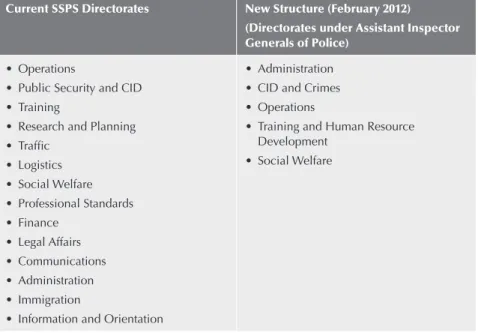
Transformation Action Plan59 includes objectives to reduce the SSPS to a force
of approximately 36,000, reduce the number of directives at headquarters
level from fourteen to five (see Table 1), and construct 50 new police stations
(four in each state and ten in Juba).
In support of newly appointed Minister of Interior Alison Magaya, the president (as commander of the police) announced a pay review in November
2011 to address the disparity in salaries between the SPLA and SSPS. Indications
show that gross salaries in the SSPS will be increased to match salaries in the
SPLA for equivalent ranks before mid-2012. This is subject to confirmation in
the national budget, and may be affected by austerity measures caused by the
cessation of oil production in early 2012.60
In the immediate post-independence period, the SSPS continued to absorb
additional personnel, such as the 400 South Sudanese policemen and customs
officers who were serving in the Sudanese police and were disowned by Khartoum after independence. Although formally trained as police personnel and effectively forming the middle-ranking officer corps, most need urgent English language training. Along with this group, the high number of personnel
prompted a review of retirement/severance options. Outside of future DDR plans, the SSPS has been examining options to downsize the force through a ‘soft landing’ approach. For example, retirement on full pay in year one, fol-lowed by half-pay in years two and three, and so on. While concrete plans have yet to be released, it is encouraging that alternative options to DDR are being discussed.
Magaya’s term as minister of interior has brought significant changes to the structure of the police. As a precursor, the president ordered the disband-ment of the controversial Public Security division after independence, leaving many of its former members to be either absorbed into the NSS or posted to other SSPS divisions. The Ministry of Interior, keen to increase the public profile of the SSPS, was quick to ensure the majority of Public Security personnel were
absorbed into the lower-profile NSS.61 The majority of the Auxiliary Force,
reporting to the IGP through the operations directive, is now recognized as a national asset to be deployed during internal emergencies. In addition, the SSPS formed the Juba-based Emergency Rescue Force (drawing on personnel
Table 1 Planned SSPS Reorganization
Current SSPS Directorates New Structure (February 2012)
(Directorates under Assistant Inspector Generals of Police)
• Operations
• Public Security and CID • Training
• Research and Planning • Traffic • Logistics • Social Welfare • Professional Standards • Finance • Legal Affairs • Communications • Administration • Immigration
• Information and Orientation
• Administration • CID and Crimes • Operations
• Training and Human Resource Development
from the Auxiliary Force)62 to coincide with the withdrawal of SPLA military
police patrolling. Initially under the control of SSPS headquarters, the force was recently transferred to the control of Central Equatoria state police
com-missioner. The Emergency Rescue Force is intended to respond to ‘999’ emergency
calls in parallel with the development of the Juba Emergency Call Centre (JECC).
The DIGP intends to have the JECC fully established by July 2012.63
International assistance
International assistance has played a role in changes within the SSPS. Two
other specialist units were established with international support in 2011: the
Livestock Patrol and Highway Patrol. With few resources, it is difficult to see how these units will have a national impact, but they may be useful in the long term in areas where there are specific problems. Undoubtedly, a Livestock Patrol Unit in remote areas of southern Jonglei would deter cattle raiding and conflict over grazing rights. New tarmac roads outside Juba will also need
policing. There were over 100 serious road traffic accidents per month in 2011
on the Juba-Nimule road, which has been under construction for a number of
years.64 The acquisition of ten motorcycles and the graduation of 15 motorcycle
police in September 2011 may reduce the risk of accidents, but further logistical
support is needed if the unit is to function properly.65
There are also international attempts to introduce the SSPS leadership to the principles of Intelligence-Led Policing (ILP). Originally conceived by a county police force in Britain and later applied in the United States to improve
intel-ligence processes after 11 September 2001, ILP orients policing around the
direction, collection, processing, analysis, dissemination, and sharing of infor-mation and criminal intelligence, as well as management accountability and
responsibility for achieving results (Peterson, 2005, pp. 6-9). ILP processes are
not dissimilar to military intelligence concepts, which have been part of armed
forces’ planning and operations cycles for over 40 years. Embedding ILP
con-cepts in the mindset of SSPS leaders has utility, and eventually it should pro-mote improvements. But, in the short term, low literacy, a lack of information processing capabilities, and poor access to information systems will limit the application of ILP. Attempts to implement anything more than ILP basics are likely to be fruitless at this time.
Despite positive signs of reform, there are strong indicators that the SSPS is having the same payroll challenges as the SPLA, including inflated strength,
inaccurate payroll sheets, and weak financial reporting. Although a 2009 UN
Police initiative to conduct a physical headcount of the SSPS resulted in a computerized database and increased coordination in drawing payroll in the states and headquarters, many of the details are now out of date. While new attempts to pull together accurate records are taking place, this initiative has
very little traction with the SSPS. It is primarily a UN-owned process.66
State police authorities regularly draw salaries for exactly 3,000 personnel
with no accounting for absenteeism, sickness, or additional recruitment. With international support, an ongoing initiative to introduce enhanced computer-ized systems, train administrative personnel, and provide better infrastructure throughout the ten states could improve the situation. In addition, the SSPS, with international support, intended to carry out another personnel audit to
update the human resource database, starting on 1 February 2012. It remains to
be seen whether this will accurately capture all personnel in the database before there are more changes to the strength, composition, and structure of the SSPS.
Misconduct
SSPS personnel deployed in major towns—especially the traffic police—con-tinue to be accused of intimidation and extortion. Their conduct, along with the behaviour of other security force personnel at joint military/security force
checkpoints in Juba in 2010 and early 2011, was often deplorable, particularly
at night. Accounts of drunkenness, unnecessary aggression, assault, and extor-tion were routine.
The independence period has seen some improvement in SSPS conduct. Reports of intimidation and assaults have declined, particularly since the Rescue Force has deployed. However, surges in insecurity in Juba and other major towns are still blamed on the police. Extortion remains a major prob-lem, and is attributed to the relatively low police salaries, compared to SPLA
counterparts.67 A survey by international advisers at the main police stations
in six states in mid-2011 indicated that over 40 per cent of those seeking help
Exploitation of unclear and ever-changing legislation, implemented by police who have little understanding of the rule of law, explains the root causes of low-level corruption and misconduct. The SSPS has established an internal sum-mary justice system to quickly deal with offending officers. Nevertheless, identifying perpetrators is still a major problem. International advisers are encouraging the SSPS to include names or identification numbers on uniforms
in order to improve conduct and accountability.69 This was the subject of
par-liamentary discussions in late 2011.
The SSPS, like the SPLA, faces numerous operational challenges. A desperate lack of basic resources is the most obvious. Predominantly, a lack of communi-cations, transportation, and trained personnel severely hampers SSPS opera-tions. There is a desperate need for mobile telephones and vehicles at police stations so officers can respond quickly. A steady increase in crime in population centres, both in frequency and in sophistication, adds to the complexity of the SSPS task. Replacing the SPLA in both urban and rural areas by establishing effective paramilitary units, as well as community police, remains an enormous undertaking for the SSPS. Arguably the SSPS’s most significant challenge is to concurrently implement its recently planned reforms while not submitting to a lack of personnel accountability on the scale of the SPLA or, worse still, sub-mitting to wholesale corruption.
V. The roles of other organized forces:
a reserve force?
The Prisons Service
The Prisons Service of South Sudan suffers from poor infrastructure, over-crowding, and unskilled prison officers. While progress has been made since
2007 to address these challenges and implement sustainable reforms, this has
been largely initiated and sustained by international partners’ funding.
From 2007 to independence, the GoSS and developing partners tried to
formulate strategies for prison reform. Ten strategies were created in 2008 alone
(see Box 1, page 36) and improvements were made to address overcrowding
in prisons, officer training, and drafting of legislation and codes of conduct. Despite these collaborative efforts, significant gaps in prison reform remained
ahead of independence in July 2011.
Since independence, prison reform has continued to progress, particularly with regard to officer training, rehabilitation of prisons, and information management. Policies and regulations have been drafted and implemented, although some are still pending approval. But whereas the prison sector was initially a dumping ground for demobilized SPLA soldiers, the government and international partners have restricted this process.
No notable strategies or frameworks specific to the prison sector have been developed, other than in the national development and budget plans. However, there are signs the director general of the Prisons Service (an experienced and
professionally trained officer) will initiate the development of a 2012–15
stra-tegic plan in February–March 2012.70 This will hopefully address the issues
raised in the 2011–13 SSDP, which identified the remaining challenges as ‘the
lack of alternatives to imprisonment; overcrowding in jails; (and) lack of funding
for rehabilitation programmes’ (GoSS, 2011b, p. 109). The development plan
identified the overall objective for the South Sudan Prisons Service by 2013 as:
‘providing secure and humane incarceration and detention services via functional