2
Risks in home-ownership: a perspective on the
Netherlands
Published as: Teye, A.L., de Haan, J., Elsinga, M.G., Bondinuba, F.K., Gbadegesin, J.W. (2017). “Risks in home-ownership: a perspective on The Netherlands”. International Journal of Housing Markets and Analysis, Volume 10(4), pp. 472-4882.
This article is © Emerald Group Publishing and permission has been granted for this version to appear inA+BE | Architecture and the Built Environment (ISSN 2212-3202 | TU Delft Library). Emerald does not grant permission for this article to be further copied/distributed or hosted elsewhere without the express permission from Emerald Group Publishing Limited.
Abstract
Purpose:Risk in home-ownership from mortgage providers’ perspectives within the euro zone has received more attention than individual home owner’s perspectives in the literature following the financial crisis in 2007/2008. The purpose of this paper is to explore the risk factors in home-ownership from the individual household’s perspectives within the owner-occupied housing sector of the Netherlands.
Design/methodology/approach:The paper adopted a broader review of extant literature on the different concepts and views on risk in home-ownership. These concepts are unified into a framework that enhances our understanding of the perceived sophisticated risk within the owner-occupied sector in the Netherlands. Findings:From the perspective of the home owner, two main types of risks were identified: mortgage default and property price risk. The paper has unearthed a quantum number of factors which underline the above risks. The mortgage default risk factors include the initial amount of mortgage loan taken out, the future housing expenses and the income development of the owner-occupier. Family disintegration is also identified as one of the main causes of mortgage default in the Netherlands. Property price risk is influenced by income, interest rates and conditions in the social and private rental sectors.
Research limitations/implications:Findings of the paper are based on review of the extant literature in the context of the Dutch housing market. Possible rigorous situational analysis using other tools are recommended for further research.
Originality/value:This paper contributes to the much needed body of knowledge in the owner-occupied sector and provides a better understanding of risk in home ownership from the individual perspectives.
Keywords:Housing markets, Risk, Dutch housing market, Home ownership, Mortgage providers, Owner-occupation
...
§ 2.1
Introduction
... Subsequent to the subprime mortgage crisis of the USA, risk in the owner-occupied sector has received extensive consideration in the housing literature (Aalbers,2010; McGreal et al.,2009;Bardhan et al.,2012;Kramer,2010;Cano Fuentes et al.,2013; Aalbers,2015). While these prior efforts shed light on the spectrum of risks in home-ownership, the arguments for home-ownership has often been skewed mostly towards the perspectives of the financial institution supplying credits for the home financing. The debates and arguments on the pitfalls from the owners’ position are quite limited in extant literature. It is clear nonetheless that the risks for the credit providers could be minimised if steps are taken to understand and manage the exposures at the level of the individual home buyers. Borrowing on “predatory terms”, for instance, could be avoided if households are informed on the nature of the associated risks they are likely to encounter.
It is centrally advocated in this paper therefore that attention be given to the risks in the owner-occupier sector within the level and perspectives of the households. The paper provides an overview of risks in home-ownership from the viewpoint of the homeowner, especially, those financing their purchase with mortgage loans. Two inherent risk factors are identified: repayment and property price risks. While repayment risk pertains to mortgage repayment, property price risk consists of loss of investment capital as a result of decline in house prices within the period of concern. Also, mortgage repayment default depends on three factors: the initial debt level, income and cost development after the loan agreement has been contracted. For property price risk, the factors are quite varied and have to do with the multiplicity features which influence the development of house prices.
The approach of this paper is mainly to offer a careful discussion of the various risk types, their effects and causalities by unifying the different concepts as dispersed in both academic and non-academic literature into a concise framework. Also, the paper clarified the nature of risk in the owner-occupied sector from the individual
household’s perspectives that constitute the larger majority who are mostly
non-professionals. It gives brief background to home-ownership in the Netherlands, discusses general views on default and property price risk as well as the factors heightening the probability of their occurrence. The consequence of default and property price decline are also discussed in the light of the Dutch and concludes with suggestions on reducing the risks in home-ownership and how to create awareness amongst households in the Netherlands.
...
§ 2.2
Growth of home-ownership in the Netherlands
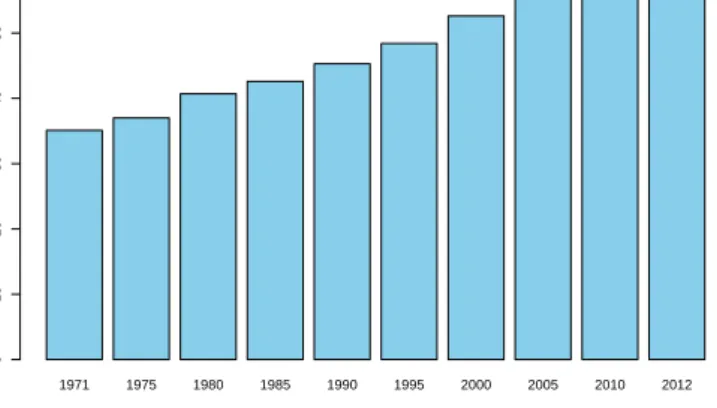
... Growth of home-ownership in the Netherlands has been steady over the decades. Between 1971 and 2012, the home-ownership rate increased from 35.1% to about 60.0% as shown in Figure2.1. The Dutch government’s stimulation of the
owner-occupied sector through income tax deductions and later by the National Mortgage Guarantee (NMG) scheme played an important role in the above achievement. Other factors include the investment and social benefit which homeowners accrue in the Netherlands. Over the years, the Dutch’s perception of
1971 1975 1980 1985 1990 1995 2000 2005 2010 2012 Year 0 10 20 30 40 50 60
FIGURE 2.1 Evolution of home-ownership (per cent of total housing stock)
Source:ABF Research B.V (2010), Eurostat
home-ownership had shifted from just having roof over one’s head to having some independence from landlords and finding a way to foster deeper connection with their relations and family (Toussaint and Elsinga,2007). Somewhat, there appears to be the idea to “immortalise” marital relationships with joint home-ownership that usually drive most people to buy private homes at the time when they are starting up their marital relationships (Neuteboom and Horsewood,2006;Toussaint and Elsinga, 2007). To others, home-ownership gives a wider choice and freedom to adapt the residential property to a more fulfilling and a self-suiting style (Elsinga,1998; Toussaint and Elsinga,2007). Such liberty to adjust the external features of the dwelling is generally not available in the rental sector.
From an investment perspective, Dutch households find home-ownership as an instrument that can be used to build equity and/or earn additional income to augment the regular pay cheque or pension (Boelhouwer,2002;Haffner,2008;Toussaint and Elsinga,2010;Toussaint,2013). Such practice evolves around buying an extra home to rent out in the private rental market and later selling it entirely when enough equity has been built. Minority also rent out a room or two in their own apartment. The fiscal treatment where mortgage interest payments are deducted from income tax also offers extra saving opportunity on mortgage outlays (Boelhouwer,2002;Elsinga,1998). Many have argued that, “when you rent, your money just flows away, but when you buy, it comes back to you and you can build up capital” (Toussaint and Elsinga,2007, pp. 182). The reference here relates to the tax-deductibility which is discussed in the next section.
§ 2.2.1 National mortgage guarantee
... From the mid-1980s, the ambition of the Dutch government shifted towards
home-ownership in the quest to shed part of the responsibility for providing housing for the population. Various policies were engineered to fulfil this new vision of the government. One such regulation is the rebranding and reconstruction of the municipal guarantees into what is now known as the Dutch National Mortgage
Guarantee [Nationale Hypotheek Garantie (NHG) in the Netherlands]. The NHG was founded in 1993 and currently administered by the voluntary public foundation called Home-ownership Guarantee Fund [Waarborgfonds Eigen Woningen (WEW)]. It has the full backing of the municipalities and the central government. The Fund primarily thrives on a premium on the mortgage amount received from the borrowers (CPB, 2013;Van Leeuwen and Bokeloh,2012). The premium is presently 1.0% but used to be 0.36% in the early years of the Fund, 0.28% for 2005-2006 and 0.85% in other previous years.
The aim of the Fund is to stimulate home-ownership by lowering the mortgage threshold for young and lower income groups. The guarantee also serves as a safety net for those entering into foreclosure for reasons such as divorce, job redundancy, ill health and other unforeseeable events. If a homeowner is able to demonstrate faithfulness, he/she is relieved from the duty to pay back to the guarantee fund. Despite the above, Dutch mortgage banks are usually hesitant in advancing credits to individuals with weak financial circumstances. However, when a borrower signed up to the NHG, the credit institutions could grant loans with loan-to-value (LTV) ratios exceeding 100 per cent. Although the maximum LTV is expected to be reduced to 100 per cent by 2018 and subsequently to about 85 per cent later (DNB,2014), the current higher LTV ratio facilitated by the NHG generally enhances the ownership rate
particularly among the lower income and younger age groups. These social classes ordinarily would not qualify for mortgage loans. In addition, the banks grant discount on the mortgage interest rate up to about 0.6 per cent for those who signed unto the NHG. This also offers most Dutch people an extra financial relief, which motivates them to consider home-ownership (Fitzsimons,2013).
Another way the scheme encourages home-ownership is the impetus it gives financial institutions to readily advance credit. Because of the backing of the central government and the municipalities, there is assurance that any credits in default will eventually be recovered. This means that the (credit) risk of the banks is reduced and they would not need to hold large regulatory or solvency capital. The banks, consequently, could issue as many loans as possible so that inaccessibility to mortgage loans is not much of a concern if the borrower opts to sign unto the scheme (CPB,2013;Fitzsimons,2013). However, in the opinion ofElsinga et al.(2014), since the reduction of the maximum LTV ratio in 2013, it has became extremely difficult for the younger and lower income groups in the Netherlands to enter into the owner-occupied sector.
§ 2.2.2 Tax deductibility
... Since the nineteenth century, Dutch homeowners have been enjoying the advantage of fully deducting mortgage interest rates from income tax (Haffner,2002). This began with the private landlords but was later extended to individuals in support of home-ownership (Rouwendal,2007). In its current form, the income tax deductions give homeowners the opportunity to recover part of their mortgage expenses equal to the product of the marginal tax rate and the gross interest on the mortgage loan. The marginal tax rate normally ranges from 42 to 52 per cent, depending on the income level (Van Leeuwen and Bokeloh,2012;Rouwendal,2007).
The generosity of the tax regime has a number of influences on the Dutch housing market in many ways. First, the income tax deductions lowers the cost of mortgage and
this provides a huge stimulation for home-ownership in the Netherlands. It is however debated that the tax rebate partly contributes to house price increases (Boelhouwer et al.,2004;Toussaint and Elsinga,2007). Second, the tax regime has made strong influence on mortgage servicing in the Netherlands. Several mortgage products were engineered purposely to optimise the benefits from the tax deductibility (Boelhouwer, 2002;Rouwendal,2007). These products were associated with the so-called
interest-only and endowment mortgages in the Dutch mortgage market. Third, the tax regulation influences the borrowing behaviour of Dutch homeowners. For instance, the wealthy in the Dutch society who could purchase a dwelling out-rightly would rather acquire a mortgage. This is due to the construction of the tax system which enables the rich to get the largest savings (Van Leeuwen and Bokeloh,2012).
Following the reforms in 2013, however, the fiscal tax deductibility has been restricted to only amortising (or classical mortgage) loans with at least an annual redemption. Whereas homeowners with origination date before January 2013 still continue to enjoy the benefits of the old tax structure, first-time buyers are constrained by the current regulations. The implication therefore is that the cost of mortgage has increased significantly for first-time buyers, making them quite hesitant to enter into the market. Also, the production of interest-only loans has reduced substantially since they are no longer deductible from income tax and have become less appealing to housing consumers.
§ 2.2.3 Risk attitude prior to the crisis
... Until the crisis, Dutch homeowners had focused mostly on the generosity of the fiscal tax deductibility which practically enabled them to recoup a substantial percentage of their mortgage repayments. There was little perception of the risks associated with home-ownership in the Dutch society. This fact was acknowledged by Van Gent in his chapter in (Doling and Elsinga,2006) edition. He emphatically noted that owner occupation was being championed in the Netherlands with the assumption that it will automatically generate asset gains for individuals and greater responsibility within the Dutch society. The revelations in a survey byToussaint and Elsinga(2007) were even more striking. They argue that as at 2006 (the year of survey), many homeowners were not much aware of any risks nor did they dread any event which possibly might affect them as homeowners. Generally, respondents of that survey felt they were much secured except concerns they had with regards to ill health and policy changes that might affect their tax break.
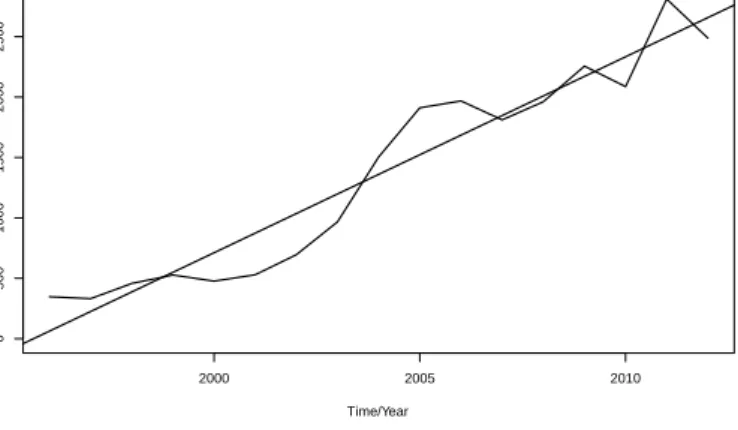
Certainly, the story changed after the 2007/2008 global financial crisis. The inherent risk became more apparent after the crisis as house prices declined by more than 25 per cent and the number of homeowners in arrears has increased considerably (see DNB,2014, Figure2.2and2.5). The impacts of these price declines and growing defaults on financial institutions and on the government purse have been substantially discussed and debated (De Vries,2010;Brounen and Eichholtz,2012;Van Leeuwen and Bokeloh,2012;Elsinga et al.,2014). On the other hand, the implications for the individual homeowner are usually overlooked.
2000 2005 2010 0 500 1000 1500 2000 2500 3000 Time/Year
FIGURE 2.2 Auction foreclosure sales in the Netherlands
Source:Kadaster
...
§ 2.3
General overview of risk in home-ownership
... Generally, extant literature identifies risks in home-ownership from two main
categories of factors. The first is often referred to as payment or default risk which deals with the ability of homeowners to pay the monthly mortgage expenses. The second has to do with volatility of house prices and is usually termed as property price risk. Depending on the scale of these risks, however, there is also systemic risk which could develop to affect the entire housing market. This systemic risk and its consequences typically extend beyond the individual homeowners (Stephens,2006). However, the discussions would be confined to that of payment and property price risk.
§ 2.3.1 Payment risk
... Due to the huge financial consequences involved, mortgage default is one of the most significant risk factors in home-ownership. Formally, default or repayment risk is used in reference to the risk arising from homeowner inability to live up to the mortgage repayment obligations. To reduce such risk, mortgage lenders normally set the initial LTV and the loan-to-income (LTI) ratios to levels they believed are bearable for the homeowner. Particularly, if the LTV and LTI ratios are very low, the hope is that the default probability will be minimal. However,Neuteboom(2008) argue that these initial lending conditions do not fully reveal occurrence of default in the future. In this author’s estimation, the cause of default rests with events occurrences during the tenure of the mortgage which do not necessarily have any bearing with the initial statistics collected.
Causes of default in repayment of mortgage
There are two distinct hypothesis underlying mortgage default, which according to many (Lambrecht et al.,1997;Yang et al.,1998;Neuteboom,2008), are the equity and ability to pay hypotheses. In the equity hypothesis, homeowners default on the
basis of comparison between the costs and returns inherent in the continuation or termination of a mortgage contract (Neuteboom,2008;Kim,2015;Chan et al.,2016; Connor and Flavin,2015;Nield,2015). In other words, default is an outcome of a thoughtful reflection in the sense that if mortgage repayment were to be continuing, it would be mainly due to the anticipated profit. In the USA, for example, where at the time of foreclosure, homeowners are not held liable for residual debts, the choice to default on mortgage obligations is much appealing when the incidence of negative equity looms or is envisaged. Basically, owner-occupiers motivated by investment reasons fall under this hypothesis, as they are mostly inclined to default not because they cannot afford but for reasons that defaulting presents a gain in disguise. That notwithstanding, the recent hike in the use of credit reports and concerns by individuals to maintain a clean credit history should gradually restrain this issue of reneging on purpose.
For countries where there is right of recourse and homeowners can be held liable for residual debts, the equity hypothesis ceases to operate. In such environments, the problem of monthly expenses being too high in relations to the household income is more important. According toBoelhouwer et al.(2005), these monthly expenses may depend on the mortgage interests and deposits, maintenance cost, insurance premiums, taxes and inflation rate (high inflation eventually depletes the mortgage loan in real terms). They may also be affected by the type of mortgage loan and the policies on tax deductions
Many authors also considered the issue of personal mismanagement and how household financial revenues are managed instead of the inflow of income (Neuteboom,2008;Kloth,2005). In the account of (Andrews and Sánchez,2011; Neuteboom and Horsewood,2006), the phenomenon of income misappropriation is generally found to associate with young people and the less educated in most of the Organisation for Economic Co-operation and Development (OECD) countries studied by the authors. It is argued that such class of people may have problems planning and estimating future expenses or possibly end up trading one debt for another in a manner which could be referred to as “mis-prioritisation” in servicing debts. Generally, it is also observed that homeowners who hold other non-housing debts along with mortgage are much constrained when it comes to repayment (Neuteboom and Horsewood, 2006). As a rule of thumb, it could be postulated that the higher the periodic
debt-service ratio, the greater the exposure to payment problems. This as well implies naturally that households with lower income and those with subprime or variable interest rate mortgage loans are much more vulnerable to payment difficulties. Consequences of default in repayment of mortgage
From the individual homeowner perspective, payment difficulties have three progressive dimensions and stages. It begins with the mortgage costs increasingly becoming burdensome. Subsequently, arrears develop and potentially this often leads to repossession (Neuteboom,2003). The consequences of repossession or better put as dispossession, on the other hand, span beyond the individual homeowner. The owner-occupier usually suffers loss of the investment capital and could also fall into residual debts. Psychological problems could also develop as a result of one losing the property. The effect of psychological problems could even be much adverse. There could equally be reduction in performance at work and family breakdowns particularly
where some have resort to the use of home-ownership as a means of consolidating marital relationships.
Also, as evidenced in the 2007/2008 crisis, repossession could trigger systemic risk with adverse implications for the financial system and economic stability (Stephens, 2006;Colin and Richardson,2014). In particular, where mortgage defaulters can freely walk away from residual debts at the time of foreclosure such as in the USA, it is probable that lenders will suffer significant loses from mortgages in negative equity. Even in situations where borrowers are liable for residual debts on negative equity, it is not always practically possible to retrieve the last penny (Neuteboom,2008;Van der Heijden et al.,2011). There are lengthy legal procedures involved which may cause the mortgage debt to deplete in value through high inflation. Personal bankruptcy laws may equally affect efforts to recover loans in default. The national government would normally also suffer if repossessions are intensified. The government in such situations would have to increase social benefits and accommodate evicted households.
Substantial sums would further have to be spent on bank bailouts to prevent bankruptcy and redundancy. In 2009, for instance, the Dutch government expended almost 48 billion Euros on bank bailouts alone (Van der Heijden et al.,2011). Furthermore, if foreclosure persists, the number of dwellings available for sale may eventually increase. This could affect house prices as supply grows from the
intensifying repossession rates (DiPasquale,1999;Baker,2008). In some places also, bad omen are often associated to repossess properties which makes their resale extremely difficult unless they are highly discounted (DiPasquale,1999;Boelhouwer and Van Weesep,1988).
§ 2.3.2 Property price risk
... Besides the credit or (re)payment risk associated with owner-occupation, the other risk is property price risk which others also referred to as equity price risk or simply asset risk. In the financial literature, asset risk is normally used in relation to the volatility or variation of the asset price over time (Crouhy et al.,2006;Crouhy,2010;Jin and Ziobrowski,2011). In the context of housing research, it is mostly restricted to the risk inherent in the decrease of the property price. Essentially, there are at least four reasons why decrease in house price is (or should be) of much concern to the homeowner. The most comprehensible and well-known is negative equity – the situation where the price of the property falls below the outstanding loan. The other reasons are immobility, loss of investment capital and general insecurities related to the collapse of house prices (Toussaint and Elsinga,2007;Phang,2010). The general dynamics of property price developments is discussed below.
Dynamics of house price development
Given the adverse consequences of decreasing house prices, it is important to understand the factors which underpin price development in the market. In general, the extent literature acknowledges the existence of some equilibrium price around which the market constantly adjusts itself (Case and Shiller,1988;Malpezzi,1999). Prior research (Abraham and Hendershott,1996;Case and Shiller,1988;Malpezzi, 1999;Ambrose et al.,2013) has therefore studied long-term effect of price equilibrium in the housing market. In view of these prior findings, house prices are thought to converge to a long-term equilibrium level which periodically gets corrected
in reaction to changes in the fundamental price determinants. Highly inspired by microeconomic theory, the equilibrium hypothesis considers that prices are driven by factors fundamental to demand and supply (Malpezzi,1999;De Vries,2010; DiPasquale,1999). Here, demand is mostly driven by factors such as income, rent, demographic features, mortgage interest rates, tax structure, amongst others (Abraham and Hendershott,1996;Ortalo-Magné et al.,2000;Muellbauer and Murphy,1997). On the supply side, the determinants are construction cost, land regulations and availability of old homes arising from forced sales, conversion of rental dwellings and sales by existing owner-occupiers (Reichert,1990;Muellbauer and Murphy,1997;DiPasquale,1999;Baker,2008).
Contrary to the equilibrium hypothesis, prices have increasingly demonstrated trends quite unexplainable by the market fundamentals (Case and Shiller,1988). In explaining the phenomenon, it is argued that fluctuations from the equilibrium price level are temporal and signify influences from external factors or exogenous shocks (Abraham and Hendershott,1996;Andrews,2010). Furthermore, it is also believed that depending on the market forces, these shocks may gradually fade away or have a long-lasting effect on future prices to possibly create new price equilibrium. Other scholars also focus on explaining the factors behind this shift in price equilibrium.Case and Shiller(1988), for instance, argue that psychological effects and consumer expectations largely underpin house price booms. As explained by these authors, expectation of owner-occupiers is usually thought to result in creating excessive demand so that due to rigidity of housing supply, sharp increase in prices become eminent.
In general, consumer expectations tend to affect prices in two ways: either there is upward swing in prices because of excess demand or prices decline as a result of consumer withdrawal. As also noted byBoelhouwer et al.(2004), consumers are usually responsive to the prevailing price settings at hand. In anticipation, that price might continue to rise, there are those who might want to buy to avoid extremely high and unaffordable future prices as well as others who might venture buying to sell and make profit from future price appreciations. The reaction of home buyers to future prices decline is contrary, as there is always a withdrawal in such situations. These consumer reactions may create the situation where demand becomes volatile and subsequently induces instability in house prices, particularly because of the lag in housing supply. These dynamics of demand and supply disparities may also explain a greater percentage of the boom and burst in the housing market (Case and Shiller, 1988;Reichert,1990;Levin and Wright,1997;Dröes,2011).
Other researchers (Muellbauer and Murphy,1997;Poterba et al.,1991;Boelhouwer and Neuteboom,2003;Aalbers,2008;Agnello and Schuknecht,2011;Andrews,2010; Andrews and Sánchez,2011;Galati and Teppa,2013) have also recognised the significant contribution of government policy to the development of house prices. These authors attribute high volatility of house prices partly to the deregulations and reregulations of the mortgage market. The case of tax reforms, down payment and income constraints relating to LTV and LTI ratios are particularly noteworthy. As emphasised byReichert(1990), though income and employment may affect house prices depending on the regional features, when it comes to mortgage interest rates, the response is uniform across board.Andrews and Sánchez(2011), on the same issue also found that there is a general upward movements of house prices when tax treatments are somehow generous.
Housing/property bubbles
Property price bubble is an important phenomenon in house price development in the housing market. The term bubble is normally used to describe the dynamics of house price movements where there is a very high percentage increase in prices (boom) over a period, followed by a sharp decline (bubble-burst). Formation of a bubble usually begins with a “normal” price appreciation as a result of “an innovation” in the housing market until prices have reached an unsustainable level by the very innovation that seemed to have ignited the upward price adjustments. For example, it is mostly believed that the recent US house price bubble began as a result of innovations in the mortgage market where incredible number of mortgage products became available to homeowners but were not well managed (Baker,2008;Mizen,2008;Aalbers,2009b). In other countries including the Netherlands, it is mostly considered that the boom was initiated by the comparatively high LTV ratio, new mortgage products and generous tax rebates.
Historically, most house price booms had ended in bubble-bursts with equal persistence according toAgnello and Schuknecht(2011). The implication is that though the length of the boom might not be readily known, once it sets in, there is a high probability that prices might sharply decline in the future. Put in another context, house price bubbles are highly fragile. The phenomenon nonetheless has allures. It is normally during those seasons of booms in which homeowners seem to take on the highest risk by taking large loans for expensive homes. Furthermore, issues such as over-valuation, predatory lending and other underhand market practices are mostly prevalent during price booms (Case and Shiller,1988;Cecchetti,2006;Aalbers,2008). Remarkably, until the bursting phase, bubbles are usually not noticed and one of its distinctive features is that bubbling prices are usually driven by factors other than market fundamentals to which some researchers allude to psychological and speculative reasons (Case and Shiller,1988;Shiller,1990;Stiglitz,1990;Flood and Hodrick,1990;Abraham and Hendershott,1996). For example,Flood and Hodrick (1990) and (Stiglitz,1990), define bubble as a phenomenon which occurs when current price increments are mainly due to expectation of high future selling prices which are unsubstantiated by the market fundamentals. Empirically, bubbles are modelled as the percentage change between the equilibrium and market price levels (Flood and Hodrick,1990;Abraham and Hendershott,1996) with the boom(burst) phase implied by the instances where market prices persistently exceed (fall below) the equilibrium level.
...
§ 2.4
Risk profile of Dutch housing market
... This section focuses attention on the risks in home-ownership in the context of the Netherlands. Here, a consideration is given to the outlook of risk and the causative factors in relation to payment risk, property price and systemic risks.
§ 2.4.1 Payment risk
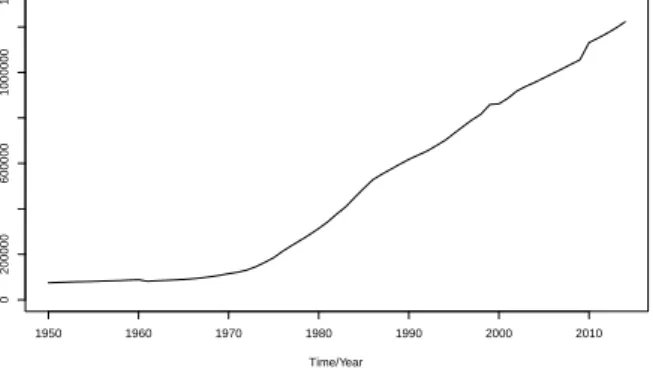
... The recent mortgage foreclosure rate in the Netherlands as in Figure2.2, has shown quite an increasing trend. Family breakdown, and divorce particularly, has been identified as the main factor behind the current upsurge in the foreclosure rate
Time/Year 1950 1960 1970 1980 1990 2000 2010 0 200000 600000 1000000 1400000
FIGURE 2.3 Yearly number of divorce in the Netherlands
Source:Statistics Netherlands (CBS)
(Van Leeuwen and Bokeloh,2012;Van Dalen et al.,2013). The number of divorces has been very high as can be seen from Figure2.3; however, as noted earlier, the general societal trend has been that most Dutch citizens enter into home-ownership at the beginning of their marital relationships at which time also their combined income qualifies them to access large mortgage loans. The challenges then arise, where in the event of a breakup of these marital relationships, a single income would no longer become adequate to service the monthly housing expenses. Interestingly, however, due to the munificent social security and compulsory unemployment insurance for permanent Dutch workers, job redundancy usually does not lead to mortgage delinquency in the Netherlands (Neuteboom and Horsewood,2006). Moreover, there have been some concerns about the risks of the interest-only loans and whether they contribute to the repossession rate in the Netherlands (Van Leeuwen and Bokeloh, 2012). A careful study of the nature of these products reveals that, though they motivate people to taking up larger sum of mortgage loans, their impacts on payment problems may not be that pronounced except there is an issue of divorce or redundancy (NVB,2014). They rather give home owners the benefit of paying lower monthly expenses.
Despite the tremendous increase in the foreclosure rate, in terms of numbers and actual percentages, it should be argued that the number of forced sales in the
Netherlands is quite low. In 2013, for instance, the total forced sales as a percentage of all transactions is only around 2.0 per cent (Van Dalen et al.,2013). Compared to other European Union (EU) countries, the Dutch foreclosure rate has generally been one of the lowest and falls only behind that of Sweden and Denmark (Fitzsimons,2013). This is somewhat interesting especially when the Netherlands has continuously been cautioned for the high level of mortgage debts as shown in Figure2.4. A number of factors account for the low foreclosure rates. First, though the financial crisis had hit hard on the Dutch labour market with unemployment rate growing from an average of 4.9 per cent before crisis to an average of about 8.5 per cent after the crisis, the generous unemployment and social benefits in the Netherlands seem to have provided sufficient cover against mortgage default as discussed above. Permanent workers in the Netherlands have unemployment insurance schemes which pay about 70-90 per cent of their last month salary up to 38 months (Neuteboom and Horsewood,2006;
Time/Year 1998 2000 2002 2004 2006 2008 2010 20 40 60 80 100 Germany France Netherlands United Kingdom United States Spain
FIGURE 2.4 Dutch mortgage debt as a percentage of GDP (1998-2010)
Source:Database for Institutional comparisons in Europe (CESifo DICE)
Cano Fuentes et al.,2013). The social security system is rather generous and
guarantees income of unlimited duration. The redundant homeowner could therefore access such social benefit as long as it can be proven that the cost of staying in one’s own home is not more than renting a new dwelling (Fitzsimons,2013). Beside these, Dutch mortgagors commonly tend to show very good repayment behaviour. This could partly be attributed to the fact that the banks do have full right to recourse. At
foreclosure, they are able, by law, to confiscate the dwelling and other assets the defaulter may have as well. Personal bankruptcy laws are also very strict at enforcement so that it is not too easy to abdicate responsibility for the debt in any event.
§ 2.4.2 Property price risk
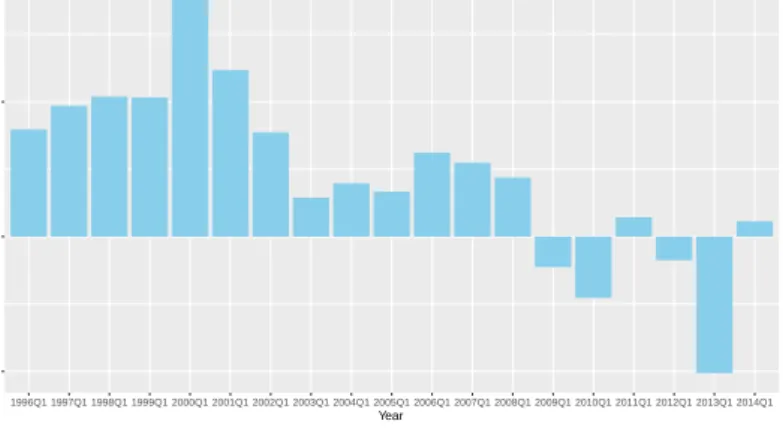
... As depicted in Figure2.5, although the average property price development in the Netherlands has generally shown an increasing trend, there have also been seasons in which prices have fallen rather sharply. Between 1978 and 1985, for instance, there was a substantial price decrease of almost 29 per cent. Following the recent global financial crisis, there have also been persistent decline in house prices between 2008 and 2013 of about 25% (see Figure2.5and2.6). Pertaining to the recent price decline, effects of the crisis and the Dutch government reregulation of the fiscal tax
deductibility have generally been the most significant factors. First, the crisis had not only impacted on unemployment, but also, the credit crunch which had affected most Dutch banks because of their international orientation had led to a tightening up of mortgage provisions in the Netherlands. This has partly restricted access to mortgage and consequently decreased the number of new home purchases (Elsinga et al.,2014). Second, following government’s review of the tax incentives for homeowners, the cost of home-ownership for new buyers has significantly increased. Together, the effect of these factors has been an apparent drop in consumer confidence and demand for new homes which have subsequently affected the price development in the market in the Netherlands. Actual loss on sales during these periods of decline to some extent is only suffered to various degrees by those who made purchases close to the peak in 2008. As demonstrated in the Figure2.5, purchases before 2003, for example, would still accrue
Time/Year 1970 1980 1990 2000 2010 50 100 150 200 250
FIGURE 2.5 Average Dutch house prices from 1965 to 2014 (in 1,000s)
Source:Dutch organisation for real estate agents (NVM), Statistics Netherlands (CBS)
−10 0 10 20 1996Q1 1997Q1 1998Q1 1999Q1 2000Q1 2001Q1 2002Q1 2003Q1 2004Q1 2005Q1 2006Q1 2007Q1 2008Q1 2009Q1 2010Q1 2011Q1 2012Q1 2013Q1 2014Q1 Year
FIGURE 2.6 Change in average house purchase prices (in percentage)
Source:Statistics Netherlands (CBS)
substantial profits if sales were made during the meltdown (seeSommervoll and de Haan,2014, Figure2.6).
§ 2.4.3 Systemic risk
... As noted earlier, a general concern for the Dutch economy has been the very high mortgage debt-to-gross domestic product (GDP) ratio. However, in contrast to the loan repayment, the response has been quite good with forced sales at only around 2 per cent, which some analysts argue that there is really not much cause to despair. To Van Leeuwen and Bokeloh(2012), for instance, there seems to be rather too much focus on the debt side than the equally high assets held by Dutch households. According to these authors, the Dutch have more assets than debts. By these authors’ estimation as at 2011, for every one euro in debt, Dutch households equally have in
reserve 1.76 and 2.41 euros of real estate and financial assets, respectively. Mostly, however, these assets are tied up in pension and insurance reserves. There is also a large amount of equity stored up in residential real estate which should probably be the concern because property prices are never guaranteed. This should be especially important for NHG which insures against residual debts since any significant price decline along with large number of foreclosures could be quite distressful. Of course, there have been concerns recently about the rising foreclosure rates which had eventually led to an increment of the premium from 0.85 to 1.0 per cent.
...
§ 2.5
Summary and conclusion
... From the perspective of the homeowner, two main types of risks are identified:
mortgage default and property price risk. The discussions have unearthed a quantum number of factors which underline these risks. Particular to default, these factors relate to the initial amount of mortgage loan taken out, the future housing expenses and the income development of the owner-occupier. In the Dutch case, family disintegration is identified as one of the main causes of mortgage default. As a recent phenomenon, most people enter into home-ownership at the start of their marital relationships. However, problems arise when those households are broken apart and the mortgage cost become too high for a single individual. On property price risk, the factors discussed are those which generally determine property price development and mainly thought to command demand and supply of owner-occupier dwellings. These factors include income levels, interest rates and conditions in the social and private rental sectors. With respect to the Netherlands, the recent price decline traces its roots to the financial crisis. The situation further deteriorated by the introduction of a new code of conduct for lenders and the government’s revision of the tax deductibility which led to an increase in the monthly expenses of home ownership.
The study also discussed the consequences of default and declining property prices in which the ultimate problem is foreclosure in combination with negative equity leading to residual debts. For the Dutch households, this implies a loss of investment capital which may subsequently lead to psychological problems. Property price decline may also trigger negative equity, immobility, loss of investment capital and insecurity. More importantly, when default occurs on extremely large scale at the same time with property prices sharply declining, there is the possibility that the financial system might experience systemic instability. For the Netherlands, this risk is insured by the NHG to some extent. In sum, the central theme advanced in the paper is awareness of the individual about the nature of the risks in home-ownership. To enhance the understanding and management of these risks at the household level, a possible consideration might be a thorough education by lenders on the risks of the mortgage products they offer. Future research could therefore consider assessing the individuals’ future complications and counselling on strategies to minimise the risks.