Americas Headquarters
Cisco Systems, Inc. 170 West Tasman Drive San Jose, CA 95134-1706 USA http://www.cisco.com Tel: 408 526-4000 800 553-NETS (6387) Fax: 408 527-0883
Cisco Intrusion Prevention System (IPS)
Version 6.0 Security Target
Version 7.0 May 30, 2007
THE SPECIFICATIONS AND INFORMATION REGARDING THE PRODUCTS IN THIS MANUAL ARE SUBJECT TO CHANGE WITHOUT NOTICE. ALL STATEMENTS, INFORMATION, AND RECOMMENDATIONS IN THIS MANUAL ARE BELIEVED TO BE ACCURATE BUT ARE PRESENTED WITHOUT WARRANTY OF ANY KIND, EXPRESS OR IMPLIED. USERS MUST TAKE FULL RESPONSIBILITY FOR THEIR APPLICATION OF ANY PRODUCTS. THE SOFTWARE LICENSE AND LIMITED WARRANTY FOR THE ACCOMPANYING PRODUCT ARE SET FORTH IN THE INFORMATION PACKET THAT SHIPPED WITH THE PRODUCT AND ARE INCORPORATED HEREIN BY THIS REFERENCE. IF YOU ARE UNABLE TO LOCATE THE SOFTWARE LICENSE OR LIMITED WARRANTY, CONTACT YOUR CISCO REPRESENTATIVE FOR A COPY.
The Cisco implementation of TCP header compression is an adaptation of a program developed by the University of California, Berkeley (UCB) as part of UCB’s public domain version of the UNIX operating system. All rights reserved. Copyright © 1981, Regents of the University of California.
NOTWITHSTANDING ANY OTHER WARRANTY HEREIN, ALL DOCUMENT FILES AND SOFTWARE OF THESE SUPPLIERS ARE PROVIDED “AS IS” WITH ALL FAULTS. CISCO AND THE ABOVE-NAMED SUPPLIERS DISCLAIM ALL WARRANTIES, EXPRESSED OR IMPLIED, INCLUDING, WITHOUT
LIMITATION, THOSE OF MERCHANTABILITY, FITNESS FOR A PARTICULAR PURPOSE AND NONINFRINGEMENT OR ARISING FROM A COURSE OF DEALING, USAGE, OR TRADE PRACTICE.
IN NO EVENT SHALL CISCO OR ITS SUPPLIERS BE LIABLE FOR ANY INDIRECT, SPECIAL, CONSEQUENTIAL, OR INCIDENTAL DAMAGES, INCLUDING, WITHOUT LIMITATION, LOST PROFITS OR LOSS OR DAMAGE TO DATA ARISING OUT OF THE USE OR INABILITY TO USE THIS MANUAL, EVEN IF CISCO OR ITS SUPPLIERS HAVE BEEN ADVISED OF THE POSSIBILITY OF SUCH DAMAGES.
Any Internet Protocol (IP) addresses used in this document are not intended to be actual addresses. Any examples, command display output, and figures included in the document are shown for illustrative purposes only. Any use of actual IP addresses in illustrative content is unintentional and coincidental.
Cisco IPS Version 6.0 Security Target
© 2006-2007 Cisco Systems, Inc. All rights reserved.
Prepared By: Prepared For:
Tresys Technology, LLC Cisco Systems, Inc. 8840 Stanford Blvd., Suite 2100 170 West Tasman Dr. Columbia, MD 21045 San Jose, CA 95134
CCVP, the Cisco logo, and the Cisco Square Bridge logo are trademarks of Cisco Systems, Inc.; Changing the Way We Work, Live, Play, and Learn is a service mark of Cisco Systems, Inc.; and Access Registrar, Aironet, BPX, Catalyst, CCDA, CCDP, CCIE, CCIP, CCNA, CCNP, CCSP, Cisco, the Cisco Certified Internetwork Expert logo, Cisco IOS, Cisco Press, Cisco Systems, Cisco Systems Capital, the Cisco Systems logo, Cisco Unity, Enterprise/Solver, EtherChannel, EtherFast, EtherSwitch, Fast Step, Follow Me Browsing, FormShare, GigaDrive, HomeLink, Internet Quotient, IOS, iPhone, IP/TV, iQ Expertise, the iQ logo, iQ Net Readiness Scorecard, iQuick Study, LightStream, Linksys, MeetingPlace, MGX, Networking Academy, Network Registrar, Packet, PIX, ProConnect, ScriptShare, SMARTnet, StackWise, The Fastest Way to Increase Your Internet Quotient, and TransPath are registered trademarks of Cisco Systems, Inc. and/or its affiliates in the United States and certain other countries.
All other trademarks mentioned in this document or Website are the property of their respective owners. The use of the word partner does not imply a partnership relationship between Cisco and any other company. (0705R)
Document Introduction
This document provides the basis for an evaluation of a specific Target of Evaluation (TOE), the Intrusion Prevention System (IPS) Sensor Software version 6.0 (IPSv6.0) executing on the following platforms: Cisco IPS 4200 Series sensors, Cisco Catalyst 6500 Series IDSM-2, Advanced Inspection and Prevention (AIP) Security Services Module (SSM) for the Cisco Adaptive Security Appliance (ASA), and the Cisco Intrusion Detection System Network Module (NM-CIDS) for Cisco Routers. This Security Target (ST) defines a set of assumptions about the aspects of the environment, a list of threats that the product intends to counter, a set of security objectives, a set of security requirements, and the IT security functions provided by the TOE which meet the set of requirements.
Revision History
Rev Date Description
1.0 January 13, 2006 Draft release
1.1 February 13, 2006 Updated in response to CCTL comments dated 01/13/06
1.2 February 13, 2006 Incorporated PD-0097
1.3 March 17, 2006 Revisions based on CCTL verdicts (Cycle 1)
2.0 September 5, 2006 PP version change and deleted audit descriptions relating to the log file. Checked for ASDM references. 3.0 October 30, 2006 Revisions based on CCTL verdicts
(Cycle 2)
4.0 December 1, 2006 Updated version 6.0 references 5.0 February 9, 2007 Revisions based on CCTL verdicts Cycle
3
6.0 April 23, 2007 Updated based on CCTL final comments
C O N T E N T S
ST and TOE Identification
1-1Security Target Overview
1-2References
1-2Acronyms and Abbreviations
1-3TOE Product Type
2-1TOE Overview
2-1Intrusion Detection and Prevention System Concept
2-1TOE Physical Boundary
2-2Appliance TOE
2-3Module TOE
2-4TOE Logical Boundary
2-6TOE Features Not Evaluated
2-7TOE Security Architecture
2-7Appliance TOE
2-7Module TOE
2-8Security Functions Claimed by the TOE
2-8TOE Data
2-8TSF Data
2-9User Data
2-9Security Management
2-9Audit
2-9Network Traffic Sensing and Analysis
2-9Identification and Authentication
2-9TOE Evaluated Configuration
2-10Assumptions
3-1Threats
3-2TOE Threats
3-2IT System Threats
3-3Organizational Security Policies
3-3Security Objectives for the TOE
4-1Security Objectives for the Environment
4-2Contents
Security Audit (FAU)
5-3FAU_GEN.1: Audit data generation
5-3FAU_SAR.1: Audit review
5-4FAU_SAR.2: Restricted audit review
5-4FAU_SAR.3: Selectable audit review
5-4FAU_SEL.1: Selective audit
5-4FAU_STG.2: Guarantees of audit data availability
5-5FAU_STG.4: Prevention of audit data loss
5-5Cryptographic Support (FCS)
5-5FCS_CKM.1: Cryptographic key generation
5-5FCS_CKM.4: Cryptographic key destruction
5-5FCS_COP.1(1): Cryptographic operation - SSH
5-5FCS_COP.1(2): Cryptographic operation - SSL
5-6Identification and Authentication (FIA)
5-6FIA_UAU.1: Timing of authentication
5-6FIA_ATD.1: User attribute definition
5-6FIA_UID.1: Timing of identification
5-6Security Management (FMT)
5-7FMT_MOF.1: Management of security functions behavior
5-7FMT_MTD.1: Management of TSF data
5-7FMT_MSA.2: Secure security attributes
5-7FMT_SMR.1: Security roles
5-7FMT_SMF.1: Specification of Management Functions
5-7Protection of the TOE Security Functions (FPT)
5-8FPT_RVM.1(1): Non-bypassability of the TSP
5-8FPT_SEP.1(1): TSF domain separation
5-8FPT_STM.1(1): Reliable Time Stamps
5-8Trusted Path/ Channels (FTP)
5-8FTP_ITC.1(1): Inter-TSF trusted channel
5-8FTP_ITC.1(2): Inter-TSF trusted channel
5-9FTP_RTC.1: Remote administration trusted channel (EXP)
5-9IDS Component Requirements (IDS)
5-9IDS_SDC.1: System data collection (EXP)
5-9IDS_ANL.1: Analyser analysis (EXP)
5-10IDS_RCT.1: Analyzer react (EXP)
5-10IDS_RDR.1: Restricted data review (EXP)
5-11IDS_STG.1: Guarantee of system data availability (EXP)
5-11Contents
Security Requirements for the IT Environment
5-12FPT_RVM.1(2): Non-bypassability of the TSP
5-13FPT_RVM.1.1(2)
5-13FPT_SEP.1(2): TSF domain separation
5-13FPT_SEP.1.1(2)
5-13FPT_SEP.1.2(2)
5-13FPT_STM.1(2): Reliable Time Stamps
5-13FPT_STM.1.1(2)
5-13TOE Security Functions
6-1Audit
6-1Identification and Authentication
6-3Security Management
6-4Network Traffic Analysis
6-5Self-protection
6-6Assurance Measures
6-8PP Conformance
7-1PP Tailoring
7-2PP Additions
7-2Security Objectives Rationale
8-1Security Requirements Rationale
8-5TOE Security Functional Component Hierarchies and Dependencies
8-10TOE Security Assurance Component Dependencies
8-12Rationale for Strength of Function Claim
8-13Rationale for TOE Assurance Requirements
8-13Rationale for Explicitly Stated SFRs for the TOE
8-13C H A P T E R
1
Security Target Introduction
This Chapter presents ST identification information and an overview of the ST. An ST contains the information technology (IT) security requirements of an identified TOE and specifies the functional and assurance security measures offered by that TOE to meet stated requirements. An ST principally defines:
• A security problem expressed as a set of assumptions about the security aspects of the environment, a list of threats that the product is intended to counter, and any known rules with which the product must comply (Chapter 3, Security Environment).
• A set of security objectives and a set of security requirements to address the security problem (Chapters 4 and 5, Security Objectives and Security Requirements, respectively).
• The IT security functions provided by the TOE that meet the set of requirements (Chapter 6, TOE Summary Specification).
The structure and content of this ST comply with the requirements specified in the Common Criteria (CC), Part 1, Annex A, and Part 3, Chapter 4.
ST and TOE Identification
This section provides information needed to identify and control this ST and its TOE. This ST targets Evaluation Assurance Level (EAL)2 augmented with ALC_FLR.1.
ST Title Cisco Intrusion Prevention System (IPS) Version 6.0 ST Version Version 7.0
Publication Date May 30, 2007 Kick-off Date March 24, 2006
Vendor Cisco Systems, Inc
ST Authors Tresys Technology, LLC
TOE Identification Cisco IPS v6.0 (IDS 4200 Series Sensors (IPS 4255, IDS 4250, IPS4240, IDS4215, IPS4260); Cisco AIP-SSM-10 and AIP-SSM-20; NM-CIDS, IDSM-2)
CC Identification Common Criteria for Information Technology Security Evaluation, Version 2.3, August 2005
Since the TOE can be implemented either in an appliance configuration or in a module configuration, it may be necessary in this ST to make a distinction between the two. When it is necessary to differentiate the appliance configuration, the ST authors will refer to it as the “Appliance TOE.” When it is necessary to differentiate the module configuration, the ST authors will refer to it as the “Module TOE.” If no distinction is necessary, the ST authors will refer to it simply as the “TOE”. When the ST authors use “TOE,” the reader should understand it to mean any and all of the appliance and module TOE
configurations.
Security Target Overview
The TOE consists of hardware and software used to provide an Intrusion Detection System (IDS) and Intrusion Prevention System (IPS) solution that is designed to identify, classify, and stop malicious traffic before they affect network continuity.
Intrusion detection is an important component of a security system, and it complements other security technologies. By providing information to site administration, intrusion detection allows not only for the detection of attacks explicitly addressed by other security components (such as firewalls and service wrappers), but also attempts to provide notification of attacks unforeseen by other components. Intrusion detection systems also provide forensic information that potentially allows organizations to discover the origins of an attack. In this manner, intrusion detection systems attempt to make attackers more accountable for their actions, and, to some extent, act as a deterrent to future attacks.
Intrusion prevention takes real time actions by stopping attacks before they reach the intended target. Intrusion prevention systems offer a deeper analysis of network traffic to identify and stop and/or block attacks that would normally pass through other security components.
This ST is based on the IDS System Protection Profile (PP) Version 1.6 and describes the Cisco IPSv6.0 features that satisfy the security functional and assurance requirements identified in the PP.
References
The following documentation was used to prepare this ST: Common Criteria
Conformance Claim
The ST is compliant with the Common Criteria (CC) Version 2.3. with the following NIAP Interpretation applied (as of the evaluation kick-off on March 24 2006): I-0407
This ST uses the CCEVS Precedents
PD-0097 to address excluded PP requirements, PD-0106 to allow no user guide to meet AGD_USR.1, and PD-108 to specify trusted channel for remote administration. The ST is EAL2, Part 2 extended, and Part 3 augmented (ALC_FLR.1). Protection ProfileConformance
Intrusion Detection System System Protection Profile, Version 1.6, dated April 4, 2006
Security Target Evaluation Status
Currently under evaluation.
Keywords Intrusion Detection System (IDS), Intrusion Prevention System (IPS), signatures, sensor, analyzer, signature analysis, security target
Chapter 1 Security Target Introduction
Acronyms and Abbreviations
Acronyms and Abbreviations
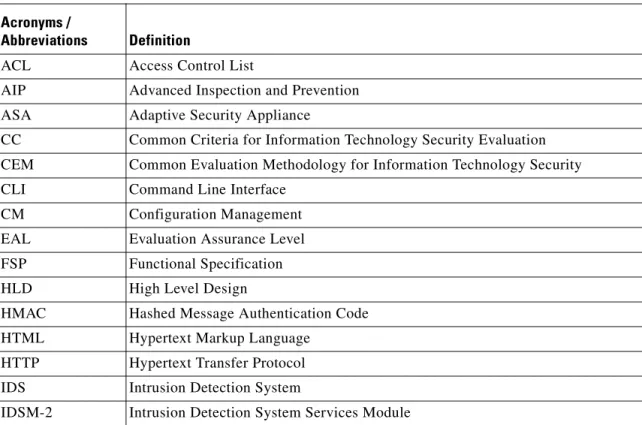
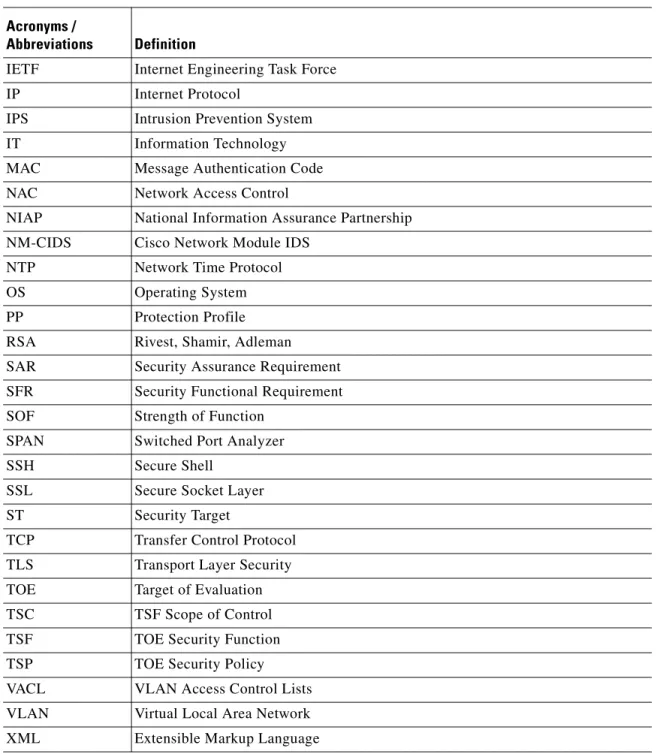
Table 1-1 presents the acronyms and abbreviations are used in this Security Target:
[CC_PART1] Common Criteria for Information Technology Security Evaluation – Part 1: Introduction and general model, dated August 2005, version 2.3,
CCMB-2005-08-001
[CC_PART2] Common Criteria for Information Technology Security Evaluation – Part 2: Security functional requirements, dated August 2005, version 2.3,
CCMB--2005-08-002
[CC_PART3] Common Criteria for Information Technology Security Evaluation – Part 3: Security assurance requirements, dated August 2005, version 2.3,
CCMB-2005-08-003
[CEM] Common Methodology for Information Technology Security Evaluation –
Evaluation Methodology, dated August 2005, version 2.3 CCMB-2005-08-004
[IDSPP] Intrusion Detection System System Protection Profile, Version 1.6, dated April 4, 2006
Table 1-1 Acronyms and Abbreviations
Acronyms /
Abbreviations Definition
ACL Access Control List
AIP Advanced Inspection and Prevention
ASA Adaptive Security Appliance
CC Common Criteria for Information Technology Security Evaluation CEM Common Evaluation Methodology for Information Technology Security
CLI Command Line Interface
CM Configuration Management
EAL Evaluation Assurance Level
FSP Functional Specification
HLD High Level Design
HMAC Hashed Message Authentication Code
HTML Hypertext Markup Language
HTTP Hypertext Transfer Protocol
IDS Intrusion Detection System
IETF Internet Engineering Task Force
IP Internet Protocol
IPS Intrusion Prevention System
IT Information Technology
MAC Message Authentication Code
NAC Network Access Control
NIAP National Information Assurance Partnership
NM-CIDS Cisco Network Module IDS
NTP Network Time Protocol
OS Operating System
PP Protection Profile
RSA Rivest, Shamir, Adleman
SAR Security Assurance Requirement
SFR Security Functional Requirement
SOF Strength of Function
SPAN Switched Port Analyzer
SSH Secure Shell
SSL Secure Socket Layer
ST Security Target
TCP Transfer Control Protocol
TLS Transport Layer Security
TOE Target of Evaluation
TSC TSF Scope of Control
TSF TOE Security Function
TSP TOE Security Policy
VACL VLAN Access Control Lists
VLAN Virtual Local Area Network
XML Extensible Markup Language
Table 1-1 Acronyms and Abbreviations (continued)
Acronyms /
C H A P T E R
2
TOE Description
This chapter provides an overview of the TOE to assist potential users in determining whether it meets their needs for intrusion detection and prevention functionality. The TOE for this ST consists of the following Cisco Sensors that support Cisco IPSv6.0: Cisco IPS 4200 Series sensors, Cisco Catalyst 6500 Series IDSM-2, Advanced Inspection and Prevention (AIP) Security Services Module (AIP SSM) for the Cisco Adaptive Security Appliance ASA, and the NM-CIDS for Cisco Routers. This chapter also defines the physical and logical boundaries; summarizes the security functions; and describes the evaluated configuration.
TOE Product Type
The TOE is a network-based Intrusion Detection and Prevention System that monitors traffic in real-time. It can analyze both the header and content of each packet. The TOE can analyze single packets or a complete flow for attacks while maintaining flow state, allowing for the detection of multi-packet attacks. The TOE uses a rule-based expert system to interrogate the packet information to determine the type of attack, be it simple or complex.
All data collection and analysis is performed by the TOE which is to be placed at strategic points throughout a target IT system1 to interrogate passing network traffic. In response to an attack, the TOE has several options that include generating an alarm, logging the alarm event, configuring access control lists (ACLs) to block attackers, dropping and modifying packets, and killing Transfer Control Protocol (TCP) sessions.
TOE Overview
The TOE for this ST is Cisco IPSv6.0 software executing on an appliance (i.e., Cisco IPS 4200 Series Sensors) or a module. Modules for this ST include the AIP SSM Module for the Cisco ASA, the IDSM-2 module for the Catalyst 6500 Series switches, or the NM-CIDS network module for Cisco routers.
Intrusion Detection and Prevention System Concept
Traditionally, an IDS passively monitors packets on a given target network looking for malicious activity. The typical means by which the IDS detects malicious activity is by using signature analysis on captured packets to determine the type of attack. In promiscuous mode, the IDS analyzes a copy of
1. Here and throughout this document, we use the terms IT system and IT network synonymously when we refer to what the TOE is monitoring.
the monitored traffic rather than the actual packet. If a packet or series of packets triggers an alarm based on signature analysis, information related to this possible intrusion is collected to be reviewed in real-time or historically. This information allows the administrator of the IDS to detect real time attacks, as well as perform forensic investigation on past attacks. Additional administrator configurable actions could be taken by the IDS to include connection resets and configuring access control lists to block the attacker.
The disadvantage of intrusion detection is that the IDS cannot stop malicious traffic from reaching its intended target for certain types of attacks. The response actions by the IDS are post-event responses and often require assistance from other networking devices (routers and firewalls) to respond to an attack.
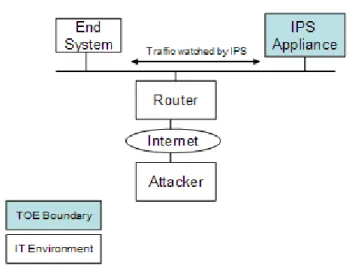
Intrusion prevention directly affects traffic flow to stop attacks from reaching the intended target. In inline mode, the IPS sits on the network which allows the IPS to stop attacks by dropping detected malicious traffic. The IPS analyzes the actual packet. If a packet or series of packets triggers an alarm, packet drop actions could be taken in addition to IDS actions. Figure 2-1 illustrates an example network topology using the IPSv6.0.
Figure 2-1 Example Network Topology Using IPSv6.0
TOE Physical Boundary
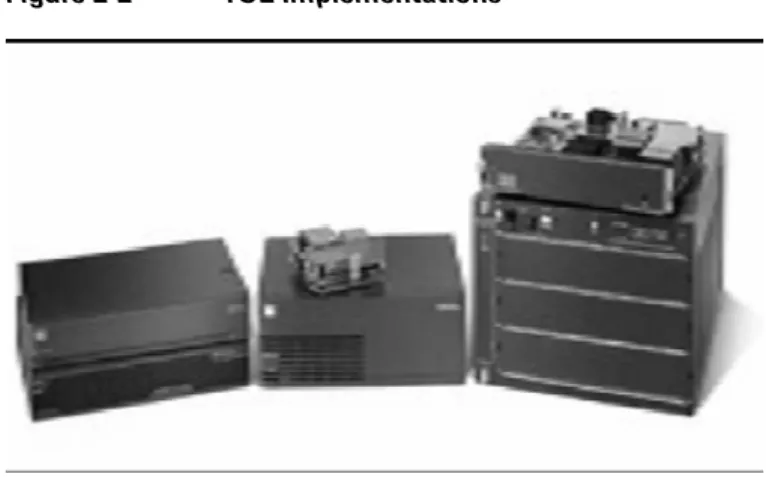
The evaluated configuration of the TOE includes four representations. Figure 2-2 below shows an actual picture of the physical TOE representations. On the left side of the picture is the Cisco IPS 4200 Series appliance, representative of all appliance models covered in this ST. The appliance is a self contained unit which provides all TOE functionality for the Appliance TOE. The Cisco NM-CIDS and Cisco IDSM-2 shown in the picture are the plug-in modules sitting atop the router appliance and switch appliance respectively. The plug-in modules each provide all TOE functionality for the Module TOE. Though the Cisco AIP SSM is not pictured, it is similar to the Cisco NM-CIDS and the Cisco IDSM-2 in that the AIP SSM is a plug in module for the ASA appliance and provides all TOE functionality for
the Module TOE. The specific module and appliance models for the TOE are listed below in Table 2-1. These models only differ in hardware configuration and throughput and do not affect how the security functions specified in the ST are met.
Figure 2-2 TOE Implementations
The following subsections describe the physical boundary for each TOE representation.
Appliance TOE
The Appliance TOE includes all Cisco IPSv6.0 application code, the resident Linux operating system (Modified Linux version 2.4 kernel) which the Cisco IPSv6.0 application runs upon, and all hardware which the IPS application code and the Linux operating system run upon. The Linux operating system (OS) cannot be installed separately from the Cisco IPSv6.0 application code, and is shipped and installed as one disk image.
Table 2-1 TOE Appliances and Modules
Model Name Part Number
Appliances IDS-4215 IDS-4215-4FE-K9 IDS-4250 IDS-4250-TX-K9 IDS-4250-SX-K9 IDS-4250-XL-K9 IPS-4240 IPS-4240-K9 IPS-4255 IPS-4255-K9 IPS-4260 IPS-4260-K9 Modules AIP-SSM-10 ASA-SSM-AIP-10-K9 AIP-SSM-20 ASA-SSM-AIP-20-K9 IDSM-2 WS-SVC-IDSM2-K9 NM-CIDS NM-CIDS-K9
An Intel x86 based platform which is encapsulated in a thin one U rack mountable case is the hardware configuration for the Appliance TOE. The Appliance TOE comes with at least three physical interfaces, a serial port, one command and control interface and at least one sensor interface. The command and control interface has an IP address that is used for configuring the appliance. The command and control interface is permanently enabled and mapped to a specific physical interface which depends on the specific model of the appliance. The command and control interface cannot be used as a sensor or TCP reset interface. Sensor interfaces are used to analyze traffic for security violations. Sensor interfaces can operate individually in promiscuous mode or can be paired to create inline interfaces for IPS processing.
The Appliance TOE includes a Modified Linux Version 2.4 kernel as its embedded Operating System (OS). All Subsystems are built atop this OS. The Appliance TOE uses the OS clock to generate timestamps for audit records.
Module TOE
Cisco IDSM-2The physical scope and boundaries of the Cisco IDSM-2 include the Cisco IPSv6.0 application code, the resident Linux operating system, and the IDSM2 hardware that resides within a Cisco Catalyst 6500 series switch. The switch itself is not included within the TOE physical boundary. The Linux operating system cannot be installed separately from the Cisco IPSv6.0 application code, and is shipped and installed as one disk image.
The Cisco IDSM-2 hardware includes an Intel x86 based module which is installed within a Cisco Catalyst 6500 series switch. The Cisco IDSM-2 comes with five physical interfaces: one command and control interface, two sensor interfaces, one backplane interface, and one TCP reset interface. The command and control interface has an IP address and is used for configuring the appliance. The command and control interface is permanently enabled and mapped to a specific physical interface. The command and control interface cannot be used as a sensing or TCP reset interface. Sensing interfaces are used to analyze traffic for security violations. Sensing interfaces can operate individually in promiscuous mode or can be paired to create inline interfaces for IPS processing. The Cisco IDSM-2 has a specific TCP reset interface because it cannot send TCP resets on its sensor ports.
The Cisco IDSM-2 Module TOE includes a Modified Linux Version 2.4 kernel as its embedded Operating System (OS). All Subsystems are built atop this OS. The Cisco IDSM-2 Module TOE does not contain a hardware clock. It receives time generation from the switch upon which it is installed and then uses the OS clock for keeping the time.
The following are the software and hardware IT Environment requirements for the Cisco IDSM-2: Catalyst Supervisor Software Requirements:
• Catalyst OS 7.5(1) (minimum)
• Cisco IOS Software Release 12.1(19)E; 12.2(14)SX1, or 12.2.(14)SY (minimum) Catalyst Supervisor hardware requirements are shown in Table 2-2.
Table 2-2 Catalyst Supervisor Hardware Options with IDSM-2
Supervisor Catalyst Software Cisco IOS Software
Supervisor 1A 7.5(1)
-Cisco AIP SSM
The physical scope and boundaries of the AIP SSM include the Cisco IPSv6.0 application code, the resident Linux operating system, and the AIP SSM hardware that resides within a Cisco ASA 5500 Series Appliance. The ASA Appliance itself is not included within the TOE physical boundary. The Linux operating system cannot be installed separately from the Cisco IPSv6.0 application code, and is shipped and installed as one disk image. The AIP SSM comes in two models: AIP-SSM-10 and AIP-SSM-20. AIP-SSM-10 supports approximately 100 Mbps throughput and AIP-SSM-20 supports approximately 200 Mbps. Only one module can populate the slot in an ASA Appliance at a time. The Cisco AIP SSM comes with three physical interfaces, one command and control interface, one backplane interface and one sensor interface. The command and control interface has an IP address and is used for configuring the module. The command and control interface is permanently enabled and mapped to a specific physical interface. The command and control interface cannot be used as a sensor or TCP reset interface. The Sensor interface is used to analyze traffic for security violations. The sensor interface can operate in promiscuous mode or inline mode.
The Cisco AIP SSM includes a Modified Linux Version 2.4 kernel as its embedded Operating System (OS). All Subsystems are built atop this OS. The Cisco AIP SSM does not contain a hardware clock. It receives time generation from the ASA Appliance upon which it is installed and then uses the OS clock for keeping the time.
The following are the software and hardware IT Environment requirements for the AIP SSM: Cisco ASA Appliance software requirements:
• Cisco Adaptive Security Appliance Software 7.0 or higher Cisco ASA Appliance hardware requirements:
• Cisco ASA 5500 series adaptive security appliance (ASA)
– ASA 5510 (AIP-SSM-10)
– ASA 5520 (AIP-SSM-10 and AIP-SSM-20)
– ASA 5540 (AIP-SSM-20) Cisco NM-CIDS
The physical scope and boundaries of the Cisco NM-CIDS include the Cisco IPSv6.0 application code, the resident Linux operating system, and the NM-CIDS hardware that resides within a Cisco router. The router itself is not included within the TOE physical boundary. The Linux operating system cannot be installed separately from the Cisco IPSv6.0 application code, and is shipped and installed as one disk image.
Supervisor 1A-PFC2 or MSFC2 7.5(1) 12.1(19)E1
Supervisor 2 with PFC2 7.5(1)
-Supervisor 2 with PFC1 or MSFC1 7.5(1) 12.1(19)E,
12.2(14)SY Supervisor 720 (integrated PFC3 and
MSFC3)
- 12.2(14)SX1
or later
Table 2-2 Catalyst Supervisor Hardware Options with IDSM-2 (continued)
The Cisco NM-CIDS comes with two physical interfaces, one command and control interface, and one sensor interface. The command and control interface has an IP address and is used for configuring the module. The command and control interface is permanently enabled and mapped to a specific physical interface. The command and control interface cannot be used as a sensor or TCP reset interface. The Sensor interface is used to analyze traffic for security violations. The sensor interface can only operate in promiscuous mode.
The Cisco NM-CIDS includes a modified Linux version 2.4 kernel as its embedded Operating System (OS). All Subsystems are built atop this OS. The Cisco NM-CIDS does not contain a hardware clock. It receives time generation from the router upon which it is installed and then uses the OS clock for keeping the time.
The following are the software and hardware IT Environment requirements for the Cisco NM-CIDS: Cisco Router software requirements:
• Cisco IOS software 12.2(15)ZJ or later
• Cisco IOS software 12.3(4)T or later Cisco Router hardware requirements:
• Cisco 2600XM Series
• Cisco 2961
• Cisco 3660
• Cisco 3725
• Cisco 3745
TOE Logical Boundary
The TOE consists of a Cisco IPSv6.0 application executing on top of a modified Linux version 2.4 kernel that is shipped and installed as one disk image. All the TOE representations are loaded with the same set of binaries along with a capabilities file. The capabilities file is used to configure what features are available for a particular TOE implementation. At startup, the TOE will determine what hardware platform it is executing on and configure itself according to the specifications in the capabilities file. In promiscuous mode, the TOE is providing IDS services. The packets do not flow through the TOE but rather the TOE is analyzing a copy of the monitored traffic. The received data is parsed for analysis and compared against known attacks (signatures). The version and revision level of the signatures used to identify known attacks is the same across all TOE representations. The response actions implemented in promiscuous mode are post-event responses and include generating an alarm, logging the alarm event, killing TCP sessions, and/or sending a command to a Cisco router, Cisco switch, or Cisco firewall to block traffic. In inline mode, the TOE is providing IPS services. The packets do flow through the TOE. The TOE performs real-time analysis of the network traffic by looking for anomalies and misuse based on an extensive, embedded signature library and inspection policy rules. When the TOE detects unauthorized activity, the TOE can in addition to the IDS response actions1, drop the packets preventing the packets from reaching its intended target. In inline mode, a packet normally comes in through the first interface of a pair on the TOE and out the second interface of the pair. The packet is sent to the second interface of the pair unless the packet is being denied or modified by a signature. Note that the AIP SSM only has one sensor interface but can still operate in inline mode.
The TOE can be managed remotely in two ways. The first is via web pages over a TLS/SSL connection. The second is through the Command Line Interface (CLI) over an SSH connection. Telnet is disabled by default and is not allowed in the evaluated configuration. The administrator is only allowed to remotely
administer the TOE via SSH. Note that the local command and control is performed via CLI. The TOE allows authorized users to configure and issue commands on the system based on the users privileges (role).
The Cisco NM-CIDS operates in promiscuous mode (IDS mode) only. All other TOE configurations operate in both promiscuous and inline mode.
The TOE generates security relevant events and system events (alarm events) and stores them to an internal event store. All events written to the event store conform to the Security Device Event Exchange (SDEE) format. The Event Viewer and the IDS Management Center are not included in the TOE. The TOE maintains reliable time which in turn is used to generate a timestamp for all event records. Unlike the Appliance TOE, the Module TOE evaluates traffic received from their host IT environment (i.e., Catalyst switch, ASA, and/or router). The Cisco ASA Appliance diverts packets to the AIP SSM just before the packet exits the egress interface and after other firewall polices are applied. For example, packets that are blocked by the Cisco ASA Appliance access list are not forwarded to the AIP SSM. For the Cisco IDSM-2, network traffic is either copied to the Cisco IDSM-2 based on security VACLs in the switch or is copied to the Cisco IDSM-2 through the switch’s SPAN port feature. The Cisco NM-CIDS processes packets that are forwarded (copied) from selected interfaces on the router to the sensor interface on the Cisco NM-CIDS.
The Module TOE does not contain a hardware clock and therefore must receive initial time from their host IT environment (i.e., Catalyst switch, ASA, or router) via a trusted channel. The Module TOE receives time generated from the host IT environment upon boot-up or when changed by the host IT environment administrator, and then maintains the time locally.
TOE Features Not Evaluated
TOE Features that are outside the scope of the defined TOE Security Functions (TSF) and thus not evaluated are:
• VLAN separation and enforcement of protection features offered by VLANs is not included in this evaluation.
TOE Security Architecture
The following sections provide details about how the security architecture of the TOE for this ST cannot be bypassed, corrupted, or otherwise compromised. An explanation is provided for how each TOE type supports the secure operation of the TSF and where applicable, how the IT environment also supports secure operation of the TSF.
Appliance TOE
The Appliance TOE is a self contained hardware and software appliance. The Appliance TOE provides IDS and IPS services to the monitored IT network. It is a dedicated device, with no general purpose operating system or programming interface. The Appliance TOE mediates the interfaces and
communications and makes sure that the security enforcement functions are invoked and succeed before allowing any other mediated security function to be used. By doing this the Appliance TOE ensures that it and its security functions are non-bypassable.
The Appliance TOE maintains a security domain for its own use. The security domain is all the hardware and software that makes up the Appliance TOE. The Appliance TOE provides for isolation at the physical boundary of the component. For this reason the whole TOE is an isolated security domain. The Appliance TOE helps in keeping the domain separate and protected by controlling interfaces into it so that only trusted and authorized communications occur that are directly related to satisfying the Appliance TOE’s capability to provide IDS and IPS services. The administrative interface is protected by authentication and by physical controls, and by means of encryption when used remotely. No untrusted processes are permitted on the Appliance TOE. Because the whole Appliance TOE is a separate physical domain and a dedicated platform solely supporting its own processes and the fact that it controls and mediates access to its interfaces, it provides a security domain for the TSF that is protected from interference and tampering.
Module TOE
The Module TOE is a hardware plug-in module. The parent chassis of the module (host IT environment) is not part of the Module TOE and is considered to be a remote trusted IT product. The Module TOE and the trusted IT product communicate via a trusted channel that is protected from modification and disclosure. The channel is a registered logical and physical interface that is not visible to the external target network. The trusted channel is used by the Module TOE to receive a time value upon boot up. The trusted IT product can use the trusted channel to change the time on the Module TOE and halt execution of the Module TOE. The Module TOE protects itself from external interference and tampering by untrusted subjects by controlling all its administrative and network interfaces. The module has no general purpose capability or programming interface. The administrative and network interfaces support the flow of packets from the host (switch, ASA, and router) as well as administration of the Module TOE itself. The protection mechanisms employed by the Module TOE ensure that TSP enforcement functions are invoked and succeed before each function within the TSC is allowed to proceed. More specifically, once a user has been authenticated, the TOE will determine which functionality (by role) is presented to the user. The host IT environment administrator can access the TOE to change the time and halt the execution of the module. Because the host IT environment is considered to be a trusted IT entity and the interface established to change the time and halt the module is via a trusted channel, the security domain for the Module TOE is still considered protected from interference and tampering. No other means, other than described, are provided for the user to interact with the Module TOE.
Since the Module TOE component mediates its own interfaces to ensure only authorized
communications occur related to the module’s ability to perform its functions, and the trusted channel between the Module TOE and the host IT environment is not considered an unauthorized unprotected channel, the Module TOE component operates in a protected and non-bypassable security domain and cannot be compromised.
Security Functions Claimed by the TOE
The TOE’s security functions (TSF) summary and the identification of TOE data are described below.
TOE Data
Data in the TOE is categorized as either user data or TSF data. The following sections identify the data included in the TOE.
TSF Data
The TSF data for the TOE are the audit records (security relevant events and system events), signature data, analytical results, capabilities files, time, and user identification and authentication (I&A) credentials.
User Data
The user data for the TOE is network traffic information that is being monitored, analyzed and/ or processed by the TOE.
Security Management
The TOE’s security management functions provides security capabilities that guarantees all authorized users are required to identify and authenticate to the TOE before any administrative actions can be performed. Thus, an authorized user is one who has been successfully identified and authenticated by the TOE. The TOE provides administrator support functionality that enables a human user to manage and configure the TOE. The TOE manages roles for authorized users to ensure restricted access to the security functions and data for the TOE.
Audit
The TOE’s Audit security function supports audit record generation, storage, and review. The TOE maintains time to generate a reliable timestamp which is applied to each audit event record. Note that the Module TOE must receive an initial time from its host IT environment via a trusted channel to set its internal clock. Audit capabilities of the TOE include selective audit review by authorized users, audit storage, and protection of audit records from unauthorized deletion. Note that “Audit Trail”, “Audit Events”, “Audit Trail Data”, “Audit Data”, “Audit Records”, and “event data” are used interchangeably to refer to the Audit records defined as TSF data.
Network Traffic Sensing and Analysis
The TOE monitors network traffic from the target IT network. The TOE collects and stores information about all events that are indicative of inappropriate activity. Received data is parsed for analysis and compared against known attacks. The TOE utilizes advance methods for the inspection and analysis of traffic to include event correlation, risk rating calculation, and threat identification (e.g., protocol analysis, pattern recognition, anomaly detection). Based on the analytical result, the TOE has several options for reaction (depending on the interface mode) that include generating an alarm, logging the alarm event, dropping or modifying packets, sending a command to a Cisco router, switch, or firewall to block traffic specific offending network traffic, or killing TCP sessions.
Identification and Authentication
The TOE Identification and Authentication function requires users to provide credentials to the TOE in order to successfully be recognized as an authorized user. The user identifies and authenticates themselves through both the command line interface (CLI) and the Web interface using SSH and TLS/SSL respectively. Note that through the CLI interface, the user can also authenticate via RSA
authentication. In the case of the physical console interface the user is directly allowed to provide a username and password to the TOE. The TOE maintains and stores user identity, authentication data, and authorizations in the underlying operating system.
TOE Evaluated Configuration
The TOE’s evaluated configuration requires:
1. Cisco 4200 Series Sensor Appliance OR
1. Cisco IDSM-2
2. Host IT environment (Cisco Catalyst Switch) OR
1. Cisco AIP SSM
2. Host IT environment (Cisco ASA Appliance)
3. DES or 3 DES enabled OR
1. Cisco NM-CIDS
2. Host IT environment (Cisco Router)
The software version “6.0(1)E1” is the evaluated version and is an internal version that maps to IPSv 6.0. Note that the Cisco router, switch and ASA Appliance functionalities provided by the host IT
C H A P T E R
3
Security Environment
This chapter identifies the following:
• Significant assumptions about the TOE's operational environment.
• IT related threats to the organization countered by the TOE.
• Environmental threats requiring controls to provide sufficient protection.
• Organizational security policies for the TOE as appropriate.
This document identifies assumptions as A.assumption with "assumption" specifying a unique name. Threats are identified as T.threat with "threat" specifying a unique name. Policies are identified as P.policy with "policy" specifying a unique name.
Assumptions
The specific conditions listed in Table 3-1 are assumed to exist in the TOE's IT environment. These assumptions include both practical realities in the development of the TOE security requirements and the essential environmental conditions on the use of the TOE.
Table 3-1 TOE Assumptions
Name Assumption
A.ACCESS The TOE has access to all the IT System data it
needs to perform its functions
A.DYNMIC The TOE will be managed in a manner that allows
it to appropriately address changes in the IT System the TOE monitors.
A.ASCOPE The TOE is appropriately scalable to the IT
System the TOE monitors.
A.PROTCT The TOE hardware and software critical to
security policy enforcement will be protected from unauthorized physical modification.
A.LOCATE The processing resources of the TOE will be
located within controlled access facilities, which will prevent unauthorized physical access.
Threats
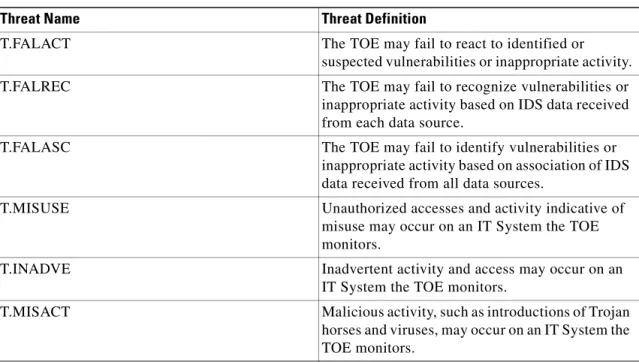
Table 3-2 and Table 3-3 list the threats addressed by the TOE. The following are threats identified for the TOE and the IT System the TOE monitors. The assumed level of expertise of the attacker for all the threats is unsophisticated.
TOE Threats
A.MANAGE There will be one or more competent individuals
assigned to manage the TOE and the security of the information it contains.
A.NOEVIL The authorized administrators are not careless,
willfully negligent or hostile, and will follow and abide by the instructions provided by the TOE documentation.
A.NOTRST The TOE can only be accessed by authorized
users.
Table 3-1 TOE Assumptions (continued)
Name Assumption
Table 3-2 TOE Threats
Threat Name Threat Definition
T.COMINT An unauthorized user may attempt to compromise
the integrity of the data collected and produced by the TOE by bypassing a security mechanism.
T.COMDIS An unauthorized user may attempt to disclose the
data collected and produced by the TOE by bypassing a security mechanism.
T.LOSSOF An unauthorized user may attempt to remove or
destroy data collected and produced by the TOE.
T.NOHALT An unauthorized user may attempt to compromise
the continuity of the System's collection and analysis functions by halting execution of the TOE.
T.PRIVIL An unauthorized use may gain access to the TOE
and exploit system privileges to gain access to TOE security functions and data.
T.IMPCON An unauthorized user may inappropriately change
the configuration of the TOE causing potential intrusions to go undetected.
IT System Threats
Organizational Security Policies
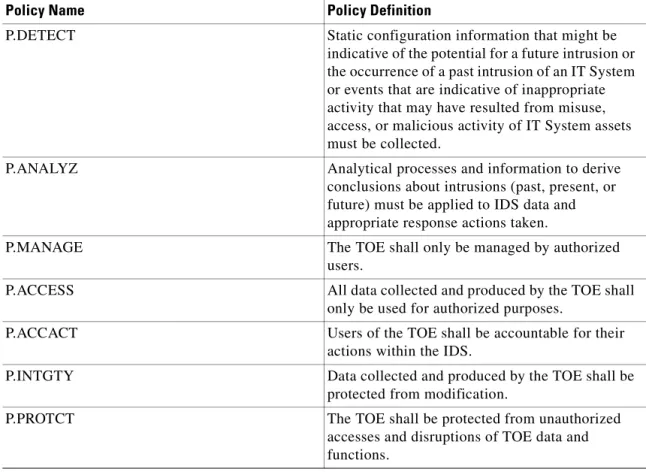
An organizational security policy is a set of rules, practices, and procedures imposed by an organization to address its security needs. Table 3-4 identifies the organizational security policies applicable to the TOE.
T.INFLUX An unauthorized user may cause malfunction of
the TOE by creating an influx of data that the TOE cannot handle.
T.FACCNT Unauthorized attempts to access TOE data or
security functions may go undetected.
Table 3-2 TOE Threats (continued)
Threat Name Threat Definition
Table 3-3 Threats to the IT System
Threat Name Threat Definition
T.FALACT The TOE may fail to react to identified or
suspected vulnerabilities or inappropriate activity.
T.FALREC The TOE may fail to recognize vulnerabilities or
inappropriate activity based on IDS data received from each data source.
T.FALASC The TOE may fail to identify vulnerabilities or
inappropriate activity based on association of IDS data received from all data sources.
T.MISUSE Unauthorized accesses and activity indicative of
misuse may occur on an IT System the TOE monitors.
T.INADVE Inadvertent activity and access may occur on an
IT System the TOE monitors.
T.MISACT Malicious activity, such as introductions of Trojan
horses and viruses, may occur on an IT System the TOE monitors.
Table 3-4 Organizational Security Policies
Policy Name Policy Definition
P.DETECT Static configuration information that might be
indicative of the potential for a future intrusion or the occurrence of a past intrusion of an IT System or events that are indicative of inappropriate activity that may have resulted from misuse, access, or malicious activity of IT System assets must be collected.
P.ANALYZ Analytical processes and information to derive
conclusions about intrusions (past, present, or future) must be applied to IDS data and appropriate response actions taken.
P.MANAGE The TOE shall only be managed by authorized
users.
P.ACCESS All data collected and produced by the TOE shall
only be used for authorized purposes.
P.ACCACT Users of the TOE shall be accountable for their
actions within the IDS.
P.INTGTY Data collected and produced by the TOE shall be
protected from modification.
P.PROTCT The TOE shall be protected from unauthorized
accesses and disruptions of TOE data and functions.
C H A P T E R
4
Security Objectives
This Chapter identifies the security objectives of the TOE and the IT Environment. The security objectives identify the responsibilities of the TOE and the TOE's IT environment in meeting the security needs.
This document identifies objectives of the TOE as O.objective with objective specifying a unique name. Objectives that apply to the IT environment are designated as OE.objective with objective specifying a unique name.
Security Objectives for the TOE
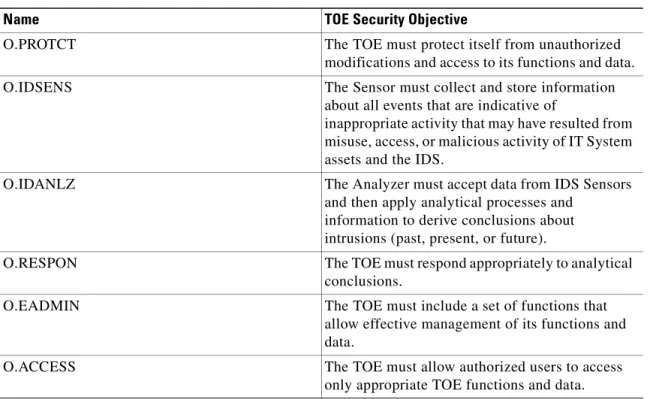
Table 4-1 identifies the security objectives of the TOE. These security objectives reflect the stated intent to counter identified threats and/or comply with any security policies identified. An explanation of the relationship between the objectives and the threats/policies is provided in the rationale section of this document.
Table 4-1 Security Objectives for the TOE
Name TOE Security Objective
O.PROTCT The TOE must protect itself from unauthorized
modifications and access to its functions and data.
O.IDSENS The Sensor must collect and store information
about all events that are indicative of
inappropriate activity that may have resulted from misuse, access, or malicious activity of IT System assets and the IDS.
O.IDANLZ The Analyzer must accept data from IDS Sensors
and then apply analytical processes and information to derive conclusions about intrusions (past, present, or future).
O.RESPON The TOE must respond appropriately to analytical
conclusions.
O.EADMIN The TOE must include a set of functions that
allow effective management of its functions and data.
O.ACCESS The TOE must allow authorized users to access
Chapter 4 Security Objectives Security Objectives for the Environment
Security Objectives for the Environment
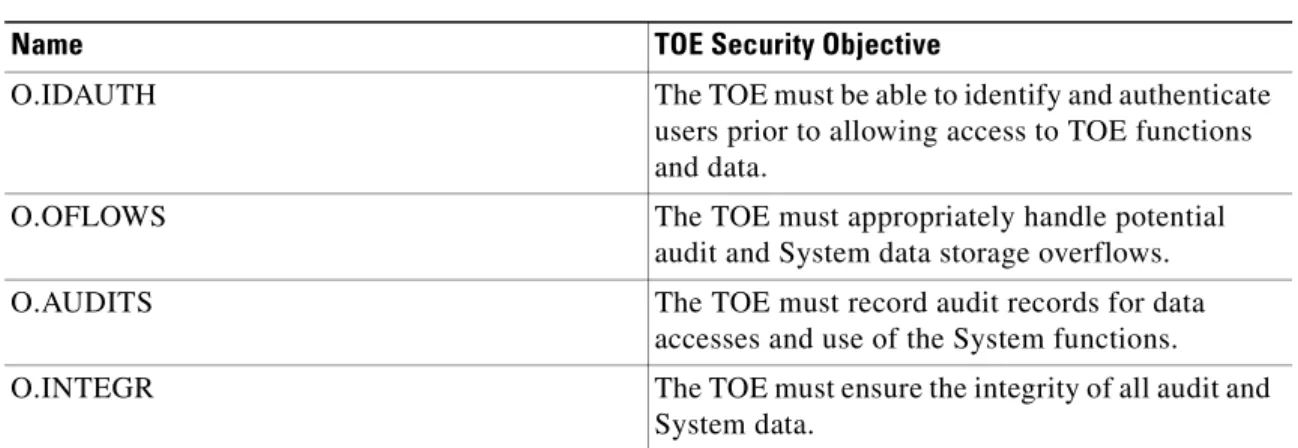
The assumptions identified in Assumptions, page 3-1 are incorporated as security objectives for the environment. They levy additional requirements on the environment, which are largely satisfied through procedural or administrative measures. Table 4-2 identifies the security objectives for the environment. Note the OE. convention varies from the PP but does not change the actual wording of the PP
Environment Objectives.
O.IDAUTH The TOE must be able to identify and authenticate
users prior to allowing access to TOE functions and data.
O.OFLOWS The TOE must appropriately handle potential
audit and System data storage overflows.
O.AUDITS The TOE must record audit records for data
accesses and use of the System functions.
O.INTEGR The TOE must ensure the integrity of all audit and
System data.
Table 4-1 Security Objectives for the TOE (continued)
Name TOE Security Objective
Table 4-2 Security Objectives for the Environment
Name IT Environment Security Objective
OE.INSTAL Those responsible for the TOE must ensure that
the TOE is delivered, installed, managed, and operated in a manner which is consistent with IT security.
OE.PHYCAL Those responsible for the TOE must ensure that
those parts of the TOE critical to security policy are protected from any physical attack.
OE.CREDEN Those responsible for the TOE must ensure that
all access credentials are protected by the users in a manner which is consistent with IT security.
OE.PERSON Personnel working as authorized administrators
shall be carefully selected and trained for proper operation of the System.
OE.INTROP The TOE is interoperable with the IT System it
monitors.
OE.TIME The IT Environment will provide reliable
timestamps to the module TOE.
OE.PROTECT The IT Environment will protect itself and the
module TOE from external interference or tampering.
C H A P T E R
5
Security Requirements
This section identifies the Security Functional Requirements for the TOE and for the IT Environment. The Security Functional Requirements included in this section are derived verbatim from Part 2 of the Common Criteria for Information Technology Security Evaluation, Version 2.3.
The CC defines operations on Security Functional Requirements: assignments, selections, assignments within selections and refinements. This document uses the following font conventions to identify the operations defined by the CC.
• Assignments: indicated by showing the value bolded in square brackets [Assignment_value].
• Selections: indicated by underlined text.
• Assignments within selections: indicated in italics and underlined text.
• Refinements: indicated in bold text with the addition of details and bold text when details are deleted.
Multiple Security Functional Requirement instances (iterations) are identified by the Security
Functional Requirement component identification followed by the instance number in parenthesis (e.g. FTP_ITC.1(1)) and the Security Functional Requirement element name followed by the instance number in parenthesis (e.g. FTP_ITC.1.1(1)). This document continues the iteration numbering for Security Functional Requirements that apply to both the TOE and the IT Environment.
Explicitly stated SFRs are identified by having a label (EXP) meaning 'Explicit Stated SFR for the TOE' after the requirement name for TOE SFRs. Because the explicit IDS requirements are transcribed from the PP, the conventions are applied accordingly.
TOE Security Functional Requirements
This section identifies the Security Functional Requirements for the TOE. The TOE Security Functional Requirements that appear in Table 5-1 are described in more detail in the following subsections.
Table 5-1 TOE Security Functional Requirements
ID Functional Component ST Operations
FAU_GEN.1 Audit data generation Selection, assignment,
assignment
FAU_SAR.1 Audit review Assignment, assignment
Chapter 5 Security Requirements TOE Security Functional Requirements
FAU_SAR.3 Selectable audit review Selection, assignment
FAU_SEL.1 Selective audit Selection, assignment
FAU_STG.2 Guarantees of audit data
availability
Selection, assignment, selection
FAU_STG.4 Prevention of audit data loss Selection, assignment
FCS_CKM.1 Cryptographic Key Generation Assignment, assignment,
assignment
FCS_CKM.4 Cryptographic Key Destruction Assignment, assignment
FCS_COP.1(1) Cryptographic Operation - SSH Assignment, assignment,
assignment, assignment
FCS_COP.1(2) Cryptographic Operation-SSL Assignment, assignment,
assignment, assignment
FIA_UAU.1 Timing of authentication Assignment
FIA_ATD.1 User attribute definition Assignment
FIA_UID.1 Timing of identification Selection, assignment,
assignment
FMT_MOF.1 Management of security
functions behavior
Assignment
FMT_MSA.2 Secure security attributes None
FMT_MTD.1 Management of TSF data Selection, assignment,
assignment, assignment
FMT_SMR.1 Security roles Assignment
FMT_SMF.1 Specification of Management
Functions
Assignment
FPT_RVM .1(1) Non-bypassability of the TSP None
FPT_SEP.1(1) TSF domain separation None
FPT_STM.1(1) Reliable time stamps None
FTP_ITC.1(1) Inter-TSF trusted channel Selection, assignment
FTP_ITC.1(2) Inter-TSF trusted channel Selection, assignment
FTP_RTC.1 (EXP) Remote administration trusted
channel
Explicitly Stated
IDS_SDC.1 (EXP) System data collection Explicitly Stated
IDS_ANL.1 (EXP) Analyser analysis Explicitly Stated
IDS_RCT.1 (EXP) Analyser react Explicitly Stated
IDS_RDR.1 (EXP) Restricted data review Explicitly Stated
IDS_STG.1 (EXP) Guarantee of system data
availability
Explicitly Stated IDS_STG.2 (EXP) Prevention of system data loss Explicitly Stated
Table 5-1 TOE Security Functional Requirements (continued)
Chapter 5 Security Requirements
TOE Security Functional Requirements
Security Audit (FAU)
FAU_GEN.1: Audit data generation
FAU_GEN.1.1The TSF shall be able to generate an audit record of the following auditable events:
a. Start-up and shutdown of the audit functions;
b. All auditable events for the basic level of audit; and
c. [Access to the System and access to the TOE and System data].
FAU_GEN.1.2
The TSF shall record within each audit record at least the following information:
a. Date and time of the event, type of event, subject identity, and the outcome (success or failure) of the event; and
b. For each audit event type, based on the auditable event definitions of the functional components included in the ST, [the additional information specified in the Details column of Table 5-2 Auditable Events].
Table 5-2 Auditable Events
Component Event Details
FAU_GEN.1 Start-up and shutdown of
audit functions
FAU_GEN.1 Access to System
FAU_GEN.1 Access to the TOE and
System data
Object IDS, Requested access
FAU_SAR.1 Reading of information
from the audit records
FAU_SAR.2 Unsuccessful attempts to
read information from the audit records
FAU_SEL.1 All modifications to the
audit configuration that occur while the audit collection functions are operating
FIA_UAU.1 All use of the authentication
mechanism
User identity, location
FIA_UID.1 All use of the user
identification mechanism
User identity, location
FMT_MOF.1 All modifications in the
behavior of the functions of the TSF
Chapter 5 Security Requirements TOE Security Functional Requirements
FAU_SAR.1: Audit review
FAU_SAR.1.1The TSF shall provide [authorized Administrators and authorized System administrators] with the capability to read [all audit trail data] from the audit records.
FAU_SAR.1.2
The TSF shall provide the audit records in a manner suitable for the user to interpret the information.
FAU_SAR.2: Restricted audit review
FAU_SAR.2.1
The TSF shall prohibit all users read access to the audit records, except those users that have been granted explicit read-access.
FAU_SAR.3: Selectable audit review
FAU_SAR.3.1The TSF shall provide the ability to perform sorting of audit data based on [date and time, subject identity, type of event, and success or failure of related event.]
FAU_SEL.1: Selective audit
FAU_SEL.1.1The TSF shall be able to include or exclude auditable events from the set of audited events based on the following attributes:
a. Event type;
b. [No additional attributes].
FMT_MTD.1 All modifications to the
values of TSF data
FMT_SMR.1 Modifications to the group
of users that are part of a role
User identity
FTP_ITC.1(1) All attempted uses of the
trusted channel functions
Initiator and target identifier
FTP_ITC.1(2) All attempted uses of the
trusted channel functions
Initiator and target identifier
Table 5-2 Auditable Events (continued)
Chapter 5 Security Requirements
TOE Security Functional Requirements
FAU_STG.2: Guarantees of audit data availability
FAU_STG.2.1The TSF shall protect the stored audit records from unauthorized deletion. FAU_STG.2.2
The TSF shall be able to detect unauthorized modifications to the stored audit records in the audit trail. FAU_STG.2.3
The TSF shall ensure that [the most recent, limited by available storage space] audit records will be maintained when the following conditions occur: audit storage exhaustion.
FAU_STG.4: Prevention of audit data loss
The TSF shall overwrite the oldest stored audit records and [send an alarm] if the audit trail is full.
Cryptographic Support (FCS)
FCS_CKM.1: Cryptographic key generation
FCS_CKM.1.1The TSF shall generate cryptographic keys in accordance with a specified cryptographic key generation algorithm [RSA] and specified cryptographic key sizes [1024 bits] that meet the following: [ANSI X9.31 and ANSI X9.80].
Application note: This SFR support key generation for both SSH and TLS/SSL.
FCS_CKM.4: Cryptographic key destruction
FCS_CKM.4.1
The TSF shall destroy cryptographic keys in accordance with a specified cryptographic key destruction method [overwrite method] that meets the following: [no standard].
Application note: This SFR support key destruction for both SSH and TLS/SSL.
FCS_COP.1(1): Cryptographic operation - SSH
FCS_COP.1.1(1)
The TSF shall perform [encryption and decryption] in accordance with a specified cryptographic algorithm [3DES] and cryptographic key sizes [168 bits] that meet the following: [FIPS 46-3].
Chapter 5 Security Requirements TOE Security Functional Requirements
FCS_COP.1(2): Cryptographic operation - SSL
FCS_COP.1.1(2)The TSF shall perform [encryption and decryption] in accordance with a specified cryptographic algorithm [3DES-EDE-CBC] and cryptographic key sizes [168 bits] that meet the following: [FIPS 46-3].
Identification and Authentication (FIA)
FIA_UAU.1: Timing of authentication
FIA_UAU.1.1The TSF shall allow [a) For the Web Interface: The TLS handshake to be performed, and input of authentication data b) For the CLI Interface: The SSH handshake to be performed, input of authentication data or in the case of the physical console interface, input of authentication data] on behalf of the user to be performed before the user is authenticated.
FIA_UAU.1.2
The TSF shall require each user to be successfully authenticated before allowing any other TSF-mediated actions on behalf of that user.
FIA_ATD.1: User attribute definition
FIA_ATD.1.1The TSF shall maintain the following list of security attributes belonging to individual users:
a. [User identity;
b. Authentication data; and c. Authorizations].
FIA_UID.1: Timing of identification
FIA_UID.1.1The TSF shall allow [a) For the Web Interface: The TLS handshake to be performed, and input of identification data b) For the CLI Interface: The SSH handshake to be performed, input of identification data or in the case of the physical console interface, input of identification data] on behalf of the user to be performed before the user is identified.
FIA_UID.1.2
The TSF shall require each user to be successfully identified before allowing any other TSF-mediated actions on behalf of that user.
Chapter 5 Security Requirements
TOE Security Functional Requirements
Security Management (FMT)
FMT_MOF.1: Management of security functions behavior
FMT_MOF.1.1The TSF shall restrict the ability to modify the behavior of the functions [of System data collection, analysis and reaction] to [authorized System administrators].
FMT_MTD.1: Management of TSF data
FMT_MTD.1.1The TSF shall restrict the ability to query and add System and audit data, and shall restrict the ability to query and modify all other TOE data to [authorized System administrators; and authorized administrators who can only query all other TOE data].
FMT_MSA.2: Secure security attributes
FMT_MSA.2.1The TSF shall ensure that only secure values are accepted for security attributes.
FMT_SMR.1: Security roles
FMT_SMR.1.1
The TSF shall maintain the following roles [ authorized administrator, and authorized System administrators].
FMT_SMR.1.2
The TSF shall be able to associate users with roles.
FMT_SMF.1: Specification of Management Functions
FMT_SMF.1.1The TSF shall be capable of performing the following security management functions:
a. [the ability to modify behavior of System data collection, analysis and reaction; and
b. the ability to query and add System and audit data; and c. the ability to query and modify all other TOE data].
Chapter 5 Security Requirements TOE Security Functional Requirements
Protection of the TOE Security Functions (FPT)
FPT_RVM.1(1): Non-bypassability of the TSP
FPT_RVM.1.1(1)The TSF shall ensure that TSP enforcement functions are invoked and succeed before each function within the TSC is allowed to proceed.
FPT_SEP.1(1): TSF domain separation
FPT_SEP.1.1(1)The TSF shall maintain a security domain for its own execution that protects it from interference and tampering by untrusted subjects.
FPT_SEP.1.2(1)
The TSF shall enforce separation between the security domains of subjects in the TSC.
FPT_STM.1(1): Reliable Time Stamps
FPT_STM.1.1(1)
The TSF shall be able to provide reliable time stamps for its own use.
Trusted Path/ Channels (FTP)
FTP_ITC.1(1): Inter-TSF trusted channel
FTP_ITC.1.1(1)The TSF shall provide a communication channel between itself and a remote trusted IT product that is logically distinct from other communication channels and provides assured identification of its end points and protection of the channel data from modification and disclosure.
FTP_ITC.1.2(1)
The TSF shall permit TSF to initiate communication via the trusted channel. FTP_ITC.1.3(1)
The TSF shall initiate communication via the trusted channel for [signature updates].
Application note: Signature updates are transmitted outbound using SCP over SSH or TLS/SSL via HTTPS.
Chapter 5 Security Requirements
TOE Security Functional Requirements
FTP_ITC.1(2): Inter-TSF trusted channel
FTP_ITC.1.1(2)The Module TSF shall provide a communication channel between itself and a remote trusted IT product that is logically distinct from other communication channels and provides assured identification of its end points and protection of the channel data from modification and disclosure.
FTP_ITC.1.2(2)
The Module TSF shall permit the remote trusted IT product to initiate communication via the trusted channel to set clock and halt execution.
FTP_ITC.1.3(2)
The Module TSF shall initiate communication via the trusted channel for [clock settings from the remote trusted IT product upon start-up and reboot].
Application note: Depending on the module, the remote trusted IT product is either the Catalyst switch, ASA appliance, or Cisco router.
FTP_RTC.1: Remote administration trusted channel (EXP)
FTP_RTC.1.1The TSF shall provide a communication channel between itself and a remote trusted IT product that is logically distinct from other communication channels and provides assured identification of its end points and protection of the channel data from modification and disclosure.
FTP_RTC.1.2
The TSF shall permit the remote trusted IT product to initiate communication via the trusted channel. FTP_RTC.1.3
The TSF shall use a trusted channel for the following functions: secure remote administration. Application note: Secure remote administration is provided by SSH and TLS/SSL.
IDS Component Requirements (IDS)
IDS_SDC.1: System data collection (EXP)
IDS_SDC.1.1The System shall be able to collect the following information from the targeted IT System resources:
a. Network Traffic; and