A Calculus Refresher
v1. March 2003
This work is licensed under the Creative Commons Attribution-Noncommercial-Share Alike 3.0 Unported License.
To view a copy of this license, visit http://creativecommons.org/licenses/by-nc-sa/3.0/ or send a letter to Creative Commons, 171 Second Street, Suite 300, San Francisco, California, 94105, USA.
www.mathcentre.ac.uk c
Contents
Foreword
2
Preliminary work
2
How to use this booklet
2
Reminders
3
Tables of derivatives and integrals
4
1. Derivatives of basic functions
5
2. Linearity in differentiation
7
3. Higher derivatives
9
4. The product rule for differentiation
10
5. The quotient rule for differentiation
11
6. The chain rule for differentiation
13
7. Differentiation of functions defined implicitly
15
8. Differentiation of functions defined parametrically 16
9. Miscellaneous differentiation exercises
17
10. Integrals of basic functions
20
11. Linearity in integration
21
12. Evaluating definite integrals
23
13. Integration by parts
24
14. Integration by substitution
26
15. Integration using partial fractions
29
16. Integration using trigonometrical identities
33
17. Miscellaneous integration exercises
35
Answers
39
Acknowledgements
46
Foreword
The material in this refresher course has been designed to enable you
to cope better with your university mathematics programme. When
your programme starts you will find that the ability to differentiate and
integrate confidently will be invaluable. We think that this is so
impor-tant that we are making this course available for you to work through
either before you come to university, or during the early stages of your
programme.
Preliminary work
You are advised to work through the companion booklet
An Algebra
Refresher
before embarking upon this calculus revision course.
How to use this booklet
You are advised to work through each section in this booklet in
or-der. You may need to revise some topics by looking at an AS-level or
A-level textbook which contains information about differentiation and
integration.
You should attempt a range of questions from each section, and check
your answers with those at the back of the booklet. The more questions
that you attempt, the more familiar you will become with these vital
topics. We have left sufficient space in the booklet so that you can do
any necessary working within it. So, treat this as a work-book.
If you get questions wrong you should revise the material and try again
until you are getting the majority of questions correct.
If you cannot sort out your difficulties, do not worry about this. Your
university will make provision to help you with your problems. This may
take the form of special revision lectures, self-study revision material or
a drop-in mathematics support centre.
Level
This material has been prepared for students who have completed an
A-level course in mathematics
Reminders
Use this page to note topics and questions which you found difficult.
Seek help with these from your tutor or from other university support services as soon as possible.
Tables
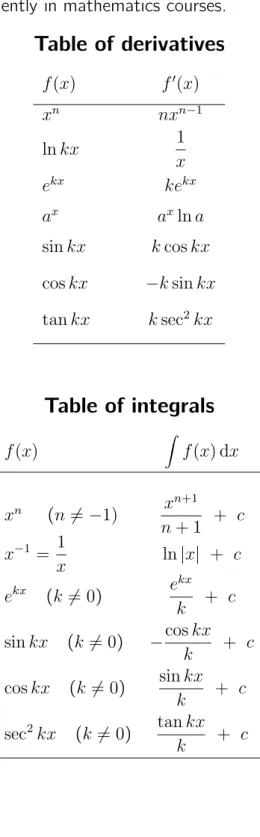
The following tables of common derivatives and integrals are provided for revision purposes. It will be a great advantage to know these derivatives and integrals because they are required so frequently in mathematics courses.
Table of derivatives
f(x) f′(x) xn nxn−1 lnkx 1 x ekx kekx ax axlna sinkx kcoskx coskx −ksinkx tankx ksec2kxTable of integrals
f(x) Z f(x) dx xn (n6=−1) xn+1 n+ 1 + c x−1 = 1 x ln|x| + c ekx (k 6= 0) e kx k + c sinkx (k6= 0) −coskx k + c coskx (k6= 0) sinkx k + c sec2kx (k6= 0) tankx k + c 41. Derivatives of basic functions
Try to find all the derivatives in this section without referring to a table of derivatives. The derivatives of these functions occur so frequently that you should try to memorise the appropriate rules. If you are really stuck, consult the table on page 4.
1. Differentiate each of the following with respect to x. (a)x (b) x6 (c) 6 (d) √x (e) x−1 (f) x1/7 (g) 1 x3 (h) x 79 (i) x1.3 (j) 1 3 √ x (k)x −5/3 (l) 1 x0.71
2. Differentiate each of the following with respect to θ.
(a)cosθ (b) cos 4θ (c) sinθ (d) sin2θ
3 (e) tanθ (f) tanπθ
(g)sin(−8θ) (h) tanθ
4 (i)cos 3πθ (j) cos −
5θ
2
!
(k)sin 0.7θ
3. Find the following derivatives. (a) d dx(e x) (b) d dy(e 2y) (c) d dt(e −7t) (d) d dx(e −x/3) (e) d dz(e 2z/π) (f) d dx(e −1.4x) (g) d dx(3 x)
4. Find the following derivatives. (a) d dx(lnx) (b) d dz(ln 5z) (c) d dx ln2x 3 6
2. Linearity in differentiation
The linearity rules enable us to differentiate sums and differences of functions, and constant multiples of functions. Specifically
d dx(f(x)±g(x)) = d dx(f(x))± d dx(g(x)), d dx(kf(x)) = k d dx(f(x)).
1. Differentiate each of the following with respect to x.
(a)3x+ 2 (b) 2x−x2 (c) −cosx−sinx (d) 3x−3+ 4 sin 4x
(e) 2ex+e−2x (f) 1
x−4−3 lnx (g) 4x
5−3 tan 8x−2e5x
2. Find the following derivatives. (a) d dt 5t 1/5+ t8 8 ! (b) d dθ 2 cos θ 4−3e −θ/4 ! (c) d dx 3e3x/5 5 ! (d) d dx 2 9tan 3x 2 − 3 4cos 8x (e) d dz 1 4z 4/3 −13e−4z/3 7
In Questions 3-5 you don’t need the product rule, quotient rule or chain rule to differentiate any of these if you do the algebra first!
3. Expand the powers or roots and hence find the following derivatives. (a) d dy q 2y (b) d dx (2x) 3 −(21x)3 ! (c) d dy 1 2e y4 ! (d) d dt √3 5e−2t
4. Simplify or expand each of the following expressions, and then differentiate with respect tox. (a) x−x 2 x3 (b) x( √x −x2) (c) 2x− 2 x 3 x2 +x (d)(e2x−1)(3−e3x) (e) 1−e−2x e−4x
5. Use the laws of logarithms to find the following derivatives. (a) d dx lnx9/2 (b) d dx ln 1 √ 6x !! (c) d dt ln t3 e3t !! (d) d dt lnte−2t1/3 8
3. Higher derivatives
1. Find the following second derivatives. (a) d 2 dx2(x 5 ) (b) d 2 dx2(cos 3x) (c) d2 dz2(e 2z −e−2z) (d) d 2 dy2(8−13y) (e) d2 dx2 1 x −3x−3x 3 (f) d2 dt2(ln 2t− √ 6t) (g) d 2 dx2 x3/2 − 1 x3/2 (h) d 2 dx2(e
x+e−x+ sinx+ cosx) (i) d
2 dt2 1 2sin 2t− 1 4ln 4t 9
4. The product rule for differentiation
The rule for differentiating the product of two functions f(x) and g(x) is
d
dx(f(x)g(x)) = f
′(x)g(x) +f(x)g′(x).
1. Differentiate each of the following with respect to x.
(a)x sinx (b) x3cos 2x (c) x−1/3e−3x
(d)√x ln 4x (e) (x2−x) sin 6x (f) 1 x tanx 3 −cos x 3
2. Find the following derivatives. (a) d dθ(sinθ cosθ) (b) d dt(sin 2t tan 5t) (c) d dz(sinz ln 4z) (d) d dx e−x/2 cosx 2 (e) d dx(e 6x ln 6x) (f) d dθ(cosθcos 3θ) (g) d dt(lnt ln 2t) 10
5. The quotient rule for differentiation
The rule for differentiating the quotient of two functions f(x) and g(x) is
d dx f(x) g(x) ! = f ′(x)g(x)−f(x)g′(x) (g(x))2 .
1. Differentiate each of the following with respect to x. (a) x 1−x2 (b) x4 1−x (c) 2−x 1 + 2x (d) 3x2−2x3 2x3+ 3 (e) 1 +√x √ x−x 11
2. Find the following derivatives. (a) d dx sinx x (b) d dx lnx x4/3 ! (c) d dθ θ2 tan 2θ ! (d) d dz ez √ z ! (e) d dx x2 ln 2x !
3. Find the following derivatives. (a) d dt sin 2t sin 5t (b) d dx e−2x tanx ! (c) d dx lnx cos 3x ! (d) d dx ln 3x ln 4x ! 12
6. The chain rule for differentiation
The chain rule is used to differentiate a “function of a function”:
d
dx(f(g(x))) =f
′(g(x)).g′(x).
1. Differentiate each of the following with respect to x.
(a)(4 + 3x)2 (b)(1−x4)3 (c) 1 (1−2x)2 (d) √ 1 +x2 (e) x− 1 x −1/3 (f)(2x2−3x+ 5)5/2 (g)qx−2√x (h) √ 1 4x2−x4 13
2. Find the following derivatives. (Remember the notation for powers of trigono-metric functions: “sin2x” means (sinx)2, etc.)
(a) d dθ(sin 2θ) (b) d dθ(sinθ 2) (c) d dθ(sin(sinθ)) (d) d dx(tan(3−4x)) (e) d dz(cos 55z) (f) d dx 1 cos3x (g) d dt(sin(2−t−3t 2))
3. Find the following derivatives. (The notation “expx” is used rather than “ ex ”
where it is clearer.) (a) d dy exp(−y2) (b) d dx(exp(cos 3x)) (c) d dx(cos(e 3x )) (d) d dx(ln(sin 4x)) (e) d dx(sin(ln 4x)) (f) d dx(ln(e x −e−x)) (g) d dt √ e3t−3 cos 3t 14
7. Differentiation of functions defined implicitly
1. Find ddxy in terms of y when x and y are related by the following equations. You will need the formula ddyx = 1/ddxy.
(a)x=y−y3 (b) x=y2+1
y (c) x=e
y+e2y (d)x= ln(y−e−y)
2. Find ddyx in terms of x and/or y when x and y are related by the following equations.
(a)cos 2x= tany (b) x+y2 =y−x2 (c) y−siny= cosx
(d)ex−x=e2y + 2y (e) x+ey = lnx+ lny (f) y= (x−y)3
8. Differentiation of functions defined parametrically
Ifx and y are both functions of a parameter t, then
dy dx = dy dt ÷ dx dt
1. Find ddyx in terms oftwhen xandyare related by the following pairs of parametric equations.
(a)x= sint, y= cost (b) x=t− 1
t, y= 1−t 2
(c) x=e2t+t, y=et+t2 (d) x= lnt+t, y =t−lnt
2. Find dx
dy in terms oftwhenxandyare related by the following pairs of parametric
equations.
(a)x= 3t+t3, y = 2t2 +t4 (b) x= cos 2t, y= tan 2t
9. Miscellaneous differentiation exercises
1. Find the following derivatives, each of which requires one of the techniques cov-ered in previous sections. You have to decide which technique is required for each derivative! (a) d dx(x 3tan 4x) (b) d dt(tan 34t) (c) d dx(exp(3 tan 4x)) (d) d dθ 3θ tan 4θ ! (e) d dx(exp(x−e x)) (f) d dy y4+y−4 y+y−1 ! (g) d dx(2 xx2) (h) d dx 1 lnx−x (i) d dx 5−3x (j) d dt(ln(lnt)) (k) d dz ln 1−z 1 +z 2!
2. Find the following derivatives, which require both the product and quotient rules. (a) d dx xcosx 1−cosx (b) d dz ez zlnz (c) d dθ sin 3θcos 2θ tan 4θ ! 17
3. Find the following derivatives, which require the chain rule as well as either the product rule or the quotient rule.
(a) d dt(e −tln(et+ 1)) (b) d dθ(sin 23θ cos43θ) (c) d dx 1−x2 1 +x2 !3/2 (d) d
dθ(exp(θcosθ)) (e)
d dx (xlnx)3 (f) d dx exp 1−x 1 +x (g) d dy 1 y2√y2−1 !
4. Find the following derivatives, which require use of the chain rule more than once. (a) d dx( √ 1−cos3x) (b) d dx exp(x−x2)1/4 (c) d dθ ln tan1 θ 18
5. Find the following second derivatives. (a) d 2 dx2( √ 1 +x2) (b) d 2 dz2(exp(z 2)) (c) d2 dθ2(sin 3θ) (d) d2 dx2 1 (1−x4)4 !
6. Remembering that cosecx = 1
sinx, secx =
1
cosx and cotx =
cosx
sinx, find the
following derivatives. (a) d dx(cosec2x) (b) d dθ(sec 2θ) (c) d dz( √ 1 + cotz) (d) d dθ(cosec 2θcot3θ) (e) d dx(ln(secx+ tanx)) (f) d dθ(tan(secθ)) 19
10. Integrals of basic functions
Try to find all the integrals in this section without referring to a table of integrals. The integrals of these functions occur so frequently that you should try to memorise the appropriate rules. If you are really stuck, consult the Tables on page 4.
1. Integrate each of the following with respect to x.
(a)x4 (b) x7 (c) x1/2 (d) x1/3 (e) √x (f)x−1/2 (g) √4 x (h) 1 x3 (i)x 0.2 (j) 1 x0.3 (k) 1 √ x (l) 1 √ x3 (m) x −2 (n) x4/3
2. Integrate each of the following with respect to x.
(a)cos 5x (b) sin 2x (c) sin12x (d) cosx
2 (e) 1 x (f)e 2x (g)e−2x (h) ex/3 (i)e0.5x (j) 1 ex (k) 1 e2x (l)cos(−7x) 20
11. Linearity in integration
The linearity rules enable us to integrate sums (and differences) of functions, and constant multiples of functions. Specifically
Z (f(x)±g(x))dx= Z f(x) dx± Z g(x)dx, Z k f(x)dx=k Z f(x)dx
1. Integrate each of the following with respect to x.
(a)7x4 (b) −4x7 (c) x1/2 +x1/3 (d) 17x1/3 (e) √x− √1 x (f) x 2+ 1 x (g)x3 + 1 x2 (h) 1 7x3 (i) 11 (j) 11 x0.3 (k)2x− 2 x (l) 7x−11
2. Integrate each of the following with respect to x.
(a)3x+ cos 4x (b) 4 + sin 3x (c) x
2 + sin
x
2 (d) 4e
x+ cosx
2
(e) e−2x+ e2x (f) 3 sin 2x+ 2 sin 3x (g) 1
kx, k constant (h) −1− 4 x (i)1 +x+x2 (j) 1 3x −7 (k) 1 2cos 1 2x (l) 1 2x2 −3x−1/2 21
3. Simplify each of the following expressions first and then integrate them with respect tox. (a)6x(x+ 1) (b) (x+ 1)(x−2) (c) x 3+ 2x2 √ x (d) ( √ x+ 2)(√x−3) (e) e2x(ex−e−x) (f) e3x−e2x ex (g) x+ 4 x (h) x2+ 3x+ 2 x+ 2 22
12. Evaluating definite integrals
1. Evaluate each of the following definite integrals. (a) Z 1 0 7x 4dx (b) Z 3 −2− 4t7dt (c) Z 2 1 (x 1/2+x1/3)dx (d)Z −1 −2 17t1/3dt (e) Z 3 1 (2s+ 8s 3)ds (f) Z 5 1 1 x2dx (g) Z 3 0 (t 2+ 2t)dt (h)Z π/4 0 cos 2xdx (i) Z 1/2 0 e 3xdx (j) Z 4 2 1 √ exdx (k) Z π/4 0 (2λ+ sinλ)dλ (l) Z 1 0 (e x+ e−x)dx
2. For the function f(x) =x2+ 3x−2verify that
Z 2 0 f(x)dx+ Z 3 2 f(x)dx= Z 3 0 f(x)dx
3. For the function f(x) = 4x2−7x verify that Z 1
−1f(x)dx=−
Z −1
1 f(x)dx.
13. Integration by parts
Integration by parts is a technique which can often be used to integrate products of functions. If u and v are both functions of x then
Z udv dxdx=uv− Z vdu dxdx
When dealing with definite integrals the relevant formula is
Z b a u dv dxdx= [uv] b a− Z b a v du dxdx
1. Integrate each of the following with respect to x.
(a)xex (b) 5xcosx (c) xsinx (d) xcos 2x (e) xlnx (f)2xsin x
2
2. Evaluate the following definite integrals. (a) Z π/2 0 xcosxdx (b) Z 2 1 4xe xdx (c) Z 1 −1 5te−2tdt (d) Z 3 1 xlnxdx
3. In the following exercises it may be necessary to apply the integration by parts formula more than once. Integrate each of the following with respect to x.
(a)x2ex (b) 5x2cosx (c) x(lnx)2 (d) x3e−x (e) x2sin x
2
4. Evaluate the following definite integrals. (a) Z π/2 0 x 2cosxdx (b) Z 1 0 7x 2exdx (c) Z 1 −1 t2e−2tdt 5. By writing lnx as 1×lnx find Z lnxdx.
6. Let I stand for the integral
Z lnt
t dt. Using integration by parts show that
I = (lnt)2−I ( plus a constant of integration )
Hence deduce thatI = 1 2(lnt)
2 +c.
7. Let I stand for the integral
Z
etsintdt. Using integration by parts twice show that
I = etsint−etcost−I (plus a constant of integration )
Hence deduce that
Z
etsintdt= e
t(sint−cost)
2 +c
14. Integration by substitution
1. Find each of the following integrals using the given substitution. (a) Z cos(x−3)dx, u=x−3 (b) Z sin(2x+ 4)dx, u= 2x+ 4 (c) Z cos(ωt+φ)dt, u=ωt+φ (d) Z e9x−7dx, u= 9x −7 (e) Z x(3x2+ 8)3dx, u= 3x2+ 8 (f) Z x√4x−3 dx, u= 4x−3 (g) Z 1 (x−2)4dx, u=x−2 (h) Z 1 (3−t)5 dt, u= 3−t (i) Z x e−x2
dx, u=−x2 (j) Z sinx cos3xdx, u= cosx
(k) Z t √ 1 +t2 dt, u= 1 +t 2 (l) Z x 2x+ 1dx, u= 2x+ 1 26
2. Find each of the following integrals using the given substitution. (a) Z x √ x−3dx, z = √ x−3 (b) Z (x−5)4(x+ 3)2dx, u=x−5
3. Evaluate each of the following definite integrals using the given substitution. (a) Z π/4 0 cos(x−π)dx, z =x−π (b) Z 9 8 (x−8) 5(x+ 1)2dx, u=x−8 (c) Z 3 2 t √
t−2 dt, by letting u=t−2, and also by letting u=√t−2
(d) Z 2 1 t(t 2+ 5)3dt, u=t2+ 5 (e) Z π/4 0 tanx sec 2xdx, u= tanx (f) Z π2 π2 /4 sin√x √ x dx, u= √x (g) Z 2 1 e√t √ tdt, u= √ t 27
4. By means of the substitution u= 4x2−7x+ 2 show that
Z 8x−7
4x2−7x+ 2dx= ln|4x
2
−7x+ 2|+c
5. The result of the previous exercise is a particular case of a more general rule with which you should become familiar: when the integrand takes the form
derivative of denominator denominator
the integral is the logarithm of the denominator. Use this rule to find the following integrals, checking each example by making an appropriate substitution.
(a) Z 1 x+ 1dx (b) Z 1 x−3dx (c) Z 3 3x+ 4dx (d) Z 2 2x+ 1dx
6. Use the technique of Question 5 together with a linearity rule to find the following integrals. For example, to find
Z x
x2−7dx we note that the numerator can be made
equal to the derivative of the denominator as follows:
Z x x2−7dx= 1 2 Z 2x x2−7dx= 1 2ln|x 2 −7|+c. (a) Z x x2+ 1dx (b) Z sin 3θ 1 + cos 3θdθ (c) Z 3e2x 1 +e2xdx 28
15. Integration using partial fractions
1. By expressing the integrand as the sum of its partial fractions, find the following integrals. (a) Z 2x+ 1 x2+xdx (b) Z 3x+ 1 x2 +xdx (c) Z 5x+ 6 x2+ 3x+ 2 dx (d) Z x+ 1 (1−x)(x−2)dx (e) Z 9x+ 25 x2 + 10x+ 9dx (f) Z 5x−11 x2+ 10x+ 9dx (g) Z 4x 4−x2 dx (h) Z 15x+ 51 x2+ 7x+ 10dx (i) Z ds s2−1
2. By expressing the integrand as the sum of its partial fractions, find the following definite integrals. (a) Z 2 1 2−8x x2+ 2xdx (b) Z 2 0 5x+ 7 (x+ 1)(x+ 2)dx (c) Z 0 −1 7x−11 x2−3x+ 2dx 29
3. By expressing the integrand as the sum of its partial fractions, find the following integrals. (a) Z x x2−2x+ 1 dx (b) Z 4x+ 6 (x+ 1)2 dx (c) Z 7x−23 x2−6x+ 9dx
4. By expressing the integrand as the sum of its partial fractions, find the following definite integrals. (a) Z 1 0 x+ 8 x2+ 6x+ 9dx (b) Z 1 −1 2x+ 19 x2+ 18x+ 81dx (c) Z 2 0 − 8x x2+ 2x+ 1dx 30
5. Find Z 2x2+ 6x+ 5 (x+ 2)(x+ 1)2dx. 6. Find Z 5x2+x−34 (x−2)(x−3)(x+ 4)dx. 7. Find Z x2−11x−4 (2x+ 1)(x+ 1)(3−x)dx. 31
8. In this example note that the degree of the numerator is greater than the degree of the denominator. Find
Z x3
(x+ 1)(x+ 2)dx.
9. Show that 2x
3 + 1
(x+ 1)(x+ 2)2 can be written in the form
2− 1 x+ 1 + 15 (x+ 2)2 − 9 x+ 2 Hence find Z 2x3+ 1 (x+ 1)(x+ 2)2 dx. 10. Find Z 4x3+ 10x+ 4
2x2+x dx by expressing the integrand in partial fractions.
16. Integration using trigonometrical identities
Trigonometrical identities can often be used to write an integrand in an alternative form which can then be integrated. Some identities which are particularly useful for integration are given in the table below.
Table of trigonometric identities
sinA sinB = 12(cos(A−B)−cos(A+B))
cosA cosB = 12(cos(A−B) + cos(A+B))
sinA cosB = 1
2(sin(A+B) + sin(A−B))
sinA cosA= 12sin 2A
cos2A= 1
2(1 + cos 2A)
sin2A= 12(1−cos 2A)
sin2A+ cos2A= 1
tan2A= sec2A−1
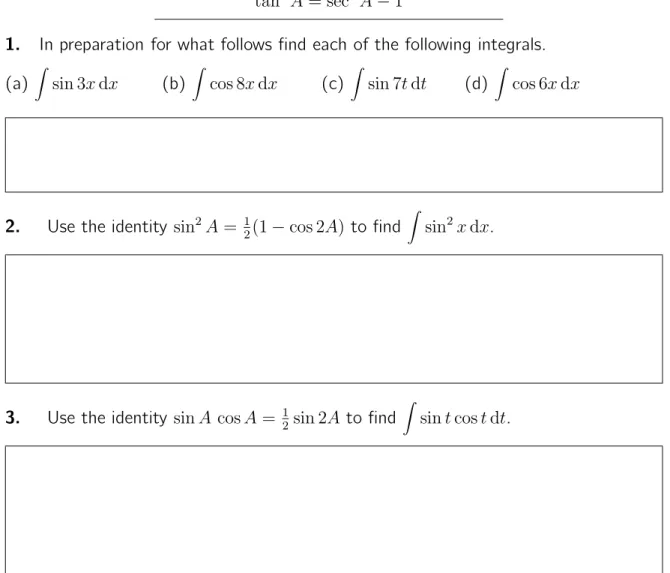
1. In preparation for what follows find each of the following integrals. (a) Z sin 3xdx (b) Z cos 8xdx (c) Z sin 7tdt (d) Z cos 6xdx
2. Use the identity sin2A= 12(1−cos 2A)to find
Z
sin2xdx.
3. Use the identity sinA cosA = 12sin 2A to find
Z
sintcostdt.
4. Find (a) Z 2 sin 7tcos 3tdt (b) Z 8 cos 9xcos 4xdx (c) Z sintsin 7tdt 5. Find Z tan2tdt.
(Hint: use one of the identities and note that the derivative of tant is sec2t).
6. Find
Z
cos4tdt. (Hint: square an identity for cos2A).
7. (a) Use the substitution u= cosx to show that
Z
sinxcosnxdx=− 1
n+ 1cos
n+1x+c
(b) In this question you are required to find the integral
Z
sin5tdt. Start by writing
the integrand as sin4t sint. Take the identity sin2t = 1− cos2t and square it to
produce an identity for sin4t. Finally use the result in part (a) to find the required integral,
Z
sin5tdt.
17. Miscellaneous integration exercises
To find the integrals in this section you will need to select an appropriate technique from any of the earlier techniques.
1. Find Z (9x−2)5dx. 2. Find Z 1 √ t+ 1dt. 3. Find Z t4lntdt. 4. Find Z (5√t−3t3+ 2) dt. 35
5. Find
Z
(cos 3t+ 3 sint) dt.
6. By taking logarithms to base e show that ax can be written as exlna. Hence find
Z axdx where a is a constant. 7. Find Z xe3x+1dx. 8. Find Z 2x (x+ 2)(x−2)dx. 36
9. Find Z tanθsec2θdθ. 10. Find Z π/2 0 sin 3xdx.
11. Using the substitution x= sinθ find
Z √ 1−x2dx. 12. Find Z exsin 2xdx. 37
13. Find Z x−9 x(x−1)(x+ 3)dx. 14. Find Z x3 + 2x2−10x−9 (x−3)(x+ 3) dx.
15. Let In stand for the integral
Z
xne2xdx. Using integration by parts show that
In =
xne2x
2 −
n
2In−1. This result is known as a reduction formula. Use it repeatedly
to find I4, that is Z x4e2xdx. 16. Find Z 1 0 1 (4−t2)3/2dt, by letting t= 2 sinθ. 38
Answers
Section 1. Derivatives of basic functions
1. (a) 1 (b) 6x5 (c) 0 (d) 1 2√x (e) −x−2 (f) 1 7x−6/7 (g) − 3 x4 (h) 79x78 (i)1.3x0.3 (j) −1 3x− 4/3 (k)−5 3x− 8/3 (l)−0.71 x1.71
2. (a)−sinθ (b) −4 sin 4θ (c) cosθ (d) 23cos23θ
(e) sec2θ (f) πsec2πθ (g) −8 cos(−8θ) =−8 cos 8θ
(h) 14 sec2 θ 4 (i) −3πsin 3πθ (j) 5 2sin −52θ =−52 sin52θ (k)0.7 cos 0.7θ 3. (a) ex (b) 2e2y (c) −7e−7t (d) −1 3e− x/3 (e) 2 πe 2z/π (f) −1.4e−1.4x (g) 3xln 3 4. (a) 1 x (b) 1 z (c) 1 x
Section 2. Linearity in differentiation
1. a) 3 b) 2−2x c) sinx−cosx d) −9x−4 + 16 cos 4x
e) 2ex−2e−2x f) −1 x2 − 3 x g) 20x4−24 sec28x−10e5x 2. (a)t−4/5+t7 (b) −1 2sin θ 4 + 3 4e− θ/4 (c) 9e3x/5 25 (d) 1 3sec 2 3x 2 + 6 sin 8x (e) 13z1/3 +4 9e− 4z/3 3. (a) √1 2y (b) 24x2+ 3 8x4 (c) 1 4e4y (d) − 2 3 3 √ 5e−2t 4. (a)− 2 x3 + 1 x2 (b) 3 2 √ x−3x2 (c) −6 x2 + 18 x4 + 4x (d)6e2x−5e5x+ 3e3x (e) 4e4x−2e2x 5. (a) 29x (b) −21x (c) 3t −3 (d) 31t− 23
Section 3. Higher derivatives
1. (a)20x3 (b)−9 cos 3x (c) 4e2z−4e−2z (d) 0 (e) 2 x3 −18x (f)−1 t2 + √ 6 4 t− 3/2 (g) 3 4x− 1/2− 15 4 x− 7/2 (h) ex+e−x−sinx−cosx (i) −2 sin 2t+41t2 39
Section 4. The product rule for differentiation
1. (a)sinx+xcosx (b) 3x2cos 2x−2x3sin 2x
(c) −13x−4/3e−3x−3x−1/3e−3x (d) 1
2√xln 4x+
1
√
x
(e) (2x−1) sin 6x+ 6(x2−x) cos 6x (f) −1
x2
tanx3 −cosx3+31xsec2 x
3 + sin
x
3
2. (a)cos2θ−sin2θ (b) 2 cos 2ttan 5t+ 5 sin 2tsec25t
(c) coszln 4z+sinzz (d) −12e−x/2cos x
2 + sin
x
2
(e) 6e6xln 6x+ e6x
x (f) −sinθcos 3θ−3 cosθsin 3θ
(g) 1
t(ln 2t+ lnt)
Section 5. The quotient rule for differentiation
1. (a) (11+−xx22)2 (b) 4x3 −3x4 (1−x)2 (c) − 5 (1+2x)2 (d) 18x−18x2 −6x4 (2x3+3)2 (e) 1 2 √x+ 1 − 1 2√x /(√x−x)22. (a) xcosx−sinx
x2 (b) (1− 4 3lnx)x− 7/3 (c) 2θtan 2θ−2θ2 sec2 2θ tan2 2θ (d) ezz(√z− 2√1 z) (e) 2xln 2x−x (ln 2x)2
3. (a) 2 cos 2tsin 5t−5 cos 5tsin 2t
sin2
5t (b) −
2e−2xtanx−e−2xsec2x
tan2x
(c) (cos 3x)/xcos+3 ln2 xsin 3x
3x , (d)
ln(4/3)
x(ln 4x)2
Section 6. The chain rule for differentiation
1. (a)6(4 + 3x) (b) −12x3(1−x4)2 (c) 4 (1−2x)3 (d) √ x 1+x2 (e) − 1 3 1 + x12 x− 1 x −4/3 (f) 52(4x−3)(2x2−3x+ 5)3/2 (g) 1− √1 x 1 2√x−2√x (h) − 4x−2x3 (4x2 −x4)3/2
2. (a)2 sinθcosθ (b) 2θcosθ2 (c) cosθcos(sinθ)
(d) −4 sec2(3−4x) (e) −25 cos45zsin 5z (f) 3 sinx
cos4x
(g) (−1−6t) cos(2−t−3t2)
3. (a)−2yexp(−y2) (b) −3 sin 3xexp(cos 3x) (c) −3e3xsin(e3x)
(d) 4 cos 4x
sin 4x = 4 cot 4x (e)
1 xcos(ln 4x) (f) ex+e−x ex−e−x (g) 23√e3t+9 sin 3t e3t −3 cos 3t 40
Section 7. Differentiation of functions defined implicitly
1. (a) 1 1−3y2 (b) y2 2y3 −1 (c) 1 ey+2e2y (d) y−e−y 1+e−y 2. (a) −2 sin 2x sec2 y (b) − 2x−1 2y−1 (c) − sinx 1−cosy (d) ex−1 2e2y +2 (e) 1 x−1 /ey −1 y (f) 3(x−y)2 1+3(x−y)2Section 8. Differentiation of functions defined parametrically
1. (a)−tant (b) −2t3t2+1 (c)
et+2t
2e2t+1 (d) t1+−1t
2. (a) 43t (b)−secsin 222tt
Section 9. Miscellaneous differentiation exercises
1. (a)3x2tan 4x+ 4x3sec24x (b) 12 tan24tsec24t (c) 12 exp(3 tan 4x) sec24x
(d) 3 tan 4θ−12θsec2 4θ tan2 4θ (e) (1−e x) exp(x−ex) (f) 3y4 +5y2 −5y−4−3y−6 (y+y−1)2 (g) (2xln 2)x2 + 2x+1x (h) x−1 x(lnx−x)2 (i) (−3 ln 5)5−3x (j) 1 tlnt (k) − 4 1−z2
2. (a) cosx−cos2
x−xsinx
(1−cosx)2 (b)
ez(zlnz−lnz−1)
(zlnz)2
(c) (3 cos 3θcos 2θ−2 sin 3θsin 2θ) tan 4θ−4 sec24θsin 3θcos 2θ
tan2
4θ
3. (a)−e−tln(et+ 1) + 1
et+1 (b) 6 sin 3θcos53θ−12 sin33θcos33θ
(c) −6x(1−x2
)1/2
(1+x2
)5/2 (d) (cosθ−θsinθ) exp(θcosθ)
(e) 3(xlnx)2(1 + lnx) (f) −2 (1+x)2 exp 1−x 1+x (g) 2−3y2 y3(y2 −1)3/2 4. (a) 3 cos2 xsinx 2√1−cos3x (b) 1 4(x−x 2)−3/4(1−2x) exp(x−x2)1/4 (c)− sec2(1/θ) θ2tan(1/θ)
5. (a) (1+x12)3/2 (b) (2 + 4z2) exp(z2) (c) 6 sinθcos2θ−3 sin
3θ (d) 320x6 (1−x4 )6 + 48x 2 (1−x4 )5
6. (a)−2 cot 2xcosec2x (b) 2 sec2θtanθ (c)− cosec2
z
2√1+cotz
(d) −2cosec2θcot4θ−3cosec4θcot2θ (e) secx (f) sec2(secθ) secθtanθ
Section 10. Integrals of basic functions
1. (a) x55 +c, (b) x88 +c, (c) 2x33/2 +c (d) 3x44/3 +c, (e) same as (c), (f) 2x1/2+c, (g) 4x5/4 5 +c, (h) − 1 2x2 +c, (i) x 1.2 1.2 +c, (j) x0.7 0.7 +c (k) same as (f) (l) −2x−1/2+c (m) −1 x +c (n) 3x7/3 7 +c 2. (a) 1 5sin 5x+c, (b) − 1 2 cos 2x+c (c) −2 cos 1 2x+c (d) 2 sin x 2 +c (e) ln|x|+c (f) 21e2x+c (g) −1 2e−2x+c (h) 3ex/3+c (i)2e0.5x+c (j) −e−x+c (k) same as (g) (l) −1 7sin(−7x) +c= 1 7sin 7x+c
Section 11. Linearity in integration
1. (a) 7x55 +c, (b) −x28 +c, (c) 2x33/2 + 3x44/3 +c (d) 51x44/3 +c, (e) 2x33/2 −2x1/2+c (f) x3 3 + ln|x|+c (g) x4 4 − 1 x +c (h) − 1 14x2 +c (i)11x+c (j) 110x.07.7 +c (k)x2−2 ln|x|+c (l) 7x2 2 −11x+c 2. (a) 3x2 2 + 1 4sin 4x+c (b) 4x− 1 3cos 3x+c (c) x2 4 −2 cos x 2 +c (d) 4ex+ 2 sinx 2 +c (e) − e−2x 2 + e2x 2 +c (f) − 3 cos 2x 2 − 2 cos 3x 3 +c (g) 1 kln|x|+c (h) −x−4 ln|x|+c (i)x+ x2 2 + x3 3 +c (j) 1 3ln|x| −7x+c (k) sin 1 2x+c (l) x3 6 −6x 1/2+c 3. (a)2x3+ 3x2+c (b) x3 3 − x2 2 −2x+c (c) 2x7/2 7 + 4x5/2 5 +c (d) x22 − 2x33/2 −6x+c (e) e33x −ex+c (f) e2x 2 −ex+c (g) x+ 4 ln|x|+c (h) x22 +x+c
Section 12. Evaluating definite integrals
1. (a) 7 5 (b) − 6305 2 (c) 2 3 √ 8 + 3 4 3 √ 16− 17 12 (d) 51 4(1− 3 √ 16) (e) 168 (f) 4 5 (g) 18 (h) 1 2 (i) 1 3(e 3/2−1) (j) 2(e−1−e−2) (k) π162 −√1 2 + 1 (l) e 1−e−1 2. Z 3 0 f(x) dx= 33 2 , Z 2 0 f(x) dx= 14 3 , Z 3 2 f(x) dx= 71 6 . Then 14 3 + 71 6 = 33 2 . 3. Z 1 −1f(x) dx= 8 3, Z −1 1 f(x)dx=− 8 3. 42Section 13. Integration by parts
1. (a)xex−ex+c (b) 5 cosx+ 5xsinx+c (c) sinx−xcosx+c
(d) 14cos 2x+12xsin 2x+c (e) 12x2lnx− 1
4x2+c (f)8 sin x 2 −4xcos x 2 +c 2. (a) π 2 −1 (b)4e 2 (c) −15 4e− 2− 5 4e 2 (d) 9 2ln 3−2
3. (a)ex(x2−2x+ 2) +c (b) 5x2sinx−10 sinx+ 10xcosx+c
(c) 12x2(lnx)2− 1 2x2lnx+ 1 4x2+c (d) −e−x(x3+ 3x2 + 6x+ 6) +c (e) −2x2 cos(1 2x) + 16 cos( 1 2x) + 8x sin( 1 2 x) +c 4. (a) π42 −2 (b) 7e−14 (c) −54e−2+ 1 4e2 5. xlnx−x+c.
Section 14. Integration by substitution
1. (a)sin(x−3) +c (b) −12cos(2x+ 4) +c (c) ω1 sin(ωt+φ) +c
(d) 19e9x−7+c (e) 1 24(3x 2+ 8)4+c (f) (4x−3)5/2 40 + (4x−3)3/2 8 +c (g) − 1 3(x−2)3 +c (h) 1 4(3−t)4 +c (i) − 1 2e− x2 +c (j) −cos4 x 4 +c (k)(1 +t 2)1/2+c (l) 2x+1 4 − 1 4ln|2x+ 1|+c 2. (a) 2(x−3) 3/2 3 + 6 √ x−3 +c (b) (x−5) 7 7 + 8(x−5)6 3 + 64(x−5)5 5 +c
which can be expanded to 1
7x 7 −7 3x 6+39 5 x 5+ 55x4− 1025 3 x 3 −375x2+ 5625x+c 3. (a)−12√2 (b) 90756 (c) 2615 (d) 52658 (e) 12 (f) 2 (g) 2(e√2−e1) 5. (a)ln|x+ 1|+c (b) ln|x−3|+c (c) ln|3x+ 4|+c (d) ln|2x+ 1|+c. 6. (a) 12ln|x2+ 1|+c (b) −1 3ln|1 + cos 3θ|+c (c) 3 2ln|1 + e 2x|+c 43
Section 15. Integration using partial fractions
1. (a)ln|x|+ ln|x+ 1|+c (b)2 ln|x+ 1|+ ln|x|+c (c) 4 ln|x+ 2|+ ln|x+ 1|+c (d)2 ln|x−1| −3 ln|x−2|+c (e) 7 ln|x+ 9|+ 2 ln|x+ 1|+c (f)7 ln|x+ 9| −2 ln|x+ 1|+c (g) −2 ln|x+ 2| −2 ln|x−2|+c (h)8 ln|x+ 5|+ 7 ln|x+ 2|+c (i) 12ln|s−1| − 12ln|s+ 1|+c 2. (a)9 ln 3−17 ln 2 (b) 2 ln 3 + 3 ln 2 (c) −3 ln 3−ln 2 3. (a)ln|x−1| −x−11 +c (b) 4 ln|x+ 1| −x+12 +c (c) 7 ln|x−3|+ 2 x−3 +c 4. (a)−ln 3 + 2 ln 2 + 125 (b) 2 ln 5−4 ln 2 + 401 (c) 163 −8 ln 3 5. ln|x+ 2|+ ln|x+ 1| − x+11 +c. 6. ln|x+ 4|+ 2 ln|x−3|+ 2 ln|x−2|+c. 7. ln|x−3|+ 12ln|2x+ 1| −2 ln|x+ 1|+c. 8. 1 2x 2−3x−ln|x+ 1|+ 8 ln|x+ 2|+c. 9. 2x−ln|x+ 1| −x15+2 −9 ln|x+ 2|+c. 10. x2−x+ 4 ln|x|+ 3 2ln|2x+ 1|+cSection 16. Integration using trigonometrical identities
1. (a)−1 3cos 3x+c (b) 1 8sin 8x+c (c) − 1 7cos 7t+c (d) sin 6x 6 +c 2. x2 −sin 24x +c. 3. −1 4cos 2t+c. 4. (a)−1 10cos 10t− 1 4cos 4t+c (b) 4 5sin 5x+ 4 13sin 13x+c (c) 1 12sin 6t− 1 16sin 8t+c 5. tant−t+c. 6. 38t+ 14sin 2t+ 321 sin 4t+c. 7. −cost+2 3cos 3t− 1 5cos 5t+c. 44Section 17. Miscellaneous integration exercises
1. (9x−2) 6 54 +c. 2. 2√t−2 ln|√t+ 1|+c. (Hint: let u=√t+ 1.) 3. 1 5t5ln|t| − 1 25t5+c. 4. 10 3t 3/2− 3t4 4 + 2t+c. 5. 13sin 3t−3 cost+c. 6. 1 lnaexlna+c= ax lna +c. 7. e3x+1 x 3 − 1 9 +c 8. ln|x+ 2|+ ln|x−2|+c. 9. 12tan2θ+c. 10. 2/3. 11. 1 2arcsinx+ x√1−x2 2 +c. 12. 15ex(sin 2x−2 cos 2x) +c 13. 3 ln|x| −2 ln|x−1| −ln|x+ 3|+c. 14. 1 2x 2+ 2x−2 ln|x+ 3|+ ln|x−3|+c. 15. 14e2x[2x4−4x3+ 6x2−6x+ 3] +c. 16. √123. 45Acknowledgements
The materials in A Calculus Refresher were prepared by Dr Tony Croft and Dr Anthony Kay, both at the Department of Mathematical Sciences, Loughborough Uni-versity.
The authors would like to express their appreciation to Dr Joe Kyle and Jonathan De Souza for their many helpful corrections and suggestions.
This edition has been published by mathcentre in March 2003. Users are invited to send any suggestions for improvement to [email protected].
Departments may wish to customise the latex source code of this booklet. Further details from:
mathcentre
c/o Mathematics Education Centre Loughborough University LE11 3TU email: [email protected] tel: 01509 227465 www: http://www.mathcentre.ac.uk 46