Crashworthiness Considerations for Van Structures
Frank C. Günther
DaimlerChrysler, Stuttgart, Germany
Summary:
The crash behavior of van structures needs to be analyzed for a wide range of vehicle weights. First, a dimensional analysis of van crash problems is presented. Then a simplified model for assessing crash pulses for van structures using Dyna3D is derived. Given a Dyna3D reference solution for the complete structure, crash pulses for smaller masses and/or initial velocities can be obtained in very little time using a single degree of freedom model.
Keywords:
crash, safety, DYNA3D, automotive
1
Introduction: Overview of computational activities for commercial vehicles safety
at DaimlerChrysler
Dyna3D is used for many different problems related to the safety of commercial vehicles. The tests conducted for vans are somewhat similar to those for passenger cars. For heavy trucks, other tests become relevant.
1.1 Vans
Dyna3D is used for simulations of:
- Euro-NCAP front and side impact (structural/occupant),
- Crash pulse for airbag fire/no fire conditions (structural),
- Various internal tests (structural/occupant).
1.2 Heavy trucks
Dyna3D is used for simulations of:
- ECE R29 cab tests (structural),
- Swedish cab tests (structural),
- Crash pulse for airbag fire/no fire conditions (structural),
- Various internal tests (structural/occupant).
2
Crash pulse of van structures
A crash pulse gives the time history of the rigid-body deceleration of a van structure. It is significant for occupant safety and the design of restraint systems. Large decelerations should be avoided since they make the design of adequate active and passive restraint systems more difficult. Crash pulses are also used in the fire/no fire conditions of active restraint systems. For a given van structure and a given type of crash, the crash pulse depends on the characteristic velocity of the crash and the characteristic mass.
For stationary crash barriers, the characteristic velocity and characteristic mass are the velocity and mass of the van structure, respectively. For moving barriers, the characteristic velocity is the velocity of the barrier. Assuming ideally inelastic impact, conservation of momentum then gives a characteristic mass of
,
v b v b cm
m
m
m
m
+
=
where
m
b is the mass of the barrier, andm
v is the mass of the vehicle. For crash configurations witha moving barrier, the characteristic mass is always smaller than the mass of the vehicle and the mass of the barrier.
For vans,
m
v will vary widely for any given structure, since payload constitutes a large percentage ofthe maximum vehicle mass. This motivates analyzing the effect of varying vehicle mass on the crash pulse.
3
Dimensional analysis of van crash problems
Dimensional analysis is commonly used in the field of fluid mechanics. However, it can be applied to other physical problems as well.
Let us assume that the global acceleration of a given van structure can be written as a function of several dimensional variables, namely
( )
t
f
(
t
m
Tm
dv
F
avgd
f
f)
a
=
;
,
,
0,
,
max,
,where
t
is the time,m
T is the total mass of the vehicle,m
d is the mass of the deforming part of thevehicle,
v
0 is the initial velocity,F
avg is the deflection-averaged resultant force on the vehicle(constand for a given van structure),
d
max is the characteristic length of the crush zone (constant for aThe dimensional matrix takes on the following form: T
m
m
dv
0F
avgd
maxf
ft
a
M 1 1 0 1 0 0 0 0 L 0 0 1 1 1 0 0 1 T 0 0 -1 -2 0 -1 1 -2We need to find
8
−
3
=
5
non-dimensional variables. Let us choose the non-dimensional mass of thecrush zone
1
ˆ
0
,
ˆ
=
≤
d≤
T d dm
m
m
m
,the ratio of energies
1
ˆ
0
,
2
1
ˆ
max 2 0≤
≤
=
E
d
F
v
m
E
avg T , the non-dimensional timemax 0
ˆ
d
tv
t
=
,the non-dimensional acceleration
2 0 max
ˆ
v
ad
a
=
,and the non-dimensional filtering frequency
0 max
ˆ
v
fd
f
=
.This leads to the reformulated relation
( )
=
0 max max 2 0 max 0 max 2 0,
2
1
,
;
ˆ
v
d
f
d
F
v
m
m
m
d
tv
f
d
v
t
a
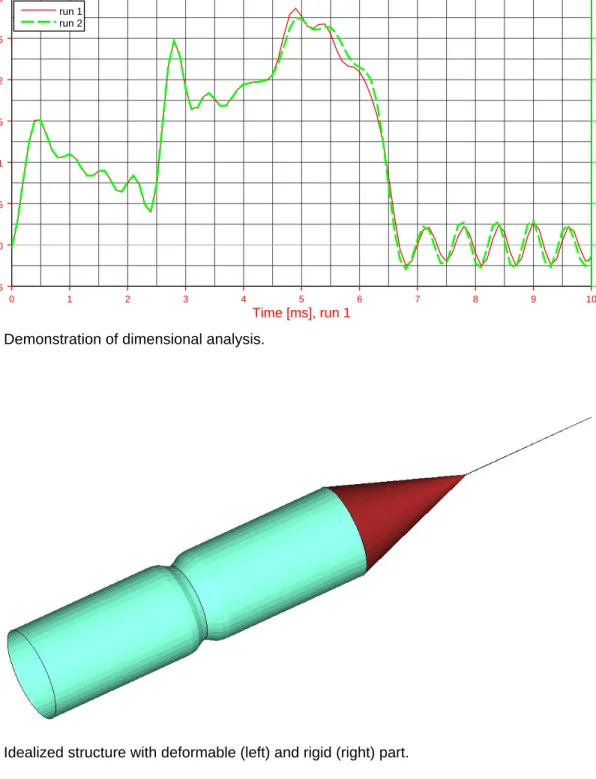
f avg T T d .In other words, the non-dimensional crash pulse (non-dimensional acceleration vs. non-dimensional time) only depends on the percentage of mass in the crush zone, the ratio of energies, and the non-dimensional filtering frequency. Fig. 1 shows two Dyna3D runs with the same non-non-dimensional variables. However, the initial velocity for the second run was doubled and the total mass was divided by four. The plot was made with the time axis of the second run scaled by 0.5 and its acceleration axis scaled by 4. These factores were obtained from the expressions for dimensionless time and dimensionless acceleration. As expected, the two scaled crash pulses are virtually identical.
In many cases, the effects of variation of the dimensional mass of the crush zone and of the non-dimensional filtering frequency can be neglected. This further simplifies the above equation.
4 Simplified
model
A simplified model can be obtained by assuming that the van structure consists of a massless, energy-absorbing crush zone and a perfectly rigid rest of the structure, in which the mass of the vehicle is concentrated. The crush zone has a force/deflection relation for loading
( )
d
f
F
=
ford
d
&
>
0
with the force
F
and the displacementd
.This force/deflection relation can be obtained from reference crash pulse that is generated by a Dyna3D simulation of the complete structure as follows: From the Dyna3D simulation the global
acceleration time history
a
( )
t
and the global displacement time historyd
( )
t
can be extracted. Thenthe equation
( )
t
m
a
( )
t
f
( )
d
( )
t
is a parametrized representation of the force/deflection relation. The simplified model can be written as
( )
d
f
d
m
c&&
=
withd
( )
0
=
0
and the initial velocityd
&
( )
0
=
v
0.This second-order, non-linear initial value problem can be solved with a smaller mass
m
c or a smallerinitial velocity
v
0, or both. Of course, as shown by the dimensional analysis of the previous section,there is no fundamental difference between varying initial velocity and varying total mass. Note that a
larger mass
m
c or a larger initial velocityv
0 cannot be used, since they would lead to deflections thatare larger than those of the reference solution.
We use Dyna3D with a non-linear spring and a point mass to integrate the above equation. The script language Perl is used to extract a load curve from the nodout file of the full structure Dyna3D reference model and to generate the input deck for the simplified model. CPU time for the simplified model is on the order of magnitude of a few seconds.
Both filtered and unfiltered acceleration data can be used to obtain the force/deflection curves. Currently, we favor the use of unfiltered acceleration data, since the global displacement and velocity history of the reference model can then be reproduced exactly by the simplified model if the original mass and initial velocity are used.
5
Example structure
To test the quality of the simplified model, an idealized structure shown in Fig. 2 is used. It consists of a deformable part (left) representing the crush zone and impacting a stonewall, and a rigid part (right) with point masses representing the rest of the vehicle. The crush zone consists of 20% of the total mass of the structure. Total mass and initial velocity are varied.
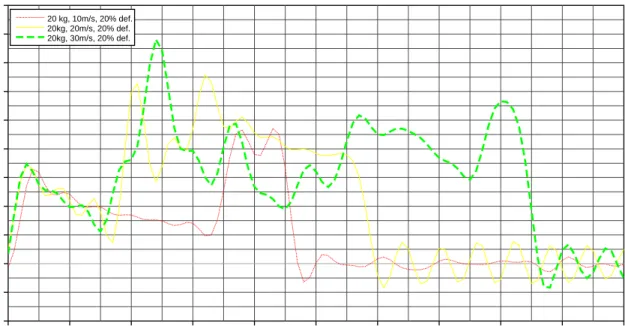
Fig. 3 shows the influence of the initial velocity on the crash pulse of the idealized structure, filtered with a 2000Hz low pass filter. Note that the length of the crash pulse depends on the initial velocity, whereas the magnitude of the acceleration remains about the same. The time axis is dilated.
Fig. 4 shows the influence of the total mass on the crash pulse of the idealized structure. The crash pulse changes in magnitude.
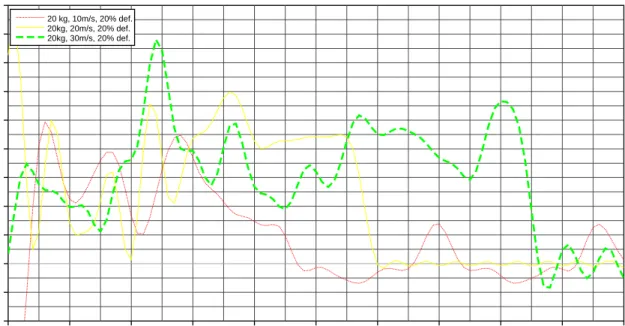
This is the behavior that would be expected by inspection of the differential equation of the simplified model. Consider now Fig. 5, which shows the effect of different initial velocities on the simplified model. The crash pulse of a 20kg, 30m/s structure is used as reference solution for the force/deflection curve. The two other crash pulses are obtained using the simplified model. Comparing Fig. 5 and Fig. 3, we find that the general shape of the crash pulse is reproduced well by the simplified model. There are, however, noticeable differences especially where the 30m/s crash pulse was used as the reference solution for a 10m/s initial velocity run.
Fig. 6 shows the effect of total mass on the simplified model. The crash pulse of a 60kg, 20m/s structure is used as reference solution for the force/deflection curve. The 40kg crash pulse from Fig. 4 is matched quite well. The 20kg crash pulse is off quite a bit, especially the location of the onset of the plateau.
6 Conclusions
A simplified model for assessing crash pulses for van structures was presented. Given a Dyna3D reference solution for the complete structure, crash pulses for smaller masses and/or initial velocities can be obtained in very little time using a single degree of freedom model. This method seems very promising where deviations of mass and initial velocity from the reference model are small.
0 1 2 3 4 5 6 7 8 9 10 0 0.5 1 1.5 2 2.5 3 3.5 4 4.5 5 −0.5 0 0.5 1 1.5 2 2.5 3 −2 0 2 4 6 8 10 12 Time [ms], run 1 Time [ms], run 2 Acceleration [mm/ms^2], run 1 Acceleration [mm/ms^2], run 2
Dimensional Analysis
run 1 run 2Fig. 1: Demonstration of dimensional analysis.
0 1 2 3 4 5 6 7 8 9 10 −2 −1 0 1 2 3 4 5 6 7 8 9 Time [ms] Acceleration [mm/ms^2]
Comparison of Different Initial Velocities
20 kg, 10m/s, 20% def. 20kg, 20m/s, 20% def. 20kg, 30m/s, 20% def.
Fig. 3: Influence of initial velocity on crash pulse
0 1 2 3 4 5 6 7 8 9 10 −1 0 1 2 3 4 5 6 7 8 Time [ms] Acceleration [mm/ms^2]
Comparison of Different Masses
20kg, 20m/s, 20% def. 40kg, 20m/s, 20% def. 60kg, 20m/s, 20% def.
0 1 2 3 4 5 6 7 8 9 10 −2 −1 0 1 2 3 4 5 6 7 8 9 Time [ms] Acceleration [mm/ms^2]
Comparison of Different Initial Velocity Scalings
20 kg, 10m/s, 20% def. 20kg, 20m/s, 20% def. 20kg, 30m/s, 20% def.
Fig. 5: Effect of initial velocities on the simplified model.
0 1 2 3 4 5 6 7 8 9 10 −1 0 1 2 3 4 5 6 7 8 Time [ms] Acceleration [mm/ms^2]
Comparison of Different Mass Scalings
20kg, 20m/s, 20% def. 40kg, 20m/s, 20% def. 60kg, 20m/s, 20% def.