End of Project Report
POLICY options
W. Dunne J.J.O’Connell1
U. Shanahan
Rural Economy Research Centre Teagasc
Project No. 4831
1Department of Agribusiness, Extension and Rural Development, Faculty of
Agriculture, University College Dublin, Belfield, Dublin 4.
Table of Contents
page
Acknowledgements
3
1. Executive Summary 4
2. Aims and objectives 13
3. Approach and Methods 15
3. Results 19
3.1 Extensification 19
3.2 Operational aspects 20
3.3 Extensification options 20
3.4 Stocking density changes 21
3.5 Economics of extensification 22 3.6 Best extensification option for Ireland 24
3.7 Maximising revenue 27
3.8 Feed resource cost implications 28
3.9 Inter-country competitiveness 29
3.10 Added complexities 31
3.11 Overall implications 32
3.12 Factors shaping Irish agriculture 33
3.13 Adjustments necessary 39
3.14 The drivers of change 40
3.15 Towards a new dynamic 42
3.16 The 2nd BSE crisis 46
3.17 EU proposals for decoupling 48
4. References and publications 51
Acknowledgements
This report is a summary of research on alternative policy options which was
undertaken in the pre and post the millennium years when the EU market for beef was very volatile and supply responses together with farm incomes were heavily
constrained by the EU Agenda 2000 policy agreement. Throughout this period it was becoming increasingly apparent that current policies were unsustainable and novel policy approaches were necessary. In anticipation of the pending change, a range of research techniques were used by the project team to analyse evolving policy proposals and devise better alternatives. Throughout the project, the authors had access to and the support of multidisciplinary expertise available within Teagasc and University College Dublin.
The research findings summarised in this report are the product of both the project team and the expertise provided by a cohort of collaborators. Throughout the research valuable observations and insightful comments were freely provided by a number of Teagasc research and advisory staff. The help and support was provided by colleagues John Heavy and Billy Fingleton, Rural Economy Research Centre, Maurice Roche, Liam Connolly and Ann Kinsella of the National Farm Survey, Michael Drennan, Gerry Keane, Richie Fallon and Padraig O’Kiely of Grange Research Centre and by Dermot Forrestal of Oakpark Research Centre together with Bernard Smyth and Liam Fitzgerald of the specialist advisory services. Valuable comments and feedback was also provided by Pat Caffrey, UCD and by Department of Agriculture officials, individual farmers and a range of experts in response to the many formal
presentations made at national and international conferences. An acknowledgement is also due to Tony McGarry for his detailed proof reading of this report. The final interpretations and any errors are, of course, the responsibilities of the authors.
Executive Summary
The incomes of Irish cattle farmers benefited greatly from the reform of the CAP for beef and cereals in 1992 and more recently under Agenda 2000. In both of these reforms the institutional support prices were reduced and animal-based direct payments (DPs) were used to compensate farmers for the anticipated market price reductions.
This research study shows that the main reason why Irish cattle farmers gained under these reforms are that Ireland gets above the EU average benefit from DPs, but below average return from EU market price support. Therefore, the greater the switch-over to DPs the larger the income gain.
Ireland’s above average benefits from DPs arises from the combined effect of the suitability of the structure of the DPs themselves and the extensive nature of the production systems used by Irish cattle farmers.
This research also showed that over the years as the switch-over to animal-based DPs progressed, cattle production per se has become uneconomic. But, Irish cattle farmers needed the cattle and had to remain in cattle farming to get access to the DPs that are in fact the only income.
The nature and structure of the 1992 and the Agenda 2000 CAP reforms have been such that cattle farmers and farming methods were becoming severely constrained by what could be described as “a mixture of administrative, economic and bureaucratic asphyxiation”. And, with cattle farming being so pervasive in Ireland, this affects most farmers within the country and other farm enterprises where they must co-exist. Income compensation for product price reductions was used to justify the introduction and continuation of the DPs in both the 1992 and the Agenda 2000 reforms. This is a very weak basis on which to justify a rather large taxpayer’s expenditure for either their continuation into the future or their extension to new entrants into farming. Under the Agenda 2000 reform, the value of the extensification premium (EP) was increased almost threefold but the operational rules were substantially altered. Consequently, the potential for extra revenue arising for Irish cattle farmers was substantial. However, the administrative compliance system was much more complex and very invasive in relation to animal management events, reducing the potential for use of improved genetics and production technology, with a progressive disconnect from the consumer market for beef.
The Agenda 2000 agreement facilitated individual Member States with the once-off choice between two extensification operational systems, each with its own premium rates and related stocking density requirements. These were:
• Option 1: a single payment of €100 (£79) per SBP and SCP collected,
provided a farm unit stocking density limit of 1.4 LU per hectare is achieved
• Option 2: with two levels of payment depending on the stocking density o €80 (£63) at < 1.4 LU per hectare
o €40 (£31.50) within the range of 1.4 and 1.8 LU per hectare.
In preparation for the negotiations for the Agenda 2000 agreement, detailed and intricate research was undertaken and published on the economic and technological implications of these extensification options. The best extensification option for Ireland was evaluated on its relative ability to deliver revenue to cattle farmers and the implications for export competitiveness of Irish beef.
Following extensive analysis of the policy options available and their likely impact it was concluded that Ireland would benefit most from availing of the Option 1
extensification system. Option 1 would:
• yield the highest revenue for the country
• target a higher portion of the revenue towards the supply of cattle from the suckler herd which are of a higher quality relative to cattle from the dairy herd
• target more of the revenue towards the poorer regions of the country where extensive production systems are already used
• release the larger dairy farms plus the more market oriented cattle fattening farms from the stocking density requirement and the
administrative bureaucracy associated with the DPs and extensification
• best facilitate the production of quality finished animals for the higher priced beef markets within the EU.
It was concluded that even if Option 2 was chosen, an increasing number of Irish cattle farmers will still aim for the 1.4 limit to get the higher of the two extensification premiums available to them, i.e. €80 rather than €40 per eligible animal. Furthermore, the incentive to do this will increase as:
• calves become scarce and expensive as cow numbers decline in response to milk and suckler cow quota limits
• the market price of beef declines once the lower Agenda 2000 price supports are implemented
• more farmers opt to join REPS, with its associated more stringent nutrient and stocking density compliance criteria
• more farmers secure off-farm employment which will lead to less labour intensive and operationally simpler cattle production systems.
Under each extensification option the study found that there are substantial knock-on economic implications for land rents, forage costs, animal management activities and the degree of market orientation of cattle farming. The scale of the knock-on
implications is directly related to both the extensification option chosen by the member state and financial incentive for the individual cattle farmers to participate in the scheme.
The research showed that the extra land required per animal for extensification purposes also adds to the internal supply of feed (forage) resources per animal for the farm unit. Therefore, a positive (feed) rent arises from the extra land which in-turn
would serve to reduce the economic cost of forage, especially internally produced silage. Furthermore, for most cattle production systems availing of extensification, managing surplus grass would be problematic especially on farms with high quality land. Consequently, this surplus feed would have to be removed for grassland
management reasons, most likely in the form of baled silage, and almost irrespective of the cost of its off-take. In such situations, there would be very limited technical or economic reasons for cattle farmers to “import” onto the farm externally purchased feeds in the form of concentrates, almost irrespective of price.
From an inter-country comparison perspective, the overall conclusion arising from the research was that Ireland may be the only EU member state that would economically benefit from using Option 1 with its single EP and a stocking density limit of 1.4. However, when a choice became available under the Agenda 2000 agreement the authorities in Ireland chose to implement Option 2, despite its economic
disadvantages, presumably because as the EU Court of Auditors report states “it allows more producers to benefit”.
The choice of Option 2 suggests an implicit trading away of the possibilities for obtaining both extra EU revenue and increased export competitiveness from EPs against a more ubiquitous distribution of the payments among Irish cattle farmers from a lower overall financial pool. This choice had multiple revenue and income distribution implications together with competitiveness consequences for Irish cattle farming in both the immediate years and subsequently when the animal-based DPs were decoupled and converted to the Single Farm Payment (SFP) system. Therefore, the choice of extensification Option 2 would prove to be particularly advantageous for the more intensive cattle farmers both in the immediate and longer term.
The perceptible financial benefit is completely transparent for the farmer who actually receives the animal-based DP per se, hence the apparent attraction of availing of Option 2. However, as our earlier research demonstrated, there are also significant indirect financial benefits arising for cattle farmers from the animal-based DP system as a consequence of the capitalisation of a portion of the value of the DPs into cattle cohort prices. In general, the main indirect beneficiaries of the capitalisation process are the farmers who breed and/or rear young animals, i.e. primarily farmers with dairy-cow and/or suckler-cow based cattle enterprises. This occurs at the expense of those farmers who may actually collect the animal-based DPs but are at the fattening or finishing stages of the cattle production chain. Therefore, farmers involved in the breeding and rearing segment benefit both directly and indirectly from the animal-based DP system. It is, however, rather difficult to precisely predict both the scale and the ultimate destination of the redistribution of these indirect benefits due to the relatively high level of inter-farm trading and the pervasive nature of cattle farming in Ireland.
A detailed analysis of trends in the actual margins derived from cattle enterprise on farms in the National Farm Survey (NFS) showed that cattle farmers’ incomes in Ireland have benefited greatly from the CAP reform in 1992 and likewise from the more recent Agenda 2000 agreement. Yet, the disillusionment about the future for Irish cattle farming continued, even post the Agenda 2000 agreement. Most of this is
related to the operational aspects and the compliance criteria of the animal-based DP income support system.
Although the overall margin for cattle was largely maintained in nominal values, an increasing proportion was being derived from the DPs. As a consequence, farmers were becoming progressively entwined in a bureaucratic compliance web and increasingly detached from beef markets and consumers. For many farmers the margins being derived from cattle production per se were both small and declining. For those specialising in fattening/finishing systems, the market-based margin had effectively disappeared mainly as a consequence of the capitalisation of a significant portion of the value of the animal-based DPs into the prices of the animals they were purchasing. In the absence of the animal-based DPs, such cattle enterprises would be considered unprofitable and would therefore cease production forthwith. But if they exited cattle production they would not have access to the DPs which were effectively both their “enterprise” margin and income.
Since the payments continued to be based on the possession of certain types of
animals which have to be “farmed” within specified stocking density limits, cattle production per se had become uneconomic and is increasingly being wedged in a cost-price squeeze. This was particularly so for those farmers involved in cattle fattening.
Under the various CAP reforms, production costs for the individual cattle farmer have been increasing due to the additive impact of:
• the quota restrictions (milk and suckler-cows) on the supply of calves which results in high calf prices, plus
• the added cost complication for calf prices arising from the capitalisation of a portion of the values of the animal-based DPs
• the ever increasing land base needed to achieve the stocking density limits required to collect the direct payments which have in effect become the only margin and/or income
• the ever increasing land base needed to collect the higher value extensification premium, thereby increasing marginal land rents and distorting feed costs, and
• the universal increases in costs arising from subsequent inflation.
It was therefore concluded that such a DP based income support system provides very limited scope for the individual farmer to manage costs and/or adjust production methods to reflect the final and generally declining market value of the beef carcass. The end result is that:
• there is no market return from producing the beef animal per se
• farmers have less and less control of the margins they can obtain from their animals
• the overall revenue in the sector is fixed and a declining portion of it is derived from the market as the value of the carcass declines in response to the
reductions in beef support prices, but
• costs are increasing and these are mainly driven by the compliance criteria for the animal-based DPs, more expensive calves and land.
For Irish cattle farmers the growing institutional complexities of the animal-based DP system, and especially the extensification element of it, was seriously distorting the inherent economics and husbandry of farming and this income support system was becoming progressively more unsustainable.
The structural weaknesses identified in the existing animal-based DP system result in an inequitable distribution of the payments themselves and a leakage of much of their value into input and operational costs. Deficiencies identified include:
• the administrative complexities and the operational costs of the payment system itself
• the poor targeting of the payments due to inherent structural weaknesses within the DP system
• the knock-on effects of the payment system in relation to:
• beef production costs and
• the lack of reward for good animal husbandry practices and for producing quality beef
• the absence of any clear benefit to either society and/or the taxpayer from a rather large expenditure.
With this animal-based DP income support system, average incomes within the aggregate cattle sector cannot increase unless the numbers of cattle farmers decline. But Irish cattle farmers, because of their circumstances, have been largely ineligible for the Farm Retirement Scheme. The end result is the farmer has to stay in beef production although there is no profit in cattle production per se. But the farmer
needs the cattle to get access to the direct payments that are in fact the income. A similar economic situation exists for most cereal farmers who wish to scale-up their activities to maintain or increase their income. The margin and almost all of the income is in the DPs but access to extra “eligible land” is required to draw down more DPs.
As a consequence, on many Irish farms, even where land is suitable for a range of enterprises, the optimum enterprise mix is becoming an issue of establishing the best balance between:
• the increasing value of the DPs for the individual enterprises, and
• the costs related to the compliance criteria for the DPs for the individual enterprises.
For individual farmers, most of the financial rewards are derived from “playing by the rules of the DP system” rather than from practising good animal and grassland
husbandry.
As outlined in various publications arising from this research, in Ireland when the EU commodity-based DP system is combined with the traditional pattern of land
inheritance and the increased availability of off-farm employment there will be very limited land available for restructuring of farms. This almost fossilisation of farm structures for both the cattle and cereals enterprises will increase unit costs over a number of years and will have a similar knock-on impact on other farm enterprises.
These research findings reinforce the earlier evidence on the desirability and the need to develop a more suitable alternative DP income support system, see End of Project Report No. 4313 and related publications. This research outlined a framework
template by which most of the structural weaknesses of the existing animal-based DP system could be rectified by de-coupling the DPs from eligible animals and
converting them into a mainly area-based whole farm payment system with more suitable compliance criteria to distribute DPs to farmers. Within the current project further development work was undertaken on the decoupling template for an
alternative multi-commodity framework for administering DPs within the EU. Also, a range of “public goods” were identified which could be incorporated into this
framework to provide a much stronger conceptual basis for continuing DP income supports into the future. The framework and related concepts were published in a number of formats to obtain feedback from stakeholders and policy makers. From an Irish perspective, this new concept was described in operational terms as “… using a schedule similar to the Farm Retirement Scheme (FRS) but with the Rural
Environment Protection Schemes (REPS) type requirements.”
If this, or a similar, EU policy framework was implemented, cattle farming in Ireland could revert to a situation where:
• the market based margin of sales value less direct costs will determine the animal numbers, type, carcass weights, slaughter dates, stocking densities and the mix of internal and external feed used, and
• the expenditure on concentrates and fertilisers will decrease to reflect the decline in animal and crop prices, animal numbers and the changes in the farm enterprise mix.
Preliminary estimates for Ireland suggest that compared to 1999, annual expenditure reductions on purchased feeds and fertilisers could be of the order of €190 (IR£150) and €60 (IR£50) million respectively. This would be the equivalent of about one million tonnes of concentrates and about 300,000 tonnes of fertilisers.
A similar restructuring of beef production would occur in other EU Member States and this, with an appropriate time lag, would reduce beef supplies and restore market balance in the EU. The historical evidence available from this project and an earlier related research on cattle prices would suggest that Ireland has most to gain in terms of market access and beef prices from an improved market balance within the EU. Fully rectifying the structural weaknesses of the existing animal-based DP system through decoupling could be tedious as any such major policy reforms at EU level are by their nature slow and difficult to achieve. Moves in this direction might be possible within the Mid-Term Review (MTR) of the Agenda 2000 reforms due in 2002/03. Already the stated EU agricultural policy objectives outlined in the Agenda 2000 proposals indicated that the direction of this change was beginning to crystallise and the Agenda 2000 agreement converted the animal-based disadvantaged/less favoured areas payments to a completely area-based system.
Meanwhile, Ireland could have implemented immediately an interim but partial solution by availing of the option provided under the Agenda 2000 agreement for a single extensification payment system. Then, eligible animals on farms stocked at 1.4
LU/ha or lower would receive an extensification premium of €100 (IR£79) each. But, all other farmers and their related land area, steers, heifers, cows and cereal area could be farmed outside the stocking density constraints of the extensification system. In addition, the national revenue take from extensification would be maximised and beef export competiviness would be enhanced.
In the autumn of 2000, just as a renewed level of confidence was beginning to emerge among Irish cattle farmers another BSE crisis occurred, first in France and later in Germany and Spain. In response, beef consumption levels declined abruptly and markets were effectively re-nationalised and normal trade flows for beef and live cattle were severely disrupted. These market problems were swiftly reflected in cattle prices in Ireland, especially for cull-cows and the lower grades of cattle. As a
consequence, farmers faced many uncertainties, in the past DP “top-ups” were paid to support their incomes but now this might not be possible due to EU budget
constraints. The BSE related market and trading complications were further accentuated in 2001 following a substantial outbreak of Foot and Mouth Disease (FMD) in the UK and a related but isolated incident in Ireland.
In response to the decline in demand and consumer confidence, a suite of EU wide supply control and consumer rebuilding measures were introduced. The main EU policy initiatives were:
• the mandatory testing of all carcasses from cattle over 30 months
• the immediate introduction of a scheme for Purchase For Destruction (PFD) of over 30 month animals at a guaranteed price
• the redefinition of eligible suckler-cows for SCP compliance
• changes in premium rights within the DP scheme, and
• intervention purchases under special conditions.
The economic impact of these policy initiatives were analysed in detail and the findings and related recommendations were made available to policy makers and stakeholders. Surprisingly, despite all of the market disruption and turbulence arising from the BSE and FMD predicaments, the annual incomes of Irish cattle farmers were largely maintained throughout this period. This was achieved by a combination of the EU policy initiatives such as the PFD and through periodic and prudent adjustments by the Minister for Agriculture of the phasing of the annual pay-out rates for the DPs. The policy changes in the Agenda 2000 agreement were scheduled to apply until the end of 2006 and were to be fully phased-in by 2003. A Mid Term Review (MTR) was also planned for 2003 with a general expectation that any further policy adjustments arising would be rather benign. However, post the BSE and FMD crises, it was becoming increasingly evident that EU society was placing a declining value on extra units of food production, or perhaps negative value for beef, but an increasing value on any public goods consumed in the production process. Therefore, an emerging rebalancing issue for future EU policy would be the farm mix of agricultural production and public goods that EU society is prepared to support financially. Against expectations, when the EU Agenda 2000 MTR proposals were published in 2002 it was recommended that all crop and animal-based DPs be converted into area type payments. This EU policy shift to a decoupled Single Farm Payment (SFP)
outlined in their MTR proposals was almost identical to the concepts, architecture and compliance requirements for the framework template developed by the authors and published under this project and its predecessor.
The EU proposal for the SFP was initially rejected by both the Irish and French authorities and by almost all of the Irish farm organisations plus the agri-business representative bodies. There was a general reluctance to fully embrace the concept of decoupling the product-based payments presumably due to concerns in relation to:
• a probable re-distribution within farming itself of the indirect benefits and costs associated with the animal-based DPs, and
• the future cost and revenue implications for the farm organisations themselves and agri-business arising from anticipated reductions in the volumes of both farm inputs used and outputs produced, together with
• the knock-on impacts on business turnover and margins plus member subscriptions to the appropriate representative organisations.
However, the feedback obtained from a series of seminars and presentations on the MTR decoupling proposals made at farmer and agri-business meetings was rather different. And it was entirely consistent with the earlier reaction obtained to the decoupling concepts and methodology developed within this project and its precursor. For most farmers it was immediately obvious that the SFP could release them from the administrative, economic and bureaucratic straightjacket into which they had progressively become enveloped with the various phases of CAP reform since 1992. After a decade of EU policy reforms, the SFP system provided farmers with their first realistic prospect of maintaining the future value of their existing DPs without the need for endless counts of eligible and non-eligible animals, matching dates of birth of animals with applications for premiums and critical census dates, and two separate methods of determining stocking densities.
Similar feedback through various institutional channels led within months to a volte-face on the Irish stance in relation to the SFP proposal, much to the surprise of most of the other EU Member States but especially France which was strongly opposed to the entire decoupling concept. In January 2003, the EU Agricultural Council agreed the CAP reforms including the SFP based on historical individual farm entitlements. In June 2003, however, modifications were agreed which gave Member States a degree of choice in the implementation of decoupling, but Ireland elected to implement the system as originally proposed in the MTR and to its original time schedule.
The EU policy shift from the product-based DP system to the SFP could provide future scope and opportunities for Ireland to differentiate, re-position or even re-brand Irish farm products, especially for beef within EU and in other markets. To advance this prospect, a series of papers on aspects and implications of such a market
segmentation approach to the evolving the EU food production policy were prepared and presented at professional international conferences. These papers also elaborated on how the earlier EU policy shift from product-based price support to DP system(s) of various formats had impacted on the economics of production per se, resource conservation and the mix of private and public costs and benefits arising.
These papers also suggested that there was greater potential under the SFP for future EU farming systems to better exploit more eco-friendly production methods and produce a more diverse range of food products. However, a comprehensive economic exploitation these opportunities would require:
• a further definition of the compliance criteria for the farming systems, together with
• the formulation of appropriate marketing strategies to exploit the increasingly diverse consumer markets arising from the combination of:
o the general rise in economic prosperity, and o the progressive enlargement of the EU itself.
1. Aims and objectives
The Agenda 2000 agreement, with a projected lifespan of seven years became
operational on January 1st 2000. This was essentially a further phase of the MacSharry CAP reforms for beef and cereals initiated in 1992, but with added emphasis on the incentive to extensify farming methods. In both of these reforms the institutional support prices were reduced and direct payments (DPs) were used to compensate farmers for anticipated product price reductions.
Within a decade, the annual EU expenditure on DPs has more than doubled, appendix Table 1. However, the mix of expenditure on individual DPs: Suckler Cow Premium (SCP), Special Beef Premium (SBP) and Extensification Premium (EP) has also changed greatly over the years.
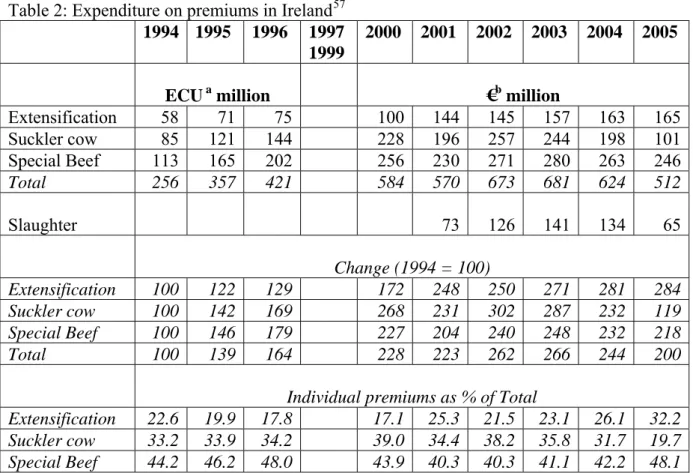
Irish cattle farmers benefited significantly from the DP system and like most of the overall EU, the mix of individual payments drawn-down gradually evolved, see appendix Table 2. In contrast to the overall EU, the revenue mix in Ireland has greater reliance on SBP and extensification, reflecting both the structure of the DPs system itself, the composition of the cattle herd and farming methods used.
Under Agenda 2000, the value of the DPs for suckler (beef) cows, steers and bulls were increased. The increase in the value of the extensification premium was even larger but the criteria for access to this premium were significantly restructured.
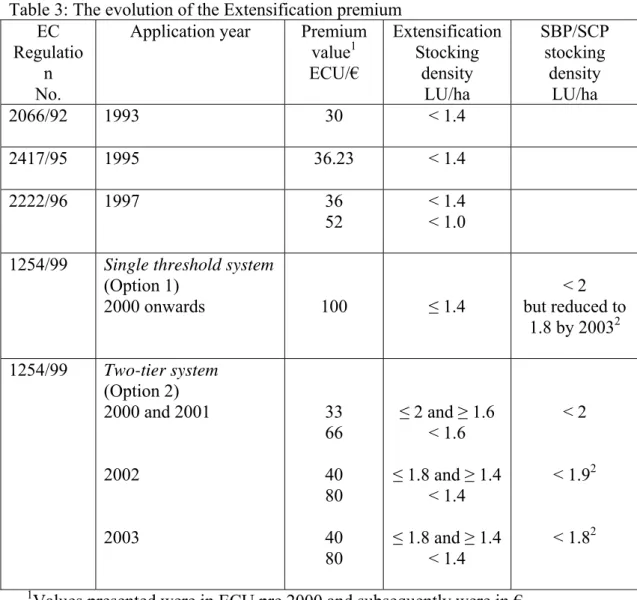
The extensification premium scheme was first introduced through the 1992 reforms to compensate specialised beef farmers for the competitive, concentrate feed cost, advantage enjoyed by intensive and semi-intensive beef producers arising from a reduction in the institutional support prices for cereals. The extensification premium system, through its stocking density requirement, provided a direct link between animal numbers and the forage producing capacity of cattle producing farms. The value of the extensification premium and the access criteria were adjusted periodically since its initiation in 1992, see summary of details in appendix Table 3. Under the Agenda 2000 agreement, Member States were offered a choice of either a single threshold system (Option 1) or a two-tier system (Option 2). Option 1 was contained in the original Agenda 2000 proposals while Option 2 emerged during the negotiations of the agreement itself.
At farm level, the extensification premium was administered as a “top up” payment on animals that had already collected either an SBP or an SCP. The maximum stocking rate eligibility requirement for SBP and SCP was set at 2.0 LU/ha and this was derived with reference to the maximum acceptable 170 kg N/ha from organic sources laid down in the Nitrates directive. The farmers access to extensification payments was restricted to lower stocking densities, but again these have been adjusted periodically, see appendix Table 3.
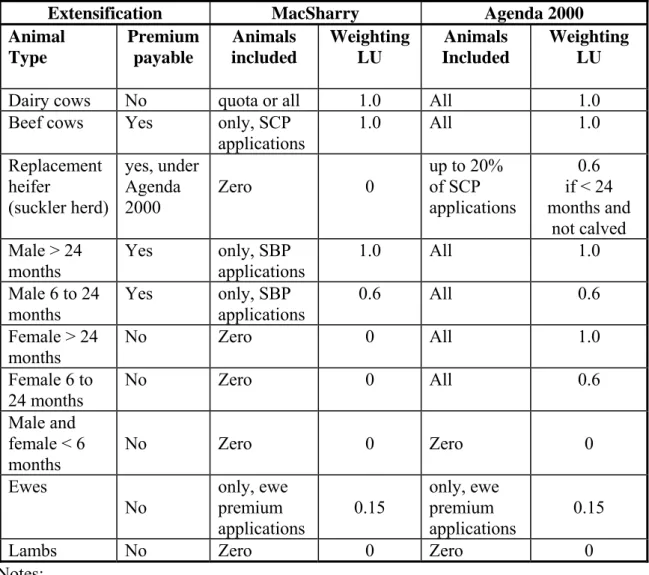
The calculation of stocking densities for extensification as operated under the MacSharry reforms only took into consideration the animals for which there was an application made for either SCP or SBP. Within this enumeration process, the
possibility existed for the presence on the farm of other “ghost” grazing animals such as those ineligible for DPs, like heifers. But under Agenda 2000, the methods of computing the stocking densities were considerably more stringent compared to the MacSharry period, and therefore there were reduced possibilities for ghost animals to exist on the farm, see appendix Table 4.
Probably of greater significance from an Irish cattle farming perspective was the extent of the evolution of the extensification payment top-up both in value terms per se (appendix Table 3) and as a proportion of the animal-based DPs (appendix Table 5), especially under the Option 1 system. `
The focus of the research undertaken under this project was to:
• determine the scale of the financial incentive under Agenda 2000 for the individual farmer to extensify production
• compare the financial attractiveness of extensification under Agenda 2000 with that of the MacSharry reform
• identify and quantify the economic and technical implications of the
extensification system for cattle production systems, feed resource costs and land use in Ireland
• evaluate the impact of the extensification system on the relative competitiveness of Irish beef production
• develop alternative policies and administrative operational procedures to ameliorate the most undesirable aspects of the existing DP system in preparation for the Mid-Term Review of the Agenda 2000 agreement scheduled for 2002/2003
• develop and prepare more suitable and acceptable longer-term policies for all farm enterprises within the EU, with particular emphasis on the decoupling of all of the product-based DPs.
2.
Approach and Methods
In an overall sense this project was an extension in time (2000 to 2004) of project No. 4313 and used a similar approach which had the twin research strategies of:
• devising a more strategic approach to the evolution of a single EU beef market
through better functioning of the existing CAP system, while simultaneously,
• devising a more suitable long term EU policy in relation to the format and function of the entire DP system of income support.
To achieve the interim objective of a better functioning of the EU “single” beef market under the existing CAP system, an in-depth evaluation of the entire structure of EU policy was undertaken. This also included an evaluation and analysis of various on-going EU policy modification proposals in response to the rapidly evolving market for beef. The resultant findings would be made available as promptly as possible, mainly in non-peer review professional and technical papers, review articles and through seminars and workshop for farmers, agri-business and other stakeholders, including policy makers. The main objective was to directly and indirectly influence policy formation at both the conceptualisation and implementation stages.
During the lifespan of the project five working papers were prepared and published on various aspects of EU policy for beef. Initially, draft working papers were prepared and circulated to a number of experts for critique and comment1. Following any necessary revisions, the actual working papers were then published to facilitate further public discussion on these very important topics. The authors consistently invited comments and observations on their analysis and conclusions. In addition a number of conference papers and a range of non-peer review articles were prepared to encourage public discussion and feedback on the issues involved and assist in the further development of alternative policy concepts and related implementation procedures.
The topics evaluated in the working papers prepared and published under project No. 4313 were:
• Inter-country comparisons of cattle prices
• An evaluation of the intervention system and the labelling regulations
• An evaluation of the operation of Aids to Private Storage
• Inter-country comparisons for Direct Payments and Total Revenue for beef
• Direct payments and cattle margins in Ireland.
Because of its evolving economic importance for grassland farming and especially cattle farming in Ireland, most of the research undertaken within this project (4831) related to a comprehensive evaluation of the entire extensification payment system with its many implications and ramifications. As a result of this research two additional working papers were prepared and published, these were:
1 The authors would particularly like to acknowledge the observations and insightful comments
received from the following Teagasc staff: Liam Connolly, Michael Drennan, Gerry Keane, Eamonn Pitts, Maurice Roche and Bernard Smyth. Valuable comments and observations were also received from Richard Healy, Head of Beef Division, Department of Agriculture.
• Extensification: an analysis of national and competitiveness issues
• Extensification: implication for cattle farming in Ireland.
Under both the Agenda 2000 proposals and the agreement itself, farm stocking densities were the key determinant in defining access to a range of options for extensification payments. Farmers could enhance their access to extensification payments by adjusting the stocking densities on their farms by either of two
alternative methods, shedding animals or renting-in land. In addition to changing the extent of the access to the extensification payment options, adjusting stocking densities could also have significant implications for the optimum on-farm mix of internal versus external feed resources. In essence, land had a cost in relation to feed resource supply but it also had a value with respect to possible access to extra revenue from extensification payments.
A series of computer spreadsheets were developed to estimate the net cost of land for forage (silage and grass) production based on both its estimated value for accessing DPs and its opportunity rental cost. The primary aim was to determine the best stocking density options for maximising the overall farm gross margin2. In addition, these programmes provided an estimate of the cost of producing the forage over the relevant range of stocking densities using both of the alternative methods for
manipulating stocking densities. This facilitated a cost comparison between internally produced forage for both grass and silage and that for externally purchased
concentrate feed.
Previous related research3 in Ireland identified a number of serious structural weaknesses in the EU animal-based DP system for farm income support and
alternative policy options were developed. To ameliorate the weaknesses identified, the approach was to develop a generalised EU policy concept for all of the EU commodity-based payments for application throughout the region which could:
• include commodities in addition to beef, and
• increase the acceptability of such a system to other EU Member States and in an international trade (WTO) context.
The administrative operational mechanisms for the Agenda 2000 agreement were essentially a further phase of the MacSharry CAP reforms but with added emphasis on the incentive to extensify farming methods. Therefore, the fundamental structural weaknesses of the animal-based DP system still remained. However, under the
2 The inter-disciplinary nature of this research traversed the normal boundaries of concepts, expertise
and methodologies. Various colleagues in both Teagasc and UCD provided professional advice on the conceptualisation and analysis of this topic. The co-operation and assistance of the following are gratefully acknowledged: Dr’s Gerry Keane, Michael Drennan and Padriag O’Kiely of Grange Research Centre, Billy Fingleton and Ultan Shanahan of Rural Economy Research Centre, and Liam Connolly, National Farm Survey and Athenry Research Centre. Professional advice and support was also generously provided by Dr’s Patrick Caffrey and John O’Connell, Faculty of Agriculture, UCD.
3 This related primarily to the capitalisation of much of the value of the animal-based DPs into present
and future costs for DP eligible young animals and land rental charges, together with the progressive economic incentive for farmers to reorient their production systems towards the compliance criteria rather than the beef market per se, see Dunne 1996f and 1997e, Dunne and O’Connell 1998, 2000abcd
Agenda 2000 agreement the added policy shift from product price support to further increases in the value for the animal-based DPs would be expected to exacerbate the inherent structural weakness of the administrative mechanism already identified. A longitudinal analysis of trends in the composition of margins for a range of cattle enterprises on Irish farms within the Teagasc, National Farm Survey (NFS) was undertaken to test the hypothesis. The results were presented at various conferences and seminars including the Teagasc annual situation and outlook conference. All of the research results, plus a series of recommendations were made available at the beef consultative group meetings on Agenda 2000 that was established by the Minister for Agriculture4. In addition, presentations on the economic and technical impacts of the Agenda 2000 proposals together with those for the subsequent agreement were also made at meetings and seminars for farmers, agri-business groups, and other stakeholders and policymakers. These meetings and seminars also provided an ideal forum to obtain feedback on the alternative policy options being developed.
The Agenda 2000 agreement was scheduled to apply until 2007 with a Mid Term Review (MTR) in 2002/2003. However, an unanticipated and serious upheaval of the beef market occurred as a result of the 2nd BSE crisis in 2000 and 2001 but this time in continental EU Member States. In response, a range of unforeseen EU policy adjustments were proposed, agreed and implemented forthwith for both the beef price support arrangements and for the DP mechanism. These included adjustments to the structural aspects of the payments per se and their compliance access conditions. As a response to emerging market and administrative uncertainties and the consequential information deficits, an analysis was urgently undertaken of the evolving policy adjustments and their immediate and longer-term implications for farm incomes and future beef exports. The findings arising were made available at the ad hoc working group meetings in the Department of Agriculture and to stakeholders through various seminars, conferences and publications.
The BSE related policy initiatives undertaken to reduce beef supplies, increase the value of and adjust the conditions for access to DPs served to only further compound the structural weaknesses already identified as inherent in the administration of the animal-based DP system. In essence, the inherent rigidity and weaknesses of the entire administrative system were becoming more and more obvious.
Most likely as a consequence of the rapidly evolving policy complexities and
deficiencies, but nevertheless unexpectedly, the EU proposals for the MTR opted for a full decoupling of all of the product-based DPs and the introduction of a system of Single Farm Payment (SFP) entitlements. The SFP incorporated all of the existing product-based DPs and the value of the SFP entitlements would be based on historical DPs received by individual farmers within a specified period.
4 Dr. W. Dunne was the Teagasc representative on the consultative committee, a summary list of the
The concepts, structure and compliance conditions for the commodity-decoupled SFP were almost identical to that developed, published and articulated at conferences and seminars under Project 4313. Consequently, Irish cattle farmers were reasonably familiar with its structure and its likely impact and consequences. Nevertheless, once the EU proposals were published there were many requests for additional
presentations at farmer and agri-business conferences and for non-peer review articles.
While individually5 Irish farmers readily accepted the principle of decoupling, other Member States were less enthusiastic about the shift to the SFP system. They were either in outright opposition, like France, or negotiated modifications to the
administrative methodology and/or even delayed its implementation in whole or in part. Much to the surprise of a number of other Member States, Ireland chose after an initial lag to agree to implement the entire SFP system and to the time schedule as proposed by the EU. This perceived Irish enthusiasm together with the range of publications recommending full decoupling which emanated from the previous and current research projects resulted in further requests for conference papers from various professional international organisations6. The main focus of these papers was to explain the operational logic behind decoupling and the future private and public costs and benefits for farmers, resource use, food markets and society in general.
5 In contrast, almost all of the Farm and agri-business organisations in Ireland were initially opposed to
the EU shift to the SFP.
3. Results
The concept of extensification was introduced as part of the switch-over to the direct payment (DP) system of income support under the MacSharry reforms of the beef regime in 1992. The purpose was to encourage extensive production methods and reduce the supply of beef.
Post the BSE crisis in 1996, and particularly under Agenda 2000 the EU income support policy for beef farming became progressively more reliant on Direct
Payments (DPs), see appendix Chart A plus appendix Tables 1 and 2. Also, the added emphasis on DPs per se was accompanied by significant restructuring of their
composition, unit value and the access compliance criteria to encourage farmers to undertake more extensive cattle production methods, see appendix Tables 3 to 5. As the research findings on the extensification system undertaken under this project shows, Irish farmers and their cattle production systems were particularly well
positioned to benefit from such a switch in EU policy emphasis, see appendix Table 2. The detailed results of the research on extensification undertaken in this project were published by Dunne et al in 2000 and 2001 in the form of working papers (working papers No. 6 and No.7). The main findings in these working papers and subsequent research on related aspects and implications are summarised below.
3.1 Extensification
The annual revenue from extensification received by Irish cattle farmers in 1999 was £80 million, approx. €102 million. This is equivalent to a price increase of about 14 pence (almost €0.18) per kilo carcass weight when allocated to all Irish beef
production. When this revenue is allocated to beef produced from the relevant animals eligible for extensification as currently administered, namely, males and cull-suckler cows, the price equivalent per kilo is of the order of 25 Irish pence, or €0.32.
The potential revenue for Irish cattle farmers from extensification was greatly
increased under Agenda 2000, see appendix Table 2. This arises because the value of the extensification premium itself was increased almost three-fold but the operational rules were changed significantly, see appendix Tables 3, 4 and 5. Furthermore, an EU wide “administrative cap7” or ceiling was also placed on the budget allocated to
extensification payments.
All of these changes in the values, structures and administrative procedures affected both the ability of individual farmers to access revenue for extensification and the overall distribution of the fixed budget between Member States, (Dunne et al, 2000, working paper No 6).
7 Therefore, should Ireland’s competitors collectively become more proficient at capturing EPs in the
future the EU budget allocation available for extensification could be exceeded. In this eventuality, it is probable that there would be a pro rata reduction for everybody in the value of their individual
premium entitlements, i.e. an EU wide claw-back mechanism similar in structure to that used by individual Member States when National quotas are exceeded for the SBPs.
3.2 Operational aspects
The extensification premium (EP) operates as a “top-up” on the formal applications for the suckler cow (SCP) and the special beef (SBP) premiums. The changes in the scale of the top-up are summarised in appendix Table 5.
Under the 1992 CAP reform, the EP was payable on farms when the eligible animals for which application was made were collectively stockedat less than 1.4 livestock units (LU) per forage hectare. In this system specific “hidden animals”, such as female cattle etc., could be excluded from the stocking density calculations, see appendix Table 4 for details. Under the Agenda 2000 Agreement significant changes in the operation of the system were introduced. Under this agreement allanimals, whether eligible for the premium or not, must be included in the stocking density calculations and heifers, as per the regulations, have the same LU weightings as male animals of the same age. Most of the relevant stocking rate compliance criteria together with the changes are summarised in appendix Table 4.
Assuming that the national land base available for beef production remains largely constant, the inclusion of extra (hidden) animals in the livestock unit calculations under Agenda 2000 could have a significant effect on stocking densities and the resulting ability of farmers to secure revenue from extensification payments. Consequently, the changes in the compliance criteria for individual DPs, and
especially extensification, impact significantly on the economics and operation of the overall Irish cattle production system(s). Also, the stocking density calculations are very acute in relation to extensification as the eligibility for these premiums relates to the entire eligible livestock herd and not just to premiums on individual animals. Consequently, there is an animal number multiplier effect with the possibility of either complete eligibility or a zero revenue outcome. Thus necessitating a significant risk management input by the individual farmer.
3.3 Extensification options
In the Fischler proposals for Agenda 2000, published in March 1998, the value of the EP was increased almost threefold to 100 euro (IR£79). While the stocking density limit was retained at 1.4 LU per forage hectare, the stocking density calculations were made more restrictive because all animals had to be accounted for (not just eligible animals). This considerable adjustment in the access criteria significantly altered the economic benefit of the extensification scheme for a range of farm circumstances and had differential impacts for individual Member States. The inter-country impact of this proposed change in the stocking density was evaluated and the results were published in working paper No. 6.
The Agenda 2000 agreement retained this type of calculation but offered Member States a choice of extensification systems with varying rates of premiums. These are:
• Option 1: a single payment of €100 (£79) per SBP and SCP collected,
provided a stocking density limit of 1.4 LU per hectare is met
OR
• Option 2: with two levels of payment depending on the stocking density o €80 (£63) at < 1.4 LU per hectare, or
An economic evaluation, published in working paper No.6, showed that:
• under Option 1, the incentive to extensify production methods is very
high as the value of the EP top-up has increased to:
o almost 50 percent of the value of the SCP and SBP per LU for
suckler cows and bulls respectively, and
o 67 percent of the value of the SBP per LU for steers
These percentages are over twice what they were under the 1992 MacSharry system, see summary in appendix Table 5.
• under Option 2 where animals on the farm are stocked at:
o less than 1.4 LU/ha, the incentive is increased significantly as
the top-up ranges from 36 to 53 percent depending on the type of animal, but,
o in the 1.4 to 1.8 range, the incentive to extensify is relatively
small at between 18 and 27 percent, and this is even less than that under the earlier MacSharry system.
Compared to the 1992 reform, the incentive to extensify production under Agenda 2000 Option 2 is more than doubled at the 1.4 stocking density limit but reduced at the 1.8 limit, see summary in appendix Table 5.
3.4 Stocking density changes
The implications for individual Member States of including heifers in the stocking density calculations under Agenda 2000 were evaluated and the detailed results were published in working paper No.6.
The main conclusion from an Irish perspective is that the inclusion of the “hidden animals” will have a greater negative impact on the access to extensification for all the other beef producing Member States, with the exception of Spain, Portugal and Greece. The specific estimates indicate if the land base available for cattle production remains constant, then the inclusion of the “hidden animals” increases the LUs and stocking density by:
• 44% for the EU-15
• a lowly 22% for Greece but a high of 61% for Luxembourg, and
• only by 34% for Ireland.
This is particularly significant in terms of relative potential for access by farmers to the revenue from extensification. Also, it could have additional competitiveness implications in the future since the total EU budget for extensification per se is fixed. The capacity of each country to adjust cattle numbers and cohorts to achieve the stocking density requirements for extensification under Agenda 2000 was analysed and evaluated. The main findings were that the removal of cows is the most effective mechanism for reducing animal numbers as the potential progeny are also eliminated. Estimates show that the removal of a cow effectively eliminates:
• 1.9 LUs in the EU15, but
• the values for individual Member States range from a high of 2.32 for Ireland to low of 1.37 for Spain.
Consequently, the removal of “surplus8 cows” would have a very large impact in making ‘room’ to acquire more extensification revenue in Ireland.
To achieve the 1.4 limit by removing cows:
• Ireland would have to reduce its cow herd by the order of 6 and 10 percent, but
• all other Member States would have to remove two to four times more of their cow herd
With the removal of this number of cows, many Member States; namely Greece, Spain, Austria, Finland, Sweden, and Denmark, would not have sufficient cows, two cows per SBP, to produce the required number of male animals to “draw-down” their quota of SBP. These countries would therefore be effectively trading off SBPs against extensification if they were to try to maintain the MacSharry level of access to EPs. The ratio for Ireland would also be restrictive but the normally lower cow
replacement rate in Ireland would reduce but not eliminate this problem.
The adjustment problems for Ireland would be very small to achieve 1.8 stocking density limit. But the 1.8 stocking density limit would draw a very high proportion of the animals and the cattle farms into the administrative ambit of the extensification system. This would greatly increase the administrative stranglehold on cattle
production in Ireland and also severely increase the operational constraints for other farm enterprises.
The 1.8 limit would cause significant constraints for all other Member States apart from Greece, Portugal and Spain. The UK, France and Belgium could exploit the option of using the replacement heifers for SCP to minimise, but not eliminate, the need to shed dairy cows to maintain access to EPs.
3.5 Economics of extensification
The economic merits of the two options for extensification were evaluated in relation to their ability to generate revenue for Irish farmers9.
The main conclusions arising are:
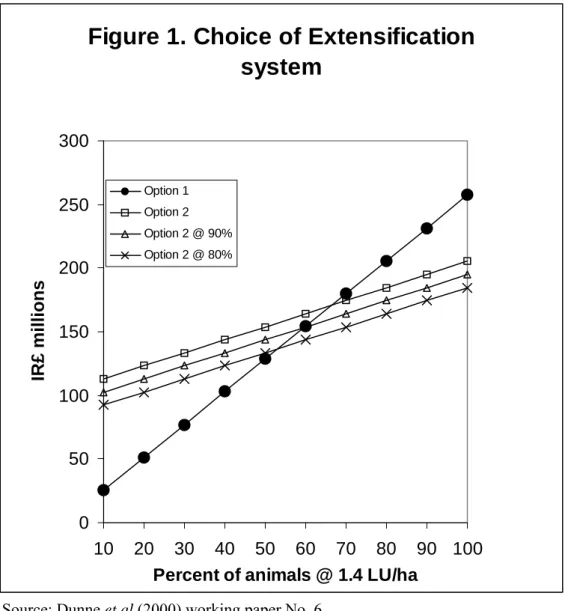
• If all the appropriate animals were stocked on farms at less than 1.4 LU, Ireland could garner a maximum €326 (IR£257) million in revenue from extensification under Option 1, but the maximum that could be collected under Option 2 would be €260 (IR£205) million
• Option 1 would give the most revenue if a high percentage of SCP and SBP animals were stocked at less than 1.4, but the lower the percentage of eligible animals in this category the greater the benefit from Option 2
• Option 2 is best when less than 66 percent of the animals are stocked on farms at a stocking rate of under 1.4, but then all eligible animals would
8 “Surplus” to the capacity requirements for fulfilling the National quota entitlements for both milk and
SCPs.
9 The computational details are available in Dunne
have to collect extensification at either the 1.4 or 1.8 level of stocking density. Otherwise the breakeven percentage would have to increase pro rata
• Option 1 is best if more than 66 percent of the animals were stocked on farms with a stocking density of less than 1.4 LUs when they claimed their SCP or the SBP. In this situation, Option 1 would provide the added advantage that the remaining animals, up to 34 per cent, and the farms on which they reside, could operate outside the administrative ambit and stocking density compliance constraints of the extensification system, (see section 3.6 below)
• At the ‘break-even’ point of 66 percent Ireland would collect €216 (IR£170) million, (see Figure 1). This could be achieved either by collecting €100/head on 66 percent of animals under Option 1 or
alternatively, under Option 2, by a combination of €80/head on 66 percent of animals and €40/head on the remaining 34 percent of animals, but
Figure 1. Choice of Extensification
system
0 50 100 150 200 250 300 10 20 30 40 50 60 70 80 90 100Percent of animals @ 1.4 LU/ha
IR£ millions
Option 1 Option 2 Option 2 @ 90% Option 2 @ 80%
• the ‘break-even’ point declines rapidly if a significant proportion of the animals under Option 2 fail to collect even the €40 extensification
premium, payable for animals with a stocking density between 1.4 and 1.8. The break-even point declines to almost 50 percent once only 80 percent or less of the animals collect the €40 extensification premium and the total potential revenue declines to €174 (IR£137) million, (see Figure 1). For a range of practical reasons, there will be some slippage in the ability of Irish cattle farmers to collect the maximum number of both SBPs and SCPs together with their related extensification premium top-up10. Given the administrative complexity
of the extensification system itself, with its separate method11 of estimating stockin
densities, some additional slippage would seem inevitable with the EPs.
g
In contrast to Ireland, cattle farmers in other EU countries were shown to be less economically dependent on DPs because they obtained higher prices for beef and the market–based margin12 contributed a greater proportion of their total margin.
However, this relative position will be more difficult to maintain under Agenda 2000 as beef prices decline and the value of the DPs increase. These contrasting revenue structures have, of course, significant implications for the competitiveness of Irish beef.
3.6 Best extensification option for Ireland
Two of the main factors in determining the best extensification option for Ireland are:
• the relative ability of the options to deliver revenue from extensification, plus
• the implications of the chosen options for inter-country competitiveness for beef production.
10 Some of the more consequential complications in relation to the drawdown of the revenue from
SBPs and SCPs are elucidated in the footnote on appendix Table 2
11 In the calculation of Livestock Units (LUs) to establish the stocking densities for extensification,
farmers had to choose in advance between two options. The standard method was to take the number of animals on the holding at certain “census dates” which would be announced retrospectively by the controlling authorities. The alternative, which reduced the administrative burden, was a simplified system whereby farmers undertook to maintain the number of animals below the given stocking density at all times throughout the year. Neither of these methods should be confused with entirely independent method that was used for calculating the stocking density for eligibility for the basic SCPs and SCPs. However, it should be noted that the latter method determined the number of eligible animals collecting SBPs and SCPs on which the extensification “top-up” payment was administered, i.e. one stocking rate system determined the number of animals on which the extensification payment was received, or the scale of the extensification payment, but another set of stocking rate calculations determined whether or not the farm unit has access to the overall extensification payment. In practice, the animals which determined the scale of the payment were not necessarily those that determined the access, this was particularly so on farms where there was a considerable turn-over or “churning” of animals due to trading, e.g. farms involved in cattle finishing and especially winter finishing.
Taking a range of feasible operational adjustments in the Irish cattle sector into account, it was concluded that extensification at the 1.4 limit will likely be collected on:
• almost all of the SCPs since the suckler cows are predominantly located on the more extensive farms in disadvantaged areas, and
• most of the 9 month13 SBP for male weanlings from the suckler herd, and
• some of the 21 month SBP, with the exact proportion dependent on the level and structure of the live export trade.
It is probable therefore that farmers’ with suckler-cow herds would benefit most if extensification Option 1 were selected. A similar situation will likely prevail on dairy farms with relatively low stocking densities. These could trade heifers and young male animals strategically to ensure that the stocking densities will be less than 1.4LU.
The more heavily stocked dairy farms are most likely to have a problem with SBP animals stocked at the 1.4 limit. A small but significant realignment of the calf and young cattle trading patterns on these farms could achieve the desired result14. These intensive farms could also specialise in fattening non-DP animals and in finishing beef cattle that have already collected their DPs elsewhere. This way they would avoid the production constraints and the entire bureaucracy of the cattle DP system. The historical data available15, pre the Agenda 2000 agreement, on the proportion of “eligible” animals collecting extensification suggested that Ireland was uniquely positioned to benefit from availing of Option 1, which was in fact the original EU proposal. This provided the basis of the recommendations by Dunne and O’Connell, contained in “strategies and objectives for Agenda 2000 negotiations” presented at the beef consultative group on Agenda 2000 that was established by the Minister for Agriculture, that Ireland should choose the extensification Option 1. The background details of this and other related recommendations are already published End of Project Report No 4313.
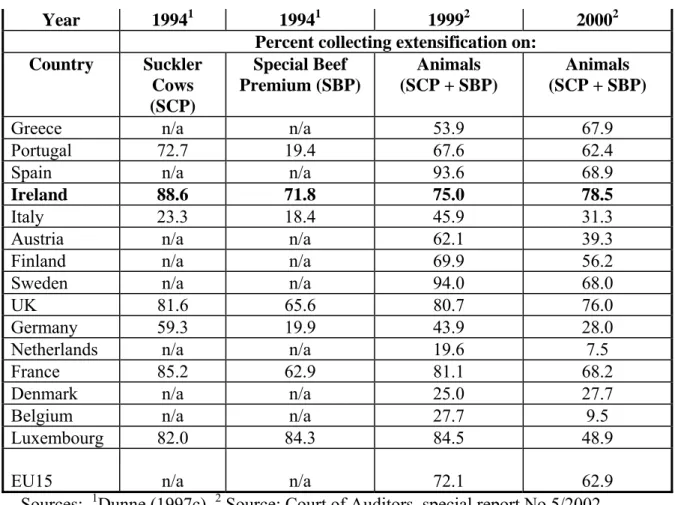
Subsequent data, published by the EU Court of Auditors16, on extensification entitlement claims for the years 2000 and 2001 provide additional evidence that Ireland would have benefited most by availing of Option 1. The actual out-turn data for a number of years, reproduced in appendix Table 8, show that over 75% of the total animals receiving SCPs and SBPs in Ireland also benefited from receiving extensification premium top-up. Therefore, the proportion of Irish animals collecting extensification has consistently been well in excess of the break-even point of 66
13 Under the earlier MacSharry system, the age limits for the SBPs for eligible steers were one month
older, at 10 and 22 months respectively.
14 These intensive dairy farms would indirectly benefit from the extensification revenue because a
portion of the premiums would be capitalised into the market value of the additional young (SBP and EP) eligible animals that may now be sold.
15 Dunne, W. Revenue from direct payments in beef production, pages 149-150, In proceedings
Agricultural Research Forum, UCD, April 1997
percent discussed in section 3.5 above. It is highly probable that the break-even point would also be exceeded under the Agenda 2000 agreement despite the shift to more stringent stocking density criteria.
Nonetheless, following the Agenda 2000 agreement, the Irish authorities chose to implement extensification Option 2, presumably to achieve a greater dispersal among farmers of the financial and farm income benefits of a reduced potential pool of extensification revenue17.
The financial and farm income benefits of this wider dispersal of extensification revenue may be more apparent than real. As noted earlier, the extensification premium was effectively administered as a “top-up” payment on animals that had already collected either an SBP or an SCP on the same farm. Within any year, the “drawdown” of an SCP was largely tied to a specific farm through the requirement for SCP quota rights, which were only partly tradable. However, no such mobility
constraints existed for the SBPs. This mobility had, of course, consequential
implications for the final farm destination of the extensification payment which could therefore significantly mitigate administrative policy efforts at targeting the dispersal of extensification revenue towards specific farm types.
As already demonstrated, there are a number of serious inherent deficiencies within the administrative structure of the animal-based DP system and these can result in a substantial indirect redistribution of much of their financial benefits. For example,
“To obtain the payment, the farmer must have eligible land and/or eligible animals. Since the supply of both is finite or controlled, part of the value of the DP goes to the suppliers of the eligible animals and land. The flow of DPs to various groups of cattle farmers creates a counter-flow of DP-induced costs, which increase along the beef production chain. The net effect is that farms involved in finishing cattle are much more dependent on DPs than those in the breeding stages. Farmers finishing cattle may appear to collect their share of DPs, but much of the value of the DP is already built into the price of the animal being bought-in”,18.
17 According to the Court of Auditors report paragraph 16
“---- . Six Member States (Germany, Greece, Spain, Austria, Portugal and Sweden) opted to apply only one threshold, so as to pay a higher EPS (Extensification Payment Scheme) subsidy to those producers that have a lower SD (Stocking Density). The other Member States opted for a two-tier system with lower EPS payments. The authorities in Spain and Austria informed the Court that they chose only one SD threshold in order to allow producers to benefit from a higher additional payment, most beef producers in these countries would have no problems in meeting the lower SD. The
authorities in France, Ireland and the United Kingdom informed the Court that they chose the two-tier system because it would allow producers to reduce their production over a number of years and/or because it allows more
producers to benefit”.
18 Dunne, W. (1998) Direct payments: case for change. Teagasc, Todays Farm July/August, 1998, pp
Since the administration of the extensification premium was essentially piggybacked on the SBP and SCP, all of these structural weaknesses would equally apply to the dispersal of its revenue and the counter-flow of related costs. Furthermore, enhancing access to extensification revenue for the more intensively stocked farms would encourage these farms to retain as many animals as possible to collect both the SBP and the EP, albeit at the lower level of €40 per animal. This, in-turn would further restrict the supply of eligible animals to other farms and thereby accentuate the overall premium capitalisation process together with its implications for the dispersal of revenue benefits and counter-flow costs.
Under Agenda 2000, the administrative stranglehold of the DPs in general and their related cost burden on cattle production in Ireland was greatly increased, even if extensification Option 1 was chosen, see section 3.4 above. The additional
bureaucratisation arising from the choice of extensification Option 2 severely added to the operational husbandry constraints within cattle farms, intensified the DP
capitalisation process per se and had knock-on implications for other farm enterprises, see section 3.8, plus sections 3.10 through to 3.13 below. All of this served to further undermine the possibilities for any targeted revenue redistribution objectives among farmers that may arise through the choice of extensification Option 2.
3.7 Maximising revenue
When all these factors are considered, it is probable that Ireland would benefit most from the Option 1 extensification system. Option 1 would:
• yield the highest revenue for the country
• target a higher portion of the revenue towards the supply of cattle from the suckler herd which are of a higher quality relative to cattle from the dairy herd
• target more of the revenue towards the poorer regions of the country where extensive production systems are already used
• release the larger dairy farms and market oriented cattle fattening farms from the stocking density requirement and the administrative bureaucracy associated with the DPs and extensification
• best facilitate the production of quality finished animals for the higher priced beef markets within the EU.
Even with Option 2, an increasing number of Irish cattle farmers will aim for the 1.4 limit to get the higher of the two extensification premiums available, i.e. €80 rather than €40 per eligible animal. The incentive to do this will increase as:
• calves become scarce and expensive as cow numbers decline in response to milk and suckler cow quota limits (see End of Project Report No. 4313)
• the market price of beef declines once the lower Agenda 2000 price supports are implemented
• more farmers opt to join REPS19, with its associated more stringent nutrient and stocking density compliance criteria
• more farmers secure off-farm employment which will lead to less labour intensive and operationally simpler cattle production systems20.