Building Blocks for
Language Workbenches
PROEFSCHRIFT
ter verkrijging van de graad van doctor aan de Technische Universiteit Delft,
op gezag van de Rector Magnificus prof. ir. K.C.A.M. Luyben, voorzitter van het College voor Promoties,
in het openbaar te verdedigen
op dinsdag13december2011om15:00uur door Lennart Christopher Leon KATS
doctorandus informatica geboren te Amsterdam
Dit proefschrift is goedgekeurd door de promotor: Prof. dr. A. van Deursen
Copromotor: Dr. E. Visser
Samenstelling promotiecommissie: Rector Magnificus voorzitter
Prof. dr. A. van Deursen Delft University of Technology, promotor Dr. E. Visser Delft University of Technology, copromotor Prof. dr. P. D. Mosses Swansea University
Prof. dr. O. Nierstrasz University of Bern Prof. dr. P. Klint University of Amsterdam Prof. dr. K. G. Langendoen Delft University of Technology Prof. dr. ir. R. L. Lagendijk Delft University of Technology
The work in this thesis has been carried out at the Delft University of Technol-ogy, under the auspices of the research school IPA (Institute for Programming research and Algorithmics). The research was financially supported by the Netherlands Organisation for Scientific Research (NWO) project 612.063.512,
TFA: Transformations for Abstractions.
Copyright © 2011 Lennart C. L. Kats
Cover: Thor’s Formation – Bryce Canyon, Utah (http://flickr.com/photos/ trodel/3599116604) © 2007 Luca Galuzzi, http://galuzzi.it. Creative Com-mons BY-SA 2.0.
Printed and bound in The Netherlands by CPI Wöhrmann Print Service. ISBN 978-90-8570-780-6
Acknowledgments
This work would not have been possible without the advice and support of many people. First of all, I would like to express my gratitude to my adviser, Eelco Visser, for his guidance and support throughout the years. He has been a mentor and role model to me and gave me the freedom to pursue research directions that I found interesting. I also owe Martin Bravenboer for helping me learn the ropes during my first year at Delft University. I thank my promotor, Arie van Deursen, for his kind support and advice, and his suggestions for improving this manuscript.
I thank the members of the reading committee, Paul Klint, Inald Lagendijk, Koen Langendoen, Peter Mosses, and Oscar Nierstrasz, for reviewing my thesis. I would also like to thank the anonymous reviewers of conferences and journals for always being right – even when contradicting each other – and for providing many useful suggestions. Also, several people voluntar-ily provided useful feedback on one or more of my papers: Nathan Brun-ing, Danny Groenewegen, Zef Hemel, Maartje de Jonge, Bernhard Merkle, Nicolas Pierron, Kees Pronk, Glenn Vanderburg, Rob Vermaas, and Sander Vermolen.
All the work of this thesis has been done in collaboration with other people. I thank the co-authors of the included publications for their contributions: Martin Bravenboer, Maartje de Jonge, Karl Trygve Kalleberg, Tony Sloane, Emma Söderberg, Rob Vermaas, and Eelco Visser. I also thank Danny Groe-newegen, Zef Hemel, Guido Wachsmuth, and others, for working together on other exciting stuff.
Martin Bravenboer and Eelco Dolstra kindly provided source files that formed a template for this thesis. Alberto González Sánchez provided me the source of his inspiring cover, depicting ‘Mount Doctorate,’ of which I will soon reach the summit myself. These templates saved me a lot of time during the final preparations of my thesis.
I have Karl Trygve Kalleberg to thank for coming up with the wonderful name “Spoofax” that always seems to make people wonder why the project is named like that, and I’m grateful for his many invaluable contributions to the original Spoofax project and the language workbench. I also thank Maartje de Jonge for her work, in particular for making error recovery fast and robust, and thank Emma Söderberg for helping us make that happen. Other con-tributors to the Spoofax project are Adil Akhter, Nathan Bruning, Sebastian Erdweg, Ricky Lindeman, Sverre Rabbelier, Vlad Vergu, Rob Vermaas, Tobi Vollebregt, and Guido Wachsmuth; thank you for all your hard work!
TheSoftware Engineering Research Groupis a wonderful place to do research. Plus it has pretty decent coffee too. Several times a day, we would form a small crowd consisting of loyal coffee and tea addicts including Sander van der
Burg, Eelco Dolstra, Danny Groenewegen, Zef Hemel (my ‘bro’), Maartje de Jonge, Rob Vermaas, and Sander Vermolen. We’d arrange these stand-up meetings by sending a short message over an IRC channel (often in the form of a single letter ’c’ or the occasional Unicode U+2615 character), and then pretty much talked about life, the universe, and everything. Other current and past group members, unfortunately too many to name here, have contributed to a great working environment. It has been a pleasure to work with you all.
Last but certainly not least, I would like to thank my family. I am grateful to my parents who have supported me these years. And I thank my sister, Merel, for all the fun times and her unwavering encouragement.
Lennart Kats October20,2011, Delft
Contents
1 Introduction 1
1.1 Domain-Specific Languages . . . 1
1.2 Domain-Specific Language Engineering . . . 2
1.2.1 Internal Domain-Specific Languages . . . 3
1.2.2 External Domain-Specific Languages . . . 4
1.2.3 Domain-Specific Language Engineering Tools . . . 4
1.3 IDE Engineering . . . 6
1.4 Integrated DSL and IDE Engineering Tools . . . 6
1.5 Challenges and Research Questions . . . 8
1.5.1 Domain-Specific Languages For Declarative Specification of Languages and IDEs . . . 9
1.5.2 Declarative Syntax Definition in Interactive Environments 13 1.5.3 Interactive Meta-Tooling Support for Language Engineer-ing . . . 14
1.6 Approach . . . 15
1.7 Origin of Chapters . . . 16
2 Mixing Source and Bytecode: A Case for Compilation by Normaliza-tion 19 2.1 Introduction . . . 19
2.2 Extensions Based on the Dryad Compiler . . . 24
2.2.1 Extension with Partial and Open Classes . . . 24
2.2.2 Extension with Traits . . . 25
2.2.3 Extension with Iterator Generators . . . 27
2.2.4 Assimilating Expression-Level Extensions . . . 30
2.3 Realization of the Base Compiler . . . 33
2.3.1 Language Design . . . 33
2.3.2 Name Management and Hygiene . . . 36
2.3.3 Typechecking and Verification . . . 36
2.3.4 Source Tracing . . . 38
2.3.5 Data-Flow Analysis on the Core Language . . . 39
2.4 Normalization Rules for Code Generation . . . 39
2.4.1 Mixed Language Normalization . . . 40
2.4.2 Pseudo-Instruction Normalization . . . 41
2.5 Discussion . . . 42
2.6 Related and Future Work . . . 43
3 Using Aspects for Language Portability 47
3.1 Introduction . . . 47
3.2 Targeting Multiple Software Platforms . . . 50
3.2.1 Language Portability Concerns . . . 50
3.2.2 Aspects to Address Language Portability Concerns . . . 52
3.3 Modularity and Aspects in Stratego . . . 53
3.3.1 Modularity and Extensible Definitions . . . 54
3.3.2 Introducing Aspect-Oriented Programming to Stratego . 55 3.3.3 Implementation of Aspects in Stratego . . . 56
3.4 Encapsulating Platform Logic with Aspects . . . 58
3.4.1 Platform-Specific Libraries . . . 58
3.4.2 Platform Escapes and Native Calls . . . 59
3.4.3 Interoperability and integration with Java applications . 62 3.4.4 Performance and Stack Behavior . . . 64
3.5 Discussion . . . 65
3.6 Related work . . . 67
3.7 Conclusion . . . 69
4 The Spoofax Language Workbench 71 4.1 Introduction . . . 71
4.2 An Overview of Spoofax . . . 76
4.2.1 Editor Services . . . 76
4.2.2 Component Architecture . . . 77
4.2.3 Structure of a Language Definition . . . 78
4.2.4 Agile Language Development . . . 79
4.2.5 Example Domain-Specific Language . . . 82
4.3 Syntax . . . 82
4.3.1 Syntactic Editor Services . . . 84
4.4 Analysis and Transformation . . . 85
4.4.1 Stratego . . . 86
4.4.2 Desugaring . . . 87
4.4.3 Reporting Errors and Warnings . . . 88
4.4.4 Binding Transformations to Editor Services . . . 89
4.4.5 Name and Type Analysis . . . 91
4.4.6 Reference Resolving and Occurrence Highlighting . . . 95
4.4.7 Content Completion . . . 95
4.4.8 Transformations, Code Generation, and Views . . . 96
4.5 Implementation . . . 97
4.5.1 Language-parametric Editor Services . . . 98
4.5.2 Semantic Services and Rewrite Rules . . . 100
4.5.3 Editor Extensibility and Customization . . . 100
4.6 Experience . . . 101
4.7 Discussion and Related Work . . . 103
4.8 Open Issues and Future Work . . . 106
5 Decorated Attribute Grammars 109
5.1 Introduction . . . 109
5.2 Attribute Grammars . . . 111
5.2.1 Pattern-Based Attribute Grammars . . . 111
5.2.2 Copy Rules . . . 113
5.3 Decorators . . . 113
5.3.1 Basic Attribute Propagation Operations . . . 114
5.3.2 Attribute Propagation using Decorators . . . 115
5.4 Applications . . . 117
5.4.1 Constraints and Error Reporting . . . 118
5.4.2 Name and Type Analysis . . . 119
5.4.3 Control-flow Analysis . . . 120
5.4.4 Data-flow analysis . . . 122
5.5 Case Study: Grammar Analyses and Transformations . . . 125
5.6 Implementation . . . 126
5.6.1 Performance . . . 127
5.7 Related Work . . . 128
5.8 Conclusions and Future Work . . . 129
6 Error Recovery for Generated Modular Language Environments 131 6.1 Introduction . . . 131
6.2 Composite Languages and Generalized Parsing . . . 133
6.3 Island Grammars . . . 136
6.4 Permissive Grammars . . . 137
6.4.1 Chunk-Based Water Recovery Rules . . . 139
6.4.2 General Water Recovery Rules . . . 140
6.4.3 Literal-Insertion Recovery Rules . . . 142
6.4.4 Combining Different Recovery Rules . . . 144
6.4.5 Automatic Derivation of Permissive Grammars . . . 144
6.4.6 Customization of Permissive Grammars . . . 147
6.5 Parsing Permissive Grammars . . . 148
6.5.1 Backtracking . . . 149
6.5.2 Selecting Choice Points for Backtracking . . . 149
6.5.3 Applying Recovery Rules . . . 150
6.5.4 Algorithm . . . 151
6.6 Layout-Sensitive Recovery of Scoping Structures . . . 153
6.7 Layout-Sensitive Regional Recovery . . . 155
6.7.1 Nested Structures as Regions . . . 155
6.7.2 Layout-Sensitive Region Selection . . . 156
6.7.3 Selection Schemata . . . 157
6.7.4 Practical Considerations . . . 158
6.7.5 Integrating Recovery Techniques . . . 159
6.8 Applying Error Recovery in an IDE . . . 159
6.8.1 Efficient Construction of Languages and Editor Services 160 6.8.2 Guarantees on Recovery Correctness . . . 160
6.8.4 Syntax Highlighting . . . 161 6.8.5 Content Completion . . . 162 6.9 Evaluation . . . 164 6.9.1 Setup . . . 164 6.9.2 Experiments . . . 166 6.9.3 Summary . . . 173 6.10 Related Work . . . 173
6.10.1 Recovery for Composable Languages . . . 174
6.10.2 IDE support for Composite Languages . . . 175
6.10.3 Island Grammars . . . 176
6.11 Conclusion . . . 176
7 Interactive Disambiguation of Meta Programs with Concrete Object Syntax 179 7.1 Introduction . . . 179
7.2 Meta-programming with Concrete Object Syntax . . . 182
7.3 Concrete Syntax Embedding Techniques . . . 183
7.3.1 Mixin Grammars . . . 184
7.3.2 Assimilation of Concrete Object Syntax in Meta Lan-guages . . . 185
7.3.3 Automatic Generation of Mixin Grammars . . . 186
7.4 Interactive Disambiguation . . . 187
7.4.1 Classes of Ambiguities . . . 188
7.4.2 Ambiguity in Quotations . . . 188
7.4.3 Ambiguity in Anti-Quotations . . . 189
7.4.4 Automatically Providing Disambiguation Suggestions . 190 7.4.5 Presentation of Suggestions . . . 192
7.5 Evaluation . . . 193
7.6 Discussion and Related Work . . . 195
7.7 Conclusion . . . 199
8 Integrated Language Definition Testing 201 8.1 Introduction . . . 201
8.2 Background: Language Definitions . . . 203
8.3 Test Specification Language Design . . . 205
8.4 Test Specification Interaction Design . . . 208
8.4.1 Editor Services for Test Specification . . . 210
8.4.2 Running Language Definition Tests . . . 210
8.4.3 Using Integrated Language Definition Testing . . . 212
8.5 Language Definition Testing by Example . . . 213
8.5.1 Syntax . . . 214
8.5.2 Static Semantic Checks . . . 215
8.5.3 Navigation . . . 216
8.5.4 Transformations and Refactorings . . . 216
8.5.5 Code Generation and Execution . . . 217
8.5.7 Freeform Tests . . . 219
8.5.8 Self Application . . . 219
8.6 Implementation . . . 219
8.6.1 Infrastructure . . . 220
8.6.2 Syntax and Parsing . . . 220
8.6.3 Tool Support . . . 222
8.7 Discussion and Related Work . . . 223
8.8 Concluding Remarks . . . 225
9 Conclusion 227 9.1 Summary of Contributions . . . 227
9.2 Evaluation . . . 228
9.3 Research Questions Revisited . . . 229
9.4 Recommendations for Future Work . . . 233
Bibliography 235
Samenvatting 257
Curriculum Vitae 261
1
Introduction
This dissertation presents research on techniques, methods, and tool support fordomain-specific language engineering. Domain-specific language engineering is the discipline of designing, developing, and maintaining domain-specific programming languages. The focus of this thesis is the architecture oflanguage workbenches their underlying technologies. Language workbenches are tools that make language engineering more efficient by providing an integrated development environment for language engineering tasks. In particular, we introduce the Spoofax language workbench, and describe its techniques for high-level, portable language definitions, language composition, interactive support for defining languages, and language testing.
In this introductory chapter, we first provide background on domain-spe-cific languages and give an overview of domain-spedomain-spe-cific language engineering approaches and tools. We then discuss open challenges in the area and outline the main research questions that are addressed in this thesis.
1.1 D O M A I N - S P E C I F I C L A N G U A G E S
Programming languages are at the heart of computer science. Fundamentally, programming languages are used to write programs that control the behavior of computer systems. Traditionally, they would do just that: provide a way to control the hardware, by allocating and accessing memory, executing com-putations, and controlling devices. Over time, high-level programming lan-guages introducedabstractionsover implementation details and moved from being hardware-oriented to being task-oriented. This evolution of languages has been a fundamental factor in allowing the construction of software of significant scale, complexity, and flexibility.
Domain-specific programming languages (DSLs) introduce abstractions for tasks in a specific domain. Notable early examples of DSLs include languages made in the Unix tradition of Little Languages [Bentley, 1986] that started in the1970’s and spawned specialized languages for technical domains such as shell services (sh), incremental rebuilds (make), lexical analysis (Lex), and parsing (Yacc). Another well-known example is the structured query lan-guage SQL [Chamberlin and Boyce,1974], which was introduced in the same time period, and is still commonly used today for database queries. DSLs are also used in domains such as insurance modeling, real-time financial trading, and scientific computation. Recent uses of DSLs have been extensively docu-mented in surveys such as [Spinellis and Guruprasad,1997; van Deursen and Klint,1998; van Deursen et al.,2000; Spinellis,2001; Mernik et al.,2005].
Two central concepts that make DSLs compelling aredomain-specific notation
and linguistic abstraction. Through domain-specific notation, DSLs can adopt specialized words, phrases, and other notational conventions that correspond to the problem domain. Through linguistic abstraction, they allow solutions to be expressed at a higher level. With the combination of these concepts, DSLs provide the following opportunities:
• Concise, high-level specificationof software by providing specialized nota-tion and abstracting over implementanota-tion details, increasing developer productivity and software maintainability and understandability. • Encapsulation of domain knowledgeby incorporating domain expertise and
technical implementation know-how, ensuring separation of concerns and supporting reuse among multiple DSL programs.
• Domain-specific analysis, verification, optimization, and parallelizationof DSL programs based on domain concepts that are made explicit in DSLs, aiding in program understanding, robustness, and avoiding the need for manual optimization at the underlying implementation level. • Domain-specific tool supportfor working with DSLs, using domain-specific
analyses in tools such as specialized editors, facilitating DSL program development, understanding, and maintenance.
• Portabilityof DSL programs by abstracting over implementation details of a particular implementation platform and potentially supporting mul-tiple target platforms.
The realization of these opportunities involves two fundamental trade-offs: • DSLs trade generality for appropriate abstractions, notation, and
expres-sive power in a limited domain.
• The opportunities provided by DSLs must be balanced against the cost of design, development and adoption of a DSL.
The key to effectively applying a DSL approach in a certain domain is to en-sure that these are favorable trade-offs. This requires a good understanding of the application domain, in order to select a suitable scope and design ap-propriate abstractions, and systematic techniques and tools for efficient DSL implementation. DSL engineering techniques and tools aim to facilitate both the design and construction of DSLs by minimizing the development time and ensuring quick turnaround time between design decisions, new domain insights, and new technical developments.
1.2 D O M A I N - S P E C I F I C L A N G U A G E E N G I N E E R I N G There are two architectural approaches that DSL engineers can follow, deter-mining the techniques and tools involved in the construction of DSLs. With theinternal DSLapproach, DSL engineers rely purely on the use of idiomatic
programming techniques in a general-purpose language, to stylize an ap-plication framework as a language in its own right. With the external DSL
approach, DSL engineers design a custom syntax (notation) and semantics (meaning) for each DSL, usually implemented in the form of specialized in-terpreters or compilers. We discuss both approaches next.
1.2.1 Internal Domain-Specific Languages
Internal DSLs, sometimes called domain-specific embedded languages, rely purely on the syntax and semantics provided by a general-purpose host lan-guages such as Haskell, Scala, or Smalltalk [Hudak,1998; Fowler,2011]. Inter-nal DSLs are distinguished from traditioInter-nal libraries and application frame-works by their use of idiomatic programming techniques. Instead of using specialized tools for language engineering, they use programming techniques such as fluent interfaces [Fowler, 2011] and meta-programming capabilities provided by the host language such as template meta-programming, reflec-tion, and implicits. These features give libraries the look and feel of a new language, while still maintaining full integration and compatibility with the host language. As an example, the Mockito library1
uses fluent interfaces and reflection to implement an internal DSL in Java:
Iterator<String> mockIterator = mock(Iterator.class); when(mockIterator.next())
.thenReturn("First") .thenReturn("Second")
.thenThrow(new NoSuchElementException());
Using an API that resembles English sentences, it provides an abstraction for the construction of mock objects. In this example, it dynamically creates a class that implements the iterator interface with the behavior described for thenext()method. As an internal DSL, Mockito adds no keywords or other syntax to the language but relies purely on the syntax and semantics of the Java language.
DSLs are naturally smaller in scope than traditional, general-purpose lan-guages. The approach of internal DSLs can provide a good match for this reduced scope by making it possible to develop a DSL with only modest ef-fort. Still, to fully realize the potential of DSLs, the approach also comes with a number of inherent limitations [Mernik et al.,2005]:
• The syntax and structure of the DSL are constrained by the user-de-finable notation offered by the host language, limiting the potential for domain-specific notation.
• Appropriate domain-specific constructs and abstractions cannot always be mapped in a straightforward way to functions or objects that can be put in a library. Examples named in [Mernik et al.,2005] are traversals and error handling.
1
• The opportunities of DSLs for domain-specific analysis, verification, op-timization, and parallelization are much harder or unfeasible based on a general-purpose language, since the source code patterns are usually too complex and not well defined. Examples are provided in [Hemel et al.,2011].
These limitations can be overcome by the use of a separate definition of the syntax and semantics of the DSL, allowing the DSL to break the mold of its general-purpose host language and facilitating analyses and transformations on domain-specific language constructs. Such a separate syntactic and se-mantic definition is the fundamental distinguishing characteristic of external DSLs.
1.2.2 External Domain-Specific Languages
External domaspecific languages have their own syntax and semantics, in-dependent of any general-purpose language. This means they can provide stronger support for domain-specific notation than internal DSLs, and sup-port increased flexibility in the static and dynamic semantics of the language. This flexibility is achieved by implementing the language syntax and seman-tics in the form of a tool such as an interpreter or compiler.
Beyond interpreters and compilers, language engineers can implement spe-cialized support for using an external DSL in an integrated development en-vironment (IDE). Modern, graphical user-interface based IDEs provide rich
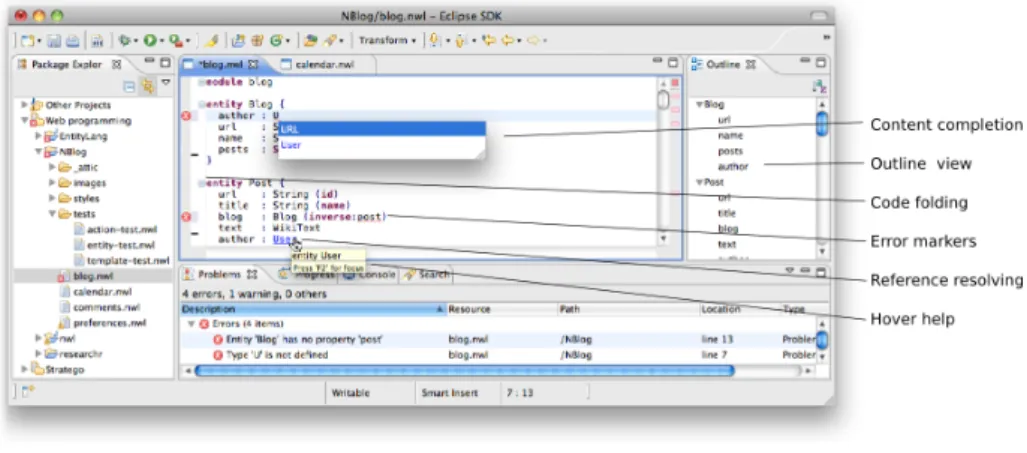
editor services that are tailored towards a specific language. Syntactic editor services provide functionality based on the syntax of a language, e.g. syntax highlighting, syntax error marking, code folding, and an outline view. IDEs can also support semantic editor services that correspond to the output of a compiler, marking errors and warnings inside the editor. Modern IDEs even take a step further and provide deeply integrated semantic editor services that provide further functionality at the semantic level of a program, such as ref-erence resolving, content completion, and refactoring.
Traditionally, a lot of effort was required for implementing language syn-tax, semantics, and editor services of external DSLs. Parsers, data structures for abstract syntax trees, traversals, transformations, and so on would be coded by hand for each language. The development of editor services adds to this burden, requiring developers to implement syntax highlighting, outline views, content completion, and all the other language-specific editor services for each DSL. This meant that a significant investment in time and effort was required for the development of a new language. Specialized tools for DSL and IDE engineering aim to address this issue.
1.2.3 Domain-Specific Language Engineering Tools
Language engineering tools significantly reduce the effort required for the development of new external DSLs. They are aimed at specific aspects of language engineering, and allow language engineers to write high-level
spec-ifications of DSL components inmeta-languagesrather than develop each com-ponent by hand using general-purpose tools and programming languages. The development of language engineering tools has been an active area of re-search for many decades. We give a brief overview of the different categories of tools.
Tools for syntax definition Writing and maintaining large parsers by hand can quickly become a tedious and laborious job. Instead of writing a parser by hand, the syntax can be described using a grammar – a DSL for syntax definition. The syntax of most programming languages can be described us-ing context-free grammars. For these grammars, it is possible to efficiently
generatea parser using a parser generator [Grune and Jacobs,2008].
Parser generators are distinguished by what types of grammars they sup-port and the performance guarantees they provide for generated parsers. Mainstream parser generators such as Yacc [Johnson,1975] and ANTLR [Parr and Fisher, 2011] generate LR or LL parsers that can only be used for cer-tain types of grammars, e.g. grammars with overlapping productions. Since only the full class of context-free grammars is closed under composition, and not any of its subclasses such as LL and LR, these parsers do not support modularity of syntax definitions. Generalized parsers such as Generalized LR (GLR) [Tomita,1988] and Earley parsers [Earley,1970] support the full class of context-free grammars. Using scannerless parsing [Salomon and Cormack, 1989,1995], Scannerless GLR (SGLR) even realizes this for lexical syntax (key-words, strings, comments, and so on) [Visser, 1997c]. SDF [Heering et al., 1989] is a grammar formalism notable for its use of GLR and subsequent use of SGLR to support modular, declarative syntax definitions.
Tools for static and dynamic semantics The static semantics of a programming language defines restrictions on the structure of valid programs that are hard or impossible to express in a standard syntactic formalism. For example, a restriction can be that variables should be assigned before use. The dynamic semantics of a programming language describes the runtime behavior of pro-grams. In this work we focus on meta-programming tools and frameworks that describe the runtime behavior by transformation to existing languages, in contrast to approaches based on formal semantics, which aim at modelling the observable behavior of programs.
Meta-programming languages and frameworks make it much easier to specify the semantics of a language, by providing a reusable abstraction layer and supporting suitable programming paradigms. Examples based on rule-based transformation systems include ASF+SDF [van den Brand et al.,2002], Stratego/XT [Bravenboer et al., 2008], and TXL [Cordy et al., 1991]. These systems use rewrite rules as a core paradigm for concise specification of trans-formations. Examples based on attribute grammars include Eli [Kastens and Waite, 1994] and JastAdd [Hedin and Magnusson,2003]. These systems use equations to concisely specify relations between attributes (or properties) of abstract syntax tree nodes. Other systems include Polyglot [Nystrom et al., 2003], a Java based extensible compiler framework, and Rascal [Klint et al., 2009], a language for analysis and transformations.
Beyond syntax and semantics, developing IDE support is an increasingly important aspect of implementing DSLs. We discuss IDE engineering next, and subsequently the integration of language engineering and IDE engineer-ing.
1.3 I D E E N G I N E E R I N G
For many current programming languages, IDEs have been developed sepa-rately from a compiler or interpreter of the language. A common approach is to use an extensible IDE platform such as Eclipse or Visual Studio, which integrates IDE support for multiple languages using a plugin architecture. Plugins consist of one or more services, such as editor services, which are reg-istered using a component model such as the OSGi Service Platform [OSGi, 2009]. Many plugins already exist for these IDE platforms, providing IDE support for specific languages as well as language-independent facilities such as version control and build management systems. Still, even with extensible IDE platforms, implementing state-of-the-art support for a new language is a daunting undertaking, requiring extensive knowledge of the sometimes com-plicated and highly interdependent APIs in general-purpose languages such as C, C#, or Java, the extension mechanisms of the plugin framework, as well as an in-depth understanding of the structure and semantics of the subject language.
Specialized tools and frameworks for IDE development significantly sim-plify the implementation of IDE services. Modern examples are Eclipse IMP [Charles et al.,2007,2009] and the Dynamic Language Toolkit [DLTK,2007]. They introduce layers of abstraction and make use of parser generators and code generation techniques to significantly simplify the development of an IDE for an existing language.
A problem with separate development of IDEs and language compilers/in-terpreters is that there tends to be significant overlap between them. For a fully functional IDE that supports deeply integrated semantic editor services, either an existing compiler should be integrated into the IDE, or the language semantics should be re-implemented. A different approach is to integrate DSL and IDE engineering, as we discuss next.
1.4 I N T E G R AT E D D S L A N D I D E E N G I N E E R I N G T O O L S
Tools such as Synthesizer Generator [Reps and Teitelbaum, 1989], Centaur [Borras et al.,1989], and Lrc [Kuiper and Saraiva,1998] were some of the first to integrate the specification of language syntax and semantics for the auto-matic generation of IDEs and compilers or interpreters. Combining these dif-ferent aspects of language development had major advantages: a low thresh-old for making an IDE, co-evolution of components shared between language compiler or interpreter and IDE, and elimination of all redundancy between those components.
A next step for comprehensive language engineering tools was self-appli-cation and integration: providing not only IDEs for programmers but also for meta-programmers. The Meta-Environment [Klint, 1993; van den Brand et al.,2001] is notable for realizing this vision. It made it possible for meta-programmers to define languages in a meta-IDE and generate IDEs for those languages. It uses a combination of SDF for syntax definition and ASF to specify language semantics, and provided a graphical interface for working with language definitions and generating new programming environments.
IDE facilities The Meta-Environment and its predecessors generate code edi-tors with syntax highlighting, an error message view, and optional integration with transformations or other tools. However, the generated editors did not yet support deeply integrated semantic editor services, as the tools provided limited means to expose the semantics of a language to be used with such services. In addition, there was much debate at the time as to which editing paradigm to use: free text editing, as applied in plain text editors, or syntax-directed editing, where edit operations are syntax-directed by the syntactic structure of the language. Syntax-directed editors were a promising direction for in-creased language sensitivity in editors at the cost of flexibility [Waters,1982; Shani, 1983; Khwaja and Urban,1993]. This design choice helped with the automatic generation of editors from a language specification, but provided an editing environment that is constrained in comparison to current IDEs that parse program text with error recovery as it is typed. In the case of the Meta-Environment, a hybrid approach was chosen, where users could select a part of the program as the “focus” that could be textually edited [van Dijk and Koorn, 1990]. Only text that could be parsed without syntax errors could leave the focus mode, in order to ensure that there was always a syntactically correct snapshot of the edited program.
Language Workbenches Language workbenches are a new generation of lan-guage engineering tools that aim to combine lanlan-guage and IDE specifica-tion [Fowler,2005a,2011]. They are distinguished by their strong focus on IDE support and specialization for DSLs rather than general-purpose languages.
By focusing on the construction and maintenance of new DSLs, rather than on the implementation of existing, general-purpose languages, language workbenches need not be concerned with supporting idiosyncrasies of exist-ing language implementations such as specific preprocessor schemes, multi-ple language dialects, or irregular type systems. Instead, they aim to provide specialized facilities to increase the cost-effectiveness of DSLs.
The field of language workbenches is still young, but awareness of the need and the benefits of these tools is increasing both in the research community and in industry. Notable language workbenches originating in the former category include EMFText [Heidenreich et al.,2009a] and MontiCore [Krahn et al., 2008]; workbenches in the latter category include MPS [Voelter and Solomatov,2010] and Xtext [Efftinge and Voelter,2006].2 Each provides novel,
2
A more extensive overview of current language workbenches and a comparison to our work is given in Section4.7.
unique qualities and innovations. For example, EMFText is notable for its derivation and refinement of concrete syntax; MontiCore for its combination of syntax and editor service specification; MPS for its extensive support for modular language definitions; and Xtext for its wide range of editor services. However, they also share a certain degree of pragmatism in avoiding a number of fundamental language engineering issues. Allegorically, we name seven examples:
• Using mainstream parser generators such as ANTLR, having an excel-lent implementation and support for error recovery, but being restricted to LL (or LR) grammars and providing no support for composition; • or, forgoing the parsing challenge altogether and revisiting
syntax-directed editing, in the form of projectional editing;
• using a general-purpose language such as Java rather than a DSL to implement the more advanced editor services;
• using a general-purpose language such as Java rather than a DSL for transformations on abstract syntax;
• or, forgoing transformations on the abstract representation and directly generating code;
• using string-based template engines rather than syntactically safe meta-programming systems for code generation;
• providing only general-purpose tools such as JUnit for testing DSL im-plementations.
Although these examples characterize the state of the practice, there are some exceptions. In particular, MPS provides its own support for syntactic normal-ization rules for local-to-local transformations, and bases its editor services on projectional editing. Xtext provides the Xtend language for transformations, an imperative language that incorporates most of the Java language and adds features such as string-based template syntax and multiple dispatch. Fully addressing the underlying language engineering issues together poses sev-eral research challenges, as outlined next.
1.5 C H A L L E N G E S A N D R E S E A R C H Q U E S T I O N S
In the preceding sections we have argued that DSLs have great potential for productivity gain and described techniques and tools that help realize this potential. Language workbenches integrate multiple techniques and tools for language and IDE specification into a comprehensive, interactive envi-ronment. Current implementations lack techniques for applying meta-DSLs for specification of declarative syntax definitions, language semantics, trans-formations, and language tests, that could further support this combination of specifying languages and IDEs.
In this thesis we focus on techniques to realize a language workbench that facilitates the use of high-level, syntactic and semantic language definitions based on meta-DSLs. The main research goal and subject of this thesis can be formulated as follows:
Introduce abstractions for high-level, declarative language definitions, from which extensible, scalable language implementations with IDE support can be generated. Support those abstractions with techniques that realize an integrated, interactive language engineering environment.
The focus of this work has been on three main research themes:
• Applyingdomain-specific languagesfor declarative specification of lan-guages and IDEs;
• supportingdeclarative syntax definitionfor generating a parser-based, interactive development environment;
• and providinginteractive meta-tooling support, exploring the applica-tion of modern IDE technology to DSL engineering.
Below, we discuss these viewpoints and formulate the research questions that drive the work presented in this thesis. In Chapter 9, we revisit these ques-tions and present our conclusions.
1.5.1 Domain-Specific Languages For Declarative Specification of Languages and IDEs
Our work follows in a line of research aimed at automatic generation of lan-guage implementations. It has been our aim to use as much existing tech-nology as possible, and to determine what programming techniques and id-ioms, language primitives, and abstractions are needed to employ language implementation technology for high-level specification of both languages and modern IDEs. In particular, our work makes use of the Stratego/XT program transformation suite [Bravenboer et al.,2008], which includes the Stratego pro-gram transformation language and SDF [Heering et al.,1989; Visser,1997c] for syntax definition. Using theMetaBorg approach, the tool suite can be effec-tively applied to composable language specification [Bravenboer and Visser, 2004]. Where previous work emphasized batch tools, we focus on interactive tools instead. In previous work, Stratego has only been applied for generating batch-based, command-line transformation systems before. SDF, however, has been used interactively in the Meta-Environment, but it could only parse and process programs in a fully syntactically correct state.
Language modularity and extensibility Key to the efficient development of languages and IDEs areabstraction, to eliminate the accidental complexity of interpreter, compiler, and IDE implementation,modularity, to reuse definitions of language and editor components, and extensibility, to customize existing
components. To explore these themes, our research begins with a case study in modular language design.
Language extensions can increase the expressivity of programming lan-guages, by introducing abstractions for common programming tasks or for tasks in a certain domain. For instance, an example of a language exten-sion defined using MetaBorg is SWUL, a language extenexten-sion for constructing user interfaces based on the Swing framework [Bravenboer and Visser,2004]. MetaBorg provides a general approach called for introducing language exten-sions, independent of a particular host language, and without restrictions on the syntax or on the context-sensitivity of the language extension.
The MetaBorg approach is based on source-to-source program translation, translating language extensions to the base language. Using source-to-source translation, it is loosely coupled to the base compiler or interpreter. This approach ensures portability of languages extensions and robustness against changes in the base language implementation. It also helps language engi-neers in rapid prototyping, as they need only basic knowledge of the language structure and semantics, and can abstract over the underlying implementation of the existing compiler or interpreter. A disadvantage of this approach is that source-to-source translators are restricted to only using the surface syntax of a language, and cannot adapt the internal stages and components of a base compiler, for example to support separate compilation or to make use of low-level primitives of the platform. For instance, in the case of Java, the surface syntax of the language does not expose JVM platform features such as jump instructions, unbalanced synchronization, and debugging information. This leads to our first research question:
ResearchQuestion 1
How can modular language plugin definitions abstract over the implementa-tion architecture of a particular programming language? Can such plugins use lower-level features provided by the target platform?
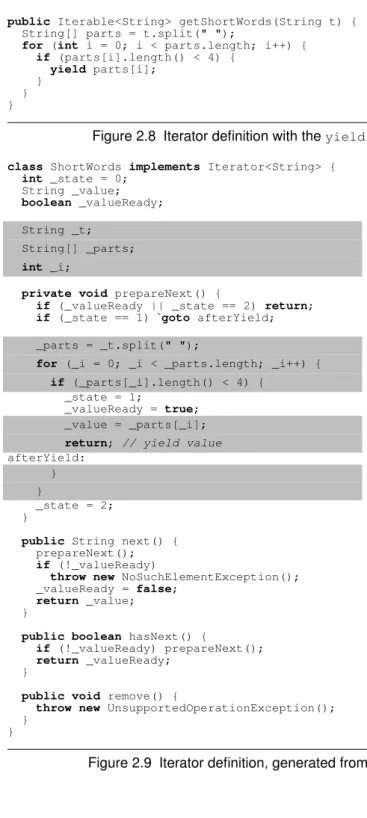
To answer this question, Chapter2investigates the design and application of an open compiler for the Java language that exposes its platform primitives (i.e., Java bytecode instructions) in the source language. We compare the im-plementation of language extensions such as traits, partial classes, and iterator generators based on this model to traditional open compiler approaches.
Portability of language definitions Given high-level, modular language defini-tions, our aim is to generate a combination of artifacts that perform traditional interpretation or compilation tasks and artifacts that provide IDE support. The latter entails generating IDE plugins for use in an extensible IDE plat-form such as Eclipse. Eclipse is based on Java, while our meta-DSL is based on C. As a first step, a study is needed to identify the challenges in porting a meta-DSL and techniques that can efficiently address them.
A central activity in retargeting a DSL to a new platform is usually the introduction of a new compiler back end. The back end translates the DSL to the platform’s language or instruction set. Beyond that, operating system-level operations, calls to other executables, performance assumptions, and
uses of the file system, specific to the original platform, must be reconsidered. Unfortunately, these concerns are pervasive in DSLs that an extensive exist-ing code base and a collection of standard libraries that provide functional abstractions for common tasks. The challenge in porting such a DSL lies in minimizing or avoiding the need to manually adapt this existing code base. This leads to the following research question:
ResearchQuestion 2
How can DSLs be efficiently ported to another platform, taking into consid-eration their reliance on platform-specific opconsid-erations and characteristics? Is it possible to do so without changing existing DSL programs and libraries written in the language?
Chapter3identifies idioms for using aspect-oriented programming [Kiczales et al.,1997] to address portability concerns of language implementations. We study the application of these idioms by porting the Stratego language to the Java platform.
Abstractions for combined specification of languages and IDEs Modern IDEs support well over a dozen distinct, language-specific syntactic and semantic editor services. These range from services that rely purely on the lexical syn-tax of the language, such as automatic comment insertion, to those relying on the context-free syntax, such as syntax highlighting and code folding, to deeply semantic services, such as content completion, which rely on the se-mantics of the language. Current language definition formalisms do not yet provide the means to specify these editor services, in particular those that rely on deep integration with the semantic definition of the language.
Because of the highly language-specific nature of modern editor services, they depend on a combination of syntactic and semantic properties of lan-guages. Consequently, a risk for the implementation of these services is re-dundancy between different services and with the language definition. For example, syntactic services such as syntax highlighting and the outline view are often implemented by writing regular expressions, which duplicates func-tionality also provided by the parser. Another risk is tight coupling to the implementation, i.e. the parser, and potentially even the parse error recovery strategy for robust editor service implementations. In the case of deeply inte-grated semantic editor services, services depend on properties of the language semantics that are not normally exposed with batch-based tools such as com-pilers. Even at the implementation level, many compilers work with symbol tables that map name references to types, and are only in memory when con-sidering a certain scope. The full name analysis must be exposed for services such as reference resolving and content completion. Ultimately, abstractions for high-level specifications of these services are needed that balance reuse and separation of concerns, leading to the following research question:
ResearchQuestion 3
How can editor service specifications be integrated into syntactic and semantic specifications of DSLs, balancing reuse and separation of concerns? How can language analysis components be structured to expose an interface for use by semantic editor services?
To address this question, Chapter4 describes the architecture of the Spoofax language workbench and investigates idioms for language definitions that combine syntax, semantics, and editor services. In addition, Chapter6 intro-duces language-independent techniques for implementing parser-based edi-tor services.
Abstractions for semantic analyses Semantic analyses are important for un-derstanding and transforming programs. Attribute grammars are a powerful formal specification notation for tree-based computation, particularly for se-mantic analysis and processing of software languages [Paakki, 1995]. They use declarative equations to specify the functional relationships between at-tributes (or properties) of abstract syntax tree nodes.
Many extensions of attribute grammars have been proposed that abstract over commonly occurring patterns, in particular supporting attribution pat-terns with non-local dependencies, such as copy rules, collection attributes [Boyland,2005], andcircular attributes[Boyland,1996; Magnusson and Hedin, 2007]. With these extensions, attribute grammars are highly effective for con-cise specification of classic data-flow analyses such as live variables and reach-ing definition analysis [Nilsson-Nyman et al.,2008].
Current extensions of attribute grammars are implemented as part of an attribute grammar evaluator. An open issue is to provide abstractions for the specification of attribute grammar extensions rather than provide attribute grammars extensions as part of an attribute grammar evaluator. By provid-ing a set of primitives to specify extensions rather than directly providprovid-ing the extensions, new abstractions could be quickly implemented as new idioms are identified [Steele,1999]. Unfortunately, no well-defined set of such primi-tives has been defined yet, and they are not linguistically exposed in attribute grammar languages. This leads to the following research question:
ResearchQuestion 4
Is it possible to generalize over common attribute grammar abstraction mecha-nisms? What primitives are needed for this generalization? Given these primi-tives, is it possible to introduce new abstractions for common analyses of DSLs?
Chapter5investigates the combination of the attribute grammars and strate-gic programming to answer this question. We apply the approach to exist-ing idioms from the attribute grammar literature and study its application in grammar analyses and transformations for parse error recovery in Chapter6.
1.5.2 Declarative Syntax Definition in Interactive Environments
The SDF syntax definition formalism allows for declarative, composable syn-tax definitions. These properties are supported by the scannerless generalized-LR (SGgeneralized-LR) algorithm [Visser,1997b] used for parsers generated from SDF def-initions. Using a combination of scannerless parsing [Salomon and Cormack, 1989, 1995] and generalized-LR parsing [Tomita,1988; Rekers, 1992] it sup-ports the full class of context-free grammars for both lexical and context-free syntax.
Parsers are at the heart of the implementation of editors in modern IDEs. Modern IDEs use a parser to obtain the syntactic structure of a program with every change that is made to it, ensuring rapid syntactic and semantic feed-back as a program is edited. As programs are often in a syntactically invalid state as they are edited, parse error recovery is needed to diagnose and report parse errors, and to construct a valid AST for syntactically invalid programs. Thus, to successfully apply a parser in an interactive setting, proper parse error recovery is essential.
Parse error recovery for generalized parsers such as SGLR has been an open issue. The scannerless, generalized nature of SGLR poses challenges for the diagnosis and recovery of errors. First, generalized parsing implies pars-ing multiple branches (representpars-ing different interpretations of the input) in parallel. Syntax errors can only be detected at the point where the last branch fails, which may not be local to the actual root cause of an error, increasing the difficulty of diagnosis and recovery. Second, scannerless parsing implies that there is no separate scanner for tokenization and that errors cannot be re-ported in terms oftokens, but only in terms ofcharacters. Moreover, based on characters, common error recovery techniques based on token insertion and deletion are ineffective, as many insertion or deletions are required to mod-ify complete keywords, identifiers, or phrases. Together, these two challenges make it harder to apply traditional backtracking error recovery approaches.
For use in a language workbench, an added criterion for an error recovery implementation is that it should require minimal effort from language engi-neers. IDEs have often used hand-written parsers in the past, or, in the case of Eclipse’s Java editor, parsers with manual customization of the recovery be-havior. For a language workbench, manual implementation or customization of a parser is an undesirable distraction that breaks the abstraction provided by a syntax definition;
ResearchQuestion 5
What techniques are needed to efficiently diagnose and recover from syntax er-rors with scannerless, generalized parsers? Is it possible to support error recov-ery without breaking the abstraction of pure and declarative syntax definition?
Chapter6introduces techniques for automatic relaxation of grammars to ac-cept syntactically incorrect inputs, in order to diagnose and recover from syn-tax errors. We investigate the combination of this technique with adaptations
of the parsing algorithm for backtracking and layout-sensitive parsing, in or-der to efficiently recover from syntax errors in a language-independent fash-ion.
1.5.3 Interactive Meta-Tooling Support for Language Engineering
Meta-programming with concrete object syntax Most meta-programming sys-tems operate on the abstract syntax of an object language, using a structured representation of programs rather than a textual one. A disadvantage of work-ing with abstract syntax is often its verbosity and unfamiliarity compared to the concrete syntax of a language. A solution is provided bymeta-programming with concrete object syntax[Klint,1993; Visser,2002], where the concrete syntax of the language is embedded in the meta language. Quotations of concrete syntax fragments and anti-quotations for meta-level expressions and variables can then be used to manipulate the abstract representation of programs. Vis-ser [2002] described a general architecture for introducing concrete syntax for any object language into any meta language by relying on the compositional-ity provided by SDF and SGLR parsing.
A usability problem of concrete syntax embedding is that quotations are often ambiguous. For example, a quoted Java code fragment|[ i = 2 ]|can either be an assignment expression, part of a local variable declaration, or even an annotation element initializer in abstract syntax. One approach to resolve these ambiguities is to require developers to write explicit tags or type names that indicate the syntactic category, e.g. writingExpr |[ i = 2 ]|, using the tagExpr to indicate that the quotation contains an expression. An open is-sue with this approach is discoverability of these names, as they depend on the (grammar) implementation and are not part of the concrete syntax of a language. If a fragment has multiple possible interpretations, and it is not clear from the context which one is correct, then only the developer can re-solve it. Based on an automated diagnosis of ambiguities, an IDE could assist developers in resolving ambiguities, leading to the research question:
ResearchQuestion 6
Can ambiguities in concrete syntax quotations be automatically diagnosed in order to determine the possible syntactic disambiguations? Can an IDE for meta-programming provide unobtrusive, interactive feedback based on such a diagnosis?
To answer this question, Chapter7describes how a generalized parser can be used to recognize all possible interpretations of quotations and investigates how to diagnose these, and how to systematically provide textual disambigua-tion opdisambigua-tions. We study the applicadisambigua-tion of this approach based using a set of existing meta programs that use quotations of different object languages.
Abstractions for language definition testing Testing is one of the most important tools for software quality control and inspires confidence in software [Beck, 2003]. Additionally, tests can be used as a basis for an agile, iterative
de-velopment process by applying test-driven development [Beck,2003]. The ap-plication of general-purpose testing techniques and frameworks such as JU-nit [Hamill, 2004] requires a significant investment in language-specific in-frastructure for writing test cases for syntax, static semantics, and editor ser-vices. Current research in automatic generation of test suites for language im-plementations [Boujarwah and Saleh, 1997; Kossatchev and Posypkin, 2005] focuses on testing complete compiler implementations, and is ineffective for testing language definitions as they are developed.
Language workbenches provide language engineers with the ability to in-teract with a language definition through the use of an editor. A common practice among language engineers is to maintain a “scratch pad” with some example program that focuses on new features that are under development. Language engineers can interact with it in various ways. For example, they can introduce type errors (“does the type checker catch this?”), control-click on an identifier (“does this hyperlink point to the right place?”) or gener-ate and run code for the example. An open issue is to provide a systematic
approach to language testing in language workbenches.
Challenges for low-threshold language testing are to provide an abstraction over the implementation details of a particular language implementation and to provide the same level of interactivity and responsiveness as ad hoc tests in a language workbench. This leads to our last research question:
ResearchQuestion 7
Is it possible to define a general abstraction for systematic testing of DSL defi-nitions? How can IDEs facilitate the development of DSL tests?
Chapter8describes the design of a parametric testing language that can be in-stantiated for a specific DSL, investigating how to address testing of different aspects of languages from both a language design and a tooling perspective.
1.6 A P P R O A C H
The core of our research method is to propose new concepts, techniques, and tools, to address open questions in the area of software and language engi-neering. Our work has a strong emphasis on tools and automation, and has resulted in the development of several open-source tools, in particular Aster, Spoofax, STRJ, and The Dryad Compiler, as well as contributions to the exist-ing JSGLR, Kiama, Stratego/XT, SugarJ, and WebDSL projects.3
The aim of our project is to collect techniques, methods, and tool sup-port for domain-specific language engineering that improve the productivity
of language engineers, based on dimensions such as understandability, main-tainability, reliability, portability, compositionality, and ease of development of software language designs. Key to progression along these dimensions is
abstractionin the form of linguistic constructs that provide increased expres-siveness or in the form of tools that abstract over common idioms or address
3
common problems that exist in a domain. Research in programming lan-guage abstractions, e.g. the line of research in attribute grammars outlined above [Boyland, 1996, 2005; Magnusson and Hedin, 2007; Nilsson-Nyman et al., 2008] aims at identifying idioms and problem areas and showing for representative case studies how these can be better supported with new ab-stractions. We use critical discussions on the findings to achieve analytical generalizations of the results and to show how it refines previous work. A summary of how the approaches of the core chapters have been evaluated is given in Section9.2.
Our research is supported by tool implementations thatrealizethe abstrac-tions, and are amenable to quantitative metrics such as performance met-rics. In our work we measured the performance of parsing and recovery in Spoofax, attribute evaluation in Aster and Kiama, and compilation in STRJ, giving an indication of practicality of an approach. To evaluate the developed tools, we apply them to projects of a realistic, representative scale. This re-quires a level of implementation maturity beyond that of prototypes, and in turn, application to real projects that are not throwaway applications. From these studies, new insights into an approach can be gained.
The MoDSE project4
has been a driving force for the application of tools such as Spoofax in realistic, sizable projects. The WebDSL project, first de-veloped using the Stratego/XT as a batch processor [Visser,2007], has been a particularly important project, driving research into modular language de-sign [Hemel et al.,2008,2009; Groenewegen and Visser,2008,2011] and even-tually static checks in an IDE environment [Kats and Visser, 2010b; Hemel et al., 2011]. The Acoda [Vermolen et al., 2011], mobl [Hemel et al., 2009], and SugarJ projects [Erdweg et al.,2011a,b] were developed primarily using Spoofax. Beyond these projects that use Spoofax as a testbed for research, we attempt to develop communities of users around our tools that work with them and provide feedback to steer further development. Additionally, we apply our tools in education. Spoofax has been used in courses on model-driven software development and compiler construction, where students cre-ate a complete compiler and IDE plugin in a single semester. Section4.6 re-ports on further experience and other projects that used Spoofax as a testbed for new research and development. This rich application experience resulted in new research directions, following from questions such as: How to support semantic editor services without reimplementing the language semantics in Java? How to get error recovery in the editor? Can we abstract over the manual work needed for writing language definition tests?
1.7 O R I G I N O F C H A P T E R S
The core chapters in this thesis are directly based on peer-reviewed publica-tions at conferences or in journals on programming languages and software engineering. As such, each chapter has distinct core contributions, but also
4
NWO/Jacquard project MoDSE: Model-Driven Software Evolution (MoDSE), 2006–2012,
contains some redundancy to ensure they are self-contained. This redun-dancy has not been eliminated to ensure the extended and revised papers can be read independently.
The author of this thesis is the main contributor of all chapters except Chap-ter 6, being responsible for most of the effort involved in implementing the approach, performing experiments, and writing the text. Chapter 6 is joint work with Maartje de Jonge and Emma Söderberg, incorporating the OOP-SLA2009paper on error recovery by Kats et al. [2009a], for which the balance of the work was in favor of the thesis author, and the SLE 2009 paper by de Jonge et al. [2009] for which the balance was in favor of De Jonge.
• Chapter 2 is an updated version of the OOPSLA 2008 paper Mixing Source and Bytecode: A Case for Compilation by Normalization[Kats et al., 2008a].
• Chapter 3 is a revised and extended version of the SCAM 2010 pa-perEncapsulating Software Platform Logic by Aspect-Oriented Programming
[Kats and Visser,2010a].
• Chapter4is an updated version of the OOPSLA2010paperThe Spoofax Language Workbench: Rules for Declarative Specification of Languages
[Kats and Visser,2010b]. This paper won the best student paper award, presented to the best paper that has a (PhD) student as its main author. • Chapter 5 is an extended version of the CC 2009 paper Decorated At-tribute Grammars: AtAt-tribute Evaluation Meets Strategic Programming[Kats et al.,2009c].
• Chapter 6 incorporates and extends the OOPSLA 2009 paper on Pro-viding Rapid Feedback in Generated Modular Language Environments
[Kats et al.,2009a] and the SLE2009paper onNatural and Flexible Error Recovery for Generated Parsers[de Jonge et al.,2009], and has been submit-ted to Transactions on Programming Languages and Systems (TOPLAS). • Chapter7is an extended version of the SLE2010paperInteractive Disam-biguation of Meta Programs with Concrete Object Syntax[Kats et al.,2011a]. • Chapter 8is published as the OOPSLA 2011paper Integrated Language Definition Testing: Enabling Test-Driven Language Development[Kats et al., 2011b].
2
Mixing Source and Bytecode:
A Case for Compilation by Normalization
A B S T R A C T
Language extensions increase programmer productivity by providing concise, often domain-specific syntax, and support for static verification of correctness, security, and style constraints. Language extensions can often be realized through translation to the base language, supported by preprocessors and extensible compilers. However, various kinds of extensions require further adaptation of a base compiler’s internal stages and components, for exam-ple to support separate compilation or to make use of low-level primitives of the platform (e.g., jump instructions, unbalanced synchronization, debug-ging information). To allow for a more loosely coupled approach, we propose an open compiler model based on normalization steps from a high-level lan-guage to a subset of it, the core lanlan-guage. We developed such a compiler for a mixed Java and (core) bytecode language, and evaluate its effectiveness for composition mechanisms such as traits, as well as statement-level and expression-level language extensions.
2.1 I N T R O D U C T I O N
Programming languages should be designed for growth in order to evolve ac-cording to the needs of the user [Steele,1999]. General-purpose programming languages offer numerous features that make them applicable to a wide range of application domains. However, such languages lack the high-level abstrac-tions required to adequately cope with the increasing complexity of software. Through the introduction oflanguage extensions, it is possible to increase the expressivity of a language, by turning programming idioms into linguistic constructs. Language extensions allow for static verification of correctness, security, and style constraints. Language extensions may bedomain-specificin nature, such as embedded SQL, or may begeneral purpose in nature, such as traits or the enhanced for loop, enumerations, and other features added in Java5.0.
The mechanisms available for realizing language extensions determine the quality of extension implementations and the effort needed for their construc-tion. If language extensions can be realized with relative ease, then building new abstraction mechanisms can be used in the software development process to incorporate programming idioms and avoid boilerplate code. The quality of a language extension comprises robustness (are error messages reported on the extended language? is code generation complete?), composability (does
the extension combine with other extensions?), and the quality of the gener-ated code. Finally, separate compilation, i.e. binary distribution of compiled, statically verified (library) components, is an important feature to reduce com-pilation time.
The creation of a language extension implies the reuse of an existing im-plementation of the base language. Generally, such reuse can be categorized as either black box reuse of a compiler by adding a preprocessor, or white box reuse by means of a deep integration with the compiler implementation.
Language extension by preprocessing A preprocessor transforms a program in an extended language into a program in the base language. Examples of pre-processors include annotation pre-processors such as XDoclet [XDoclet,2000] and Java’s APT [Sun Microsystems,2004], SQLJ [Melton and Eisenberg, 2000] an embedding of SQL in Java, and StringBorg [Bravenboer et al.,2010], a generic approach for embedding languages such as SQL. As they are employed as a separate tool, rather than requiring integration into a compiler, preprocessors are highly portable. By avoiding direct compiler extension, their implemen-tation only requires basic knowledge of a language’s structure and semantics, not of its compiler. Thus, the compiler is considered as a black box; only its published interface — the syntax of the programming language — is used, and the internal architecture of the compiler is hidden. This separation of concerns makes preprocessors well suited for rapid implementation or proto-typing of language extensions.
While preprocessors are an attractive, lightweight solution to language ex-tensibility, they are not considered a mature solution for production imple-mentation of languages. Production of a parser that is exactly compatible with the base language is not always a trivial undertaking. The lack of a (complete) source level semantic analyzer results in error messages by the base compiler about code fragments generated by the preprocessor, rather than the source code written by the programmer. Separate compilation is only possible if the compilation units of the extended language align well with those of the base language. This fails in the case of new modularity abstractions. In other words, considering the base compiler as a black box condemns the preproces-sor implementer to reimplement the front end of the base compiler.
Modifying an existing compiler To avoid reimplementation efforts, language extensions are often implemented by extension of the front end of a com-piler. This level of integration ensures that existing compiler components, such as a parser and semantic analysis, can be reused in the extended com-piler. By generating code in the front end language, it can then be further compiled using the base compiler. Traditional monolithic compilers are typ-ically not designed for extensibility, and adding a new feature may require extensive refactoring of the implementation. Since such refactorings are not incorporated upstream, this effort needs to be repeated with each release of the compiler. Extensible compilers, such as Polyglot [Nystrom et al., 2003], ableJ [Van Wyk et al., 2007], and the JastAdd extensible Java Compiler [Ek-man and Hedin,2007], are designed for extensibility with the principle that
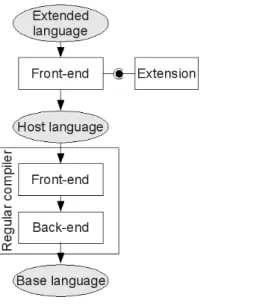
Figure 2.1 The front end extension pattern, applied by many conventional exten-sible compilers.
the implementation effort should be proportional to the size of the language extension. Thisfront end extension patternis illustrated in Figure2.1. However, even these systems do rely on white box extension, by exposing their internal structure.
Extending a compiler purely by transformation to the base language is sometimes inadequate. Compilers typically consist of multiple stages, pars-ing and gatherpars-ing semantic information in the early stages (the front end), and generating and optimizing code in later stages (theback end) [Aho et al., 2006]. This strict separation of stages is imposed to ensure straightforward modularization and reuse of compiler components. As such, some compilers for different languages share a common intermediate language and associ-ated back end. Only the final stage or stages of a compiler back end actually output the target-machine code.
Integration into the back end makes it possible to also manipulate com-piled code. This can be necessary to output specific instruction sequences or clauses not otherwise generated by the base compiler. For example, for Java, the front end does not expose a ‘goto’ operation, unbalanced synchro-nization primitives, or means of including debugging information. The back end of a compiler also forms an essential participant in composition of source and compiled code. Consider language extensions aimed at modularity, such as traits [Ducasse et al.,2006] and aspects[Kiczales et al., 1997]. To support separate compilation, such extensions require integration into a compiler’s back end. Separate compilation enables distribution of modules in compiled form, or weaving of code into compiled classes. Using a classic, multi-staged compiler, implementing such extensions is a demanding task that requires
Figure 2.2 Modular extension of a normalizing compiler.
in-depth understanding of the compiler. Extensions that span across multi-ple compilation stages get tangled throughout the different components of a compiler, and create a large dependency on its implementation.
Mixing source and bytecode Summarizing, the decision to extend a compiler using a simple, front end based approach, or a more deeply integrated ap-proach, comes down to a choice between black box or white box reuse of a base compiler, each with their own drawbacks. Rather than dismissing pre-processors, we want to embrace their simplicity and modularity and propose a compiler architecture that deals with their flaws.
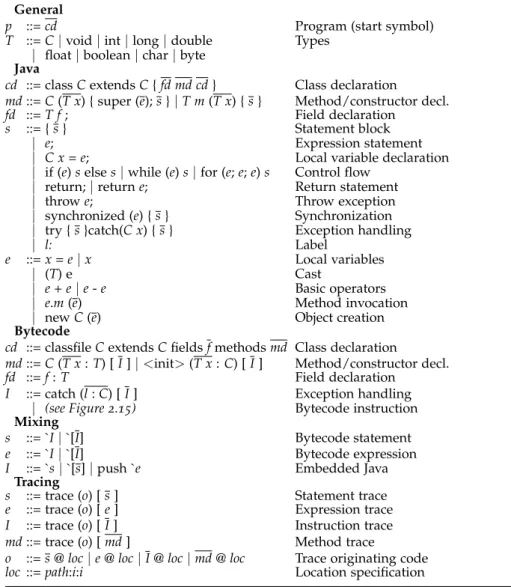
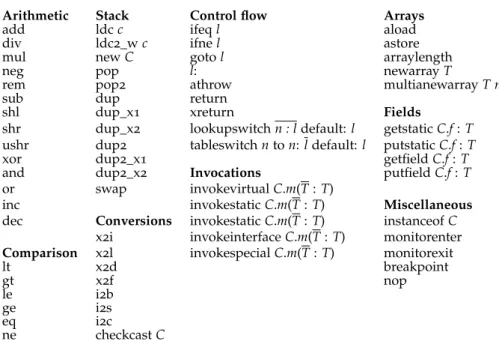
In this chapter, we propose an open compiler architecture based onmixing source and bytecodein order to enablecompilation by normalization. That is, the base language is a combination of the high-level source language (Java) and the low-level bytecode core language. This means that it is possible to use bytecode primitives, such as thegotoinstruction, directly from Java, as in the statement
if (condition) `goto label;
where the backtick (`) operator is used to distinguish between the syntax of the two constituent languages. Similarly, source code expressions and statements can be embedded in bytecode, nested to arbitrary depth. The compiler for this mixed base languagenormalizesan input program in the combined language to a program in the bytecode core language. Thus, the language produced as output of the compiler is a subset of the input language.
This architecture combines the light weight construction of extensions us-ing a preprocessor, with the access to the compiler back end of a compiler extension. Without knowing the internals of the compiler, a preprocessor can generate code in the core language where needed, as well as the extended input language where possible (see Figure2.2). In other words, an extension