2009 - 2010
Webster University 470 East Lockwood Avenue St. Louis, Missouri 63119-3194 USA
www.webster.edu Home Campus: St. Louis, Missouri, USA
© 2009 Webster University | UG-9-1
2009–2010
UnderGrad
U
a
te
St
U
die
S
Ca
t
alo
G
U.S. Extended Campuses Offering Undergraduate
Degree Completion... 5
International Campuses for Undergraduates ... 7
University Overview ... 8
Academic Policies and Information ... 13
Admission to the University ... 21
Financial Information ... 25
Student Affairs ... 30
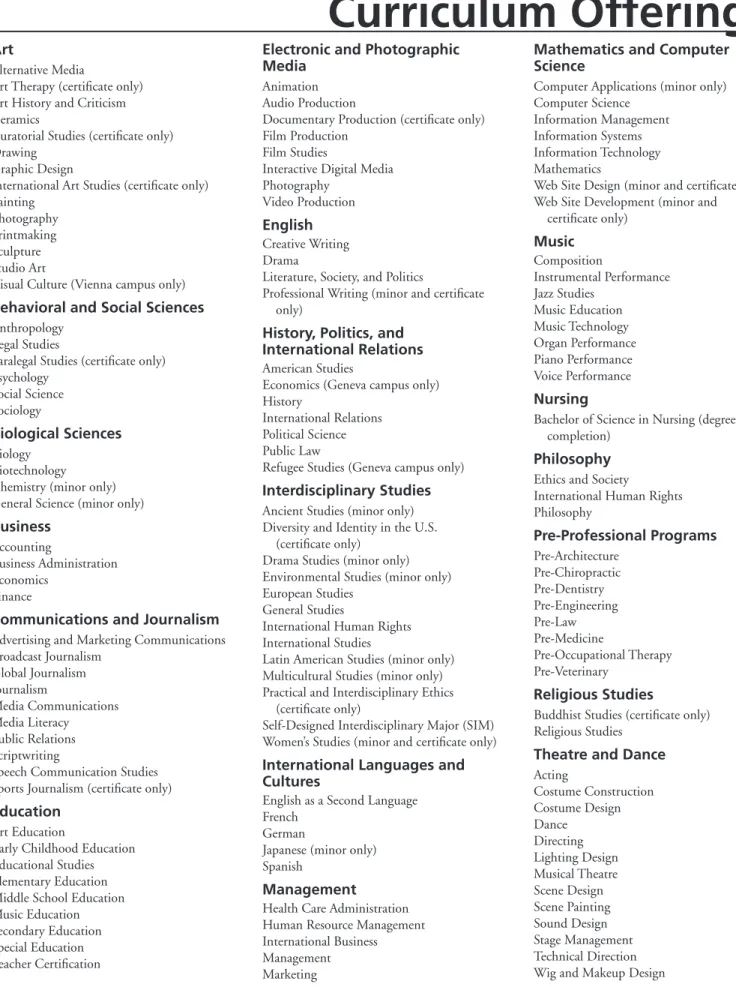
Curriculum Offerings ... 33
College of Arts & Sciences ... 34
Behavioral and Social Sciences ...36
Biological Sciences ...48
English ...54
History, Politics, and International Relations ...62
International Languages and Cultures ...73
Nursing ...83
Philosophy ...85
Religious Studies ...90
Leigh Gerdine College of Fine Arts ... 95
Art ...96
Music ...106
Theatre and Dance ...117
School of Business and Technology ... 125
Business ...126
Management ...133
Mathematics and Computer Science ...138
School of Communications ... 148
Communications and Journalism ...149
Electronic and Photographic Media ...164
School of Education... 177
Department of Teacher Education ...180
The International Campuses ...191
International Faculty ... 193
Individualized Learning Experiences ... 199
Center for Interdisciplinary Studies ... 201
Practical and Interdisciplinary Ethics ...203
Environmental Studies Minor ...203
International Studies ...208
Latin American Studies Minor ...211
Multicultural Studies Minor ...212
Self-designed Interdisciplinary Major (S.I.M.) ...213
Women’s Studies ...214
Pre-Professional Programs ... 216
Pre-Architecture ...216
Pre-Chiropractic ...216
Pre-Dentistry, Pre-Medicine, Pre-Veterinary ...216
Pre-Engineering ...216
Pre-Law ...217
Pre-Occupational Therapy ...217
Special Study Opportunities ... 218
Study Abroad at the International Campuses ...218
Study Abroad Advising, Registration, and Tuition ...218
Academic Resource Center (ARC)...219
Services for Students with Disabilities ...219
Student Leadership Development Program ...219
Combined Degrees Program ...219
Speech and Debate Program ...220
Center for Professional Development ...220
Other Programs ... 222
Combined Degrees...222
Graduate Studies ...229
Graduate Certificates ...231
University Directory ... 232
Office of the President ...232
Administration ...232
Board of Trustees ...234
Graduate Council...234
Emeriti ...235
St. Louis Metropolitan Campuses ...235
Other Undergraduate Extended Campuses ...235
International Campuses ...235
Faculty ... 236
College of Arts & Sciences
Leigh Gerdine College of Fine Arts
School of Business & Technology
School of Communications
School of Education
Webster Hall, Home Campus, St. Louis, Missouri
Academic Advising 1-800-982-3847 Financial Aid 1-800-983-4623 Follett Bookstore 1-888-467-5657 314-968-5936 (St. Louis only) Library 1-800-985-4279 Registrar 1-800-987-3447 Academic Affairs 1-800-981-9802 Business Office 1-800-981-9803 Career Services 1-800-981-9805 General Switchboard 1-800-981-9801 Student Affairs 1-800-981-9804
Saint Louis, Missouri 63119-3194 U.S.A. Internet: www.webster.edu
For general information
or application materials
U.S. Citizens to the St. Louis Campus Phone: 314-968-6991 • 1-800-75-ENROLL Fax: 314-968-7115E-mail: [email protected]
U.S. Citizens to Extended U.S. Campuses Phone or fax the campus of your choice. (For phone and fax information, see the U.S. Extended Campuses Offering Undergraduate Degree Completion section of this catalog.) International Students and U.S. Citizens Living Abroad to U.S. Campuses Phone: international access code +314-968-7433
Fax: international access code +314-968-7119
E-mail: [email protected]
U.S. Residents to International Campuses Phone: 314-968-6988 • 1-800-984-6857 Fax: 314-968-7119
E-mail: [email protected] Non-U.S. Residents to International Campuses
Phone or fax the campus of your choice. (For phone and fax information, see the International Campuses for Undergraduates section of this catalog.)
Webster University is a private, non-profit, independent, multicampus, international institution offering a wide variety of under-graduate and under-graduate degree programs. Founded in 1915, Webster University’s home campus is in Webster Groves, Missouri, USA, a major suburban center of the St. Louis metropolitan area. Webster University also offers programs at extended campus locations throughout the United States, including military education installations and metropolitan centers, international pro-grams in Europe, Asia and South America, and online distance learning programs in a large number of academic disciplines.
University. Students should be advised that not all courses are offered every year. A schedule of courses is published each year by the Office of the Registrar.
The statements set forth in this catalog are for informational purposes only and should not be construed as the basis of a contract between a student and this institu-tion. Webster University reserves the right to change any statement made in this cata-log, including but not limited to academic requirements for graduation, without actual notice to individual students. Every effort will be made to keep students advised of any such changes. Each student is responsible for keeping apprised of current graduation requirements for his or her particular degree program.
For current catalog information, consult the online catalog at www.webster.edu/ugcatalog.
It is the policy of Webster University not to discriminate in its educational programs, activities, or employment policies on the basis of race, sex, sexual orientation, color, creed, age, ethnic or national origin, or non-disqualifying handicap, as required by federal laws and regulations, including Title IX of the 1972 Educational Amendments.
Webster University complies with the Family Educational Rights and Privacy Act of 1974, Public Law 93-380 as Amended. Section 504 and Title IX Coordinator is Karen Luebbert, Vice President and Executive Assistant to the President, Webster University, 470 East Lockwood Avenue, Saint Louis, Missouri 63119-3194, U.S.A., 314-968-6949.
2
Webster University 2009–2010
... ..
.
NETWORK
CA
M
PU
SES
E
W
EB
STER
U NIV R
..
....
SIT
Y
.
...
.
.
OF
L
A
W
OR
DW
IDE
Academic Policies and Information ...13
Admission to the University ...21
Financial Information ...25
Student Affairs ...30
Curriculum Offerings ...33
College of Arts & Sciences ...34
Behavioral and Social Sciences ...36
Biological Sciences...48
English ...54
History, Politics, and International Relations ...62
International Languages and Cultures ...73
Nursing ...83
Philosophy ...85
Religious Studies ...90
Leigh Gerdine College of Fine Arts ...95
Art ...96
Music ...106
Theatre and Dance ...117
School of Business and Technology ...125
Business...126
Management ...133
Mathematics and Computer Science ...138
School of Communications ...148
Communications and Journalism ...149
Electronic and Photographic Media...164
School of Education ...177
Department of Teacher Education ... 180
The International Campuses ...191
International Faculty ...193
Individualized Learning Experiences ...199
Center for Interdisciplinary Studies ...201
Practical and Interdisciplinary Ethics ...203
Environmental Studies Minor ...203
General Studies ...206
International Human Rights ...207
Pre-Architecture ...216
Pre-Chiropractic ...216
Pre-Dentistry, Pre-Medicine, Pre-Veterinary ...216
Pre-Engineering ...216
Pre-Law ...217
Pre-Occupational Therapy...217
Special Study Opportunities ...218
Study Abroad at the International Campuses ...218
Study Abroad Advising, Registration, and Tuition ...218
Academic Resource Center (ARC) ...219
Services for Students with Disabilities ...219
Student Leadership Development Program...219
Combined Degrees Program...219
Speech and Debate Program ...220
Center for Professional Development ...220
Other Programs ...222
Combined Degrees ...222
Graduate Studies ...229
Graduate Certificates ...231
University Directory ...232
Office of the President ...232
Administration ...232
Board of Trustees ...234
Graduate Council ...234
Emeriti ...235
St. Louis Metropolitan Campuses ...235
Other Undergraduate Extended Campuses ...235
International Campuses ...235
Faculty ...236
Summer Term 2009
May term ... May 11-May 29 First 5-week term ... June 1-July 3 Second 5-week term ... July 6-August 7 8-week session ... June 8-July 31 Memorial Day/No classes.. ... May 25 Independence Day/No classes... July 3
Fall Semester 2009 (UG, M.A.T., M.M., M.S.N.)
Weekend Program (First 8-week session) ...August 22-October 10 16-week semester... August 24-December 18 First 8-week session ...August 24-October 16 Weekend Program (Second 8-week session) ..October 23-December 12 Second 8-week session ...October 26-December 18 Labor Day/ No classes ... September 4 Fall Break/ No regular classes ...October 19-23 Thanksgiving holiday/ No classes ...November 26-27
Spring Semester 2010
Weekend Program (First 8-week session) ...January 8-February 27 16-week semester... January 11-May 7 First 8-week session ... January 11-March 5 Weekend Program (Second 8-week session) ...March 12-May 1 Second 8-week session ...March 15-May 7 Martin Luther King, Jr. holiday/ No classes ... January 18 (except international campuses)
Spring Break/ No regular classes ...March 8-12 Graduation ceremony (St. Louis)... May 8
Graduate Courses
Note: Starting dates for M.A., M.B.A., M.H.A., M.P.A., M.S. and D.Mgt. courses (5000-, 6000-, and 7000- level) differ from the calendar dates listed above.
This calendar is subject to change should circumstances warrant.
Fall Semester 2009
First 8-week sessionGeneva, Leiden, Vienna ...August 24-October 16 Thailand ...August 17-October 10 16-week semester
Geneva, Leiden, Vienna ...August 24 - December 18 London ... September 7-December 17 Thailand ...August 17-December 12 Second 8-week session
Geneva, Leiden, Vienna...October 26-December 18 Thailand...October 19-December 12
Spring Semester 2010
First 8-week sessionGeneva, Leiden, Vienna ...January 11-March 5 Thailand ...January 11-March 6 16-week semester
Geneva, Leiden, Vienna...January 11-May 7 London...January 25-May 6 Thailand...January 11-May 15 Second 8-week session
Geneva, Leiden, Vienna...March 15-May 7 Thailand...March 16-May 15
International Calendar
30800 Palos Verdes Drive East Rancho Palos Verdes, CA 90274-6299 Phone: 310-377-7742, ext. 157 Fax: 310-377-6223
E-mail: [email protected]
Irvine Metropolitan Campus
32 Discovery, #250 Irvine, CA 92618 Phone: 949-450-9066 Fax: 949-450-9004 E-mail: [email protected]
Bachelor of Arts (degree completion only)
management psychology
San Diego Metropolitan Campus
6333 Greenwich Drive, Suite 230 San Diego, CA 92122
Phone: 858-458-9310 Fax: 858-458-0914
E-mail: [email protected]
Bachelor of Arts (degree completion only)
management
Florida
North Orlando Metropolitan Campus
2180 West State Road 434, Suite 5100 Longwood, FL 32779
Phone: 407-869-8111 Fax: 407-869-8623
E-mail: [email protected]
South Orlando Metropolitan Campus
6750 Forum Drive, Suite 300 Orlando, FL 32821
Phone: 407-345-1139 Fax: 407-345-0377
E-mail: [email protected]
Bachelor of Arts (degree completion only)
management
management, health care administration emphasis management, human resource management emphasis psychology
Bachelor of Science (degree completion only)
accounting
business administration
Minors
computer applications minor computer science minor
1200 East 104th Street Kansas City, MO 64131
Phone: 816-444-1000 • Fax: 816-444-1740 E-mail: [email protected]
Bachelor of Arts (degree completion only)
management
management, health care administration emphasis management, human resource managment emphasis management, marketing emphasis
Bachelor of Science in Nursing (degree completion only) Bachelor of Science (degree completion only)
business administration
Old Post Office Campus, St. Louis
815 Olive Street St. Louis, MO 63101 314-968-5966 • Fax: 314-621-9232 E-mail: [email protected] Bachelor of Arts legal studies management
management, human resource management emphasis management, marketing emphasis
psychology social science
Bachelor of Science
business administration computer science
computer science, information management emphasis
Certificate entrepreneurship paralegal studies Westport Campus 11885 Lackland Rd., Ste. 600 Maryland Heights, MO 63146 Phone: 314-968-5955 Fax: 314-291-5099 E-mail: [email protected] Bachelor of Arts management
management, human resource management emphasis management, marketing emphasis
Bachelor of Science
business administration computer science
computer science, information management emphasis
WingHaven Campus, St. Charles County
Midwest Bank Centre
2299 Technology Drive, Suite 300 O’Fallon, MO 63366
Phone: 636-561-2400 • Fax: 636-625-2522 E-mail: [email protected]
Bachelor of Arts
South Carolina
Charleston Metropolitan Campus
5300 International Blvd., Bldg. B North Charleston, SC 29418 843-760-1324 • Fax: 843-760-1153 e-mail: [email protected]
Bachelor of Arts (degree completion only)
management psychology
Columbia Metropolitan Campus
8911 Farrow Road Suite 101
Columbia, SC 29203
803-699-0900 • Fax: 803-699-2488 e-mail: [email protected]
Bachelor of Arts (degree completion only)
management psychology
Greenville Metropolitan Campus
124 Verdae Drive, Ste. 400 Greenville, SC 29607
864-676-9002 Fax: 864-676-0601 e-mail: [email protected] www.webster.edu/greenville
Bachelor of Arts (degree completion only)
Admission Officer Webster University, Vienna Berchtoldgasse 1
A-1220 Vienna Austria
Tel. (01) 269 9293 0
From outside Austria: international access code + 43 1 269 9293 0 Fax (01) 269 9293 13
From outside Austria: international access code + 43 1 269 9293 13
Bachelor of Arts Bachelor of Science Certificate
The Netherlands
Leiden Campus
Admission Officer Webster University, Leiden Boommarkt 12311 E A Leiden The Netherlands Tel. (071) 5168000
From outside The Netherlands:
international access code + 31 71 5168000 Fax (071) 5168001
From outside The Netherlands:
international access code + 31 71 5168001 E-mail: [email protected] Bachelor of Arts Bachelor of Science Certificate
Switzerland
Geneva Campus
Admission Officer Webster University, Geneva 15, route de Collex CH-1293 Bellevue GenevaSwitzerland Tel. (022) 959 8000
From outside Switzerland: international access code + 41 22 959 8000 Fax (022) 959 8061
From outside Switzerland: international access code + 41 22 959 8013 E-mail: [email protected]
Bachelor of Arts Bachelor of Science Certificate
Admission Officer
Webster University Thailand 143 Moo 5, Tambon Sampraya, Cha-am, Petchaburi 76120 Thailand
Tel. (02) 652 0705
From outside Thailand: international access code + 66 32 456 161 8 Fax (02) 652 0708
From outside Thailand: international access code + 66 32 456 169 E-mail: [email protected]
Bachelor of Arts Bachelor of Science
United Kingdom
Webster at Regent’s College
Admission OfficerWebster at Regent’s College Inner Circle, Regent’s Park London NW1 4NS United Kingdom Tel. (0207) 487 7440
From outside United Kingdom:
international access code + 44 207 487 7433 Fax (0207) 487 7425
From outside United Kingdom:
international access code + 44 207 487 7557 E-mail: [email protected]
Bachelor of Arts
Overview, Mission and
Accreditation
Webster University is a private, non-profit, multicampus, international institution offering a wide variety of undergraduate and graduate programs. The University’s headquarters is located in Webster Groves, a major suburban center of the St. Louis metropolitan area. Webster students enjoy the advantages traditionally associated with a small undergraduate college, as well as alternative options normally provided only by larger institutions.
In addition to the programs offered at the Webster Groves campus, the University provides undergraduate study opportunities at the fol-lowing St. Louis locations:
the historic Old Post Office Building in downtown St. Louis. •
in St. Louis County at Westport. •
the WingHaven Complex in St. Charles County. •
Webster University also offers undergraduate education at the fol-lowing extended-campus locations in the United States: Kansas City (Missouri); Los Angeles (California); Orlando (Florida); San Diego (California); and South Carolina at: Columbia, Charleston, and Greenville.
Students may also study at Webster’s international campuses in Geneva, Switzerland; Leiden, The Netherlands; London, United Kingdom; Vienna, Austria; or Hua Hin/Cha-am, Thailand. Last year, the Webster Groves campus enrolled 2,850 undergraduate students, and the undergraduate population at all locations totaled 5,400. The University’s worldwide enrollment was approximately 21,000 students.
Mission
Webster University, a worldwide institution, ensures high quality learning experiences that transform students for global citizenship and individual excellence.
Vision
Our vision is to be a premier U.S- based international university set-ting a distinct standard for global education.
This vision is built on a foundation of excellence in teaching and enhanced by an international perspective that fosters dialogue, respect and understanding across boundaries and between peoples. The edu-cational endeavors in support of this vision are meeting the needs and enriching a global mix of learners within an ever increasing network of students desiring a U.S. education in multiple parts of the world. The institution is committed to offering these students a distinct personal experience and building the resources required to achieve this vision. The actions of the institution are shaped by our core values.
Core Values
Students
By sustaining a personalized approach to education through small classes, close relationships with faculty and staff, and attention to stu-dent life.
Learning
By developing educational programs that join theory and practice, provide an international perspective, encourage creativity and scholar-ship, and foster a lifelong desire to learn and actively serve communi-ties and the world.
Diversity
By creating an environment accessible to individuals of diverse cul-tures, ages, and socioeconomic backgrounds and instilling in students a respect for diversity and an understanding of their own and others values.
Global Citizenship
By educating a diverse population locally, nationally, and internation-ally, acting responsibly toward the environment to foster a sustainable future, and strengthening the communities we serve.
General Education Goals
A coherent baccalaureate program provides opportunity for the study of a discipline in depth while at the same time enabling students to obtain a broad general education within the context of their individual goals. Webster University acknowledges that the ideal components of general education can be addressed throughout the curriculum and that this learning may occur in a variety of ways. The University requires all baccalaureate students to complete a general education pro-gram. The following nine goals are the framework for this program: 1. Critical Thinking (a systematic method of examining and
evaluat-ing arguments).
2. Communications (writing and speaking that are clear, concise, and accurate when conveyed to a broad audience).
3. Historical Consciousness (recognition of causes, relationships, and sequences within seemingly random social and historical events). 4. Humanities (analysis of the themes of human experience through
the legacy of great works and ideas).
5. Values (critical reflection on the attitudes and beliefs relevant to individual and social choices and actions).
6. Cultural Understanding (examination and comparison of interna-tional and/or diverse cultures).
7. Arts Appreciation (recognition of artistic expressions gained through analysis, reflection, or practical experience).
8. Scientific Understanding (analysis of concepts of a scientific dis-cipline and its methods, limitations, and impact in the modern world).
9. Mathematics (recognition of the value and beauty of mathemat-ics, as well as the ability to use geometric, algebraic, or numerical reasoning).
Webster University is committed to the idea that these processes, methods, experiences, and skills can be acquired by individuals in a variety of ways, in numerous fields of study, and at varying times in their academic lives. Generally, students satisfy the general education requirement by taking one 3-credit-hour course in each of the nine areas. See Academic Policies and Information for specific details for each degree program.
Accreditation and Memberships
Webster University is accredited by The Higher Learning Commission and is a member of the North Central Association, 312-263-0456, www.ncahlc.org.
The accreditation, which was awarded in 1925, includes under-graduate and under-graduate levels at all locations where the University offers programs.
• Arizona: Master’s degree programs at Luke AFB are licensed by the Arizona State Board for Private Postsecondary Education. If you have any complaint or grievance which you cannot resolve with the school, write or call: Arizona State Board for Private Postsecondary Education, 1400 West Washington, Room 260, Phoenix, AZ 85007, Telephone: 602-542-5709
• Arkansas: The campuses at Little Rock, Little Rock Air Force Base, Fort Smith, and Fayetteville are certified by the Arkansas Department of Higher Education. Arkansas Higher Education Coordinating Board certification does not constitute an endorse-ment of any institution or program. Such certification merely indi-cates that certain criteria have been met as required under the rules and regulations implementing institutional and program certifica-tion as defined in Arkansas Code §6-61-301. The student should be aware that these degree programs may not transfer. The transfer of course/degree credit is determined by the receiving institution. • California: “Notice of Student Rights” in California—You may
cancel your contract for school, without any penalty or obligations, by the fifth business day following your first class as described in the Notice of Cancellation form that will be given to you. Read the Notice of Cancellation form for any explanation of your cancel-lation rights and responsibilities. If you have lost your Notice of Cancellation form, ask the school for a sample copy. After the end of the cancellation period, you also have the right to stop school at any time, and you have the right to receive a refund for the part of the course not taken. Your refund rights are described in the contract. If you have lost your contract, ask the school for a description of the refund policy. If the school closes before you graduate, you may be entitled to a refund. If you have any complaints, questions, or prob-lems which you cannot work out with the school, write or call: Bureau for Private Postsecondary and Vocational Education P.O. Box 980818
West Sacramento, CA 95798-0818 Telephone: 916-445-3427
• Colorado: The metropolitan campuses at Colorado Springs and Denver are authorized to offer master’s degrees by the Colorado Commission on Higher Education.
• District of Columbia: Master’s degree programs at Bolling AFB in Washington, D.C., are licensed by the District of Columbia Educational Institution Licensure Commission.
• Florida: Master’s degree programs at the metropolitan campuses in Orlando, Jacksonville, Lakeland & Brandon, Merritt Island, Ocala, Palm Bay, Sarasota, Tampa Bay, Manatee, and at NAS Jacksonville and Patrick AFB are licensed by the Florida Commission for Independent Education. Credits and degrees earned from colleges licensed by this board do not automatically qualify the holder to participate in professional licensing examinations in the State of Florida. Any person interested in practicing a regulated profession in Florida should contact the appropriate state regulatory agency. For further information about the status of Webster University’s pro-grams in Florida, contact:
Florida Department of Education Commission for Independent Education 325 West Gaines Street, Suite 1414 Tallahassee, FL 32399-0400
Telephone: 888-224-6684 (Toll free)850-245-3200
• Kentucky: The metropolitan campus at Louisville is licensed by the Kentucky Council on Post-Secondary Education.
• South Carolina: The metropolitan campuses in Charleston, Columbia, Greenville, and Myrtle Beach are licensed by the: Commission on Higher Education
1333 Main Street, Suite 200 Columbia, SC 29201 Telephone: 803-737-2288
If students at the Charleston, Columbia, Greenville, and Myrtle Beach Metropolitan Campuses have complaints about a classroom situation, they should first attempt to resolve the situation with the instructor. If resolution cannot be made with the instructor, or if the complaint is about a general school policy over which the instruc-tor has no jurisdiction, then they may contact the school direcinstruc-tor for mediation. If the complaint cannot be resolved at the school level, students may contact Nonpublic Institution Licensing of the Commission on Higher Education. The complaint must be in writ-ing. The school director will provide students with the necessary form.
• Tennessee: Webster University is authorized by the Tennessee Higher Education Commission. This authorization must be renewed each year and is based on an evaluation by minimum stan-dards concerning quality of education, ethical business practices, health and safety, and fiscal responsibility.
• Virginia: Webster University is certified to operate by the State Council of Higher Education for Virginia (SCHEV). If a student has any complaints, questions or problems which were not resolved by the school to your satisfaction, you may contact
State Council of Higher Education for Virginia (SCHEV) 101 N. 14th Street
Richmond, VA. 23219 (804) 225-2600
• Washington: Webster University is authorized by the Washington Higher Education Coordinating Board (HECB) and meets the requirements and minimum educational standards established for degree-granting institutions under the Degree-Granting Institutions Act. This authorization is subject to periodic review and authorizes Webster University to offer the following degree programs: Master of Arts in Business and Organizational Security Management; Master of Arts in Counseling-Community Counseling; Master of Arts in Human Resources Development; Master of Arts in Information Technology Management; Master of Arts in Management and Leadership; and Master of Business Administration. Authorization by the HECB does not carry with it an endorsement by the board of the institution or its programs. Any person desiring informa-tion about the requirements of the act or the applicability of those requirements to the institution may contact the HECB at P.O. Box 43430, Olympia, WA 98504-3430.
Specialized Accreditations
Business related programs are accredited by the Association of •
Collegiate Business Schools and Programs (ACBSP)
Music programs and degrees are fully accredited and approved by •
the National Association of Schools of Music (NASM). Nursing programs and degrees are accredited by the National •
League for Nursing (NLN).
Webster University is registered for state teachers’ certificates •
by the Department of Education of the State of Missouri and is approved by the National Board for Certified Counselors, Inc. as a continuing education provider.
• Only the St. Louis Campus’ legal studies B.A., M.A. and Paralegal Certificates are approved by the American Bar Association.
The nurse anesthesia program is accredited by the Council on •
Accreditation (COA) of nurse anesthesia educational programs. Education programs are accredited by the National Council for •
Accreditation of Teacher Education (NCATE).
International Recognitions
China: The Webster University MBA program, offered in part-nership with the Shanghai University of Finance and Economics, is officially approved by and recognized by the Ministry of Education in China.
Thailand: Webster University in Thailand is an accredited, private university by the Thailand Ministry of Education under Thai law.
Austria: Webster University in Vienna is a accredited by the Austrian Ministry for Education and Culture as a private university under Austrian law.
The Netherlands: Webster University in the Netherlands is accred-ited by the Netherlands-Flemish Accreditation Agency (NVAO) and is an approved institute of higher education under Dutch law.
Memberships
Webster University holds membership in the following organizations or associations:
American Association for Paralegal Education •
American Association of Colleges of Nursing (AACN) •
American Association of Colleges of Teacher Education (AACTE) •
American Council on Education •
Association of American Colleges and Universities (AAC&U) •
Association of Theatre in Higher Education •
College Art Consortium •
College Consortium for International Studies •
College Entrance Examination Board •
Council for Adult and Experiential Learning (CAEL) •
Council of Independent Colleges (CIC) •
Council on International Educational Exchange •
Educational Theatre Association •
Higher Education Council of Metropolitan St. Louis •
Independent Colleges and Universities of Missouri •
Institute of International Education •
International Council of Fine Arts Deans •
Missouri Music Educators Association •
National Education Association •
National League for Nursing •
Webster University has been designated as an institutional member
of Servicemembers Opportunity Colleges, a group of more than 400 colleges and universities providing voluntary postsecondary education to members of the military throughout the world. As a member of SOC, Webster University recognizes the unique nature of the military lifestyle and has committed itself to easing the transfer of relevant course credits, providing flexible academic residency requirements, and crediting learning from appropriate military training and experi-ences. SOC has been developed jointly by educational representatives of each of the Armed Services, the Office of the Secretary of Defense, and a consortium of 13 leading national higher education associations; it is sponsored by the American Association of State Colleges and Universities, and the American Association of Community and Junior Colleges.
Graduates of Webster University are eligible for membership in the American Association of University Women and the American College of Hospital Administrators.
The University also holds appropriate licensure, accreditations, or approvals within the recognized state approval agencies for all locations where Webster University offers programs.
The Webster Groves Campus
University Center
The University Center, a 46,000-square-foot, $5.7 million facility, opened in the fall of 1992. Recreational facilities include a gym, an indoor swimming pool, a fitness center, locker rooms, and a sauna. Varsity athletic, intramural, and recreational programs are offered. The upper level includes the UC Crossroads food court with Blimpie Subs and Salads, World of Wings (WOW) Café, and Freshëns Smoothie Company, a campus information center, meeting and conference rooms, lounges, student organization offices, and the student leader-ship center. The Office of the Dean of Student Affairs is on the upper level.
Leif J. Sverdrup Business/Technology Complex
The 66,000-square-foot Leif J. Sverdrup Business/Technology Complex first opened for classroom use in the spring of 1988. The complex, consisting of three contiguous buildings, houses the Media Center, User Services, and the Grant Business and Management Center. Café a la Cart is located in the central lounge and provides food and beverages.The Media Center is a facility available to members of the University community for media production and instruction. Located in the Business/Technology Complex, it houses a black-and-white darkroom with 16 stations, a three-station color darkroom, a film-processing room, and a photo studio. For those interested in audio and video production, the Center has a sound studio with fully equipped 32-track audio mixing board, a radio broadcasting system, and a televi-sion studio, as well as a newly created video postproduction suite. A computerized journalism center is also located in the Media Center.
Also located in the Business/Technology Complex is User Services, which serves as a centralized location for faculty, staff, and student computer use. The center uses PC and Macintosh equipment in a set-ting suitable for group instruction or individual learning. User Services consists of 10 labs equipped with interactive video, multimedia and desktop publishing software, and laser printers. The labs run on Novell servers using Ethernet technology. Noncredit training is offered in a variety of topics including word processing, Internet, and Microsoft Office applications.
expanded lobby, the center serves as the setting for professional and student productions, lectures, and concerts, and it houses teaching spaces, workshop areas, dance studios, and faculty offices. The center features a 924-seat main stage theatre with a thrust stage and also contains a flexible-space, 125-seat Studio Theatre. In this major St. Louis cultural facility, professional performances are held throughout the year by The Repertory Theatre of St. Louis, and the Opera Theatre of Saint Louis. Many of the student productions of the University’s Conservatory of Theatre Arts and dance programs are staged in the Loretto-Hilton.
Music Hall
Designed and constructed for musical instruction and performance, the Music Hall, opened in 2006, features a 500-seat concert hall on the main floor and spacious practice/instruction studio spaces on the lower and upper levels. The Concert Hall is the home of the Webster University Symphony Orchestra. The building is also used by the Webster University Community Music School, which offers instruc-tion and performance opportunities to the region’s most talented secondary-school musicians.
Webster Hall
Built in 1915, this historic five-story, multipurpose building houses administrative offices, faculty offices, academic classrooms, science laboratories, and theatre rehearsal spaces. Special facilities include the Winifred Moore Auditorium, which seats 252 people and is used extensively for lectures, concerts, and films. Stage 3 is a 125-seat flexible theatre space used primarily for student productions of the Conservatory of Theatre Arts.
Emerson Library
Webster University five-story Emerson Library is centrally located in the University’s academic corridor and features the latest in informa-tion technology, including multimedia facilities, a reference/elec-tronic commons, an elecreference/elec-tronic classroom, and a 24-hour cybercafè. Emerson Library houses a growing collection of more than 270,000 volumes of monographs, rare books, periodicals, videos, and other media and has seating for over 700 in a variety of individual and group study spaces. Special collections of the library include the Harry James Cargas Literature and Holocaust Collection, the Henrietta Maizner Hochschild Children’s Literature Collection, the Curriculum Collection, and the University Archives. As part of a joint library sys-tem with Eden Theological Seminary’s Luhr Library, students, faculty, and staff of both Webster and Eden enjoy reciprocal resources and ser-vices of both Emerson and Luhr Libraries, including the fine collection of materials on religion and related subjects located in Luhr Library.
Through continuing technological innovation, the library provides a variety of online resources to faculty, students, and staff, including an online integrated research system. The url http://library.webster.edu is the library’s World Wide Web site, integrating online services, Internet resources, and online databases for student and faculty research. It is accessible from campus, home, or office and provides 24-hour access to the library’s online catalog; MOBIUS, a statewide consortium; over 125 online and full-text databases; Internet resources; and online ser-vices, including reference and electronic reserves.
The library’s Reference/Electronic Commons is the central service
area includes over 20 state-of-the-art online research workstations and 21,000 reference volumes. A Media Listening/Viewing Center offers a growing multimedia collection with 20 listening/viewing rooms and stations. An electronic classroom is available for hands-on instruction in the fast-changing world of libraries and the information industry.
The library features 20 group study rooms seating from four to 10 people. As education becomes more experiential and collaborative, these rooms provide essential space for group research and projects. Each is fully wired for electronic as well as traditional research and study. The library also offers a variety of individual study environ-ments, including study carrels with task lighting and network connec-tions. Open reading areas on the upper level include individual and group seating and are fully wired for electronic and traditional research. A large lecture/conference room provides space for both instruction and meetings. Many areas of the library also include wireless access to the Internet.
Jazzman’s Cybercafé offers coffee bar fare and provides an informal and lively meeting place that is accessible 24 hours a day. Over 20 multi-function, networked workstations are available for student use of e-mail and online research resources. On the top floor of the library, a Faculty Development Center includes the latest multimedia equipment and resources for teaching and learning excellence as faculty incorpo-rate information technology into the curriculum.
Garden Park Plaza
Located on Garden Avenue, Garden Park Plaza provides parking spaces for 700 vehicles and also houses the offices of Academic Advising, Career Services, and the Office of Admission. The University bookstore is also housed on the ground floor of the building.
Loretto Hall
Offices located in Loretto Hall include the Academic Resource Center, Mail and Copy Solutions, Multicultural Center, Study Abroad Offices, the Registrar and Writing Center.
Maria Hall
Maria Hall, originally constructed in 1959, was completely renovated and reopened in Fall 2008. Housing 102 students in double suites (two double rooms sharing a private bathroom), the building now has mod-ern heating and air conditioning systems, wired and wireless Intmod-ernet connectivity, floor lounges, and quiet study rooms. It is conveniently located above the primary campus dining facility, Marletto’s Café. Marletto’s was completely renovated in 2004 and offers a variety of healthy and vegetarian options, a salad bar, a cook-to-order grill, pizza, and special entrees.
Webster Village Apartments
The Webster Village Apartments include six apartment buildings hous-ing 280 students in efficiencies and 2- and 4-bedroom units plus a clubhouse and an outdoor pool.
East and West Halls
With the opening of two new residence halls in Fall 2006, Webster University provides modern, air-conditioned, on-campus housing options for students. West Hall, housing 231 students, is reserved for freshmen and includes shared two-bedroom, one-bath suites. East Hall, housing 112 students, is primarily for sophomores and upperclassmen
and includes shared three-bedroom, two-bath suites and private four-bedroom, two-bath suites. These new residence halls include laundry rooms, social lounges, study lounges, kitchenettes on each floor, a rec-reation room, a multipurpose room, and a classroom.
Other Instructional Locations and Campus Facilities
Pearson House contains the departmental offices for English and philosophy, as well as six classrooms.H. Sam Priest Center for International Studies houses the History, Politics, and International Relations Department.
The Music Building contains faculty offices, a recital hall, three classrooms, 10 teaching studios, and 20 practice rooms.
The Visual Arts Studios house drawing, painting, printmaking, ceramics, sculpture, and graphic design studios. The building systems were extensively renovated in 2008.
The Cecille R. Hunt House contains art faculty offices and studios. Student Health Services and Counseling and Life Development are located in a house at 540 Garden Avenue, just behind the International Recruitment and Services Center.
The International Recruitment and Services Center is at 538 Garden Avenue.
The Multicultural Center and International Student Affairs department is located in the lower level of Loretto Hall.
The Admissions Center is located at 8356 Big Bend Boulevard, and it houses undergraduate admissions.
The John Allan Love Foundation Alumni House is at 534 Garden Avenue.
Opera Theatre of Saint Louis is at 210 Hazel Avenue.
The Carriage House is the headquarters for The Repertory Theatre of St. Louis, the professional regional theatre company that works directly with the Webster Theatre Conservatory.
The St. Louis Metropolitan Area
The metropolitan St. Louis area has a population of more than two million people and offers students many opportunities to enrich their educational experiences through its cultural and entertainment attrac-tions.
St. Louis is frequently called “The Gateway to the West” because of its historic role in the nation’s westward expansion. Commemorating this role is the 630-foot, stainless steel Gateway Arch designed by Eero Saarinen. The arch is the focal point of the 86-acre Jefferson National Expansion Memorial on the Mississippi riverfront.
Downtown St. Louis is the hub of the metropolitan area, featuring a commercial and business district, the Laclede’s Landing entertainment district on the riverfront, the Scottrade Center, and Busch Stadium. A short distance away is St. Louis Union Station, built in 1894 and now a major tourist attraction and shopping area. Webster University has participated in this downtown renewal with an expanded campus in the Old Post Office building.
St. Louis attractions include one of the world’s major zoos in Forest Park, site of the 1904 World’s Fair. Also located in Forest Park are the Saint Louis Art Museum; the Municipal Opera amphitheatre; the St. Louis Science Center; and the Missouri Historical Society Museum.
Among St. Louis’ cultural opportunities are The Repertory Theatre of St. Louis and Opera Theatre of Saint Louis, both housed on Webster University’s home campus; the Saint Louis Symphony; and professional theatre and entertainment events presented at the historic Fox Theatre and other theatres in the urban area.
St. Louis is the home of the baseball Cardinals, the hockey Blues, and the football Rams. The Missouri Botanical Garden contains one of the world’s outstanding botanical collections. The Climatron, a domed greenhouse, recreates a tropical ecosystem.
Other places of interest include the boyhood home of Eugene Field, “the children’s poet”; Campbell House, a preserved and authentically furnished Victorian mansion (1854); the gracious Chatillon-DeMenil Mansion (1848); the magnificent Byzantine-style St. Louis Cathedral, with its brilliant mosaics; and Ulysses S. Grant’s Farm Estate, with roaming herds of buffalo and deer.
Bachelor of Science (BS) Bachelor of Fine Arts (BFA) Bachelor of Music (BM)
Bachelor of Music Education (BMEd) Bachelor of Science in Nursing (BSN) Bachelor of Arts/Master of Arts (BA/MA) Bachelor of Science/Master of Arts (BS/MA) Bachelor of Science/Master of Science (BS/MS) Bachelor of Music/Master of Music (BM/MM)
Bachelor of Science in Nursing/Master of Science in Nursing (BSN/MSN) Certificate Programs
Webster University’s BA and BS degrees are firmly grounded in the lib-eral arts. They represent differing but equal curricula. Genlib-eral educa-tion requirements are generally the same for both degrees; however, the BS may require more courses in the major, thus allowing fewer elective courses. Webster awards the BA to those who concentrate in language, literature, history, and other humanities and liberal arts areas. The University may grant the BS in social and natural sciences or in highly applied or technical fields. Webster University also offers a limited number of baccalaureate programs that are professional and restrictive in content, application and intent. The curricula are highly structured and prescriptive. These professional degrees include the BFA, BM, BMEd and the BSN.
Baccalaureate Degree Policies and
Procedures
Baccalaureate Degree Requirements
Students completing the bachelor’s degree must meet these requirements: Successful completion of 128 credit hours.
1.
Successful completion of at least 30 of a student’s final 36 credit 2.
hours registered for and earned directly from Webster University. These residency credit hours may include credit hours earned through assessment of prior learning and departmental credit hours by examination.
A cumulative grade point average of 2.0 earned in courses taken 3.
at Webster University based on a 4.0 system.
Successful completion of an approved major. Options include: 4.
• Completion of the requirements for an established major in a
department.
• Completion of an approved individualized area of concentration
(IAOC).
• Completion of the requirements for dual majors if the areas
are available with the same degree, with the exception of a self-designed interdisciplinary major (SIM).Note: The same course may not satisfy the degree requirements for two different majors and/or minors.
Successful completion of general education requirements. 5.
For a listing of the nine general education goals, see General Education Goals.
Students must graduate under the requirements in effect at the time of their acceptance as a degree-seeking student. Students leaving the University for more than one calendar year must be readmitted and must graduate under the requirements in effect at the time of their readmission.
General Education Requirements
Webster University requires all baccalaureate students to complete a general education program. The faculty of Webster University have
categories. An approved list of courses addressing each of the general education goals is available through academic advisors. Students have the responsibility to select their general education coursework, with the guidance of their academic advisor, within these guidelines. Up to two courses within the student’s major department may be used to satisfy general education goals, so long as the courses represent different aca-demic disciplines as indicated by course prefixes. All other courses used to satisfy the general education requirement must be taken outside of the student’s major department. Individual departments may also iden-tify more specific general education coursework within this program.
Bachelor of Arts and Bachelor of Science (BA, BS) programs require students to address each of the nine general education goals (27 credit hours minimum).*
*Note: Students majoring in programs from the School of Communications (BA degree) are required to complete 36 credit hours in general educa-tion. Students pursuing a BS degree in computer science with an emphasis in information technology or information management are required to address four of the general education goals (12 credit hours minimum). See specific department listings for additional information.
Professional Degree (BFA, BM, BMEd, BSN) programs require students to address at least four of the general education goals (12 credit hours minimum--see specific departmental listings).
Transfer students are referred to information on general education equivalencies and other specific transfer guide-lines.
Baccalaureate Degree Requirements
at Metropolitan Campuses
Webster University offers an undergraduate upper-division degree-completion program at its metropolitan campuses in Kansas City, Missouri; Orlando, Florida; San Diego, California; at its Weekend College program at Marymount College in Los Angeles, California; and South Carolina at: Charleston, Columbia and Greenville. Students completing their baccalaureate degree at these locations must complete the same graduation requirements as students at the home campus. Refer to the U.S. Extended Campuses Offering Undergraduate Degree Completion section for more complete information.
Major Overview
Each department at Webster may require a final overview in the stu-dent’s major. Departments determine the nature of the overview and its procedures.
Some departments require a written comprehensive examination, which is prepared and evaluated by a departmental committee. An oral examination supplements the written exam in other departments. A recital, exhibit, or production may supplement a written examination in fine arts. Still other methods of proving satisfactory proficiency in a discipline may be set by departments.
The student completing coursework in July or December is subject to the same overview requirements as the student graduating in May. At the instructor’s and department’s discretion, graduating seniors may be excused from the final examination in courses covered by the departmental overview.
Minor
Students may elect to complete an approved minor. A minor requires a minimum of 18 credit hours of formal coursework from the University curriculum successfully completed in residence at Webster University with a grade of C- or better. The minor is formally acknowledged on the student’s transcript. This secondary focus must be in an area of
study different from the student’s major or may be in an interdisci-plinary area of study, such as fine arts, liberal arts, or women’s studies. Courses used to fulfill a requirement for a major may not also be used to fulfill a requirement for a minor. A student may earn up to two minors.
Academic Advising
Beyond the major and general education requirements, all elective coursework at Webster is chosen by the student to meet individual educational goals; therefore, academic advising plays a major role in the student’s academic career at Webster and provides degree-seeking
students with individualized academic program planning.
On acceptance to the University, students normally schedule an appointment with the Academic Advising Center to discuss their aca-demic plans and to register for first semester classes. (Transfer students seeking teacher certification are advised to schedule a course audit with the Teacher Certification Office prior to making an appointment in the Academic Advising Center.) Based on this initial advising session, the office assigns the student to an academic advisor. This individual is usually a faculty member within the student’s intended area of study. Students who have not yet chosen a field of study are usually advised within the Academic Advising Center. (BSN students make their initial advising appointment through the Nursing Department.)
Throughout their academic careers at Webster, students work with their academic advisors to plan their choice of University courses. The advisor helps the student choose coursework to meet individual educa-tional and career goals, informs students about academic policies and procedures, and helps solve a variety of academic problems. Ultimately, however, it is the responsibility of each student to keep apprised of current graduation requirements for his or her particular degree pro-gram. Students may request a change of advisor through the Academic Advising Center.
Freshman Seminar
All new full-time degree-seeking freshmen with fewer than 16 credit hours of college credit are required to take GNST 1200 Freshman Seminar. See General Studies for a description of the course.
Registration
Students currently attending Webster register for the upcoming session during their current session of enrollment.
Academic Load
The recommended academic load for full-time students is 16 credit hours each semester. Sixteen credit hours for eight semesters total the 128 credit hours required for a degree. For students enrolling in 8- or 9-week terms, the recommended academic load is two to three courses per term (6-9 credit hours). Students in good academic standing must request written approval from the Academic Advising Center to enroll for more than 18 credit hours in a single semester (or 9 credit hours in a term). Students who take more than 18 credit hours are charged for the additional credit hours at the per-credit-hour rate.
Connections/e-mail Accounts
Webster University provides all students, faculty, and staff with a University e-mail account through Connections. Employees and stu-dents are expected to:
Activate their Connections account after receiving their username 1.
and password. Students will receive a letter in the mail 10-14 days after they first register for classes and will need this letter to set up their Connections account. Faculty and staff will be issued a Connections username when they begin work.
Regularly check incoming University e-mail. Your Webster e-mail 2.
account is where all official communication from Webster will be sent.
Regularly check their Connections Personal and Campus 3.
Announcements.
Maintain their University e-mail account in working order 4.
(including compliance with the University’s Acceptable Use Policy and appropriately managing disk space usage).
Students may choose to have their University e-mail forwarded to an alternate e-mail address. Connections account holders can call the Help Desk (x5995 or toll free at 1-866-435-7270) for assistance with this setup. Instructions are also provided on the Information Technology web site at www.webster.edu/helpdesk. Individual account holders are solely responsible for ensuring that all University correspondence continues to be received and read. Connections also provides access to grades and registration. Students must access their final class grades through the Connections “Student Academic Services” channel. Faculty must input their final class grades through the Connections “Faculty/Staff Academic Services” channel. Those students eligible to register online may do so through the Connections “Student Academic Services” channel.
Directed Studies
In cases of scheduling problems, a student may request a directed study as a tutorial to complete an undergraduate course outlined in this cata-log, except for reading courses, practica and independent studies.
The following conditions prevail if a course is to be completed as a directed study:
A basis for the directed study must be documented. Requests for 1.
directed studies are to be written and submitted to the chair or director by the student, along with supporting documentation. Approval must be given by the chair or director.
2.
The course must be in the curriculum at the campus where the 3.
student is enrolled.
Directed studies are identified on the student’s transcript by the 4.
catalog course prefix, number and title and include a directed study notation.
Student Schedule Changes
Students may change their schedules (drop/add) during the official drop/add period. Prior to the beginning of classes, students may add or drop classes with the approval of an academic advisor. After classes have begun, students may add a course with the approval of the instructor and an academic advisor. Students may drop classes through the end of the second week of the term/semester. Section changes in the same course will be approved or not at the advisor’s discretion. Drop/add forms may be obtained from the Office of the Registrar or the Academic Advising Center. In order for schedule changes to be official, the academic advisor must sign the drop slip; the academic advisor and the instructor (after classes have begun) must sign the add slip. Students who do not submit signed drop/add forms by the dead-line will be graded and charged according to their registration on file at the end of the official drop/add period. Merely informing the instruc-tor or advisor of the intent to drop a class or not attending a class will not constitute an official schedule change.
Students may make these changes online once their advisor has “released” them for registration each semester. Drop/add forms will be required only when students are dropping after the last drop date or adding after classes have begun.
Withdrawal from Courses
Students may withdraw from courses after the official drop/add period. Tuition waivers for withdrawals are made on a pro rata basis. Since the credit hours of withdrawals remain on the student’s record, students adding courses and exceeding the 18-credit-hour maximum will be charged additional tuition. Students may withdraw from courses up
sor. The symbol for course withdrawal (W) is recorded on the student’s transcript. Withdrawals after the above dates may occur only under exceptional circumstances, and the withdrawal form must be approved by the instructor, the advisor, department chair and the director of the Academic Advising Center.
Sequential Degrees
Students who have earned a previous baccalaureate degree may apply to pursue a sequential degree in a different area of study. Webster graduates apply for this option through the Academic Advising Center; graduates of other accredited institutions apply through the Office of Undergraduate Admissions. On admission, credits awarded toward the previous degree will be evaluated by the Office of the Registrar for acceptance toward the sequential degree and the new major. All students admitted for a sequential degree are required to complete all remaining core requirements in the major, the University’s residency requirement, as well as departmental residency requirements. Webster graduates seeking a sequential degree are required to complete a mini-mum of 30 additional credit hours in residence as part of the sequen-tial degree. Sequensequen-tial degree students are not required to complete the University’s general education requirement. They are advised by the department/program in which the sequential degree is sought.
Graduate-Undergraduate Registration
Courses in the 5000 series are graduate courses. An upper-division undergraduate student may enroll in them with the written permission of his or her advisor and the appropriate dean.
Courses in the 4000 series are upper-division courses in undergradu-ate studies. A graduundergradu-ate student may enroll in them with the written permission of his or her advisor and the instructor of the course. With written approval of the graduate program director, the credit may be applied toward the student’s graduate degree. Undergraduate Reading Courses (4610) and Apprentice Teaching (EDUC 4940, EDUC 4950, EDUC 4960, EDUC 4965, EDUC 4970, EDUC 4980) may not be applied toward a graduate degree.
With the exception of the common core courses required for the combined BA/MA, BS/MA, BS/MS, BM/MM, and BSN/MSN programs, courses in the 4000 or 5000 series used to complete an undergraduate degree may not be counted toward the credit-hour requirement for a graduate degree at Webster. Graduate programs may establish limits for the number of credit hours in 4000-level courses they will accept toward the degree.
Concurrent Registration
Current Webster students may request permission to register for classes at other institutions; however, they must obtain prior approval. The permission forms for concurrent registration may be obtained from the Office of the Registrar and filed with that office prior to registration at the other institution. This policy applies to summer session coursework at other institutions, study abroad programs, and other international study coursework.
Interinstitutional Registration
Webster has established a program with Fontbonne, Lindenwood, Maryville and Missouri Baptist universities; and with Eden Theological Seminary that allows degree-seeking students registered at Webster University for 13-18 credit hours to register for undergraduate classes at any of these institutions during their regular terms. The interin-stitutional agreement does not apply during the summer, weekend, or interim sessions, and students must furnish their own transporta-tion. Students may take courses at these colleges, universities, and the Seminary if they are not offered at Webster. Webster students register
Students register for interinstitutional courses with Webster University.
Teacher Certification
Students interested in earning credits for Missouri teacher certifica-tion at Webster University should contact the School of Educacertifica-tion, Department of Teacher Education representative. Information regard-ing teacher certification is included in the Education curriculum sec-tion of this catalog.
Course Numbering System
1000-1999 lower division (freshman level) 2000-2999 lower division (sophomore level) 3000-3999 upper division (junior level) 4000-4999 upper division (senior level)While courses are sequenced as lower- through upper-division, juniors and seniors may elect introductory-level courses outside their major field of study.
Student Classification
Students may be classified in several ways, depending on the purpose of the classification.
Full Time vs. Part Time. The terms full time and part time are used for reporting purposes and for awarding federal, state, and Webster University financial aid.
Students registered for 12 credit hours or more per semester are considered full time and may be eligible for federal and state financial aid. Those registered for 11 credit hours or fewer per semester are con-sidered part time. For financial aid purposes, some students are consid-ered half time. See Financial Aid for more information.
Flat-Fee vs. Per-Credit-Hour Billing. The terms flat-fee and per-credit-hour are used for Webster University billing purposes.
Students registered for 13 to 18 credit hours pay flat-fee tuition. Those registered for 12 credit hours or fewer pay tuition at a per-credit-hour rate. Students must be registered for 13 or more credit hours to be eligible for Webster Scholarship and Webster Grant assis-tance. For more information, see the Undergraduate Tuition section.
Classification. Students are considered sophomores after complet-ing 30 credit hours; juniors must have 60 credit hours; and seniors must have 90 credit hours.
Class Attendance
Webster University reserves the right to involuntarily drop enrolled students from classes that they do not attend during the first week of classes. Attendance requirements are set by the instructor and, as a general rule, students are expected to attend all class sessions of every course. In the case of unavoidable absence, the student must contact the instructor. The instructor may give ample warning to the student and then recommend that the student withdraw from the course. The student is subject to appropriate academic penalty for incomplete or unacceptable makeup work, or for excessive or unexcused absences.
Certificate Program Policies and Procedures
A certificate program normally consists of an identified sequence of coursework within a narrowly defined discipline. Certificate programs are designed for both first-time degree-seeking students and individuals who already possess a baccalaureate degree. Admission policies for certifi-cate-seeking students are the same as for degree-seeking undergraduates.Requirements for Certificate Programs
A minimum of 18 credit hours in specified coursework earned at 1.
All courses to be applied to a certificate program must be com-2.
pleted with a grade of C or better. Some departments may estab-lish a higher overall cumulative grade requirement for specific certificate programs.
Courses fulfilling the requirements of a certificate program may 3.
also be used to satisfy the requirements of a degree program, but may not be used to complete another certificate.
Transfer credits are not applicable to certificate programs. 4.
The general academic and financial policies of the University apply to certificate-seeking students. However, scholarship awards are available to baccalaureate-seeking students only. On completion of the approved program, certificates are awarded in May, August and December. See listing of all Webster University certificates.
Student Conduct
Statement of Ethics
Webster University strives to be a center of academic excellence. The University makes every effort to ensure:
The opportunity for students to learn and inquire freely. 1.
The protection of intellectual freedom and the rights of professors 2.
to teach.
The advancement of knowledge through scholarly pursuits and 3.
relevant dialogue.
The University community is by nature pluralistic and diverse. Those who elect to participate in the Webster University commu-nity accept the responsibility of sharing in the effort to achieve the University’s mission as an institution of higher learning. Each person is expected to respect the objectives of the University and the views expressed within the community.
Participants in this shared enterprise strive to be governed by what ought to be rather than by what is. To accomplish its goals, members of the University community aspire to a standard that is higher than
mere compliance with formalized University requirements and local,
state, and federal law. All members endeavor to fulfill the following expectations:
Preserve academic honor and integrity by repudiating all forms of 1.
academic and intellectual dishonesty. Treat others with respect and dignity. 2.
Respect the rights and property of others. 3.
Act with concern for the safety and well-being of all associates. 4.
Inquiry, discourse and dissent, within the framework of an orderly academic environment, are essential elements of a University
com-munity. Members of the Webster University community recognize this
and are consequently supportive of democratic and lawful procedure, and dedicated to rational approaches to solving problems. This assumes openness to change as well as commitment to historical values.
Misconduct
Webster University students assume the obligation of conducting themselves in a manner compatible with the University’s function as an educational institution. Student misconduct may be subject to dis-ciplinary action, up to and including dismissal from the University. To the extent that penalties for any misconduct are prescribed by law, the University will consider appropriate action under such laws.
Complete descriptions of student rights and responsibilities and the University disciplinary procedure are printed in the Student Handbook and Calendar , available in the Office of Student Affairs or the University Center information desk or online.
Classroom Disruption
Behavior occurring within the academic arena, including but not
limited to classroom disruption or obstruction of teaching, is within the jurisdiction of Academic Affairs. In cases of alleged campus and/or classroom disruption or obstruction, a faculty member and/or admin-istrator may take immediate action to restore order and/or to prevent further disruption (e.g., removal of student[s] from class or other set-ting). Faculty members have original jurisdiction to address the imme-diacy of a situation as they deem appropriate. When necessary and appropriate, Public Safety and/or the local (or military) police may be contacted to assist with restoring peace and order. Faculty response is forwarded to the academic dean (or his or her designee) for review and, if necessary, further action. Further action might include permanent removal from the course. Repeated offenses could lead to removal from the program and/or the University.
Transfer Credit
Webster University evaluates coursework completed at accredited colleges/universities or postsecondary institutions for acceptance as transfer credit. In addition, students may have other previous learning experiences (such as corporate or military training) evaluated for credit. Official transcripts and other documentation of all previous study must be submitted to the Office of Undergraduate Admissions at the time of application.
The University accepts a maximum of 98 credit hours of transfer work toward a bachelor’s degree unless that work includes significant lower-division work, in which case the following may apply.
The University accepts a maximum of 64 credit hours from any combination of the following:
Community colleges, unless the credits are part of a successfully 1.
completed associate’s degree program from a regionally accredited institution.
Credit hours completed in programs designated by Webster 2.
University as lower division.
Credit hours included in the 32-credit-hour maximum awarded 3.
for first year (freshman) work earned through any combination of International Baccalaureate, Advanced Placement, CLEP General Exams, and other designated 13th year programs normally com-pleted prior to enrollment at the University.
Standardized tests designated as lower division.
4.
Duplicate coursework does not transfer. Transfer credit hours do not count toward the University’s residency requirement. Webster University’s residency requirement is the completion of 30 credit hours of the last 36 credit hours prior to graduation.
Evaluation of Transfer Credit
The Office of the Registrar conducts the transfer-of-credit-hour evalua-tion. Transfer credit normally includes:
1. College-level work completed at accredited institutions. The University accepts as transfer credit college-level work satisfac-torily completed with a grade of C or better. Courses completed with a grade of D have severe transfer restrictions and generally are not applicable toward graduation requirements at Webster. 2. Standardized tests conducted external to Webster. These
include ACT-PEP; Excelsior College Ex-aminations; CLEP; DANTES; GED College Level; and USAFI. Because this credit is normally designated lower division, no more than 64 credit hours are transferable. Academic departments approve area exams, establish possible course equivalencies, determine acceptable test scores, and determine the amount and level of credit. These exams are used to assess prior college-level learning and should be completed in the early stages of enrollment at the University.
Standardized exams are not approved for upper-class students.
3. Extra-institutional credit. The University awards transfer credit for selected military and corporate training programs that have
full transfer of successfully completed associate’s degrees