Self-securing Ad Hoc Wireless Networks
Haiyun Luo, Petros Zerfos, Jiejun Kong, Songwu Lu and Lixia Zhang
∗Abstract
Mobile ad hoc networking offers convenient infrastructure-free communication over the shared wire-less channel. However, the nature of ad hoc networks makes them vulnerable to security attacks. Exam-ples of such attacks include passive eavesdropping over the wireless channel, denial of service attacks by malicious nodes as well as attacks from compromised nodes or stolen devices. Unlike their wired counterpart, infrastructureless ad hoc networks do not have a clear line of defense, and every node must be prepared for encounters with an adversary. Therefore, a centralized or hierarchical network security solution does not work well.
This work provides scalable, distributed authentication services in ad hoc networks. Our design
takes a self-securing approach, in which multiple nodes (say,k) collaboratively provide authentication
services for any node in the network. This paper follows the design guidelines of [7] and makes several new contributions. We first formalize a localized trust model that lays the foundation for the design, and then expand the adversary model that the system should handle. We further propose refined localized certification services, and develop a new scalable solution of share updates to resist more powerful adversaries. Finally, the new solution is evaluated through simulations.
1
Introduction
Mobile ad hoc networking offers convenient infrastructure-free communications over the shared wire-less channel. A group of networking devices communicate among one another using wirewire-less radios and operate by following a peer-to-peer network model. In recent years, ad hoc wireless networking has found applications in military, commercial and educational environments such as emergency rescue missions, home networks of personal devices, and instantaneous classroom/conference room applica-tions.
The nature of these networks makes them vulnerable to security attacks. Examples of attacks include passive eavesdropping over the wireless channel, denial of service attacks by malicious nodes and at-tacks from compromised entities or stolen devices. Unlike wired networks where an adversary must gain physical access to the wired link or sneak through security holes at firewalls and routers, wireless attacks may come from anywhere along all directions and target any weak link in the system. The infras-tructureless ad hoc network will not have a clear line of defense, and every node must be prepared for
∗H. Luo, P. Zerfos, J. Kong, S. Lu and L. Zhang are with UCLA Computer Science Department, Los Angeles, CA 90095. E-mails:{hluo,pzerfos,jkong,slu,lixia}@cs.ucla.edu
encounters with an adversary. Therefore, a centralized or hierarchical network security solution [1, 2] does not work well in mobile, ad hoc networks.
This work provides scalable, distributed authentication services in ad hoc networks. Two nodes1
authenticate each other via signed, unforgeable certificates issued by a ”virtual“ trusted certification au-thority. Compared with common network authentication solutions [1, 2] that rely on physically present, third-party trusted (certification authority) server(s), our design takes a self-securing approach, in which
multiple nodes (say, k) collaboratively serve the role of a certification authority server. Therefore, the
authority and functionality of the authentication server are distributed to each node’s locality. Any local
knodes are trusted as a whole and collaboratively provide authentication services.
Some nice features of our design are as follows. The system does not expose to any single point of compromise, single point of denial of service attack, or single point of failure. Authentication can be performed in every network neighborhood; this feature is important to authenticate roaming users in a mobile ad hoc network. Furthermore, our solution scales to large network size, and is robust against wireless channel errors.
This paper follows the design guidelines of [7] and makes several new contributions. We first formal-ize a localformal-ized trust model that lays the foundation for the design, and then expand the adversary model that the system should handle. We further propose refined localized certification services, and develop a new scalable solution of share updates to resist more powerful adversaries. Finally, the new solution is evaluated through simulations.
The rest of the paper is organized as follows. Section 2 summarizes the related work. Section 3 presents system models. Section 4 outlines the overall architecture and defines the localized trust model. Section 5 presents the refined certification service design. Section 6 describes the parallel share updates. Section 7 presents the measurement results via UNIX implementation and simulation evaluation via ns-2. Section 8 discusses several related issues, and Section 9 concludes this paper.
2
Related Works
Popular network authentication architectures include Kerberos [5] and the X.509 standard [1]. Two entities authenticate each other via a globally trusted certificate authority (CA). While this model works well in wired networks, it fails in large ad hoc wireless environments for several reasons: (a) Ad hoc networks provide no infrastructure support. The cost of maintaining such centralized servers may be prohibitively high. (b) The CA servers are exposed to single points of compromises and failures. They expose to various malicious attacks. (c) Multihop communications over the error-prone wireless channel expose data transmissions to high loss rate and larger average latency. Frequent route changes induced by mobility also make locating and contacting CA servers in a timely fashion non-trivial [6]. Variations of the above model, such as hierarchical CAs and CA delegations [2] can ameliorate, but cannot addresses issues like service availability and robustness [7].
PGP [3, 9] follows a “web-of-trust” authentication model. This approach does not scale beyond a relatively small community of trusted individuals. It would be difficult for each node to maintain a long list of trusted friends. Moreover, the members of a network may not even reach consensus on who is trusted and who is not, since independent “communities of trust webs” [3] may be formed as a by-1For simplicity, we only handle node authentication in this work. The same design applies equally well in user
product of this approach. We address these issues by proposing a trust model, where a locally trusted
entity that is identified by a certificate (signed by its localk-node community) is globally accepted.
SPKI/SDSI [8] is a key distribution system that attempts to simplify the complex data structures and specifications of the X.509 standard. Principals are public keys in SPKI/SDSI. They act as certification authorities for their own namespaces. However, those simplification efforts follow a language-oriented approach. They emphasize clarity and readability, while networking issues are barely addressed. Our incentives are more network-concerned and particular attention has been paid to the characteristics of the ad hoc wireless environment
Security function sharing has been an active research area in the literature [11, 12, 13, 14, 15, 16], where threshold secret sharing [17] serves as a basic primitive. Resilience against compromised nodes is enhanced by distributing the functionality of the centralized CA server among a fixed group of servers. Proactive secret sharing [18] can further improve robustness via periodic updates. However, the focus of these proposals is to maximize the security of the shared secret in the presence of possible compromises of the secret share holders. They typically assume a small group of a few servers with rich network con-nectivity. Our scheme is inspired by these works, but extends the idea further to minimize the effort and complexity for mobile nodes to locate and contact the service providers. We devise scalable protocols to distribute certification services into every node. There is no differentiation between servers and clients in our system: a threshold number of any nodes can collaboratively act as a server to provide certification services for other nodes. Besides, our solution typically works within one-hop neighborhood and does not involve multihop wireless communication.
There are several recent works on security in wireless networks. [19] proposes a Kerberos-based authentication scheme for mobile users in wireless cellular networks. [20] directly applies the threshold secret sharing and proactive secret share update techniques in a fixed group of “special nodes”. Instead of following the client-server model, we take a peer-to-peer approach to maximize service availability and facilitate localized communication.
3
System Model
This work considers an ad hoc wireless network, where mobile nodes communicate with one another
via the bandwidth-constrained, error-prone, and insecure wireless channel. We assumenmobile nodes,
andnmay be dynamically changing as mobile nodes join, leave, or fail over time. Besides,nis not
con-strained since there may be a large device population. The network provides neither physical nor logical infrastructure support, and the reliability of multihop packet forwarding based on underlying transport layer and ad hoc routing is not assured. We also make the following realistic assumptions. (1) Each node has a unique nonzero ID and a mechanism to discover its one-hop neighborhood. (2) Communication between one-hop neighboring node is more reliable compared with multihop communication over the
error-prone, wireless channel. (3) Each node has at leastk one-hop legitimate neighboring nodes2. (4)
Mobility is characterized by a maximum node moving speedSmax. (5) Each node is equipped with some
local detection mechanism to identify misbehaving nodes among its one-hop neighborhood, e.g., those proposed in [4, 22]. This assumption is based on the observation that although intrusion detection in ad hoc networks is generally more difficult than in wired networks [4], detecting misbehaviors among one-hop neighbors is readily easier and practical due to the broadcast nature of the wireless transmission [22].
3.1 Adversary Models
Our design handles two kinds of attacks: the DoS attacks and node break-ins. Adversaries may issue DoS attacks from various layers of the network stack ranging from network layer Smurf and Teardrop, transport layer TCP flooding and SYN flooding, and other attacks in application layer [23]. Our architecture seeks to isolate and minimize these impacts by maximizing service availability at every node’s locality.
For adversaries that seek to compromise networking nodes, we assume that the underlying crypto-graphic primitives such as RSA are computationally secure. However, we do allow occasional break-ins through factors such as insecure OS, software bugs and backdoors etc. Several adversaries may conspire into a group. For ease of presentation, we denote such an adversary group by a single adversary. We characterize the adversaries in the following two models as proposed in [18]:
• Model I: During the entire lifetime of the network, the adversary cannot break or controlkor more
nodes.
• Model II: Consider time being divided into intervals of lengthT. During any time intervalT, the
adversary cannot break or controlk or more nodes.
Although at any time constant it cannot break or controlk or more nodes, the adversary of model II can
choose its victims at each time interval. As time goes on each node in the network can be broken during some time interval. [7] handles the adversary of model I. In this paper, we extend with scalable parallel share update techniques to handle model II adversaries (Section 6).
4
The Architecture
This section presents our overall architecture. We first formalize a localized trust model, and then briefly introduce the certificate-based approach, which is based on the de facto standard RSA.
4.1 Localized Trust Model
A well-defined trust model is fundamental in authentication protocols. In the dominant trusted third party (TTP) trust model [2], an entity is trusted only if it is verified by a central authority. While im-plementations of the TTP model possess efficiency and manageability properties in centralized systems, they suffer from scalability and robustness problems. In PGP’s “web-of-trust” model [9], each entity manages its own trust based on direct recommendation. [21] seeks to further quantify the notions of trust and recommendation. To address the unique networking issues in in an ad hoc wireless network, we provide a localized trust model as follows.
In our localized trust model, an entity is trusted if anyktrusted entities claim so within a certain time
periodTcert. Thesek entities are typically among the entity’s one-hop neighbors. Once a node is trusted
by its local community, it is globally accepted as a trusted node. Otherwise, a locally distrusted entity
is regarded as untrustworthy in the entire network. k andTcert are two important parameters withTcert
characterizing the time-varying feature of a trust relationship [21].
Two options for setting k are as follows. The first is to set k as a globally fixed parameter that
second option is to setk as a location-dependent variable. For instance,k may be the majority of each node’s neighboring nodes. This second option provides more flexibility to work in concert with diverse local network topology. However, there is no clear system-wide trust criterion. Due to lack of effective mechanisms to authoritatively determine a node’s neighborhood in a mobile environment, the adversaries may take the advantage of this feature. In our design, we choose the first option with a network-wide
fixedkthat is tuned according to the network density and system robustness requirements (Section 5.3).
If a node could not findkneighbors in certain location, it may roam to meet more modes or wait for new
nodes to move in. We will show how mobility helps a node to “accumulate” enough number of nodes in Section 5 and 7.2.1.
Trust management and maintenance are distributed in both space (k) and time (Tcert) domains in
our localized trust model. This property is particularly appropriate for a large dynamic ad hoc wire-less network, where centralized trust management would be difficult or expensive. Besides, a node indeed cares most the trustworthiness of its immediate neighbors in practice. This is because a node will communicate with the rest of the world via its one-hop neighbors. The good news is that due to the broadcast nature of wireless transmissions, a node may monitor and certify its one-hop neighbors in a communication-efficient way [22].
4.2 Primitives
Authentication via certificates In an RSA-based design, the system CA’s RSA key pair is denoted as {SK, P K}, whereSK is the system private/secret key and P K is the system public key. SK is used
to sign certificates for all nodes in the network. A certificate signed bySK can be verified by the
well-known public keyP K. By threshold secret sharing,SK is shared among network nodes. Each nodevi
holds a secret share Pvi, and anykof such secret share holders can collectively function as the role of
CA. However,SK is not visible, known or recoverable by any network node. We seek to preserve the
secrecy ofSKall the time.
Besides the system key pair, each node vi also holds a personal RSA key pair{sk¯i,pk¯i}. To certify
its personal keys, each nodevi holds the certificatecerti in the format of< vi,pk¯i, T >, which reads as:
“It is certified that the personal public key ofvi ispk¯i during the time interval[t, t+T]. A certificate is
valid only if it is signed by system secret keySK.
Certification services Certification services include issuing/renewing certificates, revoking certificate, storing and retrieving certificates and certificate revocation lists (CRLs) [10]. Each certificate is stamped with an expiration time. Nodes have to obtain a new certificate before expiration. The revocation service maintains the CRLs of revoked certificates.
Polynomial secret sharing Our design makes extensive use of the polynomial secret sharing due to
Shamir [17]. A secret, specifically the certificate-signing key SK, is shared among all n nodes in the
network according to a random polynomial of orderk −1. A coalition of k nodes with k polynomial
shares can potentially recoverSKby Lagrange interpolation, while no coalition up tok−1nodes yields
any information aboutSK.
Proactive secret share update To further defend the polynomial secret sharing against the model II adversaries, Herzberg et al. proposed periodical secret share updates with different polynomials [18]. We extend this technique with scalable algorithms to further improve the the robustness of our system against adversaries of model II.
4.3 Overview
In our architecture, each node carries a certificate signed withSK. P Kis assumed to be well-known
for certificate verification. Nodes without valid certificates are treated as adversaries and denied from access to any network resources such as packet forwarding and routing. When a mobile node moves to a new location, it exchanges certificates with its new neighbors. Authenticated neighboring nodes help each other forward and route packets. They also monitor each other to detect possible misbehaviors and break-ins. Specific monitoring mechanisms are left to each individual node’s choice.
Certificates are stamped with expiration time. Nodes have to be issued a new certificate upon the expiration of its old certificate. In the centralized authentication architecture, nodes have to contact a CA
server for this service. In our architecture, we distribute the certificate-signing keySKinto each node of
the network. Nodevirequests new certificate from any coalition ofknodes, typically among its one-hop
neighbors. Upon receipt ofvi’s certification request, a node checks its records. The records consist of a
distributed CRL and/or direct monitoring data onvi. If its record showsvias a well-behaving legitimate
node, it returns a “partial” certificate by applying its share of SK. Otherwise the request is dropped.
By collectingkpartial certificates,vi combines them together to generate the full new certificate as if it
were from a CA server. A misbehaving or broken node that is detected by its neighbors will be unable to renew its certificate. It will be cut off from the network at the expiration of its current certificate. With the distributed CRL mechanisms proposed in this paper, a still-valid certificate can be revoked. This mechanism further enables free node mobility.
A valid certificate in our system represents the trust from a coalition of k nodes. Nodes with valid
certificates are globally trusted. A node without a valid certificate or with its certificate revoked will be denied network access. Each node contributes to the overall trust management and maintenance by monitoring and certifying its neighboring nodes. By this means, we realize the localized trust model as proposed in Section 4.1. Adversaries or compromised nodes will be effectively isolated once detected. Their impact on the overall network is localized and minimized.
The secrecy of the certificate signing key SK is protected by the k-threshold polynomial sharing
mechanism. It is robust against adversaries of model I as defined in Section 3.1. In this paper, we
enhance the security ofSK by employing a scalable parallel share update algorithm to handle model II
adversaries.
By distributing certification services into each node’s one-hop locality, we realize ubiquitous service availability for mobile nodes and robustness against DoS attacks. With the dynamic coalescing opti-mization and certification revocation with distributed CRLs, legitimate nodes can move freely over the network. Our protocols are immune from the unreliability of underlying transport layer protocols and ad hoc routing mechanisms. By distributed periodic share update, system maintenance overhead is spreaded around the network, and hot congestion spots are avoided.
5
Localized Certification Services
In this section, we present our refined localized certification services. They include certificate issu-ing/renewal with dynamic coalescing, certificate revocation and distributed CRLs.
The work in [7] proposed a k-bounded coalition offsetting technique to enable scalable distributed
certificate generation. Node vi firstly locates a coalitionBof k neighbors{v1,· · ·, vk} and broadcasts
certifica-tion service is granted. Upon receivingk partial certificates from coalition B, node vi multiplies them
together to recover its full certificate.
There are two drawbacks in the above approach. Firstly, if any node in coalitionBfails to respond due
to node failures or moving out of range, all the other partial certificates become useless. The computation
of other nodes are all wasted andvihas to restart the whole process from the very beginning. We present
an optimization called dynamic coalescing to solve the problem in Section 5.1. Our optimization is
based on the observation that the coalition can be formulated dynamically from anykresponding nodes,
instead of being specified byvi a priori.
The second drawback is that when node vj receives a certification request from vi, its records may
not provide enough information onvi. It may be because the interaction betweenvi andvj does not last
long enough. Moreover, vi may not exist in vj’s records at all if they just met. vj has two options
in this scenario. One is to serve vi’s request, since no bad records are located. The risk is that a
roaming adversary who has no hope to get a new certificate from his previous location may take the
advantage. The other option is to drop the request, since no records can demonstratevi well-behaving.
But a legitimate mobile node may not be able to get a new certificate. [7] took the second policy to handle roaming adversaries. The cost is the limitation on node mobility: a mobile node has to prepare a certificate with enough long validity time before he moves. In this paper we take the first approach to enable free node mobility. Roaming adversaries are handled with the distributed certificate revocation mechanisms presented in Section 5.2.
In this section, we show how dynamic coalescing together with distributed certificate revocation
en-ablesvi to “accumulate” enough helpers on the move. Node mobility actually becomes a bless for our
service availability (simulation evaluation in Section 7.2.1).
5.1 Certificate Issuing/Renewal with Dynamic Coalescing
Each nodev in the network holds a polynomial sharePv of the certificate signing exponentSK
ac-cording to a random polynomialf(x)s.t. Pv =f(v). f(x) =SK+Pkj=1−1fjxj, wheref1,· · ·, fk−1 are
uniformly distributed over a finite filed. Nodevibroadcasts its request for a new certificate, without
spec-ifying the coalition. A neighboring nodevjthat receives the request and decides to serve the request will
return a partial certificateCERTvj by directly applying its polynomial shares on the certificate statement
certasCERTvj = (cert)
Pvj
modN. Upon receiving at leastk such partial certificates, nodevi picksk
to form the coalitionB. Without loss of generality, supposevichooses{CERTv1,· · ·, CERTvk}. Node
vithen converts each of them according to the IDs of thesekresponding nodes:
CERTv0j = CERTvj lvj(0) modN wherelvj(0) = Qk r=1,r6=j vr
vr−vj mod N. vi then multiplies them together to generate the candidate
cer-tificate asCERT0 =Qk
r=1CERTv0jmodN. Finally nodeviemploys thek-bounded coalition offsetting
algorithm [7] to recover its new certificateCERT fromCERT0.
The computation complexity for each of the serving nodes is O(1). For the requesting node the
computation complexity is still O(k), but the actual computation load is doubled. More computation
overhead is pushed into the requesting node’s side compared with [7]. The communication protocol
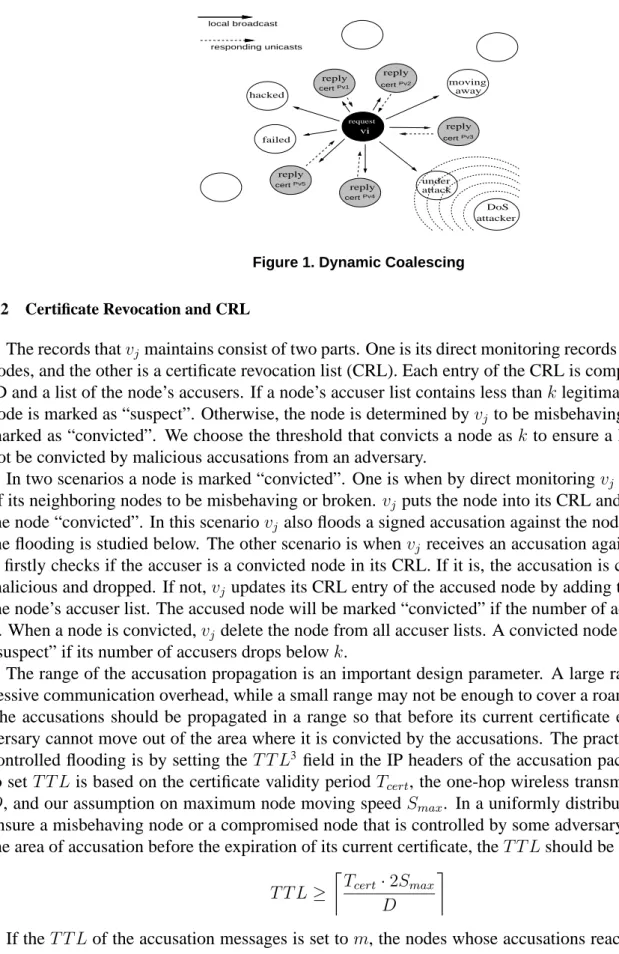
consists of a single round of localized communication: one broadcast request andk unicast responses
(Figure 1). It has minimum requirements on the reliability of wireless communications. As long as k
certPv2 certPv5 reply local broadcast responding unicasts certPv1 certPv4 reply certPv3 reply request vi reply reply hacked attack under DoS attacker moving away failed
Figure 1. Dynamic Coalescing
5.2 Certificate Revocation and CRL
The records thatvj maintains consist of two parts. One is its direct monitoring records on neighboring
nodes, and the other is a certificate revocation list (CRL). Each entry of the CRL is composed of a node
ID and a list of the node’s accusers. If a node’s accuser list contains less thank legitimate accusers, the
node is marked as “suspect”. Otherwise, the node is determined byvj to be misbehaving or broken and
marked as “convicted”. We choose the threshold that convicts a node as k to ensure a legitimate node
not be convicted by malicious accusations from an adversary.
In two scenarios a node is marked “convicted”. One is when by direct monitoringvj determines one
of its neighboring nodes to be misbehaving or broken. vj puts the node into its CRL and directly marks
the node “convicted”. In this scenariovj also floods a signed accusation against the node. The range of
the flooding is studied below. The other scenario is whenvj receives an accusation against some node.
It firstly checks if the accuser is a convicted node in its CRL. If it is, the accusation is concluded to be
malicious and dropped. If not,vj updates its CRL entry of the accused node by adding the accuser into
the node’s accuser list. The accused node will be marked “convicted” if the number of accusers reaches
k. When a node is convicted,vj delete the node from all accuser lists. A convicted node will be marked
“suspect” if its number of accusers drops belowk.
The range of the accusation propagation is an important design parameter. A large range causes ex-cessive communication overhead, while a small range may not be enough to cover a roaming adversary. The accusations should be propagated in a range so that before its current certificate expires, the ad-versary cannot move out of the area where it is convicted by the accusations. The practical scheme for
controlled flooding is by setting the T T L3 field in the IP headers of the accusation packets. One way
to set T T L is based on the certificate validity periodTcert, the one-hop wireless transmission distance
D, and our assumption on maximum node moving speedSmax. In a uniformly distributed network, to
ensure a misbehaving node or a compromised node that is controlled by some adversary cannot escape
the area of accusation before the expiration of its current certificate, theT T Lshould be set at least:
T T L≥
Tcert·2Smax
D
If theT T L of the accusation messages is set tom, the nodes whose accusations reachvj must be at
mostm hops away. Thereforevj’s CRL contains nodes at mostm+ 1hops away. To further decrease
the CRL complexity,Tcert after an entry’s last update,vj can remove it from its CRL. The reason is that
afterTcert a convicted node should have its certificate expired, and thus be cut off from the network. vj
holds each CRL entry forTcertso that it will not serve a convicted node that carries still-valid certificate.
In our design, CRL is constrained in both space domain and time domain. It is built and maintained on-demand, and stored locally. These properties comply with the overall scalability and robustness of our architecture, and the ad hoc nature of the network.
5.3 Setting ParameterkandTcert
k is the most important parameter in our architecture. An implementation with large k can tolerate
more powerful adversaries, but the service availability decreases. Systems with a small k feature high
service availability and robustness against DoS attacks, but are more vulnerable to break-ins. In general,
parameter k characterizes the ad hoc network’s connectivity redundancy and represents our tradeoff
between service availability and system robustness.
The parameterTcert is used to balance between certificate issuing/renewal and certificate revocation
overheads. SmallTcert causes less overhead on accusation propagation and CRL maintenance. But the
overhead of certificate issuing/renewal is proportionally larger. LargeTcertleads to less frequent
certifi-cate issuing/renewal. The costs are larger accusation propagation range and higher CRL complexity.
6
Parallel Share Updates
The work in [7] is robust against the adversaries of model I as defined in Section 3.1. To handle stronger model II adversaries, Herzberg et al. proposed periodical updates of each node’s secret share [18]. However, the proposed protocols in the proactive secret sharing context require each node collect inputs from all other nodes to finalize its update. Their approaches are not applicable in our scenario for several reasons: (a) The solution is not scalable. In an ad hoc network with dynamic membership and topology, a node cannot afford to maintain global knowledge and the full network topology; (b) The communication overhead is too high for wireless channel; (c) These proposals require a global broadcast channel, which does not exist in typical ad hoc wireless networks. Applying Byzantine agreement pro-tocol to simulate an authenticated broadcast channel incurs prohibitively high communication overhead [26] even for wired networks. It is not feasible in wireless networks.
In this section, we propose two approaches to achieve scalable and efficient share update in ad hoc wireless networks. The first approach is a simple sequential process based on the self-initialization as
presented in [7]. Firstly a coalition of k nodes update their shares by applying the existing protocols
as proposed in [18]. The self-initialization protocols then follow to update the shares of the rest of the network. The second approach features parallel share updates over the network for fast convergence. The cost is higher computation overhead at each node. We present the parallel share update mechanism as follows.
Similar to [18], we divide time into periods. Each time period is composed of a share update phase
and an operational phase. At the beginning of the share update phases, a chosen coalition ofknodes in
the system collaboratively generate a random share update polynomialfu(x) =fu,1x+· · ·+fu,k−1xk−1
where fu(0) = 0. fu is then encrypted by P K for privacy against adversaries. The coalition then
an adversary from emulating a coalition ofk nodes to fake share updates. The encrypted polynomial, together with its signature, is then propagated in the network by flooding. Once a node receives the
encrypted update polynomial, it requests share-update service fromk neighboring nodes to evaluate its
Pu,vi = fu(vi). Note that as long as they apply the same version of shares, theseknodes can serve the
request without having their share updated first. The process is composed of three steps:
1. Collaborative generation of the update polynomialfu. At the beginning of each update phase,
each node initiates updates with probability 1/n,ˆ wherenˆ is an estimate on the total number of
networking nodes. This ensures that statistically there is only one node to initiate the update
process. Once a node vi decides to initiate the update, it locates a coalition of k neighbors and
collaboratively generate the encrypted update polynomial(fu)P K and a signature.
2. Robust propagation of the update polynomial. Nodevi floods the encrypted update polynomial
(fu)P K with the signature in the network. We take the advantage of the robustness of the flooding
protocol in connectivity-redundant ad hoc networks, to ensure that each node receives the update polynomial at least once.
3. Distributed evaluation of share updatePu,vi. Since the propagatedfu is encrypted by the system
P K, each nodevi solicits itskneighbors to collaboratively evaluatePu,vi =fu(vi)for it. Similar
to the localized certification services, each of these k neighboring nodes returns a partial share
update. Nodevi adds these k partial updates together to recover Pu,vi. Node vi then updates its
share and erases its old share at the end of the update phase.
Our design is (k, n)-secure [24] in the sense that given up to k −1 shares ofSK and a history of
polynomial many partial results, an adversary learns no more aboutSKthan without these information.
The following theorem shows the security of our design. Due to lack of space, we leave the detailed algorithms, communication protocols and proof to the technical report [25].
Theorem 1 (Security) The localized certification and share update algorithms are RSA(k, n)-secure.
7
Implementation and Performance Evaluation
We implemented our design in both the popular network simulator ns-2 and UNIX platforms. The Unix implementation is used to evaluate the computational cost, and the network simulator helps us to evaluate the communication aspects of our protocols, such as scalability, service availability, mobility and channel error in ad hoc wireless networks.
The design of our protocols and algorithms is flexible enough to allow implementation at any layer above the MAC layer in the networking protocol stack. Moreover, it does not make specific assumptions on the network and transport layer protocols. We choose an application-layer implementation for several reasons: (a) We avoid modifications of lower-layer protocols such as packet and frame formats. This facilitates incremental deployment. (b) We achieve maximal independency of the underlying network configurations. This improves the portability and extensibility. (c) We can evaluate the communication efficiency of our security protocols without any specific performance enhancements provided by lower layers.
512 768 1024 1280 1536 1792 2048 0 5 10 15 20 25
RSA Key Length (bit)
Processing Delay (second)
Certificate Renewal (K = 5) RSA (Speed=10) RSA(Speed=107) RSA(Speed=202) PCC(Speed=10) PCC(Speed=107) PCC(Speed=202) Combine(Speed=10) Combine(Speed=107) Combine(Speed=202)
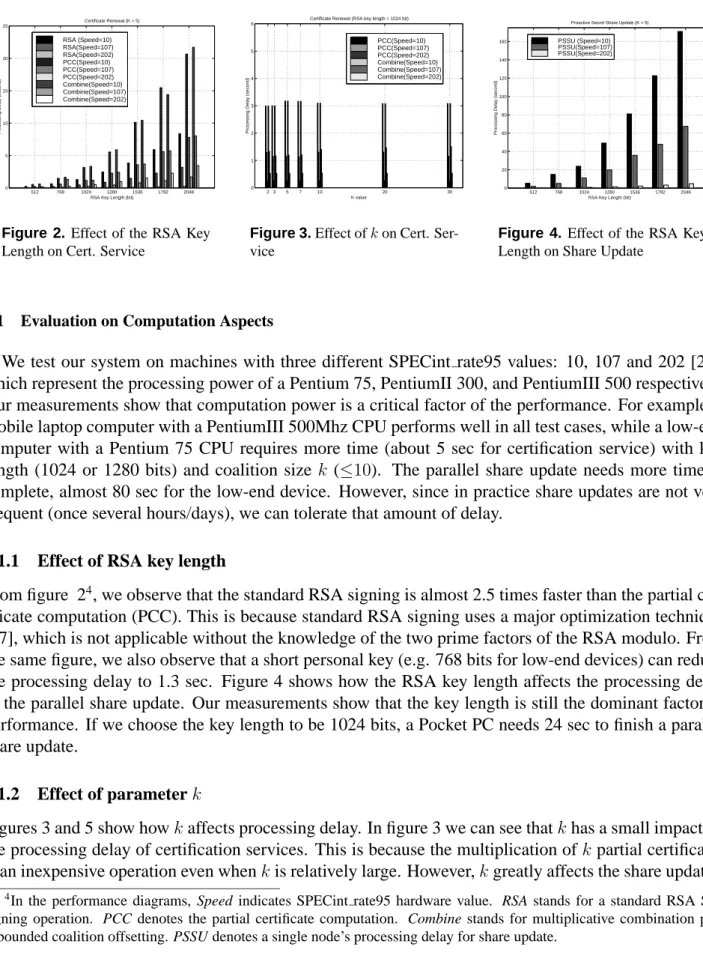
Figure 2. Effect of the RSA Key Length on Cert. Service
2 3 5 7 10 20 30 0 1 2 3 4 5 6 K value
Processing Delay (second)
Certificate Renewal (RSA key length = 1024 bit)
PCC(Speed=10) PCC(Speed=107) PCC(Speed=202) Combine(Speed=10) Combine(Speed=107) Combine(Speed=202)
Figure 3.Effect ofkon Cert. Ser-vice 512 768 1024 1280 1536 1792 2048 0 20 40 60 80 100 120 140 160
RSA Key Length (bit)
Processing Delay (second)
Proactive Secret Share Update (K = 5)
PSSU (Speed=10) PSSU(Speed=107) PSSU(Speed=202)
Figure 4.Effect of the RSA Key Length on Share Update
7.1 Evaluation on Computation Aspects
We test our system on machines with three different SPECint rate95 values: 10, 107 and 202 [28], which represent the processing power of a Pentium 75, PentiumII 300, and PentiumIII 500 respectively. Our measurements show that computation power is a critical factor of the performance. For example, a mobile laptop computer with a PentiumIII 500Mhz CPU performs well in all test cases, while a low-end computer with a Pentium 75 CPU requires more time (about 5 sec for certification service) with key
length (1024 or 1280 bits) and coalition size k (≤10). The parallel share update needs more time to
complete, almost 80 sec for the low-end device. However, since in practice share updates are not very frequent (once several hours/days), we can tolerate that amount of delay.
7.1.1 Effect of RSA key length
From figure 24, we observe that the standard RSA signing is almost 2.5 times faster than the partial
cer-tificate computation (PCC). This is because standard RSA signing uses a major optimization technique [27], which is not applicable without the knowledge of the two prime factors of the RSA modulo. From the same figure, we also observe that a short personal key (e.g. 768 bits for low-end devices) can reduce the processing delay to 1.3 sec. Figure 4 shows how the RSA key length affects the processing delay of the parallel share update. Our measurements show that the key length is still the dominant factor of performance. If we choose the key length to be 1024 bits, a Pocket PC needs 24 sec to finish a parallel share update.
7.1.2 Effect of parameterk
Figures 3 and 5 show howkaffects processing delay. In figure 3 we can see thatkhas a small impact on
the processing delay of certification services. This is because the multiplication of kpartial certificates
is an inexpensive operation even whenkis relatively large. However,kgreatly affects the share updates.
4In the performance diagrams, Speed indicates SPECint rate95 hardware value. RSA stands for a standard RSA
SK-signing operation. PCC denotes the partial certificate computation. Combine stands for multiplicative combination plus
From figure 5, we observe that the processing delay grows linearly withk. This is because each node in
thekcoalition has to processk−1P K-encrypted polynomial coefficients.
7.1.3 Testbed measurements
We measured our testbed system in a wireless network with 2Mbps WaveLAN channels. The SPECint rate95 values of the requester and the 3 responders were 10, 115, 77, 77, respectively. Table 7.1.3 shows the delays of the certification process in seconds. Requester delay denotes the delay from the time the
re-quester sends request to the time it obtains and verifies its new certificate. PCC i denotes the delay
measured on helperito generate a partial certificate. We tested various key length and the results favor
short key length when the requester was a low-end device.
key Requester Responders
(bit) PCC 1 PCC 2 PCC 3 512 3.469 0.520 0.967 0.956 768 5.998 1.119 1.971 2.021 1024 11.913 2.228 4.047 4.013 1280 14.088 2.428 4.558 4.430 1536 20.090 3.944 7.234 7.148 1792 29.657 5.939 10.855 10.752 2048 40.292 8.162 14.791 14.820 2 3 5 7 10 20 0 50 100 150 K value
Processing Delay (second)
Proactive Secret Share Update (RSA key length = 1024 bit)
PSSU(Speed=10) PSSU(Speed=107) PSSU(Speed=202)
Figure 5.Effect ofkon Share Up-date 30 40 50 60 70 80 90 100 0 10 20 30 40 50 60 70 80 90 100 # of Nodes Success %
Success Rate − Certificate Renewal
Mobility: 1m/sec Mobility: 3m/sec Mobility: 5m/sec Mobility: 10m/sec Mobility: 15m/sec Mobility: 20m/sec
Figure 6.Cert. Service: Success Ratio vs. Node # 1 2 3 4 5 6 7 8 9 10 0 10 20 30 40 50 60 70 80 90 100 Coalition K Success %
Success Rate = f(K) − Certificate Renewal
Figure 7.Cert. Service: Success Ratio vs.k
7.2 Evaluation on Communication Aspects
In this section, we analyze the performance of our communication protocols with respect to
scalabil-ity, service availabilscalabil-ity, node mobilscalabil-ity, channel errors and the parameterk. We use four metrics. Success
Ratio measures the ratio of the number of successful certification services over the number of requests. Average Delay measures the average latency for a node to request a certification service. Overhead mea-sures the communication overhead in bytes. Convergence time meamea-sures the time required to complete a share update over the network.
We run simulation experiments in networks with sizes ranging from 30 to 100 nodes. Node moving speed varies from 1 m/sec to 20 m/sec. We apply the random way-point model in ns-2 to emulate node
mobility patterns. The certificate expiration is set to 5 time units. Parameterk is set to 5 if unspecified,
except for the topologies that consist of 30 nodes, wherekis set to 3.
30 40 50 60 70 80 90 100 100 200 300 400 500 600 700 800 900 1000 1100 # of Nodes # of KBytes
Number of KBytes − Certificate Renewal
Mobility: 1m/sec Mobility: 3m/sec Mobility: 5m/sec Mobility: 10m/sec Mobility: 15m/sec Mobility: 20m/sec
Figure 8.Cert. Service: Bytes vs. Node # 30 40 50 60 70 80 90 100 0 10 20 30 40 50 60 70 80 90 100 # of Nodes Success Ratio (%)
Success Ratio − Error Rate 10%, Mobility 5m/sec
Cert. Renewal Centr. CA − 1 serv. Centr. CA − 4 serv.
Figure 9.Cert. Service: Success Ratio vs. Node #, Error Rate 10 %
30 40 50 60 70 80 90 100 0 10 20 30 40 50 60 70 80 90 100 # of Nodes
Avg. Delay (sec)
Avg. Delay − Error Rate 10%, Mobility 5m/sec Cert. Renewal Centr. CA − 1 serv. Centr. CA − 4 serv.
Figure 10. Cert. Service: Avg. Delay vs. Node #, Error Rate 10 %
7.2.1 Certification services
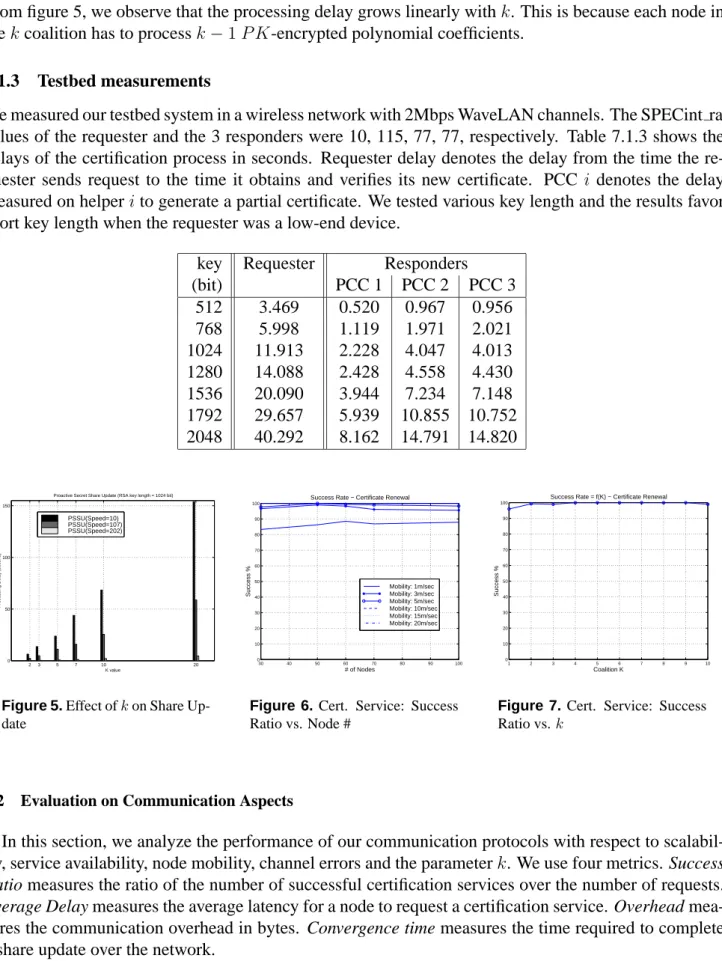
Scalability and mobility. We first evaluate the scalability of our certification service as the network size grows from 30 up to 100 nodes. Figure 6 shows the success ratio of the certification services. From the figure, we observe that the success ratio is always over 95% and in most cases 100%, as the number of nodes increases. As the node speed varies from 1 m/sec to 20 m/sec, we observe that the success ratio almost remains unchanged at speeds above 1 m/sec. For the case of 1 m/sec, the success ratio is around 95%. The main reason is that under low node density and low mobility a node may have difficulty in
locating k neighboring nodes for certification services. The results show how mobility improves our
certification service availability.
Impact of k Figure 7 shows the success ratio as a function of the coalition sizek. The success ratio is
almost independent of the coalition size and almost 100% forkvarying between 1 to 10. This essentially
means that we may increase the overall security level of the network by increasingk, without sacrificing
the effectiveness.
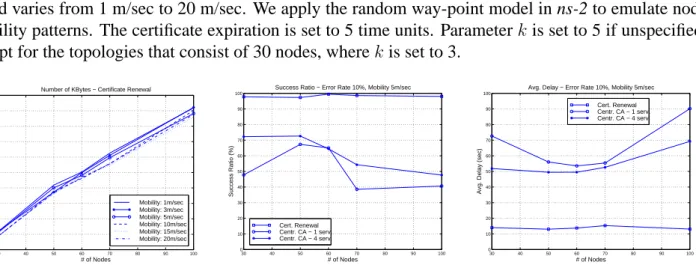
Communication overhead Figure 8 shows the total communication overhead in bytes (including retrans-missions), versus the number of networking nodes. The overall overhead grows linearly as the number of nodes increases, i.e., the per node overhead remains fixed and scalable to the network size. Moreover, the communication overhead is almost independent of the node moving speed.
Channel errors The impact of wireless channel errors on our protocols is shown in figures 9 and 10. Node mobility is set to 5 m/sec and the channel error is set to 10%. From these figures, we see that our localized design is robust against the channel error. However, the performance of both the single CA and 4-CA centralized approaches degrades significantly.
7.2.2 Parallel share update
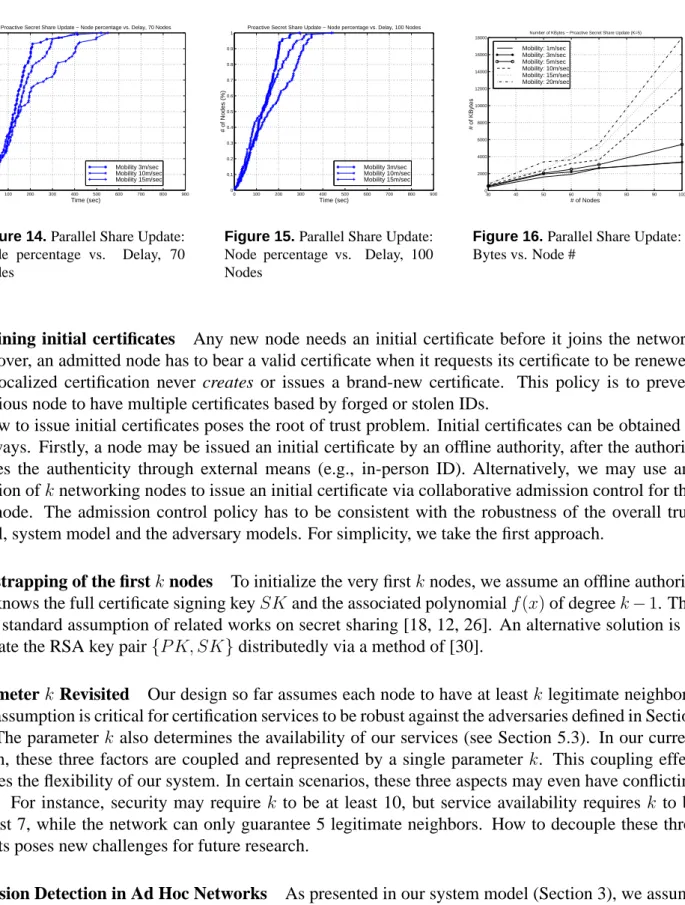
Scalability and Mobility Although the secret share update protocol may not be executed as often as that of certificate renewal, its ability to scale to the network size and resilience against the node mobility are critical to ensure the secret share consistency. Figure 11 shows the average delay experienced by each node while updating its secret share. We observe that the delay remains almost constant as the number of nodes in the network increases, and mobility has little impact on it even at the high speed of 15m/sec. Figure 12 shows the convergence time, the time required for the share update to finish, as a function of the network size and node mobility. From the figure we can see that the convergence time is almost independent of the network size and node moving speed as expected. These results demonstrate the scalability and the resilience against node mobility of our design.
Figure 13-15 expose more details of the share update process. In these figures the y-axis represents the percentage of nodes that manage to update their shares within the time on the x-axis. They show the cumulative distribution of the update process. We vary the network scale from 30 nodes to 100 nodes, and the node moving speed from 3 to 15 m/sec. An interesting observation is that the larger the network, the faster the update process. For example, in the network consisting of 60 nodes that move at the speed of 15m/sec, 90% of the nodes have their share updated within 550 seconds, while for the network that consists of 100 nodes moving at the same speed, the time drops significantly to 300 seconds. From these figures, we also note that as the size of the network grows, the impact of mobility decreases. This is a great improvement compared with the solution that we proposed in our previous work [7], where the convergence time increases linearly as the network scale grows.
Communication overhead Figure 16 shows the communication overhead (in bytes) as a function of the network size and node moving speed. From the figure, it is clear that the communication overhead grows linearly as the number of nodes increases. However, at high mobility speed (above 15 m/sec), the growth as the function of mobility is nonlinear, since multiple rounds of communications are involved.
30 40 50 60 70 80 90 100 0 100 200 300 400 500 600 700 800 900 # of nodes Time (sec)
Proactive Secret Share Update − Average Delay
Mobility 1m/sec Mobility 3m/sec Mobility 5m/sec Mobility 10m/sec Mobility 15m/sec
Figure 11.Parallel Share Update: Avg. Delay vs. Node #
30 40 50 60 70 80 90 100 0 100 200 300 400 500 600 700 800 900 # of Nodes
Completion Time (sec)
Completion Time − Proactive Secret Share Update (K=5)
Mobility: 1m/sec Mobility: 3m/sec Mobility: 5m/sec Mobility: 10m/sec Mobility: 15m/sec
Figure 12.Parallel Share Update: Convergence Time vs. Node #
0 100 200 300 400 500 600 700 800 900 0 0.1 0.2 0.3 0.4 0.5 0.6 0.7 0.8 0.9 1 Time (sec) # of Nodes (%)
Proactive Secret Share Update − Node percentage vs. Delay, 60 Nodes
Mobility 3m/sec Mobility 10m/sec Mobility 15m/sec
Figure 13.Parallel Share Update: Node percentage vs. Delay, 60 Nodes
8
Discussions
0 100 200 300 400 500 600 700 800 900 0 0.1 0.2 0.3 0.4 0.5 0.6 0.7 0.8 0.9 1 Time (sec) # of Nodes (%)
Proactive Secret Share Update − Node percentage vs. Delay, 70 Nodes
Mobility 3m/sec Mobility 10m/sec Mobility 15m/sec
Figure 14.Parallel Share Update: Node percentage vs. Delay, 70 Nodes 0 100 200 300 400 500 600 700 800 900 0 0.1 0.2 0.3 0.4 0.5 0.6 0.7 0.8 0.9 1 Time (sec) # of Nodes (%)
Proactive Secret Share Update − Node percentage vs. Delay, 100 Nodes
Mobility 3m/sec Mobility 10m/sec Mobility 15m/sec
Figure 15.Parallel Share Update: Node percentage vs. Delay, 100 Nodes 30 40 50 60 70 80 90 100 0 2000 4000 6000 8000 10000 12000 14000 16000 18000 # of Nodes # of KBytes
Number of KBytes − Proactive Secret Share Update (K=5)
Mobility: 1m/sec Mobility: 3m/sec Mobility: 5m/sec Mobility: 10m/sec Mobility: 15m/sec Mobility: 20m/sec
Figure 16.Parallel Share Update: Bytes vs. Node #
Obtaining initial certificates Any new node needs an initial certificate before it joins the network.
Moreover, an admitted node has to bear a valid certificate when it requests its certificate to be renewed. Our localized certification never creates or issues a brand-new certificate. This policy is to prevent malicious node to have multiple certificates based by forged or stolen IDs.
How to issue initial certificates poses the root of trust problem. Initial certificates can be obtained in two ways. Firstly, a node may be issued an initial certificate by an offline authority, after the authority verifies the authenticity through external means (e.g., in-person ID). Alternatively, we may use any
coalition ofknetworking nodes to issue an initial certificate via collaborative admission control for this
new node. The admission control policy has to be consistent with the robustness of the overall trust model, system model and the adversary models. For simplicity, we take the first approach.
Bootstrapping of the firstknodes To initialize the very firstknodes, we assume an offline authority
who knows the full certificate signing keySKand the associated polynomialf(x)of degreek−1. This
is the standard assumption of related works on secret sharing [18, 12, 26]. An alternative solution is to
generate the RSA key pair{P K, SK}distributedly via a method of [30].
Parameter kRevisited Our design so far assumes each node to have at leastk legitimate neighbors.
This assumption is critical for certification services to be robust against the adversaries defined in Section
3.1. The parameterk also determines the availability of our services (see Section 5.3). In our current
design, these three factors are coupled and represented by a single parameter k. This coupling effect
reduces the flexibility of our system. In certain scenarios, these three aspects may even have conflicting
goals. For instance, security may require k to be at least 10, but service availability requires k to be
at most 7, while the network can only guarantee 5 legitimate neighbors. How to decouple these three aspects poses new challenges for future research.
Intrusion Detection in Ad Hoc Networks As presented in our system model (Section 3), we assume
each node is equipped with some local detection mechanism to identify misbehaving nodes among its one-hop neighborhood. While we admit that this might seem a strong assumption, some initial progress has been reported recently [22]. We believe that as time goes, better local intrusion detection mechanism
will be available to serve our purpose.
9
Conclusions
This paper describes a new self-securing approach to node authentication in mobile, ad hoc wireless networks. To this end, we propose a localized trust model, together with its realization to address issues of ad hoc wireless networks such as node mobility, network dynamics, wireless channel errors, DoS attacks and adversary break-ins. Several optimization techniques greatly enhance the efficiency and robustness of our algorithms and protocols. Through localized design, we ensure the scalability of our architecture to facilitate practical deployment in a potentially large-scale network with dynamic node membership.
References
[1] A. Aresenault and S. Turner, “Internet X.509 public key infrastructure,” draft-ietf-pkix-roadmap-06.txt, 2000 [2] R. Perlman, “An overview of PKI trust models”, IEEE Network, p. 38-43, vol.13, (no.6) Nov.-Dec. 1999 [3] A. Abdul-Rahman, “The PGP trust model,” EDI-Forum: the Journal of Electronic Commerce, Apr. 1997 [4] Y. Zhang and W. Lee, “Intrusion detection in wireless ad hoc networks,” ACM MOBICOM, 2000
[5] J. Kohl and B. Neuman, “The Kerberos network authentication service (version 5),” RFC-1510
[6] D. B. Johnson and D. A. Maltz. “Dynamic source routing in ad hoc wireless networks.” Mobile Computing, vol 353, 1996
[7] J. Kong, P. Zerfos, H. Luo, S. Lu and L. Zhang, “Providing robust and ubiquitous security support for MANET,” IEEE ICNP 2001, 2001.
[8] R. Rivest and B. Lampson. “SDSI – a simple distributed security infrastructure,” Working document from
http://theory.lcs.mit.edu/ cis/sdsi.html
[9] S. Garfinkel, “PGP: Pretty Good Privacy,” O’Reilly & Associates Inc., USA, 1995
[10] “PKI practices and policy framework,” ANSI X9.79, American National Standards Institute, 2000.
[11] L. Gong, “Increasing availability and security of an authentication service,” IEEE Journal on Selected Areas
in Communications, Vol.11, No.5, Jun. 1993
[12] Y. Frankel, P. Gemmell, P. Mackenzie and M. Yung, “Proactive RSA,” CRYPTO, 1997
[13] T. Wu, M. Malkin, and D. Boneh, “Building intrusion tolerant applications,” Eighth USENIX Security
Sym-posium, 1999
[14] Y. Frankel, P. Gemmel, P. MacKenzie, M. Yung, “Optimal-resilience proactive public-key cryptosystems,”
FOCS ’97, 1997.
[15] R. Gennaro, S. Jarecki, H. Krawczyk and T. Rabin, “Robust and efficient sharing of RSA functions,” Journal
of Cryptology, 1996
[16] Y. Frankel and Y. G. Desmedt. “Parallel reliable threshold multi-signature,” Technical Report TR-92-04-02, Dept. of EECS, University of Wisconsin-Milwaukee, 1992
[17] A. Shamir, “How to share a secret,” Communications of ACM, 1979
[18] A. Herzberg, S. Jarecki, H. Krawczyk, and M. Yung, “Proactive secret sharing,” Extended abstract, 1995 [19] A. Fox and S. Gribble, “Security on the move: Indirect authentication using Kerberos,” ACM MOBICOM,
1996
[20] L. Zhou and Z. J. Haas. “Securing ad hoc networks,” IEEE Networks, 13(6):24–30, 1999
[21] A. Abdul-Rahman and S. Hailes, “A distributed trust model”, ACM New Security Paradigms Workshop, 1997 [22] S. Marti, T. Giuli, K. Lai and M. Baker, “Mitigating routing misbehavior in mobile ad hoc networks,” ACM
[23] J. D. Howard, “An analysis of security incidents on the Internet 1989 - 1995,” CMU Ph.D. Dissertation, 1997
[24] A. D. Santis, Y. Desmedt, Y. Frankel and M. Yung, “How to share a function securely,” STOC 1994
[25] H. Luo and S. Lu, “Ubiquitous and robust authentication services for ad hoc wireless networks,” UCLA
Computer Science Technical Report 200030, Oct. 2000 http://www.cs.ucla.edu/mng/TR200030.pdf
[26] R. Canetti, S. Halevi, and A. Herzberg, “Maintaining authenticated communication in the presence of break-ins,” Journal of Cryptology, 13(1):61-105, 2000
[27] A. Menezes, P. Oorschot and S. Vanstone, “Handbook of applied cryptography,” CRC Press, 1996 [28] Standard Performance Evaluation Corporation, http://www.specbench.org
[29] A. K. Lenstra and E. R. Verheul. “Selecting cryptographic key sizes,” Public Key Cryptography, pp. 446– 465, 2000
[30] M. Malkin, T. Wu and D. Boneh, “Experimenting with shared generation of RSA keys,” Internet Society’s