CLINICAL STUDY
Effect of 1-year treatment with interferon-b1b on thyroid
function and autoimmunity in patients with multiple sclerosis
F Monzani, N Caraccio, G Meucci1, F Lombardo1, G Moscato1, A Casolaro, M Ferdeghini2, L Murri1and E Ferrannini
Departments of Internal Medicine,1Neurosciences and2Oncology, University of Pisa School of Medicine, Pisa, Italy
(Correspondence should be addressed to F Monzani, Department of Internal Medicine, University of Pisa, via Roma 67, I-56126 Pisa, Italy)
Abstract
Objective: Interferon-b (IFN-b) is a widely used therapy for multiple sclerosis (MS), a demyelinating disease of the central nervous system. This study has evaluated the effect on thyroid function and autoimmunity of a 1-year treatment with IFN-b1b in patients with MS.
Patients: We studied 31 patients (age 3467 years, 21 women) with relapsing-remitting MS during IFN-b1b treatment of 1 year duration. Systematic thyroid assessment and measurements of serum interleukin-6 (IL-6) levels were performed at baseline and every 3 months during treatment.
Results: Sixteen percent of the patients had autoimmune thyroiditis before IFN-b1b, all positive for anti-peroxidase antibodies. The overall incidence of thyroid dysfunction was 33% over 1 year (10% hyperthyroidism, 23% hypothyroidism). Thyroid autoimmunity developed in 5/26 patients (19%), in one case without dysfunction. In addition to autoantibody positivity at baseline, female gender and the presence of an ultrasound thyroid pattern suggestive of thyroiditis were identified by multiple logistic regression as additional risk predictors for the development of thyroid dysfunction. During IFN-b1b treatment, serum IL-6 levels rose in a consistent biphasic pattern; there was, however, no difference between patients with or without incident thyroid abnormalities.
Conclusions: We conclude that IFN-b1b therapy can induce multiple alterations in thyroid function, some of which are unrelated to thyroid autoimmunity. IL-6 measurement is not useful to identify patients prone to develop thyroid abnormalities. Though thyroid dysfunction is generally subclinical and often transient, systematic thyroid assessment should be performed during IFN-b1b treatment.
European Journal of Endocrinology141325–331
Introduction
Multiple sclerosis (MS) is a demyelinating disease of the central nervous system that is associated with an aberrant immune response to myelin and, possibly, non-myelin self-antigens (1). Moreover, previous studies have shown a significant association between MS and several autoimmune disorders, including autoimmune thyroiditis (2, 3).
Recently, interferon-b (IFN-b) has been widely used to treat patients with relapsing-remitting MS (4). Since type I interferons modulate the immunoregulatory system, these cytokines may precipitate autoimmune disorders. In fact, thyroid disease, with clinical mani-festations of hyper- or hypothyroidism, has been reported in 5–12% of patients treated with IFN-a for various diseases (5–7), especially in those with pre-existing autoimmunity (8–11). Apart from two case reports (12, 13), only one clinical study has investi-gated autoimmunity and thyroid function during IFN-b
treatment (14). In that study, however, a thorough
evaluation of pretreatment thyroid autoimmunity and ultrasound features was not carried out.
The aim of the present study was to evaluate the effect on thyroid function and autoimmunity of a 1-year treatment with IFN-b1b in patients with relapsing-remitting MS. The presence of pre-existing thyroid autoimmunity, or other possible risk factors for developing thyroid disease, was also evaluated.
Patients and methods
Patients
Thirty-one patients, 21 women and 10 men (mean age 34.4 years, range 23–49) attending the outpatient clinic of the Department of Neurosciences, were enrolled in this study after giving written informed consent. The study protocol was approved by the local Ethical Committee. Patients were affected by MS and classified as relapsing-remitting according to Lublin criteria (15). q1999 Society of the European Journal of Endocrinology Online version via http://www.eje.org
Additional inclusion criteria were as follows: (i) patients with at least two acute exacerbations in the previous 2 years but clinically stable and off corticosteroid treatment for at least 30 days prior to the study; and (ii) patients whose rating score on the Kurtzke Expanded Disability Status Scale (16) ranged from 1 to 3.5.
Methods
IFN-b1b was administered s.c. (8×10⁶IU every other day) for 12 months. Before interferon therapy was begun, all patients were submitted to a routine clinical work-up, and the presence of familial autoimmune history was recorded. Thyroid ultrasound examination with a 7.5 MHz real time transducer (Toshiba, Kawa-saki, Japan) was carried out by the same operator (N C) at baseline and after 1 year of IFN-b1b treatment. Blood samples were collected at baseline and every 3 months up to 1 year for evaluation of free thyroid hormone (tri-iodothyronine (FT3) and thyroxine (FT4)), thyrotropin (TSH), and serum thyroglobulin (Tg) levels. Anti-thyroglobulin (Tg-Ab), anti-thyroid peroxidase (TPO-Ab), anti-TSH receptor (TR-Ab) autoantibody, and interleukin-6 (IL-6) concentrations were also assessed basally and every 3 months. A99mTc thyroid scan was performed in patients developing hyperthyroidism during IFN-b1b treatment.
Serum FT4, FT3, Tg and TPO-Ab levels were mea-sured by specific RIAs (Sorin Biomedica, Saluggia, Italy), Tg-Ab levels by a specific IRMA assay (ICN Pharmaceutical, Asse Relegen, Belgium) and TSH by an ultrasensitive IRMA method (Diasorin, Stillwater, MN, USA). Serum IL-6 levels were determined by ELISA (Biosource, Nirelles, Belgium), with a detection limit of 2 pg/ml. Normal ranges in our laboratory are as follows: FT4: 7.2–19.3 pmol/l; FT3: 3.7–8.6 pmol/l; Tg: <60 nmol/l; TSH: 0.3–3.6 mIU/l; TPO-Ab: <10 IU/ml; Tg-Ab: <50 IU/ml; TR-Ab: <16 IU/ml; IL-6: 3–8.5 pg/ ml.
Statistical analysis
Unless otherwise stated, data are given as the mean
6S.E. Undetectable IL-6 levels were assigned an
arbi-trary value of 1 pg/ml, which equals one half of the detection limit (17). Mean values and percentages were compared by Student’s t-test, ANOVA, Mann–Whitney U test and x2 test as appropriate. A multiple logistic regression model was used for the analysis of risk factors for the development of thyroid disease.
Results
All patients (n= 31) completed their 1-year IFN-b1b treatment course. Among them five were affected by Hashimoto’s thyroiditis at baseline, eight developed thyroid dysfunction and/or autoimmunity of various degrees during IFN-b1b treatment, while 18 did not
326 F Monzani and others EUROPEAN JOURNAL OF ENDOCRINOLOGY (1999)141
Table 1 C linical, ultrasoun d, function al an d autoi mmune feature s o f th e patie nts with MS submitt ed to IFN-b 1b thera py. Patients Fa milial Onset of Onset of Thyroid ( n ¼ 31) Se x U ltraso und patte rn autoim munity au toimmunity dysfun ction dysfun ction Staying euthyro id withou t 1 0 F/8 M 1 1 norm al, yes ¼ 9, no ¼ 9– – – autoim munity ( n ¼ 18) 2 n o dular goite r, 5 hypo echo ic With thyroid dysfunc tion and 7 F/1 M 8 hypo echo ic yes ¼ 7, no ¼ 1 4 before IFN, 1 befor e IFN, 5 subcl inical hypo-, autoim munity ( n ¼ 8) 2 a t 6 mon ths, 4 a t 3 m onths 2 subclinica lhyper-, 2 a t 1 2 months 2 a t 6 m onths, 1 over t hype r-1 a t 9 m onths With thyroid autoi mmuni ty 1 F/1 M 1 hypo echo ic, yes ¼ 2 1 before IFN, – – only ( n ¼ 2) 1 w ith collo id are as 1 a t 9 mon ths With thyroid dysfunc tion only 3 F 3 hypo echo ic yes ¼ 1, no ¼ 2 – 3 a t 3 m onths 1 over t hypo -, ( n ¼ 3) 2 subcl inical
hypo-Thy roid abn or malities and IFN-b 1b ther a py for MS 327 JOURN AL OF ENDOCRINOLOGY (1999) 141
Table 2 FT4, FT3, TSH, Tg, IL-6, Tg-Ab and TPO-Ab levels in the three patients with pretreatment Hashimoto’s thyroiditis developing dysfunction during IFN-b1b therapy.
Basal values Values at onset of thyroid dysfunction
FT4 FT3 TSH Tg Tg-Ab TPO-Ab IL-6 FT4 FT3 TSH Tg Tg-Ab TPO-Ab IL-6
Patient (pmol/l) (pmol/l) (mIU/l) (pmol/l) (IU/ml) (IU/ml) (pg/ml) (pmol/l) (pmol/l) (mIU/l) (pmol/l) (IU/ml) (IU/ml) (pg/ml) Onset/duration
BoG 10.8 5.3 2.06 18.3 4.0 259.0* 1.0 13.9 5.1 4.33* 18.3 7.0 419.0* 27.1* 3 months/transient
FA 11.1 5.4 1.14 169.8* 4.0 33.0* 12.3* 17.2 6.9 0.08* 164.5* 21.0 438.0* 2.7 6 months/transient
PR 7.7 3.7 2.61 163.6* 52.0* 187.0* 1.0 8.7 4.8 4.28* 153.9* 36.0 336.0* 5.2 3 months/permanent
* Pathological values.
Table 3 FT4, FT3, TSH, Tg, IL-6, Tg-Ab and TPO-Ab levels in the eight patients developing thyroid disease during IFN-b1b therapy.
Basal values Values at onset of thyroid dysfunction/autoimmunity
FT4 FT3 TSH Tg Tg-Ab TPO-Ab IL-6 FT4 FT3 TSH Tg Tg-Ab TPO-Ab IL-6
Patient (pmol/l) (pmol/l) (mIU/l) (pmol/l) (IU/ml) (IU/ml) (pg/ml) (pmol/l) (pmol/l) (mIU/l) (pmol/l) (IU/ml) (IU/ml) (pg/ml) Onset/duration
PN* 12.6 5.2 3.34 38.2 1.0 2.0 16.5** 13.0 4.4* 4.01** 33.9 6.0 5.0 2.7 3 months/permanent PC 9.1 4.4 1.02 112.5** 3.0 3.0 8.0 17.5 5.7 0.02** 118.3** 64.0** 4.0 30.5** 3 months/transient VV8 14.8 5.8 0.58 50.4 1.0 8.0 8.6** 35.5** 13.2** 0.11** 346.2** 13.0 8.0 16.2** 3 months/transient BG 18.6 4.9 2.65 45.3 4.0 3.0 4.8 9.5 4.8 4.25** 52.3 2.0 7.0 12.3** 3 months/transient TT 8.1 4.6 1.85 38.1 1.0 6.0 7.3 9.3 4.8 3.74** 45.1 12.0 4.0 1.0 3 months/permanent CR∧ 10.9 4.9 3.17 16.5 2.0 3.0 28.4** 10.3 5.4 3.00 13.5 3.0 15.0** 25.5** 9 months/permanent TA 10.3 5.2 2.43 16.3 14.0 2.0 20.4** 11.4 5.8 3.88** 18.1 6.0 10.0** 1.0 6 months/transient DM 10.9 6.4 1.18 31.9 6.0 3.0 16.5** 11.7 4.9 1.61 20.2 240.0** 4.0 23.2** 9 months/permanent
* At 12 months the patient developed overt hypothyroidism.8At 12 months the patient developed Tg-Ab antibodies (116 IU/ml).∧At 12 months the patient developed subclinical
develop any thyroid abnormality (Table 1). A significant TR-Ab titer was never observed during the study.
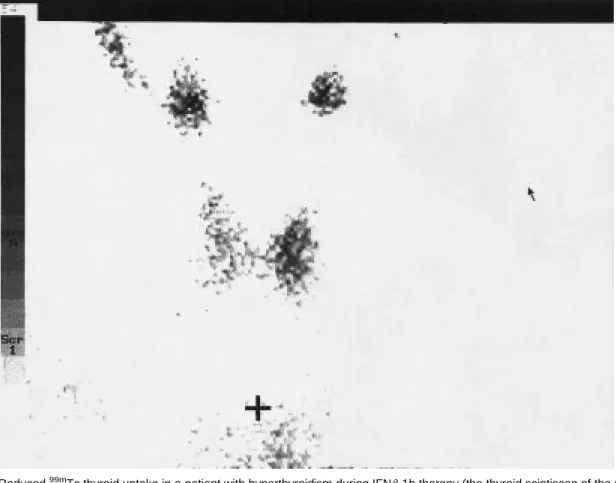
Among the five patients (three female and two male) with pretreatment Hashimoto’s thyroiditis, four were positive for TPO-Ab and one for both Tg-Ab and TPO-Ab. As for their thyroid function one had subclinical hypothyroidism (FT4: 8.9 pmol/l, FT3: 5.2 pmol/l, TSH: 3.69 mIU/l) not worsening during treatment, while the other four were euthyroid. During the study period, one of them remained euthyroid but became positive also for Tg-Ab (64 IU/ml, at 3 months), while two developed subclinical hypothyroid-ism at the 3-month control, and one developed tran-sient (lasting 6 weeks) subclinical hyperthyroidism at 6 months (Tables 1 and 2). This latter patient showed a diffuse reduction in thyroid uptake at 99mTc scintiscan (Fig. 1), and was effectively treated with propranolol only (60 mg daily) without interrupting IFN-b1b.
Among the remaining 26 patients, 8 (31%) developed thyroid disease during IFN-b1b treatment (Tables 1 and 3). All of them were female, and five had a positive family history of autoimmune diseases. In detail, one patient developed a positive Tg-Ab titer and remained euthyroid, while five (two with positive TPO-Ab titer,
and three without significant autoantibody levels) became hypothyroid (four subclinical and one overt). The last two patients became positive for Tg-Ab titer and developed transient hyperthyroidism (one sub-clinical, one overt) after 3 months of therapy. At baseline their thyroid ultrasound pattern was not homogeneous, mainly hypoechoic. At the onset of hyperthyroidism, the thyroid ultrasound echogenicity did not change in both patients, while a diffuse reduction in uptake was observed at 99mTc scintiscan (Fig. 1). Furthermore, the patient with overt hyperthy-roidism showed a significant increase in serum Tg levels concomitant with the onset of hyperthyroidism. Both patients were effectively treated with propranolol (60 and 80 mg daily) without stopping IFN therapy. Hyperthyroidism was no longer evident 6 weeks later in both cases.
At baseline, mean serum IL-6 levels were 9.7 pg/ml (95% confidence interval (CI): 6.8–12.6). During
IFN-b1b therapy, IL-6 values showed a biphasic behavior regardless of the presence of thyroid abnormalities (Fig. 2). In particular, serum IL-6 levels rose ,2-fold at 3 months (20.0 pg/ml, CI: 12.7–27.3, P< 0.005 vs basal levels), returned to baseline at 6 months (10.9 pg/ml, CI: 6.3–15.5), and then rose at 9 and 12
328 F Monzani and others EUROPEAN JOURNAL OF ENDOCRINOLOGY (1999)141
Figure 1 Reduced99mTc thyroid uptake in a patient with hyperthyroidism during IFNb-1b therapy (the thyroid scintiscan of the patient
months up to,2-fold (14.9 pg/ml, CI: 10.3–19.5, and 21.7 pg/ml, CI: 11.5–31.8, P= 0.02, and P< 0.01 vs basal value respectively). No correlation between IL-6 value and thyroid hormone, TSH, Tg or thyroid auto-antibody level was found.
By ultrasonography, mean thyroid volume (as esti-mated by the ellipsoid formula, length×width× thick-ness×0.52) was 10.6 ml (range: 4.5–20.7). At 1 year, thyroid volume was significantly increased (13.0 ml, range 6.0–22.0,P= 0.004), with no difference between patients with or without incident thyroid abnormalities. Among patients not developing thyroid dysfunction, two had a single benign solid thyroid nodule, which remained unchanged cytologically and ultrasono-graphically after 1 year of IFN-b1b therapy. Among the eight patients who developed thyroid dysfunction and/or autoimmunity during treatment, seven showed a diffuse hypoechoic pattern without changes at the 1-year ultrasound control (Table 1).
The development of thyroid dysfunction was signi-ficantly related to positive baseline TPO-Ab titer (P= 0.01). By multiple logistic regression, female gender (P= 0.01, odds ratio 55.4), and the presence of a diffuse hypoechoic thyroid pattern at ultrasound examination (P= 0.04, odds ratio 19.6) were additional risk factors. Familial autoimmunity, reported by 9/18 patients without development of thyroid disease, did not reach statistical significance (P= 0.8).
Discussion
Previous studies have reported an association between MS and autoimmune disorders (18), particularly thyroiditis, with a prevalence of ,16% (2, 3). In accord, we found 16% of patients with autoimmune thyroiditis before IFN-b1b therapy, all of whom had a positive TPO-Ab titer. The development of thyroid disease, with clinical manifestations of hyper- or
hypothyroidism with or without evidence of autoimmu-nity, has been reported in 5–12% of patients treated with IFN-a for various diseases (5–7). A higher inci-dence has been observed in patients with HCV hepatitis undergoing long-term (12 months) IFN-atherapy: 20% hypothyroidism and 9% thyrotoxicosis (19).
In the present series, the overall incidence of thyroid dysfunction during IFN-b1b therapy was 33%, with three cases of hyperthyroidism and seven of hypothy-roidism. Moreover, thyroid autoimmunity developed in 5/26 patients (19%), in one case without organ dysfunction. These data only partially agree with a recent study (14) showing, during IFN-b treatment, thyroid autoimmunity in 5/17 (29%) MS patients and transient hyperthyroidism in one of these five (5.9%). In that study, however, pretreatment anti-thyroid antibodies were assessed only in three out of these five patients (two positive and one negative for thyroid autoimmunity), so the actual incidence of thyroid autoimmunity development was not available. Moreover, we observed an overall higher prevalence of dysthyroidism but overt thyroid dysfunction devel-oped in only two patients (6.1%).
Pre-existing thyroid autoimmunity has been sugges-ted as an important risk factor during IFN-a therapy, thyroid disease developing in up to 60% of patients with positive baseline TPO-Ab (8–11). Similarly, in our series 75% of the patients with elevated pre-treatment TPO-Ab levels developed thyroid dysfunction during IFN-b1b therapy. Furthermore, we found that risk was higher in women and was significantly enhanced by an ultrasound thyroid pattern suggestive of thyroiditis (20).
Both IFN-a and IFN-b1b administration promote autoimmune disease, but the mechanisms of this effect are not completely understood. IFN-ahas been sugges-ted to induce thyroid dysfunction by stimulating the production of thyroid-inhibitory cytokines and/or
Figure 2 Mean (6S.E.M.) serum IL-6 concentrations in patients with MS at baseline and during treatment with IFN-b1b. Open bars¼patients without thyroid abnormalities; hatched bars¼patients with thyroid abnormalities. *P<0:05,8P<0:02 vs baseline.
activation of cytotoxic lymphocytes in the thyroid (21, 22). IFN-ais also known to suppress the expression of MHC class II antigens in thyroid cells (23). Thus, it seems likely that the expression of these antigens in thyrocytes is not necessary to induce thyroid auto-immunity in patients treated with IFN-a. Recently, Yamazaki et al. (24) demonstrated thatin vitro IFN-a
and IFN-binhibited radioiodine (125I) organification in human thyroid cells. Overall, these findings suggest a direct action of IFNs on thyroid function, possibly accompanied by autoimmunity and cytotoxicity.
Though the most likely explanation for the thyroid dysfunction occurring with IFN-b1b therapy remains an autoimmune reaction, a direct inhibitory effect of IFN-b1b on iodine organification may be presumed in those patients who developed hypothyroidism without thyroid autoimmunity. A similar mechanism may be involved in the thyroid volume increment observed in our study. Direct cytotoxicity may account, at least in part, for the development of transient hyperthyroid-ism, as suggested for IFN-a(10). This could explain the low 99mTc uptake and the absence of positive TR-Ab titer observed in our patients (although a significant increase of Tg was detected in the patient with overt hyperthyroidism only).
To test whether thyroid tissue damage may be involved in the development of transient thyroid dysfunction, we measured both IL-6 and Tg levels during IFN-b1b treatment. In fact, similar to Tg, IL-6 has been regarded as a marker of thyroid destruction (17). In our patients, chronic IFN-b1b treatment induced a significant increase of IL-6 secretion, which, however, was not associated with a concurrent increase in Tg levels. Although in most cases the appearance of thyroid abnormalities coincided with the first peak of IL-6 (3 months into therapy), no significant differ-ences were observed between patients with or without thyroid dysfunction. Thus, IL-6 increments may reflect a systemic effect of IFN-b1b on the immune system rather than a direct action on the thyroid gland (25). Moreover, in agreement with a previous study with IFN-a (26), IL-6 concentrations did not prove useful in identifying patients developing thyroid abnormalities. In conclusion, IFN-b1b therapy can induce multiple alterations in thyroid function, some of which are unrelated to thyroid autoimmunity. In addition to pre-existing thyroiditis, female gender and an hypoechoic thyroid pattern are reliable predictors of thyroid abnormalities. Though thyroid dysfunction is generally subclinical and often transient, systematic thyroid assessment should be performed before and during IFN-b1b treatment.
Acknowledgements
We thank Drs L Manca and A Natali for their valuable comments and assistance in analyzing the study results.
References
1 Antel JP, Freedman MS, Brodsovsky S, Francis GS & Duquette P. Activated suppressor cell function in severely disabled patients with multiple sclerosis.Annals of Neurology198925204–207. 2 Kiessling WR & Pflughaupt KW. Antithyroid antibodies in multiple
sclerosis.Lancet1980141.
3 Ioppoli C, Meucci G, Mariotti S, Martino E, Lippi F, Gironelli Let al.
Circulating thyroid and gastric parietal cell autoantibodies in patients with multiple sclerosis. Italian Journal of Neurological Science19901131–36.
4 The IFNB Multiple Sclerosis Study Group. Interferon beta-1b is effective in relapsing-remitting multiple sclerosis. I. Clinical results of a multicenter, randomized, double-blind, placebo controlled trial.Neurology199343655–661.
5 Ronnblom LE, Alm GV & Oberg KE. Autoimmunity after alpha-interferon therapy for malignant carcinoid tumors. Annals of Internal Medicine1991115178–183.
6 Fentiman IS, Thomas DS, Balkwill FR, Rubens RD & Hayward Jl. Primary hypothyroidism associated with interferon therapy of breast cancer.Lancet198511166.
7 Burman P, Totterman TH, Oberg K & Karlsson FA. Thyroid autoimmunity in patients on long-term therapy with leukocyte-derived interferon.Journal of Clinical Endocrinology and Metabolism
1986631086–1090.
8 Weetman AP & McGregor AM. Autoimmune thyroid disease: further development in our understanding. Endocrine Reviews
199415788–830.
9 Watanabe U, Hashimoto E, Hisamitsu T, Obata H & Hayashi N. The risk factor for development of thyroid disease during interferon-alpha therapy for chronic hepatitis C. American Journal of Gastroenterology199489399–403.
10 Roti E, Minelli R, Giuberti T, Marchelli S, Schianchi C, Gardini Eet al.
Multiple changes in thyroid function in patients with chronic active HCV hepatitis treated with recombinant interferon-alpha.
American Journal of Medicine1996101482–487.
11 Imagawa A, Itoh N, Hanafusa T, Oda Y, Waguri M, Mijagawa Jet al.
Autoimmune endocrine disease induced by recombinant inter-feron-alpha therapy for chronic active type C hepatitis.Journal of Clinical Endocrinology and Metabolism199680922–926. 12 Tanabashi S, Kawase Y, Ukita M, Shiroko J, Kametani M, Kumada H
et al.A case of chronic hepatitis complicated by subacute thyroiditis during beta interferon treatment.Nippon Shokakibyo Gakkai Zasshi
199693496–500.
13 Schwid SR, Goodman AD & Mattson DH. Autoimmune hyper-thyroidism in patients with multiple sclerosis treated with interferonb-1b.Archives of Neurology1997541169–1170. 14 Martinelli V, Gironi M, Rodegher M, Martino G & Comi G.
Occurrence of thyroid autoimmunity in relapsing-remitting multiple sclerosis patients undergoing interferon-b treatment.
Italian Journal of Neurological Science19981965–67.
15 Lublin FD, Whitaker JN, Eidelman BH, Miller AE, Arnason BGW & Burks JS. Management of patients receiving interferon-b-1b for multiple sclerosis: report of a consensus conference.Neurology
19964612–18.
16 Kurtzke JF. Rating neurologic impairment in multiple sclerosis: an expanded disability status scale (EDSS).Neurology198333
1444–1452.
17 Bartalena L, Brogioni S, Grasso L, Rago T, Vitti P, Pinchera Aet al.
Interleukin-6: a marker of thyroid-destructive processes?Journal of Clinical Endocrinology and Metabolism1994791424–1427. 18 Seyfert S, Klappas P, Meisel C, Fisher T & Junghan U. Multiple
sclerosis and other immunological diseases. Acta Neurologica Scandinavica19908137–42.
19 Preziati D, La Rosa L, Covini G, Marcelli R, Rescalli S, Persani Let al.
Autoimmunity and thyroid function in patients with chronic active hepatitis treated with recombinant interferon alpha-2a.
European Journal of Endocrinology1995132587–593.
20 Marcocci C, Vitti P, Cetani F, Catalano F, Concetti R & Pinchera A. Thyroid ultrasonography helps to identify patients with diffuse
lymphocytic thyroiditis who are prone to develop hypothyroid-ism.Journal of Clinical Endocrinology and Metabolism199172209– 213.
21 Nagayama Y, Izumi M, Ashizawa K, Kiriyama T, Yokoyama N, Morita Set al.Inhibitory effect of interferon-gon the response of human thyrocytes to thyrotropin (TSH) stimulation: relationship between the response to TSH and the expression of DR antigens.
Journal of Clinical Endocrinology and Metabolism198764949–953. 22 Volpe´ R. Immunology of human thyroid disease. InAutoimmune Disease of the Endocrine System, pp 173–239. Ed. R Volpe´. Florida: CRC Press, 1990.
23 Guerin V, Todd I, Hammond LJ & Bottazzo GF. Suppression of HLA class II expression on thyrocytes by interferon-alpha 1.
Clinical and Experimental Immunology199079341–345. 24 Yamazaki K, Kanaji Y, Shizume K, Yamakawa Y, Demura H,
Kanaji Yet al.Reversible inhibition by interferons alpha and beta of
125
I incorporation and thyroid hormone release by human thyroid folliclesin vitro.Journal of Clinical Endocrinology and Metabolism
1993771439–1441.
25 Brod SA, Marshall GD, Henninger EM, Sriram S, Khan M & Wolinshy JS. Interferon-b1b treatment decreases tumor necrosis factor-a and increases interleukin-6 production in multiple sclerosis.Neurology1996461633–1638.
26 Minelli R, Girasole G, Pedrazzoni M, Giuliani N, Schianchi C, Gruberti Tet al.Lack of increased serum interleukin-6 and soluble IL-6 receptor concentrations in patients with thyroid diseases following recombinant human interferon alpha therapy.Journal of Investigative Medicine199644370–374.
Received 17 February 1999 Accepted 14 June 1999