European Research Studies Journal Volume XXI, Issue 2, 2018
pp. 200-213
State Programs for Sustainable Rural Development
O.B. Dordzhieva
1, B.V. Dordzhieva
2, S.O. Siptits
3Abstract:
The paper discusses the formation of state programs for sustainable rural development. The urgency of the study of state support for rural areas is determined by the problems of reforming the agrarian policy of the Russian Federation.
Using the program-target method, the authors proposed a methodology for the formation of state programs for sustainable rural development.
Keywords: Rural areas, countryside, state support, target programs, sustainable development of rural areas, program-target planning, indicators, economic and mathematical modeling.
JEL Classification: O10, O13, Q10.
1Kalmyk State University B.B.Gorodovikova, [email protected] 2Kalmyk State University B.B.Gorodovikova.
3Russian Institute of Agrarian Problems and Information Science (VIAPI) named after A.A. Nikonov.
1. Introduction
Rural development is a variant that is being realized nationally given rise to a lot of intractable problems, the quintessence of which has been the lack of employment and rural poverty. The urgency of studying the phenomenon of rural areas in Russia has become especially acute in the past 15 years due to the acute crisis of agriculture, which has not been avoided when reforming the agrarian economy of the former Soviet Union. Currently, the condition of many rural areas in our society is recognized as unsatisfactory. Its signs are a low standard of living that has led to a critical state of the rural community, rural depopulation, a decline in the level of people’s vocational training, disruption of most reproductive processes, negative forms of migration and the danger of losing control over the territory. The term "sustainable development of rural areas" was introduced to indicate the expected socially useful phenomenon, in a sense directly opposite to the observed (Galiev, 2013).
Among the agrarian economists, the point of view prevails that all the troubles of the rural population are connected with the low profitability of agriculture. This is partly true, since 27% of the population of the Russian Federation live in rural areas, and only 5.1% are engaged in agriculture and this share is likely to decline under the influence of scientific and technical progress and intensification of production (Petrikov, 1999).
In market economies, the drivers of development, as a rule, are the communities of entrepreneurs. As is known, the main motive of entrepreneurial activity is profit, and the engine of progress is competition. In this simplified scheme, there is no room for large-scale socially beneficial projects requiring the involvement and integration of a large number of different quality parties into the system; the rural population, entrepreneurs, scientists and the authorities from municipal to federal state.
2. Materials and methods
A rural territory (RT) is a complex system combining natural, economic and social phenomena, and its current state is the result of historical evolution. Any rural area is an open system that has an external environment with which it interacts. In the RT, one can see objects of different nature; land resources, surface and underground water sources, road network, rural settlements, air basin, forest fund, historical monuments, enterprises of various economic sectors, social and engineering infrastructure facilities, special purpose facilities, etc. The evolution of the RT is the result of the interaction of its objects with each other and the external environment, in which man's economic activity is playing not the least role.
The external environment in which the RT is functioning can be represented by a system of connections with geographically close or remote regions, the regulatory base of the federal and regional (including this RT) levels. In addition, one must take
into account that each RT has the property of generating an internal institutional environment containing cultural, business and other norms.
In the "Concept of Sustainable Development of Rural Territories", the focus is on creating conditions for the reproduction of renewable resources of the territory (ecological environment, soil cover, basic funds, population, cultural environment, etc.) over an indefinite period, which is closely linked with ensuring a decent standard of living for the rural population (Leigh and Blakely, 2016). From this definition, it follows that any RT can be characterized by a set of features that measure the state of its different subsystems; the geographical environment, the environmental setting, the demographic subsystem, the economy, the socio-infrastructure, etc. These measurements are most often performed on numerical scales (the area of the RT); however, rank variables (a codifier of the soil type) are also found, for which one can introduce order relations (chernozem is better than gray forest soils), as well as variables of a nominal type (relief is smooth). Some of the features that are most important for assessing the level of development of the RT can be viewed as indicators or, more generally, the arguments on which indicators are determined. It is already clear that there will be several such indicators, that is, there will be a problem of estimating the degree of development rate of the RT by many criteria.
The dynamics of the RT characteristics determine the trajectory of its evolution, on which it is possible to distinguish at least two sections: transitional – from the co-temporal state to the trajectory of stable development - and, in fact, the trajectory along which the values of the selected criteria monotonously improve, for example, increase (in contrast from the transition area, in which the growth in some criteria may be accompanied by a decrease in others) (Dordzhieva and Siptits, 2014). The entrance to the trajectory of sustainable development is associated with the costs of various resources, including living labor. The structure of these costs, as well as their volumes, differs from the background values corresponding to the inertial evolution of the RT. Thus, the central problem of getting the RT onto the path of sustainable development is the solution of the task of managing a complex socio-economic-ecological project specific for each rural territory or its type, revealed in the course of solving the problem of RT typology.
3. Results
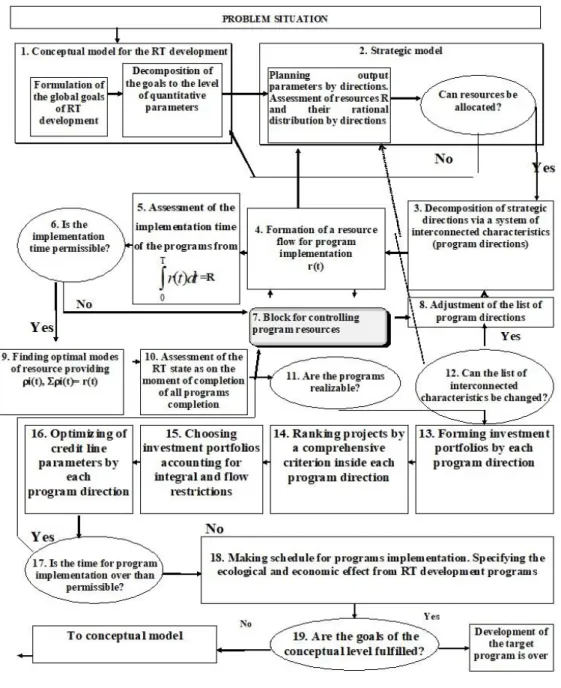
As is known, to solve such problems, the program-target planning apparatus has been created as the most adequate means of achieving the targets in the framework of preliminarily rationalized budget. In further discussions, the authors will proceed from the following diagram illustrating the sequence of steps and the form of information interaction of individual elements of the program-target method (Figure 1). The authors describe the essence of the procedures from which the whole algorithm of program-target planning is applied in relation to the tasks of rural development.
Figure 1. Algorithm for implementation of a target program of RT development
First of all, note that the whole algorithm of program-target planning is built on the iterative principle and contains a number of cycles. Cycles perform a variety of functions, such as achieving global RT development goals, coordination of the global and strategic targets, managing program resources, managing implementation time, and investment project portfolios. Thus, one can distinguish the following cycles:
1. The cycle of globally-targeted monitoring, in which blocks 1-19-1 are covered; 2. The cycle of conceptual and strategic harmonization (blocks 1-2-1);
3. The cycle of resource/product balancing (blocks 2-3-4-2);
4. The cycle of management of time of program implementation (blocks 4-5-6-7-4); 5. The cycle of control of the dimension of the strategy vector (blocks 3-4-5-6-9-10- 11-12-8-3);
6. The cycle of management of investment portfolios (blocks 13-14-15-16-17-7-4-5- 6-9-10-11-13).
As already mentioned, the entire system of program-targeted planning is interactive, so the final decision on the number of iterations within any cycle and the adequacy of the accuracy achieved remains with the decision-maker (Voronin and Fateeva, 2014). The algorithm is based on four models: conceptual, strategic, program and project. These models differ considerably by their nature, the degree of formalization and the mathematical apparatus applied. The conceptual model does not use any formal procedures and is a sample of the system analysis applied to the problem situation in the domain of interest. A group of system analysts serves as the material embodiment of the model, the main task of which is to maintain close contact with the RT governing bodies and possibly with the regional management bodies. The latter is necessary in the rare and unlikely event that the leadership of the RT is not oriented to the global development goals of the region as an integral social and economic system (Lichko and Romanyuk, 2009; Dudin et al., 2017; Anikina et al., 2016). The strategic model of rural development is designed to aggregate the dynamics of the directions formed at the conceptual level, concretized to the indicators of socio-economic and ecological nature (Malecki, 1997).
Let us consider the mathematical formulation of such a problem. Let us denote as
)
(
t
S
i the property characterizing the i-th sign of a rural territory at the t-th time moment. Let the total number of such properties be N, that is,i
N
. Note that N includes not only the immanent properties of the RT, but also all types of exchange interactions with the external environment. Let us designate byK
k
N
M
j
t
S
U
k(
j(
)),
k
,
the value of the k-th indicator characterizing the current state of the RT development, and byU
kF – its target value. The authors assume that both the RT properties themselves and the functions of these properties can be used as indicators: in the first case)
(
))
(
(
S
t
S
t
U
k j
j ; in the second case, to makeU
k(
S
j(
t
))
, severalproperties of the RT are used belonging to the set
M
k, which has among its elements some set of indices from N, depending on the type of indicator. The project on transferring the RT to the path of sustainable development consists of a set of projects, each being capable of changing several properties of this territory. In fact, we are dealing with an operator of the following form:1 2
(
( ))
(
( ))
(
( ))
...
,
,
[1,
]
(
( ))
(
( ))
j nR t
R t
v R t
P j
n
R t
R t
=
(1)where
v
(
R
(
t
))
is the vector function of the
-th project, the argument being the accumulated amount of money spent on the implementation of the
-th project. P is the total number of projects,))
(
(
R
t
j
is the change of the j-th feature of the RT due to the implementation of the
-th project,
n
is the number of the RT features influenced by the
-th project (McCann 2002).The dynamics of the properties of the RT, determined by the internal forces of self-development and the impacts of the project, can be written in the form of a system of equations of state: 0 1
)
0
(
,
)),
(
(
))
(
(
)
(
)
1
(
i i i П i m i i iS
S
N
i
N
M
m
t
R
t
S
G
t
S
t
S
=
+
+
=
+
=
(2) Here, it is assumed that a change in the value of the i-th feature is the consequence of the two reasons: the system’s self-developmentG
i(
S
m(
t
))
and the control response from the project(
(
))
1
t
R
П i
= .The function
G
i(
S
m(
t
))
has, as its arguments, a set of the RT features from a particular multitudeM
i, dependent on i, i.e., the feature of the RT "the mortality rate of the rural population" may depend on the properties of "per capita income", "the number of health workers per 1,000 people", "unemployment rate", etc., and the form of dependence can have this form:
=
min 0 0 0B
n
D
B
n
D
K
K
med med m m , (3)where
K
m,
K
m0 are the mortality coefficients in the studied territory and in some etalon rural territory,B
n
D
,
med,
are the per capita income, the number of health workers per 1,000people and unemployment rate in the studied RT; the denominator has the same arguments for an etalon RT,
is the parameter identified empirically. The control response(
(
))
1
t
R
П i
=is the dependency between the change in
)
(
t
S
i and money costs on all projects. Meantime, it is assumed that in market conditions the only deficient source is highly liquid payment funds – money. As noted above, the argumentR
(
t
)
is the accumulated amount of money spent on funding the
-th project of the change in the i-th feature of RT. The typical view of dependency is)
(
)
(
max
R
R
j j, where
R
max is the amount of money needed for funding the
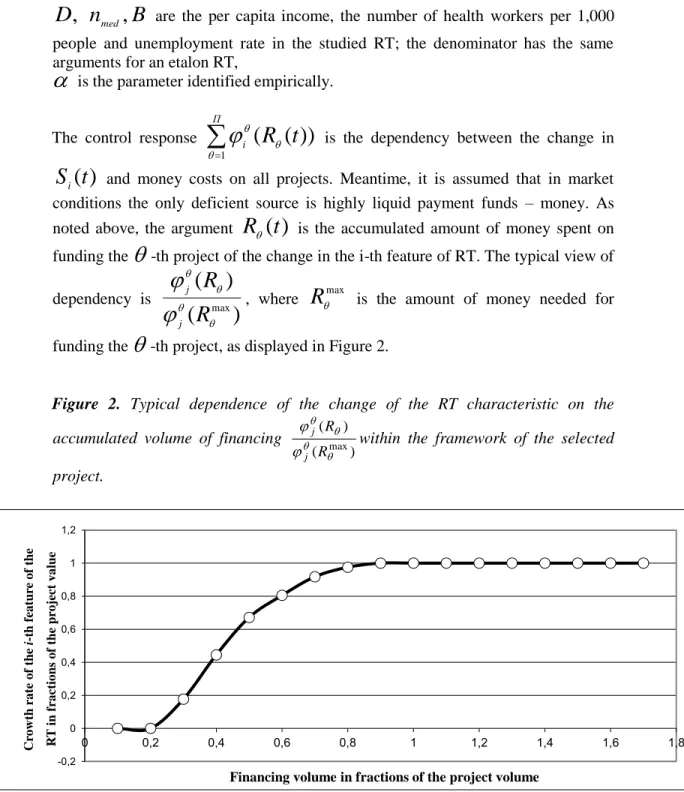
-th project, as displayed in Figure 2.Figure 2. Typical dependence of the change of the RT characteristic on the
accumulated volume of financing
) ( ) ( max R R j j
within the framework of the selected project. -0,2 0 0,2 0,4 0,6 0,8 1 1,2 0 0,2 0,4 0,6 0,8 1 1,2 1,4 1,6 1,8 C row th rate of the i -th featur e of the R T in f rac tio ns of t he pr oj ec t va lu e
The threshold effect, as a rule, is also present for the RT properties, measured in continuous numerical scales and, moreover, for qualitative characteristics (Murtuzaliev et al., 2009; Bashmakov et al., 2015; Havlíček et al., 2013).
4. Discussion
Speaking about money as the only scarce resource of the project on getting the RT onto the path of sustainable development, one should also keep in mind the possible restrictions on the labor involved in the implementation of this project. The labor resources of the RT itself, the use of which in the project is certainly a priority, may not be sufficient, or their professional qualities may not correspond to its goals and objectives. In this case, it will be necessary to provide additional measures to attract third-party workforce or train the existing executors (Resolution of the Government of the Russian Federation No. 598, 2013).
The financing of the RT transition to a sustainable development path can in general be carried out from several sources: the budgets of municipalities, the regional and federal budgets, and the attracted investments and funds obtained from the sale of municipal property, land plots, various rights and lease payments. Without loss of generality, all sources of financing can be divided into two groups: budgetary and investor funds.
The model for the development of the RT budget is the equation of the financial balance as follows: 0 1
)
0
(
)
(
)
(
)
(
)
(
)
(
))
(
1
)(
(
)
1
(
W
W
t
B
t
I
t
VE
t
V
t
S
t
t
W
t
W
b N i i i=
+
+
−
−
+
−
=
+
=
(4)where
W
(
t
)
is the size of the RT consolidated budget at the end of the t-th period, B(t) is the replenishment of the RT development budget from budget sources of higher levels,)
(
t
V
is the expenditure of the budget for program implementation,VE(t) is the total operating costs of the budget, which cannot be attributed to the implementation of the program,
i
is the the norm of receipts to the budget, related to the change of the i-th property of the RT,)
(
),
(
t
I
bt
is the share of the RT budget paid to investors in the form of return payments and dividends and the flow of investment by private investors, respectively.The funds of private investors
I
b(
t
)
can be attracted to the project through various mechanisms: b = 1 – in the form of funds for the implementation of specific projectswithout compensation or with partial compensation of risks; b = 2 – in the form of investments in the RT, depersonalized, but under state guarantees of repayment and ensuring a specified rate of return.
From the financial balance equation, one can determine the flow of financing the program V(t):
)
(
)
(
)
(
)
(
))
(
)
(
)
(
)
(
1t
B
t
I
t
VE
t
S
t
t
W
t
W
t
V
b N i i i−
+
+
+
−
=
=
(5)where
W
(
t
)
is the desired increase in the RT budget.Now everything is ready for the formalization of the task of optimal management of the program to get the RT onto the trajectory of sustainable development.
K
k
N
M
j
U
U
t
S
U
k K k F k F k j k T t
−
= =min,
,
)
(
(
2 1 1N
i
N
M
m
t
R
t
S
G
t
S
t
S
i П i m i i i+
=
+
+
=,
)),
(
(
))
(
(
)
(
)
1
(
1
(6)0
)
(
)
(
)
(
)
(
))
(
)
(
)
(
)
(
1
+
+
−
+
−
=
=t
B
t
I
t
VE
t
S
t
t
W
t
W
t
V
b N i i i
=
Пt
R
t
V
t
R
10
)
(
),
(
)
(
0 0,
(
0
)
)
0
(
W
S
iS
iW
=
=
The result of solving this problem shows the distribution
R
(
t
)
of the dynamically generated amount of program financing between the projects and over time on a given interval [0, T] of time periods. By virtue of this formulation, the greatest possible approximation of the program indicators to the specified targets will be ensured, and the peculiarities of the change in the properties of the RT will be accounted for in the form of a system of equations of its state (Marsden, 2004). The main problem that must be solved at the program level is that of ensuring the sustainability of the developing economy of rural areas. The essence of the problem of sustainability management is to identify the types, number and sequence of projects included in the program, which get the RT onto the trajectory of balanced economic growth. It is assumed that there is a database containing a systematized and exhaustive list of project passports that can potentially be implemented in this RT. A passport means a set of investment projects that are homogeneous in terms of functions performed, differing only in volume-cost characteristics.Thus, the RT economic growth should be achieved through the launch of projects combining the greatest possible efficiency gains while maintaining sustainability and meeting the constraints on resource and ecology.
Particular attention should be paid to the transition area of the trajectory of the economic system of the RT; from the initial state to the path of sustainable development. At the program level, to solve this problem, it is possible to propose an economic-mathematical model that takes into account the main dynamic characteristics of RT-related activities.
)
(
)
(
))
(
),
(
(
1t
K
t
L
a
t
K
t
L
F
i i i i i i i i −=
)
(
))
(
),
(
(
)
1
)(
(
)
1
(
t
K
t
b
F
L
t
K
t
U
t
K
i+
=
i−
i+
i i i i+
i (7))
(
)
(
)
1
(
t
D
L
t
L
i+
=
i ,t
[
0
,
T
],
i
[
1
,
n
]
]
,
1
[
,
)
0
(
,
)
0
(
0 0n
i
K
K
L
L
i=
i i=
i
where
F
i(
L
i(
t
),
K
i(
t
))
is the production function of the i-th activity depending on laborL
i(
t
)
and capitalK
i(
t
)
; for definiteness, assumed in a Cobb-Douglas form with continuous effect of scale,i
is the coefficient of depreciation of fixed assets for the i-th activity,i
b
is the share of output invested in the development of the i-th activity,)
(
t
U
i is the external investments in the development of the i-th activity,)
(
D
is the coefficient of reproduction of working population of the RT accounting for migration;D is the average income per capita of the RT population,
]
,
1
[
,
)
0
(
,
)
0
(
0 0n
i
K
K
L
L
i=
i i=
i
is the initial distribution of labor and capital by activities,T is the period of the target program,
N is the number of activities in the RT (Resolution of the Government of the Russian Federation No. 598, 2013).
The authors will assume the innovative nature of the development of the rural area, aimed at saving labor and increasing the return on new basic production assets. For the production function used, this means growing elasticity of capital output with the introduction of new capacities associated with the i-th activity. Therefore:
=+
=
i i t i it
U
1 0)
(
)
(
(8)where
i is the innovative parameter equaling to the share of accumulated investments, added to the initial values of
i0.The value of
(
D
)
may be represented as follows:))
1
(
)
(
(
))
1
(
(
+
=
0+
−
−
t
D
t
D
t
D
(9)
==
n i i iF
L
K
D
1)
,
(
(10)where
i is the share of wages in gross output of the i-th activity.The above economic-mathematical model defines a multitude of trajectories of the RT development depending on the volume and distribution of investments over the interval of the target program.
Now, the authors will define the program for the development of the RT, which provides the specified growth rates of gross profit, reaching positive capital dynamics by various activities, growth of per capita income of the population, creation of prerequisites for population growth.
To achieve these goals, investments in fixed production assets will be required, which can be found as the solution of the following task:
= =
T t i n it
U
1 1min
)
(
]
,
1
[
)),
0
(
),
0
(
(
))
(
),
(
(
L
T
K
T
mF
L
K
i
n
F
i i i=
i i i
(11))
0
(
)
(
i iT
K
K
]
,
1
[
],
,
1
[
),
(
)
(
0
maxT
t
n
i
t
U
t
U
i
i
where
U
imax(
t
)
is the restriction for maximal amount of investments in the i-th activity.The task in equation (11) consists in determining the minimum required volume of investments, the distribution of which over time and activities, taking into account the constraints in equation (7), ensured an m-fold increase in gross output for each activity and positive capital gain over the target program interval. It should be noted that due to the innovative nature of the changes in the RT economic system, such dynamics will be preserved in the future.
The authors have considered the stationary version of the economic development of the RT, consisting in "innovation-investment" pumping without launching new activities in the RT (Altukhov, 2012). The authors assumed the existence of some
database containing passports of activities potentially possible at RTs of different types. A passport of an activity is understood as a certain technical project, determined by the dependence of the gross output, specific for this type of activity, on the costs of its implementation. The choice of a specific set of projects from the database for many reasons cannot occur automatically, but is carried out within the conceptual model of rural development. The authors assume that such a choice has been made and several candidate projects have appeared for consideration. The question arises of the sequence of their implementation, of course, subject to the availability of investment resources.
To answer this question, it is advisable to use the ideas on the interspecific balance, which in the linear approximation can be written in the form of the Leontief model:
==
=
+
n i j j i ijx
c
x
j
n
a
1,...,
1
,
(12)where
a
ijis the technological coefficients of costs on the product of the i-th activity for making a unit of the j-th product.j
x
is the gross output of the j-th activity in the RT,j
c
is the final consumption of the j-th product.The ability of the economic system to satisfy demand under the conditions of this technology from an algebraic point of view for the model (12) is reduced to the
diagnosis of the productive properties of the matrix
−
−
=
−
nn n na
a
a
a
A
E
1
...
.
...
...
1
)
(
1 1 11 .Remember that (I-A) is productive if it is non-negative invertible, that is, the determinant of the matrix is not equal to zero
E
−
A
0
and all the elements of the inverse matrix(
E
−
A
)
−1are positive. From the economic standpoint, such a system is capable to form profit with all ensuing consequences.Let us recall now the candidate projects selected for implementation within the framework of the target program, ranked by decreasing cost recovery. Obviously, each of them, being added to the RT economy, can destroy the productivity property of the technological matrix A. Therefore, the implementation of the project should be preceded by the diagnostics of the performance of the modified matrix
A
(
n
+
k
n
+
k
)
, where k is the number of candidate projects.5. Conclusion
The presented methodology can serve as a theoretical basis for the formation of state targeted programs for rural development. The considered procedure applied to the rural area will make a significant contribution to the improvement of theoretical and methodological foundations, the development of methodological and practical support, the formation of an effective mechanism for sustainable development of rural areas and the directions for its implementation, and substantiates the scientific novelty of the study.
The initial scientific hypothesis underlying the study is the assumption that the identification and solution of theoretical and methodological problems of sustainable development of rural areas will make it possible to improve the social and economic system through optimal and effective combination of elements of archaism and modernization.
References:
Altukhov, A.I. 2012. For Innovative Development of the Agroindustrial Complex – a Scientifically Grounded Mechanism of Management. The economy of agriculture in Russia 3, 4-19.
Anikina, I.D., Gukova, V.A., Golodova, A.A. and Chekalkina, A.A. 2016. Methodological Aspects of Prioritization of Financial Tools for Stimulation of Innovative Activities. European Research Studies Journal, 19(2), 100-112.
Bashmakov, A.I., Popov, V.V., Zhedyaevskii, N.D., Chikichev, N.D. and Voyakin, A.E. 2015. Generic Heurorithm of Innovation Management from Generating Ideas to Commercialization. European Research Studies Journal, 18(4), 47-56.
Dordzhieva, O.B., Siptits, S.O. 2014. Theoretical Foundations for the Formation of Sustainable Rural Development Programs. Collected Materials of the International Scientific and Practical Conference "Archaism and Modernization in the Conditions of Sustainable Development of Rural Territories: Modern Problems and Prospects", 61-63, Elista, Kalmyk State University.
Dudin, M.N., Smirnova, O.O., Vysotskaya, N.V., Frolova, E.E., Vilkova, N.G. 2017. The Deming Cycle (PDCA) Concept as a Tool for the Transition to the Innovative Path of the Continuous Quality Improvement in Production Processes of the Agro-Industrial Sector. European Research Studies Journal, 20(2B), 283-293.
Galiev, R.R. 2013. Problems of the Development of Regional Programs for the Sustainable Development of Agriculture in Market Conditions. Nikon readings, 18.
Havlíček, K., Thalassinos I.E. and Berezkinova, L. 2013. Innovation Management and Controlling in SMEs. European Research Studies Journal, 16(4), 57-70. Leigh, N.G., Blakely, E.J. 2016. Planning Local Economic Development: Theory and
Practice. Sage Publications.
Lichko, K.P. and Romanyuk, M.A. 2009. Forecasting and Planning in the Agroindustrial Complex. The Economics of Agriculture in Russia, 4, 44-56.
Malecki, E.J. 1997. Technology and Economic Development: The Dynamics of Local, Regional, and National Change. Longman Pub Group.
Marsden, T. 2004. The Quest for Ecological Modernisation: Re‐Spacing Rural Development and Agri‐Food Studies. Sociologia ruralis, 44(2), 129-146.
McCann, E.J. 2002. The Cultural Politics of Local Economic Development: Meaning-Making, Place-Meaning-Making, and the Urban Policy Process. Geoforum, 33(3), 385-398. Murtuzaliev, M.M., Omarov, M.R., Kurbanalieva, A.M. 2009. Modeling the Sustainability
of Economic Development. The scientific life, 5, 33-35.
Petrikov, A.V. 1999. Agrarian Economics at the Turn of the Century: Methodology, Traditions, Development Prospects. Moscow, Encyclopedia of Russian villages. Resolution of the Government of the Russian Federation No. 598 On the Federal Target
Program "Sustainable Development of Rural Territories for 2014-2017 and for the Period until 2020". 2013.
Voronin, B.A., Fateeva, N.B. 2014. State Policy in the Agrarian Sphere of the Russian Federation. The agrarian messenger of the Urals, 7(125).