Xprobe2++: Low Volume Remote Network Information Gathering Tool
Fedor V. Yarochkin, Ofir Arkin
∗, Meder Kydyraliev
†, Shih-Yao Dai, Yennun Huang
‡, Sy-Yen Kuo
Department of Electrical Engineering
National Taiwan University
No. 1, Sec. 4, Roosvelt Road, Taipei, 10617 Taiwan
E-mail:
[email protected]
Abstract
Active operating system fingerprinting is the process of actively determining a target network system’s underlying operating system type and characteristics by probing the target system network stack with specifically crafted packets and analyzing received response. Identifying the underlying operating system of a network host is an important char-acteristic that can be used to complement network inven-tory processes, intrusion detection system discovery mech-anisms, security network scanners, vulnerability analysis systems and other security tools that need to evaluate vul-nerabilities on remote network systems.
During recent years there was a number of publications featuring techniques that aim to confuse or defeat remote network fingerprinting probes.
In this paper we present a new version Xprobe2, the net-work mapping and active operating system fingerprinting tool with improved probing process, which deals with most of the defeating techniques, discussed in recent literature.
Keywords: network scanning, system fingerprinting, network discovery
Submission Category:Software Demonstration
1. Introduction
One of the effective techniques of analyzing intrusion alerts from Intrusion Detection Systems (IDS) is to recon-struct attacks based on attack prerequisites. [8]. The suc-cess rate of exploiting many security vulnerabilities is heav-ily dependent on type and version of underlying software, running on attacked system and is one of the basic required components of the attack prerequisite. When such informa-tion is not directly available, the Intrusion Detecinforma-tion Sys-tem correlation engine, in order to verify whether attack
∗Ofir Arkin is with Insightix †Meder Kydyraliev is with Google ‡Yennun Huang is with Vee Telecom
was successful, needs to make “educated guess” on possible type and version of software used at attacked systems.
For example, if Intrusion Detection system captured net-work payload and matched it to the exploit of Windows sys-tem vulnerability, the risk of such detected attack would be high only if target system exists, indeed is running Windows Operating System and exposes the vulnerable service.
In this paper we propose a new version of the Xprobe2 tool[1] (named Xprobe2++) that is designed to collect such information from remote network systems without having any privileged access to them. The original Xprobe2 tool was developed based on number of research works in the field of remote network discovery[12], [3], [1] and includes some advanced features such as use of normalized network packets for system fingerprinting, “fuzzy” signature match-ing engine, modular architecture with fmatch-ingerprintmatch-ing plugins and so on.
The Xprobe2++ basic functionality principles are sim-ilar to the earlier version of the tool: the Xprobe2++ uti-lizes similar remote system software fingerprinting tech-niques. However the tool includes a number of improve-ments to the signature engine and fuzzy signature matching process. Additionally, the new version of the tool includes a number of significant enhancements, such as use of test information gain weighting, originally proposed in [4]. The network traffic overhead minimization algorithm uses the test weights to re-order network probes and optimize mod-ule execution sequence. The new version of the tool tool also includes modules to perform target system probing at the application layer. This makes the tool capable of suc-cessfully identifying the target system even when protocol scrubbers (such as PF on OpenBSD system) are in front of the probed system and normalize network packets[2][5].
Use of Honeynet software (such as honeyd) is also known to confuse remote network fingerprinting. These Honeynet systems are typically configured to mimic actual network systems and respond to fingerprinting with pack-ets that match certain OS stack signatures[9]. Xprobe2++ includes the analytical module that attempts to detect and
identify possible Honeynet systems among the scanned hosts.
This paper’s primary contribution is introduction of re-mote network fingerprinting tool that uses both network layer and application layer fingerprints to collect target sys-tem information and is capable of feeding such data (in form of XML) to information consumers (such as Intrusion De-tection System correlation engine).
The rest of this paper is organized as follows: Sec-tion 2 introduces basic concepts of network fingerprint-ing and the problems that the tool has to deal these days, and also proposed solutions. Section 3 introduces ba-sic Xprobe2/Xprobe2++ architecture. Section 4 introduces improvements that were brought in Xprobe2++. 5 Sec-tion demonstrates some evaluaSec-tion results and SecSec-tion 6 discusses possible problems and Section 7 concludes this work.
2. Preliminaries
Network Scanning is the process of sending one or a number of network packets to a host or a network, and based on received response (or lack of such) justifying the exis-tence of the network or the host within target IP address range.
Remote Operating System Fingerprinting is the process of identifying characteristics of the software (such as Oper-ating System type, version, patch-level, installed software, and possibly - more detailed information), which runs on remote computer system. This can be done by analyzing network traffic to and from the remote system, or by send-ing requests to remote system and analyzsend-ing the responses. The passive analysis of network traffic is frequently named in literature aspassive fingerprintingand active probing of remote systems is named as active fingerprinting.
Xprobe2++ is a novel active remote operating system fingerprinting tool that uses TCP/IP model networking layer protocols and application layer requests to identify the type and version of operating system software, running on target system.
With introduction of application layer tests Xprobe2++ aims at resolving the problems, which can not be resolved by fingerprinting at network layer. In the remaining part of this section we are going to discuss typical problems and issues that a network layer operating system fingerprinting tools have to deal with during the scanning process.
2.1. Modern Fingerprinting Problems
Honeypot systems, modified TCP/IP stack settings and network packet scrubbers are known to frequently confuse
remote fingerprinting tools. Honeypot systems often re-spond as hosts or a group of hosts to remote fingerprinting tools. Modified TCP/IP stack responses are hard to finger-print with strict signature matching. When packets traverse across the network, they can be modified by network traffic normalizers. All of these factors affect the accuracy of the OS fingerprinting.
Xprobe2++ is aware of these problems and deals with them by using fuzzy matching and mixed signatures that probe target system at different layers of OSI Model net-work stack.
Moreover, such behavior of some routing and packet fil-tering devices could be analyzed and signatures to identify and fingerprint intermediate nodes could be constructed.
For example, OpenBSD PF filter is known to return dif-ferent values in TTL field, when a system behind the filter is accessed [6]. A signature can be constructed to detect this behavior.
3. Tool Architecture Overview
The Xprobe2++ tool architecture includes several key components: core engine, signature matcher, and an ex-tendable set of pluggable modules (also known as plugins). The core engine is responsible for basic data management, signature management, modules selection, module loading and probe execution. The signature matcher is responsible for result analysis. The plugins provide the tool with packet probes to be sent to the target systems and methods of ana-lyzing and matching the received responses to the signature entries.
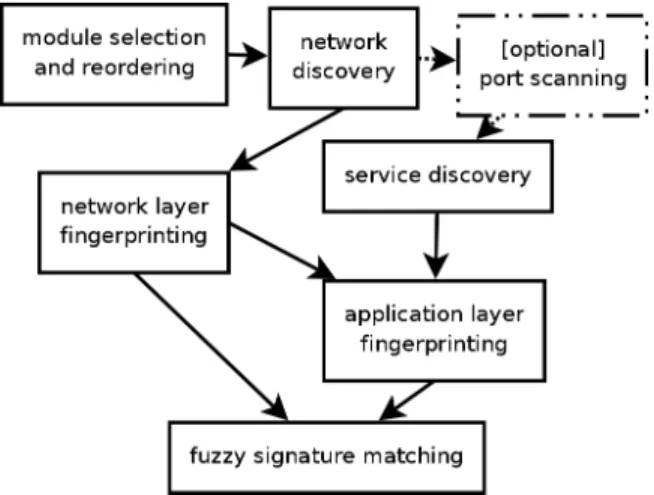
The Xprobe2++ modules are organized in several groups: Network Discovery Modules, Service Mapping Modules, Operating System Fingerprinting Modules and Information Collection Modules.
The general sequence of module execution is denoted on Figure 1. Each group of the modules is dependent on suc-cessful execution of the other group, therefore groups of modules are executed sequentially. However each partic-ular module within the group may be executed in parallel with another module within the same group.
It is possible to control which modules, and in what se-quence are to be executed, using command line switches1.
3.1. Network Discovery Modules
Xprobe2 discovery modules are designed to perform host probing, firewall detection, and provide information for the automatic receive-timeout calculation mechanism. Xprobe2++ comes with a new module that uses SCTP pro-tocol for remote system probing.
The aim of all network discovery modules is to elicit a response from a targeted host, either a SYN—ACK or a RST as a response for the TCP ping discovery module and an ICMP Port Unreachable as a response for the UDP ping discovery module or an SCTP response for SCTP ping module. The round trip time, which can be calculated for any successful run of a discovery module, is remembered by module executor and is further used by the receive-timeout calculation mechanism. The receive-receive-timeout calcu-lation mechanism is used at the later stage of the scanning to to estimate actual target system response time and identify silently dropped packets without having to wait longer.
3.2. OS Fingerprinting Modules
The Operating System Fingerprinting Modules in Xprobe2++ include both network layer fingerprinting mod-ules that operate with network packets and application layer fingerprinting modules that operate with application re-quests.
The OS fingerprinting modules provide set of tests for a target (with possible results, stored in signature files) to determine the target operating system and the target archi-tecture details based on received responses.
The execution sequence and the number of executed operating system fingerprinting modules can be controlled manually or be selected automatically based on the informa-tion discovered by network discovery modules or provided by command line switches.
3.3. Fuzzy Signature Matching Mechanism
The Xprobe2 tool stores OS stack fingerprints in form of signatures for each operating system. Each signature will
1Please refer to the Xprobe2++ manual page for the detailed
informa-tion.
contain data regarding issued tests and possible responses that may identify the underlying software of target system.
Xprobe2/Xprobe2++ signatures are presented in human-readable format and are easily extendable. Moreover,the signatures for different hosts may have variable number of signature items (signatures for different tests) presented within the signature entry. This allows the tool to maintain as much as possible information on different target plat-forms without need to re-test the whole signature set for the full set of fingerprinting modules every time, when the system is extended with new fingerprinting modules.
Following example depicts the Xprobe2++ signature for Apple Mac OS operating system with application layer sig-nature entry for SNMP protocol.
f i n g e r p r i n t { OS ID = ” A p p l e Mac OS X 1 0 . 2 . 3 ” i c m p e c h o r e p l y = y i c m p e c h o c o d e = ! 0 . . . s n m p s y s d e s c r = Darwin K e r n e l V e r s i o n h t t p c a s e i n s e n s i t i v e = y }
The signature contains the pairs of key, values for finger-printing tests (key) and matching results (values). The key-words are defined by each module separately and registered within Xprobe2 signature parser run-time.
Xprobe2 is the first breed of remote OS fingerprint-ing tools that introduced “fuzzy” matchfingerprint-ing algorithm for the Remote Operating System Fingerprinting process. The “fuzzy” matching is used to avoid impact on the accuracy of fingerprinting by failed tests and the tests, which were confused by modified TCP/IP stacks and network protocol scrubbers. Thus in case if no full signature match is found in target system responses, Xprobe2 provides a best ef-fort match between the results received from fingerprinting probes against a targeted system to the signature database. The details of Xprobe2 “fuzzy” matching algorithm can be found in our earlier publication[1].
In Xprobe2++ the “fuzzy” matching algorithm is up-dated, so module weights and reliability metrics are used in final score calculation. The original algorithm for module weight calculation is proposed in[4]. Reliability metric is a floating point value in range[0,1], which can be optionally included as part of signature for each test.
4. Tool Improvements
4.1. Application Layer Signatures
Some TCP/IP network stacks may be modified deliber-ately to confuse remote Operating System Fingerprinting
attempts. In other cases a network system may simply for-ward a TCP port of an application. The modern OS finger-printing tool has to have possibilities to deal with this type of systems and possibly identify the fact of OS stack modi-fication or port forwarding. Xprobe2++ deals with the fact by using additional application layer differentiative tests to map different classes of operating systems. The methods of application layer fingerprinting are known to be effective[2] and it is much harder to emulate application layer responses to match signatures of a particular operating system. The application layer responses are not modified by network protocol scrubbers and thus may provide more accurate in-formation. We do not claim that it is impossible to alter sys-tem responses at application layer, but we simply point out there is less motivation to modify system responses at appli-cation layer, as this is much more complex task with higher risks of bringing system instability or introducing security vulnerabilities in the application.
The applications running on different operating systems may respond differently to certain type of requests. This behavior is dictated by operating system limitations or dif-ferences in design of underlying operating system compo-nents. A simple test that verifies ’directory separator’ map-ping simply tests how target system handles ’/’ and ’\\’ type requests. The application will respond differently un-der Windows and Unix because of the difference in the filesystem implementation. Modifying Application layer responses to respond as other type of operating system is not an easy task. For example, normalization of responses to “..\..\requests on web server running on the top of OS/2 platform may “unplug” a security hole on this operating system[7].
Xprobe2++ uses application-layer modules in order to detect and correct possible mistakes of fingerprinting at net-work layer. These modules can also collect additional infor-mation on target host. In addition to that, the new version of Xprobe2++ comes with a module that attempts to detect honeyd instances and other “honeypot” systems by generat-ing known-to-be valid and invalid application requests and validating responses. The variable parts of these requests, such as filenames, usernames and so on, are randomly gen-erated to increase complexity of creating “fake” services without full implementation of the application or protocol. Inconsistencies with received application responses are con-sidered as signs of possible honeypot system.
In addition to that, the inconsistency of the results re-turned by application layer tests and network layer tests may signify presence of a honeypot system, a network-layer packet normalizer or a system running static port address translated (PAT) services.
The detailed list of implemented application layer tests is shown in Table 4.1. As it can be observed from this ta-ble, some of these application layer tests can only
differenti-ate between classes of operating systems, while others may identify certain characteristics, such as used filesystem type, which are specific to the particular operating system(s) and and may give some clues of used software version.
We would like to further discuss the groups of applica-tion layer tests, which are supported by our tool. However it should be understood that the testing possibility at applica-tion layer is not limited by those methods discussed in this section. More specific application layer tests, such as used for HTTP Server fingerprinting [10] or Ajax Fingerprinting Techniques[11] can be used to gain additional precision in remote system fingerprinting process.
Underlying Filesystem tests- this group of tests aims at detecting how underlying OS system calls han-dle various characteristics of directory or file name. For example, FAT32 and NTFS filesystems threat MS-DOS file names, such as FOO∼1.HTM, in a special way, file names are case insensitive, requests to file names contain-ing special character 0x1a (EOF marker) will return dif-ferent HTTP responses from a web server running on the top of Windows (403) and Unix OS (404). Presence of special files- This method is not as reliable as filesystem based methods, however it often produces useful results. There are special files on some filesystems, such as Thumbs.db that is automatically created on Windows sys-tems when folder is accessed by Explorer. The file format is different on different OS versions. If such file is obtained, it is possible to validate whether the file was created at the system where it is presently located by comparing the ap-plication and the file time stamps.
We also believe it might be possible to perform further differentiation of operating systems at application layer by analyzing encoding types, supported by application or un-derlying file system. It may also be possible to analyze dis-tribution of application layer response delays for different requests in order to identify “fake” services or fingerprint particular software versions. Further research in this area is needed.
4.2. Optional TCP Port Scanning
One of the motivations for developing the original Xprobe2 tool was to avoid dependency on network finger-printing tests that would require excessive amount of net-work probes in order to collect the preliminary information. Xprobe2++ network layer tests are primarily based on vari-ety of ICMP protocol tests. Such tests do not require any additional information of target system, such as UDP or TCP open or closed port numbers simply because there is no “port” concept in context of the protocol.
The optional TCP/UDP port scanning module, when en-abled, allows execution of TCP, UDP and application layer tests, because only these tests require knowledge of TCP
Test type Usable Protocol Test precision
Directory Separator HTTP Windows vs. Unix
New line characters HTTP Windows vs. Unix
Special/reserved filenames HTTP Windows vs. Unix
Root directory FTP Windows,Unix,Symbian,OS/2
Special characters (EOF,EOL
Filesystem limitations HTTP, FTP Correlates FS-type to OS
Filesystem illegal characters HTTP, FTP Correlates FS-type to OS
Case sensitivity HTTP, FTP Windows vs. Unix
Special filenames handling HTTP, FTP Windows vs. Unix
Special files in directory HTTP, FTP Windows types, MacOS, Unix
Binary file fingerprinting FTP Windows, Unix types
Figure 2. Xprobe2++ Application Layer Tests
and UDP port status.
If optional TCP/UDP port scanning module is not exe-cuted, which is default behavior, Xprobe2++ will only use information provided by command line (such as open port numbers), and the ports, which statuses are discovered dur-ing execution of other tests. Modules are reordered prior the execution in order to minimize total number of packets and optimize useablity of information that could be discov-ered during each module execution. For example, the ap-plication layer test that uses UDP packet with SNMP query will be placed for execution before the module that requires a closed UDP port. When the SNMP query is sent, the received response (if any) will reveal the status of SNMP port at target system. If the UDP port is closed, the ICMP Port Unreachableresponse would be received. In this case the received datagram is passed to the module that requires closed UDP port. If a UDP packet response is received, the SNMP signatures can be matched to the received re-sponse. If no response is received, the result of this test is not counted.
This way Xprobe2++ maintains its minimal usage of packets for the network discovery.
5. Evaluations
We evaluated the new version Xprobe2++ system by exe-cuting Xprobe2++ and nmap scans against a number of dif-ferent network systems: computer hosts, running Linux and windows operating systems and variety of protocols, routers and networked printers. Additionally, we tested Xprobe2++ against a web server system running on Linux operating system and protected by OpenBSD packet filter with packet normalization turned on. We verified correctness of each execution and corrected the signatures, when it was neces-sary.
The HTTP application module was manually loaded
in Xprobe2++ by specifying port 80 as open port in Xprobe2++ command line. The same parameter was passed to Nmap tool. Nmap used port module for TCP ping probe to identify responsiveness of remote system.
We also performed a few test runs by simultaneously executing Xprobe2++ and nmap against unknown network systems and recording network traffic load generated by each tool. The the sampled network traffic throughput, recorded with ntop, is shown on Figure 3. Please note that nmap needs to execute port scanning in order to be able to successfully guess remote operating system type, while Xprobe2++ can rely on results of the tests, which do not require any ports to be known, with exception for applica-tion layer module. The diagram simply demonstrate that it is possible to decrease network overhead when no TCP port scanning is performed.
Figure 3. Xprobe2++ and nmap generated traffic loads.
6. Discussions
Our tool provides a high performance, high accuracy net-work scanning and netnet-work discovery techniques that allow users to collect additional information of scanned environ-ment. Xprobe2++ is focused on using minimal amount of
packets in order to perform active operating system finger-printing, that makes the tool suitable for larger-scale net-work discovery scans. However these benefits also lead to some limitations, which we would like to discuss in this section.
In order to successfully fingerprint target system, Xprobe2++ needs the remote host to respond to at least some of the tests. If no preliminary information is collected before the tests and some of the protocols (such as ICMP) are blocked, Xprobe2++ results may be extremely impre-cise or the tool may actually fail to collect any information at all. We consider this as the major limitation of the tool.
The other limitation with the application-layer tests is that currently Xprobe2++ does not perform network ser-vice fingerprinting. By doing so we minimize network traf-fic overhead and risk of remote service to crash, however Xprobe2++ may also run wrong tests on the services, that are running on non-standard ports or even miss the services, which are running on non-common port numbers. Meth-ods of low-overhead, risk-free network service fingerprint-ing could be subject of our further research that could re-solve this limitation.
Also, despite of the fact that the the tool is capable of performing remote host fingerprinting without performing any preliminary port scanning of the target system, this may lead to significant performance drops when running application-layer tests on filtered port numbers. We believe that preliminary port probe for each application-layer test may be helpful to resolve this limitation.
Xprobe2++ uses libpcap library for its network traffic capture needs. The library provides unform interface to network capture facilities of different platforms and great portability, however it also makes the tool unsuitable for high-performance, large volume parallel network finger-printing tasks, due to high packet drop ratio on heavily loaded networks. Use of PF RING sockets, available on Linux platform, may be considered in future releases of this tool in order sacrifice portability for performance improve-ments.
7. Conclusion
Our primary contribution is demonstration of the tool that is capable of using the application layer fingerprinting tests along with network layer fingerprinting to perform OS fingerprinting remotely with higher precision and lower net-work overhead. Additionally, the tool can demonstrate that with the use of application layer tests it is possible to detect specific network configurations, which could not be identi-fied by using network layer fingerprinting tests alone.
8. Availability
Developed application is free software, released under GNU General Public License. The discussed version of this software will be released before the conference at the project web site:
http://xprobe.sourceforge.net
Acknowledgment
This study is conducted under the ”III Innovative and Prospective Technologies Project” of the Institute for In-formation Industry which is subsidized by the Ministry of Economy Affairs of the Republic of China.
References
[1] O. Arkin and F. Yarochkin. A ”Fuzzy” Approach to Re-mote Active Operating System Fingerprinting. available at http://www.sys-security.com/archive/papers/Xprobe2.pdf, 2002.
[2] D. Crowley. Advanced Application Level OS Fin-gerprinting: Practical Approaches and Examples. http://www.x10security.org/appOSfingerprint.txt, 2002. [3] Fyodor. Remote OS detection via TCP/IP Stack Finger
Print-ing. http://www.phrack.com/show.php?p=54&a=9, 1998. [4] L. G. Greenwald and T. J. Thomas. Toward undetected
op-erating system fingerprinting. InWOOT ’07: Proceedings of the first USENIX workshop on Offensive Technologies, pages 1–10, Berkeley, CA, USA, 2007. USENIX Association. [5] J. Jiao and W. Wu. A Method of Identify OS Based On
TCP/IP Fingerptint. In UCSNS International Journal of Computer Science and Network Security, Vol.6 No. 7B, 2006. [6] M. Kydyraliev. Openbsd ttl fingerprinting vulnerability.
http://www.securityfocus.com/bid/4401, 2002.
[7] A. Luigi. Apache 2.0.39 directory traversal and patch disclo-sure bug. http://securityvulns.ru/docs3377.html, 2002. [8] P. Ning, Y. Cui, D. S. Reeves, and D. Xu. Techniques and
tools for analyzing intrusion alerts. ACM Trans. Inf. Syst. Secur., 7(2):274–318, 2004.
[9] G. Portokalidis and H. Bos. Sweetbait: Zero-hour worm de-tection and containment using low- and high-interaction hon-eypots.Comput. Netw., 51(5):1256–1274, 2007.
[10] S. Shah. Httprint: http web server fingerprinting. http://net-square.com/httprint/httprint paper.html, 2004.
[11] S. Shah. Ajax fingerprinting. http://www.net-security.org/dl/articles/Ajax fingerprinting.pdf, 2007. [12] F. Veysset, O. Courtay, and O. Heen. New Tool and
Technique for Remote Operating System Fingerprinting. http://www.intranode.com/site/techno/techno articles.htm, 2002.