Economic Welfare Implication of Ghana’s Cocoa Production in a
Changing Global Climate
Jonathan D. Quartey Department of Economics
Kwame Nkrumah University of Science and Technology Kumasi, Ghana.
Abstract
This paper assessed the economic welfare implications of cocoa production as is currently practiced in Ghana. This is against the background of global consensus to cut down on carbon emissions, putting a demand on cocoa producing countries like Ghana to mitigate climate change through cuts in deforestation and forest degradation. Secondary data was quantitatively analyzed, following an integrated impact assessment model process to determine the net economic welfare effect of cocoa production in Ghana, in a changing global climate. The results show that Ghana makes a net welfare loss of at least US$1.3 billion per annum by producing cocoa the way it does currently. Thus cocoa production in its current form in Ghana reduces economic welfare. To avoid the needless welfare loss through the quest for economic growth through the current cocoa production framework, Ghana would need to resort to carbon trading, serious government commitment to the course of climate change mitigation from land use change and forestry and sustainable agroforestry.
Keywords: Carbon emission, climate change, cocoa, economic welfare, Ghana. 1. Background of the study
The Paris Agreement on Climate in December 2015 saw 195 countries and the European Union indicating their willingness to contribute to the reduction of global carbon dioxide (CO2) emissions. The resolve was to hold
global temperatures to no more than 2oC above preindustrial values. The agreement defined the course of action by governments between 2020 and 2030 after nearly 23 years of negotiations (Codur et al. 2016).
Human caused climate change has in recent times been a drag on economic welfare not only in developing countries but also in developed ones. Estimates for the United States of America show that the country could lose between 1-3% of Gross Domestic Product (GDP) annually due to anthropogenic climate change (Nordhaus & Boyer 2000; Ackerman & Stanton 2008). The toll on poorer countries has been rather high, leading not only to loss of GDP but also long term disruptions in the livelihoods of whole communities and loss of human lives in some cases.
Following economic analysis, greenhouse gas (GHG) emissions, which cause planetary climate changes, represent both an environmental externality and the overuse of a common property resource. Current estimates of the planet’s absorptive capacity are about 20-50% of current human caused emissions of carbon, implying that a reduction of at least 50-80% is needed. The development of national and international policies to combat global climate change remains a huge challenge, involving many scientific, economic, and social issues (Harris et al. 2015). One of such issues occurs in Ghana’s agricultural sector in the form of cocoa production.
2. The problem
Since its introduction in West Africa, cocoa has been the major cause of land use change in the high forest zone of the region, where it has replaced agriculture that included fallowing to maintain fertility (Gockowski & Sonwa 2007).
The progressive adoption of new varieties decoupled from recommended farming practices has come at a considerable cost in terms of deforestation and biodiversity loss. While clearing land for cocoa production inevitably implies some loss of forest cover, degradation has accelerated in recent years through the introduction and progressive replacement of the traditional shade-dependent and tolerant ‘Tetteh Quarshie’ variety with the new open-field hybrid one, which –unlike traditional trees that still need on average about 30 to 40 percent crown cover - grows in full sun conditions. Currently, in nearly three quarters of the cocoa belt of Ghana (72%) shade is light or almost nonexistent (Gockowski & Sonwa 2007).
Farmers have a strong preference for full sun systems because of the higher short-term profitability which is linked to their much shorter growing cycle (Obiri et al. 2007). However, in full sun systems the damage from capsid attacks tends to be higher than in shaded systems, and carbon stores are reduced by half contrary to the higher carbon sequestration potential of the traditional shaded cocoa systems (Norris 2008).
One major omission of climate change inventories in Ghana has been their silence on the contribution of cocoa production to climate change. For instance, in the Ghana Environmental Protection Agency’s Greenhouse gas
inventory report for 1990 to 2006 published in 2010 (EPA 2010), no mention was made of emissions from cocoa production even though the agricultural sector was discussed at length. This knowledge gap needs urgent bridging particularly considering the welfare implications of such omission for the several vulnerable people in Ghana and the world at large. In addition, the economic welfare implications of current cocoa production practices need to be known to inform policy towards sustainable national development in a changing global climate.
This study therefore seeks to assess the economic implications of the extent to which cocoa production in Ghana has contributed to carbon dioxide emissions build up, to cause both current and future climate change. It specifically tries to determine the economic welfare effect of Ghana’s cocoa production in a changing global climate. The following section provides an overview of the cocoa sector in Ghana. This is followed by a conceptual framework linking the cocoa sector to economic welfare. The analysis of data then follows, leading to the discussion of the main findings. The paper finally proposes the way forward for cocoa production in Ghana and concludes.
3. Ghana’s Cocoa Sector
Cocoa has provided significant income to the Ghanaian economy for over one century. From as early as 1891 cocoa was being exported as a cash crop from Ghana (Adjinah & Opoku 2010). Beginning from 1910/1911, Ghana became the leading cocoa producer in the world, until 1977. Currently, Ghana produces about 21% of the 70% world cocoa supply emanating from West Africa (Asante-Poku & Angelucci 2013).
With an annual production level of over 700,000 metric tons between 2003 and 2013 (ICCO 2014), and an estimated cultivation area of approximately 1.6 million hectares (FAOSTAT 2015), cocoa production has been a major contributor to the economy of Ghana. Currently, it is estimated that the cocoa sector employs about 6 million people (Anthonio & Aikins 2009), comprising over 800,000 farm families (these include 350,000 farm owners, share croppers and their dependents) who depend on cocoa production for 70% - 100 % of their annual income (Asamoah & Baah 2003). Just as cocoa production is critically important to individual farming families and other players in the cocoa sector; it is also a major cash crop and foreign exchange earner for the country’s economy. In 2010 for instance, cocoa accounted for a little over 8% of the country’s Gross Domestic Product (GDP) and 30% of total export earnings (Ashitey 2012; Asare 2015). Cocoa became attractive as a cash crop in Ghana because of the lower cost involved in its cultivation, compared to crops like palm, as well as the favourable natural conditions that existed in the forest belts.
3.1 Cocoa and forests in Ghana
Cocoa cultivation has been criticized for its contribution to deforestation of Ghana’s tropical high forest belt (MSE 2002). It is estimated that about 50-70 % of the total areas of protected forestlands in Ghana have been illegally encroached by cocoa farmers (England 1993; MSE 2002; Wade et al. 2010).
In Ghana, cocoa farms could be categorized as high or heavy shade if there exist about 22–30 forest trees per hectare (ha) in the mix; medium shade cocoa farms consist of 15–18 forest trees per ha (Manu & Tetteh 1987; Ofori-Frimpong et al. 2007; Opoku-Ameyaw et al. 2010) and low shade cocoa farms have 5-6 trees per hectare (Ruf 2011).
There exists however conflicting recommendations on the required number of trees per unit area cocoa farm, which is supposed to correspond to a certain percentage of shade cover needed for cocoa production. For instance, environmentalists claim that cocoa farms with a diversity of forest tree species numbering 70 per hectare can provide a shade cover of 40% (Asare & Asare 2008). This density is roughly equivalent to a shade tree spacing of 12 m x 12 m. Meanwhile, the Cocoa Research Institute of Ghana (CRIG) recommends up to 18 emergent trees (≥ 12 meter height) per hectare (roughly a 24 m x 24 m spacing) providing permanent shade cover corresponding to approximately 30-40% shade (Anim-Kwapong 2006).
Ghana’s forest cover has almost halved since 2000: only 4.6 million hectares remained in 2011 with 1.6 million hectares as forest reserves. Ghana’s deforestation rate is about 2 percent per year, representing a loss of 135,000 hectares per year (FAO 2010). Recent assessments indicate that rates may have been accelerating in Brong Ahafo and the Western Region. The major direct causes of deforestation as summarized in Ghana’s Readiness Preparation Proposal (R-PP 2010) have been agricultural expansion, particularly for cocoa production, harvesting for fuel wood and charcoal and illegal logging (World Bank 2015). Recent expansion has been greatest in the Western Region which now accounts for over half of the production. Increasingly, farmers are shifting from shaded cocoa to open cocoa cultivation, accompanied by forested land encroachment.
In addition, the government of Ghana has prioritized cocoa as a commodity crop and is aiming to increase cocoa production from about 745,000 Mt to about 1,000,000 Mt per annum. However, one of the major problems facing sustainable cocoa production in Ghana is that to increase cocoa yield, some farms were established in clear cut forests providing poor habitats for a wide range of biodiversity (Asare 2006). In such instances, there is increased cocoa yield, but this puts, significant ecological stress on the cocoa trees, which become susceptible to pests attack and productivity decline within relatively few years (Rice & Greenberg 2000).
Ghana has experienced significant forest loss through expansion of the cocoa industry by promotion of zero shade cocoa production systems. This has gradually led to the fragmentation of forest landscapes, loss of wildlife corridors and forest connectivity and degradation of biodiversity and the ecosystem goods and services these offer. One of the more prominent consequences of deforestation, which has significantly affected cocoa production, is a significant loss of major soil nutrients. This has been a leading cause of the gradual decline of national cocoa yields (UNDP 2012).
3.2 Climate Change and cocoa production in Ghana
Ghana is already experiencing an increase in extreme weather conditions, with higher incidences and longer periods of flooding and drought. In some degraded areas, attempts to replant cocoa have failed due to seedling mortality as a result of prolonged drought, low soil fertility and an increased incidence of diseases and pests (Padi et al. 2013). Negative changes like extended periods of rainfall or drought, with its associated high temperatures, have been argued to increase the rate of disease and pest development, as well as modify host resistance, which could lead to changes in the physiology of host-pathogen/pests interaction.
Temperatures have warmed by 1°C over the past 30 years (EPA 2010). Ghana has a warm and comparatively dry south east coast, is hot and humid to the south west and hot and dry in the north. From 20-year observed data, temperatures in all zones are rising, whereas rainfall has been reducing and becoming increasingly erratic. The seasonal distribution of rainfall is particularly important for the maintenance of the ecology and current cocoa production (EPA 2010).
The Government of Ghana has noted that the country’s climate has become unpredictable and more intense weather events can be expected, such as torrential rains, excessive heat and severe dry winds as a result of climate change (EPA 2011). Temperatures in Ghana are already high with a mean annual temperature above 24°C. Average figures range between 24°C and 30°C although temperatures ranging from 18 – 40°C are more common. There will be warming for all regions, particularly the three Northern regions with increases of between 2.1-2.4°C by 2050. This amounts to 1.7-2°C for the Central regions and to 1.3 to 1.6°C for the southern regions (EPA 2011).
The forecast for precipitation gives a cyclical pattern over 2010-2050 for all regions, with high rainfall levels followed by drought every decade or so. Changes in run-off and stream flows will increase the risk of floods and/or droughts in both rural and urban areas. The predicted changes in climate will have adverse social and environmental impacts including human well-being, food security and water availability with serious consequences for cocoa production (EPA 2010).
4. Conceptual Framework
This study conceptualizes the result of cocoa production on climate change and eventually on economic welfare change by means of an Integrated Impact Assessment Model process. By definition, integrated assessments seek to understand the linkages or interactions and feedbacks among complex systems. Integrated Impact Assessment models (IAMs) of climate change are motivated by the need to balance the dynamics of carbon accumulation in the atmosphere and the dynamics of de-carbonization of the economy (Nordhaus, 1994) as has been identified through cocoa farming in Ghana. An example of the interaction between the cocoa economy and climate systems is shown in Figure 1.
While cocoa production results in substantial forest clearance on a permanent basis, it also results in an increase in the CO2 stock within the carbon cycle as shown in Figure 1. This increases the atmospheric concentration of
carbon, affecting climate dynamics to contribute to global climate change. Global climate change then causes damage, which for the cocoa sector results in lower yields and higher costs of production. These outcomes would necessitate the use of existing resources to mitigate or adapt to the damage, leading to loss in production which has the tendency to make people whose incomes depend on cocoa production worse off. Therefore, cocoa production can be viewed as a source of economic welfare reduction if the net value of the production activity is negative (that is, a net damage).
It is worth noting that damage could occur through a multiplier effect, creating more than proportionate damage even for a relatively small quantity of forest loss. This would depend on the total economic value of the loss of forest cover, since forests have multiple functions. Estimating the net damage or loss due to cocoa production would require the derivation of the individual losses that are attributable to the corresponding loss of forest cover. Current practice in Ghana and most developing countries assign a zero value to forest loss when it comes to cocoa production. This makes cocoa production seem very lucrative, an incentive which has the potential of decimating the cocoa industry. For instance, while carbon markets exist in many parts of the world, the cost of cocoa production in Ghana still assigns a zero value to carbon, since it does not appear in the cost build up. Thus the real cost of cocoa production has been underestimated, causing externalities. The nonmarket nature of most of the ecological functions of the tropical forest may also be responsible for the zero value assigned to them particularly in developing countries, since this appears to conceal their value.
4.1 Valuing forest loss
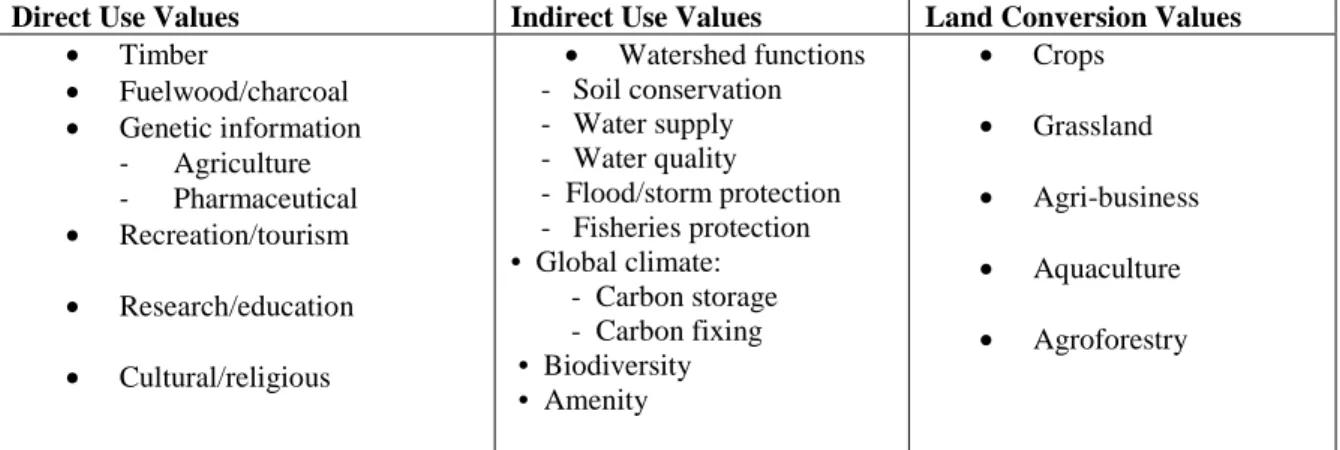
The types of economic value to be found in forests are use values and non-use values. Use values refer to willingness to pay to make use of forest goods and services. Such uses may be direct, e.g. extractive uses, or indirect, e.g. watershed protection or carbon storage. Use values may also contain option values; willingness to pay to conserve the option of future use even though no use is made of the forest now. Such options may be retained for one's own use or for another generation. Non-use values relate to willingness to pay which is independent of any use made of the forest now or any use in the future. Non-use values reveal the multi-faceted nature of the motivations for conservation, e.g. being driven by concerns about future generations, the 'rights' of other sentient beings etc. Some of these values are classified in Table 1.
The sum of use and non-use values is total economic value. It is this value that is lost if a forest area is converted to other uses or seriously degraded. Total economic value can then be estimated by summing individual use and non-use values, or by seeking some all-encompassing willingness to pay for the forest generally. On the other hand, benefits that could be obtained from forest land conversion include revenues from or direct uses of crops, grassland, agri-business, aquaculture and agroforestry.
Table 1: Instrumental economic values of tropical forests and forest land conversion
Direct Use Values Indirect Use Values Land Conversion Values • Timber • Fuelwood/charcoal • Genetic information - Agriculture - Pharmaceutical • Recreation/tourism • Research/education • Cultural/religious • Watershed functions - Soil conservation - Water supply - Water quality - Flood/storm protection - Fisheries protection • Global climate: - Carbon storage - Carbon fixing • Biodiversity • Amenity • Crops • Grassland • Agri-business • Aquaculture • Agroforestry 5. Methodology
To reduce their loss of forest value and carbon emission, cocoa sectors must first accurately measure them. However, limited data and methodological complexities used to calculate emissions from land-use change (in this case, conversion of non-agricultural land to agricultural land for cocoa production) present a hurdle. Though lifecycle emissions analyses for chocolate production exist, most do not include emissions from land-use change resulting from the establishment of new cocoa production areas. Or, if they are included, estimates are rough (Harris et al. 2015). Cadbury estimates that 169grams (6 ounces) of carbon dioxide equivalent are emitted into the atmosphere for each 49grams (1.7 ounce) Dairy Milk chocolate bar. This calculation includes emissions from the production of raw ingredients such as cocoa, cocoa butter, milk and sugar, and from packaging and distribution, but not from land-use change (Harris et al. 2015).
This study as indicated earlier, estimates net economic welfare change from Ghana’s cocoa production with particular reference to forest conversion. It employs secondary data mainly from Ghana Cocoa Board (COCOBOD) and the United Nations Convention on Biological Diversity (CBD) compiled by Pearce (2001). Emissions data from the Ghana Forestry Commission was not used because the Measurement, Reporting and Verification (MRV) System in Ghana identified a limitation for forest emissions data from the Commission. It observed that Ghana’s Forest Preservation Programme (FPP) collected significant data and undertook processing that did not provide a sufficiently complete time series of land cover to generate land cover change statistics required to develop Intergovernmental Panel on Climate Change (IPCC) compliant Forest Reference Emission Levels (FREL) (FC 2015). Additional years of remote sensing classifications were thus required to meet World Bank Forest Carbon Partnership Facility (FCPF) reference period requirements and improve the estimates of historical deforestation and forest degradation (FC 2015). Not until this requirement is met, the direct use of available carbon emissions data from the Commission could convey inaccurate representations for cocoa emission computations through deforestation.
Values for various forest resource functions were specifically derived through total economic value aggregation procedure for tropical forests and fit the Ghanaian context. Therefore, departing from life cycle cost assessments, which theoretically cannot capture total economic value; this study derives the net economic welfare change for Ghana through cocoa production. Specific attention is given to CO2 emissions due to their direct bearing on the
effect of cocoa production on climate change in Ghana. 5.1 Carbon emission from forest conversion
A number of studies suggest potentially very large values for the carbon storage functions of Tropical forests. It is important to distinguish between carbon stored in a standing forest that is close to 'carbon balance' and carbon sequestered in a growing forest. In the former case there is an economic value to the carbon stored and much of which value is lost if the forest is burned or logged, depending in part on the subsequent use of the converted land. Whether such a forest can realise such storage values depends on the baseline, i.e. on what is likely to happen to the forest in the absence of some protective or sustainable use measure (Pearce 2001).
Forest not under threat of conversion has a storage value but this value is unlikely to be realised, although forecasts of continuing rates of forest cover loss of some 0.8% per annum does place a considerable amount of forest under threat (Pearce 2001). Forest that is threatened in the near-to-medium future has a storage value which can be realised through protective measures. Another way of thinking about the issue of storage value is to consider the lost value of the forest in the event of conversion. In this case, the carbon storage value is lost. Sequestration, on the other hand, relates solely to the net fixation of carbon by a growing forest. The value of the carbon sequestered is the same, per tonne of carbon, as in the carbon storage case, but the value will be aggregated only over the rotation life of the forest if that applies (Pearce 2001).
6. Analysis
6.1 Cost of carbon emission from cocoa production
There are an enormous number of studies on the carbon stored and sequestered in different forest types. Brown and Pearce (1994) suggest benchmark figures for carbon content and loss rates for tropical forests, as shown in Table 2. A closed primary forest has some 283 tC/ha of carbon and if converted to shifting agriculture would release about 204 tonnes of this, and about 220 tonnes if converted to permanent agriculture. Cairns et al. (1994) found the carbon content of tropical forests to be 220 tC/ha.
Table 2: Changes in carbon with land use conversion: tropical forests tC/ha
Shifting cultivation with shaded cocoa
Permanent agriculture with no shaded cocoa Original carbon 79
(54 soil, 25 biomass)
63 (mainly soil) Closed primary forest 283
(116 soil, 67 biomass)
-204 -220
Source: Modified from Pearce (2001)
Using such estimates as benchmarks, the issue arises to find the economic value of such carbon stocks. A significant literature exists on the economic value of global warming damage and the translation of these estimates into the economic value of a marginal tonne of carbon.
A review of the literature by Clarkson (2000) suggests a consensus value of $34/tC. Tol et al. (2000) also reviewed the studies and suggest that it is difficult to produce estimates of marginal damage above $50/tC. Taking $34-50/tC as the range produces very high estimates for the value of forests as carbon stores. In practical terms, however, a better guide to the value of carbon is what it is likely to be traded at in a 'carbon market'. Carbon markets have existed since 1989 and refer to the sums of money corporations and governments have been willing to invest in order to sequester carbon or prevent its emission. Several hundred 'carbon offset' investments of this kind exist, all of them voluntary and unrelated to climate change legislation (Pearce 2001).
Zhang (2000) suggests that, if there are no limitations placed on worldwide carbon trading, carbon credits will exchange at just under $10 per tC. If 'hot air' trading is excluded, the price will be $13/tC. Also, average agroforestry carbon credit prices increased from US$ 5 to 10 between 2009 and 2010 (Peters-Stanley et al. 2011). We therefore take US$10/tC as a conservative estimate for computations in this study. It should be noted that these values relate to forests that are under threat of conversion and capable of being the subject of deforestation avoidance agreements as in the case of Ghana.
Planted area of cocoa in Ghana peaked at 2.0 million ha in 2004, fell to 1.45 million ha in 2007 and rose to 1.82 million ha in 2008, falling again to 1.63 million ha in 2010 and 1.80 million ha in 2015 (Asante-Poku & Angelucci, 2013; UNDP 2014; COCOBOD 2016). Given this unstable posture, our analysis on cocoa farm sizes as well as the total area of land under cocoa was maintained at the 2002 inventory of the COCOBOD shown in Table 3, which, being the least among the figures recurred in 2007. Thus the size of the planted area used for our analysis is 1,450,000 ha, with the number of farmers being 350,000. The selected planted area could also account for changes due to recent forest bushfires in cocoa regions as well as reported conversions of some cocoa farms to food crop farms.
Table 3: Cocoa farm sizes and farmers in Ghana Size range (ha) Total hectares in size
range
Number of farmers Percentage of farmers in size range Up to 0.1 187,155 120,750 34.5 1.1-2.0 218,481 87,500 25.0 2.1-4.0 336,633 85,750 24.5 4.1 -8.0 287,363 40,250 11.5 8.1-20 191,863 14,000 4.0 20.1 -40.0 38,270 1,400 0.4 More than 40 190,235 350 0.1 Total 1,450,000 350,000 100
Source: Ghana Cocoa Board (COCOBOD) cited in Anim-Kwapong & Frimpong (2006)
The conversion of primary forests into cocoa plantations results in a drastic reduction of forest carbon to give room and create light and air circulation conditions adequate for cocoa production. For instance, in Indonesia,
the transformation of primary forests into cocoa AFS decreased forest carbon by 75–88% (Stephan-Dewenter et al. 2007; Smiley & Kroschel 2008). Other estimates from West Africa establish forest carbon losses at 60–75% (Gockowski & Sonwa 2011). In Ghana, carbon losses caused by clearing primary forests to plant cocoa reached 75%, depending on the typology of the cocoa plantation (Wade et al. 2010).
Thus from Table 2, the loss of 204tC per hectare applies for farm sizes of up to 2.0 hectares, which traditionally are small and operate mostly under shade (Asare 2015). The remaining areas traditionally operate under light to no shade, losing 220tC per hectare due to conversion to cocoa farms. These values were used to compute the carbon lost in Table 4, with a multiplication by US$10 per hectare providing the cost of lost carbon for each cocoa farm size range.
Table 4: Loss of carbon from forest conversion to cocoa and associated cost in US$/ha in Ghana Size range (ha) Total hectares in size
range
Loss of carbon (tC) Cost of lost carbon in US$ Up to 0.1 187,155 38,179,620 381,796,200 1.1-2.0 218,481 44,570,124 445,701,240 2.1-4.0 336,633 74,059,260 740,592,600 4.1 -8.0 287,363 63,219,860 632,198,600 8.1-20 191,863 42,209,860 422,098,600 20.1 -40.0 38,270 8,419,400 84,194,000 More than 40 190,235 41,851,700 418,517,000 Total 1,450,000 312,509,824 3,125,098,240
Source: Table 3 and Author’s computations using CBD conversion rates
Table 4 shows the quantities of carbon lost through the various cocoa farm sizes as well as the corresponding values lost through conversion of forest for cocoa farming. For the 1.45 million ha of cocoa farms, 312.5 million tC are lost with a total value of US$3.1 billion.
Carbon stored in cocoa tress under mixed shade canopies in Central American plantations (9 tC/ha) compares well with the 10.5 tC/ha stocked in an eight years old, full sun cocoa plantation in Ghana (Somarriba et al. 2013; Isaac et al. 2007). Suppose it could be accepted with much caution that cocoa trees are capable of storing 16tC/ha, since plantations are really not forests; the net loss could come down to 289.31 million tC with a total value of US$2.89 billion.
6.2 Net benefit of cocoa production
With respect to benefits from cocoa production, the mean value of revenues from cocoa for 2010 to 2014 obtained from ISSER (2015) was used. These covered exports of cocoa beans, other cocoa products and processed cocoa (Table 5). This mean value was US$2.5 billion per annum.
Thus with respect to carbon loss, the net benefit of cocoa production per annum would be US$ (2,513.84 – 2,893.10) million, which is equal to negative US$379.26 million or –US$0.38 billion, indicating a net loss per annum. This shows that in terms of carbon loss, cocoa production in its current state in Ghana is welfare reducing. The loss recurs annually because it represents the annual opportunity cost for producing cocoa every year, in terms of CO2 emissions.
Table 5: Cocoa revenues for Ghana from 2010-2014
Product 2010 2011 2012 2013 2014
Cocoa Total (US$m) of which:
- Cocoa beans (US$m) - Cocoa products (US$m) - % of cocoa processed 2,219.6 1,594.4 625.2 23.7 2,870.8 2,027.9 842.9 26.4 2,828.6 2,192.7 635.9 20.1 2,267.3 1,612.1 655.2 23.9 2,382.9 1.618.9 764 25.1 Source: Bank of Ghana as cited in ISSER (2015)
According to FAOSTAT (2015) commodity balances, cocoa produced in Ghana goes mainly to other utilities with no waste produced. None of the cocoa is said to be processed or used as feed. However, the Ghana COCOBOD reports that cocoa waste is also used as mulch and feed for animals (COCOBOD 2012). National consumption of cocoa by-products is negligible if we consider that only a small quantity of the light crop is sold by COCOBOD to local processing companies. There are four major cocoa processing companies in Ghana that process the cocoa beans into primary products, such as, liquor, butter, powder and cake. Only 10 percent of the
locally processed cocoa is used for the production of confectionary products for the local market (Asante-Poku & Angelucci 2013). Thus, even with a further assumption that there could be some other benefit of cocoa production in Ghana with a value of 5% of the derived benefit (which seems highly an overestimate, since the value of the light crop is usually less than 20% of the main), the added benefit reduces the net loss by only US$125.692 million per annum, still leaving a substantial net loss of US$253.568 million per annum just for carbon value lost.
7. Implication of current cocoa production for climate change
Another way to look at the loss due to carbon is to consider it as an added source of human induced climate change. This shows that Ghana’s cocoa production creates a loss of about 289.31 million tonnes of carbon with respect to the global carbon assimilative capacity. This is an equivalent of 1061.408MtCO2e (where 1 tC = 3.67
tCO2e). In terms of marginal annual additions this would come to about 9.1MtCO2e, using the base year for
forest depletion as 1900, the commonest reference point in literature on Ghana. Ghana’s official total greenhouse gas (GHG) emission was 10.459MtCO2e in 2006 and 22.92681MtCO2e in 2010 (EPA 2010). This marginal
annual addition thus was about 95% and 43% of Ghana’s entire emissions for 2006 and 2010 respectively. With projected GHG emission for 2020 being 37.81MtCO2e (GoG 2015) the marginal emission will be about 26% of
the projection, given there is no further expansion in cocoa farming area. These proportions make cocoa production in Ghana a key category to be explicitly included in carbon inventory, based on the criteria for the Ghana Measurement, Reporting and Verification System final report (ID 67024) of 2015.
7.1 Computational issues
While our computations consider the original state of forest cover (primary forest) including below ground carbon stock, other computations use current state of forests, which remain highly degraded, to obtain emissions. The latter assumes away the damage caused before the computation. This remains an anomaly because of the type of pollutant in question. Carbon is a stock pollutant and not a sink pollutant, therefore earlier emissions cannot be wished away.
Also, total economic value computations capture real costs which would be higher than the costs provided by assessments with life cycle cost procedure. The true values of natural resources are better captured by total economic values as explained earlier in the paper. While it remains the choice of official actors to select procedures and conventions for computation of these values, it should be abundantly clear that understatements will be more damaging for developing countries than for developed ones because of the number of forest dependent populations and the extent of vulnerability. For instance in Ghana, where about 70% of people’s livelihoods depend on natural resources mainly forests for food, water and energy (World Bank 2015), any underestimation of forest value which leads to rapid forest loss would render about 70% of the population worse off due to the created externality, increasing inequality.
In addition, official deforestation statistics have for some time come under suspicion; which could also cause discrepancies in value assessments. Based on statistics from the United Nations Food and Agriculture Organization (FAO) Forest Resource Assessment (FRA) (Food and Agriculture Organization (FAO) 2010), the Intergovernmental Panel on Climate Change reported a 1.84 GtCO2 yr_1 global decline in CO2 emissions from
land use change from the 1990s to the 2000s, attributed largely to a decreasing rate of deforestation (Stocker et al. 2013).
However, estimates of forest area changes across the tropics prior to 2000 remain uncertain. The FRA has been criticized for inconsistencies in the definition of forest among countries and over time, as well as its dependence on national self-reporting (Matthews, 2001; Defries et al. 2002; Grainger 2008). Previous studies have shown that the FRA overestimated changes in forest area (Houghton 1999; Steininger et al. 2001; Achard et al. 2002; Defries et al. 2002) in the 1980s and the 1990s. In the tropics especially, the FRA reported a declining rate of deforestation from the 1980s to the 1990s, while studies based on satellite data observed opposite trends (Defries et al. 2002). Estimates indicate 62% acceleration in net deforestation in the humid tropics from the 1990s to the 2000s, contradicting a 25% reduction reported by the United Nations Food and Agriculture Organization Forest Resource Assessment. It is worth noting however that temperate forest reports do not have these discrepancies (Kim et al. 2015).
Accounting for total economic value lost from carbon emissions would thus come in two main ways as far as cocoa production is directly concerned. First, this will occur through the loss of funds which could have been received through carbon storage development assistance and secondly through being a significant contributor to global carbon emissions, by increasing Ghana’s per capita GHG emissions. The least net loss of revenue is worth about US$253.568 million while the emissions move Ghana from a per capita emission of 1tCO2e to about
1.4tCO2e, an increase of 40%, placing Ghana among the high GHG emitting countries in the developing world.
8. Other ecosystem function losses
Apart from the loss due to carbon, biodiversity loss (particularly of genetic information) from cocoa farming induced deforestation and forest degradation is also substantial for Ghana. Cocoa production occurs almost wholly within areas identified as biodiversity hotspots in West Africa (Myers et al. 2000) and it has been noted that cocoa production is likely to remain a major contributor to deforestation at the forest-agriculture interface particularly in West Africa (Donald 2004). To compute the loss of biodiversity we assumed conservatively that only 20% of the loss occurring to a standard tropical forest (a mean of US$1,500/ha from CBD data) would occur when a Ghanaian forest is planted with cocoa. This amounted to US$300/ha, showing a loss of US$435 million for the area of 1,450,000 ha of cocoa cultivated.
Another substantial loss in Ghana is the watershed benefits lost for converting forests to cocoa plantations. Using the mean value of US$433/ha from CBD data, we obtain a loss of US$627.85 million. Thus loss of biodiversity and watershed benefits amount to US$(435+627.85) million, which is US$1,062.85 million or US$1.06 billion per annum. Other relevant losses exist which will not be computed due to their remoteness from the aim of this study.
9. Implication for livelihood and economic welfare
A summation of the net losses due to value of carbon emission, biodiversity and watershed benefits gives US$ (253.57 + 435 + 627.85) million or US$1.32 billion, which is the least net benefit forgone due to cocoa production in Ghana annually. This means Ghana would be better off by at least US$1.32 billion per annum by ceasing to produce cocoa the way it is done today. Therefore, current cocoa production reduces the economic welfare of Ghanaians by at least US$1.32 billion per annum. In addition, the following implications of contributing significantly to global climate change due to current cocoa production are noteworthy for Ghana. 9.1 Cocoa farmers
The high dependence on agriculture poses serious socio- economic consequences, particularly given the importance of cocoa to both export earnings and farmers’ livelihood. The livelihood of many cocoa producers in Ghana is threatened by temperature rises. According to the International Center for Tropical Agriculture (CIAT), a temperature rise of more than 2°C by 2050 will leave many of West Africa’s cocoa-producing areas too hot for cocoa. By 2050, a rise of 2°C will drastically affect production in lowland regions, including some of the major cocoa-producing areas in Ghana (Schroth et al. 2016). Farmers in these areas are especially vulnerable since cocoa production is their primary source of cash income.
9.2 Coastal zone
Ghana’s coastal zone is central to the economy, with five large cities including the national capital and significant physical infrastructure investments. It is, at the same time, extremely vulnerable to flooding and erosion. The Keta area, for example, is already experiencing an annual coastal erosion rate of three metres and other areas at risk include the west coast and some sandy beaches on the central coast. One quarter of Ghana’s population lives less than 30 metres above sea level, and a projected global sea level rise of 1 metre by 2100 could put hundreds of thousands of people at risk and inundate 1,120 square kilometres of land (MEST 2010). Damage to the coastal zone in the form of flooding, land loss, and forced migration is projected to be $4.8 million per annum by the 2020s, rising to $5.7 million per annum by the 2030s (EPA 2010).
9.3 Northern Ghana
In the north of the country, the 2007 floods demonstrated how climate change undermines development investments. The floods affected 317,000 people, with 1,000 kilometres of roads destroyed, 210 schools and 45 health facilities damaged, and 630 drinking water facilities damaged or contaminated. Direct emergency funding cost around US$25 million. Also, thousands of people were displaced by floods in the north that killed more than 30 people (MEST 2010).
9.4 Future generations
Sustainable allocation of resources requires adequate provision for future generations. The sustainability of any economy will depend very much on its capacity to bequeath enough resources to those yet unborn. Depleting all resources in the present while leaving behind ecological damage for future generations creates intergenerational inequity showing how unstable the economy concerned is.
The evidence of willingness to make provision for future generations in an economy can be seen through its discount rate. A high discount rate implies the economy prefers current consumption to future consumption and therefore will make little or no provision for the future. A low discount rate on the other hand shows the
economy makes provision for the future. The discount rate of over 20% reveals that future generations’ welfare is not adequately catered for. Ghana’s depletion of forests through cocoa production is likely to continue without recourse to the plight of future generations’ welfare. Cameron (2011) notes that without a clearly specified approach for building up climate change resilience, it is unlikely that future escalations in economic and social costs from cocoa production in Ghana can be avoided.
10. The way forward
Following the substantial net loss to the Ghanaian economy due to cocoa production in its current state, as well as its devastating contribution to global climate change, the study proposes a three-sphere way forward.
10.1 Carbon trading
Farmers could be persuaded to increase their tree canopy and decrease their cocoa yield if carbon trading makes it worth their while and effort. This will require charging for carbon in cocoa production where farmers choose to reduce tree canopy as is the current practice. A few issues will however have to be sorted out with the introduction of carbon trading.
For instance, because verification of carbon offsets is expensive, CO2 contracts typically apply to land sizes ranging from 3,000-5,000 hectares. But the average cocoa farm in Ghana is only two to three hectares. Each contract, then, would require approximately 2,000 farmers to federate (Filou & Kenny 2010).
Carbon rights are not established in law yet, although many are going on the assumption that they will follow the timber rights that standing trees will fall under the jurisdiction of the Forestry Commission, while planted trees, will be owned by whoever plants them. There will be the need to undertake detailed scientific work to build a robust case for future contracts between farmers and carbon credit buyers. Methodologies and structures will have to be established to take the credits to market. These efforts would require international input to fit into the global carbon trading agenda (Filou & Kenny 2010).
10.2 Government’s response
Ghana‘s response to climate change has been very good, if not to say outstanding, when measured by signature and in documentation to meet the external requirements of the international architecture. Unfortunately this is not yet matched by delivery in country (Cameron 2011). Climate change is, on paper, a priority for Government of Ghana and is of concern to key civil society organisations. However much of ‘the response’ is in fact in response to the demands of the international climate architecture reporting requirements, which detracts from delivery.
The strong supporting role of some development partners means that it is possible that climate change is a more donor driven agenda than is immediately apparent, supported by specific funding over the last few years, bolstered by the expectation of significant additional international funding in the near term (Cameron 2011). The evidence came up very strongly from Ghana’s INDCs presented for COP 21 in Paris in 2015.
Climate change is still a more internationally driven agenda in Ghana. Across government there is only narrow understanding amongst a few of the impacts climate change will have on Ghana‘s development. Engagement to date has focused too narrowly within a select group of technical experts. There is an urgent need to build climate change leadership across a broad range of senior political leaders and to increase climate change awareness across government, civil society and the private sector. Capacity deficits could be significantly restricting the response (Cameron 2011).
10.3 Agroforestry
The best possible environmental alternative to the current one would be a mixed agroforestry system where the forest is selectively thinned and fruit tree species with economic value - such as oil palm, avocado and citrus - are left to grow next to cocoa trees, providing shade in addition to food and cash for the farming household (Gockowski & Sonwa 2007).
Thus the CRIG would need to put into action a new mechanism to counter its prescription of no shade cocoa as the answer to increased output, to come up with a scientific way of shaded cocoa production in the long run. This should come as policy calling for a cessation of all expansion activities with no shade cocoa production as the immediate step to stem the further loss of value through cocoa production in Ghana.
11. Conclusion
Following the identification a knowledge gap on the economic welfare implications of cocoa production in Ghana within the framework of anthropogenic climate change, this study employed quantitative analysis of
secondary data through an integrated impact assessment model process to determine the net welfare effect of cocoa production in Ghana.
The study found that Ghanaians incur a net welfare loss of at least US$1.3 billion annually through cocoa production in its current form. Also, the annual increase in per capita carbon emissions of 40% through cocoa production contribute significantly to damage the country is currently suffering through climate change. The study concludes that Ghana is sowing a seed for its own impoverishment through cocoa production as currently practiced. It is needless to seek Gross Domestic Product growth to the country’s own detriment. Instead, economic growth must be sought while preserving the environment which directly supports the livelihood of at least 70% of Ghana’s population, as well as the welfare of future generations. The production of cocoa in Ghana needs to get responsive to the global call for sustainable development through carbon trading, practical commitment from central and local authorities to climate change mitigation and sustainable agroforestry. References
Achard, F., Eva, H. D., Stibig, H. J., Mayaux, P., Gallego, J., Richards, T., & Malingreau, J. P. (2002). Determination of deforestation rates of the world's humid tropical forests. Science, 297(5583), 999-1002. Ackerman, F., Stanton, E. A., & Bueno, R. (2013). CRED: A new model of climate and development.
Ecological Economics, 85, 166-176.
Adjinah, K. O., & Opoku, I. Y. (2010). The National Cocoa Diseases and Pest Control (CODAPEC): Achievements and Challenges. Feature Article, Wed, 28, Myjoyonline. com.
Anim-Kwapong, G. J. (2006). Potential of planted and natural tree fallows for rehabilitation of degraded cocoa farmlands in Ghana. In: Conference proceedings on extending cacao for biodiversity conservation, Kumasi, Ghana (pp. 14-18).
Anim-Kwapong, G. J. & Frimpong, E. B. (2006). Vulnerability and adaptation assessment under the Netherlands climate change studies assistance programme phase 2 (NCCSAP2): Vulnerability of agriculture to climate change- impact of climate change on cocoa production report. Cocoa Research Institute of Ghana. New Tafo Akim, Ghana.
Anthonio, D. C. & Aikins, E. D. (2009). Reforming Ghana ́s cocoa sector-an evaluation of private participation in marketing. Lulea University of Technology, Sweden.
Asamoah, M., & Baah, F. (2003). Improving research-farmer linkages: The role of CRIG. In: 4th International Seminar on Cocoa-Pests and Diseases (INCOPED), Accra (pp. 19-21).
Asante-Poku, A. & Angelucci, F. (2013). Analysis of incentives and disincentives for cocoa in Ghana. Technical notes series.
Asare, R. (2006). A review on cocoa agroforestry as a means for biodiversity conservation. In: World Cocoa Foundation Partnership Conference proceedings, Brussels (p. 15).
Asare, R. (2015) The relationships between on-farm shade trees and cocoa yields in Ghana. IGN PhD Thesis November 2015. Department of Geosciences and Natural Resource Management, University of Copenhagen, Frederiksberg. 42pp.
Asare, R. & Asare, R.A. (2008). A participatory approach for tree diversification in cocoa farms: Ghanaian farmers’ experience. STCP Working Paper. International Institute of Tropical Agriculture, Accra, Ghana. Ashitey, E. (2012). Cocoa Report Annual. Global Agricultural Information Network, GAIN Report Number
GH1202, USDA.
Brown, K. & Pearce, D. W. (1994). The causes of tropical deforestation: the economic and statistical analysis of factors giving rise to the loss of the tropical forests. UBC Press.
Cairns, M. & Meganck, R. (1994). Carbon sequestration, biological diversity and sustainable development: Integrated forest management. Environmental Management 18(1):13-22.
Cameron, C. (2011). Climate change financing and aid effectiveness: Ghana case study. OECD/ADB/DDC commissioned report.
Codur, A.M., Moomaw, W. & Harris, J. (2016). After Paris: The New Landscape for Climate Policy. Global Development and Environmental Institute, Tufts University. Climate Policy Brief No. 2.
Ghana Cocoa Board (COCOBOD). (2012). Doing good business with quality cocoa. Image block for extension sessions. COCOBOD, Accra.
DeFries, R. S., Houghton, R. A., Hansen, M. C., Field, C. B., Skole, D., & Townshend, J. (2002). Carbon emissions from tropical deforestation and regrowth based on satellite observations for the 1980s and 1990s. Proceedings of the National Academy of Sciences, 99(22), 14256-14261.
England, P. (1993). Forest protection and the rights of cocoa farmers in Western Ghana. Journal of African Law, 37(02), 164-176.
Filou, E. & Kenny, A. (2010). How can carbon markets help avert chocolate shortage. The Ecosystem Marketplace. Accessed at www.greenbiz.com on 15th January, 2016.
FAOSTAT (2015). Food and Agriculture Organization of the United Nations Statistics Division. FAO, Rome. Forestry Commission (2015). Development of Reference Emissions Levels and Measurement, Reporting and
Verification System in Ghana FC/FCPF/MRV/REL/RFP/01/2013 Final Report prepared by Indufor Oy, Finland for the Forestry Commission of Ghana, Accra, Ghana.
Forestry Commission (2015) National REDD+ Strategy. Report prepared by Prize Water House Coopers for the Forestry Commission of Ghana, Accra.
Environmental Protection Agency (EPA). (2010). Environmental performance rating and disclosure: report on the performance of mining and manufacturing companies. Environmental Protection Agency, Accra, Ghana.
Environmental Protection Agency (EPA) (2011). Ghana Second National Communication to the UNFCCC February 2011. EPA, Accra, Ghana.
Gockowski, J., & Sonwa, D. (2007). Biodiversity conservation and smallholder cocoa production systems in West Africa with particular reference to the Western Region of Ghana and the Bas Sassandra region of Côte d’Ivoire. Draft paper, Institute of Tropical Agriculture, Ibadan, Nigeria. http://www. odi. org. uk/events/2007/11/19/434-paper-discussion-biodiversity-conservationsmallholder-cocoa-production-systems-west-africa. pdf.
Gockowski, J., Afari-Sefa, V., Sarpong, D. B., Osei-Asare, Y. B. & Agyeman, N. F. (2013). Improving the productivity and income of Ghanaian cocoa farmers while maintaining environmental services: what role for certification? International Journal of Agricultural Sustainability, 11(4), 331-346.
Government of Ghana (GoG). (2015). Ghana’s intended nationally determined contribution (INDC) and accompanying explanatory note. Document submitted to COP 21, Paris. Republic of Ghana, Accra. Grainger, A. (2008). Difficulties in tracking the long-term global trend in tropical forest area. Proceedings of the
National Academy of Sciences, 105(2), 818-823.
Hackman, K.O. (2014). The state of biodiversity in Ghana: knowledge gaps and prioritization. International Journal of Biodiversity and Conservation, 6(9):681-701.
Harris J.M., Roach, B. and Codur A.M. (2015) The Economics of Global Climate Change. A GDAE Teaching Module on Social and Environmental Issues in Economics. Global Development and Environmental Institute, Tufts University.
Harris, N., Payne, O. A. & Mann, S. A. (2015). How much Rainforest is in that chocolate bar? World Resources Institute, Washington DC, USA.
Houghton, R. A. (1999). The annual net flux of carbon to the atmosphere from changes in land use 1850–1990. Tellus B, 51(2), 298-313.
ICCO (2014) Production of cocoa beans. ICCO Quarterly Bulletin of Cocoa Statistics: Cocoa year 2013/14 Published: 28-11-2014, vol XL, No. 4. International Cocoa Organization
Institute of Statistical, Social and Economic Research (ISSER). (2015). The State of the Ghanaian Economy in 2014. ISSER, Accra.
Isaac, M.E., Timmer, V.R., Quashie-Sam, S.J., 2007. Shade tree effects in an 8-year old cocoa agroforestry system: biomass and nutrient diagnosis of Theobroma cacao by vector analysis. Nutr. Cycl. Agroecosyst. 78, 155–165.
Joint FAO/WHO Expert Committee on Food Additives. Meeting, & World Health Organization. (2010). Evaluation of Certain Food Additives: Seventy-first Report of the Joint FAO/WHO Expert Committee on Food Additives (Vol. 71). World Health Organization.
Kim, D.-H., J. O. Sexton, and J. R. Townshend (2015), Accelerated deforestation in the humid tropics from the 1990s to the 2000s, Geophys. Res. Lett., 42, 3495–3501, doi:10.1002/2014GL062777.
Manu, M., & Tetteh, E. K. (Eds.). (1987). A guide to cocoa cultivation. Cocoa Research Institute of Ghana (Ghana Cocoa Board). Accra, Ghana.
MSE (2002) National Biodiversity Strategy Action Plan. Ministry of Environment and Science, Accra, Ghana.
Ministry of Environment Science and Technology (MEST)(2010). Ghana goes for green growth. National engagement on climate change. MEST, Accra.
Myers, N., Mittermeier, R. A., Mittermeier, C. G., Da Fonseca, G. A., & Kent, J. (2000). Biodiversity hotspots for conservation priorities. Nature, 403(6772), 853-858.
Nordhaus, W. D. (1994). Managing the global commons: the economics of climate change (Vol. 31). Cambridge, MA: MIT press.
Nordhaus, W. D., & Boyer, J. G. (2000). Warming the world: the economics of the greenhouse effect.
Norris, K. (2008). Agriculture and biodiversity conservation: opportunity knocks. Conservation letters, 1(1), 2-11.
Obiri, B. D., Bright, G. A., McDonald, M. A., Anglaaere, L. C., & Cobbina, J. (2007). Financial analysis of shaded cocoa in Ghana. Agroforestry systems, 71(2), 139-149.
Ofori-Frimpong, K., Asase, A., Mason, J., & Danku, L. (2007). Shaded versus unshaded cocoa: implications on litter fall, decomposition, soil fertility and cocoa pod development. Nature Conservation and Research Center.
Opoku-Ameyaw, K., Baah, F., Anchirinah, V., Dzahini-Obiatey, H. K., Cudjoe, R. A., Acquaye, S., & Opoku, Y. S. (2010). Cocoa Manual—A Source Book for Sustainable Cocoa Production. Cocoa Research Institute of Ghana, Tafo.
Pearce, D. W. (2001). The economic value of forest ecosystems. Ecosystem health, 7(4), 284-296.
Peters-Stanley, M., Hamilton, K., Marcello, T., Sjardin, M. (2011). Back to the Future: State of the Voluntary Carbon Markets 2011. Ecosystem Market Place Forest Trends Association and Bloomberg New Energy Finance, USA.
Rice, R.A. & Greenberg R. (2000) Cacao cultivation and the conservation of biological diversity. Ambio 29, 167–173.
Ruf, F. O. (2011). The myth of complex cocoa agroforests: the case of Ghana. Human Ecology, 39(3), 373-388. Schroth, G., Läderach, P., Martinez-Valle, A. & Bunn, C. (2016). “From site-level to regional adaptation
planning for tropical commodities: cocoa in West Africa”. Mitigation and Adaptation Strategies for Global Change (Springer: DOI 10.1007/s11027-016-9707-y).
Smiley, G.L. & Kroschel, J. (2008). Temporal change in carbon stocks of cocoa – Gliricidia agroforests in Central Sulawesi, Indonesia. Agrofor. Syst. 73, 219–231.
Somarriba, E., Cerda, R., Orozco, L., Miguel Cifuentes, M., Dávila, H.,Tania Espin, T., Mavisoy, H., Ávila, G., Alvarado, E., Poveda, V., Astorga, C., Say, E. & Deheuvels, O. (2013). Carbon stocks and cocoa yields in agroforestry systems of Central America. Agriculture, Ecosystems and Environment, 173: 46– 57.
Stanton, E. A. & Ackerman, F. (2008). Out of the Shadows: What’s Behind DEFRA’s New Approach to the Price of Carbon. A report to Friends of the Earth England, Wales and Northern Ireland. Stockholm Environment Institute, Stockholm.
Steininger, M. K., Tucker, C. J., Townshend, J. R., Killeen, T. J., Desch, A., Bell, V., & Ersts, P. (2001). Tropical deforestation in the Bolivian Amazon. Environmental conservation, 28(02), 127-134.
Stephan-Dewenter, I., Kesslerc, M., Barkmannc, J., Bosa, M., Buchorig, D., Erasmih, S., Fausth, H., Geroldh, G., Glenke, K., Gradsteind, S.R., Guhardjai, E., Harteveldd, M., Herteld, D., Höhna, P., Kappash, M., Köhlerh, S., Leuschnerd, C., Maertensj, M., Marggrafe, R., Migge-Kleiank, S., Mogeai, J., Pitopangl, R., Schaeferk, M., Schwarzem, S., Spornd, S.G., Steingrebek, A., Tjitrosoedirdjoi, S.S., Tjitrosoemitoi, S., Tweleh, A., Weberh, R., Woltmannk, L., Zellerm, M.N., Tscharntkea, T. (2007). Tradeoffs between income, biodiversity, and ecosystem functioning during tropical rainforest conversion and agroforestry intensification. PNAS 104 (12), 4973–4978.
Stocker, T. F., Qin, D., Plattner, G. K., Tignor, M., Allen, S. K., Boschung, J. & Midgley, B. M. (2013). IPCC, 2013: climate change 2013: the physical science basis. Contribution of working group I to the fifth assessment report of the intergovernmental panel on climate change.
Tol, R. S., Fankhauser, S., Richels, R. G., & Smith, J. B. (2000). How much damage will climate change do? Recent estimates. World Economics-Henley On Thames-, 1(4), 179-206.
Wade, A. S., Asase, A., Hadley, P., Mason, J., Ofori-Frimpong, K., Preece, D. & Norris, K. (2010). Management strategies for maximizing carbon storage and tree species diversity in cocoa-growing landscapes. Agriculture, ecosystems & environment, 138(3), 324-334.
World Bank (2010). Economics of Adaptation to climate change: Ghana country study. World Bank, Washington DC.