Studyguide
Master’s programme
Project Management
2013-2014
Contents
1 Foreword 5
2 Organization of the study programme 7
2.1 Professional profile ... 7
2.1.1 Profession ... 7
2.1.2 Details of professional profile ... 7
2.1.3 Competenties of a beginning professional practitioner ... 9
2.1.4 Graduate skills ... 10
2.1.5 Field of work and employment fuctions ... 10
2.2 Profile of study profile ... 10
2.2.1 General ... 10
2.2.2 Study programme objective ... 10
2.2.3 The HBO (‘Higher Vocational Education’) Master’s level of the study programme ... 10
2.2.4 Teaching: principles ... 11
2.3 Organization of the study programme ... 11
2.3.1 Programme tracks ... 11
2.3.2 Abridged and accelerated study programme routes ... 12
2.3.3 Certificates ... 12
2.3.4 Degrees and titles ... 13
2.3.5 Structure of the study programme ... 13
2.3.6 Programmes ... 14
2.3.7 Internships and value of internships ... 15
2.3.8 Graduating ... 15
2.4 Board of Examiners ... 16
2.4.1 Establishment and appointments ... 16
2.4.2 Composition ... 16
2.4.3 Powers and responsibilities ... 17
2.4.4 Petitions ... 17 2.5 Facilities ... 18 2.5.1 Supervision ... 18 2.5.2 IT facilities ... 18 2.5.2.1 General ... 18 2.5.2.2 Student mail ... 18 2.5.2.3 SharePoint ... 19 2.5.2.4 OSIRIS Student ... 19 2.5.2.5 Password ... 20
2.5.2.6 Information security and privacy ... 21
2.5.2.7 Recording your study progress ... 21
2.5.3 Student desk ... 21 2.5.4 Study association ... 21 2.5.5 Programme committees ... 22 2.6 Contact details ... 22 3 Courses 23 3.1 Course participation ... 23
3.2 Enrolling for courses ... 23
3.3 Obligation to attend ... 23 3.4 Entry requirements ... 23 3.5 Course descriptions ... 23 4 Exams 24 4.1 Introduction ... 24 4.2 Exemptions ... 24 4.3 Organization of exams ... 25
4.3.1 Duration and form of exams ... 25
4.3.3 Enrolling for and taking exams ... 26
4.3.4 Facilities for those with functional limitations ... 27
4.3.5 Proof of identity required for written exams ... 28
4.3.6 Procedures during exams ... 29
4.4 Assessment ... 29
4.4.1 Assigning the marks; viewing the exam ... 29
4.4.2 Irregularities / fraud ... 30
4.4.3 Keeping and returning exams ... 31
4.4.4 Validity of results ... 31
5 Certification 32 5.1 Procedure for awarding certificates ... 32
5.2 ‘Cum laude’ or ‘met genoegen’ (with merit) ... 32
6 Timetables 34 6.1 Annual timetable ... 34
6.2 Vakanties en vrije dagen ... 34
6.3 Days and times of lessons ... 34
6.4 Opening hours for buildings ... 34
6.5 Timetable information and alterations ... 35
7 Complaints, objections and appeals 36 7.1 Introduction ... 36 7.2 Objections... 36 7.3 Appeals ... 37 7.3.1 Lodging an appeal ... 37 7.3.2 Further appeals ... 38 7.4 Complaints... 38 7.4.1 Submitting a complaint ... 38
7.4.2 Requesting a review of how a complaint has been dealt with ... 38
7.5 Undesirable behaviour ... 39
7.6 Complaints, objections and appeals diagram ... 39
8 Student affairs 40 8.1 Student support and guidance ... 40
8.2 Talent grant ... 40
8.3 Student counsellor ... 41
8.4 Confidential counsellor ... 41
8.5 Studentenarts ... 42
8.6 Student Psychologist Office ... 42
8.7 Mediation ... 43
8.8 Studying with a functional limitation ... 43
8.9 Improving your language skills ... 44
8.10Library ... 44
8.11Student participation ... 44
8.11.1 Consultation bodies ... 44
8.11.2 Support for students who are involved with administrative duties ... 45
8.12Studium Generale ... 45 8.13Student association ... 45 8.13.1 General ... 45 8.13.2 Bestuursbeurs ... 46 8.14Top-level sport ... 46 8.15Trajectum... 46 8.16Sport ... 46
8.17Safe, healthy, and environmentally-friendly study ... 46
8.18Insurance cover: liability, accident, and travel ... 49
9 About the HU 50 9.1 Algemene informatie ... 50
9.1.1 Education profile of the HU ... 50
9.1.2 Bachelor’s and Master’s system ... 51
9.1.4 Rules governing order ... 53
9.1.5 Quality assurance ... 53
9.1.6 Organogram HU ... 54
9.1.7 Locaties HU ... 54
9.2 General information on the faculty of economics &management... 54
9.2.1 General ... 54
9.2.2 Organizational chart of the faculty ... 54
9.2.3 Contact information ... 54
9.2.4 Plattegrond ... 55
9.2.5 Practical provisions and instructions ... 55
9.2.6 Facilities ... 55
9.2.7 Enrolment for and unenrolling from the study programme ... 56
9.2.8 Study costs, supplementary fees and rebates ... 57
9.2.8.1 Tuition Fees ... 57
9.2.8.2 Costs of books and learning materials ... 58
9.2.8.3 Other costs ... 58
9.2.8.4 Financial assistance ... 58
10 Course descriptions 59 11 Appendices 69 11.1Teaching and Examination Regulations ... 69
11.2Other regulations ... 69
The definitive version of this Study Guide was accepted on 24 June 2013 by the Board of Directors after receiving advice from the Programme Council and approved by the faculty director on 01 July 2013.
1
Foreword
Dear Student,Welcome to the 2013-2014 Study Guide for the Facility & Real Estate Management programme. We hope that you will have a pleasant and successful study time on our study programme. In this study guide, you will find important rules and information which can help you to do so. Hogeschool Utrecht offers demand-driven and competency-based education. Competency-based means that you will be well prepared when you begin your professional life (see2.11). Demand-driven: we aim to structure teaching and the related support activities in a way that enables you to develop during your time as a student in the way that you prefer and which best suits your needs.
Below you will find information about the most important aspects of your course and the choices available to you.
Influence of the students
Many of the choices we offer have been devised or improved as a result of initiatives by your fellow students. The HU (University of Applied Sciences Utrecht) regards you as a partner – you are part of our knowledge community, so we greatly value your ideas and opinions. Your first opportunity to air your views is in the evaluations of every module, in which you can give your assessment and tips for improvements. We also organize dialogue sessions for each programme and in each faculty, in which we discuss your study programme and all the aspects related to it. The HU supports the active participation of students on Programme Committees and participatory bodies (8.111). Every year, we ask you to fill in the NSE (National Student Survey). And if there is a lecturer who has particularly impressed you, you can nominate him or her as the lecturer of the year!
Excellence
The HU acknowledges different types of excellence. If you get excellent results in your exams, your diploma may bear the words ‘cum laude’ or ‘met genoegen’ (‘with merit’) (5.2).
What else?
You can also use your time as a student to broaden your mind, and to gain experience outside your regular studies. You could consider taking an active part in the administration of your study association, for example, or social organization or students’ sports club (03, 06). We have already mentioned participatory bodies and Programme Committees. If you are a leading practitioner of your sport, you could combine your sporting activities with a study programme (04). As you see, there is a huge range of options that the HU actively supports.
Falling behind in your studies
You may find that your studies are not progressing as you had hoped, for all kinds of reasons. If this happens because of something that is beyond your control, such as illness or a functional disorder, there are various schemes that you can use to get help. If you miss an exam because of your personal situation, you can request an extra retake (4.3.3). If you have not obtained enough study credits and are facing the possibility of being given a negative (binding) recommendation on continuing your studies, then you will be given help with a revised study schedule, which has to be taken into account by the Board of Examiners (5.1). And if you had a student grant in the past, and are still studying as a result of these circumstances beyond the period of your grant entitlement, then there is the possibility of receiving financial support (8.) In all these cases, you should report your situation as soon as possible to your study progress advisor (SLB) (2.5.1) or your student counsellor (8.3)!
Of course it is not desirable that you should take an excessively long time to complete your studies. To prevent this, study programmes sometimes provide extra catch-up courses. These are announced via SharePoint.
And if you have a functional limitation, it may be that you need a longer time to complete your programme, but that is by no means always necessary. The HU has a wide range of facilities that can be useful to you in your studies (8.8).
1
Problems and complaints
Do you have any problems that are having a negative impact on your studies? Or questions because you don’t know where exactly to get assistance? See your study progress advisor (2.5.1) or a student
counsellor (8.3): they can give you advice or refer you to the appropriate person or department. If you have any complaints about your treatment by another student or employee, you can also speak to a confidential counsellor (8.4). If the situation is escalating, our student mediators can often help prevent matters escalating further and restore harmony to the group (8.7).
In the event that something at the HU is not right or you disagree with a decision, every faculty and study programme has its own ‘complaints desk’ where you can lodge objections or submit complaints (7.1).
What does the HU expect of you?
We aim to provide you with a study programme and a study climate that enable you to develop as much as possible. The HU expects all students to abide by the rules (9.1.4). Unacceptable behaviour (such as harassment, sending hate mail, verbal abuse or physical violence) will not be tolerated.
To receive a diploma, it has to be genuinely earned. Fraud (0) is not tolerated. In particular, if it means that innocent students are affected because exam results are declared invalid, the penalties are severe. Both unacceptable behaviour and fraud may lead to the perpetrators being expelled from the study programme. As you see, there are plenty of opportunities to enjoy life as a student at the HU, most of which you will find in this Study Guide. Read it carefully, before you start your study programme. The table of contents can be used to locate any given item, but if you are still not clear or cannot find what you are looking for, look at SharePoint or ask your study progress advisor or at the Student Desk (2.5.3).
We hope you enjoy your time as a student and wish you the best of luck in the coming academic year. On behalf of all my colleagues who contribute towards your study programme,
Drs. Caroline van der Linden van Sprankhuizen Director of Centre for Business & Management
2
Organization of the study programme
2.1
Professional profile
2.1.1
Profession
Project management already has a relatively long history. In retrospect of course there have always been instances of 'projects' throughout history. The same cannot be said for Project Management (as a 'profession' based upon scientific insights). The history of Project Management is a short one and it would even be a valid question as to whether or not it has already become an independent profession.
The field of work came into being as a result of development in planning techniques around the year 1900. For a long time Project Management has been synonymous with planning. An important figure in that period was Henry Gantt; one of the first to develop planning methods such as the well-known Gantt chart. A key project in the development of the profession was the Manhattan project during the Second World War. The fifties brought forth the fine tuning of some planning methods such as PERT and CPMi. After this the focus lay on the aspects of money and quality of information as well as organisation. In the nineties the personal aspect of project managing came into focus, and thus the personal competences of the project manager. With this, project management became much more than just technical methodology. This development has since been fortified further by the increasing importance of the social and ethical context in which the project is realized. In that context it is also evident that the focus not only lies on the individual project, but also on the “ umbrella” 'program', which it is part of, (and again at the coordinating level of the portfolio of programs) in an organization. Higher educated people will often work incidentally, and
sometimes constantly on projects. Given the level of education it is probable that they will take on the role of project manager now and again. Thus, working in projects might even be referred to as a generic competence in higher education.
From the aforementioned, it can be derived that it is not possible to distinguish project management as an independent work field, at least not under that name. However, the course chooses to make a clearer distinction and will focus on ICT and various other commercial services. Knowledge of context is an important factor for success when it comes to project management, and it is important to take this into account during the development of a course. The choice for the domain of commercial services came from the fact that the research group, where the initiative to develop this course arose, is involved in these services and the fact that there are a lot of relevant companies in the area open to cooperation with the course.
This research makes clear that there is more to projects than just (correctly) applying a certain technical method.
1
Program Evaluation and Review Technique;Critical Path Method.
See art. 12 OER-HU
2.1.2
Details of professional profile
For the professional profile, a connection is sought with that which is developed by the professional organisation of project managers, the International Project Management Association (IPMA: www.ipma.ch). The IPMA represents 45 national project management associations and has 40.000 members in total; The Dutch department has about 2.300 members (www.ipma-nl.nl)ii.
In the early nineties the IPMA already drew up a professional profile (in the form of a competence profile) with requirements that project managers should meet. This set should enable project managers to receive independent certification. This certification comes in four increasing levels of mastery
Since 2006 the competence profile has been altered; this concerns the third generation, The ICB 3 (International Competence Baseline, version 3). In this edition the competences are split up into three categories.
1. Technical competences,
These competences include the techniques used when working on projects such as being able to plan, organise, manage, etc.
2. Behavioural competences,
These competences include personal traits of the project manager such as leadership, motivation, dealing with adversity and crises, etc
3. Contextual competences,
These competences do not concern the project itself, but the programs, portfolios and the existing organisation. To place a project in its context, the project manager requires a broad understanding of business.
The behavioural competences and the contextual competences in the third edition are new. In previous versions the focus was predominantly on the technical competences and on a few 'personal attitudes'. With this the professional profile has recently developed as a profession. There are now far more behavioural and contextual competences which are more crucial to the success of a project than the technical competences alone.
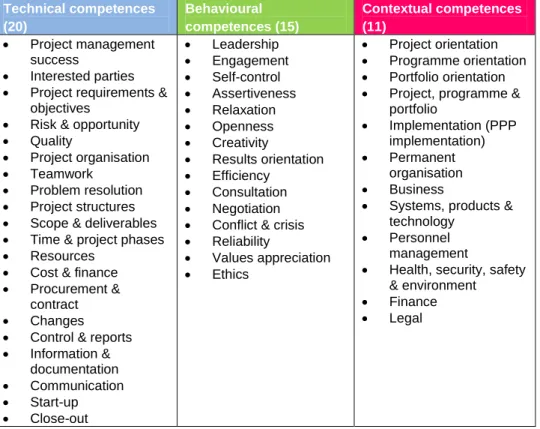
The competence profile includes 46 competences as is shown in Table 1. The IPMA uses this definition of the word 'competence': "A competence is a collection of knowledge, personal attitudes, skills, and relevant experience needed to be successful in a certain function."
Tabel 1 IPMA competentieprofiel
Technical competences (20) Behavioural competences (15) Contextual competences (11) Project management success Interested parties Project requirements &
objectives Risk & opportunity Quality
Project organisation Teamwork
Problem resolution Project structures Scope & deliverables Time & project phases Resources
Cost & finance Procurement &
contract Changes Control & reports Information & documentation Communication Start-up Close-out Leadership Engagement Self-control Assertiveness Relaxation Openness Creativity Results orientation Efficiency Consultation Negotiation Conflict & crisis Reliability Values appreciation Ethics Project orientation Programme orientation Portfolio orientation Project, programme &
portfolio Implementation (PPP implementation) Permanent organisation Business
Systems, products & technology
Personnel management
Health, security, safety & environment Finance Legal
Note: This table only shows the name, not the full explanation.
For the development of the final qualifications of the MPM the ICB 3 by IPMA has been used as a starting point since there is substantial and international support with project managers and because it concerns a relatively recent development which takes into account new trends and developments.
The ICB 3 lacks competences concerning analytical thinking and doing scientific research. These competences are a necessity for a master's degree. This part will be added during the course as a fourth category (in addition to the ICB 3 competences for technical, behavioural and contextual competences).
2
IPMA and PMI are complementary in their work. PMI focuses on project management processes in their Project Management Body of Knowledge (PMBOK). IPMA focuses on competences of project managers in their International Competence Baseline (ICB). That is a more useful approach for an educational institute. Furthermore, IPMA is more orientated towards Europe, while PMI is primarily orientated towards America. 3
Copied from ICB 3, p. 29. The table gives an overview of the titles. See art. 12 OER-HU
2.1.3
Competenties of a beginning professional practitioner
Technical Competences1. The student has consummate knowledge of and profound insight into the most important methods and techniques used in designing and managing (complex, large scale and strategy-critical) projects and is capable of selecting the appropriate methods and techniques to achieve the project’s objectives and goals.
2. The student is capable of successfully managing (complex, large scale and strategy-critical) projects within their context of programs, portfolios, organizations, stakeholders and society, taking into consideration the project’s economic, environmental and social impact.
3. The student is capable of organizing people, capabilities, resources and activities in order to achieve a (complex, large scale and strategy-critical) project’s objectives and goals.
Behavioural competences
4. The student has consummate knowledge of and profound insight into key aspects and viewpoints of managing (complex, large scale and strategy-critical) change and is capable of deciding on and executing appropriate actions to ensure that the project results are effective and durable.
5. The student has the personal, interpersonal and managerial skills to effectively and efficiently manage people and teams of people working in or contributing to projects, while recognizing and respecting different cultures and value systems.
6. The student is sensitive to the organizational, cultural and social-economic environment of the project, has the power of judgment to decide upon the appropriate course of action and has the personal and interpersonal skills to effectively inform, influence and motivate other people and to handle resistance to change.
Contextual competences
7. The student has consummate knowledge of and profound insight into the main strategic drivers of an organization, understands how a portfolio of programs and projects contributes to the strategic goals and is capable of advising an organization on identifying and developing appropriate programs and projects.
8. The student has consummate knowledge of and profound insight into the economical,
environmental and social considerations that can influence an organization’s strategy and activities, is aware of possible ethical issues and is capable of advising an organization on the reflection of these considerations in its (portfolio of) programs and projects.
9. The student can understand, review and contribute to the justification of a project in the context of an organization’s strategic objectives and goals and economical, environmental and social considerations.
10. The student can (also in communication with stakeholder parties and the general public) assess, evaluate and reflect upon the relevance, risks, effectiveness and efficiency of a project, before the start of, during the execution of and after completion of the project and can formulate conclusions with respect to short and long term adaptations and improvements, also with regard to (the further development of) his own competences.
Scientific competences
11. The student is capable of planning and conducting scientifically based research.
12. The student is capable to develop authentic research based contributions to the body of knowledge on project management.
2.1.4
Graduate skills
Please, see par. 2.1.3 See art. 12 OER-HU
2.1.5
Field of work and employment fuctions
Students will be trained to become strategic project managers. The relevancy and urgency of project management is increasing in most, if not every, industry of our society. Within the master there is no specific focus on a working field. To create a meaningful and rich learning context, we expect that students can reflect on and give input from their work field.
See art. 12 OER-HU
2.2
Profile of study profile
2.2.1
General
See section 2.1.1.
2.2.2
Study programme objective
In the foundation of the master Project Management lays the educational concept of competency based learning. Managers, lecturers and students work on their development through the following basic principles:
A. The learning process of the student is the focus.
The students are being coached in their development – and learning process. The master provides learning tools to facilitate these processes.
B. The student is responsible for his own learning process.
The level of independent learning will increase during the programme: the student becomes the manager of his own development – and study process.
C. The learning organisation
Because of the constant changes and increasing complexity of professions, study programmes have been developing too. An innovative attitude is expected from students.
D. Realistic tasks. The programme offers realistic tasks. Assignments have a clear connection with the work field.
See art. 12 OER-HU
2.2.3
The HBO (‘Higher Vocational Education’) Master’s level of the study
programme
The task of the HU is to educate you, as a student, for a position of employment at ‘HBO’ (Higher Vocational Education) Master’s level. That is why, as a graduate, you need to possess a large number of competencies based on the profession profile, to the required standard. In order to determine the level of professional expertise, the following four interrelated criteria are applied:
Technical Behavioural Contextuel
Scientific competences See art. 12 OER-HU.
2.2.4
Teaching: principles
All the study programmes at the HU are constructed according to a competency-oriented teaching model. A competency is the combination of knowledge, skills, and attitudes that are needed in order to perform a task in a particular professional context.
As far as the teaching we provide is concerned, this means the following:
Teaching is aimed at acquiring professional competencies: gaining knowledge, skills and attitudinal aspects in a cohesive manner with which professional tasks can be performed in or outside the Netherlands, in an international context;
For you, as a student, learning is an activity with a clear goal, so the teaching stimulates active and independent study;
Your lecturers support and coach you in your learning process, and are experts on the substantive aspects of a particular competency field;
The learning takes place as much as possible in realistic learning environments, in which learning tasks resemble professional tasks. Modern media are used;
The teaching is based on the concurrency principle (i.e., education and concurrent employment). Learning moments in the programme and in the practical professional field benefit each other; Learning is a social and interactive process that you never undertake on your own. For that
reason, you spend a lot of time on your programme working with others – students, lecturers and professionals from the field. In order to determine to what level you have mastered the
competencies, you take exams periodically. The exams are marked, and this gives you an idea of how far in the learning process you have come.
The programme highly values scientific research. Training in research skills is an important part in the curriculum.
The curriculum is given as a blended model of:
Classroom teaching (lectures, instruction, work and responsive classes). These classes give students the opportunity to gain knowledge from hearing the lectures, but also to exchange knowledge between students. This is an important tool because the expertise and experience of teachers and students is often ahead of the consolidated insights from literature. The lecture is one of the most suitable methods for timely and in context knowledge.
Assignments (individually and in groups); this includes: - Assignments to be done in school.
- Assignments to be done within the organisation the student is currently working or within another organisation.
Individual coaching and reflection. The course supplies coaching and guidance of students doing the Project management skills course. For this course behavioural competences are the most important and these are the ones that require guidance and reflection. The professors are available to answer questions about the assignment.
Working in an electronic environment. The course will supply a MS SharePoint site in which information about the course, schedules, material for the course, literature, web links, discussion boards, glossaries, etc. can be shared. Consultation, working together and feedback is possible without the need of face-to-face appointments.
Often, the education will be offered as an 'integrated approach', through means of working on projects in relation to the working environment of the student. This way students will be able to learn in a more efficient way. As a result, the working environment of the student will see a direct beneficial effect of the course. This mean that the working environment of the student must meet certain requirements; the intake procedure will check this.
2.3
Organization of the study programme
2.3.1
Programme tracks
You can take your study programme on a part-time basis.
Part-time programme
‘Part-time’ means studying for a limited number of days every week and/or in the evenings. The part-time programmes focus heavily on what you are learning in your professional field in parallel to your studies. To be eligible to this programme the student must hold a bachelor degree and at least two years of relevant working experience. Also the current job has to provide a dynamic work area, where assignments can be conducted.
See art. 14, 15, 17 and 20 OER-HU.
2.3.2
Abridged and accelerated study programme routes
Abridged versions are possible for those who have obtained exemptions for parts of the curriculum. For more information about exemptions, see Section 4.2. Accelerated means that you take the programme at a quicker pace (planned).
Students who successfully finished the post-hbo Project Management of the HU, may qualify for exemptions within the Master Project Management.
The study post-hbo Project Management, a one year programme, consists of five courses: - Fundamentals of Project Management
- Advanced Methods of Project Management - Leadership and Teamwork
- Program and Portfolio Management - Project Management Skills
The courses ‘Advanced Methods of Project Management’, ‘ Leadership and Teamwork’ and ‘Program and Portfolio Management’ are the same courses as in the master of Project Management.
As proof that you have completed the post-hbo programme you will receive a (CIPION) certificate. The Master Project Management has no fast-track option.
2.3.3
Certificates
As proof that you have completed the Master’s programme, the Board of Examiners issues you with a diploma, the Dutch legal term for which is ‘getuigschrift’.
The diploma is signed by the chairman and a member of the Board of Examiners. A European-model International Diploma Supplement (IDS) is added to the Master’s diploma and the AD. The process involves no costs. The IDS provides information on the nature and the substance of the study programme and lists the results obtained by the graduate. This makes it easier for ‘outsiders’, including those from abroad, to appreciate what the study programme and diploma entail.
For each study programme, you receive just one. See section 5.1 for the procedure by which diplomas are issued.
If you have successfully completed more than one exam but you have not attained a degree because you have not completed the entire examination programme, you can ask the Board of Examiners to issue a declaration listing the exams that you have passed. Like a diploma, the declaration is signed by the chairman and a member of the relevant Board of Examiners.
2.3.4
Degrees and titles
If you successfully complete a Master’s degree programme at the HU, you will earn a title, as well as a degree. The degree is granted by the Board of Examiners on behalf of the Executive Board. A degree confers the right to bear a title – Master in the case of a Master’s programme. The subject or field in which the degree has been obtained is added to the degree title.
The awarding of a Master’s degree (Master of Project Management) confers the right to list it after your name, abbreviated to ‘MPM’
See art. 34 OER-HU.
2.3.5
Structure of the study programme
Legal duration of study, study load, and study creditsThe study load of the programme and its related courses is expressed in study credits (ECs) in accordance with the European Credit Transfer System (ECTS), which is designed to make it easier to compare study programmes internationally. One EC corresponds with 28 hours’ of study (including contact hours). The total duration of the programma is two years. Each academic year is divided into four blocks of nine weeks.
The lectures are given on Tuesday afternoons and evenings. No lectures will be offered in week eight and nine of a block; these weeks are reserved to finish off projects, papers or examinations, etc..
In each block two specific courses (six contact hours in total) are been offered and a single lecture in Project Management Skills and Sustainable Project Management. These last two courses (combined 12 hours) have a linking-function to all other courses in the programme and will be offered the entire programme. The study burden is approximately 20 hours a week, including 7.5 contact hours. During the thesis period the study burden is considered higher.
The Master Project Management has two specialized routes: Strategic Project Management
Construction Project Management
Grey: Common courses
Blue: Specialization Strategic Project Management
Yellow: Specialization Construction Project Management2.3.6
Programmes
In each academic year, the programme department sets the curriculum of both the study programme as a whole and its components. This study programme is valid only in the year for which it is set.
The preliminary year courses are shown below, and include the number of EC that they are worth, and the OSIRIS code.
You can find a detailed overview and descriptions of the courses at the back of this Study Guide and in OSIRIS (www.osiris.hu.nl). Competence domain Subcourses EC OSIRIS-code Technical competences
Advanced methods of Project Maganagement
Structured Project Management Project Planning and
structuring
Risk and Opportunity Management
15
MMPM-TECHCOMP-10
Behavioral competences
Stakeholder Management & Project Governance Project Management Skills Management of Change
15
Leadership & Teamwork Contextual
competences
Strategic Management Management
Program & Portfolio Management
Budgeting & Business case Management Sustainability in Project Management 10 MMPM-CONTCOMP-10 Scientific competences
Research Methods and techniques
Thesis
20
MMPM-SCIECOMP-10
2.3.7
Internships and value of internships
An internship is not part of the programme of this programme.
2.3.8
Graduating
Studying at the HU involves concluding your programme with a graduation exam, which you can only pass if you have met the final achievement levels of the programme. The graduation exam consist of writing a dissertation and a public presentation and defence. Exemptions are never granted for this graduation exam or any part of it. In other words, anyone wishing to obtain a diploma must successfully complete the graduation exam.
In culmination of your studies in the Master of Project Management you have to conduct some research on a topic that is related to your work environment, but which is also related to the research lines of lecturers and researchers that are involved in this programme. This research is referred to as the ‘Thesis project’, or ‘Thesis’ for short.
During the research period you will learn more about the practice and the topic of your interest. Besides acquiring knowledge you will develop skills as a researcher and make a contribution to the field of knowledge about this topic. Finally you have to defend this thesis. At which your work will be assessed to determine if these goals were achieved.
The purpose of the thesis can be described from five perspectives: 1. Client Solving of a practice related problem
2. Student Further development of master competencies 3. Training Testing your master competencies
4. Professional field/practice Creation and dissemination of new knowledge 5. The institution Contribution to the knowledge area
Out of these perspectives three main themes stand out. These will be briefly explained.
Relevance for Practice
In the thesis you will address a problem/question from the world of practice. It might very likely be an issue for which there is no obvious and/or standard solution. It is expected that the results of your investigation should be relevant and useful for practice. Results of such a study could be recommendations, a new model, a new method etc.
Notwithstanding the relevance to practice; the study still needs to meet the criteria for scientific research of the highest quality.
Competencies
Even though you have had time to develop your masters competencies in all the separate modules of this programme, the thesis allows you to demonstrate, in a more complex environment, your
level of competence in this knowledge area as a whole. The thesis, its presentation and its defence are also therefore assessed on these competencies. During the whole thesis project the
competencies that are relevant for the conduct of research are developed further and are demonstrated in the thesis and the defence. These competencies include research methods as well as competencies in dealing with the relevant literature. In addition you also develop the ability to demonstrate a reflective, quality conscious and independent approach to research.
Knowledge Development
The practical problems that you have to address in your research not only requires you to apply existing knowledge and solutions in the world of practice, but also requires you to develop new knowledge. This can also include procedural knowledge that has not yet been applied in a certain way in a certain situation. It would then be useful to know if this implies an improvement in practice. This kind of knowledge development is often crucial for the organization, and will allow the
organization to perform better.
The knowledge you create must therefore be useful for the client or initiator of the project, but also for your fellow professionals. That means that it must be possible to generalize the knowledge. In terms of knowledge sharing this therefore means that there is the ambition that your results should
be publishable in a specialist journal or academic journal.
For more information about the exam and the diploma, and for unenrolling after graduation, see Section 5.1.
Digital submission and publication of theses and research articles
The HU is one of the Institutes of Higher Education that is actively involved in the HBO Knowledge Base, in which publications such as theses and research articles produced in these institutes are made available in digital form to any interested party anywhere in the world. Conversely, they can also be of use for those involved in teaching and research. If you obtain a mark of 7 (out of 10) or higher for your thesis, then you may have it digitally published on the HBO Knowledge Base free of charge. One important precondition for this is that the company where you worked on your internship agrees, and that your thesis does not contain any confidential information.
For more information, go to www.hbo-kennisbank.nl
2.4
Board of Examiners
2.4.1
Establishment and appointments
Every study programme at the HU has a Board of Examiners, organized at Institute or Faculty level. The Board of Examiners supervises the quality of testing and is the body that issues diplomas. The Boards of Examiners reach their decisions independently of the management of the study programme.
The faculty has Boards of Examiner for the following programmes or groups of programmes: Institute for Business Administration
Institute for Business Economics Institute for Marketing of Commerce
FEM Masters ( a joined exam board for all master programmes of the FEM)
2.4.2
Composition
Every Exam Board is made up of at least three members, namely a Chairman, a Vice-Chairman and one or more members. The members of the Exam Board are appointed by the Faculty Board. The Exam Board can be contacted by e-mail [email protected]
The members of the Board of Examiners for our FEM master programmes are: - Mr. P. Breman Chairman
- Mr. M. Geerdink vice- chairman representative Master Facility & Real Estate Management
-
Mr. H. Duits representative Master Accounting & Auditing-
Ms. B. Pasian representative Master Project Management-
2.4.3
Powers and responsibilities
The powers and responsibilities of the Board of Examiners are laid down in Chapter 4 of the HU Teaching and Examination Regulations for Master’s programmes and in the HU Board of Examiners Faculty Regulations.
Among the responsibilities of the Board of Examiners is to ensure that the rules relating to teaching and exams, as laid down in the HU Teaching and Examination Regulations for Master’s programmes and study guides are correctly implemented. In addition, the Board safeguards the quality of the exams, gives advice with regard to policy formulation, appoints examiners, grants exemptions, and awards diplomas.
In addition to the frame of reference in the previously mentioned regulations, the Board of Examiners may also lay down rules with regard to:
Procedures during written exams (examination regulations); Invigilation during written exams (instructions to invigilators); Procedures during oral exams (examination protocol); Setting and assessing exams (examination guidelines);
Imposing penalties for irregularities (fraud procedure), including declaring exam results invalid.
2.4.4
Petitions
The lecturers/examiners and the Board of Examiners implement the rules contained in the HU Teaching and Examination Regulations for Master’s programmes and in the Study Guide. If you believe that a deviation from the rules should be applied in your case – an extra opportunity to sit an exam, for example, or a different exam schedule – then you may submit a petition to the Board of Examiners, but be sure to do so in time. For example, if you would like to sit an exam during a forthcoming exam period, you should remember that the Board of Examiners will require a period of three weeks in which to deal with your request.
All petitions must be accompanied by the following information: a. Your name, address, and student registration number; b. Date;
c. Your request, and the reason for it;
d. The study programme and type (full-time, part-time, dual) for which you are enrolled and - if applicable - the course code of the course to which the petition relates;
e. Any documentary evidence. Do not forget to sign your petition.
Please note! Additional rules apply to requests for exemptions – see Section 4.2.
There is a difference between a request and an objection or appeal. You should submit a request if you wish to obtain a decision from the Board of Examiners.
If you do not agree with a decision of the Board of Examiners, you may lodge an objection (and appeal). The latter works as follows:
You submit an objection no more than two weeks (the time limit for objections) after you have received the decision of the Board of Examiners, directly to the Board of Examiners or via the legal protection office of the faculty;
The general principle is that the Board of Examiners must reach a decision within two weeks of receiving the objection;
If you do not agree with the decision on your objection, you have the option of appealing against it. You should do this through the HU Legal Protection for Students office. Appeals are dealt with by the Board of Appeals concerning Examinations. The period during which an appeal may be lodged is six weeks after you receive the decision on your objection from the Board of Examiners. For more information on submitting an objection or appeal, see Chapter 7 or go to
www.klachtenwegwijzer.hu.nl.
2.5
Facilities
2.5.1
Supervision
In our master’s PM coaching and guiding is done by:
- The possibility to hand in concept papers and proposals - Specific guidance during dissertation.
- The possibility to ask for extra guidance at the course director.
The course director of the Master’s in PM is also your first contact person to discuss your study progress. See art. 16 OER-HU.
2.5.2
IT facilities
2.5.2.1
General
The HU provides a number of standard IT facilities, which you can access using your HU user name and password. You will receive these by e-mail, shortly before you are due to start your studies, after which you will be able to log on to:
Your own e-mail address (www.nieuwemail.hu.nl;
The computers at the HU. You can also use the wireless network inside the HU buildings to log on to your own laptop (Eduroam, www.eduroam.nl);
The online catalogue of the media centre (www.catalogus.hu.nl); The HU intranet (www.sharepoint.hu.nl);
Your own space for storing files (SharePoint, My Site); OSIRIS Student (www.osiris.hu.nl);
A number of public sites, such as Surfspot (www.surfspot.nl). You can use this to buy hardware and software at reduced rates.
More information about the IT facilities and current developments can be found on the IT website (www.ict.hu.nl).
2.5.2.2
Student mail
Students at HU are given their own e-mail address. This is an important channel of communication for keeping you up to date with the latest information regarding your study programme; in fact, it is the only communication channel that is used for this purpose. Your mailbox can be accessed via
www.nieuwemail.hu.nl, using your HU user name and password. It is your responsibility to check your HU e-mails on a regular basis.
You can also use your student mail to contact your fellow students and lecturers. Every e-mail address can be found in the address book, and there is also a diary, a to-do list, and a list of contact persons. In addition, you can have mail automatically sent to your private e-mail address, and of course it is possible to synchronize your mail, to-do list and contact persons with your mobile or Smartphone.
2.5.2.3
SharePoint
At the HU, we work together digitally using SharePoint, but SharePoint is also used to provide information. In addition, more and more systems at HU use SharePoint to give users access to information. SharePoint works with Microsoft Office, which makes it easy to work jointly on documents, presentations or
spreadsheets. Intranet
The HU intranet contains information from every faculty, institute and HU service department. All information relating to education and the organization can be found here.
Your study programme’s intranet contains links to courses, notifications and diaries for the HU, the faculty and your study programme, which lecturers are off sick and of course the latest news. Portfolio
In order to provide optimum support for your study career, many study programmes make use of a portfolio. This portfolio is also digitally supported by SharePoint.
Courses
Many of the courses that are supported digitally have their own space on SharePoint. The use of these sites can vary from the exchange of information – such as PowerPoint presentations by lecturers – to working in collaboration with your fellow students on projects or assignments. MySite
MySite is a personal page on SharePoint. You can use it to keep files that you can open and alter both at home and at the HU. You can also create workspaces where you can work either by yourself or with other students on projects, papers, or assignments. In addition, you can create a blog with which to share your knowledge with others.
2.5.2.4
OSIRIS Student
OSIRIS stands for ‘Onderwijs en Studenten Informatie, Registratie en InschrijfSysteem’ (teaching and student information, records and enrolment system). The HU uses this system to record students’ progress – it contains your details, exam results, and information on which exams you have enrolled for.
Every student can access OSIRIS via www.osiris.hu.nl. Once you have logged on, you can use the following basic functionalities:
View your exam results
Using the ‘Resultaten’ (results) tab, you can see the marks you have gained for your last 15 exams (including interim exams), and there is a statistical overview of the average marks achieved for each exam. If you would like to view all your results in the current academic year, click on the ‘Voortgang’ (progress) tab. Under ‘Dossier’ (file), you will find an overview of all your results from throughout your time at the HU. You should check the results as soon as they are online, and report any errors within four weeks of their being uploaded to OSIRIS to the examiner whose name is listed alongside the result in question, or to the Board of Examiners.
Study progress
If you would like to know which subjects you still need to do before being able to graduate, go to the ‘Voortgang’ (progress) tab. Under the ‘Studievoortgang’ (study progress) heading, select your study programme and indicate that you would like to view your ‘nog te volgen onderwijs’ (lessons still to be completed). OSIRIS will then compare your results with the curriculum, and will highlight which parts of the programme you have completed, and which you still need to do.
Applying for exemptions
You can fill in an application form for exemptions under ´Studievoortgang – vrijstelling aanvragen´ (study progress – applying for an exemption). Your curriculum will then be displayed; this serves as the basis for your exemption application, to be completed on the relevant form which you can then print off. More information about granting exemptions can be found in Section 4.2.
Exam and course information
Information about exams/tests, courses, and optional courses, and on how to enrol, can be found in OSIRIS.
Enrolling for courses and exams
Using the ‘Inschrijven’ (enrolment) tab, you can select with the help of a simple wizard whether you wish to enrol for a course or an exam. This means, for example, that you can choose from the courses from the compulsory part of your curriculum, or look for a course from the complete range on offer at the HU. Information about the enrolment period can be found in Section 4.3.3 of this Study Guide, and more details about enrolment are given in Section 3.2.
Enrolment overview
If you would like to know for which courses and exams you have enrolled, go to the ‘Inschrijven’ (enrolment) tab, and look under the ‘Overzicht inschrijvingen’ (enrolment overview) heading. The overview only displays the courses and exams that are being given at present or in the future.
Confirmation of enrolment
It sometimes happens that you think you have enrolled correctly for a course or exam, but there is no record of this in the relevant administration. To prevent this situation from arising, you receive a confirmation e-mail in your HU account each time you enrol. You should therefore always check that you have received this notice, and be careful not to delete it.
Unenrolling from courses and exams
If you have enrolled for a course or exam and now wish to unenrol from it, click on the ‘Uitschrijven’ (unenrol) tab. Check the components (courses or exams) from which you wish to unenrol, and select unenrol. Unenrolment from a course or exam is only possible during a set period. You will receive a confirmation e-mail of your unenrolment. Be careful not to delete it.
Amending your personal details
Use the ‘Personalia’ (personal details) tab to enter your change of address and to upload a passport-sized photograph. This will be used for your student identity card, a new version of which will be sent to you every year. If any of the information in the personal details section is incorrect, you should contact the Enrolments Office. Changes of address can also be entered via Studielink.
E-mail notification of results
If you click on the ‘Aanvullende informatie’ (additional information) link, you can sign up to e-mails every time you receive a result. If 'E-mail resultaten' (e-mail results) is set to 'Aangemeld' (signed up), you will receive an e-mail whenever a result is entered into OSIRIS. If you have it set to 'Afgemeld' (not signed up), you will not.
2.5.2.5
Password
Your HU password expires after a period of time, and you will receive an automatic request to enter a new password. This can be done from any workplace at the HU. You can also change your password from home via www.wachtwoord.hu.nl. The new password must consist of eight characters and contain both letters and numerals. You can also use this website to reset your password in case you have forgotten your old one; a one-off text message containing the new password will be sent to you.
If you have any questions or need assistance in relation to your password, go to the Student Desk (see Section 2.5.3) or the www.ict.hu.nl website.
2.5.2.6
Information security and privacy
The HU attaches a great deal of value to information security. We have applied measures to our entire infrastructure to ensure the maximum possible protection from misuse of the data at HU. In addition, there are rules with regard to the use of the computers and the HU network – these are contained in the IT code of conduct (see www.reglementen.hu.nl). You are expected to know and adhere to these rules. As a user, you can also take steps to improve security:
do not leave any computer you have logged into unattended; do not tell anyone else your password;
remove immediately letters and lists containing confidential information from the printer; mail any questions or comments regarding the topic of confidentiality to
The HU also has privacy regulations based on the Dutch Data Protection Act, which deals with the protection of personal information. The regulations describe, among other things, what information is confidential and what rules apply with regard to how it is used. The www.ict.hu.nl website has more information on this.
2.5.2.7
Recording your study progress
Your study results are recorded in the HU digital study progress system, OSIRIS. See Section . Study progress is expressed in study credits in accordance with the European Credit Transfer System (ECTS). For each course that you conclude with a pass, you will be awarded the EC available for that course. No EC are awarded for interim exams. See also Section 0.
2.5.3
Student desk
You can use the Student Desk for all kind of questions, like: Questions about the organisation
Making appointments with student counsellors; Complaints via Tips & Dips 088 – 481 62 40
You can call the Student Sesk on 088 – 481 62 01 or e-mail [email protected] You can also consult information at the Student Desk’s informationsite on the Intranet. Ther you can also consult answers to frequently asked questions (FAQ’s).
Student desk opening hours:
During teaching and organisation days: Monday to Friday from 9.00 to 16.00;
During vacations: daily from 10.00 to 12.00 and 13.00 – 15.00. with the exception of days of obligation (see 1.2.7.), during the summer vacation: daily from 10.00 to 12.00 and from 13.00 to 15.00;
During test days: daily from 30 minutes before the start of the first exam until 30 minutes after the start of the last exam.
For specific questions regarding the master’s programme in F&REM you have to contact the Master office of the Centre for Business and Management.
2.5.4
Study association
The aim of study associations is to help you enjoy your time as a student as much as possible. Study associations not only organize fun and social activities, but they also help you become involved with your programme, the HU, and your future professional field. The study associations at HU are united in the
OSHU umbrella organization, which represents the interests of the various associations across the HU. For more information, go to the OSHU website: www.oshu.nl
2.5.5
Programme committees
Each study programme also has a programme committee. In some cases, several study programmes are represented by the same programme committee, in which case it is known as a Joint Programme Committee. The committees are advisory bodies to the institution management, advising on such matters as the content of lessons, study progress advice that is given and the practical components of study programmes. The programme committees include students among their number. If you have a good idea for improving your study programme, be sure to let the programme committee know!
If you would like to become a member of your programme committee yourself, you can stand as a candidate at the next elections. You can get more information from the coordinator for administrative participation by students, who can be reached at [email protected]. The coordinator also provides support for the programme committees.
2.6
Contact details
The programme manager of the Master Project Management is ms. Thuy-Vy Nguyen, Msc. Her contact details are:
T: 088 481 6319
The master office, part of the Centre for Business & Management, is responsible for the complete organization of this master programme.
The master office can be reached at [email protected] and by phone at + 31 6 380 60 666 The (general) contact details for the Centre for Business and Management are: [email protected] and +31 88 481 6840
3
Courses
3.1
Course participation
Your study programme curriculum is composed of ‘teaching units’, or courses. A course is a cohesive whole of the knowledge, insight, and skills to be acquired by the students, with a study load expressed in EC. Each course is concluded with an exam.
Every course is listed at the back of this Study Guide, and they are all published in OSIRIS
(www.osiris.hu.nl) before the start of the academic year, as well as in the course descriptions in Section 3.5.
3.2
Enrolling for courses
You can only take a course if you have enrolled in OSIRIS (www.osiris.hu.nl) on time. If you are not correctly enrolled, you will not be able to take the course. It is possible to enrol (and unenrol) up tot wo weeks before the start of the period in which the course lessons take place. If you have enrolled for a course, you will be automatically enrolled for the first regular exam following the course. Should you not wish to take this exam, you can unenrol yourself from it up to one week after the latest enrolment date for the exam. See Section 4.3.3.
The master office is responsible for enrolling you for the courses and exams in OSIRIS on time.
3.3
Obligation to attend
It is very important for the sake of your study progress that you attend every lesson. You not only learn from your lecturer, but also through interacting with your fellow students. Year in, year out, it has been shown that students who attend every lesson perform better in their studies and complete their programme more quickly. For some courses, attendance is compulsory: this is stated in the course descriptions. See Section 3.5
3.4
Entry requirements
Every course is subject to certain entry requirements - see the course descriptions in Chapter 10. If you do not meet these requirements, you may not take the course unless the Board of Examiners has given you permission to do so. For more information about the procedure for applying for such permission, see Section 4.2.
In masters Project Management there are no specific entry requirements for the courses in the programme, except for the public defense of the thesis. The student must have passed all other courses of the
programme before he will be allowed defend his thesis
3.5
Course descriptions
The descriptions of the courses in your study programme, which contain all relevant information, are listed at the back of this Study Guide.
See art. 14 en 15 OER-HU.
4
Exams
4.1
Introduction
ExamsEach course concludes with an exam, designed to test your knowledge, insight, and skills. An exam may take the form of a test of the professional attitude of a student. The primary purpose of an exam, including group-based exams, is to compare what individual students have learned with the set objectives of the course. The Board of Examiners appoints the examiners who will set and mark the exams, and enter the results into OSIRIS. An exam can be split into up to two interim exams per unit worth 5 EC. In other words, a course worth 5 EC may have a maximum of two interim exams and one worth 15 EC may have up to six. An exam pass is defined as one for which a mark of 5.5 (out of 10) or more has been awarded – marks are rounded up to whole numbers (see Section 4.4.1). If interim exams have been held, the exam as a whole is deemed to have been passed only when every interim exam has been taken, and when their collective results are sufficient for a pass. The course descriptions detail the weightings given to each interim exam, including any interim exams for which a minimum mark must be obtained.
Exams
Every Master’s study programme has an Final exam. To pass this exams, you must fulfil the preset norms. This means that all the exams for the relevant stage of study must have been passed, and all the required ECs obtained.
As soon as you have completed the programme, the Board of Examiners will assess your results at their next meeting. If you have passed and have complied with all the other obligations in relation to the study programme, then the Board of Examiners will award you a diploma. Procedural rules apply here: see Section 5.1.
4.2
Exemptions
The Board of Examiners can grant you an exemption from exams and interim exams. This means you do not have to take the course in question and that you will be awarded the study credits that go with it. By law, an exemption may only be granted if you are enrolled at the HU.
The HU has decided only to grant exemptions on the basis of exams that the student has already passed, as follows:
- previous education, on the basis of which you were admitted to the study programme; - exams that you passed that formed part of an accredited study programme;
- exams during a study programme, the quality safeguards of which are comparable to those of the accreditation system (see below). This is especially important in the case of foreign study programmes.
In the Netherlands, ‘accredited’ means the study programme in question has been subjected to an independent external audit by the Accreditation Organisation of the Netherlands and Flanders (NVAO). In practice, every HBO and WO study programme for which you can enrol via Studielink meets this criterion. If other study programmes are involved, primarily those from other countries, the Board of Examiners will investigate whether the quality of the programmes is safeguarded in a similar manner.
The HU therefore does not grant exemptions for work experience. However, if the study programme offers this possibility, you can ‘cash in’ the work experience you have gained by having it tested in an exam. It is also possible to have professional products you have made while working considered for your study programme, which may give you the opportunity to accelerate your learning track. For more information about learning track-independent testing, see paragraph 4.3.1.
If you wish to be considered for one or more exemption, you must submit a request to the Board of Examiners stating your reasons. This request must be signed and contain the following details:
a) your name, address and student number;
c) if possible, supporting documentation demonstrating the content of the course(s) taken (e.g. a course description or course guide showing the knowledge, skills and competencies tested);
d) if possible, which course(s) the exemption is being requested for;
e) an authenticated copy of the diploma with a list of marks or an authenticated certificate of exams passed previously.
Exemptions are valid for six years and are granted by the Board of Examiners on the basis of the procedure listed in Article 31 of the HU Teaching and Examination Regulations for Master’s programmes 2013-2014. In exceptional cases, the Board of Examiners may deviate from the six-year period. You must submit any request to this effect to the Board of Examiners. See Section 4.2. for general information about the procedure for requesting exemptions.
Discuss first with your course director whether it makes sense to apply for an exemption. Requests must always be accompanied by written documentary evidence (diploma, list of marks, declaration, etc.). Within the HU, exemptions are only now granted for previous education. (For requirements, see paragraph 4.2). Exemptions are therefore shown in OSIRIS as ‘VRY-O’ (on the basis of previous education). In previous years, when it was still possible to grant exemptions on other grounds, other codes were also used: ‘VRY-A’ (on the basis of an assessment of a certified RPL agency), ‘VRY-E’ (on the basis of knowledge and skills acquired elsewhere without an RPL assessment), or VRY (unspecified). De vrijstelling blijft buiten beschouwing bij een eventuele berekening van een gemiddelde. See art. 31 OER-HU
4.3
Organization of exams
4.3.1
Duration and form of exams
The purpose of exams is to test and assess the work you have done in your studies. This can take different forms, the most common of which are:
exams with closed questions; exams with open-ended questions; exams with multiple-choice questions; papers or other forms of written assignments; portfolios;
reflective reports;
creating and/or giving a presentation or carrying out a task; an oral exam.
The course descriptions (chapter 10) indicate whether or not an exam can be taken without your having taken the course. This is important if you believe you already possess the relevant competencies as a result of work, other experience or a non-recognized form of schooling. As mentioned above (4.2), the HU only grants exemptions on the basis of previous schooling, and not on the basis of other forms of
experience. However, by taking an exam for which no attendance on the preceding course is necessary, you can ‘convert’ your experience into something tangible and accelerate your progress in the study programme.
The examiners set the assignments, questions and assessment criteria and ensure (together with others who are involved with the exam) that the required secrecy is observed until the candidates have been given the questions.
The amount of time available for each exam is given in OSIRIS and on the question paper, and is also announced by the invigilator.
In exceptional circumstances, exams may be extended or curtailed. See art. 23 OER-HU.
4.3.2
Exam timetable
Most exams are given during the exam period at the end of the first and second term. The master office will inform you of your exam timetable (possibly as part of the semester timetable). The timetable will be published no later than four weeks before the start of the exam period via the notice boards and OSIRIS (www.osiris.hu.nl). You can use your yearly timetable to see in which term certain courses are concluded. Exam retakes are timetabled for the last two weeks in August, just before the start of the next academic year (which starts on 1 September).
The exam timetables give exact information on which day, at what time, and in which room the exams (or retakes) are being held.
See art. 23 OER-HU.
4.3.3
Enrolling for and taking exams
Enrolling for examsYou may only take an exam if you have enrolled for it in OSIRIS (www.osiris.hu.nl) in time. If you are not enrolled correctly, you may not take the exam.
If you have enrolled for a course, you will be automatically enrolled for the first regular exam that follows it. If you do not wish to take the exam, you must unenrol from it no more than one week after the latest enrolment date. If you are enrolled for an exam but do not actually take it, your result will be recorded as ‘NA’ (‘not present’) in ORISIS. This is treated as an exam result, which means you will only have one more opportunity to sit the exam. Enrolling for exams that do not take place immediately after the course (that is, the retakes) is your responsibility.
Number of exams / Retakes / Replacement assignment
The number of times that an exam is held in one year is expressed in exam sittings. The number of times that a student may take the same exam is expressed in exam attempts.
During the academic year, there are multiple dates for each course on which you may sit the exam. To find out when these dates are, see OSIRIS. And even for some courses there is only one exam sitting, because the nature of the course is such that a retake is not reasonably possible in the same academic year. For each course only one resit is allowed during the same academic year. And a resit is only possible when you did not pass the exam and were granted with a mark lower than 5.5
Taking a resit annuls all previous results obtained for the exam in question.
If you have run out of attempts at passing a particular exam, and have not yet passed it, you may request the Board of Examiners to grant you an extra attempt in the following circumstances.
Events beyond your control
If you are unable to take an exam because of events beyond your control, you should ask the Board of Examiners for an extra attempt at taking the exam. ‘Events beyond your control’ refers to one or more of the following:
Illness;
Pregnancy;
Exceptional family circumstances;
Other situations, to be assessed by the Board of Examiners.
The programme may also grant an extra exam attempt if it forms part of a policy aimed at students who have fallen behind with their studies (or who are likely to do so).
Students more than three months behind schedule with their studies
Students who:
a. have taken the exam at least once, and
b. who look likely to fall behind with their studies by at least three months; may submit a request to the Board of Examiners for an extra exam attempt.
Exam sitting in the event that a course is altered or replaced
The name, form, or substance of courses and exams may change or be replaced from one year to the next. In the academic year after any such change or replacement, two exam sittings will take place based on the old course.
As well as an extra exam attempt, you may also ask the Board of Examiners for a replacement assignment. This means that you take the exam in a form other than the regular version. The Board of Examiners may grant such a request if;
a. you have the right to an exam attempt, and
b. you have already taken the regular exam at least twice, and
c. a lecturer of the subject has given a positive recommendation regarding your request, and
d. you are likely to fall behind schedule in your studies by at least three months.
The Board of Examiners will also give permission for a replacement assignment if the student is unable to take part in a compulsory introduction, excursion or work week as a result of events beyond his or her control or personal (including financial) circumstances.
See art. 23, 24 en 25