E
XTERNAL
S
HOCKS AND
B
ANKING
C
RISES
IN
D
EVELOPING
C
OUNTRIES
: D
OES THE
E
XCHANGE
R
ATE
R
EGIME
M
ATTER
?
C
HANDIMA
M
ENDIS
CES
IFO
W
ORKING
P
APER
N
O
. 759
C
ATEGORY6: M
ONETARYP
OLICY ANDI
NTERNATIONALF
INANCEA
UGUST2002
An electronic version of the paper may be downloaded
• from the SSRN website: www.SSRN.com
CESifo Working Paper No. 759
E
XTERAL
S
HOCKS AND
B
ANKING
C
RISES IN
D
EVELOPING
C
OUNTRIES
: D
OES THE
E
XCHANGE
R
ATE
R
EGIME
M
ATTER
?
Abstract
This paper examines some determinants of banking crises in developing economies. Specifically, the effects of terms of trade shocks and capital flows are analyzed. The choice of the nominal exchange rate regime is found to be a crucial factor in the way various shocks are transmitted through the monetary sector. A logit model is used on panel data and preliminary results indicate that countries with flexible regimes were able to lessen the impact of external shocks on the domestic economy. This in turn reduced the likelihood of banking crises.
JEL Classification: E42, E51, G21.
Keywords: banking crises, shocks, exchange rates.
Chandima Mendis 1601 18th St, NW, Apt. 1007
Washington DC 20009 U.S.A.
1. Introduction
The causes and consequences of banking crises have regained prominence after the recent wave of financial and banking crises in emerging economies. A number of internal and external factors, such as capital flows, terms of trade shocks, institutional strength and appreciations of exchange rates have been identified in the literature as contributory factors. While factors such as interest rates, stock market crashes and public confidence could
seriously affect the performance of a banking system, the type of exchange rate regime could also be a major determining factor in the way external shocks are transmitted to the banking sector. This is particularly important in small open developing economies, which are heavily dependent on volatile primary product exports and foreign capital and where large negative shocks have the potential to create banking crises.
This paper empirically focuses on the link between external factors and the incidence of banking crises in developing small open economies, (SOEs). Major banking crises over the 1970 to 1992 period are identified from existing case studies. Using theoretical priors from the literature, principal factors that may lead to banking crises in these economies are modeled in a logistic framework. Particular emphasis is placed on the occurrence of terms of trade shocks, capital flows, bank lending and how they affect economies under different nominal exchange rate regimes.
The remainder of the paper is organized as follows. Section II discusses the theoretical literature. Section III analyzes case studies from the literature and the
methodology used to define crisis episodes. Section IV explains the econometric model and Section V conducts the estimation. Section VI concludes the analysis.
II. Literature on Banking Crisis
We begin by defining a banking crisis, with some commonly cited examples: “..liquidation of credits that have been built up in a boom. '' Veblen [1904] `”.. a sharp reduction in the value of banks' assets, resulting in the apparent or real insolvency of many banks and accompanied by some bank collapse and possibly some runs.'' Federal Reserve Bank of San Francisco [1985]
''... situation in which a significant group of financial institutions have liabilities exceeding the market value of their assets, leading to runs and other portfolio shifts, collapse of some financial firms, and government intervention.'' Sundararajan and Balino [1991]
“.. a non-linear disruption to financial markets in which adverse selection and moral hazard problems become much worse, so that financial markets are unable to efficiently channel funds to those who have the most productive investment opportunities. '' Frederic Mishkin [1996]
These definitions imply that banking crises have both micro and macro economic origins. In fact, the interaction of microeconomic and macroeconomic factors could explain a large number of banking crises in SOEs. Macroeconomic factors such as negative terms of trade shocks, level and composition of foreign debt, changes in interest rates, recessions and sudden capital outflows have been suggested as major determinants of crises. Some of these factors are also conditioned by the nature of the policy environment in place, such as
institutional strength, confidence in government and the type of the nominal exchange rate regime in operation prior to the occurrence of a crisis. On the microeconomic front,
institutional factors relating to bank supervision and regulation, adequate legal and judicial framework with regard to bankruptcy, law enforcement as well as internationally recognized accounting standards could also have a bearing on the performance and soundness of a banking system. In fact, the combination of several of these factors have the potential to trigger a banking crises.
The theoretical literature for analyzing banking crises is reflective of these numerous contributory factors, with different models and theories explaining various aspects of banking crises. While it is impossible to discuss all models pertinent to banking crises, a brief
overview of the main explanations will be conducted. These will be discussed under the monetary approach to financial crises, asymmetric information and micro theories and the business cycle view of banking crises. We start with the monetary view and the role played by exchange rates.
1. Monetary approach and exchange rates
The monetary approach emphasizes the role of money growth and its variability as the principal determinant of a crisis, Friedman and Schwartz [1963]. A financial crisis need not occur at any particular stage of the business cycle, but could result from a change in the monetary base, such as a sudden and erratic tightening of reserve money, or a foreign inflow which may force financial enterprises to sell assets to meet reserve obligations. This may reduce asset prices, raise interest rates and threaten solvency. The exchange rate regime is one of the factors which may affect the way external shocks impact on monetary base and banking sector. This arises works through the demand for money and the supply of supply.
The demand for money is affected through two elements. First there is the
conventional change in the transactions demand component. Second, agents also hold money as a store of value. The process by which the supply of money is altered depends on the type of exchange rate regime, i.e. if it is fixed or flexible. If the currency is freely floating, then the supply of money is determined by the central bank. When the exchange rate is fixed, the supply of base money is determined by the balance of payments. The Neary [1985] model analyzes the adjustment process under fixed and floating exchange rates.
The level of real money balances is determined by a conventional money demand function:
(1) m−P =α −y δi
where i is the domestic interest rate and m, P and y are the logarithms of nominal
money demand, the price level and the level of income. This equation is related to the
nominal exchange rate in two ways. First, the domestic price level P is a weighted average of
the prices of trade and non-traded goods:
(2) P= βnPn +(1−βn)e.
Secondly, the expected changes in the exchange rate influence the link between the
affect). For simplicity, Neary initially ignores expected exchange-rate changes, so domestic and foreign rates are identical. The money market is obtained by substituting the domestic money supply into the money demand function and is depicted in Figure 1. The vertical axis shows the price level of non-tradables. The horizontal axis shows the nominal exchange rate,
(i.e. domestic currency per unit of foreign currency). The NN locus depicts the non-tradable
market equilibrium and MM the money market equilibrium. Any ray through the origin
corresponds to the relative price of non-traded to traded goods and gives a real exchange rate.
The economy's initial equilibrium is at A, where the NN and MM loci intersect.
If the economy operated a flexible exchange rate, the domestic money market is always in equilibrium and the economy must lie along this locus. Under a fixed exchange
rate on the other hand, the economy could be, for example, at a point above the MM locus, reflecting a shortfall of actual holdings of real money balances below desired holdings. This disequilibrium must be offset by a buildup of foreign exchange reserves to augment domestic
money supply. Therefore, all points above the MM locus depict situations of balance of
payments surplus and all points below reflect deficits.
The model can be used to analyze the effects of a boom. With a pre-boom equilibrium
A, the increased demand for non-tradables shifts the NN locus upwards to NN1. The increase
in real income also raises demand and if domestic money supply is unchanged, the price level
must fall to restore money market equilibrium. The liquidity effect shifts the MM locus to
MM1. The nominal exchange rate appreciates from e0 to e1, and a new equilibrium C is
reached. The greater slope of OC relative to OA implies a fall in the real exchange rate. This
combined with the nominal appreciation means that the price of domestic tradable goods unambiguously falls while the price of non-tradables may rise or fall.
Now consider the case when the exchange rate is fixed at e0 . The price of
non-tradables moves the economy to B, and since desired money balances are greater than actual, the equilibrium at this point cannot be maintained indefinitely. Instead the trade surplus leads to a build-up of foreign reserves and in the absence of sterilization, money supply gradually
rises. This causes both the MM1 and NN1 curves to shift upwards. This process can only end
when the post-boom equilibrium real exchange rate is attained at point D where the surplus is
eliminated and the economy reaches its new long run equilibrium. In this Neary framework, a fixed exchange rate increases the real and monetary effects of a boom and gives rise to
inflationary pressures as the rise in the price of non-traded goods is brought about by a rise in the nominal price rather than a fall in the price of tradables. If a large part of this monetary expansion is transmitted through the banking system in the form of bank credit, a large debt overhang may result. A slowdown in growth or a recession in subsequent years, may deteriorate the loan portfolio. A negative shock, such as sudden capital outflows would also adversely affect the banking sector. Lower foreign reserves and bank liquidity would result in higher interest rates and subsequently a decline in output and employment. These factors would increase debt servicing burden of borrowers and increase the potential for default. If this is systematic across the financial sector, a banking crisis may result.
The situation may be less acute under a floating regime, if most of the debt is
domestic, as capital outflows and reduced demand for real money balances would depreciate the currency and raise domestic prices. This in turn would reduce the real value of assets of the banking system (including loans given to the private sector). Furthermore, the real value of bank liabilities would also fall, lessening the impact of the negative outflow on banks. Floating exchange rates would also accommodate downward wage rigidity through a nominal depreciation, after a negative shock or economic slowdown, easing competitive pressures. The key difference between the fixed and flexible exchange rate scenarios is that the adjustment in the fixed case mainly affects the supply side and the price level while under flexible regimes, the adjustment largely takes place through cahnges in the nominal exchange rate and relative prices.
While the transmission of external shocks through different exchange rate regimes could play a leading role in causing crises, the interaction of various other internal
disturbances and institutional factors could also important in determining banking crises. These relate to institutional strength with regard to supervision, prudential regulation relating to connected lending, accounting standards affecting the disclosure of financial information and an adequate legal environment. Some of these micro theoretic factors are discussed below.
2. Micro theoretic explanations
The micro view comes from asymmetric information and credit market analysis. The most commonly discussed approach is the credit rationing situation resulting from various market failures, Stiglitz and Weiss [1981]. Due to asymmetric information and adverse selection, banks may ration credit, creating problems for non-financial firms. According to Mishkin [1996], the problems of moral hazard and adverse selection rise after stock market crashes. As the value of net worth declines, the moral hazard problem increases as borrowers have less to lose by making a more risky investment. Demirguc-Kunt and Detragiache, hereafter DKD [1997], have argued that these problems of moral hazard and adverse selection are attenuated after financial liberalization in developing countries. While the benefits of financial liberalization have been well documented in theoretical and empirical work, hasty liberalization of often weak financial sectors have known to create financial
crises in subsequent years, Diaz-Alexandro[1985]. DKD [1997] address this issue using
cross country data and shows that countries which liberalized with weak institutional and regulatory frameworks were more susceptible to financial crises in subsequent years.
3. Business cycle explanations of banking crises
The business cycle approach looks at the vulnerability of a financial sector over the business cycle. The financial sector responds endogenously to movements in the business cycle, see Minsky [1977], Taylor and O'Connell [1985]. A crisis may develop due to systematic forces near the peak of the cycle as interest rates rise. Reduced lending by banks and high interest payments may adversely affect non-financial firms, increasing the
likelihood of default. The entire financial sector may suffer after a surprise shock, such as news of a major bankruptcy. Studies by Calomiris and Garton [1991], Greenwald and Stiglitz [1988] and Bernanke and Gertler [1988] show that unanticipated shocks such as stock market crashes could lead to financial crises through the impact on the balance sheets of financial institutions.
External conditions could also affect assets of the banking sector. Terms of trade shocks could profoundly affect the profitability of firms and households in primary product exporting economies. Unanticipated changes in the terms of trade could make debtors unable to discharge their debts, deteriorating bank balance sheets. Sachs, Tornell and Velasco [1996] argue that countries with a high proportion of short term debt may end up with a maturity mismatch due to sudden changes in interest rates and debt service requirements. Eichengreen and Rose [1998] make the point that this maturity mismatch is attenuated in developing countries where the average length of maturity is much shorter than in developed countries. Aligned to this is the problem of currency mismatch, where a large proportion of loans is denominated in foreign currency, as an exchange rate depreciation may severely increase the debt service requirement.
III: Evidence of Banking Crises
The literature has mainly focused on developed economies, particularly the United States, to analyze numerous episodes of bank runs and crises, with the most notable during the Great Depression, Benanke [1983], Hubbard [1991]. There have been severe banking crises in other developed countries, Honohan [1997]. Developing countries have also been subject to major crises over the last 20 years, with considerable costs attached, Caprio and Klingebiel [1996], (Table 1). Due to the small and concentrated nature of banking systems in developing countries, even a single bank failure can have tremendous effects.
Table 1
Developing Country Banking Crises - Post 1970
Country Extent of banks affected
Cameroon High proportion of loans written off
Chile 7 commercial banks, 1 finance company affected
Colombia 6 banks affected
Cote D’Ivoire 4 big banks insolvent
Ecuador one bank liquidated, one take over
Egypt 5 banks affected
Gabon state banks affected
Ghana 7 banks insolvent
Honduras 12 banks affected
Jordan large number of banks affected
Kenya 4 banks, 24 non-bank firms in distress
Malawi Lending to agricultural parastatsals Malaysia 4 banks insolvent, 24 others affected
Mauritania S major banks
Mexico 29 banks closed or merged
Nigeria half banks in distress
Philippines 8 banks, 32 thrifts, 128 small banks
Senegal 6 commercial banks and 1 development bank
Sri Lanka 4 state owned banks
Tanzania most of banking system insolvent
Thailand 24 finance companies closed, 3 commercial banks affected
Uganda 50% of banks in distress
Uruguay numerous banks affected
Venezuela many banks were affected, including US branches
Zambia Meridian Bank became insolvent
Table 2
Nature of Developing Country Banking Crises
Country Cause(s) Costs of restructuring
Cameroon oil shock
Chile high RER & interest rates, tot shock, 41.2%% of GDP
asset bubble, wage rigidity 45% of financial assets
Colombia bad lending & management, low growth 25% of assets, 5% of GDP
high debt, poor regulations k institutions
Cote d’Ivoire tot shock, inadequate 60-70% of banking assets
supervision, high RER 25% of GDP
Ecuador recession, high debt levels and interest rates na
Egypt oil shock 4.9% of GDP
Gabon oil shock 5.6% of GDP
Ghana poor regulations, supervision, devaluation 6% of GDP
Honduras inadequate monitoring na
Jordan fall in private capital inflows na
Kenya tot shocks, drought, connected lending, 15% of liabilities
insufficient capitalized banks, rules
Malawi poor regulations and lending na
Malaysia tot shocks, fall in asset prices 7.7% of deposits, 4.7% of GDP
Mauritania tot shock na
Mexico excessive borrowing, high interest rates 2.3% of GDP
Nigeria poor regulations, debt overhand 20% of bank assets
Philippines tot shocks, bad lending 5.2% of deposits, 3% of GDP
Senegal tot shock, drought, 20-30% of financial assets
poor supervision 17% of GDP
Sri Lanka tot shocks, poor lending and regulation 35% of loan portfolio, 5% of GDP
Tanzania excessive parastatal lending 10% of GDP
Thailand poor management & regulations 25% of assets
oil shock, 0.7% of GDP
Uganda bad lending na
Uruguay fall in beef prices, high interest rates, na
Venezuela financial liberalization, poor loans, 13% of GDP, 30% of deposits
Zambia poor management and regulations 13% of commercial bank assets
cost - 1.4% of GDP Sources: Caprio and Klingebiel [1996]
na- data not given in case studies
Table 3 describes how crisis years for each country were assigned. The first category consists of studies where crisis years were explicitly stated, namely by Caprio and Klingebeil [1996] and DKD [1997]. They used one of the following four main thresholds to define a
banking crisis; (i) that the ratio of non-performing loans to GDP must exceed 10% ,or (ii) the cost of the rescue operation must be at least 2% of GDP, or (iii) there must be a large scale reorganization and nationalization of banks, or (iv) the enactment of various emergency measures, such as deposit freezes, prolonged bank holidays, deposit guarantees, etc.
Table 3
Definition of Banking Crises
Country Crisis Years Explicitly Stated Crisis years implicitly ascertained from case studies
Caprio Demirgu-Kunt Sundararajan Hausmann & Morris et Alexander Crisis years & Klingebeil & Detragiache & Balino Rojas-Suarez al1 et al2 used
Cameroon 1987-90 1986-90 1986-90 Chile 1981-83 1981-84 1981-84 Colombia 1982-87 1982-85 1982-85 Cote D'Ivoire 1988-91 1987-92 1987-92 Ecuador early 1980s 1984-88 1984-88 Egypt 1987-92 1987-92 1987-92 Gabon 1986-90 1986-90 Ghana 1982-89 1982-90 1983-90 Honduras 1983-92 1983-92 Jordan 1989-90 1989-90 Kenya 1985-89 1986-89 Malawi 1981-85 1981-85 Malaysia 1985-88 1985-88 1986-88 1985-88 Mauritania 1984-93 1988-92 Mexico 1981-82 1982 1982 Nigeria 1990s 1991-94 1990-92 Philippines 1981-87 1981-87 1981-87 1981-87 Senegal 1988-91 1983-88 1984-88 Sri Lanka 1989-93 1990-93 1990-92 Tanzania 1987 1988-94 1988-92 Thailand 1983-87 1983-87 1983-87 1983-87 Uganda 1994 1990-94 1990-92 Uruguay 1981-84 1981-85 1981-86 1981-86 Venezuela 1980 1993-94 1980-81 Zambia 1991-95 1991-92
The second group of studies analyzed banking crisis years implicitly, with qualitative information relating to financial fragility, non-performing loans and the cost of restructuring. Although the information was not comprehensive, these studies gave an indication of the
severity of crises. For the purposes of this paper, common crisis periods were identified from all six studies. When the crisis periods differed, information from the studies discussing the crises implicitly were used as they had more detailed in-depth information.
IV: Empirical Estimation 1. Econometric model
The econometric model estimates the probability of a country experiencing a crisis using a logit model. A logit model estimates whether or not an event occurs, or in this case whether a country experienced a crisis or not. Following Baltagi [1995], the dependent
variable is a binary choice variable yit =1 if the event happens and 0 if it does not happen
for country i at time t. If pit is the probability that a crisis occurs, then
E(yit) – 1.pit + 0.(1-pit) = pit. This is usually modeled as a function of some explanatory
variables:
(3) pit =Pr[yit =1]=E(yit |xit)=F'(x'it β).
For the linear probability model, F(x’it$) = x’it$, the usual panel data methods apply
except that y∧it is not guaranteed to lie in the unit interval. The standard solution has been to
use the logistic or normal cumulative distribution functions that constrain F(x’it$) to lie
between 0 and 1. In this case, a country experiences a crisis if the explanatory variable(s) exceeds some unobserved threshold, i.e.
(5) yit =0, if y*it#0,
where y*it= x’it$ + uit, so that
(6) Pr[ 1] Pr[ * 0] Pr[ 'β] ( ' β). t it it it t i y u x F x y = = > = >− =
The last equality holds as long as the density function describing F is symmetric around zero.
2. Fixed effects estimation
Moving from the pooled estimation, a useful extension of the analysis is the fixed effects estimation with country characteristics. Chamberlin [1980] suggests a way of wiping
out deviations from group means in a logit framework. Consider a large sample with n
observations, and T time periods. Chamberlin [1980] suggests using the following
conditional likelihood function to get a computationally convenient estimator:
(7) Pr( ,..., | ). 1 1 1
∑
∏
= = = t it iT i N i y y y LThis implies that the likelihood for each set of T observations is conditioned on the
number of 1s in the panel. By conditioning on the sum of observations, heterogeneity effects
can be removed and a conditional likelihood function created from the product of those terms
for which the sum is not zero or T. For example, let us consider the case where T=2; the
unconditional likelihood is (8) Pr( 1)Pr( 2). 1 i i N i y y L
∏
= =The sum (yi1 + yi2) can be 0, 1 or 2. If it is 0, both yi1 and yi2 are 0 and
(9) Pr[yi1 =0,yi2 =0 | yi1 +yi2 =0]=1.
(10) Pr[yi1 =1,yi2 =1 | yi1 +yi2 =2=1].
Since log 1 =0, these terms add nothing to the conditional likelihood. Only
observations for which yi1 + yi2 = 1 matter in log L are given by
(11) Pr[yi1 =0,yi2 =1 | yi1 +yi2 =1],
and
(12) Pr[yi1 =1,yi2 =0 | yi1 +yi2 =1].
The latter can be calculated as
(13) Pr[yi1 =1,yi2 =0 | Pr[yi1+ yi2 =1],
with
(14) Pr[yi1 +yi2 =1]=Pr[yi1 =0,yi2 =1]+Pr[yi1 =1,yi2 =0],
since the latter two events are mutually exclusive. Therefore,
(15) . 1 ] 1 Pr[ ' ' 1 β β it i it i x u x u i e e y + + + = = This means that,
(16) Pr[ 1, 1] 1] . 2 ' ' ' 2 1 2 1 β β β i it x it x x i i i i e e e y y y y + = = + = = Similarly, (17) Pr[ 0, 1| 1] , 2 ' ' 2 ' 2 1 2 1 β β β i it x i x x i i i i e e e y y y y + = = + = =
and neither probability involves u. By conditioning on yi1 + yi2, the ui have been
3. The variables
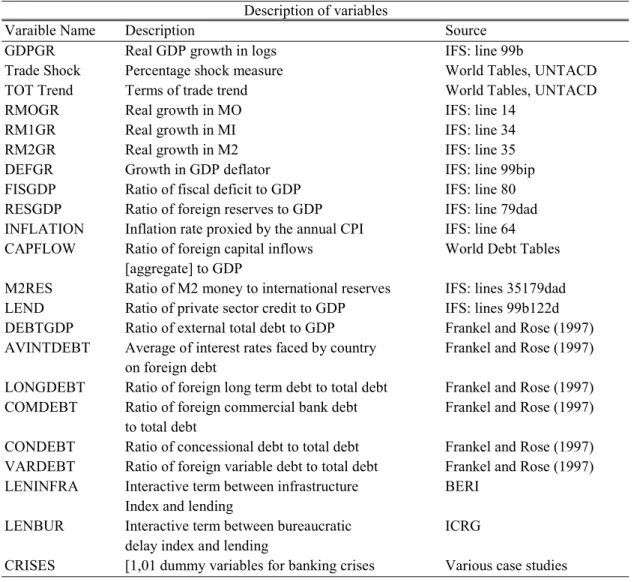
Definition of variables and the corresponding descriptive statistics are shown in Tables 4 and 5.
Table 4 Description of variables
Varaible Name Description Source
GDPGR Real GDP growth in logs IFS: line 99b
Trade Shock Percentage shock measure World Tables, UNTACD
TOT Trend Terms of trade trend World Tables, UNTACD
RMOGR Real growth in MO IFS: line 14
RM1GR Real growth in MI IFS: line 34
RM2GR Real growth in M2 IFS: line 35
DEFGR Growth in GDP deflator IFS: line 99bip
FISGDP Ratio of fiscal deficit to GDP IFS: line 80
RESGDP Ratio of foreign reserves to GDP IFS: line 79dad
INFLATION Inflation rate proxied by the annual CPI IFS: line 64
CAPFLOW Ratio of foreign capital inflows World Debt Tables
[aggregate] to GDP
M2RES Ratio of M2 money to international reserves IFS: lines 35179dad
LEND Ratio of private sector credit to GDP IFS: lines 99b122d
DEBTGDP Ratio of external total debt to GDP Frankel and Rose (1997)
AVINTDEBT Average of interest rates faced by country Frankel and Rose (1997)
on foreign debt
LONGDEBT Ratio of foreign long term debt to total debt Frankel and Rose (1997)
COMDEBT Ratio of foreign commercial bank debt Frankel and Rose (1997)
to total debt
CONDEBT Ratio of concessional debt to total debt Frankel and Rose (1997)
VARDEBT Ratio of foreign variable debt to total debt Frankel and Rose (1997)
LENINFRA Interactive term between infrastructure BERI
Index and lending
LENBUR Interactive term between bureaucratic ICRG
delay index and lending
Table 5 Descriptive Statistics
Variable Obs. Mean St. Dev. Max. Min
GDPGR 899 0.01 0.06 20 19.98 SHOCK 895 2.62 20.85 -60.2 33.3 RM0GR 1035 0.06 0.26 3.77 -1.96 RM1GR 1059 0.01 0.3 5.98 -1.89 RM2GR 1058 0.1 0.3 5.37 -1.3 FISGDP 975 -0.01 0.07 0.62 -0.25 RESGDP 807 0.01 0.04 0.26 -0.5 DEFGR 1105 0.11 0.23 4.73 -1.94 INFLATION 1055 0.19 0.36 5 -0.13 CAPFLOW 880 0.08 0.09 0.6 -0.061 M2RES 1024 4.71 26.46 812.7 0.04 LEND 917 0.24 0.18 0.9 0.002 DEBTGDP 886 0.83 1.52 13.9 0.01 AVINTDEBT 1006 6.07 2.82 16.5 0.12 LONGDEBT 858 0.49 0.46 4.2 0.02 COMDEBT 858 0.11 0.15 0.94 0.01 VARDEBT 858 0.13 0.18 1.1 0.01 CONDEBT 858 0.19 0.28 2.08 0.02 LENINFRA 285 0.61 0.56 2.94 0.003 LENBUR 285 0.7 0.58 2.94 0.001
3.11. Measuring external shocks
The impact of shocks is captured by the terms of trade and capital inflows.
Unanticipated terms of trade shocks are measured by the deviation of the terms of trade from its long run trend and is expressed as a percentage term. This variable is further
disaggregated into positive and negative shocks in subsequent sensitivity analysis. The “size” of these shocks is therefore regressed against the crisis variable. The impact of capital
inflows is captured by the capflow variable, the ratio of capital flows to GDP. Capital flows consist of net long term debt flows (commercial and public), net foreign direct investment
Table 6
Identifying Shock Periods
Country Terms of trade shock Exchange rate regime at onset of
Positive negative positive shock negative shock
Botswana 1977-1982 Flexible
Cameroon 1978-1982 1986-1992 Fixed Fixed
Chile 1968-1974 1975-1988 Fixed Fixed
Colombia 1976-79 Flexible
Congo 1972-1975 1986-1990 Fixed Fixed
1979-1985 Fixed
Costa Rica 1976-1979 Fixed
Cote D'Ivoire 1976-1980 Fixed
Dominican Rep 1974-76 Fixed
Ecuador 1977-80 1986-90 Fixed Fixed
1982-86
Egypt 1972-74 Fixed
1979-85 1986-90 Fixed Fixed
El Salvador 1977-80 Fixed
Ethiopia 1976-80 Fixed
Gabon 1979-84 1986-92 Fixed Fixed
Ghana 1976-79 Fixed
Guatemala 1976-1980 Fixed
Indon 1979-85 1986-90 Flexible Flexible
Korea
Kenya 1976-1980 Fixed
Malawi 1976-1980 1981-83 Fixed Fixed
Malaysia 1977-1985 1986-90 Fixed Fixed
Mauritius 1974-1977 Fixed Mexico 1979-85 1986-90 Flexible Morocco 1974-78 Fixed Niger 1970-74 Fixed Nigeria 1972-75 Flexible 1979-85 1986-90 Flexible Flexible Paraguay Fixed Philippines 1973-75 1979-85 Flexible
Senegal 1974-1979 1979-84 Fixed Fixed
Sri Lanka 1976-79 Flexible
Syria Fixed Tanzania 1976-80 Fixed Thailand 1974-76 1980-85 Fixed Tunisia 1974-78 1981-85 Fixed Uganda 1976-79 Fixed Uruguay 1973-75 1980-85 Flexible Venezuela 1973-1977 Fixed 1979-85 1986-90 Fixed Zambia 1969-72 Fixed 1974-76 1977-85 Fixed
3.12. Financial variables
With the lifting of controls on interest rates and directed credit, evidence from case studies points to lending booms with the proliferation of new banks. A corollary of this may be a worsening of financial fragility, especially if undertaken without adequate institutional development, DKD [1997]. The literature uses a number of variables to proxy for financial liberalization. An obvious choice is lending itself (Lend), which is private sector credit from the banking sector expressed as a percentage of GDP. To test whether sudden capital
outflows lead to liquidity crises, the ratio of M2 money to foreign reserves is introduced, (M2reserves). The composition of debt, in terms of maturity and creditor has received much attention, Sachs et al [1996]. This may be important for countries with a high proportion of short term foreign commercial debt with variable interest rates.
3.13. Macroeconomic variables
Inflation was introduced as it is normally associated with mismanagement of the economy. Other macroeconomic variables include the fiscal deficit and various measures of nominal exchange rate in the sensitivity analysis. The real exchange rate (Reer) was used to test for overvaluation. Real GDP growth was used to investigate the impact of banking crises on real income . In order to establish the causality between real income growth and crises, lagged values of the real GDP variable were used in the predictive model. Finally, to test for sensitivity of crisis year definitions, different years of banking crises were introduced.
V. Econometric Results 1. Baseline model
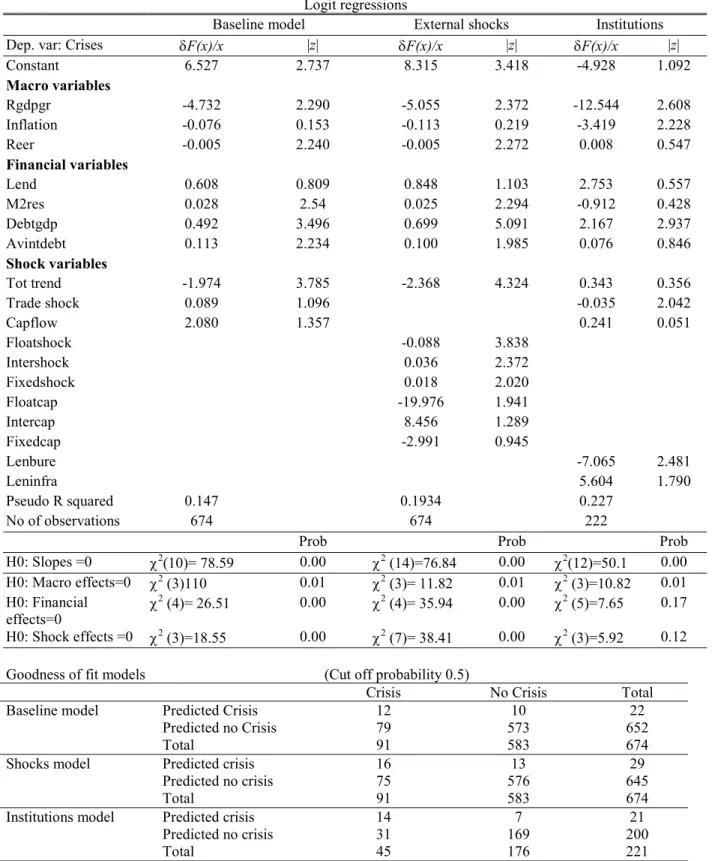
Table 7 Logit regressions
Baseline model External shocks Institutions
Dep. var: Crises δF(x)/x |z| δF(x)/x |z| δF(x)/x |z|
Constant 6.527 2.737 8.315 3.418 -4.928 1.092 Macro variables Rgdpgr -4.732 2.290 -5.055 2.372 -12.544 2.608 Inflation -0.076 0.153 -0.113 0.219 -3.419 2.228 Reer -0.005 2.240 -0.005 2.272 0.008 0.547 Financial variables Lend 0.608 0.809 0.848 1.103 2.753 0.557 M2res 0.028 2.54 0.025 2.294 -0.912 0.428 Debtgdp 0.492 3.496 0.699 5.091 2.167 2.937 Avintdebt 0.113 2.234 0.100 1.985 0.076 0.846 Shock variables Tot trend -1.974 3.785 -2.368 4.324 0.343 0.356 Trade shock 0.089 1.096 -0.035 2.042 Capflow 2.080 1.357 0.241 0.051 Floatshock -0.088 3.838 Intershock 0.036 2.372 Fixedshock 0.018 2.020 Floatcap -19.976 1.941 Intercap 8.456 1.289 Fixedcap -2.991 0.945 Lenbure -7.065 2.481 Leninfra 5.604 1.790 Pseudo R squared 0.147 0.1934 0.227 No of observations 674 674 222
Prob Prob Prob
H0: Slopes =0 χ2(10)= 78.59 0.00 χ2 (14)=76.84 0.00 χ2(12)=50.1 0.00 H0: Macro effects=0 χ2 (3)110 0.01 χ2 (3)= 11.82 0.01 χ2 (3)=10.82 0.01 H0: Financial effects=0 χ 2 (4)= 26.51 0.00 χ2 (4)= 35.94 0.00 χ2 (5)=7.65 0.17 H0: Shock effects =0 χ2 (3)=18.55 0.00 χ2 (7)= 38.41 0.00 χ2 (3)=5.92 0.12
Goodness of fit models (Cut off probability 0.5)
Crisis No Crisis Total
Baseline model Predicted Crisis
Predicted no Crisis Total 12 79 91 10 573 583 22 652 674
Shocks model Predicted crisis
Predicted no crisis Total 16 75 91 13 576 583 29 645 674 Institutions model Predicted crisis
Predicted no crisis Total 14 31 45 7 169 176 21 200 221
The coefficients and associated z-statistics are shown in the first two columns. Diagnostic tests are shown at the bottom of the table together with joint hypothesis tests for the shock, macro and financial effects. Finally, tabulations of actual and predicted values are reported for each regression. Overall, the pooled results have a low explanatory power. However, the levels are similar to those found in the literature, for example Eichengreen and Rose [1998]. Of the macro variables, the contemporaneous growth rate is highly significant, implying that negative real income shocks could lead to a banking crisis. However, as causality may run from the banking sector to the real economy, a predictive model with lagged values is tested in the next section.
Coming to the other macro variables, the inflation term was not significant, while the real exchange rate (Reer) term was significant and negatively associated with crises. This implies that real exchange rate appreciations increases the probability of banking crises. The ratio of foreign debt to GDP was highly significant. Furthermore, the average interest rate faced by a country on its foreign debt (Avindebtgdp), was also significant. Sudden increases in debt service requirements strongly increased the probability of banking crises, supporting Sachs et al. [1996], that debt maturity mismatches could generate banking crises. Although DKD [1997] also find real interest rates to be significant, the interest rate used in this study applies to the debt stock outstanding for that particular country, as changes in this variable are a more appropriate indicator of a crisis than a general interest rate. The trade shock variable was positive, but insignificant, though the trend term was significant. Capital inflows were also not significant. The other significant variable is the ratio of M2 money to international reserves. The results suggest that the probability of a crisis is significantly
enhanced with a low level of reserves, i.e. a sudden capital outflow could seriously undermine the banking system. Looking at the diagnostic statistics, the test for joint
significance for the aggregate effects was jointly significant in the baseline model. From the table of actual and predicted outcomes, at a cut-off probability of 0.5%, 12 out of 22 cases were correctly predicted as having crises and 573 out of 652 cases were correctly predicted as not having crises in the baseline model, i.e. in total 86% of the cases were correctly classified.
2. Shocks and choice of exchange regime
The relationships between nominal exchange rate regimes and shocks was analyzed to investigate the nature of the monetary transmission channel. Nominal regimes were
broadly classified into fixed pegs, intermediate regimes and floating rates. Dummy variables were created for each year for the three types of regime. These in turn were interacted with the shock variables. For example, if Kenya experienced a positive external shock in 1979, and the exchange rate regime in operation was a fixed peg, then the interactive dummy for the fixed exchange rate and the external trade shock, (Fixshock), took a value of one
multiplied by the shock variables, and zero for other years. This differs from the Eichengreen and Rose study, which employs [1,0] dummy variables for each regime. The question posed in this study is more specific, investigating how different regimes interact with external shocks.
The results in the second regression in Table 7 also support the priors on the effects of trade shocks on the macro economy. Terms of trade shocks that enter through floating
exchange rate regimes decrease the probability of banking crises. For both intermediate and pegged regimes, the results are diametrically opposite, where shocks significantly increase the probability of crises. The results are less conclusive for capital inflows, though the interactive variable on the floating exchange rate term is negative and significant. An
interpretation could be that capital flows entering through floating exchange rate regimes are less likely to cause crises. These results again support the assertions made in the theory regarding the transmission of external inflows and their monetary consequences. It was suggested that under fixed exchange rate regimes, external inflows would have a greater effect on monetary growth, particularly on the supply side. Shocks and capital inflows going though floating regimes had a lower probability of creating a crisis in subsequent years (with a negative sign), than shocks that went through more rigid regimes, which had a positive sign on the coefficients. Coming to the diagnostics, the combined macro, shock and financial effects were jointly significant. In the goodness-of-fit table, 576 out of the 645 cases were correctly predicted as not having a crisis, and 16 out of the 29 cases were predicted as having crises, i.e. (87%) of the case were correctly classified.
3. Role of institutions
Since theoretical foundations concerning asymmetric information and moral hazard are linked to institutional structure, the level of “financial institutional development'” could significantly affect banking crises. Unfortunately, data on institutional development, such as
existent across countries. The closest proxies available were the Bureaucratic Delay Index from the Business Environmental Risk Intelligence (BERI) organization, and the
International Country Risk Guide (ICRG) measures on infrastructure.
These variables consist of indices specifying infrastructure quality, on a 0 to 4 scale. Higher values imply low infrastructure quality. However, complete data for all the countries were not available, with data missing for most of the 1970s and for the entire period for some countries. This reduced the sample size to 222 observations. The infrastructure index was interacted with the lending variable to yield (Leninfra), to proxy how poor levels of institutions such as prudential regulation and banking supervision might have led to excessive lending. The signs on the coefficient imply that the level of infrastructure
development could affect the probability of banking crises through bank lending, i.e. lending booms associated with low quality institutions increased the likelihood of crises. Interacting the bureaucratic variable with lending, (Lenbur), did not yield significant results. The signs on the other key variables such as real income, and shock variables were significant for the institutions equation. The other significant variable is the lagged ratio of M2 money to international reserves. DKD [1997] also use an institutional variable in their study, where a law and order variable measuring the quality of law enforcement, i.e. measures of effective legal and judiciary systems, (proxying corruption) was highly significant, i.e. a higher value in the index implies a higher level of law and order which decreases the probability of crises.
From the table of predictions, 14 out of the 21 cases were correctly predicted as having a crisis, while 169 out of the 200 cases were correctly predicted as not having crises,
implying in total that 83% of all the cases were correctly called. However, these results must be treated with caution due to the small sample size. The models were then subjected to a range of robustness and sensitivity tests.
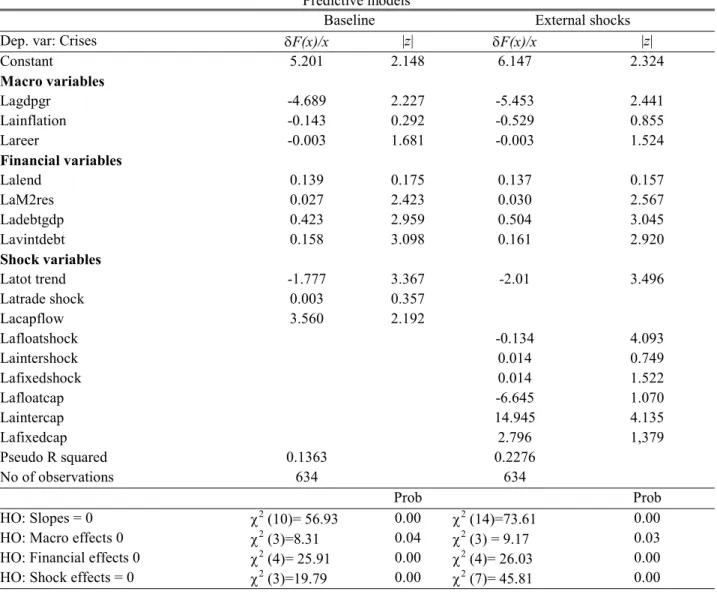
4. Predictive model
When lagged values of the explanatory variables were used, they more or less confirmed the results of the baseline model. The average rate of interest variable, debt to GDP ratio and M2 to GDP were all correctly signed and significant. Eichengreen and Rose
Table 8 Predictive models
Baseline External shocks
Dep. var: Crises δF(x)/x |z| δF(x)/x |z|
Constant 5.201 2.148 6.147 2.324 Macro variables Lagdpgr -4.689 2.227 -5.453 2.441 Lainflation -0.143 0.292 -0.529 0.855 Lareer -0.003 1.681 -0.003 1.524 Financial variables Lalend 0.139 0.175 0.137 0.157 LaM2res 0.027 2.423 0.030 2.567 Ladebtgdp 0.423 2.959 0.504 3.045 Lavintdebt 0.158 3.098 0.161 2.920 Shock variables Latot trend -1.777 3.367 -2.01 3.496 Latrade shock 0.003 0.357 Lacapflow 3.560 2.192 Lafloatshock -0.134 4.093 Laintershock 0.014 0.749 Lafixedshock 0.014 1.522 Lafloatcap -6.645 1.070 Laintercap 14.945 4.135 Lafixedcap 2.796 1,379 Pseudo R squared 0.1363 0.2276 No of observations 634 634 Prob Prob HO: Slopes = 0 χ2 (10)= 56.93 0.00 χ2 (14)=73.61 0.00
HO: Macro effects 0 χ2 (3)=8.31 0.04 χ2 (3) = 9.17 0.03
HO: Financial effects 0 χ2 (4)= 25.91 0.00 χ2 (4)= 26.03 0.00
Goodness of fit models (Cut off probability 0.5)
Crisis No Crisis Total
Predictive model Predicted Crisis
Predicted no Crisis Total 11 78 89 12 533 545 23 611 634
Shocks model Predicted crisis
Predicted no crisis Total 23 66 89 12 533 545 35 599 634
[1998] also find high debt to GDP ratios and high foreign interest rates to be significant predictors of crises. The lagged value of capital flows is a significant predictor of impending problems. In the disaggregated shocks model, the effects of shocks transmitted through floating exchange rate regimes reduced the likelihood of a crisis. While the lagged floatcap term became insignificant, the value of the intermediate interactive term became highly significant. Coming to the test of joint significance, only the macro effects were rejected at the 3% and 4% levels. Furthermore, 11 out of 23 outcomes were correctly predicted as having crises and 533 out of 611 were predicted as not having crises, yielding a combined 84% percentage of correctly predicted outcomes for the baseline variant. By the same token, 88% of cases were correctly predicted in the disaggregated model.
5. Robustness
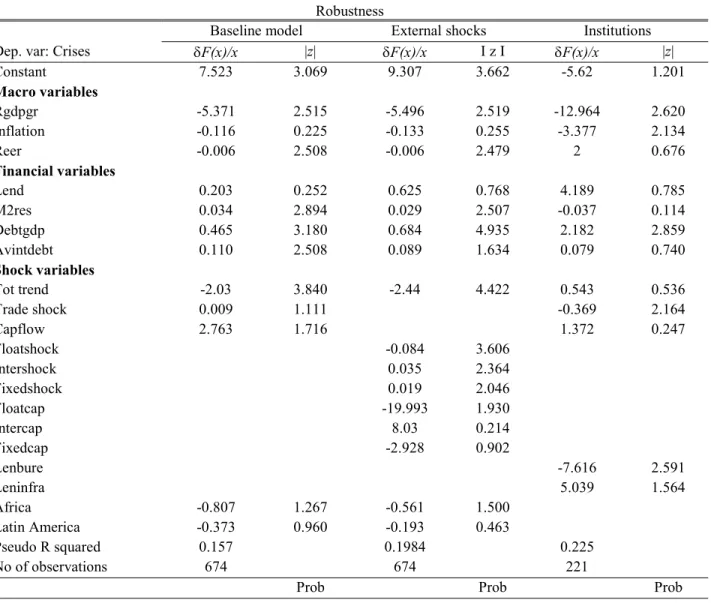
Regional dummy variables were introduced to test for robustness. The results more or less remain unchanged as shown by the Table 9. Both regional dummies were insignificant. The tests for joint significance also suggest robust results except for the institutions
regressions, where the joint test for shock effects is rejected at the 5 and 10 per cent levels. Finally, from the goodness-of-fit tables, high levels of predicted outcomes were obtained.
The coefficient on the real income term remained significant. However, the real exchange rate becomes significant in the second equation, suggesting that the causality in adjustment runs from the crisis to the real exchange rate in this version of the analysis. Both the ratio of M2 to reserves and debt to GDP become significant “during'” the crisis. The average interest rate faced by countries on the other hand loses significance. Looking at the specification of the model, the joint significance tests are rejected at the 5% level suggesting that the second model gives a better fit.
Table 9 Robustness
Baseline model External shocks Institutions
Dep. var: Crises δF(x)/x |z| δF(x)/x I z I δF(x)/x |z|
Constant 7.523 3.069 9.307 3.662 -5.62 1.201 Macro variables Rgdpgr -5.371 2.515 -5.496 2.519 -12.964 2.620 Inflation -0.116 0.225 -0.133 0.255 -3.377 2.134 Reer -0.006 2.508 -0.006 2.479 2 0.676 Financial variables Lend 0.203 0.252 0.625 0.768 4.189 0.785 M2res 0.034 2.894 0.029 2.507 -0.037 0.114 Debtgdp 0.465 3.180 0.684 4.935 2.182 2.859 Avintdebt 0.110 2.508 0.089 1.634 0.079 0.740 Shock variables Tot trend -2.03 3.840 -2.44 4.422 0.543 0.536 Trade shock 0.009 1.111 -0.369 2.164 Capflow 2.763 1.716 1.372 0.247 Floatshock -0.084 3.606 Intershock 0.035 2.364 Fixedshock 0.019 2.046 Floatcap -19.993 1.930 Intercap 8.03 0.214 Fixedcap -2.928 0.902 Lenbure -7.616 2.591 Leninfra 5.039 1.564 Africa -0.807 1.267 -0.561 1.500 Latin America -0.373 0.960 -0.193 0.463 Pseudo R squared 0.157 0.1984 0.225 No of observations 674 674 221
HO: Slopes = 0 χ2 (12)= 66.48 0.00 χ2 (14)=77.42 0.00 χ2 (14)=35.01 0.00
HO: Macro effects 0 χ2 (3) = 13.2 0.00 χ2 (3)= 13.34 0.00 χ2 (3)=10.56 0.01
HO: Financial effects 0 χ2 (4) = 24.81 0.00 χ2 (4)= 37.14 0.00 χ2 (4)=13.31 0.01
HO: Shock effects = 0 χ2 (3) = 19.92 0.00 χ2 (7)= 34.29 0.00 χ2 (3) =6.02 0.11
HO: Institu. effects = 0 χ2 (2) =6.73 0.03
Goodness-of-fit: (cut-off probability 0.5) Crisis No crisis Total
8 20 575 674 583 674 Baseline Crisis Predicted crisis Predicted no crisis Total 12 79 91
6. Sensitivity analysis - different treatment of crisis years
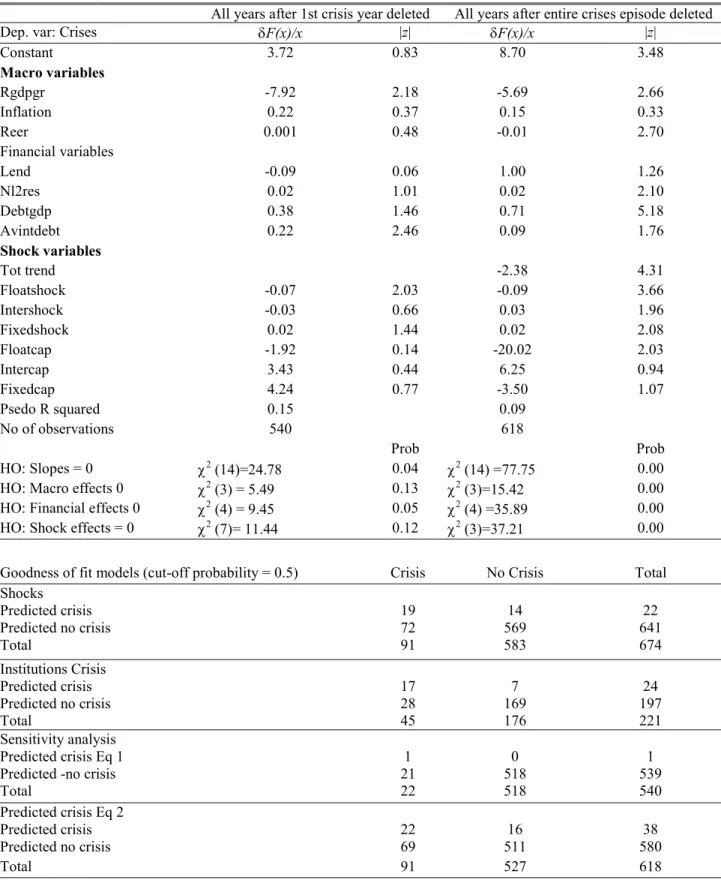
Two variations of crisis years were used in the sensitivity analysis to separate the feedback effects when a crisis was on-going crisis from those factors that influenced the build-up to the crisis. From Table 10, in the first model, all years after the first year of the crisis are deleted. In the second model, all years after the occurrence of the entire crisis are deleted. The results again lend weight to the argument that countries with flexible exchange rates were less likely to face banking crises from external shocks.
Table 10 Definitions of crises
All years after 1st crisis year deleted All years after entire crises episode deleted
Dep. var: Crises δF(x)/x |z| δF(x)/x |z|
Constant 3.72 0.83 8.70 3.48 Macro variables Rgdpgr -7.92 2.18 -5.69 2.66 Inflation 0.22 0.37 0.15 0.33 Reer 0.001 0.48 -0.01 2.70 Financial variables Lend -0.09 0.06 1.00 1.26 Nl2res 0.02 1.01 0.02 2.10 Debtgdp 0.38 1.46 0.71 5.18 Avintdebt 0.22 2.46 0.09 1.76 Shock variables Tot trend -2.38 4.31 Floatshock -0.07 2.03 -0.09 3.66 Intershock -0.03 0.66 0.03 1.96 Fixedshock 0.02 1.44 0.02 2.08 Floatcap -1.92 0.14 -20.02 2.03 Intercap 3.43 0.44 6.25 0.94 Fixedcap 4.24 0.77 -3.50 1.07 Psedo R squared 0.15 0.09 No of observations 540 618 Prob Prob HO: Slopes = 0 χ2 (14)=24.78 0.04 χ2 (14) =77.75 0.00
HO: Macro effects 0 χ2 (3) = 5.49 0.13 χ2 (3)=15.42 0.00
HO: Financial effects 0 χ2 (4) = 9.45 0.05 χ2 (4) =35.89 0.00
HO: Shock effects = 0 χ2 (7)= 11.44 0.12 χ2 (3)=37.21 0.00
Goodness of fit models (cut-off probability = 0.5) Crisis No Crisis Total
Shocks Predicted crisis 19 14 22 Predicted no crisis Total 7291 569583 641674 Institutions Crisis Predicted crisis Predicted no crisis Total 17 28 45 7 169 176 24 197 221 Sensitivity analysis Predicted crisis Eq 1 Predicted -no crisis Total 1 21 22 0 518 518 1 539 540 Predicted crisis Eq 2 Predicted crisis 22 16 38 Predicted no crisis 69 511 580 Total 91 527 618
7. Foreign Debt composition
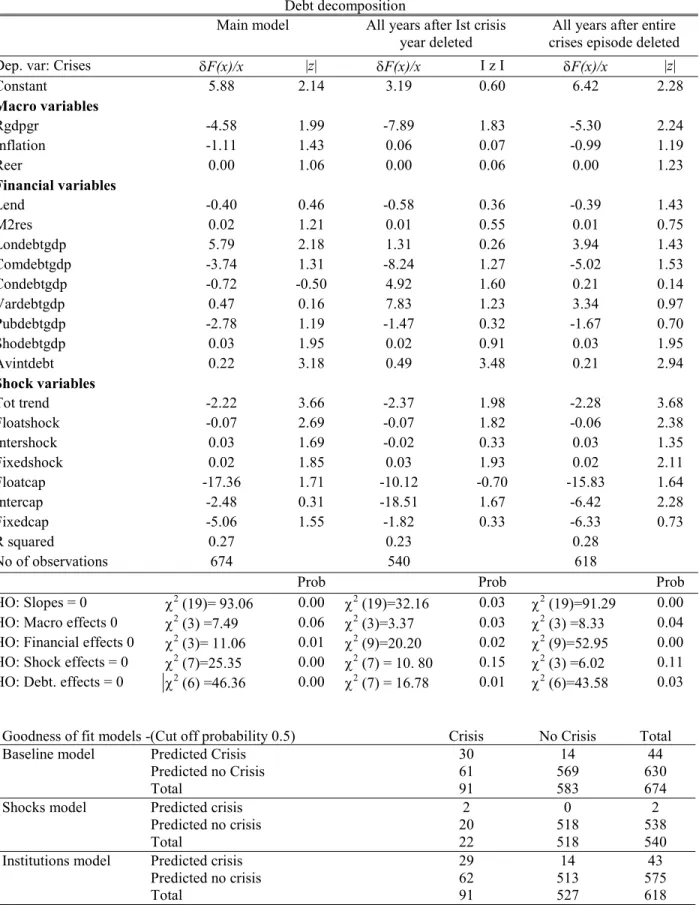
Using the Frankel and Rose [1996] database, the aggregate debt variable was decomposed into long term debt to GDP (Longdebtgdp), commercial debt to GDP, (Comdebtgdp), concessional debt to GDP, (Condebtgdp), variable interest debt to GDP (Vardebt), public debt to GDP, (Pubdebtgdp) and the ratio of short term debt to GDP, (Shodebtgdp). Results are shown in Table 8, starting with the main model.
As seen, only the long term and short term debt definitions were important. They had the expected sign and support the view that excessive levels of debt, especially short term debt, led to problems in the banking sector, while concessional debt was unlikely to have induced crises. These results again corroborate results from the literature, for example by Sachs et al. [1996] and Eichengreen and Rose. The signs on the interacted terms of trade shock variables exhibited the expected signs in the first equation, where more flexible regimes lessened the likelihood of a crisis. The other two equations use different definitions of the crisis periods. Again the results support the underlying story looking at the first and last equation. When all the post-crisis years were deleted in the last equation, the signs on the interacted shock variables remained unchanged. Only the interaction between capital flows and fixed regimes had a sign contrary to what was expected.
Table 11 Debt decomposition
Main model All years after Ist crisis
year deleted crises episode deletedAll years after entire
Dep. var: Crises δF(x)/x |z| δF(x)/x I z I δF(x)/x |z|
Constant 5.88 2.14 3.19 0.60 6.42 2.28 Macro variables Rgdpgr -4.58 1.99 -7.89 1.83 -5.30 2.24 Inflation -1.11 1.43 0.06 0.07 -0.99 1.19 Reer 0.00 1.06 0.00 0.06 0.00 1.23 Financial variables Lend -0.40 0.46 -0.58 0.36 -0.39 1.43 M2res 0.02 1.21 0.01 0.55 0.01 0.75 Londebtgdp 5.79 2.18 1.31 0.26 3.94 1.43 Comdebtgdp -3.74 1.31 -8.24 1.27 -5.02 1.53 Condebtgdp -0.72 -0.50 4.92 1.60 0.21 0.14 Vardebtgdp 0.47 0.16 7.83 1.23 3.34 0.97 Pubdebtgdp -2.78 1.19 -1.47 0.32 -1.67 0.70 Shodebtgdp 0.03 1.95 0.02 0.91 0.03 1.95 Avintdebt 0.22 3.18 0.49 3.48 0.21 2.94 Shock variables Tot trend -2.22 3.66 -2.37 1.98 -2.28 3.68 Floatshock -0.07 2.69 -0.07 1.82 -0.06 2.38 Intershock 0.03 1.69 -0.02 0.33 0.03 1.35 Fixedshock 0.02 1.85 0.03 1.93 0.02 2.11 Floatcap -17.36 1.71 -10.12 -0.70 -15.83 1.64 Intercap -2.48 0.31 -18.51 1.67 -6.42 2.28 Fixedcap -5.06 1.55 -1.82 0.33 -6.33 0.73 R squared 0.27 0.23 0.28 No of observations 674 540 618
Prob Prob Prob
HO: Slopes = 0 χ2 (19)= 93.06 0.00 χ2 (19)=32.16 0.03 χ2 (19)=91.29 0.00
HO: Macro effects 0 χ2 (3) =7.49 0.06 χ2 (3)=3.37 0.03 χ2 (3) =8.33 0.04
HO: Financial effects 0 χ2 (3)= 11.06 0.01 χ2 (9)=20.20 0.02 χ2 (9)=52.95 0.00
HO: Shock effects = 0 χ2 (7)=25.35 0.00 χ2 (7) = 10. 80 0.15 χ2 (3) =6.02 0.11
HO: Debt. effects = 0 χ2 (6) =46.36 0.00 χ2 (7) = 16.78 0.01 χ2 (6)=43.58 0.03
Goodness of fit models -(Cut off probability 0.5) Crisis No Crisis Total
Baseline model Predicted Crisis
Predicted no Crisis Total 30 61 91 14 569 583 44 630 674
Shocks model Predicted crisis
Predicted no crisis Total 2 20 22 0 518 518 2 538 540 Institutions model Predicted crisis
Predicted no crisis Total 29 62 91 14 513 527 43 575 618
8. Fixed effects specification
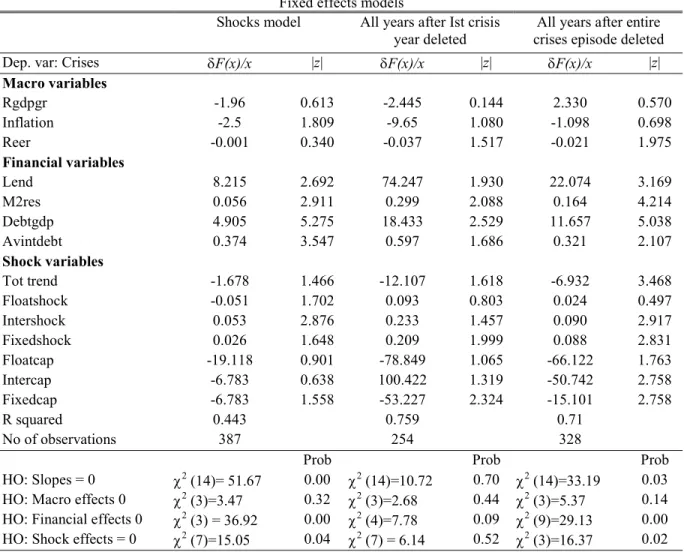
In the fixed effects version, only those countries which experienced crises were included. The first equation interacted the shocks model with exchange rate regimes. Sensitivity analysis of the crisis variable was carried out following the definitions used previously. The fixed effects results are reported in Table 12 and corroborate some of the findings from the pooled results. The interactive shock terms survives the fixed effects estimation. The capital flow variable is significant but negative in sign. The effects on the financial variables all have robust effects on the fixed effects estimation. However, the significance of the real income growth term diminishes. Of the test for joint significance, only the effects of the macro variables were rejected in the shocks model. Coming to the other two models, all the tests of joint significance are rejected when the first definition of crisis was used, while only the financial effects mattered in the second definition.
Table 12 Fixed effects models
Shocks model All years after Ist crisis
year deleted crises episode deletedAll years after entire
Dep. var: Crises δF(x)/x |z| δF(x)/x |z| δF(x)/x |z|
Macro variables Rgdpgr -1.96 0.613 -2.445 0.144 2.330 0.570 Inflation -2.5 1.809 -9.65 1.080 -1.098 0.698 Reer -0.001 0.340 -0.037 1.517 -0.021 1.975 Financial variables Lend 8.215 2.692 74.247 1.930 22.074 3.169 M2res 0.056 2.911 0.299 2.088 0.164 4.214 Debtgdp 4.905 5.275 18.433 2.529 11.657 5.038 Avintdebt 0.374 3.547 0.597 1.686 0.321 2.107 Shock variables Tot trend -1.678 1.466 -12.107 1.618 -6.932 3.468 Floatshock -0.051 1.702 0.093 0.803 0.024 0.497 Intershock 0.053 2.876 0.233 1.457 0.090 2.917 Fixedshock 0.026 1.648 0.209 1.999 0.088 2.831 Floatcap -19.118 0.901 -78.849 1.065 -66.122 1.763 Intercap -6.783 0.638 100.422 1.319 -50.742 2.758 Fixedcap -6.783 1.558 -53.227 2.324 -15.101 2.758 R squared 0.443 0.759 0.71 No of observations 387 254 328
Prob Prob Prob
HO: Slopes = 0 χ2 (14)= 51.67 0.00 χ2 (14)=10.72 0.70 χ2 (14)=33.19 0.03
HO: Macro effects 0 χ2 (3)=3.47 0.32 χ2 (3)=2.68 0.44 χ2 (3)=5.37 0.14
HO: Financial effects 0 χ2 (3) = 36.92 0.00 χ2 (4)=7.78 0.09 χ2 (9)=29.13 0.00
V1: Conclusion
This paper examined various determinants of banking crises. The results point to a strong association between the incidence of external shocks and the occurrence of banking crises in SOEs. Key macroeconomic factors such as negative income shocks, level of debt and the real exchange rate were decisive determinants of crises. Countries with high levels of external debt, particularly short term debt were more likely to have banking crises than countries which relied on concessional borrowing. Both terms of trade shocks and capital flows were significant predictors of crises. Some of these factors were also conditioned by the nature of the policy environment in place, in particular the exchange rate regime. This was more profound in cases where external inflows were channeled through fixed or rigid exchange rate regimes. In particular, negative trade shocks, were responsible for a large number of banking crises in the sample. Shocks that were transmitted through more flexible exchange rate regimes caused less problems to the banking sector.
While externally driven factors played a leading role in this process, various other internal disturbances and institutional factors also led to banking crises in SOEs. When low levels of infrastructure and bureaucratic delay were interacted with bank lending, the likelihood of banking crises increased. Again the problem was more acute under rigid exchange rate regimes.
Bibliography
Alexander, W., J. Davis, L. Ebrill, and C. Lindgren [1997] Systematic Bank Restructuring and Macroeconomic Policy , International Monetary Fund, Washington DC.
Baltagi, B. [1995], Econometric Analysis of Panel Data, John Wiley & Sons, Chichester.
Bernanke, B. [1983] “Nonmonetary Effects of the Financial Crisis in the Propagation of the Banking Crisis'”, American Economic Review, vol. 73, 257-276.
Bernanke, B. and M. Gertler [1989] “Financial Fragility and Economic Performance,” Quarterly Journal of Economics, vol. 105, 87-114.
Calomiris, C. and G. Garton [1991] “The Origins of Bank Panics: Models, Facts and Bank Regulation,'' in R. Hubbard, [ed.], Financial Market and Financial Crises, University of Chicago Press, Chicago.
Caprio, G. and D. Klingebiel [1996] “Bank Insolvencies: Cross-Country Experience”, World Bank Policy Research Working Paper, No. 1620, Washington DC.
Choudhri, E and L. Kochin [1980] “The Exchange Rate and the International Transmission of the Business Cycle Disturbances”, Journal of Money, Credit and Banking, vol. 12, 565-574.
Demirguc-Kunt, A. and E. Detragiache [1997] “The Determinants of Banking Crises: Evidence from
Developing and Developed Countries”, International Monetary Fund Working Paper, WP/97/106, Washington DC.
Diaz-Alejandro, C. [1985] “Good-Bye Financial Repression, Hello Financial Crash”, Journal of Development Economics, vol. 19, 1-24.
Eastwood, R. and A. Venables [1982] “The Macroeconomic Implications of a Resource Discovery in an Open Economy”, Economic Journal, vol. 92, pp. 285-299.
Eichengreen, B. and A. Rose [1998] “Staying Afloat when the Wind Shifts: External Factors and Emerging-Market Banking Crises”, Working Paper No. 6370, Cambridge.
Federal Reserves Bank of San Francisco [1985] “The Search for Financial Stability: the Past Fifty Years”, conference proceedings, June 23-25.
Frankel, J. and A. Rose [1997] “Currency Crashes in Emerging Markets; Empirical Indicators”, National Bureau of Economic Research Working Paper No 543, Cambridge.
Friedman, M. and A. Schwartz [1963], A Monetary History of the United States, 1867-1960}, Princeton University Press, Princeton.
Greenwald, B. and J. Stiglitz [1988] “Information, Financial Constraints, and Business Fluctuations”, in Khan, M. and S. Tsiang, [eds], Expectations and Macroeconomics, Oxford University Press, Oxford.
Hausmann, R. and L. Rojas-Suarez [1996] Banking Crises in Latin America, Inter American Bank, Washington Honohan, P. [1997] “Banking System Failures in Developing and Transition Countries”, Bank for International Settlements Working Paper, Basle.
Hubbard, R. [1991] Financial Markets and Financial Crises, University of Chicago Press, Chicago. Kindleberger, C. [1978] Manias, Panics and Crashes, Basic Books, New York.
Minsky, P. [1977] John Maynard Keynes, Colombia University Press, New York.
Mishkin, F. [1996] “Understanding Financial; Crises”, National Bureau of Economic Research Working Paper No. 5600, Cambridge.
Morris, F., M. Dorfman, J. Ortiz, and M. Franco [1990] ‘Latin America's Banking Systems in the 1980s”, World Bank Discussion Papers, No 81, Washington DC.
Neary, P. [1985] “Real and Monetary Aspects of Dutch Disease”, in Jungfeld, K. and D. Hague (eds),
Structural Adjustment in Developed Open Economies, Macmillan, London.
Sachs, J., A. Tornell, and A. Velasco [1996] “Financial Crises in Emerging Markets”, Brookings Papers on Economic Activity, Washington DC.
Stiglitz, J. and A. Weiss [1981] “Credit Rationing in Market with Imperfect Information'', American Economic Review, vol. 72, 393-410.
Sundararajan, V. and T. Balino [1991] Banking Crises; Cases and Issues, International Monetary Fund, Washington DC.
Taylor, L. and S. O'Connell [1985] “A Minsky Crisis”, Quarterly Journal of Economics, vol. 100, 871-885. Temin, P. [1976] Did Monetary Forces cause the Great Depression? N. Norton, New York.
CESifo Working Paper Series
___________________________________________________________________________
689 Amihai Glazer and Vesa Kanniainen, The Effects of Employment Protection on the Choice of Risky Projects, March 2002
690 Michael Funke and Annekatrin Niebuhr, Threshold Effects and Regional Economic Growth – Evidence from West Germany, March 2002
691 George Economides, Apostolis Philippopoulos, and Simon Price, Elections, Fiscal Policy and Growth: Revisiting the Mechanism, March 2002
692 Amihai Glazer, Vesa Kanniainen, and Mikko Mustonen, Innovation of Network Goods: A Non-Innovating Firm Will Gain, March 2002
693 Helmuth Cremer, Jean-Marie Lozachmeur, and Pierre Pestieau, Social Security, Retirement Age and Optimal Income Taxation, April 2002
694 Rafael Lalive and Josef Zweimüller, Benefit Entitlement and the Labor Market: Evidence from a Large-Scale Policy Change, April 2002
695 Hans Gersbach, Financial Intermediation and the Creation of Macroeconomic Risks, April 2002
696 James M. Malcomson, James W. Maw, and Barry McCormick, General Training by Firms, Apprentice Contracts, and Public Policy, April 2002
697 Simon Gächter and Arno Riedl, Moral Property Rights in Bargaining, April 2002
698 Kai A. Konrad, Investment in the Absence of Property Rights: The Role of Incumbency Advantages, April 2002
699 Campbell Leith and Jim Malley, Estimated General Equilibrium Models for the Evaluation of Monetary Policy in the US and Europe, April 2002
700 Yin-Wong Cheung and Jude Yuen, Effects of U.S. Inflation on Hong Kong and Singapore, April 2002
701 Henry Tulkens, On Cooperation in Musgravian Models of Externalities within a Federation, April 2002
702 Ralph Chami and Gregory D. Hess, For Better or For Worse? State-Level Marital Formation and Risk Sharing, April 2002
703 Fredrik Andersson and Kai A. Konrad, Human Capital Investment and Globalization in Extortionary States, April 2002
705 Daniel Gros and Carsten Hefeker, Common Monetary Policy with Asymmetric Shocks, April 2002
706 Dirk Kiesewetter and Rainer Niemann, Neutral and Equitable Taxation of Pensions as Capital Income, April 2002
707 Robert S. Chirinko, Corporate Taxation, Capital Formation, and the Substitution Elasticity between Labor and Capital, April 2002
708 Frode Meland and Gaute Torsvik, Structural Adjustment and Endogenous Worker Recall Probabilities, April 2002
709 Rainer Niemann and Caren Sureth, Taxation under Uncertainty – Problems of Dynamic Programming and Contingent Claims Analysis in Real Option Theory, April 2002 710 Thomas Moutos and William Scarth, Technical Change and Unemployment: Policy
Responses and Distributional Considerations, April 2002
711 Günther Rehme, (Re-)Distribution of Personal Incomes, Education and Economic Performance Across Countries, April 2002
712 Thorvaldur Gylfason and Gylfi Zoega, Inequality and Economic Growth: Do Natural Resources Matter?, April 2002
713 Wolfgang Leininger, Contests over Public Goods: Evolutionary Stability and the Free-Rider Problem, April 2002
714 Ernst Fehr and Armin Falk, Psychological Foundations of Incentives, April 2002
715 Giorgio Brunello, Maria Laura Parisi, and Daniela Sonedda, Labor Taxes and Wages: Evidence from Italy, May 2002
716 Marta Aloi and Huw Dixon, Entry Dynamics, Capacity Utilisation and Productivity in a Dynamic Open Economy, May 2002
717 Paolo M. Panteghini, Asymmetric Taxation under Incremental and Sequential Investment, May 2002
718 Ben J. Heijdra, Christian Keuschnigg, and Wilhelm Kohler, Eastern Enlargement of the EU: Jobs, Investment and Welfare in Present Member Countries, May 2002
719 Tapio Palokangas, The Political Economy of Collective Bargaining, May 2002
720 Gilles Saint-Paul, Some Evolutionary Foundations for Price Level Rigidity, May 2002 721 Giorgio Brunello and Daniela Sonedda, Labor Tax Progressivity, Wage Determination,
and the Relative Wage Effect, May 2002
723 Paolo M. Panteghini, Endogenous Timing and the Taxation of Discrete Investment Choices, May 2002
724 Achim Wambach, Collusion in Beauty Contests, May 2002
725 Dominique Demougin and Claude Fluet, Preponderance of Evidence, May 2002 726 Gilles Saint-Paul, Growth Effects of Non Proprietary Innovation, May 2002
727 Subir Bose, Gerhard O. Orosel, and Lise Vesterlund, Optimal Pricing and Endogenous Herding, May 2002
728 Erik Leertouwer and Jakob de Haan, How to Use Indicators for ‘Corporatism’ in Empirical Applications, May 2002
729 Matthias Wrede, Small States, Large Unitary States and Federations, May 2002
730 Christian Schultz, Transparency and Tacit Collusion in a Differentiated Market, May 2002
731 Volker Grossmann, Income Inequality, Voting Over the Size of Public Consumption, and Growth, May 2002
732 Yu-Fu Chen and Michael Funke, Working Time and Employment under Uncertainty, May 2002
733 Kjell Erik Lommerud, Odd Rune Straume, and Lars Sørgard, Downstream Merger with Oligopolistic Input Suppliers, May 2002
734 Saku Aura, Does the Balance of Power Within a Family Matter? The Case of the Retirement Equity Act, May 2002
735 Sandro Brusco and Fausto Panunzi, Reallocation of Corporate Resources and Managerial Incentives in Internal Capital Markets, May 2002
736 Stefan Napel and Mika Widgrén, Strategic Power Revisited, May 2002
737 Martin W. Cripps, Godfrey Keller, and Sven Rady, Strategic Experimentation: The Case of Poisson Bandits, May 2002
738 Pierre André Chiappori and Bernard Salanié, Testing Contract Theory: A Survey of Some Recent Work, June 2002
739 Robert J. Gary-Bobo and Sophie Larribeau, A Structural Econometric Model of Price Discrimination in the Mortgage Lending Industry, June 2002
740 Laurent Linnemer, When Backward Integration by a Dominant Firm Improves Welfare, June 2002
742 Christian Keuschnigg and Soren Bo Nielsen, Start-ups, Venture Capitalits, and the Capital Gains Tax, June 2002
743 Robert Fenge, Silke Uebelmesser, and Martin Werding, Second-best Properties of Implicit Social Security Taxes: Theory and Evidence, June 2002
744 Wendell Fleming and Jerome Stein, Stochastic Optimal Control, International Finance and Debt, June 2002
745 Gene M. Grossman, The Distribution of Talent and the Pattern and Consequences of International Trade, June 2002
746 Oleksiy Ivaschenko, Growth and Inequality: Evidence from Transitional Economies, June 2002
747 Burkhard Heer, Should Unemployment Benefits be Related to Previous Earnings?, July 2002
748 Bas van Aarle, Giovanni Di Bartolomeo, Jacob Engwerda, and Joseph Plasmans, Staying Together or Breaking Apart: Policy-makers’ Endogenous Coalitions Formation in the European Economic and Monetary Union, July 2002
749 Hans Gersbach, Democratic Mechanisms: Double Majority Rules and Flexible Agenda Costs, July 2002
750 Bruno S. Frey and Stephan Meier, Pro-Social Behavior, Reciprocity or Both?, July 2002 751 Jonas Agell and Helge Bennmarker, Wage Policy and Endogenous Wage Rigidity: A
Representative View From the Inside, July 2002 752 Edward Castronova, On Virtual Economies, July 2002
753 Rebecca M. Blank, U.S. Welfare Reform: What’s Relevant for Europe?, July 2002 754 Ruslan Lukach and Joseph Plasmans, Measuring Knowledge Spillovers Using Patent
Citations: Evidence from the Belgian Firm’s Data, July 2002
755 Aaron Tornell and Frank Westermann, Boom-Bust Cycles in Middle Income Countries: Facts and Explanation, July 2002
756 Jan K. Brueckner, Internalization of Airport Congestion: A Network Analysis, July 2002
757 Lawrence M. Kahn, The Impact of Wage-Setting Institutions on the Incidence of Public Employment in the OECD: 1960-98, July 2002
758 Sijbren Cnossen, Tax Policy in the European Union, August 2002
759 Chandima Mendis, External Shocks and Banking Crises in Developing Countries: Does the Exchange Rate Regime Matter?, August 2002