H. Oldenkamp1, I.J. de Jong2
1
NKF KABEL B.V., Electronics Group, P.O. Box 26, 2600 MC Delft, The Netherlands, Telephone: +31 15 2605616, Fax: +31 15 2605714, Email: [email protected]
2
OKE-Services, Nieuwstraat 29, 5611 DA Eindhoven, The Netherlands, Telephone: +31 40 2445262, Fax: + 31 2464133, Email: [email protected]
Abstract
AC modules offer a lot of advantages compared to traditional photovoltaic systems with one central inverter. These do not only relate to safety, but also to economics, especially of smaller systems. AC modules are especially interesting to use for the integration into buildings, as the independent operation of AC modules prevents that a whole PV system will function poorly due to shading of only one PV module. Research and development into AC module inverters started in the early nineties. The development efforts have resulted in AC module inverters ranging from 100 to 250 Watts. The available inverters are all more or less mature. Currently we are in the stage of market introduction. Larger projects are being executed to gain data about the inverters in the field. Besides safety standards are being developed in order to guarantee safe operation of the inverters.
Future developments of AC modules will focus on lowering the price. At this moment AC modules are considered price competitive with traditional PV systems up to 700 Watts. Due to economies of scale AC modules will become competitive for rooftops of about 20 PV modules (2000 Watts). By using new circuit technologies the price of AC module inverters will drop further, making AC modules even more competitive. It is expected that with the start of a new century, new inverter technologies will be introduced.
Why AC modules?
Traditional photovoltaic (PV) systems require complex DC cabling giving rise to a lot of problems. In particular grid connected PV systems with one central inverter have shown significant problems with respect to:
Ø High DC voltage levels.
Ø Safety.
Ø Cable losses.
Ø Risk of DC arcs.
Ø Fire hazard and protection
Most of these problems can be overcome by expensive cabling and installation systems, but such solutions increase the costs at system level. Components like inverters, switchgear, cables have to be selected in accordance with system size. This requires an individual design of each system and is an obstacle in expanding the system.
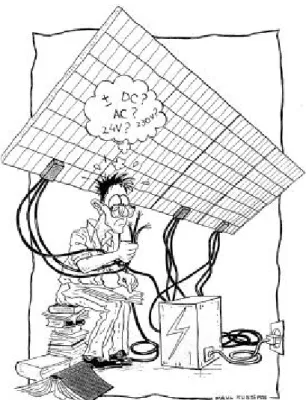
Thus, in general the installation of traditional PV systems is rather complex, which is reflected by figure 1.
Figure 1. Representation of traditional PV system with one central inverter.
AC modules, in which the inverter is integrated in the PV module, overcome these problems. The advantages of AC modules compared to traditional PV systems are:
Ø Each module works independently: if one fails, the other AC modules will keep on delivering power to the grid.
Ø High modularity allowing easy system expansion.
Ø Low minimum system size of one AC module, lowering the threshold for individuals to start their own PV plant.
Ø Use of standard AC installation material, which reduces costs of installation material and system design.
Ø Low conduction losses and cable costs.
Ø No mismatch losses at system level as each AC module operates in its own Maximum Power Point (MPP).
Ø No need for string diodes.
Ø No need for bypass diodes.
Ø Low lightning induced surge voltages, because of the compact DC system layout. The main advantage of the use of AC modules is reflected by figure 2: simplicity of the total system. All these features make AC modules an interesting option for the integration of photovoltaic systems into buildings. Especially the independent operation of AC modules, which prevents that a whole PV system will function poorly due to shading of only one PV module.
Figure 2. Representation of PV system with AC modules.
The past: development
The first idea about AC modules originates from the seventies. Due to technical limitations the idea was never put into practice. In the late eighties research into AC module inverters was started by the Institut für Solar Energie-versorgungstechnik (ISET) e.V. [1]. Professor Kleinkauf promoted the idea of AC modules in several papers. He emphasised the advantages of AC modules, by then called module integrated converters, MICs (see also figure 3).
Figure 3. Representation of field operation of AC (MIC) modules by Kleinkauf in 1992 [2] A couple of years later, in the early nineties, we see that the promotion by Professor Kleinkauf was not in vane. It was out of the blue adopted by several companies, both in Europe and the USA. Research and development into AC module inverters started in parallel in the Netherlands, Germany, Switzerland and the USA.
In the USA we see a strong governmental and utility push, which has led to AC module inverters based on traditional techniques. In Europe developments were rather initiated by private companies, although in some cases supported by local governments. We see here more innovative concepts.
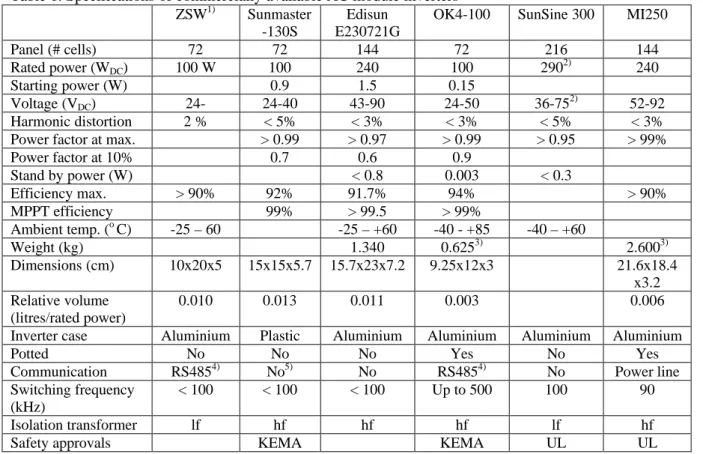
The different development efforts (taking 3 to 7 years) have led to AC module inverters ranging from 100 to 250 Watts. The selection of power size was based on technical feasibility, economics and the size of available PV modules. The switching techniques used range from more conservative (low frequency, 50-100 kHz) to more innovative (high frequencies up to 500 kHz). Specifications of available AC module inverters are presented in table 1.
Table 1. Specifications of commercially available AC module inverters ZSW1) Sunmaster
-130S
Edisun E230721G
OK4-100 SunSine 300 MI250
Panel (# cells) 72 72 144 72 216 144
Rated power (WDC) 100 W 100 240 100 2902) 240
Starting power (W) 0.9 1.5 0.15
Voltage (VDC) 24- 24-40 43-90 24-50 36-752) 52-92
Harmonic distortion 2 % < 5% < 3% < 3% < 5% < 3% Power factor at max. > 0.99 > 0.97 > 0.99 > 0.95 > 99%
Power factor at 10% 0.7 0.6 0.9 Stand by power (W) < 0.8 0.003 < 0.3 Efficiency max. > 90% 92% 91.7% 94% > 90% MPPT efficiency 99% > 99.5 > 99% Ambient temp. (o C) -25 – 60 -25 – +60 -40 - +85 -40 – +60 Weight (kg) 1.340 0.6253) 2.6003) Dimensions (cm) 10x20x5 15x15x5.7 15.7x23x7.2 9.25x12x3 21.6x18.4 x3.2 Relative volume (litres/rated power) 0.010 0.013 0.011 0.003 0.006
Inverter case Aluminium Plastic Aluminium Aluminium Aluminium Aluminium
Potted No No No Yes No Yes
Communication RS4854) No5) No RS4854) No Power line Switching frequency
(kHz)
< 100 < 100 < 100 Up to 500 100 90
Isolation transformer lf hf hf hf lf hf
Safety approvals KEMA KEMA UL UL
1)
ZSW developed a range of AC module inverters, from 100 up to 400 Watts. Currently only the inverters of 100 and 300 Watts are commercially available. In table 1 only the data of the inverter of 100 Watts are given; those of the 300-Watts inverter are comparable.
2)
The rated power and voltage range of the SunSine 300 are estimated values
3)
The weight of these inverters is including potting material.
3)
The ZSW and OK4-100 feature extensive monitoring facilities; the OK4-100 also has an internal kWh counter.
4)
The Sunmaster-130S has an optional RS485 interface with extensive monitoring facilities
All the inverters meet general safety requirements and feature island protection. This means that the inverters can only function when connected to the grid. Several inverters include monitoring facilities for which different communication techniques are used: commu-nication by means of a separate two-wire RS485 interface or power line communication. Especially when the AC modules are integrated into buildings this is a very handy feature. It enables to check if all individual AC modules are working well. When the monitoring facility features an internal kWh counter, monitoring can be limited to checking the output of the inverters once week or month: the internal kWh counter shows the output of the individual AC modules over a period of time and is therefore the reflection of their performance.
All the inverters have to be mounted on the backside of the PV module, while the OK4-100 also offers the possibility to be mounted on the
frame. Some of the inverters are fully potted, which has a positive effect on safety and lifetime.
The present: market introduction
The first prototype of an AC module inverter was presented in 1992. It was developed by the
Zentrum für Sonnenenergie und Wasserstoff-Forschung Baden-Württemberg (ZSW), Germany. It concerned an inverter of 50 Watts, using a high frequency concept with a lf transformer. In 1994 ZSW produced a first series of 100 Watts inverters, based on the same technique. Mainly because of economics and electromagnetic interference problems ZSW is now using low frequency switching concepts for their small inverters.
In the period 1994-1996 three other European companies introduced AC module inverters: Mastervolt (Netherlands), Alpha Real (Switzerland) and OKE-Services (Netherlands). In 1996-1997 the first AC module inverters developed by US companies (Ascension Technology, AES) were launched on the market. All these inverters have reached the stage of market introduction on a larger scale; the products have become more or less mature. Some of the inverters are optimised for specific PV modules:
Ø The Sunmaster-130S for Shell 100 Watts module (24 Volts)
Ø The Sunsine 300 for the ASE 300 Watts module (36 Volts)
Ø The MI250 for the Solarex 240 Watts module (48 Volts).
In these cases the development was executed in close co-operation with the PV manufacturers. Inherently the market introduction focuses on the AC module as a whole.
The other inverters were developed more independently, but can be used with several PV modules. For example the Edisun E230721G will work fine with a Solarex 240 Watts module (48 Volts). The OK4-100 can be combined with any 100-130 Watts PV module (24 Volts). In general all AC module inverters are designed for operation of multiples of 12 Volts modules in series. Currently we see that the companies, who developed their inverters independently, seek co-operation with PV manufacturers. This enables the promotion of AC modules on the market, rather than AC module inverters. Besides, smaller companies are starting co-operation with bigger companies in order to produce larger series.
Whether AC modules can compete with traditional PV systems does not only depend on the price of the inverter itself: the selling price of the whole AC module is decisive. Generally the PV manufacturers that sell the AC modules set the price. Because of the high additional value, there is a tendency to increase the selling price of an AC module compared to a PV module with more than the price of the inverter. Prices of AC modules therefore differ strongly, ranging from US$ 6 to US$ 9 per Watt peak. Depending on price and country AC modules are price competitive with traditional PV systems for systems up to about 700 Watts.
There is a distinct difference between the perception of the market in Europe and the USA. In Europe the private market is seen as the largest potential segment. Especially, the implementation on rooftops offers opportunities for AC modules. The so-called ‘growth project’ that will start in 1998 in the Netherlands may serve as an example. On 9000 rooftops initially four AC modules will be installed. The private owners of the houses will be encouraged to expand their PV plant with additional AC modules in the years to come. In the USA however, parties expect most of AC module plants of 1 – 10 kWp or even larger. The manufacturers perceive the government and utilities as the main buyers of AC modules. Currently AC modules are being implemented in several larger projects. Most of these projects still focus on demonstration and obtaining data about AC modules in the field. Examples of projects are found all over Europe. In the Netherlands currently 2100 AC modules are being implemented in a large sound barrier. With a growing market projects focus on other aspects of AC modules: safety, lifetime and economics.
In several countries safety standards for AC modules are being developed. In the Netherlands this has resulted in the KEMA-approval for AC module inverters. Currently all AC module inverters used in the Netherlands have to comply with this approval. In the USA the Underwriters Laboratories (UL) developed a standard (UL 1741) especially for AC modules. The SunSine 300 and the MI250 are both UL listed, while the OK4-100 probably will be listed in the spring of 1998.
In Europe AC modules are mainly being implemented on rooftops and buildings. Therefore costs of reparation will be high. Moreover, most of the inverters are mounted on the PV module. It is therefore important that the inverters have a lifetime comparable with that of the PV module, which last more than 20 years. In order to gain more insight into the lifetime of AC module inverters, several research projects are being executed. Amongst others, the Netherlands Energy Research Foundation ECN is performing accelerated life tests to obtain data, which can be used for lifetime prediction calculations.
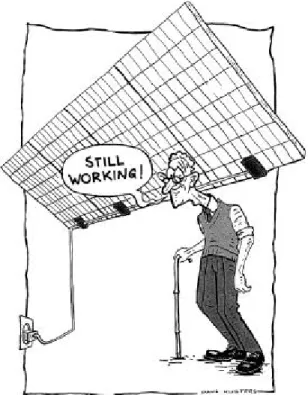
Figure 4. AC modules in the future: a reliable and proven product with a long lifetime.
The future: a growing market and
improving designs
The market of AC modules will strongly grow especially when private persons will enter the market. It is expected that before the next century 50.000-100.000 AC modules will be installed. With these numbers the reliability of AC modules will be proven by the year 2000. Customers will separate the wheat from the chaff and only the best inverters will survive in the market place. A shake up of the market can be expected within three years. Moreover, potential buyers and users of AC modules will set higher demands, especially relating to installation and monitoring. Low cost standard AC cabling assemblies will be developed, enabling easy system installation. Extensive monitoring facilities will be included in all inverters. These will also become more intelligent and will include e.g. automatic signalling when AC modules do not function properly. The software will also become more enhanced and user friendlier and will eventually be replaced by low cost monitoring displays with fault indication and diagnostics.
With a growing market the production series will become larger and mass production will start. Because of the higher volumes components will
become available optimised for AC modules, like custom design chips. Also other production techniques can be used. Just because of the economies of scale it is expected, that in the near future AC modules will be price competitive with traditional PV systems up to 2000 Watts. This is about the size of one rooftop.
The size of PV modules also plays an important role. In Europe PV manufacturers generally produce 100 Watts modules, which is quite small compared to the USA where 200 and 300 Watts modules are more common. The costs of an inverter do not level with the power. Therefore, AC modules with higher power (e.g. 300 Watts) are less expensive in terms of costs per Watt peak than AC modules with less power (e.g. 100 Watts). This supports the idea to manufacture larger PV modules. On the other hand, especially in Europe, the private market for AC modules of 100 Watts is very large.
Further improvements of AC module inverters are expected. In Australia a lot of effort is being put into the development of a new AC module inverter. Also in Europe several development projects started aiming primarily at lowering the price of AC module inverters.
In the Netherlands for example two AC module inverter projects have started, both funded by
Novem, the Netherlands agency for energy and the environment. One of these projects aims at a cost reduction of even 50% next to an increase of the efficiency to 95%. Detailed calculations on new innovative topologies indicate that this target seems feasible. Thus, we expect that with the start of the next century, new inverter technologies will be introduced.
Innovative technologies, larger PV modules and high volume production can make the expectations of Professor Kleinkauf in 1992 [2] come true: a drop of the price of AC module inverters to below US$ 0.5 per Watt peak.
Acknowledgements
We would like to thank the following companies and persons for supplying us with information about their AC module inverters:
Ø ZSW, Dr. Werner Knaupp.
Ø Alpha Real ag, Mr. Markus Real.
Ø Ascension Technology, Mr. Greg Kern.
References
Ø Kleinkauf, W.: Photovoltaic Power Conditioning; 10th EPVSEC, Lisbon, Portugal, 1991
Ø Kleinkauf, W.; Sachau, J.; Hempel, H.: Developments in inverters for photovoltaic systems; 11th E.C. Photovoltaic Solar Energy Conference, Montreux, Switzerland, 1992
Ø Haan, S.W.H. de; Oldenkamp, H.; Frumau, C.F.A.; Bonin, W.: Development of a 100W resonant inverter for AC modules, 12th EPSEC, Amsterdam, The Netherlands, 1994
Ø Haan, S.W.H. de; Oldenkamp, H.; Wildenbeest, E.J.: Test results of a 130W AC module; a modular solar AC power station, 24th PVSC, Hawaii, 1994
Ø Schekulin, D.; Schumm, G.: AC modules – Technology, characteristics and operational experience; 13th EPSEC, Nice, France, 1995
Ø Schekulin, D.; Bleil, A.; Binder, C.: Schumm, G.: Module-integratable inverters in the power range of 100-400 Watts, 13th EPSEC, Nice, France, 1995
Ø Oldenkamp, H.; Haan, S.W.H. de; Jong, I.J. de; Baltus, C.W.A.; Frumau, C.F.A.; Verhoeven, S.A.M.: Competitive implementation of multi-kilowatts grid connected PV-systems with OKE4 AC modules, 13th EPSEC, Nice, France, 1996
Ø Knaupp, W.; Schekulin, D.; Volgtlander, I.; Bleil, A.; Binder, C.: Operation of a 10 kW PV façade with 100W AC photovoltaic modules, 25th PVSC, Washington D.C., 1996
Ø Oldenkamp, H.; Jong, I.J. de; Baltus, C.W.A.; Verhoeven, S.A.M.; Elstgeest, S.: Reliability and accelerated life tests of the AC module mounted OKE4 inverter, 25th PVSC, Washington D.C., 1996
Ø Verhoeve, C.W.G.; Frumau, C.F.A.; Held, E. de; Sinke, W.C.: Recent test results of AC module inverters, 14th EPSEC, Barcelona, Spain, 1997
Ø Oldenkamp, H.; Jong, I.J. de; Baltus, C.W.A.; Verhoeven, S.A.M.: Advanced high frequency switching technology of OK4 AC module inverters break the 1 US$ per Watt price barrier, 14th EPSEC, Barcelona, Spain, 1997
![Figure 3. Representation of field operation of AC (MIC) modules by Kleinkauf in 1992 [2]](https://thumb-us.123doks.com/thumbv2/123dok_us/9488042.2430893/2.892.113.421.711.1155/figure-representation-field-operation-ac-mic-modules-kleinkauf.webp)