SECTION 2301 GENERAL
2301.1 Scope. High-piled combustible storage shall be in
accordance with this chapter. In addition to the requirements of this chapter, the following material-specific requirements shall apply:
1. Aerosols shall be in accordance with Chapter 28. 2. Flammable and combustible liquids shall be in
accor-dance with Chapter 34.
3. Hazardous materials shall be in accordance with Chapter 27.
4. Storage of combustible paper records shall be in accor-dance with NFPA 13 and NFPA 230.
5. Storage of combustible fibers shall be in accordance with Chapter 29.
6. Storage of miscellaneous combustible material shall be in accordance with Chapter 3.
2301.2 Permits. A permit shall be required as set forth in
Sec-tion 105.6.
2301.3 Construction documents. At the time of building
per-mit application for new structures designed to accommodate high-piled storage or for requesting a change of occu-pancy/use, and at the time of application for a storage permit, plans and specifications shall be submitted for review and approval. In addition to the information required by the Inter-national Building Code, the storage permit submittal shall include the information specified in this section. Following approval of the plans, a copy of the approved plans shall be maintained on the premises in an approved location. The plans shall include the following:
1. Floor plan of the building showing locations and dimensions of high-piled storage areas.
2. Usable storage height for each storage area. 3. Number of tiers within each rack, if applicable. 4. Commodity clearance between top of storage and the
sprinkler deflector for each storage arrangement. 5. Aisle dimensions between each storage array. 6. Maximum pile volume for each storage array. 7. Location and classification of commodities in
accor-dance with Section 2303.
8. Location of commodities which are banded or encapsu-lated.
9. Location of required fire department access doors. 10. Type of fire suppression and fire detection systems. 11. Location of valves controlling the water supply of
ceil-ing and in-rack sprinklers.
12. Type, location and specifications of smoke removal and curtain board systems.
13. Dimension and location of transverse and longitudinal flue spaces.
14. Additional information regarding required design fea-tures, commodities, storage arrangement and fire pro-tection features within the high-piled storage area shall be provided at the time of permit, when required by the fire code official.
2301.4 Evacuation plan. When required by the fire code
offi-cial, an evacuation plan for public accessible areas and a sepa-rate set of plans indicating location and width of aisles, location of exits, exit access doors, exit signs, height of storage, and locations of hazardous materials shall be submitted at the time of permit application for review and approval. Following approval of the plans, a copy of the approved plans shall be maintained on the premises in an approved location.
SECTION 2302 DEFINITIONS
2302.1 Definitions. The following words and terms shall, for
the purposes of this chapter and as used elsewhere in this code, have the meanings shown herein.
ARRAY. The configuration of storage. Characteristics
consid-ered in defining an array include the type of packaging, flue spaces, height of storage and compactness of storage.
ARRAY, CLOSED. A storage configuration having a 6-inch
(152 mm) or smaller width vertical flue space that restricts air movement through the stored commodity.
BIN BOX. A five-sided container with the open side facing an
aisle. Bin boxes are self-supporting or supported by a structure designed so that little or no horizontal or vertical space exists around the boxes.
COMMODITY. A combination of products, packing
materi-als and containers.
DRAFT CURTAIN. A structure arranged to limit the spread
of smoke and heat along the underside of the ceiling or roof.
EARLY SUPPRESSION FAST-RESPONSE (ESFR) SPRINKLER. A sprinkler listed for early suppression
fast-response performance.
EXPANDED PLASTIC. A foam or cellular plastic material
having a reduced density based on the presence of numerous small cavities or cells dispersed throughout the material.
EXTRA-HIGH-RACK COMBUSTIBLE STORAGE.
Storage on racks of Class I, II, III or IV commodities which exceed 40 feet (12 192 mm) in height and storage on racks of high-hazard commodities which exceed 30 feet (9144 mm) in height.
HIGH-PILED COMBUSTIBLE STORAGE. Storage of
combustible materials in closely packed piles or combustible materials on pallets, in racks or on shelves where the top of storage is greater than 12 feet (3658 mm) in height. When required by the fire code official, high-piled combustible stor-age also includes certain high-hazard commodities, such as rubber tires, Group A plastics, flammable liquids, idle pallets and similar commodities, where the top of storage is greater than 6 feet (1829 mm) in height.
HIGH-PILED STORAGE AREA. An area within a building
which is designated, intended, proposed or actually used for high-piled combustible storage.
LONGITUDINAL FLUE SPACE. The flue space between
rows of storage perpendicular to the direction of loading.
MANUAL STOCKING METHODS. Stocking methods
uti-lizing ladders or other nonmechanical equipment to move stock.
MECHANICAL STOCKING METHODS. Stocking
meth-ods utilizing motorized vehicles or hydraulic jacks to move stock.
SHELF STORAGE. Storage on shelves less than 30 inches
(762 mm) deep with the distance between shelves not exceed-ing 3 feet (914 mm) vertically. For other shelvexceed-ing arrange-ments, see the requirements for rack storage.
SOLID SHELVING. Shelving that is solid, slatted or of other
construction located in racks and which obstructs sprinkler dis-charge down into the racks.
TRANSVERSE FLUE SPACE. The space between rows of
storage parallel to the direction of loading.
SECTION 2303
COMMODITY CLASSIFICATION
2303.1 Classification of commodities. Commodities shall be
classified as Class I, II, III, IV or high hazard in accordance with this section. Materials listed within each commodity clas-sification are assumed to be unmodified for improved combus-tibility characteristics. Use of flame-retarding modifiers or the physical form of the material could change the classification. See Section 2303.7 for classification of Group A, B and C plas-tics.
2303.2 Class I commodities. Class I commodities are
essen-tially noncombustible products on wooden or nonexpanded polyethylene solid deck pallets, in ordinary corrugated cartons with or without single-thickness dividers, or in ordinary paper wrappings with or without pallets. Class I commodities are allowed to contain a limited amount of Group A plastics in accordance with Section 2303.7.4. Examples of Class I com-modities include, but are not limited to, the following:
Alcoholic beverages not exceeding 20-percent alcohol Appliances noncombustible, electrical
Cement in bags Ceramics
Dairy products in nonwax-coated containers (excluding bottles)
Dry insecticides
Foods in noncombustible containers
Fresh fruits and vegetables in nonplastic trays or containers Frozen foods
Glass
Glycol in metal cans Gypsum board Inert materials, bagged Insulation, noncombustible
Noncombustible liquids in plastic containers having less than a 5-gallon (19 L) capacity
Noncombustible metal products
2303.3 Class II commodities. Class II commodities are Class I
products in slatted wooden crates, solid wooden boxes, multi-ple-thickness paperboard cartons or equivalent combustible packaging material with or without pallets. Class II commodi-ties are allowed to contain a limited amount of Group A plastics in accordance with Section 2303.7.4. Examples of Class II commodities include, but are not limited to, the following:
Alcoholic beverages not exceeding 20-percent alcohol, in combustible containers
Foods in combustible containers
Incandescent or fluorescent light bulbs in cartons Thinly coated fine wire on reels or in cartons
2303.4 Class III commodities. Class III commodities are
commodities of wood, paper, natural fiber cloth, or Group C plastics or products thereof, with or without pallets. Products are allowed to contain limited amounts of Group A or B plas-tics, such as metal bicycles with plastic handles, pedals, seats and tires. Group A plastics shall be limited in accordance with Section 2303.7.4. Examples of Class III commodities include, but are not limited to, the following:
Aerosol, Level 1 (see Chapter 28) Combustible fiberboard
Cork, baled Feed, bagged Fertilizers, bagged Food in plastic containers
Furniture: wood, natural fiber, upholstered, nonplastic, wood or metal with plastic-padded and covered arm rests Glycol in combustible containers not exceeding 25 percent Lubricating or hydraulic fluid in metal cans
Lumber
Mattresses, excluding foam rubber and foam plastics Noncombustible liquids in plastic containers having a capacity of more than 5 gallons (19 L)
Paints, oil base, in metal cans Paper, waste, baled
Paper and pulp, horizontal storage, or vertical storage that is banded or protected with approved wrap
Paper in cardboard boxes
Pillows, excluding foam rubber and foam plastics Plastic-coated paper food containers
Plywood Rags, baled
Rugs, without foam backing Sugar, bagged
Wood, baled
Wood doors, frames and cabinets Yarns of natural fiber and viscose
2303.5 Class IV commodities. Class IV commodities are
Class I, II or III products containing Group A plastics in ordi-nary corrugated cartons and Class I, II and III products, with Group A plastic packaging, with or without pallets. Group B plastics and free-flowing Group A plastics are also included in this class. The total amount of nonfree-flowing Group A plas-tics shall be in accordance with Section 2303.7.4. Examples of Class IV commodities include, but are not limited to, the fol-lowing:
Aerosol, Level 2 (see Chapter 28)
Alcoholic beverages, exceeding 20-percent but less than 80-percent alcohol, in cans or bottles in cartons.
Clothing, synthetic or nonviscose Combustible metal products (solid) Furniture, plastic upholstered
Furniture, wood or metal with plastic covering and padding Glycol in combustible containers (greater than 25 percent and less than 50 percent)
Linoleum products
Paints, oil base in combustible containers Pharmaceutical, alcoholic elixirs, tonics, etc. Rugs, foam back
Shingles, asphalt
Thread or yarn, synthetic or nonviscose
2303.6 High-hazard commodities. High-hazard
commodi-ties are high-hazard products presenting special fire hazards beyond those of Class I, II, III or IV. Group A plastics not other-wise classified are included in this class. Examples of high-hazard commodities include, but are not limited to, the following:
Aerosol, Level 3 (see Chapter 28)
Alcoholic beverages, exceeding 80-percent alcohol, in bot-tles or cartons
Commodities of any class in plastic containers in carousel storage
Flammable solids (except solid combustible metals) Glycol in combustible containers (50 percent or greater)
Lacquers, which dry by solvent evaporation, in metal cans or cartons
Lubricating or hydraulic fluid in plastic containers Mattresses, foam rubber or foam plastics
Pallets and flats which are idle combustible Paper, asphalt, rolled, horizontal storage Paper, asphalt, rolled, vertical storage
Paper and pulp, rolled, in vertical storage which is unbanded or not protected with an approved wrap
Pillows, foam rubber and foam plastics Pyroxylin
Rubber tires
Vegetable oil and butter in plastic containers
2303.7 Classification of plastics. Plastics shall be designated
as Group A, B or C in accordance with this section.
2303.7.1 Group A plastics. Group A plastics are plastic
materials having a heat of combustion that is much higher than that of ordinary combustibles, and a burning rate higher than that of Group B plastics. Examples of Group A plastics include, but are not limited to, the following:
ABS (acrylonitrile-butadiene-styrene copolymer) Acetal (polyformaldehyde)
Acrylic (polymethyl methacrylate) Butyl rubber
EPDM (ethylene propylene rubber) FRP (fiberglass-reinforced polyester) Natural rubber (expanded)
Nitrile rubber (acrylonitrile butadiene rubber) PET or PETE (polyethylene terephthalate) Polybutadiene
Polycarbonate Polyester elastomer Polyethylene Polypropylene
Polystyrene (expanded and unexpanded) Polyurethane (expanded and unexpanded)
PVC (polyvinyl chloride greater than 15 percent plasticized, e.g., coated fabric unsupported film) SAN (styrene acrylonitrile)
SBR (styrene butadiene rubber)
2303.7.2 Group B plastics. Group B plastics are plastic
materials having a heat of combustion and a burning rate higher than that of ordinary combustibles, but not as high as those of Group A plastics. Examples of Group B plastics include, but are not limited to, the following:
Cellulosics (cellulose acetate, cellulose acetate butyrate, ethyl cellulose)
Fluoroplastics (ECTFE, ethylene-chlorotrifluoroethylene copolymer; ETFE, ethylene-tetrafluoroethylene copoly-mer; FEP, fluorinated ethylene-propylene copolymer) Natural rubber (nonexpanded)
Nylon (Nylon 6, Nylon 6/6)
PVC (polyvinyl chloride greater than 5-percent, but not exceeding 15-percent plasticized)
Silicone rubber
2303.7.3 Group C plastics. Group C plastics are plastic
materials having a heat of combustion and a burning rate similar to those of ordinary combustibles. Examples of Group C plastics include, but are not limited to, the follow-ing:
Fluoroplastics (PCTFE, polychlorotrifluoroethylene; PTFE, polytetrafluoroethylene)
Melamine (melamine formaldehyde) Phenol
PVC (polyvinyl chloride, rigid or plasticized less than 5 percent, e.g., pipe, pipe fittings)
PVDC (polyvinylidene chloride) PVDF (polyvinylidene fluoride) PVF (polyvinyl fluoride) Urea (urea formaldehyde)
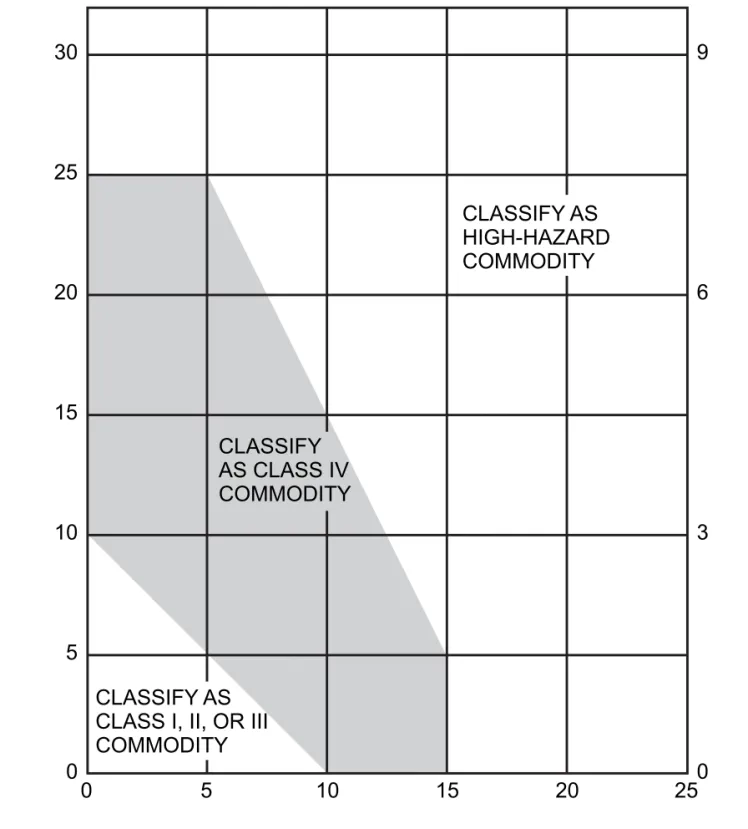
2303.7.4 Limited quantities of Group A plastics in mixed commodities. Figure 2303.7.4 shall be used to determine
the quantity of Group A plastics allowed to be stored in a package or carton or on a pallet without increasing the com-modity classification.
SECTION 2304
DESIGNATION OF HIGH-PILED STORAGE AREAS 2304.1 General. High-piled storage areas, and portions of
high-piled storage areas intended for storage of a different commodity class than adjacent areas, shall be designed and specifically designated to contain Class I, Class II, Class III, Class IV or high-hazard commodities. The designation of a high-piled combustible storage area, or portion thereof intended for storage of a different commodity class, shall be based on the highest hazard commodity class stored except as provided in Section 2304.2.
2304.2 Designation based on engineering analysis. The
des-ignation of a high-piled combustible storage area, or portion thereof, is allowed to be based on a lower hazard class than that of the highest class of commodity stored when a limited quan-tity of the higher hazard commodity has been demonstrated by engineering analysis to be adequately protected by the auto-matic sprinkler system provided. The engineering analysis shall consider the ability of the sprinkler system to deliver the higher density required by the higher hazard commodity. The higher density shall be based on the actual storage height of the pile or rack and the minimum allowable design area for sprin-kler operation as set forth in the density/area figures provided
in NFPA 13. The contiguous area occupied by the higher haz-ard commodity shall not exceed 120 square feet (111 m2) and
additional areas of higher hazard commodity shall be separated from other such areas by 25 feet (7620 mm) or more. The sprin-kler system shall be capable of delivering the higher density over a minimum area of 900 square feet (84 m2) for wet pipe
systems and 1,200 square feet (11 m2) for dry pipe systems.
The shape of the design area shall be in accordance with Sec-tion 903.
SECTION 2305
HOUSEKEEPING AND MAINTENANCE 2305.1 Rack structures. The structural integrity of racks shall
be maintained.
2305.2 Ignition sources. Clearance from ignition sources shall
be provided in accordance with Section 305.
2305.3 Smoking. Smoking shall be prohibited. Approved “No
Smoking” signs shall be conspicuously posted in accordance with Section 310.
2305.4 Aisle maintenance. When restocking is not being
con-ducted, aisles shall be kept clear of storage, waste material and debris. Fire department access doors, aisles and exit doors shall not be obstructed. During restocking operations using manual stocking methods, a minimum unobstructed aisle width of 24 inches (610 mm) shall be maintained in 48-inch (1219 mm) or smaller aisles, and a minimum unobstructed aisle width of one-half of the required aisle width shall be maintained in aisles greater than 48 inches (1219 mm). During mechanical stocking operations, a minimum unobstructed aisle width of 44 inches (1118 mm) shall be maintained in accordance with Sec-tion 2306.9.
2305.5 Pile dimension and height limitations. Pile
dimen-sions and height limitations shall comply with Section 2307.3.
2305.6 Arrays. Arrays shall comply with Section 2307.4. 2305.7 Flue spaces. Flue spaces shall comply with Section
2308.3.
SECTION 2306
GENERAL FIRE PROTECTION AND LIFE SAFETY FEATURES
2306.1 General. Fire protection and life safety features for
high-piled storage areas shall be in accordance with Sections 2306.2 through 2306.10.
2306.2 Extent and type of protection. Where required by
Table 2306.2, fire detection systems, smoke and heat removal, draft curtains and automatic sprinkler design densities shall extend the lesser of 15 feet (4572 mm) beyond the high-piled storage area or to a permanent partition. Where portions of high-piled storage areas have different fire protection require-ments because of commodity, method of storage or storage height, the fire protection features required by Table 2306.2 within this area shall be based on the most restrictive design requirements.
0
0
0
3
6
9
5
10
15
20
25
30
5
10
PERCENT BY WEIGHT OF UNEXPANDED PLASTIC
dPERCENT
BY
VOLUME
O
F
EXP
ANDED
P
LASTIC
cPERCENT
BY
WEIGHT
O
F
EXP
ANDED
P
LASTIC
d15
20
25
CLASSIFY
AS CLASS IV
COMMODITY
CLASSIFY AS
HIGH-HAZARD
COMMODITY
CLASSIFY AS
CLASS I, II, OR III
COMMODITY
FIGURE 2303.7.4 MIXED COMMODITIESa, b
a. This figure is intended to determine the commodity classification of a mixed commodity in a package, carton or on a pallet where plastics are involved. b. The following is an example of how to apply the figure: A package containing a Class III commodity has 12-percent Group A expanded plastic by volume. The
weight of the unexpanded Group A plastic is 10 percent. This commodity is classified as a Class IV commodity. If the weight of the unexpanded plastic is increased to 14 percent, the classification changes to a high-hazard commodity.
c. Percent by volume= Volume of plastic in pallet load Total volume of pallet load, including pallet d. Percent by weight = Weight of plastic in pallet load
TABLE 2306.2
GENERAL FIRE PROTECTION AND LIFE SAFETY REQUIREMENTS
COMMODITY CLASS SIZE OF HIGH-PILED STORAGE AREAa (square feet) (see Sections 2306.2 and 2306.4)
ALL STORAGE AREAS
(See Sections 2306, 2307 and 2308)b
SOLID-PILED STORAGE, SHELF STORAGE AND PALLETIZED STORAGE
(see Section 2307.3) Automatic fire-extinguishing system (see Section 2306.4) Fire detection system (see Section 2306.5) Building access (see Section 2306.6) Smoke and heat removal (see Section 2306.7) Draft curtains (see Section 2306.7) Maximum pile dimensionc (feet) Maximum permissible storage heightd (feet) Maximum pile volume (cubic feet) I-IV 0-500 Not Requireda Not Required Not Requirede Not Required Not Required Not Required Not Required Not Required 501-2,500 Not Requireda Yesi Not Requirede Not Required Not Required 100 40 100,000 2,501-12,000
Public accessible Yes
Not Required Not Requirede Not Required Not Required 100 40 400,000 2,501-12,000 Nonpublic accessible (Option 1) Yes Not Required Not Requirede Not Required Not Required 100 40 400,000 2,501-12,000 Nonpublic accessible (Option 2) Not
Requireda Yes Yes Yesj Yesj 100 30f 200,000
12,001-20,000 Yes Not
Required Yes Yes
j Not
Required 100 40 400,000
20,001-500,000 Yes Not
Required Yes Yes
j Not
Required 100 40 400,000
Greater than
500,000g Yes
Not
Required Yes Yes
j Not Required 100 40 400,000 High hazard 0-500 Not Requireda Not Required Not Requirede Not Required Not Required 50 Not Required Not Required 501-2,500
Public accessible Yes
Not Required Not Requirede Not Required Not Required 50 30 75,000 501-2,500 Nonpublic accessible (Option 1) Yes Not Required Not Requirede Not Required Not Required 50 30 75,000 501-2,500 Nonpublic accessible (Option 2) Not
Requireda Yes Yes Yesj Yesj 50 20 50,000
2,501-300,000 Yes Not
Required Yes Yes
j Not
Required 50 30 75,000
300,001-500,000g, h Yes Not
Required Yes Yes
j Not
Required 50 30 75,000
For SI: 1 foot = 304.8 mm, 1 cubic foot = 0.02832 m3, 1 square foot = 0.0929 m2.
a. When automatic sprinklers are required for reasons other than those in Chapter 23, the portion of the sprinkler system protecting the high-piled storage area shall be designed and installed in accordance with Sections 2307 and 2308.
b. For aisles, see Section 2306.9.
c. Piles shall be separated by aisles complying with Section 2306.9.
d. For storage in excess of the height indicated, special fire protection shall be provided in accordance with Note g when required by the fire code official. See also Chapters 28 and 34 for special limitations for aerosols and flammable and combustible liquids, respectively.
e. Section 503 shall apply for fire apparatus access.
f. For storage exceeding 30 feet in height, Option 1 shall be used.
g. Special fire protection provisions including, but not limited to, fire protection of exposed steel columns; increased sprinkler density; additional in-rack sprinklers, without associated reductions in ceiling sprinkler density; or additional fire department hose connections shall be provided when required by the fire code official. h. High-piled storage areas shall not exceed 500,000 square feet. A 2-hour fire wall constructed in accordance with the International Building Code shall be used to
divide high-piled storage exceeding 500,000 square feet in area.
i. Not required when an automatic fire-extinguishing system is designed and installed to protect the high-piled storage area in accordance with Sections 2307 and 2308.
2306.3 Separation of high-piled storage areas. High-piled
storage areas shall be separated from other portions of the building where required by Sections 2306.3.1 through 2306.3.2.2.
2306.3.1 Separation from other uses. Mixed occupancies
shall be separated in accordance with the International Building Code.
2306.3.2 Multiple high-piled storage areas. Multiple
high-piled storage areas shall be in accordance with Section 2306.3.2.1 or 2306.3.2.2.
2306.3.2.1 Aggregate area. The aggregate of all
high-piled storage areas within a building shall be used for the application of Table 2306.2 unless such areas are separated from each other by 1-hour fire barrier walls constructed in accordance with the International Build-ing Code. OpenBuild-ings in such walls shall be protected by opening protective assemblies having a 1-hour fire pro-tection rating.
2306.3.2.2 Multiclass high-piled storage areas.
High-piled storage areas classified as Class I through IV not separated from high-piled storage areas classified as high hazard shall utilize the aggregate of all high-piled storage areas as high hazard for the purposes of the appli-cation of Table 2306.2. To be considered as separated, 1-hour fire barrier walls shall be constructed in accor-dance with the International Building Code. Openings in such walls shall be protected by opening protective assemblies having a 1-hour fire protection rating.
Exception: As provided for in Section 2304.2. 2306.4 Automatic sprinklers. Automatic sprinkler systems
shall be provided in accordance with Sections 2307, 2308 and 2309.
2306.5 Fire detection. Where fire detection is required by
Table 2306.2, an approved automatic fire detection system shall be installed throughout the high-piled storage area. The system shall be monitored and be in accordance with Section 907.
2306.6 Building access. Where building access is required by
Table 2306.2, fire apparatus access roads in accordance with Section 503 shall be provided within 150 feet (45 720 mm) of all portions of the exterior walls of buildings used for high-piled storage.
Exception: Where fire apparatus access roads cannot be
installed because of topography, railways, waterways, non-negotiable grades or other similar conditions, the fire code official is authorized to require additional fire protec-tion.
2306.6.1 Access doors. Where building access is required
by Table 2306.2, fire department access doors shall be pro-vided in accordance with this section. Access doors shall be accessible without the use of a ladder.
2306.6.1.1 Number of doors required. A minimum of
one access door shall be provided in each 100 lineal feet (30 480 mm), or fraction thereof, of the exterior walls which face required fire apparatus access roads.
2306.6.1.2 Door size and type. Access doors shall not
be less than 3 feet (914 mm) in width and 6 feet 8 inches (2032 mm) in height. Roll-up doors shall not be used unless approved.
2306.6.1.3 Locking devices. Only approved locking
devices shall be used.
2306.7 Smoke and heat removal. Where smoke and heat
removal are required by Table 2306.2, smoke and heat vents shall be provided in accordance with Section 910. Where draft curtains are required by Table 2306.2, they shall be provided in accordance with Section 910.3.4.
2306.8 Fire department hose connections. Where exit
pas-sageways are required by the International Building Code for egress, a Class I standpipe system shall be provided in accor-dance with Section 905.
2306.9 Aisles. Aisles providing access to exits and fire
depart-ment access doors shall be provided in high-piled storage areas exceeding 500 square feet (46 m2), in accordance with Sections
2306.9.1 through 2306.9.3. Aisles separating storage piles or racks shall comply with NFPA 13. Aisles shall also comply with Chapter 10.
Exception: Where aisles are precluded by rack storage
sys-tems, alternate methods of access and protection are allowed when approved.
2306.9.1 Width. Aisle width shall be in accordance with
Sections 2306.9.1.1 and 2306.9.1.2.
Exceptions:
1. Aisles crossing rack structures or storage piles, which are used only for employee access, shall be a minimum of 24 inches (610 mm) wide.
2. Aisles separating shelves classified as shelf stor-age shall be a minimum of 30 inches (762 mm) wide.
2306.9.1.1 Sprinklered buildings. Aisles in sprinklered
buildings shall be a minimum of 44 inches (1118 mm) wide. Aisles shall be a minimum of 96 inches (2438 mm) wide in high-piled storage areas exceeding 2,500 square feet (232 m2) in area, that are accessible to the public and
designated to contain high-hazard commodities.
Exception: Aisles in high-piled storage areas
exceed-ing 2,500 square feet (232 m2) in area, that are
acces-sible to the public and designated to contain high-hazard commodities, are protected by a sprin-kler system designed for multiple-row racks of high-hazard commodities shall be a minimum of 44 inches (1118 mm) wide.
Aisles shall be a minimum of 96 inches (2438 mm) wide in areas accessible to the public where mechanical stocking methods are used.
2306.9.1.2 Nonsprinklered buildings. Aisles in
nonsprinklered buildings shall be a minimum of 96 inches (2438 mm) wide.
2306.9.2 Clear height. The required aisle width shall
extend from floor to ceiling. Rack structural supports and catwalks are allowed to cross aisles at a minimum height of
6 feet 8 inches (2032 mm) above the finished floor level, provided that such supports do not interfere with fire depart-ment hose stream trajectory.
2306.9.3 Dead ends. Dead-end aisles shall be in accordance
with Chapter 10.
2306.10 Portable fire extinguishers. Portable fire
extinguishers shall be provided in accordance with Section 906.
SECTION 2307
SOLID-PILED AND SHELF STORAGE
2307.1 General. Shelf storage and storage in solid piles, solid
piles on pallets and bin box storage in bin boxes not exceeding 5 feet (1524 mm) in any dimension, shall be in accordance with Sections 2306 and this section.
2307.2 Fire protection. Where automatic sprinklers are
required by Table 2306.2, an approved automatic sprinkler sys-tem shall be installed throughout the building or to 1-hour fire barrier walls constructed in accordance with the International Building Code. Openings in such walls shall be protected by opening protective assemblies having 1-hour fire protection ratings. The design and installation of the automatic sprinkler system and other applicable fire protection shall be in accordance with the International Building Code and NFPA 13.
2307.2.1 Shelf storage. Shelf storage greater than 12 feet
(3658 mm) but less than 15 feet (4572 mm) in height shall be in accordance with the fire protection requirements set forth in NFPA 13. Shelf storage 15 feet (4572 mm) or more in height shall be protected in an approved manner with spe-cial fire protection, such as in-rack sprinklers.
2307.3 Pile dimension and height limitations. Pile
dimen-sions, the maximum permissible storage height and pile vol-ume shall be in accordance with Table 2306.2.
2307.4 Array. Where an automatic sprinkler system design
utilizes protection based on a closed array, array clearances shall be provided and maintained as specified by the standard used.
SECTION 2308 RACK STORAGE
2308.1 General. Rack storage shall be in accordance with
Sec-tion 2306 and this secSec-tion. Bin boxes exceeding 5 feet (1524 mm) in any dimension shall be regulated as rack storage.
2308.2 Fire protection. Where automatic sprinklers are
required by Table 2306.2, an approved automatic sprinkler sys-tem shall be installed throughout the building or to 1-hour fire barrier walls constructed in accordance with the International Building Code. Openings in such walls shall be protected by opening protective assemblies having 1-hour fire protection ratings. The design and installation of the automatic sprinkler system and other applicable fire protection shall be in accor-dance with Section 903.3.1.1 and the International Building Code.
2308.2.1 Plastic pallets and shelves. Storage on plastic
pallets or plastic shelves shall be protected by approved spe-cially engineered fire protection systems.
Exception: Plastic pallets listed and labeled in
accor-dance with UL 2335 shall be treated as wood pallets for determining required sprinkler protection.
2308.2.2 Racks with solid shelving. Racks with solid
shelving having an area greater than 32 square feet (3 m2),
measured between approved flue spaces at all four edges of the shelf, shall be in accordance with this section.
Exceptions:
1. Racks with mesh, grated, slatted or similar shelves having uniform openings not more than 6 inches (152 mm) apart, comprised of at least 50 percent of the overall shelf area, and with approved flue spaces are allowed to be treated as racks without solid shelves.
2. Racks used for the storage of combustible paper records, with solid shelving, shall be in accordance with NFPA 13.
2308.2.2.1 Fire protection. Fire protection for racks
with solid shelving shall be in accordance with NFPA 13.
2308.3 Flue spaces. Flue spaces shall be provided in
accor-dance with Table 2308.3. Required flue spaces shall be main-tained.
2308.4 Column protection. Steel building columns shall be
protected in accordance with NFPA 230.
2308.5 Extra-high-rack storage systems. Approval of the
fire code official shall be obtained prior to installing extra-high-rack combustible storage.
2308.5.1 Fire protection. Buildings with extra-high-rack
combustible storage shall be protected with a specially engi-neered automatic sprinkler system. Extra-high-rack com-bustible storage shall be provided with additional special fire protection, such as separation from other buildings and additional built-in fire protection features and fire depart-ment access, when required by the fire code official.
SECTION 2309 AUTOMATED STORAGE
2309.1 General. Automated storage shall be in accordance
with this section.
2309.2 Automatic sprinklers. Where automatic sprinklers are
required by Table 2306.2, the building shall be equipped throughout with an approved automatic sprinkler system in accordance with Section 903.3.1.1.
2309.3 Carousel storage. High-piled storage areas having
greater than 500 square feet (46 m2) of carousel storage shall be
provided with automatic shutdown in accordance with one of the following:
1. An automatic smoke detection system installed in accor-dance with Section 907, with coverage extending 15 feet (4575 mm) in all directions beyond unenclosed carousel storage systems and which sounds a local alarm at the
operator’s station and stops the carousel storage system upon the activation of a single detector.
2. An automatic smoke detection system installed in accor-dance with Section 907 and within enclosed carousel storage systems, which sounds a local alarm at the opera-tor’s station and stops the carousel storage system upon the activation of a single detector.
3. A single dead-man-type control switch that allows the operation of the carousel storage system only when the operator is present. The switch shall be in the same room as the carousel storage system and located to provide for observation of the carousel system.
SECTION 2310 SPECIALTY STORAGE
2310.1 General. Records storage facilities used for the rack or
shelf storage of combustible paper records greater than 12 feet (3658 mm) in height shall be in accordance with Sections 2306 and 2308 and NFPA 13 and NFPA 230. Palletized storage of records shall be in accordance with Section 2307.
TABLE 2308.3
REQUIRED FLUE SPACES FOR RACK STORAGE
RACK CONFIGURATION
AUTOMATIC SPRINKLER PROTECTION
SPRINKLER AT THE CEILING WITH OR WITHOUT MINIMUM IN-RACK SPRINKLERS
IN-RACK SPRINKLERS AT
EVERY TIER NONSPRINKLERED
25 feet
25 feet Any height Any height
Storage height Option 1 Option 2
Single-row rack
Transverse flue space
Sizeb 3 inches Not Applicable 3 inches Not Required Not Required
Vertically
aligned Not Required Not Applicable Yes Not Applicable Not Required
Longitudinal flue space Not Required Not Applicable Not Required Not Required Not Required
Double-row rack
Transverse flue space
Sizeb 6 inchesa 3 inches 3 inches Not Required Not Required
Vertically
aligned Not Required Not Required Yes Not Applicable Not Required
Longitudinal flue space Not Required 6 inches 6 inches Not Required Not Required
Multi-row rack
Transverse flue space
Sizeb 6 inches Not Applicable 6 inches Not Required Not Required
Vertically
aligned Not Required Not Applicable Yes Not Applicable Not Required
Longitudinal flue space Not Required Not Applicable Not Required Not Required Not Required For SI: 1 inch = 25.4 mm, 1 foot = 304.8 mm.
a. Three-inch transverse flue spaces shall be provided at least every 10 feet where ESFR sprinkler protection is provided. b. Random variations are allowed, provided that the configuration does not obstruct water penetration.