American Shoppers
Online and Offline
Open to Exploitation:
A Report from the Annenberg Public Policy Center
Joseph Turow,
Lauren Feldman,
&
Kimberly Meltzer
Joseph Turow is Robert Lewis Shayon Professor of Communication at the University of Pennsylvania’s Annenberg School for Communication. His published work includes more than sixty articles and nine books on the mass media, including Niche Envy:
Database Marketing and American Life (MIT Press, forthcoming), The Wired Homestead
(MIT Press, 2003, edited with Andrea Kavanaugh); and Breaking Up America: Advertising and the New Media World (University of Chicago Press, 1997; Chinese edition, 2004). He currently serves on the editorial boards of Journal of Broadcasting and Electronic Media, New Media and Society, Journalism, and Poetics.
Lauren Feldman and Kimberly Meltzer are both Ph.D. candidates at the University of Pennsylvania’s Annenberg School for Communication.
Open to Exploitation:
American Shoppers Online and Offline
By Joseph Turow, Lauren Feldman, and Kimberly Meltzer
June 2005
Open to Exploitation:
American Shoppers Online and Offline
Overview ……….3
Background ………..6
The Study and the Population ………....13
Lacking the Knowledge ……….17
Concerns and Objections ………....21
Linking Attitudes and Backgrounds to Knowledge ...27
OVERVIEW
M
ost Americans who use the Internet have little idea how vulnerable they are to abuse by online and offline marketers and how the information they provide can be used to exploit them.That is one conclusion from this unprecedented national phone survey conducted by the Annenberg Public Policy Center. The study indicates that many adults who use the internet believe incorrectly that laws prevent online and offline stores from selling their personal information. They also incorrectly believe that stores cannot charge them different prices based on what they know about them. Most other internet-using adults admit that they simply don’t know whether or not laws protect them.
The survey further reveals that the majority of adults who use the internet do not know where to turn for help if their personal information is used illegally online or offline. The study’s findings suggest a complex mix of ignorance and knowledge, fear and bravado, realism and idealism that leaves most internet-using adult American shoppers open to financial exploitation by retailers.
Americans’ lack of knowledge about marketplace rules puts them at risk. We found that:
• 68% of American adults who have used the internet in the past month believe incorrectly that “a site such as Expedia or Orbitz that compares prices on different airlines must include the lowest airline prices.”
• 49% could not detect illegal “phishing”—the activity where crooks posing as banks send emails to consumers that ask them to click on a link wanting them to verify their account.
• 66% could not correctly name even one of the three U.S. credit reporting agencies (Equifax, Experian, and TransUnion) that could keep them aware of their credit worthiness and whether someone is stealing their identity.
Consumers are also vulnerable to subtle forms of exploitation online and offline. • 64% of American adults who have used the internet recently do not know it is
legal for “an online store to charge different people different prices at the same time of day.” 71% don’t know it is legal for an offline store to do that.
• 72% do not know that charities are allowed to sell their names to other charities even without permission.
• 64% do not know that a supermarket is allowed to sell other companies information about what they buy.
• 75% do not know the correct response—false—to the statement, “When a website has a privacy policy, it means the site will not share my information with other websites and companies.”
This lack of knowledge signals that the great majority of U.S. adults who use the internet is unprepared to deal with two hot trends that are rapidly becoming facts of life in stores,
yet have hardly received attention beyond the trade press. One trend, which marketers call behavioral targeting, involves buying or collecting information about a customer’s activities in order to know how to best sell to him or her. The second development is price discrimination: when a seller charges different prices to different customers based on data the seller has about them.
We asked a nationally representative sample of 1,500 adults who used the internet during the past month 17 true-false questions about key aspects of these new developments and where they can turn for help if their personal information is used illegally. Among them were the statements noted on page 3 as examples of Americans’ lack of knowledge. In fact, we found that the respondents know correct answers to an average of only 7 of the 17 of the true-false questions. We also found that they overwhelmingly object to most forms of behavioral targeting and all forms of price discrimination as ethically wrong.
• 76% agree that “it would bother me to learn that other people pay less than I do for the same products.”
• 64% agree that “it would bother me to learn that other people get better discount coupons than I do for the same products.”
• 66% disagree that “it’s OK with me if the supermarket I shop at keeps detailed records of my buying behavior.”
• 87% disagree that “it’s OK if an online store I use charges people different prices for the same products during the same hour.”
• 72% disagree that “if a store I shop at frequently charges me lower prices than it charges other people because it wants to keep me as a custmer more than it wants to keep them, that’s OK.”
Most internet-using U.S. adults are aware that companies can follow their behavior online. Almost all (89%) of those who say their supermarkets offer frequent shopper cards applied for them—and in doing it gave the stores personally identifiable
information about themselves. In this retail environment where companies collect personal information, Americans do directly admit feeling vulnerable. Only 17% agree with the statement that “what companies know about me won’t hurt me” (81% disagree), 70% disagree that “privacy policies are easy to understand,” and 79% agree that “I am nervous about websites having information about me.” Sadly, though, only about one out of three (35%) says he or she “trust(s) the U.S. government to protect consumers from marketers who misuse their information.”
In the face of all this nervousness and seeming confusion, it is startling that 65% of internet-using adult Americans nevertheless say they “know what I have to do to protect myself from being taken advantage of by sellers on the web.” Judging by their scores on the true-false test, they have a misplaced sense of confidence. People who say they know how to protect themselves score just as poorly on the questions—and even the ones specifically regarding the online marketplace—as the people who don’t think they know how to protect themselves. By contrast, those with a higher education tended to be more modest about knowing how to protect themselves but were more likely to score better on the test.
In fact, of all characteristics in people’s backgrounds, having more years of education is the best predictor of understanding basic realities about power to control information on them and the prices they pay when shopping online and offline. Yet even having more general schooling doesn’t necessarily mean really knowing this world well. People whose formal education ended with a high school diploma know correct answers to an average of 6.1 items out of a possible 17. People with a college degree do better—8.1— but that still means they get only 45% right. Even people with graduate school or more average 8.9 correct—just 51% correct.
As U.S. society moves further into the twenty-first century, prices that vary based on firms’ information about us could become an increasing feature of the marketplace. Database-driven price distinctions could spread as growing numbers of retailers use information consumers never knew they revealed to draw detailed conclusions about their buying patterns that they would not have wanted. Consumers who are not aware of how behavioral targeting and price discrimination work, of what rights they hold when it comes to companies’ using knowledge about them, and of how to respond to these circumstances may not know they are not getting the best deals. They may consistently be paying more than others for the same products.
At the end of the report we therefore suggest three courses of action. First, the Federal Trade Commission should require websites to drop the label Privacy Policy and replace it with Using Your Information. The new designation will likely go far toward reversing the broad public misconception that the mere presence of a privacy policy automatically means the firm will not share the person’s information with other websites and
companies. Second, U.S. school systems—from elementary through high school—must develop curricula that tightly integrate consumer education and media literacy. Paying new attention to these much-neglected subjects is critical if society is to succeed in
preparing young people for the increasingly challenging twenty-first century marketplace. Third, the government should require retailers to disclose specifically what data they have collected about individual customers as well as when and how they use those data to influence interactions with them. The survey found that Americans are begging for openness in their relationships with marketers.
Our examination of internet-using American adults in the new online/offline marketplace was carried out by ICR/International Communication Research for the Annenberg Public Policy Center of the University of Pennsylvania. The study was conducted by telephone from February 8 to March 14, 2005, among a nationally representative sample of 1,500 respondents who said they had used the internet within the past thirty days.
Our aim was to address two critical public policy questions that have not previously been explored: How much do Americans know about who is allowed to control information about them when they shop online and offline? And what do they know and feel about those two rather secretive activities, behavioral targeting and price discrimination, that are increasingly affecting American shoppers on- and offline?
BACKGROUND
T
hese questions are important because it is becoming clear that shopping in the twenty-first century will be quite different from the way it was in the twentieth. One does not have to turn to the movie Minority Report for an idea of futuristic gizmos consumers will confront in local malls. Activities are already underway across the retailing spectrum— in banks, high-end boutiques, supermarkets, and discounters—that are fundamentally altering the relationship Americans have with stores.Two particular developments stand out: behavioral targeting and price discrimination. Behavioral targeting in a retail environment takes place when a firm keeps track of a customer’s shopping history in order to know how to best sell to him or her.1 Price discrimination comes in a variety of forms, economists note.2 The ones that most attract retailers involves using information to change prices based on what the seller knows about individual consumers or consumer segments.3
Retailers consider behavioral targeting and price discrimination crucial tools to cope with the hypercompetitive online and offline circumstances in which they find themselves. Critics of the trend worry that it may well put many consumers at financial and even social disadvantage unless they understand what is happening. This study explores whether they do.
T
he term behavioral targeting is often associated with the virtual world but the activity it describes takes place offline as well.4 Online stores can closely follow movements of visitors—for example, to see what products they viewed and whether they started to buy something but didn’t complete the purchase. Stores can save the records of these actions and, by placing text files called cookies in the visitors’ computers, maintain a collection of what the people who use that computer have looked at on the site over time.Of course, following activities on a computer does not reveal whether they reflect the clicks of more than one person—several members of a household, for example. Stores do keep records of the online purchases of individuals, and they try to encourage their
customers to identify themselves when they visit their sites by “signing in” with a password. Getting the password typically means registering—providing name and email address in addition to other information such as gender, birthdate, and zip code.5
The consumer’s reward for offering personally identifiable information and signing in is the opportunity to receive quick checkout, “special offers” and attention via email. The store gains a gold mine of information. Each time registered visitors enter the online stores using their passwords, stores can add information about their specific activities to a database. That allows the store’s data analysts to categorize the consumer in terms of preferences and long-term value.
Based on sales and tracking information, the merchant can also decide whether it is useful to buy additional information about those customers from data brokers. Over the
past few decades, the sale and purchase of information on individuals has become big business. Recent news reports about the theft or accidental loss of personally identifiable information by data brokers Choicepoint6 and Lexis Nexis Group7 shined an unusual public beacon on an industry that is aided by the absence of U.S. laws to control much of the extraction, manipulation and sharing of data about people and what they do online or offline. Without customer permission, organizations not “affiliated” with each other are prohibited from sharing certain personal health information, certain types of personal financial information held by certain types of firms, certain information that video stores and cable systems collect about their customers’ viewing, and personally identifiable information from children younger than thirteen years.8 Generally, though, companies have virtually free reign to use data in the U.S. for business purposes without their customers’ knowledge or consent. Merchants can therefore easily buy information on valued customers’ backgrounds and activities with an eye toward better understanding their interests and purchasing power.
A retailer will often hire behavioral-targeting firms to bring together for analysis all the data the retailer is collecting about customers. The firms create profiles of the
individuals, often placing them into labeled segments of consumers with similar buying characteristics. Then, based on rules for data handling that include scoring individuals on various characteristics, the firms customize interactions with customers and the customer segment in ways intended to be the most profitable possible.
The behavioral targeting firm Epiphany, for example, claims that it “offers a complete solution for optimizing interactions with customers over online channels such as the Web, e-mail, and SMS [i.e., short text messages on cell phones].” In a “case study” on its website, Epiphany claims that by using its expertise and software, American Airlines has gained “a comprehensive view of its customers across all [electronic communication] touchpoints . . . to enhance customer relationships.”9 For the American Airlines website, AA.com, Epiphany implements personalization and content management software to analyze customer profiles as customers move through the site and then proceeds to “match them to relevant content and offers on the site.”10 Epiphany does that with an
electronic newsletter sent to millions of customers. Called AAirmail, the publication provides customized content and offers tailored to the individual profiles Epiphany has created. As an example, newsletter articles vary to help individual customers reach their next top-tier status—Gold, Platinum or Executive Platinum.11
As an American Airlines marketing executive describes them, these activities are part of a larger “unified view of customer behavior” that allows the company to “integrate data about past transactions and interactions, online or otherwise.”12 Increasing numbers of merchants are going beyond the digital realm and using Epiphany or larger database firms such as Oracle-PeopleSoft, or Acxiom to create central customer databanks for the instantaneous use of all customer information. As one writer put it, the repositories “collect data from all points” and then “tailor permission-based offerings to
In tune with this idea, retailers increasingly act as if their selling arena has merged into one integrated online/offline marketplace. Consumers, they believe, are
“multi-channel”—they shop both online and offline.14 Acxiom tells its clients that “The ability to best serve your customers when it matters most—during the interaction—is critical to achieving customer growth and retention goals. Acxiom’s customer recognition solutions enable companies to distinguish customers accurately and consistently, providing
complete and instant access to relevant customer data across all channels of communication.”15
G
rowing numbers of merchants are therefore merging the data they have about their customers from the web, the phone, and the store floor in a bid to give their desired customers a seamless experience. In the process, behavioral targeting is taking place offline, online and across both areas. The offline activity has actually been going on for quite a while. As early as the 1980s, financial and leisure firms as well as elite retailers were following the logic of developing relationships with customers based on digital repositories and then treating them differently based on what they learned. They created the databases by soliciting information from their customers, buying information about their lifestyles from data brokers, and tracking their interactions with them.Mid-priced department stores and supermarket chains took longer to adopt this strategy. By 2000, though, that was changing rather quickly. A major reason had to do with the enormous price competition that they confronted in discount retailer Mart. Wal-Mart uses an aggressive “everyday low prices” strategy supported by a legendary efficiency, strong pressure on suppliers, and a huge investment in databases to track the movement and sale of products. The approach often determines the price of products in an area and consequently frightens retailers that sell the same or similar items. The phenomenon is so pervasive and powerful that it has become a noun—Wal-Martization— in the Forrester Research consultancy’s lexicon.16
In the absence of an ability to compete on price with Wal-Mart and similar discounters, many retailers have been searching for the best strategies with which to survive. Some consultants suggest that the answer lies in adapting to the varied needs of the area better than Wal-Mart can in terms of the right quality, convenient locations, and variety of offerings. Another stream of analysis sees Wal-Mart’s long-term Achilles heel in terms of its difficulty in getting close to the individual customer or small-customer niches. This view emphasizes that with the exception of its Sam’s Club wholesale setup, the company does not keep track of individual customer purchases or reach out to them in unique ways.
Increasingly, retailers see a key competitive advantage in the Wal-Mart age as knowing and rewarding profitable customers better than Wal-Mart or any other competitors. The goal is to sell products that those consumers will perceive as valuable not primarily because of the price but because the product quality and service consistently matches what they need. Analytics firms with the expertise of finding patterns in purchase data develop profiles of “best” or at least “good” customers so as to focus on wooing them.
The idea is that as important as prospecting for new customers is, retailers should pay more attention to the good customers they already have. One reason is the belief that a high percentage (sometimes 80%) of a company’s profit comes from a small percentage (often around 20%) of repeat purchasers and that it costs several times more to get a new customer as it does to retain a loyal one. Another belief is that the best new customers will be those who are similar to the best old ones. The more the retailer uses databases to find out about its desirable clientele, then, the better it can keep them, find others like them, and not pursue “low-value” consumers who tend to shop only for bargains or who return too many goods.
So, for example:
• The Claritas company’s P$ycle database helps banks figure out whom to keep and pursue as customers by statistically linking their customer to what Claritas knows about the background and behavior of types—segments—of people it concludes are like them. When fed a bank’s customer data, P$ycle software segments them “by evaluating the economic and demographic factors that have the greatest effect on their financial behavior.” The 8 major groups into which P$ycle divides the population reflects a slide from high prosperity to virtual penury: Wealth Market, Upscale Retired, Upper Affluent, Lower Affluent, Mass Market, Midscale
Retired, Lower Market, and Downscale Retired. The trick with all the groups and segments, according to Claritas, is to link the data to the bank’s “house file” to create “actionable” information—for example, whether or not to invite certain people as customers and, if so, what packet of materials to send.17
• According to Direct magazine, the Bloomingdales department store, which keeps transaction records of all its customers, uses database software called Klondike to focus on the store's 15,000 most valuable patrons. It contains their transactions, the history of promotional materials sent to them, and basic household
information. Klondike presents the data about these people to Bloomingdale’s telephone call center and sales floor personnel. By swiping the best customer’s credit card at a point of service terminal—a cash register—salespeople can get an overview of the shopping interests of individual customers. The idea is to “enable salespeople to custom-build merchandise suggestions.”18
• In 2005 the CEO of data-mining firm IRI noted that for years, food and drug retailers have been compiling data from frequent-shopper cards but doing little with it. That, he said, was starting to change quickly. IRI signed a deal with a major grocery chain to mine shopper data to help it target marketing toward the most profitable customers. He expected more supermarkets to do the same.19 A columnist in Progressive Grocer magazine noted that a small but growing number of chains are pursuing strategies that both invite “very good customers” and push away “cherry pickers.” He opined that behavioral targeting—“creating a profile of their customers and then performing triage on the market to save their most valuable purchasers”—is a wise competitive stance in a Wal-Mart world, where “competing on price is out of the question.”20
P
rice discrimination is a logical corollary to behavioral targeting. Economists commonly identify three types of bias. First-degree price discrimination occurs when a different charge is tailored to a specific buyer based on what the seller knows about the customer. With the second-degree type, sellers openly offer a variety of fee options—for example, grocery discounts for buying large quantities or lowered bank fees for keeping large account balances—to induce consumers to choose the one that matches their interests or abilities to pay. In third-degree price discrimination, the seller decides what segments of the market have different levels of price sensitivity and charges the groups accordingly. Examples of third degree price discrimination are senior-citizen and student discounts. But while retailers grant senior citizen and student discounts openly, in a growing number of circumstances they are categorizing consumers into statistical segments without their knowledge. People in certain niches may then get different discount offers for the same products and services—as well as for different products and services—compared to those in other niches. For example, banks that use the Claritas P$ycle system vary the deals they present customers based on the lifestyle segments into which they slot them. Many financial institutions also carry out first-degree price discrimination without notifying their customers. They do it by scoring them based on their financial abilities and payment activities in the marketplace. Department stores and even supermarkets have been moving swiftly into this area, as well, though they don’t discuss it publicly. With Bloomingdale’s Klondike, for example, “aggregate spending information atop each customer's file allows the floor rep to make snap decisions about offering specialservices” that increase the value of that person’s purchases compared to other
customers.21 On the flip side, stores have been trying to find ways to discourage shopping from what some retailers call “bottom feeders”—consumers who visit them mostly for bargains and return products too often.22
As for supermarkets, the frequent-shopper or “loyalty” card (held by far more than 50% of U.S. households) is currently their central way for keeping track of individual
household purchases and charging them differently. One common supermarket price-discrimination tactic involves the Catalina database system that gives different value coupons based on analyses of consumer’s purchases using the store’s loyalty card for 104 weeks.23 Tests of in-store computer tracking technologies by Albertsons and Stop and Shop aim to customize the consumer’s discounts based on shopping history from the moment the consumer enters the store. In both cases being a loyal customer doesn’t automatically mean getting the lowest prices. Computer analyses of shopping histories might determine that a person’s allegiance to some products means that he or she would buy them even without the discounts, or with smaller discounts than others might get for the same items at the same time.
Merchants consider the online environment a particularly ripe area for such “dynamic pricing”—that is, for first-degree price discrimination driven by behavioral targeting. Writing in Harvard Business Review, associates from McKinsey & Company chided online companies that they are missing out on a “big opportunity” if they are not tracking customers’ behavior and adjusting prices accordingly.24 Consultants urge retailers to
tread carefully, though, so as not to alienate customers.25 The most public revelation of price discrimination online centered on customer anger at Amazon.com in September 2000 when it offered the same DVDs to different customers at discounts of 30%, 35%, or 40% off the manufacturer’s suggested retail price. Amazon insisted that its discounts were part of a random “price test” and not based on customer profiling. After weeks of customer criticism, the firm offered to refund the difference to buyers who had paid the higher prices.26
Though website executives are wary of discussing the subject, it seems clear the practice continues. Consumer Union’s Webwatch project found many bewildering and seemingly idiosyncratic price differences, sometimes quite large, in its investigation of airline offers on travel sites.27 When asked whether travel websites vary prices based on what they know about customers’ previous activities, one industry executive told Webwatch advisor and University of Utah professor Rob Mayer, “I won’t say it doesn’t happen.”28
A
ll this, it should be noted, is usually quite within the law. In the Virginia Journal of Law and Technology, Robert Weiss and Ajay Mehrotra conclude that “as long as the price differences are based on reasonable business practices such as rewarding loyal customers and do not discriminate against race, gender, or other impermissiblecategories, dynamic pricing appears to be legal.”29 Some economists argue, in fact, that certain types of price discrimination may in certain circumstances promote an efficient use of society’s resources. The classic case is that of the dedicated, but by no means rich, country doctor who charges rich people more than poor people so that he can continue to serve both and make a reasonable living. More relevant to the current discussion, supporters of price discrimination that is tied to behavioral targeting and other types of personal profiling argue that is part of a larger process through which companies get to know and serve individual customers in ways that benefit both sides.
Consumer advocates dispute this claim. They argue that while database-guided price discrimination might well help some businesses, it is considerably harmful to individuals and society. Of particular concern to critics are issues of privacy, reduced personal autonomy, misuse of data, and financial harm. Price discrimination based on profiling, they say, invariably means using information about individuals in ways that do not involve their permission. Further, retailers do not tell customers what information they have about them, so that price-discrimination decisions based on errors are quite possible. But even if the private information is correct, there still is the ethical issue of not
allowing customers a say in the profiles stores create about them or the niches in which stores place them.
Writing about behavioral price discrimination in the financial industry, Janet Gertz states in the San Diego Law Review that “many characterize the commercial exploitation of consumer transaction data as a classic example of a market failure.” She explains that “statistics indicate that the power shift facilitated by predictive profiling has proven highly profitable for the financial services industry. However, there is little evidence that indicates that any of these profits or cost savings are being passed on to consumers.”30
Chris Hoofnagle of the Electronic Privacy Information Center suggests that the same argument can be made regarding retailers in general. He notes that the Wall Street Journal found that frequent shopper cards do not generally save consumers money. He implies that giving stores the opportunity to vary discounts by what they know customers have paid in the past might increase this imbalance even more, especially for certain consumers. Hoofnagle also suggests that stores are acting unethically when they try to push customers away because data show they are frugal or sharp shoppers. At the very least, they are disallowing what many consumers have been taught throughout their lives by schools, parents, and ads that exhort them to follow storewide sales. From this perspective, database-driven price discrimination is against the American Way—at least as it was practiced in the twentieth century.31
The arrival of behavioral targeting and price discrimination in a severely competitive offline/online marketplace indicates that the U.S. is entering a new Way. Retailers in the twenty-first century are basing their relationships with consumers on fundamentally new assumptions and technologies. Underlying these changes are crucial issues of social fairness and marketplace transparency. A few experimental studies have shown that when researchers confront consumers with situations featuring price discrimination, the consumers reduce their trust in the retailers doing the discriminating.32 Until now, however, no one has asked what consumers would say if retailers justified price discrimination to consumers with arguments that sometimes they may benefit from it. In fact, until now no one has explored what the U.S. public knows and thinks about these activities that promise to be key parts of twenty-first century marketing. How much do Americans know about who is allowed to control behavioral and other personal
information about them in the online/offline marketplace? Are consumers aware of the existence of price discrimination based on behavioral targeting and other profiling? If they are aware of it, do they accept it as part of economic life, do they resent it, or do they simply believe that the government places limits on it in the interest of fairness?
THE STUDY AND THE POPULATION
B
ecause our questions relate to both the online and offline marketplace, we decided to focus on U.S. adults who use the internet. We cast our net broadly. We included people 18 years or older in our study if they said yes to the question, “Have you used the internet in the past month at home, work, or anywhere else?”Our questions aimed to focus on two areas. One was people’s knowledge of the law when it comes to a company’s right to collect information about them online or offline and to charge them and others different prices for the same items at the same time. The second area centered on people’s attitudes regarding these activities. The interview schedule itself had seven parts beyond the introductory screening material. Part 1 asked about the person’s internet use. Part 2 solicited people’s views about companies’ having access to their personal information, profiling them behaviorally, and charging them different prices—sometimes to their benefit—based on what they learn. In Part 3 the interviewee was given a series of statements about the rules of price discrimination and profiling—especially behavioral targeting—in the marketplace and asked whether each was true or false. Part 4 involved three short scenarios describing different types of behavioral targeting and soliciting the person’s opinions about their ethical acceptability. Part 5 asked people to agree or disagree about statements regarding privacy and personal information. Part 6 asked about the person’s everyday privacy-protecting activities and concerns online and offline. And Part 7 requested background data such as age,
education, and ethnicity.
ICR/International Communication Research of Media, Pennsylvania, carried out the field work for our survey from February 8 to March 14, 2005. ICR used a nationally
representative RDD (random digit dial) sample to screen households for adults age 18 or older who said that they used the internet in the past month. Using the American
Association of Public Opinion Research (AAPOR) RR3 method, a standard for this type of survey, the overall response rate for this study was a very good 58.4%.
The telephone interviews, which averaged 20 minutes, were completed with a nationally representative sample of 1,500 adults. The process involved Computer Assisted
Telephone Interviewing System (CATI), which ensures that questions follow logical skip patterns and that attitude statements are automatically rotated, eliminating question-position bias. The resulting data were weighted to population estimates of people who say they used the internet during the past month that were calculated from ICR’s large daily rolling cross-sectional study, Centris.33 The margin of error for reported
percentages based on the entire sample of 1,500 is plus or minus 2.51 percentage points at the 95% confidence level. The margin of error is higher for smaller subgroups within the sample.
Tables 1 and 2 provide an introductory snapshot of the population we interviewed. As Table 1 indicates, women slightly outnumber men; 73% designate themselves as non-Hispanic white, 8% call themselves non-non-Hispanic blacks; non-Hispanics (white and black) comprise about 10% of the sample; Asian Americans make up 3%; and Native
Americans comprise about 1%. About 60% are under age 45, 57% are married, and 44% have children under age 18. Most have at least some higher education, and while a substantial percentage say their household brings in more than $75,000 annually, a firm claim about this population’s income distribution is difficult because 17% of the
population refused to reveal it.
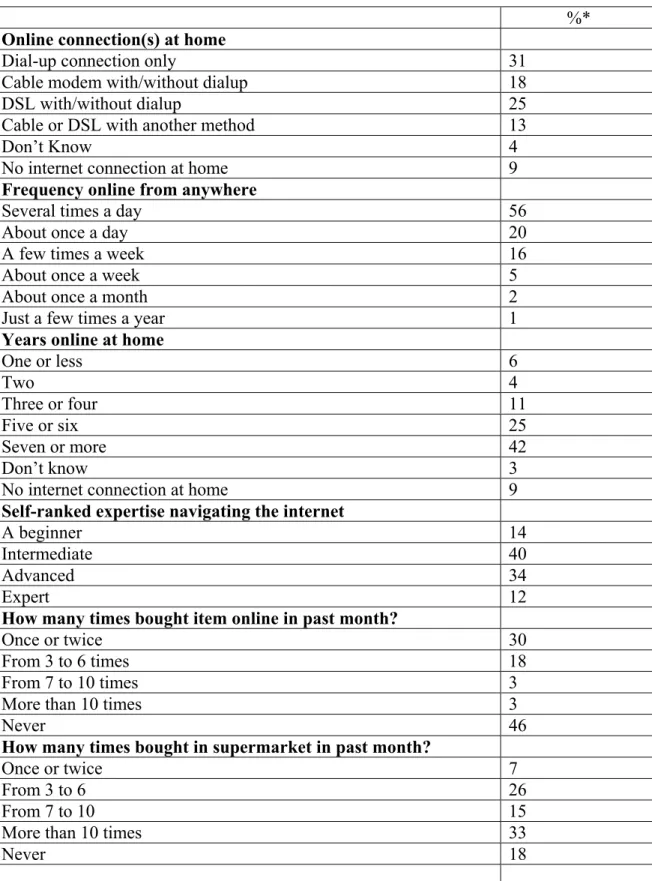
Table 2 indicates that 91% of the respondents have at least one way of connecting to the internet from home. Fully 42% of the respondents say they have been online at home for seven years or more, an indication of the maturing of this medium. Several say they can use more than one method from home, typically dialup and DSL. Three quarters of the respondents go online at least once a day, and about half say they connect several times during the course of the day. When they “navigate the internet,” 46% call their level of expertise “advanced” and “expert” while 54% consider themselves “beginner” and “intermediate.”
Because this survey centers on the marketplace, we asked the people we phoned basic questions about their offline and online shopping. As Table 2 shows, 81% say they bought something in the supermarket during the past month, while 54% say they bought something online in the past month. Not surprisingly, the supermarket is also more popular than the internet in terms of the number of times people go there to buy. Further analysis shows no significant differences between men and women on this score. Similar percentages of both genders are shoppers both offline and online, and they shop with similar frequency.
Table 1: Characteristics of U.S. Adults
Who Used the Internet “In the Past Month”( N=1,500)
%* Sex Male 48 Female 52 Age 18-34 37 35-44 22 45-54 18 55-64 10 65+ 12 No answer 2
Race and ethnicity
White non-Hispanic 73 White Hispanic 9 Black non-Hispanic 8 Black Hispanic 1 Asian-American 3 Native American 1 Other 1 No answer 4 Education
Less than high school graduate 8 High School/tech school graduate 31
Some College 27
College graduate or more 34
No answer 1
Family Income
Less than $40K 26
$40K but less than $75K 29
$75K but less than $100K 13
$100K+ 14
Don’t Know/No answer 17
Parental Status
Parent of child below age 18 44
Not parent of child below age 18 54
No answer 2
*When the numbers don’t add up to 100% it is because of a rounding error.
Table 2: Internet activity, internet expertise, and shopping frequency (N=1,500)
*When the numbers don’t add up to 100% it is because of a rounding error.
%* Online connection(s) at home
Dial-up connection only 31
Cable modem with/without dialup 18
DSL with/without dialup 25
Cable or DSL with another method 13
Don’t Know 4
No internet connection at home 9
Frequency online from anywhere
Several times a day 56
About once a day 20
A few times a week 16
About once a week 5
About once a month 2
Just a few times a year 1
Years online at home
One or less 6 Two 4 Three or four 11 Five or six 25 Seven or more 42 Don’t know 3
No internet connection at home 9
Self-ranked expertise navigating the internet
A beginner 14
Intermediate 40 Advanced 34 Expert 12 How many times bought item online in past month?
Once or twice 30
From 3 to 6 times 18
From 7 to 10 times 3
More than 10 times 3
Never 46 How many times bought in supermarket in past month?
Once or twice 7
From 3 to 6 26
From 7 to 10 15
More than 10 times 33
LACKING THE KNOWLEDGE
W
e did find statistically significant differences between the way internet users with certain background characteristics and attitudes performed on the true-false test. Yet our results also showed that even better scorers typically do not have strong basic knowledge of the subject.The statements for the test evolved from a wide-ranging review of academic, trade, and public policy literature as well as discussions with individuals in the Federal Trade Commission and public advocacy organizations. The goal was to generate a series of propositions about what consumers ought to know regarding three topics: who is allowed to control the profiling information about them that can lead to price discrimination, whether the law protects them from secret forms of price discrimination offline and online, and where they can turn for help if they worry that their information is being abused. We created dozens of statements, shared them with colleagues and policy
experts, and tested them on college students. We chose the 17 in the survey because they speak to basic, everyday issues involving banks, supermarkets, travel sites, video stores and credit; cover the three topics of control, protection, and help; and offer a balanced attention to both the offline and online marketplace. When taken together to form a knowledge scale, the 17 true-false items demonstrate good internal reliability, as
indicated by a Cronbach’s Alpha of 0.74. This means that all of the individual items are statistically associated with one another and thus all appear to be measuring the same underlying concept. By convention, scales that obtain Alpha scores of 0.70 or higher are considered reliable.
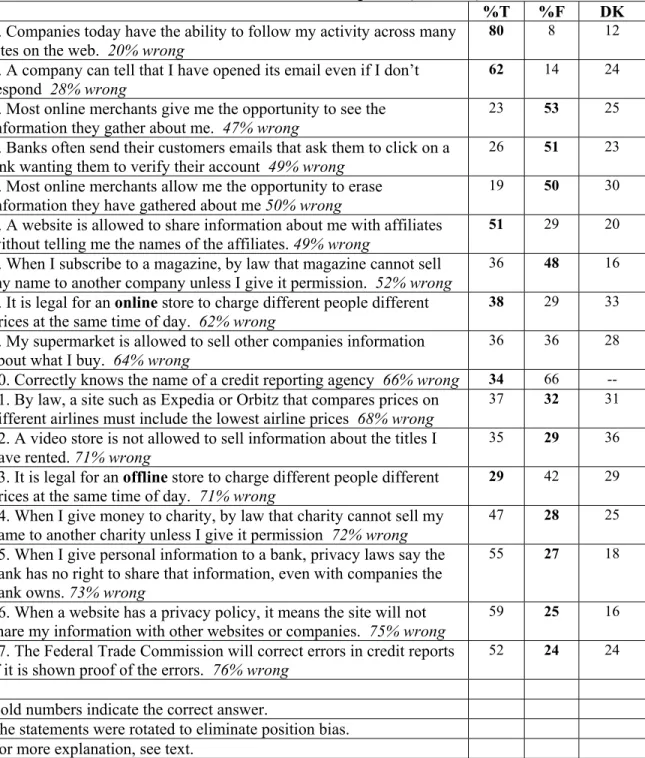
In introducing this section of the interview, the ICR representative stated that “For the next series of statements, please tell me if each one is true or false. If you’re not sure, just say, “not sure.” Table 3 presents the statements, the responses, and the percent that got them wrong. “Wrong” here means the number who said “don’t know” added to those who gave the incorrect true or false answer. Don’t know indicates a willingness to
frankly admit ignorance. The proportion of people who said they don’t know tends to hover between one between around one-fifth and one-third of the responses. Fairly large percentages of internet-using adults are willing to admit that they don’t know these marketplace facts of life.
Going down the table from most correct to least correct responses, three themes seem clear:
• Most internet-using U.S. adults are aware that companies can follow their behavior online. Fully 80% know marketers “have the ability” to track them across the web, and 62% know that a company “can tell” if they have opened its email without getting their response.
• Large majorities of internet-using U.S. do not understand key laws and practices relating to profiling, behavioral targeting and price discrimination. About half of the population does know some basics. About 50% recognize that
most online merchants are allowed to share information with “affiliates” without the consumers’ permission; that magazines can sell information about them without permission; and that merchants do not (and need not) allow consumers the opportunity to see or erase the information they gather about them. Moreover, about half seem to have caught the description of “phishing” and so answer it is false that banks “often send their customers emails that ask them to click on a link wanting them to verify their account.”
Yet saying one out of two internet-using adults is aware of these realities means that the other 50% do not understand them. In this connection, the inability of half the
respondents to discern phishing is particularly alarming because of the activity’s growth. The Gartner consulting firm concluded from April 2004 research that direct losses from identity theft fraud against phishing attack victims — including new-account, checking account and credit card account fraud — cost U.S. banks and credit card issuers about $1.2 billion in 2003.34
It is also troubling that around 50% of internet-using U.S. adults are unaware that information about them can move between magazines and amid affiliated websites without their approval. A similar percentage thinks they have more control over the information that online firms hold about them than they actually do. A far higher percentage—75%—doesn’t realize that that the mere presence of a privacy policy is no indication that a site will refrain from sharing visitors’ information. This pattern of unawareness online and offline may well lead them to be less careful about providing certain sorts of information to merchants than they would be if they knew what actually takes place.
Table 2 also shows a lack of knowledge about the legal right of supermarkets, video stores and charities to sell personal information; of banks to share customer information with affiliates; and of retailers’ to discriminate on price. When it comes to these topics, from 63% to 72% of respondents are wrong. Considering the popularity of online travel sites, one must suspect that many people don’t get the best deals when 68% of internet-using adults believe incorrectly that “a site such as Expedia or Orbitz that compares prices on different airlines must include the lowest airline prices.”
It might seem odd that higher proportions of respondents are incorrect about the legality of information-sharing by banks, charities, supermarkets and video stores than by magazines and non-specific “websites.” Although we have no data to explain the differences, it seems reasonable that that those interviewed used their belief about the sensitivity of the material that the merchants gather as a guide for answering. People may believe that banks and supermarkets hold data about their activities that are more
personally revealing than what generic websites and magazines store about them. People may also believe that disclosing the charities that receive their money means divulging particularly sensitive information about lifestyles. Respondents therefore may have concluded that it is illegal for banks, charities and supermarkets but not generic “websites” and magazines to exchange information.
Note that the statement on video rentals has the highest “don’t know” percentage in Table 3. Perhaps that is because respondents are unsure whether the personal data reflected in video rental titles pass a personal-sensitivity threshold that would make sharing them illegal. As it happens, video tapes represent an unusual case—where there actually is a law to stop stores from revealing personal data. Only 29% of respondents answered that statement correctly, though.
• Large majorities of internet-using U.S. adults do not know basic places to turn for help if their marketplace information is used illegally. The lack of understanding regarding marketplace laws and practices carries over to their understanding of where they can go for recourse if things do go wrong. Fully 76% agree incorrectly that “The Federal Trade Commission will correct errors in credit reports if it is shown proof of the errors.” The FTC suggests that
consumers contact one of the three national credit reporting agencies, Equifax, Experian, or TransUnion. Yet when asked “Can you give me the name of national Credit Reporting Agencies that can give you a copy of your credit report?” 66% of the respondents could not name any of them.
Table 3: Responses to statements about rules of profiling, behavioral targeting, price discrimination and recourse in the marketplace (N=1,500)*
%T %F DK
1. Companies today have the ability to follow my activity across many sites on the web. 20% wrong
80 8 12
2. A company can tell that I have opened its email even if I don’t respond 28% wrong
62 14 24
3. Most online merchants give me the opportunity to see the information they gather about me. 47% wrong
23 53 25
4. Banks often send their customers emails that ask them to click on a link wanting them to verify their account 49% wrong
26 51 23
5. Most online merchants allow me the opportunity to erase information they have gathered about me 50% wrong
19 50 30
6. A website is allowed to share information about me with affiliates without telling me the names of the affiliates. 49% wrong
51 29 20
7. When I subscribe to a magazine, by law that magazine cannot sell my name to another company unless I give it permission. 52% wrong
36 48 16
8. It is legal for an online store to charge different people different prices at the same time of day. 62% wrong
38 29 33
9. My supermarket is allowed to sell other companies information about what I buy. 64% wrong
36 36 28
10. Correctly knows the name of a credit reporting agency 66% wrong 34 66 --
11. By law, a site such as Expedia or Orbitz that compares prices on different airlines must include the lowest airline prices 68% wrong
37 32 31
12. A video store is not allowed to sell information about the titles I have rented. 71% wrong
35 29 36
13. It is legal for an offline store to charge different people different prices at the same time of day. 71% wrong
29 42 29
14. When I give money to charity, by law that charity cannot sell my name to another charity unless I give it permission 72% wrong
47 28 25
15. When I give personal information to a bank, privacy laws say the bank has no right to share that information, even with companies the bank owns. 73% wrong
55 27 18
16. When a website has a privacy policy, it means the site will not share my information with other websites or companies. 75% wrong
59 25 16
17. The Federal Trade Commission will correct errors in credit reports if it is shown proof of the errors. 76% wrong
52 24 24
Bold numbers indicate the correct answer.
The statements were rotated to eliminate position bias. For more explanation, see text.
*When the numbers don’t add up to 100% it is because of a rounding error. T=true; F=false; DK=don’t know
Notes explaining the basis for the correct answers can be found at the Annenberg Public Policy website:
CONCERNS AND OBJECTIONS
P
art 4 of the interview involves three short scenarios describing different types ofbehavioral targeting and soliciting the person’s opinions about their ethical acceptability. Scenario 1 centers on a “website [that] changes the ads that you see based on what you are reading on the site. The site does not ask you for any personal information. It just looks at what you are reading now and places ads related to that topic next to the article. One result is that people get different ads based on their interest.”
In Scenario 2, an “online store you like decides to buy personal information about you from a database company that lets it know your job, how many children you have, whether or not you have a car, and what vacations you take.” It then changes the products seen based on that lifestyle information.
Scenario 3 shifts to “a supermarket [you shop at] near your home.” We asked the person interviewed to picture that “The supermarket places a device on the shopping cart you use. The supermarket asks you to swipe your frequent shopper card into the device on the shopping cart.” (We asked those interviewed to imagine using a frequent shopper card if they don’t have one.) “As you walk down the aisle,” we continued, “the device checks the records of your past shopping in the store’s computer and gives you personalized offers, including offers others do not get. It also gives other people using the cart personalized offers that you do not get.”
After presenting each of the first two scenarios, we asked the respondents whether they thought the activities we wanted them to imagine “actually do” take place. The
affirmatives were overwhelming. 85% believe that some websites analyze what people are reading on their sites; 84% accept that sites change the ads that people see based on what they are reading on their sites; 84% believe that sites buy personal information about “you” from database companies; and 75% agree that sites change the products “people” see based on the personal information that the sites have bought from database companies. These responses parallel our earlier-noted finding that 80% of the
respondents know “Companies today have the ability to follow my activity across many sites on the web.” In addition to believing that this sort of behavioral profiling takes place online, a substantial portion of the population is explicitly aware that at least some type of personal identification takes place in the supermarket: Almost all (89%) of the 1,079 respondents of our sample who say their supermarkets offer frequent shopper cards received one. In the course of filling out material for it, they knowingly gave the stores personally identifiable information about themselves.
This wide awareness of behavioral tracking online and personal identification in offline supermarkets by no means translated into acceptance of the price discrimination that might flow from firms having these data. As Table 4 shows, most internet-using adults dislike a range of activities that retailers carry out daily based on customer information they collect.
Table 4: Attitudes about retailer activities online and offline (N=1,500)
% A % D % N %DK
It’s OK if the supermarket I use charges different people different prices for the same products during the same hour.
8 91 1 -- It’s OK if a store charges me a price based on what it knows
about me.
8 91 -- 1 If I trust an online store, I don’t mind if it buys
information about me from database companies without asking me.
9 90 -- 1
It’s OK if an online store I use charges different people different prices for the same products during the same hour
11 87 1 1 Websites should be required to let customers know if they
charge different people different prices for the same products during the same hour.
84 14 1 1 It would bother me to learn that other people pay less than I do
for the same products.
76 22 1 1 If a store I shop at frequently charges me lower prices than it
charges other people because it wants to keep me as a customer more than it wants to keep them, that’s OK.
26 72 2 -- The information I give online stores about myself will often
determine the prices they will charge me.
21 67 2 10 It’s OK with me if the supermarket I shop at keeps detailed
records of my buying behavior
32 66 2 -- It would bother me to learn that other people get better
discount coupons than I do for the same products.
64 33 2 -- It would bother me if websites I shop at keep detailed records
of my buying behavior.
57 41 2 1 It’s OK if a store I shop at frequently uses information it has
about me to create a picture of me that improves the services they provide for me.
50 47 2 1 If I trust an online store, I don’t mind giving it information
about what I have bought in the last month. 49 49 1 1 *When the numbers don’t add up to 100% it is because of a rounding error.
A=agree or agree strongly; D=disagree or disagree strongly; N=neither agree nor disagree; DK=don’t know
The smallest (though still-high) numbers of people object to situations that involve volunteering information to retail websites and accepting online behavioral targeting when the retailer is trustworthy. 49% of internet using adults disagree (and 49% agree) that “If I trust an online store, I don’t mind giving it information about what I have bought in the last month.” 47% disagree (and 50% agree) that “It’s OK if a store I shop at frequently uses information it has about me to create a picture of me that improves the services they provide for me.”
Take trust and improved service out, and more object. 57% agree that “It would bother me if websites I shop at keep detailed records of my buying behavior. Similarly, 66% disagree with the statement that “It’s OK with me if the supermarket I shop at keeps detailed records of my buying behavior.” Higher still is the negative response to a statement that people seem to have understood as a violation of trust: 90% of the respondents disagree that “If I trust an online store, I don’t mind if it buys information about me from database companies without asking me.”
The most consistent objections are to various presentations of price discrimination online and offline. Evidence suggests that people don’t expect that it is happening to them on a continual basis. Even though people know that they are tracked on the internet, only 21% agree that “The information I give online stores about myself will often determine the prices they will charge me.” Table 4 suggests that large percentages would object to it happening, though. When presented with various concatenations of price discrimination, between 64% and 91% of respondents registered aversion to the activity. Interestingly, a smaller percentage (64%) disagrees with discount coupons as mechanisms for price discrimination compared to simply asking for less money (76%). The largest percentages are riled about the idea of different people paying different prices for the same products during the same hour. 87% disagree with the implementation of such a practice by an “online store” and 91% disagree with its taking place in the supermarket.
The responses the internet-using adults gave to questions about the three scenarios indicated that their objections to rather general statements about price discrimination carry over to more concrete situations. All five circumstances are plausible. Websites often present different ads and products to their online customers as a result of database or tracking information. Similarly, supermarkets regularly present customers with discounts based on what they know about them through their frequent shopper cards, including whether they have children at home. Differential pricing in favor of people over 45 years old is probably not common, although price discrimination for “senior citizens” and AARP members (who are 50+) has become a well-publicized part of the retail landscape and receives little public condemnation. An important difference in this case compared to standard senior and AARP discounts is that in the scenario the
favorable treatment is not announced publicly. Rather, the consumer is treated to the age discount based on the supermarket’s behavioral and other database information. We used the “people over 45” designation to see if people would accept the idea of price
discrimination in an unusual age bracket and to note if people outside that age bracket would object more than those inside it.
We asked the people we interviewed what they thought of the three supermarket
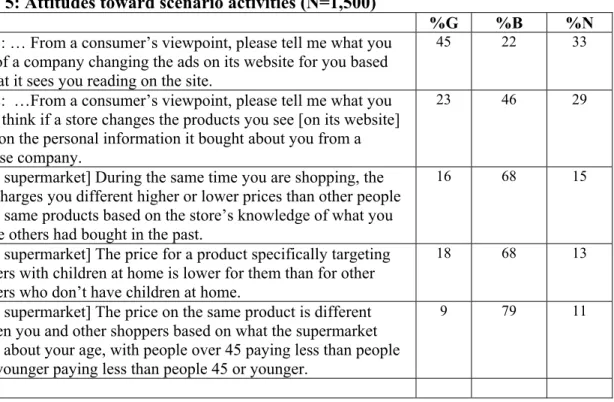
situations on a continuum from very good to very bad, with “neither a good nor bad idea” in the middle. As Table 5 indicates, 68% believe it is a “bad” or “very bad” idea if the store charges them different “higher or lower” prices than other people based on database information about their previous purchases. That response is not at the level of the 91% who in the non-scenario part of the interview thought it is wrong if “if the supermarket I use charges different people different prices for the same products during the same hour.” But it does fall in line with the reaction to statements such as “It’s OK with me if the supermarket I shop at keeps detailed records of my buying behavior” (66% disagree) and “It would bother me to learn that other people pay less than I do for the same products” (64%).35
When it comes to the specific examples of supermarket discrimination around children and age, the proportions of people objecting—68% for children and 79% for age—are as large as or even larger than the proportion of internet-using adults who object to the pricing statement that does not mention a demographic category. Moreover, people voice little support for self-serving price-discrimination. When confronted with privileged pricing for children under age 18, people with children under age 18 are as likely to object to the activity as parents with kids age 18 and older. We do find a statistically significant relationship between being over age 45 and accepting the age-based price discrimination in the scenario as a “good” or “very good” idea. That
relationship is quite weak, however. Fully 79% of internet using adults of all ages do not like behavior-driven price discrimination around age.
The first two scenarios center on popular forms of behavioral tracking that don’t involve price discrimination. Rather, they entail following people’s web movements or using purchased data about them for the purpose of deciding what content to serve them. The first scenario involves sending custom-chosen ads based on noticing the person’s
“reading on the site.” The second involves showing the respondent different products on the site based on “personal information it bought about you from a database company.” Table 5 reveals an interesting switch in responses between these two types of profile-driven customization. 45% of the respondents say that changing the ads based on what the site “sees you reading on the site” is a good or very good idea; 22% think it is a bad or very bad idea, while 33% say it is neither good nor bad. By contrast, 46% of the respondents believe that from a consumer’s standpoint it is a bad or very bad idea to change the products they see based on purchased personal information. 23% say it is a good or very good idea, and 29% say it is neither good nor bad.
Because different aspects of the two scenarios might explain the flip, we asked the respondents to tell us in an open-ended way why they answered “a good idea,” “a bad idea,” or “neither good nor bad” to each case. It turns out that with respect to each scenario the great majority of people who discuss it favorably when noting it is “a good idea” or “neither a good nor bad idea” say the behavioral customization would allow them to learn about products specifically for them. As might be expected, the proportion of those interviewed who note this benefit declines across the two scenarios—from 42%
who mention it in the case of custom-presented ads based on a person’s reading to 25% who mention the benefit when presented with the idea of custom-presented products based on purchased personal data. Instead of answers stressing that advantage, reasons for the second case being “a bad idea” increased.
Table 5: Attitudes toward scenario activities (N=1,500)
%G %B %N Case 1: … From a consumer’s viewpoint, please tell me what you
think of a company changing the ads on its website for you based on what it sees you reading on the site.
45 22 33
Case 2: …From a consumer’s viewpoint, please tell me what you would think if a store changes the products you see [on its website] based on the personal information it bought about you from a database company.
23 46 29
[In the supermarket] During the same time you are shopping, the store charges you different higher or lower prices than other people for the same products based on the store’s knowledge of what you and the others had bought in the past.
16 68 15
[In the supermarket] The price for a product specifically targeting shoppers with children at home is lower for them than for other shoppers who don’t have children at home.
18 68 13
[In the supermarket] The price on the same product is different between you and other shoppers based on what the supermarket knows about your age, with people over 45 paying less than people 45 or younger paying less than people 45 or younger.
9 79 11
*When the numbers don’t add up to 100% it is because of a rounding error.
G=good or very good idea; B=bad or very bad idea; N= neither good nor bad
Two major criticisms came up in responses to both the first and second scenarios. One was that tracking or profiling people is an invasion of privacy. The other was that not showing people ads or products that others could see is an unfair limitation of people’s views of the world. While 29% of the 1,500 internet-using adults volunteered privacy concerns and/or 25% noted world-view concerns in the data-buying case, substantially smaller numbers (11% and 14%, respectively) responded this way in the situation where ads are changed based on what people are reading at that time. Clearly the data-buying scenario bothers people who aren’t concerned that serving different ads based on what people are reading would inhibit their privacy or view of what was available for sale. For them, the second scenario is a situation where the desire for privacy and the autonomy to view all options exceed the benefits of personalization.
Underlying the concerns and objections our respondents raised is a general feeling of vulnerability in the retail environment. Table 6 shows that only 17% agree with the statement that “what companies know about me won’t hurt me” (81% disagree), 70% disagree that “privacy policies are easy to understand,” and 79% agree that “I am nervous about websites having information about me.” People seem to expect enforced
transparency in retail activities. 84% agree that “Websites should be required to let customers know if they charge different people different prices for the same products during the same hour.” Sadly, though, only about one out of three (35%) says he or she “trust(s) the U.S. government to protect consumers from marketers who misuse their information.”
Table 6: Attitudes towards privacy and personal information (N=1,500)
% A % D % N %DK
Websites should be required to let customers know if they charge different people different prices for the same products during the same hour.
84 14 1 -- What companies’ know about me won’t hurt me. 17 81 1 1 I am nervous about websites having information about me 79 18 2 -- I like to give information to websites because I get offers for
products and services I personally like.
20 78 2 1 If a store I shop at frequently charges me lower prices than it
charges other people because it wants to keep me as a customer more than it wants to keep them, that’s OK.
26 72 2 1 Web site privacy policies are easy to understand. 28 70 2 2 I am more concerned about giving away sensitive information
online than about giving away sensitive information any other way.
65 32 2 -- I know what I have to do to protect myself from being taken
advantage of by sellers on the web.
65 33 1 1 I trust the U.S. government to protect consumers from
marketers who misuse their information
35 65 -- 1 I trust websites not to share information with other companies
or advertisers when they say they won’t.
43 55 -- 1 When I go to a web site it can collect information about me
even if I don’t register.
47 45 1 7
*When the numbers don’t add up to 100% it is because of a rounding error.
A= agree or agree strongly; D=disagree or disagree strongly; N=neither agree nor disagree; DK=don’t know
LINKING ATTITUDES AND BACKGROUNDS TO KNOWLEDGE
I
n the face of all the nervousness and seeming confusion around the laws and practices of behavioral targeting and price discrimination, it is startling that 65% of internet-using adult Americans nevertheless say they “know what I have to do to protect myself from being taken advantage of by sellers on the web.” One way to judge whether to accept this self-assessment is to examine their scores on the 17 true-false questions about laws and practices of price discrimination and behavioral targeting and about where they can turn for help if their marketplace information is used illegally. What shows up is a misplaced sense of confidence. People who say they know how to protect themselves score just as poorly on the true-false questions—and even the ones specifically regarding the online marketplace—as the people who don’t think they know how to protect themselves. To get a sense of whether any of the attitude statements we presented to our respondents relate to higher or lower knowledge scores, we conducted a multiple regression where the score on the true-false test was regressed on the twenty-four attitudinal variablesmeasured in the survey. Eight attitudes emerged as statistically significant predictors of knowledge; these are listed in Table 7, along with their corresponding regression
coefficients. Together, these eight attitudes account for nearly 20% of the variance in knowledge (R2=0.197). A positive coefficient indicates that as agreement with the statement increases, so does one’s score on the true-false test; a negative coefficient suggests that the more one disagrees with the statement, the greater one’s true-false knowledge.36
Table 7: Predicting True/False Knowledge Score From Attitudes (N=1,087)
Unstandardized Regression Coefficients B Standardized Regression Coefficients Beta A website can collect information about me even if I don’t
register
0.470*** 0.221 It’s OK if a store I shop at uses information about me to
create a picture of me
0.432*** 0.180 I get a better price shopping online than at the mall 0.217** 0.083 I am more concerned about giving away sensitive
information online -0.132* -0.061
I am nervous about websites having information about me -0.180* -0.066 What companies know about me won’t hurt me -0.232** -0.081 I trust the U.S. government to protect consumers from
marketers misusing their information -0.333*** -0.143 Web site privacy policies are easy to understand -0.408*** -0.158
CONSTANT 6.416
R2 0.197
The attitudes were measured on a 5-point scale, where 1=strongly disagree and 5=strongly agree. N=1,087 and not 1,500 because people who answered “don’t know” were