RESOLUTION NO. 3 OF 1999
REMUNERATIVE ALLOWANCES AND BENEFITS
Noting that the employer and the trade unions wish to enter into the agreement that regulates remuneration, allowances and benefits,
The employer and the trade unions agree as follows.
1 Trade unions and the employer enter into the agreement entitled “Agreement on Remuneration, Allowances and Benefits,” which is attached to this resolution, on the following terms.
2 Subject to clause 3 the agreement applies to the employer and employees who are:
(a) employed by the State, and
(b) who fall within the registered scope of the council.
3 The agreement does not apply to the employer and those employees covered by an agreement concluded in a sectoral council prior to the date the agreement comes into force.
4 The parties will commence negotiations on new conditions of remuneration, allowances and benefits, which will replace the agreement, within three months of the date on which this resolution is signed, or within three months from the date when the new Public Service Regulations come into effect, whichever is later.
5 The new agreement on remuneration, allowances and benefits will be finalised within twelve months from the date on which this agreement is signed.
6 Any provision regarding remuneration, allowances and benefits that was contained in any provision set out in any collective agreement or regulation, including the Public Service Staff Code, the Public Service Regulations and the Personnel Administration Standards, but which was, by mistake, omitted from or amended in the agreement to the detriment of an employee, may be identified and tabled at Council for negotiation.
7 The employer commits itself to bargaining on omitted provisions, as described in paragraph 6, in good faith, and will reinstate any commitment that is not trivial, purely procedural, or entirely subject to managerial discretion.
8 If there is a dispute about the interpretation or application of the agreement or this resolution, any party may refer the matter to the council for resolution in terms of the dispute resolution procedure of the council.
9 This agreement comes into effect on the date on which the Public Service Laws Amendment Act 1998 (Act No 86 of 1998) comes into effect.
10 Any dates in the agreement that define the transition from the pre-existing prescripts will be amended to reflect the date on which this agreement comes into effect.
11 For the purpose of this resolution and the agreement:
(a) “Council” means the Public Service Co-ordinating Bargaining Council;
(b) “Employee” means an employee (i) employed by the State, and
(ii) who falls within the registered scope of the council
(c) “Employer” means the State as employer
(d) “the agreement” means the agreement entitled Agreements on Remuneration, Allowances and Benefits, which is attached to this resolution
(e) “Sectoral council” means a bargaining council
(i) established by the council, or the President, in terms of section 37 of the Labour Relations Act of 1995, or
(ii) deemed to be a sectoral council in terms of item 16 and 18 of Schedule 7 to the Labour Relations Act of 1995; and
(f) “Trade union” means a trade union, a two or more trade unions acting together, who are parties to the council.
ANNEXURE B
AGREEMENTS ON REMUNERATION, ALLOWANCES AND BENEFITS
I. Service bonus
1 Aim
The employer shall provide a service bonus to encourage employees, where appropriate, to stay in the public service.
2 Eligibility
2.1 An employee shall receive a service bonus if she or he
(a) has a permanent contract or a fixed-term contract lasting at least three months, unless the contract specifies otherwise, and
(b) in the year ending on her or his bonus date, does not resign or undergo discharge due to misconduct.
3 Bonus date
3.1 The bonus date for an eligible employee born between April and December shall fall in the month of her or his birthday.
3.2 The bonus date for an eligible employee born between January and March shall fall in April.
3.3 The employer shall pay an employee her or his service bonus on the day the employer normally pays salaries in the relevant month.
4 Calculation
4.1 For calculating a service bonus, the employer shall take into account continuous employment in a state department, state or state aided school, or a statutory body established by Parliament.
4.2 If an eligible employee has worked a full year up to the bonus date, she or he shall receive a month’s salary after deduction for the GEPF as provided in paragraph 4.4. 4.3 If an eligible employee has worked part of a year up the bonus date, she or he shall
receive an equivalent part of her or his monthly salary after deduction for the GEPF as provided in paragraph 4.4.
4.4 The employer shall deduct from an employee’s service bonus (a) if the employee belongs to the GEPF, 7 per cent, and
(b) a percentage equivalent to the percentage of working time for which the employee received no pay due to unpaid leave other than sick leave. 4.5 When the employer pays the service bonus, the employer shall contribute the
equivalent of 27 per cent of the bonus to the GEPF. 4.6 If an employee
(a) was born between January and March, and
she or he shall receive, as a bonus, a share of her or his monthly salary equivalent to the part of the year she or he worked after the previous bonus payment, less deduction for the GEPF as provided in paragraph 4.4.
4.7 If an employee dies, the employer shall not reduce her or his bonus to repay a debt she or he owed the employer.
5 Payment
5.1 The employer shall pay the service bonus directly to an eligible employee.
5.2 If an eligible employee dies while in service, the employer shall pay the bonus directly
(a) to a person or persons whom the employee designated in writing for this purpose, or
(b) if the employee did not designate such a person, to a surviving spouse or spouses, or
(c) if the employee has no spouse, to her or his dependant children, or (d) if no dependant child exist, into the employee’s estate.
An appendix will replicate the calculations now in the regulations. ***
II. Leave
1 Aim
The employer shall grant an employee leave for normal vacation requirements, to recover from illness, and for other specified reasons.
2 Eligibility
2.1 An employee shall receive leave under this agreement if she or he
(a) has a permanent contract or a fixed-term contract lasting at least one year, and
(b) no other binding agreement or regulation applies. 3 Vacation leave
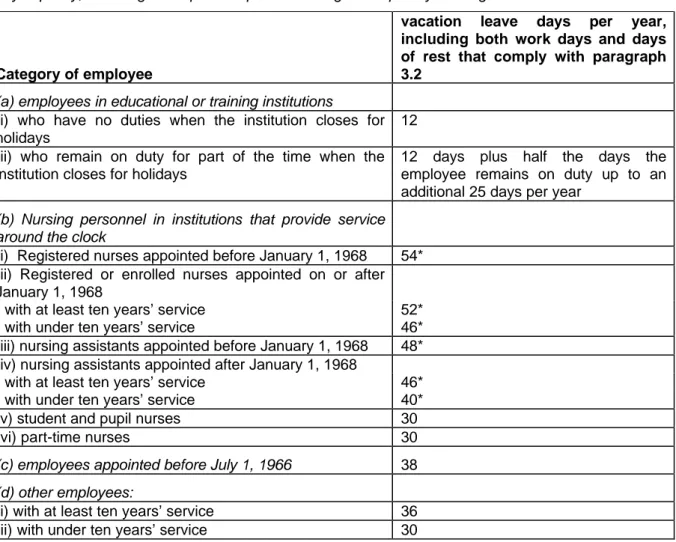
3.1 The employer shall provide vacation leave as specified in Table 1. 3.2 The employer shall count as a day of vacation leave a day of rest
(a) that falls within a period of leave, or
(b) that falls without interruption between two periods of leave.
3.3 For each month of service, an employee may utilise one twelfth of her or his annual vacation leave.
3.4 If the employer agrees,
(a) an employee may use more vacation leave than Table 1 provides, and (b) the employer shall subtract the excess days from leave earned thereafter. 3.5 The employer may refuse an employee vacation leave only for pressing operational
reasons. 4 Leave gratuity
4.1 The employer shall pay a leave gratuity to an employee who dies or is discharged for a reason other than
(a) misconduct, (b) absconding,
(c) retirement to avoid a discharge for misconduct, or (d) resignation, unless paragraph 3.6 applies.
4.2 The employee shall pay a leave gratuity to an employee who resigns
(a) in accordance with her or his contract during a period of extended contractual service, or
(b) because
(i) her or his spouse is a public servant who is transferred and
(ii) the employee cannot find government employment at or near the new place of work of her or his spouse.
4.3 A leave gratuity shall consist of payment of a day’s salary, plus pensionable allowances where applicable, for each day of leave an employee did not utilise while employed in the public service.
4.4 If a head of department authorises the transfer of an employee without a break in service between government departments or from a state or state-aided school or a statutory body established by Parliament,
(a) the employee shall retain her or his accumulated leave, and (b) her or his previous service shall count for leave purposes. 4.5 If
(a) an employee becomes a head of department, or (b) a head of department extends her or his contract,
she or he shall receive a special leave gratuity. The special leave gratuity shall equal the leave gratuity the employee would receive on discharge, up to a maximum of 10 per cent of the employee’s unused vacation leave.
4.6 Where an executing authority does not have complete leave records, she or he shall provide a realistic leave gratuity.
4.7 This agreement does not affect
(a) commitments made before 1994, or (b) leave accumulated before March 1, 1999. 5 Sick leave
5.1 For an employee with up to ten years’ of service, for each three-year period of employment, the employer grants
(a) an employee in an educational or training institution (i) 90 days sick leave at full pay, and
(ii) 90 days sick leave at half pay, and
(b) an employee not in an educational or training institution (i) 120 days sick leave at full pay, and
(ii) 120 days sick leave at half pay.
5.2 After ten years’ continuous service, an employee shall receive the amount of sick leave provided in paragraph 4.1, plus
(a) if she or he works in an educational or training institution (i) 90 days sick leave at full pay, and
(ii) 90 days sick leave at half pay, or
(b) if she or he does not work in an educational or training institution (i) 120 days sick leave at full pay, and
(ii) 120 days sick leave at half pay.
5.3 If an employee transfers to a group with fewer days of sick leave, she or he shall retain her or his original number of sick leave days for the remainder of the three-year cycle.
5.4 If an employee transfers to a group with more days of sick leave, the employer shall immediately provide her or him with the larger number of sick leave days, less any days already used.
5.5 For each two-year period of employment, if an employee has utilised all her or his sick leave and paid vacation leave, the employer may grant her or him up to 92 additional days of sick leave at half pay.
5.6 The employer may grant unpaid sick leave to an employee who has used all of her or his paid sick leave.
5.7 An employee who applies for or utilises sick leave shall, if the employer requires, provide a certificate from a registered medical professional in the relevant field. The certificate shall describe the illness and the period needed for recuperation.
5.8 The employer may select a medical professional to examine the employee and provide the certificate described in paragraph 4.7.
5.9 If an employee has utilised ten days of sick leave in a year, the employer shall grant her or him additional sick leave only if the employee provides
(a) a medical certificate to justify the leave, or
(b) a compelling reason for failing to submit a medical certificate.
5.10 If an employee presents a medical certificate demonstrating that she or he became ill while on vacation leave, the employer shall convert the days covered by the certificate to sick leave.
6 Use of vacation leave for treatment for substance abuse
6.1 If an employee
(a) has completed a reasonable period of satisfactory service, and (b) abuses alcohol or another drug,
she or he may utilise accumulated or probable future vacation leave for relevant treatment. 6.2 After at least 12 months, if expert evidence indicates that the employee has been
rehabilitated, the employer may return to the employee the leave used during treatment.
7 Special sick leave
7.1 If, as a result of an employee’s work, she or he suffers an injury or contracts a disease, the employer may grant her or him special sick leave for the period during which she or he cannot work.
7.2 If an employee suffers a work-related injury due to accident involving a third party, the employer shall grant the employee special sick leave only if
(a) the employee authorises the employer to claim for compensation against the third party, or
(i) brings a claim for compensation against the third party, and
(ii) undertakes to use compensation received to recompense as far as possible the employer’s contribution to the employee’s costs from the accident.
7.3 For special sick leave, the employer shall pay the difference between the pay of the employee and any compensation received from the Workmen’s Compensation Commission.
8 Maternity leave
8.1 A woman employee shall receive 84 days leave at full pay for each of two confinements.
8.2 A woman employee may receive paid leave for more than two confinements in exceptional circumstances, including if:
(a) one of her children died, (b) she remarried,
(c) her doctor indicates that she should have a child for the sake of her physical health, or
(d) she became pregnant following a sterilisation.
8.3 If a woman employee has utilised all her maternity leave, and wishes to take leave for a confinement, she shall
(a) utilise available vacation leave, and/or (b) receive up to 184 days of unpaid leave.
8.4 An employee who adopts a child aged under two years qualifies for leave on the same terms as for a confinement as provided in paragraphs 7.1 to 7.3.
8.5 If a woman experiences a miscarriage, still birth or termination of pregnancy after starting paid maternity leave,
(a) any leave utilised shall not count as part of her paid maternity leave, and (b) if necessary, she may utilise sick leave for days taken off as a result of the
miscarriage, still birth or termination.
9 Leave for office bearers or shop stewards of recognised unions
An office bearer or shop steward of a recognised union shall receive up to ten days paid leave for activities related to her or his union position.
10 Unpaid leave
10.1 If an employee has utilised all her or his paid vacation leave, the employer may grant her or him unpaid vacation leave. Only in exceptional cases shall the employer grant more than 184 days of unpaid vacation leave in a period of 18 months.
10.2 An employee shall utilise unpaid leave for an absence from work due to
(a) arrest, imprisonment or appearance in court on a criminal charge that leads to a conviction, or
11 Special leave
11.1 If a department does not have a written policy on special leave, an executing authority shall negotiate a policy in the relevant bargaining council.
11.2 The policy shall indicate
(a) the circumstances under which the executing authority shall authorise special leave at full pay,
(b) if any, those responsibilities other than work for which the employer shall not require an employee to utilise leave, and
(c) as far as possible, events for which the executing authority shall not provide such leave.
11.3 The policy may provide paid leave for family requirements such as childcare, study, examinations, military service, resettlement due to a transfer, collective bargaining or other labour-relations requirements, participation in sports, sabbaticals where appropriate, or any other purpose.
Table 1. Vacation leave by category of employee
Note: Holidays include weekends as well as public holidays. Service includes continuous service in any capacity, including time spent suspended during a disciplinary hearing and on authorised leave.
Category of employee
vacation leave days per year, including both work days and days of rest that comply with paragraph 3.2
(a) employees in educational or training institutions (i) who have no duties when the institution closes for holidays
12 (ii) who remain on duty for part of the time when the institution closes for holidays
12 days plus half the days the employee remains on duty up to an additional 25 days per year
(b) Nursing personnel in institutions that provide service around the clock
(i) Registered nurses appointed before January 1, 1968 54* (ii) Registered or enrolled nurses appointed on or after January 1, 1968
- with at least ten years’ service 52*
- with under ten years’ service 46*
(iii) nursing assistants appointed before January 1, 1968 48* (iv) nursing assistants appointed after January 1, 1968
- with at least ten years’ service 46*
- with under ten years’ service 40*
(v) student and pupil nurses 30
(vi) part-time nurses 30
(c) employees appointed before July 1, 1966 38 (d) other employees:
(i) with at least ten years’ service 36 (ii) with under ten years’ service 30
* If the employee serves in a lecturing capacity at a training college for nurses, the employer shall reduce the leave by one day for each public holiday on which the employee does not work.
III. Medical Assistance
1 Assistance to employees in South Africa
1.1 The employer shall pay two thirds of an employee’s normal subscription to a registered medical scheme, up to a maximum monthly payment.
1.2 The maximum monthly payment shall equal the value, with inflation, of R672 in April 1998. The Minister shall revise the employer’s maximum contribution on April 1 every year by an amount equivalent to the increase in the medical Consumer Price Index. 1.3 The employer shall pay a subscription only directly to a registered medical scheme. 1.4 If an employee joins a registered medical scheme that requires payment of a
subscription in advance, in the first month the employer shall pay both the advance subscription and the monthly subscription.
1.5 If an employee takes unpaid leave, her or his department shall continue to pay the employer contribution to the employee’s medical scheme as long as the employee pays her or his contribution.
2 Medical assistance at retirement or termination of services
2.1 The employer shall continue medical assistance as provided in Table 1 to an employee who leaves the public service, if
(a) the employee belonged to a registered medical scheme for the year ending on the date she or he left the public service, and
(b) the employee leaves the public service because of
(i) retirement, including early retirement where it does not result from misconduct or incapacity,
(ii) death, or
(iii) discharge as a result of ill health or injury on duty.
2.2 If an employee or pensioner dies and her or his remaining spouse becomes a principal member of the relevant medical scheme, the employer shall transfer the benefits provided under Table 1 to the spouse.
2.3 This agreement shall not affect medical benefits for people who left the public service before December 1, 1993.
Table 1. Benefits for eligible former employees
Note: In this table, “service” refers to employment by an institution funded primarily and directly from the central or provincial budget.
Group Benefits
(a) An employee who dies or who retires for reasons not related to health: (i) aged at least 50 with at least
15 years of service
Two thirds of the subscription to the employee’s medical scheme, up to the maximum provided in Paragraph 1.
(ii) aged under 50 with at least 15 years of service
From age 50, the same as in (i) . (iii) with at least ten but under
15 year of service, irrespective of age
A payment of 36 times the employer’s monthly contribution to the employee’s medical scheme
(iv) with under ten years of service
A payment of 12 times the employer’s monthly contribution to the employee’s medical scheme
(b) An employee discharged for ill health (i) with at least ten years of
service
Two thirds of the medical scheme subscription, up to the maximum provided in Paragraph 1.
(ii) with at least five but under ten years of service
A payment of 24 times the employer’s monthly contribution to the employee’s medical scheme
(iii) with under five years of service
A payment of 12 times the employer’s monthly contribution to the employee’s medical scheme
(c) Employees who retire due to an injury on duty
Two thirds of the medical scheme subscription, up to the maximum provided in Paragraph 1.
IV. Home-owner allowance
1 Aim
The employer shall assist employees to repay home loans. 2 Requirements for obtaining a home-owner allowance
2.1 Eligibility for employees
(a) An employee may receive a home-owner allowance if she or he is (i) a full-time, permanent public servant, and
(ii) under 65 years old.
(b) An employee may not receive a home-owner allowance if the employer already pays a home-owner allowance to her or his spouse.
(c) If an employee changes jobs but remains a public servant eligible for a home-owner allowance, the employer shall continue to pay the allowance. 2.2 Home ownership
(a) An employee may receive a home-owner allowance for
(i) a home registered in her or his name, whether singly or with her or his spouse;
(ii) a home registered in the name of her or his spouse, if the employee received the allowance for the home before October 1995;
(iii) a home that stands on land to which the employee has legal right of possession, including legally valid rights to occupy state or tribal land; or
(iv) a home
(i) which she or he has contracted to purchase and
(ii) for which she or he has obtained an eligible mortgage as described in paragraph 2.4 below, but
(iii) which she or he has not yet occupied for reasons beyond her or his control.
(b) An employee may receive a home-owner allowance only for a home located in South Africa.
2.3 Occupancy
(a) Except where an employee is transferred or, for reasons beyond her or his control, temporarily cannot stay in her or his home, the employer shall provide a home-owner allowance only for a home in which an employee and/or her or his immediate family live for most of the year.
(b) For this purpose, an employee’s immediate family includes only (i) her or his spouse,
(ii) dependent children, and/or
(iii) relatives who rely on the employee for the bulk of their subsistence. (c) The employer shall continue to pay the home-owner allowance on a home for
a limited period
(i) if the employer transfers geographically within South Africa, and (ii) the employee and her or his immediate family consequently have no
(d) The employer shall pay the home-owner allowance on a home for a limited period if an employee
(i) joins the public service directly from a state or state-aided school or a statutory body established by Parliament,
(ii) received a home-owner allowance in her or his former position, and (iii) the employee and/or her or his immediate family consequently have
no reasonable alternative but to move to a new home
(e) In the circumstances described in paragraphs 2.3(c) and (d), the employer shall continue to pay the allowance for the shortest of the following periods: (i) until the employee sells her or his home and the new owner registers
it in her or his name;
(ii) until the employee qualifies for a home-owner allowance for a home at her or his new headquarters; or
(iii) for six months from the date the transfer comes into effect.
(f) If the transferred employee cannot sell her or his old home at a price that covers the outstanding bond, the employer may continue to pay the allowance, if
(i) the employee rents her or his old home, unless it proves impracticable, and the employer reduces the allowance by the amount of the rental, and
(ii) every six months, the employer reviews payment of the allowance and justifies its extension or termination.
(g) If the employer transfers an employee outside of South Africa,
(i) if her or his immediate family no longer stay in the home, she or he shall, if possible, rent it out, and
(ii) the employer shall continue to pay the home-owner allowance less any rent received by the employee.
(h) If an employee who receives a home-owner allowance must, to carry out her or his official duties, move with her or his immediate family into state-owned housing,
(i) the employee shall rent out her or his home, unless that proves impossible for reasons beyond the employee’s control, and
(ii) the employer shall deduct the value of the rent, if any, from the home-owner allowance paid the employee.
2.4 Mortgage bonds
(a) The employer shall provide a home-owner allowance only to help repay a bond, part of a bond or an extension of a bond
(i) obtained from a government agency, a legally registered financial institution or a financial institution established by special statute, and (ii) that the employee uses to purchase her or his home or to finance
immovable improvements and/or alterations, including structural maintenance on her or his home.
(b) The employer shall help repay a bond only during its original term. The employer shall not supplement a home-owner allowance to help an employee repay an advance on an existing bond or re-institute a bond, irrespective of how the employee uses the relevant funds.
3 Value of the home-owner allowance
3.1 The maximum home-owner allowance shall equal the allowed interest on a bond of R70 000. The Minister shall set the allowed interest rate equal to the weighted average interest rate levied by the five largest financial institutions in South Africa at the start of each quarter.
3.2 If the employer does not pay the interest on the first mortgage before the first instalment, the home-owner allowance shall equal the smallest of the following sums: (a) 75 per cent of the compulsory monthly interest plus capital payment on an
eligible bond or part of a bond,
(b) 1,254 per cent of the value of the eligible bond or part of a bond, or (c) the maximum allowance.
3.3 If an employee
(a) pays interest on a first or main mortgage before the first instalment, and (b) complies with the occupancy requirements provided in paragraph 2.3, the employer shall pay the interest on the bond for up to thirty days, up to the monthly allowance provided in paragraph 3.1, and reduce the home-owner allowance as provided in paragraph 3.3.
3.4 If paragraph 3.3 applies, the employee’s monthly housing allowance shall equal the smallest of:
(a) 73 per cent of the compulsory monthly interest plus capital payment on an eligible bond or part of a bond,
(b) 1,15 per cent of the value of the eligible bond or part of a bond, or (c) 96,6 per cent of the maximum allowance.
3.5 If an employee owns a share in a home and is not married to her or his co-owner, he or she shall receive the lesser of
(a) the allowance payable on a bond equal to 50 per cent of the registered bond on the property, and
(b) a portion of the allowance provided in paragraph 3.2 or 3.4 proportional to the lesser of
(i) her or his share in a bond on the home and (ii) her or his share in the property.
4 Start and termination
4.1 The employer shall pay
(a) the home-owner allowance on the first instalment of an eligible bond when it falls due, and
(b) the regular home-owner allowance from the first monthly pay day after the first instalment.
4.2 The employer shall terminate the home-owner allowance on the day an employee becomes ineligible.
4.3 Where the employer discharges an otherwise eligible employee for any reason, the employer shall stop paying the home-owner allowance on the employee’s last monthly pay day.
4.4 If
(a) an eligible employee is suspended without emoluments or takes paid or unpaid leave, and
(b) continues to make her or his bond payments, the employer shall continue to pay her or his home-owner allowance. 5 Change in ownership
5.1 An employee who receives a home-owner allowance may sell her or his home and buy or build another home. In such a case, her or his home-owner allowance shall apply only to a bond equal to the excess of
(a) the bond on the second home, over
(b) the proceeds to the employee from the sale of the first home, after deducting the transfer costs and the balance of the bond.
5.2 If an employee divorces, and
(a) her or his spouse gets title to her or his first home,
(b) the employee retains the home but must increase debt on it to pay for the share of her or his spouse, or
(c) the employee and her or his spouse sell the home and divide the proceeds, the employee shall receive the allowance she or he would receive if she or he had sold the home as provided under paragraph 5.1 and kept only half the proceeds.
V. Motor finance scheme (MFS) for senior employees
1 Aim
The employer shall pay an allowance to eligible members of the management echelon to obtain and maintain a car as part of their salary and service benefits. For eligible employees, the employer shall provide financing for a new car every four years.
2 Definitions
In this agreement,
subsidised motor scheme means Motor Transport Scheme for Heads of Departments and Subsidised Motor Transport Scheme, and
MFS car means a car obtained under the MFS, or transferred to it. 3 Eligibility
3.1 An incumbent in a position graded equivalent to Director, Chief Director, Deputy Director General or Director General may participate in the MFS, unless her or his position or contract disqualifies her or him.
3.2 An employee may not participate if she or he
(a) holds a car under a subsidised motor scheme, or
(b) works abroad as a transferred official, including in Botswana, Lesotho or Swaziland.
4 Procedures for accessing the MFS
4.1 The Departments of State Expenditure and Public Service and Administration shall prescribe how an employee may access the MFS.
4.2 The Department of State Expenditure shall maintain financial arrangements for the purchase of cars under the MFS.
4.3 If an eligible employee
(a) has obtained a car under a subsidised motor scheme, and
(b) no more than three years have passed since the date of the car’s first registration,
she or he may transfer the financing of the car to the MFS. 4.4 If an eligible employee
(a) owns a car that was first registered less than three years earlier, and (b) has never transferred a private car to the MFS,
she or he may transfer the car to the MFS instead of obtaining a new car. She or he may at any time withdraw the car from the scheme and apply to purchase a new car under the MFS or obtain a car under a subsidised motor scheme.
5 Maximum loan amount
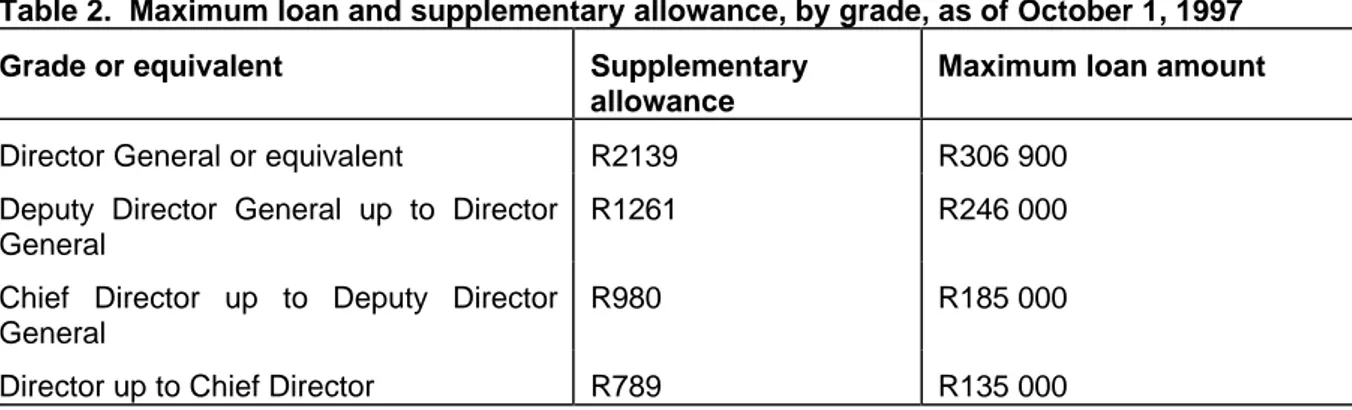
5.1 Table 2 indicates the maximum new loan the employer will provide under the scheme, by grade.
5.2 The Minister may revise the amount available for a new loan on a quarterly basis, using the Consumer Price Index for motor cars.
6 Payments to an employee who buys a new car
The employer shall pay an employee who buys a new car the following amounts. 6.1 Basic allowance. The employer shall
(a) pay the employee a monthly basic allowance equal to the instalment on the loan obtained for the MFS car, and
(b) to pay the loan instalment, deduct the same amount directly from the employee’s monthly salary.
6.2 Supplementary allowance. The employer may pay an employee a supplementary allowance to compensate for official use of her or his MFS car for up to 500 kilometres a month. Table 1 gives the level of the allowance, which shall depend on the grade of the employee. The Minister may revise the supplementary allowance annually using the Consumer Price Index for the running cost of cars.
6.3 Additional compensation. The employer shall provide additional compensation if an employee must use her or his MFS car to travel more than 500 kilometres a month on official business. The employer shall provide compensation for the excess kilometres in accordance with guidelines provided by the Department of Transport. 6.4 Cash allowance. If a participant in the MFS purchases a car for less than the
maximum loan amount for which she or he qualifies, she or he shall receive a monthly cash allowance.
(a) The monthly cash allowance shall equal the difference between (i) the actual monthly instalment on the car, and
(ii) the instalment that would have fallen due on the maximum loan amount.
(b) The cash allowance
(i) forms part of the employee’s salary, but
(ii) the employer and employee shall not pay pension contributions related to it.
7 Payments to an employee who transfers a private car or a car obtained under a motor subsidy scheme
7.1 To determine the original price of the car in order to calculate the relevant allowances,
(a) for a car transferred from a motor subsidy scheme, the Department of Transport shall provide the price; and
(b) for a private car, the employee shall provide a receipt or an affidavit that records the purchase price.
7.2 Between the date the employee transfers the car to the MFS and four years from the date of the car’s first registration,
(a) the employer shall pay the employee, if she or he remains eligible, a monthly basic allowance equal to the lesser of
(i) the payment on capital plus official interest as defined in Table 1 on the price of the car at the time or purchase, and
(ii) the maximum loan amount for the employee concerned, and
(b) the employer shall deduct from the employee’s salary an amount equal to the monthly basic allowance provided under paragraph 6.1.
7.3 The employer may pay the employee an allowance to compensate for the use of her or his MFS car as described in paragraph 6.2, and additional compensation as described in paragraph 6.3.
8 Employee responsibilities
8.1 An employee who participates in the MFS shall:
(a) meet the cost of running, maintenance, and registration, licensing and insurance; and
(b) comprehensively insure the MFS car.
8.2 If an employee must use her or his MFS car to travel away from her or his normal place of work, the employer shall pay monthly parking costs in excess of R10 a month and toll fees.
9 Use of other forms of transport
9.1 An employee shall use her or his MFS car for an official journey, except in exceptional cases where
(a) public transport would prove more reasonable and/or practical, (b) the roads in question are too rough for a normal passenger car, or (c) the MFS car is undergoing repairs or service.
9.2 For a Director General in the MFS, a journey between home and the normal place of work constitutes an official journey.
9.3 Whether an employee with an MFS car may use another form of transport for an official journey shall be decided by:
(a) in the case of an employee with the grade of Director or Chief Director, the executing authority; and
(b) in the case of an employee with the grade of Director General or Deputy Director General, the employee concerned.
9.4 If an employee must undertake an official journey and her or his MFS car is undergoing repairs or service,
(a) if an employee has the grade of Director General or Deputy Director General, she or he may use state motor transport, or
(b) if the employee has the grade of Director or Chief Director, (i) she or he shall obtain and utilise another private car, and
(ii) the employer shall provide compensation as if she or he used her or his MFS car.
9.5 If the MFS car of an employee with the grade of Director General or Deputy Director General is undergoing repairs or service, the employee
(a) may use state motor transport for private purposes, and
(b) pay the tariff levied in the case of semi-official vehicles used for private journeys, as prescribed by the Department of State Expenditure.
10 Replacement of car
10.1 If an employee has not yet repaid the loan for an MFS car, she or he may replace the car only if
(a) she or he cannot use or sell the car due to accident damage, fault or theft, or (b) she or he leaves the public service.
10.2 If an employee must write off an MFS car as described in 10.1(a), she or he
(a) shall pay the outstanding loan in full, and until that time pay any instalments that fall due; and
(b) after redeeming the outstanding loan, she or he may apply for a new loan from the MFS.
10.3 If an employee must replace a car as provided in 10.1(b),
(a) for the remainder of the original loan period, the employer shall pay a basic allowance equal to the instalments on the original loan, and
(b) the employee shall pay any additional cost for her or his new car.
11 Promotion, demotion or termination
11.1 If a participant in the MFS changes in grade but remains eligible for participation, the employer shall
(a) continue to pay the same basic and cash allowance until the employee becomes eligible for a new loan,
(b) change the supplementary allowance to the level applicable to the employee’s new grade from the date of her or his promotion or demotion, and (c) when the employee becomes eligible for a new loan, provide a loan
commensurate with her or his new grade. 11.2 An employee shall cease to participate in the MFS if
(a) for any reason, she or he stops working in a position covered by the scope of this agreement; or
(b) she or he does not complete satisfactorily a probationary period for permanent employment in an eligible grade.
Table 1. Official interest rate
Period of application Official interest rate
January 1, 1993 - January 31, 1994 15 per cent February 1, 1994, to August 31, 1995 14 per cent
From September 1, 1995 16 per cent
Table 2. Maximum loan and supplementary allowance, by grade, as of October 1, 1997 Grade or equivalent Supplementary
allowance
Maximum loan amount
Director General or equivalent R2139 R306 900 Deputy Director General up to Director
General
R1261 R246 000
Chief Director up to Deputy Director General
R980 R185 000
Director up to Chief Director R789 R135 000
VI. Voluntary severance package
1 Aims
If
1.1 the government wants to correct the size of the public service and create scope for redeploying supernumerary personnel,
1.2 an employee volunteers to terminate her or his services, and
1.3 the national interest does not require her or his continued employment in the public service,
the employer shall pay the employee a voluntary severance package (VSP). 2 Duration
The employer shall stop offering the VSP when the government determines that the public service has reached the correct size.
3 Eligibility
If an employee volunteers for a VSP, the employer may grant it unless
3.1 the employee faces a charge of misconduct or inefficiency, or the possibility of dismissal based on misconduct or inefficiency; or
3.2 the commission contemplated in section 236(6) of the 1993 Constitution is reviewing, or plans to review, the employee’s contract, appointment or promotion.
4 Criteria for granting the VSP
4.1 The final decision on whether to grant a VSP to an employee lies with her or his executing authority. The executing authority shall seriously consider approving an application, with due consideration to the interests of the state.
4.2 If an executing authority declines an application for a VSP, she or he shall give the employee the reasons in writing.
4.3 The employer may delay granting a VSP by up to 18 months if:
(a) the employee works in a function where an Act requires that an incumbent have particular competencies;
(b) termination of the employee’s services shall:
(i) seriously disturb public peace and order, resulting in loss of life, (ii) disrupt implementation of reconstruction and development
programmes, or
(iii) have serious humanitarian implications; or
5 Conditions for termination of service
An employee who takes a VSP shall leave the public service under the provisions of section 17(2)(c) of the Public Service Act, with a severance package as provided in paragraph 7. 6 Restrictions on rejoining the public service
If an employee takes a VSP, the employer may not reappoint her or him in terms of the Public Service Act.
7 Value of the VSP
7.1 An employee who receives a VSP shall not claim any further benefit or payment from the employer.
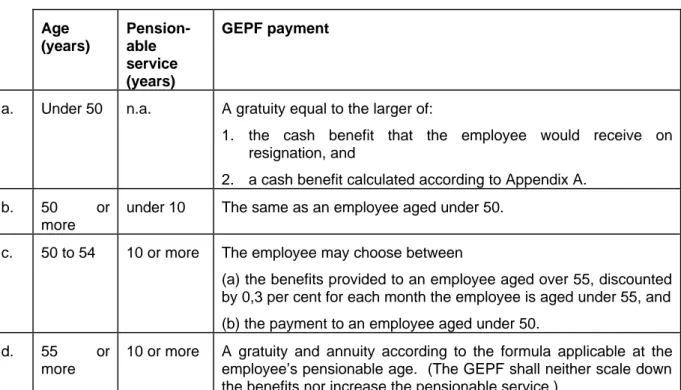
7.2 If an employee who belongs to the GEPF receives a VSP, the GEPF shall make the payments provided in Table 1.
7.3 The employer shall pay the equivalent of one week’s remuneration for each full year that the employee worked in the public service.
7.4 The employer shall pay an employee who receives a VSP:
(a) a leave gratuity equivalent to one day’s pay for each day of the employee’s accumulated leave, valued in terms of the employee’s salary on termination of service;
(b) six times the monthly home-owner allowance for which the employee qualified on her or his last day of work;
(c) if an employee
(i) does not qualify for continued medical assistance on termination of her or his service, and
(ii) in the last month before the employer granted the VSP the employer made a monthly contribution to a medical scheme on the employee’s behalf,
a cash amount equal to six times the employer’s contribution to the medical scheme.
(d) the service bonus due to the employee on the date of termination; and (e) if the employee requests, a cash payment in place of notice, equal to the
amount she or he would have earned during the applicable notice period, including benefits.
7.5 If an employee belongs to the Motor Finance Scheme when she or he receives a VSP, the employer shall pay an amount equal to six times her or his monthly basic allowance.
7.6 If an employee has a car from the subsidised motor transport scheme when she or he receives a VSP,
(a) the employer shall pay her or him an amount equal to six times the monthly instalment owed on the car, and
(b) if the employee repays the outstanding debt on the car, she or he shall own it. 7.7 The employer may exempt an employee who receives a VSP from outstanding debts
or contractual obligations to the employer that arise from education and/or training, including military training.
7.8 An employee who receives a VSP may continue to occupy state housing (a) in normal cases, for up to one month, and
(b) if the employee would otherwise suffer serious hardship, for up to three months.
7.9 The employer shall pay resettlement benefits
(a) to an employee aged 55 years or older who receives a VSP, in the amount provided to employees who retire, and/or
(b) to an employee who has to leave official quarters as a result of taking a VSP, to move to a new home in the same town.
Table 1. VSP benefits from the GEPF Age (years) Pension-able service (years) GEPF payment
a. Under 50 n.a. A gratuity equal to the larger of:
1. the cash benefit that the employee would receive on resignation, and
2. a cash benefit calculated according to Appendix A. b. 50 or
more
under 10 The same as an employee aged under 50. c. 50 to 54 10 or more The employee may choose between
(a) the benefits provided to an employee aged over 55, discounted by 0,3 per cent for each month the employee is aged under 55, and (b) the payment to an employee aged under 50.
d. 55 or more
10 or more A gratuity and annuity according to the formula applicable at the employee’s pensionable age. (The GEPF shall neither scale down the benefits nor increase the pensionable service.)
Appendix A.
The cash benefit described in Table 1 (a) shall equal the present value of the employee’s actual contributions to the pension fund, adjusted for seniority. The GEPF shall calculate it as
Z x (R1xN1 + R2xN2) x Int x Sev x D where
Z = the employee’s average annual pensionable salary • in the 36 months up to resignation, or
• if the employee has not yet served 36 months, during her or his period of service
R1 x N1 = the employee’s actual contribution to the pension fund as a percent of her or his salary on April 30, 1996, multiplied by her or his actual pensionable years of service to that date
R2 x N2 = 7,5 per cent multiplied by the employee’s years of pensionable service following April 30, 1996
Int = 100 per cent, plus 2,5 per cent multiplied by the employee’s full years of pensionable service
Sev = 100 per cent, plus
10 per cent multiplied by the employee’s full years of pensionable service up to 20 years, plus
15 per cent multiplied by the employee’s full years of pensionable service between 20 and 30 years, plus
20 per cent multiplied by the employee’s full years of pensionable service in excess of 30 years.
D = 100 per cent less the relevant discount from Table 2.
Table 2. Discount for years of service.
for an employee with completed months of pensionable service equal to:
Percentage discount (maximum from previous category plus discount per month in category)
0-36 0
37-120 0,26% for each month over 36 months
121-240 21,84% plus 0,17% for each month over 120 months
241-360 42,24% plus 0,07% for each month over 360 months
over 481 63,84% plus 0,05% for each month over 480 months
VII. Overtime
1 Aim
If an executing authority
1.1 expressly requires an employee to work more than normal hours or on days of rest, and
1.2 other agreements do not prevent overtime payments to the employee, the employer may provide compensation through time off or additional pay. 2 Definition
In this agreement, overtime refers to work in excess of the hours of work per week or month that an employee has contracted to perform.
3 Authorisation
3.1 Before an executing authority may authorise compensation for overtime, she or he shall negotiate a written policy for her or his department, determining
(a) under what conditions the department shall provide compensation for overtime work,
(b) what kind of compensation the department shall provide, and
(c) categories of employee to whom the department shall not provide compensation for overtime.
3.2 An executing authority shall communicate the departmental policy on overtime to all the employees in her or his department.
3.3 The employer may decline to authorise compensation for overtime.
3.4 The employer shall provide compensation for overtime only where an executing authority or her or his delegate has required or authorised, in writing,
(a) the performance of overtime work, and
(b) overtime compensation for the work performed. 4 Rest, meal breaks and travel
4.1 If an executing authority authorises overtime, she or he shall ensure (a) fair and acceptable limits on the extent of overtime,
(b) periods for rest and meals, and
(c) as far as possible, that employees travel to and from work at a time when public transport is available.
4.2 Overtime shall generally include periods (a) provided for rest and meals, and
(b) when an employee must stay at her or his place of work but cannot actually work due to circumstances beyond her or his control.
4.3 In order to perform authorised overtime, an employee may travel from home to her or his normal place of work or from the normal workplace to home at a time when she or he usually would not travel. In this case,
(a) if the employee was not on authorised standby duty, (i) the journey counts as an official journey, but
(b) if the employee was on authorised standby duty, the time spent on the journey counts as overtime work.
4.4 If, in order to perform authorised overtime, an employee must travel to a place other than her or his normal place of work, the time spent on the journey shall count as overtime work.
5 Sunday work
5.1 The employer shall provide compensation for Sunday work when an executing authority has required an employee, in writing, to work paid overtime
(a) on a Sunday or other public holiday, if the employee does not normally work on such a day, or
(b) on a day the employee normally has off to compensate for work on a Sunday or other public holiday.
5.2 The employer shall compensate authorised Sunday work by
(a) paying the employee concerned two times her or his normal hourly remuneration, or
(b) granting time off equal to the time worked. 6 Normal overtime
6.1 The employer shall provide compensation for normal overtime when an executing authority
(a) has required an employee, in writing, to perform official duties for more hours than the employee’s normal working hours during a week, but
(b) has not required Sunday work as defined in paragraph 5, or night overtime as defined in paragraph 7.
6.2 The employer shall compensate authorised normal overtime by
(a) paying the employee concerned one and one third times her or his normal hourly remuneration, or
(b) granting the employee time off equal to time worked. 7 Night overtime
7.1 The employer shall provide compensation for night overtime when
(a) an executing authority has required an employee, in writing, to perform paid overtime between 20:00 hours and 6:00 hours, and
(b) the employee does not normally work at night.
7.2 The employer shall compensate authorised night overtime by
(a) paying the employee concerned two times her or his normal hourly remuneration, or
(b) granting the employee time off equal to the time worked. 8 Overtime allowance
8.1 The employer may pay an employee a fixed monthly allowance to compensate for overtime if
(a) the employee performs reasonably similar amounts of authorised overtime, Sunday work or night overtime from month to month, and
(b) the employee agrees in writing.
8.2 The allowance shall equal the average monthly compensation the employee received for overtime in the six months preceding the establishment of the allowance.
***
VIII. Standby allowance
1 If the employer requires an employee to be available for the performance of duty outside of her or his normal working hours, the employer shall pay a standby allowance.
2 The employer shall pay the allowance if an employee’s supervisor requires an employee to be available for duty
2.1 at a place other than the employee’s normal place of work, and 2.2 for a period of at least 16 hours during a 24-hour period
(a) from the normal closing time of the employee’s place of work, or (b) on a day on which the employee would not normally work. 3 The standby allowance shall equal R19,60 for each 24-hour period.
4 The standby allowance shall not affect or be affected by a payment for overtime due to the employee.
IX. Danger allowances
1 The employer shall compensate an employee who risks her or his life in the course of carrying out specified duties or training.
2 The employer shall not pay a danger allowance to an employee of the South African Police Services (SAPS), South African National Defence Force (SANDF), or the Department of Correctional Services who does not participate in the line activities of her or his department. 3 An employee may receive a Standard Danger Allowance and/or a Special Danger Allowance. 4 The employer shall pay the Standard Danger Allowance to an employee who
4.1 undertakes or trains for one or more of the duties listed in paragraph 5, and
4.2 in the course of her or his work or training, experiences a genuine risk to her or his life.
5 The following duties may qualify for the Standard Danger Allowance: (a) under-water diving;
(b) parachute jumping;
(c) surveying, inspecting and/or helping to operate a vessel or submarine at sea, or an aeroplane, in pursuance of the employee’s line functions;
(d) dowsing fires at airports and/or rescue work during fires and/or other emergencies;
(e) working with core drills, explosives or explosive weapons;
(f) repairing and maintaining arms and ammunition for the Inspectorate of Naval Ordinance of the Navy;
(g) working with or guarding convicts, people held in places or safety, or people on parole;
(h) investigating or preventing a crime; (i) executing a military operation;
(k) working for the safety restricted laboratory of the National Institute for Virology.
6 The employer shall pay the Special Danger Allowance to an employee who works in one or more of the following:
(a) the Task Force of the SAPS;
(b) a Public Order Policing Unit of the SAPS;
(c) the Reaction Unit of the Department of Correctional Services; (d) the Special Forces of the SANDF;
(e) the Department of Correctional Services, in duties that require direct contact with maximum security prisoners;
(f) the SAPS or SANDF in areas that the National Commissioner of the SAPS and/or the Chief of the SANDF has designated as high risk due to:
(i) attacks on members of the SAPS and/or the SANDF; (ii) widespread violent offences; and/or
(iii) military activities by enemy forces.
7 If an employee qualifies for the Standard Danger Allowance on one or more grounds, she or he shall receive R200 a month, or the equivalent amount in daily terms.
8 If an employee qualifies for the Special Danger Allowance on one or more grounds, she or he shall receive R300 a month, or the equivalent amount in daily terms.
9 If an employee qualifies for both the Standard and the Special Danger Allowances, she or he may receive both simultaneously.
10 The employer shall pay a danger allowance on the date an eligible employee receives her or his salary. The employer shall stop paying the allowance when the employee stops being eligible.
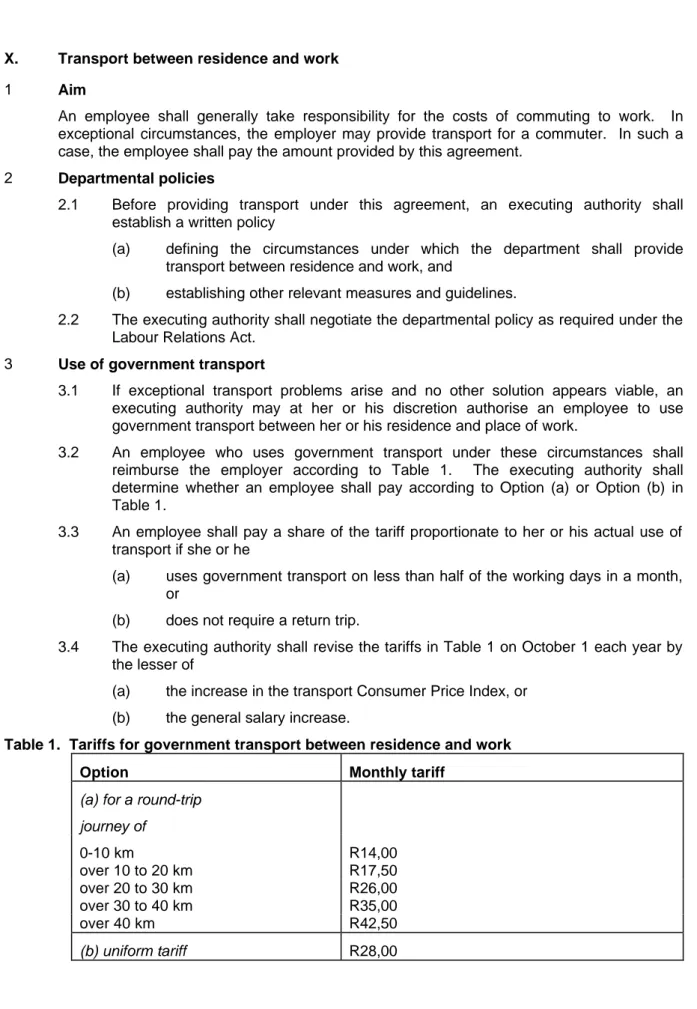
X. Transport between residence and work
1 Aim
An employee shall generally take responsibility for the costs of commuting to work. In exceptional circumstances, the employer may provide transport for a commuter. In such a case, the employee shall pay the amount provided by this agreement.
2 Departmental policies
2.1 Before providing transport under this agreement, an executing authority shall establish a written policy
(a) defining the circumstances under which the department shall provide transport between residence and work, and
(b) establishing other relevant measures and guidelines.
2.2 The executing authority shall negotiate the departmental policy as required under the Labour Relations Act.
3 Use of government transport
3.1 If exceptional transport problems arise and no other solution appears viable, an executing authority may at her or his discretion authorise an employee to use government transport between her or his residence and place of work.
3.2 An employee who uses government transport under these circumstances shall reimburse the employer according to Table 1. The executing authority shall determine whether an employee shall pay according to Option (a) or Option (b) in Table 1.
3.3 An employee shall pay a share of the tariff proportionate to her or his actual use of transport if she or he
(a) uses government transport on less than half of the working days in a month, or
(b) does not require a return trip.
3.4 The executing authority shall revise the tariffs in Table 1 on October 1 each year by the lesser of
(a) the increase in the transport Consumer Price Index, or (b) the general salary increase.
Table 1. Tariffs for government transport between residence and work
Option Monthly tariff
(a) for a round-trip journey of 0-10 km R14,00 over 10 to 20 km R17,50 over 20 to 30 km R26,00 over 30 to 40 km R35,00 over 40 km R42,50 (b) uniform tariff R28,00
XI. Official journeys
1 General
1.1 The employer may meet reasonable costs of travel for official purposes.
1.2 In the context of this agreement, an executing authority shall establish written policies on, among others,
(a) procedures for approving an official journey (b) acceptable means and class of transport (c) expenditure limits
(d) when the employer shall pay for an employee’s household or family to accompany her or him.
1.3 If an employee takes an official journey that violates a policy of her or his department, the employer may compensate the employee for none or only part of the costs.
2 Serious illness or family death
2.1 If an employee travelling on official duty becomes so ill she or he must remain distant from her or his home, the employer may pay reasonable actual costs for travel and accommodation for one or more family members to join her or him.
2.2 If an employee on official duty away from her or his normal place of work returns home because a spouse, parent or child becomes severely ill or dies, the employer may pay reasonable actual costs for the employee’s travel and accommodation.
3 Official journeys
3.1 If an employee must use her or his private transport to carry out her or his duties, the employer may
(a) provide an allowance to cover reasonable actual costs, and/or
(b) compensate the employee according to tariffs prescribed by the Department of Transport.
3.2 The employer may compensate an employee for the cost of official journeys, including travel to and from the normal work place, when an employee must
(a) temporarily take up duties and, in consequence, residence at another place of work, or
(b) travel to work outside of normal hours.
3.3 If an employee must frequently undertake official automobile trips and does not have a licence, the employer may compensate her or him for the reasonable actual costs associated with obtaining one.
XII. Accommodation while on official journeys
1. Aim
If an employee must take an official journey, the employer shall meet her or his accommodation costs.
2. Scope
This agreement shall not apply to an employee who receives compensation under the agreements on camping staff or sessional employees.
3.1. If an employee must take an official journey lasting under 24 hours, the employer shall meet reasonable actual accommodation costs, if any.
3.2. If an employee must take an official journey that lasts for 24 hours or longer, for each day or part of a day on the journey she or he may claim either:
a. reasonable actual expenditure on accommodation plus an allowance of R37,00 a day, or
b. an allowance of R121,50 a day.
XIII. Camping
1 When camping staff perform duties away from their regular place of work, the employer may pay them a daily allowance of up to R45,00. If a department provides rations in kind, it shall deduct the cost from the daily allowance.
2 Where camping staff work away from headquarters on a regular and continuous basis, the employer may pay a fixed monthly amount to compensate them for accommodation costs. 3 Departments shall provide the necessary camping equipment and facilities for camping staff
and for their immediate families, if their families normally stay with them.
4 The employer may refund expenditure on parking fees as well as the reasonable cost of fuel and water used in the camp.
XIV. Separation allowance
1 The employer shall compensate an employee whose work requires considerable travelling for the disruption to her or his family life and for the inconvenience.
2 In this agreement, dependant mean an employee’s relative, including a child, who lives with the employee and relies on the employee for the bulk of her or his subsistence.
3 To be eligible for the separation allowance, an employee
3.1 must spend at least 180 nights a year on official duties away from her or his normal place of work, and
3.2 may not receive another allowance, other than a subsistence allowance, to compensate for the time spent away from home.
4 The employer shall pay an eligible employee a separation allowance if the employee must travel on official duties away from her or his normal place of work for an uninterrupted period of over 15 days.
5 The employer shall continue to pay the separation allowance if, during a trip that qualifies for the allowance, an employee remains away from her or his normal place of work while taking 5.1 sick leave, including special sick leave, for a continuous period of up to six months,
or
5.2 special leave with full pay.
6 The employer shall pay separation allowance on a day of rest unless, on that day, the employee travels to her or his home at the employer’s cost.
7 The separation allowance shall equal
7.1 R15,19 per day for a person who lives with a spouse and/or dependants, and 7.2 R10,63 per day for a person who does not live with a spouse and/or dependants.
XV. Resettlement
1 General
1.1 The employer shall generally meet, within reason, the actual resettlement costs within the country incurred by an employee and her or his immediate family as a result of official duties, or, in some cases, on termination of service or death.
1.2 For this purpose, an employee’s immediate family includes only an employee’s (a) spouse,
(b) minor child, and/or (c) relative
(i) who lives with the employee except when attending an educational institutions, and
(ii) who relies on the employee for the bulk of her or his subsistence. 2 Departmental policy
2.1 An executing authority shall establish and where appropriate negotiate written policies on resettlement, including among others
(a) limits on expenditure,
(b) maximum periods of compensation,
(c) restrictions on the quantity and kind of personal effects covered, and (d) costs of property transfer.
3 Costs associated with transfer
3.1 If the employer requires an employee to transfer to a new place of work, the employer may assist the employee with the associated costs, as provided below.
3.2 Travel and subsistence
The employer may meet the reasonable actual costs an employee incurs for travel and subsistence during:
(a) one visit by an employee or a member of her or his immediate family to the new place of work before the date of the transfer, and
(b) the move of the employee and her or his immediate family to the new place of work.
3.3 Transportation and storage of household and personal effects
For household and personal effects of the employee and her or his immediate family, the employer may meet reasonable actual costs of transport to the new permanent accommodation, storage, packing and unpacking, and insurance cover.
3.4 Interim accommodation
If the employee and her or his immediate family must unavoidably rent interim furnished accommodation at the old and/or new place of work, the employer may meet reasonable actual costs.
3.5 Tax on motor vehicles that cross international borders
The employer may pay the actual expenditure on custom duty, tax and other levies or fees that arise from the transportation of private motor vehicles (including vehicles obtained under the Motor Finance Scheme) across international borders.
(a) For each school child who must change school and who is a dependent of the employee, the employer may provide a once-off amount of R1030.
(b) On a quarterly basis, the Minister shall revise the amount described in paragraph 3.6(a) in accordance with the Consumer Price Index for clothing and footwear.
3.7 Travel expenses of dependent school children
If members of the employee’s immediate family must remain in a school near the employee’s former place of work, the employer may, for a maximum of one school year, cover the most economical reasonable mode of travel to the new place of work at the beginning and end of the school year and for school holidays.
3.8 Transfer fees on accommodation
The employer may pay reasonable actual transfer fees if the employee purchases a dwelling or a building site at the new place of work.
3.9 Sundry costs
To meet incidental expenses, the employer may pay
(a) if an employee will occupy furnished accommodation at the new place of work, 25 per cent of the employee’s basic monthly salary on the date of resettlement, or
(b) if an employee will occupy unfurnished accommodation, the employee’s basic monthly salary on the date of resettlement.
4 Privileges for new appointees
4.1 The employer may pay the reasonable actual costs of relocation of a newly appointed public servant to her or his place of work. These expenditures may include reasonable actual costs of:
(a) travel by the employee and her or his immediate family, and
(b) transport, insurance and one month’s storage for personal and household goods.
4.2 The employee shall agree in writing to repay the employer’s expenditure for relocation if she or he should leave the public service in a year or less.
4.3 If an employee is recruited from abroad, her or his executing authority may provide a once-off sum to assist her or him with initial expenses before she or he receives her or his first salary payment.
5 Privileges on termination of service or death
5.1 If
(a) an employee dies or retires, or
(b) the employer terminates the contract of a contract employee,
the employer shall meet, at the request of the employee or her or his family, the reasonable actual costs of resettlement of the employee and her or his immediate family, as provided in paragraphs 5.2 and 5.3.
5.2 In the case of an employee recruited in South Africa, the employer will pay for resettlement within South Africa.
5.3 In the case of an employee recruited from abroad, the employer will pay for resettlement at the employee’s place of origin.
5.4 The employer may meet the costs of transporting home the remains of an employee who died on official duty away from her or his normal place of work.
XVI. State and Other Housing
1 This agreement applies if
1.1 the employer deems it necessary for an employee to occupy specific housing, and 1.2 the employee is not a member of the SANDF, the SAPS or Correctional Services. 2 The employer shall require an employee to live only in housing that provides a safe and
healthy environment for the employee and, where relevant, her or his family.
3 An executing authority may establish a more detailed policy for her or his department, if 3.1 she or he negotiates the policy, if necessary, and
3.2 the policy does not violate this agreement.
4 The executing authority shall enter into an agreement of tenancy with the employee. The contract shall ensure that, if
4.1 the employer determines that an employee no longer needs to occupy the specific housing to carry out her or his work, or
4.2 the employee terminates her or his employment with the public service,
the employer shall give the employee and/or her or his family three months’ notice to move out of the housing.
5 If the employer requires an employee to occupy specific housing, the employee shall pay: 5.1 for standard housing, defined as housing built with permanent materials,
(a) for married housing, 4 per cent of her or his basic salary to a maximum of R200 per month; or
(b) for single housing, 1 per cent of her or his basic salary;
5.2 for non-standard housing, for instance prefabricated housing, 50 per cent of the rent for equivalent standard housing; or
5.3 for voetstoots housing, which means housing that has deteriorated to the point where it cannot be fully repaired, 75 per cent of the rent for equivalent standard housing. 6 If the employer can provide only single housing for a married employee, the employee shall
pay 75 per cent of the rent for married housing of the same type.
7 If the employer can provide only quarters in a hostel or shared housing for a single employee, the employee shall pay 75 per cent of the rent for single housing of the same type. 8 The employee shall pay municipal taxes, levies and services for the housing.
9 If the employee must temporarily move out of the housing to permit necessary maintenance work or to let a substitute employee move in, the employer shall
9.1 exempt the employee from payments for the relevant period; and 9.2 reimburse her or him for
(a) expenses related to the transport and storage of personal effects and (b) the reasonable actual costs of alternative accommodation for the period
XVII. Clothing for work
1 Uniforms and special clothing
1.1 If an employee’s work requires that she or he wear a uniform or particular clothing, the employer shall provide either
(a) the uniform or clothing, or
(b) an allowance that covers the reasonable actual cost of the uniform or clothing.
1.2 If
(a) an employee must hire formal clothing to attend an event either (i) on duty, or
(ii) at the explicit instruction of her or his executing authority or head of department, and
(b) she or he does not receive an allowance for clothing or a representation allowance,
the head of department may approve reimbursement of the cost. 2 Protective clothing
The employer shall provide and launder protective clothing for an employee where necessary 2.1 to comply with legislation or a collective agreement,
2.2 to safeguard the employee’s health,
2.3 to prevent the transmission of an infection, or
2.4 to protect the employee’s private clothes or uniform from excessive dirt or wear. 3 Clothing grant on transfer
3.1 The employer may provide a clothing grant if
(a) the employer transfers an employee outside of South Africa to a new workplace with an extreme change in climate, and
(b) the employee has not received a similar grant in the past three years.
3.2 The executing authority shall prescribe a maximum amount for the grant. Up to that amount, the grant shall reflect reasonable actual expenditure.
XVIII. Assistance with boarding school and lodging fees
1 If, for specific work-related reasons, an employee’s children must attend school away from home, the employer may help with some of the costs.
2 An executing authority may assist with boarding costs for a dependant child of an employee if the child attends primary or secondary school, and
2.1 the employee’s work requires the employee to move frequently, or 2.2 the schools available where the employee lives and works
(a) are over 32 km distant, or
(b) do not teach in the employee’s home language.
3 The employer shall not provide this kind of assistance for an employee 3.1 who is stationed abroad and receives a child allowance, or